New Podcast Episode: Frederick Douglass Washington DC Sites, Last Day

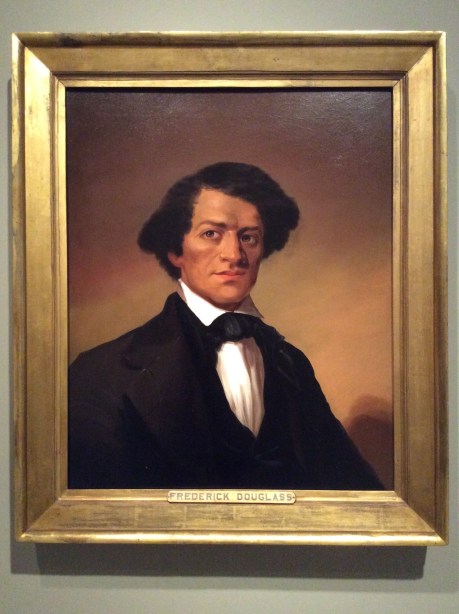
Portrait of Frederick Douglass by unknown artist, 1844, National Portrait Gallery in WashingtonD.C.,

Portrait of Frederick Douglass by unknown artist, 1844, National Portrait Gallery in WashingtonD.C.,

Listen to this podcast episode here or on Google Play, or subscribe on iTunes

Fourteenth Day, Saturday, April 2nd

After a morning glancing at the light rainfall through the coffee shop window as I write up some notes and look up some things in preparation for the day, I begin my day’s explorations with a visit to the National Portrait Gallery. It’s at 8th and F Streets NW, its official address: unusually, it lacks a street number.

While I’m here primarily to see all the Douglass portraits I can find and have little time to spare since it’s my last day in D.C., I’ve wanted to visit the Portrait Gallery for a long time, and allow myself an extra hour to explore.

After I’ve made my inquiries at the information desk, one of the first portraits that grab my attention as I head towards my first destination is a bust of Louisa May Alcott. As you may remember from my Boston account, she was the only one willing to sit next to Douglass and his second wife Helen Pitts Douglass at Wendell Phillips’ funeral in 1884, just about a month after their marriage…. Read the original account here:

Ordinary Philosophy and its Traveling Philosophy / History of Ideas series is a labor of love and ad-free, supported by patrons and readers like you. Please offer your support today!
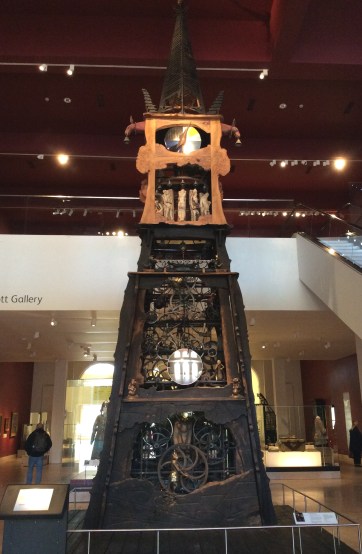
New Podcast Episode: Nature’s Clocks

Millenium Clock, National Museum of Scotland, Edinburgh, 2014 by Amy Cools

Millenium Clock, National Museum of Scotland, Edinburgh

Listen to this podcast episode here or on Google Play, or subscribe on iTunes

I see lines and dots. My face and body are sprinkled with freckles and bumps and moles and little spots, red and brown, with new ones popping up all the time. I see scattered patches of rough skin where innumerable sunburns killed its ability to heal itself gracefully. The surface of my face and body is not so smooth as it once was, with lines and little ripples appearing unexpectedly and with increasing regularity. My lips are a little less full than they were before, and there’s thickening around my face and body in different places than where the baby fat used to be, and of a different texture.

There’s a country song I love with a line that goes ‘I look in the mirror in total surprise, at the hair on my shoulders, the age in my eyes’…. Read the original piece:

Ordinary Philosophy and its Traveling Philosophy / History of Ideas series is a labor of love and ad-free, supported by patrons and readers like you. Please offer your support today!
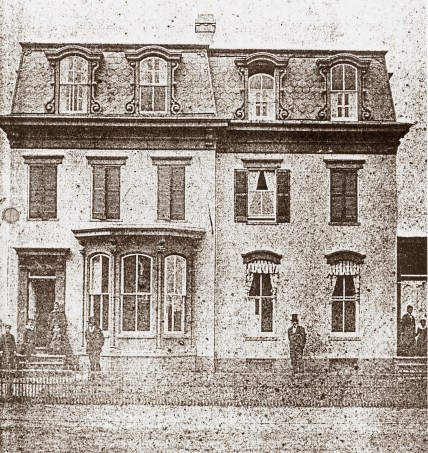
New Podcast Episode: Frederick Douglass Washington DC Sites, Day 1, Part 2

Frederick Douglass standing in front of his home at 320 A Street NE, Washington, DC, in 1876. Public domain via NPS

Frederick Douglass standing in front of his home at 320 A Street NE, Washington, DC, in 1876. Public domain via NPS

Listen to this podcast episode here or on Google Play, or subscribe on iTunes

Thirteenth Day, Friday, April 1st, continued

I leave the approximate site of Helen Pitts-Douglass’ onetime home at 913 E St NE, and head southwest to 316-18 A Street NE.

In 1872, Douglass moved his family here to Washington, DC. Since his beloved farm home on the hill in Rochester had burned to the ground on June 2, 1872, probably by arson, Douglass was bitter and in the mood to shake the dust of that city from his feet. He had already been considering a permanent move to Washington since his work with the New National Era newspaper (more on that to come), his political work, and his efforts to obtain a good government appointment often took him there, sometimes for lengthy stays. In fact, he was in Washington when he received a telegram notifying him of the fire….  Read the full account here

Ordinary Philosophy and its Traveling Philosophy / History of Ideas series is a labor of love and ad-free, entirely supported by patrons and readers like you. Please offer your support today!

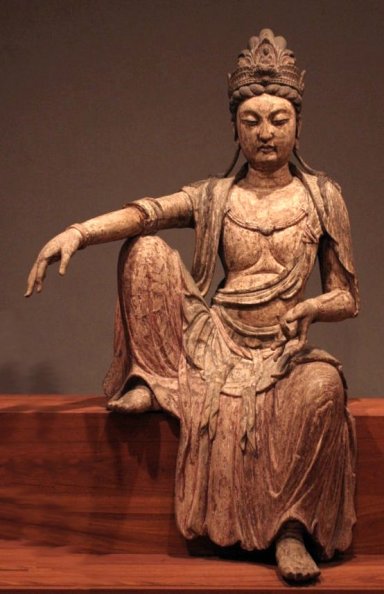
New Podcast Episode: Compassion, Emptiness, and the Heart Sutra, by Ryan V. Stewart

d1185-guanyin252c2bthe2bchinese2bexpression2bof2bavalokiteshvara252c2bnorthern2bsung2bdynasty252c2bchina252c2bc-2b1025252c2bwood252c2bhonolulu2bacademy2bof2barts252c2bpublic2b1Listen to this podcast episode here or on Google Play, or subscribe on iTunes

One of the chief concerns of philosophy, since time immemorial, has been to properly address the question, “How do I live?” Namely, “How do I live well?” Naturally—for as long as our species has had the wherewithal to question its purpose and condition, the problem of ethics has found itself at the frontiers of human thought. Many moral philosophies have since rushed into that wide gulf between knowledge and truth, systems of understanding and action which attempt to conquer our ethical indecisiveness and color in a void where so much uncertainty exists.

Many traditions prescribe the ideal, virtuous, or noble life. From the ancient, academic, or political—e.g. Epicureanism, utilitarianism, humanism, or libertarianism—to the more mystical or overtly religious—e.g. Jainism, Christianity, or Taoism—many are concerned with how one acts (or can act), or at least how one views oneself in relation to others and to the world at large…. Read the original essay here

Ordinary Philosophy and its Traveling Philosophy / History of Ideas series is a labor of love and ad-free, entirely supported by patrons and readers like you. Please offer your support today!

New Podcast Episode: Frederick Douglass Washington DC Sites, Day 1, Part 1

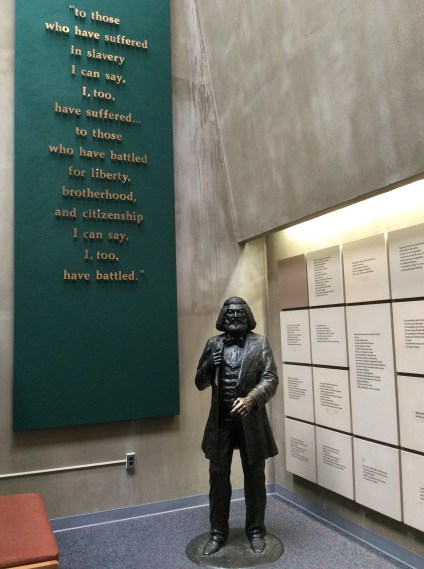
Statue and quote at the Frederick Douglass National Historic Site

Statue and quote at the Frederick Douglass National Historic Site

Listen to this podcast episode here or on Google Play, or subscribe on iTunes

Thirteenth Day, Friday April 1st

I begin at Cedar Hill in Anacostia, Frederick Douglass’ handsome, gabled house on a hill overlooking Washington DC. He moved here with Anna and the kids in September of 1878, having lived in the capital city of Washington for a little over six years. In a sense, the Douglasses didn’t really move out of Washington when they moved into their new suburban home east of the Anacostia River. Anacostia, called Uniontown in the mid-1800’s then switched back again, was part of the District of Columbia, which in turn was larger than Washington and encompassed it. When the boundaries of Washington and the District of Columbia became one and the same in 1878, the Douglasses’ Anacostia home became a Washington city home then too.

It’s another lovely day, again the sky is partly cloudy, the air soft and warm and a little breezy, freshly washed by the morning’s rain. The cold weather I had shivered in for much of the first half of my trip is nearly forgotten.

The National Park Service now owns and runs the house, the grounds, and the visitor center and museum, collectively called The Frederick Douglass National Historic Site. I take a brief look at the outside of the house, then stop at the visitor center and sign up for the guided tour which will start shortly. I take another brief look around while I wait, and note the displays and artifacts I want to examine more closely when I return to the visitor center museum…. Read the full account here:

Ordinary Philosophy and its Traveling Philosophy / History of Ideas series is a labor of love and ad-free, entirely supported by patrons and readers like you. Please offer your support today!

New Podcast Episode: Frederick Douglass Chambersburg and Gettysburg PA Sites

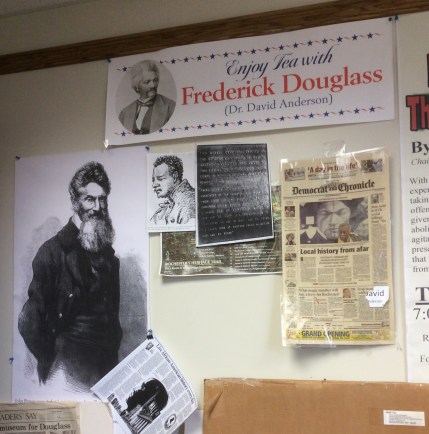
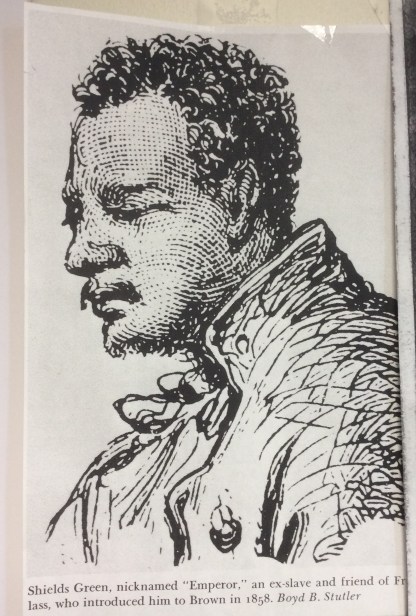
Poster of Shields Green in David Anderson's Nazareth College office, photo 2016 Amy Cools

Listen to this podcast episode here or on Google Play, or subscribe on iTunes

Twelfth Day, Thursday March 31st

It’s breezy, overcast, and warm the day I drive south from Rochester to Washington D.C., with a first stop in Chambersburg, Pennsylvania to visit two sites of special interest for my Frederick Douglass journey.

The first is a two story clapboard house at 225 E. King St, where John Brown rented a room in Mary Ritner’s boarding house in the summer of 1859, and where he planned his doomed raid on the federal arsenal at Harper’s Ferry. Unfortunately, I’m visiting during the off-season: the house is closed until the tourist season starts in May, but I find a blog with two nice photos of the interior posted. It happens to be a blog dedicated to Fredrick Law Olmsted, the great landscape architect who designed Highland Park, site of Frederick Douglass’ statue and memorial in Rochester…. Read the written account here:

Ordinary Philosophy and its Traveling Philosophy / History of Ideas series is a labor of love and ad-free, entirely supported by patrons and readers like you. Please offer your support today!

New Podcast Episode: Affirmative Action and Balance

Justice et inégalité - les plateaux de la balance by Frachet, Jan 2010, Public Domain via Wikimedia CommonsListen to this podcast episode here or on Google Play, or subscribe on iTunes

The recent Supreme Court decision in Fisher v. University of Texas at Austin, et al., was a cautious but significant one in favor of affirmative action. As Adam Liptak writes in his New York Times article ‘Supreme Court Upholds Affirmative Action Program at University of Texas‘, while ‘not all affirmative action programs will pass constitutional muster… the ruling’s basic message was that admissions officials may continue to consider race as one factor among many in ensuring a diverse student body.’

This opposes the central tenet of affirmative action opposition: admission to universities can only be based on merit, which in turn is determined mainly by grades buttressed by the quality of relative achievements; therefore, only color-blind admissions criteria are just and fair.

But as we all well know, educational institutions have been generally the purview of the wealthy, the connected, and the white for most of our history…. Read the original article:

Ordinary Philosophy and its Traveling Philosophy / History of Ideas series is a labor of love and ad-free, supported by patrons and readers like you. Please offer your support today!
New Podcast Episode: Frederick Douglass Seneca Falls, Canandaigua, Honeoye, and Mt Hope Cemetery Sites

Women's Rights National Historical Park headquarters, Seneca Falls NY

Women’s Rights National Historical Park headquarters, Seneca Falls NY

Listen to this podcast episode here or on Google Play, or subscribe on iTunes

Eleventh day, Tuesday March 30th

It’s a beautiful, clear sunny day, and the chill of the morning gives way to a balmy afternoon. I drive about an hour east and slightly to the south, through the lovely Finger Lakes region of New York to Seneca Falls.

I’m here to visit what’s now the Women’s Rights National Historical Park, which is headquartered at 136 Fall Street in Seneca Falls. I begin with the reconstructed Wesleyan Church next door at Fall and Mynderse Streets, the site of that momentous occasion which brings me here. I’ve long wanted to visit this place and had hoped to do so during my history of ideas travel series about Elizabeth Cady Stanton, but didn’t have enough time during that trip to make the journey, about a five hour drive from New York City one-way. But here I am at long last…. Read the written account here:

Ordinary Philosophy and its Traveling Philosophy / History of Ideas series is a labor of love and ad-free, entirely supported by patrons and readers like you. Please offer your support today!
New Podcast Episode: Frederick Douglass Rochester NY Sites, Day 2

Douglass scholarship articles and posters, Dr. David Anderson's office, Nazareth College Rochester, 2016 Amy CoolsListen to this podcast episode here or on Google Play, or subscribe on iTunes

Tenth day, Tuesday March 29th

I begin my day with an early visit to Dr. David Anderson, a Frederick Douglass scholar, visiting professor at Nazareth College, founding member of Blackstorytelling League, and an all around delightful and fascinating man! He is kind enough to grant me an interview of an hour or so, which ends up turning into a much longer conversation than that.

Among many other things too numerous to describe in full here (I’ll bring more details of our talk into the discussion of my subsequent discoveries), we talk about the Douglass family as a whole, and especially, Frederick Douglass’ wife Anna…. Read the written account here:

Ordinary Philosophy and its Traveling Philosophy / History of Ideas series is a labor of love and ad-free, entirely supported by patrons and readers like you. Please offer your support today!
Interview with Ken Morris, Anti-Slavery Activist

Ken Morris, image credit Kenneth Morris.jpgListen to this podcast episode here or on Google Play, or subscribe on iTunes

I’m honored and excited to introduce my next guest for Ordinary Philosophy’s 58th podcast episode, Ken Morris.

Ken Morris is closely linked to Frederick Douglass, the subject of my most recent history of ideas travel series, and carries on his legacy by working in a noble and very important cause, anti-slavery activism. He has an incredible family history and personal life story and array of accomplishments which you’ll be sure to find as impressive and fascinating as I do, but I’ll stop here and let him tell you all about it….

For more about Ken Morris and his work, please visit:

The Frederick Douglass Family Initiatives website
Bio: http://fdfi.org/ken
Facebook: https://www.facebook.com/FrederickDouglassFamilyInitiatives/
Twitter: https://twitter.com/kmorrisjr
and Picturing Frederick Douglass, to which Mr. Morris contributed and sales of which benefit the FDFI: http://fdfi.org/book

Ordinary Philosophy and its Traveling Philosophy / History of Ideas series is a labor of love and ad-free, supported by patrons and readers like you. Please offer your support today!