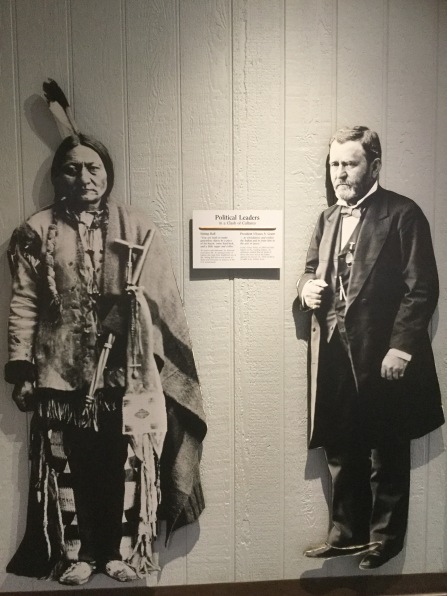
New Podcast Episode: Little Bighorn Battlefield National Monument

Life-size images of Sitting Bull, chief and holy man of the Hunkpapa Lakota, and U.S. President Ulysses S Grant, at the Little Bighorn National Monument museum.

Listen to this podcast episode here or on Google Play, or subscribe on iTunes

Little Bighorn Battlefield National Monument, Friday, July 21st, 2017

Early morning Friday, I awake to a most spectacular view: the Beartooth Mountains from the top of Beartooth Pass, at about 10,900 feet above sea level. As you may remember, I had to pull off the road to sleep last night since I encountered a road block in the middle of the night between Yellowstone National Park and my next destination, the Little Bighorn Battlefield National Monument. The Beartooth Pass drive is incredible, a worthy destination in itself. I’m very glad I chose this longer route, I can’t imagine any other northern route would come close to its beauty.

The drive from the pass to the Little Bighorn is a happy and thoughtful one. I have the deep glow of satisfaction from reveling in the spectacular natural beauty of Yellowstone National Park and Custer-Gallatin National Forest combined with the physical afterglow which follows vigorous exercise from my fast hike up Mt. Washburn. But during the long drive, I also think a lot about the events which occurred at the site I’m approaching, so I’ve grown a little somber as well… Read the written version here

Ordinary Philosophy and its Traveling Philosophy / History of Ideas series is a labor of love and ad-free, supported by patrons and readers like you. Please offer your support today!
New Podcast Episode: Lewis & Clark Caverns, Yellowstone National Park, and Our Public Lands

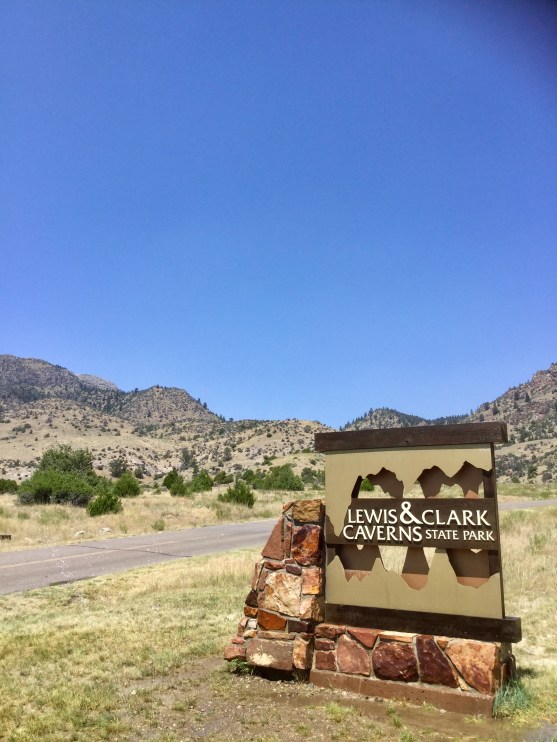
Entrance to Lewis & Clark Caverns State Park, Montana. Merriwether Lewis’ and William Clark’s expedition never visited these caves: they were not discovered (by whites, anyway) until the later 1800’s. But the expedition did pass nearby, a little further south along the Jefferson River, so the caverns were later named for these intrepid explorers

Listen to this podcast episode here or on Google Play, or subscribe on iTunes

Journal: Billings, Montana, Friday, July 21, 2017

In my idealistic early adulthood, I often lamented how a certain coffee chain, with its weirdly militarist logo of a two-tailed mermaid with a star on her head (the old logo was much better), seemed to crowd out much of the market for charming coffee shops serving Italian style preparations while playing quality music. The more I’ve traveled, however, the more I’ve come to appreciate their ubiquitous clean bathrooms, unlimited wifi, comfortable chairs and tables to write and read at, and dependable coffee.

Especially this morning. I woke up disheveled and a bit cramped: I camped out in the car last night on a pull-out near the road block at the very top of the pass on Beartooth Highway, which runs through the mountains of the Shoshone and Custer-Gallatin National Forests. There’s construction on the road and I made it there too late to get through; they close the top of the pass during the night so that the construction zone can be navigated safely, only in daylight hours. My decision as to where to spend the night, therefore, was made for me: every campground, lodge, and hotel I passed were full. It was too windy to set up my tent in the dark, so I re-made the nice cozy nest in the backseat that I had made the night before to spend the night in Yellowstone. I fell asleep to a spectacularly clear and starry night, and I woke up to this:… Read the written version here

Ordinary Philosophy and its Traveling Philosophy / History of Ideas series is a labor of love and ad-free, supported by patrons and readers like you. Please offer your support today!

New Podcast Episode: Bitterroot Mountains and the Lewis and Clark Wendover Ridge Hike

A view through the windshield of Petty Creek Rd / Rte 489 between I-90 and Hwy 12, Lolo National Forest, Montana

Listen to this podcast episode here or on Google Play, or subscribe on iTunes

Journal: Powell Campground & Lochsa Lodge, Clearwater-Nez Perce National Forest, Monday, July 17th, 2017

After lingering over breakfast this morning with my sister Bonnie, cousin Beth, nephew Cory, and cousin Mo, I realized there was no way I was making it from Spokane to Yellowstone National Park today. So I thought: why not camp near Lochsa Lodge and do the Lewis and Clark Wendover Ridge hike, which friends of mine will be doing later this week, on the way? I’ve left plenty of time in my itinerary to go spur-of-the-moment adventuring. My friends have told so many tales of joy and hardship on this hike that my curiosity and spirit of competition just can’t resist the challenge. So, I make my decision. I stop at Superior Ranger Station off I-90, discuss my plans with the two oh-so-kind and helpful women there, and get directions. The ranger here who knows the trails, as well as the ranger she conferred with by phone at Powell Ranger Station, both warn me that the trail is extremely rough and in parts nearly impassible, not having been maintained in any way for at least two years. Sounds to me right now more like a dare than a warning.

I head south on Petty Creek Road, a beautiful drive through a pastoral valley, and over the ridge to Highway 12 and a short drive back west. I was here last in snowy, frigid January. It’s very different today… Read the written version here

Ordinary Philosophy and its Traveling Philosophy / History of Ideas series is a labor of love and ad-free, supported by patrons and readers like you. Please offer your support today!
New Podcast Episode: To the Great Plains and Illinois I Go, in Search of Crazy Horse, Sitting Bull, Abraham Lincoln, and Other American Histories

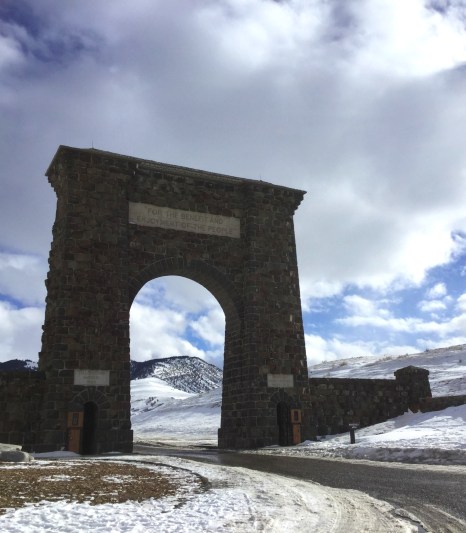
Roosevelt Arch at the North Entrance of Yellowstone National Park. Photo: January 2017 by Amy Cools

Listen to this podcast episode here or on Google Play, or subscribe on iTunes

Hello, friends of Ordinary Philosophy!

From time to time, I take a trip to some corner of the globe, to explore the lives and ideas of great thinkers in the places where they lived and worked. For this series, I follow in the footsteps of thinkers who are no longer alive, since those who are still telling their own stories. But those who are no longer alive in the body live on in the ideas that they pass on, and in the example they provide for us to follow.

I’m pleased and excited to announce my seventh philosophical-historical adventure: an almost three-week road trip through the Great Plains and on to Illinois. I’ll fly from Chicago to Scotland on August 9th: I’ll be pursuing a master’s degree in the history of ideas at the University of Edinburgh starting this fall. In the meantime, I’m overjoyed to have this window of time to explore parts of my country which I’ve never seen, and to learn as much as I can along the way…. Read the written version here

Ordinary Philosophy and its Traveling Philosophy / History of Ideas series is a labor of love and ad-free, supported by patrons and readers like you. Please offer your support today!
New Podcast Episode: The Love of Possession is a Disease With Them

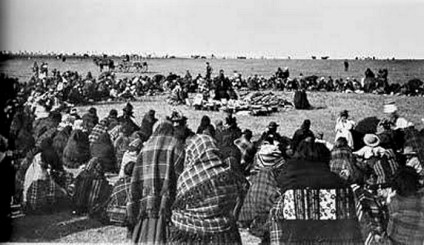
Lakota giveaway ceremony, photo origin unknown

Listen to this podcast episode here or on Google Play, or subscribe on iTunes

In my recent readings in the history of the Lakota and other native peoples of America’s Great Plains, I’ve been struck by descriptions of their giveaway ceremonies. They remind me of another practice I had learned of before, and which I believe is more generally familiar: the potlatch, a related custom practiced by Native Americans of the Northwest. Potlatches generally came with strict expectations of giving the gifts away again promptly, and then some. These exchanges cemented power relations and were often aggressively competitive; they’re better understood as tactical, sociopolitical transactions rather than simple acts of generosity.

Lakota giveaway ceremonies, however, are much more altruistic in the sense that we commonly understand the term. The gifts are given freely with no expectation of payback; in fact, the resulting impoverishment itself is a badge of honor. That’s why I chose a quote by Sitting Bull, the great Hunkpapa Lakota chief, to introduce this essay. He once illustrated the contrast between Lakota and white attitudes towards property by telling how his poverty aroused the admiration of his people, rather than the disdain most white people feel toward such a state. To those who share Sitting Bull’s impression of the invaders of his homeland, the driving need to amass and own material goods can be a sign of spiritual poverty…. Read the written version here

Ordinary Philosophy and its Traveling Philosophy / History of Ideas series is a labor of love and ad-free, supported by patrons and readers like you. Please offer your support today!
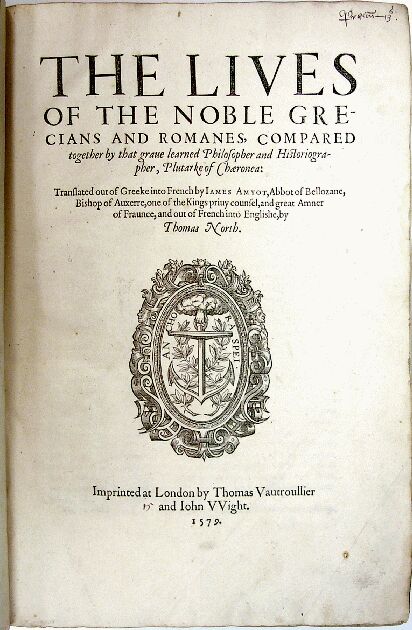
New Podcast Episode: East Bay Hike with Plutarch, June 11th, 2017

Title page of Thomas North’s translation of Plutarch’s Lives, 1579, first edition

Listen to this podcast episode here or on Google Play, or subscribe on iTunes

Sunday, June 11th, 2017

I’ve been planning to read the whole of Plutarch’s Parallel Lives of the Noble Greeks and Romans for some time. I’ve also been longing for a really good stretch of the legs, especially after this last week of office work and a Saturday selling off more of my belongings in preparation for my move to Scotland. (Sorting and selling off most of the artifacts of my life and of my twenty-plus years of small business ownership has been a tedious process. If the ashes would turn into dollars to fund my education and travel, I’d gladly set it all on fire at this point and be done with it.)

It occurred to me yesterday that I could do both my hiking and my reading on my free day tomorrow! So I downloaded Lives from LibriVox onto my little portable audio player and plotted a good long Bay Area Ridge Trail hike similar to one I did two years ago…

Read the written version here

Ordinary Philosophy and its Traveling Philosophy / History of Ideas series is a labor of love and ad-free, supported by patrons and readers like you. Please offer your support today!

New Podcast Episode: Remembering Joan of Arc

Joan of Arc by Amy Cools, about 1998

Listen to this podcast episode here or on Google Play, or subscribe on iTunes

My fascination with Joan of Arc, born sometime in 1412 and put to death by fire on May 30th, 1431, is long-standing, beginning in my girlhood. Joan, as you likely know, is the French national heroine who fought to remove medieval France from English rule, whose exploits turned the tide and guaranteed France’s ultimate victory in the Hundred Year’s War.

She was the daughter of prosperous peasants in Domrémy, France. On a self-proclaimed mission from God to restore French rule to the rightful heir of the House of Valois, she convinced the local baron, military leaders, and eventually the crown prince to put her in charge of the dispirited French army, despite the fact that she was illiterate, militarily inexperienced, and a teenage girl…. Read the written version here

Ordinary Philosophy and its Traveling Philosophy / History of Ideas series is a labor of love and ad-free, supported by patrons and readers like you. Please offer your support today!
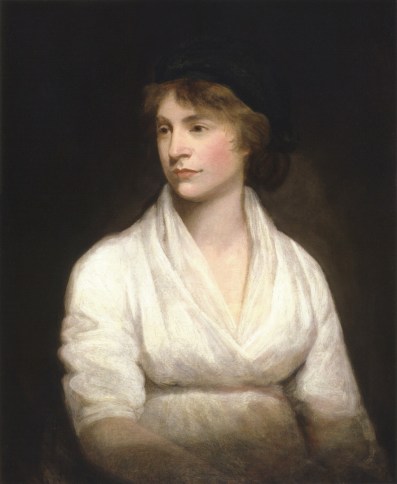
New Podcast Episode: Mary Wollstonecraft, Champion of Reason, Passionate in Love

Listen to this podcast episode here or on Google Play, or subscribe on iTunes

The life and work of Mary Wollstonecraft, mother of modern feminism, can seem to reveal a mass of contradictions.

Her seminal feminist work, A Vindication of the Rights of Woman, champions reason as the ultimate guide for a moral and productive life. She used reason to great effect to show why women should, and how they could, grow out of their socially constructed roles as under-educated coquettes and household drudges. She believed that reason should rule both individuals and societies because it’s the best tool we have to achieve justice and to perfect the self. Without reason, she thought, human beings are ruled by narrow self-interest, by the prejudice born of ignorance, and by crude lust.

Yet the life Wollstonecraft chose to live was widely criticized both during her lifetime and over the two hundred plus years since her death. It’s not just because she didn’t conform to the mores of her time; her life choices are still considered unreasonable and even self-destructive by many. At times, they made her an object of scandal, impoverished, or deeply depressed, even in such desperate straits that she twice attempted suicide. That’s because she was also deeply passionate, devoted to retaining her personal and mental freedom while abandoning herself to loves which never failed to break her heart, be they revolution, family, friend, or lover. For Wollstonecraft, reason and passion are not opposites: they are two sides of the same coin. A truly reasonable person, she thought, is kind, affectionate, and generous as well, and a passionate lover of justice, truth, and beauty….

Read the written version here

Ordinary Philosophy and its Traveling Philosophy / History of Ideas series is a labor of love and ad-free, supported by patrons and readers like you. Please offer your support today!
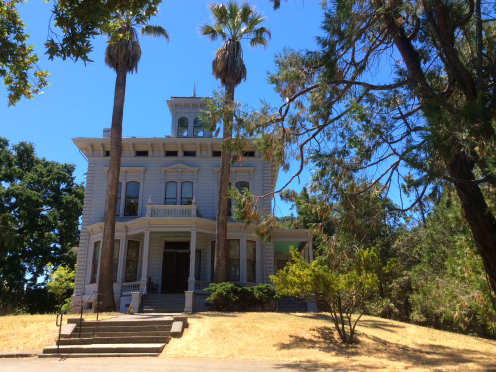
New Podcast Episode: A Visit to the John Muir National Historic Site in Martinez, CA

The Muir family home built by Dr. John Strentzel at John Muir National Historic Site, Martinez, CA

Listen to this podcast episode here or on Google Play, or subscribe on iTunes

In honor of the anniversary of John Muir’s birth, April 21, 1838, I’ll share the story of my visit to an important place in his life last summer. It was June 26th, 2016, a hot, bright day in Martinez, CA.

The John Muir National Historic Site is just south of the Carquinez Strait, which links San Pablo and Suisun Bays. Benicia, California’s third but short-lived capital city, is just across the strait and was reached by ferry in Muir’s time. A lovely town with a well-preserved historic district, Benicia is well-situated on a waterway that permits easy passage for ships and ferries. In its early years, the strait allowed for easy passage of people, animals, and the products of this agricultural region and later industrial center, so it became a busy, thriving center of commerce. It enjoyed its first big boom with the Gold Rush, as it lay on an easy route between San Francisco and the gold fields.

Martinez was also a hub of Gold Rush activity. The ferry between Benicia and Martinez enjoyed a monopoly on getting all those gold-crazed fortune seekers south to the gold fields and north again to cash in. But Martinez was also an important agricultural town, and this site preserves just a little bit of that aspect of its history. It’s about a thirty-five-minute drive northeast of where I live in Oakland….

Ordinary Philosophy and its Traveling Philosophy / History of Ideas series is a labor of love and ad-free, supported by patrons and readers like you. Please offer your support today!
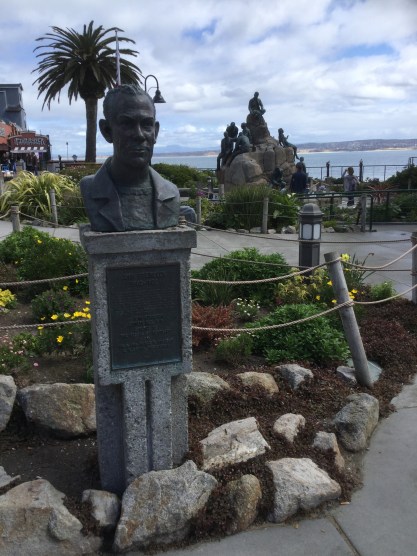
New Podcast Episode: Two Stories About Following the Life and Work of John Steinbeck

Bust of John Steinbeck and sculptures of people who inspired Cannery Row, Monterey, CA

Listen to this podcast episode here or on Google Play, or subscribe on iTunes

March 4th – 9th, 2017

For several days this last week, I’ve been on a literary retreat hosted by Clay Jenkinson, Becky Cawley, and Russ Eagle. You may remember Clay and Becky from the account of my last retreat with them at Lochsa Lodge in the Bitterroot Mountains in January. Clay is a humanities scholar who has been very influential in my own study and thought for the last few years, Becky has worked with Clay for many more years than that co-creating historical, cultural, and literary tours throughout the United States, and Russ Eagle has made Steinbeck a special study for many years as well. At Lochsa Lodge this winter, we read and discussed Walden Pond and Henry David Thoreau’s concept of living deliberately, as well the history of the Native Americans of the Great Plains and the wars of the United States’ expansion into their territories through the 1800’s, and the echoes of those wars and that expansion in the DAPL fight today.

This tour took us to Monterey, Pacific Grove, the Salinas Valley, and the mountains and coastline of this beautiful region of California following the life and work of the great American writer John Steinbeck

* See my profile of Julia Ward Howe, whose Battle Hymn of the Republic provided the title of The Grapes of Wrath, and which is printed in the opening pages of the novel

Read the written version here and here

Ordinary Philosophy and its Traveling Philosophy / History of Ideas series is a labor of love and ad-free, supported by patrons and readers like you. Please offer your support today!