On the Recent Intelligence Squared U.S. Debate About Basic Income

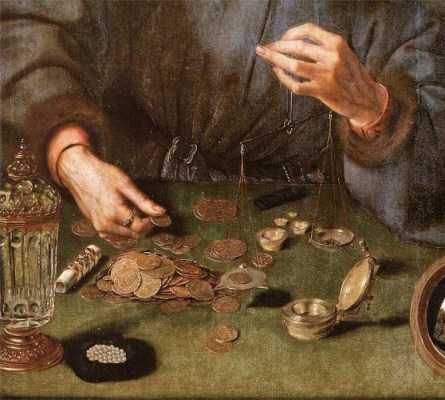
The Moneylender and his Wife by Quinten Massijs (detail)

This weekend, on the BART ride to San Francisco and on the walk to and from my destination there, I listened to this fascinating debate on Intelligence Squared U.S.:  The Universal Basic Income Is The Safety Net Of The Future. (It’s also available as a podcast.) It was so thought-provoking that my walk turned into a rather long one, as I stopped every few blocks to sit down and scribble some notes in response to what I heard.

The debaters in favor of the motion are the libertarian political scientist Charles Murray, infamous in many circles for co-authoring The Bell Curve, and labor leader Andrew Stern. These two make surprising debate partners, but of course, that’s part of the fun!

The debaters against the motion are Jared Bernstein and Jason Furman, both economic advisors to the Obama administration, and both more on the liberal / progressive end of the economic spectrum, which also adds to the interesting contrasts between audience expectations and the arguments made.

Here’s the summary of the debate from the IQ2 website:

Imagine getting a check from the government every month. $600 guaranteed. It’s happening in Finland, where a pilot program is being launched to test what’s known as a “universal basic income.” As technology transforms the workplace, jobs and income will become less reliable. The idea is that a universal basic income could serve as a tool to combat poverty and uncertainty in a changing society, and provide a cushion that empowers workers, giving them latitude to take risks in the job market. But some argue a guaranteed income would take away the incentive to work, waste money on those who don’t need it, and come at the expense of effective programs like Social Security, Medicare and Medicaid. Is the universal basic income the safety net of the future?

I’ve written about basic income before in light of Thomas Paine’s case for a social welfare system, broadly distributed to the point that we’d call it basic income today, in his pamphlet Agrarian Justice of 1796. I’m broadly sympathetic to the case for basic income especially insofar as I’m convinced by two of his major arguments.
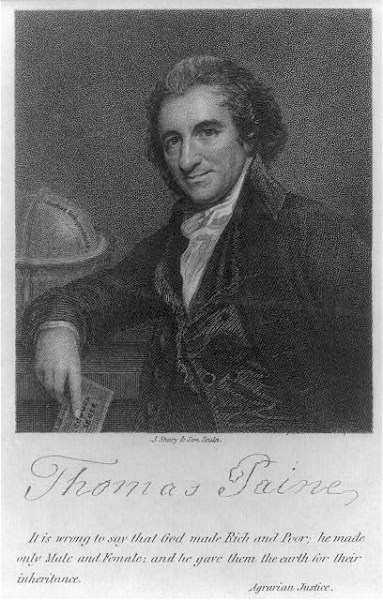
One, Paine argues that the right to private property is not an intrinsic right or derived from nature, or even from moral convictions about deservingness or our duties toward those less fortunate. Rather, property rights are artificial rights we’ve created for efficiency’s sake: it’s a way to incentivize people to be as productive as possible to the benefit of both individual and society. But whatever efficiencies property rights promote, Paine observes just as we observe now, they too often deprive people of the very thing they promise to provide. Economies based on property rights deny most people direct access to the world’s natural resources while sometimes failing to reward them proportionally.

This is true not only of those who produce the most necessary, useful goods and services such as growing and preparing food, building and maintaining our cities, towns, and homes, and caring for the disabled and sick; they are often the ones who receive the lowest wages. In the meantime, others who create such frivolous and even arguably harmful things as casinos, violent video games, and poor quality trinkets that become trash almost as soon as they’re made can often make money hand over fist. Some people are not able to make money even if they were willing: they may be disabled or aged, or the skilled work they’ve done all their lives becomes obsolete. Worst of all, those who raise children, care for the disabled and aged, and otherwise keep the home generally receive no pay, though their work benefits society most of all. The amount of money we can bring in generally determines the resources we have access to, so if we have no money, we have no property. Property rights, then, guarantee us the right to property without any consideration as to whether or not we actually end up be able to obtain or keep any. Therefore, Paine argues, we owe every person compensation for denying them their natural right to equal access to the world’s resources.

Two, Paine argues that a universal income is better than discretionary welfare, such as that based solely on need, because it prevents the inevitable jealousies and complaints of unfairness that can erode social cohesion and undermine mutual trust. If everyone starts out at the same basic level, we may not have all of the same chances in life just as we don’t now, advantages or disadvantages that we can’t do much about: we may have rich parents, poor parents, or none at all; we may be able-bodied or we may not; we may be beautiful, smart, or have other attributes that society rewards. But, we’ll all have the same basic chance that we can give one another: the freedom and well-being guaranteed by a basic level of economic security.

But back to the debate…. Why this digression, you might ask? I return to Paine because he makes the first sustained modern argument (that I’m aware of) in favor of a basic income and because his basic points, or closely related ones, are brought up throughout this debate. In the question and answer session, Andrew Stern refers to the way perceived unfairness, such as Paine discusses, has long politically undermined need-based programs, from publicly-funded unemployment benefits to health care insurance for those with low income. Stern also points out that many people already enjoy ‘undeserved’ basic income, such as those born to parents who can afford to provide it. If we have no problem with those people reaping the benefits of work they didn’t do, why not everyone? Charles Murray adds the element of personal responsibility to the question of perceived unfairness of needs-based welfare. If everyone were given the same basic level of resources, people could no longer justly claim victimhood for not having the same chances as everyone else. If we collectively provide the same benefits to everyone, we can hold people to a basic equal accountability for all who could work and contribute more than they do.

Murray, as you may guess from his emphasis on opportunities for traditional marriage and the preeminence of personal responsibility, is much more conservative than the other participants in the debate, and introduces a free market argument that many political conservatives might like just as well as pro-labor liberals and progressives. This argument is founded on the importance of competition in a well-functioning economy. To harness the benefits of competition, Murray proposes that if people have ‘walking – away’ money, employers will have to compete with one another for employees, and in doing so, they will have to innovate to make jobs appealing. Employers would have to offer good wages, provide a pleasant and safe working environment, and make the work seem meaningful and appreciated. This is a sort of competition that serves drives wages, standards, and productivity up, not sending wages and working conditions spiraling in the race to the bottom that so many unregulated job markets, mostly competing to lower prices, have exhibited throughout the history of capitalism.

Jared Bernstein repeats the argument throughout the debate, like a mantra, that a dollar given to someone that doesn’t need it is a dollar taken away from someone that does. Many in the audience seem to find this argument convincing, but I don’t, at least without much more justification than he provides. For one thing, neither Bernstein nor his debate partner Jason Furman addresses the vast expenditures of time and money of a bureaucracy required to administer large-scale need-based welfare. It’s expensive for government as well as for individuals, who are required to provide proofs of their need, which is multi-dimensional and subjective and therefore difficult and time-consuming to demonstrate. (Murray does address problems with this kind of bureaucracy, but he emphasizes its unpleasantness and the way it re-introduces a form of serfdom, creating a class of people whose freedom is limited by this system.) For another thing, neither Bernstein nor Furman directly addresses the fact that universal basic income would vastly expand the number of people with disposable income for the first time, much more vastly than needs-based programs do. Most of this money, in turn, would go straight back into the economy, rather than into the ever-inflating bank accounts of the ever-fewer, ever-wealthier wealthiest individuals who are now gobbling up an ever-larger share of the economic pie. Our targeted redistribution system has been entirely unable to resolve this inefficiency, and in fact, may exacerbate it.

The side arguing in favor of the motion, which, as I’ve already mentioned, I’m more sympathetic to for aforementioned reasons, does not, in the end, convince the audience. They’re handily defeated, as the side arguing against the motion not only convinces most of the undecided but also wins over some of the basic income supporters. I suspect that Murray hurts his side a bit by spending too much time on arguments that I think are beside the point, such as whether more people could afford to get married (it doesn’t have to be expensive!) and on very subtle, not-very-well expressed arguments that were lost among the rest. But I would like to hear another major debate in which basic income is supported by stronger arguments, more convincing answers to objections, and most of all, better evidence. As Stern points out, there are small-scale and short-term experiments in basic income happening all over, in Alaska, Finland, and Toronto, for example, but the results are not in yet. I agree that such a major social program should be rolled out with some caution, given the potential fallout from unforeseen as well as foreseen potential side effects. But perhaps smaller experiments can’t reveal the benefits that a complete reinvention of a large economy would reveal, especially if effectiveness is entirely a matter of scale. For example, such a well-balanced, sturdy, and beautifully functioning thing as a termite mound couldn’t happen without an incredibly large number of factors contributing, namely the weather, millions of termites, many square miles of dirt, and so on. If you took a small pile of dirt and a small number of termites, a well-functioning termite mound would not result.

Our American re-invention of government was another such experiment founded on the idea that people can govern themselves and on the ideal of universal human rights (the ideal, mind you, not yet the reality). Many societies before and for some time since had tried to correct abuses and oppressions with one reform here, one reform there, or with a wholesale chaotic and violent overthrow after societal cohesion had already collapsed through famine and extreme corruption (such as, famously, the French Revolution). But it took a large number of fair-minded people to come together and lay the foundation for an entirely new system of government based on the ideal that all human beings have the right to life, liberty, and the pursuit of happiness, or as John Locke originally formulated it, life, liberty, and property. Or in the case of universal basic income, to actual property.

Ordinary Philosophy and its Traveling Philosophy / History of Ideas series is a labor of love and ad-free, supported by patrons and readers like you. Please offer your support today!

~~~~~~~~~~~~~~~~~~~~~

Sources and Inspiration:

Labor Theory of Property.” Wikipedia, The Free Encyclopedia

Locke, John. Two Treatises of Government, 1689

Paine, Thomas. Agrarian Justice, 1796.

Paine, Thomas. The Rights of Man, 1791.

The Universal Basic Income Is The Safety Net Of The Future. Intelligence Squared U.S. Debate, March 22, 2017

Bad Things Happen for a Reason, and Other Idiocies of Theodicy, by Jason Blum

Ancient of Days by William Blake

Ancient of Days by William Blake

The problem of evil is a classic dilemma in the philosophy of religion. The relative ease with which the problem can be stated belies the depth of the challenge that it presents to traditional monotheism. Roughly, it can be summarised as follows:

If God is omnipotent, then He has the power to create a world without evil.

If God is omniscient, then no moment of evil goes divinely unnoticed.

If God is omnibenevolent, then He has the desire to rid the world of evil.

Therefore, the world should be perfect, or at least free of undeserved suffering. Yet, a cursory glance reveals a world that clearly is not inherently just or free from undeserved suffering.

Hence, the problem of evil: how can a perfect deity allow such injustice and rampant evil in the world that He created?

Many solutions to the problem of evil – called ‘theodicies’ – have been proposed. There is the argument of free will, attributing evil not to God but to humanity’s misuse of its own freedom. Others have argued that certain kinds of moral goodness – compassion, for instance – are not possible in a world without evil, and the value of these types of goodness outweighs the evils on which their existence depends. There is also what I call ‘the big-picture defence’, claiming that evil only appears as such from our limited perspectives. Were we able to see things from the perspective of God, we would see that, in the grand scheme of things, every apparent evil plays a necessary role in making the world more perfect.

The philosopher Gottfried Leibniz’s simple solution was to argue in 1710 that this world is necessarily the best of all possible worlds. Leibniz depicts God assessing in His infinite mind all the various possible worlds that He could create. Because He is a loving God, the one He chooses to create is surely the ‘best of all possible worlds’. Leibniz’s argument suggests that it is ultimately meaningless to complain about this evil or that injustice; because this is the best of all possible worlds. We should take comfort in the fact that everything is, in the final analysis, as good as it can possibly be.

Voltaire derided Leibniz’s solution, writing a book to satirise it. In Candide (1759), the eponymous hero and his companions stumble through the world, constantly beset by bad luck and predations. They witness even greater tragedies in the world around them. Their troubles arise from the uncaring forces of the natural world, but also from the naiveté of Candide, who is constantly assured by his mentor, Professor Pangloss, that this is indeed the best of all possible worlds. In juxtaposing vivid depictions of myriad cruelties and Professor Pangloss’s blind insistence on the ultimate goodness of the universe, Voltaire demonstrates that there is a poignant reality to the experience of suffering that cannot be rationalised away. The claim that justice naturally inheres in the order of things does not bear scrutiny.

There is also a profound moral danger to certain types of theodicy.

The essential difficulty of the problem of evil is how to reconcile its apparent existence with a loving, all-powerful deity. One popular method has been to reassert the inherent justice of the world, implying, if not explicitly claiming, the righteousness of the suffering that we witness throughout it. The result is, essentially, a theological form of victim-blaming.

For example, the American evangelical preacher Pat Robertson explained the 2010 earthquake in Haiti – which killed between 220,000-316,000 people, and injured another 300,000 – as the fault of the Haitian people. The people of Haiti had apparently sworn a pact with Satan in exchange for delivering them from French rule, and the earthquake was divine retribution for that bargain (delivered approximately two centuries later). Robertson similarly suggested that both Hurricane Katrina and terrorism were divine punishment for the fact that abortion is still legal in the United States. Robertson, of course, is not alone. An Iranian mullah has blamed earthquakes on women dressing immodestly; a New York rabbi blamed the advancement of gay rights in the US for another earthquake in 2011; many Burmese Buddhists blamed a 2008 cyclone that killed approximately 130,000 people on bad karma.

The desire that motivates these interpretations is understandable. Natural disasters and terrorist attacks are either random events in a chaotic world, or they are explicable events within a discernible pattern. In the former case, we inhabit an essentially amoral universe: bad things happen to good people, children die premature deaths, and tragedy strikes without remorse, all without rhyme or reason. In the latter case, we inhabit a much more hospitable universe where there is some sort of inherent order: a place where morality is inscribed into the very fabric of things, assuring us that, if only we play by the rules, evil will be punished, goodness will be rewarded, and justice will reign supreme.

It is easy to understand the attraction of that vision. But it has a substantial dark side. Like any theodicy, it cannot simply unmake suffering, and so it instead tries to justify it. The claim that the universe is inherently just then implies that those who suffer deserve it. The existence of a just God and a moral universe is gained at the cost of condemning victims of misfortune as blameworthy. And so, hundreds of thousands of Haitians died because their ancestors made a pact with the devil. Women and homosexuals agitating for equal rights are blamed for deadly natural disasters.

Such a worldview conveniently scapegoats someone, usually whatever population someone wishes to demonise: women, homosexuals, the poor, etc. It also normalises social ills that could otherwise be addressed and meliorated. In a dark irony, holding that the universe is ultimately a just place ends up condoning the suffering and injustice that happens within it, often on the backs of those most in need.

Visions of a just universe need not function this way. Theodicy authorises only the suffering of the less fortunate when it indulges in willful blindness and insists on justice as a foregone conclusion, denying reality in favour of comforting ignorance. Alternatively, when justice is construed as hope – as a vision of what the world could possibly be – it functions as a lodestar. This acknowledges the disturbing realities with which we are surrounded, and refuses to be disillusioned by them. By regarding justice as an ideal rather than a present reality, one’s vision of the inequalities and brutalities of the present moment remains unobstructed, allowing them to be faced. The just universe in which we should believe is the one that can be created only through dedicated effort and real action on our part. But that can happen only if we refuse to take shelter in soothing fantasies. Aeon counter – do not remove

This article was originally published at Aeon and has been republished under Creative Commons.

Jason Blum is a visiting assistant professor on the college writing programme at Davidson College in North Carolina. His first book is Zen and the Unspeakable God (2015). (Bio credit: Aeon)

~ Ordinary Philosophy is a labor of love and ad-free, supported by patrons and readers like you. Any support you can offer will be deeply appreciated!

*All views and opinions expressed by guest writers are their own and do not necessarily reflect those of Ordinary Philosophy’s editors and publishers

Happy Birthday, John Rawls!

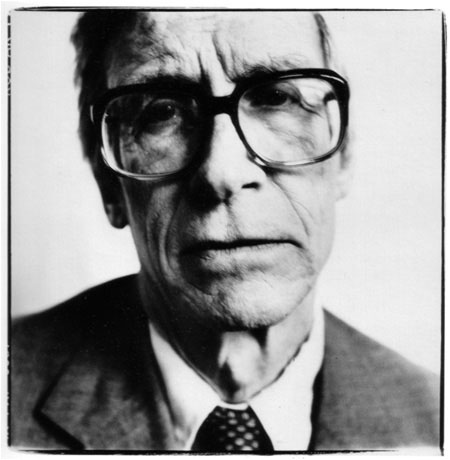
John Rawls, image via BBC's Will and Testament blogLet’s remember and celebrate John Rawls, Feb 21, 1921 – Nov 24, 2002, the great political and moral theorist who thinks of justice as fairness, on his birthday.

Among his greatest contributions is the thought experiment called ‘the veil of ignorance’. It’s a beautifully simple tool for designing a just society. Imagine you’re to be placed into society with no idea what you would be: rich, poor, or middle-class; tall or short; intelligent or not; of which gender; outgoing or shy; of which race; employed and at what kind of job or not at all; and so on.

Given that you have no idea what your roles in life will be, what cultural practices, laws, policies, governmental system, economic system, and so on, would you put into place? Remember, behind that veil of ignorance, you’ll have to decide what kind of society benefits everyone the most since you could end up being anyone. If you were really in that situation, imagine just how fair you’d be. Perhaps, as Rawls imagines, we’d all be far better off if that was really how the world works.

Here’s a short list of resources to learn more about the great John Rawls:

John Rawls – by Leif Wenar for The Stanford Encyclopedia of Philosophy

John Rawls – by Henry S. Richardson for the Internet Encyclopedia of Philosophy

A Theory of Justice – by John Rawls (Google book preview)

and my own work featuring Rawls:

Behind the Veil: Rawls, Locke, de Tocqueville, and Human Connection in a Liberal Society

Communitarianism, Writ Large

Sources, Influences, Shout-Outs, and all that Good Stuff

Ordinary Philosophy and its Traveling Philosophy / History of Ideas series is a labor of love and ad-free, supported by patrons and readers like you. Please offer your support today!

Happy Birthday, Jeremy Bentham!

Jeremy Bentham's Auto-Icon at University College London, 2003 by Michael Reeve, GNU Free Documentation License Version 1.2

Jeremy Bentham’s Auto-Icon at University College London, photo 2003 by Michael Reeve

Jeremy Bentham, the great English moral and legal philosopher born on February 15, 1748, was a very strange man. A brilliant one, but strange nonetheless. He was a precocious child and advanced in his studies very early, finding Westminster and Queen’s College at Oxford too easy and therefore rather boring. He was trained as a lawyer but decided not to practice law after hearing William Blackstone’s lectures. Blackstone’s treatise Commentaries on the Laws of England is still considered one of the most authoritative and foundational works on English law, so for a guy to consider them so flawed that he’d want to give up his career seems a bit… well, presumptuous. But he demonstrated his own great intellectual capacities through his lifetime of prolific writing, mostly on legal theory, moral philosophy, and social reform. In the end, he earned the right to a certain degree of arrogance.

Bentham is generally considered the father of utilitarianism, the moral philosophy which judges anything that can be judged as right or wrong, good or evil, according to how conducive it is to ‘the greatest happiness of the greatest number.’ Utilitarianism, then, is a type of consequentialism, which holds that a thing is right or wrong based on its consequent harms or benefits. Bentham did not invent the principles of utilitarianism; he discovered them in the writings of Cesare Beccaria (who authored the ‘greatest happiness’ axiom), David Hume, Claude Helvétius, and Joseph Priestley. But he spent a lifetime synthesizing these principles into a cohesive, fleshed-out moral philosophy founded on utility, whether a law or action increases or decreases pleasure or happiness. This principle can seem too subjective to apply to matters of law or public policy; after all, what makes one happy can make another less so, and how can we determine whether the happiness of one is greater, or more important, than the happiness of another? Bentham, careful and systematic in his approach to this as he was to everything else, devised his ‘Felicific Calculus’ to solve this problem. Bentham believed that pleasure, a natural phenomenon like everything else in the world, was likewise quantifiable. He hoped his method of assigning unitary measurements to pleasure, then determining their relative values through mathematics, was a way to make his moral philosophy practicable, conducive to real social reform.

To many, the idea that pleasure and happiness could be reduced to mathematical formulas seems very strange; some think he may have had Asperger’s syndrome or another cognitive feature that caused Bentham to view emotion with such scientific detachment. But as socially awkward as he and his ideas often were, his utilitarian philosophy led to him to some moral conclusions that we now consider extremely progressive and much more caring than those typical of his times. For example, he was an early proponent of racial equality, women’s rights, and animal rights. As to animal rights, just as for all classes of human beings, considering only the pleasure and pain of some sentient beings and not others when it comes to morals is unscientific and therefore unjustifiably biased. After all, animals, like all human beings, have feelings too, and their feelings are just as important to them as ours are to us. So, a moral system based on feelings must consider all equally important, so that one unit of pig happiness, for example, is just as morally significant as one unit of human happiness. The only correct way to balance them out in matters of morals and public policy is to apply the Felicific Calculus to determine how much pleasure or pain each experience in any given situation.

At the end of his long and productive life, the committed naturalist arranged to have his body publicly dissected, both for scientific inquiry and to provide an example to others; he believed that a perfectly good body should never go to waste and that everyone should donate their body to science. He also arranged to have his head and skeleton preserved, dressed in his clothes and stuffed to look as lifelike as possible, to be displayed in some public place. The preservation of Bentham’s head, with its glass eyes he had purchased some years before, left much to be desired; the expression it ended up with creeped people out. So his Auto-Icon, as he called it, sits today in its glass case at University College, London with a nice lifelike wax head in its place. His real head is safely stored away where students, prone to stealing over the years in a series of pranks, can no longer get to it.

Read more about the brilliant and eccentric Bentham at:

Jeremy Bentham – by James E. Crimmins for The Stanford Encyclopedia of Philosophy

Jeremy Bentham – University College London website

Jeremy Bentham on the Suffering of Non-Human AnimalsUtilitarianism.com

Ordinary Philosophy and its Traveling Philosophy / History of Ideas series is a labor of love and ad-free, supported by patrons and readers like you. Please offer your support today!

Margaret Sanger and Race

Dr Dorothy Ferebee - Planned Parenthood as a Public Health Measure for the Negro Race, speech for Birth Control Federation of America, 1942

Dr Dorothy Ferebee – Planned Parenthood as a Public Health Measure for the Negro Race, speech for Birth Control Federation of America, 1942

Since the earliest days of her birth control activism, Margaret Sanger has been often accused of being a racist, among other things. To many of her critics, her birth control advocacy must be understood as a nefarious plot to undermine human morals and decency, and any means of twisting her message to convey this are fair game. As I discuss in an earlier piece, a favored method of attack, which persists to this day, is to present a sentence or phrase of Sanger’s out of context to ‘prove’ her ‘true’ beliefs about people of other races. Her detractors even claim that she was on a genocidal mission to reduce or even exterminate black people, Jews, and other immigrant groups by destroying future generations. Never mind that Martin Luther King, Jr. praised her work on behalf of his beleaguered people. Never mind that she worked closely with civil rights leaders such as Mary McLeod Bethune and W.E.B. DuBois. Never mind that she opened clinics to serve black and other minority women because so many existing clinics refused to serve anyone but whites. Never mind that she wrote in 1944:

‘We must protect tomorrow’s Chinese baby and Hindu baby, English and Russian baby, Puerto Rican, Negro and white American babies who will stand side by side… to bring promise of a better future’.

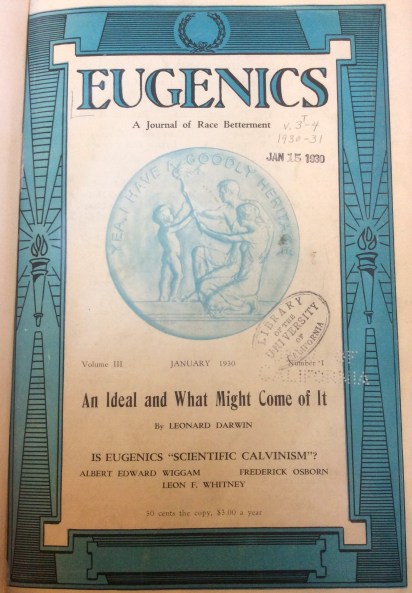
Eugenics journal, photo 2017 by Amy CoolsNow, as a eugenicist, Sanger did make herself an easy target for her accusers despite her decades of work with underserved and marginalized people, first as a nurse in the slums of the Lower East Side of New York City and then as a birth control pioneer. Eugenics, enthusiastically adopted by many who considered themselves scientific, progressive, and enlightened in the first half of the 20th century, is now recognized as pseudoscience, (mis)applying the evolutionary process of (unguided) natural selection to utopian social engineering theories. Eugenicists believed that the ills of humanity could be cured preemptively by breeding them out of existence while breeding in favor of ‘desirable’ traits. Despite the rosy vision of transforming humanity into the most vigorous, hyper-intelligent, and disease free race the world had ever seen, eugenics principles actually produced very ugly results when instituted as social policy. Here in the United States, government programs incarcerated mentally ill, disabled, and socially maladjusted people and forcibly sterilized them. Then the world’s most infamous eugenicists, the Nazis, took those principles to their most extreme logical conclusion, borrowing a page from the United States’ eugenics book in instituting the most horrific, murderous selective-breeding process the world has ever seen, inflicting untold and untellable quantities of human suffering and bloodshed.

Little wonder, then, that eugenics has a very bad name. Though the desire to reduce human suffering caused so many to embrace it, eugenics was based on a fundamental misunderstanding of Darwin’s great theory. Its proponents understood natural selection just well enough to appreciate its power for change but missed the greater point: the wide variety of human traits and capabilities is itself a long-evolved, complexly-balanced, and very very successful web of adaptations developed and attuned over hundreds of thousands of years. Human beings, necessarily self-centered and short-sighted, are very inept judges of trait selection in comparison with Nature itself.

Buck v Bell Virginia Historical Marker Q 28, Courtesy of Historical Collections, Claude Moore Health Sciences Library, University of VirginiaSanger, like many other eugenicists, was inconsistent in her attitudes about who should have children, when, and who should decide. Generally, she advocated for the right to self-determination in reproductive matters, calling for mass education and for cheap, reliable, widely available methods of birth control. In many instances, however, she advocated coercive sterilization for violent criminals and for those who she believed could not make this important decision for themselves, such as the mentally ill and cognitively disabled. She backed away from the latter, though, as the Nazis rose to power and instituted coercive, violent eugenics practices on a grand scale. Sanger was an early, ardent, and very vocal opponent of Nazism, and its policies alerted her to the problems of her short-sighted views on forced sterilization for anyone. As the logical-extreme beliefs of Nazism revealed, eugenics had its limits, and even the most non-coercive, most benign brands of eugenics were discarded by most of its former proponents over time.
But there are two other things Sanger was very consistent about.

One was her dismay at the sheer quantity of human suffering in the world and her desire to reduce it if she could. I find that oft-cited Sanger quotes, particularly from her book Woman and the New Race, refer to her observation that poor immigrants were especially likely to have more children than they could afford, and her claim that they were more likely therefore to produce ‘unfit’ children. ‘Unfit’, as Sanger described them, are those who are malnourished, diseased, undereducated, and in countless other ways ill-equipped to lead happy, flourishing lives. Yet, as is often the case with politically- and ideologically-motivated attacks, Sanger’s words are presented out of the context in which she wrote them, inspired by the plight of the immigrants she had in mind, mostly the Eastern Europeans she worked with in New York City’s Lower East Side. Before her time as a birth control activist, Sanger worked for them as a visiting nurse. As a Socialist activist and as a health care provider, she was driven by her special concern for the working poor that she observed were abused, often taken advantage of, in their desperation, by rapacious employers who offered them meager wages and terrible working conditions in exchange for backbreaking hours of miserable labor. These families were broken down from disease, hard labor, malnutrition, and, for the women, numerous pregnancies that often ended disastrously from these very health-destroying circumstances. One of Sanger’s most infamous quotes from Woman and the New Race, ‘The most merciful thing that the large family does to one of its infant members is to kill it’, so often used to ‘prove’ that Sanger was both racist and genocidal, is understood as a sarcastically-despairing remark when presented within the chapter in which it appears. That chapter describes the horror and suffering that preceded the all-too-frequent deaths of the immigrant poor, especially children and their mothers, and laments society’s lack of concern in preventing all this suffering and death. Even the next sentence alone will do: ‘The same factors which create the terrible infant mortality rate, and which swell the death rate of children between the ages of one and five, operate even more extensively to lower the health rate of the surviving members.’

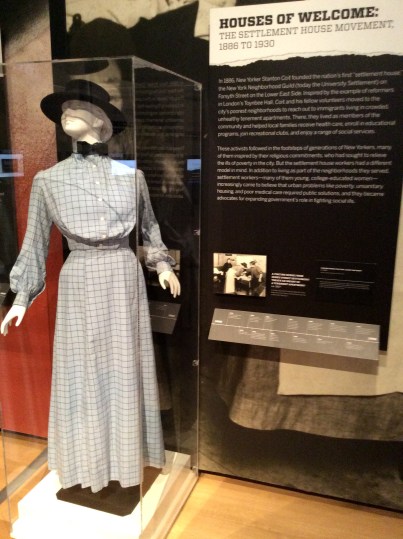
Nurse's uniform, ca. 1905, of Lilian Wald visiting service to the Lower East Side tenements of NYC

Nurse’s uniform, ca. 1905, of Lilian Wald visiting service to the Lower East Side tenements of NYC. Sanger would likely have worn an updated version of this uniform when she worked there in 1911

Second, Sanger believed all human beings should be given the same care and opportunities as everyone else. That’s why she opened her first birth control clinic in the racially diverse Brownsville neighborhood of Brooklyn in 1916, opened clinics to serve black and Latina women in Columbus Hill and Harlem neighborhoods in the late 1920’s and early 1930’s, and expanded her mission to help black communities in the American South in 1939. While there might be more than a shade of paternalism (maternalism?) in these efforts, her own writings, as well as the support of black civil rights leaders, demonstrate that her motives were, at least on the whole, motivated by her concern that justice be done for these underserved people.

As Sanger wrote to her friend Albert Lasker in 1939:

‘You are quite right in assuming that poor white people down South are not much better off than the Negroes, but there has been at least a start in several states to help the poor whites and as there is not sufficient time for a nurse, nor the material left over, for the Negroes, they are just left out of the service in most of the states. That is why I was anxious to have a special fund directed for the Negroes…’

Returning to Woman and the New Race, Sanger gave another reason why she was driven to improve lives in the disadvantaged communities she worked with and advocated for:

‘They would not be here if they did not bear within them the hardihood of pioneers, a courage of no mean order… And they have something else. The cell plasms of these peoples are freighted with the potentialities of the best in the Old World civilization. They come from lands rich in the traditions of courage, of art, music, letters, science, and philosophy… The immigrant brings the possibilities of all these things to our shores, but where is the opportunity to reproduce in the New World the cultures of the old? What opportunities have we given to these peoples to enrich our civilization? We have greeted them as “a lot of ignorant foreigners,” we have shouted at, bustled, and kicked them… What hope is there for racial progress in this human material, treated more carelessly and brutally than the cheapest factory product?’

In other words, America’s immigrants carry greatness in their very genetics, which our factories and farms have too often exploited, quashed, and wasted over the centuries by treating them as little more than wealth-generating fodder before kicking them to the curb or the ditch.

And in her article ‘Love or Babies: Must Negro Mothers Choose?’ Sanger wrote:

‘The Negro race has reached a place in its history when every possible effort should be made to have every Negro child count as a valuable contribution to the future of America. Negro parents, like all parents, must create the next generation from strength, not from weakness; from health, not from despair.’

Civil rights leader W.E.B. Dubois shared this view with Sanger: that if oppressed people were to overcome the social forces arrayed against them, they needed to forge their way from a position of strength: of health, of education, of increased wealth, and birth control was one of the ways to get there. And Sanger and DuBois both believed that they all could get there because they were just as capable of greatness as anyone else, given the same chances.

This doesn’t sound like racism to me.

*Listen to the podcast version here or on Google Play, or subscribe on iTunes

Ordinary Philosophy and its Traveling Philosophy / History of Ideas series is a labor of love and ad-free, supported by patrons and readers like you. Please offer your support today!

~~~~~~~~~~~~~~~~~~~~~~~~~~~~~~~~~~~

Sources and inspiration:

Another Look at Margaret Sanger and Race‘, Feb 23, 2012. From The Margaret Sanger Papers Project at NYU

Birth Control or Race Control? Sanger and the Negro Project‘ The Margaret Sanger Papers Project Newsletter #28 (Fall 2001)

Ferebee, Dorothy Boulding, d. 1980, “Speech by Dorothy Boulding Ferebee, M.D. entitled “Planned Parenthood as a Public Health Measure for the Negro Race,” January 29th, 1942,” Smith Libraries Exhibits

Margaret Sanger and the African American Community‘, compiled by Anna Holley, SisterSong Intern, July 2010, TrustBlackWomen.org

Marlin, George. ‘Margaret Sanger: “Abortion is Dangerous and Vicious”‘ Dec 14, 2011, The Catholic Thing blog

A Negro Number, June 1932 edition of Birth Control Review, by various authors.

Reed, Miriam. ‘Margaret Sanger: Correcting the False Narratives of Racism‘, June 30, 2016. Church and State

Sanger, Margaret, 1879-1966, “Letter from Margaret Sanger to Albert Lasker, November 12, 1939,” Smith Libraries Exhibits, Margaret Sanger Papers, Sophia Smith Collection.

Sanger, Margaret. ‘Love or Babies: Must Negro Mothers Choose?‘ Source: Negro Digest, August 1946, pp.3-8, via The Margaret Sanger Papers Project at NYU

Sanger, Margaret. ‘Population – Everybody’s Business,’ Published Article. Source: Tomorrow, 1944, pp. 16-18, Margaret Sanger Microfilm S72:0480, via The Margaret Sanger Papers Project at NYU

The Truth About Margaret Sanger‘, Blackgenocide.org

The Golden Rule

‘What is hateful to thee, do not do until thy fellow man; this is the whole Law. The rest is commentary’ – Hillel the Elder, ca. 30 BCE – 10 CE

This is a particularly beautiful iteration of the Golden Rule, as I remember hearing Christopher Hitchens point out. Rather than recommending that you do to others what you would want done to yourself, which assumes you know best what others would prefer, this Golden Rule is one of restraint and respect. Do not impose, it says: we do not always know what’s best, so live and let live, and do no harm.

Ordinary Philosophy and its Traveling Philosophy / History of Ideas series is a labor of love and ad-free, supported by patrons and readers like you. Please offer your support today!

~~~~~~~~~~~~~~~~~~~~~~~~~~~~~~
Source and inspiration: 

Kloppenburg, James T. Towards Democracy. New York: Oxford University Press, 2016, p. 41.


But My Brain Made Me Do It!

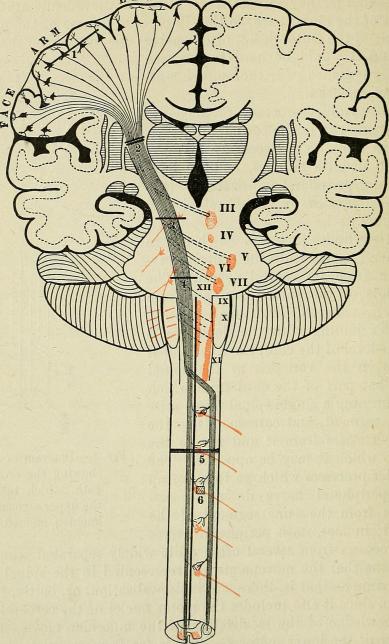
I’m on the home stretch of preparations for the GRE, studying hard in hopes that I only have to take it once. How I long to get in good writing time again and finish my beloved Douglass travel account series! Soon, soon. Until then, here’s a piece I published almost exactly two years ago today, which I just re-edited for clarity and flow, and re-illustrated with a beautiful drawing of a cross-section of brain and spinal column evocative of a flower.

Amy M Cools's avatarOrdinary Philosophy

Brain illustration from The Principles and Practice of Medicine...' by W Osler, 1904, public domain via Wikimedia CommonsThere’s a common idea which leads many people (myself included) to instinctively excuse our own or others’ less-than-desirable behavior because we were under the sway, so to speak, of one or another mental state at the time. This is illustrated especially clearly in our justice system, where people are routinely given more lenient sentences, given the influence of strong emotion or of compromised mental health at the time the crime was committed. “The Twinkie Defense” is a(n) (in)famous example of the exculpatory power we give such mental states, where Dan White claimed that his responsibility for the murder of two people was mitigated by his depression, which in turn was manifested in and worsened by his addiction to junk food. We routinely consider ourselves and others less responsible for our wrong actions if we’ve suffered abuse suffered as children, or because we were drunk or high at the time, or we…

View original post 1,523 more words

Happy Birthday, Ida B. Wells!

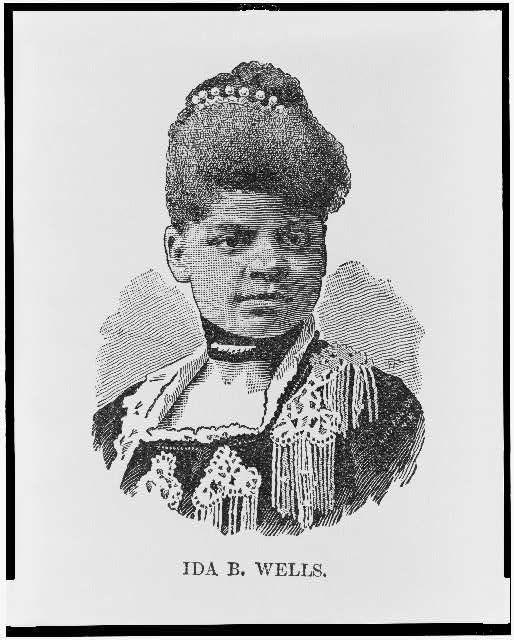
Ida B. Wells, head-and-shoulders portrait, published, 1891, Image retrieved from the Library of Congress LC-USZ62-107756, public domainIn my recent journey following the life of Frederick Douglass, I was so glad to have the opportunity to visit the place in New York City where he may have first met the great Ida B. Wells. It was late 1892, and this fiery young newspaperwoman had published her very controversial piece of investigative journalism in the New York Age on June 25, 1892. It was expanded and published as a pamphlet later that year as Southern Horrors: Lynch Law in All Its Phases.

Many people at that time thought of lynching as an unfortunate and somewhat rare excess of race-hatred by frustrated Southern whites. And many more saw it as a lawless but not entirely unjustified species of vengeance against black men who had raped white women. But Wells would change all that. In early 1892, three of Wells’ friends were lynched after a dispute between themselves and white owners of a rival business. She was outraged, and began an investigation of the practice and history of lynching as a whole.

When Wells wrote Southern Horrors, she had already been an activist and writer for black rights for many years. In 1884, she resisted being forced out of the first class train car into the ‘colored car’; she later sued the train company, won the first suit, then lost on appeal. This incident (which echoes Douglass’ train protest in 1841) led to many other lawsuits, articles, and activism against anti-black laws and social practices. In 1892, her investigation of lynching revealed to Wells that lynching was far from just vengeance for rape, it was inflicted for petty crimes, supposed insubordination or impertinence, drunkenness, competition, and so on. She discovered that lynchings were not all that rare, either, and came to the conclusion that they consisted a form of social control, a replacement for the terrorism of the slave system.

Douglass was inspired and energized by Wells’ writing and anti-lynching work, and wrote a letter praising Southern Horrors as an introduction. He visited her in New York City where she was living for a little while as a writer for and part owner of the New York Age, which was (probably) published at the site I visited in Harlem. I visited a second site associated with Wells two days after my New York visit: she delivered one of her hard-hitting speeches in her speaking tour following the publication of Southern Horrors at Tremont Temple in Boston on Feb 13th, 1893.

Education was another driving force in her life. Her first job was as a teacher at age 14, and she taught for many years, over time supplementing her teaching with journalism, writing and editing for the Evening Star, The Living Way, and the Free Speech and Headlight. Another of her most controversial, consciousness-raising articles was published in 1891 in the Free Speech about the conditions in black schools: the poor quality of the buildings which housed them, and of the education and morals of the teachers and school boards who administered them. She was not fired outright, but the school refused to hire her for the next school year. She then went on to work full-time for the newspaper, promoting the Free Speech from city to city and writing articles along the way, until the Free Speech‘s offices and printing press were destroyed by angry whites after the publication of her ‘Lynch Law’ piece. Adversity only served to strengthen Wells’ resolve, each attack causing her to re-double her efforts on behalf of her people.

Wells went on to have a long and distinguished career in writing, investigative journalism, and activism for black rights and women’s suffrage. She worked with Frederick Douglass and W.E.B. DuBois, toured the United States and Europe as a speaker and activist, founded Chicago’s Alpha Suffrage Club, served as secretary of the National Afro-American Council, founded and became the first president of the Negro Fellowship League, and helped found the National Association for the Advancement of Colored People (NAACP), among many other things.

For a long time, Wells thought of marriage and romantic relationships as oppressive, where women were expected to defer to men and flatter their vanity. But one day, she met a man who must have made her feel very differently, an attorney, writer, and fellow advocate for black rights named Ferdinand Barnett. She married him and they raised four children.

Please follow the links below to learn more about Ida B. Wells. If I manage to accomplish the tiniest fraction of what she did in my own life, I would consider myself a great success.

Ordinary Philosophy and its Traveling Philosophy / History of Ideas series is a labor of love and ad-free, supported by patrons and readers like you. Please offer your support today!

~~~~~~~~~~~~~~~~~~~~~~~~

Sources and inspiration:

Ida B. Wells-Barnett‘, episode 25 of the History Chicks podcast by Beckett Graham and Susan Vollenweider.

Ida B. Wells-Barnett‘. Encyclopædia Britannica. Encyclopædia Britannica Online.

McBride, Jennifer. ‘Ida B. Wells: Crusade for Justice‘. From Webster University’s website.

McNally, Deborah. ‘Barnett, Ferdinand Lee (1858-1936)‘, in BlackPast.org

Steptoe, Tyina. ‘Barnett, Ida Wells (1862-1931)’, in BlackPast.org

Wells, Ida. B. Crusade for Justice: The Autobiography of Ida B. Wells. Ed. Alfred Duster. Chicago, University of Chicago Press, 1970.

Wells, Ida. B. Southern Horrors: Lynch Law in All Its Phases, 1892, via Project Gutenberg

Wikipedia contributors. ‘Ida B. Wells‘. In Wikipedia, The Free Encyclopedia.

Wintz, Paul Finkelman, Cary D. Encyclopedia of the Harlem Renaissance: K-Y. 2004.


Frederick Douglass Chambersburg and Gettysburg PA Sites

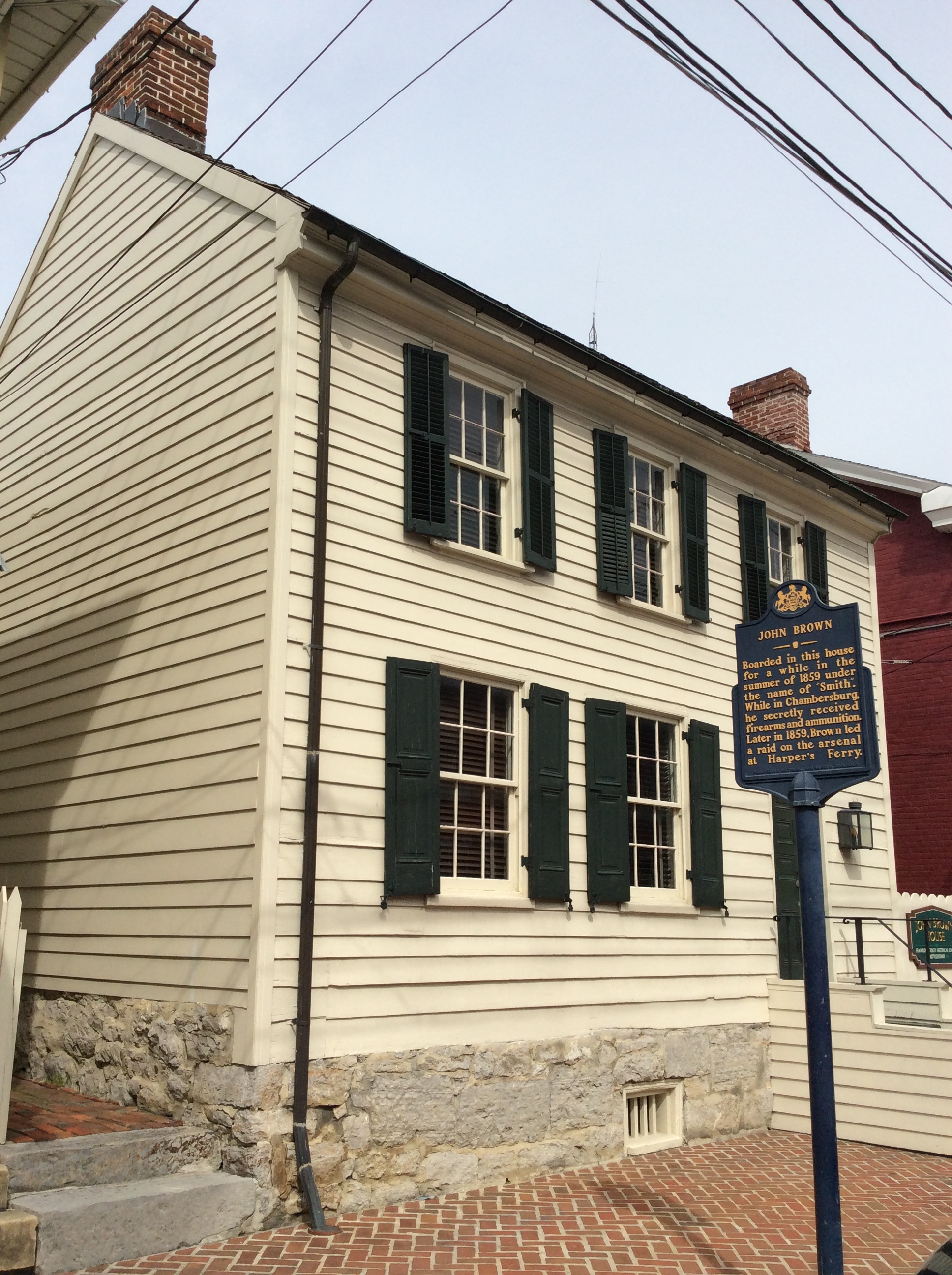
A view of the John Brown House in Chambersburg, PA

A view of the John Brown House at 225 E. King St, Chambersburg, PA

Twelfth Day, Thursday March 31st

It’s breezy, overcast, and warm the day I drive south from Rochester to Washington D.C., with a first stop in Chambersburg, Pennsylvania to visit two sites of special interest for my Frederick Douglass journey.

The first is a two story clapboard house at 225 E. King St, where John Brown rented a room in Mary Ritner’s boarding house in the summer of 1859, and where he planned his doomed raid on the federal arsenal at Harper’s Ferry. Unfortunately, I’m visiting during the off-season: the house is closed until the tourist season starts in May, but I find a blog with two nice photos of the interior posted. It happens to be a blog dedicated to Fredrick Law Olmsted, the great landscape architect who designed Highland Park, site of Frederick Douglass’ statue and memorial in Rochester.

Douglass had met Brown in September of 1847 while he was on a speaking tour, on the recommendation of other abolitionists. Brown had already developed a reputation as an especially fierce and dedicated one. In 1837, he had declared publicly “Here, before God, in the presence of these witnesses, from this time, I consecrate my life to the destruction of slavery.” By the time Brown met Douglass in 1847, he had already been engaged in activism for several years; for example, as you may remember from the account of my day in Lynn, MA, Brown used to speak at that town’s Sagamore Hall, which burned down in 1843, though there’s no evidence of their ever having met in Lynn. Brown invited Douglass to have dinner with him and his family in his plain, working-class Springfield Massachusetts home. He had started out as a tanner by trade, and after some financial failures, had become a successful merchant at that point. Douglass was at first surprised by the disparity between Brown’s ‘Spartan’ home, in such contrast to his prosperous-looking business office downtown, and then impressed by the fiery, righteous, single-minded, Biblically-minded (in the Old Testament sense) radical.

Douglass was still a pacifist Garrisonian at that time, but was as convinced as Brown that the political system was incapable of ending such an embedded, prejudice-ridden, and profitable (in certain contexts, such as the heavily agricultural South) system as slavery. Douglass and Brown likely had a lively discussion that evening in Springfield and on many occasions to follow, how slavery might be ended outside of the political system, and debated the relative merits of war and peace in reform. Brown visited Douglass at his South Avenue Rochester home on more than occasion and stayed with Douglass there awhile in early 1858 writing up a constitution for his planned mountain community of self-freed ex-slaves.

John Brown House (2) in Chambersburg, PA

Another view of the house where John Brown boarded in Chambersburg, PA

Douglass quoted Brown in his Life and Times as saying ‘God has given the strength of these [Alleghany] hills to freedom; they were placed here for the emancipation of the negro race; they are full of natural forts… The true object to be sought is first of all to destroy the money value of slave property… by rendering such property as insecure.’ So in 1847, he had already been planning to help slaves escape and remain free. In his remarks to Douglass, Brown displayed the fanaticism of the zealot in proclaiming that God not only ordained his plan, but placed just the right landscape right there where he could carry it out. But he also revealed his pragmatism and his business sense, which allowed him to astutely identify one of the bulwarks of slavery, the financial interests of a predominantly agricultural economy, then come up with a practical solution for undermining that bulwark. Slaves not only provided the necessary labor for these large farms, especially for labor-intensive crops like cotton, but were the dominant form of investment for Southern capitalists and living collateral for debt endemic to an agricultural economy. But if the financial incentive for slavery was removed by removing investment security, Brown thought, the institution would wither away.

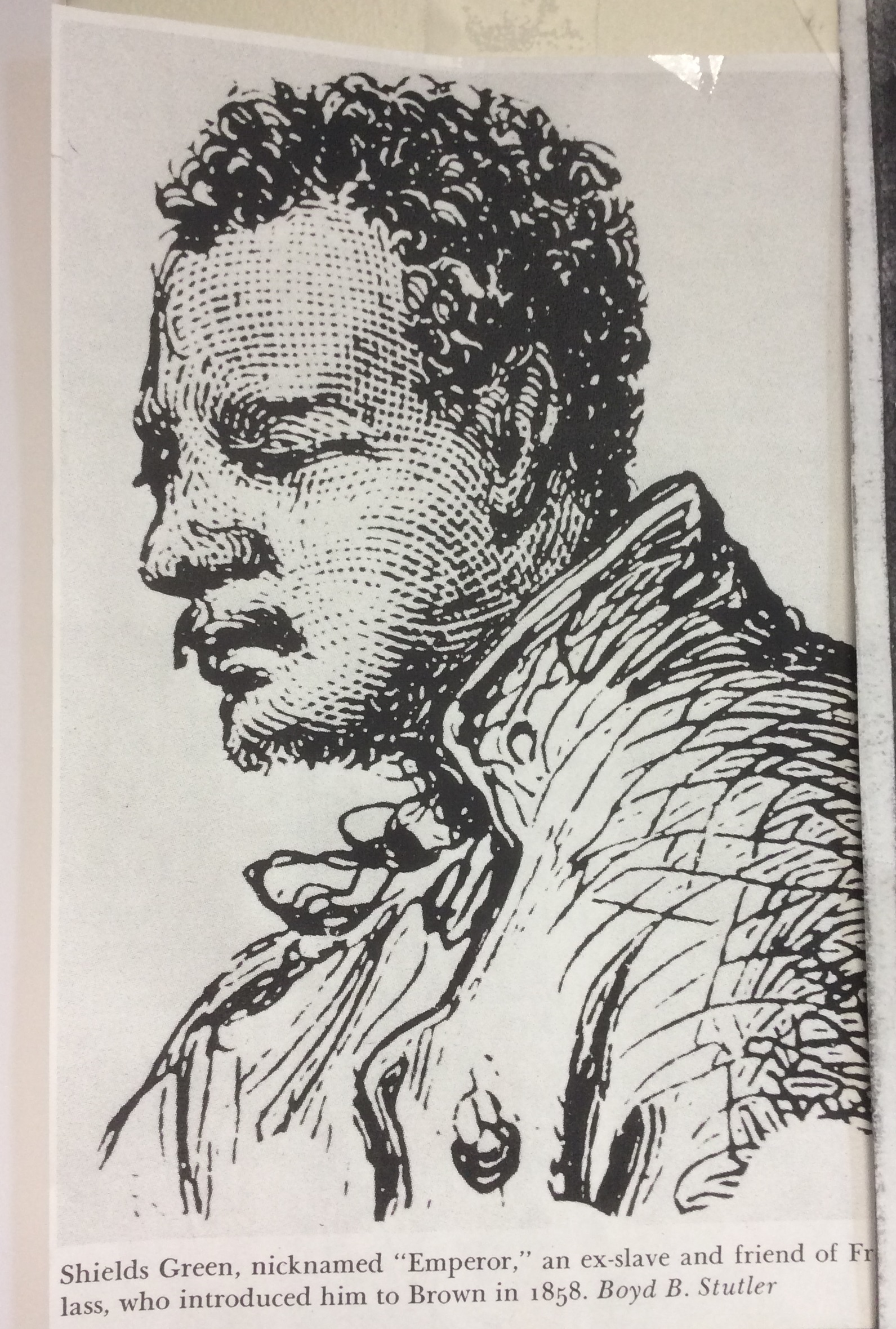
Poster of Shields Green in David Anderson's Nazareth College office

Poster of Shields Green in David Anderson’s Nazareth College office

But as you may have thought many times up to this point, it’s time I stop referring to the Harper’s Ferry plan and raid before explaining what it was and how it all went down.

Douglass and Brown’s mutual friend Shields Green accompanied Douglass from Rochester to Chambersburg in August of 1859, in response to John Brown Jr’s appeal for personal and financial support for Brown Sr’s soon-to-be-enacted operation. It had been postponed the year before due to an opportunist who volunteered his services to the venture then blackmailed potential supporters with threats of reporting the conspiracy, which in the end, he did. Douglass, now a longtime supporter and friend of Brown’s and sympathetic to his overall project of helping slaves escape, wanted to find out how the plan was progressing, how it may have changed, and how much support it had gathered. Along the way, Douglass gave some lectures as a cover for the purpose of his trip to Chambersburg and collected funds for the venture.

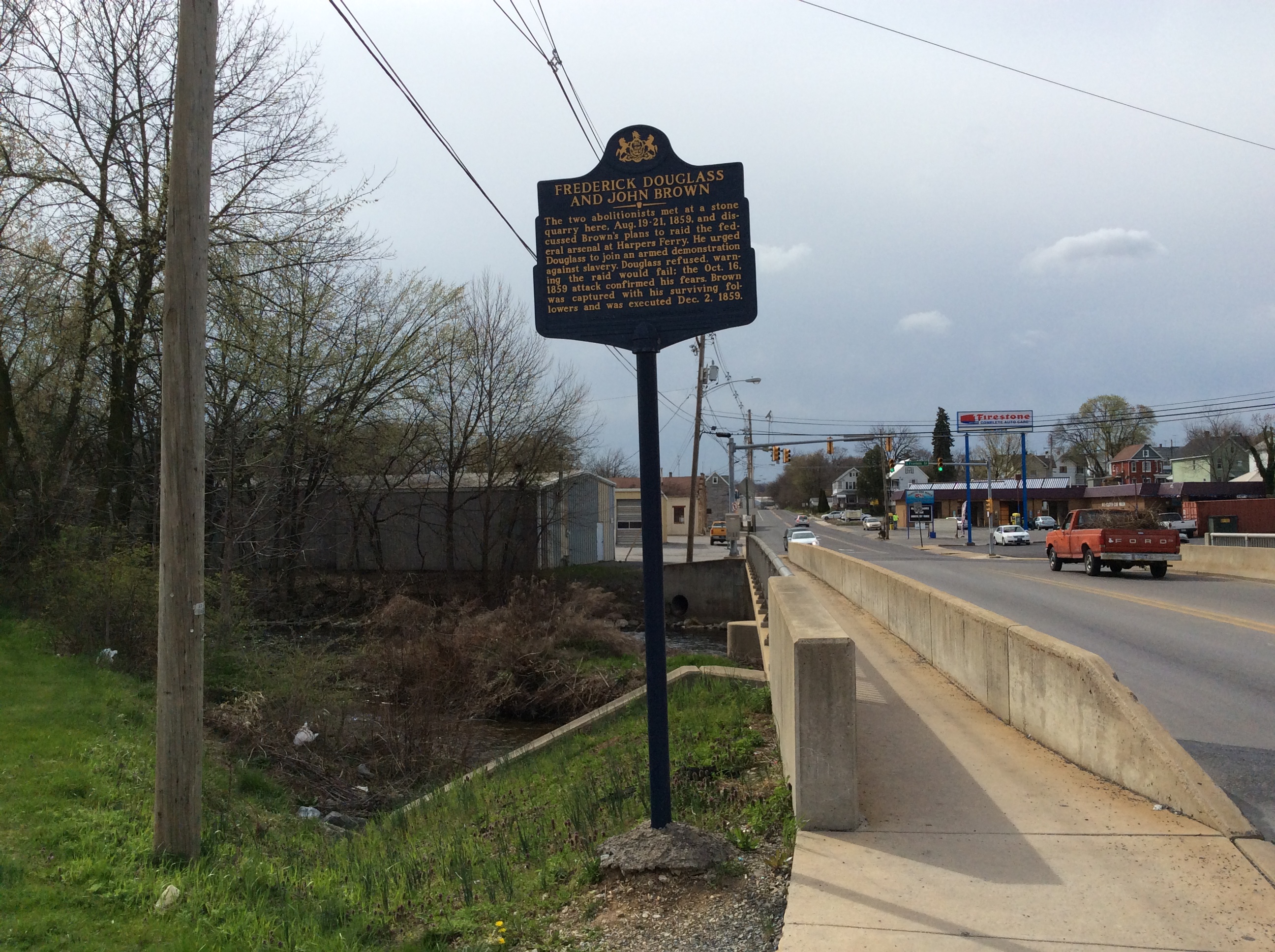
Quarry site historical marker where Douglass and Brown met, Chambersburg, 2016 Amy Cools

Quarry site historical marker where Douglass and Brown met in Chambersburg, PA, in August of 1859

The old Quarry site is generally listed as the place where Southgate Mall now stands at W. Washington St, but that’s not quite where you find the historical marker, though it is nearby. To find the marker, go to the east end of the bridge where Lincoln Highway (30) crosses over Conococheague Creek, between Cedar Ave and S. Franklin St. Loudon St is the next street to the north of W. Washington, and a broad open parking lot runs along the creek between the two, behind what’s currently a Rent-A-Center.

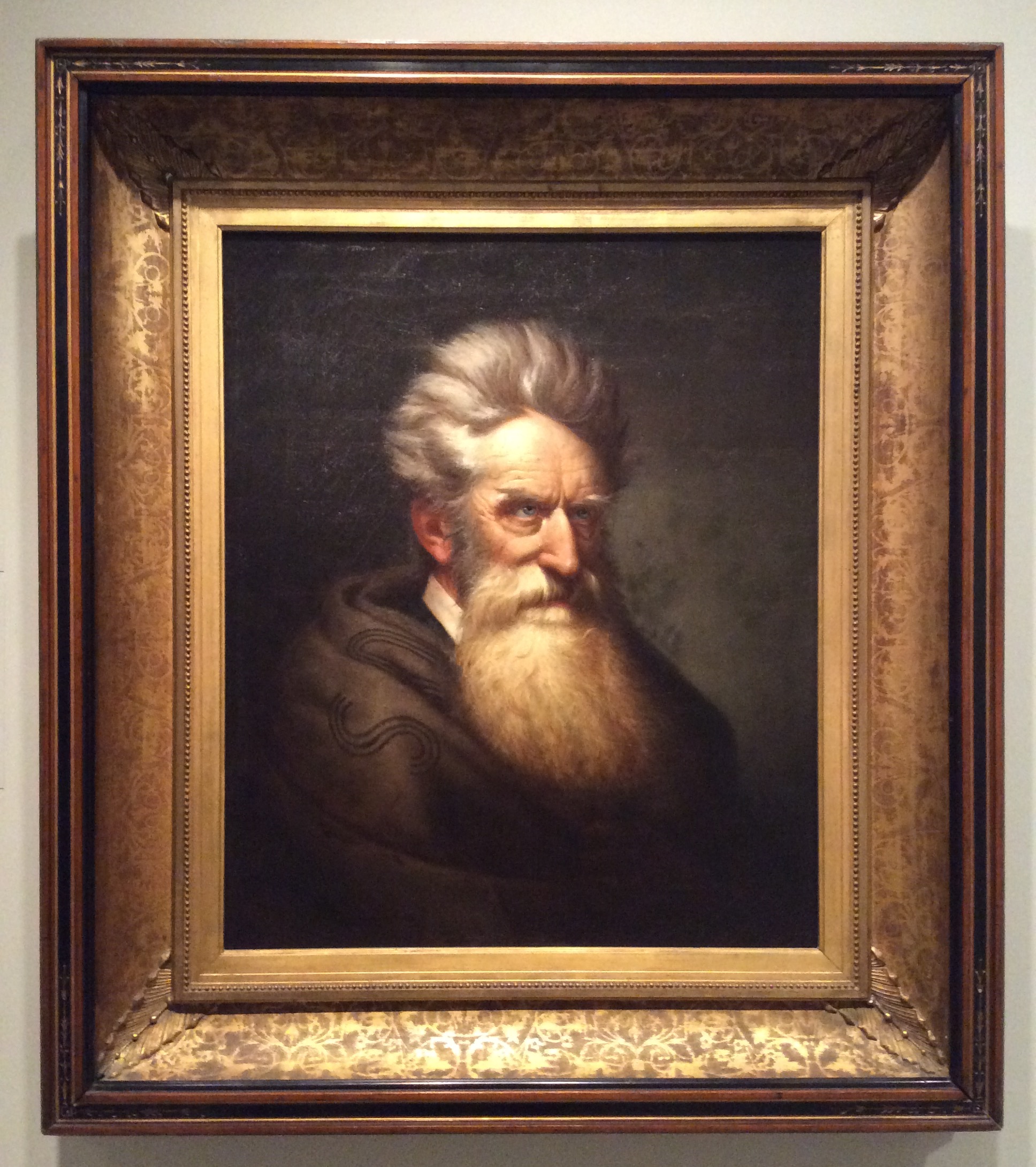
Portrait of John Brown by Born Torrington in National Portrait Gallery

Portrait of John Brown by Ole Peter Hansen Balling, 1872, at the National Portrait Gallery in Washington, DC

Douglass met with Brown here, who was outfitted as a fisherman, a perfect disguise for a creekside meeting. They, along with Green, and Brown’s secretary John Kagi, sat on the rocks and discussed and argued about Brown’s plan for the raid, apparently all night, and continued to meet and discuss the raid over the next couple of days. Brown intended to seize and occupy the federal arsenal at Harper’s Ferry, Virginia, with the small force of 22 men he had convinced to fight with him, and hold it as a symbol of righteous revolt against an evil government which had betrayed and oppressed so many of its people. This, in turn, was intended to inspire courage and anger in the slave population, and spark a mass exodus from bondage. It’s easy to picture Brown, of the deepset eyes, lined face, and flowing beard, playing the part of the angry Moses. From what he heard of the plans now, which had come to sound very much like an outright rebellion, Douglass thought the raid would certainly fail by provoking an aggressive military response. He also feared that its failure would set back the abolitionist cause in the long term by provoking a political response to increase legal protections of slavery as well.

By this time, Douglass’ view on violence had shifted: he had come to accept that violence is sometimes necessary and justified if great enough injustices or harms are being done and if other means have been tried and failed. So it wasn’t the proposed violence alone that made him oppose the plan, it’s just that he thought this particular plan would fail. Though he refused to join the raid, he later spoke of John Brown as a martyr, and always had a high opinion of his moral integrity and courage. As David Anderson of Nazareth College discussed with me in our interview, Shields Green stayed behind to join Brown in the raid. Douglass described Green in his Life and Times as ‘a man of few words, and his speech was singularly broken; but his courage and self-respect made him quite a dignified character.’ ‘Dignified’: high praise from Douglass, who valued that quality so much and took great care to nurture and project it in his own person. Shields Green survived the raid, but was captured and executed ten days later. 

Both Brown and Douglass, as you can see if you read Brown’s own speech at his trial, and as you can gather from Douglass’ Life and Times discussion of Brown, insisted that the Harper’s Ferry plans all along were only to encourage individual slaves to escape, then provide the means to defend themselves and other escapees along the route east and north. They claimed that a general slave insurrection was never part of the plan. But as was the government’s position, it all looked very much intended to spark a rebellion. I would add, it would have been a justified one if one ever could be, far more justified than the United States’ original rebellion against the British. Systematized forced labor, wage theft, rape, child-stealing, complete disenfranchisement, imposition of hunger and thirst, beatings, and enforced ignorance is a more dire set of provocations than unpopular taxes imposed without sufficient representation, in my view.

Chambersburg Map of 1894, Old Jail, Franklin County Museum, 2016 A Cools

Chambersburg Map of 1894, from the Franklin County Museum in the Old Jail, 175 E. King St.

I make a brief stop in the Franklin County Museum in the Old Jail building right down the street from the John Brown house at 175 East King Street, where I find a nice map of old Chambersburg. The town was burned by a rogue contingent of the Confederate army on July 30, 1864 (some soldiers were horrified at the senselessness of this attack against civilians and did their best to help save lives and possessions), but the Old Jail and the John Brown House both survived.

I grab a cup of coffee and jot down some notes, then continue on my way east to Washington D.C. via (you may have guessed it) Gettysburg, about 35 minutes away. Though this place is central to the legacy of Douglass’ friend and hero Abraham Lincoln, the link to Douglass’ life and ideas is a little more indirect. But I find this fascinating essay by David Blight, noted Douglass scholar. It’s a perfect accompaniment for this account, since it so well explains how Lincoln’s and Douglass’ ideas converged ever more closely as the Civil War continued, and really ties the places and themes I explore in this day’s journey together very well. Here’s a selection from that essay:

‘…Lincoln asked Douglass to lead a scheme reminiscent of John Brown and Harpers Ferry. Concerned that if he were not reelected, the Democrats would pursue a negotiated, proslavery peace, Lincoln, according to Douglass, wanted “to get more of the slaves within our lines.” Douglass went North and organized some twenty-five agents who were willing to work at the front. In a letter to Lincoln on August 29, 1864, Douglass outlined his plan for a “band of scouts” channeling slaves northward. Douglass was not convinced that this plan was fully “practicable,” but he was ready to serve. Because military fortunes shifted dramatically with the fall of Atlanta, this government-sponsored underground railroad never materialized. But how remarkable this episode must have been to both Douglass and Lincoln as they realized they were working together now to accomplish the very “revolution” that had separated them ideologically in 1861. Garry Wills has argued that Lincoln performed a “verbal coup” that “revolutionized the revolution” at Gettysburg. By 1864, that performance reflected a shared vision of the meaning of the war. Ideologically, Douglass had become Lincoln’s alter ego, his stalking horse and minister of propaganda, the intellectual godfather of the Gettysburg Address and the Second Inaugural.’ – from ‘“Your Late Lamented Husband”: A Letter from Frederick Douglass to Mary Todd Lincoln

I arrive at Gettysburg, and it’s cloudy, a bit gusty, and dropping scattered rain, but not cold. The air feels soft, and the light’s getting a bit low.

Gettysburg National Military Park, Gettysburg, PA

Gettysburg National Military Park, Gettysburg, PA

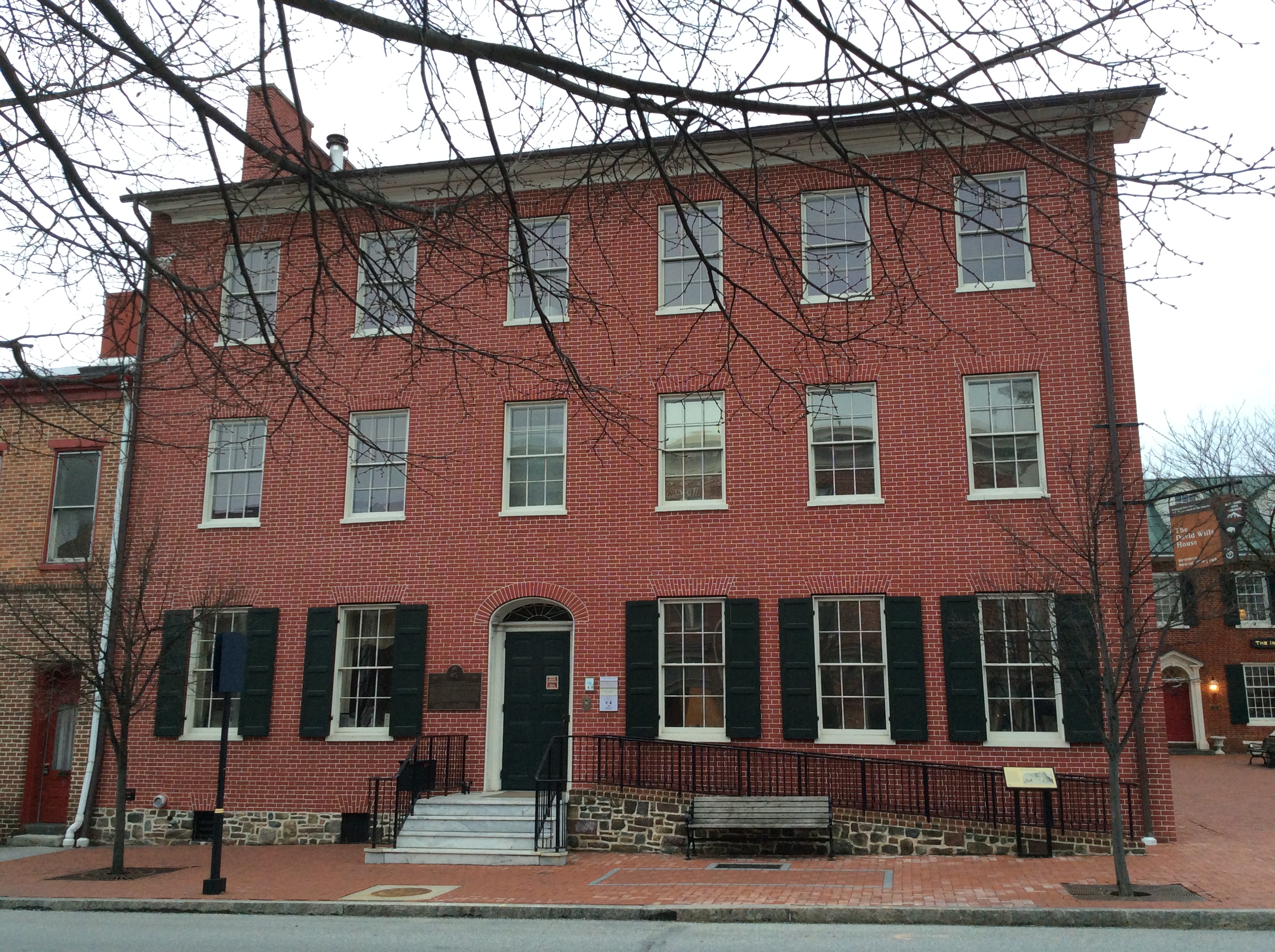
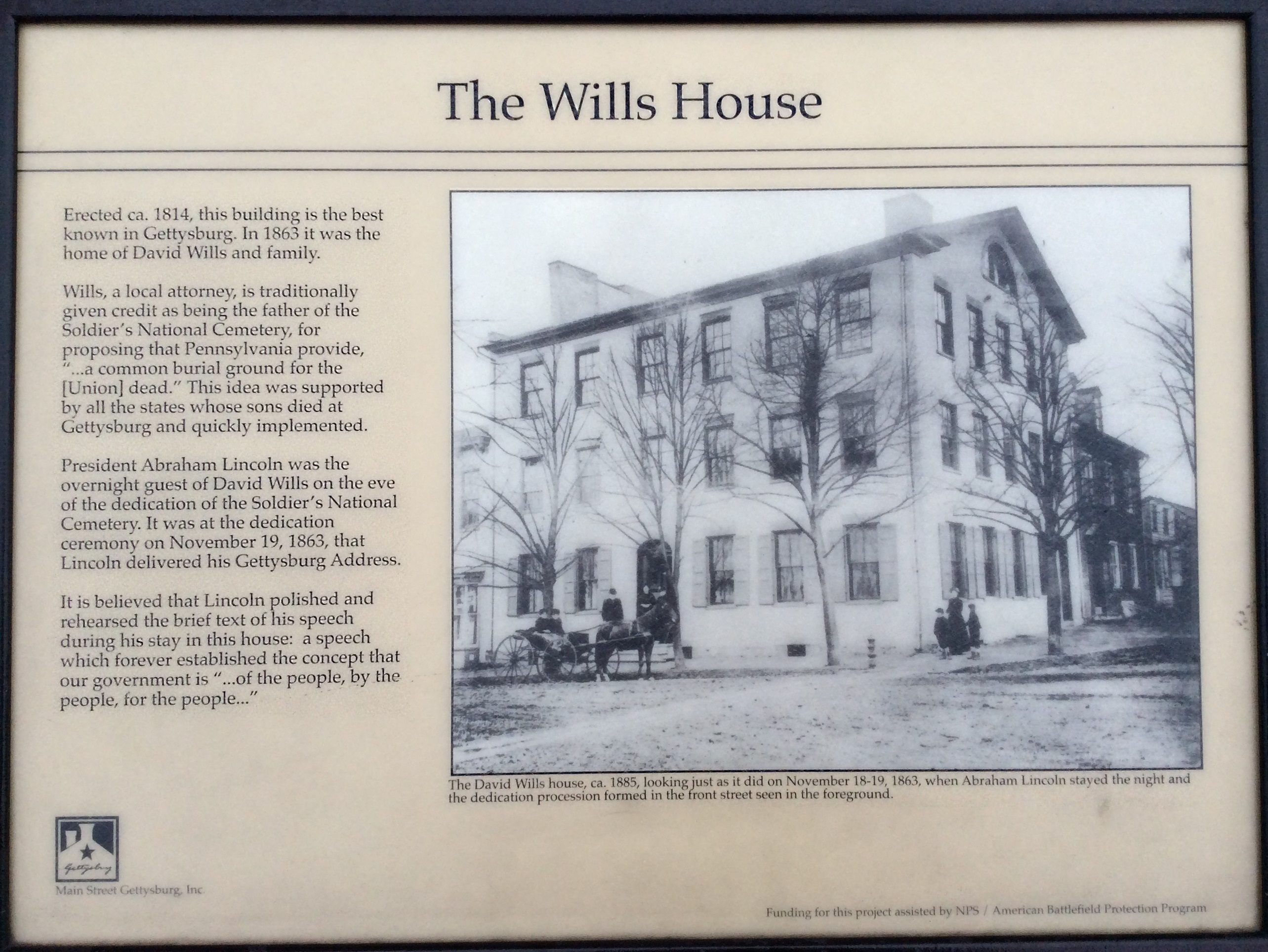
David Wills House where Lincoln stayed, Gettysburg PA, 2016 Amy Cools

David Wills House where Lincoln stayed in Gettysburg, PA, the night before he delivered his address

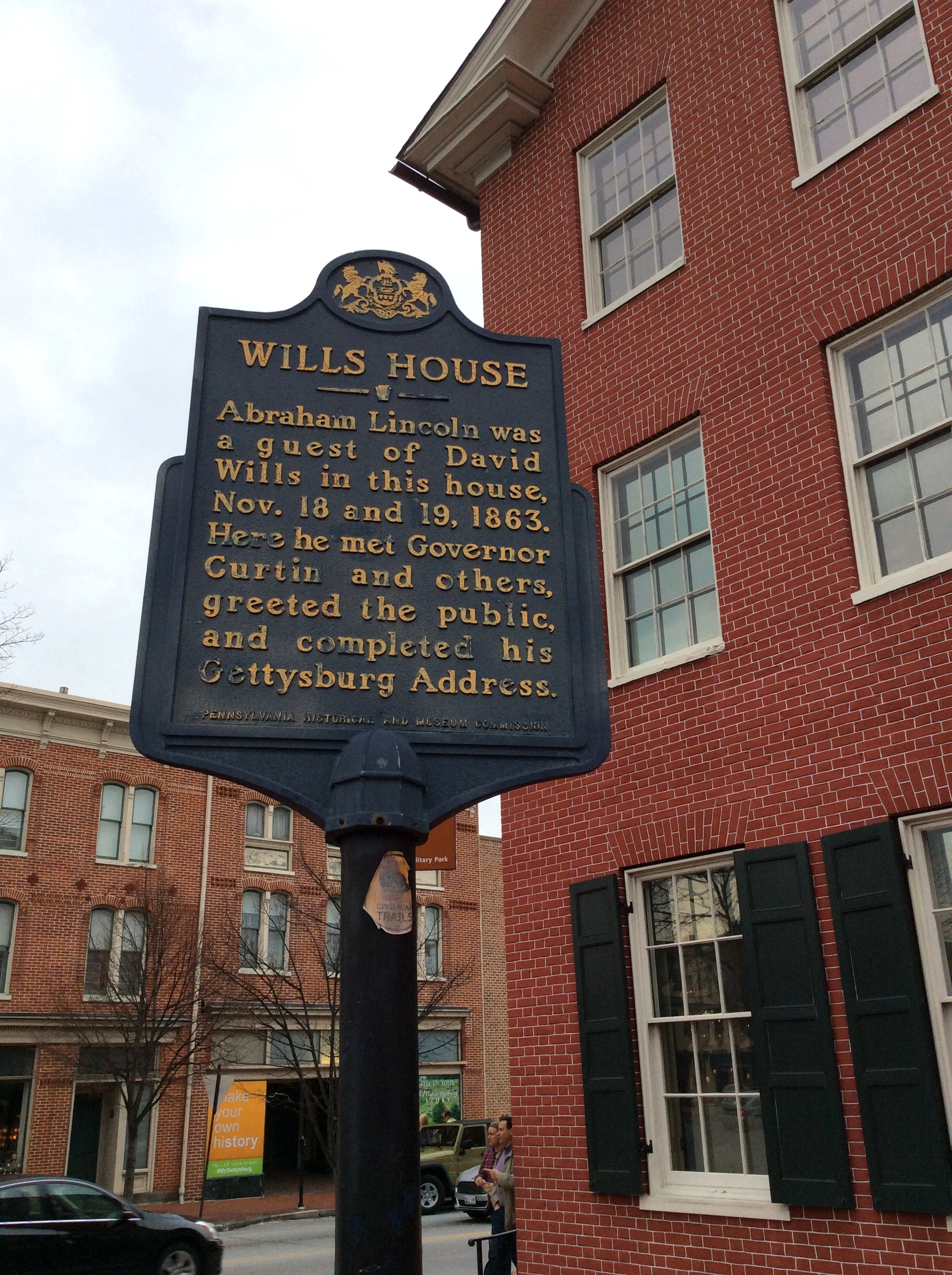
David Wills House historical marker, Gettysburg PA, 2016 Amy CoolsThe drive through the park is lovely, the grass is green, the park and its structures are beautifully maintained. I stop for a map, then head straight to the David Wills House. I arrive too late to go inside, however, though I do find another excellent blog, packed with photos of every part of the interior; scroll to the bottom of the page to find links to all of the posts in the series. Thanks, good people of the Gettysburg Daily!

Lincoln stayed the night before delivering the Gettysburg address, and likely gave it a final edit here. The house was packed with dignitaries and visitors here for the great event, the dedication of a national cemetery at the site of the bloodiest battle of the Civil War. Lincoln’s host David Wills was an attorney who had overseen the effort to recover the hastily buried bodies from the battlefield and re-inter them with more care at a specially dedicated Soldier’s National Cemetery to the east of the battlefield. This was no mean feat, as over 3,000 soldiers were killed in the Battle of Gettysburg, from July 1st to July 3rd, 1863.

Lincoln’s address was not the only one delivered that day; orator Edward Everett’s was two hours long and well-received. But Lincoln’s brief speech, with its readily memorizable brevity and eloquence, made it the one that not only made it into most of the newspapers first, people could quote from it and recite it to one another straight away. And Lincoln’s high-pitched voice carried very well. Short but eloquent speeches had become a hallmark of Lincoln’s style, as had religious and dramatic themes which were very familiar to the public, references that resonated with them and could convey volumes in only a few well-chosen words. Lincoln had become, at this point, a masterful rhetorician, and his address transformed, for so many distraught and angry Americans, a senseless slaughter into a noble sacrifice.

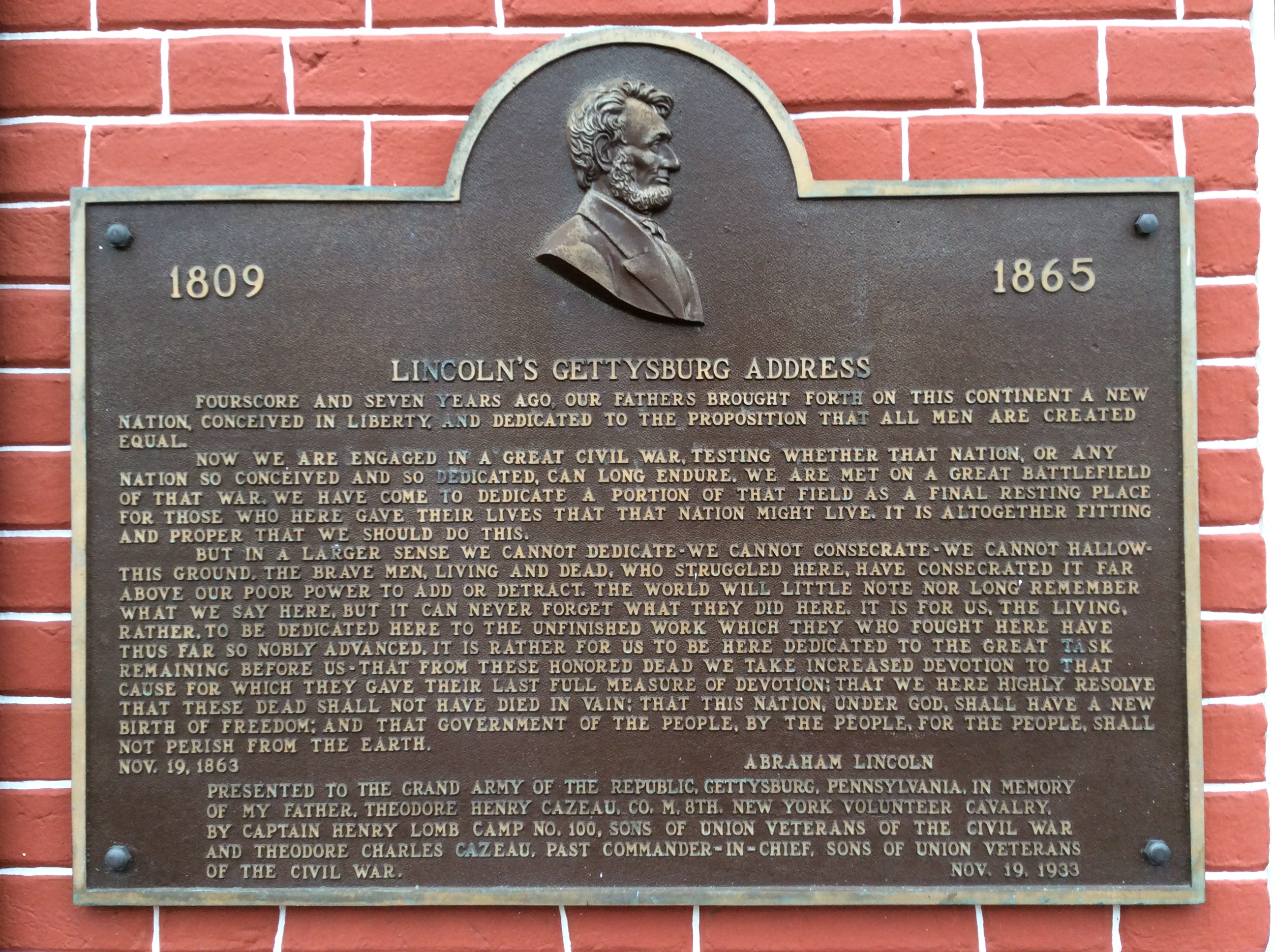
The Gettysburg Address on the Wills House wall

The Gettysburg Address on the Wills House wall

David Wills House sign, Gettyburg, PA, photo 2016 by Amy Cools

Gettysburg Train Depot, built in 1859, where Lincoln arrived on August 18th, 1863

Gettysburg Train Depot, built in 1859, where Lincoln arrived on November 18th, 1863

I head two blocks north to 35 Carlisle St, where the old Gettysburg Railroad Station still stands. Built in 1859, it also served as a field hospital and military transport during the Civil War. The Gettysburg Daily blog also includes a wealth of detailed photos of the Gettysburg depot and the original location of the tracks that Lincoln’s train rolled in on near dusk on November 18th, 1863.

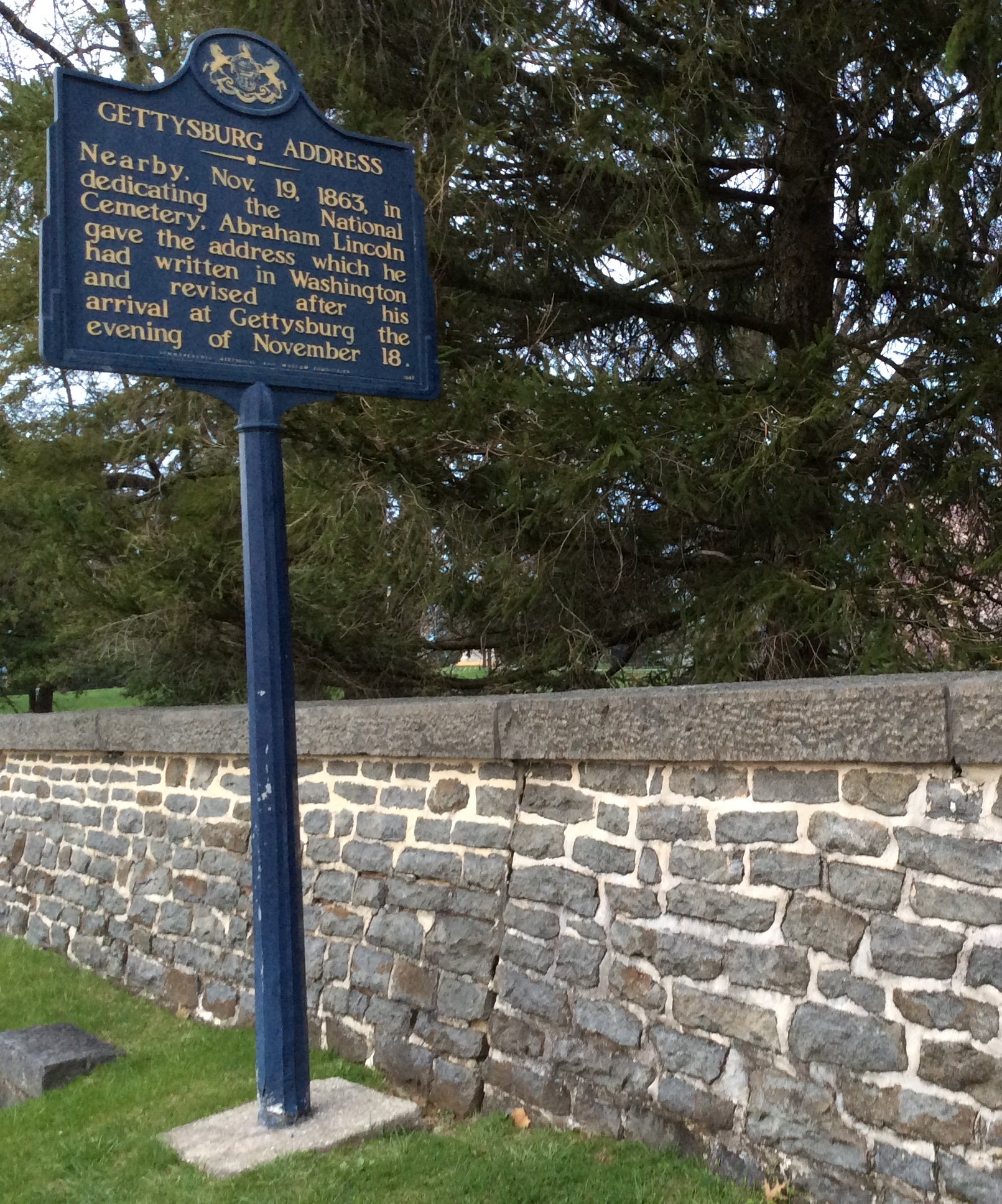
Gettysburg Address historical marker at Gettysburg National Cemetery

Gettysburg Address historical marker at Gettysburg National Cemetery

My last site to visit for the day takes me about a mile south, from Baltimore Street to Steinwehr Avenue to Taneytown Rd, aka Highway 134. There’s a handsome but simple old stone wall, originally built in 1864 and restored in 1980. There’s a gate about three quarters of the way down on my left, and a parking lot across the street on my right. I’m so glad I’m not continuing my drive yet, it’s just too nice outside to be content in a car. The clouds have cleared a little, and the setting sun makes quite a show on the clouds still there on the horizon, and the rain has gone.

I enter the gate and find that Gettysburg National Cemetery is one of the most moving and beautiful monuments I have ever visited, more than I expected. The flowering trees are in bloom, in every shade of pink, white, and cream, among the evergreens and those which are still bare of leaves or buds. It’s peaceful in the low warm light of the evening.

Headstones in Gettysburg National Cemetery

Headstones in Gettysburg National Cemetery

Headstones in Gettysburg National Cemetery (2), photo 2016 Amy Cools

Soldiers National Monument, Gettysburg National Cemetery, photo by Henry Hartley, shared under Creative Commons Lic. 2.0

Soldiers National Monument, Gettysburg National Cemetery, photo by Henry Hartley, shared under Creative Commons License. 2.0

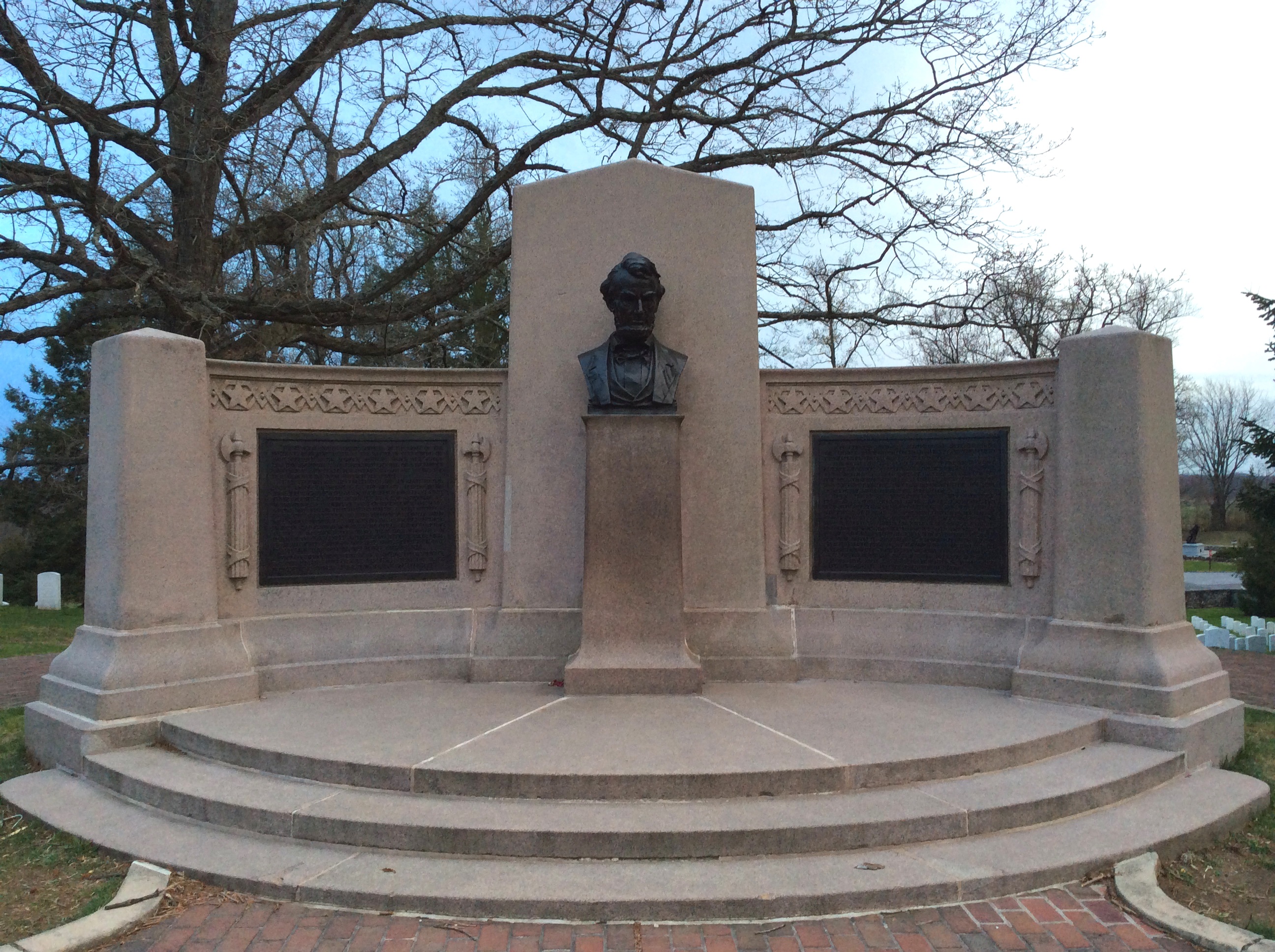
The sun in sinking fast, and the gates will be closing soon. I could continue my way down the path which winds around to my left to the tall white stone Soldiers National Monument, near the site where Lincoln delivered his address. But it’s a ways down and in the interests of time, I decide to start with a closer monument, to the right after you enter the gate. It’s a monument dedicated to the Gettysburg Address itself. The taller central stone is fronted by a strongly executed bust of Lincoln, flanked by two large plaques on the curved sides carved with stars and ceremonial hatchets. One plaque contains the Address, the other contains a selection from David Will’s letter to Lincoln, inviting him to participate in the dedication ceremony and to make some remarks. The letter was sent to Lincoln only 17 days before the ceremony, and scholars debate on the significance of the last-minute invitation. National cemeteries were a new thing, run by the states, and their dedications were usually officiated over by more local dignitaries; Wills may have thought it unlikely that the President, burdened with war cares, would be able to make it, only fully realizing Gettysburg’s true political significance as the event day drew near. In any case, Lincoln did grasp it, and contrary to popular mythology, prepared his remarks very carefully, as was his wont.

Lincoln's Gettysburg Address Memorial at Soldier's National Cemetery

Lincoln’s Gettysburg Address Memorial at Soldier’s National Cemetery

I find I’ve been lingering for awhile, and it’s closing time. I’m reluctant to go, but I suppose it’s for the best. I’m hungry and I don’t want to be searching for my lodgings late at night. So I continue the two hours further south to Washington D.C., looking forward to my next day’s adventures after a good night’s sleep.

Listen to the podcast version here or on Google Play, or subscribe on iTunesLooking out of the Gettysburg National Cemetery gate, photo 2016 by Amy Cools

Ordinary Philosophy and its Traveling Philosophy / History of Ideas series is a labor of love and ad-free, supported by patrons and readers like you. Please offer your support today!

~~~~~~~~~~~~~~~~~~~~~~~~~

Sources and Inspiration:

An Official Invitation to Gettysburg.’ American Treasures of the Library of Congress online exhibition

Blight, David W. ‘“Your Late Lamented Husband”: A Letter from Frederick Douglass to Mary Todd Lincoln‘. In The Gilder Lehrman Institute of American History website

Brown, John. ‘Address of John Brown to the Virginia Court…‘, Boston, Massachusetts, circa December, 1859. On The Gilder Lehrman Institute of American History website

Burning of Chambersburg Historical Marker.Explore PA History website

The Cotton Economy in the South‘. American Eras, 1997, c. Gale Research Inc, via Encyclopedia.com

Douglass, Frederick. The Life and Times of Frederick Douglass. Re-published 1993, Avenal, New York: Gramercy Books, Library of Freedom series.

Douglass, Frederick. My Bondage and My Freedom: 1855 Edition with a new introduction. Re-published 1969, New York: Dover Publications, Inc.

Foner, Philip S. The Life and Writings of Frederick Douglass, Vol. 1-4. New York: International Publishers, 1950.

Franklin County Historical Society: ‘Old Jail‘ and ‘John Brown House (Ritner Boarding House)‘, website

Gettyburg Daily, assorted articles on the David Wills House, Abraham Lincoln, and Gettysburg (scroll down to see list)

Gettysburg Lincoln Railroad Station‘, Destination Gettysburg Philadelphia website

Gettysburg National Cemetery‘. In Wikipedia, The Free Encyclopedia.

John Brown (abolitionist)‘. In Wikipedia, The Free Encyclopedia.

Linder, Douglas. ‘The Trial of John Brown: A Chronology.’ Famous Trials, an educational and non-commercial site maintained at the University of Missouri-Kansas City Law School

McFeely, William. Frederick Douglass. New York: W.W. Norton & Company, 1991.

The Register of the Lynn Historical Society, Volumes 8-12, by Lynn Historical Society

Resisting Slavery: St. John’s Congregational Church.’ in Our Plural History, a project of Springfield Technical Community College, MA

Rodríguez, Arlene. ‘Resisting Slavery: John Brown‘. in Our Plural History, a project of Springfield Technical Community College, MA

Shields Green‘. In Ohio History Central

The United States v. John Brown (all articles), 2010. University of Missouri-Columbia School of Law website

Wills, Garry. ‘The Words That Remade America: The Significance of the Gettysburg Address.’ Adapted from his book of the same name for The Atlantic, 2012

Affirmative Action and Balance

Justice et inégalité - les plateaux de la balance by Frachet, Jan 2010, Public Domain via Wikimedia CommonsThe recent Supreme Court decision in Fisher v. University of Texas at Austin, et al., was a cautious but significant one in favor of affirmative action. As Adam Liptak writes in his New York Times article ‘Supreme Court Upholds Affirmative Action Program at University of Texas‘, while ‘not all affirmative action programs will pass constitutional muster… the ruling’s basic message was that admissions officials may continue to consider race as one factor among many in ensuring a diverse student body.’

This opposes the central tenet of affirmative action opposition: admission to universities can only be based on merit, which in turn is determined mainly by grades buttressed by the quality of relative achievements; therefore, only color-blind admissions criteria are just and fair.

But as we all well know, educational institutions have been generally the purview of the wealthy, the connected, and the white for most of our history. Opponents of affirmative action say the only way to correct this historic injustice is to remove considerations of race and wealth in the admissions process itself, relying on other methods of promoting equal opportunity in education so as to make historically disadvantaged groups equally capable of high test scores and advanced achievement.

But I don’t agree, and am a proponent of some types of affirmative action, including the University of Texas’ well-designed and balanced method, for many reasons.

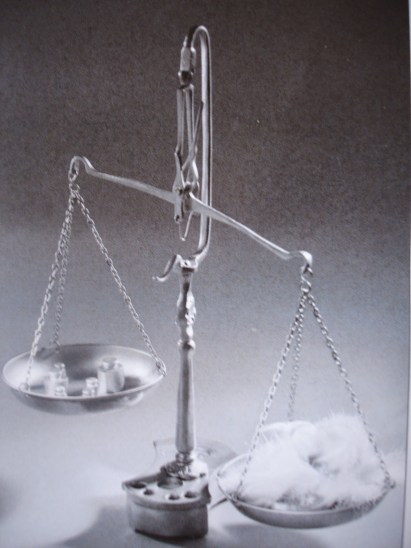
For one, some sort of affirmative action appears necessary to balance the historical wrongs of our educational system. I picture a classic scale, with a neutral, color-blind system based on merit alone as its fulcrum. For most of our history, the weights of racial, social, and economic privilege were piled almost entirely on one end. If the weights hadn’t been placed all at one end over time, then sure, color-blind admissions criteria might be fine. Opponents of affirmative action argue that the balance has already been corrected by other methods, such as a free public educational system, anti-discrimination laws, certain welfare and scholarship programs, and so on. But if it’s really been balanced, why the continued disparity in outcomes, within the schools and in relative chances of success after graduation in so many arenas of life? Putting the idea that some races are just naturally more gifted and capable of achievement than others aside for the moment, which I’ll consider shortly and (spoiler alert!) reject, the failure of equality in outcomes strongly suggest that color-blind policies don’t balance it all out. I think they are again, at best, the fulcrum of the scale, the default position. But the fact that race, money, and connections have been piled on one end over the centuries can’t be undone, so the balance can’t be reached by simply removing the weight of history. The weights with which to balance the other side are also selective policies, this time favoring those who are not part of historically advantaged groups, such as the wealthy, connected, and white. Of course, merit must count, as it’s always done; it would be a disservice to students to remove the challenge and expectation of excellence that propel learning and achievement, and this Supreme Court agrees. But it’s become clear that test-based merit can’t be the only consideration if we wish to right the balance.

To return to the idea that some racial and ethnic groups are naturally more intelligent or capable of advanced achievement than others: this claim has been shown by science and history to be deeply flawed, to say the least. All racial and ethnic groups have produced too many individuals of great intellectual ability and advanced achievement to make this claim convincing to anyone but the most hardened racists, and civilizations throughout history, made of up people of all races, have taken turns outperforming others in innovation and intellectual advances throughout world history. While test scores have shown that many racial and ethnic groups do, at times, perform lower on tests, the results change dramatically as the social circumstances of the test-takers do. If the ability to score high on tests is changeable, then it’s not likely to be simply genetic. And this is assuming that performance on such tests is the same thing, or a direct predictor of, merit as it relates to education, which is a huge and I think unjustifiable assumption, but this is a topic outside of the scope of this essay.

Furthermore, studies have also shown us is that student success and failure can depend not only intelligence and socioeconomic background, but on expectations of success on the part of teachers, of families, of communities, and most importantly, of the students themselves. To claim that a student has an equal opportunity to succeed whether or not they are part of a student body that includes a significant number of others like them, racially or otherwise, is untenable. There are a few particularly individualistic personalities who can and do achieve highly despite isolation on campus, despite racism, classicism, legal discrimination, and so forth. But as members of a highly social species, most human beings rely much more on the opinions of their fellow human beings, and on feelings of companionship and belonging. And when a student looks around campus and sees few or no-one like them, it’s unlikely they’ll expect to succeed where those like themselves have not.

The Supreme Court recognizes this simple fact: color-blind admissions programs are not always just in a society that’s not and never has been color-blind. Admissions programs admit real students into real campuses where they help prepare them for success in the real world – an often racist world. If an admissions program doesn’t succeed in making a campus look like an institution of a free and democratic society which values opportunity for all, it’s unlikely it could be a just and fair one.

Listen to the podcast version here or on Google Play, or subscribe on iTunes

Ordinary Philosophy and its Traveling Philosophy / History of Ideas series is a labor of love and ad-free, supported by patrons and readers like you. Please offer your support today!

~~~~~~~~~~~~~~~~~~~~~~~~

Sources and inspiration:

Affirmative Action: Court Decisions.’ National Conference of State Legislatures website

Booth, Margaret Zoller and Jean M. Gerard. Self-esteem and academic achievement: a comparative study of adolescent students in England and the United States, Sept 2011

The Black-White Test Score Gap. Edited by Christopher Jencks and Meredith Phillips,
Brookings Institution Press, 1998.

Lindsey, Brink. ‘Why People Keep Misunderstanding the ‘Connection’ Between Race and IQ.’ The Atlantic, MAY 15, 2013

Liptak, Adam. ‘Supreme Court Upholds Affirmative Action Program at University of Texas‘. The New York Times, June 23, 2016

Tauber, Robert T. Classroom Management: Sound Theory and Effective Practice. Westport: Greenwood Publishing Group, 2007