Into the Last Remaining Unexplored Region on Earth: The Human Mind, by Charles M. Saunders

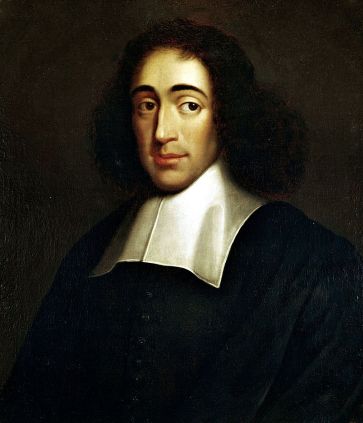
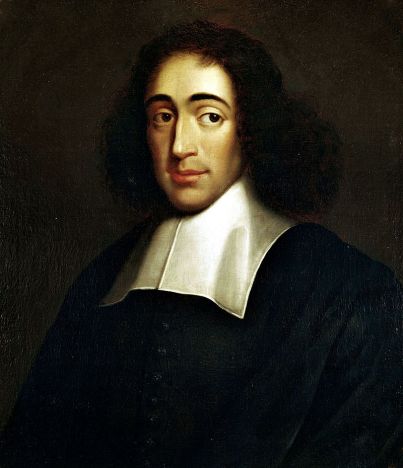
Portrait of Baruch de Spinoza (1632-1677), ca. 1665, by an unknown artist

Why Spinoza, Why Now?

A Series of Six Essays for Ordinary Philosophy – A Condensed Version of the Ethics – Examined in Detail

Part 1: Into the Last Remaining Unexplored Region on Earth: The Human Mind

Baruch Spinoza (1632-1677) was a respected scholar of Jewish ancestry who eventually became known for his philosophy and political writings. For his philosophy, he selected what he hoped would be a straightforward system: the geometrical method. Rather than lengthy and technically oriented arguments and rhetorical mechanisms, he wrote in somewhat simple Latin and in short, clear, concise statements. He assigns unique connotations to his lexicon which present additional challenges to those who attempt to study his writings. But these are not insurmountable.

In order to make his views on metaphysics, ontology, epistemology, ethics, and psychology clear and to present them as logically and as unadorned as possible, he selected a method which mimics that used by Euclid in his geometry. He was not seeking any type of mathematical certainty to support his hypotheses. But what he did hope would come through was the logical interconnection in descending inductive order within the axioms, definitions, propositions, explanations, demonstrations, and scholia (explanatory notes added to the margins) which make up the body of the text.

Unfortunately, what Spinoza thought would come across as a self-evidently true and accurately phrased demonstration has been and continues to be viewed as one of the most difficult documents to comprehend in the history of ideas. In order to begin the process of unraveling his Gordian knot of text, this essay presents a type of abstract from Letters to No One in Particular: a Discussion and Illustration of Spinoza’s Fragment or On the Improvement of the Understanding. That means, that to understand clearly and to grasp Spinoza’s intended meaning the study must begin outside the bounds of the Ethics itself.

For this first installment in the six essays which will comprise this ‘condensed’ study of the Ethics, it is critically important to begin with the brief treatise written prior to the it, On the Improvement of the Understanding (or, as it is also called, the Fragment), because it is the only place where Spinoza explicitly details his completely unique concept of ‘idea.’

The intended meaning of his ‘idea’ has effectively eluded and flummoxed even the finest minds that have commented on the Ethics. That is for two reasons: 1- Without an adequate grasp of the details in the Fragment which efficiently serves as the linchpin for the Ethics, Spinoza’s revolutionary grasp of human epistemology and the existence and operating functions of the active mind, will remain out of reach. And 2- Most if not all of the commentators on the subject, pre-supposed that by ‘idea’ Spinoza intended either: a judgment, a mental image, a propositional statement, or an abstraction formed from impressions from the sensible world. But he meant none of these things, and that is precisely why we are here today. An important reminder – In the Fragment [TIE] Spinoza emphasized that the ‘idea’ does not, in any way, involve words. With this firmly in mind, let us continue.

In this essay, an outline and explanation of the main message of the Fragment will be presented which will be accompanied by quotations from one of the true scholars of Spinozan explication, Professor Errol E Harris. The quotes are taken from his Salvation from Despair, A Reappraisal of Spinoza’s Philosophy (The Hague, Martinus Nijhoff, 1973), pp 87-88.

In the Proemium to the Fragment, Spinoza announces his intention to make known and accessible to the reader the nature of the human character which comprises the innate and organic operation and functioning of the mind. He describes it thusly: ‘What that character is we shall show in due time, namely, that it is the knowledge of the union existing between the mind and the whole of nature.’ (TIE). What we need to ferret out is exactly what constitutes this ‘union’.

From that axiomatic starting point, he sets out to discover if there is any possibility that the human mind has any built-in capacity or potential to obtain to any type of knowledge which can be affirmed to be absolutely certain, that is, true. To do this, Spinoza begins by detailing the four kinds of knowledge (perception) which taken together, constitute the spectrum of inputs which every person absorbs from the extended world.

The first three, he discovers, each serves its own limited purpose and can, up to a point, prove useful in everyday living (imagination), in gathering unverifiable information (sensation), and in solving problems and thinking rationally (reasoning). None of these three involves certainty because they are involved with ‘images’, and ultimately Spinoza realized that only with the fourth kind, intuitive understanding, could certainty be achieved. By ‘intuitive,’ he means a type of knowing which includes encapsulating the efficient or proximate cause of the object being considered.

Spinoza discovered that this certainty was only made possible due to the activity and presence in every human mind of the adequate idea. This idea is innate, within the mind, and serves as a tool or agency-in-act, which organically connects and effectively anchors the mind in its union existing between it and the whole of nature. This means that the extended world and the mind are virtually inter-operationally connected. A most startling and revolutionary claim, to say the least.

Let us pause here for a moment to dwell on the enormity of what has just been stated. What Spinoza discovered in the idea runs counter to virtually every depiction of any possibility for human knowledge ever discussed or imagined possible. Every philosopher before or after him and virtually all of contemporary science posit humans as passive receptors of impressions from the sensible world. These impressions then formulate, by various descriptions, mental images which serve as unverifiable judgments or mental entities, usually depicted as some distillation of the empirical paradigm or materialism.

Now along comes Spinoza and says, no way, my friends, you’ve got it all wrong.

Since the time and space available makes demands on us to be brief, elaboration on this revolutionary discovery by Spinoza will not be possible, for now. It is incumbent on us, to move along and to offer a bit more of detail on this process before signing off. At this point, Harris will assist us to flesh out Spinoza’s revolutionary assertion.

In order to expand on this organic aspect of the mind, its role as agency-in-act along with its element of the ‘idea,’ and its role of potency-in-act, we will lay a bit of groundwork for Harris’ compressed and succinct demonstration of the idea. The role of the idea, both in its role as conduit for the absorption of data cum knowledge, as well as performing as the active ingredient, so to speak, in its function of melding with the world of extension, represents Spinoza’s breakthrough in his discovery of the primary functioning operations in the assimilation and accumulation of an individual human’s knowledge base. One currently ascribed to misapprehension about human experience, which caused Leibniz to posit windowless monads, must be addressed.

As an integral part of the whole of nature, people are not segregated off from the world. We are as interconnected as any other integrated element in nature which comprises the universal system.

We have no problem dealing with animals being able to sense objects outside their visual range and to sense immanent unforeseen dangers in the form of severe storms and wildfire. Why should we believe that humans are walled off inside their bodies like kingdoms within a kingdom?

Once the significance of this comes clear, it becomes possible to begin to accept our active participation in the gathering of knowledge which has effectively allowed for civilization to grow and for science to advance. Now we must ask; How does this work? Enter Harris. Under the sub-title ‘Idea Ideae,’ in Salvation from Despair (p. 87). we find:

‘As the idea of the body is the mind, so the idea of that idea is the idea of the mind. In “de Intellectus Emendatione” [in TIE], Spinoza explains that every idea is the “objective essence” of its ideatum, of which the actuality is the “formal essence.” But the idea is a different entity (or mode) from its object (although they are identical in substance), if only because they exist in different attributes. The idea of a circle has no center or circumference [no properties]. So, he says, the idea has a formal essence of its own, of which the objective essence is the idea of the idea (idea ideae). This is further explained in the Ethics (II, xxi, S) as “nothing else than the form of the idea so far as it is considered as a mode of thought and apart from its relation to its object.” Its relation to its object, we already know, is substantial identity (or, as Spinoza says in some context of adequate ideas, exact correspondence).’

Simply stated, an idea has a real-time life of its own. For example: someone sees a movie, really enjoys it, and relates the entire experience to a friend. When that friend later views the same film, they report back that the experience of seeing the film was exactly the same as the ‘picture’ that formed in their mind when it had been described. That idea of the film was contained within the memory of one mind and conveyed, in its entirety, to the friend.

Thus the formal essence and the objective reality made a perfect match. The ‘idea’ is real. We use them every day; we just remain unaware of their presence and potency. That is, until now!

One final thought from Harris and we will sign off. When Spinoza titled his Fragment [TIE] On the Improvement of the Understanding, what follows is what he had in mind. Harris continues:

‘The inherent self-reflectiveness of consciousness is what enables us to purify the intellect and progress from confused and inadequate ideas [the first three kinds of knowledge mentioned above] to clear and true knowledge [the fourth kind of knowledge, intuitive understanding]. It is because we can reflect upon what we think, and know that we know, that we can criticize and improve our thinking. Idea Ideatum, therefore, is nothing but the consciousness of one’s own thinking, or the idea of one’s own mind. Spinoza speaks of a series of ideae idearum (ideas of ideas) ad infinitum, strictly no regress is involved, only an unlimited capacity for reflection or self-knowledge. The object of an idea and the idea of the object are substantially identical. Both are the same essence, one formal and the other objective. Thus the idea of an idea is strictly the same object or entity merely conscious (or more fully conscious) of itself.’ (Salvation from Despair)

Because it is so vital to see Spinoza’s idea at work in our own minds, let’s consider one more example:

Each morning when a person gets into the driver seat of their car and starts the engine or motor, they have no need to ask themselves if they know how to drive. They know that they know how to drive. Beyond that, if called upon to do so, anyone who drives could teach someone else to do so. This would involve dictating to the learner, from memory, the steps involved, such as: open the door, seat yourself, and attach your seatbelt. Before starting the car, check the mirrors, make sure your field of vision is unobstructed, etc, etc. In fact, many people could prepare a written outline of the entire process which would then serve as a training manual. Once the trainee obtains their operator’s license, it can be said that the instructor captured the idea encapsulated in their mind and transferred that adequate idea of how to drive to another person who successfully absorbed the contents of the idea, made it their own, and re-converted it into the reality of driving an automobile. This transfer of the idea from one mind to another demonstrates that the idea is a quantifiable, measurable entity and fulfills any empirical stricture placed upon it.

This idea exists as a real entity. It is measurable; remember the training manual. The idea (in mind) and the object (driving) are the same things expressed as micro-sets in modality of the two infinite attributes of thought and extension. Finally, the driver’s manual serves as the idea, of the idea (in the mind) of the idea (driving lesson). The manual, which could be used by virtually anyone to teach themselves how to drive, demonstrates the existence of an idea independent of the mind!

Exhausted yet? Have no fear, this is extraordinarily difficult to track and to take in whole.

Take all the time necessary to reflect on this information, it is admittedly difficult to absorb and perhaps even challenging to accept. Find ways to see it operating in your own life. Once you have successfully accomplished this task you will stand ready to join those of us who understand that a human being is much more than a passive receptor. We are full-fledged and engaged participants in one of the universe’s most unique and ever-evolving possibilities, the creata!

Semper Sapere Aude! (Always dare to know!)

Charles M. Saunders

~ Ordinary Philosophy is a labor of love and ad-free, supported by patrons and readers like you. Any support you can offer will be deeply appreciated!

*All views and opinions expressed by guest writers are their own and do not necessarily reflect those of Ordinary Philosophy’s editors and publishers
Happy Birthday, Averroes (Ibn Rushd)! By Eric Gerlach

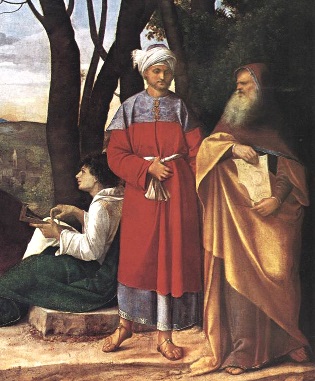
Averroes by Giorgione893 years ago today, on April 14th, 1126, the great Islamic philosopher, theologian, political theorist, and scientist Ibn Rushd, or as he is known by the Latinate version of his name in Europe, Averroes, was born.

Among his many achievements, Averroes is credited with popularizing the study of Aristotle in Europe, inspiring the work of Thomas Aquinas and the Christian Scholastics.  Averroes was known as “The Commentator” and Aristotle “The Philosopher” to Aquinas and the Scholastics, as Averroes wrote multiple commentaries to help others understand Aristotle’s thought. To the left is an image of Averroes standing between and above an ancient Greek sage, likely Aristotle, and an Italian scholar of the Renaissance, sitting at their feet, painted by Giorgione of Venice. Averroes was also a major influence on Maimonides, Giordano Bruno, Pico della Mirandola, and Baruch Spinoza, and was one of the great souls that Dante wrote was dwelling in limbo with the Greek sages who lived before Jesus.

Aquinas Averroes and Scholastics

Thomas Aquinas

Averroes’ grandfather and father both served as chief judge of Cordoba, the place where Averroes was born, which later became part of Spain. Averroes wrote prolifically, twenty-eight works of philosophy as well as important treatises on law and medicine.  As a rationalist, Averroes argued that philosophy and religion teach the same truth and thus are not in conflict, such that intellectuals pursue the same matters that common people comprehend through religion and rhetoric.  He also argued that analytic thinking was important for the proper interpretation of the Quran, as Christian Scholastics would argue later about the Bible in Europe.  Averroes’ works were banned and burned in Islamic and Christian lands at different times, but they were revered enough to survive in both places.

Averroes was opposed to the work of Al-Ghazali, the Sufi mystic and author of The Incoherence of the Philosophers.  Ghazali argued that philosophers such as Plato, Aristotle, Al-Farabi and Avicenna contradict each other, and are thus incoherent as a set, and also contradict the teachings of Islam.  Ghazali also argued that Aristotle and those who follow him are wrong to assert that nature proceeds according to established laws, as all things proceed directly through the will of God.  Averroes wrote his most famous work, The Incoherence of the Incoherence, in response to Ghazali. Averroes defended Aristotle and argued that philosophy does lead to coherent truth, which is not in conflict with Islam, and that nature proceeds indirectly from God via the laws of nature, which God established during creation.

Portrait of Baruch de Spinoza (1632-1677), ca. 1665, by an unknown artist

Portrait of Baruch de Spinoza (1632-1677), ca. 1665, by an unknown artist

Averroes is also famous for his idea of monopsychism, that we all share the same divine soul, mind, and awareness, with each taking a part such that the lower soul is individual and mortal but the higher soul is universal and immortal, the source of true inspiration and reason.  Spinoza, who said that each of us is like a wave on the great sea of being, was a pantheist, inspired in part by Averroes.  Much later, when Albert Einstein was asked if he believed in God, he said, in the spirit of Averroes, “I believe in Spinoza’s god”.

In these and countless other instances, we can discern the influence of Averroes throughout both Eastern and Western thought. Thank you for your wisdom and insight, Averroes!

*A version of this piece was previously published at Ordinary Philosophy

~ Ordinary Philosophy is a labor of love and ad-free, supported by patrons and readers like you. Any support you can offer will be deeply appreciated!

*All views and opinions expressed by guest writers are their own and do not necessarily express those of Ordinary Philosophy’s editors and publishers

Happy Birthday, Thomas Jefferson!

Thomas Jefferson by Charles Bird King, 1836, after Gilbert Stuart, at the Smithsonian Portrait Gallery in Washington, D.C. Photo 2016 by Amy Cools

In remembrance of Thomas Jefferson (April 13, 1743 – July 4, 1826) on his birthday, let me share anew my tributes to his memory, his life, and his ideas from over the years:

To Washington DC, Virginia, and Philadelphia I Go, In Search of Thomas Jefferson

To Paris, France I Go, In Search of Revolution-Era Thomas Paine, Mary Wollstonecraft, and Thomas Jefferson

and my thrilling interview with Clay Jenkinson, Jefferson scholar

Interview with Clay Jenkinson as Thomas Jefferson

I hope you enjoy following me as I followed in the footsteps of Jefferson!

*A version of this piece was previously published at Ordinary Philosophy

~ Ordinary Philosophy is a labor of love and ad-free, supported by patrons and readers like you. Any support you can offer will be deeply appreciated!

Damasio, Spinoza and our Current Confusion about Cause and Effect, by Charles M. Saunders

Portrait of Baruch de Spinoza (1632-1677), ca. 1665, by an unknown artist

In this article, Charles M. Saunders considers Looking for Spinoza: Joy, Sorrow, and the Feeling Brain by Antonio Damasio
(Houghton Mifflin Harcourt Publishing, N.Y., 2003)

In 2003, one of our most capable and respected neuroscientists went searching for Spinoza. What Antonio Damasio found is both enlightening and alarming. It is laudable that an empirical scientist had the interest, care, and capability to analyze the sequencing and behaviors associated with what Spinoza terms ‘the Emotions.’ This is clearly a positive development. When our neuroscientist friend recognized that something about emotional response is measurable, he made strides for the entire scientific community. But by focusing his analysis only on chapters 3 and 4 of “The Ethics”, Damasio sidetracks Spinoza’s metaphysics, chapters 1 and 2 while presenting Spinoza as some sort of intuitive materialist. The alarming part in all of this is that chapters 3 and 4 are linked inexorably to 1 and 2 wherein Spinoza insists that our thoughts are as real as our experience. As notable as Damasio’s respect for Spinoza’s psychology may be there is a tremendous distance from his awakening to the import and physical reality of the emotions to an adequate understanding of the full impact of Spinoza’s discovery, that the human mind has the ability to form replications of objects so accurate that these ideas are essentially the same thing as the objects they represent.

This is an astounding claim that Spinoza makes and to this day, it has been overlooked or dismissed in light of the advances in contemporary science and its ability to “reduce” everything in its purview through observation and measurement. But cause and effect are not observable within the same time and space.

Brain illustration from The Principles and Practice of Medicine...' by W Osler, 1904, public domain via Wikimedia Commons

Brain illustration from The Principles and Practice of Medicine…’ by W Osler, 1904, public domain via Wikimedia Commons

When the neuroscientist-researcher connects electrodes to a patient to monitor brainwaves there is no question that the observable patterns that emerge are exciting and are indicators of some brain activity related to behaviors that correspond to the patient’s emotional state and mood changes But to conclude from this that the patterns and their location in the brain somehow indicates the cause of the thinking process is a leap that indicates faulty reasoning and bad science. To draw a conclusion about the source of the thinking process from an electroencephalogram is akin to a person who while standing atop the tallest building in a large city before dawn observes the pattern of traffic lights below and concludes that the pattern of lights is the cause of the flow of traffic. No matter how many thousands of lights make up the discernable pattern of the flow of traffic, the actual cause of the traffic is not observable. The cause of the traffic resides elsewhere. It originates in the reasons that each individual driver leaves home and enters the flow: going to work, driving a friend to the hospital, making deliveries, police responding to emergencies and countless other actions are the actual cause of the traffic and they are entirely disconnected from one another. There is no common cause to be observed and reported on here.
This analogy demonstrates the confusion inherent in the empirical process. There is no argument about what the scientist sees during the study. But there is a strong argument against what he claims to have observed. If this mistaken insistence that causality must be observable resided solely in speculative neurobiology the harm might not be that negligible. Unfortunately for us, this curious misunderstanding of cause and effect permeates most of our scientific theory and practice, including applications in healthcare diagnosis and treatment.

Perhaps one of the most debilitating misapplications of the empirical process lies within the field of genetics and the supposed causal link observable in DNA. Crick and Watson never assigned any causal agency to their brilliant discovery. They clearly understood DNA for what it is; a marker not a cause. Assigning cause to DNA strands came later after arrogance and the same faulty reasoning process employed by Damasio came into play. Whether a person suffers from cancer or obesity or a predilection towards baldness, DNA is not the cause of the affliction it merely marks the presence of the condition. To carry the traffic lights/scientific research analogy a bit further, just as we can clearly understand that no matter how complicated or advanced the light pattern and system flow technology might be it cannot be said to be the cause of the traffic. That flow can only be understood by seeing the individual actions and behaviors that are the actual cause. So with DNA, it is a marker that notes the presence not the cause of disease.

The upshot of all this is that our current empirical/materialist science system that has brought about some of the most significant advances for humans in medicine and other sophisticated technologies contains a seriously flawed view of cause and effect. But by insisting on a research focus only on the world of external experience it ignores the rich world of experience’s counterpart and co-equivalent, the Human Mind. This now outmoded way of explaining our planet and our relationship to it must give way to a more sophisticated view. This view will credit the mind as the source and wellspring of any scientific achievement that we’ve ever accomplished and that it is the mind which provides us with the most magnificent tool at our disposal for unraveling Nature’s mysteries.

Charles M. Saunders

~ Ordinary Philosophy is a labor of love and ad-free, supported by patrons and readers like you. Any support you can offer will be deeply appreciated!

*All views and opinions expressed by guest writers are their own and do not necessarily express those of Ordinary Philosophy’s editors and publishers

Happy Birthday, H.P. Grice!

In honor of this anniversary of H.P. Grice’s birth on March 13th, 1913, let me share an undergraduate paper I had an especially good time writing.

Heads up: this paper features a lot of colorful and crude language, examined philosophically of course, and comedians’ opinions.

To learn more about the brilliant Grice, I recommend Richard E. Grandy and Richard Warner’s excellent bio and exploration of the ideas of this philosopher of language, in the Stanford Encyclopedia of Philosophy. Enjoy!

Slang and Grice’s Cooperative Principle

In “Logic and Conversation”, H. P. Grice outlines the unspoken but fixed rules of conversation that not only explain the workings of ordinary language, but account for implicature.

In a paper written only three years later in 1978, “Is Slang a Word for Linguists?”, Bethany K. Dumas and Jonathan Lighter develop a set of criterion for distinguishing slang from other language, through analysis of historical definitions and attitudes and description of its characteristics. In the contemporary F**k, A Documentary, Steve Anderson presents a more informal exposition of a particularly controversial yet ubiquitous slang word, interviewing a host of linguists, politicians, social critics, and entertainers on issues surrounding the use, abuse, and censorship of the term. These interviewees contribute a variety of insights into the nature of slang and its influence on language generally as well as on social thought and attitudes. In this paper, I explain how Grice’s rules of conversation, besides accounting for implicature, also provide an excellent explanation of the mechanism by which slang originates, develops, and conveys meaning.

Question: if sentences and terms refer to things in the world and/or express thoughts, how is it that so many utterances actually convey meaning without using apparently appropriate or specific terminology?

In his paper, Grice considers this phenomenon of pragmatics, or language behavior. He explains that implicature, the ability of a statement to convey meaning without including literal or explicit terms, is possible because acts of language are governed by rules and maxims. The Cooperative Principle (1) contains four rules: quantity, quality, relation, and manner. Each rule, in turn, contains one or more maxims, or principles of linguistic etiquette. Grice proceeds to explain how exploiting these rules and maxims enables a speaker to implicate what they want to say without expressing it literally. Implication serves countless linguistic functions: irony, the discreet sharing of gossip, insult, raising doubts, avoiding or expressing rudeness, social and political critique, proclaiming membership in a social group, artistic expression, etc. Implication is so integral to conversation, so effective for conveying meaning while tailoring the needs of expression to the context of a given situation, that Grice argues that a philosophic theory of language is incomplete without an explanation of it.(2)

Dumas and Lighter are concerned with formalizing a set of criteria for determining what constitutes slang. Prior to their paper, ‘slang’ was a variously defined, often maligned, and poorly understood category of language.(3) The paper opens with a series of descriptions and characterizations of slang over time by linguists, academics, and authors, many of whom dismiss slang as, at best, an unfortunate habit engaged in by the uneducated, lazy, and the thoughtless, or at worst, a corrosive force on language and morals. A few of these figures, however, are much more impartial in their assessment, characterizing slang as a side product of social change or simply a sort of code; a few (Walt Whitman, for example) even approve of its use. Dumas and Lighter demonstrate an attitude of professional detachment in their exploration of slang, considering their paper a much-needed contribution to this academically neglected subject; they recognize, contrary to the dismissive commentary of their peers, that slang is an important area of pragmatics. Like Grice, they narrow their criteria of what constitutes slang language to four: it lowers the dignity of formal/serious speech or writing; it implies a special familiarity between speaker and hearer or speaker and referent; it’s taboo in higher-status social circles; and it’s a euphemism to protect the user from social discomfort or the necessity of elaboration.(4)

Anderson’s documentary, unlike the scholarly works summarized above, is an informal and irreverent romp aimed at a mainstream audience, yet it provides informative insights into the usage and functions of slang.(5) It’s an exploration into a specific slang term, ‘fuck’, widely considered offensive and confrontational by society generally. Yet, it’s a subtle term as well, capable of conveying very complex meanings in various shades, and often considered especially useful for ‘expressing the inexpressible’. (Comedian Billy Connolly provides a particularly charming example of this: “…’fuck off!’…is international; I don’t care where you are…if someone’s fucking with your bags…in Tibet…and you say…’fuck off!’ …he knows exactly what you mean…and off he will fuck!”) Some of the interviewees in this documentary enjoy using this word, some consider it obscene and find hearing or using it offensive, and some are uncomfortable with it, but consider right to free speech so democratically essential that they oppose any sort of coercive censorship of its use. Many of the interviewees (even some of those who disapprove of it generally) acknowledge that ‘fuck’ and other slang/obscene terms have historical significance for challenging and testing social norms and institutions, and many entertainers, authors, academics, and reporters consider this category of language as an important element in artistic and political expression. The academics interviewed in the film, such as Geoffrey Nunberg and Reinhold Aman (the latter humorously billed as ‘a cunning linguist’) discuss why ‘fuck’ is an interesting word strictly linguistically as well, including for its venerable pedigree and for its variety of forms.

Dumas and Lighter’s quote from James Sledd: “the most crucial feature of slang: it is used deliberately, in jest or in earnest, to flout a conventional social or semantic norm”(6) neatly dovetails Grice’s characterization of the way implicature likewise works, by flouting or exploiting conventions of use. Between the the two, Dumas and Lighter’s paper and Anderson’s documentary contain at least one specific discussion or pragmatic example for each rule and maxim of Grice’s Cooperative Principle; and I’ll present and explore these examples following Grice’s arrangement.

The first Cooperative Principle is Quantity, containing two maxims; the first is “Make your contribution as informative as required”. ‘Fuck’, ‘dude’, and other slang terms can abbreviate a large amount of information (7) (as demonstrated previously by Billy Connolly), especially between the speaker and an ‘insider’ audience, a subgroup who uses terms familiar to the speaker. So, using any of these terms exploits this maxim by violating it when speaking within the wider community, since using this term either conveys no information, or is ambiguous meaning in meaning, in this context. However, the maxim is not violated if such a term is used within the subgroup. The mirror maxim, “Do not make your contribution more informative than is required”, is exploited in one way by the element of connotation essential for slang, another method of using a term or expression to informally convey an additional amount of information not gleanable from the general term or expression itself. (8) For example, this information can include contextual information about the speaker, approval or disapproval of the content of the discourse, or compliments or insults directed at the audience.

Quality, the second Cooperative Principle, also contains two maxims. “Do not say what you believe to be false” is exploited when a speaker intentionally breaks with conversational convention by using a term that would not be true or accurate if understood according to its usual definition. (9) The following sentence is an example Dumas and Lighter provide, a slang term inserted into an otherwise conventional sentence, as an instance of flouting this maxim.”The Federal government spends nearly one hundred billion bucks annually for defense.” (10) Traditionally, ‘bucks’, as the term for male deer, would understood according to that definition, and the above sentence would be false. However, ‘bucks’ as a slang term for ‘dollars’, is accurately used within this sentence, but the truth of the statement is only preserved for others familiar with the slang usage, or for those who accept the propriety of its usage. In this case, the choice of the slang usage of ‘bucks’ in place of ‘dollars’ could convey the additional meaning of disrespect for the Federal government, or of identification with the same social group as the audience, and so on. In this way, an apparent falsity actually functions as an more efficient method of conveying the additional meaning with a simple switch of terms. “Do not say that for which you lack adequate evidence” is a more idealistic maxim, though I grant that most people expect the speaker to have some justification their statement, be it independently verifiable evidence or at least an accurate, relevant anecdote. However, in ordinary conversation, it’s sometimes important for a speaker to extricate themselves from a difficulty caused by the conversation itself. Perhaps the speaker is in a position to be embarrassed by their own lack of knowledge of the subject discussed. Or, perhaps the speaker is impatient with the conversation, out of lack of interest or in a state of offense at the subject matter, or has a personal dislike of the other participant(s) in the conversation. Whatever the reason, using slang, or more specifically obscenity, can “…protect the user from the discomfort or annoyance of further elaboration.” (11)

Relation is the sole Cooperative Principle with only one maxim: “Be relevant.” Walt Whitman, quoted by Dumas and Lighter, shares the slang speaker’s disdain for strict adherence to this maxim: “Slang, or indirection, [is] an attempt of common humanity to escape from bald literalism, and express itself illimitably….”(12) Whitman here extols the potency of slang terms, in much the same way as entertainers, artists, and free speech advocates such as Billy Connolly, Lenny Bruce, Shakespeare, and Sam Donaldson do, (13) for conveying force and shades of meaning the speaker finds unconveyable in conventional terms. These slang/obscene terms import some of this meaning precisely from the novelty, unexpectedness, or seeming irrelevance of the terms. While singer Pat Boone, for example, may advocate (sometimes humorously) elegant expressions using traditional, even terms for the more intimate functions of the human body as creative ways to express wrath, insult, or depths of passion (14), this general manner of speaking simply doesn’t convey other shades of meanings, such as disapprobation of a political body or philosophy, or declaration of membership in a subgroup, or disgust with corruption, or humorous social commentary, and so forth, that’s essential to political or artistic discourse or is more relevant to the context in which slang is used.

Grice’s final Cooperative Principle, Manner, contains four maxims. Sam Donaldson, veteran anchorman of ABC news, enjoys the term ‘fuck’ as an all-purpose word unlike most others, for its versatility as a substitute for an amazingly large number of other terms while retaining its own particular shade of meaning. (15) Yet ‘fuck’ clearly violates, on its face, the first maxim “Avoid obscurity of expression”, as it seems to rarely denote its original and specific referent, but instead any one of a numerous other things (often within in a noun phrase): as a substitute for actions such as ‘destroy’, ‘harm’, or ‘undermine’, descriptions such as ‘drunk’, ‘wrong’, or ‘in trouble’, or exclamations such as ‘that’s wonderful!’, ‘that’s awful!’, or ‘that’s amazing!’ It appears to be an obscure expression until the context is considered, making it an excellent one for interpersonal and other specific conversational usage but inexcusably ambiguous (according to the maxim) for formal discourse. With ‘fuck’, as with all slang, novelty is important (16), as is the speaker’s intention (17). What the speaker wishes to express is often something they find ordinary words insufficient for: conveying such additional meanings as mentioned earlier: biographical details, general attitudes about life or mood of the moment, or status in society or with a particular subgroup, to give a few examples. (18)

“Avoid ambiguity” is closely related to the obscurity maxim. Again, ‘fuck’ provides an excellent example of slang interpreted through Grice’s Cooperative Principle. As funnyman Billy Connolly explains, it has a guttural sound which aids its expressiveness; a “primal word” (19) that, while to Connolly is unambiguous in its general meaning, is ambiguous in reference to literal translatability: the hearer can understand the word to mean a whole variety of things, depending on the circumstances. Slang is also often used as a euphemism to allay the discomfort of the speaker in a given situation, for example, saying “I love you” can seem too formal, or serious, or connote a level of commitment to the hearer that the speaker is not prepared to make. Instead, a slang phrase such as “you’re cool” or “I dig you” conveys the meaning of some level of affection of the speaker for the hearer, but in a strategically ambiguous way.20 The speaker can later claim that the statement expressed merely friendly feelings or passionate emotion, whichever best suits the speaker at the time.

Some slang actually exploits the third maxim “Be brief” (or, “Avoid unnecessary prolixity”) by obeying it to a fault. ‘Fuck’, ‘dude’, and other slang words are often used to abbreviate longer sentences, as briefly discussed two paragraphs earlier in the “Obscurity”section. Many pop-culture favorites such as commercials, video skits, and comedy films such as “Baseketball” feature characters who conduct entire conversations mostly or even entirely composed of repetitions of a single slang term, variously inflected, to express entire statements of approbation, anger, surprise, inquiry, or command (a web browser search for videos, using the single keyword ‘dude’, will quickly provide multiple examples of this). Yet, this brevity of speech is only successful in conveying the desired meanings when the speaker and hearer belong to the same social group that uses the slang term this way. (21) The general community that conducts conversations according to the Cooperative Principle will not understand such usage. The fourth and final maxim, “Be orderly, is exploited by slang terms (rather obliquely) in their function of punctuating sentences with unconventional words so as to make them more informal, less “dignified”. (22) A more direct example of this, once again, is a particular way the word ‘fuck’ is used: this time, by inserting it in the middle of another word or phrase, interrupting its expression so as to lend it additional dynamic force, in a positive (“fan-fucking-tastic”, “abso-fuckingly-lutely”) or negative manner (“no-fucking-way” or “jeezus-fucking-christ”) (23). Besides the slang classification of such terms by the conversational community, the slang terms inserted into sentences in such a way obtains its forcefulness from the very fact that it interrupts an otherwise orderly sequence of syllables or words.

From my very first reading, I was impressed, and remain so, by Grice’s explanatively powerful, tidy, and intuitive theory for how ordinary conversation and implicature function.

As my research for this paper progressed, I was also surprised by how neatly Grice’s Cooperative Principle and Dumas and Lighter’s description of slang fit together. From Dumas and Lighter’s retelling of historical descriptions and accounts of slang, it appears that there was a poverty of theoretical work on its origins and pragmatics. It appears clear that this was due to an attitude of academic aloofness, if not outright disdain, towards this essentially populist form of expression. Yet slang provides a living laboratory for observing the dynamics of the evolution of language and the way new terms and expressions come into being, as slang originates, changes, and disappears so quickly. It’s the linguistic fruit fly for evolutionary research! And the sheer number of scholarly articles I found on the subject of slang while I was doing my research indicates that scholars of language have discovered this.

While I share the scholar’s high valuation of precision in discourse, I also value vibrancy of expression in many forms including that such as that slang provides, as Walt Whitman did, and as the contemporary comic and author Stephen Fry does: “Imagine if the structure, meaning and usage of language was always the same as when Swift and Pope were alive. Superficially appealing as an idea for about five seconds, but horrifying the more you think about it. If you are the kind of person who insists on this and that ‘correct use’ I hope I can convince you to abandon your pedantry. Dive into the open flowing waters and leave the stagnant canals be. But above all let there be pleasure. Let there be textural delight, let there be silken words and flinty words and sodden speeches and soaking speeches and crackling utterance and utterance that quivers and wobbles like rennet. Let there be rapid firecracker phrases and language that oozes like a lake of lava. Words are your birthright …Don’t be afraid of it, don’t believe it belongs anyone else, don’t let anyone bully you into believing that there are rules and secrets of grammar and verbal deployment that you are not privy to. Don’t be humiliated by dinosaurs into thinking yourself inferior because you can’t spell broccoli or moccasins. Just let the words fly from your lips and your pen. Give them rhythm and depth and height and silliness. Give them filth and form and noble stupidity. Words are free and all words, light and frothy, firm and sculpted as they may be, bear the history of their passage from lip to lip over thousands of years.” (24)

Damn straight, Stephen Fry!

*A version of this post was previously published at Ordinary Philosophy

~ Ordinary Philosophy is a labor of love and ad-free, supported by patrons and readers like you. Please offer your support today!

NOTES:

1 – Grice, H.P. “Logic and Conversation” in The Philosophy of Language, ed. A. P. Martinich, Oxford University Press, Oxford 2008, 173
2 – Ibid, 172
3 – Dumas, Bethany K. and Jonathan Lighter. “Is Slang a Word for Linguists?”. American Speech, Vol. 53 No. 1 (Spring 1978) pp 5-17, 10
4 – Ibid 14-15
5 – Anderson, Steve. F**k, A Documentary, 2005
6 – Dumas and Lighter, 12
7 – F**k
8 – Dumas and Lighter, 13
9 – Ibid, 13
10 – Ibid, 14
11 – Dumas and Lighter, 15
12 – Ibid, 5
13 – F**k
14 – Ibid
15 – Ibid
16 – Dumas and Lighter, 7
17 – Ibid 11-12
18 – Ibid 13-14
19 – F**k
20 – Dumas and Lighter, 15
21 – F**k
22 – Dumas and Lighter, 14
23 – F**k
24 – Fry, Stephen. “Don’t Mind Your Language” Stephenfry.com.

Happy Birthday, Michel de Montaigne!

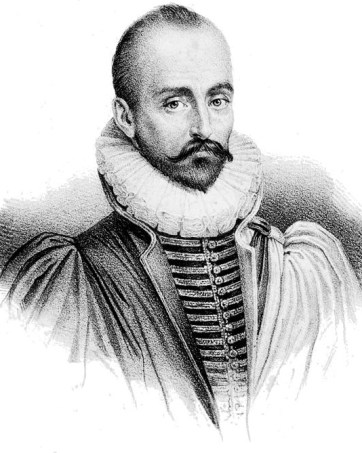
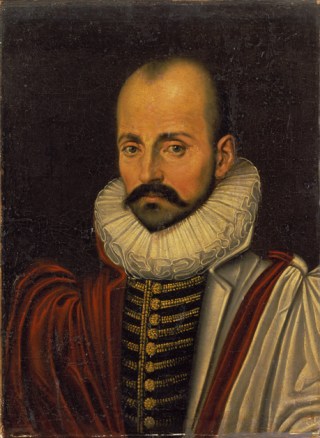
Michel de Montaigne, public domain via Wikimedia Commons

Michel de Montaigne, public domain via Wikimedia Commons

Let us remember and honor the great Michel de Montaigne (Feb 28, 1533 – Sep 23, 1592), a thinker after my own heart, on this anniversary of his birth.

Montaigne was a deeply philosophical thinker, though he never developed a complete philosophical system or moral theory. He invented, or at least popularized, a revolutionary way of writing: the essay. In his essays, he wrote about anything and everything he found interesting enough to observe and think deeply about which was …well, just about everything, especially his inner life. His Essays are a rich source of wonderful philosophical and moral insights. As the Stanford Encyclopedia of Philosophy describes: “… under the guise of innocuous anecdotes, Montaigne achieved the humanist revolution in philosophy. He moved from a conception of philosophy conceived of as theoretical science, to a philosophy conceived of as the practice of free judgment’. Judgment, in this sense, involves applying both our cultivated moral sense and our reason, enriched with knowledge, to navigating the complexity and variety of situations we face throughout our lives; it also refers to the expansive, tolerant attitude we should display towards each other and towards the whole of reality.

While Montaigne highly valued education, he also recognized that it can be overemphasized to the detriment of learning from our own experiences. In his day, education often consisted largely, even mostly, of rote memorization of a vast quantity of facts. This learning method can stifle our ability to exercise practical judgment and serve to blunt social skills as well, preventing us from learning from and about each other, which is essential for cultivating moral understanding. We should learn as much about the world and each other as possible, Montaigne thought, through interpersonal interaction as well as through more formal types of education.

Montaigne also thought that sometimes, our big, smart brains can even hinder our quest for wisdom. For example, we can become ashamed, insecure, even hateful of our own bodies when we contrast the refinements of education and the arts to the material, often messy, even disgusting reality of caring for the body and satisfying its needs. This distaste for our bodies is ungenerous and ungrateful, said Montaigne, considering how we rely on our bodies for so much. In fact, even to this Catholic Christian man who believed in the soul, we are our bodies in an essential way. Our bodies are much more than just meat that our souls inhabit, they are intimate partners of souls, and together, they comprise whole human beings. As such, our bodies deserve our compassion, gratitude, love, and respect.

Our big brains can make also make us too proud, unable to recognize wisdom in humble or unexpected places. Those of little or no education, Montaigne maintains, sometimes display more wisdom than the most rigorous scholar. This includes animals, who, especially, are sometimes wiser than we are; for example, they live their whole lives with the natural, unembarrassed, proper attitudes towards their own bodies that allows them to unapologetically enjoy the pleasure of being alive. Montaigne believed that we should learn from them and imitate them in these respects. Those who have the most wisdom to teach us, then, can come from all walks of life, and the wisest person will be receptive to the lessons that can be learned anywhere.

Furthermore, we shouldn’t limit our exposure merely to our own cultures, but should learn about as many other cultures and beliefs as possible. Montaigne, like Confucius, believed that before you can be a philosopher or a moral theorist, you must first be an anthropologist. A wide-ranging education and exposure to the world has two major advantages. First, the information you have to work with will be much more vast, your scope much wider, than if you merely stuck to the received wisdom of your own culture. Secondly, you will cultivate in yourself the very virtues that characterize the wise and moral person: tolerance, benevolence, respect, kindness, generosity, understanding, and so forth. Conversely, narrowness of outlook and xenophobia lead to hatred, violence, and so on, as the horrific stories coming back from the conquest of the New World made him all too aware. Montaigne believed we shouldn’t base our attitudes about right and wrong on habit, which is morally lazy and which a narrow education can easily lead us to do; rather, we should temper our moral attitudes with reason, and our reason, in turn, should be informed by an expansive and ever-expanding body of knowledge.

michel-de-montaigneThis can make Montaigne seem like a moral relativist, but I don’t think that this is so. He was a committed Catholic, which seems to rule that out. Yet he did recognize that some things society traditionally recognized as wrong are in fact both bad and good, sometimes one or sometimes the other depending on the circumstances, sometimes both at the same time. For example, consider drunkenness. It can be bad, such as when it gets you fired or leads you to violence. But, it can also be good, such as promoting sociability or artistic disinhibition. Montaigne recognized that if there are universally true moral maxims, they’re likely to be few. Rather, his approach to philosophy is a skeptical one: he recognized that an attitude of uncertainty and doubt is a fruitful one for gaining wisdom. When you don’t easily accept the first easy answers that come along, when you’re always waiting for more information to come in, when you generally accept that there’s a possibility you are wrong, you are practicing a wise skepticism; otherwise, you cheat yourself out of the opportunity to learn.
Ethically, Montaigne espoused some behaviors as universally preferable: those that are inspired by tolerance, joyfulness, sociability, generosity, benevolence, curiosity, a good-humored attitude towards other people and their varied ways of living, and so on; he specifically denounced cruelty and narrowness in thinking and feeling. He described his ethical theory not by outlining a rigorous system, however, but by enacting and describing a moral attitude that inspired moral behavior in others. In sum, he may or may not have been a relativist when it comes to a specific theory or set of maxims, but he was definitely not relativistic in the overarching value he placed on the art of being a good, complete human being, and on promoting the same in others.

Montaigne’s Essays demonstrate that the most well-reasoned advanced moral theory may never be quite as convincing, effective, or influential when spelled out as that which is lived out. Montaigne showed us how we can all be philosophers, how we can live ethically, and how we can discover it all for ourselves.

Philosophers, if they’re doing it right, will be the happiest of all people since philosophy can and should be a joyful enterprise, and we should all be philosophers.

Learn more about this great master of introspection here:

Essays ~ by Michel de Montaigne

Me, Myself, and I: What Made Michel de Montaigne the First Modern Man? ~ by Jane Kramer for The New Yorker

Michel de Montaigne ~ by Marc Foglia for The Stanford Encyclopedia of Philosophy

Michel de Montaigne ~ Melvin Bragg discusses Montaigne’s life and thought with David Wootton, Terence Cave, and Felicity Green (my Intellectual History advisor!) for the BBC’s In Our Time

Michel de Montaigne ~ from The Book of Life

Michel de Montaigne (1533—1592) ~ by Christopher Edelman for Internet Encyclopedia of Philosophy

Michel de Montaigne (1533-1592) ~ by Terence Green for Philosophy Now

Michel de Montaigne: French Writer and Philosopher ~ by Tilde A. Sankovitch for Encyclopædia Britannica

Montaigne on Death and the Art of Living ~ by Maria Popova for Brain Pickings

Can We Have More Than One Friend? According to Montaigne, No ~ by Manuel Bermudez

Philosophy: A Guide to Happiness – Montaigne on Self-Esteem ~ by Alain de Botton

*A version of this piece was previously published at Ordinary Philosophy

~ Ordinary Philosophy is a labor of love and ad-free, supported by patrons and readers like you. Any support you can offer will be deeply appreciated!

Happy Birthday, Jeremy Bentham!

Jeremy Bentham's Auto-Icon at University College London, 2003 by Michael Reeve, GNU Free Documentation License Version 1.2

Jeremy Bentham’s Auto-Icon at University College London, photo 2003 by Michael Reeve

Jeremy Bentham, the great English moral and legal philosopher born on February 15, 1748, was a very strange man. A brilliant one, but strange nonetheless. He was a precocious child and advanced in his studies very early, finding Westminster and Queen’s College at Oxford too easy and therefore rather boring. He was trained as a lawyer but decided not to practice law after hearing William Blackstone’s lectures. Blackstone’s treatise Commentaries on the Laws of England is still considered one of the most authoritative and foundational works on English law, so for a guy to consider them so flawed that he’d want to give up his career seems a bit… well, presumptuous. But he demonstrated his own great intellectual capacities through his lifetime of prolific writing, mostly on legal theory, moral philosophy, and social reform. In the end, he earned the right to a certain degree of arrogance.

Bentham is generally considered the father of utilitarianism, the moral philosophy which judges anything that can be judged as right or wrong, good or evil, according to how conducive it is to ‘the greatest happiness of the greatest number.’ Utilitarianism, then, is a type of consequentialism, which holds that a thing is right or wrong based on its consequent harms or benefits. Bentham did not invent the principles of utilitarianism; he discovered them in the writings of Cesare Beccaria (who authored the ‘greatest happiness’ axiom), David Hume, Claude Helvétius, and Joseph Priestley. But he spent a lifetime synthesizing these principles into a cohesive, fleshed-out moral philosophy founded on utility, whether a law or action increases or decreases pleasure or happiness. This principle can seem too subjective to apply to matters of law or public policy; after all, what makes one happy can make another less so, and how can we determine whether the happiness of one is greater, or more important, than the happiness of another? Bentham, careful and systematic in his approach to this as he was to everything else, devised his ‘Felicific Calculus’ to solve this problem. Bentham believed that pleasure, a natural phenomenon like everything else in the world, was likewise quantifiable. He hoped his method of assigning unitary measurements to pleasure, then determining their relative values through mathematics, was a way to make his moral philosophy practicable, conducive to real social reform.

To many, the idea that pleasure and happiness could be reduced to mathematical formulas seems very strange; some think he may have had Asperger’s syndrome or another cognitive feature that caused Bentham to view emotion with such scientific detachment. But as socially awkward as he and his ideas often were, his utilitarian philosophy led to him to some moral conclusions that we now consider extremely progressive and much more caring than those typical of his times. For example, he was an early proponent of racial equality, women’s rights, and animal rights. As to animal rights, just as for all classes of human beings, considering only the pleasure and pain of some sentient beings and not others when it comes to morals is unscientific and therefore unjustifiably biased. After all, animals, like all human beings, have feelings too, and their feelings are just as important to them as ours are to us. So, a moral system based on feelings must consider all equally important, so that one unit of pig happiness, for example, is just as morally significant as one unit of human happiness. The only correct way to balance them out in matters of morals and public policy is to apply the Felicific Calculus to determine how much pleasure or pain each experience in any given situation.

At the end of his long and productive life, the committed naturalist arranged to have his body publicly dissected, both for scientific inquiry and to provide an example to others; he believed that a perfectly good body should never go to waste and that everyone should donate their body to science. He also arranged to have his head and skeleton preserved, dressed in his clothes and stuffed to look as lifelike as possible, to be displayed in some public place. The preservation of Bentham’s head, with its glass eyes he had purchased some years before, left much to be desired; the expression it ended up with creeped people out. So his Auto-Icon, as he called it, sits today in its glass case at University College, London with a nice lifelike wax head in its place. His real head is safely stored away where students, who had stolen it over the years in a series of pranks, can no longer get to it.

Read more about the brilliant and eccentric Bentham at:

Jeremy Bentham – by James E. Crimmins for The Stanford Encyclopedia of Philosophy

Jeremy Bentham – University College London website

Jeremy Bentham on the Suffering of Non-Human AnimalsUtilitarianism.com

~ Ordinary Philosophy is a labor of love and ad-free, supported by patrons and readers like you. Any support you can offer will be deeply appreciated!!

Happy Birthday, Frederick Douglass!

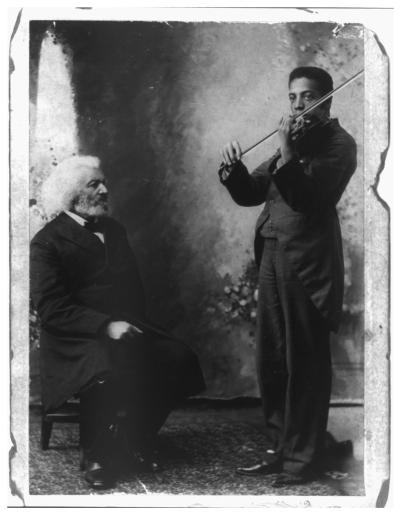
Frederick and Joseph Douglass, from the Library of Congress archives, via Lion of Anacostia b

Frederick Douglass and his grandson Joseph, concert violinist who inherited his love of music from his grandparents, from the Library of Congress archives

Let us remember and salute the great human rights activist and Enlightenment thinker Frederick Douglass, on this near-anniversary of his birth.

The exact day of Douglass’ birth is unknown. We know the year, 1818, from his entry in the slave ledger of his master Aaron Anthony. His likely birth month, February, is an estimate. In his later years, Douglass chose to celebrate his birthday on February 14th because, he said, his mother Harriet once called him ‘my Valentine’.

Douglass is among my favorite people that ever inhabited the earth. He was born into slavery in Maryland, was mostly self-educated, escaped to freedom when he was 20, married the loving and strong Anna Murray, and became one of the most eloquent and influential advocates for civil rights in American, and, indeed, world history. He was an author, orator, preacher, activist, statesman, patriarch, musician, and world traveler. I had the joy of following the life and ideas of this motivated, resourceful, brilliant, complicated, and incredibly fascinating person through the United States, and now I’m continuing my research in Scotland, where he spent a relatively brief but very influential part of his life.

Here are a few links to some articles and works of art by, about, and inspired by the great Frederick Douglass, including my own work.

7 Haunts of Frederick Douglass in New York City ~ by Amy Cools for Untapped Cities

Frederick Douglass ~ by Melvyn Bragg and guests Karen Salt, Nicholas Guyatt, and Celeste-Marie Bernier for In Our Time

Frederick Douglass – by Ronald Sundstrom for Stanford Encyclopedia of Philosophy

Frederick Douglass  ~ Melvin Bragg discusses the life and ideas of Frederick Douglass with Karen Salt, Nicholas Guyatt, and Celeste-Marie Bernier for In Our Time

Frederick Douglass: In Progress ~ by Leigh Fought

Frederick Douglass Papers ~ at Indiana University-Purdue University Indianapolis

Frederick Douglass Papers ~ at the Library of Congress

Frederick Douglass: United States Official and Diplomat ~ by the Editors for Encyclopædia Britannica

Frederick Douglass and a Valentine, Emily Dickinson and a Snake – by Rob Velella for The American Literary Blog

Frederick Douglass in Washington, D.C.: The Lion of Anacostia – by John Muller

Frederick’s Song– Douglass’ words arranged and set to music by SayReal and Richard Fink

From Oakland to Maryland, New York, and Massachusetts I Go, in Search of Frederick Douglass – History of ideas travel series by Amy Cools for Ordinary Philosophy

Interview with Ken Morris, Anti-Slavery Activist ~ by Ken Morris and Amy Cools for Ordinary Philosophy Podcast

Interview with Leigh Fought on Anna and Frederick Douglass ~ by Leigh Fought and Amy Cools for Ordinary Philosophy Podcast

Frederick Douglass in the British Isles ~ History of ideas travel series by Amy Cools for Ordinary Philosophy in Scotland, England, and Ireland, 2018-2019

*A version of this piece was previously published in Ordinary Philosophy

~ Ordinary Philosophy is a labor of love and ad-free, supported by patrons and readers like you. Any support you can offer will be deeply appreciated!

Happy Birthday, Charles Darwin!

A Charles Darwin display at the Kelvingrove Museum, Glasgow, Scotland

Let’s remember and salute Charles Darwin, the thinker who came to understand the basic mechanism by which we and all other species on earth come to be.

Born on February 12, 1809, Darwin was the grandson of Enlightenment physician, poet, and botanist Erasmus Darwin, who posited his own theory of evolution, as had many others, who observed its effects but had not successfully formulated a theory to explain how it worked. Given that his father was also a physician, it seemed natural that young Charles would take up the family profession. He studied medicine at the University of Edinburgh (my university!) from the age of 16 to 18. Darwin would have attended classes in the original building on South Bridge, now called the Old College, beautifully designed by Robert Adam (it didn’t yet have the dome it has now). While he loved the excellent science education he received there, Darwin decided being a physician was not for him.

Old College Building on South Bridge, University of Edinburgh, where Darwin attended classes

His father then sent Darwin to Christ’s College, Cambridge, with the idea that he could be a minister instead. Darwin did well at Christ’s College, but it was his pursuits as a naturalist that really captured his imagination and into which he poured his best efforts. After he completed his Bachelor of Arts degree in 1831, he continued his scientific study of animals and geologic formations. When the opportunity arose to travel to South America on the HMS Beagle later that year, Darwin took it, and spent the next five years gathering specimens and making detailed notes of his observations of the natural world. Among the wealth of valuable scientific information he amassed, Darwin’s observations of the appearance of apparently designed adaptations in living things; fossils of known and unknown animals sometimes found in the most unexpected places (remains of ancient sea life embedded in rocks at high elevation?!?); and the incredible amount of waste and suffering throughout the natural world, from wasps who laid their eggs in living caterpillars so that the growing grubs would devour them slowly from within to the genocide and slavery routinely practiced against the native people there, gave him much to think about.

Finches in a Charles Darwin display case at the Kelvingrove Museum, Glasgow, Scotland. The adaptations of finch beaks to food sources provided Darwin a perfect example of how natural selection works to produce the appearance of design.

With his experience broadened, his understanding deepened, and his body strengthened by the rigors of his expeditions, Darwin returned to England a wiser, stronger, more serious man. The first publications of his findings, together with his friendships with influential scientists such as the geologist Charles Lyell, made him famous. Darwin had found his profession. He began to pull together the evidence of his own eyes with the work of other naturalists and scientists to formulate a theory that would explain it all. What would explain a world of living things replete with beauty and waste, some joy and contentment but far more suffering, animals marvelously wrought but more often than not hidden from the human eye either by remoteness, incredibly tiny size, or time through extinction? It was the work of Edinburgh’s own self-made geologist James Hutton, popularized and developed by Lyell, which gave Darwin one key to the mystery. Since it had become clear that the earth was indeed ancient, not young as popular interpretations of the Bible would have it, species had plenty of time to adapt and change to their environment as needed, just as the earth itself had plenty of time to form as it is.

Hutton’s Section near the foot of Salisbury Crags, Holyrood Park, Edinburgh, Scotland. On my twice-weekly hikes, I regularly pass by this rock formation. It sparked James Hutton’s realization that the earth must be ancient indeed to give the rocks time to layer, fold, and bend as they do here.

Another key to the mystery was the mass suffering and death Darwin observed. While he mourned it, it was no doubt a comforting realization that it was not designed into the natural world by a divine mind that he was nonetheless bound to worship. Rather, Darwin realized that the living things that could not survive in the environment they found themselves in left those better equipped to do so to reproduce and pass on their adaptations. This realization, this theory of natural selection, Darwin recognized to be explosive as well. It took him about twenty years of careful thought and self-questioning to publish this theory. He knew, for one, that his theory went against people’s natural squeamishness and desire to think of the earth as a friendly home. More than that, Darwin knew perhaps better than anyone what a profound challenge this theory was to orthodox Christianity. But when another naturalist, Alfred Russel Wallace, independently arrived at the same theory, Darwin was galvanized to publish his findings in 1859. His On the Origin of Species went on to become one of the most influential works in the history of thought.

Another Charles Darwin display at the Kelvingrove Museum, Glasgow, Scotland

Darwin’s life is a fascinating one in so many more ways outside of the scope of this piece. To learn more about this husband, father, writer, and restless seeker for truth, I recommend the excellent works I’ve linked to below.

Before that, one more thing: I’ve always hated the term ‘Social Darwinism’ because I think it’s terribly misleading. It refers to the idea that societies can be structured so as to direct evolution in some way, for example, by allowing the weakest or least able, as defined by that society, to die off so that the strongest and most able are the most likely to survive and reproduce. But Darwin did not espouse that idea, nor do scientists now understand him to have implied it. For Darwin, as for those who understand the theory of evolution by natural selection as an explanation of a natural process rather than a policy of action, the reason why human beings have become such a successful species is precisely our capacity for empathy and solidarity. It’s the fact that we care about each other as individuals, that we help each other survive and develop our unique capacities that makes us so adaptable, so creative, so able to get by in such a wide variety of environments. Social Darwinism, then, is contrary to Darwin’s own theories about human evolution. Eugenics, ‘survival of the fittest,’ and other such ideas that later thinkers claimed as part of Darwin’s intellectual legacy are not, in fact, his, or ideas that he would endorse given what he actually wrote. The problem with putting Darwin’s name in the term ‘Social Darwinism’ is that it wrongly implies that it was his idea, and therefore leads many to think of him as a cruel and heartless thinker, responsible for ideas which have caused much suffering and death. He was nothing of the sort.

Charles Darwin’s gravestone in Westminster Abbey, London, England. I was naughty and snuck in a quick photo, though photography is not allowed in the city’s places of worship.

Charles Darwin placard at the Kelvingrove Museum, Glasgow, Scotland

Learn more about this most influential of scientists and thinkers:

Charles Darwin: British Naturalist ~ by Adrian J. Desmond for Encyclopædia Britannica

Charles Darwin: Evolution and the Story of Our Species ~ iWonder at the BBC

Charles Darwin: various articles ~ by Maria Popova for Brain Pickings

Darwin Correspondence Project ~ at the University of Cambridge website

Darwin’s Influence on Modern Thought ~ by Ernst Mayr for Scientific American, November 24 2009

Darwin Online ~ read Charles Darwin’s books, articles, and other publications online

The Evolution of Charles Darwin ~ by Frank J. Sulloway for Smithsonian Magazine, December 2005

The Origin of the Thesis ~ by Claire Pettitt for The Times Literary Supplement

*A version of this piece was previously published at Ordinary Philosophy

Ordinary Philosophy and its Traveling Philosophy / History of Ideas series is a labor of love and ad-free, supported by patrons and readers like you. Please offer your support today!

Happy Birthday, Simone Weil!

Simone Weil via Wikimedia Commons, public domain

Simone Weil, born on February 3, 1909, lived only thirty-four years. She died as an unintentional martyr to her ideals on August 24th, 1943; she contracted tuberculosis when her overworked, underfed, exhausted body, working for the French Resistance in England, could not fight off disease. As she had done before, Weil refused to eat more than wartime rationing allowed to others, or to accept extra medical help. In a sense, allowing herself to become so run-down that she collapsed and died soon thereafter seems inconsistent with one of her central beliefs: that morality is centered on obligations to one another. When she debilitated herself through overwork and malnourishment, she rendered herself unable to fulfill those obligations she believed in. Yet in working for the benefit of others among those doing the same work, and demanding of herself that she do so under the same hard conditions that many others had to struggle in, Weil continued her long practice of putting her ideals in practice and in the process, testing them. The idealist, deeply spiritual Weil, in this way, often acted as a sort of empirical ethicist.

Weil was born to well-to-do, agnostic Jewish parents who provided her a very comfortable, secure childhood. Her high level of intelligence was evident from a very early age, and she received an excellent education. She surpassed the brilliant Simone de Bouviour in her École Normale Supérieure postgraduate exams. Yet Weil resisted employment as a full-time academic; she was intensely interested in common human concerns such as labor rights and politics. While teaching philosophy, Weil took time to travel to Germany to help her determine why Nazism took such hold there, and donated much of her time and skills to groups who supported working people. She left teaching in 1934 to work in a factory for some months, to observe conditions for unskilled working women. Weil then followed her activist instincts into joining Spain’s Republican efforts against the far-right, authoritarian Francisco Franco’s revolt in the Spanish Civil War, but an injury rendered her unable to complete her combat training, so she lent her support through her primary skill, writing. After she and her parents fled the Nazis first from Paris (she worked for a time as a farm laborer in rural France during this period), then from France, Weil joined Charles De Gaulle’s Free France movement from their London center of operations. Weil’s practice of observing work conditions and political movements first-hand undoubtedly contributed greatly to the force of the ideas she drew from such experiences.

Throughout all of this, Weil had many mystical experiences and converted to Christianity, with many of her beliefs overlapping Catholic doctrines, However, she refused to be baptized or ally herself with any one sect, prioritizing personal spiritual transformation over ritual. Weil wrote creatively and deeply on spirituality and theology; among her most original ideas was that the silence of God was necessary for creation to happen; he wasn’t dead, despite all appearances, he was just absent from the places where creation happens.

Weil had also long thought deeply about the liberal philosophy of human rights, and came to the conclusion that it was an ultimately empty concept on its own. Since it was not centered on a robust concept of human obligations, it was ultimately unworkable: rights, so conceived, could be and often were bought and sold, and while non-interference can mean rights are not violated, this means little when we need support that human rights theory doesn’t necessarily entail that we give to one another. It was only a commitment to fulfilling one’s obligations to others that well-being, bodily integrity, and every other aspect of each person’s humanity can be respected and protected. Weil put this idea to the test by working at that auto factory, as described above, where she observed the effects of the mechanical process of mass assembly on herself and other workers; to her, it appeared dehumanizing, harmful to the moral and spiritual self, instilling docility. In this and other institutions of a rights-based, private-property-centric society, Weil saw that aspects of humanity were rendered into something tradable in the marketplace, and interpersonal relations were reduced to contractual agreements, real or implied. Such a system allows for justice to be dispensed differently, or for differential access to basic human needs, according to one’s ability to pay. While I believe it’s true that liberal societies’ commitments to universal human rights have brought about a level of peace, prosperity, and individual liberty unparalleled in all other types of society throughout history, Weil’s ideas provide important insights into how a liberal system based on individual human rights might not consistently promote human well-being and personal fulfillment unless it is balanced by a robust ethic of interpersonal obligations.

Learn more about the spiritual philosopher and activist Simone Weil, who Susan Sontag called ‘one of the most uncompromising and troubling witnesses to the modern travail of the spirit,’ at:

‘God Isn’t Dead, He’s Silent’: Simone Weil Dies, Very Young ~ by Nettanel Slyomovics for Haaretz

Gravity and Grace ~ by Simone Weil

Should We Still Read Simone Weil? ~ by Heather McRobie for The Guardian

Simone Weil ~ by A. Rebecca Rozelle-Stone and Benjamin P. Davis for The Stanford Encyclopedia of Philosophy

Simone Weil ~ by Susan Sontag for The New York Review of Books

Simone Weil articles, assorted ~ by Maria Popova for Brain Pickings

Simone Weil: French Philosopher ~ at Encyclopaedia Britannica

What We Owe to Others: Simone Weil’s Radical Reminder ~ by Robert Zaretsky for The New York Times‘ Stone blog

~ Ordinary Philosophy is a labor of love and ad-free, supported by patrons and readers like you. Any support you can offer will be deeply appreciated!