“Held in Trust by History:” The Intellectual Activism of Lerone Bennett Jr., by Christopher Tinson

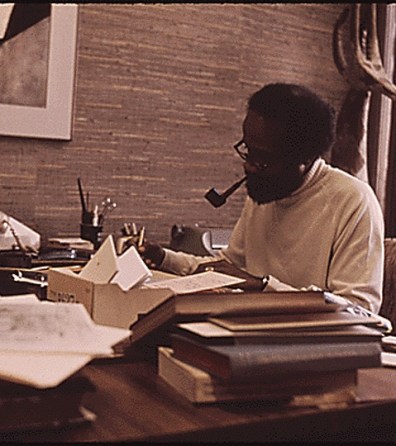
Lerone Bennett, Jr, by John H. White for Series DOCUMERICA, Oct 1973, public domain (cropped)

On the morning of December 11, 2016, a notice in the Chicago area news read as follows: “Author Lerone Bennett Found Safe After Being Reported Missing.” The 88-year old scholar and journalist had decided to go for an early morning walk, without telling anyone. According to the notice, Bennett had been located hours after he had gone missing. While the news report provided few details about the incident, it indicated that Bennett was “the author of multiple books” who had “previously worked as an editor at JET and Ebony Magazine.” The brevity of this note calls attention to two important facts: that Bennett is not dead as many have assumed, and that he is still largely known for his work at Ebony and for the publication of two critically acclaimed texts even though he produced over ten. While this notice locates Bennett, it fails to account for the extraordinary impact of this important figure.

Lerone Bennett, Jr.—social historian, Black Studies architect, and intellectual activist—spent over four decades at Ebony magazine. Ebony, arguably the premier African American lifestyle magazine of the 20th century, was founded by John H. Johnson in 1945. In addition to Ebony, Bennett also maintained a full organizational life, holding memberships and associations in such organizations as the short-lived Black Academy of Arts and Letters, the Race Relations Information Center, the Institute of the Black World, the Association for the Study of Negro Life and History, and the Martin Luther King, Jr. Memorial Center. In 1965, John Henrik Clarke was the first to announce Bennett as a social historian and historian Pero Dagbovie revisited Bennett’s influence on Africana Studies in an article in the Journal of Black Studies. Renewing the interest in Bennett’s life opens us to several objectives: to gain a sense of African American historical expertise and craftsmanship, to achieve an expansive definition of intellectual history and the social function of the historian, to contextualize Bennett’s productivity, motivations, and range as a thinker, to achieve a view into his philosophy of life, and lastly to arrive at the creatively disruptive and reparative dimensions of history, all of which are discernible in Bennett’s robust body of work.

Born and bred in the south, Bennett moved to Chicago after a stint at the Atlanta Daily World and was named Associate Editor at Ebony in 1954. Bennett’s time at Ebony was unique. Starting out slowly, he later emerged as one of Johnson’s trusted advisors—he eventually co-wrote Johnson’s autobiography. He used the prestige of one of America’s most successful black entrepreneurs to teach and disseminate black history. The common association of Bennett with the popularizing of history reduces his impact. His record shows that far from watering down the African American experience in the United States, he sought to forge a reparative, justice-centric, visionary account of past human endeavor and the stakes of social disequilibrium. For Bennett, history looks backwards and forwards simultaneously. A brief survey of Ebony issues over this period reveals several principal social concerns, including: African American struggles over rights, passionate interest in the decolonization of the African continent, the uncovering or rediscovering key contributors to Africana intellectual life, and measuring the growing discontent with the prospects of American democracy. On one hand, Ebony emphasized high-life aspiration and on the other it cultivated a devoted and deeply engaged readership. Throughout the 1960s Bennett published a broad range of essays commenting on African American politics, culture, and Afro-diasporic history. Virtually no subject escaped Bennett’s pen. Among the writings in this period are essays on African independence, civil rights militancy, popular culture, and other histories that comprised the series “Pioneers of Protest.”

However, Bennett’s career took off upon the publication of Before the Mayflower in 1962, which began as a series of Ebony essays in 1961. The book was an immediate sensation. Mainstream press outlets such as the Chicago Tribune favorably reviewed the book. The Tribune also carried book reviews written by Bennett while he served as associate editor at Ebony. Historian and activist John Henrik Clarke’s review essay for the black left periodical Freedomways in 1965 locates Bennett in relation to the Civil Rights upsurge carried out by “A new generation of restless black Americans.” For Clarke, Bennett was part of a new generation who, like himself, could be called participant historians. In other words these were historians who not only documented history, but were themselves poised and principled activists in their own regard. Clarke offered readers a glimpse into Bennett’s background before diving into a review of key sections of Before the Mayflower and several of his seminal Ebony articles. Accompanying the piece was two of Bennett’s poems, showcasing a multitalented intellect.

The great irony of Bennett’s career, perhaps, is found in his relationship with Ebony, a magazine known for its dependency on advertising that peddled skin lighteners, platform shoes, cigarettes, scotch, the latest styles, and wigs. Bennett was bent on using the popular magazine of the black high life as a reputable platform to document and forecast black struggle, and he succeeded. Still, this did not mean he went unquestioned about what some perceived to be a contradiction.

Without question, Ebony was a critical platform for Bennett. In the front matter of every book he published for JPC, he earnestly thanked Johnson for allowing him the massive platform, time, and resources to research and write. He could reach larger audiences than professors at exclusive colleges or universities, but he could also keep relationships with those institutions that had no effect on his work. Ebony thus emerges as a premier, if unlikely, site of black cultural knowledge production. In this sense Ebony was a different kind of public institution. Bennett certainly benefitted from this unique arrangement and never took it for granted. Not only could he be in the thick of key debates as sage and journalist and historian, but also Ebony’s book publishing gave him a direct line to the national book networks. Among their many publishing pursuits, Bennett and Johnson had plans for an Ebony Encyclopedia.

Bennett’s approach to publishing was methodical and systematic. Lectures and speeches became articles, articles became books, or anthologies. Ebony therefore was unparalleled in its disruption of American consumer trends and U.S. based intellectual work. Bennett had the best of both worlds in terms of institutional credibility among all sectors of the black community. Bennett’s work ethic and standards of excellence had earned him the trust of John H. Johnson. The two carved out what was an enviable relationship. Bennett had access to the publishing mogul, and Johnson needed Bennett’s intellectual heft to bolster the magazine’s reputation and commitment to sincere and earnest coverage of black life beyond the simple demands of capitalist advertising and an aspiring black middle class’s pursuit of the high life. But Johnson was no fool. And although he refused to wear his politics on his sleeve, Bennett viewed Johnson as a sincere and chief advocate of black life. Effectively, Bennett was the bridge across a full spectrum that stretched from a petty capitalist, black bourgeoisie, churchgoing, assimilationist community, to grassroots militants and middle- and working class intellectuals with nationalist proclivities, alongside full expressions of black elite aspiration. No matter the segments of the black community and their ideological shadings or capitalist accouterments, in Bennett’s view, their fates were linked, and, moreover, they all had to answer the call of history and the demands of time.

At the turn of the 21st Century, Bennett remained active. On April 26, 2000, Bennett testified in front of the “Joint Hearing of the Finance and Human Relations Committees of the Chicago City Council on Reparations for African-American Slaves and Their Descendants.” The sage historian took full advantage of the opportunity to underscore the unpaid debt long past due. Interestingly, atop the typed speech, in Bennett’s cursive handwriting are the words, “Held in Trust by History.” It was as if Bennett was reminding himself of the duty to once again shine due light on the evidence and make the case plain.

Like W.E.B. Du Bois and Carter G. Woodson, he showed a commitment to “living history” and modeled a kind of public intellectualism that was both strident and sensitive. His time at Ebony suggests that a popular media platform could just as easily become a classroom. For Bennett, history was not just a discipline–it was obligation, memory, and art. He was moved by the opportunity, calling, and challenge of doing good work on behalf of a people’s struggle. Lerone Bennett, Jr. no longer needs an “All Points Bulletin/Missing Persons Report.” He has been here the whole time.

This piece was originally published at The African American Intellectual History Society (AAIHS) Blog

Christopher Tinson is an Associate Professor of Africana Studies and History at Hampshire College. His interdisciplinary research and teaching focuses on the intersections between Africana radical traditions, Ethnic Studies, critical media studies, incarceration, and community-based education. His book on Liberator magazine and black activism of the 1960s, entitled Radical Intellect, is forthcoming. (Bio credit: AAIHS)

~ Ordinary Philosophy is a labor of love and ad-free, supported by patrons and readers like you. Any support you can offer will be deeply appreciated!

*All views and opinions expressed by guest writers are their own and do not necessarily reflect those of Ordinary Philosophy’s editors and publishers

Steinbeck Retreat, Monterey Bay and Salinas Valley Region of California, March 4th – 9th, 2017

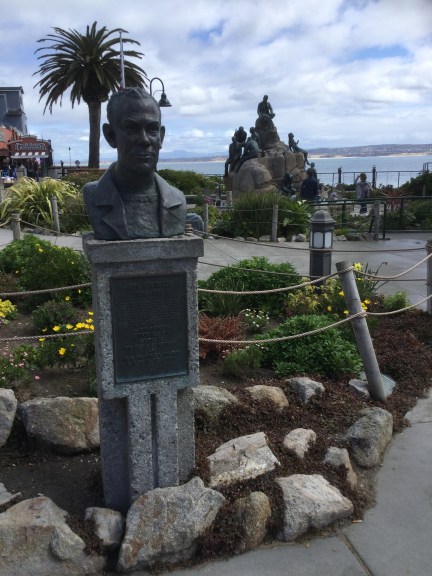
Bust of John Steinbeck and sculptures of the local people who inspired Cannery Row, Monterey, CA

For several days this last week, I’ve been on a literary retreat hosted by Clay Jenkinson, Becky Cawley, and Russ Eagle. You may remember Clay and Becky from the account of my last retreat with them at Lochsa Lodge in the Bitterroot Mountains in January. Clay is a humanities scholar who has been very influential in my own study and thought for the last few years, Becky has worked with Clay for many more years than that co-creating historical, cultural, and literary tours throughout the United States, and Russ Eagle has made Steinbeck a special study for many years as well. At Lochsa Lodge this winter, we read and discussed Walden Pond and Henry David Thoreau’s concept of living deliberately, as well the history of the Native Americans of the Great Plains and the wars of the United States’ expansion into their territories through the 1800’s, and the echoes of those wars and that expansion in the DAPL fight today.

This tour took us to Monterey, Pacific Grove, the Salinas Valley, and the mountains and coastline of this beautiful region of California following the life and work of the great American writer John Steinbeck. It was a special joy for me that this retreat was all about history, literature, and gorgeous scenery from my home state of California. I had read and loved Steinbeck’s novels especially when I was in my late teens to mid-twenties but it had been far too long since I revisited his work. I re-read some of his novels for this occasion, and some were new to me. I found a rich source of beauty and wisdom much more revealing to me with the added benefit of a decade and more of life-years.

Interior of Rocinante, the customized camper truck from John Steinbeck’s Travels With Charley

We read Travels with Charley, Tortilla Flat, Cannery Row, Of Mice and Men, and The Pearl; selections from The Red Pony, The Log from the Sea of Cortez, and East of Eden (though most of us read the latter in full since it’s a general favorite); and read and discussed most in depth what Clay, myself, and many others consider his greatest work, The Grapes of Wrath.

The Grapes of Wrath, as you may know, is the story of the epic journey of the Joad family as they flee the loss of their crops and their family home in the Dust Bowl disaster in Depression Era America. The Joads are a fictional family but their struggles are closely based on the struggles of actual immigrants as they face the life of much-maligned, much-neglected, and much-abused refugees from drought and debt in their own nation. Some members of the clan die in the course of their journey, some strike out on their own, a family friend who accompanied them is murdered by a vigilante trying to break up the worker’s rights movement that he had joined, and one becomes a fugitive after he kills his friend’s assassin. Throughout the novel, Ma Joad is transformed from mother to matriarch as she holds the family together through the terrible hardships they suffer in search of work and a new home. She’s one of my favorite female characters in all fiction in her strength, courage, integrity, wisdom, generosity, and great heart. Others in the family are ennobled and transformed as well: the ex-convict, fugitive son Tom joins the worker’s rights movement after his friend is martyred; the disillusioned, tortured loner and binge drinker Uncle John works until he nearly drops to help save the family from a flood and sends a stillborn infant downstream in a crate, Moses-on-the-Nile fashion, to alert others of the migrant’s wrongs; and narcissistic, immature daughter Rose of Sharon … well, I won’t spoil the powerful, disturbing, beautiful ending in case you haven’t read it yet.

Bust of Ed Ricketts memorializing the spot where he died in Monterey, CA

Over the course of several days, we toured Monterey and the settings of Steinbeck’s Cannery Row, centered around the character of Doc, modeled on his great friend the charismatic biologist Ed Ricketts, and visited one of Steinbeck’s homes in neighboring Pacific Grove, only several blocks away. We visited the aquarium, housing so much of the marine wildlife which fascinated Steinbeck and Ricketts; walked beautiful Point Lobos, well-loved by Steinbeck and where his family held a memorial service for him and spread some of his ashes; hiked in Pinnacles National Park, not directly associated with Steinbeck but linked to the Gabilan Mountain range which Steinbeck describes in such glowing terms in East of Eden; and, on perhaps my favorite outing of all, we climbed Fremont Peak, as Steinbeck did when on a visit to his old home town in Travels With Charley. Fremont Peak itself is beautiful, its chapparal terrain glowing green from the prolonged rains that rescued California from severe drought this winter and spring, scattered with cloud-gray rocks of the perfect size and grippy roughness to scramble around on, and the view from it is just spectacular: sprawling agricultural fields on one side, Monterey Bay on the other.

The rest of the retreat group spent their last day in Salinas at the Steinbeck Center, the Steinbeck House, and the Garden of Memories where Steinbeck and many of his family members are buried. I didn’t make it to Salinas with the group, having to return to work for the day, but I did visit the Steinbeck Center and House earlier on the first day of the trip since I was free. Unfortunately, I ran out of time to make it to the Garden of Memories before I was due to join the retreat.

I didn’t take many pictures during the trip; I was in retreat mode and in the mood to mostly leave my electronics put away so as to lose myself in the beauty and spirit of these places, unfiltered, unmediated. But I did chronicle my own visit to the Steinbeck Center and the Steinbeck House in Salinas and our day touring Monterey and Pacific Grove. Here are a few photos, below, in addition to the ones above.

It was such a lovely week, and I’m still enjoying the afterglow. Thank you, older, newish, and brand-new Odyssey Tour friends! ‘Til we meet again…

* See my profile of Julia Ward Howe, whose Battle Hymn of the Republic provided the title of The Grapes of Wrath, and which is printed in the opening pages of the novel

*Listen to the podcast version here or on Google Play, or subscribe on iTunes

~ Ordinary Philosophy is a labor of love and ad-free, supported by patrons and readers like you. Please offer your support today!

Main Street, Salinas, CA. According to a sign out front, John Steinbeck ate at Sang’s Cafe, in the white building with the blue trim just to the left of Maya Cinemas

Rocinante, the customized camper truck from John Steinbeck’s Travels With Charley. As you may remember, Rocinante was the name of Don Quixote’s horse. At the Steinbeck Center in Monterey, CA.

Steinbeck House, Salinas, CA, where John Steinbeck was born

Ed Ricketts’ Pacific Biological Laboritories, Monterey, CA. Ricketts was an important figure in Steinbeck’s life and work. Steinbeck also studied marine biology at Stanford, but did not receive a degree there. But not for lack of interest in marine biology or learning in general…

Interior of the downstairs lab area of Ed Rickett’s Pacific Biological Laboratories.

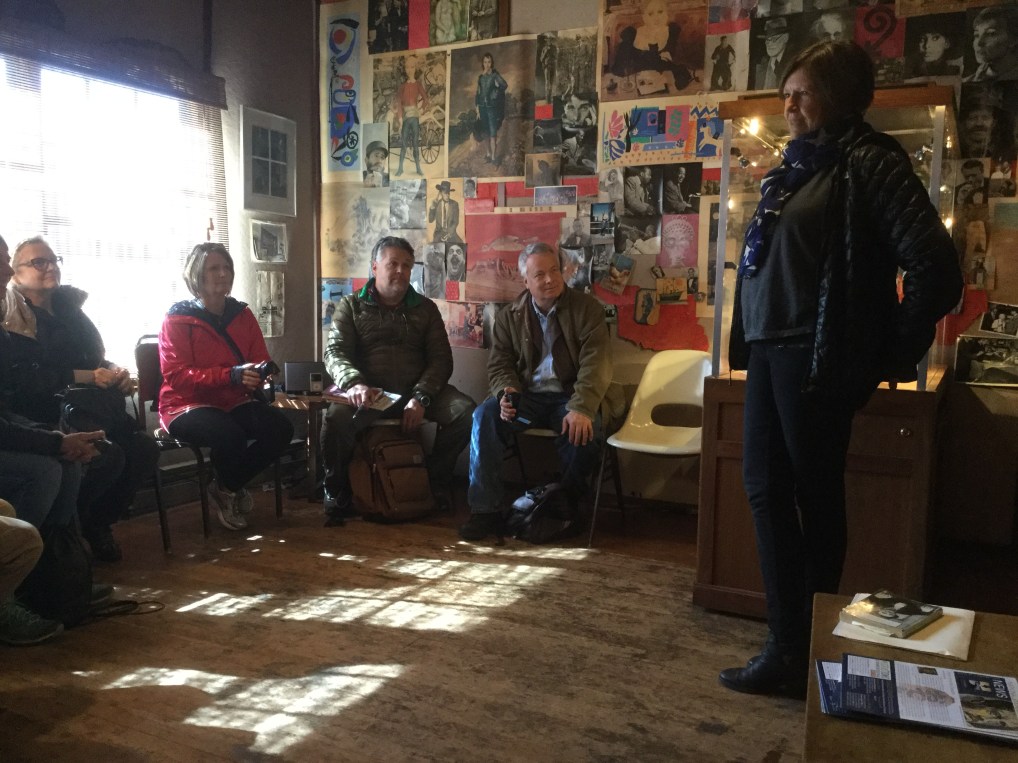
Discussion with Susan Shillinglaw, Steinbeck scholar and writer of books about him and others central to his life and work, upstairs in the Pacific Biological Laboratories, with Clay Jenkinson and Russ Eagle

John Steinbeck’s home and garden at 147 11th Street in Pacific Grove, CA

Monterey and its beautiful Bay with its rich tidepools

Me on Fremont Peak. Thanks for the photo, Larry!

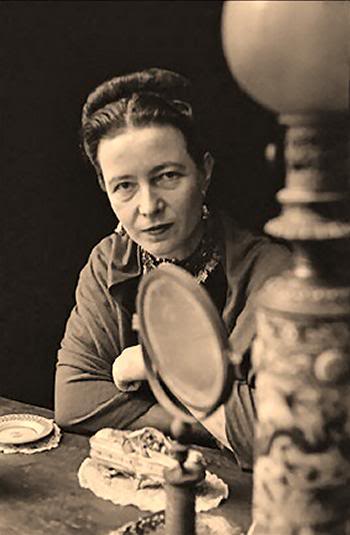
Simone de Beauvoir’s Political Philosophy Resonates Today, by Skye C Cleary

Simone de Beauvoir is rightly best known for declaring: ‘One is not born, but rather becomes, woman.’ A less well-known facet of her philosophy, particularly relevant today, is her political activism, a viewpoint that follows directly from her metaphysical stance on the self, namely that we have no fixed essences.

The existential maxim ‘existence precedes essence’ underpins de Beauvoir’s philosophy. For her, as for Jean-Paul Sartre, we are first thrown into the world and then create our being through our actions. While there are facts of our existence that we can’t choose, such as being born, who our parents were, and our genetic inheritance, we shouldn’t use our biology or history as excuses not to act. The existential goal is to be an agent, to take control over our life, actively transcending the facts of our existence by pursuing self-chosen goals.

It’s easy to find excuses not to act. So easy that many of us spend much of our lives doing so. Many of us believe that we don’t have free will – even as some neuroscientists are discovering that our conscious will can override our impulses. We tell ourselves that our vote won’t make any difference, instead of actively shaping the world in which we want to live. We point fingers at Facebook for facilitating fake news, instead of critically assessing what we’re reading and reposting. It’s not just lazy to push away responsibility in such ways, but it’s what de Beauvoir called a ‘moral fault’.

Since we’re all affected by politics, if we choose not to be involved in creating the conditions of our own lives this reduces us to what de Beauvoir called ‘absurd vegetation’. It’s tantamount to rejecting existence. We must take a side. The problem is, it’s not always clear which side we ought to choose. Even de Beauvoir failed to navigate through this question safely. She adopted questionable political stances: she once, for example, dismissed Chairman Mao – responsible for the murder of over 45 million people – as being ‘no more dictatorial’ than Franklin D Roosevelt. De Beauvoir’s philosophy of political commitment has a dark side, and she personally made some grave errors of judgement, yet within her philosophy, there’s an opening to address this issue.

In The Ethics of Ambiguity (1947) she argues that to be free is to be able to stretch ourselves into an open future full of possibilities. Having this kind of freedom may be dizzying, but it doesn’t mean we get to do whatever we like. We share the earth, and have concern for one another; if we respect freedom for ourselves, then we should respect it for others, too. Using our freedom to exploit and oppress others, or to support the side that promotes such policies, is inconsistent with this radical existential freedom.

With oppressive regimes, de Beauvoir acknowledged that individuals usually pay a high price for standing up to dictators and the tyranny of the majority, but demonstrated concretely – through her writing and political engagement – the power of collective action to bring about structural change. An intellectual vigilante, de Beauvoir used her pen as a weapon, breaking down gendered stereotypes and challenging laws that prohibited women from having control over their own bodies. She authored and signed the Manifesto of the 343 in 1971, which paved the way for birth control and abortion in France. Her most famous work, The Second Sex (1949), sparked a new wave of feminism across the world.

Today more than ever it’s vital to recognise that freedom can’t be assumed. Some of the freedoms that de Beauvoir fought so hard for in the mid-20th century have since come under threat. De Beauvoir warns that we should expect appeals to ‘nature’ and ‘utility’ to be used as justifications for restrictions on our freedom. And she has been proved correct. For example, the argument that Donald Trump and others have used that pregnancy is inconvenient for businesses is an implicit way of communicating the view that it is natural and economical for women to be baby-making machines while men work. However, de Beauvoir points out ‘anatomy and hormones never define anything but a situation’, and making birth control, abortion, and parental leave unavailable closes down men’s and women’s ability to reach beyond their given situations, reinforcing stereotypical roles that keep women chained to unpaid home labour and men on a treadmill of paid labour.

In times of political turmoil, one may feel overwhelmed with anxiety and can even be tempted with Sartre to think that ‘hell is other people’. De Beauvoir encourages us to consider that others also give us the world because they infuse it with meaning: we can only make sense of ourselves in relation to others, and can only make sense of the world around us by understanding others’ goals. We strive to understand our differences and to embrace the tension between us. World peace is a stretch, since we don’t all choose the same goals, but we can still look for ways to create solidarities – such as by working to agitate authoritarians, to revolt against tyrants, to amplify marginalised voices – to abolish oppression. Persistence is essential since, as de Beauvoir says, ‘One’s life has value so long as one attributes value to the life of others, by means of love, friendship, indignation and compassion.’ De Beauvoir is surely right that this is the risk, the anguish, and the beauty of human existence.Aeon counter – do not remove

Skye C Cleary is a lecturer at Columbia University, the City College of New York, and Barnard College, and is the managing editor of the American Philosophical Association’s blog. Her latest book is Existentialism and Romantic Love (bio credit: Aeon)

This article was originally published at Aeon and has been republished under Creative Commons.

~ Ordinary Philosophy is a labor of love and ad-free, supported by patrons and readers like you. Any support you can offer will be deeply appreciated!

*All views and opinions expressed by guest writers are their own and do not necessarily reflect those of Ordinary Philosophy’s editors and publishers

O.P. Recommends: The Ideas That Make Us, with Bettany Hughes

Bettany Hughes is one of my very favorite public intellectuals; from one talk to the next, one documentary series to another, I think, now this is the best ever. Perhaps you can tell from the manner in which I frequently share her work that I have more than a little crush on her: intelligent, wealthy in knowledge, endlessly curious, warm, beautifully spoken, lovely, funny, and always fascinating.

Anyway, as I was doing some filing and other such mindless tasks yesterday afternoon, I began re-listening to The Ideas That Make Us, a BBC 4 series about ‘the history of the most influential ideas in the story of civilisation.’ Hughes, a historian deeply trained in the classics, follows the history of ideas in the Western world, often beginning with the origins of the words we use to refer to them: Virtue, Justice, Peace, Agony, Charisma, and so on, many from the ancient Greek. I particularly love the story of the origin of Idea itself and the appearance of the term in a lyric poem by Pindar (another wonderful discovery); idea derives from the Greek idein, ‘to see.’ Hughes embarks on this story from within an MRI machine, bringing the Idea full circle: to see, in the original sense of the word, on the screen what we have long thought could only be manifested through language.

Follow this and many other fascinating stories of the history of great ideas with Hughes here

~ Ordinary Philosophy is a labor of love and ad-free, supported by patrons and readers like you. Please offer your support today!

In Memory of Hypatia of Alexandria

Detail of the death portrait of a wealthy woman, c. 160-170 AD near modern-day Er-Rubayat in the Fayum, public domain via Wikimedia CommonsHypatia’s birthday is somewhere between 350 and 370 AD; a range of dates indicating great uncertainty, to be sure, but original sources that old are hard to come by, especially from a city as turbulent and violence-torn as the Alexandria of her day. The day of her death is better known, sometime in March of 415 AD. Since the latter date is more precise, we’ll break with our birthday remembrance tradition here and celebrate the memory of Hypatia in the month of her tragic and violent death instead of on the date of her birth.

She was a mathematician, astronomer, teacher, and philosopher who wrote commentaries on important works in geometry and astronomy with her father Theon, likely contributing original work of her own. Hypatia was a Neoplatonist, a philosophy with mystical overtones which posits that everything derives its being from the One, an ultimately conscious yet nonmaterial, non-spacial entity which is the pure ideal of everything that is. She was a scholar and teacher in a field and in a male-dominated world, and historians from her day to ours emphasize her extraordinary talents and her femininity with a nearly equal mix of awe and bemusement.

So let us remember and honor Hypatia for her great contributions to human knowledge and to the history of women’s liberation, living proof that women are equals in intellect and courage.

And let us also remember her sad death as a cautionary tale against those who inflame popular sentiment to seize power for themselves. Hypatia met her death at the hands of a Christian mob caught up in the anti-pagan hysteria of the day; Alexandria itself was caught up in a power struggle between civic and religious authority. The mob of extremists who dragged Hypatia from her carriage, torture and kill her with roofing tiles, and defile her body are inspired by their partisanship with theocratic bishop Cyril to kill this pagan philosopher, this mathematician and astronomer (then often equated with sorcerer), this woman who dared teach men, this friend of Cyril’s rival Orestes, civic leader of Alexandria. According to Hypatia scholar Micheal Deakin, “Cyril was no party to this hideous deed, but it was the work of men whose passions he had originally called out. Had there been no [earlier such episodes], there would doubtless have been no murder of Hypatia.”

From a certain millionaire we all know* who rose to power whipping up populist support throughout his presidential race with extremist racial and religious rhetoric, back to Hypatia’s time and beyond, power-hungry opportunists plead innocence from the very violence they inspire. Yet it appears hard to justify that plea when reason and the lessons of history plainly reveal the nearly inevitable results of fomenting sectarian strife. Extremism in the defense of liberty or anything else is a vice** because of the way it drives away reason and sympathy, and after all, nothing is as liberty-destroying as mob violence and death.

* ‘What If Trump Wins?’ by Jeet Heer in New Republic, Nov 24, 2015

** in reference to the quote ‘Extremism in the defense of liberty is no vice’ from Barry Goldwater’s 1964 presidential nomination acceptance speech 

Read more about the great Hypatia of Alexandria:

Deakin, Michael.’Hypatia of Alexandria‘ from Ockham’s Razor radio program of Radio National of Australia (transcript), Sun August 3rd 1997. (click ‘Show’ across from ‘Transcript’)

O’Connor, J J and E F Robertson. ‘Hypatia of Alexandria‘, from the School of Mathematics and Statistics, University of St Andrews, Scotland website.

‘O’Neill, Tim. ‘“Agora” and Hypatia – Hollywood Strikes Again‘. Armarium Magnum blog, Wed May 20, 2009

Zielinski, Sarah. ‘Hypatia, Ancient Alexandria’s Great Female Scholar‘. Smithsonianmag.com, Mar 14, 2010.

…and about Neoplatonism

Wildberg, Christian, “Neoplatonism“, The Stanford Encyclopedia of Philosophy (Spring 2016 Edition), Edward N. Zalta (ed.)

~ Ordinary Philosophy is a labor of love and is ad-free, supported by patrons and readers like you. Please offer your support today!

~ A version of this piece was originally published here at Ordinary Philosophy one year ago

O.P. Recommends: NYT’s Story of How Zachary Turpin, Graduate Student at the University of Houston, Found a Lost Walt Whitman Novel

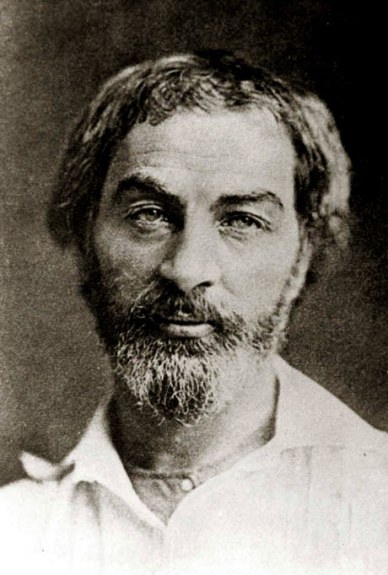
Walt Whitman in 1854, Daguerreotype, Photographer unknown probably Gabriel Harrison, public domain via Wikimudia Commons

Walt Whitman in 1854, daguerreotype, photographer unknown (probably Gabriel Harrison), public domain via Wikimedia Commons

I just came across this exciting story this morning in the New York Times’ Books section about how Zachary Turpin, a graduate student at the University of Houston, found a lost Walt Whitman novel. It was published in serial form in The Sunday Dispatch in 1852. It’s called Life and Adventures of Jack Engle: An Autobiography, and subtitled A Story of New York at the Present Time.

Read the New York Times article about the book’s discoverer and how he made his discovery here,

and read more about the book, part of the book itself online, and order a print copy here

Ordinary Philosophy and its Traveling Philosophy / History of Ideas series is a labor of love and ad-free, supported by patrons and readers like you. Please offer your support today!


Happy Birthday, Audre Lorde!

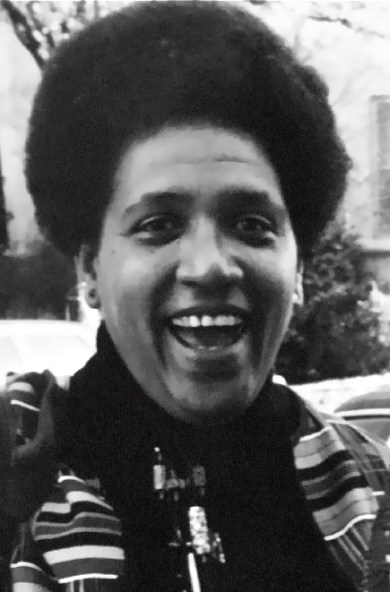
Audre Lorde, 1980

Audre Lorde, 1980

Poet and civil rights activist Audre Lorde was born on February 18, 1934. In remembrance of this powerful and eloquent woman on her birthday, I’ll share the bio I found at the Poetry Foundation:

‘A self-described “black, lesbian, mother, warrior, poet,” Audre Lorde dedicated both her life and her creative talent to confronting and addressing the injustices of racism, sexism, and homophobia. Her poetry, and “indeed all of her writing,” according to contributor Joan Martin in Black Women Writers (1950-1980): A Critical Evaluation, “rings with passion, sincerity, perception, and depth of feeling.” Concerned with modern society’s tendency to categorize groups of people, Lorde fought the marginalization of such categories as “lesbian” and “black woman,” thereby empowering her readers to react to the prejudice in their own lives. While the widespread critical acclaim bestowed upon Lorde for dealing with lesbian topics made her a target of those opposed to her radical agenda, she continued, undaunted, to express her individuality, refusing to be silenced. As she told interviewer Charles H. Rowell in Callaloo: “My sexuality is part and parcel of who I am, and my poetry comes from the intersection of me and my worlds… [White, arch-conservative senator] Jesse Helms’s objection to my work is not about obscenity…or even about sex. It is about revolution and change.” Fighting a battle with cancer that she documented in her highly acclaimed Cancer Journals (1980), Lorde died of the illness in 1992…. Read more about Audre Lorde and her poetry here

Ordinary Philosophy and its Traveling Philosophy / History of Ideas series is a labor of love and ad-free, supported by patrons and readers like you. Please offer your support today!

Happy Birthday, Frederick Douglass!

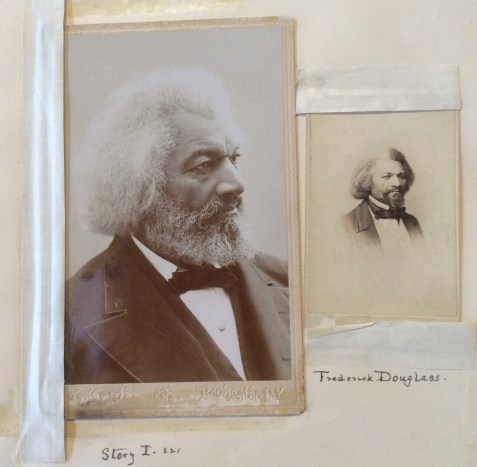
Two portraits of Frederick Douglass from the Hutchinson Family scrapbook, photo by Amy Cools

Two portraits of Frederick Douglass from the Hutchinson Family scrapbook in the archives of the Lynne Museum & Historical Society, photo by Amy Cools

The exact day of Frederick Douglass’s birth is unknown. We know the year, 1818, from the slave ledger of his master Aaron Anthony. His likely birth month, February, is an estimate. In his later years, Douglass chose to celebrate his birthday on February 14th because his mother Harriet once called him ‘my Valentine’.

Douglass is one of my favorite people that ever inhabited the world. He was born into slavery in Maryland, was mostly self-educated, escaped to freedom when he was 20, married the loving and strong Anna Murray, and became one of the most eloquent and influential advocates for civil rights in American, and, indeed, world history. He was an author, orator, preacher, activist, statesman, patriarch, musician, and world traveler. Not only was he a motivated, resourceful, brilliant, complicated, and incredibly fascinating person, I think he was oh-so-handsome too.

Here are a few links to some articles and works of art by, about, and inspired by the great Frederick Douglass, including my own work.

7 Haunts of Frederick Douglass in New York City – by Amy Cools for Untapped Cities

Frederick Douglass – by Ronald Sundstrom for Stanford Encyclopedia of Philosophy

Frederick Douglass and a Valentine, Emily Dickinson and a Snake – by Rob Velella for  The American Literary Blog

Frederick Douglass in Washington, D.C.: The Lion of Anacostia – by John Muller; this is my favorite blog about Douglass

Frederick’s Song – Douglass’ words arranged and set to music by SayReal and Richard Fink

From Oakland to Maryland, New York, and Massachusetts I Go, in Search of Frederick Douglass – History of ideas travel series by Amy Cools for Ordinary Philosophy

Interview with Ken Morris, Anti-Slavery Activist – by Ken Morris and Amy Cools for Ordinary Philosophy Podcast

Interview with Leigh Fought on Anna and Frederick Douglass – by Leigh Fought and Amy Cools for Ordinary Philosophy Podcast

Ordinary Philosophy and its Traveling Philosophy / History of Ideas series is a labor of love and ad-free, supported by patrons and readers like you. Please offer your support today!

O.P. Recommends: Bettany Hughes At 5×15 – Socrates And The Good Life

One of my favorite historians, broadcasters, and speakers, Bettany Hughes, gives a wonderful talk here on Socrates. Enjoy!

~ Ordinary Philosophy is a labor of love and ad-free, supported by patrons and readers like you. Any support you can offer will be deeply appreciated!

*All views and opinions expressed by guest writers are their own and do not necessarily reflect those of Ordinary Philosophy’s editors and publishers

History As A Communal Act: The History of Black History Month, by Stephen G. Hall

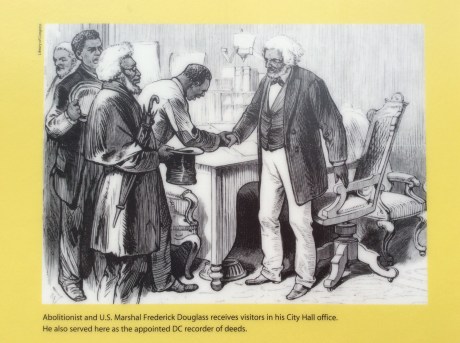
Frederick Douglass as US Recorder of Deeds, Library of Congress image, sign at D.C. Court of Appeals

Frederick Douglass as US Recorder of Deeds, Library of Congress image, sign at D.C. Court of Appeals

African Americans have always imagined and constructed history as a communal act. At the inception of the African American historical enterprise in the early 19th century, Jacob Oson’s Search for Truth (1817), one of the first examples of a textual African American historical production, offers insights into these communal sensibilities. Oson delivered the address in New Haven and New York, the locations of two dynamic free black communities, addressing communal concerns such as the African past, contemporary treatment, and identity. He also received help in publishing the address from Christopher Rush, Bishop in the African Methodist Episcopal Zion Church, one of the largest black church organizations in the country. From inception to publication, history existed not as the purview of the few, but as a communal product.

Oson’s work was no mere isolated incident. Writers were largely community advocates: ministers, abolitionists, autodidacts, and bibliophiles. James W.C. Pennington’s A Textbook of the Origin and History of the Colored People (1841)  offered important insights into African American history. Maria Stewart’s speeches blended piety with calls for communal action and awareness of racial injustice. Robert Benjamin Lewis’s interracial heritage (Native American and African) served as a springboard for his humanistic and universal history of African-descended people titled Light and Truth (1844). Black writers also envisioned their community as transnational. They engaged the African past as well as the complexities of the African Diaspora. They ruminated on the history of Haiti and Latin America. For these writers, African Americans were more than mere products of North American slavery. Their history was intertwined with the social, political, and cultural fabric of Africa and the Diaspora. In short, African American intellectuals understood their unique role as African-descended people whose history shaped the global experience.

Communal engagement proved central in dramatizing and reflecting the sentiments of historical periods. As African Americans laid the groundwork in the nation’s transition from slavery to freedom, Black history heralded these changes. William Wells Brown’s The Black Man (1863) and The Negro in the American Rebellion (1867) provided the first blueprints for the future. William Still’s The Underground Railroad (1871) reconstructed black heroism in the fight to end slavery. Black remembrance of the past focused less on individual achievements and more on the community’s collective ability to overcome obstacles to achieve clear goals. Freedom’s advent emanated from and served communal purposes.

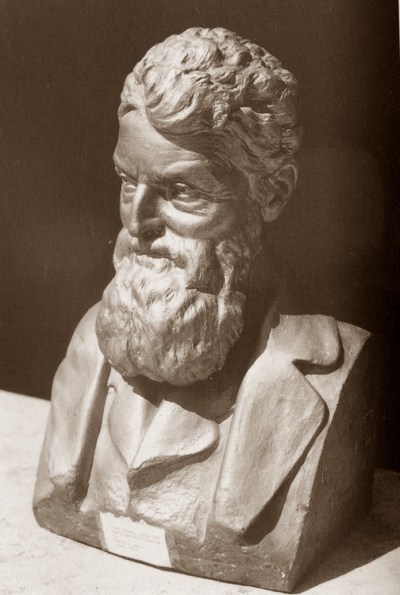
Sculpture of John Brown by Edmonia Lewis

Sculpture of John Brown by Edmonia Lewis

Black history’s communal manifestations were not merely textual. West Indian Independence Day and Juneteenth and Emancipation Day Celebrations, to name a few, permeated the communal landscape throughout the 19th and into the 20th centuries. Artistic representations, especially the work of Edmonia Lewis and Meta Vaux Warrick Fuller, were very important. Both of these women used sculpture to powerfully reconstruct the black past. Lewis’s John Brown (1864–65) and Robert Gould Shaw (1867–68, marble) depict historical figures subsequently revered in black communities. Her communal representation, Forever Free (1867, marble), celebrated the ratification of the 13th Amendment. The original title of the piece was “Morning of Liberty.” Fuller’s Ethiopia Awakening (1914), Mary Turner (Silent Protest Against Mob Violence) (1919) and Ethiopia Awakening (1930) highlight themes of racial pride, cultural awareness, and awakening and resilience in the face of adversity.

The outgrowth of these communal sensibilities naturally impacted the growth of the professionalized African American history project. Carter G. Woodson’s establishment of the Association of the Study of Negro Life and History (ASNLH) in 1915, the Journal of Negro History (1916), and the Associated Publishers in 1916 built on preexisting traditions of communal engagement and representation. These traditions were already extant in the African American historical enterprise for at least a century prior to their professionalization. Woodson used the “Documents” and “Notes” sections of the JNH to present communal offerings, the living and breathing history found in the attics and basements of African Americans around the country. Due to the small number of professionally trained historians, Woodson understood that the African American historical project must embrace the larger community as well as the professional and lay classes. Woodson utilized the broadest cross-section of the black community, drawing on everyone from K-12 educators and administrators to physicians, politicians, and pastors and ordinary people who displayed an interest in the historical past.Black literary and historical societies, bibliophiles, and collectors were also prominent in this regard. Groups such as the American Negro Academy, the Negro Society for Historical Research, and the Mu-So Lit Club played a prominent role in promoting the study of history. Their efforts were complimented by bibliophiles such as Arthur Schomburg and Jesse Moorland. Schomburg, a Puerto-Rican immigrant, collected books about the global black experience in his Harlem apartment. His extensive collection was purchased by the New York Public Library in 1925. Today it comprises the nucleus of the Schomburg Collection in Harlem, New York. Jesse Moorland, an avid bibliophile, YMCA activist, and close friend of Carter G. Woodson, donated his sizable collections to the institution, which today are housed at Howard University’s Moorland-Springarn Room.

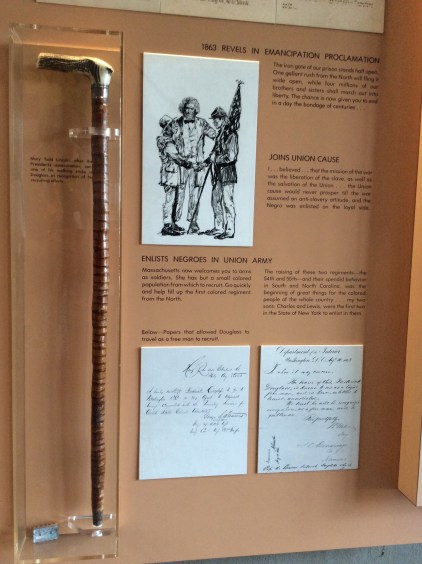
Abraham Lincoln's walking stick, Mary Todd Lincoln's gift to Frederick Douglass

Abraham Lincoln’s walking stick, Mary Todd Lincoln’s gift to Frederick Douglass

Given more than a century of deep engagement with history in black communities in textual, commemorative, artistic, organizational (literary and historical societies and libraries and repositories), and professional projects, it is not surprising that Negro History Week (1926) and later Black History Month (1980) emerged. Instituted as a communal celebration of black possibility and reality, Negro History Week continued earlier themes of accentuating black communal achievements, charting communal possibility and using institutional spaces to shape historical understanding within black communities and more important, in the national and global spheres. Its celebration in February acknowledges its communal roots. February is the birth month of two revered figures in African American life and history in the 19th and early 20th centuries: Frederick Douglass and Abraham Lincoln. Douglass and Lincoln loomed large in the black imagination because of their associations, tangible and symbolic, with Emancipation. The commemorative celebrations of the Emancipation Proclamation and the 13th Amendment, as well as the long communal struggle to eradicate slavery from the order of things, resonated in the chords of memory in African-descended populations well into the 20th century.

In 1926, the Annual Meeting of the ASNLH was held at Morgan State College (now university) in Baltimore. A “Negro History Week Roundtable” featured educators primarily from the State of Maryland and the District of Columbia. Given the prominence and activism of the black communities in these two locales, they serve as a representative sample for how “the movement,” as it was commonly labeled, impacted black communities. The comments of the educators, one of whom was Dr. Otelia Cromwell, Head of the Department of History and English in the public schools in the District of Columbia, emphasized the importance of the work. They also highlighted the impact of the celebration on young people in urban and rural communities. According to Cromwell, the observance of Negro History Week not only proved of great interest to students, faculty, and staff in the District of Columbia, but it also “had the effect of improving the tone and atmosphere of the school room.” The summation of Cromwell’s remarks unquestionably demonstrates the immeasurable nature of history’s communal reach. The report read: “These results which cannot be easily set forth in words or mathematically measured she believed to be the most important of all.” Cromwell knew that history’s import and meaning transcended the solidarity of a single moment in time. It permeated the classroom and seeped into the collective strivings of untold generations. It informed one hundred years of historical engagement and interrogation. It gave rise to textual writing, commemorative celebrations, artistic representations, literary and historical societies, black bibliophiles and collectors, and finally the professionalization of African American history in the first half of the twentieth century.

These same communal sensibilities informed the rise of the African American museum movement in the 1960s: The DuSable Museum of African American History (1961), the International Afro-American Museum in Detroit (1965), the Anacostia Community Museum in Washington (1967), and the African American Museum of Philadelphia (1976). Other community-inspired projects include The Blacks in Wax Museum in Baltimore (1983) and the National Afro American Museum and Cultural Center in Wilberforce, Ohio (1987). All of these museums used history and historical artifacts to dramatize the black past and present it to the community. These efforts culminated in the creation of the National African American Museum on the National Mall in 2016.

Our contemporary moment has witnessed the continuation of these communal projects. It has spawned the use of digital spaces (Internet and social media such as Twitter, Facebook, Tumblr, Pinterest, Snapchat, Instagram) to present African American history and historical ideas in new and dynamic ways. The construction of syllabi to educate diverse publics about contemporary events is a direct outgrowth of this communal focus. These efforts are too numerous to name them all, but a few examples will suffice: Dr. Marcia Chatelain’s #Ferguson Syllabus and the work of Drs. Chad Williams, Kidada Williams, and Keisha Blain with the #CharlestonSyllabus, The D.A.TT Freedom Summer 2015 Syllabus, the #BlackPantherSyllabus, the #The Baltimore Syllabus, the BlackLivesMatter Syllabus, the Welfare Reform Syllabus, the Trump Syllabus 2.0, and the Trump Syllabus 2.0: Supplementary List.

Black History Month, then, is more than a month-long celebration or an obligatory relic of an outmoded past. Rather it is and continues to serve as the catalyst for the transmission of a dynamic historical memory embedded in the collective striving of a global people to celebrate their historical past, affirm their humanity, and share the richness and vibrancy of their history as a communal act.

This piece was originally published at The African American Intellectual History Society (AAIHS) blog

Stephen G. Hall is the Program Coordinator of History at Alcorn State University. He is the author of A Faithful Account of the Race: African American Historical Writing in Nineteenth-Century America (UNC Press, 2009).  He is currently completing an edited book entitled History as A Communal Act: African American Historians and Historical Writing Past and Present (Routledge Press, forthcoming). His second book project is entitled Global Visions: African American Historians Engage the World, 1885–1960. (Bio credit: AAIHS)

Ordinary Philosophy and its Traveling Philosophy / History of Ideas series is a labor of love and ad-free, supported by patrons and readers like you. Please offer your support today!