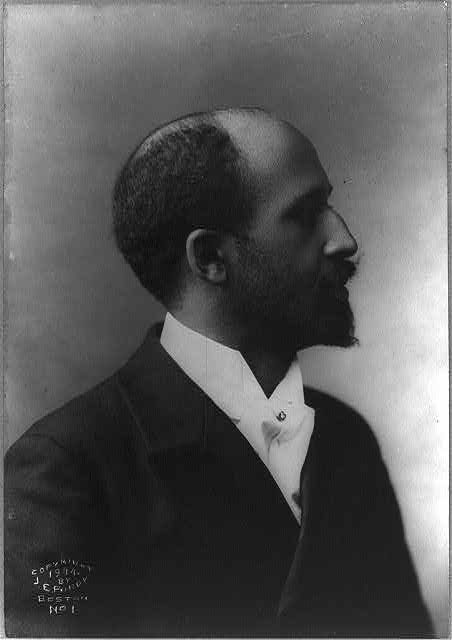
Happy Birthday, W.E.B. Du Bois!

W.E.B. Dubois, Photograph taken by J.E. Purdy in 1904, public domain via Library of Congress

W.E.B. Dubois, photograph taken by J.E. Purdy in 1904, public domain via Library of Congress

Let us honor the life and legacy of the great American writer, historian, journalist, professor, activist, philosopher, and race theorist W.E.B. Du Bois, born on February 23, 1868.

The NAACP (of which he was a founder) writes of DuBois:

‘William Edward Burghardt Du Bois (February 23, 1868 – August 27, 1963) was an American civil rights activist, leader, Pan-Africanist, sociologist, educator, historian, writer, editor, poet, and scholar. He became a naturalized citizen of Ghana in 1963 at the age of 95.

…In 1891 Du Bois got his master of arts and in 1895 his doctorate in history from Harvard. His dissertation, The Suppression of the African Slave Trade to the United States of America, 1638-1870, was published as No. 1 in the Harvard Historical Series. This important work has yet to be surpassed. In 1896 he married Nina Gomer, and they had two children. …[A]t the University of Pennsylvania… he conducted the pioneering sociological study of an urban community, published as The Philadelphia Negro: A Social Study (1899). These first two works assured Du Bois’s place among America’s leading scholars.

Du Bois’s life and work were an inseparable mixture of scholarship, protest activity, and polemics. All of his efforts were geared toward gaining equal treatment for black people in a world dominated by whites and toward marshaling and presenting evidence to refute the myths of racial inferiority’ …

Read his NAACP bio in full here

Donald J. Morse writes of DuBois for the Internet Encyclopedia of Philosophy:

‘W. E. B. Du Bois was an important American thinker: a poet, philosopher, economic historian, sociologist, and social critic. His work resists easy classification. This article focuses exclusively on Du Bois’ contribution to philosophy; but the reader must keep in mind throughout that Du Bois is more than a philosopher; he is, for many, a great social leader. His extensive efforts all bend toward a common goal, the equality of colored people. His philosophy is significant today because it addresses what many would argue is the real world problem of white domination. So long as racist white privilege exists, and suppresses the dreams and the freedoms of human beings, so long will Du Bois be relevant as a thinker, for he, more than almost any other, employed thought in the service of exposing this privilege, and worked to eliminate it in the service of a greater humanity. Du Bois’ pragmatist philosophy, as well as his other work, underlies and supports this larger social aim. Later in life, Du Bois turned to communism as the means to achieve equality. He envisioned communism as a society that promoted the well being of all its members, not simply a few. Du Bois came to believe that the economic condition of Africans and African-Americans was one of the primary modes of their oppression, and that a more equitable distribution of wealth, as advanced by Marx, was the remedy for the situation ….

Read the full IEP bio here

You will find another good short bio and list of DuBois’ writings at The Pennsylvania Center for the Book‘s website

…and click here for pieces about or featuring DuBois at Ordinary Philosophy

Ordinary Philosophy and its Traveling Philosophy / History of Ideas series is a labor of love and ad-free, supported by patrons and readers like you. Please offer your support today!
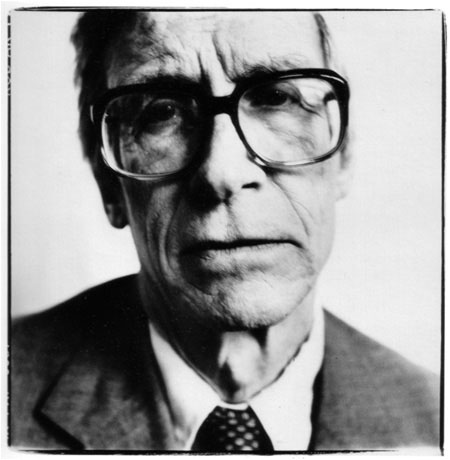
Happy Birthday, John Rawls!

John Rawls, image via BBC's Will and Testament blogLet’s remember and celebrate John Rawls, Feb 21, 1921 – Nov 24, 2002, the great political and moral theorist who thinks of justice as fairness, on his birthday.

Among his greatest contributions is the thought experiment called ‘the veil of ignorance’. It’s a beautifully simple tool for designing a just society. Imagine you’re to be placed into society with no idea what you would be: rich, poor, or middle-class; tall or short; intelligent or not; of which gender; outgoing or shy; of which race; employed and at what kind of job or not at all; and so on.

Given that you have no idea what your roles in life will be, what cultural practices, laws, policies, governmental system, economic system, and so on, would you put into place? Remember, behind that veil of ignorance, you’ll have to decide what kind of society benefits everyone the most since you could end up being anyone. If you were really in that situation, imagine just how fair you’d be. Perhaps, as Rawls imagines, we’d all be far better off if that was really how the world works.

Here’s a short list of resources to learn more about the great John Rawls:

John Rawls – by Leif Wenar for The Stanford Encyclopedia of Philosophy

John Rawls – by Henry S. Richardson for the Internet Encyclopedia of Philosophy

A Theory of Justice – by John Rawls (Google book preview)

and my own work featuring Rawls:

Behind the Veil: Rawls, Locke, de Tocqueville, and Human Connection in a Liberal Society

Communitarianism, Writ Large

Sources, Influences, Shout-Outs, and all that Good Stuff

Ordinary Philosophy and its Traveling Philosophy / History of Ideas series is a labor of love and ad-free, supported by patrons and readers like you. Please offer your support today!

Happy Birthday, Nicolaus Copernicus!

Nicolaus Copernicus portrait from Town Hall in Toruń, ca.1580, public domain via Wikimedia Commons

Nicolaus Copernicus portrait from Town Hall in Toruń, ca.1580, public domain via Wikimedia Commons

Let us remember and salute the visionary Nicolaus Copernicus on the occasion of his birthday.

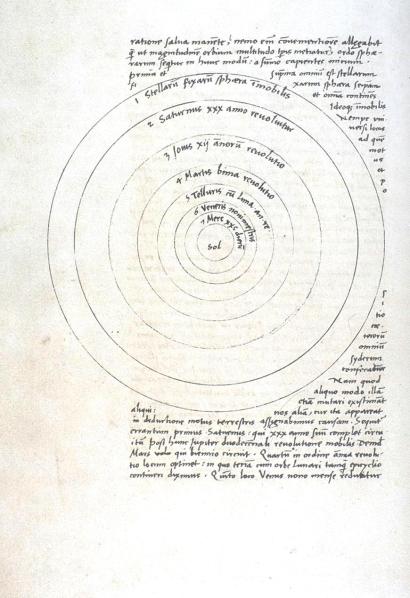
de-revolutionibus-manuscript-p9b-by-nicolas-copernicus-www-bj-uj-edu-pl-public-domain-via-wikimedia-commons

De Revolutionibus manuscript, page 9b by Nicolaus Copernicus (www.bj.uj.edu.pl) Public domain via Wikimedia Commons

Born on February 19th, 1473, Copernicus gave our modern world the heliocentric theory of the solar system. He credited the ancient Greek astronomer and mathematician Aristarchus of Samos with originally describing how Earth and her sister planets orbit around the sun and took it upon himself to make the observations and work out the mathematics to prove it. Copernicus reintroduced the heliocentric theory so convincingly that it overcame the dominant earth-centered model preferred by the powerful Christian Church for theological reasons. His rigorous and clear reason simply could not accept the clumsy, assumption-laden model that Claudius Ptolemy had devised in the second century A.D. to explain why the planets did not behave as expected if the earth-centered model was accurate. Copernicus was a religious man himself, but he did not believe that his faith required him to believe something that his reason and his own eyes demonstrated was untrue.

For emphasizing the primacy of observation-driven reason over theology when it comes to describing and explaining the natural world, Copernicus is widely credited with starting the Scientific Revolution.

Here’s a short list of excellent resources to learn more about the great Nicolaus Copernicus:

Nicolaus Copernicus – by Sheila Rabin for The Stanford Encyclopedia of Philosophy

Nicolaus Copernicus – by J.J. O’Connor and E.F. Robertson for the MacTutor History of Mathematics Archive, School of Mathematics and Statistics University of St. Andrews, Scotland

Nicolaus Copernicus – From Wikipedia, the free encyclopedia

Copernicus – episode 2 of the BBC series The Beauty of Diagrams, hosted by mathematician Marcus du Sautoy

Ordinary Philosophy and its Traveling Philosophy / History of Ideas series is a labor of love and ad-free, supported by patrons and readers like you. Please offer your support today!
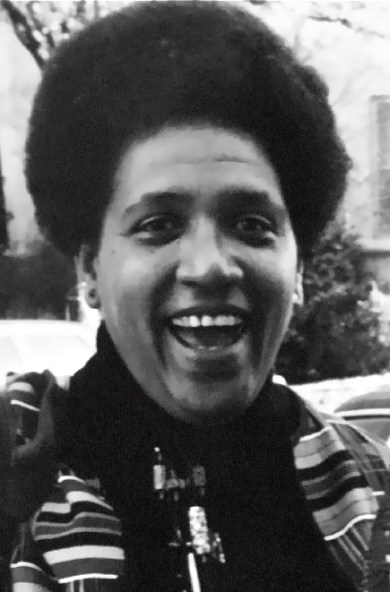
Happy Birthday, Audre Lorde!

Audre Lorde, 1980

Audre Lorde, 1980

Poet and civil rights activist Audre Lorde was born on February 18, 1934. In remembrance of this powerful and eloquent woman on her birthday, I’ll share the bio I found at the Poetry Foundation:

‘A self-described “black, lesbian, mother, warrior, poet,” Audre Lorde dedicated both her life and her creative talent to confronting and addressing the injustices of racism, sexism, and homophobia. Her poetry, and “indeed all of her writing,” according to contributor Joan Martin in Black Women Writers (1950-1980): A Critical Evaluation, “rings with passion, sincerity, perception, and depth of feeling.” Concerned with modern society’s tendency to categorize groups of people, Lorde fought the marginalization of such categories as “lesbian” and “black woman,” thereby empowering her readers to react to the prejudice in their own lives. While the widespread critical acclaim bestowed upon Lorde for dealing with lesbian topics made her a target of those opposed to her radical agenda, she continued, undaunted, to express her individuality, refusing to be silenced. As she told interviewer Charles H. Rowell in Callaloo: “My sexuality is part and parcel of who I am, and my poetry comes from the intersection of me and my worlds… [White, arch-conservative senator] Jesse Helms’s objection to my work is not about obscenity…or even about sex. It is about revolution and change.” Fighting a battle with cancer that she documented in her highly acclaimed Cancer Journals (1980), Lorde died of the illness in 1992…. Read more about Audre Lorde and her poetry here

Ordinary Philosophy and its Traveling Philosophy / History of Ideas series is a labor of love and ad-free, supported by patrons and readers like you. Please offer your support today!
Happy Birthday, Jeremy Bentham!

Jeremy Bentham's Auto-Icon at University College London, 2003 by Michael Reeve, GNU Free Documentation License Version 1.2

Jeremy Bentham’s Auto-Icon at University College London, photo 2003 by Michael Reeve

Jeremy Bentham, the great English moral and legal philosopher born on February 15, 1748, was a very strange man. A brilliant one, but strange nonetheless. He was a precocious child and advanced in his studies very early, finding Westminster and Queen’s College at Oxford too easy and therefore rather boring. He was trained as a lawyer but decided not to practice law after hearing William Blackstone’s lectures. Blackstone’s treatise Commentaries on the Laws of England is still considered one of the most authoritative and foundational works on English law, so for a guy to consider them so flawed that he’d want to give up his career seems a bit… well, presumptuous. But he demonstrated his own great intellectual capacities through his lifetime of prolific writing, mostly on legal theory, moral philosophy, and social reform. In the end, he earned the right to a certain degree of arrogance.

Bentham is generally considered the father of utilitarianism, the moral philosophy which judges anything that can be judged as right or wrong, good or evil, according to how conducive it is to ‘the greatest happiness of the greatest number.’ Utilitarianism, then, is a type of consequentialism, which holds that a thing is right or wrong based on its consequent harms or benefits. Bentham did not invent the principles of utilitarianism; he discovered them in the writings of Cesare Beccaria (who authored the ‘greatest happiness’ axiom), David Hume, Claude Helvétius, and Joseph Priestley. But he spent a lifetime synthesizing these principles into a cohesive, fleshed-out moral philosophy founded on utility, whether a law or action increases or decreases pleasure or happiness. This principle can seem too subjective to apply to matters of law or public policy; after all, what makes one happy can make another less so, and how can we determine whether the happiness of one is greater, or more important, than the happiness of another? Bentham, careful and systematic in his approach to this as he was to everything else, devised his ‘Felicific Calculus’ to solve this problem. Bentham believed that pleasure, a natural phenomenon like everything else in the world, was likewise quantifiable. He hoped his method of assigning unitary measurements to pleasure, then determining their relative values through mathematics, was a way to make his moral philosophy practicable, conducive to real social reform.

To many, the idea that pleasure and happiness could be reduced to mathematical formulas seems very strange; some think he may have had Asperger’s syndrome or another cognitive feature that caused Bentham to view emotion with such scientific detachment. But as socially awkward as he and his ideas often were, his utilitarian philosophy led to him to some moral conclusions that we now consider extremely progressive and much more caring than those typical of his times. For example, he was an early proponent of racial equality, women’s rights, and animal rights. As to animal rights, just as for all classes of human beings, considering only the pleasure and pain of some sentient beings and not others when it comes to morals is unscientific and therefore unjustifiably biased. After all, animals, like all human beings, have feelings too, and their feelings are just as important to them as ours are to us. So, a moral system based on feelings must consider all equally important, so that one unit of pig happiness, for example, is just as morally significant as one unit of human happiness. The only correct way to balance them out in matters of morals and public policy is to apply the Felicific Calculus to determine how much pleasure or pain each experience in any given situation.

At the end of his long and productive life, the committed naturalist arranged to have his body publicly dissected, both for scientific inquiry and to provide an example to others; he believed that a perfectly good body should never go to waste and that everyone should donate their body to science. He also arranged to have his head and skeleton preserved, dressed in his clothes and stuffed to look as lifelike as possible, to be displayed in some public place. The preservation of Bentham’s head, with its glass eyes he had purchased some years before, left much to be desired; the expression it ended up with creeped people out. So his Auto-Icon, as he called it, sits today in its glass case at University College, London with a nice lifelike wax head in its place. His real head is safely stored away where students, prone to stealing over the years in a series of pranks, can no longer get to it.

Read more about the brilliant and eccentric Bentham at:

Jeremy Bentham – by James E. Crimmins for The Stanford Encyclopedia of Philosophy

Jeremy Bentham – University College London website

Jeremy Bentham on the Suffering of Non-Human AnimalsUtilitarianism.com

Ordinary Philosophy and its Traveling Philosophy / History of Ideas series is a labor of love and ad-free, supported by patrons and readers like you. Please offer your support today!

Happy Birthday, Frederick Douglass!

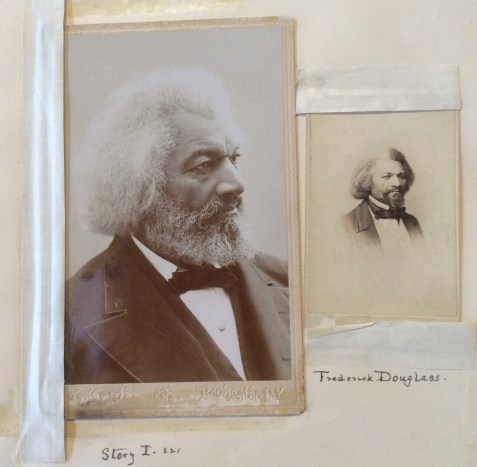
Two portraits of Frederick Douglass from the Hutchinson Family scrapbook, photo by Amy Cools

Two portraits of Frederick Douglass from the Hutchinson Family scrapbook in the archives of the Lynne Museum & Historical Society, photo by Amy Cools

The exact day of Frederick Douglass’s birth is unknown. We know the year, 1818, from the slave ledger of his master Aaron Anthony. His likely birth month, February, is an estimate. In his later years, Douglass chose to celebrate his birthday on February 14th because his mother Harriet once called him ‘my Valentine’.

Douglass is one of my favorite people that ever inhabited the world. He was born into slavery in Maryland, was mostly self-educated, escaped to freedom when he was 20, married the loving and strong Anna Murray, and became one of the most eloquent and influential advocates for civil rights in American, and, indeed, world history. He was an author, orator, preacher, activist, statesman, patriarch, musician, and world traveler. Not only was he a motivated, resourceful, brilliant, complicated, and incredibly fascinating person, I think he was oh-so-handsome too.

Here are a few links to some articles and works of art by, about, and inspired by the great Frederick Douglass, including my own work.

7 Haunts of Frederick Douglass in New York City – by Amy Cools for Untapped Cities

Frederick Douglass – by Ronald Sundstrom for Stanford Encyclopedia of Philosophy

Frederick Douglass and a Valentine, Emily Dickinson and a Snake – by Rob Velella for  The American Literary Blog

Frederick Douglass in Washington, D.C.: The Lion of Anacostia – by John Muller; this is my favorite blog about Douglass

Frederick’s Song – Douglass’ words arranged and set to music by SayReal and Richard Fink

From Oakland to Maryland, New York, and Massachusetts I Go, in Search of Frederick Douglass – History of ideas travel series by Amy Cools for Ordinary Philosophy

Interview with Ken Morris, Anti-Slavery Activist – by Ken Morris and Amy Cools for Ordinary Philosophy Podcast

Interview with Leigh Fought on Anna and Frederick Douglass – by Leigh Fought and Amy Cools for Ordinary Philosophy Podcast

Ordinary Philosophy and its Traveling Philosophy / History of Ideas series is a labor of love and ad-free, supported by patrons and readers like you. Please offer your support today!
Happy Birthday, Abraham Lincoln!

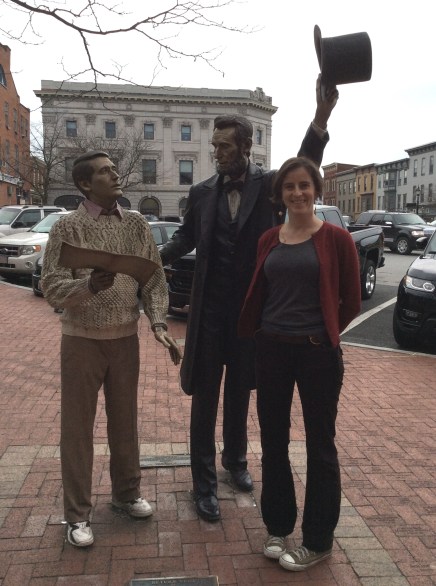
Me with Abraham Lincoln's sculpture near David Wills house where he stayed in Gettysburg, PA, the night before giving his great Address.

Me with Abraham Lincoln’s sculpture near David Wills’ house where he stayed in Gettysburg, PA, the night before giving his great Address.

Let’s remember and salute the great Abraham Lincoln, father of our nation reborn in liberty, on his birthday.

Born on February 12th, 1809, this child of a poor Kentucky farm family was largely self-educated yet rose to become our most revered President since George Washington. He was a hard-working man, from farm laborer and rail splitter to flatboat operator on the Mississippi River, then shop owner, militia captain, postmaster, lawyer, politician, then President of the United States. A popular man revered for his storytelling, conversation, intelligence, and general reputation for high integrity, Lincoln won his second campaign for political office and entered the House of Representatives in 1834. He was a successful and innovative lawyer and revered for his speechmaking. His series of debates with Democratic senator Stephen Douglas in 1858 thrust him into the national spotlight, and while he lost the race to replace Douglas in the Congress that year, his reputation continued to grow, and he defeated Douglas in the presidential race two years later. He won the Presidency as head of the newly formed anti-slavery Republican party.

Lincoln’s antipathy to slavery originated with his flatboat trip to New Orleans, where he witnessed its horrors first hand. Over the years, his political antislavery position fluctuated though it always disgusted him personally. For most of his political career, he advocated the moderate policy of stopping slavery’s spread to the new territories, leaving it in place where it already existed in the expectation that economic factors would naturally lead to its demise. But the intransigence of the slave states and the contingencies of the Civil War, combined with his own moral hatred of slavery, caused him to change his mind. Lincoln’s Emancipation Proclamation of January 1, 1863 freed all slaves in those states in rebellion, and nearly 200,000 freed black men fought for the Union Army, helping to ensure its eventual success.

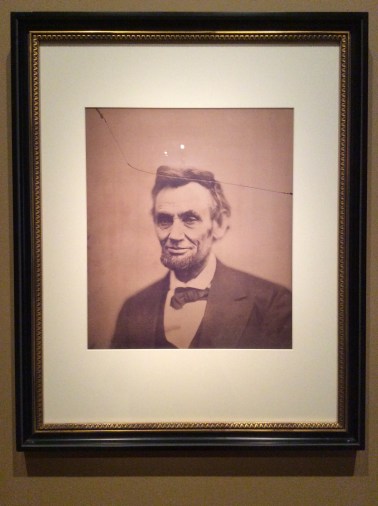
Abraham Lincoln by Alexander Gardner, Feb 5, 1865, National Portrait Gallery in D.C., 2016 Amy Cools

Abraham Lincoln by Alexander Gardner, Feb 5, 1865, National Portrait Gallery in D.C., photo 2016 by Amy Cools

Even more than his childhood poverty and lackof education, I find Lincoln’s success even more remarkable in light of the recurrent and severe depression he suffered throughout his life. While it can be crippling, it can also make sufferers that much more attuned to the suffering of fellow human beings, while deepening the understanding of human nature and increasing the capacity for sympathy. Lincoln was one of these, and his suffering refined his sensitivities and strengthened him, helping to make him the great man he became.

Having led the nation through the trauma and horror of the Civil War, Lincoln was assassinated only a month after his re-inauguration to the Presidency in 1964, shot in the head on April 14th by pro-slavery actor John Wilkes Booth while attending a play at Ford’s Theater.

Here are a few links and images of writings and works of art by, about, featuring, and inspired by Abraham Lincoln, including some of my own work.

Audiobooks of speeches and other writings of Abraham Lincoln at Librivox

Speeches, letters, and other writings by Abraham Lincoln digitized by the Northern Illinois University Libraries

Abraham Lincoln – in Wikipedia

April the 14th, Part I – by Gillian Welch

The Gettysburg Address – by Abraham Lincoln

Lincoln’s Great Depression – by Joshua Wolf Shenk for The Atlantic: Abraham Lincoln fought clinical depression all his life, and if he were alive today, his condition would be treated as a “character issue”—that is, as a political liability. His condition was indeed a character issue: it gave him the tools to save the nation

Abraham Lincoln also featured prominently in Frederick Douglass’s life and ideas which I wrote about in a history of ideas travel series I wrote last year. Here are the pieces which feature Lincoln:

Frederick Douglass Lynn Sites, Part 2: Historical Society & Hutchinson Scrapbook
Frederick Douglass, Rochester NY Sites Day 2
Frederick Douglass Seneca Falls, Canandaigua, Honeoye, and Mt Hope Cemetery Sites
Frederick Douglass Chambersburg and Gettysburg PA Sites
Frederick Douglass Washington DC Sites, Day 1, Part 1
Frederick Douglass Washington DC Sites, Day 1, Part 2
Frederick Douglass Washington DC Sites, Last Day

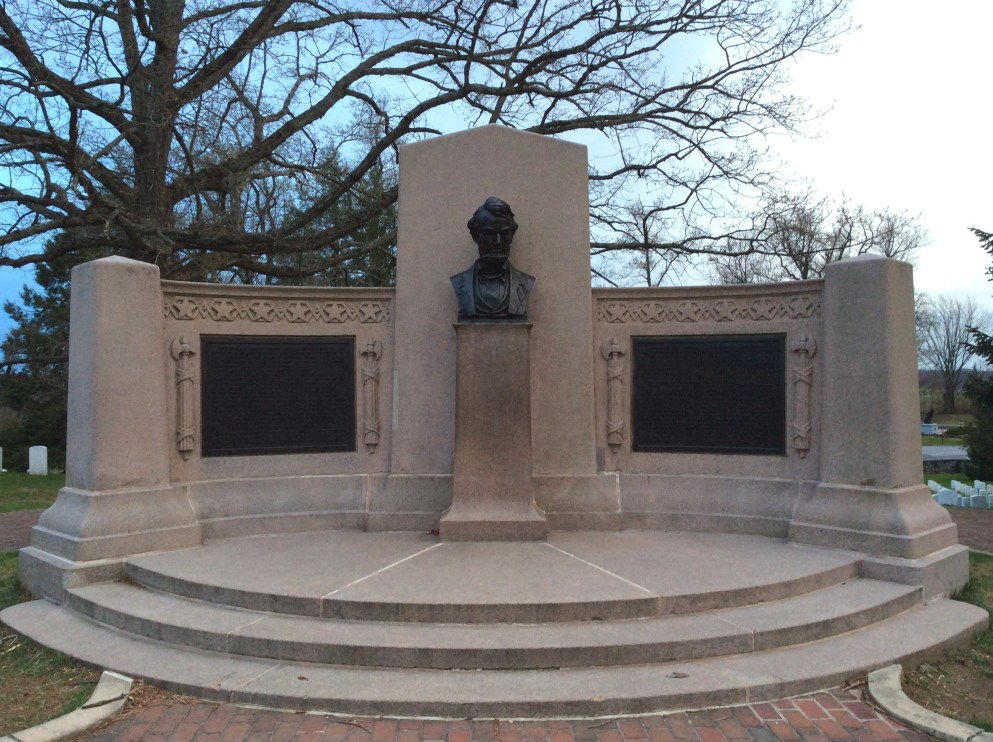
Lincoln's Gettysburg Address Memorial at Soldier's National Cemetery

Lincoln’s Gettysburg Address Memorial at Soldier’s National Cemetery, photo 2016 by Amy Cools

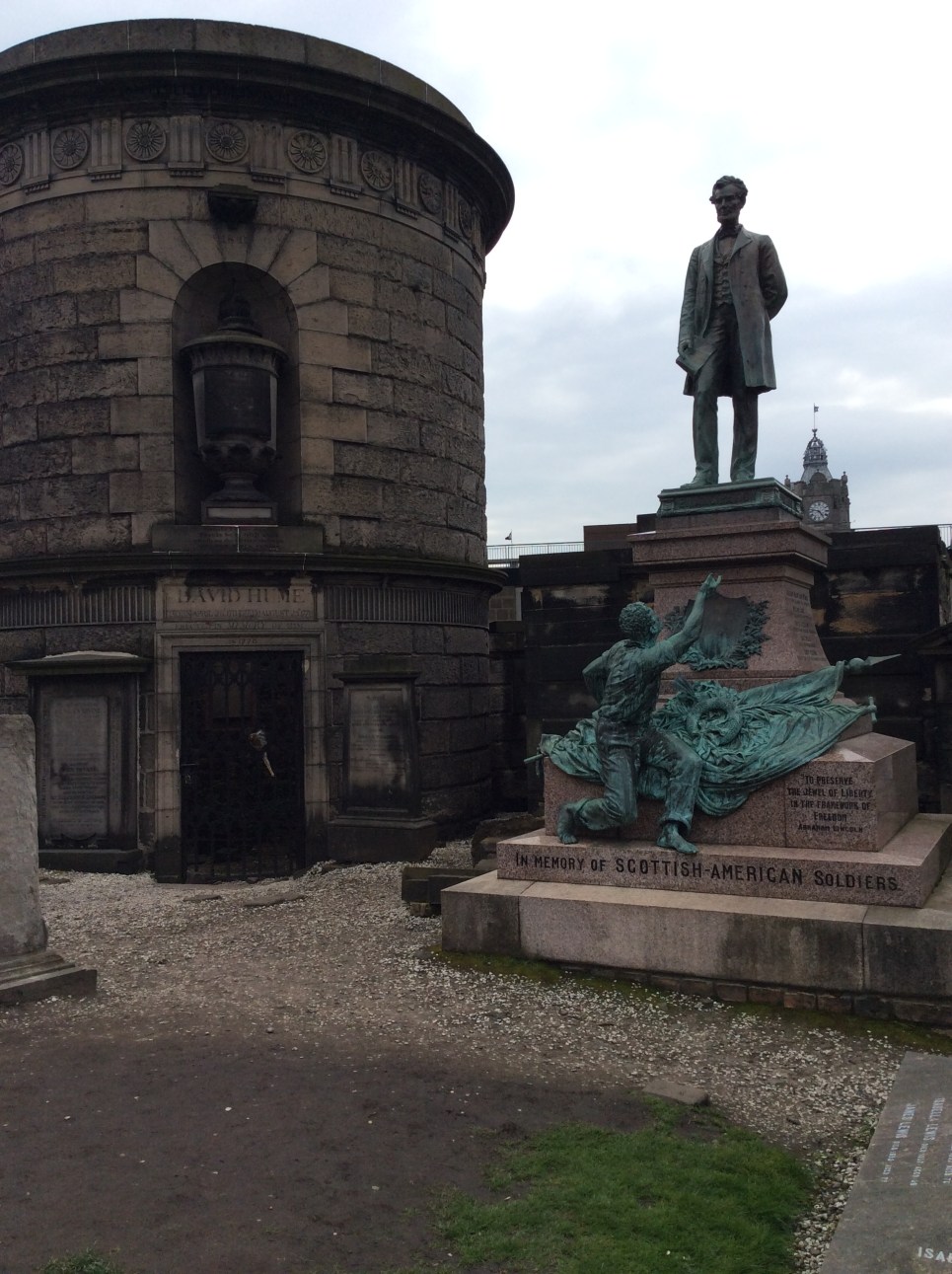
Hume's and Abraham Lincoln Scottish soldier monuments,

Hume’s grave and Abraham Lincoln sculpture on a monument to Scottish American soldiers, Calton Hill Cemetery, Edinburgh, Scotland, photo 2014 by Amy Cools

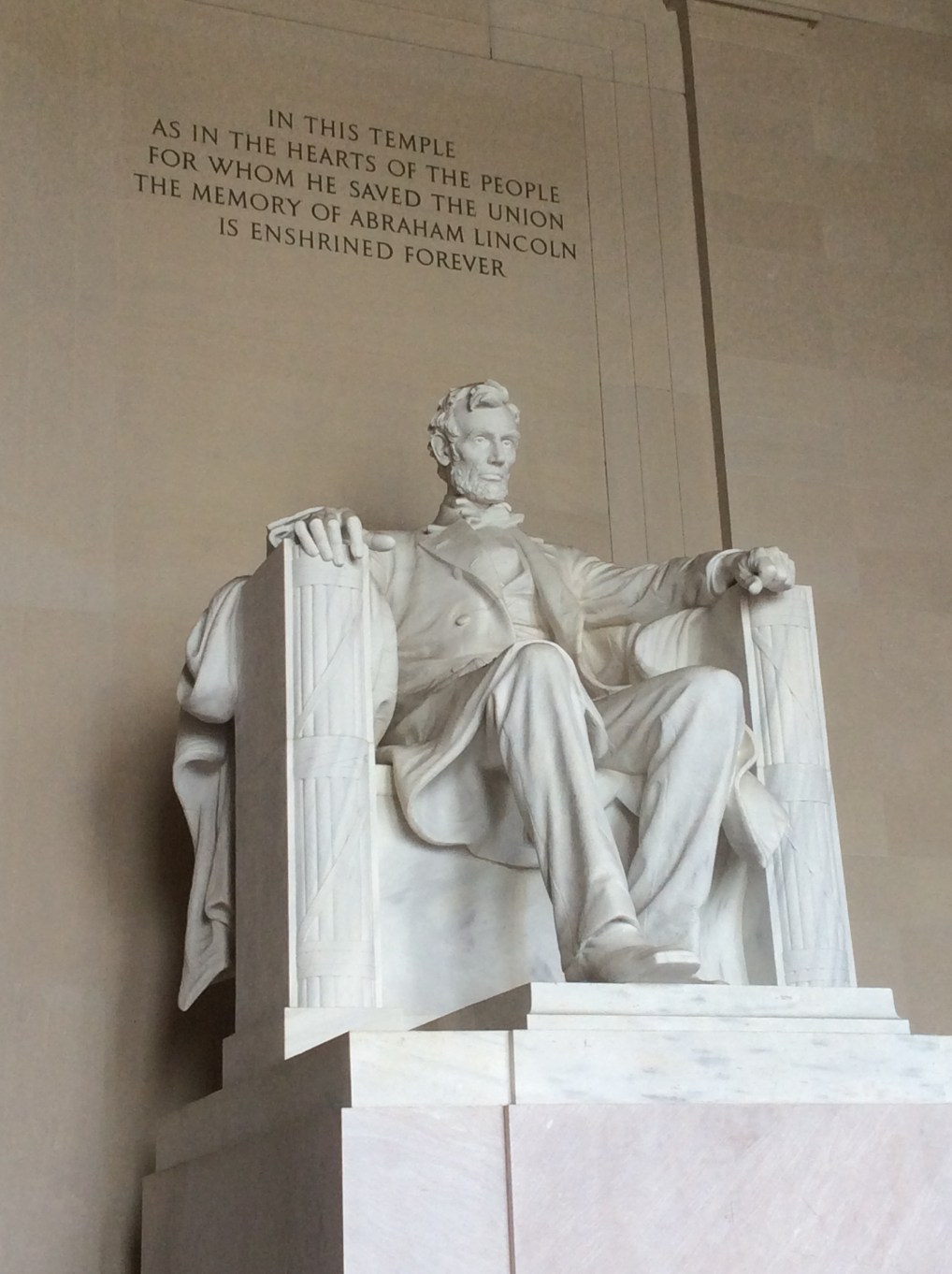
Sculpture of Abraham Lincoln in the Lincoln Memorial, Washington DC, photo 2015 by Amy Cools

Sculpture of Abraham Lincoln in the Lincoln Memorial, Washington DC, photo 2015 by Amy Cools

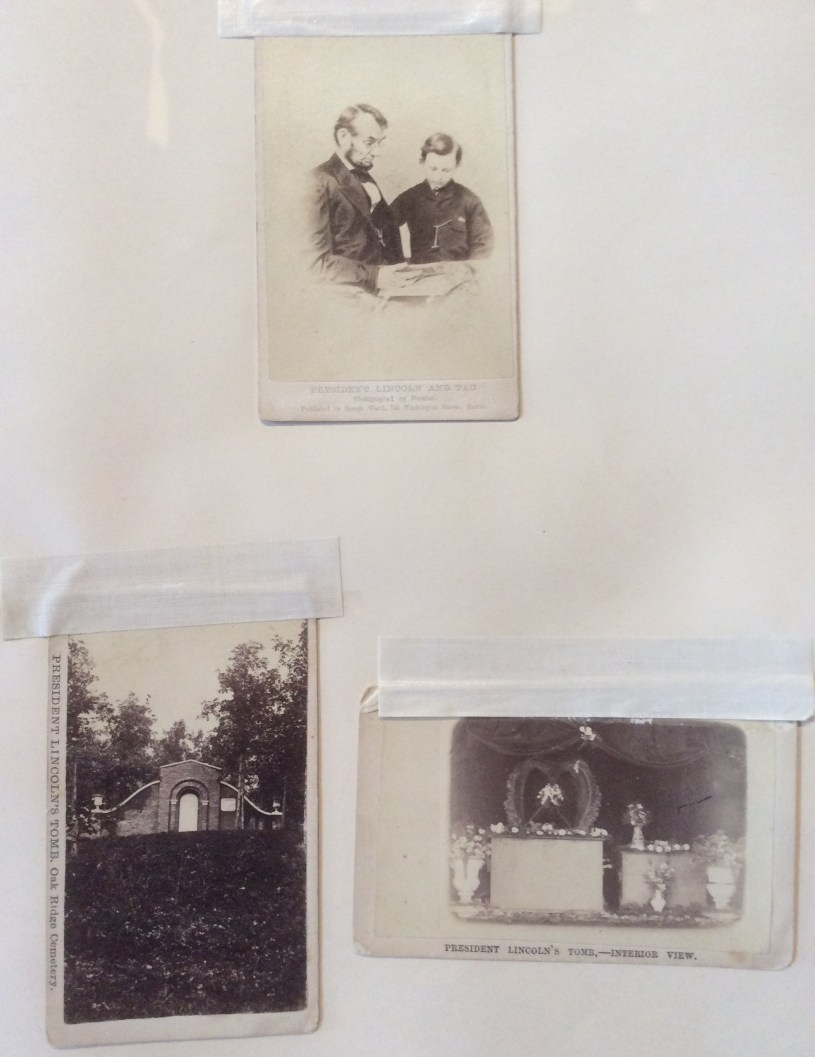
Abraham Lincoln with his son and 2 views of his tomb, from Hutchinson scrapbook at Lynn Museum

Abraham Lincoln with his son and two views of his tomb, from the Hutchinson scrapbook at Lynn Museum, photo 2016 by Amy Cools

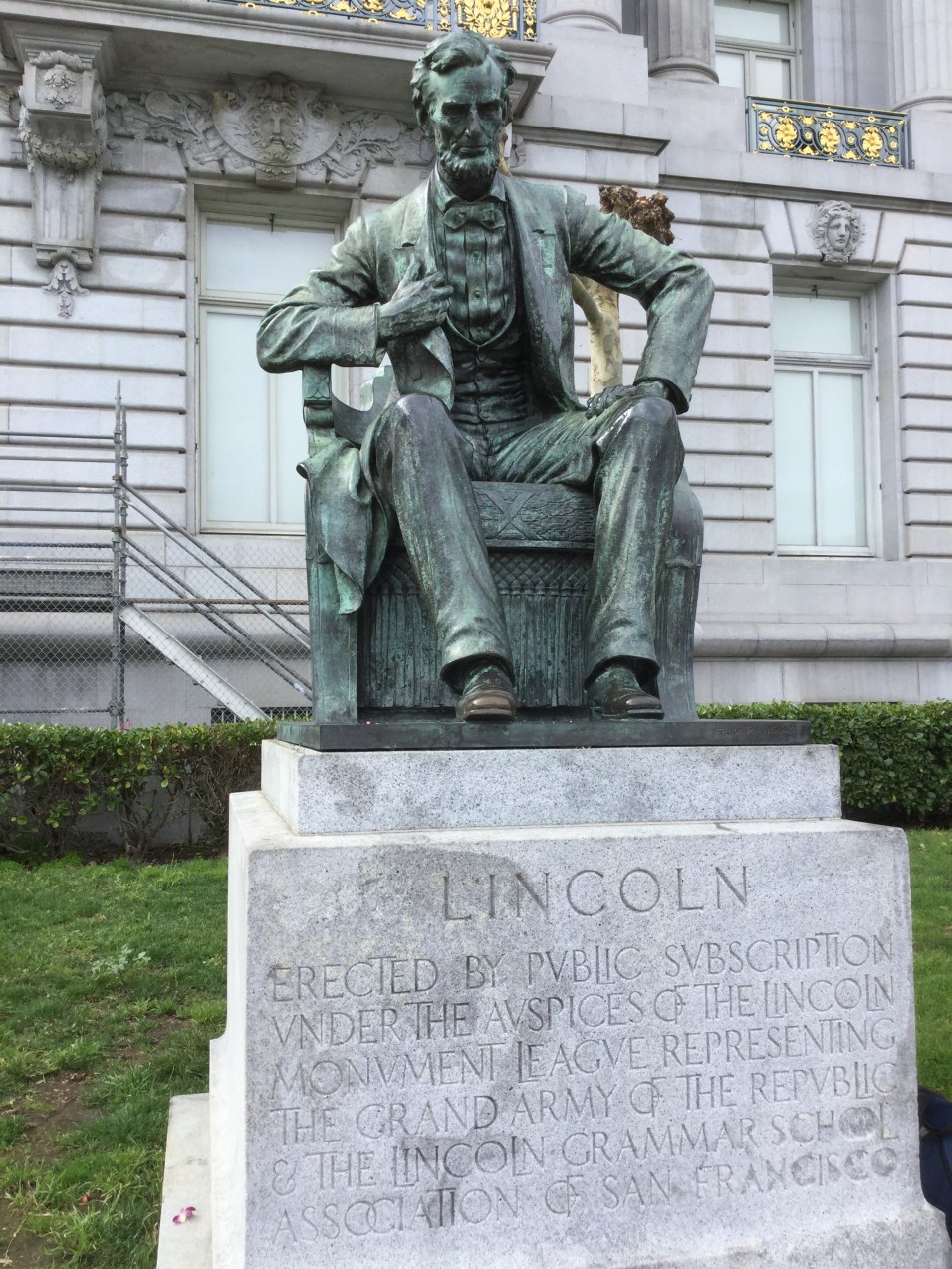
Statue of Abraham Lincoln outside of San Francisco's City Hall, photo 2017 by Amy Cools

Statue of Abraham Lincoln outside of San Francisco’s City Hall, photo 2017 by Amy Cools

Ordinary Philosophy and its Traveling Philosophy / History of Ideas series is a labor of love and ad-free, supported by patrons and readers like you. Please offer your support today!
Happy Birthday, Thomas Paine!

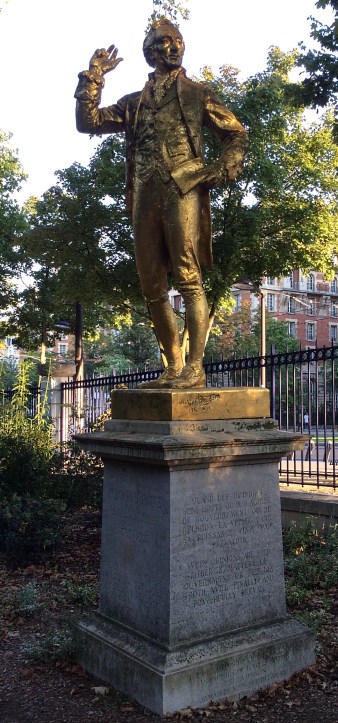
Statue of Thomas Paine by Gutzon Borglum, 1938, Parc Montsouris, Paris, photo 2015 by Amy Cools

Statue of Thomas Paine by Gutzon Borglum, 1938, Parc Montsouris, Paris, photo 2015 by Amy Cools

Let’s remember and salute the great Thomas Paine, father of our American identity, on his birthday. Born on January 29th, 1737, his great pamphlets made the case for American independence from Britain, outlined his Lockean conception of human rights, and argued for the primacy of reason in epistemology, politics, science, and theology. He’s a primary influence in my own concept of America as a bastion of liberty, of reason, of freedom of conscience, of the idea that property rights entail the obligation to share our wealth with those who lack what they need.

Here are a few links to some articles and works of art by, about, and inspired by Thomas Paine, including some of my own work.

Common Sense – Thomas Paine (1776)

The American Crisis – Thomas Paine (1776-83)

The Rights of Man – Thomas Paine (1791)

The Age of Reason – Thomas Paine (1794)

Agrarian Justice – Thomas Paine (1795-96)

Thomas Paine – from The Stanford Encyclopedia of Philosophy

To Paris, France I Go, In Search of Revolution-Era Thomas Paine, Mary Wollstonecraft, and Thomas Jefferson – history of ideas travel series in which I follow Thomas Paine’s life and ideas in the era of the French Revolution

Thomas Paine on Basic Income, and Why Welfare is Compatible with an Individualist Theory of Human Rights – my essay on how Paine’s ideas about property rights led him to advocate the unconditional allocation of public funds for the support of the young, the old, and the disabled

Pretty Pink Rose – David Bowie and Adrian Belew (1990) – ‘She tore down Paris on the tail of Tom Paine, but the left wing’s broken, the right’s insane’

As I Went Out One Morning – Bob Dylan (1968) ‘As I went out one morning to breathe the air around Tom Paine’s, I spied the fairest damsel that ever did walk in chains’

Tom Paine’s Bones – Graham Moore (1995) Recorded by Dick Gaughan in 2001. ‘Well they say I preached revolution but let me say in my defence, all I did wherever I went was to talk a lot of Common Sense’

Ordinary Philosophy and its Traveling Philosophy / History of Ideas series is a labor of love and ad-free, supported by patrons and readers like you. Please offer your support today!
To New York City I Go, In Search of Ernestine Rose and Elizabeth Cady Stanton

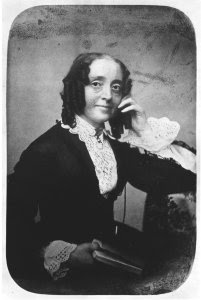
Happy Birthday, Ernestine Rose! Well, happy belated birthday: I was so busy yesterday finishing my tasks at work and preparing for my week’s travel that I overlooked the day’s significance!

A little over two and a half years ago, I followed Ernestine Rose and her intellectual heir Elizabeth Cady Stanton through their history in New York City. Here’s the story in case you missed it!

Oh, and there’s an exciting new book coming out about Rose, called The Rabbi’s Atheist Daughter, which I can hardly wait to read.

Here’s to you, Ernestine Rose, and your fight for human rights!

Amy M Cools's avatarOrdinary Philosophy

Hello, friends of Ordinary Philosophy!

I’m pleased and excited to announce my upcoming adventure: my second philosophical-historical themed adventure, this time to New York City!

In case you missed my first go-round in my series of philosophy-travel pieces, here’s my plan:

So I’m taking a series of trips to places around the world, where I explore the lives and ideas of great thinkers in the places where they lived and worked. I’ll follow in the footsteps of thinkers who are no longer alive, since those who are still telling their own stories. But those who are no longer alive in the body live on in the ideas that they pass on, and in the example they provide for us to follow.

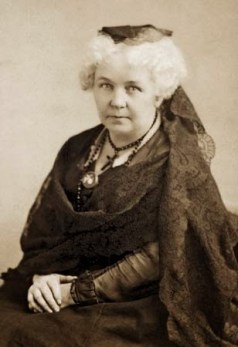
For this next installment, I’ll be following Ernestine Rose and Elizabeth Cady Stanton, two of the greatest founders of the women’s rights movement. Elizabeth was born in New York state, and…

View original post 253 more words

Happy New Year, and a Personal Reflection at the Close of My Fourth Decade

Signs on a post off Mountain View Road, rising out of the Anderson Valley, California

Today is the last day of 2016, and my last day in my 30’s.

It feels significant, somehow, turning 40.

Perhaps it’s because my love of history and my long background in collecting, buying and selling vintage goods. They’ve put me in the habit of organizing things into chunks of time: decades, centuries, eras. It’s a useful tool, even if a blunt one, since of course events and styles don’t come into and out of existence based on the turn of a calendar page. But the human mind looks for patterns existent in nature, which leads to the impulse to impose more precise ones on top of those, artificial even as they’re based on natural phenomenon. The calendar year traces the earth’s yearly rotation around the sun, and units of ten reflect the number of fingers we’ve used to count since our infancy.

As I enter my fifth decade of life, I’m looking forward to big changes. It’s been my habit generally to follow my whims, whatever sparked my interest and excited my imagination at the moment, wherever they’ve led, much as the Native Americans of the plains (which I’m reading about now) followed wherever the buffalo herds, fresh water, and new grasses led them. This free-spirit predisposition has given me a varied life, often an exciting one. But my tendency to take the short view has also hampered me in many ways, since pursuing a meaningful career, achieving larger goals, and making enough money to fund them usually demands strategic planning and sacrificing short term needs and desires. And the lack of long term strategy and planning has often severely frustrated my deeper desires for the former. Sometime luck smooths our way and facilitates our talents and passions, such as landing the right job, meeting the people who can help us, inheriting money or having the knack for making it, or hitting upon the right invention or idea which meets the need or captures the imagination of the public. But sometimes, we need to make our own luck in other ways.

I love what I do and pursue my interests as avidly as time allows, but I’ve found myself driven and bothered by a sense of ambition new to me. I suppose I’m one of those late bloomers, at least I hope so. I wish, no, need, to bloom. I’m not satisfied any longer cramming the pursuit of my deepest interests into the scraps of time left to me before and after the hours I’m busy making a living. Don’t get me wrong, I value what I do for a living: I believe I’ve done good, honest work, I’ve learned so much from my jobs, and I’m grateful for the opportunities. But I also believe I can accomplish some things more in line with my particular talents and passions if I impose more and much-needed discipline upon myself, and place myself in situations where I can meet others who share my passion for this kind of learning. I have so much learning to do, knowing only enough to realize I know so little.

So I’ve prepared for my return to academic studies and applied to many grad schools, casting my nets widely and ambitiously, waiting with baited breath to see what comes of it. My education is drawn out and rather piecemeal, but I’m hoping some great institution(s) of learning will do me the honor of finding my body of work, both academic and independent, compelling enough to place their faith in me. The last time I returned to university was one of the richest, most exciting, and most satisfying parts of my life, and I’m looking forward to my next immersion in learning with the greatest excitement.

In the meantime, I’m celebrating the turn of the year and of the next decade of my life quietly on a little camping trip, one of my favorite things to do. I’m feeling reflective so I’m not partying, which I’ve so enjoyed doing for past New Years’. I love carefree conversation, carousing a little, and dancing with my friends. But somehow, this feels like a different sort of occasion.

Happy New Year, my dear friends, family, and all of you who take an interest in my work. I thank you all sincerely, and with much love. I hope this year satisfies the deepest needs and desires of your minds and hearts.

~ Amy Cools