When I Help You, I Also Help Myself: On Being a Cosmopolitan, by Massimo Pigliucci

Kunyu Quantu, or Map of the World, 1674 by Ferdinand Verbiest. At the Hunterian Museum, University of Glasgow

One of the axioms of modern morality is that there is an inevitable tension between altruism and selfishness. The more you focus your attention, energy and resources toward your own benefit, the less ‘of course’ you can do for others. As a result, we all strive to find some balance between these two opposing demands, often ending up far short of our ideal, and feeling guilty about it. (Well, some of us feel guilty, at any rate.)

But what if this is in fact a false dichotomy? What if we adopted a different framework, according to which helping ourselves helps humanity at large, and conversely, helping others helps us as well? This is the basic idea behind cosmopolitanism, literally being a citizen of the world, which originated in Ancient Greece and was further developed in Rome. Turns out, ancient Greco-Roman philosophy still has a thing or two to teach us moderns.

The term ‘cosmopolitan’ was associated with the ancient Cynic philosophers, named after a word that didn’t have the modern connotation at all, but rather indicated a group of radicals devoted to challenging society’s norms by living simply, owning no property or housing. One of the schools of Hellenistic philosophy influenced by the Cynics was that of the much more mainstream Stoics (who lived in actual houses, and some – like the Roman Senator Seneca – were even rich). The Stoics developed the idea of cosmopolitanism into a general philosophy that guided their everyday thoughts and actions. As Epictetus, the slave-turned-philosopher of second-century Rome, put it in Discourses: ‘Do as Socrates did, never replying to the question of where he was from with: “I am Athenian,” or “I am from Corinth,” but always: “I am a citizen of the world.”’ This strikes me as something we ought to remember, internalise, and practise – especially in these times of fear-mongering, xenophobia, Brexit, Trumpism, and nationalistic tribalism.

The Stoic idea was simple and elegant: all humans inhabit the same big city, indeed we are so interconnected and interdependent that we are really an extended family, and we ought to act accordingly, for our own sake. The Stoic philosopher Hierocles came up with the image of a number of concentric circles of concern: at the centre of the smaller, inner circle, is you. Right outside is the circle of your family. Outside that is the one comprising your friends. The next circle over is that of your fellow citizens (ie, in the literal sense of those inhabiting the same city), then that of your countrymen, and finally humanity at large.

A modern philosopher such as Peter Singer talks of expanding the circles, meaning that we should aim at enlarging our concerns to encompass more and more people, thus overcoming our natural selfishness. Hierocles, in contrast, thought that we should aim at contracting the circles, bringing other people closer to us because we realise that they are our own kin. The closer we get them to us, the more the self/other dichotomy dissolves, and the more our interests align with those of our community. Indeed, Hierocles went so far as to instruct his students to address strangers as ‘brothers’ and ‘sisters’ (or, depending on their age, as ‘uncles’ and ‘aunts’), in an early form of cognitive therapy aiming at restructuring the very way we think about others – and consequently the way we act toward them.

In his Meditations, the emperor Marcus Aurelius, also a Stoic, summarised the idea of cosmopolitanism and our duty to others in the form of a logical sequence: ‘If the intellectual part is common to all men, so is reason, in respect of which we are rational beings: if this is so, common also is the reason that commands us what to do, and what not to do; if this is so, there is a common law also; if this is so, we are fellow-citizens; if this is so, we are members of some political community.’

This is what the Stoics captured in one of their fundamental slogans: ‘Live according to nature.’ It doesn’t mean that we should go around naked, hugging trees in the forest, but rather that we should examine human nature and live according to it. And human nature is fundamentally that of a social being capable of reason. (Notice that I said capable of reason, some of us employ such capacity more often or more keenly than others…) It follows that living according to, or in harmony with, nature, means doing our part to use reason to improve society. Whenever we do so, we at the same time make things better for us (because social beings thrive in a functional and just society) as well as for others. Which means that the modern self/other dichotomy is far too simplistic, and in fact misleading, because it artificially pits the interests of the individual against those of society. Of course, there will always be specific cases where we have to choose between the immediate interests of, say, our children and those of strangers. But keeping in mind that in the long run our children will thrive in a flourishing society helps to shift our way of thinking from treating life as a zero-sum game to seeing it as a cooperative one.

Stoic cosmopolitanism should not be taken to imply that the ideal human society resembles a beehive, where individuality is subsumed for the benefit of the group. On the contrary, the Stoics were keen defenders of human freedom and very much valued the independence of individual agents. But they thought that the freedom to pursue our individual goals, to flourish in our own way, is predicated on the existence of a society of similarly free individuals. And such society is possible only if we realise that our collective interests are broadly aligned. We might be from Athens or Corinth (or the United States or Mexico) as an accident of birth, but in a deeper sense we are all members of the same global polis. We would be well advised to start acting like it.Aeon counter – do not remove

This article was originally published at Aeon and has been republished under Creative Commons.

Massimo Pigliucci is professor of philosophy at City College and at the Graduate Center of the City University of New York. His latest book is How to Be a Stoic: Ancient Wisdom for Modern Living, 2017. He lives in New York. (Bio credit: Aeon)

~ Ordinary Philosophy and its Traveling Philosophy / History of Ideas series is a labor of love and ad-free, supported by patrons and readers like you. Please offer your support today!

*All views and opinions expressed by guest writers are their own and do not necessarily express those of Ordinary Philosophy’s editors and publishers

Say What? David Hume on Religion

‘Convulsions in nature, disorders, prodigies, miracles, though the most opposite to the plan of a wise superintendent, impress mankind with the strongest sentiments of religion; the causes of events seeming then the most unknown and unaccountable.’

~ David Hume, The Natural History of Religion, Section VI, paragraph 3

Ordinary Philosophy and its Traveling Philosophy / History of Ideas series is a labor of love and ad-free, supported by patrons and readers like you. Please offer your support today!

New Podcast Episode: Wounded Knee, Pine Ridge Reservation, South Dakota

Entering Pine Ridge Reservation via Bombing Range Rd (what a name!) from the Badlands, South Dakota.

Listen to this podcast episode here or on Google Play, or subscribe on iTunes

Wounded Knee, South Dakota, afternoon and evening of July 25th, 2017

From McLaughlin, Standing Rock Reservation, South Dakota, I make the 5-hour drive south to my next destination in the Pine Ridge Reservation, just a little ways north of the Nebraska border. My drive takes me through Badlands National Park, though only for a short while. What I see of it is beautiful, and I certainly plan to return.

My destination is Wounded Knee, named for Wounded Knee Creek and the site of a conflict between the United States Army and the band of Chief Spotted Elk, or Big Foot, as the U.S. army dubbed him… Read the written version here

Ordinary Philosophy and its Traveling Philosophy / History of Ideas series is a labor of love and ad-free, supported by patrons and readers like you. Please offer your support today!

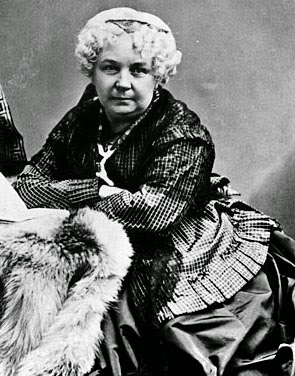
Happy Birthday, Elizabeth Cady Stanton!

In honor of the great feminist Elizabeth Cady Stanton’s birthday, I’m re-sharing the stories of some of my explorations of her life and ideas in the places she lived and worked, often in conjunction with her fellow feminists Ernestine Rose and Frederick Douglass.

To New York City I Go, In Search of Ernestine Rose and Elizabeth Cady Stanton

Enjoy, and I hope you find her story as fascinating, informative, and inspiring as I do!

Ordinary Philosophy and its Traveling Philosophy / History of Ideas series is a labor of love and ad-free, supported by patrons and readers like you. Please offer your support today!

Rationality and the Origins of Myth: Bayle, Fontanelle, and Toland

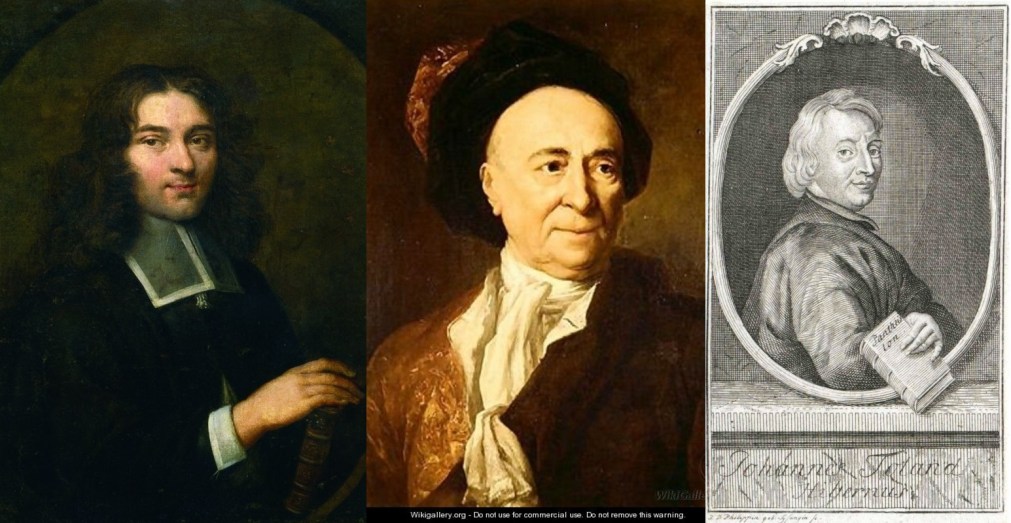
Pierre Bayle, Bernard de Fontanelle, and John Toland; all images in the public domain or free for noncommercial use

This is an extended version of a blog post I recently wrote for my seminar class Myth and the History of Scholarship in Early Modern Europe. I thought I’d share it with you just in case you’re interested in what I’ve been working on at the University of Edinburgh lately ~ Amy

From the ancient philosophers of Greece and Rome to the European Renaissance to early modern Europe in the Age of Discovery, thinkers and scholars attempted to make sense of mythology and the multiplicity of belief from ancient to modern times, in light of their own understanding of the nature of God and the workings of the universe. The Renaissance saw the humanistic attempt to understand mythology as allegories, repositories of ancient wisdom in fable form which conveyed essential religious truths to those discerning enough to perceive them. Then, missionaries to the New World and theologians wrestled with the fact that vast numbers of human beings had no knowledge of the biblical God or of Jesus Christ. They attempted to reconcile this with their beliefs about God’s justice and mercy by recasting pagan myths as expressions of natural theology.

The years leading up to the Enlightenment saw another significant shift in ways of thinking, a rationalist approach that we now associate with the rise of skepticism and the scientific method. In the decades straddling the turn of the 17th century, Huguenot scholar Pierre Bayle, French scientist and writer Bernard de Fontanelle, and British freethinker and religious critic John Toland offered their own critical approaches to the myths of the ancients and of the New World.

‘…People began, in various countries, to write histories in a more reasonable manner and generally with more verisimilitude. So no new fables appear; people are satisfied with preserving the old ones. But can this ever stop those who are infatuated with antiquity? They imagine to themselves that under the fables are hidden secrets of the physical and moral world (Fontanelle 18)’

In On the Origin of Fables, Pierre Bayle (1647–1706) applies ‘natural reason’ and Aristotelian method to myths and ancient philosophy to determine whether they are worthy of belief or useful in promoting a rational understanding of God and the world. Bayle’s approach is to offer critical examinations of particular myths. Through these examples, Bayle intends to demonstrate that mythology is not a vessel of truth, allegorical or otherwise. For one, he considers the ancient Greek philosopher Anaximenes’ idea that the gods were produced by the air, which is the primary and original cause of everything. Bayle rejects this idea as absurd because natural reason doesn’t allow us to believe that a thing’s efficient cause (Aristotle’s term for that which is responsible for another thing’s state of being) to be inferior to that which gave rise to it (Bayle 110). Even more ridiculous, for Bayle, is the idea that a non-thinking thing like air could give rise to a thinking thing like a god (p 113). (I suspect that Bayle would have little use for the theory of evolution.) Other myths such as the birth of Venus, who arose from the foam created when Saturn cut off his father Chaos’ genitalia and threw them into the sea, or that  thunder and lightning is caused by Jupiter’s hurling thunderbolts to earth, aren’t only immoral and brutish, but entirely useless for understanding the rationality of the universe.

Bernard de Fontenelle (1657-1757) sees mythology as the product of the childishness of the human mind at the dawn of reason. When humans observed some amazing or unexpected thing that they couldn’t explain, they naturally embellished it a little so that they could (Fontanelle 11). These embellishments often consisted of positing beings with human-like capacities causing the phenomenon in some recognizable way. Fontanelle, like Bayle, uses the example of thunder and lightning, a mysterious phenomenon that could be explained by imagining a being very like a human but more powerful, who throws arrows of fire like humans do but much larger ones from higher up (p 11-12). He also uses the example of rivers: they originate somewhere, so why not from pitchers like these we use to make water flow? (p 11) But to make rivers, the being(s) who pour the pitchers must have much larger ones, with added power that can keep them flowing plentifully and with force. With each subsequent retelling of these stories, they took on more and more fantastic elements they passed from one person to the other (Consider Michel de Montaigne’s passage about un/reliable testimony in his essay ‘Of Cannibals’), resulting in elaborate and fantastic myths.

But Fontanelle doesn’t judge these almost accidental mythmakers harshly; rather, he makes an interesting and astute observation: it’s actually harder to adhere strictly to the truth than to embellish a tale, especially when it’s about something exciting. It’s harder because 1) ‘our imagination gets heated up with its subject’ (Fontanelle 11) and begins to elaborate the tale all on its own and 2) the more marvelous details you add, the more interest, encouragement, and admiration you arouse in your audience. But though rationality is hard and the imagination is lively (p 15), Fontanelle insists that it’s still essential that we resist ignorance. David Hume would later elaborate on Fontanelle’s idea about myths and miracles, making it one of the centerpieces of his skeptical philosophy in his Enquiry concerning Human Understanding.

John Toland’s (1670-1722) theory also cites human ignorance and frailty in the origins of myth, but he offers a less general account. In his view, myths spring from the honor paid to the dead. Worship of the gods is an extension of the respect, fear, and supplication of powerful rulers, warriors, magicians, and so on (Toland 72). He accepts Euhemerus’ idea that the gods of myth refer to real people but that, over time, their origins were forgotten (p 85). Toland observes that the honor paid to the gods closely resemble the honors paid to dead heroes and princes, so he postulates a common origin for these practices.

Toland further explains that the gods, based on exceptional humans now dead, are also based on human ideas and virtues (p 88). Here, both Toland and Bayle reflect the ancient philosopher Xenophanes, who argues that all gods are devised to resemble their creators. If animals had gods too, they would look, act, and have the same mental features as those animals—at least, the strongest, best, most admired animals among them. Fontanelle also takes a Xenophanean view in his description of how the gods evolve over time: the gods of the earliest, most primitive myths were as irrational, lustful, and brutal as the people themselves. But just as societies became more civilized, more rational, and more virtuous, so did the gods (Fontanelle 13).

Fontanelle, Toland, and Bayle all take a rationalist approach to the subject of myth, as they do to the sciences and all other areas of inquiry. All myths and idolatry are born from irrationality, and if we are to understand the world as it really is, as a rational place created and designed by a rational God, it’s important to demonstrate the irrationality of the myths and remove their power to promote irrationality in the general public. This will result in a more rational, moral, and free society.

Bayle, again, takes the approach of examining particular examples of myths to show that their origins are irrational and that they cannot, even as allegory, be seen to impart anything good or true, or to promote understanding in any way. He continues his exploration of ancient ideas about air, this time the myth that equates the goddess Juno with the air. Despite all attempts to understand this myth as a way of understanding a truth about the workings of the world, it does nothing but confuse and confound. Bayle again invokes Aristotle, who says that if it’s a thinking being, it must have a soul, and if that being is a part of nature and has a soul, it must be an animal. Therefore, if Juno is the air, she’s a sort of animal being constantly being torn and wounded by things passing through her, which he offers as such a patent absurdity that the myth couldn’t possibly promote a rational understanding of nature. (p 117-118)

Fontanelle argues that his time was one of the most intellectually vigorous (p 13), no doubt because he saw it as an age of rationality. He has a progressive view of the human capability for rationality (p 17), and sees it as the way of the world that all human societies will become more rational over time, just as the Greeks did, and just as he suspects that the Native Americans encountered by the Spanish would if given the time to develop their capabilities (p 16). This is consistent with Fontanelle’s view that creation itself is a rational system. It would make sense, then, that the more human beings come to understand it, the more rational they become as well. That’s why it’s a mistake to perpetuate irrationality by continuing to teach the myths through the arts such as poetry, fine arts, and theater (p 17).

Toland argues that a multiplicity of gods and objects of worship, which is characteristic of the less rational belief systems, is correlated with irrationality, less freedom, and more autocracy. The more gods a society creates, the more autocratic and the less free and rational the society – (Toland 98) (Noted scientist and religious skeptic Richard Dawkins would likely point out that in that case, the most free, rational, and democratic societies would have no gods at all.)

‘So [the well-meaning Philosophers] proceeded to explain away the rest of the Gods; and, as Allegorys are as fruitful as our Imaginations, scarce any two Authors cou’d wholly agree in their Opinions. But supposing the Truth of the matter had bin as any or all of ’em wou’d have it, yet their Religion was not a whit the better, and deserv’d to be abolished; since, what ever were the Speculations of a few among the Learned, ‘cis evident that the Vulgar took all these to be very real Gods, of whom they stood in mighty fear, and to whom they paid Divine Adoration…’ (p 122)

So even if the myths could be interpreted as allegories by the learned, their dissemination spread ignorance and irrationality and so did far more harm than good.

‘But if any shou’d wonder how Men cou’d leave the direct and easy Path of Reason ‘ton wander in such inextricable Mazes, let him but consider how in very many and considerable Regions the plain Institution of Jesus Christ cou’d degenerate into the most absurd Doctrins, unintelligible Jargon, ridiculous Practices, and inexplicable Mysterys…’ (p 129)

Bayle goes further than Toland, and believes that myth not only correlates with barbarous societies, but that they promote acceptance of bad behavior. The myth of Jupiter, for example, deifies a being guilty of just about every crime you can think of: murder, rape, incest, lies, and cruelty of every sort (Bayle 107). Fortunately, Bayle observes, most people behave better than the gods of mythology, an observation that extends beyond his close examination of many mythological beliefs.

Fontanelle also observes that belief does not necessarily inform moral convictions or behavior; in fact, they seem to be quite separate:

‘What is strange is that Christians, whose system of religion is so pure, yield almost nothing to the gentiles in respect to engaging in vices. It is a mistake to believe that the moral practice of a religion corresponds to the doctrines of its confession of faith. (p 107)’

People, then as now it seems, accept those religious beliefs that accord with their own principles and moral characters more than the other way around.

~ Thanks to Dr. Felicity Green for inspiration and insight

Bibliography

Bayle, Pierre, ‘Jupiter’, in Historical-Critical Dictionary: Selections [1697], trans. Richard Popkin (Indianapolis, 1991), pp. 107-119.

‘Bernard Le Bovier, sieur de Fontenelle.’ (2017, 25 January), In Encyclopædia Britannica. Retrieved from www.britannica.com/biography/Bernard-Le-Bovier-sieur-de-Fontenelle  ; accessed 09 November, 2017.

Falcon, Andrea, “Aristotle on Causality”, The Stanford Encyclopedia of Philosophy (Spring 2015 Edition), Edward N. Zalta (ed.). Retrieved from https://plato.stanford.edu/archives/spr2015/entries/aristotle-causality/ ; accessed 09 November, 2017.

Fontenelle, Bernard de, De l’origine des fables [wr. c.1691-99, pub. 1724]. English trans. Of the Origin of Fables by Burton Feldman and Robert D. Richardson, The Rise of Modern Mythology 1680-1860 (Indiana, 1972), pp. 10-18.

‘John Toland’. (2017, 17 August), In Encyclopædia Britannica. Retrieved from www.britannica.com/biography/John-Toland ; accessed 09 November, 2017.

Lennon, Thomas M. and Hickson, Michael, ‘Pierre Bayle’, In The Stanford Encyclopedia of Philosophy (Fall 2014 Edition), Edward N. Zalta (ed.), https://plato.stanford.edu/archives/fall2014/entries/bayle/ ; accessed 09 November 2017

Toland, John, Letters to Serena (London, 1704), part III

Ordinary Philosophy and its Traveling Philosophy / History of Ideas series is a labor of love and ad-free, supported by patrons and readers like you. Please offer your support today!

The Bodies of Men Who Have Perished: Reading the Iliad in the 1980s, by L.D. Burnett

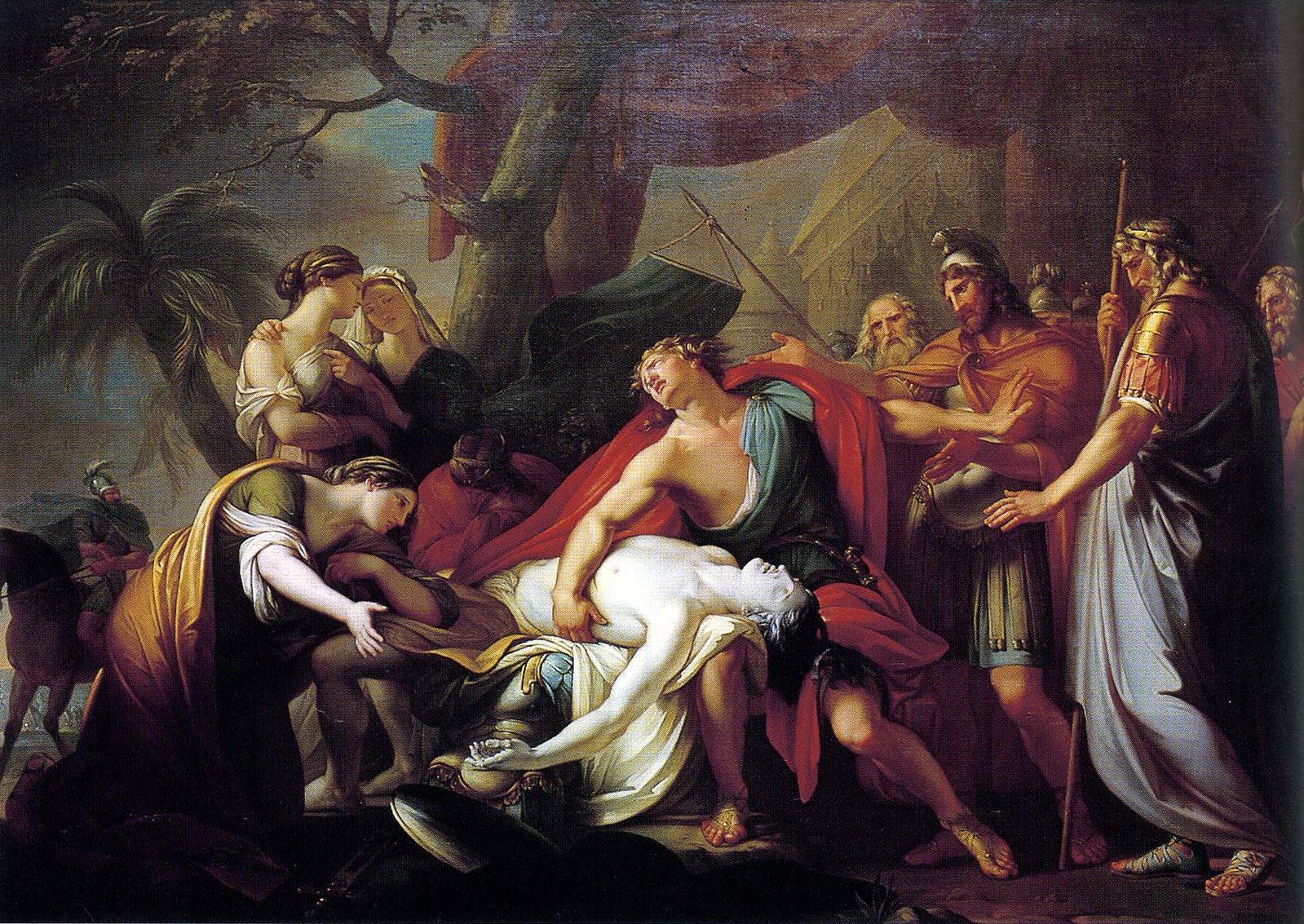
“Achilles Lamenting the Death of Patroclus,” Gavin Hamilton, ca. 1763

Queer love lies at the heart of the Iliad as a work of art.

This was not the claim of my fall quarter Western Culture prof, though he certainly tried to explain the nature of the relationship between Achilles and Patroklos, and how that fit into Greek ideas of manhood, and how it fit (or didn’t) with our own ideas of sexuality.  I don’t think he used the word “queer,” but he did emphasize that to call those two heroes “a gay couple” or “gay lovers” would be both anachronistic and inattentive to the complexities and resonances of the intimacy between them.  Or something like that.

But “queer” as a word that points to a body of scholarly theory and “queer” as a word reclaimed by folk whose intimate relationships, whose inner and intertwined lives, don’t fit neatly within simple binaristic categorizations – that’s a fitting enough word for a consideration of Patroklos and Achilles and the Iliad and the canon and the culture of the 1980s.

What struck me on this re-read of the Iliad was the distinctive portrayal of Achilleus’s grief.  Many warriors fall in these few days of battle, and many Greek heroes, and Trojan heroes too, lose men dear to them – perhaps as dear, indeed, as Patroklos was to Achilles.  Warriors on both sides are smitten with sorrow to see their brothers in arms fall, and warriors on both sides fight fiercely to retrieve the bodies of their fallen comrades – though no battle rages as fiercely or as long as the battle for Patroklos’s body.

And when that broken body is returned to the tents of Achilles – there grief pours forth from different, deeper streams. It is all the grief of brothers in arms, and more.  It is the grief of a lover for not only the life, but the very body, of his beloved.

Achilleus’s anguish over the broken body of Patroklos is compelling.  In a way, I suppose, it is echoed in Priam’s grief as he later pleads for Hector’s body.  But I think rather Priam’s grief harmonizes with Achilleus’s sorrow – it is grief in a different register, or maybe a different key altogether, and they share but one note in common between them:  an unfathomable tenderness toward the body of their own fallen warrior, beloved, though loved in different ways.

Here is how Achilles mourned, and what he feared:

Peleus’ son led the thronging chat of their lamentation
and laid his manslaughtering hands over the chest of his dear friend
with outbursts of incessant grief. As some great bearded lion
when some man, a deer hunter, has stolen his cubs away from him
out of the close wood; the lion comes back too late, and is anguished,
and turns into many valleys quartering after the man’s trail
on the chance of finding him, and taken with bitter anger;
so he, groaning heavily, spoke out to the Myrmidons….
So speaking brilliant Achilleus gave orders to his companions
to set a great cauldron across the fire, so that with all speed
they could wash away the clotted blood from Patroklos….(XVIII, 316-323, 343-345)

The poem goes on to describe in detail the tender care Achilles and his companions take in cleaning and preparing Patroklos body for his eventual funeral.

Yet no mortal effort can overcome decay. The body of the beautiful, the beloved one, his spirit shorn from the world of the living, will see corruption, Achilles fears, before he has a chance to return from avenging Patroklos’s death.  And he is not resigned.

His mother cannot comfort him, but she can help him.

Thetis, the water nymph, the immortal, does two things for her son in his grief:  she commissions for him immortal armor from the Olympian forge of Hephaistos, and when she returns with the enchanted shield – that immortal aesthetic object, art that literally captures the full round of earthly life, a frieze of figures in constant motion, the whole world of human meaning and meaning-making to live on and on past the death of the hero who will bear it on his shoulders – she gives her son what aid she can in caring for the body of his friend.

Achilles, after receiving the armor, tells his mother,

I am sadly afraid,
during this time, for the warlike son of Menoitios
that flies might get into the wounds beaten by bronze in his body
and breed worms in them, and these make foul the body, seeing
that the life is killed in him, and that all his flesh may be rotted.”(XIX, 23-27)

Achilles’ love for Patroklos does not transcend the burdens of embodiment.  This a feature that some other readers, maybe from another time or maybe now, might see as a great flaw. But in Achilles I see a mother’s son grieving for his lover, and like his mother, I find in this no cause for reproach.

In turn the goddess Thetis the silver-footed answered him:
“My child, no longer let these things be a care in your mind.
I shall endeavor to drive from him the swarming and fierce things,
those flies, which feed upon the bodies of men who have perished….
Go then and summon into assembly the fighting Achaians,
and unsay your anger against Agamemnon, shepherd of the people,
and arm at once for the fighting, and put your war strength upon you.”
She spoke so, and drove the strength of great courage into him;
and meanwhile through the nostrils of Patroklos she distilled
ambrosia and red nectar, so that his flesh might not spoil. (XIX, 28-39)

Ambrosia is an Olympian gift, the drink of the immortals – but that was not the gift we talked about when we discussed this work in reading group in the 1980s.  Instead, we talked about that shield, about how the poet celebrated art and storytelling as something immortal, with the shield of Achilles a stand-in for the poet’s work itself: a made thing through which life immortal moves.  That was our focus:  understanding the meaning of the shield of Achilles.

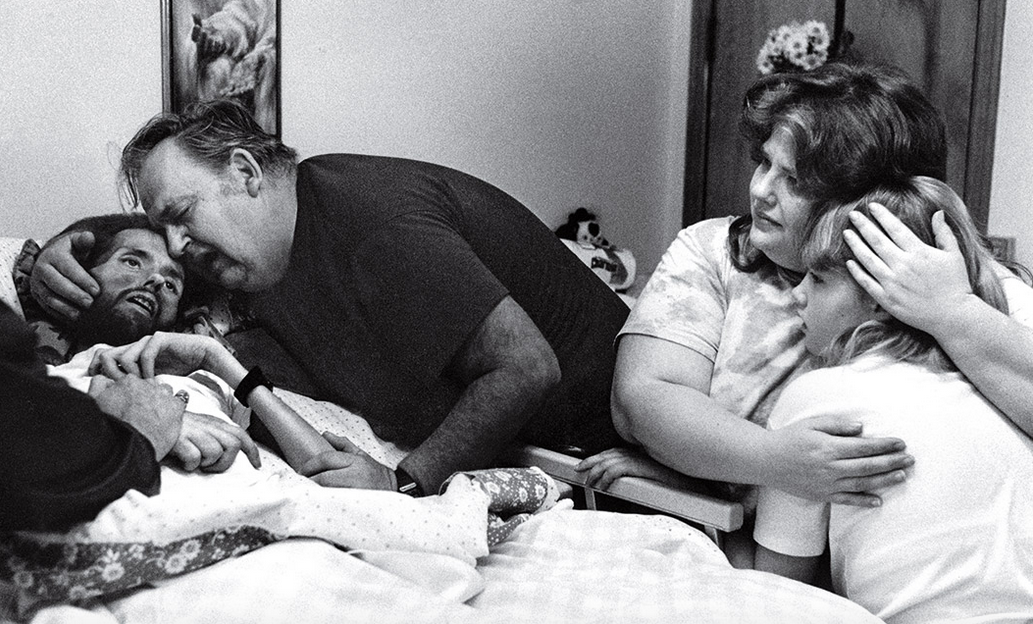
But the years during which Stanford freshmen were asked to read the Iliad were the very years when AIDS was ravaging queer communities, sweeping away queer lives (and hemophiliacs’ lives, and needle-sharing heroin addicts’ lives and unsuspecting partners’ lives) in an ever-advancing tidal wave of utter destruction.  Imagine the keening grief of Achilles magnified by the millions.  Imagine the great immortal shield, the Solace of Art, clattering to the ground, unfinished and undone, because the artists – the writers, the painters, the set designers, the actors, the sculptors, the dancers, the poets, the singers, the writers of songs – were literally wasting away.  Often they were mourned by the friends, their comrades in arms, their partners in love.  But often they died, as Patroklos did, and Achilles too, far away from home – disowned, despised, abandoned.

“David Kirby on his deathbed, Ohio, 1990,” Therese Frare / LIFE

We were reading this text against that background, but I’m not sure how many of us made the connection.  At the time, I did not. Seeing they do not see…

Now, though, every time I teach the second half of the U.S. history survey, I talk at length about the AIDS crisis.  I talk about the murderous neglect of the Reagan administration, and the vile hatefulness pouring forth from many key leaders on the religious Right, who called AIDS a punishment from God and a fate that gays deserved.  I talk about how many in mainstream American culture, out of prejudice and fear, had turned their backs on their own fellow citizens, and how AIDS activists and allies incessant advocacy and hospice training and political work and lobbying and protesting and constant painful heartrending public appeals to shared humanity and common decency combined to force the nation to take heed, to take care, to pour research and resources into finding a cure, a treatment, a ray of hope.

I tell my students that in the 1980s and 1990s, AIDS was seen as a sure death sentence, and many saw it as a sentence that its sufferers deserved.  But now there is preventative treatment, and treatment for symptoms, and maybe even hope of a cure.  And on the final exam, every semester, I have one or two students who tell me some version of, “I’m gay [or, I’m queer, or, I’m a LGBTQ ally] and I didn’t know anything about this history. Thank you so much for teaching this.  We didn’t cover the AIDS crisis in high school.”

And at first I think, How could you not cover the AIDS crisis in a high school U.S. history class?  On the other hand, how could you begin do it justice?

And who am I to judge?  I read Achilles mourning for Patroklos, lover for beloved, and my thoughts turned to abstractions like Art and Immortality, Great Books and Canonicity, when matters of much greater import were at stake.

Learn, and live – live.  There were too many who did not.

This piece was originally published at the Society for U.S. Intellectual History Blog

L.D. Burnett received her Ph.D. in Humanities (History of Ideas) from the University of Texas at Dallas (2015), where she is currently employed as the 2017-2018 Teaching Fellow in History. Her book, Canon Wars: The 1980s Western Civ Debates at Stanford and the Triumph of Neoliberalism in Higher Education, is under contract with University of North Carolina Press. (Bio credit: S-USIH)

~ Ordinary Philosophy and its Traveling Philosophy / History of Ideas series is a labor of love and ad-free, supported by patrons and readers like you. Please offer your support today!

*All views and opinions expressed by guest writers are their own and do not necessarily reflect those of Ordinary Philosophy’s editors and publishers

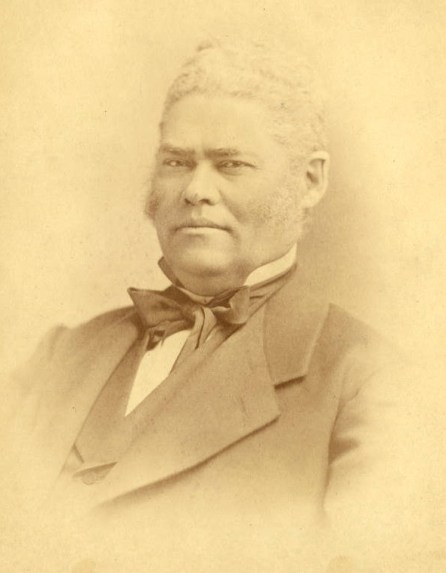
Happy Birthday, John Jones!

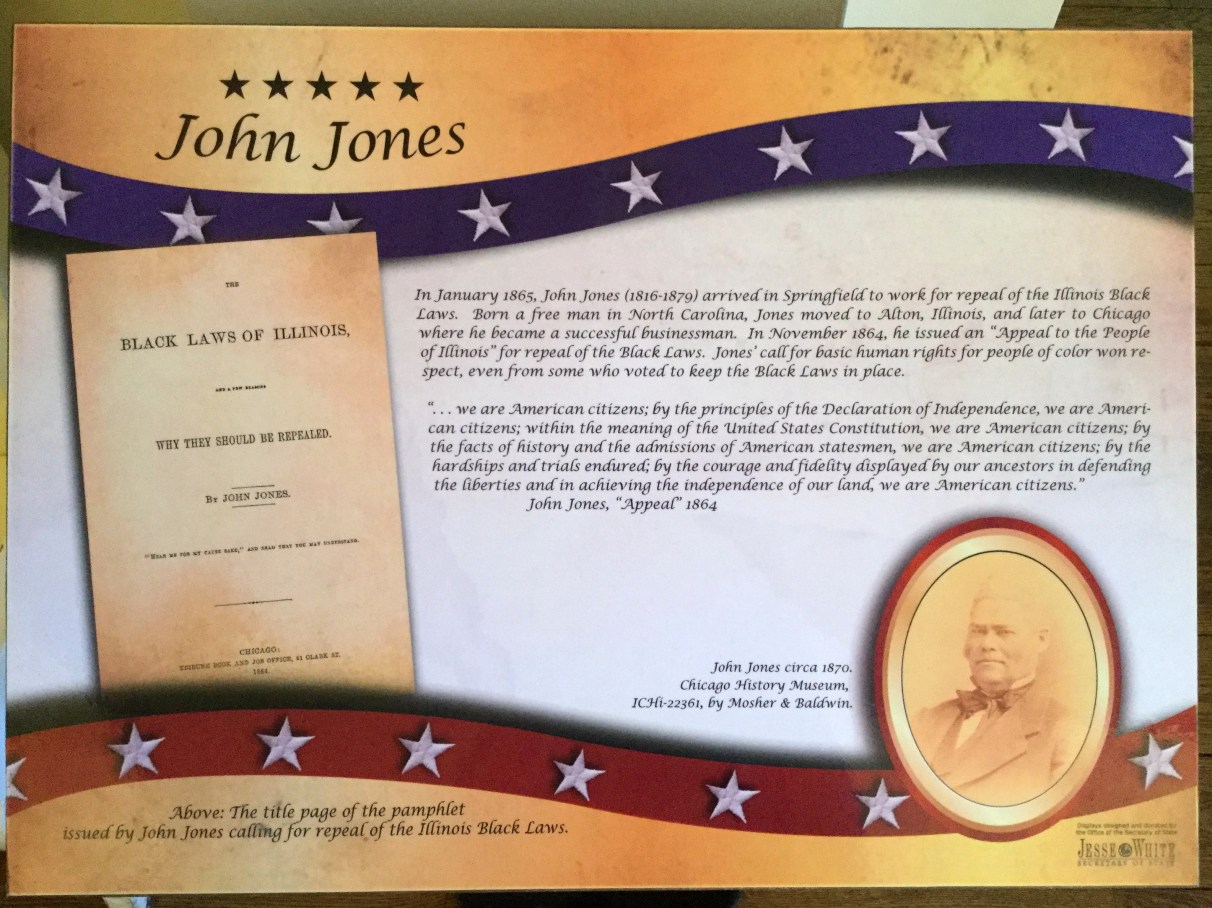
John Jones, portrait by Mosher & Baldwin, 1882, courtesy of the Chicago History Museum

When I visited Springfield, Illinois this summer, I found a very interesting plaque at the Old State House downtown. It told the story of John Jones and his activism against Illinois’s Black Laws, a set of legal codes that pertained only to black people, and, as you likely and immediately supposed,  were terribly oppressive. Such laws have a long history in the United States and as long as they’ve been around, lovers of justice have been around to fight them. John Jones was one such person.

Born on November 3rd, 1816 to an American black mother and German white father, Jones had to make his own way early in the world. Jones’ mother did not trust his father to do right by his son so she apprenticed him to a tailor when he was very young. The resourceful Jones taught himself to read and write and, having learned what he needed to, he released himself from the tailor’s service by age 27. He then obtained official free papers for himself and his wife, née Mary Jane Richardson, and secured their freedom to live and travel by posting a $1,000 bond in 1844. While he and his wife were both born free, they had to worry about the numerous ‘fugitive’ slave catchers and kidnappers prowling around, all too happy to capture as many black persons as they could get ahold of, passing them off as escaped slaves in exchange for a substantial payoff.

The Joneses moved to Chicago from Alton, Illinois in 1845, where there was an established community of black entrepreneurs and therefore, more opportunities for families such as theirs. Jones worked hard and savvily, building up a very successful tailoring business and amassing an impressive fortune within just a few years. The Joneses used their success to help their fellow black citizens, making their home one of the key Chicago stops on the Underground Railroad. Jones poured much of his money and time into civil rights activism, working for the abolitionist cause and to overturn the Fugitive Slave Act of 1850 and the already decades-old Black Laws of Illinois, sometimes with his fellow autodidact and activist Frederick Douglass. For the rest of his life, Jones was a prominent intellectual, moral, religious, and political leader in the black community of Chicago and beyond.

Learn more about the courageous civil rights leader John Jones at:

John Jones (1816–1879): Activist, politician, tailor, entrepreneur  ~ by Jessie Carney Smith for Encyclopedia.com

Jones, John ~ by Cynthia Wilson for Blackpast.org

Historical placard for John Jones, Old State House, Springfield, Illinois

Ordinary Philosophy and its Traveling Philosophy / History of Ideas series is a labor of love and ad-free, supported by patrons and readers like you. Please offer your support today!

Photobook: Missouri Constitutional Rights Flag Captured by Union Soldiers on June 14th, 1861

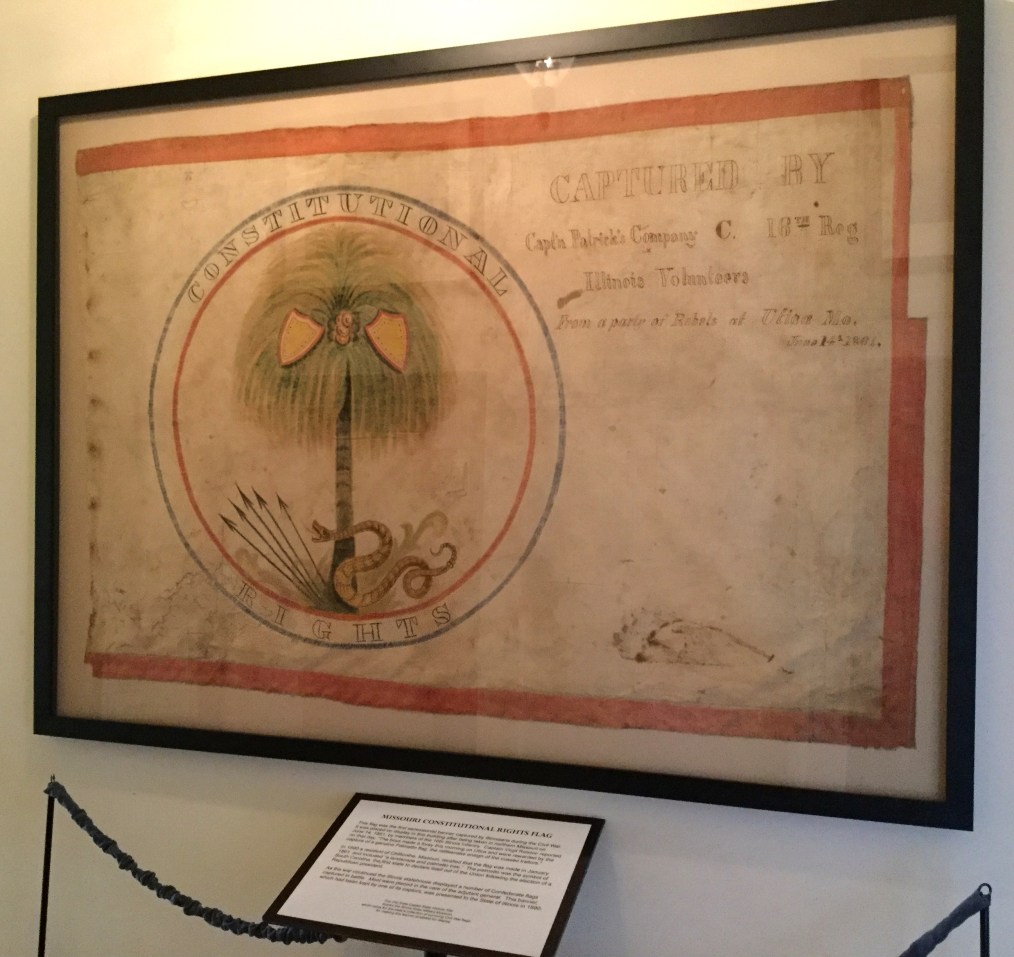
Missouri Constitutional Rights Flag captured by Union soldiers on June 14th, 1861, Old State Capitol Building, Springfield, Illinois.

The claim that the Southern states seceded primarily over the Constitutional issue of states’ rights issues is an oft-repeated one, and I think a troubling one for many reasons. For one thing, it’s part of a long tradition of trying to sidestep or minimize the problems of race-based slavery and the resulting intransigent racism that has plagued our country since its formative years, often on the part of people who don’t want to support laws that promote racial equality. For another, this states’ rights claim was as disingenuous then as it is now: the Southern states seceded not because the federal government was trying to stop slavery in their states. There was, as yet, no concerted attempt to do so. They were incensed that the federal government, in their view, was not doing enough to enforce the legal right to own slaves in free states: by forcing local governments and private individuals, against their own philosophical and religious convictions, to return escaped slaves; to allow slaveowners to retain their rights to own slaves when they traveled and even moved to free states; and to extend the rights to own slaves to new territories.

Ordinary Philosophy and its Traveling Philosophy / History of Ideas series is a labor of love and ad-free, supported by patrons and readers like you. Please offer your support today!

Should Life in Jail be Worse than Outside, on Principle? By Chris Barker

Sheriff’s House and Jail in Easton, Maryland, c. 1881

Approximately 2.3 million people in the United States are currently in prison or jail. (Prisons are run by federal or state authorities; jails are run locally.) China, a non-democratic regime with a population four times larger than the US, incarcerates fewer persons in per-capita and absolute terms. What’s more, most people in US jails today have not been convicted, meaning that they are being punished without trial. Since US jail admissions number approximately 11 million per year, pre-trial incarceration is, arguably, the real problem of ‘mass incarceration’.

The crucial concept governing carceral practices is something called ‘less eligibility’. The idea dates back to the English Poor Law Amendment Act of 1834, which codified English practices of dealing with the indigent. In 1832, the economist Nassau William Senior described how the ‘first and most essential of all conditions’ in administering relief to the poor (often by moving them into a workhouse) is that the indigent’s ‘situation on the whole shall not be made really or apparently so eligible as the situation of the independent labourer of the lowest class’. That is, the conditions in the workhouse should be awful: worse even than the poorest of the poor.

But even before Senior’s famous line, a different carceral ideal was afoot: equality. In 1791, writing specifically about criminal offenders, the English utilitarian philosopher Jeremy Bentham argued that ‘the ordinary condition of a convict doomed to a punishment that few or none but the individuals of the poorest class are apt to incur, ought not to be made more eligible than that of the poorest class of subjects in a state of innocence and liberty’. As the historian Janet Semple observed in Bentham’s Prison (1993), his rule of severity is not ‘less eligibility’ but a more commonsense equality principle – offenders should have access to no more resources than they had while free. ‘Bentham,’ Semple wrote, ‘did not envisage grinding his convicts down to below the level of the poorest of the poor.’

Other countries do not run their jails and prisons according to a principle of less eligibility. German prisons operate under an ‘approximation’ principle, wherein offenders’ rights to privacy, dignity and property are protected. Norwegian prisons use a similar ‘normality principle’, which holds that daily prison life should be, as far as possible, no different from ordinary life. Fellow Englishman and Bentham disciple James Mill embraced the normality principle in 1825 by arguing that inmates in pre-trial incarceration should be allowed to lead the same life that they enjoyed prior to arrest, including access to employment and freedom to make small purchases with their own money. Today, US jails and prisons have rejected these examples in thrall to ‘less eligibility’, and not just for the poorest of the poor.

Why are the carceral practices in the US so harsh? Part of the reason is the vestige of a Christian-inspired desire to reform the offender’s soul. Around the time of the Revolution, the penitentiary’s ‘unsocial manner of life’ based on order, obedience and silence could seem plausible only to those who thought that they could achieve a ‘new victory of mind over matter’. Today, prolonged solitary confinement is coming to be seen for what it is: torture. Another reason, identified in James Whitman’s book Harsh Justice (2005), is populism. Elected prosecutors and judges are guided by popular, punitive attitudes in a way that unelected bureaucrats in countries such as Germany (or Canada) are not. Survey research shows that Canadian and US attitudes about punishment are similar, but Canada has much more lenient sentencing policies than the US because bureaucratic appointees, not elected officials, make decisions about punishment. Another layer is race. Warehousing black males is clearly an outcome, and perhaps also an important aim, of US criminal justice. The result of this grab-bag of influences is segregation without soul-craft, and discipline and surveillance without reform.

If, as I think, the aim of punishment is rehabilitation, it is hard to justify less rather than equal eligibility. But not all agree that rehabilitation is the primary aim of punishment. Deterrence theorists think that controlling crime is the most important aim of punishment. Retributivists hold that punishment should repay the harm done to another in a like manner: an eye for an eye, a tooth for a tooth.

As evidence that precisely the opposite happens in US prisons, The End of Punishment (2013) by the present-day retributivist Robert Blecker’s recounts an interview with a Tennessee Death Row correctional officer who feels like a waiter, and a guard who complains that Florida’s Death Row is ‘the best deal in the building’. Blecker is right that we should classify offences and offenders according to the severity of their crime. Perhaps the ADX Florence supermax prison should even be, as its ex-warden described it to CNN, ‘far much worse than death’ for the worst of the worst. But think about this: county jail is ‘hard time’, and harder than state prison, as I am told by a local jail administrator. Almost 500,000 held in US jails are being held pre-trial. The average jail time served is short. Offenders quickly return to their communities, but they are not prepared for re-entry. Even the average jail and prison time might actually help offenders to become worse.

Too often, the US conversation about criminal justice is about principles and theories of punishment: rehabilitation, retribution, deterrence. What I am arguing here is that these theories amount to little if we ignore less eligibility, or how we punish. Visiting a jail without an outdoor yard, where offenders have no physical contact with friends and family during their incarceration, or a prison where life unfolds within coils of obtrusive razor wire, is not a normal life, and doesn’t prepare you to return to normal life. As opinion in the US starts to move away from some punitive strategies such as solitary confinement, we should reconsider which of our other carceral practices meet or violate the crucial secondary principles (leniency, proportionality, egalitarianism) of a just criminal justice system.

In Germany, there are restrictions on types of uniforms, on partitioning visitors from offenders, and on the use of bars and peepholes in cells. There are also protections of offenders’ rights to privacy, information, public exposure, and leisure and culture, that do not exist in the US. In the US, courts have upheld the constitutionality of expressive punishments that demean offenders, pre-trial incarceration that looks punitive, and denials of privacy and dignity.

It is a tragedy if the attempt to have a just society with a suitable criminal justice system has been transformed into criminogenic warehousing, based on surveillance and discipline, which achieves few or none of the goals of punishment. It is foolishness to countenance such a system merely because it has not yet touched you. The road to the present state of affairs leads through less eligibility, which, on the surface, is a principle that makes sense: treat offenders to a life that is worse than life on the outside. After all, why should offenders have air conditioning if the farmer ‘living in innocence and liberty’ does not? But the answer is that it is too easy to forget the other constraints on the dignity, privacy and autonomy of those incarcerated in jails and prisons.

Our present system is costly and ineffective; it creates aberrant economies and empowers prison gangs that in turn influence street gangs. Prisons reproduce the cultural inadequacy of life on the inside on our streets and in popular culture, and when offenders are released into communities, their lack of rehabilitation justifies further segregation and other collateral consequences, such as employment and housing discrimination.Aeon counter – do not remove

This article was originally published at Aeon and has been republished under Creative Commons.

Chris Barker is assistant professor of political science at Southwestern College in Kansas. (Bio credit: Aeon)

~ Ordinary Philosophy is a labor of love and ad-free, supported by patrons and readers like you. Any support you can offer will be deeply appreciated!

*All views and opinions expressed by guest writers are their own and do not necessarily reflect those of Ordinary Philosophy’s editors and publishers

Happy Birthday, John Adams!

John Adams by John Trumbull, 1793, National Portrait Gallery, Washington, D.C.

Like many who watched the excellent 2008 miniseries John Adams with Paul Giamatti in the title role and Laura Linney as Abigail Adams, my interest in the United States’ second president increased quite a bit after watching it. And when I read John Ellis’ Passionate Sage: The Character and Legacy of John Adams last year, I found myself thoroughly engrossed. I read of a man who was brilliant, insecure, honest, vain, visionary, retrograde, loving, selfish… all character traits which I believe are often found in the most interesting and accomplished people. The same traits that drive people to do wonderful and unusual things are often the same as, or found in conjunction with, those which make people thoroughly insufferable. For example, the insecure egoist’s need to be loved and admired provides the drive for accomplishment, and those who are intelligent enough to surpass most others in this regard are also intelligent enough to recognize it, resulting in vanity. Perhaps because I don’t have to put up with him personally, I can freely admire and even feel affection for Adams as the sensitive, flawed human being  revealed in his massive correspondence; an egoist who nevertheless was obsessed with justice and did his best to see it done in the world, who sacrificed his own posterity and a second term in office to preserve his new country from the existential threat of an ill-conceived war; whose dignity was far too easily wounded but at times proved himself a loyal friend even to those that betrayed him – Thomas Jefferson being a prime example.

Americans may have more easily forgiven all of this if he hadn’t championed the Alien and Sedition Acts and signed them into law, parts of which are seen today as contrary to essential American principles. In his fear that the bond between the states in his newly united country would break apart under the strain of war and the spiraling controversies of party politics, Adams overreached. But his legacy shouldn’t be overshadowed by this one, though admittedly significant, mistake. As Ellis writes for Encyclopædia Britannica,

Although Adams was regarded by his contemporaries as one of the most significant statesmen of the revolutionary era, his reputation faded in the 19th century, only to ascend again during the last half of the 20th century. The modern edition of his correspondence prompted a rediscovery of his bracing honesty and pungent way with words, his importance as a political thinker, his realistic perspective on American foreign policy, and his patriarchal role as founder of one of the most prominent families in American history.

Learn more about our oh-so-human, brilliant president John Adams at:

John Adams ~ Miniseries by HBO, 2008

John Adams As He Lived: Unpublished Letters to Dr. Benjamin Waterhouse, Professor of Physic at Harvard College ~ published in The Atlantic, May 1927

John Adams: The Case of the Missing John Adams Monument ~ Lillian Cunningham for the Presidential podcast series presented by The Washington Post

John Adams: President of the United States ~ Joseph J. Ellis for Encyclopædia Britannica

Plain Speaking: In David McCullough’s Telling, the Second President is Reminiscent of the 33rd (Harry Truman) ~ by Pauline Maier for The New York Times: Books, May 27, 2001

Sorry, HBO. John Adams Wasn’t That Much of a Hero ~ Jack Rakove for The Washington Post, April 20, 2008

~ Ordinary Philosophy is a labor of love and ad-free, supported by patrons and readers like you. Any support you can offer will be deeply appreciated!