Ernestine Rose and Elizabeth Cady Stanton: A Brief History

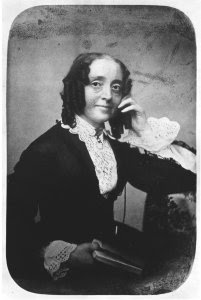
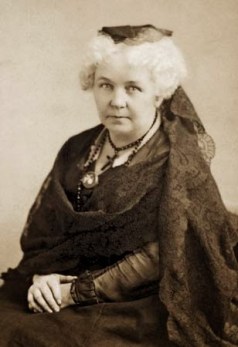
With my first day of discovery under my belt, I’ll start by telling you a little about the two wonderful women who are the inspirations for and subjects of my project, in case you’re encountering them here for the first time.

Ernestine Rose was a Polish, immigrant, feminist, abolitionist, public-speaking, socialist, atheist Jewish woman. Unless she had happened to be black, she had nearly as many cards stacked against her chances of leading a successful and happy life in her time as one person could have. To a person like myself and I suspect like you, dear reader, such a list of attributes today indicate her utter awesomeness! Anyway, Rose did manage to make a career for herself in which she was widely admired and financially stable, even sometimes well off, regardless of the fact that she was such a controversial figure. That’s because she had the good fortune to receive a very good education, she was an inspiring and gifted public speaker, she had a lot of energy and a strong work ethic, (despite her frequent struggles with ill health), she such displayed fearlessness and integrity in her convictions, and it didn’t hurt that she was very attractive, especially by the standards of her day.

Ernestine, born in 1810, was the daughter of a rabbi, and was well read and precocious at a young age. For example: she convinced her father to teach her to read the Torah in its original language so that she could discuss and debate the meaning of the actual text with him. When she was a young woman, she escaped an arranged marriage by appealing to the Polish civil court (rather than the local Jewish court as was customary) and decided to make the most of her life by leaving her segregated, anti-Semitic native city. She went from Berlin, where she learned German and invented the perfumes and a room-scenting device that helped support the family, to London, where she met her dearly-loved, fellow liberal-progressive husband William Rose, and finally to the United States, where she and her husband soon opened up a ‘fancy’ shop selling her perfumes and his silversmithing creations, and where she threw herself whole-heartedly into public speaking, writing, and organizing in support of women’s rights, abolition, separation of church and state, and other human rights causes. Her public speaking was as controversial as her unorthodox beliefs, since at that time it was considered immodest and unwomanly, limited to men only; but it was her open and unapologetic atheism that was most controversial, and most unusual. She lived and worked in the United States, based in New York City, from 1836 to 1869, when she moved to England to (mostly) rest and retire from public life when her health began to give out for good.

Elizabeth Cady Stanton, born five years after Ernestine in central New York State, was as fearless and tireless in her activism as she was in motherhood. Like Ernestine, she was an outspoken and unapologetic feminist, abolitionist, and freethinker. After a thorough formal education, somewhat unusual for women in her time, she married at age 25 (leaving out the ‘obedience’ vow, since she viewed marriage as a partnership between two consenting, rational adults, rather than a hierarchical power arrangement) and raised seven children.
She wrote prodigiously, and since giving birth to and raising so many children kept her too busy for frequent travel and public speaking, she worked closely with Lucrecia Mott, another founding feminist, and entered into a longtime collaboration with a fellow feminist, Susan B. Anthony. While the two were very different in so many many ways (Elizabeth was fiery and impolitic in expressing her opinions, Susan was more tactful; Elizabeth was a skilled writer and orator but less skilled organizer, while Susan was the opposite; Elizabeth was an outspoken critic of religion and the Bible, Susan, like Lucretia, was a Quaker), they were extremely attached to one another, and their often opposing strengths made them probably the single most effective and influential team in feminist history. (Side note: if you are interested in the history of human rights and progressive activism in the United States, you may be struck by the prevalence of Quakers among their ranks. While there were many Quaker sects, they tended to hold radical beliefs for their day: they were egalitarian, pro-education, anti-war, and encouraged critical discussion and examination in matters of religion.)
With Lucretia’s, Susan’s, and others’ help, especially while she was still home bound with her young children, Elizabeth conceived of and put together numerous meetings and organizations, including the first women’s rights conference at Seneca Falls in 1848, numerous abolitionist and temperance events, the American Equal Rights Association, the International Women’s Council, and many more. She wrote the Woman’s Bible, A Declaration of Sentiments (modeled on the Declaration of Independence), Solitude of Self (often considered her greatest speech), History of Woman Suffrage (with others), and much more. She was the first woman to run for Congress, wrote and was the primary impetus behind the passage of the first federal bill protecting women’s property to pass into law (following Ernestine, who has campaigned for it earlier), and annually campaigned, unsuccessfully, for suffrage for women. (Though she lived a very long life, she did not live to see this victory achieved.) Like Ernestine, she was a rare outspoken critic of religion, and considered all of them anti-woman, especially the three religions of the Bible. She worked up to the day she died in 1902 (on October 27th, the date I flew in to NYC.)

Now that we have a brief history of those great women fresh in our minds, let’s follow in their footsteps!

Shortly to follow: an account of my first day in New York City. visiting sites associated with their lives here…..

~~~~~~~~~~~~~~~~~~~~
Sources and Inspiration:
Dorress-Worters, Paula. Mistress of Herself: Speeches and Letters of Ernestine Rose, Early Women’s Rights Leader. The Feminist Press at CUNY, 2008
Elizabeth Cady Stanton. (2014, November 4). In Wikipedia, The Free Encyclopedia. Retrieved 15:33, November 5, 2014, from  http://wikipedia.org/wiki/Elizabeth_Cady_Stanton
‘Elizabeth Cady Stanton Dies At Her Home’, On This Day, New York Times, Oct 7th, 1902. http://www.nytimes.com/learning/general/onthisday/bday/1112.html
Ernestine Rose. (2014, July 7). In Wikipedia, The Free Encyclopedia. Retrieved 15:34, November 5, 2014, from http://wikipedia.org/wiki/Ernestine_Rose
Freedman, Janet. ‘Ernestine Rose.’ Jewish Women’s Archive  http://jwa.org/encyclopedia/article/rose-ernestine
Kolmerten, Carol. The American Life of Ernestine L. Rose. Syracuse, N.Y., 1999.  http://books.google.com/books?id=0JkRzTh7QUsC&printsec=frontcover&source=gbs_atb#v=onepage&q&f=false
‘New Lanark: An Introduction’. Undiscovered Scotland: The Ultimate Online Guide. http://www.undiscoveredscotland.co.uk/lanark/newlanark/
Stanton, Elizabeth Cady, Susan B. Anthony, and Matilda Josyn Gage. History of Woman Suffrage, volumes 1 and 2. Rochester, N.Y., 1881,1887

To New York City I Go, In Search of Ernestine Rose and Elizabeth Cady Stanton

Hello, friends of Ordinary Philosophy!

I’m pleased and excited to announce my upcoming adventure: my second philosophical-historical themed adventure, this time to New York City!

In case you missed my first go-round in my series of philosophy-travel pieces, here’s my plan:

So I’m taking a series of trips to places around the world, where I explore the lives and ideas of great thinkers in the places where they lived and worked. I’ll follow in the footsteps of thinkers who are no longer alive, since those who are still telling their own stories. But those who are no longer alive in the body live on in the ideas that they pass on, and in the example they provide for us to follow.

For this next installment, I’ll be following Ernestine Rose and Elizabeth Cady Stanton, two of the greatest founders of the women’s rights movement. Elizabeth was born in New York state, and lived many years in New York City, where she also died. Ernestine was born in Poland (so at some point, I hope to make it to Poland and write an ‘Ernestine Rose, Part 2 series!) and lived for many years in New York City, and though she did not live in the United States for all of her life, much of her most important work on behalf of women was done here. So off to New York City I go! There, I’ll visit significant landmark associated with their lives, places where they lived, worked, died, thought, wrote, studied, and rested.

I’ll be traveling there from October 29th through November 2, and will be writing throughout the trip. I’ll be writing not only about their ideas, but about what I can discover about their everyday lives here, and whatever feeling of their time and place I manage to uncover.

If you have any questions for me to answer while I’m there, or pictures you’d like me to take for you, or any information you have that could help me with this project, I’d love to hear from you!

Follow Ernestine Rose and Elizabeth Cady Stanton with me:

Ernestine Rose and Elizabeth Cady Stanton: A Brief History
Ernestine Rose and Elizabeth Cady Stanton Sites, NYC, Part 1
Ernestine Rose and Elizabeth Cady Stanton Sites, NYC, Part 2
Ernestine Rose and Elizabeth Cady Stanton Sites, NYC, Part 3
In Her Own Words: Solitude of Self, by Elizabeth Cady Stanton, 1892
In Her Own Words: A Defense of Atheism, by Ernestine Rose, 1861

For more about Elizabeth Cady Stanton at Ordinary Philosophy, please visit:

Frederick Douglass Albany, Troy, and Syracuse NY Sites
Frederick Douglass Seneca Falls, Canandaigua, Honeoye, and Mt Hope Cemetery Sites
Is Feminism Passe? No! Cries A Distinct Lack of Statuary

And about Ernestine Rose and Elizabeth Cady Stanton:

Philosophy and Early Feminist Thought

On Morality: Objective or Subjective?

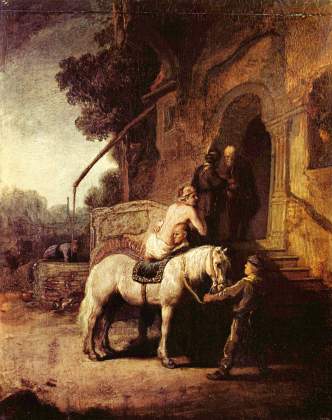
The Good Samaritan by Jean de Jullienne, 1766, after, public domain via Wikimedia CommonsIs morality objective, or subjective?

If it’s objective, it seems that it would need to be something like mathematics or the laws of physics, existing as part of the universe on its own account. But then, how could it exist independently of conscious, social beings, without whom it need not, and arguably could not, exist? Is ‘objective morality’, in that sense, even a coherent concept?

If it’s subjective, how can we make moral judgments about, and demand moral accountability from, people of times, backgrounds, belief systems, and cultures different than our own? If it’s really subjective and we can’t make those kinds of moral judgments or hold people morally accountable, then what’s the point of morality at all? Is ‘subjective morality’ a coherent concept either?

Take the classic example of slavery, which today is considered among the greatest moral evils, but until relatively recently in human history was common practice: could we say it was morally wrong for people in ancient times, or even two hundred years ago, to own slaves, when most of the predominantly held beliefs systems and most cultures supported it, or at least allowed that it was acceptable, if not ideal? Does it make sense for us to judge slave owners and traders of the past as guilty of wrongdoing?

From the objective view, we would say yes, slavery was always wrong, and most people just didn’t know it. We as a species had to discover that it was wrong, just as we had to discover over time, through reason and empirical evidence, how the movements of the sun, other stars, and the planets work.

From the subjective view, we would say no. We can only judge people according to mores of the time. But this is not so useful, either, because one can legitimately point out that the mere passage of time, all on its own, does not make something right become wrong, or vice versa. (This is actually a quite common unspoken assumption in the excuse ‘well, those were the olden days’ when people want to excuse slavery in ancient ‘enlightened, democratic’ Greece, or in certain pro-slavery Bible verses.) In any case, some people, even back then, thought slavery was wrong. How did they come to believe that, then? Was the minority view’s objections to slavery actually immoral, since they were contrary to the mores their own society, and of most groups, and of most ideologies?

Morality can be viewed as subjective in this sense: morality is secondary to, and contingent upon, the existence of conscious, social, intelligent beings. It really is incoherent to speak of morality independently of moral beings, that is, people capable of consciousness, of making and understanding their own decisions, of being part of a social group, because that’s what morality is: that which governs their interactions, and makes them right or wrong. Morality can be also viewed as subjective in the sense that moral beliefs and practices evolved as human beings (and arguably, in some applications of the term ‘morality’, other intelligent, social animals) evolved.

Morality can be viewed as objective in this sense: given that there are conscious, social beings whose welfare is largely dependent on the actions of others, and who have individual interests distinct from those of the group, there is nearly always one best way to act, or at least very few, given all the variables. For example, people thought that slavery was the best way to make sure that a society was happy, harmonious, and wealthy. But they had not yet worked out the theoretical framework, let alone have the empirical evidence, that in fact societies who trade freely, have good welfare systems, and whose citizens enjoy a high degree of individual liberty, are in fact those that end up increasing the welfare of everyone the most, for the society as well as for each individual. So slavery was always wrong, given that we are conscious, social, intelligent beings, because as a practice it harmed human beings in all of these aspects of human nature. Slavery is destructive to both the society and the individual, but many people did not have a reasonable opportunity to discover that fact, other than through qualms aroused by sympathetic observation of so much suffering.

In sum: it appears that in many arguments over morality, where people accuse each other of being ‘dogmatic’, or of ‘moral relativism’, or various other accusations people (I think) carelessly throw at each other, is due to a basic misunderstanding. To have an ‘objective’ view does not necessarily entail one must have a fixed, eternal, essentialist view of morality which does not allow for moral evolution or progress. Likewise, to have a ‘subjective’ view of morality does not entail thinking that ‘anything goes’, or that morality is entirely relative to culture, religion, or belief system. Here, as is the case with so many important issues, simplistic, black-and-white explanations do not lead to understanding, nor to useful solutions to life’s most pressing problems.

* Also published at The Dance of Reason, Sac State’s philosophy blog

Ordinary Philosophy and its Traveling Philosophy / History of Ideas series is a labor of love and ad-free, supported by patrons and readers like you. Please offer your support today!

Free Will and the Self

Free will and the self. What are they? While they are the two most important phenomena to each and every one of us, they’re notoriously hard to describe. Of course, we ‘know’ what they are: respectively, they are the experience, the feeling, of being in control of our own actions, of our thoughts and behaviors, and of having an identity and a personality that exists over time. Without them, our lives seem pointless: if we have no free will, then we are mere automatons, and we can take no credit and no responsibility for anything we do. If we have no self, then there is no we, no ‘I’, at all.

Experiments and scholarship by neuroscientists, biologists, psychologists, and others have revealed some starling things about the workings of the brain and how human beings think, behave, and make decisions. The field of neuroscience has grown by leaps and bounds in the past few decades since the advent of technologies that allow us to observe the living brain at work, though we’ve been learning much about the brain over the last few centuries by observing the results of damage to its various parts. These results have, in turn, thrown traditional accounts of the self and free will into question.

Many have gone so far as to say that since we’ve discovered that our actions result from the cause-and-effect processes of a physical brain, then we have no free will: our actions and all our thoughts are determined by the cause-and-effect laws of nature. And since we’ve discovered that the sense of self arises from the confluence of the workings of the parts of the brain, and damage or changes to those parts can cause radical changes to our personalities and the ways we feel about the world and ourselves, that the self is an illusion too.

Yet, how can free will and the self not exist when we experience them throughout our lives? Since we can talk about them to one another, they must exist in some sense, at least. And it’s not that they exist in the way that fictional characters in a story exist, for example, or other artificial creations. We experience these phenomena intimately, from the time we attain consciousness early in life, until the time our brains are so aged or damaged that we are conscious no longer. The concepts of free will and the self are ubiquitous in our language, our culture, the very way we think. Read this paragraph again, review all the thoughts you’ve had in the last hour (and ever had, in fact) and you’ll find that the concepts of ‘I’, ‘you’, ‘we’ (distinct selves in the world), combined with the concept of some action or thought purposely performed by one’s self, are a constant theme. In fact, almost everything we talk and think about would be incoherent without these concepts, and all the purposes that drive us would disappear and render all we do meaningless.

So what gives? How do modern discoveries about the workings of the brain jibe with traditional concepts of free will and the self?

It appears the confusion results from the way we use the terms. There are actually two things we’re referring to. One is the actual experience of the phenomena we call ‘the self’ and ‘free will’. The other is how we account for them, how we define them and explain how they work.

Consider what we mean by other terms, such as ‘disease’. At one time or another, we had various explanations as to what these things are, and how they are caused. One popular explanation that convinced people for hundreds of years: disease is the result of the imbalance of the four humours of the body: blood, black and yellow bile, and phlegm. A physician’s job is to restore the balance and so bring about cure. Other explanations are vitalist (life and health are the result of the interaction between some sort of non-physical spiritual ‘force’ or ‘energy’ and a physical body), such as chiropractic and traditional Chinese medicine. Disease is cause by some sort of disruption in the body, and a physician’s job is to correct the alignment and communication channels of the parts of the body so that the vital force can flow freely and restore health. And the most pervasive and popular explanation of disease throughout human history, of course, is that it’s caused by the vengeance of an angry god or the maleficence of evil spirits (witch-burnings, anyone?).

Over time, human beings invented and developed the scientific method pioneered by Francis Bacon, and began to more carefully examine the correlations of disease symptoms with the circumstances in which they occurred (outbreaks of cholera mapped so that the epidemic was revealed to center on a polluted source of drinking water in 1830’s London; the correlation of damage to a particular parts of the brain to the symptoms of brain damaged patients; the dissection of corpses, comparing diseased organs to healthy ones). With the discoveries of the physical causes of disease, by pathogens and by damage to parts of the body, effective cures were finally able to be developed.

Given that the explanations for the origins of disease are based on the understanding that they’re natural, the result of physical processes, and traditional explanations, does that mean that disease can no longer be said to exist? Does that mean we have to come up with an entirely new terminology? I don’t think it does. The term ‘disease’ refers to instances of the body suffering in some way, not functioning as a healthy body does. What we do when we are confronted with the phenomenon of disease is the same as it ever was: we seek to avoid it, we detest being afflicted by it and seeing others afflicted by it, we seek to understand its causes, and we seek to cure it.

Similarly, the denial of the existence of free will and the self is based on the misguided assumption that understanding the inner workings of a thing, in a way incompatible with traditional explanations, is to deny that the phenomena exist at all. To understand that the mind is the product of a physical brain obeying the laws of nature rather than a sort of spirit or soul inhabiting a machine-body is not to say the mind doesn’t exist. The experience of free will and the self is the same either way, and whether what makes the ‘I’ an ‘I’ is better explained naturally or supernaturally makes no difference. We are still agents, it’s still what’s going on in our brains that cause everything we do, and we still make choices, and it’s still ‘we’ that make them.

In sum, discovering how the phenomena we experience that we’ve dubbed ‘free will’ and the ‘self’ really work doesn’t mean that they don’t exist; it just means we understand more about them now. And to me, as to other lovers of knowledge and understanding, that’s a good thing.

* Also published at Darrow, a forum on the cultural and political debates of today

~~~~~~~~~~~~~~~~~

Sources and inspiration:

Dennett, Daniel. ‘On Free Will Worth Wanting’. Interview on Philosophy Bites by David Edmunds and Nigel Warburton. http://philosophybites.com/2012/08/daniel-dennett-on-free-will-worth-wanting.html

Klein, Jürgen, “Francis Bacon”, The Stanford Encyclopedia of Philosophy (Winter 2012 Edition), Edward N. Zalta (ed.) http://plato.stanford.edu/entries/francis-bacon/

‘John Snow’, from BBC History series. http://www.bbc.co.uk/history/historic_figures/snow_john.shtml

Kean, Sean. Interview on Inquiring Minds podcast by Indre Viskontes and Chris Mooney, published June 12, 2014 https://soundcloud.com/inquiringminds/38-sam-kean-these-brains-changed-neuroscience-forever

Metzinger, Thomas. The Ego Tunnel: The Science of Mind and the Myth of the Self. New York: Basic Books, 2009 http://www.goodreads.com/book/show/5895503-the-ego-tunnel

Sharif, Azim F. and Kathleen D. Vohs. ‘What Happens to a Society That Does Not Believe in Free Will?’ Scientific American, June 2014. http://www.scientificamerican.com/article/what-happens-to-a-society-that-does-not-believe-in-free-will/

 Wikipedia (various authors): ‘Daniel David Palmer’ (founder of chiropractic), ‘Humorism’, and ‘Traditional Chinese Medicine’
http://en.wikipedia.org/wiki/Daniel_David_Palmer
http://en.wikipedia.org/wiki/Humorism
http://en.wikipedia.org/wiki/Traditional_Chinese_medicine

Pornography

Recently, I read a post on Facebook where my cousin’s wife woefully reported that my cousin’s new anti-pornography site had to be taken down due to a huge negative reaction (though he received much support as well). The site is (was?) called ‘Her Name’, and it’s a forum where you assign a name (first name only) to a woman whose dignity had been affronted through pornography: women you know, women you’ve seen but not met, and so on. By naming these women, their humanity, their individual worth is re-affirmed, and all are reminded that each woman a life and a story beyond the simple object of gratification that pornography portrays them as.

That was what I was able to gather from the description of the website and from  my cousin’s wife’s post. But I didn’t find many details of why many objected strongly to the website, in the blog review and discussion of ‘Her Name’ I found on Patheos, nor on Facebook. Nor was I able to discern clear arguments in support of the claim that women are, in fact, dehumanized or injured in other ways by pornography.

Here’s what I gathered about the nature of the angry comments: by providing a forum to name these women, my cousin was (inadvertently, I believe) also creating a handy tool for ideologues to shame women taking part in pornography, or to ‘out’ women who want to keep their porn careers private. And here’s what I gathered from the discussion overall: pornography is bad, especially for women, period.

I’m glad that my cousin feels passionately about the issue insofar as he is concerned with promoting the dignity and freedom of women. And I’m glad that he’s taking part in the public discussion that we should all continue to have about pornography. It’s such a complicated subject, to which the blog reviewer doesn’t do justice: she offers no arguments to support her assertion that porn dehumanizes women. She simply claims that it’s a tool of the devil to destroy souls by denying their existence without explanation as to why or how.

Another thing: the overall characterization of porn, on the site and the blog post, was almost exclusively about the victimization of women, yet both sexes are involved in its production as well as the consumption, to one degree or another. I presume that the assumption is that men are making most or all of the decisions, and the women are all victims and dupes. I have serious doubts about both of these claims, if they really are such. Be that the case, let’s keep in mind that while I offer primarily offer women as examples in the discussion here for consistency’s sake in comparing the arguments, most of the points made apply to all sexes involved.

Based on his replies to the blog review comments, my cousin’s objections also appear to be based primarily on his religious beliefs: lust is sinful, tempting another to lust is sinful, sexual intercourse outside of marriage is sinful, and so on. These claims will have little meaning for those not adherents to particular dogmas. Yet we can infer broader points from what he has to say. For one, the anonymity and secrecy surrounding pornography, of the actors and the viewers, indicate that shame, an instinctive reaction to pornography, indicates there’s something wrong with it. Secondly, porn, by its very nature, dehumanizes the participants by reducing them to a collection of parts that have no purpose other than to gratify sexual desire. And thirdly, supporting the sexual gratification market that is porn, also supports awful practices as sex slavery and rape by validating the general idea that it’s okay to view some women, or all women, as nothing but objects of lust.
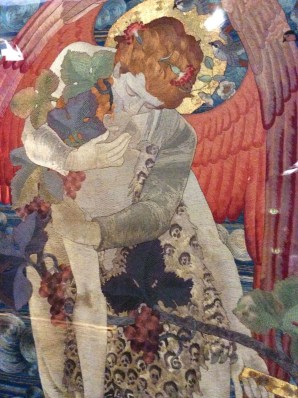
Those who subscribe to the ideas of the growing sex-positive movement, however, would not recognize this wholly negative portrayal of pornography. Sexuality, they say, is not only natural, but as valuable a characteristic of the human personality as reason or creativity. It originates from the best parts of human nature: empathy, sympathy, cooperation, our rich emotionality, the urge to create new life. It’s one of the most exciting ways that humans can bring each other joy, and unite in one of the most emotionally intense, intimate ways that we can. In short, sex is beautiful, and the ways in which we enjoy it can be, and should be, as variable as is the range of human personality itself. It’s precisely because of patriarchy and religion, in fact, that human sexuality has been shamed, perverted, twisted, and portrayed as ugly and exploitative in all contexts outside of the confines of male-dominated monogamy. That type of sex-negative religious view, in turn, is a regrettable inheritance from our evolutionary ancestors, who felt the need to exert control of women’s sexuality in the competition to successfully procreate with limited resources. When religion and patriarchy lose their influence, sexuality can again be freely expressed in all its joy and beauty, and the religiously-imposed shame will melt away. After all, as Mark Twain says, ‘Nature knows no indecencies; man invents them.’ 

Pornography, then, in this view, is to sexuality as academia and the scientific community are to intelligence, and sculpture and novels are to creativity: an expression of our sexual nature. There’s bad pornography, and good pornography, just as there are harmful scientific theories such as eugenics, and clunky, tacky, poorly written novels such as ‘Atlas Shrugged’ and ‘Naked Came the Stranger’, and lousy art such as Dan Lacey’s pancake and unicorn paintings (though hilarious!)

So why is sex the one part of the human nature whose expression and gratification we consider most taboo even as it’s most alluring? Why single it out this way? We don’t consider gratifying hunger and thirst as shameful, nor other needs and desires such as art, music, or intellectual stimulation. What is it about sex that engaging in it, and portraying it, is considered dehumanizing in all but the very narrow context of marriage, when it’s such a very human thing for all to do and to desire? Why is considered so good and yet so bad? 

Let’s explore the problem of treating sex differently than other aspects of human nature by considering a rather extreme example. I read an opinion piece the other day about Somaly Mam and her apparently now-dubious credentials as an advocate against sex trafficking. The author makes what I think is an excellent point: Mam would ‘liberate’ sex-workers only to place them in what many might call ‘honest’ work: jobs in the apparel industry, where in Cambodia, as in many other places where sex-trafficking is a big problem, it’s a free-for-all. There are few to no human rights protections or regulations, and the women work long, back-breaking hours for little pay in awful conditions. It’s that, or starve, so there’s no real choice for most of these women. So what makes the sweatshop job more ‘dignified’? In both cases, the women have little to no autonomy, and are treated with contempt (perhaps, one might argue, more so in the sweatshop job, since the woman is not even considered a ‘possession’, and therefore of some personal value to the owner!) Is it the only the fact that it’s there’s sex involved that makes the latter condition of miserable servitude somehow better than the former? We would probably hear many on the anti-pornography side of the argument say that, of course, both are examples of terrible behavior of the slavers and of the sweatshop owners, but I would wager that they would not be impassioned advocates of labor unions, minimum wage laws, and regulations as they might be anti-sex-work activists.

The porn industry does not, for the most part, resemble the terrible practice of sex slavery, so considering them side by side is only useful insofar as it helps us recognize our own often inconsistent attitudes about sex and respect for our fellow human beings. So let’s return to a less dramatic example, where autonomy is not in question. Does the dehumanization lie in portraying a woman in such a way as to present only one aspect of her nature for the satisfaction of the audience, in this case her sexuality? How about when she is ‘reduced’ to another aspect of her person, say her physical appearance? Let’s take the example of a model for fine art, or for fashion photography. She is chosen because she is beautiful (or interesting-looking, for fits the chosen profile, or whatever), and is paid to stay still while the artist captures the outward appearance of her body, and is dismissed when the work is complete. Is she dehumanized then? How about any interaction in which a human being is only considered in the light of the narrow role they play in the other’s life in that moment, the waiter, the conversationalist at the bar, the cashier, the barista, the taxi driver, the person who makes the clothes one buys, the arms dealer? They are anonymous, or will be except during that particular transaction, and they will never be seen again. Are they dehumanized too? Why is it that interacting with another person in only their role as a sexual being more dehumanizig than interacting with them only insofar as they play a different role?

One may reply, that sex is deeply intimate and meaningful, where a painting a portrait is not (necessarily, anyway), nor is ordering food or coffee or buying stuff, nor chatting up a stranger at a bar. But why must sex always be intimate and meaningful? Just as conversation can be intimate and meaningful, it can also be casual, or meaningful but not lasting (that fascinating, intelligent fellow traveler on an overnight flight who shared the best stories and ideas you ever heard which stayed for you for life, while you never see them again), or baby talk that the infant will not remember, or part of the larger conversation a committed pair have over their shared lifetime. Yet all of those types of communication are an important part of a full life. So it goes with all other parts and products of human nature. Just because it can be deeply intimate and meaningful and long-lasting, doesn’t mean it has to be; there’s room for simple, easy, non-committed encounters as well, isn’t there?

Again, what’s so special about sex?

For the last half-dozen paragraphs, I’ve offered arguments and counter-examples from the sex-positive perspective against the anti-pornography view I (admittedly briefly) summarized at the outset. (Since I outlined only those arguments I could muster that have a broader-than-religious applicatio, it was necessarily relatively brief). Intellectually, I sympathize with the latter, since they not only harmonize best with a naturalistic philosophy most informed with verifiable evidence, but are more consistent with the values of autonomy and liberty. Yet anti-pornography advocates makes some valuable points, too, as we shall see.  

Thus far, we’ve considered arguments in favor of anti-pornography and pro-pornography (or at least anti-anti-pornography) ideas. But how do they play out in real life? Is pornography really as nasty, destructive, and shameful as some say, or as pro-human, life-affirming, nature-celebrating as others say? What does porn really look like out there, and what is its actual effect?

Here’s where I think the anti-pornographers have a point: much of the actual, mainstream pornography doesn’t seem to celebrate the same degree of respect for autonomy, diversity, and positive-body-image values that the sex-positive community has. Mainstream porn seems to chew women (and men) up and spit them out in the same way as Hollywood and the tabloids do (and these days, even Fox News and CNN!). The only people that are considered sexy enough to be featured are the hard-bodied, perfectly evenly tanned, straight and/or blonde haired, fake-white-teeth, heavily made up, simultaneously tiny-waisted and big-titted (or -cocked) stars of Barbie and Ken’s dreams. If you want to be a porn star and aren’t born with this set of attributes, under the knife and chemicals you go! There is porn made for people with other body types who wish to act in it, but as of yet, it’s generally of the boutique, Good Vibrations variety (G.V. is like Whole Foods, for the socially-conscious and horny). As of now, the body-positive attitudes celebrated in those wonderful You-Tube manifestos have not yet influenced the mainstream porn industry, just as they have not influenced Hollywood or news outlets.

I wish the porn industry overall actually looked more like the sex-positive activists’ vision, I really do! One day it may, when people grow tired of the monotony of seeing people of a only very few body types represented. Real-girl-next-door, all-natural, widows, Wallendorf Venuses, seniors, divorcees with empty nest syndrome, all of these may one day be represented as widely, and more personally, in mainstream porn as they are in people’s actual day to day fantasies and moments of curiosity. But I doubt it will happen anytime soon, if beauty magazine covers and increasing rates of plastic surgery are any indication. When it comes to body-shaming, it seems the narrow conception of beauty that informs mainstream pornography, as in all those other aforementioned public arenas: the only beauty that is celebrated is of such a rare type, and so many slice and paint themselves to artificially achieve it, that most women and girls are left to feel self-conscious and in some way not valued, since most don’t look like that standard. So they binge and purge, cut and paste, and smash themselves into ill-fitting clothing and tottering shoes.

Yet it’s not all bad news with mainstream pornography. When women are supposedly more dehumanized than ever through its unprecedented consumption as well as its extreme appearance standards, it’s also the era of unprecedented levels of legal protection of pornography actors, and of moral attitudes against the their oppression, in all categories of sex work. State by state, country by country, developed nations are instituting health regulations, labor unions, and laws that protect sex workers from the disease, exploitation, coercion, and violence that plagued them as long as sex work as existed (as the ‘oldest profession’, that’s a long time!). Sex workers, from pornography actors to prostitutes, need to worry less and less that they will be further victimized by the police or by the courts when they report crimes done against them, and sex trafficking, sex with minors, pimping, and other crimes of coercion (and patriarchy!) are less and less morally and legally acceptable than the sex-for-pay itself. 

So on the whole, I find must side with the sex-positive community in the matter of pornography. Their arguments, as I interpret them, are not only more logically consistent with what we observe in human nature and behavior, but are better aligned with what we actually see happening when it comes to protecting and caring for women and everyone else in porn. But we must keep in mind the nastier elements that are still very characteristic of the market overall, that I think my cousin and some others in the discussion recognized. There is a significant level of disrespect for our fellow human beings in the industry at large, and we must keep up the good fight against all manner of body-shaming, violence, exploitation, and coercion that are still endemic in porn.

P.S. It may seem odd that, throughout this post, I never refer to my cousin and his wife by their names, though they made their names public in the blog post discussion. My purpose is (somewhat smart-alecky, my apologies if my little joke offends!) to illustrate the point: perhaps it’s best to let people make their names public when and if they want to, when it comes to such a still-delicate subject. While it’s true that many porn actors have published their names, it’s often with the understanding that the only people likely to notice are in the porn-making and porn-watching communities, not likely to be seen by grandmas and co-workers who may not understand or agree with their choices due to the stigma that remains. The choice should be left to the porn actors publish their names more widely; it’s up to the rest of us to make the public sphere a more welcome, less harmful place to do so.

************************************************************************

Sources and inspiration:

– Thanks to my cousin and his wife for starting such a fascinating and complex discussion of pornography in the context of naming versus anonymity, which brings to bear so many important and practical issues: human nature, sexuality, morality, the meaning of dignity, autonomy, and so much more

– My husband Bryan, whose intelligent conversation inspired and informed this piece throughout, besides being the most beautiful and sexy man I’ve ever had the pleasure to behold both naked and clothed.

– My sister Therese and my dear buddy Kristin, who also offered valuable insights, and patiently put up with my pestering them with counterexamples and devil’s-advocacy

– Dan Savage http://www.savagelovecast.com/

– Greta Christina http://freethoughtblogs.com/greta/

– All whose work I linked to throughout the article

Last Day in Edinburgh, May 13th, 2014

I’m sitting here in James Court, having a pint at the Jolly Judge, under a cozy little overhang, watching the rain fall all around me. It started out as a sunny day, with a brilliant blue sky with scattered big puffy white clouds, probably even a hot spring day by Scottish standards.
I’ve been wandering Edinburgh all day to say goodbye to the city, and started by walking the length of the Water of Leith again, from Murrayfield Stadium to Canonmills this time; I’ll be adding some more pictures to my photojournal of that lovely place.

Then I pop by the Scottish National Portrait Gallery, since it’s on my way to the bus stop where I’m to transfer. I had forgotten to take a picture of the sculptures of David Hume and Adam Smith that adorn the southeast tower (which I’ll be adding to my account of that day), and I chat a bit with Sarah at the information desk, such a sweet woman!

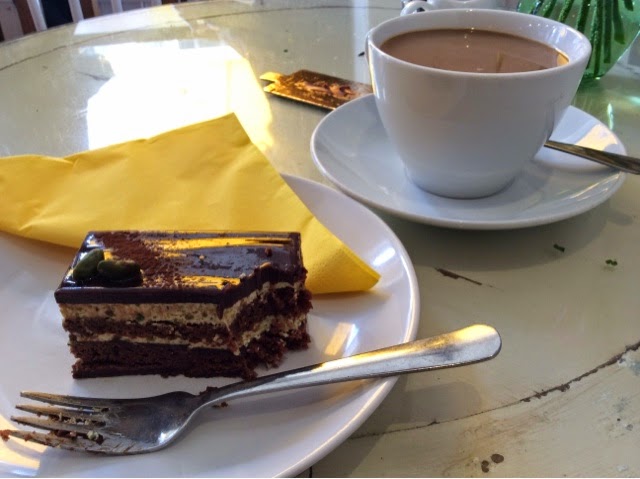
I return to Easter Road to a wonderful bakery called The Manna House, a new favorite haunt, where I celebrate with a piece of chocolate pistachio opera cake and a creamy coffee. If you ever come to Edinburgh, be sure to come here, everything they make is as delicious as it is pretty.

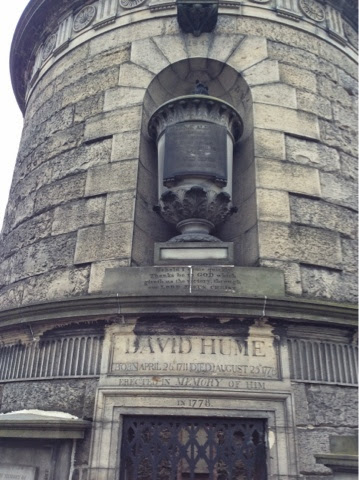
Then over to Calton Hill, to say farewell to the mortal remains of the great thinker I came here to discover in his hometown. As anyone would in my place, I feel  deeply moved, my chest tight, my eyes prickly. Is there someone you deeply admire, where you’ve often felt that bittersweet ache that you so wish you could meet them, knowing you never could except through the artifacts, and more importantly, the words and ideas, they left behind?  Then you know how I’m feeling just now.
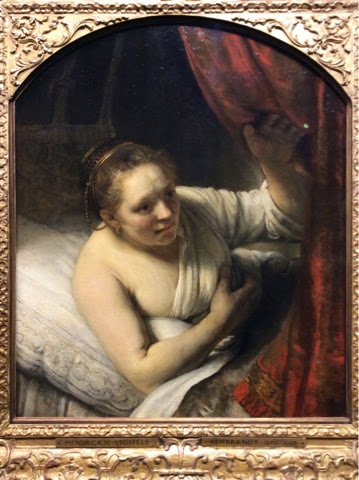
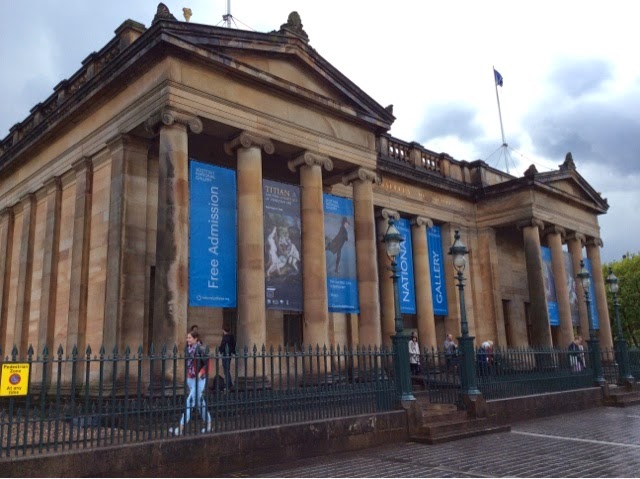
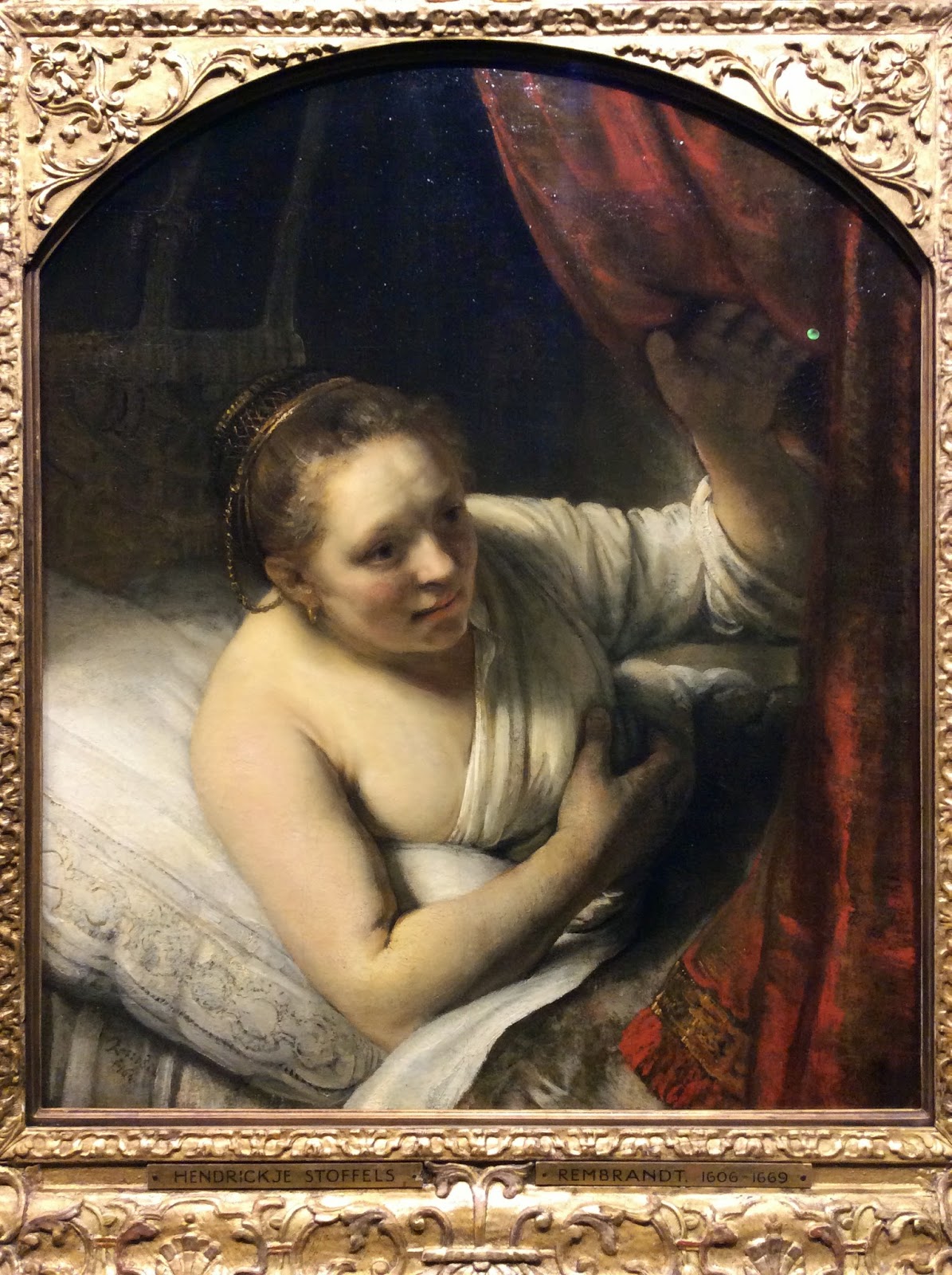
Then to the Scottish National Gallery (not to be confused with National Portrait Gallery) home to some of the great masterpieces of the world. I discover that one of my very favorite Rembrandt paintings here! That cheers me up quite a bit.

About ten minutes after I go inside, I hear the rain start to pour, and see the lightning flash through the skylight. I decide this would be a good place to linger ’till they close at five. And as soon as I leave, the rain abruptly stops, and I’m greeted to this spectacular sky again:


What a nice place Scotland is in May! The weather is changeable and keeps you on your toes, but it’s exciting in its variety. And I realize I just can’t bring myself to go back to the library and research and write anymore, as much as I intended to. I just have to walk around the city as much as I can in the time I have left, and besides, I’ve gathered a lot of material at this point. More to come on that.

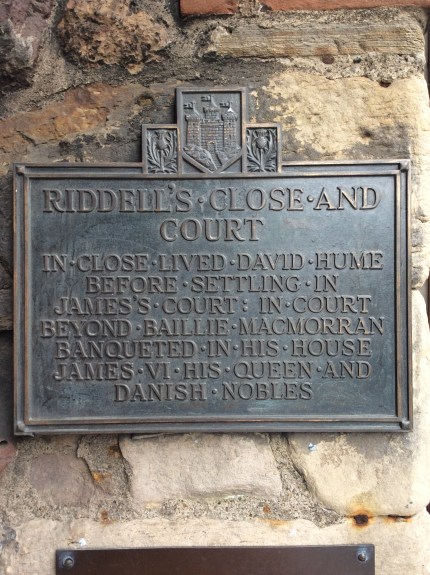
Which brings me again to where I am, the first Hume site I came across when I got here: he lived somewhere in James Court with his sister for a number of years (as I mentioned in my first blog post). I think this was his second house in Edinburgh he lived in as an adult, after his Riddle’s Court sojourn.

Soon, I’ll be having dinner with my kind and friendly hosts, Adam and Krystallenia, and early in the morning getting on a plane to return to my loving husband, my family and friends, and my beautiful California. And as soon as I can, I’ll be back, next time with my Bryan.

Ordinary Philosophy and its Traveling Philosophy / History of Ideas series is a labor of love and ad-free, entirely supported by patrons and readers like you. Please offer your support today!
~~~~~~~~~~~~~~~~~~~~~~~~

Hume Sites and Monuments, Part 3

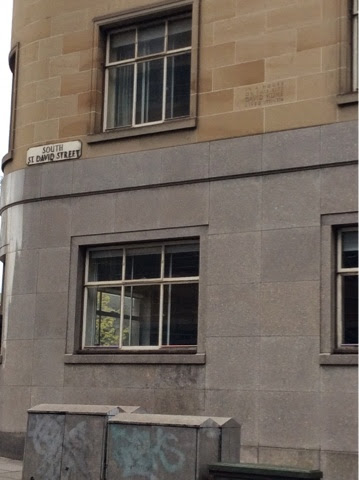
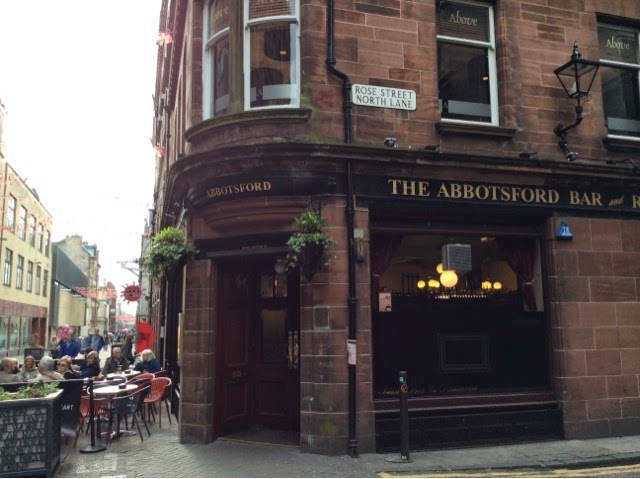
I enjoy a pint at the Abbotsford pub, traditionally a literary hangout, as I begin this account. Here’s hoping I’ll absorb more of that skill!I’m here at the Abbotsford because it’s near the site where I returned a couple days ago, to see if I could find that invisible plaque marking the site of David Hume’s New Town house. I’ve done some more digging in the meantime, and found that I had formed the wrong impression from my original source. I’ve found some photos of the actual plaque, which is actually just carved into the stone of the building, rather than the embossed brass plate I conceive of from the word ‘plaque’. Another traveler’s article I’ve discovered helpfully remarked it’s higher up than one might expect. Also, it’s at what’s now 21 St David’s St and 8 Rose St, which numbers are on different sides of the same building, not 8 St David’s as the address had been numbered once upon a time.

So here’s the plaque, on this building right by pretty St Andrew’s square, right across the street from Jenner’s. Can you see it?
Look up, way up, above the gray stone part of the building, between the windows.
Up, up, up…..
There it is, up there, near the upper right of this photo. It reads ‘On a house in this site David Hume lived, 1771 – 1776’. This is also where he died.
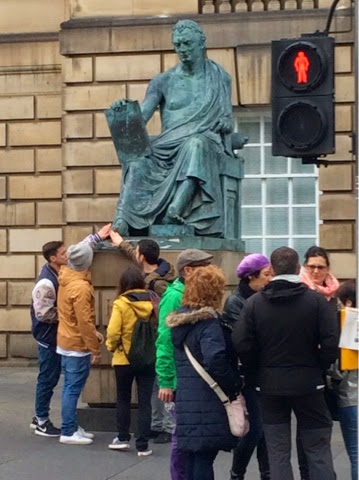
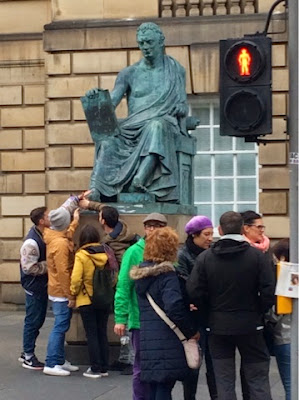
 I also happen to be waiting for someone right across the street from Hume’s statue on the Royal Mile the other day, and while waiting, I decided to snap some photos of passersby rubbing the statues toe for luck, so that some of Hume’s knowledge would rub off on them. I wrote a little essay about that practice.
I’ve been tentatively planning to go to Chirnside, the place where Hume grew up. The house is no longer there, but the gardens are, and the place where the house was is well marked. The fares turn out to be quite expensive, and since the house isn’t there anymore, it seems a lot to pay since I’m traveling on the cheap. I decide to spend the money instead enjoying my remaining time in Edinburgh, immersed in the place, eating locally made delicious food. So I go and have some marvelous pastries at The Manna House instead, planning to visit Chirnside next time I’m here, hopefully on a bike tour.
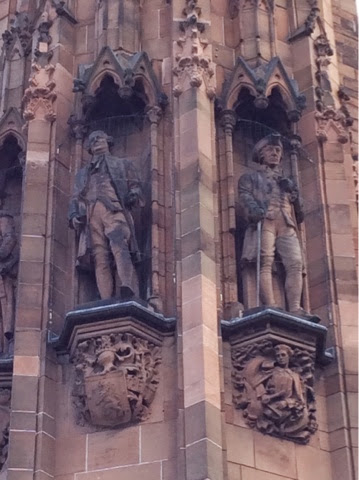
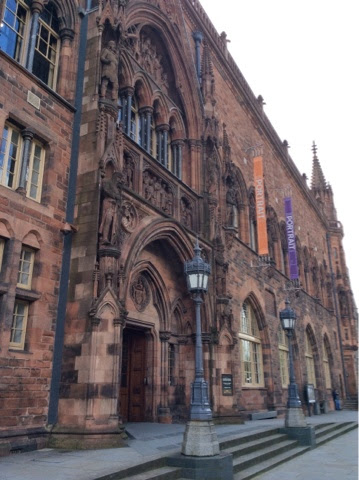
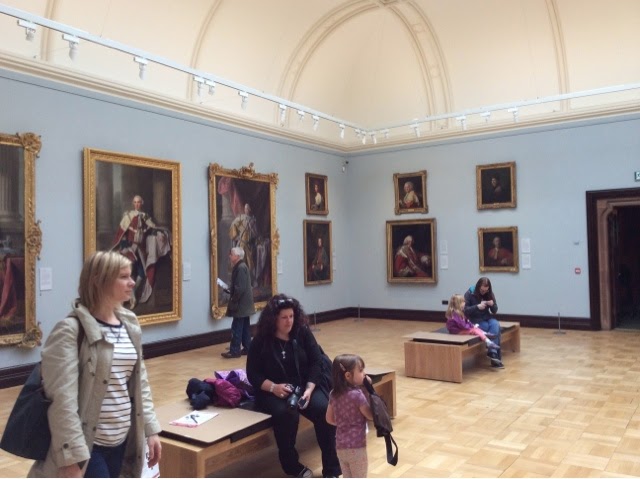
 The last of the David Hume-related sites I visit today is the Scottish National Portrait Gallery. It’s even more beautiful than I expected, inside and out. Sculptures of Hume and his friend Adam Smith, philosopher and economist who wrote The Wealth of Nations and The Theory of Moral Sentiments, adorn the southeast tower.
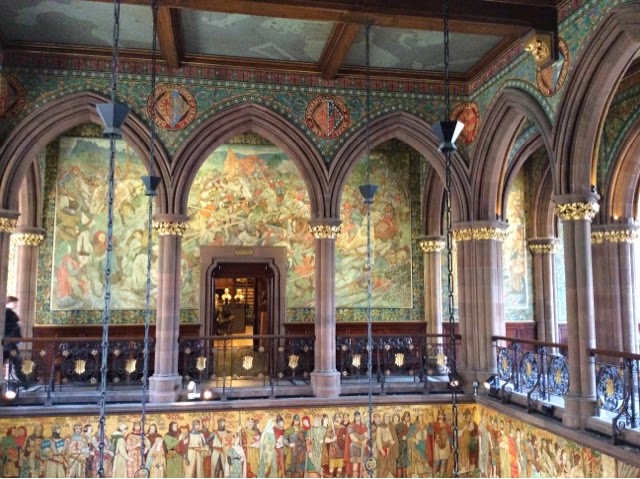
Photo 2014 by Amy Cools

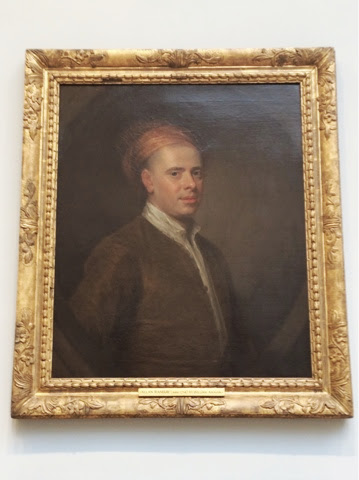
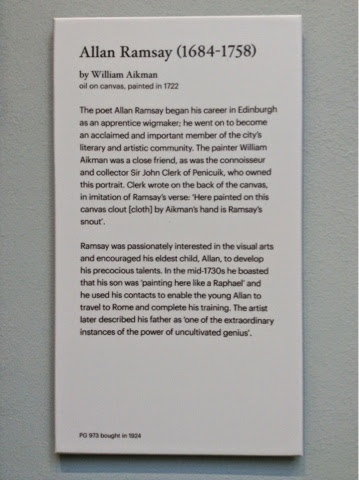
Allan Ramsey as a young man

Allan Ramsey’s famous portrait of Hume is here, the portrait where’s he’s facing the artist, wearing a gold-lace-trimmed red jacket. Here’s the artist and some info about him. First, the artist as a young man:

 
Here’s a little more about Allan Ramsey, David Hume, and the Scottish Enlightenment….
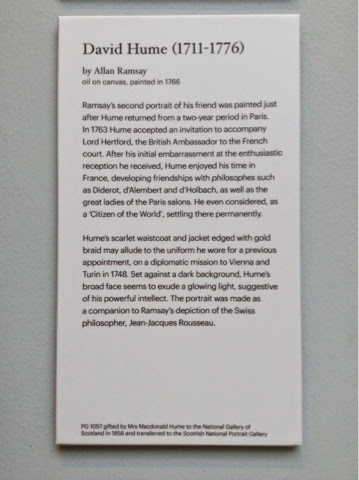
And about David Hume and his portrait...

David Hume by Allan Ramsey, 1766, oil on canvas

Definitely a guy I’d like to have dinner and drinks with, and hours of conversation! A genial man who’s seen the world and knows how to eat well, aside from his intellectual achievements.
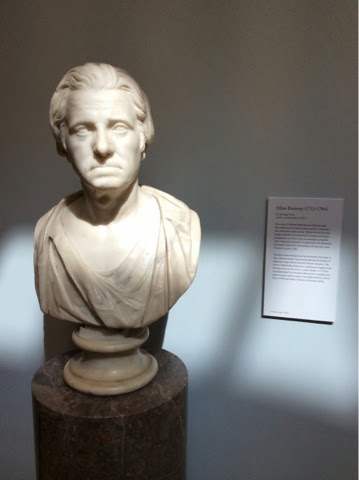
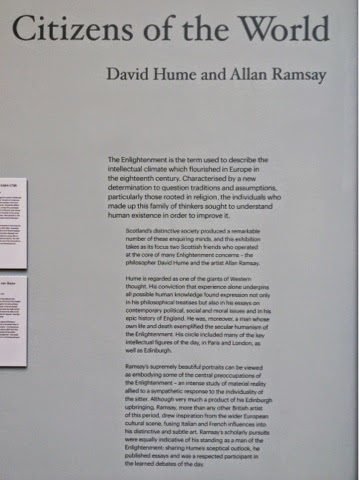
What I hadn’t been expecting to find, when coming here to see this portrait was the sheer number of portraits I’d find of friends, associates, and other people whose lives intersected with Hume’s.
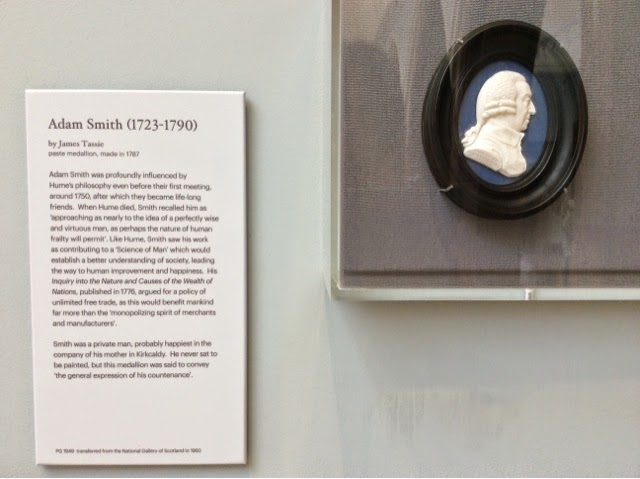
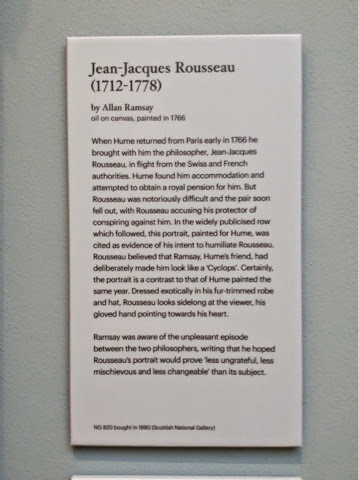
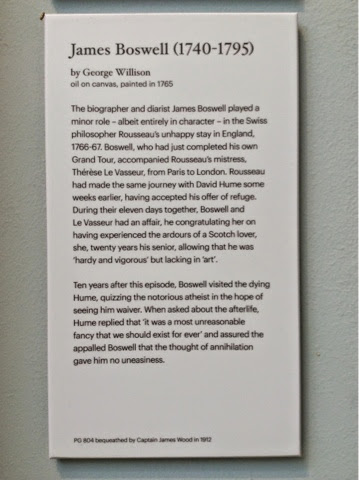
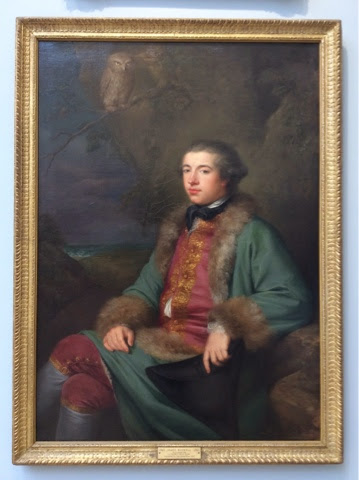
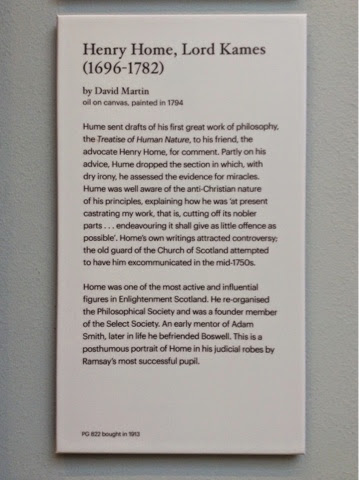
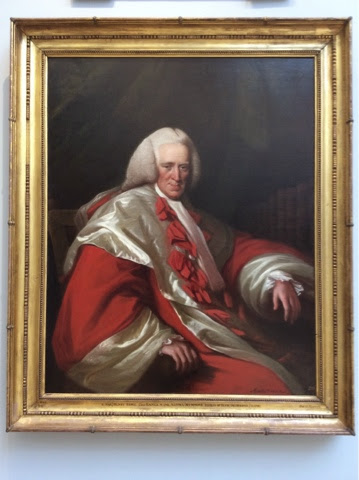
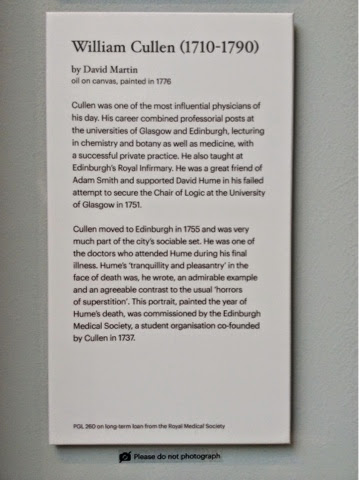
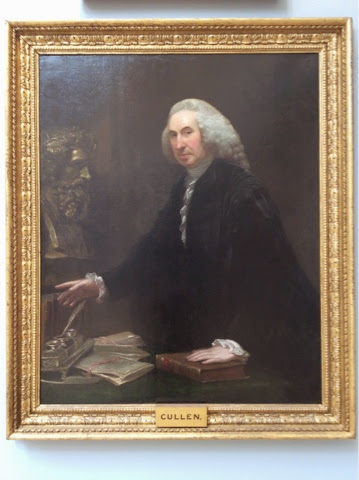
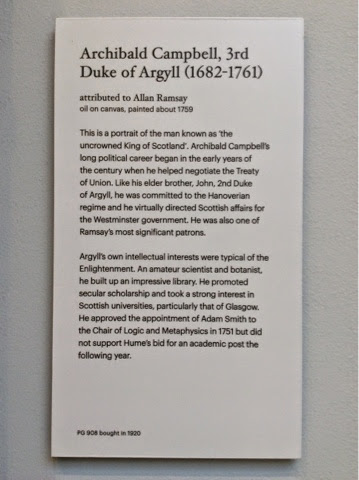
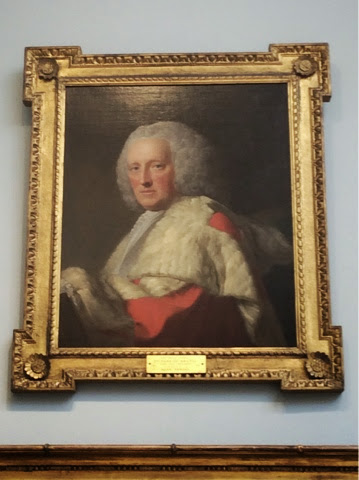
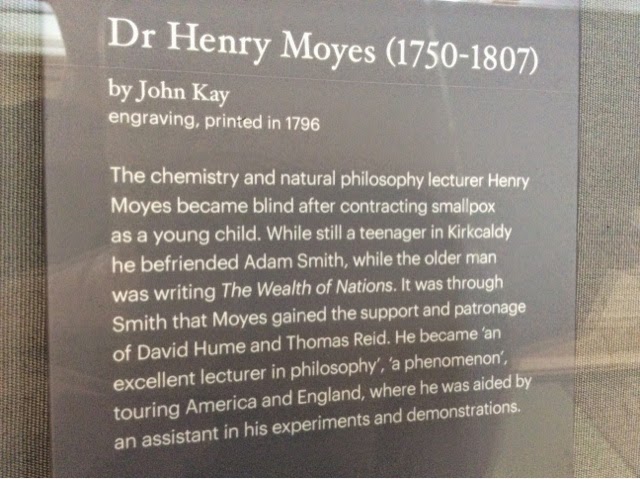
Here’s a series of portraits of these people, preceded by the plaques identifying the subject and the artist, and/or telling the story of their relation to Hume. I’ll start with Adam Smith, a good friend of Hume’s, who was influenced by him, supported him in the difficulties he faced due to his unorthodox views, and can be credited most with providing us the account of his last days:

The Author of the Wealth of Nations [Adam Smith] by John Kaye

This next guy shares the same name that Hume was born with; Hume changed the spelling of his last name from ‘Home’ because he was writing for an international audience, most of whom would not know from the spelling that the name is pronounced ‘Hume’ in Scotch-English.

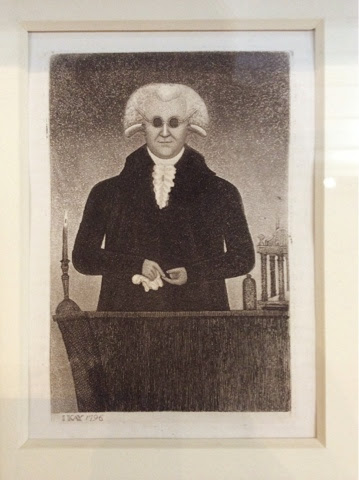
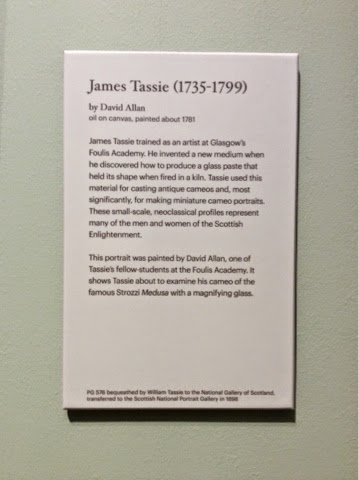
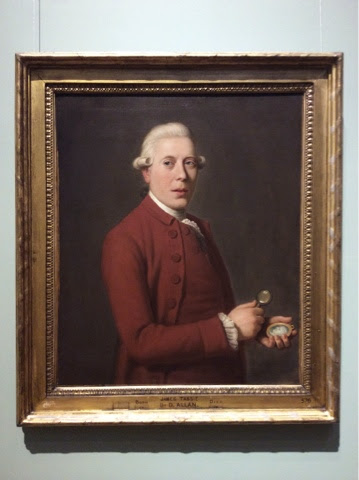
And here’s a last little portrait, a miniature in cameo by this guy…

James Tassie, miniaturist who created the cameo portrait of David Hume below

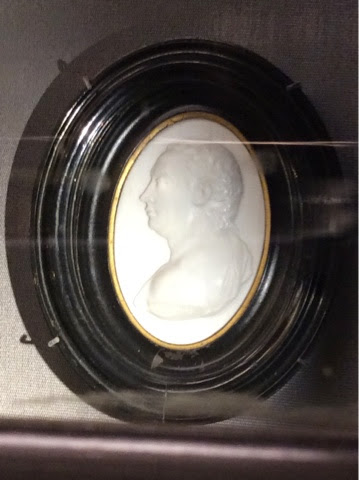
Cameo portrait of David Hume by James Tassie

It’s hard to take a good photo if it because it’s in a glass case high above my head with many other cameo portraits by Tassie. This cameo was completed a few years after Hume’s death.
The Scottish National Portrait Gallery ends up being one of my favorite museums I visit, not only because of the beautiful artwork and fascinating stories I discover, but because the whole building is lovely, the lighting is perfect, and the feel of the place makes you want to linger. I spend much more time here than I planned, the time just flies by….
So I think my Sites and Monuments series will end here; the last couple days I’ll spend researching, writing, and just wandering and admiring. Soon to come: more ponderings on various subjects, inspired by my man Hume.

Ordinary Philosophy and its Traveling Philosophy / History of Ideas series is a labor of love and ad-free, entirely supported by patrons and readers like you. Please offer your support today!

The Tale of the Magic Toe – Superstition? Or What?

I attended a meeting of the Humanist Society of Scotland the other day, and some of us were chatting about my David Hume project. They recommended sites to see and people and ideas to add to my research, and I was telling them what I had seen and discovered so far. They also regaled me with some Hume anecdotes. Such a friendly group of people, so engaged with important issues of the day, and so welcoming and ready to chat and have a good time!

One thing that came up was the classical statue of Hume on the Royal Mile in Edinburgh’s Old Town. I noticed that the left toe of the statue is polished to a bright brassy shine, from the tradition of students and others rubbing it for luck, so as to absorb some of his wisdom.

Some who I was talking to laughed, as if at a friendly little joke, while others took it a little more seriously. What would Hume, the greatest philosopher of the Scottish Enlightenment, skeptic, naturalist, and pragmatist, think about this seemingly superstitious practice? Some thought he would very much disapprove, as Richard Wiseman does.

That’s a very good question, I thought. Although he did not approve of superstitious thinking generally, would he consider the toe-rubbing an example of real superstition? Would he take it seriously?

A few days later, standing in the square across from the statue, I watched the crowd go by as I was waiting. Many paused and looked a little wonderingly at the big shiny toe, while others stopped, usually people who were in groups, and rubbed it, laughing and chatting. There was an Asian couple who did this more solemnly and almost ritualistically, rubbing the toe and than their heads, as if to physically rub in the absorbed knowledge like a salve. The scene, to anyone who is not just a little too grouchy for their own good (I think), was a charming and friendly one.

In thinking it over, I recalled another Hume story recounted, for my benefit, at the HSS meeing. One day, Hume was crossing the bog created by the recent draining of the Nor Loch; he was going from his house in Old Town to check on the progress of the house he was having built in New Town. On the way, he slipped in the mud, and partially because it was slippery and partly because he was a fat man, he couldn’t get up. He asked a passing sturdy fishseller for help, but she knew who he was: a reputed atheist. She refused to help, unless he recited the Lord’s Prayer and the Creed. He obliged, she offered him her hand, and they went on their way. For some time afterwards, this was a favorite funny anecdote of Hume’s, and he referred to her as the most astute theologian that he had ever met.

So I was thinking: would Hume, who recognized the humor, even charm, in the story of the fishseller, really disapprove of the toe-rubbing? He was such a sociable person; he thought that the most virtuous people were the charming, friendly,  conversational, generous people. Sharing a happy time and a laugh is among the best things one person can do for another.

My conclusion: Hume himself would look on the toe-rubbers, smile and laugh, and probably join in, getting great satisfaction out of the joke. I think that sometimes, in the pursuit of reason, some of us can forget the role that the little rituals and talismans we create are a sort of game or story that we engage in to facilitate friendly communication, and play. This can go for astrology, tarot cards, knocking on wood, whatever. I’m not talking about those who sell their services, hoodwinking people into believing that if they pay enough money, their fortunes can be changed. I’m talking about how most people actually engage in these practices. They might say sometimes that they believe, maybe a little, in the magic power of these practices and objects.

But if you observe people closely, most carry on as if they didn’t believe in actual magic. They still go to work, study hard, pay for insurance, and go about the business of life as if it’s up to them to take responsibility for as much of their future as they have control over, whether or not they had just read the tarot or rubbed a brass toe.

People need stories and games, rituals and talismans, and some need these things more than others. it’s as ancient a part of our nature as just about anything else. By taking it all too seriously, committed  rational thinkers run the danger of giving so-called magical thinking too much credit, and too much power. All of these things are human creations, and we should use them only insofar as they help our lives, as opportunities for fun and human bonding.

So as long as your life is not hindered by superstition, play with those cards with the mysterious and pretty pictures, splash around the ‘holy’ water, and touch the ‘lucky’ statue! Chill out, and have a good time, people! I believe this philosopher wouldn’t mind a bit.

~ Ordinary Philosophy and its Traveling Philosophy / History of Ideas series is a labor of love and ad-free, supported by patrons and readers like you. Please offer your support today!

Hume Sites and Monuments, Part 2

117 (2)Thursday, ‎May ‎08, ‎2014

…or more accurately this time, Hume sites and artifacts.

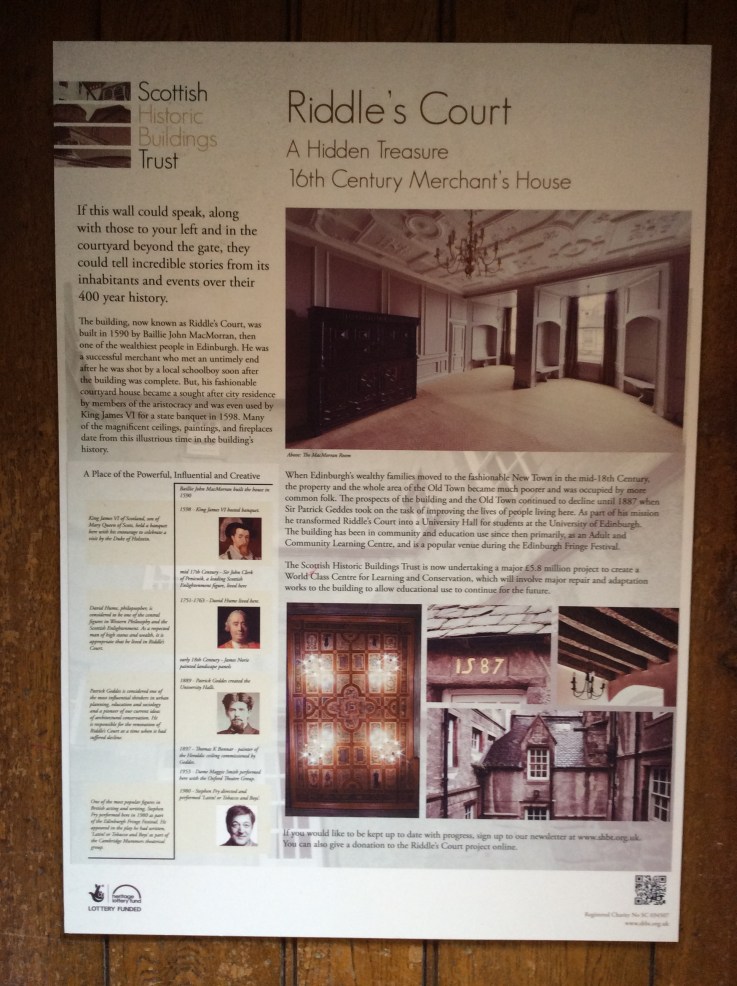
On Thursday afternoons, the Scottish Historic Buildings Trust holds an open house for Riddle’s Court (a small square enclosed by the buildings that surround it), where David Hume bought his first house in the 1750’s. In his time, the building was called a ‘land’, and a floor or suite of the building that comprised the rooms where the tenant lived was called a ‘house’. So a ‘land’ held several ‘houses’, today’s ‘flats’.

The rooms that are open to the public are on the opposite side of the court from where his house was; records are not clear from the time, but it’s pretty certain he lived in one of the upper houses on the Royal Mile side of the court. I’ll show you where in a moment.134 (2)

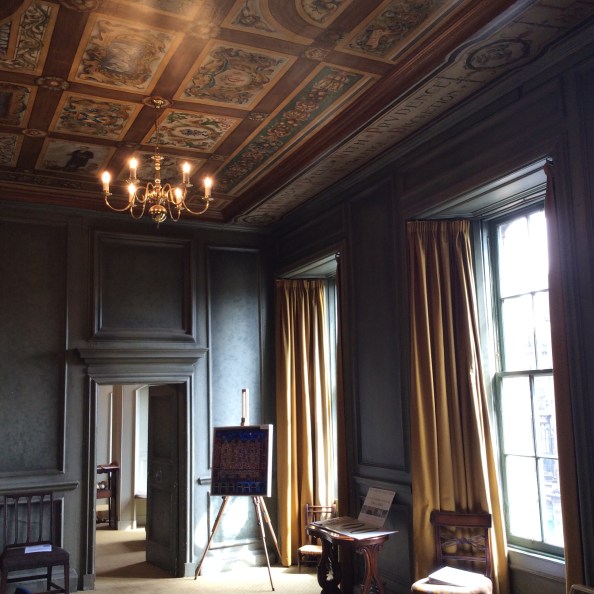
This room with the beautiful ceiling was a drawing room for later inhabitants. You can read about it in the center photo below. The closeup of the ceiling shows David Hume’s monogram, to commemorate his living nearby.779

785777778

Here (above) are views looking upwards from inside the court; the reddish color of the walls at the right is a natural color that they would have used at the time, and he probably lived in one of these upper houses. The photo on the left is at the left of the reddish wall, and I include it ’cause it’s pretty!

And here’s the view of the building that I’m in, opposite from Hume’s house, from Victoria Street below. Victoria Street was built in the 1830’s, where a steep, narrow footpath used to run through the gardens behind Riddle’s Court and the neighboring houses. My mother-in-law recommended that I visit Victoria Street; coincidentally, I discover that in constructing it, they almost decided to tear down the Riddle’s Court buildings, one of the most important sites I’ve come to visit. Fortunately, someone decided it was best to keep them since the buildings have such a rich history and Patrick Geddes, who was responsible for saving and restoring so many of Edinburgh’s most important historical buildings, turned it into a student center.

Two views in Riddle’s Court, Old City, Edinburgh

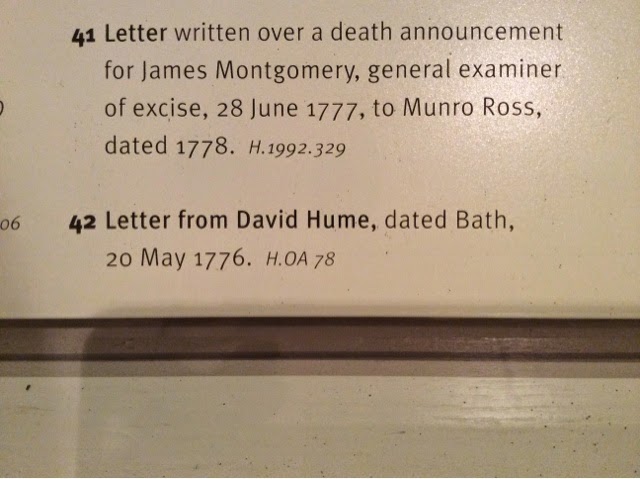
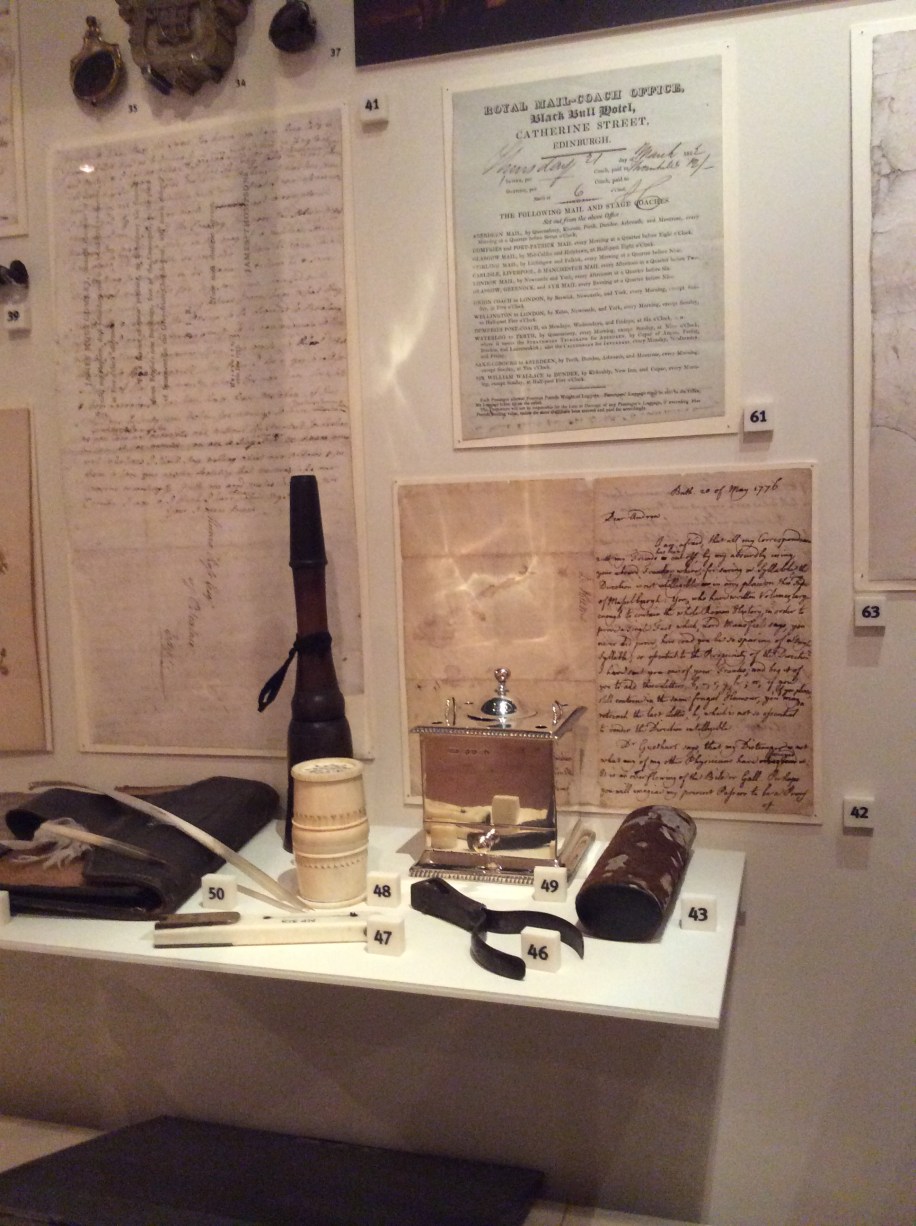
Now I turn to the first artifact I find on this trip that David Hume himself touched: a letter written just a few months before his death. It’s on display at the National Museum of Scotland, where I spend some hours this afternoon gazing at wonderful natural specimens and historical artifacts of Scotland. Hume had gone to Bath in hopes that the mineral springs there would help relieve the symptoms of the intestinal or abdominal disorder, probably cancer, that he died from. In the letter, he’s telling a man named Andrew that he’s feeling better at the moment.

A letter from David Hume to ‘Andrew’ dated May 20th 1776, at an exhibit in the National Museum of Scotland in Edinburgh

Jenner’s department store off St Andrew’s Square in Edinburgh’s New Town

Note: The following story has an update.

The next day, I set out to find the commemorative plaque at the site where David Hume’s New Town house (apartment) was at 8 South St. David’s St. at Rose. I can’t find the plaque anywhere, but his house may have stood about where this large department store stands now….

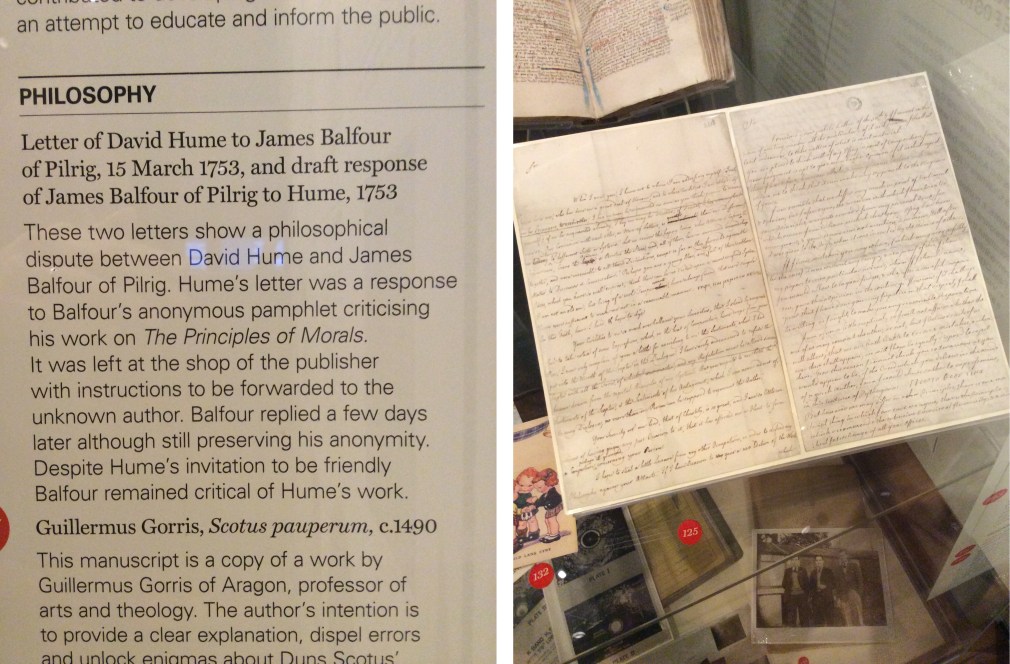
I return to the National Library of Scotland to catch up on my writing and research, and there’s another letter in Hume’s own hand on display just feet away from where I’m writing this post, at an exhibition celebrating the achievements of the Scots people.

David Hume worked for some years in the 1750’s as the librarian for the Advocate’s Library, which eventually became the National Library. Although he had a falling out with the library over their blocking of some ‘undesirable’ books he had ordered, he continued to work for them since he needed access to their collection for the ambitious, multi-volume History of Britain he was working on, for which he was most famous during his lifetime. He donated the small salary that he earned from the Library to a blind poet friend, Thomas Blacklock.

Throughout my trip, I’ve been working intermittently in the Special Collections reading room at the National Library of Scotland, referring to first editions of David Hume’s books, all published in his lifetime, save for a few ‘dangerous’ works that were published shortly after his death. I’m not allowed to take photos of them, but you’ll find them described in my various Hume essays written during and following this trip, in the section that follows each essay, called ‘Sources and Inspiration’ (my informal brand of works cited page that I use for my blog essays). When I’m back home and have more time and my own computer, I’ll look for more information on these books, with links and photos.

Letter from David Hume to James Balfour dated Mar 15, 1753 on exhibit at the National Library of Scotland

The library is closing, so I must go. More on Hume to come!

Ordinary Philosophy and its Traveling Philosophy / History of Ideas series is a labor of love and ad-free, entirely supported by patrons and readers like you. Please offer your support today!