Second Day in Paris Following Thomas Paine, Mary Wollstonecraft, and Thomas Jefferson, Part 1

22 rue Meslay, Paris. Mary Wollstonecraft may have lived here at Aline Filliettaz’s house from December 1792 through June 1793. See update to the search for the Filliataz house

Monday, August 10th, 2015

I get up at a decent hour, though of course not too early: I discovered early on when I began to travel in earnest that proper rest is essential for clear thinking, map-reading capabilities, and the good humor necessary for enjoying the day.

Since there’s such a huge number of sites to visit on my itinerary, I’ve decided to visit them in an order determined not by subject nor in any kind of chronological order, but by proximity to one another, so I can better cover them all.

I make my way from my temporary digs on Boulevard Voltaire up toward Republique, then make a soft left and head for 22 rue Meslée (now called the rue Meslay). Mary Wollstonecraft lived here at her friend Aline Filliettaz’s house from December 1792 through June of 1793, shortly after arriving in Paris. Wollstonecraft was full of hope for the Revolution and longed to be a part of it, and thought that the humanitarian and egalitarian Enlightenment principles she espoused were more likely to take hold there before they would in her home country of England, as they had (to an extent) in America. By the time she arrived in Paris, she was a self-made woman, a governess and schoolmarm who had become the bestselling author of two progressive and highly influential books, A Vindication of the Rights of Men, 1790 (a scathing rebuttal to Edmund Burke’s Reflections on the Revolution in France) and A Vindication of the Rights of Woman, 1792.

In fact, her Rights of Men was published the year before Paine’s Rights of Man, which was also a response to Burke, but Paine’s became the most famous by far. However, Wollstonecraft held her own with Rights of Woman, as it’s now widely considered the founding work of modern feminism. Wollstonecraft was lonely and blue when she first lived at this house, since her hosts were away and the servants behaved haughtily and uncooperatively towards her, but she soon cheered up when she began to get out more and hang out with her expatriate friends and their Parisian social circle. (More on that soon.)

Building where 22 rue Meslay is now located in Paris, France

The Fillattaz house is on a little side street in the Marais district, near the medieval Temple where the royal family was held during the French Revolution, before the King was guillotined in December of 1793 and Marie Antoinette was sent to the Concierge. Wollstonecraft wrote in her account of this period in her life that she saw the King being taken from the Temple prison to his trial at the Hôtel de Ville, where the Convention Nationale was held, from her window at this house. See update to the search for the Filliataz house

By the way, it’s important to make this point at the beginning: as is the case with all private residences and some other sites I visit during this tour, unless I can find a clear indicator of the history of the building (in accounts I have access to, on plaques, on cornerstones, etc), it’s very possible that I may not have found the exact location, especially if it’s not a public building with a clearly documented history. Many of my sources list an address without specifying whether it’s the modern address or the historical one and numbers change over time, and some streets are re-routed or disappear entirely, as do many of the original buildings, and records are not always consistently kept or may have been lost in the intervening years. Since my subjects were all here well over two centuries ago, it’s likely that at least a few of these locations are approximate, rather than the exact sites, despite my best efforts to discover them. This is especially true of Mary Wollstonecraft since she’s the only one of my subjects who never held public office or had any government appointments.

Courtyard behind 22 rue Meslay

63 rue Faubourg St-Denis, Paris, France. It’s the right address but not actually the site of Paine’s once-time residence, since the address had changed since his time. You can the story of how I find the true site here.

For example, poking around for historical details of the rue Meslay, I found that George Sands was born on that same street, and the address was 15 in her time, 46 now. I didn’t find any info as to whether Wollstonecraft’s 22 address is the new one, old one, or just that same address in different sources, but since she described seeing the King’s carriage pass by her window on the way to trial, it may be that the Filliettaz house was further up the street, in a taller building or at a higher elevation, so that she could see as far over as Boulevard Saint-Martin, the next street over and the route he would taken. But another source describes the house as having six stories, and the house now at 22 matches this description.

If I have time, I might swing back over there for further explorations since the place I’m staying now and the place I’ll be staying when I return to Paris (I’ll be joining my husband Bryan tomorrow for a quick family visit to Berlin, then to Saint Quentin en Yvellines where he’ll commence the Paris-Brest-Paris cycling event) are not too far away.
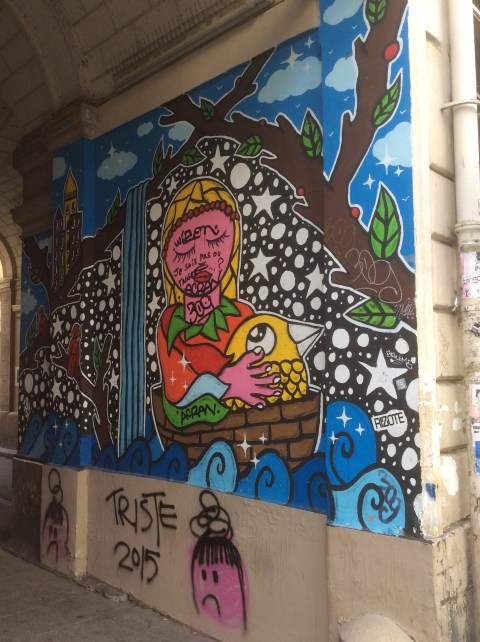
A mural on a wall on rue Faubourg St-Denis

Next, I head for 63 rue Faubourg St-Denis, at rue des Petits Ecuries, where Thomas Paine moved in 1793 to share the ground floor of a ‘mansion farmhouse’ with six friends. Paine wrote in glowing terms of the lifestyle there, and they had farm animals and grew fruits and vegetables, as that area was still pretty rural, and they would romp in the garden to take their minds off the tumult and violence in Paris. He was living here when he, with a committee of nine others, drafted a new constitution for France, though this one was unsuccessful: the Girondin faction which Paine worked with were moderates, while the radical Jacobins were gaining power and, over time, took over the Revolution entirely, instituting the Reign of Terror. (See update on the search for the rue Faubourg Saint-Denis house).

It’s unlikely that any part of the building that stands here now is original, either in whole or in part, given Paine’s description of it, and the current address may not the same as the historical one [this turns out to be the case]. The only fruits and vegetables to be obtained here now are from the colorful produce shops that line this now urban, rough-around-the-edges but vibrant and colorful part of the city. I think this neighborhood is wonderful, and it reminds me in many ways of the Mission district of San Francisco before it became mostly taken over by hipsters and tech people.

A view of rue Faubourg St-Denis

At 101 rue de Richelieu, Paris, France.

Next, I head down to rue de Richelieu in search of the place where Thomas Paine moved in with James Monroe’s family in November 1794. Monroe had finally secured Paine’s release from his eight-month imprisonment at the Luxembourg (I’ll return to this subject after I’ve visited that palace-turned-prison-turned-Senate house). Paine lived with the Monroes for about 2 years, not all of them here, since they moved more than once. At the time of his release, they lived at 101 rue de Richelieu, which begins at Bd. Montmarte where it meets Bd. Poissonere, in the 2nd Arrondissement.

At 101, I find a classy place, fit for an honored foreign dignitary, with a lovely courtyard with a lovely arched entryway, updated with a modern reflecting pool. Again, I’ll return to this street soon for further explorations, which will be easier next time since I’m now getting very familiar with this corner of Paris, and as I find more source material with which to confirm whether the numbers have changed. (See update to the search for the Monroe house on rue de Richelieu.)

Courtyard at 101 rue de Richelieu
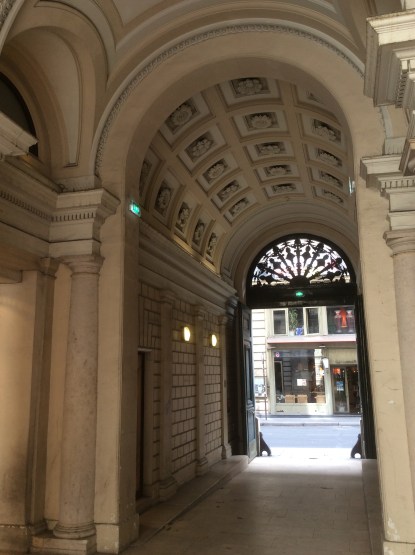
An entryway to 101 rue de Richelieu

When Paine was released from prison, he was broken down in health and spirits: he had nearly died from typhus, and he had an open ulcer on his side that wouldn’t heal. He had also felt that his American friends in high places had deserted him, not doing what they could to rescue him from his predicament. He was especially upset with Gouverneur Morris, the ambassador (then ‘Minister Plenipotentiary’) to France at the time, and with president George Washington. Morris was the primary author of the preamble to the United States Constitution as well as many of its other sections and he was an able statesman, but the French government lacked confidence in him; he was recalled after they repeatedly requested he be replaced by another. From their writings, it appears that Paine and Morris alternately liked, respected, and loathed one another. Morris often writes very sarcastically about Paine, and though I’m quite the Paine fan-girl, I find some of his remarks very funny and witty, though others are just plain bitchy and catty.

While Paine did offer valuable assistance to Monroe (Morris’ replacement) in his role as the new American ambassador, Paine was at this time also, as an aftereffect of his imprisonment and disillusionment with the French Revolution, given to depression, anger, and paranoia, and as a result of all of these, binge drinking. He was to acquire a reputation as an alcoholic, but since these accusations came almost entirely from his political enemies during and after his lifetime, this characterization is suspect. His friends and colleagues describe him as a social drinker, wont to make merry in the evenings and engage in enthusiastic discussions about politics, science, and philosophical topics as long as anyone was willing.

I next head north to rue Taitbout and turn left on rue de la Victoire, and go to the grand house at 60 rue de la Victoire, which was 6 rue Chantereine in Paine’s time, in the 9th Arrondissement.

60 rue de la Victoire, once 6 Rue Chantereine, former Home of Napoleon and Josephine Bonaparte

It was likely in this house that Paine attended a party thrown by Julie and Francois-Joseph Talma in October 1792. The house was owned by Mrs. Talma, formerly Louise-Julie Carreau, and she held a famous salon here. Her husband was a well-known actor and passionate Revolutionary, friends with Jacques-Louis David (who, I was surprised to discover was among those who voted in favor of executing the King) and Napoleon Bonaparte, who moved into this house in 1796 with his new wife Josephine). Like Paine and Wollstonecraft, the Talmas were Girondinist in their sympathies, yet there was a ruckus between Paine and other attendees of the party, many of whom had begun to turn on this once-beloved muse and author of two revolutions.

Two Details of 60 rue de la Victoire, former Home of Napoleon and Josephine Bonaparte

The history of the French Revolution is, among other things, a prime example of how people, even as they see themselves pursuing the same lofty goals and are members of the same political party, just can’t seem to avoid petty infighting. This sort of thing undermines so many important projects, and as we see all too often, petty disagreements can devolve to self-righteousness and even blind radicalism over time. French culture, in that era especially, placed a high value on ‘sensibility’, valuing the free expressions of both raw and cultivated emotions. As we have also seen in the French Revolution, unbridled passion was very often allowed to trump reason. To Paine’s dismay, he watched the beloved Enlightenment campaign for rational democratic government, that he served so enthusiastically and so well, turn into a bloody campaign of vengeance and terror.

View of Église Notre-Dame de Lorette from Rue Lafitte, Paris, France

Side view of Opera Comique, Formerly Theatre Des Italiens

It was very near this place that Thomas Jefferson moved for awhile, eight years earlier in October 1784, on the cul-de-sac (impasse) Taitbout off rue La Fayette near rue St Georges. He signed a long-term lease at Hotel Landron, also called Hotel Taitbout, but only ended up living here for about one year. I explore this area very thoroughly, peeking into every courtyard, driveway, and byway I can find, but a hotel by this name is nowhere to be found so far as I can see. (By the way, ‘hotel’ wasn’t used in the same sense as we use it today: It could refer to a grand house or a large public building.) This area is very near where I’ll be staying next week, so I’ll return if I find more leads, and I’m looking ever more forward to doing so, it’s such a beautiful neighborhood.

Jefferson was an avid patron of the arts, and attended the theatre often while living in Paris to see plays and musical performances. He often went to the Theatre des Italiens, very near his Taitbout place on Boulevard des Italiens. There is no theatre today with that name, but I find Opera Comique in just about the right place. Could this be the same building? The building appears to be of the right vintage. I look into it, and sure enough, it is! It’s in the process of getting a facelift and a good cleaning, but the side entrance is in good repair and attractive with its lovely cast iron lacy canopy.

Opera Comique, formerly Theatre Des Italiens, Paris, France, under repair

I still have many sites I’ll be visiting throughout the course of the day, so I’ll take a break here.

To be continued in Part 2:  >>>

~~~~~~~~~~~~~~~~~~~~~~~~~~~

Sources and inspiration:

Adams, William Howard. The Paris Years of Thomas Jefferson. New Haven/London: Yale University Press, 1997.

Bell, David. ‘5 Myths About the French Revolution‘, New York Post, Jul 9th, 2015.

Gordon, Lyndall. Vindication:  A Life of Mary Wollstonecraft. New York: Harper Collins, 2006.http://www.harpercollins.com/9780060957742/vindication

Grossman, Ira. ‘The House on the Rue de la Victoire
Jacobs, Diane. Her Own Woman: The Life of Mary Wollstonecraft. New York: Simon & Schuster, 2001.

Jacoby, Susan. Freethinkers: A History of American Secularism. New York: Owl Books, 2004.

Nelson, Craig. Thomas Paine: Enlightenment, Revolution, and the Birth of Modern Nations. New York: Viking Penguin, 2006.

Todd, Janet. Mary Wollstonecraft: A Revolutionary Life. New York: Columbia University Press, 2000

Tomalin, Claire. The Life and Death of Mary Wollstonecraft. London: Weidenfield & Nicholson, 1974.’

French Revolution.’ Wikipedia, The Free Encyclopedia., Jul. 17 2015.

Williamson, Audrey. Thomas Paine: His Life, Work, and Times. New York: St. Martin’s Press, 1973.

Review: In Defense of a Liberal Education, by Fareed Zakaria

In Defense of a Liberal Education, by Fareed Zakaria
New York: W.W. Norton & Company, Inc., 2015

When I returned to college a few years ago to follow my heart’s desire and study philosophy, one of my ethics professors opened the first class session with this question: ‘Why are you here?’ It was not meant as that ubiquitous and difficult-to-answer metaphysical question which would be the topic of so many future course discussions (difficult because it’s not well-formed, many of us would object, being too nebulous). He meant, why where we there in his class, and why were we attending college at all?

I was sitting there, aglow with satisfaction at having resumed my pursuit of a higher education after spending so many years working for others, then struggling to keep my own small business afloat in the 2008 recession era. I was feeling that the daily tasks of my working life were taking up an inordinate amount of time while failing to satisfy my curiosity about the world, so I reduced the size of my business (I’m happy to report it continues to thrive to this day) and returned to school.

In answer to my ethics professor’s question, a few hands went up. ‘To get a good job?…’ one student offered, hesitatingly. ‘I want to get rich! That’s what we’re all here for, really’ said another, with bravado. Others chimed in in assent, with a few objecting that while that’s really what they were here for, too, that’s not the only reason. While some lip service was paid to the intrinsic value of education, the instrumental view of college, as a means to the end of achieving wealth and status, won out in that particular discussion.

In the idealistic mood I was in, I was disappointed. I was here because I was sick to death of the struggle to get ahead, and was thrilled at the prospect of pouring most of my energy into learning and thinking; making money was now relegated to the periphery of my life, and good riddance. For awhile, at least, I would be thrifty and work enough to pay the bills and save a little for emergencies, and that was it.

Why open this review with an anecdote? I’m inspired to to do by Zakaria himself, who opens his excellent little book with his own story: how he, like his brother, came to America and received a liberal education, and what it did for him. In fact, his book is all about what education can do to make each individual’s life a much richer one, in every sense of the word. When I say ‘little book’, I only mean it’s not long, just six chapters and less than 200 pages. It’s really a very big book when it comes to the ideas he explores and the wealth of information and evidence he supplies in support of his arguments. I’ve long admired Zakaria’s ability to express important ideas clearly, succinctly, and with personality, and with this book, he accomplishes all of these to the highest degree.

A liberal education, as Zakaria describes it, is not only generous in its rewards; it’s liberating. It frees the mind narrowed by a lack knowledge and experience, of deeply exploring other points of view. It expands and strengthens the mind as it becomes more elastic, ever ready to take in more information and process it in light of what you’ve learned so far. The more art and culture you take in, the more developed your aesthetic tastes become, and the more you’re able to appreciate. The more you’re practiced in critical thinking, the better able you are to take in new ideas and explore them for quality and for beauty, for strengths and weaknesses. When done right, a liberal education should not make you a ‘know-it-all’; it should make you more open, more ready and able to constantly learn more as you go through life, and more keenly aware of how little anyone can really know about this fantastically rich, complicated, and endlessly fascinating universe we find ourselves in.

A liberal education also makes you a better citizen. You learn about important and influential political theories, and critiquing them logically as well as comparing how they fare throughout history, you learn what works, what doesn’t, and how to judge what might work best in the future. You learn about those who made a big difference in the world, how you can make a difference too, and why you should try to do so. It’s also a quintessentially American innovation: by the people, of the people, and for the people. It’s a great equalizer, open to anyone (or at least intended to be) who has the basic skills and the desire to learn, no matter what socioeconomic class they come from. It presents the best ideas from all over the world for the students to critique and compare on their own merits, though instructors who themselves came from all manner of backgrounds.
Zakaria compares liberal education to skills-based training, which is now winning favor in public and political discourse as the more practical way to help people improve their lives. Many politicians are decrying public education as too ephemeral and calling for more public money to be spent on job training, if spent on education at all. Even President Obama, in favor of free junior college for qualified applicants, recently took a crack at a humanities major. While agreeing that skills-based training is very important, Zakaria explains why it’s not only not enough for a democracy, it’s not enough for a nation that wants to stay innovative and competitive. A person whose talents are honed and locked into one narrow set of skills may be very good at one particular job, but when changes in technology and in the market render that job obsolete, that person’s training is no longer relevant, and they’re left poorly equipped to pursue other options. Consider an entire population educated and trained this narrowly, and you see the problem. As Zakaria points out, a liberal education, which focuses on instilling a broad base of knowledge and generally applicable critical thinking skills, does much more to help people become more informed, flexible, and equipped to take in new information and apply it in new ways.

When I reconsider that ethics class discussion in light of Zakaria’s book, I realize we were talking past each other. There’s no reason to choose between the instrumental side and the intrinsic value of college. A liberal education, which as undergrads we were all pursuing, helps us accomplish all of our goals in a way few other social institutions can, and can be essential for helping us become the best human beings we can be.

Anecdote and Evidence

I was engaged in conversation the other day with someone I like very much and whose opinions I respect, yet with whom I often disagree. This is a very good thing: these are the sort of discussions that keep us honest. They force us to confront arguments and evidence we hadn’t considered before. They challenge us to recognize our unjustified assumptions, things we’ve long taken for granted and never thought to question. And over time, they instill in us the habit of forming good quality arguments that withstand such challenges, and discard those that don’t. These are valuable lessons which we don’t learn so readily in discussion with like-minded people, in preaching to the choir, so to speak.

That evening, we were mostly discussing politics, history, and social issues. Over the course of the evening, I found my interlocutor often supported his arguments primarily with anecdotes, as we all often do. Anecdotes are invaluable discussion tools: they illustrate what we mean by taking the argument out of the realm of the abstract into concrete reality, or in other words, they bring the argument to life. But over the course of the evening, I found that for nearly every anecdote he presented, I thought of one in support of a counterargument. Now it just so happened that some of the topics under discussion were sensitive issues, and since we were in mixed company and everyone was on holiday, I was loathe to bring up anything that would cause strong discomfort or hurt feelings, so I held back.

But I wish I had asked him to clarify this crucial detail: did he mean to use these anecdotes as illustrations, or as evidence?

If he was using these anecdotes to illustrate the larger points he was making, well and good. If he was using these anecdotes as evidence of how stated facts or general rules were manifested or broke down in particular circumstances, well and good. And if he was using these anecdotes as evidence of how particular circumstances can give rise to unique results, again, well and good.

Yet, the fact that I could easily think of a contradictory anecdote for every one he presented weakened his arguments in my mind as he was making them, in those cases where he was arguing in favor of truth claims about the world as a whole. That’s because he hadn’t made is clear how he was using these anecdotes to support his claims.

We should keep this in mind every time we make an argument: an anecdote, considered on its own, should not be considered evidence when it comes to general rules, facts, or theories.

Generally, we should be hesitant to rely too much on anecdotes when we want to persuade others of the truth of what we’re saying.Why? Well, the world is a complicated place, with innumerable factors to consider when making a judgment on any given situation. So while any one anecdote can show how a particular array of circumstances can lead to a specific outcome, it doesn’t reveal enough about what can happen given another particular set of circumstances, or what usually happens in the world as a whole.

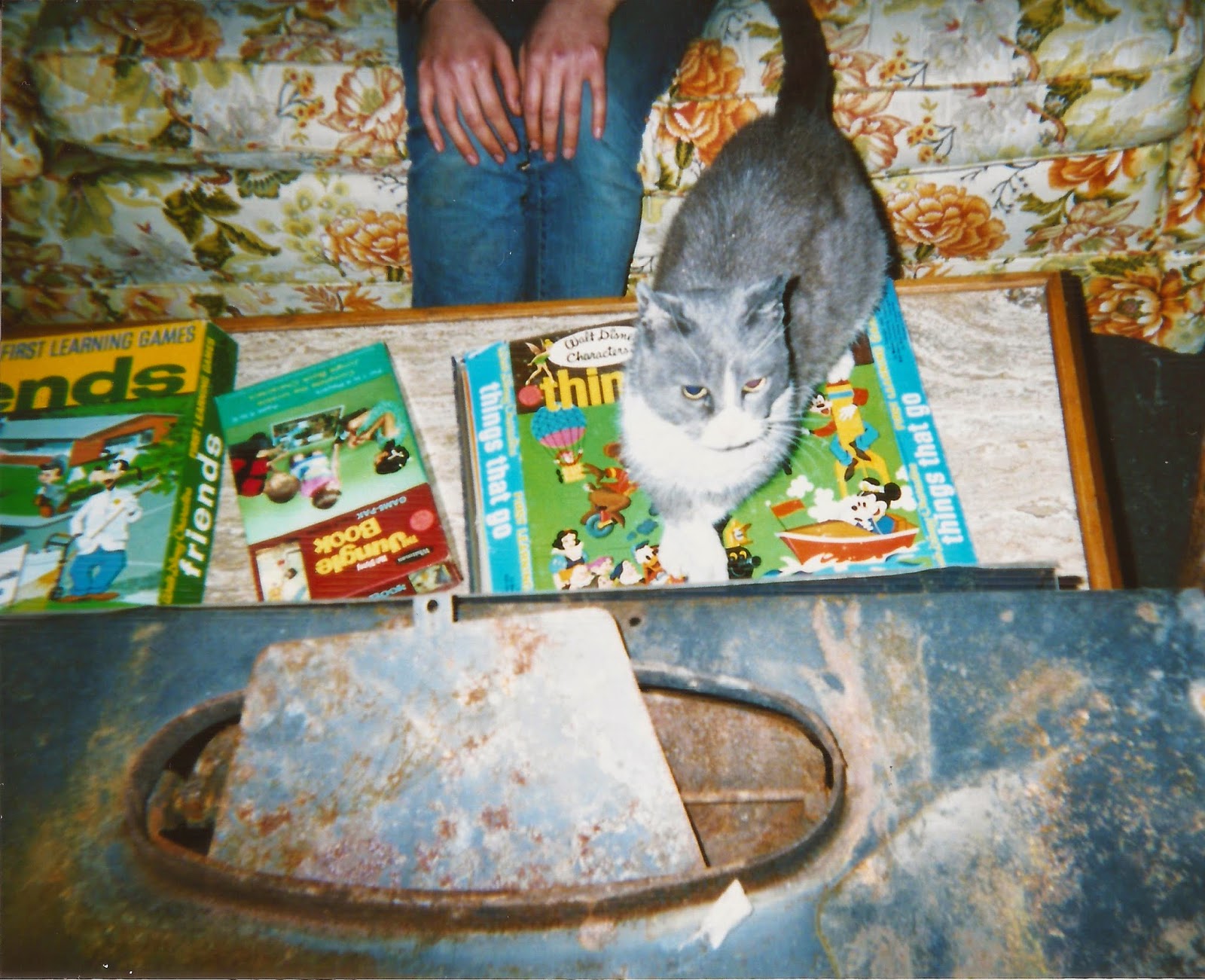
There was a warehouse cat I knew named Stinky, years ago when I worked in a salvage yard and retail warehouse. She was a charmingly decrepit cat, runty and ancient. She purred like an old lawnmower, she had rheumy eyes, and she ate a special diet of soft food because she had no teeth. She had terrible arthritis or some other undiagnosed bone or joint condition, which gave her an oddly rolling gait and caused her to nearly fall over every time she strained her head up around to the side to look at you. She also left a patch of brown dust everywhere she slept because she could not reach around to groom her body. For all of this, she seemed to have a happy life: she was very affectionate, showed few signs of pain or distress for all her maladies, and dearly loved and tenderly cared for by all of us who worked there. (My heart still aches with affection when I remember our dear departed little kitty!)

Now, suppose someone where to discuss cats with me, and based on my close acquaintance with Stinky, I were to argue that cats are slow, ungainly creatures with no teeth, that they are dirty animals that don’t groom themselves, they always weigh less than eight pounds, and if you were to hear a low rumbling sound, you can bet it’s a cat. My interlocutor would justifiably think I’m a little nutty. When it comes to talking about one cat, an anecdote is very revealing. When it comes to talking about the species cat, not so much. In other words: one cat is an anecdote, but lots of cats are evidence.

While all this might appear obvious, it’s natural for human beings to form beliefs and to argue on the basis of what we’re familiar with: we all have our own sets of experiences from which we draw our ideas about the world. Yet, as we grow in knowledge and understanding, it’s important to gather as much information as we can about the world that goes beyond our own experience, since we lead ourselves astray all the time by relying on anecdotes, or in other words, the limits of our own experience. The anecdote can point us in the direction of where to seek for truth, since it reveals facts about the world in that particular time and place, but on its own, can’t tell us much about larger truths or how the world works as a whole.

Statistics are evidence. Meta-studies are evidence. One study can be considered useful evidence if it’s sufficiently large and well-conducted, but given so many variables in the world and the statistical likelihood of getting skewed results in any one given study, it’s better to rely on meta-studies, or a hypothesis or theory supported by many studies and observations over time.

Returning to the anecdote with which I began this piece to illustrate my argument: given the evidence of the many discussions we’ve had over time, I have every reason to believe my interlocutor that evening is an intelligent person, well-informed in many ways. Given my confidence in his abilities, I also believe he’s fully aware of the difference between anecdote and evidence. Yet, since our evolved brains naturally think first in terms of our own experience so that we easily fall into the anecdote-belief trap, we need to keep in mind the difference between anecdote and evidence, use them appropriately, and make it clear to ourselves and our partners in discussion how we’re using each of them to support our arguments and why.

Thomas Jefferson Sites, Part 2: Williamsburg

Second day, April 20th

I drive down to Williamsburg, where Thomas Jefferson received much of his higher education, read law, and embarked on his political career. It’s a long drive of almost three hours each way, and I take advantage of much of the time to catch up on some research via podcast. (Thank you, inventor(s) of the podcast, I can’t tell you how many of my hours you made fascinating and happy!). The rest of the time, as is my wont, I sing loudly to myself.

Colonial Williamsburg is partly authentic restoration and partly tourist-pandering attraction: at times, it feels just a little more like a historically-themed street in Disneyland than a historical site. Perhaps because it’s a little too clean and tidy, with actors in period costumes incongruously mingling with tourists and very stage-ily reinacting Revolutionary-era colonial Virginia scenes. Many of the buildings are very obviously dedicated to hawking souvenirs.

But oh well, best not to be a hater. In a perfect world, perhaps, the public might fully finance the expensive restoration and upkeep of historic sites like this through taxes or donations. As it’s not a perfect world, ‘ye olde historickal shoppes’ and entertainment help keep the place afloat, and in the end, what matters is that it’s still here to be studied and enjoyed. The souvenir shops are not nearly as obnoxious as many others I’ve seen, the buildings are in excellent repair, the grounds are lovely and well cared for, and on the whole, I’m satisfied.

I make a loop around Colonial Williamsburg after buying maps and a vintage postcard for my mother-in-law (who’s trying her best to instill in me the virtue of thoughtfully sending postcards while traveling. It’s still tucked among my maps and notes. Sighhhh.). I start off with ice cream cone in hand, as it’s fairly hot and muggy for a spring day to a California gal like me. But there’s a nice breeze blowing, and the sky is blue.

I begin with George Wythe’s house.

Wythe was a lawyer and teacher, and instructed Jefferson in the law. He also helped Jefferson get started in politics, and was a co-revolutionary and lifelong friend as well. Like Jefferson, he believed that reason should determine who’s fit to rule, rather than heredity. He may have been, in fact, the single most influential person in Jefferson’s life which he actually met (in other words, not counting those whose ideas he studied), with the possible exception of James Madison.

Not only did Jefferson spend a good deal of time in this house in his years as a young law student in the early 1760’s, he lived in this house with his wife and little daughter for a while in 1776, soon after he drafted the Declaration of Independence, while he served in the Virginia House of Delegates.It’s a simple but handsome house, and I’d like to go inside but it’s a Monday just before the tourist season begins in earnest, and it’s closed for the day.

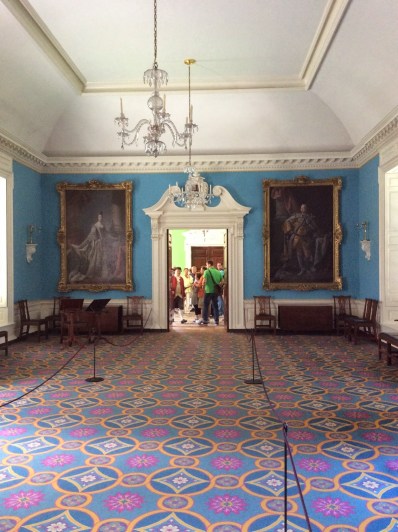
The Governor’s Palace, however, is open, and I take the tour. It’s a much more decorative building than most I’ve seen, but still made of the inevitable red bricks of native Virginia clay. It was designed and originally built in the early 1700’s.

But this actual building’s a reconstruction: the original building burned down in late 1781, almost 3 years after Jefferson moved into the Palace as governor of Virginia. A little under a year into his tenure, he moved out again, the government having moved to Richmond as a safety measure. The Revolutionary War was raging, the British were bringing the fight ever farther inland, and Jefferson had a young family now to protect.

Though Jefferson only lived in this house for about a year, he had already spent a lot of time here in as a student (he was a member of one of Virginia’s elite families) and later in his years as a lawyer and government official. He loved to play the violin, and Francis Fauquier, governor at the time, was a music enthusiast as well. Along with Wythe and another of Jefferson’s most beloved and admired teachers William Small, Fauquier took the talented young man under his wing, and the four would gather frequently under this roof (well, the original one anyway).Later on, Jefferson made many drawings of the Governor’s palace, ostensibly with the view of remodeling or upgrading it for his own planned tenure there, but the war changed his plans. Jefferson’s drawings would later aid in the reconstruction of the building in the 1930’s.

The gardens in the back of the palace are more formal than I like, laid out in geometric lines and aggressively pruned, but still nice to walk in on this sunny spring day.

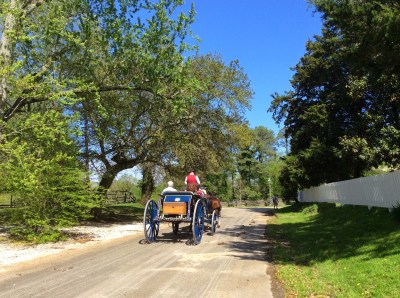
I continue on, and make a counterclockwise loop around the town. It’s a lovely walk between the Governor’s palace and the next site I visit: I wander among green fields sprinkled with wildflowers, crisscrossed with paths, and bound with rough hewn fences; handsome old trees with tender young leaves, little bridges over winding streams, and Georgian and Federal style grand homes mostly made of that inevitable red brick interspersed with quaint little wood houses and outbuildings. I forget to take a picture of Peyton Randolph’s house, an imposing dark red brick, long, angular house, startled as I am by a carriage laden with sightseers which passes by me more closely than I would have liked. In fairness to the driver, I was distracted by site-seeking and more unaware of my general surroundings than safety might require. Randolph was a distant cousin and fellow Virginia politician, and Jefferson would surely have visited his house regularly.

Then to the Capitol Building.

Like the Governor’s Palace, the building that now stands is a meticulous reconstruction from the 1930’s, of the original building as it would have looked in Jefferson’s time and earlier. The British used it for military purposes during the Revolutionary War, since the government of Virginia had moved inland to Richmond, and the building fell into ruin from subsequent disuse. I really like its design, with its rounded ends and archways; it’s a refreshing break from the nearly unrelieved squareness of the rest of the architecture I’ve seen around here.

The original Capitol building witnessed many scenes of immense historical importance to the American colonies. Patrick Henry’s speech against the Stamp Act was greatly inspiring to Jefferson, who attended debates at the Capitol while still a law student, and who continued to admire Henry as an orator, if not as a serious intellectual or lawyer, for the rest of his life. Jefferson also spent a lot of time there as a member of the House of Burgesses, and with George Wythe, George Washington, and other leaders, debated and discussed issues related to the growing tensions with Britain, and how a possible split from the mother country could be brought about.

Then down the street to the Raleigh Tavern, this one a clapboard affair, and a reconstruction of the original.
As I arrive, I see a performance in progress, of several costumed ‘townspeople’ debating political issues of the days leading up to the Revolutionary War. I pick my way among the crowd and get as close a look as possible. Again, to my disappointment, it’s closed at the moment.

The Raleigh Tavern, like the Capitol building, also hosted many historically fraught scenes. Virginia and other colonial leaders met there regularly; George Washington frequented it often. Jefferson spent a lot of time there too: not only studying, lawyering, and politicking, but also wooing one of his earliest love interests. He was a romantic and a man of healthy sexual appetite, evidenced not only by the frequency of his wife’s pregnancies (which helped bring about her early death in 1782, at age 33) and his decades-long affair with Sally Hemings, but also the number of his romantic interests. At age 20, he danced there with Rebecca Burwell, where she rejected his (self-described) awkward declarations of love and devotion.Then onward along the square and across the row of pubs (which I note for future reference) to the Wren building at the College of William and Mary.
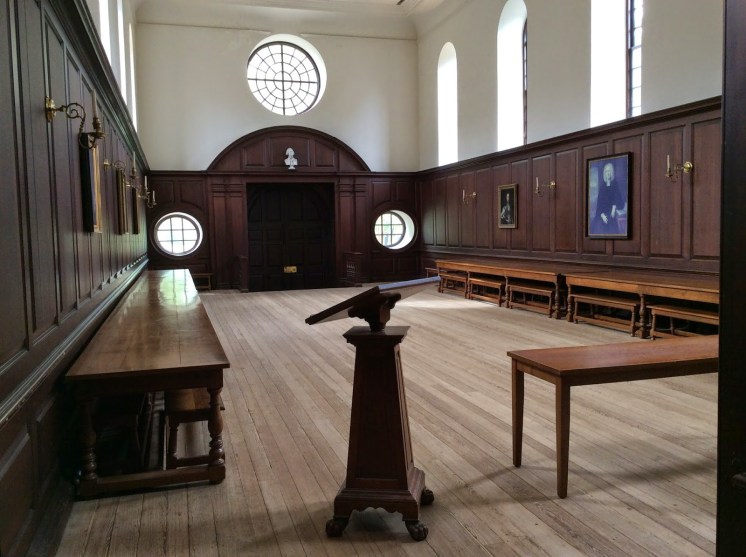
Jefferson enrolled here in 1760, a few days before he turned 17, to study moral philosophy, natural philosophy (as science was known then), and mathematics, until he went on the study law under (the aforementioned) George Wythe (William and Mary Colleges’ first law professor). He lived and studied in the Wren building itself. Ten years after he graduated, Jefferson drew up plans to improve and expand the Wren building, but as was the case with the Governor’s Palace, the Revolutionary War intervened, and the building looks like it did when Jefferson was a student, and not as Jefferson the architect imagined it.

The classrooms have a cozy or closed-in appearance, depending on your taste or mood, with dark, heavy wood paneling, lined with benches. Jefferson acquired much of the education he valued most highly at William and Mary under the instruction of his dearly loved teacher and friend William Small. In later years, he was sometimes admiring of, and sometimes critical of, the college in his writings. He thought it among the best educational institutions American parents could send their children to, because it had such excellent professors as Small and Wythe. Yet he was critical of the addition of its school for Christianizing Native Americans, and thought its location and resources insufficient for providing adequately for the intellectual and physical well-being of its students. As he critiqued William and Mary, he formulated plans for an institution of higher learning which he would later realize (more in a later post about that).

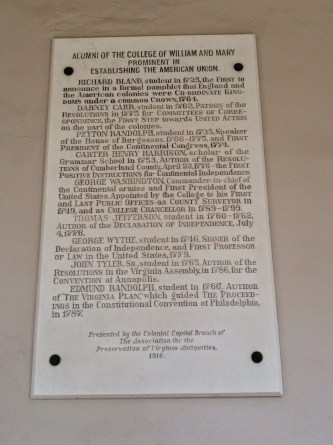
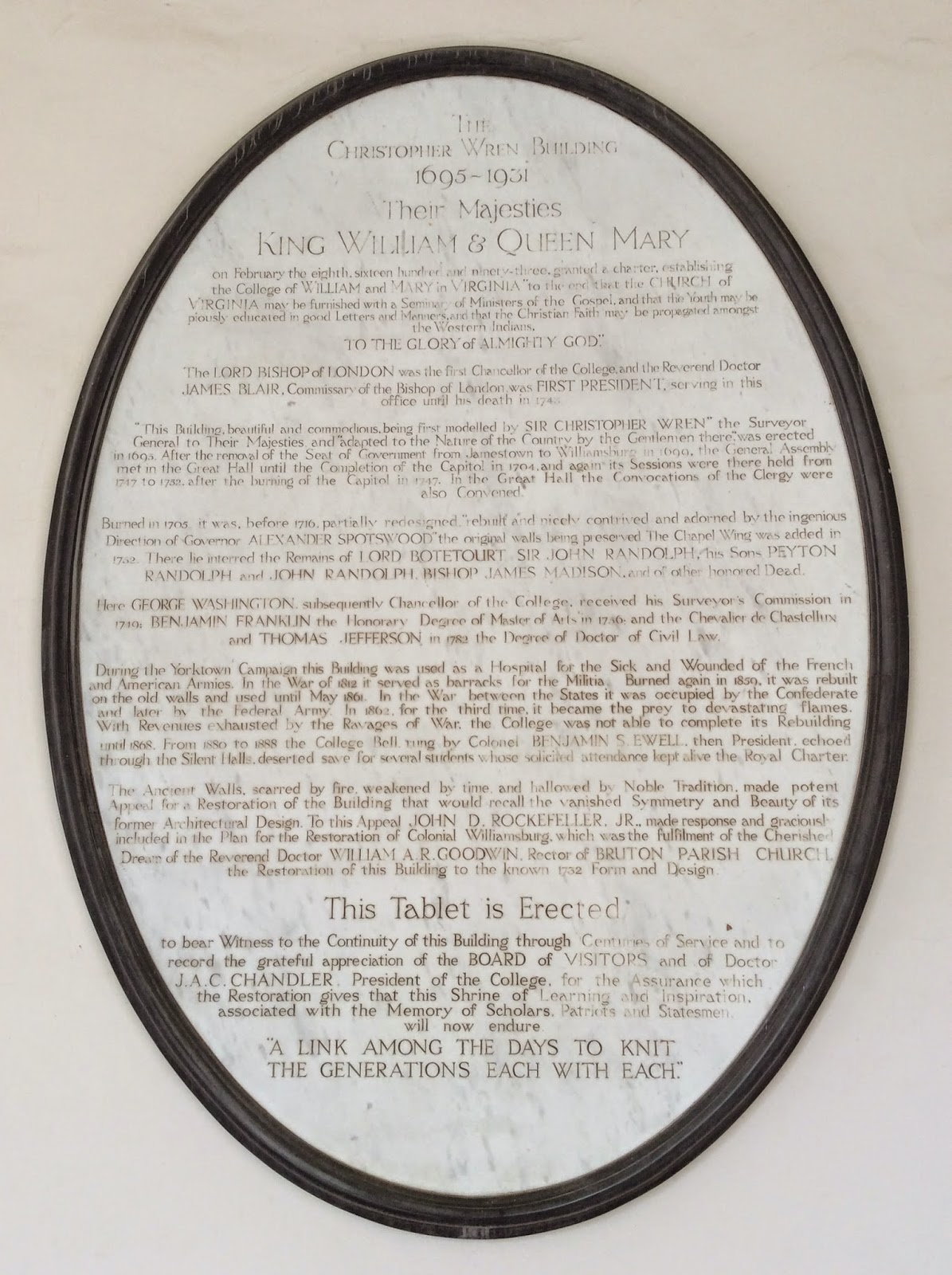
For all its Jefferson-described limitations, this college boasts many of the most famous graduates in early American history (as you can see from the Wren building’s proudly displayed plaques pictured below): Thomas Jefferson, George Washington, Payton Randolph, George Wythe, and Edmund Randolph, among others.
After touring the central rooms of the building, open to the general public even though classes are in session as I explore, I leave the Wren building and William and Mary grounds and return to the row of pubs I had passed a little while ago. I choose the Trellis Bar and Grill, since the charmingly named Dog Street Pub with the cute sign isn’t seating people outside at the moment; they seem to be setting up for the dinner beer garden. The Trellis serves a favorite ale of mine (Ommegang Hennepin saison) and after all, one can’t visit a college town and not have a beer, right?

I cool my throat with the tasty cold brew and relax my slightly achy traveling feet as I edit my photo roll and write up some notes of today’s trip.

The breeze, having turned into a gusty wind, bring clouds and a few drops; the air feels soft and velvety and seems to indicate a coming storm. Time to make the long drive back to Takoma Park, where I’m staying, at the north edge of D.C. On the way home, I witness the most spectacular lightning storm I’ve seen in years (we don’t see those much in California) and a fairly brief yet dramatic hail-and-rain-and-wind-storm. Though I’m a little nervous as the wind shakes my tiny little rental car around and the rain renders me a little blind, I’m enjoying it more than not as I take shelter in a fast-food barbecue joint (kinda good, kinda gross, as you might expect), and feel it’s been an excellent adventuresome day.

To be continued…

*Listen to the podcast version here or on iTunes

~~~~~~~~~~~~~~~~~~~~~~~~~~~~~~~~~

Sources and Inspiration: 

“Capitol (Williamsburg, Virginia).” Wikipedia contributors. Wikipedia, The Free Encyclopedia. http://en.wikipedia.org/wiki/Capitol_%28Williamsburg,_Virginia%29

Colonial Williamsburg, website of The Colonial Williamsburg Foundation.


Jefferson: Writings. Compiled by The Library of America, New York: Penguin Books.
http://www.loa.org/volume.jsp?RequestID=67

Jenkinson, Clay. The Thomas Jefferson Hour. Podcast.
http://www.jeffersonhour.com/listen.html

Meacham, Jon. Thomas Jefferson: The Art of Power. New York: Random House, 2012.
http://www.jonmeacham.com/books/thomas-jefferson-the-art-of-power/

‘Timeline of Jefferson’s Life’. Monticello.org. Website of the Thomas Jefferson Foundation.
http://www.monticello.org/site/jefferson/timeline-jeffersons-life

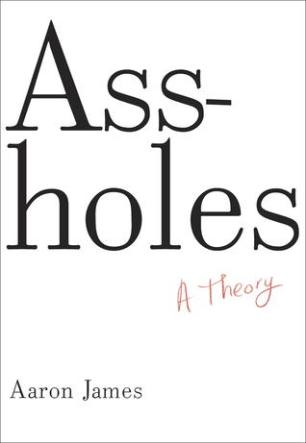
Book Review / Reflections On: Assholes, a Theory

The title might make you think it’s not a serious work, that it’s tongue-in-cheek, even a parody of a philosophy book.

But it’s really a very good, intelligently written, well-thought-out exploration of a sadly widespread phenomenon. And yes, it’s so satisfying to finally see that age-old question ‘Why are you being such an asshole?’ addressed and explained so thoroughly.

Author Aaron James is not being merely provocative in using the term ‘asshole’ to designate the particular kind of person he’s talking about. He uses this colloquialism because we really have no other word that’s so specific and so widely understood, to refer to a person who displays a certain attitude and systematically engages in certain types of bad behavior. Here’s James’ three-part definition: the asshole 1) allows himself to enjoy special advantages and does so systematically: 2) does this out of an entrenched sense of entitlement; and 3) is immunized by his sense of entitlement against the complaints of other people (p 5).

When we say of someone: ‘what an asshole!’, or observe ‘that was such an asshole thing to do!’ pretty much everyone recognizes this just the sort of person or behavior we’re talking about. If we were to use a more formal or non-slang term instead, as in ‘what a bad person!’ or ‘that was a depraved thing to do!’, the full richness and specificity of meaning that the colloquial, richly nuanced term asshole possesses wouldn’t be fully expressed. Look at how many words it took James to define what we mean by ‘asshole’ (and I would say, not quite fully: none of the definition’s three parts describe the little shudder of outraged disgust we feel when we see assholes doing what they do.)

That’s why, like James and fellow philosopher Harry Frankfurt, whose 2005 paper ‘On Bullshit’ caused quite a stir, I disagree with linguistic purists and prudes who wholly reject the use of colloquialisms in serious or academic work (though I speak only for myself as to how far this should go ). Out of self-righteously willful obtuseness, I insist, these purists just don’t ‘get it’. Everyday spoken language is much more fluid and adaptable than formal language, because there’s no arbiter of proper usage ‘breathing down your neck’ other than your partner in conversation. In the virtual experimentation lab that is daily conversation, we search for words that express exactly what we mean as efficiently if possible, and if there’s no ready word available, we adapt one that already exists, or make one up on the spot. As long as the person you’re talking to right then understands you, ‘it’s all good’. Formal language, on the other hand, evolves much more slowly, and must adhere more rigidly to existing standards of usage. Only over long periods of time do newer terms, having entered into common usage, filter up through the levels of linguistic formalization, and become accepted by editors of dictionaries, publishing houses, and news media. Yet the formalization of language doesn’t always result in a more expressive, precise one. As you can see, I used several idioms and colloquialisms in this paragraph, in quotes, to express my thoughts, and if you haven’t ‘been living under a rock’ you probably understood exactly what I meant. You can also see that colloquialisms can not only be a more colorful or amusing way, but more efficient way, of expressing yourself. You can test this by trying to define the full meaning of these colloquialisms, with all their nuance, using a lesser number of terms in formal language. I’d ‘bet your ass’ you can’t!

(In one of my student papers written a few years ago, I explore the linguistic origins and evolution of colloquialisms in the light of Grice’s Cooperative Principle, Dumas and Lighter’s paper on slang, and Steven Anderson’s hilarious and thoughtful documentary F**k. )

But I digress. To return to James’ book: it has a lot going on. So much so that it lead me to think, for example, more about the nature of language itself, just from the parts where he discusses what ‘asshole’ means, the various subtypes of assholes, and compares and contrasts asshole to related terms bitch, schmuck, assclown, douchebag, dickhead, dick move, and so on. (He forgot one of my favorites, asshat, which refers to having one’s head up one’s own ass, thereby wearing it like a hat.) It’s a testament to the richness of ideas in this book that thinking it over, every time, engendered so many other interesting lines of thought. Exploring the concepts contained in the term ‘asshole’ raises important questions about respect for one’s self and others, of human dignity, of exploitation, of how you should act and not act in a cooperative society, what we can rightfully expect of others and why their failure to live up to this is so objectionable, and much more; in short, this term is thick with moral and political implications.

There’s one point on which I disagree: his suggestion that, while assholes are far more likely to be men (which I agree is the case), they are almost entirely a product of culture (chapter 4). While I agree there may be cultural factors that help instill asshole qualities in men, and that some cultures are more likely to instill these qualities than others, it seems that nature plays a larger role than James allows. I think it likely that testosterone, the hormone which we know increases the tendency to aggression, contributes a lot to the phenomenon of assholery. After all, the traits James ascribes to the asshole are aggressive in nature: systematically granting oneself special privileges over others, of feeling entitled to things whatever the circumstances, and rejecting or ignoring others’ just complaints. It’s not that all men are assholes, far from it. It’s just that the biological factor of hormonal makeup increases the likelihood that males will be more susceptible to asshole influences, or more likely to possess aggressive traits that readily fall into asshole patterns of thought and behavior, than women. To my mind, assholery is a product of combined nature and nurture: asshole seeds take root in ground made more fertile by testosterone.

One of my favorite sections of the book was on asshole capitalism. James is not claiming here that capitalism is necessarily an asshole system. What he’s claiming is that capitalism is essentially a cooperative system ripe for exploitation by assholes, which, in turn, puts it in ever-present danger of collapse, of being destroyed from within. That’s because capitalism is a system of exchange and of reward: people exchange goods and services cooperatively and fairly, which generates trust and more trade, and people reward those who devise and provide the best goods and services with admiration and customer loyalty. And assholery, systematically behaving as if one is entitled to things regardless of the actual value of their contributions to the world, threatens the stability of the cooperative environment necessary for capitalism.

Since assholes systematically regard themselves as the rightful recipients of the best of everything, out of a sense that they are entitled to it per se, assholes exploit other people’s willingness to be fair and to reward others. Asshole drivers feel that owning bimmers entitle them to run red lights and rev their motors inches from people in crosswalks; asshole CEOs and managers think nothing of the fact that their wealth is built on the backs of sweatshop laborers or from industries that generate mass pollution; asshole bankers think they should earn millions or billions a year because they ‘have the balls’ to gamble other people’s money in financial markets, even at the risk of bringing down entire economies (to be fair, they are often so obsessed with their own rewards they may have a hard time even conceiving of larger, potentially dire consequences, because that would mean seriously considering interests other than their own).

Capitalism can and does thrive when people act somewhat selfishly within a larger context of cooperativeness. But never to the extent that the system would hold up under too much lying, cheating, stealing, abuse and neglect of employees, etc. That’s because money, and markets, can’t operate without trust. If most people can be trusted and it’s just a relatively few bad apples gaming the system, well, human nature being what it is, that’s to be expected. But if entitled, self-obsessed, rapacious assholes proliferate beyond a certain proportion, all bets are off. James explains why the modern Russian oligarchic system is rightly considered a full asshole capitalist system and the Japanese system is very much not. Worryingly, and not the least bit to my surprise, James presents evidence for what I’ve already been convinced of: the United States brand of capitalism is edging far too close to Russia’s end of the spectrum, and much farther away from Japan’s. That’s because our modern American capitalist culture has become one of entitlement (as much as certain pundits like to use this word exclusively to refer to aid to the poor, not handouts and special privileges to the rich), in which far too many of use we feel justified in grabbing whatever we want because we somehow, innately, ‘deserve’ it, everyone else be damned.

In sum: this book is a very useful book, on how to understand the origins and nature of assholes; on how to recognize and deal with assholes in the media and in daily life (James’ theory helps explain why certain assholes in the media remain entrenched in their self-serving dishonesty); and as a cautionary tale of when societies allow and encourage assholery to run amok.

– This book review is dedicated to my father-in-law, a man given to succinctness. His fatherly wisdom, which so resonated with my husband he has retold it many times over the years: ‘Son, don’t be an asshole. The world has enough of them already’.

James, Aaron. Assholes, a Theory. First published Doubleday, NY 2012.
First Anchor Books Edition, Apr 2014.  www.onassholes.com

Nicholson, Christie. ‘Testosterone Promotes Aggression Automatically’, Scientific American, June 9, 2012. http://www.scientificamerican.com/podcast/episode/testosterone-promotes-agression-aut

Thanks also to www.urbandictionary.com, which helped me make sure I had all my colloquialisms right, and avoided spelling bimmer ‘beamer’ like a moron

Book review: Plato at the Googleplex: Why Philosophy Won’t Go Away

As I sit here and sit here, racking my brain for a place to start this book review, I find I’m at a loss. I should have scribbled some notes as I was going along. But I didn’t, dammit. Perhaps it was because I was too enthralled all the while, each chapter taking me to new and surprising places. And since I’ve finished, it left me with so much to think about all at once, so therefore, I don’t know where to begin…
Well, here’s the gist of it: Plato at the Googleplex, by Rebecca Newberger Goldstein, is about Plato, his philosophy, his life and times, and his relevance to the world today. The chapters jump back and forth in time: each non-fiction chapter is about Plato’s (and his main influence Socrates’) life and thought, and is interspersed with a fictional one where Plato finds himself in some modern scenario. In each of the latter, he’s involved in dialogue and debate with various figures representative of our time, from an advice-session-turned-discussion with a media escort accompanying Plato in advance of his Authors at Google presentation and a tech geek on lunch break, to a panel discussion on how to raise a perfect child with a tiger-mom-slash-idealist and a Freudian, to an interview with a Bill O’Reilly-like pundit, to an MRI session in a neuroscientist’s research lab.

I’ve read some Plato over the years, a book here, and (mostly) a selection there, and he nearly always felt very removed. His language seemed remote and foreign, his thought experiments (the mythical Republic) seemed outlandish and overly idealistic, and the leading-question and answer style of his Socrates felt contrived, by modern standards of taste. Yet it took this scholar of Plato, who brought to bear her considerable skill as a novelist, to reveal Plato as the thinking, seeking, flesh-and-blood person who, more than just about anyone, got this whole philosophical project going in a big way.

Plato got it all going by showing us how to question everything, and why we should: it’s the only way to make progress. Not progress for its own sake: progress for our own sake, as it’s necessary to make every life better in a practical sense, and more worthwhile in a personal and social sense. Goldstein addresses time and again the objection that philosophy makes no progress, since it’s still asking the same questions. While the ‘same questions’ part might be true, the ‘no progress’ part is not. Some of the questions remain the same because they’re the questions each individual person must answer in regards to their own lives and experiences, no two of which are just alike. Therefore, the answers will be different for each person. Others of these ‘same questions’ are of such magnitude that we must keep asking them in order to slowly fill in the wealth of detail each answer requires if we are ever to get to a satisfactory one. Some remain important but unanswered, not necessarily because they are unanswerable (though many may well be), but because we don’t have the tools or information we need available yet. And so on and so forth.

Yet the most important reason we keep asking so many of these same questions is that the search for answers keeps generating yet more important questions, and yet more answers. And we, intelligent, restless, creative, curious creatures that we are, love love LOVE trying to find things out. I think more than we love knowing, though we love to know some things. And it’s the practice of never taking things for granted, never resting on our epistemological laurels too long, always asking, that Plato teaches us is the best way to learn about the marvelous world around us, and the universe out there, and that within our own minds.

In short: I highly recommend this glorious book. We would all do better to know more about Plato and why he’s so important, and it’s hard to imagine anyone doing a better job of describing why and how this is than Goldstein. But more than that, this book is a celebration of philosophy, the love of wisdom itself. It’s taken its place way up there among my very favorites!
(It’s = Philosophy and this book.)

Plato at the Googleplex: Why Philosophy Won’t Go Away. Pantheon, New York 2014.
http://www.rebeccagoldstein.com/publications/plato-googleplex-why-philosophy-won%E2%80%99t-go-away

Science and Philosophy, a Beautiful Friendship: A Response to Michael Shermer

There’s been some very public dig-taking between the science and philosophy camps lately. Lawrence KraussNeil DeGrasse TysonStephen Hawking, and other scientists are saying philosophy’s become irrelevant, little more than an esoteric old boy’s club. On the other hand, philosophers, theologians, politicians, and others criticize ‘scientism‘, the conviction that science, and only science, can and should be the ultimate source for all human knowledge; that all truth claims, that all ethical, metaphysical, and political beliefs, should not only be informed by or founded on, but entirely determined by, empirical evidence.

Michael Shermer’s article ‘A Moral Starting Point: How Science Can Inform Ethics‘ (Scientific American, February 2015) doesn’t dismiss philosophy so directly. He includes philosophy in a list of three other arenas of human thought, with religion and political theory, as those to which most people turn for answers in matters of right and wrong, good and evil. Science can, Shermer says, provide those answers, and goes on to explain why he believes ethics has no better source for them. The history of the human race is rife with slavery, torture, theft, and discrimination, yet all diminish human flourishing. Much of this harmful behavior consists of the group abusing certain of its members for the sake of others. But since it’s individual beings that ‘perceive, emote, respond, love, feel, and suffer’, Shermer says, it’s individual beings that are the ‘fundamental units’ of nature (evidenced by the fact they’re what natural selection targets). The primary purpose of ethics, then, is to promote the flourishing of individual beings, and to denounce all that doesn’t.

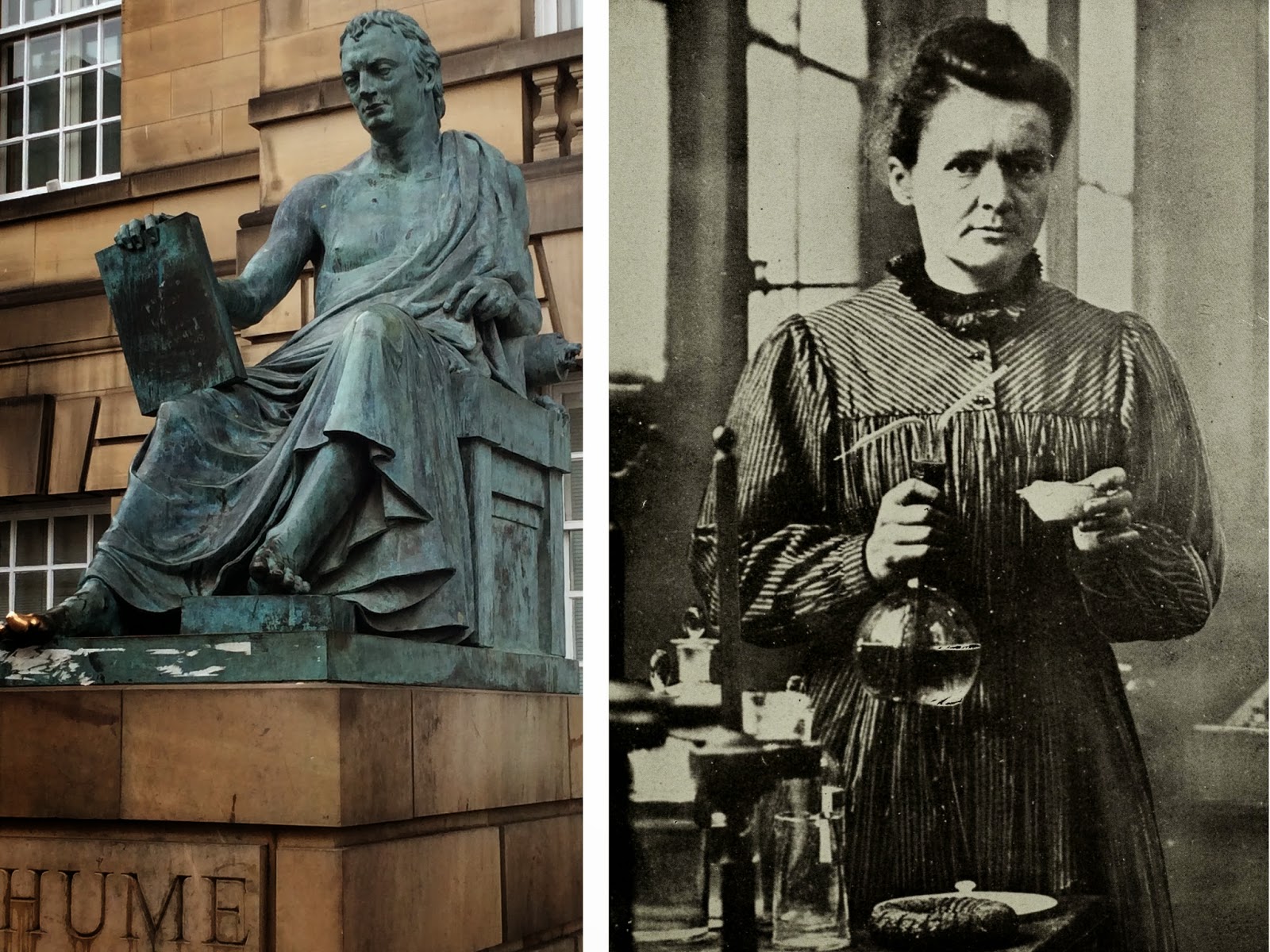
Yet as I read Shermer’s article several times, satisfied as I am that he places high value on the importance of empirical evidence, I find I have some objections. He doesn’t discuss how easy it is to jump to conclusions, inferring the ‘ought’ too quickly from the ‘is’. David Hume is the philosopher most famous for describing how tricky it really is to derive the ‘is’ directly from the ‘ought’, or in other words, the problems with assuming that just because something is a certain way, that means it should be that way. For example, how do we go about deciding that one fact, or one ‘is’, is more important than another fact when determining what ought’ to be done?

I also worry his argument helps perpetuate a certain myth, widely maintained by those who feel the need to erect walls around their respective fields of inquiry. In some cases, like Krauss’s, this whole debate appears to devolve into some sort of intellectual pissing contest. The myth is the claim that there’s a sharp dividing line between each field of inquiry, just as the committed political libertarian perceives the divide between the one and the many, the individual and the group. When Shermer includes philosophy in the list of alternate sources for ethics, and, implicitly, dismisses it as the best candidate, I think that he hints, wrongly, that philosophy is in competition with science generally.

A famous example of leaping too quickly from the ‘is’ to the ‘ought’, or in other words, deriving an ethical system too quickly from a scientific discovery, is eugenics. Many were so enthusiastic about the thrilling new scientific theory of natural selection, derived from observations in nature, that they thought it could be applied to all explanatory theories. Just as it is a fact that nature selects against certain individuals based on the ability to thrive in its environment, so it is that human beings should emulate nature and act as rational arbiters of fitness. In other words, we should select select against those individuals we think ‘degrade’ society by their existence and by their capacity to pass on their ‘undesirable’ qualities.
Scientists widely thought, from the late nineteenth century to the middle of the twentieth, that the human species could be more efficiently ‘perfected’ through the judicious selection of traits to pass on to future generations.

Here, philosophy and science (and yes, even religion) could have done a much better job at working together: arguably, these eugenic ethicists could have used a lot more Hume, philosopher, and a little less Cesare Lombroso, physician and criminologist who thought all bad human traits were physically inherited. It’s not that the physical sciences should not contribute to ethics, not in the least. It’s that more checks and balances between fields of inquiry could have kept so many over-eager scientists from over-applying their discoveries where there are good arguments to show they did not belong. If eugenicist scientists had paid more heed to Hume’s warning that we can’t so readily derive the ‘ought’ (what we should do) from the ‘is’ (the actual state of affairs in the world), perhaps they may have more carefully considered all of the evidence, including human moral instinct and logical arguments in favor of human equality, done a better job of including all available scientific data in their social theories, and restrained themselves from unleashing such a destructive ideology on the world.

 
But shouldn’t ethics be informed by facts about the world? If it isn’t, doesn’t that make ethics too arbitrary, or too abstract, to be applied to the lives of actual, living human beings, as members of a society as well as individuals? I agree with Shermer that it should. But I also think that facts about the world aren’t enough, on their own, to fully determine what we ought to do. In fact, these facts can’t be enough, all on their own. That’s because, for one thing, there are so many ‘is’s’ to consider, many of which indicate an opposite course of action would be best. To return to one of the many problems with eugenics: its promoters considered the ‘is’ of natural selection against ‘unfit’ members as the most important fact to consider in deciding which lives society ‘ought’ to consider worth living. After all, it’s selection against weak and ecologically ‘unfit’ individuals which made their surviving descendants ‘superior’. But there are other ‘is’s’: human beings are naturally disposed to empathize with those who are suffering to help them out, even if they are sickly, disabled, or otherwise more susceptible to an early death. This disposition, this instinct, is itself an evolved trait. It’s also a fact that the same cooperative set of instincts that compel us help the ‘unfit’ survive is the same that drives us, as a species, to help each other live happier, healthier, wealthier, and therefore ‘fitter’ lives in the long run, as individuals as well as members of society.
 
Shermer considers the well-being of individuals the primary goal of ethics, and for scientific reasons. He explains: ‘The singular and separate organism is to biology and society what the atom is to physics—a fundamental unit of nature. The first principle of the survival and flourishing of sentient beings is grounded in the biological fact that it is the discrete organism that is the main target of natural selection and social evolution, not the group. We are a social species, but we are first and foremost individuals within social groups and therefore ought not to be subservient to the collective.’ It’s clear that he, like all rational, well informed thinkers, doesn’t ascribe to the principles of eugenics, now considered not science, but pseudoscience. But it’s not so clear how he’s justified, based on scientifically confirmed facts alone, in saying that because natural selection works on the individual, it’s the individual whose interests should be protected first, and society second. After all, natural selection also works against individuals, culling some for the benefit of the group. So, one could just as well argue that the evidence shows it’s better for individuals, as well as for society, if those who are sickly or more likely to pass on disease and disability to others, should at least be allowed to die off as nature, without our intervention, would have it. Shermer needs more than just an array of facts to show why some, and not others, should inform ethics.
It’s true that, historically, far too much death and destruction have been wrought on individuals when they are perceived as ‘subservient’ to the group. In this, Shermer has much evidence on his side. But it’s also true that much harm results from placing too much emphasis on the rights of individuals over the wellbeing of society. Lax gun regulations make it easy on gun enthusiasts to enjoy their hobby while also making it easy for the murderously criminal and mentally ill to obtain guns too; lax labor laws make is easy for employers to exploit and abuse their workers to the point of disabling injury and death; lax financial regulation allow a few speculators plunge economies into ruin and populations into a state of want; ‘personal belief’ exemptions allow parents not to vaccinate their children, resulting in epidemics of disease and even death; the list goes on and on. Great harm, generally, comes from the attempt to separate individuals and society into two competing camps, or to, as Margaret Thatcher would have it, from acting on the belief that the group, or ‘society’, doesn’t really exist at all.

In our intensely social, emotive, thinking human species, the incredible degree of individualness that individuals can achieve is due at least as much to the contributions of the group, over time, as to the individual’s own efforts. Human beings make art, tell stories, travel, enjoy romance and friendship, build buildings and erect monuments, and create such rich and complex products of thought as history, myth, religion, politics, literature, science, and to my mind the greatest, philosophy (since it overarches and unifies all other systems of thought), precisely because of the level of sociability we have evolved. The rugged, self-reliant individual of American mythology, for example, is precisely that: a myth. No human being could get very far if they didn’t have a society, to help feed, clothe, and equip them with the tools and technology they need to perform their wonderful individual feats, and to restore them to health and pass on their story afterwards. Humans flourish when individuals efforts are promoted and when they’re not allowed to infringe too much on the interests of the group.

The human species, as a whole, flourishes so well because of this two-way dependence between the individual and the group: you can’t have one without the other. The incredible diversity of its individual members should be encouraged and protected because they make our species among the most adaptable, and therefore among the most resilient on earth. When we oppress individuals, when we seek to crush expression of personality, or system of belief, or ability to pursue personal goals and professions, we wrong both the individual and the human species, by undermining individual potential while making the species that much less diverse and therefore, less adaptable. When we undermine the flourishing of society by allowing individuals to pursue purely self-interested whims and goals to the detriment of all, we wrong the individual too. Short-sighted, self-centric market choices leading to mass pollution and climate change, widespread cell phone use while driving, ideologues who keep their children out of the public schools to indoctrinate them in one world view, and one only… when the individual is allowed, by the group, to pursue their own myopic interests to the detriment of all, individuals suffer too.

In all other areas of biological science, it’s essential to understand a species as a whole if you want to fully understand any individual. When you look at an individual being, you see a set of characteristics that could just as well be quirks as traits; when you look at the species as a whole, you recognize which of those characteristics all have in common, and which are necessary for all members of a given species to survive and flourish. Even when it comes to solitary animals, most cats, for example, we consider each one as members of the species cat as well as a particular furry, comfort-loving, furniture-ravaging, mouse-chasing, charmingly mischievous, producer-of-the-cutest-offspring-on-earth-namely-kittens animal. If we didn’t perceive them dualistically in this way, we wouldn’t understand much about any one cat, let alone all cats. If we were to encounter an individual animal with all those traits, and had never encountered or learned about others, we wouldn’t know what to feed them, how we might need to protect the furniture, or why we should keep a video camera handy when they’re around. If we need this dualistic perception of cat as one furry animal and one of many cats in order to understand it, how much more so for a highly social species, such as humans, whose interests and fates are so intertwined. I see no reason, scientific or otherwise, to look at the human species any differently in this regard.
 
This cat example might seem so illustrate such an obvious point as to be silly, but I think we need to remind ourselves of it every time an intellectual tries to divorce fields of inquiry from one another in the general human project of truth-seeking, or an ethicist, politician, or anyone else tries to completely separate the interests of the individual from that of the group. I think both are mistakes that Shermer comes too close to making in this article.
This whole discussion of how easy it is to draw wrong conclusions from scientific evidence can also serve to buttress Shermer’s initial point about ethics, even if it doesn’t support his overemphasis on the divide between the individual and the group. I agree that scientifically verifiable facts about human beings should inform our ethics; the best system of ethics, to my mind, is a naturalistic system. Here’s where we arrive at what Shermer mostly gets right. Looking outwards at the world provides the raw material for any system of thought, as his title ‘A Moral Starting Point’ more than suggests. After all, all knowledge begins with the information we receive through our senses, as Aristotle, Hume, and the other empiricist philosophers point out. There is no reason to think we could think at all if we have never heard, seen, felt, tasted, or smelled anything to think about. And it’s thinking that gets us to do more than just sensing the world as a microbe, a plant, or a clam does, reacting without reflection. Philosophy is the human species’ way of taking the art of thinking as far as it can go: we examine what the information we receive might mean in a larger context. We question, we look for answers restlessly not only because we want to solve problems: we love to do so. Philosophy, after all, literally means ‘love of knowledge/wisdom’, translated from the Greek. And as we ask and as we look, in the interplay between the input of our senses and the organization of information through thought, science affords reality the opportunity ‘to answer us back’, as Rebecca Newberger Goldstein so puts it so well (Plato, p. 34).Philosophy not only provides the impetus and the direction for the inquiry of science: once we find out the facts, it helps us figure out what to make of them. In every step of the way, the formulation of scientific theories relies heavily on philosophy, from the application of the rules of logic to the justification of why we should value or emphasize one set of facts over another. In fact, until very recently, science was a branch of philosophy (natural philosophy) until that general branch of inquiry about the natural world became so large it specialized and branched off, then branched off again into physics, biology, chemistry, and so forth. Those areas of philosophy that didn’t branch off into the sciences and into theology, came to be identified with the arcane varieties of metaphysics, epistemology, ethics, and so on, pursued largely behind the walls of academia today.

But philosophy is not limited to an arcane, highly abstract field of inquiry, as fascinating and valuable as that can be. It’s that approach to life as a perceiving, emoting, responding, loving, feeling, suffering, and thinking being, that every person partakes in, to one level or another. Philosophy, from its very beginnings, originates in the public square. It’s welcoming into ones’ self the whole world of things to sense and to imagine with a curious, critical, and interdisciplinary approach, and engaging in that way of thinking with others. I want to know why, and how, and who, and so on, and not only to know what is, but why I care about it and why others should too. Science is a big part of this. Yet philosophy is prior to, and necessary for, the former. In fact, it was my love of philosophy that led to my fascination with science, to question and replace some of the ideas I was taught in my youth (creationism, the doctrine of original sin, the sacralization of virginity, and so on) with a more naturalist system of inquiry. To separate philosophy from science is as unhelpful as divorcing the individual from the species: one does not function without the other.When it comes to understanding the universe, in fact, there is no such thing as ‘nonoverlapping magisteria’ of thought (as Steven Jay Gould put it when he tries, to my mind unsuccessfully, to justify the separation of theology and science). I think it’s a mistake to engage in the kind of intellectual turf war that science, philosophy, and other fields of inquiry are sometimes engaged in, not only because it sets up mental road blocks to incorporating the full range of evidence and ideas available, it sets a bad example for critical thinking. Shermer does well to remind philosophers, many of whom are sadly remiss in this, that they need science to keep them honest, so that subtle errors in logic, mistakes in self-justification, or over-weddedness to a particular tradition of thought can’t lead them too far astray.

But ‘philosophy-jeerers’, as Newberger Goldstein calls them, make a mistake when forgetting how much science owes philosophy, and how heavily they actually depend on it. For example, at the beginning of the article, Shermer refers to rights theory in philosophy as a popular source of ethics, as a contrast to a scientific view. Yet later on in the same piece, he refers to ‘natural rights’ as a scientific ethical principle. Yet rights theory has always been derived, even if indirectly at times, from the application of reason to observed facts about human beings: that they are rational and feeling creatures, that they are capable of autonomous will, that they seek to live ‘the good life’, and so on. To intimate that rights theory is, or has ever been, an alternative to an empirical view of ethics is either to ignore or to misunderstand what rights theory is and always has been.
Darwin's Ghost be Rebecca Stott, Photo Credit: Goodreads
Remember Aristotle, philosopher extraordinaire, one of the earliest and most famous founders of two (among many) of the most influential fields of philosophy: ethics and natural philosophy (better known today as science). As so delightfully described in Rebecca Stott’s Darwin’s Ghosts, Aristotle didn’t remain in his armchair (did they have armchairs in ancient Greece?), spinning abstract theories straight out of his head, arguing tedious points of logic with his fellow philosophers. He looked to the world to provide the raw material with which to craft his theories on the origins and nature of life, diving for specimens of sea flora and fauna, following animals around and recording their behavior. It was his philosophical mind that drove him to ask the questions and look for answers, and it was nature that provided the predicates, the subjects, of his reasoning.

In the words of Humphrey Bogart, we can see, from accounts of her birth, ‘the beginning of a beautiful friendship’ between Science and her parent, Philosophy. The most intimate kind of friendship, where the dialogue is open and honest and each supports the other, guiding one another away from the pitfalls and wrong turns the other doesn’t see.

So from the very beginning, philosophy has always been there to keep science honest, supplying the discipline of logic and helping it avoid methodological errors. It makes it clear to why there are relatively few direct or easy links from the ‘is’ to the ‘ought’ when formulating principles of ethics. It shows science that finding out how things work doesn’t readily indicate how we should apply that information in our daily lives, that even the best scientist is prone to bias, misunderstanding, and underestimation of that which we don’t yet know, and how science can be used to help and not harm.

There is no honest philosophy without science, and there is no science at all without philosophy.

*Listen to the podcast version here or on iTunes
* A version of this piece is published in Philosophy Now
*Also published in Darrow
~~~~~~~~~~~~~~~~~~~~~~~~~~~~~

Sources and inspiration:

Anderson, Ross. ‘Has Physics Made Philosophy and Religion Obsolete?’ The Atlantic. Apr 23, 2012
http://www.theatlantic.com/technology/archive/2012/04/has-physics-made-philosophy-and-religion

Burnett, Thomas. ‘What is Scientism?’ American Association for the Advancement of Science website.
http://www.aaas.org/page/what-scientism

‘Cesare Lombroso.’ In Wikipedia, The Free Encyclopedia
http://en.wikipedia.org/wiki/Cesare_Lombroso

Fagan, Andrew. ‘Human Rights’. Internet Encyclopedia of Philosophy.
http://www.iep.utm.edu/hum-rts/#H2

Gould, Stephen Jay. “Nonoverlapping Magisteria,” Natural History 106 (March 1997): 16-22
http://www.colorado.edu/physics/phys3000/phys3000_fa11/StevenJGoulldNOMA.pdf

Hume, David. A Treatise of Human Nature, Book III: Of Morals. 1739.

http://www.earlymoderntexts.com/pdfs/hume1740book3.pdf
Nerdist Podcast: ‘Neil Degrasse Tyson Returns Again’. March 17th, 2014
http://www.nerdist.com/pepisode/nerdist-podcast-neil-degrasse-tyson-returns-again/

Newberger Goldstein, Rebecca: Plato at the Googleplex: Why Philosophy Won’t Go Away. 
New York, 2014 http://www.rebeccagoldstein.com/publications/plato-googleplex-why-philosophy-

 
Shermer, Michael: ‘A Moral Starting Point: How Science Can Inform Ethics.’ Scientific American, 
February 2015.  http://www.scientificamerican.com/Stott, Rebecca. Darwin’s Ghosts: The Secret History of Evolution. Random House, New York 2012.
https://books.google.com/books?id=5Lt_MXhNJEoC&pg=PP5&dq=darwin%27s+ghost

Thatcher, Margaret. Quote from interview with Women’s Own magazine, Oct 31st 1987.
http://briandeer.com/social/thatcher-society.htm

Warman, Matt. ‘Stephen Hawking Tells Google “Philosophy is Dead”‘. The Telegraph, May 17th, 2011
http://www.telegraph.co.uk/technology/google/8520033/Stephen-Hawking-tells-Google-philosophy

What Leaving Religion Has Done for Me

I grew up as a member of a large and generally very religious, very conservative Catholic family. As I describe in an earlier piece, both sides of my family are close-knit and traditional, with a tendency to insularity. When I was much younger, I loved it. Religion, especially in its more traditional and fundamentalist forms, has many upsides: a strong sense of community, a feeling of intimate belongingness in a group that shares a creed, a mythology, a history, and an identity. There are things I remember fondly: the warmth that suffuses family faith-based rituals, like putting on a fresh new dress for Easter morning, or the excitement of Christmas midnight mass, with its rich decorations, solemn rituals, and stirring hymns. We would return and light the tree, a luminous and dream-like vision to a child who just woke up from the wee-hours car ride home. There were pancake breakfasts and coffee socials after Mass, Sunday school friends, singing in the choir, and suppression of giggles as my brother, sisters, and I pulled faces at each other during the hour-plus long service.

I also remember that religious fervor, that soaring feeling, that high, that rush of heart-swelling emotion that would come over me sometimes as I sought connection with the divine. In my mid-teens, Jesus was my ‘drug’ of choice. (Not that I did much in the way of drugs later, ahhh-hem.) The Catholic religion has many elements that suit a romantic temperament: prayers and chants, candles and incense, a baroque artistic sense, a preoccupation with death, suffering, and self-sacrifice, and a deep veneration for martyrdom. And no-one is more romantic than a teenager.

But that feeling of belongingness can also lead to insularity, so that you feel removed to some degree from the broader human community and from the wider world of ideas. There was a feeling of loneliness sometimes, of separation from the world. I remember times when my religious compatriots and I would bad-mouth secular people: their music, clothing, slang, history, practices, and beliefs and ideas (I later learned we were mostly wrong about what they actually think and believe). It felt satisfying, in a way, as it made me feel part of some exclusive club, but it felt a bit mean too. We portrayed the rest of the world to ourselves as a lost, sad, evil place compared with what our religion had to offer. We could rest easy, satisfied that we knew the truth and could lead more meaningful, ‘holy’ lives, here on earth and after death. (Though, oddly enough, I feared death terribly in those years, and thought of it often. Try as I might, the always vague promise of the joys of heaven failed to console me. I thought perhaps God was testing me: tests of faith are an important theme in Catholicism.)

As I approached adulthood, and began to meet people from different backgrounds, with different beliefs, faith faded and gave way to doubt. I’d always been a curious person, but my youthful shyness and anxiety, combined with my insular upbringing, kept me mostly isolated from the world beyond family and church. It wasn’t until I entered the workforce, and then attended junior college, that I discovered the wider world, one of dazzling variety, and found it suited my personality to a T.

Slowly, I began to emerge from my religious shell. I began to let down my guard, thinking: if my religion is true, my faith will survive running the gauntlet of questions, challenges, and opposing ideas, gaining strength along the way. After all, if integrity and love of knowledge are virtues and God is good, God would prefer even an honest atheist to an intellectually lazy believer. So I opened myself up to discovery, to an enthralling diversity of beliefs, ideas, cultures, and practices, a world with a rich and varied history. Science, literature, philosophy, history, art, culture, religion itself, all became available to me to explore, to consider, and to critique, honestly, in its own terms, and on its own merits. There were no more heresies and dogmas: now, there were facts and theories, truth and falsehood, useful ideas and otherwise. There was no more sin and redemption: now, there were systems of ethics and self-improvement, and considered moral judgments derived from considerations of good and bad, help and harm, beneficence and selfishness, virtue and non-virtue. The supernatural gave way to the natural, certitude to a healthy skepticism, blanket acceptance of creed to understanding, faith to belief ‘wisely apportioned to the evidence’.

I came to value the sense of belonging to humanity as a whole over the sense of belonging to a narrower community of belief. My newfound cosmopolitanism broadened my sense of care for and responsibility to my fellow human beings beyond the scope of any one ideology. The world was no longer divided into ‘Us’ (in my case, Catholics) and ‘Them’, the poor benighted souls wandering this world lost, hopeless, and forlorn. Instead, I came to understand that all of these tools we’ve developed, from morality to literature to government to art to religion, are products of the great quest to better ourselves, to attain the happiness and fulfillment that all humans seek. Religion, like culture, language, and so on, I came to understand as a human creation, and no more or less important, sacred, or immune to change and criticism than any other artifact. Religion lost its magic: since humans made religion, humans can reform or unmake it. I could glean the best of what it has to offer, and explore its history, appreciate its role in moral progress, gain insight from its ethical and metaphysical theories, enjoy the creativity which gave rise to its fables and rituals, and discard the rest.

Likewise, the whole of the great treasure trove of human thought became available to me for study and consideration. There is no list of banned books, no heresies. Instead, there are good ideas and bad ideas: theories that better explain the workings of the universe, and those that do not; beliefs that accord with reality and with reason, and those that do not; ideologies that lead people to do good and to lead better lives, and those that do not; literature and art that arouse the best emotions and enrich understanding in us, and those that do not.

Many religions, including the brand of fundamentalist Catholicism in which I was raised, lead many adherents to restrict the education of their children to a cherry-picked, often distorted or flat-out-wrong, circumscribed array of ideas, scientific theories, and historical accounts that accord with the doctrines of their faith. Many of these children remain ignorant of the wider world of human thought and history until something in their experience or personality compels them to look beyond the teachings of their youth. For example, my own dear grandmother, out of love but misguided by her piety, did a disservice to the education of her grandchildren by attempting, and in some cases succeeding, to restrict our education in this way. Her religious beliefs led to her conviction that a broad, liberal education offered too many temptations to disbelief, so she felt compelled keep us from learning anything other than that which would accord with her fundamentalist Catholic faith. As I later discovered, she was right, not for the reasons she thought. Truth, in my opinion, holds fast in the face of challenges; it does not give way as easily as error does. Each new thing I learned, then, was not a temptation: it was a window of opportunity for growing in understanding, and for replacing bad ideas with better ones. Fortunately, I inherited, and was inspired by, her adventurous side, her love of people. Over time, I encountered and fell in love with the wider world of ideas, through the people I came to meet and the broader education I eventually received.

Now, in place of memorizing and reciting the Apostle’s Creed, I immerse myself in Aristotle and Mill, in Hume and Kant, in Wollstonecraft, Rose, Stanton, Jefferson, and Paine, in Avicenna and Aquinas, in Rawls, Pinker, Newberger Goldstein, and Hitchens. I can immerse myself in the teachings of religious founders as well, including the historical Jesus, endlessly more complex, fascinating, and inspiring than the blonde, haloed icon of the Baltimore Catechism. I have the opportunity to explore what all of these thinkers and reformers have to offer, to seek to understand their ideas on their own terms, putting aside those distorted accounts produced by religious rivalry. I can also, without fear of divine censure, explore the bad ideas people have conceived, from belief in witchcraft and satanic possession to the defense of torture, to racist ideologies, to ‘holy war’ and terrorism to social Darwinism (a sadly misleading term, does a disservice to a great thinker by associating his name with eugenics, a pseudoscientific theory contrary to his own ideas). I can try to enter the minds of those who created these dangerous and immoral ideas, in order to really understand how they came up with them, and to better explain why they are so terrible.

These days, I think of myself as a happier, more morally responsible, more intellectually honest, and more informed person than I would have been if I had remained religious. In that, I speak for myself only. Yet I know that this is true for many others, whose accounts celebrate the benefits of their own religious deconversions. It’s my impression that the most joyful, most passionate, and yes, the most resentful converts from religion are those who were brought up in more restrictive, fundamentalist belief systems. Critics say that such people gave up their religion because it was too hard, so they took the easy way out; or, that they just wanted to be able to ‘sin’ freely. I’ve had these accusations thrown at me many times. In a sense, they’re right, but not for the reasons they think. Many of these religions are too hard because their restrictions and demands are contrary to human nature since they’re based on deeply flawed accounts of it, and much of what they deem ‘sin’ is not wrong after all.

Many people attribute their own best qualities, of character, of behavior, of outlook on life, to religion, whether it’s the one they were brought up with or one they converted to. While I recognize the fact that religion can give a deep sense of fulfillment, the evidence indicates religiosity is not more of a predictor for good behavior than secularism. Study after study, personal account after personal account reveal that religious people commit most crimes at about the same rate, are about as generous, and behave about as morally overall than secular people.

My own observation is that people use religion to justify whatever way they are inclined to behave, good or bad. As the physicist Steven Weinberg points out, good people do good things, and evil people do evil things, regardless of religion. Many of the kindest, wisest, and most wonderful people I know are religious, and credit their religion with their moral successes. I’ve also known plenty of religious people use their beliefs to dodge responsibility for their bad behavior with excuses such as ‘the devil made me do it’ and ‘well, of course, I’m just a sinner’. They use this get-out-of-jail-free-card, such as this particular one available to Catholics (but of course, not necessarily endorsed by all Catholics): ‘I’ll just go to Confession later’. Some are otherwise good people who hold what I think are immoral beliefs, because they were taught to believe this way, and threatened with eternal punishment if they don’t. Others aren’t morally praiseworthy people in any sense of the term, and go through life doing only that which serves their own short-term self-interest. Religion, for these, is a matter of convenience or habit.

All of these things are basically true of the non-religious people I’ve come across, including my secular community of friends, family, and co-workers. Some are kinder than others, some are morally committed to doing good, some have a more nihilistic, selfish, or jaded view of the world. Yet here’s why I generally prefer a secular brand of morality over the religious: secular people generally take goodness more for granted. While this might sound counter-intuitive as an indicator of a better moral character or as a way of habituating oneself to better behavior, I think it’s excellent for both.

For example, when complimented on a good deed, a secular response is generally something along these lines: ‘well, obviously, it’s the right thing to do’, or, ‘it just feels right / good’, or, ‘of course, that’s how decent people behave’. These sorts of responses indicate that they see goodness as the default position, as required by reason, as a basic human instinct, or both. After all, human beings go through day to day life being decent to one another: we pay the asking price for the things we want, we step aside to let others pass on the sidewalk, we obey the rules of traffic, we say please and thank you, we lavish food, money, and medical care on strangers as well as family and friends, we spend huge amounts of our time communicating complex thoughts and ideas, and so on and so on. We take all this for granted, to our credit. When we compare the human species with all others, even to our closest relatives the chimpanzees, we find that our level of cooperation, generosity, and tolerance is quite remarkable. In all other species, some combination of predation, raiding, warfare, murder, infanticide, and/or indifference to suffering and the welfare of anyone besides close kin and allies are par for the course. With humans, however, such behavior makes the news.

Since goodness is the default, it’s badness has to be explained: by mental illness, alcohol or drugs, a bad upbringing, a momentary selfishness that overcame one’s better side, or by faulty ideology or culture. Therefore, most good deeds are not terribly remarkable: they are a natural product of sociability combined with reason. Sociability gives us the instincts to cooperate and help others; reason shows us that the more widely we extend our cooperation and good-naturedness, the better off everyone is in the long run.

Since secular people (as well as many liberal and progressive religious people) tend to believe in the basic goodness of human nature, they tend to be liberal in politics and morality, and broad in their conception of human nature. For example: since it’s everyone’s basic duty to help one another out, it’s right and just that we all pay taxes to create public welfare systems for those less fortunate than ourselves. To not institute public welfare systems is to say that it’s right that people should enjoy the benefits of civilized society, while being permitted to shirk their responsibility to care for those whom it hasn’t benefited. Another example: since most kinds of human behavior are good or at least morally neutral, there’s only a narrow range of behaviors that should be prohibited, namely those that actively harm others. Human nature, with its unique combination of advanced intelligence and strong social instincts, has evolved to include a wide variety of ways of being that are not only valid, but worthy of celebration, as they are indicative of the wonderfully fascinating, complex, endlessly inventive creatures that we are.

It’s no surprise, then, that secularists and adherents of the more liberal religions, which share this belief in basic human goodness and the broadness of human nature, have been on the forefront of reform and civil rights movements throughout history. Abolition of slavery, religious liberty, women’s, worker’s, and gay rights, indeed all of the great movements for reform and freedom, originated with the dissidents, the broad-minded, and the humanists. Religion is made for human beings, not the other way around.

An aside: there are certain leading secularists, such as Richard Dawkins and Sam Harris, who claim that the only ‘true’ religious believers are fundamentalists. They argue that liberal and reformed believers just want to pick and choose the ‘nice’ parts and discard the rest, which constitutes a betrayal of their religion. I think this view is not only historically inaccurate, it’s based on a more basic categorical error. Religions are not, and have never been, eternally ‘fixed’ systems that do, or ‘should’, remain constant over time. They are better understood as belonging to a category of things that include culture and language, all of which come gradually into being from thoughts and practices that are products of human nature, and change over time. Culture, language, and religion evolve as human nature evolves and as the totality of human knowledge and wisdom expands and is applied to current circumstances. It’s no more true to say that the only ‘true’ religion is that which remains wedded to a particular holy book or creed established by a synod, or a particular interpretation of these, than it is to say that the only ‘true’ communicator of English language is one who strictly adheres to the first Webster’s dictionary, or considers the Canturbury Tales or the works of Shakespeare as the eternal exemplar of ‘true’ English grammar and style.

Let’s contrast the more liberal, progressive, humanist views of secularists and moderate believers with the views of some of the more fundamentalist and hierarchical religions, usually descendants of tribal belief systems. This includes the brand of conservative Catholicism I grew up with (which is not reflective of all variants of Catholicism, some of which are quite tolerant and emphasize social justice). In these belief systems, humans are born in sin, ‘fallen’, weak and corrupt, and it’s only through the greatest struggle, and never without divine help, that we can achieve goodness. Their view of human nature is narrow: people are created to fulfill one of a number of comparatively few, narrowly defined roles, and behavior and proclivities that aren’t in accordance with these are sinful. Their view of life is one of spiritual warfare: we are beset on all sides by Satan and his agents as they vie with God for dominance over our souls. The way to redemption, then, is a lifetime of constant prayer, diligence, and suffering, battling one’s way to an eventual union with God that relatively few can achieve.

Secularism and the liberal religions, with their naturalist view of morality, emphasize the ordinariness of human goodness and the value of habitual, systematic, readily achievable goodness. The more rigid, fundamentalist religions, on the other hand, emphasize the difficulty of defeating evil and the value of relatively rare exploits of good deeds through heroic self-denial. While the latter may be more romantic and exciting, I think that the secularist and humanist view of human nature has been more conducive to human flourishing overall. It promotes a greater quantity of goodness in the world by making it understandable and accessible. This is readily apparent when we examine the evidence throughout history and up to the present time. Where we find tolerant governments and secular or progressive religious belief systems, we find less warfare, a higher standard of living, and a system of laws that protect all citizens from oppression, from each other as well as from government itself. Where we find civilizations dominated by religious fundamentalism, rigid ideologies, and aristocratic and ‘ordained’ hierarchies, on the other hand, we find the opposite.

In sum: leaving religion behind, for me, has proved not only emancipatory, but has provided a wonderful opportunity for learning, for critical thought, and for personal growth that I may never had had otherwise. I still have a residual distaste for religion, especially for its more ritualistic trappings, as one has a distaste for imbibing a substance one has overindulged in, or for fire after one has been burned. I shy away from churches, am creeped out by rote prayers, and feel depressed when listening to Gregorian chants and solemn hymns. (I feel very differently about other forms of sacred music, and wouldn’t you know it, I never heard any of them in the church of my youth.) Yet I seek wisdom from any source in which it may be found, and since I know that there is much to be found in religious traditions as there is in any arena of human thought, I look for it there, too, despite the inclinations I sometimes have against it. And one day, when my residual aversion to religion has finally worn away, I’ll be that much less in the sway of the kind of bias that blinds the intellect and blunts the understanding.

*Listen to the podcast version here or here on iTunes
*Also published at Darrow http://darrow.org.uk/2015/04/12/what-leaving-religion-has-done-for-me/

Welcome to the Podcast Edition of Ordinary Philosophy!

Hello dear readers, and welcome to the
podcast version of Ordinary Philosophy!

You can listen to the podcast here, on Google Play, or subscribe in iTunes.

Like many of you, I’m a big fan of podcasts, mostly because my life is very busy. One day in the future, I hope to have a lot more time to do each task one at a time, to really be present, as they say, as I wash the dishes, straighten the house, do the laundry, and perform all those other tasks that take up time, but not much thought.

But at this time in my life, between my day jobs, my creative projects, and spending time with friends and family (which I don’t do enough of these days, sadly), I don’t have enough time to keep up the world of ideas as nearly much as I’d like to by sitting down and reading. Instead, I keep myself informed and increase my education by listening to lots of podcasts: discussions with my favorite authors and thinkers, audio renditions of books and essays, debates, recordings of classes on my favorite subjects, and so on. I listen to these podcasts while doing those aforementioned chores, and let me tell you: as one who is not fond at all of household chores like doing the dishes and washing the floor, the podcast is a marvelous invention: they transform boring chore time into great opportunities for learning and exploration. I’m also an avid hiker, and it’s a wonderful thing to be able to immerse myself in some fascinating ideas or discussion as I immerse myself in the beauties of nature.

To begin with, this podcast will simply consist of audio recordings of my Ordinary Philosophy pieces. Over time, I may add commentary and who knows, perhaps interviews and discussions with guests. We’ll see how it goes. In the meantime, here’s Ordinary Philosophy in audio form: I hope you find it interesting and enjoyable!

… And here’s episode 2: Is the Market Really the Most Democratic Way to Determine Wages?
Originally published as an essay Feb 6th, 2014