Welcome to the Podcast Edition of Ordinary Philosophy!

Hello dear readers, and welcome to the
podcast version of Ordinary Philosophy!

You can listen to the podcast here, on Google Play, or subscribe in iTunes.

Like many of you, I’m a big fan of podcasts, mostly because my life is very busy. One day in the future, I hope to have a lot more time to do each task one at a time, to really be present, as they say, as I wash the dishes, straighten the house, do the laundry, and perform all those other tasks that take up time, but not much thought.

But at this time in my life, between my day jobs, my creative projects, and spending time with friends and family (which I don’t do enough of these days, sadly), I don’t have enough time to keep up the world of ideas as nearly much as I’d like to by sitting down and reading. Instead, I keep myself informed and increase my education by listening to lots of podcasts: discussions with my favorite authors and thinkers, audio renditions of books and essays, debates, recordings of classes on my favorite subjects, and so on. I listen to these podcasts while doing those aforementioned chores, and let me tell you: as one who is not fond at all of household chores like doing the dishes and washing the floor, the podcast is a marvelous invention: they transform boring chore time into great opportunities for learning and exploration. I’m also an avid hiker, and it’s a wonderful thing to be able to immerse myself in some fascinating ideas or discussion as I immerse myself in the beauties of nature.

To begin with, this podcast will simply consist of audio recordings of my Ordinary Philosophy pieces. Over time, I may add commentary and who knows, perhaps interviews and discussions with guests. We’ll see how it goes. In the meantime, here’s Ordinary Philosophy in audio form: I hope you find it interesting and enjoyable!

… And here’s episode 2: Is the Market Really the Most Democratic Way to Determine Wages?
Originally published as an essay Feb 6th, 2014

On Empathy, Sympathy, and Compassion

I was listening to an episode of Inquiring Minds podcast the other day, and in it, cognitive scientist Paul Bloom discusses his and others’ research on the earliest manifestations of morality in human babies, a hot topic in psychology and neuroscience these days.

Near the end of the (fascinating) interview, Bloom discusses the difference between compassion and empathy, as he sees it:

‘..I’m writing a book on empathy now, and I’m against it. I’m arguing that empathy’s a poor moral guide. And it’s… it’s like saying you hate kittens, or you’re in favor of Ann Coulter… it just sounds really weird. But I would make a distinction between empathy and compassion, where empathy is putting yourself in someone’s shoes and feeling their pain. And I think empathy can do good in the short term, but it tends to distort things. It’s racist and parochial, it’s a lot easier for me …to feel empathy for someone who looks like me and is adorable, than someone who scares me or lives far away and doesn’t look like me.

Empathy is innumerate, it tends to focus on the plight of individuals, not on groups. It’s because of empathy that societies like ours tend to care much more about a little girl stuck in a well than we do about global warming. Because I can empathize with the girl and her family. Global warming is some abstract thing. Yeah, it might kill billions of people, but show me one… and if you can’t, empathy has no moral pull. Compassion is valuing people, it’s valuing human life, and in a distant sort of way. And I think in every possible way, compassion trumps empathy. Even at the local level. So it’s not just contemporary doctors, but it’s actually Buddhist theologians [who] have long pointed out that feeling empathy for suffering people will exhaust you and will burn you out and make you useless, while a more distanced compassion, where they [people] have value, and you care about them and you want them to be better, but you don’t feel their pain, is actually better to be a good person.So I’m a big champion of compassion and very down on empathy.’ – Paul Bloom, ‘Babies and the Origins of Good and Evil’, Inquiring Minds #60, 46:38 – 48:24

I was edified by Bloom’s remarks: a few times over the last several months, I thought over what I’d written in a previous mini-essay, ‘Empathy for Immigrants‘. In it, I appealed to those who take a hard-line stance against amnesty for illegal immigrants, challenging them to imagine having to choose between obeying the law and trying to procure health, safety, and access to a better life for themselves and their children.

While I continue to think it important to be able to put ourselves in others’ shoes, to take their emotional perspective, to realize that their interests are just as important to them as ours are to us insofar as we can feel with them, I’ve been doubting that this is of primary importance. To think it is, is to imply that if we don’t feel emotionally attached to others’ interests, then they might not be important. Empathy, it seems, is too narrow, too dependent on us happening to feel like being good to others. What leads to empathy in the first place?

As I was thinking about it, over time, I realized that what I was really calling for in that piece was more like sympathy, or compassion. But let’s take a moment here to consider an objection that probably already arose in your mind, or was about to: isn’t it just a question of semantics to be picky about the meanings of empathy, sympathy, and compassion? Aren’t they more or less interchangeable terms? Or aren’t they close enough to the same that the differences aren’t worth worrying about?

It’s true that they are often used interchangeably, and in some cases, it doesn’t matter which term is used, if what’s being said comes across clearly enough through context. Other times, though, they’re used interchangeably and confusingly, as in the Wikipedia article which seems to mix up the meanings of ‘sympathy’ and ’empathy’ multiple times in the first paragraph alone, and the Dictionary.com article which contradicts psychotherapist Stephen Crippen. In any case, it’s not the semantics of the words themselves which are so important (though for clarity’s sake it helps to distinguish the differences, and use accordingly), of course: it’s the ideas these terms are meant to convey.

So how do these three terms differ, and why is it important to understand the difference?

Keeping in mind that it’s the ideas behind the words, not the semantics, that are important, I’ll be using the word empathy in the way that academics and researchers such as Bloom, Rebecca Saxe, and Steven Pinker tend to use it, to refer to a state of internalizing anothers’ mental state, of ‘putting yourself in their shoes’, of experiencing, if only for a moment, another’s pain, joy, or perplexities as your own. Sympathy, while a related concept, is more often used (according to my own experience and my admittedly rather perfunctory research) to refer to a state of general concern for or identification with anothers’ experience, without necessarily internalizing it. Pinker describes it as ‘aligning another entity’s well-being with one’s own, based on a cognizance of their pleasures and pains’ (576). In other words, when we sympathize, we still identify with another’s internal experiences and care about them, but it’s enough to know they have them: we don’t necessarily have to feel them ourselves. Sympathy, then, is more like compassion, which is to care about the well-being of others and desire to help them as a result of our convictions, regardless of whether we feel like it at the time.

So to go back to my objection about empathy: it seems too narrow, too contingent, to be more than a starting point, morally speaking. It can give us the original impetus to do good, but doesn’t go far enough. Empathy gives us patriotism, local-sports-team-fandom, a feeling of religious, racial, ethnic, cultural, and ideological identity. These can all be important; David Hume points out how central the passions or ‘sentiments’ are to human morality, including empathy (in his time, termed sympathy). (Book III, Sect 1, Pt 1) Without our empathetic responses first toward our families, then our immediate social circles, then our wider community, morality would probably not exist. Those instincts first show us in life how to care about other people, as it did our earliest pro-social ancestors. Caring about people like ourselves is relatively easy.

That’s because, as Bloom points out and as history shows us, our empathetic response is usually aroused by the cute and the familiar. Just about everyone wants to help big-eyed babies, dimpled little children, good-looking people, and members of our racial, national, religious, cultural, political party, or sports team ‘tribe’.

Yet, empathy does little for us when we encounter people from other groups. We don’t like to think about it, but we rejoice when we watch someone we don’t identify with take a fall; we don’t really want to help them most of the time. This is so common, we take it for granted so much, that we don’t even notice it happening. Gun enthusiasts rejoice when George Zimmerman is set free and mock Trayvon Martin’s defenders, and anti-gun activists feel a thrill when yet another school shooting adds weight to their argument, even as both groups speak regret for the victims. Conservatives gloat over Bengazi and liberals over Iran-Contra, and act as if each occurrence is a ‘proof’ of the rightness of their party and of the evilness of the other; we say little or nothing about the dead unless it serves to bolster our talking points. We beat up fans wearing the wrong sports jersey as we leave the game, ‘our’ team victorious, and we turn up our noses as we find ourselves having to share space with unsophisticated, poor, ‘uncool’, awkward, or otherwise ‘outsider’ people. We can’t, really, imagine what it would be like if ourselves or our children belong to groups who are more routinely beaten, imprisoned, or shot while committing the sort of petty crimes and youthful indiscretions, or having a public outbreak of mental illness, that our group routinely goes through unscathed. We bomb, declare war on, execute, allow to starve and die of illness in refugee camps and across the border, and otherwise treat our fellow human beings with an abundance of neglect and destruction, because we happen to not feel like caring for them. Empathy fails all the time.

It takes that leap of the imagination, inherent in sympathy or compassion, to want to help those who are not like us. Sympathy and compassion make us want to help people not just because we feel like it but because we believe in it for its own sake, for philosophical, religious, or other ideological reasons. Experiencing more kinds of people who are not like us, personally through travel and virtually through media, expands our opportunities and our instincts for empathy to some extent. Hume made this case somewhat controversially in his time, and our experience in our new cosmopolitan, digitally connected world bears this out. Yet sympathy/compassion can extend this capacity orders of magnitude more: it leads us to universalize the kindness and generosity that we naturally extend to our members of our close communities. Sympathy/compassion is the habit of  extending our concern for others based on our beliefs about justice, community, human rights, human flourishing, and so on. When we base our convictions on the right way to treat others on reason at least as much as on our pro-social instincts, we expand our moral characters, and not only increase our sympathy/compassion, we develop and expand our capacity for empathy as well.

*Also published at Darrow, a forum for culture and ideas

Ordinary Philosophy and its Traveling Philosophy / History of Ideas series is a labor of love and ad-free, supported by patrons and readers like you. Please offer your support today!

~~~~~~~~~~~~~~~~~~~~~~~~~~~~~~~~~~~~~

Sources and Inspiration:

Bloom, Paul. ‘Babies and the Origins of Good and Evil‘, Inquiring Minds podcast episode #60

Crippen, Stephen. ‘Empathy, Sympathy, and Compassion 101‘.

Hume, David. A Treatise of Human NatureVolume III – Of Morals (online). Originally printed for Thomas Longman in London, England, in 1740. (I had a glorious time referring to versions published in Hume’s own lifetime during my trip to Edinburgh!) 

Pinker, Steven. The Better Angels of Our Nature: Why Violence Had Declined. New York: Viking Penguin, 2011.

Saxe, Rebecca et al. ‘Finding Empathy‘, Video

Stueber, Karsten, “Empathy“, The Stanford Encyclopedia of Philosophy (Spring 2014 Edition), Edward N. Zalta (ed.)

What is the Difference Between Empathy and Sympathy?‘, Dictionary.com Word FAQs.

In Her Own Words: A Defense of Atheism, by Ernestine Rose, 1861

My friends: –In undertaking the inquiry of the existence of a God, I am fully conscious of the difficulties I have to encounter. I am well aware that the very question produces in most minds a feeling of awe, as if stepping on forbidden ground, too holy and sacred for mortals to approach. The very question strikes them with horror, as is owing to this prejudice so deeply implanted by education, and also strengthened by public sentiment, that so few are willing to give it a fair and impartial investigation, –knowing but too well that it casts a stigma and reproach upon any person bold enough to undertake the task, unless his previously known opinions are a guarantee that his conclusions would be in accordance and harmony with the popular demand. But believing as I do, that Truth only is beneficial, and Error, from whatever source, and under whatever name, is pernicious to man, I consider no place too holy, no subject too sacred, for man’s earnest investigation; for by so doing only can we arrive at Truth, learn to discriminate it from Error, and be able to accept the one and reject the other.

No is this the only impediment in the way of this inquiry. The question arises, Where shall we begin? We have been told, that “by searching none can find out God” which has so far proved true; for, as yet, no one has ever been able to find him. The most strenuous believer has to acknowledge that it is only a belief, but he knows nothing on the subject. Where, then, shall we search for his existence? Enter the material world; ask the Sciences whether they can disclose the mystery? Geology speaks of the structure of the Earth, the formation of the different strata, of coal, of granite, of the whole mineral kingdom. –It reveals the remains and traces of animals long extinct, but gives us no clue whereby we may prove the existence of a God.

Natural history gives us a knowledge of the animal kingdom in general; the different organisms, structures, and powers of the various species. Physiology teaches the nature of man, the laws that govern his being, the functions of the vital organs, and the conditions upon which alone health and life depend…. But in the whole animal economy–though the brain is considered to be a “microcosm”, which which may be traced a resemblance or relationship with everything in Nature–not a spot can be found to indicate the existence of a God.

Mathematics lays the foundation of all the exact sciences. It teaches the art of combining numbers, of calculating and measuring distances, how to solve problems, to weigh mountains, to fathom the depths of the ocean; but gives no directions how to ascertain the existence of a God.

Astronomy tells us of the wonders of the Solar System–the eternally revolving planets, the rapidity and certainty of their motions, the distance from planet to planet, from star to star. It predicts with astonishing and marvelous precision the phenomena of eclipses, the visibility upon our Earth of comets, and proves the immutable law of gravitation, but is entirely silent on the existence of a God.

In fine, descend to the bowels of the Earth, and you will learn what it contains; into the depths of the ocean, and you will find the inhabitants of the great deep; but neither in the Earth above, nor the waters below, can you obtain any knowledge of his existence. Ascend into the heavens, and enter the “milky way,” go from planet to planet and to the remotest star, and ask the eternally revolving systems, Where is God? and Echo answers, Where?

The Universe of Matter gives us no record of his existence. Where next shall we search? Enter the Universe of Mind, read the volumes written on the subject, and in all the speculations, the assertions, the assumptions, the theories, and the creeds, you can only find Man stamped in an indelible impress his own mind on every page. In describing his God, he delineated his own character: the picture he drew represents in living and ineffaceable colors the epoch of his existence–the period he lived in.

It was a great mistake to say that God made man in his image. Man, in all ages, made his God in his own image, and we find that just in accordance with his civilization, his knowledge, his experience, his taste, his refinement, his sense of right, of justice, of freedom, and humanity, –so has he made his God. But whether coarse or refined; cruel and vindictive, or kind and generous; an implacable tyrant, or a gentle and loving father; it still was the emanation of his own mind –the picture of himself.

But, you ask, how came it to be that man thought or wrote about God at all? The answer is very simple. Ignorance is the mother of Superstition. In proportion to man’s ignorance he is superstitious–does he believe in the mysterious. The very name has a charm for him. Being unacquainted with the nature and laws of things around him, with the true causes of the effects he witnessed, he ascribed them to false ones–to supernatural agencies. The savage, ignorant of the mechanism of a watch, attributes the ticking to a spirit. The so-called civilized man, equally ignorant of the mechanism of the Universe, and the laws which govern it, ascribes it to the same erroneous cause. Before electricity was discovered, a thunderstorm was said to come from the wrath of an offended Deity. To this fiction of man’s uncultivated mind, has been attributed all of good and evil, or wisdom and of folly. Man has talked about him, written about him, disputed about him, fought about him,–sacrificed himself, and extirpated his fellow man. Rivers of blood and oceans of tears have been shed to please him, yet no one has ever been able to demonstrate his existence.

But the Bible, we are told, reveals this great mystery. Where Nature is dumb, and Man ignorant, Revelation speaks in the authoritative voice of prophecy. Then let us see whether that Revelation can stand the test of reason and of truth.–God, we are told, is omnipotent, omniscient, omnipresent, –all wise, all just, and all good; that he is perfect. So far, so well; for less than perfection were unworthy of a God. The first act recorded of him is, that he created the world out of nothing; but unfortunately the revelation of Science–Chemistry–which is based not on written words, but demonstrable facts, says that Nothing has no existence, and therefore out of Nothing, Nothing could be made. Revelation tells us that the world was created in six days. Here Geology steps in and says, that it requires thousands of ages to form the various strata of the earth. The Bible tells us the earth was flat and stationary, and the sun moved around the earth. Copernicus and Galileo flatly deny this flat assertion, and demonstrates by Astronomy that the earth is spherical, and revolves around the sun. Revelation tells us that on the fourth day God created the sun, moon, and stars. This, Astronomy calls a moon story, and says that the first three days, before the great torchlight was manufactured and suspended in the great lantern above, must have been rather dark.

The division of the waters above from the waters below, and the creation of the minor objects, I pass by, and come at once to the sixth day.

Having finished, in five days, this stupendous production, with its mighty mountains, its vast seas, its fields and woods; supplied the waters with fishes–from the whale that swallowed Jonah to the little Dutch herring; peopled the woods with inhabitants–from the tiger, the lion, the bear, the elephant with his trunk, the dromedary with his hump, the deer with his antlers, the nightingale with her melodies, down to the serpent which tempted mother Eve; covered the fields with vegetation, decorated the gardens with flowers, hung the trees with fruits; and surveying this glorious world as it lay spread out like a map before him, the question naturally suggested itself. What is it all for, unless there were beings capable of admiring, of appreciating, and of enjoying the delights this beautiful world could afford? And suiting the action to the impulse, he said, “let us make man.” “So God created man in his own image; in the image of God created he him, male and female created he them.”

I presume by the term “image” we are not to understand a near resemblance of face or form, but in the image or likeness of his knowledge, his power, his wisdom, and perfection. Having thus made man, he placed him (them) in the garden of Eden–the loveliest and most enchanting spot at the very head of creation, and bade them (with the single restriction not to eat of the tree of knowledge), to live, to love, and to be happy.

What a delightful picture, if we could only rest here! But did these beings, fresh from the hand of omnipotent wisdom, in whose image they were made, answer the great object of their creation, answer the great object of their creation? Alas! no. No sooner were they installed in their Paradisean home, than they violated the first, the only injunction given them, and fell from their high estate; and not only they, but by a singular justice of that very merciful Creator, their innocent posterity to all coming generations, fell with them! Does that bespeak wisdom and perfection in the Creator, or in the creature? But what was the cause of this tremendous fall, which frustrated the whole design of the creation? The Serpent tempted mother Eve, and she, like a good wife, tempted her husband. But God did not know when he created the Serpent, that it would tempt the woman, and that she was made of such frail materials, (the rib of Adam,) as not to be able to resist the temptation? If he did not know, then his knowledge was at fault; if he did, but could not prevent that calamity, then his power was at fault; if he knew and could, but would not, then his goodness was at fault. Choose which you please, and it remains alike fatal to the rest.

Revelation tells us that God made man perfect, and found him imperfect; then he pronounced all things good, and found them most desperately bad. “And God saw that the wickedness of man was great in the earth, and it grieved him at his heart.” “And the Lord said, I will destroy man whom I have created, from the face of the earth; both man and beasts, and the creeping things, and the fowls of the air, for it repenteth me that I have made them.”So he destroyed everything, except Noah with his family, and a few household pets. Why he saved them is hard to say, unless it was to reserve materials as stock in hand to commence a new world with; but really, judging of the character of those he saved, by their descendants, it strikes me it would have been much better, and given him far less trouble, to have let them slip also, and with his improved experience made a new world out of fresh and superior materials. (*see footnote)

As it was, this wholesale destruction even, was a failure. The world was not one jot better after the flood than before. His chosen children were just as bad as ever, and he had to send his prophets, again and again, to threaten, to frighten, to coax, cajole, and to flatter them into good behaviour. But all to no effect. They grew worse and worse; and having made a covenant with Noah after he sacrificed of “every clean beast and of every clean fowl,”–“The Lord smelt the sweet savour; and the Lord said in his heart, I will not again curse the ground any more for man’s sake; for the imagination of man’s heart is evil from his youth; neither will I again smite any more every living thing, as I have done.” And so he was forced to resort to  the last sad alternative of sending “his only begotten son,” his second self, to save them. But alas! “his own received him not,” and so he was obliged to adopt the Gentiles, and die to save the world. Did he succeed, even then? Is the world saved? Saved! From what? From ignorance? It is all around us. From poverty, vice, crime, sin, misery, and shame? It abounds everywhere.Look into your poor-houses, your prisons, your lunatic asylums; contemplate the whip, the instruments of torture, and of death; ask the murderer, or his victim; listen to the ravings of the maniac, the shrieks of distress, the groans of despair; mark the cruel deeds of the tyrant, the crimes of slavery, and the suffering of the oppressed; count the millions of lives lost by fire, by water, and by the sword; measure the blood spilled, the tears shed, the sighs of agony drawn from the expiring victims on the altar of fanaticism; –and tell me from what the world was saved? And why was it not saved? Why does God still permit these horrors to afflict the race? Does omniscience not know it? Could omnipotence not do it? Would infinite wisdom, power, and goodness allow his children thus to live, to suffer, and to die? No! Humanity revolts against such a supposition.

Ah! Not now, says the believer. Hereafter will he save them. Save them hereafter! From what? From the apple eaten by our mother Eve? What a mockery! If a rich parent were to let his children live in ignorance, poverty, and wretchedness, all their lives, and hold out to them the promise of a fortune at some time hereafter, he would justly be considered a criminal, or a madman. The parent is responsible to his offspring–the Creator to his creature.

The testimony of Revelation has failed. Its account of the creation of the material world is disproved by science. Its account of the creation of man in the image of perfection, is disproved by its own internal evidence. To test the Bible God by justice and benevolence, he could not be good; to test him by reason and knowledge, he could not be wise; to test him by the light of the truth, the rule of consistency, we must come to the inevitable conclusion that, like the Universe of matter and of mind, this pretended Revelation has also failed to demonstrate the existence of a God.

Methinks I hear the the believer say, you are unreasonable; you demand as impossibility; we are finite, and therefore cannot understand, much less define and demonstrate the infinite. Just so! But if I am unreasonable in asking you to demonstrate the existence of the being you wish me to believe in, are you not infinitely more unreasonable to expect me to believe–blame, persecute, and punish me for not believing–in what you have to acknowledge you cannot understand?

But, says the Christian, the world exists, and therefore there must have been a God to create it. That does not follow. The mere fact of its existence does not prove a Creator. Then how came the universe into existence? We do not know but the ignorance mind of man is certainly no proof of the existence of a God. Yet upon that very ignorance has it been predicated, and is maintained. From the little knowledge we have, we are justified in the assertion that the Universe never was created, from the simple fact that not one atom of it can be annihilated. To suppose a Universe created, is to suppose a time when it did not exist, and that is a self-evident absurdity. Besides, where was the Creator before it was created? Nay, where is he now? Outside of that Universe, which means the all in all, above, below, and around? That is another absurdity. is he contained within? Then he can only be a part, for the whole indeed includes all the parts. If only a part, then he cannot be the Creator, for a part cannot create the whole. But the world could not have made itself. True; nor could God have made himself; and if you must have a God to make the world, you will be under the same necessity to have another to make him, and others still to make them, and so on until reason and common sense are at a stand-still.

The same argument applies to a First Cause. We can no more admit of a first than a last cause. What is a first cause? The one immediately preceding the last effect, which was an effect to a cause in its turn–an effect to causes, themselves effects. All we know is an eternal chain of cause and effect, without beginning as without end.

But is there is no evidence of intelligence, of design, and consequently of a designer? I see no evidence of either. What is intelligence? It is not a thing, a substance, an existence in itself, but simply a property of matter, manifesting itself through organizations. We have no knowledge of, nor can we conceive of, intelligence apart from organized matter; and we find that from the smallest and simplest insect, through all the links and gradations in Nature’s great chain, up to Man–just in accordance with the organism, the amount, and the quality of brain, so are the capacities to receive impressions, the power to retain them, and the abilities to manifest and impart them to others; namely, to have its peculiar nature cultivated and developed, so as to bear mental fruits, just as the cultivated earth bears vegetation–physical fruits. Not being able to recognize an independent intelligence, I can perceive no design or designer except in the works of man.

But, says Paley, does the watch not prove a watchmaker–a design, and therefore a designer? How much more does the Universe?Yes; the watch shows design, and the watchmaker did not leave us in the dark on the subject, but clearly and distinctly stamped his design on the face of the watch. Is it as clearly stamped on the Universe? Where is the design, in the oak to grow to its majestic height? In the formation of the wing of the bird, to enable it to fly, in accordance with the promptings of its nature? or in the sportsman to shoot it down while flying? In the butterfly to dance in the sunshine? or its being crushed in the tiny fingers of a child? Design in man’s capacity for the acquisition of knowledge, or in his groping in ignorance? In the necessity to obey the laws of health, or in the violation of them, which produces disease? In the desire to be happy, or in the causes that prevent it, and make him live in toil, misery, and suffering?

The watchmaker not only stamped his design on the face of the watch, but he teaches how to wind it up when it runs down; how to repair the machinery when it is out of order; and how to put a new spring in when the old one is broken, and leave the watch as good as ever. Does the great Watchmaker, as he is called, show the same intelligence and power in keeping, or teaching others to keep, this complicated mechanism–Man–always in good order? and when the life-spring is broken replace it with another, and leave him just the same? If an Infinite Intelligence designed man to possess knowledge, he could not be ignorant; to be healthy, he could not be diseased; to be virtuous, he could not be vicious; to be wise, he could not act so foolish as to trouble himself about the Gods, and neglect his own best interests.

But, says the believer, here is a wonderful adaptation of means to ends; the eye to see, the ear to hear, &c. Yes, this is very wonderful; but not one more jot so, than if the eye were made to hear, and the ear to see. The supporters of Design use sometimes very strange arguments. A friend of mine, a very intelligent man, with quite a scientific taste, endeavored once to convince me of a Providential design, from the fact that a fish, which has always lived in the Mammoth Cave of Kentucky, was entirely blind. Here, said he, is strong evidence; in that dark cave, where nothing was to be seen, the fish need no eyes, and therefore has none. He forget the demonstrable fact that the element of light is indispensable in the formation of the organ of sight, without which it could not be formed, and no Providence, or Gods, could enable the fish to see. That fish story reminds me of the Methodist preacher who proved the wisdom and benevolence of Providence in always placing the rivers near large cities, and death at the end of life; for Oh! my dear hearers, said he, what could have become of us had he placed it at the beginning?

Everything is wonderful, and wonderful just in proportion as we are ignorant; that that proves no “design” or “designer”. But did things come by chance? It exists only in the perverted mind of the believer, who, while insisting that God was the cause of everything, leaves Him without any cause. The Atheist believes as little in the one as in the other. He knows that no effect could exist without an adequate cause, and that everything in the Universe is governed by laws.

The Universe is one vast chemical laboratory, in constant operation, by her internal forces. The laws or principles of attraction, cohesion, and repulsion, produce in never-ending succession the phenomena of composition, decomposition, and recomposition. The how, we are too ignorant to understand, to modest to presume, and too honest to profess. Had man been a patient and impartial inquirer, and not with childish presumption attributed everything he could not understand, to supernatural causes, given names to hide his ignorance, but observed the operations of Nature, he would undoubtedly have know more, been wiser, and happier.

As it is, Superstition has ever been the greatest impediment to the acquisition of knowledge. Every progressive step of man clashed against the two-edged sword of Religion, to whose narrow restrictions he had but too often to succumb, or march onward at the expense of interest, reputation, and even life itself.

But, we are told, that Religion is natural; the belief in a God universal. Were it natural, then it would indeed be universal, but it is not. We have ample evidence to the contrary. According to Dr. Livingstone, there are whole tribes or nations, civilized, moral, and virtuous; yes, so honest that they expose their goods for sale without guard or value set upon them, trusting to the honesty of the purchaser to pay its proper price.

Yet these people have not the remotest idea of a God, and he found it impossible to impart it to them. And in all the ages of the world, some of the most civilized, the wisest, and the best, were entire unbelievers; only they dared not openly avow it, except at the risk of their lives. Proscription, the torture and the stake, were found most efficient means to seal the lips of heretics; and though the march of progress has broken the infernal machines, and extinguished the fires of the Inquisition, the proscription, and the more refined but not less cruel and bitter persecutions of an intolerant and bigoted public opinion, in Protestant countries, as well as in Catholic, on account of belief, are quite enough to prevent men from honestly avowing their true sentiments upon the subject. Hence there are few possessed of the moral courage of a Humboldt.

If the belief in a god were natural, there would be no need to teach it. Children would possess it as well as adults, the layman as the priest, the heathen as much as the missionary. We don;t have to teach the general elements of human nature;–the five senses, seeing, hearing, smelling, tasting, and feeling. They are universal; so would religion be were it natural, but it is not. On the contrary, it is an interesting and demonstrable fact, that all children are Atheists, and were religion not inculcated into their minds they would remain so. Even as it is, they are great sceptics, until made sensible of the potent weapon by which religion has ever been propagated, namely, fear–fear of the lash of public opinion here, and a jealous, vindictive God hereafter. No; there is no religion in human nature, nor human nature in religion. It is purely artificial, the result of education, while Atheism is natural, and, were the human mind not perverted and bewildered by the mysteries and follies of superstition, would be universal.

But the people have been made to believe that were it not for religion, the world would be destroyed–man would become a monster, chaos and confusion would reign supreme. These erroneous notions conceived in ignorance, propagated by superstition, and kept alive by an interested and corrupt priesthood who fatten on the credulity of the public, are very difficult to be eradicated.

But sweep all the belief on the supernatural from the face of the earth, and the world would remain just the same. The seasons would follow each other in their regular succession; the stars would shine in the firmament; the sun would shed his benign and vivifying influence of light and heat upon us; the clouds would discharge their burden in gentle and refreshing showers; and cultivated fields would bring forth vegetation; summer would ripen the golden grain, ready for harvest; the trees would bear fruits; the birds would sing in accordance with their happy instinct, and all Nature would smile as joyously around us as ever. Nor would man degenerate. Oh! no. His nature, too would remain the same. He would have to be obedient to the physical, mental, and moral laws of his being, or to suffer the natural penalty for their violation; observe the mandates of society, or receive the punishment. His affections would be just as warm, the love of self-preservation as strong, the desire for happiness and fear of pain as great. He would love freedom, justice, and truth, and hate oppression, fraud, and falsehood, as much as ever.

Sweep all belief in the supernatural from the globe, and you would chase away the whole fraternity of spectres, ghosts, and hobgoblins, which have so befogged and bewildered the human mind, that hardly a clear ray of the light of Reason can penetrate it. You would cleanse and purify the heart of the noxious, poisonous weed of superstition, with its bitter, deadly fruits–hypocrisy, bigotry, and intolerance, and fill it with charity and forbearance towards erring humanity. You would give man courage to sustain him in trials and misfortune, sweeten his temper, give him a new zest for the duties, the virtues, and the pleasures of life.

Morality does not depend on the belief in any religion. History gives ample evidence that the more belief the less virtue and goodness. Nor need we go back to ancient times to see the crimes and atrocities perpetrated under its sanction. Look at the present crisis–at the South with 4,000,000 of human beings in slavery, bought and sold like brute chattels under the sanction of religion and of God, which the Reverends Van Dykes and Raphalls of the North fully endorse, and the South complains that the reforms in the North are owing to Infidelity. Morality depends on accurate knowledge of the nature of man, of the laws that govern his being, the principles of right, of justice, and of humanity, and the conditions requisite to make him healthy, rational, virtuous, and happy.

The belief in a God has failed to produce this desirable end. On the contrary, while it could not make man better, it has made him worse; for in preferring blind faith in things unseen and unknown to virtue and morality, in directing his attention from the known to the unknown, from the real tot he imaginary, from the certain here to a fancied hereafter, from the fear of himself, of the natural result of vice and crime, to some whimsical despot, it perverted his judgment, degraded him in his own estimation, corrupted his feelings, destroyed his sense of right, of justice, and of truth, and made him a moral coward and a hypocrite. The lash of a hereafter is no guide for us here. Distant fear cannot control present passion. It is much easier to confess your sins in the dark, than to acknowledge them in the light; to make it up with a God you don’t see, than with a man whom you do. Besides, religion has always left a back door open for sinners to creep out of at the eleventh hour. But teach man to do right, to love justice, to revere truth, to be virtuous, not because a God would reward or punish him hereafter, but because it is right; and as every act brings its own reward or its own punishment, it would best promote his interest by promoting the welfare of society. Let him feel the great truth that our highest happiness consists in making all around us happy, and it would be an infinitely truer and safer guide for man to a life of usefulness, virtue, and morality, than all the beliefs in all the Gods ever imagined.

The more refined and transcendental religionists have often said to me, if you do away with religion, you would destroy the most beautiful element of human nature–the feeling of devotion and reverence, ideality, and sublimity. This, too, is an error. These sentiments would be cultivated just the same, only we would transfer the devotion from the unknown to the known; from the Gods who, if they existed, would not need it, to man who does. Instead of reverencing an imaginary existence, man would learn to revere justice and truth. Ideality and sublimity would refine his feelings, and enable him to admire and enjoy the ever-changing beauties of Nature; the various and almost unlimited powers and capacities of the human mind; the exquisite and indescribable charms of a well-cultivated, highly refined, virtuous, noble man.

But not only have the priests tried to make the very term Atheism odious, as if it would destroy all of good and beautiful in Nature, but some of the reformers, not having the moral courage to avow their own sentiments, wishing to be popular, fearing lest their reforms would be considered Infidel, (as all reforms assuredly are,) shield themselves from the stigma, by joining in the tirade against Atheism, and associate it with everything that is vile, with the crime of slavery, the corruptions of the Church, and all the vices imaginable. This is false, and they know it. Atheism protests against this injustice. No one had a right to give the term a false, a forced interpretation, to suit his own purposes (this applies also to some of the Infidels who stretch and force the term Atheist out of its legitimate significance). As well we might use the terms Episcopalian, Unitarian, Universalist, to signify vice and corruption, as the term Atheist, which means simply a disbelief in a God, because finding no demonstration of his existence, man’s reason will not allow him to believe, nor his conviction to play the hypocrite, and profess what he does not believe. Give it its true significance, and he will abide the consequences; but don’t fasten upon it the vices belonging to yourselves. Hypocrisy is the mother of a large family!

In conclusion, the Atheist says to the honest conscientious believer, Though I cannot believe in your God which you have failed to demonstrate, I believe in man; if I have no faith in your religion, I have faith, unbounded, unshaken faith in the principles of right, of justice, and humanity. Whatever good you are willing to do for the sake of your God, I am full as willing to do for the sake of man. But the monstrous crimes the believer perpetrated in persecuting and exterminating his fellowman on account of differences of belief, the Atheist, knowing that belief is not voluntary, but depends on evidence, and therefore there can be no merit in the belief of any religions, nor demerit in a disbelief in all of them, could never be guilty of. Whatever good you would do without fear of punishment, the Atheist would do simply because it is good; and being so, he would receive the far surer and more certain reward, springing from well-doing, which would constitute his pleasure, and promote his happiness.

‘A Defense of Atheism’ by Ernestine Rose. Reproduced with permission from Women Without Superstition: No Gods – No Masters, The Collected Writings of Women Freethinkers of the Nineteenth and Twentieth Centuries. Edited by Annie Laurie Gaylor. Madison, Wisconsin 1997.
https://ffrf.org/shop/women-without-superstition-no-gods-no-masters

***************************************************************************

* Note: In the paragraph regarding the story of Noah’s flood, Ernestine Rose could be interpreted as having a negative view of human nature, or she could be satirizing religious views of human nature as intrinsically evil and in need of redemption from some power outside of itself. From her other writings, it appears to be the latter; in her writings overall, she reveals her more positive view of human nature. For example, consider this quote: “I have endeavored to the best of my powers and ability to serve the cause and progress of humanity, to advocate what seemed to be the truth; to defend human nature from the libel cast upon it by superstition…” (Dorress-Worters, Paula. Mistress of Herself: Speeches and Letters of Ernestine Rose, Early Women’s Rights Leader. The Feminist Press at CUNY, 2008, p. 208)

Ernestine Rose and Elizabeth Cady Stanton: A Brief History

With my first day of discovery under my belt, I’ll start by telling you a little about the two wonderful women who are the inspirations for and subjects of my project, in case you’re encountering them here for the first time.

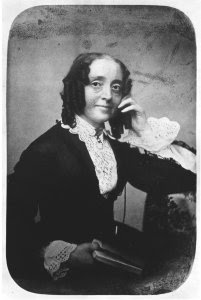
Ernestine Rose was a Polish, immigrant, feminist, abolitionist, public-speaking, socialist, atheist Jewish woman. Unless she had happened to be black, she had nearly as many cards stacked against her chances of leading a successful and happy life in her time as one person could have. To a person like myself and I suspect like you, dear reader, such a list of attributes today indicate her utter awesomeness! Anyway, Rose did manage to make a career for herself in which she was widely admired and financially stable, even sometimes well off, regardless of the fact that she was such a controversial figure. That’s because she had the good fortune to receive a very good education, she was an inspiring and gifted public speaker, she had a lot of energy and a strong work ethic, (despite her frequent struggles with ill health), she such displayed fearlessness and integrity in her convictions, and it didn’t hurt that she was very attractive, especially by the standards of her day.

Ernestine, born in 1810, was the daughter of a rabbi, and was well read and precocious at a young age. For example: she convinced her father to teach her to read the Torah in its original language so that she could discuss and debate the meaning of the actual text with him. When she was a young woman, she escaped an arranged marriage by appealing to the Polish civil court (rather than the local Jewish court as was customary) and decided to make the most of her life by leaving her segregated, anti-Semitic native city. She went from Berlin, where she learned German and invented the perfumes and a room-scenting device that helped support the family, to London, where she met her dearly-loved, fellow liberal-progressive husband William Rose, and finally to the United States, where she and her husband soon opened up a ‘fancy’ shop selling her perfumes and his silversmithing creations, and where she threw herself whole-heartedly into public speaking, writing, and organizing in support of women’s rights, abolition, separation of church and state, and other human rights causes. Her public speaking was as controversial as her unorthodox beliefs, since at that time it was considered immodest and unwomanly, limited to men only; but it was her open and unapologetic atheism that was most controversial, and most unusual. She lived and worked in the United States, based in New York City, from 1836 to 1869, when she moved to England to (mostly) rest and retire from public life when her health began to give out for good.

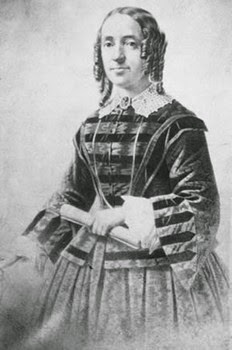
Elizabeth Cady Stanton, born five years after Ernestine in central New York State, was as fearless and tireless in her activism as she was in motherhood. Like Ernestine, she was an outspoken and unapologetic feminist, abolitionist, and freethinker. After a thorough formal education, somewhat unusual for women in her time, she married at age 25 (leaving out the ‘obedience’ vow, since she viewed marriage as a partnership between two consenting, rational adults, rather than a hierarchical power arrangement) and raised seven children.
She wrote prodigiously, and since giving birth to and raising so many children kept her too busy for frequent travel and public speaking, she worked closely with Lucrecia Mott, another founding feminist, and entered into a longtime collaboration with a fellow feminist, Susan B. Anthony. While the two were very different in so many many ways (Elizabeth was fiery and impolitic in expressing her opinions, Susan was more tactful; Elizabeth was a skilled writer and orator but less skilled organizer, while Susan was the opposite; Elizabeth was an outspoken critic of religion and the Bible, Susan, like Lucretia, was a Quaker), they were extremely attached to one another, and their often opposing strengths made them probably the single most effective and influential team in feminist history. (Side note: if you are interested in the history of human rights and progressive activism in the United States, you may be struck by the prevalence of Quakers among their ranks. While there were many Quaker sects, they tended to hold radical beliefs for their day: they were egalitarian, pro-education, anti-war, and encouraged critical discussion and examination in matters of religion.)
With Lucretia’s, Susan’s, and others’ help, especially while she was still home bound with her young children, Elizabeth conceived of and put together numerous meetings and organizations, including the first women’s rights conference at Seneca Falls in 1848, numerous abolitionist and temperance events, the American Equal Rights Association, the International Women’s Council, and many more. She wrote the Woman’s Bible, A Declaration of Sentiments (modeled on the Declaration of Independence), Solitude of Self (often considered her greatest speech), History of Woman Suffrage (with others), and much more. She was the first woman to run for Congress, wrote and was the primary impetus behind the passage of the first federal bill protecting women’s property to pass into law (following Ernestine, who has campaigned for it earlier), and annually campaigned, unsuccessfully, for suffrage for women. (Though she lived a very long life, she did not live to see this victory achieved.) Like Ernestine, she was a rare outspoken critic of religion, and considered all of them anti-woman, especially the three religions of the Bible. She worked up to the day she died in 1902 (on October 27th, the date I flew in to NYC.)

Now that we have a brief history of those great women fresh in our minds, let’s follow in their footsteps!

Shortly to follow: an account of my first day in New York City. visiting sites associated with their lives here…..

~~~~~~~~~~~~~~~~~~~~
Sources and Inspiration:
Dorress-Worters, Paula. Mistress of Herself: Speeches and Letters of Ernestine Rose, Early Women’s Rights Leader. The Feminist Press at CUNY, 2008
Elizabeth Cady Stanton. (2014, November 4). In Wikipedia, The Free Encyclopedia. Retrieved 15:33, November 5, 2014, from  http://wikipedia.org/wiki/Elizabeth_Cady_Stanton
‘Elizabeth Cady Stanton Dies At Her Home’, On This Day, New York Times, Oct 7th, 1902. http://www.nytimes.com/learning/general/onthisday/bday/1112.html
Ernestine Rose. (2014, July 7). In Wikipedia, The Free Encyclopedia. Retrieved 15:34, November 5, 2014, from http://wikipedia.org/wiki/Ernestine_Rose
Freedman, Janet. ‘Ernestine Rose.’ Jewish Women’s Archive  http://jwa.org/encyclopedia/article/rose-ernestine
Kolmerten, Carol. The American Life of Ernestine L. Rose. Syracuse, N.Y., 1999.  http://books.google.com/books?id=0JkRzTh7QUsC&printsec=frontcover&source=gbs_atb#v=onepage&q&f=false
‘New Lanark: An Introduction’. Undiscovered Scotland: The Ultimate Online Guide. http://www.undiscoveredscotland.co.uk/lanark/newlanark/
Stanton, Elizabeth Cady, Susan B. Anthony, and Matilda Josyn Gage. History of Woman Suffrage, volumes 1 and 2. Rochester, N.Y., 1881,1887

To New York City I Go, In Search of Ernestine Rose and Elizabeth Cady Stanton

Hello, friends of Ordinary Philosophy!

I’m pleased and excited to announce my upcoming adventure: my second philosophical-historical themed adventure, this time to New York City!

In case you missed my first go-round in my series of philosophy-travel pieces, here’s my plan:

So I’m taking a series of trips to places around the world, where I explore the lives and ideas of great thinkers in the places where they lived and worked. I’ll follow in the footsteps of thinkers who are no longer alive, since those who are still telling their own stories. But those who are no longer alive in the body live on in the ideas that they pass on, and in the example they provide for us to follow.

For this next installment, I’ll be following Ernestine Rose and Elizabeth Cady Stanton, two of the greatest founders of the women’s rights movement. Elizabeth was born in New York state, and lived many years in New York City, where she also died. Ernestine was born in Poland (so at some point, I hope to make it to Poland and write an ‘Ernestine Rose, Part 2 series!) and lived for many years in New York City, and though she did not live in the United States for all of her life, much of her most important work on behalf of women was done here. So off to New York City I go! There, I’ll visit significant landmark associated with their lives, places where they lived, worked, died, thought, wrote, studied, and rested.

I’ll be traveling there from October 29th through November 2, and will be writing throughout the trip. I’ll be writing not only about their ideas, but about what I can discover about their everyday lives here, and whatever feeling of their time and place I manage to uncover.

If you have any questions for me to answer while I’m there, or pictures you’d like me to take for you, or any information you have that could help me with this project, I’d love to hear from you!

Follow Ernestine Rose and Elizabeth Cady Stanton with me:

Ernestine Rose and Elizabeth Cady Stanton: A Brief History
Ernestine Rose and Elizabeth Cady Stanton Sites, NYC, Part 1
Ernestine Rose and Elizabeth Cady Stanton Sites, NYC, Part 2
Ernestine Rose and Elizabeth Cady Stanton Sites, NYC, Part 3
In Her Own Words: Solitude of Self, by Elizabeth Cady Stanton, 1892
In Her Own Words: A Defense of Atheism, by Ernestine Rose, 1861

For more about Elizabeth Cady Stanton at Ordinary Philosophy, please visit:

Frederick Douglass Albany, Troy, and Syracuse NY Sites
Frederick Douglass Seneca Falls, Canandaigua, Honeoye, and Mt Hope Cemetery Sites
Is Feminism Passe? No! Cries A Distinct Lack of Statuary

And about Ernestine Rose and Elizabeth Cady Stanton:

Philosophy and Early Feminist Thought

Virtue Ethics: An Ancient Solution to a Modern Problem, by Peter D.O. Smith

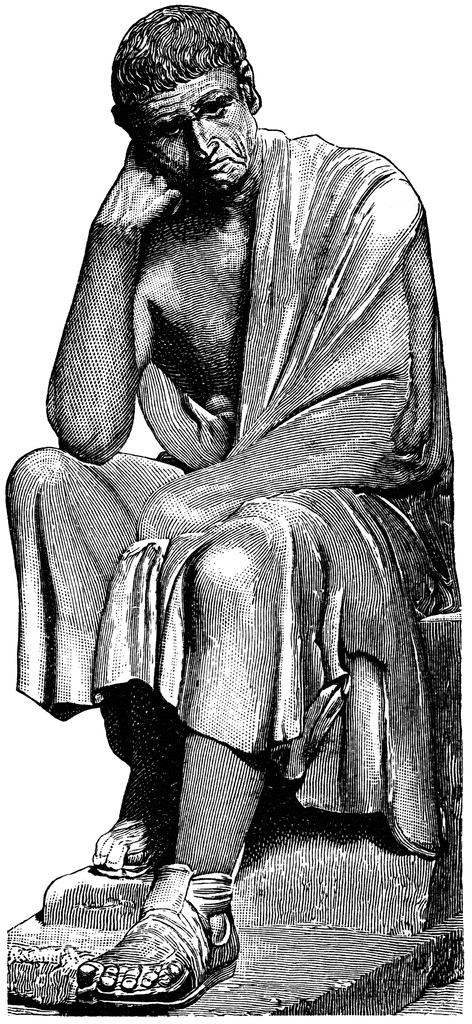
Aristotle

I recently discovered this piece by Peter D.O. Smith in Scientia Salon, a favorite ‘webzine about philosophy and science‘ of mine.

I’m especially interested in philosophy’s attempt to unify ethics, to help bring the various particular ethical systems and local moralities into some sort of accord, or at least to bridge the gaps between them to whatever extent possible. Great harm often results when adherents of different ethical / moral systems come into conflict (religious wars, political gridlock), where instead of seeking common ground in the pursuit of the good, conflicting parties seek to dominate by force and inflammatory rhetoric. Blinded by self-righteousness, these conflicting parties can bring about a situation where at best, no progress is made as each side expends all of their efforts undermining the other, or at worst, inflict death and destruction on each other and on innocent bystanders.
This piece addresses this problem, and offers virtue ethics as an excellent candidate for its resolution.
What do you think? 
~~~~~~~~~~~~~~~~~~~
Introduction

This article is neither a defense of nor an attack against either religion or secularism. It treats them as well established sociological facts and no more than that. I take them as given and argue that a greater moral good can be achieved if the two belief systems find common moral ground in virtue ethics.

Why should we care?

Moral choices infuse most aspects of our life, whether we know it or not. And a great number of these moral choices are bad ones. This is why our prisons are filled to overflowing [1], and recidivism is so high at 66% [2]. This is why we have so many war dead and this is why so many die violent deaths at the hands of murderers or radical ideologues. This is also why we have such an inequitable distribution of wealth. This is why cheating is rampant at schools and universities [3]. We maintain large standing armies to protect ourselves from the bad moral choices of others and on occasion we use it to inflict our bad moral choices on others. This is why we have no qualms in spying on our own citizens [4] or in killing without due process. This is why almost everyone has been the victim of crime, unfairness, injustice, discrimination, bullying [5], sexism, racism, ageism or other forms of bigotry, bias, and discrimination. This is why stalking is commonplace [6].

Bad moral choices touch us all and are the major cause of suffering in today’s world. Every person who has been jilted by a cheating partner has felt that suffering. Marital infidelity is the most common cause of divorce and abuse is another important cause [7]. One in five women are sexually assaulted at university [8]. Even natural disasters such as earthquakes or floods are compounded by moral failures as nations don’t respond adequately. Famines become moral failures when we cannot distribute food where and when it is needed. Our economic systems become moral failures when they turn into instruments of greed. Our political systems become moral failures when they are used for the advantage of the powerful, to exploit or neglect the weak.

The point I am making is that moral suffering is real, pervasive and needs attention. We have made great progress in reducing material suffering, but only some progress in reducing moral suffering. This is the important challenge that faces us today, to reduce moral suffering with the same degree of success that we have reduced material suffering.

What then is the problem?

The problem quite simply is that, in comparative terms, we do not give moral problems much attention at all and that we give it the wrong kind of attention, by creating a growing thicket of rules and regulations [9].

Modern society rewards material progress while neglecting moral progress. We have huge budgets for science research and we give large rewards to outstanding achievers in science. But society allocates far smaller amounts to advance moral interests or to reward moral achievers. As a simple example, of the six Nobel awards, only one (Peace) has a moral dimension [10]. Of the other 21 high-honour prizes, only seven have a moral component [11]. School education has a strong science bias but gives little attention to moral education [12]. Our criminal justice system spends a great deal on addressing the outcome of moral problems but little on addressing the causes of moral problems, with the result we have a recidivism rate of 66% [2]. We punish moral offenses but we do not prevent them. We have resorted to a form of legislated morality with our criminal justice and human rights systems. This is a framework with large gaps that does not address or give guidance to private morality.

We are becoming a rules based society, but the rules have only a weak hold because they lack intrinsic motivation [13]. Perhaps the most dramatic example of this was the collapse of the banking system. Banking is one of the most highly regulated parts of the economy, and yet that does not prevent abuse and exploitation [14]. Without intrinsic motivation the rules become a challenge to find means of evasion. We have reacted by adding more rules but it is only a matter of time before more means are found to evade them too. There has been an explosive growth in criminal laws. For the past twenty-five years, a period over which the growth of the federal criminal law has come under increasing scrutiny, Congress has created over 500 new crimes per decade [9]. Adding to this, the Administration is increasingly relying on mandates and directives.

A modern problem

Western society, for a long time, had a broad consensus on morality that was derived from religion. Indeed religion can be seen, in sociological terms, as society’s way of promoting cohesion through moral consensus [15]. Modernity and the Enlightenment have weakened the hold of religious morality, providing space for alternative conceptions of it to take hold. Modernity introduced a spirit of utilitarianism [16] and this has shaped present day society’s concept of morality. But it was not merely the concept that changed, but also the authority of moral systems. Religious moral systems derived their authority from their concept of God and this helped to provide intrinsic motivation. With the new utilitarian morality a new authority was introduced, the individual. Inevitably this has resulted in a weakened and diffuse moral sensibility that contains many contradictions. This new concept of morality has been accompanied by a shift from intrinsic to extrinsic motivation. Extrinsic motivation is, by its very nature, less effective.

With this new concept of morality came a changed approach to society’s problems. The spirit of utilitarianism has created a tacit assumption that alleviating material need reduces the impetus for moral wrongs. There is a belief that moral wrongs are largely the outcome of material conditions. Thus effort has been directed to solving material problems, which have in any case been shown to have easy solutions, while true moral problems remain intractable and so are neglected. We have been picking the low hanging fruit.

We are divided by differing concepts of morality

With the weakening of religious morality and the widespread adoption of utilitarian approaches a sharp moral divide has opened up in society.

The secular world has adopted a tacit, inchoate form of moral consequentialism. It believes there is no absolute good or bad, only that acts should be judged by their consequences. It rejects the absolute lawgiver and the laws of religious deontology. It makes the individual the final arbiter of his acts.

The religious world, by contrast, believes in absolute good and bad and that acts can themselves be inherently good or bad. It believes there is an absolute lawgiver that has handed down a set of rules for a good life. The religious world rejects moral consequentialism on the grounds that it is a shifting and dangerous moral system that is easily tailored to suit the needs and desires of the moment.

As consequentialism or utilitarianism rose to the fore, reflecting the material and mechanical spirit of the times, challenging long held moral conceptions, Protestant Christianity (and Islam) retreated into a form of hardline deontology. The result is the strong ethical divide we see today.

There is thus a yawning chasm between the moral concepts of the religious and secular worlds. This chasm weakens the ability of society to address common moral problems since it lacks consensus. Society has reacted to this problem with a growing thicket of laws with no end in sight [17]. This has proven to be a poor solution, since adding rules merely invites further evasion if they are not reinforced or accompanied by some form of intrinsic motivation.

The need for a middle ground

We are a common people with common moral problems that affect us all. To solve these problems we need a unifying moral concept that both the religious and secular worlds can accept. For example, schools are a place where we should also give our youth moral preparation for adult life, and schools serve both world-views. This is one example of why it is necessary that we find common ground. Deontology and moral consequentialism are not acceptable to both sides of the divide and so cannot fulfill this need.

Which raises the question: is there a middle moral ground where the secular and religious worlds can meet and agree? Today’s society places a strong emphasis on the concepts of justice and rights. These can be seen as instances of what are known as ‘virtues’ and it is in virtue ethics, the third major branch of ethical philosophy, that I see an important opportunity for finding common ground between the secular and the religious worlds. Virtue ethics shows promise as the means of filling in the gaps of legislated morality. One can think of it as being the soft flesh on the hard skeleton of legislated morality, making a healthy, functioning body that is directed to the purpose of flourishing. Virtue ethics can be seen as an important form of intrinsic motivation that makes the regulated rules of society more effective while providing strong guidance to unregulated, private conduct. It is not accidental that here has been a sharp increase in academic interest in virtue ethics lately [18].

The appeal of virtue ethics

Virtue ethics is an enduring idea with ancient roots. Aristotle, some 2,300 years ago, clearly articulated the ethical philosophy known today as virtue ethics [19, 20]. Cicero, close to the time of Christ, wrote of it as being one of the three main contending moral systems of the day [21]. Catholicism, early on, incorporated it into its teachings where it continues to this day to be a major influence [22]. The last 50 years have seen a marked revival of academic interest in virtue ethics [18, 23], and Alisdair McIntyre’s publication of After Virtue was a landmark in this revival [24].
Virtue ethics looks neither to rules nor to consequences. Instead it considers internal motivations directed at realizing the telos, or end, of a “good” person, and it is in this that the religious and secular worlds can find agreement. In my mind, the appeal of virtue ethics is fivefold.

First, the generally accepted list of virtues is free of religious terminology or implications. This makes the virtues acceptable to the secular world. At the same time the religious world finds them a natural extension of its beliefs. For example, Catholicism has embraced virtue ethics, and both secularists and theists would readily agree on the list of 52 virtues given by the Virtue Project [25]. Theists would add faith, hope and charity to that list while secularists would ignore them, a minor difference. The differences that the many belief systems bring to this are largely ones of terminology and emphasis. It is an ethical system that is neutral about belief systems and can therefore be accepted by all belief systems.

Second, supplying an internal motivation is a better way of obtaining a good outcome, whether of act or consequence. It is widely agreed that intrinsic motivation is more effective than extrinsic motivation (intrinsic motivation refers to doing something because it is inherently interesting or enjoyable, and extrinsic motivation refers to doing something because it leads to a separable outcome[13]).

Third, by supplying intrinsic principles, rather than rules, it is adaptable to a wide range of circumstances. A rules based system can only adapt to new circumstances by adding new rules, something that becomes intolerable in the long run.

Fourth, virtue ethics supplies a means of internalizing and integrating rules into a person’s behavior, making them more effective. It is a powerful way of reinforcing the rules and regulations of society by translating them into intrinsic motivation.

Fifth, virtue ethics can supply a new source of meaning, independent of but complementary to religious belief. It can be an antidote to the angst of modernity. This is a large field that is only touched on here.

In short, virtue ethics is capable of supplying an intrinsic motivation that is acceptable to both the secular and religious worlds. We live in an overwhelmingly rules dominated world. Virtue ethics offers a way of internalizing and then integrating rules such that they become intrinsically motivating. It is a promising field for finding common ground between the secular and religious worlds, to makes rules and regulations more effective, and to provide a source of meaning for the non-religious.

A practical solution

The attraction of virtue ethics is its practicality and simplicity. It can be formulated in simple terms that are appealing to most people. It is independent of belief systems and yet most belief systems can accept it, with only changes in terminology. It can easily be taught at an elementary level while still be challenging at a philosophical level. It is easily incorporated into codes of conduct for organizations.

But it is not just a solution to individual moral concerns. It can also be expanded to any domain of activity as an example discussed by Bruni and Sugden shows in the case of market economics [26]. They describe the market as a practice having a telos of voluntary and mutually beneficial exchanges. They explain: “On the supposition that the telos of the market is mutual benefit, a market virtue in the sense of virtue ethics is an acquired character trait with two properties: possession of the trait makes an individual better able to play a part in the creation of mutual benefit through market transactions; and the trait expresses an intentional orientation towards and a respect for mutual benefit. In this section, we present a catalog of traits with these properties, without claiming that our catalog is exhaustive.” Their catalogue of traits, or virtues, include universality, enterprise and alertness, respect for trading partners, trust and trustworthiness, acceptance of competition, non-rivalry, self-help and stoicism about reward.

Another example is the Character Counts! Coalition for moral education in schools, which uses a virtue ethics framework centered on respect, responsibility, trustworthiness, caring, justice, fairness, civic virtue and citizenship [27].

These examples are intended to show that a virtue ethics framework can readily be adapted to any domain of activity or ‘practice.’ This makes virtue ethics a very flexible approach that can be tailored to all parts of our culture.

The role of secularism

Secularism has defined itself in opposition to theism. Its great achievement was the separation of religion from public life. Going beyond that, some secularists have set themselves the goal of destroying religion. This seems to be an ill advised goal as its chief result has been: to poison the public perception of atheism [28] and to harden the stance of Christian fundamentalism. Religion is a deep seated sociological phenomenon and is not going away. It has been part of human history for at least 40,000 years and remains an important part of all societies. It is far too durable a phenomenon and there is no realistic prospect that it will be ended [29]. The criticisms directed at religion by secularism have prompted strong reforms in religion and so have been useful for that end. The so-called war between secularism and religion is now becoming counterproductive as it obscures the major issue facing society, that of moral suffering. Now it is time that secularism embraces this problem and treats religion as an ally and not an enemy, or at least declares a truce. This does not mean religion should not be criticized when the occasion demands it, and indeed criticism can be a healthy impetus for reform. But attention should be shifted to the real enemy, moral suffering. To overcome this enemy the secular world should make common cause with the religious world. It can do this by embracing virtue ethics and making it the central plank of a morally committed secularism.

A solution to future problems

Population growth and rapid industrialization of the third world will create a situation of resource shortages and ultimately low growth [30]. Coping with this new world will require a major re-adjustment of values away from today’s one of rampant consumerism centered on hedonistic happiness. It will require a strong sense of responsibility and restraint, frugality will become the new watchword. Virtue ethics is our best hope of navigating this challenging new world. As Julia Annas, in Intelligent Virtue [31], explains, the virtues are a template for flourishing, in that to become a virtuous person is to become a flourishing person. It is a move away from hedonistic happiness to the eudaimonia of the virtues. This is a radical move away from the idea of happiness that depends on circumstances or goods, a necessary move in the resource constrained world that lies in our future.

That this goal is not so elusive can readily be appreciated when we compare the levels of positive emotions of some poor countries with those of some rich countries [32]:
Panama 85%, Singapore 46%;
Lesotho 77%, United Kingdom 77%;
Swaziland 76%, Germany, 74%.
_____
Peter D.O. Smith is a foundry metallurgist, quality engineer, software engineer, and corporate manager (recently retired), who lives by the motto fides quaerens intellectum.

[1] US incarceration rate.
[2] Recidivism in the United Sates.
[3] Academic cheating fact sheet.
[4] The Snowden Files.
[5] 44% of children report having been bullied.
[6] Stalking.
[7] Causes of divorce.
[8] Sexual assaults at university.
[9] Revisiting the explosive growth of new crimes.
[10 Nobel prizes, literature, medicine, physics, chemistry, peace, and economics.
[11] Other high honor prizes.
[12] How Moral Education Is Finding Its Way Back into America’s Schools.
[13] Ryan and Deci, Intrinsic and Extrinsic motivation.
[14] Why only One Banker Went to Jail.
[15] Nicholas Wade, The Faith Instinct.
[16] Trends in utilitarianism – Google books Ngram.
[17] Business Ethics: The Law of Rules.
[18] Trends in virtue ethics – Google books Ngram.
[19] Nichomacaen Ethics.
[20] Notes on Nichomachean Ethics.
[21] On Moral Ends, Marcus Tullius Cicero, Julia Annas.
[22] The Cardinal Virtues in the Middle Ages: A Study in Moral Thought from the Fourth to the Fourteenth Century.
[23] Contemporary virtue ethics.
[24] Alisdair MacIntyre, After Virtue.
[25] The Virtues Project.
[26] Reclaiming virtue ethics for economics.
[27] The Six Pillars of Character.
[28] Net rating of religious belief systems.
[29] Growth of Religion.
[30] Paul Gilding, The Great Disruption.
[31] Julia Annas, Intelligent Virtue.
[32] Gallup poll, Positive emotions worldwide.

This piece was originally published on Sept 25th, 2014 at 
http://scientiasalon.wordpress.com/2014/09/25/virtue-ethics-an-ancient-solution-to-a-modern-problem/

Money and Human Worth

‘It’s just business.’

This is one of my least favorite phrases of all time. 
It seems to be used, generally, to explain away unpleasant, unkind, or unethical behavior, or to avoid addressing or dealing with the undesirable side effects of a difficult but necessary decision, in a situation where money is involved.

Yet just because the phrase ‘it’s just business’ might be used only in difficult or unpleasant situations, that doesn’t make it wrong, does it? Couldn’t it be a shorthand way of pointing out that it’s impossible to make everyone happy in every business transaction, since it involves two or more opposing sets of interests? In fact, the phrase could be revealing humane concern, a regret that there are often undesirable side effects to the other in conducting business.

Yes, I allow; the utterer could be expressing these sentiments, choosing this phrase because it’s a ready-made, widely understood part of our lexicon.

But we don’t hear it being used this way much, do we? It seems this phrase is almost always used to justify rudeness, treating human beings as if they’re merely a means to an end or taking advantage of an opportunity to exploit others; to explain away bribery, theft, extortion, bullying, abuse… It’s not generally used in cases of honest dealing, of courtesy and respect for other person(s) involved in a transaction, of doing one’s best to make sure an employee is treated or ‘let go’ in as just and fair a manner as possible. In such situations, no such disclaimer is necessary.

So why am I bringing this up? What’s caused me to think about why and how people use this phrase, and for it to rankle with me enough to write this essay?

Full disclosure: I have a working gal’s chip on my shoulder.

I’ve worked for a living my entire life, since I was about seventeen. Most of those years I worked in customer service. I’ve prepared and served food and drink, I’ve sold goods and services, I’ve made art and things to wear, I’ve lifted and carried loads, I’ve decorated and cleaned, I’ve answered phone calls, I’ve scheduled appointments and events… The list goes on. I consider it all honest work, and I think… no, I know, I’ve helped make life better for many, many people along the way.

All this is true, in fact, of most of the people in the world. Behind every counter and cash register, on the receiving end of every phone call and email, in every kitchen and factory and field and warehouse and office and hospital, other people’s work make our lives better. We depend on them for providing the necessities and the luxuries of life. Their hard work makes our lives enjoyable and even possible. Given this fact, it never fails to disappoint me, and sometimes still surprises me, how often people feel entitled to treat working people with condescension, disdain, and even abuse, from the first moment of interaction.

Now most people I’ve worked for and done business with have been decent, many more have been polite, friendly and supportive, and some have been the loveliest people I’ve ever had the pleasure to meet, some have become dear friends. I consider myself lucky that in so many ways, throughout the course of my working life, I’ve enjoyed a great deal of moral and financial support, others’ concern for my well-being, a richness of interesting experiences, of opportunities to improve my situation, of the goodness of other people, and of the chance to expand my talents, exercise my creativity and problem solving skills, and best of all, to never stop learning.

But I also couldn’t possibly begin to make a full account of the number of times I’ve felt dismissed, condescended to, treated like a machine or a servant, and attacked for all manner of disappointments and inconveniences (real or perceived) whether I was responsible for them or not, simply by virtue of being on the other side of that counter, that receipt book, that telephone, that paycheck. I am also keenly aware how instrumental I was, or at least tried to be, in making that person’s life better at that moment. And this, again, is true of every working person in the world. Without us working people, no one could eat food, drink water, keep themselves and their homes and cities clean, travel, heal their ills, enjoy any luxuries, and so on, in comfort and security. And of course, the category ‘us working people’ include the vast majority of humanity. Most of us work for a living, and each job we do involves at least some kind of business interaction. It’s work that provides the (real) goods and services for sale in any business transaction. And almost all of us who live in this world have had many occasions to bemoan ill treatment in our capacities as workers and engagers in business.

This is where we arrive at the connection between the phrase ‘it’s just business’ and why it bothers me so much. I detest it because it expresses an attempt to dehumanize the interaction and, by extension, the person one does business with. It implies that one can remove the ‘human element’, the consideration of the other as a being with moral worth to whom we have certain obligations, from the realm of business. And if it’s not really a human interaction, therefore, one does not have to act with kindness, fairness, or respect.

I argue that this the attempt to dehumanize business is impossible: business is entirely about people. All business transactions are a type of human interaction. It’s true that when we make a bargain, when we exchange money for something we want, certain elements are added to the interaction. There are problems of fairness to be resolved, there’s customer loyalty to be won, the need for expediency may be pressing, and so forth. But all types of human interaction contain unique elements: all involve a particular combination of expectations, obligations, etiquette, and other considerations. The fact that it’s a business transaction, and not another kind, does not subtract from the basic fact that all parties are human beings to whom we owe a basic level of respect and courtesy.

Business, in this sense, is always personal.

Most of us, most of the time, recognize this. Most business, day to day, is conducted in a reasonably courteous and decent way. We greet the other person, we say thank you (if not always ‘please’), we ‘shake hands on it’. We don’t usually lie, steal, or bully to get what we want. We treat our colleagues and employees with decency at least when we come into direct contact with them, we praise their work and give them raises and bonuses if we can, we usually feel regret, at least on some level, if we feel we need to fire them, and we hope they do well in the future. When we consider the phrase ‘it’s just business’, we realize that it holds little meaning when considered in light of how we usually behave. Understood as ‘it’s just a human interaction that involves money,’ we realize it’s a rather meaningless statement.

So it appears clear that we resort to this phrase when doing the right thing by the person we’re doing business with becomes difficult or inexpedient to getting what we want. And I fear it’s became far too widely, and far too unquestioningly, accepted when used this way. Why have we come to acquiesce to the idea that when money enters an interaction, that its appropriate to overlook or cast aside our concern for the cost in human dignity, in respect, well-being, rights, justice, and simple decency? I fear that in our enthusiasm for the benefits of the marketplace, we too easily become complacent to what can be lost.

What we can lose is the respect we should have, as a central feature of our character, for the moral worth of others, and that if we let that slip, we undermine ourselves as social creatures, and in turn, everyone’s prospects for well-being. If our dignity, our moral worth, is up for sale, then the marketplace, ideally a highly cooperative, mutually beneficial institution, devolves into an arms ace where the most ruthless thrive in the short term, while trust erodes and the whole system of collapses in the long run. We can recognize this by comparing and contrasting various societies and their market systems, contemporary and historical. Oligarchies, tyrannies, rigidly enforced class systems and aristocracies, ideologically-based planned economies, are all extreme examples of how the disregard of individual human worth and dignity cause a marketplace to lose its ability to benefit all, and ultimately to self-destruct.

So, from a matter as minor as rudeness to a salesperson, to as serious as slavery, the same principle applies. The exchange of money for something we want or need makes no difference, morally, to the basic way we should treat anyone. That’s because, while goods or services are marketable, a person’s moral worth can never be, and should never be, up for sale.

It’s true that we’re sometimes justified in expressing anger and disappointment when doing business. Sometimes others fail, a little or a lot, in performing their part of the bargain or duties of their job, and we feel quite unfriendly when that’s the case. Sometimes others fail to provide good customer service, and are rude and unhelpful from the start. Sometimes others provide ‘services’ and products that are faulty, useless, or even harmful. In these circumstances it’s just to criticize their work, or to withhold or take back payment if the terms of the exchange aren’t fulfilled, or to let them know that you won’t be patronizing their business again. It’s appropriate, in such cases, and to voice one’s displeasure.

But this just reaction to the failure of the other to fulfill their part of the bargain is not what I’m criticizing here. It’s the unspoken attitude, unfortunately too widespread in my observation, that the person with the money in the exchange is automatically entitled to be abrupt and impersonal, to always demand, command, act impatient, and even abuse those they’re paying, in a manner inconsistent with respect for human dignity. It’s implied in the adage ‘the customer is always right.’ Are you the recipient of a payment, for goods or services, or as an employee on the clock? If so, many think, you are immediately transformed into a legitimate target for frustration, impatience, desire, greed, and sense of entitlement, whether or not you were responsible for the disappointment. In this sense, it feels as if you are no longer a person to them. Because if they consider you a person, wouldn’t they feel that they should be polite, respectful, or at a minimum, not rude or hateful to you, just as they would any other person?


Again, to argue that business is not personal, that it removes much or even all of the human element, is to make a very serious claim, with dire repercussions. It would imply that the moral worth of a human being is calculable in dollars and cents, and that it can be bought and sold. I argue that the number value of money and the degree of significance of a human life can never be aligned, and that you can’t ‘pay away’ your moral obligations towards any human being. When you pay for a good or a service, that, and only that, is what you pay for. Your payment does not apply in any way to your moral obligation to respect others.

One might object: ‘I didn’t choose to enter into any kind of relationship with the person I’m doing business with, they just happened to be the one I had to interact with to get something I need or want. Shouldn’t relationships be a matter of choice? Why, then, can’t a business interaction be impersonal, especially if members of a society agree that it’s impersonal?’

To begin with, all human interactions ultimately belong in the category of unchosen relationships. We stumble upon interactions with people all the time, and it’s a fact of life that all relationships occur because of chance circumstances, at least at first. We don’t choose for ourselves who we pass by on the street, who the open seat on the subway is next to, who our classmates, colleagues, or the new neighbors will be, who the people we already know will introduce us to, or who our parents, siblings, and relatives are. They become part of our world via circumstances out of our control. Since all human interactions belong in the same category. I argue, the same basic obligation to be just, polite, and respectful applies equally in all human interactions.

Secondly: one can no more give away or sell one’s own moral worth than they can choose to negate or buy another’s. That’s because human worth, mutual obligations of respect and duty and mutual dependence, are not merely a part of some unspoken contract. They are a feature of human nature by virtue of the fact that we are social and rational, and therefore, moral beings. ‘X cannot buy or sell away the moral with of Y‘ is equally true, if we are indeed rational, social beings, whether the variables X and Y are replaced in that statement by ‘you’ or ‘I’. (1)

It’s a fundamental part of the human condition that we are all bound together in a mutual web of obligation and dependency. Without one another, we would not get very far in life, and all we achieve, all we do, are the result of the combination of our own efforts with the contributions of others. One needs the ingenuity and knowledge of physics of the inventor and the architect when one needs a car, a bridge, a home, and owes a debt of gratitude for the resulting vast improvement in the ease and comfort of life. The inventor and the architect, in turn, needs the labor of the miner, the smelter, and the carpenter, and owes not only money, but respect and gratitude for supplying the raw material, without which their designs could not be realized, and for being among their clients, without which their wealth could not be earned and their work would not be needed. One needs the knowledge and skill and of the physician when health fails, and owes to her gratitude, admiration, and respect for the services she provides, and the hard work and intelligence it required to attain her abilities to heal. The physician needs the fruit of the work of the laborer in the field to sustain her life, and owes the laborer gratitude, admiration, and respect for the difficulty of the work performed and the fact that her life is sustained through his labor. The exchange of money is simply the means by which the exchange is organized; the basic fact that we all depend on each other, and have moral obligations to each other, is not altered by its usage.

*****************************************************************************
(1) Pinker, Steven. The Better Angels of Our Nature, 2011, Viking Penguin, New York. pp 647-648

Book Review: Darwin’s Ghosts: The Secret History of Evolution

Well, it’s sort of a book review. It’s more like a very informal description of a reaction to the book.
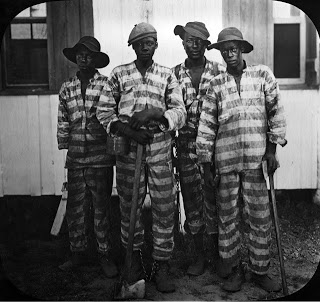
Which was: immense enjoyment.

My sister was nearly finished reading it when she left it behind at my house one day. In short order, I ‘accidentally’ forgot to bring it back to her the next time I saw her, or to remind her to take it with her when she came to visit. Perhaps I’m a bad sister, but that’s what she gets when she leaves such a marvelous book behind. Oh, the trials of having excellent taste in reading materials!

Anyway, I picked it up and started browsing through it, since she had already mentioned it to me, and from the start, I could hardly put it down. The long inward struggle that Charles Darwin went through prior to publishing his discovery of the evolution of species (or, rather, the primary mechanism that drives it), is well-known. Yet only the broad outline is really known: no-one can entirely imagine what goes through your mind at a time like that. What tortured thoughts must you wrestle with when you know a truth and believe it’s too important to remain untold, but are also shy, torn by loyalty to family and friends, and fear scorn, notoriety, and persecution?

The book begins with the story of Darwin around this time, just after he published On the Origin of Species, when he had finally been spurred on to do so after another naturalist, Alfred Wallace, made the same discovery independently sixteen or so years later. The book returns often to the story of Darwin’s struggles before publishing, since so many, whose stories are also told in this book, went through similar trials; it first opens with Darwin considering how best to acknowledge and properly credit those whose work contributed most to his theory.

The author proceeds to first takes us on a giant leap far back into the past, to ancient Greece, where the great natural philosopher Aristotle gathered sea sponges and fishes and was the first known to describe them systematically. Then she guides through a history, from Aristotle to Darwin, of the intensely curious, intellectually brilliant, and restless thinkers and observers who gave us modern science. Throughout, I was enthralled. Rebecca Stott tells of awkward, cranky loners who spent most of their time in dusty specimen cabinets or crawling about on hands and knees, meticulously recording the denizens of the natural world, of precocious, highly educated children of privilege who went on to lavish their money and leisure hours in the cause of scientific advancement, of pious priests and moralistic skeptics and atheists who considered the natural universe the most sacred and the most beautiful treasure trove of knowledge available to all, and of many more: a wide variety of people of various temperaments, backgrounds, advantages, types and levels of ability and creativity, are represented in this wonderful history of ideas and of discovery.

Among other scenes in book, I felt myself longing to have had the chance to take part in any, if just one, of those salons of Enlightenment Paris or Edinburgh. Fashionable, educated women and men hosted dinner parties to bring together the best and brightest minds, full of the most original, revolutionary, and fascinating ideas that human minds were creating. But these salons were not where it was all happening: some of the greatest discussions and intellectual achievements at the time happened in ordinary and humble studies, attics, homemade labs, lecture halls, monk’s rooms, coffee shops, and student’s quarters. It was a time when thinking and knowledge was, it seems to me, more widely and more highly valued. Not only familiarity with facts and factoids, but real understanding, was the greatest prize to be sought, the greatest goal in life.

If you want some of the best examples of how to be a part of that great quest, pick up this book and romp through the history of ideas with her. I think you’ll be as glad you did as I was.

*****************************

Stott, Rebecca. Darwin’s Ghosts: The Secret History of Evolution. Random House, New York 2012.
https://books.google.com/books?id=5Lt_MXhNJEoC&pg=PP5&dq=darwin%27s+ghost

‘Flaunting’ is a Terrible Excuse for Crime

Have you ever heard the argument: ‘Well, she shouldn’t have worn that skimpy outfit / got drunk / flirted at that party. It’s (also) her fault she was raped / assaulted.’?

Compare that argument with this one: ‘Well, he shouldn’t have been wearing that Rolex / Versace suit / driven that Lexus. It’s (also) his fault he was held up / beaten to the ground and robbed.’

These are equally terrible arguments.

While one might have a point saying that a person acted impractically by wearing something in a situation where there might be predators around, that has nothing to do with the fact that it’s entirely the fault of the criminal for committing the crime.

Stop Pretending ‘The Law’ is Not Racist!


Victims of convict leasing, from an earlier era of selective law enforcement

Everybody’s talking these days about the killing of Michael Brown in Ferguson, Missouri. And the protests following the shooting. And the host of other recent killings and use of force against black people by police officers.

I’ve also heard many pundits, commentators, and counter-protesters (in support of the officer who shot Brown) say that all this controversy is pointless, unfounded, just plain wrong. The laws are not racist, they say. Neither are officers expressly told (most of the time) to target minorities. They also say that they themselves never have trouble with police officers as long as they cooperate and just do what the officer says, as they’re supposed to, which just goes to show that as long as you behave yourself, you have nothing to worry about.

As a generally ‘well-behaved’ (mostly so, but then again, I rarely got caught when I wasn’t) white woman who has never felt unfairly targeted by law enforcement, I say to this second group of people, if you are an adult yet you think the law is ‘color-blind’, either you systematically let your biases filter out too much of the available information out there, you live under a rock, or you’re lying. Or something like one of these.

Because I had never been unfairly targeted by police, I was mostly, blissfully unaware, until my very early adulthood, that such things were still going on. I thought this sort of behavior on the part of the police largely a relic of the past, of the Jim Crow and Civil Rights era that I became so fascinated by in my schoolgirl years (and remain so to this day). We all love hero stories, and I thought of Rosa Parks and Martin Luther King (and my favorite fictional hero, Atticus Finch) as among the greatest, ordinary people who stood up for the oppressed and the outcast, who triumphed against the tyrannical and the cruel, and most of all, the unjust: I always have been rather obsessed with issues of justice. I thought police had mostly changed their racist ways like most of us, and now usually did the right thing, especially because, of course, they make it their mission to stop those who don’t do the right thing.

My rather childish ignorance was first revealed to me when I witnessed my then boyfriend, a young Mexican man, pulled over by a police officer for no good reason at all.  Usually, if we were driving, we were driving together unmolested, but that day, I was following his car in mine because we had met up after work. A police car passed me after a stoplight and to my surprise, I found that his flashing lights and siren were intended for my boyfriend! We were not speeding, and it was daytime so car lights were not an issue… I could not think of a reason he would be pulled over. After the questioning ended and the cop had left, I asked my boyfriend what had happened. He admitted, embarrassed, that this happened to him all the time, it was just a regular part of his life. A young Mexican man in an old car must, necessarily, be up to no good, or if he wasn’t now, he must recently have been or was about to.

I was angry and shocked at the injustice of it all, and tried to imagine what it would feel like, and the effect it would have on my character, if I were regularly treated as a criminal, or a potential criminal, based entirely on what I look like, from the time I was young. I don’t think I could imagine, fully, what it would truly be like, but it seems a reasonable expectation that many people’s moral characters could be damaged from an early age, if many of the adults around them, especially those who set themselves up as authorities and moral leaders, act so unjustly. These young people are taught that ‘the law’ is used to protect others but punish them, that the police are not there to protect them, and that justice has a different meaning depending on what color you are, or worse, that it doesn’t really exist.

As I’ve gone through life, as I’ve had friends, co-workers, and fellow students of many races and ethnicities, as I have followed the news, and have done some study and research on matters of criminal justice, I’ve encountered countless instances of minorities unfairly and systematically targeted by law enforcement. I have a dear friend who used to travel though Colorado and Utah to go visit her family, who had to allow time for the inevitable police stop or two on each trip, no matter how carefully she drove. Yes, as you may have guessed, my friend is black. (My brother regularly travels a route in more or less the same geographical region, and has never had that problem).

These related issues, of racial profiling and selective law enforcement, has bothered me so long that when I had the opportunity a few years ago to take a criminal justice class, I jumped at the chance. I chose this subject  as the topic of my final paper, and my research uncovered a wealth of information on the subject. Study after study, public record after public record, revealed that minorities are pulled over, stopped and frisked, or arrested even for incredibly minor infractions that I had no idea that were ever enforced, at disproportionately high rates, commonly double or more than the rate of white people, in jurisdiction after jurisdiction, all over the United States. And even when minorities and whites are charged with the same or similar crimes, they get very different treatment: whites are shown leniency far, far more often than anyone else: they are, on average, sentenced to fewer years in prison or are routed to treatment instead; they are sent to state courts instead of federal courts. Minorities generally get the book thrown at them.

And in case you’re one of those who think that the law is color-blind, no, the objection you might make, that minorities commit more of the crimes so of course they’re targeted and go to jail more, is not valid. This vast accumulation of evidence that minorities are disproportionately targeted holds true for all kinds of crimes, the ones that whites commit at the same or higher rates, as well as ones that different minority groups commit at higher rates. Especially drug crimes: while whites commit most drug crimes at the same or higher rates than other groups, they are arrested far less, and if caught, don’t tend to be punished nearly as often.

Much of this information, many of these stories, have been featured in news story after news story over the years. This includes the seemingly ever-increasing recent stories in which black people are shot and/or killed for trying to get into their own house they locked themselves out of, or for being mentally ill and having a breakdown in public, or for selling single cigarettes on a street corner, or for having a fight with a bullying wannabe self-appointed ‘lawman’ on his way home. Have these pundits and ‘color-blind’ pollyannas been sticking their fingers in their ears and shouting ‘nah-nah-nah-nah-nah, it’s not happening!’ as black and brown people are being shot, beaten, and arrested, by the score, for the kinds of mistakes and indiscretions that most of us have engaged in at one time or another without permanent repercussion, while minorities are being caged at a rate that puts those old Jim Crow regions to shame?

I would say to these people, especially parents: imagine what would have happened to you, and what the life chances would be for your kids, if you and they were stopped and frisked, pulled over and your car searched, constantly throughout your life. If all those times you were a little naughty and had a drink while underage or too soon before you drove, or you or your friends had a little weed or coke in your car or pocket, or had sassed a cop when you were immature and raging with hormones and gleeful with youthful irresponsibility, or committed a petty theft…. Imagine that instead of getting away with it at the time, as most of us have, you would almost surely be caught and suffer permanent consequences (jail time, a criminal record, or worse) because everywhere you go, you are likely to be followed around by someone who assumes you probably belong in jail because of what you look like, has the power to throw you in there, and in extreme cases, even beat, choke, or shoot you, with impunity.

I and most of the white people that I, and I expect that you, know would all have been arrested or jailed at least once if the laws were enforced equally for everyone. But those of us lucky enough to go through life untargeted probably have forgotten most of the stupid things we’ve done because we haven’t had to suffer permanent harm for it; instead, we grew up, and had the chance to live a decent life, get an education and good housing, and get a decent job because we don’t have a criminal record. I fear for my nephew when I remember that he has to grow up as a young black man in this society, that he has far less wiggle room to make the mistakes that most of us make as we grow up and struggle through life. I got away, and still do, with my indiscretions and mistakes, easily, because I’m not targeted. That is not likely to be the case for my nephew.

Give that a ponder, put yourself in other’s shoes. If you are honest, I think you’ll admit that we still live in a racist, unjust, and all to much un-free society, especially for those of us with darker skin. Stop pretending now, if you are doing so, that racism is over just because the letter of the law is no longer racist. As long as law enforcement is racist, the reforms of the Civil Rights era have very limited practical meaning, and the struggles of our great social reformers continue to be, largely, in vain.