

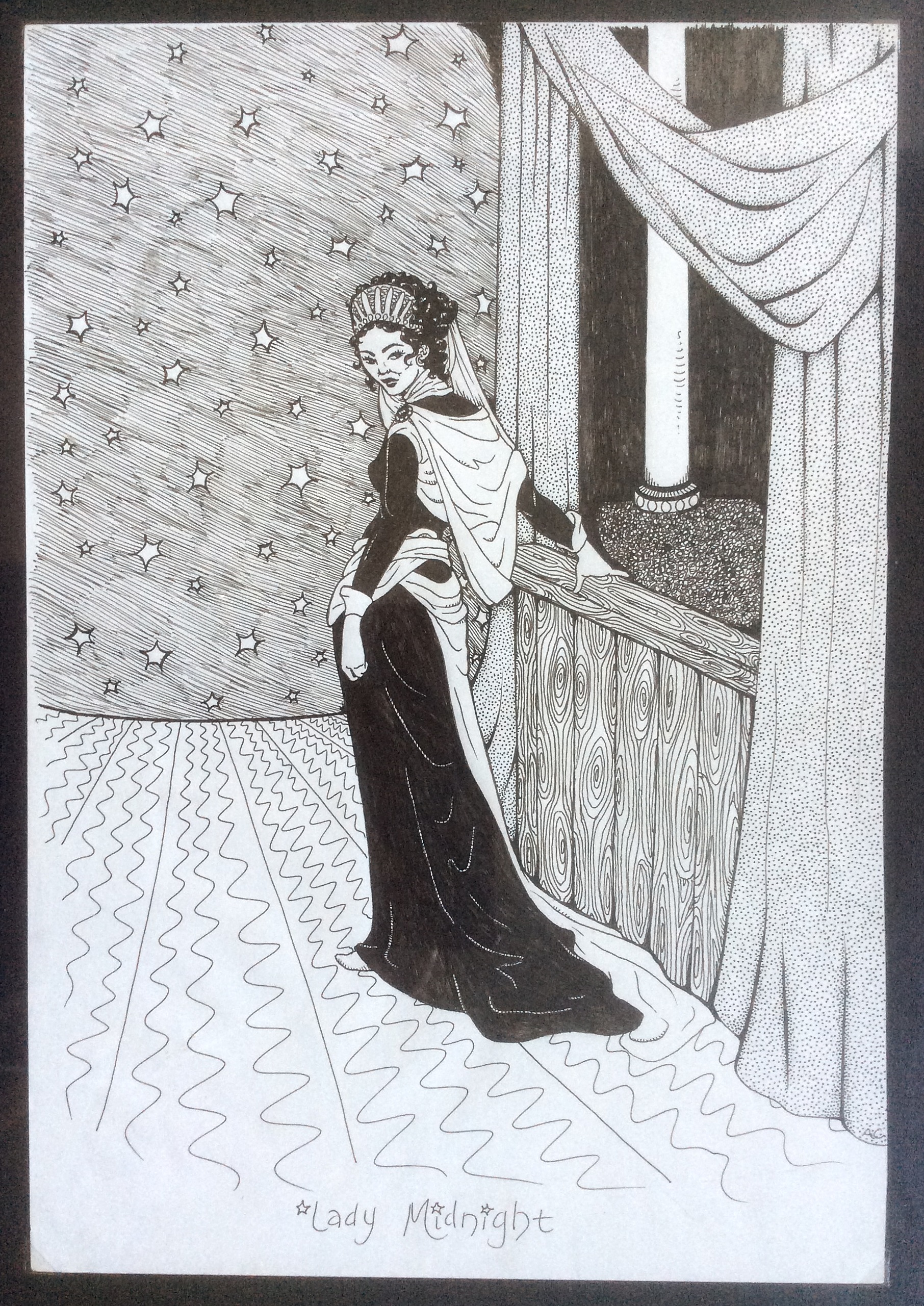
Joan of Arc by Amy Cools, about 1998. My mental image of her then was influenced by popular iconography and films, much of it which, as I did, portrayed her as tall, fair-skinned, and light-haired (think Ingrid Bergman’s 1948 film portrayal). In real life, she was somewhat short, dark-eyed with black hair, and had a sun-tanned, athletic body that, despite their describing it as attractive, aroused no lust in her fellow soldiers. Perhaps this resulted from their idealization of her as too godly for mere mortals to touch. Or perhaps, as I surmise, her indifference to sex with men was too manifest to give rise to that kind of chemistry. My drawing does, I think, manifest my youthful idea of her as a lovely tomboy, as an active, confident girl was then miscalled. Joan’s wearing the white shift which she wore to the stake and holding her cross made of two sticks tied together, which a sympathetic bystander quickly fashioned to comfort her on her way to execution
My fascination with Joan of Arc, born sometime in 1412 and put to death by fire on May 30th, 1431, is long-standing, beginning in my girlhood. Joan, as you likely know, is the French national heroine who fought to remove medieval France from English rule, whose exploits turned the tide and guaranteed France’s ultimate victory in the Hundred Year’s War.
She was the daughter of prosperous peasants in Domrémy, France. On a self-proclaimed mission from God to restore French rule to the rightful heir of the House of Valois, she convinced the local baron, military leaders, and eventually the crown prince to put her in charge of the dispirited French army, despite the fact that she was illiterate, militarily inexperienced, and a teenage girl.
By the time Joan reached the Dauphin, as the French crown prince was called, the French had long been in the habit of losing battles, even when they had the upper hand in numbers and defensive position, often because they were unable to cohere as a unified fighting force. French society was still feudal, highly stratified by class, and the army was no exception. Common soldiers were ill-equipped and underused, mistrusted and despised by aristocratic and wealthy knights jealous of their own superior rank. They could not bring themselves to give common soldiers opportunities for a share in the military glories of conquest. So French armies, fractured by class with everyone out for themselves, lost time after time to the more pragmatic and unified English forces. Troops of English longbowmen, for example, were made of up common soldiers highly valued for their strength and skill, and the English army made full use of them, to the detriment of the French. When Joan came along, a peasant in direct communication with Saint Micheal the Archangel, patron saint of French knights, she served as the much-needed unifier of French sympathies. Knights and commoners alike were united by their love of her and what she represented, and they began to fight as one, an army made holy and therefore equal: the aristocracy and chivalric order may have been respecters of persons, but the God who called Joan to lead them in their sacred quest was not.
Joan also whipped the army into shape, demanding that they train as hard as she did. She banned gambling, swearing, and prostitution from the camps, and required that soldiers attend religious services regularly. These reforms served the double purpose of further unifying soldiers through daily rituals that helped internalize their sense of holy, shared purpose, and of reducing the opportunities for alcoholism, venereal disease, and other ravages of hard living that could weaken her forces. She also prohibited raiding and pillaging which further unified French sympathies, especially of the common people and the countryside who had long suffered the predations of marauding English and French soldiers.

Joan of Arc, ca. 1450-1500, oil on parchment, artist unknown, public domain
Once she had raised the Seige of Orléans, drove the English from fort after fort, and led the Dauphin to be crowned King at Reims, her hawkish mission fell victim to what she considered dithering and intrigue, and what Charles VII considered diplomacy to save lives and capital. As Joan saw it, aristocrats and corrupt clerics, still jealous of their own social standing and opportunities for power either as leaders in the newly strengthened French order or as secret English collaborators, blocked her next great project: to deliver Paris from English control. She relieved her frustration and boredom by leading a series of minor skirmishes against the English, and was finally captured at one of these. She was handed over to an ecclesiastical court, led by French clerics symphathetic to the English cause, so they try her as heretic, ‘proving’ her in league with Satanic fiends, as the great English playwright William Shakespeare portrays her in Henry V. This would discredit her godly mission, her power to unite the French, and her assistance to Charles VII’s cause, thereby undermining his royal legitimacy. She was burned at the stake in Rouen, having accomplished the first part of her mission, the liberation of Orléans and the coronation of her King, and setting in motion the second part, the complete liberation of France from English rule, at only nineteen years old.
But it was clear to both French and English that the ‘holy’ court that condemned Joan was led and manipulated by political actors, not by men of God whose chief concern was to protect the Church from heresy. About twenty years after her death, the victorious French king Charles VII, who owed his crown and the reclamation of his kingdom to Joan, was finally reminded of his debt of gratitude by the realization that his hold on power was threatened if his rule was the result of the machinations of a heretic. A trial of rehabilitation and nullification commenced in the mid-1400’s, which formally vindicated her and proved to their satisfaction her mission came from God. Almost five hundred years after her death, Joan of Arc was proclaimed a saint by the Catholic Church.
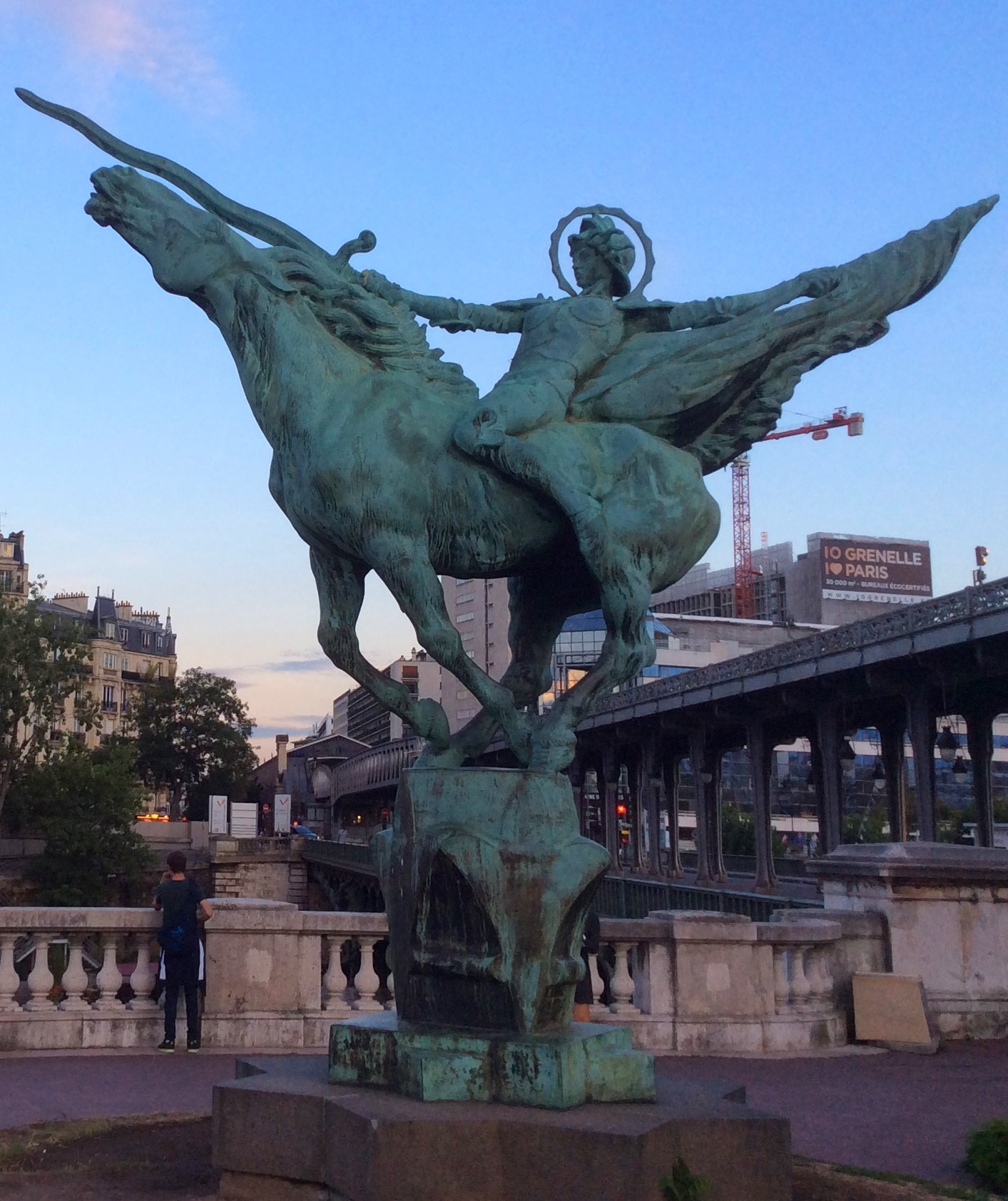
Joan of Arc statue in Paris, France, photo 2015 by Amy Cools. This stylized depiction of her, in that Art Deco style I so love, makes me think of a green flame: green for the fields in which she roamed as a child shepherd, flame for her passionate intensity. Her attempt to liberate Paris by force from English rule was put to a stop by Charles VII’s diplomatic maneuverings, as well as by a wound she suffered in the failed assault. Paris was recovered by the French only a few years later by a means this inveterate warrior dismissed as a sign of weakness: by treaty. I believe, by the way, the fire she was wont to ignite in the hearts of soldiers also flamed in the breasts of the liberators of Paris five hundred years later in WWII.
I was religious as a child and a teenager, and admired her then as a Catholic saint. By my late teens, I had left religious belief behind, but my admiration for her has only grown and deepened over the years. She became something more to me, more rich, more mysterious, more complex. I think of her now as a native genius, with no other language or context in which to express, to herself and others, her political and military insights than the religion which infused her life and the life of the lives of her fellow countrypeople. And the way she was able to baffle, rebut, and defeat her interrogators at the show trial by those determined to discredit her before burning her at the stake remains a marvel. Her intellect was such that, despite her illiteracy and lack of formal education, she was able to see right through the legal deceptions of her judges and prosecutors, avoiding every verbal trap and pitfall they set for her, turning their attacks and arguments right back on them.
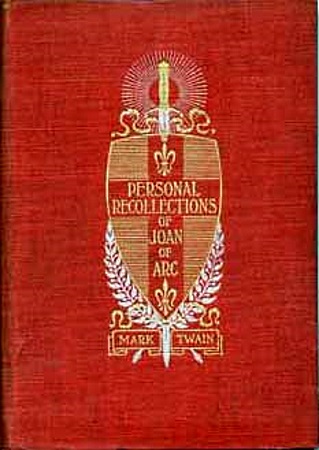
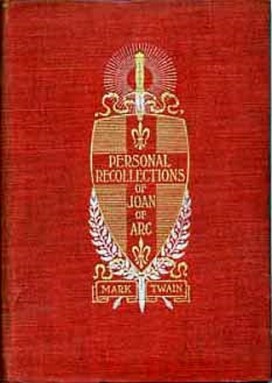
In preparation for this anniversary of her death, I’ve immersed myself in writing and art about Joan. Besides various histories, I’ve recently re-read Mark Twain’s historical novel Personal Recollections of Joan of Arc, which was recommended to me by my devoutly Catholic grandmother. I’ve read it many times over the last two decades. It was Twain’s own favorite of all his novels; he proudly announced he spent twelve years researching it and two years writing it, which he did for no other novel. While Joan is as full of comical scenes and quips as any of his other works, it’s a tender book, channeling his love for his own wife and daughters, with much less sarcasm and much more earnest, overtly expressed sorrow and compassion than anything else he ever wrote. His Joan is suffused with the sweetness, purity, and honesty he perceived much of in young girls and too little of in the rest of the world. Twain’s ideas about young girls and women are, I think, hyper-sentimental, naive, even dehumanizing to the extent that his ideal of female virtue did not include the full range of human reason and passion. He, like most in his era, in Joan’s time, and in fact, Joan herself, fetishized female virginity. But I love his account of Joan’s brave life and tragic death nonetheless, just as we can be forgivingly fond of the quaint idealizations of our fathers, uncles, and grandfathers of the sweet purity of womanhood while secretly rolling our eyes.

Drawing of Joan of Arc by Clément de Fauquembergue, as a doodle on the margin of the protocol of the parliament of Paris, dated May 10th, 1429. It’s the only contemporary image of her
Unlike Twain’s tender ideal of Victorian-style womanhood and the Church’s monumental Saint, I find the complex, flesh-and-blood Joan, full of marvelous virtues, deep flaws, incredible natural abilities, inexplicable quirks, and ordinary human qualities, much more interesting. I admire her courage, audacity, bravery, energy, savviness, intelligence, trust in her own abilities, and independence of spirit. I’m disturbed and even at times repelled by her single-minded, sometimes bloodthirsty willingness to sacrifice so many human lives for her cause; her insistence that those things going on in her own mind were the absolute truth and must be believed and obeyed or else; her absolute allegiance to the divine right of kings as established by male bloodline (especially given that many of the French preferred the less ruthless, less feudal, more legally scrupulous style of English rule); and her hyper-religiosity which impelled her to write letters calling on others to put Muslims and religious dissenters to the sword.
The real Joan is such a compendium of attributes and mysteries that she’s become an icon and an inspiration to perhaps the diverse set of people I can think of:
Joan of Arc is a working person’s icon. She’s a self-made woman who got her start working with her hands in the fields, and given very little formal education. But with her own common sense, strong sense of self, and enterprising spirit, she pulled herself up by her bootstraps more quickly and to a greater height than nearly anyone else in history. She began as an illiterate peasant in a feudal society and ended up chief of the armies of France before she reached twenty, and after her death reached even greater heights as a Catholic saint, a military legend, and France’s eternal national hero.
Joan of Arc is a religious icon. She claimed an intimate knowledge of the will of God through the voices of his emissaries he sent to her, St Michael the Archangel, St Catherine, and St Margaret. She’s a treasured if difficult icon for Catholicism: she claimed that God spoke to her directly through heavenly messengers, even as the Church considered itself the divinely-appointed sole intercessor between humanity and heaven. Though she presented a challenge to Church hierarchy and to the Pauline conception of women as the silent, submissive inheritors of Eve’s great sin, Joan was re-reconciled to the very Church that had condemned her, for a variety of theological as well as (I think history makes clear) political reasons. (Re-reconciled because her first formal ecclesiastical examination at Poitiers, to establish the truth of her mission before she was allowed to meet the Dauphin, declared that she was devout, orthodox in religion, a true virgin, and free of deceit). Though she remained passionately loyal to the Church and hated religious dissent, she also embodied the independent spirit that inspired the Protestant revolution, centered on the conviction that God can, and does, speak directly to us in our hearts and through Scripture, no earthly intercessors required.
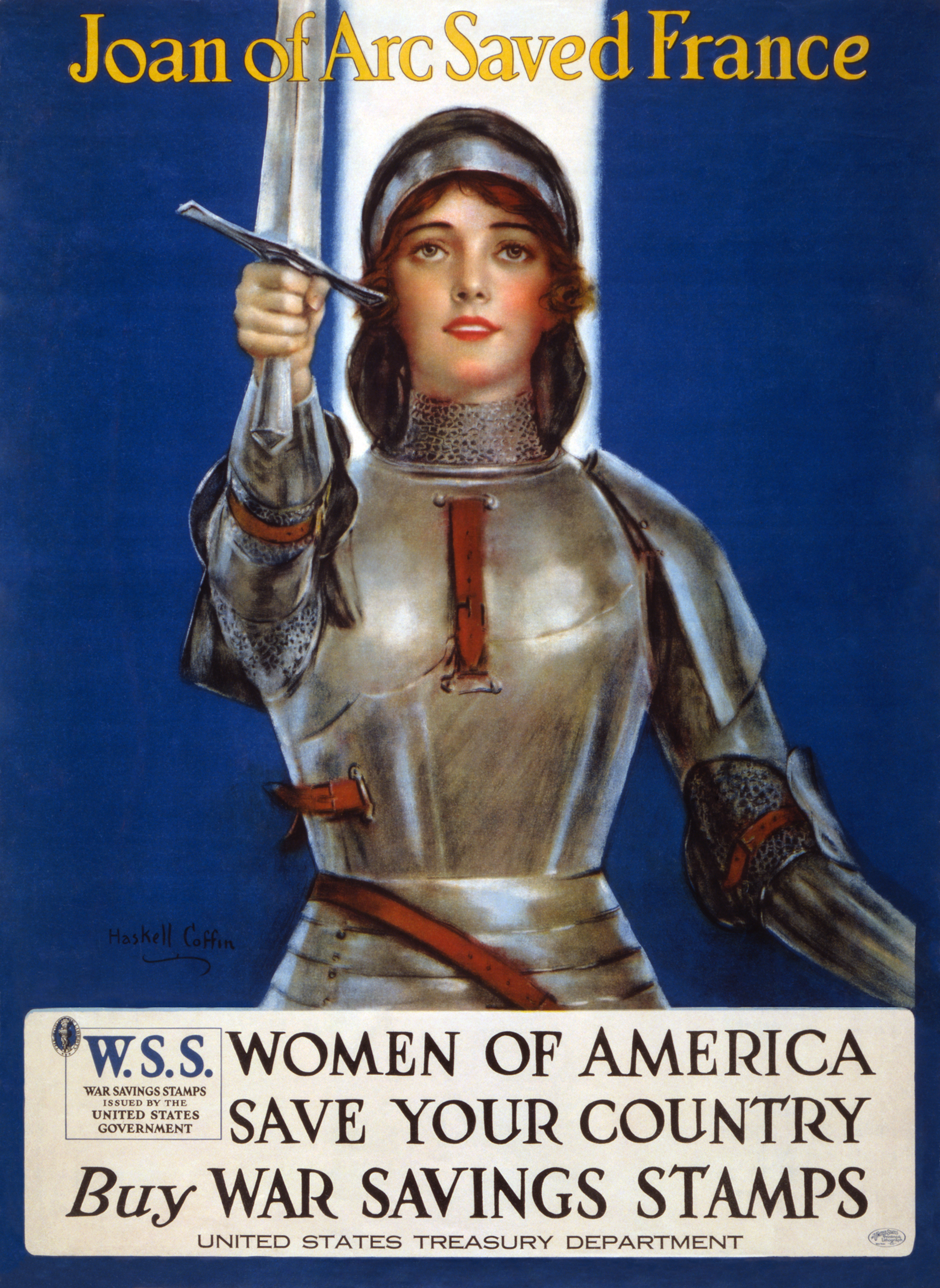
World War I lithograph poster, 1918. It’s rather a strange one, using the image of Joan to encourage women to help the war effort by attending to their domestic concerns; the US military still banned women from fighting. But Joan was all the rage then: Twain’s thoroughly researched novel, together with other renewed scholarly interest in her over the previous fifty years, made the story of her life much more widely known, and the Church had recently beatified her. She was made a saint two years after this poster was published.
Joan of Arc is a military icon. She loved fighting and spurned any diplomacy beyond plans to move the English out of France as quickly as possible. Though she initially wept at the sight of soldiers wounded and dead as a result of her aggressive tactic of direct assault, she continued to lead every charge in her favored, necessarily casualty-heavy way. Her rhetoric in letters and speech, though embellished with appeals to Christian forbearance and mercy, was violent, filled with threats to chop off heads and put to the sword all who did not obey the will of God as she proclaimed it to be. She inspired deep and enthusiastic devotion in her soldiers, even in her most hard-bitten, most skeptical generals, and quickly achieved a mythic stature among her countrypeople that even General Douglas MacArthur could only envy.
Joan of Arc is a queer icon. She was a cross-dresser who disdained sex with men. Her first simple style of male garb was a practical measure for a soldier who needed to move freely and for a woman often surrounded by men in a culture that regarded single women without escort as fair sexual prey. But over time, as she first encountered the delights of elegant and expensive clothing, showered upon her as gifts of admiration and gratitude, she became quite the clothes horse. She saw no problem with this: medieval sensibilities often conflated holiness with material richness just as the Old Testament did, and God, his favorites, saints, and angels were almost invariably portrayed in the richest of finery. But her enemies mocked her adopted style of wearing silken hose and richly embellished garments in fine fabrics as proof she was as vain, conceited, and driven by lust for personal fame and riches as they had always said. Another reputed French visionary, a young shepherd boy being groomed as Joan’s more convenient, less pugnacious replacement as saintly advisor to the king, blamed her capture on her having fallen prey to vanity and luxury. They claim that she was captured because of her finery, pulled off her horse by the fancy little cape she had grown fond of wearing.

Jeanne d’Arc by Albert Lynch, engraving from Figaro Illustre magazine, 1903, public domain
Joan of Arc is an art and fashion icon. Her exploits, her cross-dressing, her independence of spirit, and her short hair inspired centuries of creative people to capture this wondrously unique individual on canvas, in brass and wood, and in textiles. And songs, poems, stories, films, plays, and countless other forms of creative expression emphasize this, that, or the other facet of her varied and mysterious character. And the Joan-style, French-invented bobbed haircut of the 1920’s, the same decade which saw Joan’s canonization and women’s obtaining the full legal right to vote in the United States and Britain (it took France another twenty years), became a potent symbol, a public declaration that each cropped head recognized that:
Joan of Arc is the feminist icon, par excellence. She bested men in daring and stamina on the battlefield, in intellect time after time in the courtroom, in keeping her own counsel and determining her own destiny despite opposition from family, church, and society, in self-preservation from her would-be prison rapists, and in the courage she displayed on the day of her death. And yet, as she charmingly boasted near the beginning of her final trials, she was confident that she a better seamstress and spinner than just about any other woman! She wore armor, pretty dresses, rough men’s clothes, and over-the-top finery as it suited her. She sang, rode horses, adventured, communed with God and angels, told men and other women what to do, and drove thousands of people to distraction wondering what to make of this extraordinary, inspiring, difficult, inexplicable, and unforgettable person.
*Listen to the podcast version here or on Google Play, or subscribe on iTunes
It’s my dream and my plan, as soon as resources and time allow, to follow the life and ideas of Joan of Arc in France. Stay tuned, though it might be quite a while, and in the meantime, here are some great sources for learning more about this marvelous woman:
Ditié de Jeanne d’Arc (Song of Joan of Arc) ~ by Christine de Pizan, ed. Angus J. Kennedy and Kenneth Varty (Oxford: Society for the Study of Medieval Languages and Literature, 1977), trans. L. Shopkow
Henry VI, Part I ~ by William Shakespeare, 1591 via Open Source Shakespeare (website)
Jeanne d’Arc ~ by T. Douglas Murray, New York: McClure, Phillips & Co, 1902 (excerpts detailing her trial)
Joan of Arc ~ by Beckett Graham and Susan Vollenweider, The History Chicks podcast, episode 51
Joan of Arc: A Life Transfigured ~ by Kathryn Harrison, New York: Doubleday, 2014
Joan of Arc ~ 1948 film directed by Victor Fleming, screenplay by Maxwell Anderson
Joan of Arc: A History ~ by Helen Castor, New York: HarperCollins, 2015
Joan of Arc: The Warrior Saint ~ by Stephen Wesley Richey, Westport, CT: Praeger Publishers, 2003
The Passion of Joan of Arc ~ 1928 film, screenplay by Joseph Delteil and Carl Theodor Dreyer, directed by Carl Theodor Dreyer
Personal Recollections of Joan of Arc ~ by Mark Twain, 1896
The Riddle Of Mark Twain’s Passion For Joan Of Arc ~ by Daniel Crown for The Awl, Apr 3, 2012.
Saint Joan ~ 1957 film adapted George Bernard Shaw’s play Saint Joan, screenplay by Graham Greene, directed by Otto Preminger
*A version of this piece was previously published at Ordinary Philosophy
~ Ordinary Philosophy is a labor of love and ad-free, supported by patrons and readers like you. Any support you can offer will be deeply appreciated!






























 The
The 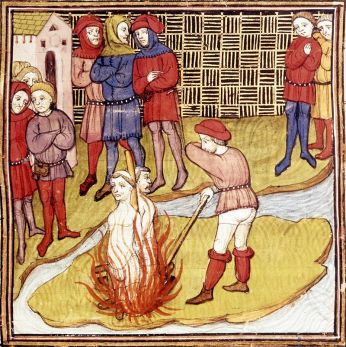 That’s because we’re still under the influence of a very old, even primal idea: that death is rendered not only glorious but a worthy goal if it’s for a cause. Nearly all ideologies and belief systems still prize their martyrs, and we see, worryingly, the resurgence of this idea in some parts of the world are leading to ever more deadly results. Martyrdom has long been such a potent symbol of belief and an effective recruitment tool that if there aren’t any genuine ones to hold up for emulation, it’s a sure bet some will be created. The Umpqua tragedy may be an example of this, of recasting the horrific murder of innocent people as a romantic tale of holy self-immolation in defiance of evil personified. The memory of the lives of the innocents who died there, and the heroism of those who risked themselves to protect others from harm, can become lost in the ideological rhetoric.
 Yet I am simultaneously wary of glorifying these cases of martyrdom for martyrdom’s sake, even when the circumstances of deaths such as these appear most moving, most noble, and most beautiful. That’s because I can’t forget, and I believe none of us can afford to forget, that what makes death or suffering count as martyrdom depends entirely on your frame of reference. My martyr may be your heretic; your martyr may be my traitor who deserved death; my martyr may be the holy warrior who attacked your corrupt and sinful country in the name of all that’s holy and your deadly foe it’s your patriotic duty to destroy. Martyrdom of this sort, understood as the ultimate sacrifice of the death-defying, uncompromising champion of the ultimate good, knows no side and every side. Every side claims their own, and every side who has martyrs to claim (creating them if necessary) treats them as their trump card, the ultimate demonstration of the rightness and superiority of their own beliefs. There’s Father Damien, and there are kamikaze pilots. There’s Quảng Đức, and there are suicide bombers. There’s Joan of Arc, and there are Crusaders, jihadists, those who carried out pogroms, and youth who still flock every day to join the ranks of ISIS and fight to deliver sacred territory from the hated infidels.
 But here’s the problem: if it’s okay to sacrifice one person, even if that person is one’s own self, then it’s more than just a slippery slope to thinking it’s okay to sacrifice others. As we can see in such cases as kamikaze pilots, crusaders, holy warriors, and suicide bombers, the glorification of martyrdom has always had the unfortunate tendency to inspire willingness to sacrifice others along with ourselves. After all, if it’s good to sacrifice one person for the greater good, isn’t it at least as good or even better to sacrifice more people? But self-inflicted martyrdom which simultaneously kills others is generally not driven by this sort of calculation, of each side just upping the ante. When we consider martyrdom, we must also consider the ideologies and belief systems that inspire or at least allow for it. And nearly all not only involve a belief in an afterlife, they believe this world is merely a proving ground for that afterlife, so death counts for little in comparison to eternity. Furthermore, most ideologies and faiths who glorify martyrdom base their beliefs on sacred books in which holy war and violent destruction of the nonbeliever, the godless, the idolator, and the infidel is celebrated as much or even more than personal martyrdom. In the end, we end up with the same old world full of mutually hostile martyr/holy warrior belief systems that have led to centuries of violent religious and ideological conflict and ethnic cleansing.
 And who’s to say who’s right? Which religion, which ideology has the correct view of martyrdom? Which, if any, can be demonstrated to inspire true martyrdom, to the exclusion of others? Bertrand Russell, philosopher and ardent pacifist, is often quoted as saying ‘I would never die for my beliefs because I might be wrong’. Many have described this as cynical or revealing a weakness of character, an inability to form convictions. I think a more fair and charitable interpretation is that Russell believed everyone should practice proper epistemic humility. Especially when it comes to such a momentous question as preserving human life, our own and others: we should do so whenever possible, since whatever our other beliefs, we can all readily demonstrate, whatever our other beliefs, that other human beings suffer grief when we die and that we can surely help others when we’re around to do so. It’s far more difficult to demonstrate, for example, that God likes it even better when we die in his name or that we can help those on earth from beyond the grave, as believers in intercessory prayer or spiritualists hold. Better all around, when it comes to our safety as well as our chances of not believing in things that are terribly wrong, when we’re accountable to one another for the larger consequences of our beliefs.
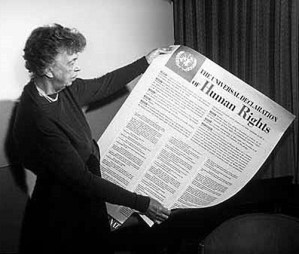 In a world where religiously-, politically-, and ideologically-motivated terrorism and mass shootings are again on the rise, we need to let go of our old cherished ideal of martyrdom as the ultimate holy and noble act. If we want to instill in ourselves and others the value that all lives matter, the glorification of any kind of martyrdom appears as toxic to this as the old belief in the curative powers of bleeding and purging was to health. This seems like a call for rejecting our long-loved heroes, our Joans and Quảngs and Damiens, but I don’t believe it is. We have a robust capacity for understanding that context matters, and just as we can believe George Washington’s doctors did their best to cure him the only (turns out wrong) way they knew how, we can simultaneously revere the courage and conviction of martyrs of the past while believing that in the age of universal human rights and ethics of care, martyrdom is the wrong way to go and should not be glorified, praised, or used as evidence of the superiority of our own beliefs over others.
 Ordinary Philosophy