Book Review: Darwin’s Ghosts: The Secret History of Evolution

Well, it’s sort of a book review. It’s more like a very informal description of a reaction to the book.

Which was: immense enjoyment.

My sister was nearly finished reading it when she left it behind at my house one day. In short order, I ‘accidentally’ forgot to bring it back to her the next time I saw her, or to remind her to take it with her when she came to visit. Perhaps I’m a bad sister, but that’s what she gets when she leaves such a marvelous book behind. Oh, the trials of having excellent taste in reading materials!

Anyway, I picked it up and started browsing through it, since she had already mentioned it to me, and from the start, I could hardly put it down. The long inward struggle that Charles Darwin went through prior to publishing his discovery of the evolution of species (or, rather, the primary mechanism that drives it), is well-known. Yet only the broad outline is really known: no-one can entirely imagine what goes through your mind at a time like that. What tortured thoughts must you wrestle with when you know a truth and believe it’s too important to remain untold, but are also shy, torn by loyalty to family and friends, and fear scorn, notoriety, and persecution?

The book begins with the story of Darwin around this time, just after he published On the Origin of Species, when he had finally been spurred on to do so after another naturalist, Alfred Wallace, made the same discovery independently sixteen or so years later. The book returns often to the story of Darwin’s struggles before publishing, since so many, whose stories are also told in this book, went through similar trials; it first opens with Darwin considering how best to acknowledge and properly credit those whose work contributed most to his theory.

The author proceeds to first takes us on a giant leap far back into the past, to ancient Greece, where the great natural philosopher Aristotle gathered sea sponges and fishes and was the first known to describe them systematically. Then she guides through a history, from Aristotle to Darwin, of the intensely curious, intellectually brilliant, and restless thinkers and observers who gave us modern science. Throughout, I was enthralled. Rebecca Stott tells of awkward, cranky loners who spent most of their time in dusty specimen cabinets or crawling about on hands and knees, meticulously recording the denizens of the natural world, of precocious, highly educated children of privilege who went on to lavish their money and leisure hours in the cause of scientific advancement, of pious priests and moralistic skeptics and atheists who considered the natural universe the most sacred and the most beautiful treasure trove of knowledge available to all, and of many more: a wide variety of people of various temperaments, backgrounds, advantages, types and levels of ability and creativity, are represented in this wonderful history of ideas and of discovery.

Among other scenes in book, I felt myself longing to have had the chance to take part in any, if just one, of those salons of Enlightenment Paris or Edinburgh. Fashionable, educated women and men hosted dinner parties to bring together the best and brightest minds, full of the most original, revolutionary, and fascinating ideas that human minds were creating. But these salons were not where it was all happening: some of the greatest discussions and intellectual achievements at the time happened in ordinary and humble studies, attics, homemade labs, lecture halls, monk’s rooms, coffee shops, and student’s quarters. It was a time when thinking and knowledge was, it seems to me, more widely and more highly valued. Not only familiarity with facts and factoids, but real understanding, was the greatest prize to be sought, the greatest goal in life.

If you want some of the best examples of how to be a part of that great quest, pick up this book and romp through the history of ideas with her. I think you’ll be as glad you did as I was.

*****************************

Stott, Rebecca. Darwin’s Ghosts: The Secret History of Evolution. Random House, New York 2012.
https://books.google.com/books?id=5Lt_MXhNJEoC&pg=PP5&dq=darwin%27s+ghost

Review: Tierra Mia Coffee

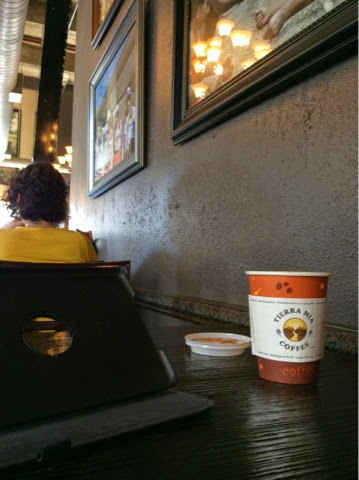
Rode a different way from work today, in hopes of stumbling across a new coffee shop to try out, in my ongoing search of homey, comfy, friendly places to sip and munch while I write, complete with wi-fi. away from the distractions of home.                                                            I’ve been finding this search to be a challenge, since it seems the trend in coffee shops is sleek, overpriced establishments with an edgy, painfully hip, even clinical feel, where apparently it’s a job requirement for baristas to give the distinct impression that they’re too cool for you and everyone else. And these cafes are usually filled to the rafters with affected self-conscious hipster types who pose together, coldly looking you up and down as you enter to see if you’re wearing one of five or so approved hipster uniforms, and that it passes muster.                                                                                   Fortunately, I discovered that the new coffee shop I stumbled upon today, Tierra Mia Coffee, is decidedly not one of these places. It’s roomy and airy, with high ceilings, classic European-style decor, plenty of seating, and a straightforward selection of classic espresso drinks and pastries, along with a wide assortment of pour-over specialty coffees to choose from. Not cheap, but not too expensive either. My mocha Mexicana was rich and delicious, though I was disappointed that it arrived in a paper cup. They do have mugs, you just have to remember to specifically request one. 
The clientele was refreshingly diverse, people from various age groups, socioeconomic statuses, and personal styles, like a cosmopolitan city downtown cafe, just on a smaller scale. That’s how I like it.
I would have stayed longer, but the wi-fi was glitchy. I didn’t hold that against them, though, it’s a common problem that I’m sure they’ll fix soon. I’ll be back next time I need a place to write when I’m in Uptown Oakland..

Who, What, Why, How: http://www.tierramiacoffee.com/

Where: 2001 Broadway, Oakland, CA 94612

When: Mon – Thu 6:30 am – 8:00 pm Fri 6:30 am – 9:00 pm Sat – Sun 8:00 am – 8:00 pm

Perhaps I’ll see you there sometime!


‘Flaunting’ is a Terrible Excuse for Crime

Have you ever heard the argument: ‘Well, she shouldn’t have worn that skimpy outfit / got drunk / flirted at that party. It’s (also) her fault she was raped / assaulted.’?

Compare that argument with this one: ‘Well, he shouldn’t have been wearing that Rolex / Versace suit / driven that Lexus. It’s (also) his fault he was held up / beaten to the ground and robbed.’

These are equally terrible arguments.

While one might have a point saying that a person acted impractically by wearing something in a situation where there might be predators around, that has nothing to do with the fact that it’s entirely the fault of the criminal for committing the crime.

Free Will and the Self

Free will and the self. What are they? While they are the two most important phenomena to each and every one of us, they’re notoriously hard to describe. Of course, we ‘know’ what they are: respectively, they are the experience, the feeling, of being in control of our own actions, of our thoughts and behaviors, and of having an identity and a personality that exists over time. Without them, our lives seem pointless: if we have no free will, then we are mere automatons, and we can take no credit and no responsibility for anything we do. If we have no self, then there is no we, no ‘I’, at all.

Experiments and scholarship by neuroscientists, biologists, psychologists, and others have revealed some starling things about the workings of the brain and how human beings think, behave, and make decisions. The field of neuroscience has grown by leaps and bounds in the past few decades since the advent of technologies that allow us to observe the living brain at work, though we’ve been learning much about the brain over the last few centuries by observing the results of damage to its various parts. These results have, in turn, thrown traditional accounts of the self and free will into question.

Many have gone so far as to say that since we’ve discovered that our actions result from the cause-and-effect processes of a physical brain, then we have no free will: our actions and all our thoughts are determined by the cause-and-effect laws of nature. And since we’ve discovered that the sense of self arises from the confluence of the workings of the parts of the brain, and damage or changes to those parts can cause radical changes to our personalities and the ways we feel about the world and ourselves, that the self is an illusion too.

Yet, how can free will and the self not exist when we experience them throughout our lives? Since we can talk about them to one another, they must exist in some sense, at least. And it’s not that they exist in the way that fictional characters in a story exist, for example, or other artificial creations. We experience these phenomena intimately, from the time we attain consciousness early in life, until the time our brains are so aged or damaged that we are conscious no longer. The concepts of free will and the self are ubiquitous in our language, our culture, the very way we think. Read this paragraph again, review all the thoughts you’ve had in the last hour (and ever had, in fact) and you’ll find that the concepts of ‘I’, ‘you’, ‘we’ (distinct selves in the world), combined with the concept of some action or thought purposely performed by one’s self, are a constant theme. In fact, almost everything we talk and think about would be incoherent without these concepts, and all the purposes that drive us would disappear and render all we do meaningless.

So what gives? How do modern discoveries about the workings of the brain jibe with traditional concepts of free will and the self?

It appears the confusion results from the way we use the terms. There are actually two things we’re referring to. One is the actual experience of the phenomena we call ‘the self’ and ‘free will’. The other is how we account for them, how we define them and explain how they work.

Consider what we mean by other terms, such as ‘disease’. At one time or another, we had various explanations as to what these things are, and how they are caused. One popular explanation that convinced people for hundreds of years: disease is the result of the imbalance of the four humours of the body: blood, black and yellow bile, and phlegm. A physician’s job is to restore the balance and so bring about cure. Other explanations are vitalist (life and health are the result of the interaction between some sort of non-physical spiritual ‘force’ or ‘energy’ and a physical body), such as chiropractic and traditional Chinese medicine. Disease is cause by some sort of disruption in the body, and a physician’s job is to correct the alignment and communication channels of the parts of the body so that the vital force can flow freely and restore health. And the most pervasive and popular explanation of disease throughout human history, of course, is that it’s caused by the vengeance of an angry god or the maleficence of evil spirits (witch-burnings, anyone?).

Over time, human beings invented and developed the scientific method pioneered by Francis Bacon, and began to more carefully examine the correlations of disease symptoms with the circumstances in which they occurred (outbreaks of cholera mapped so that the epidemic was revealed to center on a polluted source of drinking water in 1830’s London; the correlation of damage to a particular parts of the brain to the symptoms of brain damaged patients; the dissection of corpses, comparing diseased organs to healthy ones). With the discoveries of the physical causes of disease, by pathogens and by damage to parts of the body, effective cures were finally able to be developed.
Given that the explanations for the origins of disease are based on the understanding that they’re natural, the result of physical processes, and traditional explanations, does that mean that disease can no longer be said to exist? Does that mean we have to come up with an entirely new terminology? I don’t think it does. The term ‘disease’ refers to instances of the body suffering in some way, not functioning as a healthy body does. What we do when we are confronted with the phenomenon of disease is the same as it ever was: we seek to avoid it, we detest being afflicted by it and seeing others afflicted by it, we seek to understand its causes, and we seek to cure it.

Similarly, the denial of the existence of free will and the self is based on the misguided assumption that understanding the inner workings of a thing, in a way incompatible with traditional explanations, is to deny that the phenomena exist at all. To understand that the mind is the product of a physical brain obeying the laws of nature rather than a sort of spirit or soul inhabiting a machine-body is not to say the mind doesn’t exist. The experience of free will and the self is the same either way, and whether what makes the ‘I’ an ‘I’ is better explained naturally or supernaturally makes no difference. We are still agents, it’s still what’s going on in our brains that cause everything we do, and we still make choices, and it’s still ‘we’ that make them.

In sum, discovering how the phenomena we experience that we’ve dubbed ‘free will’ and the ‘self’ really work doesn’t mean that they don’t exist; it just means we understand more about them now. And to me, as to other lovers of knowledge and understanding, that’s a good thing.

* Also published at Darrow, a forum on the cultural and political debates of today

~~~~~~~~~~~~~~~~~

Sources and inspiration:

Dennett, Daniel. ‘On Free Will Worth Wanting’. Interview on Philosophy Bites by David Edmunds and Nigel Warburton. http://philosophybites.com/2012/08/daniel-dennett-on-free-will-worth-wanting.html

Klein, Jürgen, “Francis Bacon”, The Stanford Encyclopedia of Philosophy (Winter 2012 Edition), Edward N. Zalta (ed.) http://plato.stanford.edu/entries/francis-bacon/

‘John Snow’, from BBC History series. http://www.bbc.co.uk/history/historic_figures/snow_john.shtml

Kean, Sean. Interview on Inquiring Minds podcast by Indre Viskontes and Chris Mooney, published June 12, 2014 https://soundcloud.com/inquiringminds/38-sam-kean-these-brains-changed-neuroscience-forever

Metzinger, Thomas. The Ego Tunnel: The Science of Mind and the Myth of the Self. New York: Basic Books, 2009 http://www.goodreads.com/book/show/5895503-the-ego-tunnel

Sharif, Azim F. and Kathleen D. Vohs. ‘What Happens to a Society That Does Not Believe in Free Will?’ Scientific American, June 2014. http://www.scientificamerican.com/article/what-happens-to-a-society-that-does-not-believe-in-free-will/

 Wikipedia (various authors): ‘Daniel David Palmer’ (founder of chiropractic), ‘Humorism’, and ‘Traditional Chinese Medicine’
http://en.wikipedia.org/wiki/Daniel_David_Palmer
http://en.wikipedia.org/wiki/Humorism
http://en.wikipedia.org/wiki/Traditional_Chinese_medicine

Pornography

Recently, I read a post on Facebook where my cousin’s wife woefully reported that my cousin’s new anti-pornography site had to be taken down due to a huge negative reaction (though he received much support as well). The site is (was?) called ‘Her Name’, and it’s a forum where you assign a name (first name only) to a woman whose dignity had been affronted through pornography: women you know, women you’ve seen but not met, and so on. By naming these women, their humanity, their individual worth is re-affirmed, and all are reminded that each woman a life and a story beyond the simple object of gratification that pornography portrays them as.

That was what I was able to gather from the description of the website and from  my cousin’s wife’s post. But I didn’t find many details of why many objected strongly to the website, in the blog review and discussion of ‘Her Name’ I found on Patheos, nor on Facebook. Nor was I able to discern clear arguments in support of the claim that women are, in fact, dehumanized or injured in other ways by pornography.

Here’s what I gathered about the nature of the angry comments: by providing a forum to name these women, my cousin was (inadvertently, I believe) also creating a handy tool for ideologues to shame women taking part in pornography, or to ‘out’ women who want to keep their porn careers private. And here’s what I gathered from the discussion overall: pornography is bad, especially for women, period.

I’m glad that my cousin feels passionately about the issue insofar as he is concerned with promoting the dignity and freedom of women. And I’m glad that he’s taking part in the public discussion that we should all continue to have about pornography. It’s such a complicated subject, to which the blog reviewer doesn’t do justice: she offers no arguments to support her assertion that porn dehumanizes women. She simply claims that it’s a tool of the devil to destroy souls by denying their existence without explanation as to why or how.

Another thing: the overall characterization of porn, on the site and the blog post, was almost exclusively about the victimization of women, yet both sexes are involved in its production as well as the consumption, to one degree or another. I presume that the assumption is that men are making most or all of the decisions, and the women are all victims and dupes. I have serious doubts about both of these claims, if they really are such. Be that the case, let’s keep in mind that while I offer primarily offer women as examples in the discussion here for consistency’s sake in comparing the arguments, most of the points made apply to all sexes involved.

Based on his replies to the blog review comments, my cousin’s objections also appear to be based primarily on his religious beliefs: lust is sinful, tempting another to lust is sinful, sexual intercourse outside of marriage is sinful, and so on. These claims will have little meaning for those not adherents to particular dogmas. Yet we can infer broader points from what he has to say. For one, the anonymity and secrecy surrounding pornography, of the actors and the viewers, indicate that shame, an instinctive reaction to pornography, indicates there’s something wrong with it. Secondly, porn, by its very nature, dehumanizes the participants by reducing them to a collection of parts that have no purpose other than to gratify sexual desire. And thirdly, supporting the sexual gratification market that is porn, also supports awful practices as sex slavery and rape by validating the general idea that it’s okay to view some women, or all women, as nothing but objects of lust.

Those who subscribe to the ideas of the growing sex-positive movement, however, would not recognize this wholly negative portrayal of pornography. Sexuality, they say, is not only natural, but as valuable a characteristic of the human personality as reason or creativity. It originates from the best parts of human nature: empathy, sympathy, cooperation, our rich emotionality, the urge to create new life. It’s one of the most exciting ways that humans can bring each other joy, and unite in one of the most emotionally intense, intimate ways that we can. In short, sex is beautiful, and the ways in which we enjoy it can be, and should be, as variable as is the range of human personality itself. It’s precisely because of patriarchy and religion, in fact, that human sexuality has been shamed, perverted, twisted, and portrayed as ugly and exploitative in all contexts outside of the confines of male-dominated monogamy. That type of sex-negative religious view, in turn, is a regrettable inheritance from our evolutionary ancestors, who felt the need to exert control of women’s sexuality in the competition to successfully procreate with limited resources. When religion and patriarchy lose their influence, sexuality can again be freely expressed in all its joy and beauty, and the religiously-imposed shame will melt away. After all, as Mark Twain says, ‘Nature knows no indecencies; man invents them.’ 

Pornography, then, in this view, is to sexuality as academia and the scientific community are to intelligence, and sculpture and novels are to creativity: an expression of our sexual nature. There’s bad pornography, and good pornography, just as there are harmful scientific theories such as eugenics, and clunky, tacky, poorly written novels such as ‘Atlas Shrugged’ and ‘Naked Came the Stranger’, and lousy art such as Dan Lacey’s pancake and unicorn paintings (though hilarious!)

So why is sex the one part of the human nature whose expression and gratification we consider most taboo even as it’s most alluring? Why single it out this way? We don’t consider gratifying hunger and thirst as shameful, nor other needs and desires such as art, music, or intellectual stimulation. What is it about sex that engaging in it, and portraying it, is considered dehumanizing in all but the very narrow context of marriage, when it’s such a very human thing for all to do and to desire? Why is considered so good and yet so bad? 

Let’s explore the problem of treating sex differently than other aspects of human nature by considering a rather extreme example. I read an opinion piece the other day about Somaly Mam and her apparently now-dubious credentials as an advocate against sex trafficking. The author makes what I think is an excellent point: Mam would ‘liberate’ sex-workers only to place them in what many might call ‘honest’ work: jobs in the apparel industry, where in Cambodia, as in many other places where sex-trafficking is a big problem, it’s a free-for-all. There are few to no human rights protections or regulations, and the women work long, back-breaking hours for little pay in awful conditions. It’s that, or starve, so there’s no real choice for most of these women. So what makes the sweatshop job more ‘dignified’? In both cases, the women have little to no autonomy, and are treated with contempt (perhaps, one might argue, more so in the sweatshop job, since the woman is not even considered a ‘possession’, and therefore of some personal value to the owner!) Is it the only the fact that it’s there’s sex involved that makes the latter condition of miserable servitude somehow better than the former? We would probably hear many on the anti-pornography side of the argument say that, of course, both are examples of terrible behavior of the slavers and of the sweatshop owners, but I would wager that they would not be impassioned advocates of labor unions, minimum wage laws, and regulations as they might be anti-sex-work activists.

The porn industry does not, for the most part, resemble the terrible practice of sex slavery, so considering them side by side is only useful insofar as it helps us recognize our own often inconsistent attitudes about sex and respect for our fellow human beings. So let’s return to a less dramatic example, where autonomy is not in question. Does the dehumanization lie in portraying a woman in such a way as to present only one aspect of her nature for the satisfaction of the audience, in this case her sexuality? How about when she is ‘reduced’ to another aspect of her person, say her physical appearance? Let’s take the example of a model for fine art, or for fashion photography. She is chosen because she is beautiful (or interesting-looking, for fits the chosen profile, or whatever), and is paid to stay still while the artist captures the outward appearance of her body, and is dismissed when the work is complete. Is she dehumanized then? How about any interaction in which a human being is only considered in the light of the narrow role they play in the other’s life in that moment, the waiter, the conversationalist at the bar, the cashier, the barista, the taxi driver, the person who makes the clothes one buys, the arms dealer? They are anonymous, or will be except during that particular transaction, and they will never be seen again. Are they dehumanized too? Why is it that interacting with another person in only their role as a sexual being more dehumanizig than interacting with them only insofar as they play a different role?

One may reply, that sex is deeply intimate and meaningful, where a painting a portrait is not (necessarily, anyway), nor is ordering food or coffee or buying stuff, nor chatting up a stranger at a bar. But why must sex always be intimate and meaningful? Just as conversation can be intimate and meaningful, it can also be casual, or meaningful but not lasting (that fascinating, intelligent fellow traveler on an overnight flight who shared the best stories and ideas you ever heard which stayed for you for life, while you never see them again), or baby talk that the infant will not remember, or part of the larger conversation a committed pair have over their shared lifetime. Yet all of those types of communication are an important part of a full life. So it goes with all other parts and products of human nature. Just because it can be deeply intimate and meaningful and long-lasting, doesn’t mean it has to be; there’s room for simple, easy, non-committed encounters as well, isn’t there?

Again, what’s so special about sex?

For the last half-dozen paragraphs, I’ve offered arguments and counter-examples from the sex-positive perspective against the anti-pornography view I (admittedly briefly) summarized at the outset. (Since I outlined only those arguments I could muster that have a broader-than-religious applicatio, it was necessarily relatively brief). Intellectually, I sympathize with the latter, since they not only harmonize best with a naturalistic philosophy most informed with verifiable evidence, but are more consistent with the values of autonomy and liberty. Yet anti-pornography advocates makes some valuable points, too, as we shall see.  

Thus far, we’ve considered arguments in favor of anti-pornography and pro-pornography (or at least anti-anti-pornography) ideas. But how do they play out in real life? Is pornography really as nasty, destructive, and shameful as some say, or as pro-human, life-affirming, nature-celebrating as others say? What does porn really look like out there, and what is its actual effect?

Here’s where I think the anti-pornographers have a point: much of the actual, mainstream pornography doesn’t seem to celebrate the same degree of respect for autonomy, diversity, and positive-body-image values that the sex-positive community has. Mainstream porn seems to chew women (and men) up and spit them out in the same way as Hollywood and the tabloids do (and these days, even Fox News and CNN!). The only people that are considered sexy enough to be featured are the hard-bodied, perfectly evenly tanned, straight and/or blonde haired, fake-white-teeth, heavily made up, simultaneously tiny-waisted and big-titted (or -cocked) stars of Barbie and Ken’s dreams. If you want to be a porn star and aren’t born with this set of attributes, under the knife and chemicals you go! There is porn made for people with other body types who wish to act in it, but as of yet, it’s generally of the boutique, Good Vibrations variety (G.V. is like Whole Foods, for the socially-conscious and horny). As of now, the body-positive attitudes celebrated in those wonderful You-Tube manifestos have not yet influenced the mainstream porn industry, just as they have not influenced Hollywood or news outlets.

I wish the porn industry overall actually looked more like the sex-positive activists’ vision, I really do! One day it may, when people grow tired of the monotony of seeing people of a only very few body types represented. Real-girl-next-door, all-natural, widows, Wallendorf Venuses, seniors, divorcees with empty nest syndrome, all of these may one day be represented as widely, and more personally, in mainstream porn as they are in people’s actual day to day fantasies and moments of curiosity. But I doubt it will happen anytime soon, if beauty magazine covers and increasing rates of plastic surgery are any indication. When it comes to body-shaming, it seems the narrow conception of beauty that informs mainstream pornography, as in all those other aforementioned public arenas: the only beauty that is celebrated is of such a rare type, and so many slice and paint themselves to artificially achieve it, that most women and girls are left to feel self-conscious and in some way not valued, since most don’t look like that standard. So they binge and purge, cut and paste, and smash themselves into ill-fitting clothing and tottering shoes.

Yet it’s not all bad news with mainstream pornography. When women are supposedly more dehumanized than ever through its unprecedented consumption as well as its extreme appearance standards, it’s also the era of unprecedented levels of legal protection of pornography actors, and of moral attitudes against the their oppression, in all categories of sex work. State by state, country by country, developed nations are instituting health regulations, labor unions, and laws that protect sex workers from the disease, exploitation, coercion, and violence that plagued them as long as sex work as existed (as the ‘oldest profession’, that’s a long time!). Sex workers, from pornography actors to prostitutes, need to worry less and less that they will be further victimized by the police or by the courts when they report crimes done against them, and sex trafficking, sex with minors, pimping, and other crimes of coercion (and patriarchy!) are less and less morally and legally acceptable than the sex-for-pay itself. 

So on the whole, I find must side with the sex-positive community in the matter of pornography. Their arguments, as I interpret them, are not only more logically consistent with what we observe in human nature and behavior, but are better aligned with what we actually see happening when it comes to protecting and caring for women and everyone else in porn. But we must keep in mind the nastier elements that are still very characteristic of the market overall, that I think my cousin and some others in the discussion recognized. There is a significant level of disrespect for our fellow human beings in the industry at large, and we must keep up the good fight against all manner of body-shaming, violence, exploitation, and coercion that are still endemic in porn.

P.S. It may seem odd that, throughout this post, I never refer to my cousin and his wife by their names, though they made their names public in the blog post discussion. My purpose is (somewhat smart-alecky, my apologies if my little joke offends!) to illustrate the point: perhaps it’s best to let people make their names public when and if they want to, when it comes to such a still-delicate subject. While it’s true that many porn actors have published their names, it’s often with the understanding that the only people likely to notice are in the porn-making and porn-watching communities, not likely to be seen by grandmas and co-workers who may not understand or agree with their choices due to the stigma that remains. The choice should be left to the porn actors publish their names more widely; it’s up to the rest of us to make the public sphere a more welcome, less harmful place to do so.

************************************************************************

Sources and inspiration:

– Thanks to my cousin and his wife for starting such a fascinating and complex discussion of pornography in the context of naming versus anonymity, which brings to bear so many important and practical issues: human nature, sexuality, morality, the meaning of dignity, autonomy, and so much more

– My husband Bryan, whose intelligent conversation inspired and informed this piece throughout, besides being the most beautiful and sexy man I’ve ever had the pleasure to behold both naked and clothed.

– My sister Therese and my dear buddy Kristin, who also offered valuable insights, and patiently put up with my pestering them with counterexamples and devil’s-advocacy

– Dan Savage http://www.savagelovecast.com/

– Greta Christina http://freethoughtblogs.com/greta/

– All whose work I linked to throughout the article

Last Day in Edinburgh, May 13th, 2014

I’m sitting here in James Court, having a pint at the Jolly Judge, under a cozy little overhang, watching the rain fall all around me. It started out as a sunny day, with a brilliant blue sky with scattered big puffy white clouds, probably even a hot spring day by Scottish standards.

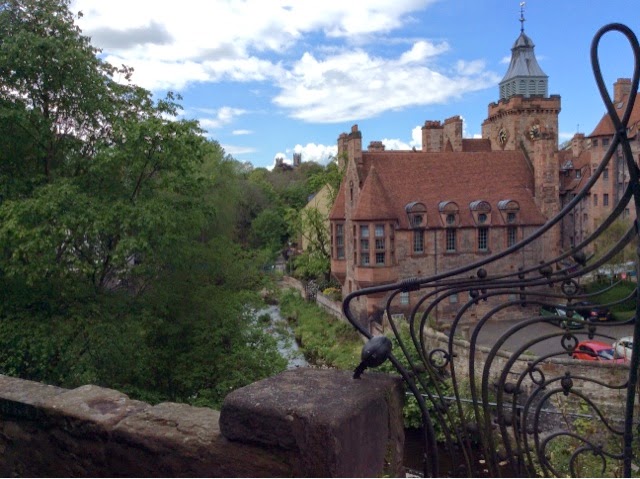
I’ve been wandering Edinburgh all day to say goodbye to the city, and started by walking the length of the Water of Leith again, from Murrayfield Stadium to Canonmills this time; I’ll be adding some more pictures to my photojournal of that lovely place.

Then I pop by the Scottish National Portrait Gallery, since it’s on my way to the bus stop where I’m to transfer. I had forgotten to take a picture of the sculptures of David Hume and Adam Smith that adorn the southeast tower (which I’ll be adding to my account of that day), and I chat a bit with Sarah at the information desk, such a sweet woman!

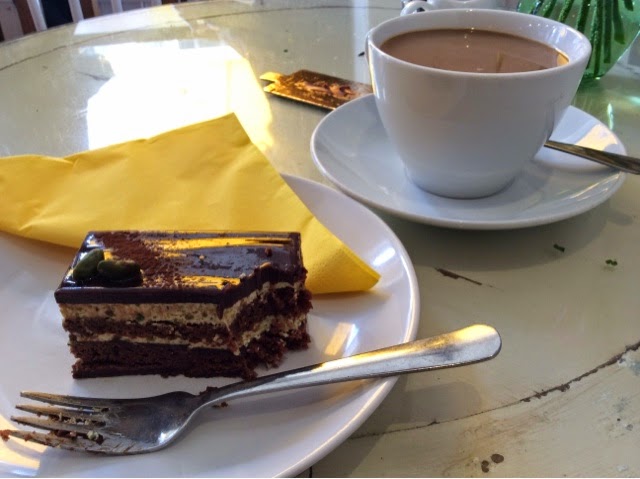
I return to Easter Road to a wonderful bakery called The Manna House, a new favorite haunt, where I celebrate with a piece of chocolate pistachio opera cake and a creamy coffee. If you ever come to Edinburgh, be sure to come here, everything they make is as delicious as it is pretty.

Then over to Calton Hill, to say farewell to the mortal remains of the great thinker I came here to discover in his hometown. As anyone would in my place, I feel  deeply moved, my chest tight, my eyes prickly. Is there someone you deeply admire, where you’ve often felt that bittersweet ache that you so wish you could meet them, knowing you never could except through the artifacts, and more importantly, the words and ideas, they left behind?  Then you know how I’m feeling just now.
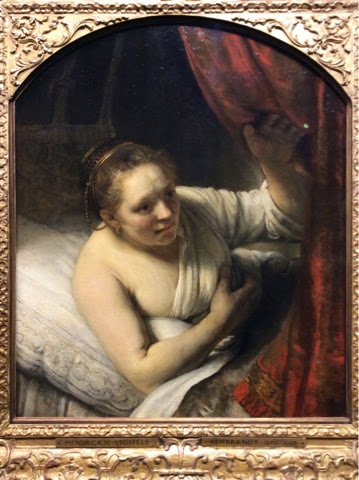
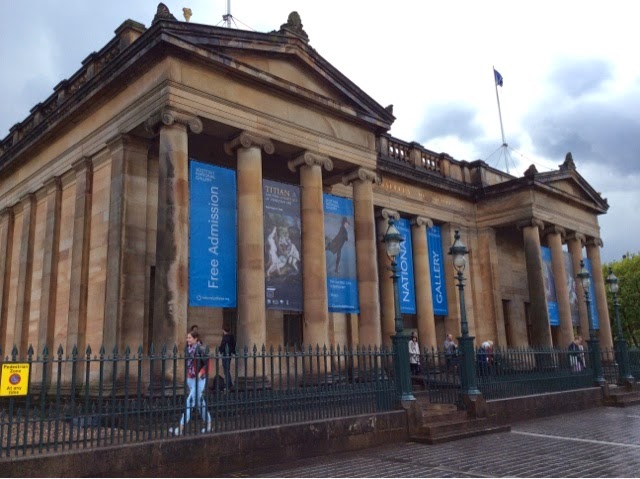
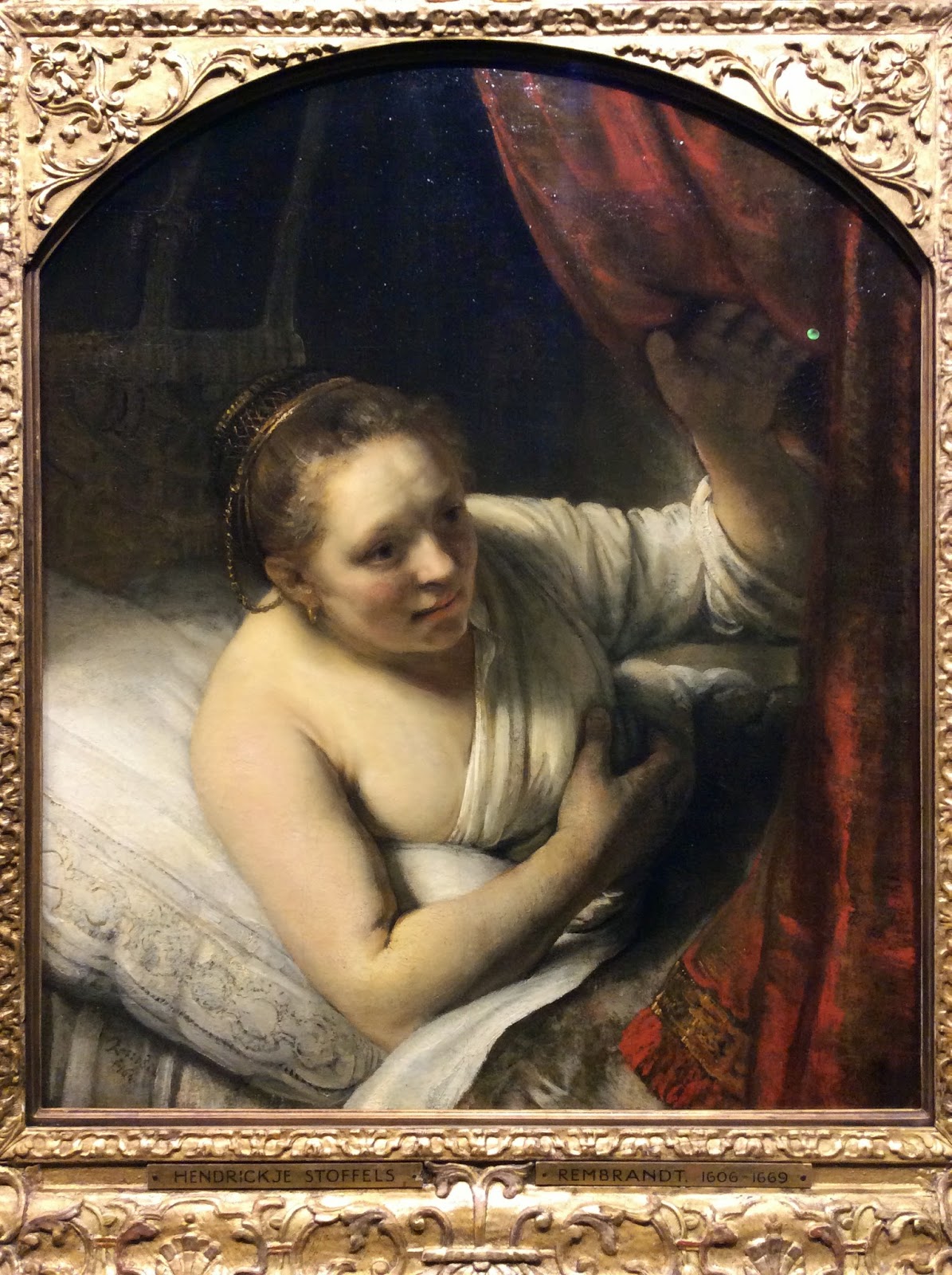
Then to the Scottish National Gallery (not to be confused with National Portrait Gallery) home to some of the great masterpieces of the world. I discover that one of my very favorite Rembrandt paintings here! That cheers me up quite a bit.

About ten minutes after I go inside, I hear the rain start to pour, and see the lightning flash through the skylight. I decide this would be a good place to linger ’till they close at five. And as soon as I leave, the rain abruptly stops, and I’m greeted to this spectacular sky again:
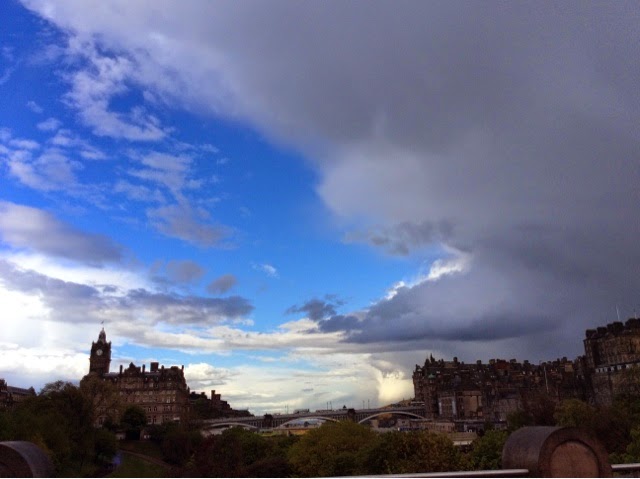

What a nice place Scotland is in May! The weather is changeable and keeps you on your toes, but it’s exciting in its variety. And I realize I just can’t bring myself to go back to the library and research and write anymore, as much as I intended to. I just have to walk around the city as much as I can in the time I have left, and besides, I’ve gathered a lot of material at this point. More to come on that.

Which brings me again to where I am, the first Hume site I came across when I got here: he lived somewhere in James Court with his sister for a number of years (as I mentioned in my first blog post). I think this was his second house in Edinburgh he lived in as an adult, after his Riddle’s Court sojourn.

Soon, I’ll be having dinner with my kind and friendly hosts, Adam and Krystallenia, and early in the morning getting on a plane to return to my loving husband, my family and friends, and my beautiful California. And as soon as I can, I’ll be back, next time with my Bryan.

Ordinary Philosophy and its Traveling Philosophy / History of Ideas series is a labor of love and ad-free, entirely supported by patrons and readers like you. Please offer your support today!
~~~~~~~~~~~~~~~~~~~~~~~~

What is a ‘Natural’ Medicine, Anyway?

I’ve often found that many people aren’t aware of the difference between herbal medicines and homeopathic remedies, perhaps because these terms have come to be used more and more interchangeably. There are many herbal, or ‘natural’, medicines, that are proven to work for many conditions: aspirin, quinine, ginger, marijuana, and so on. Homeopathy refers to nothing of this sort. Rather, homeopathy makes two claims: 1. like cures like (for example, a substance that makes a stomach ache will also cure it) as long as it’s greatly diluted, and 2. water has a ‘memory’, and it can be ‘imprinted’ by adding such a substance to it. Neither of these claims can be substantiated by any scientific means, and to my mind, they’re preposterous.

Homeopathic businesses, just like peddlers of many other ‘natural’ cures, wish to remain immune from demonstrating, through studies and testing, that they actually work and are not harmful. Yet they are both multi-billion dollar industries with the potential to do massive harm. To my mind, their efforts to remain immune from regulation and oversight are just as corrupt as those of some pharmaceutical companies and other industries that seek to shield themselves from public accountability. There are other ‘natural’ medicines which are proven to work, offered by honest practitioners who care enough to demonstrate effectiveness, that the health-conscious consumer can opt for instead.

I use the word ‘natural’ in quotes because I think there’s something odd about qualifying certain medicines as natural, and some as not. Since I don’t believe in anything ‘supernatural’, by default, everything is natural. The difference between all these medicines, then, is whether they’re effective or not, or whether they’re harmful or not.

~ This little essay is a reflection inspired by Jerry Coyne’s article ‘Why Do Liberals Tolerate Pseudoscience at Whole Foods?

The Value of a Liberal Education, and Two Risks of an Ideologically Narrow One

I grew up in a large, pretty close-knit extended family. There was a lot of dysfunction, as with many families, but a lot of love too. While I was often frustrated by the choices of some relatives (such as the tendency to enable bad behavior by sheltering the ‘sinner’ from consequences, or pretending it wasn’t happening), I was also secure in the knowledge that I belonged to a large, loving circle of people who would never abandon each other.

We were also a very insular family. We mostly hung out with each other and a few close family friends, pretty much all from church and pretty much all holding similar beliefs. Many of us kids, especially the older ones, had little contact with people outside of family and church. Many of us were (and some still are) home-schooled with a very conservative, fundamentalist Catholic curriculum, and many others attended all or mostly religious schools.

Given the state of much of the public school system, at least in the working class neighborhoods where many of us grew up, a part of me sympathizes with this choice. American public schools often leave much to be desired, to say the least. Since we have such a rotten system in America of funding public schools, with funding determined by the local tax base, we create a classist school system where the kids who need the most help don’t get the funding. So much for the non-aristocratic, egalitarian, freedom-of-opportunity ideal of America! But I digress…

But it seemed that the choice to limit our schooling to a strict Catholicism-centric education was usually based less on the concern with education quality as on a concern with raising children to replicate their parent’s beliefs and lifestyles. This makes sense in a certain way: parents want what’s best for their children, and people generally believe their own beliefs are the best, so, it’s logical parents want their children to believe and live as the parents see fit.

But here’s the way in which that doesn’t make sense: children are not replicants of their parents. They have their own thoughts, their own personalities, and their own sets of experiences. The world is full of different beliefs systems and lifestyles, often incompatible with those of the parents, that fulfill people, that suit them and make them happy. Every child, however they were raised, will inevitably confront that fact, and in today’s world of rapid, comprehensive access to data from all over the world, it will not take long.

Many parents recognize these facts, and are comfortable raising their children in a cosmopolitan fashion.

They want to equip their children with all the information they might require to navigate the world successfully in any community they may end up being a part of. To this end, they want children to truly understand not only their own beliefs, but the beliefs of others. While these parents may explain to their children why they think their own beliefs are better, they know that understanding the alternatives strengthens their capacity for critical thought. These patents also understand that their children should be comfortable interacting with people who believe and behave differently than they do, and familiarity with other faiths and cultures is the best way to accomplish this. Last but not least, these parents have the epistemic humility to admit that there’s a possibility that they are wrong, and they want to afford their children the opportunity to discover for themselves if that’s the case.

Such wise parents would agree, as I do, with Daniel Dennett, the philosopher who promotes the idea that a study of world religions should be a basic part of childhood education. Since religion is so central to both private and public life for most inhabitants of the world, he argues, children require this information to be wise and informed citizens. I think the same applies to science, politics, history, literature, and other disciplines relating to how people go about sharing, navigating, and understanding this world together.

For those parents who insist on providing an ideologically narrow education for their children, I’d ask them to consider this questions: when children grow up and confront different beliefs, customs, and lifestyles for the first time, as they inevitably will, what happens? What happens, for example, to the child of Biblical fundamentalists who finds out that almost all scientists, besides the half-dozen quoted in their textbooks, believe the Earth is billions of years old? Or that prayer doesn’t, statistically, prove to be effective in healing people? Or that people of other belief systems often live as harmonious, happy, fulfilled, ‘blessed’ lives as they do? Or even better? What happens to the barely educated woman, married off in her early teens and taught to be submissive to her husband, when she discovers that other women have the opportunity enjoy a rich intellectual life, a successful career, or a partnership with a spouse that respects her as an independent person?
For some children educated in this narrow way, whether their parents’ intentions were benign or otherwise, they will mostly reject alternative beliefs and ideas they come across out of hand. (‘That can’t be true, Dad would never lie to me.’ ‘I feel deep in my heart I know the truth, so I don’t need to question it.’ ‘Those poor Buddhists, they didn’t learn about Jesus. When they do, then they’ll truly be happy.’ ‘That’s the Devil talking, better not listen or I’ll be tortured in hell.’ ‘Liberals don’t believe in anything, but I do, so they must not have anything of value to say.’ ‘Environmentalists should just trust God instead of the government to protect the earth.’) They will grow up to more or less replicate the lives of their parents, happy in the security of knowing that they know the truth, what life’s really all about.
Others (I think very much a minority, but some) will thoroughly question the beliefs they were raised with in light of new ideas they’ve confronted, and in the end retain their parents’ beliefs because, to them, those beliefs ‘held up’ to the scrutiny. They might make some modifications here and there, but overall, stay convinced. These few are among the happiest of people, even happier than the unquestioning believers, I think, because they enjoy not only a sense of security in their beliefs, but intellectual satisfaction.

Still others will end up with a smorgasbord of beliefs, considering some sacred and unquestionable, discarding others, and adopting new ones. (Conservative Catholics derisively call others ‘cafeteria Catholics’ for engaging in this sort of picking and choosing.)

Many more will engage in ‘doublethink’, holding two or more contradictory beliefs at the same time. To take another example from the religion of my childhood, one might believe that it’s ‘spiritually true’ that the body and blood of Jesus is present in the eucharistic wafer, but also believe it’s scientifically impossible for a thing to have all the qualities of bread while simultaneously being composed of human tissue. (The psychological phenomenon of cognitive dissonance, how pervasive it is and the ways we deal with it, is discussed thoroughly and fascinatingly in Carol Tavris and Elliot Aronson’s book Mistakes Were Made, but Not By Me. I highly, highly recommend it.)

But there are two big risks for the hopeful yet, I think, misguided parents who seeks to shelter their children from knowledge that could contradict their own cherished beliefs. And I think parents would do well to consider these risks carefully before embarking on this project of transforming education into something more akin to indoctrination.
Risk #1: Your children might grow up to challenge you on your perceived deception. They will ask: What did you have to hide? Why did you feel you had to shelter me from thinking through these matters in an informed way? If what you taught me was really, evidently true, than why did you go to such lengths to keep me from learning about opposing ideas? And why would you undermine my ability to defend the beliefs you wanted to pass on, by keeping me ignorant of the challenges to those beliefs?
I went through that process myself, resenting my education which as narrow and limited until I took it into my own hands and chose a public college rather then the very conservative one my family would choose for me. Initially, I questioned the motives of my family, and was very angry that I was years behind in many subjects, especially science and history. Over time, I’ve come to realize that it was their tactics, not their motivations, that were at fault. But the damage had been done.

Risk #2: But by fair the largest danger is raising children with the potential to be bigots, even violent ones. While most children brought up to strictly conform to the beliefs of their parents will not turn out that way, of course, too many do. Consider this: what inspires oppression, warfare, and terrorists attacks? They come from the ideologically ‘pure’, from those who think it’s their job to make sure the world conforms to their ideology, from religious dogmatism to racial ideology to political utopianism. And the more isolated people are in their minds from the ideas and beliefs of others, the more sure, the more committed they are, that they are right, so everyone else must be wrong. And if others are wrong, if they are different, they are the enemy.

Since people are rarely convinced to convert to a whole new set of beliefs overnight, the ideologue often resorts to violence as a means of forcibly imposing those beliefs. Ironically, violence, though a popular tool
throughout history for trying to impose change, it’s the least effective, as psychologist Steven Pinker and other researchers reveal. To this day, religiously and politically motivated terror attacks and assassinations continue to make headlines.

Yet despite this, things on that front are getting better all the time. I recently heard Pete Seeger say, pertaining to the environment, that the world will be saved by people working in their communities. I think the world will also be saved by children who grow up in this new era where information about the world is not so easily hidden from them. Despite some parent’s best efforts, children can no longer so easily be sheltered in little bubbles of idealized ignorance, sentimentally dubbed ‘innocence’. Since information flows so freely, children now grow up exposed to media that brings others’ experiences so vividly to life, and are now more comfortable in the presence of people who look and think differently then they do. Familiarity with ‘others’ humanizes them, and communities will come to be determined mostly by shared interests, not by geographic location or ideological isolationism.

So parents, teach your children not only how to be good people, but to be informed citizens of the world. It will be a safer and more wondrous place for them and their progeny, and I bet they’ll thank you for it.

Happy Thomas Paine’s Birthday!

It’s January 29th, the date commonly chosen to commemorate the birth of the great freethinker and author of the American revolution, Thomas Paine. (His exact birthdate is unknown.) Paine offered eloquent political and moral arguments in support of the colonies’ right to break away and form independent states, using ordinary language accessible to all. He probably did more than any other individual to rally popular support to that cause. But Paine not only offered compelling arguments in favor of freedom from tyranny in politics: he was a staunch deist and opponent of religion, and considered the clergy as oppressive as any monarch could be.

Paine, whom Theodore Roosevelt once referred to as a ‘filthy little atheist’ died in poverty and obscurity, yet many of us quote him frequently without even knowing it. He shared with Thomas Jefferson the uncanny ability to encapsulate ideas into perfectly turned phrases so well, that they remain in common usage today.

If you’re intrigued, find out more about Thomas Paine here
http://plato.stanford.edu/entries/paine/
here,
http://en.wikipedia.org/wiki/Thomas_Paine
and, very briefly, here
http://www.npr.org/templates/story/story.php?storyId=1592233

The Debate Over Motherhood, and the Human Family. Or, To Have or to Have Not…

…children, that is.

Over the last year, it seems, there’s been a deluge of essays, articles, and other works about the decision of whether or not to have children. The Time cover story on ‘The Childfree Life‘ kicked off quite a bit of controversy, as well as some applause. Many were thrilled to have their choice not to have children finally presented in a positive light in such an influential publication, but many found it distasteful and even insulting. Others, such as Melanie Notkin, criticized the article, in this case not for what it promoted or criticized, but for containing too many assumptions and misinterpretations.

So here’s another take on the subject, from a fond auntie from a very large extended family, who chooses not to have children.

So why all the fuss? Why are we still arguing over all this in a time and place where women, generally, have the right their own persons, to say no to sex, to pursue careers, to engage fully in public and political life?

Although birth control has now been widely and cheaply available for decades, it’s clear that we’re not yet comfortable with our newfound ability to enjoy our sexuality while simultaneously controlling our reproduction. We haven’t yet decided what this means for us. What are the ramifications, economically, morally, legally? Will we be better off overall, or not? Are we to be frightened that people will stop valuing parenthood as a worthy choice, if remaining childless is considered just as good? Or are we to rejoice that the human race may slow its population growth to a sustainable level?

Mark Driscoll is a ‘celebrity’ pastor from the Seattle area, whose view of the whole birth control issue is not positive, to say the least. His essay ‘Who’s Afraid of Pregnant Women?’ first appeared in the ‘On Faith’ blog in December 2013 (now found on FaithStreet). Driscoll’s essay conveys some of the same feeling I sense in many parents, especially women, when they write or share comments and articles that extol full-time motherhood. He expresses a feeling of beleaguerment for parents of large families, and fears that human life has become less valuable to us than other animals, that pregnant women are regularly belittled for being ‘breeders’, and that it is our godly duty to bear and raise children.

I came upon his article weeks ago, and have mulled it over several times: it stuck with me because I recognize some of his ideas and attitudes as very similar, if not identical, to those of many of my own relatives. I belong to a very large, largely conservative Catholic family, and they are huge fans of having children: my father is one of fifteen kids, my mother one of nine. I’m one out of five siblings, and as of last count, I have 70 or so first cousins. Indoor family reunions are out of the question unless we rent a large hall, and when we dance our traditional Virginia Reel, it’s quite a work-out!

I’ve always considered it great fun to be part of such a big family. I’ve had playmates and companions at hand my whole life. It’s fascinating, at family reunions, to see how various family traits pop up, reshuffled and recombined in so many ways; which traits seem to skip a generation and which do not, how a male family member might appear if they were born a woman instead (and vice versa), and so on. (With so many first cousins, the likelihood that there are more close look-a-likes evidently increases.) My extended family is, in fact, just of the sort that Driscoll extols, and is going strong.

I’m also a sucker for babies and children generally. They are adorable in their smallness, with their squeaky voices, their quirky and often hilarious pronunciations and turns of phrase as they learn to speak, in their toddling walk, in their displays of newly acquired, unexpected, and impressive intelligence, and in so many other ways. Of course, I tend to see them at their best: rarely at bedtime, or sick, or throwing tantrums. I see them when they’re on vacation or when they’re excited at the prospect of playing with a visiting auntie (or cousin, or family friend) who’s not worn out from childcare, and who’s easily manipulated into lenience.

So it’s natural that though I’ve chosen not to have children, I wonder once in a while if I’m missing out on something I would actually enjoy, just as I do with other big life choices of the sort where if I choose one thing, it necessarily excludes another. I’ve noticed that many people who choose not to be parents, especially women, are torn, while others feel quite strongly that choosing childlessness is right for them. Having children is a huge responsibility, presents many risks and challenges, and requires giving up one’s current lifestyle, so parenthood appears daunting and even downright unattractive for many. But when it comes to what Mark Driscoll describes as a general modern attitude of ‘contempt for motherhood, I just don’t know what he’s talking about.

I happen to be of an age, my later 30’s, when it’s common to start having children these days, especially where I live, the San Francisco Bay Area. It’s also a place where parenting is a popular choice, despite Driscoll’s claims. I’ll use the place I live as an example, though I suspect that the same is true for other coastal, more urban areas of the US as well, if my friends and acquaintances, media and popular TV shows are any indication. At the same time, it’s true that there’s a comparatively lower birth rate in San Francisco and other large cities than in the US overall. Driscoll attributes this comparatively low birth rate to his ‘contempt for motherhood’ theory, but I don’t think his assumptions are correct.

To begin with, SF proper is an incredibly expensive place to live. When city people have established their careers and met their partners, generally, they move to the suburbs or some smaller town to have their kids, if they haven’t struck it rich and can afford to stay. What I don’t find is that people, generally, love animals to the exclusion of kids. Pets are affordable companions, and need relatively little space, perfect for small city apartments and roommate situations. But children need room, and time, and money for college if you can afford it, so you wait to have them until you have a good job and money put aside.

If you spend much time in the Bay Area, especially as a woman, you find out very quickly, and have it impressed upon you very regularly, that many women here are enthusiastic mothers. They promote the parenting lifestyle vigorously (albeit a particular pure-food-centric, small-family, hands-on, ‘sustainable’ style). The joyous new mothers I know now look at me askance when I answer their inevitable ‘So, when are you having a baby?’ in the negative. After a doubtful pause, sometimes they say, unconvinced by their own words, ‘Well, it’s not for everyone.’ But more often, a knowing nod: ‘…when that clock starts ticking…’ Who knows, perhaps I have a very, very slow clock! Which has been getting slower by the year…..

The whole ‘breeder’ as an expression of contempt-for-mothers thing that Driscoll complains of, I’ll pass over lightly. It’s a tongue-in-cheek term, a response to the eons of dismissiveness and denigration of the gay community as so-called destroyers of the family. (Weird. My gay relatives didn’t in the least bit interfere with the considerable fecundity of my extended family.) The point of that wry, joking term is to criticize the very idea of valuing a human person only in light of their birthing potential, rather than for their own sake as a human being. Yes, the term may be adopted by some who are critical of the decision to have large families in a world where not all kids who are born are cared for, but that’s generally because they see that choice as unsustainable, destructive to future generations. Whether or not you agree with their opinion on the matter, I just don’t see a logical connection to contempt for motherhood in either sense. I think Driscoll could step outside of his own sphere and experience actually talking to members of these communities to understand what they’re getting at.

Driscoll does, however, expressly reveal contempt for people who choose not to have children. He doesn’t address the reasons (other than his assumed ‘contempt’) why people make this choice, so it’s hard to know how he would argue against what would appear to most reasonable people to be excellent reasons. For some, there’s a high probability of risk to their health, as revealed by family and personal medical history. Some are poor and don’t want to give birth to children they can’t afford to feed and educate properly, and some live in dangerous or oppressive areas of the world. Some find that they can best help out their community or extended family by being more available with time and resources than they might be as parents. Some simply feel that having kids to please others, contrary to their own desires and the bent of their personalities, would be irresponsible, let alone selfish. There are many more reasons people decide not to have children, I think usually not for one, but for a variety of reasons (I am among these).

Instead, the contempt Driscoll expresses in his phrase ‘fools’ parade’ seems to be entirely Biblically based. Yet he’s he’s on shaky ground with his particularly narrow interpretations. For one, even if he’s right, that his God exists and literally commanded that humans ‘fill the earth with people’, it seems we did a really good job already, and will continue to do so even if all we did was reproduce at a replacement rate. That commandment does not logically entail that each and every person have as many children as possible, regardless of the circumstances. For another, God may be a ‘good and perfect father to millions’, it’s hard to prove otherwise. But millions of other kids, if his account is correct, are allowed by that same God to die of starvation and disease, and indiscriminate childbearing has never alleviated the problem.

Driscoll leaves no room for the idea that, as a believer in his God, you could also believe that respect for life actually entails prudent childbearing, and that if we are all part of God’s family, that means that there’s a variety of roles in that family other than parents, such as aunts, uncles, grandparents, cousins, and so forth. (While Catholics, especially, promote the big family lifestyle, they also incorporate this interpretation to some degree, with their spiritual roles of celibate ‘sisters’, ‘brothers’, and ‘fathers’.) Parents sometimes need the all-important extra help that non-parent family members are in the best position to provide, and others who wish to rear children but not give birth, such as many gay parents, adopt those children that no one else is caring for. Others invent, build, entertain, and in other ways use all their time and energy to help create a beautiful and more interesting world for all to grow up and flourish in, and so participate indirectly in raising the next generation.

Driscoll seemingly attributes his ‘contempt for motherhood’ to ‘evolutionary thinking’ (he’s not clear on this point), claiming that it leads to thinking of human beings as ‘nothing more than a particular arrangement of cells and matter’. But I fail to see how he makes this assumption, as no evolutionary thinker I’ve met, or whose work I’ve read, thinks this way.

I, too, am an evolutionary thinker, and as such, my sense of the human race as one big family is no spiritual construct, but concrete reality. As an evolutionary thinker, I think it’s absurd that Driscoll parrots that tired old trope that if you accept the scientific theory of evolution, than you must think that humans are nothing more than the sum of their parts, with no point to their existence and with no reason to be good to one another. But why would he assume this? I think it’s unlikely that someone in his position is really that ignorant of the basics of human evolution; rather, I think he feels the need to subscribe to this this false dichotomy of selfish evolutionist or generous deist in order to reach his desired conclusion.

Morality, empathy, altruism: all are key components of human psychology, and they are the very reasons why we are an evolutionary success story. The ‘inevitable’ evils he attributes to evolutionary thinkers, such as genocide and isolation, are directly contrary to the story of how we evolved as one of the most complex, highly social species the world has ever seen. Most other species do not have the same sense of care towards one another as we do, and that’s because most require relatively little cooperation, if any, for their survival, with their short reproductive cycles, sharp teeth, strong limbs, exoskeletons, and so on. Without cooperation, a strong sense of fairness, empathy, and high regard for human life, the few human beings that exist would live lives that are ‘solitary, poor, nasty, brutish, and short‘… in fact, we would not be identifiable as human beings at all.