Why We Need Citizen Philosophers

a184d-woman2bwriting2c2bgerard2bter2bborch2b5bpublic2bdomain5d2c2bvia2bwikimedia2bcommonsI am a citizen philosopher, and very likely, so are you.

So what is citizen philosophy, why is it a useful concept, and what is its role in the world?

Let’s begin by considering what we mean by philosophy, generally speaking. For a long time, philosophy has been considered an almost exclusively academic pursuit, so highly specialized that only a very few experts can properly be called philosophers. As Eric Schwitzgebel points out, this is a relatively new development. In the Western world, it traces its origins to classical Greece; each region has its own history of philosophy or its analog, from Egypt to China to the Americas, indeed, the whole world. As with all fields of inquiry, philosophy has branched out and specialized until much of it would be barely comprehensible to its first practitioners. Indeed, almost all fields of inquiry we know today started out as a branch of philosophy: mathematics, logic, science, medicine, theology, you name it.

But philosophy, or ‘love of wisdom’, began in the home, the workplace, the market square, and the street corner. As agriculture became more advanced, curious and intelligent people had more time to ponder the whys and hows of the natural world and human experience. These people weren’t originally chosen or designated by some authority as the ‘thinkers’ as opposed to everyone else, the ‘doers’. Instead, philosophy naturally grew out of conversation. Over time, as questions and ideas advanced and grew more numerous, it also specialized, organically, over time. A branch here dedicated itself to figuring out how nature works, first under the name natural philosophy, later science, which branched further into biology, geology, physics, and so on. A branch there dedicated itself to figuring out how we should behave and what we should value, and now we have political theory, aesthetics (study of beauty and taste), bioethics (ethics in medicine), theology, and so on. We began to ask and answer ever more complex questions about how to best live as members of societies, what’s going on within our own minds and why, what are our roles in the universe, and what it all means… including the question ‘what is meaning?’. Over time, certain people were recognized as particularly good at asking and answering these important questions, so they came to be recognized as specialists and authorities. But philosophy, broadly construed, remained a pursuit of many more people than that.

Panthéon, Temple of Reason, Paris, France, Photo 2015 by Amy CoolsPhilosophy has been demystified by re-entering popular culture to a significant extent. There’s an ever-growing audience for popular philosophy books, articles, magazines, podcasts, and blogs. The term itself has also been re-broadened. ‘Philosophy’ has taken on many new shades of meaning as it’s now used to refer to a particular view of life, or personal standards of taste, or set of hopes and dreams, or working theory of knowledge, or organization method, or substitution for the loaded term ‘spiritual’ …even a brand of skin care products! (This one bothers me: it offends my sense of the ‘sacred’ by capitalizing on respect for something I believe shouldn’t be and, and really can’t be, bought and sold.) Some of its newfound popularity is the result of advancing secularization accompanied by our continuing need for meaningfulness. Some is the result of our newly data-centric lives brought to us by the internet, creating the need to make sense of the deluge of new information available to us. And some is the result of the meeting, blending, annexing, and clashing of cultures in a world ever more connected through media and ease of travel, creating the need to find new ways of communicating and living together in an ever more cosmopolitan world.

In short, philosophy is enjoying a comeback in the public sphere. What I’m calling citizen philosophers are all those actively, consistently ask and answer questions about the nature of the universe and how to make sense of our experiences in it, and who aren’t necessarily engaged in professional or academic philosophy. While citizen philosophers tend to spend a lot of time in inquiry and self-education, many find academic philosophy too arcane, too subtle and obscure to help the rest of us navigate our increasingly complex inner and interpersonal lives.

I, for one, love academic philosophy. I am continuously in awe of the work these men and women do, devoting their lives to hard study, to asking the most challenging questions, and to a deep examination of the most nuanced and complex problems. This body of work is breathtaking in its scope, beautiful in the elegance of its arguments and solutions, satisfying in its wit and cleverness, fascinating in its intensive scholarship, and indispensable in its ability to help us figure out why and how to make a better world. I find it highly enjoyable and fulfilling, as well as challenging and frustrating, to grasp and wrangle with the work of academic philosophers. To be sure, academic philosophy has had its share of what David Hume calls ‘sophistry and illusion, fit only to be consigned to the flames’, and what Harry Frankfort more succinctly calls ‘bullshit’. But philosophy is not alone in this: science has had its phrenology and eugenics, medicine its humours and bloodletting, theology its justification for slavery and pogroms, and so on. Like these other disciplines, academic philosophy has some wonderfully effective built-in self-correctors, and continues to be an essential, I think preeminent, field of inquiry.
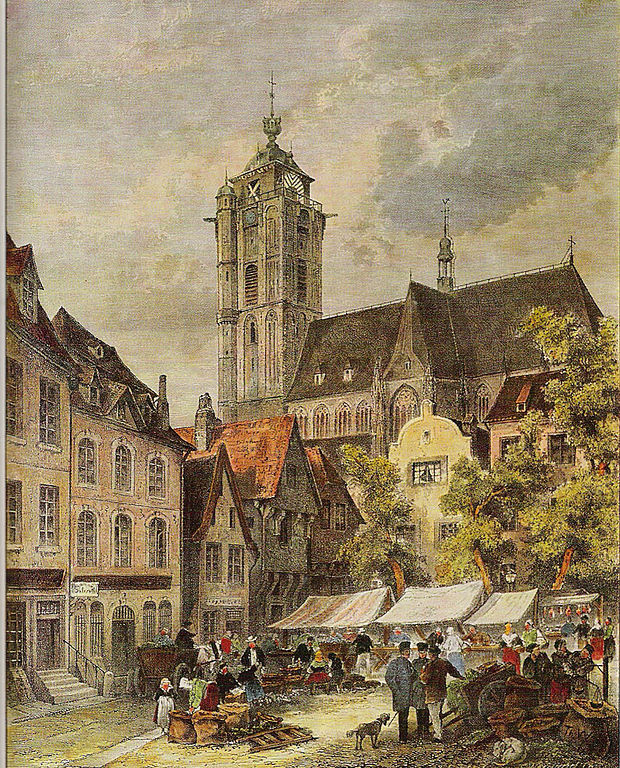
Marketplace in Duisburg by Theodor Weber, 1850, Public Domain via Wikimedia CommonsBut many of the most important and interesting questions don’t come down to us from on high, so to speak, originating from academia and revealed as if a sort of holy writ. In fact, most of the questions and problems we all wrangle with still originate in the public sphere, in the home, workplace, classroom, hospital, church, courtroom, political assembly, and so on. They bubble up from the challenges and uncertainties of our daily lives, are filtered through conversation and the arts, are swept up in social, legal, and political movements and institutions, and carried into the pool of academic philosophy, where they are further clarified and distilled in treatises, lectures, books, and so on.

And these questions don’t only originate with the public at large, we offer our first answers there. The answers range from fragmentary to nuanced, from intuitive to well-considered, from repetitions of received wisdom to original, from off-the-cuff to well-informed. They’re offered by people from all walks of life with their own areas of expertise and unique capabilities of understanding born of particular experience. These citizen philosophers are on the first line of discovery and inquiry, and called so because they don’t participate in this process as a profession, but as a matter of personal interest and as members of society at large, not subject to the demands and constraints of academic philosophy. Of course, the category of ‘citizen philosopher’ doesn’t exclude academic philosophers, because of course they, too, participate in the same process of question-creation and question-answering in the course of their everyday lives as well as in academia.

It’s the very lack of the demands and constraints of academic philosophy that gives citizen philosophy an important role to play in the public life. The world as it is offers so many varieties of human experience, so many ways of seeing the world, so many challenges that academic philosophers, like the rest of us, never have the opportunity to confront directly. Yet the scope of academic philosophy, at least potentially, is as broad as the possibilities of human (even, perhaps nonhuman?) experience. So how can it be that academic philosophers can possibly access enough information, and consider things from enough perspectives, to ask and answer all the important questions that could be addressed? If academic philosophers were endowed with almost limitless powers of comprehension and imagination, they might in theory take in all the available information  and then truly understand what it’s like to be a coal miner in China, a cardiologist experiencing a heart attack firsthand, a one and a half year old who just created their first sentence, a person with frontal lobe epilepsy experiencing a supernatural vision, or a terrorist who became so after their entire family was killed by a bomb, and then conceive of all of the social, epistemic (relating to the study of knowledge), metaphysical (relating to the ultimate nature of all that exists), political, and every other sort of questions that may arise from these experiences. (À la the mythical Mary in Frank Jackson’s black and white room.) But of course, this is impossible in the real world. Sometimes, raw data is the fodder of academic philosophical inquiry. But more often I think, academic philosophers inquire into the questions, morals, stories, works of art, aphorisms, dogmas, memories, narratives, and all other products of the human mind after they’ve undergone the first round of questioning and examination in the public square.
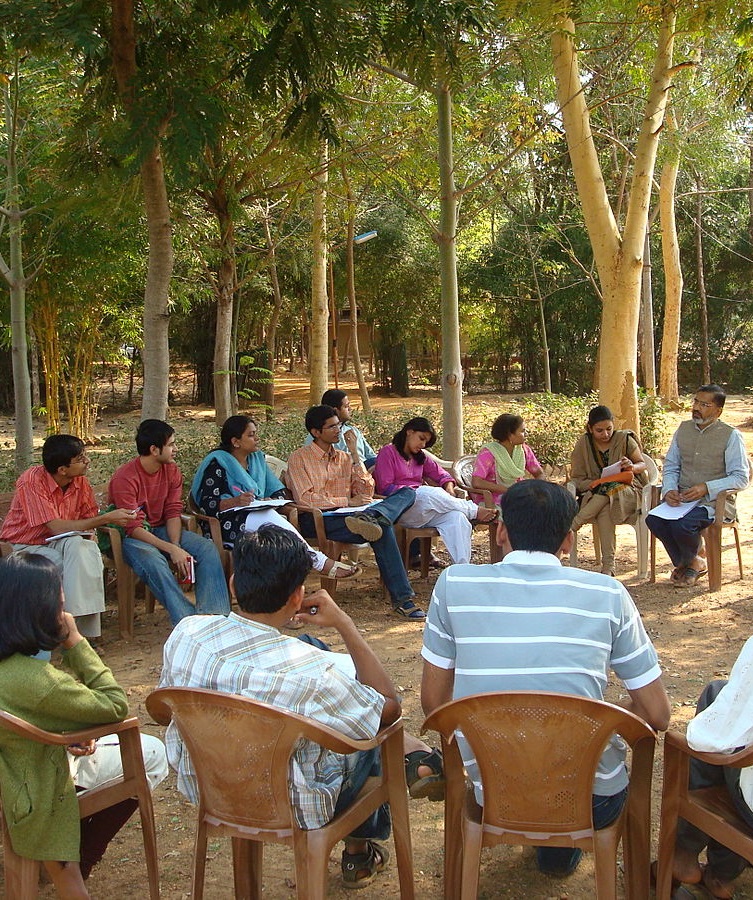
Group discussion in the camps of Nirman (cropped), by Abhijeet Safai, Public Domain via Wikimedia CommonsI, for one, am glad to see philosophy ever more present in the public square. That’s because I perceive philosophy as the great quest for understanding that academic and citizen philosophers all engage in, and, as I see it, each gives something of immeasurable and irreplaceable value to the other. We need only recall some philosophical forays that have failed, from scholastic hairsplitting quibbles to postmodern navel-gazing-verging-on-masturbatory obscurantisms, to recognize that academic philosophy benefits enormously by its give and take with the public square. To remain relevant, honest, exciting, and dedicated to truth and beauty, philosophy as a method of inquiry must include robust discourse with the broader community of activists, artists, reporters, bloggers, protesters, workers, political actors, discussion groups, and all who care enough to question. And these, in turn, are kept honest by academic philosophers, who challenge all of us to subject our passionately held convictions to critical thinking.

The discipline and expertise of academic philosophers, and the broader set of experiences, challenges, and opportunities for new questions and unique ways of understanding the larger community that citizen philosophers offer, each serve to keep the other more honest, more challenged, and more informed, in the great world conversation we’re all having.

~ An earlier version is also published at Ordinary Philosophy and published in Darrow in a version nearly identical to this one. My thanks to Darrow’s editors for their very helpful comments, critiques, and suggestions, especially in pointing out that the original version often read more like an obscure academic philosophy piece and less like the conversation in the public square it promotes!

~ Also published in The Fifth Floor Polish philosophy magazine

Ordinary Philosophy and its Traveling Philosophy / History of Ideas series is a labor of love and is ad-free, supported by patrons and readers like you. Please offer your support today!

~~~~~~~~~~~~~~~~~~~~~~~~~~~~~~~~~~~

Sources and inspiration:

‘Mary’s Room’, in Philosophy Index

Schwitzgebel, Eric. ‘What Philosophical Work Could Be‘. Published in Ordinary Philosophy and in the author’s own The Splintered Mind
Aristotle’s Tomb Found?

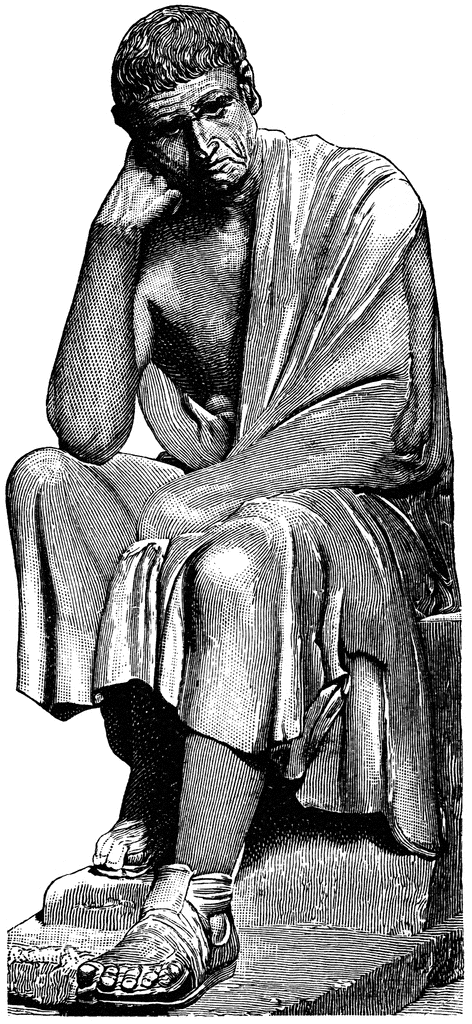
27f5e-69729_aristotle_lgSo there’s been all this buzz the last couple of days about the possible discovery of Aristotle’s tomb. Here’s the New York Times on the story:

‘A Greek archaeologist who has been leading a 20-year excavation in northern Greece said on Thursday that he believed he had unearthed the tomb of Aristotle.

In an address at a conference in Thessaloniki, Greece, commemorating the 2,400th anniversary of Aristotle’s birth, the archaeologist, Konstantinos Sismanidis, said he had “no proof but strong indications, as certain as one can be,” to support his claim.

The tomb was in a structure unearthed in the ancient village of Stagira, where Aristotle was born, about 40 miles east of Thessaloniki. According to Mr. Sismanidis, the structure was a monument erected in Aristotle’s honor after his death in 322 B.C….’

I really hope it’s true!

In case you haven’t encountered Aristotle much, here’s a good introduction to his life and thought at the Internet Encyclopedia of Philosophy:

‘Aristotle is a towering figure in ancient Greek philosophy, making contributions to logic, metaphysics, mathematics, physics, biology, botany, ethics, politics, agriculture, medicine, dance and theatre. He was a student of Plato who in turn studied under Socrates. He was more empirically-minded than Plato or Socrates and is famous for rejecting Plato’s theory of forms.

As a prolific writer and polymath, Aristotle radically transformed most, if not all, areas of knowledge he touched. It is no wonder that Aquinas referred to him simply as “The Philosopher.”…’

Ordinary Philosophy and its Traveling Philosophy / History of Ideas series is a labor of love and ad-free, entirely supported by patrons and readers like you. Please offer your support today!

~~~~~~~~~~~~~~~~~~~~~~~~~~~~~

Sources and Inspiration:

Aristotle‘, in the Internet Encyclopedia of Philosophy

Kitsantonismay, Niki. ‘Greek Archaeologist Says He Has Found Aristotle’s Tomb‘. The New York Times (online), May 26, 2016

Happy Birthday, John Stuart Mill!

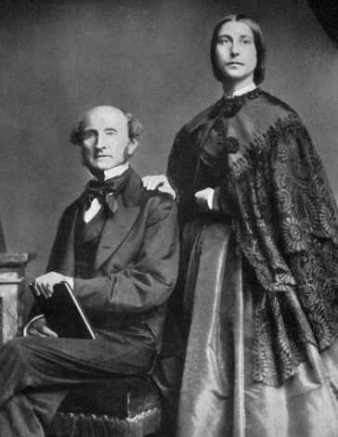
John Stuart Mill and Helen Taylor, daughter of Harriet Taylor, collaborated with Mill after her mother's death, public domain via Wikimedia CommonsOne of my very favorite ideas in political philosophy is John Stuart Mill’s ‘marketplace of ideas’ (though he didn’t phrase it this way himself): that the free, open, and vigorous exchange of ideas in the public square does more to further human knowledge than anything else. But not only has his comprehensive and to my mind, absolutely correct defense of free speech in his great work On Liberty had an immense and beneficial influence on the history and theory of human rights, he was admirable in myriad other ways as well:
‘Mill believed in complete equality between the sexes, not just women’s colleges and, someday, female suffrage but absolute parity; he believed in equal process for all, the end of slavery, votes for the working classes, and the right to birth control (he was arrested at seventeen for helping poor people obtain contraception), and in the common intelligence of all the races of mankind… all this along with an intelligent acceptance of the free market as an engine of prosperity and a desire to see its excesses and inequalities curbed…. Mill was an enemy of religious bigotry and superstition, and a friend of toleration and free thought, without overdoing either…’ ~ Adam Gopnik, from his article and book review ‘Right Again‘, 2008

‘The son of James Mill, a friend and follower of Jeremy Bentham, John Stuart Mill (1806-1873) was subjected to a rigorous education at home: he mastered English and the classical languages as a child, studied logic and philosophy extensively, read the law with John Austin, and then embarked on a thirty-five career with the British East India Company at the age of seventeen. (He also suffered through a severe bout of depression before turning twenty-one.) Despite such a rich background, Mill credited the bulk of his intellectual and personal development to his long and intimate association with Harriet Hardy Taylor. They were devoted friends for two decades before the death of her husband made it possible for them to marry in 1852; she died in Avignon six years later. Mill continued to write and to participate in political affairs, serving one term in Parliament (1865-68). The best source of information about Mill’s life is his own Autobiography (1873). Mill

Philosophically, Mill was a radical empiricist who held that all human knowledge, including even mathematics and logic, is derived by generalization from sensory experience. In A System of Logic, Ratiocinative and Inductive (1843) he explained in great detail the canons for reasoning inductively to conclusions about the causal connections exhibited in the natural world.

Mill’s moral philosophy was a modified version of the utilitarian theory he had learned from his father and Bentham. In the polemical Utilitarianism (1861) Mill developed a systematic statement of utilitarian ethical theory. He modified and defended the general principle that right actions are those that tend to produce the greatest happiness of the greatest number of people, being careful to include a distinction in the quality of the pleasures that constitute happiness. There Mill also attempted a proof of the principle of utility, explained its enforcement, and discussed its relation to a principle of justice. Mill

Mill’s greatest contribution to political theory occurs in On Liberty (1859), where he defended the broadest possible freedom of thought and expression and argued that the state can justify interference with the conduct of individual citizens only when it is clear that doing so will prevent a greater harm to others. Mill also addressed matters of social concern in Principles of Political Economy (1848) and Considerations on Representative Government (1861) and eloquently supported the cause of women’s rights in The Subjection of Women (1869).’

~ from The Philosophy Pages by Garth Kemerling, licensed under a Creative Commons Attribution-Share Alike 3.0 Unported License

Read more about John Stuart Mill:

Anschutz, Richard Paul. ‘John Stuart Mill: British Philosopher and Economist‘. In Encyclopædia Britannica.

Gopnik, Adam. ‘Right Again: The Passions of John Stuart Mill‘. New Yorker magazine website, Oct 6 2008

Heydt, Colin. ‘John Stuart Mill (1806—1873)‘, Internet Encyclopedia of Philosophy

Mill, John Stuart. On Liberty, from Project Gutenberg

Wilson, Fred. “John Stuart Mill“, The Stanford Encyclopedia of Philosophy

~ Ordinary Philosophy and its Traveling Philosophy / History of Ideas series is a labor of love and ad-free, entirely supported by patrons and readers like you. Please offer your support today!

The Philosopher’s Drinking Song

Good morning! Feeling a bit irreverent and impish today, so I’m sharing this little gem with you all. Thank you, Monty Python!

Ordinary Philosophy and its Traveling Philosophy / History of Ideas series is a labor of love and ad-free, supported by patrons and readers like you. Please offer your support today!

Happy Birthday, Bertrand Russell!

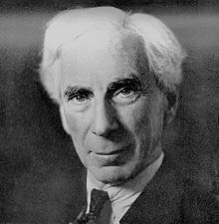
Betrand Russell in 1938, image public domain  via Wikimedia CommonsBertrand Russell lived an extraordinarily long life, in which he did an extraordinary number of extraordinary things.

Encyclopedia Britannica introduces him thusly: ‘Bertrand Russell ….born May 18, 1872, Trelleck, Monmouthshire, Wales- died Feb. 2, 1970, Penrhyndeudraeth, Merioneth, [was a] British philosopher, logician, and social reformer, founding figure in the analytic movement in Anglo-American philosophy, and recipient of the Nobel Prize for Literature in 1950. Russell’s contributions to logic, epistemology, and the philosophy of mathematics established him as one of the foremost philosophers of the 20th century. To the general public, however, he was best known as a campaigner for peace and as a popular writer on social, political, and moral subjects. During a long, productive, and often turbulent life, he published more than 70 books and about 2,000 articles, married four times, became involved in innumerable public controversies, and was honoured and reviled in almost equal measure throughout the world…’

For myself, he was particularly influential to my younger freethinking self, disenchanted with the religion of my youth and seeking new and more satisfying ways of viewing the world. I read his great History of Western Philosophy and Why I Am Not a Christian each several times over. I admire his clear, precise thinking and his principled anti-war stance which came at a significant cost, including jail time and loss of a prestigious job at the University of Chicago, and it’s always so enjoyable to watch him speak (you’ll find plenty of videos on YouTube) in his oh-so-aristocratic accent with a pipe often tucked into the corner of his mouth. He was not a perfect man, but oh man, he was never a less-than-fascinating one.

Read more about Bertrand Russell:

Bertrand Russell‘. In Encyclopedia Britannica

Irvine, Andrew David, “Bertrand Russell“, The Stanford Encyclopedia of Philosophy

~ Ordinary Philosophy and its Traveling Philosophy / History of Ideas series is a labor of love and ad-free, entirely supported by patrons and readers like you. Please offer your support today!

The Tale of the Magic Toe – Superstition? Or What?

Two years ago, I was in Edinburgh musing about what David Hume would think of people rubbing his statue’s toe for luck…

Amy M Cools's avatarOrdinary Philosophy

I attended a meeting of the Humanist Society of Scotland the other day, and some of us were chatting about my David Hume project. They recommended sites to see and people and ideas to add to my research, and I was telling them what I had seen and discovered so far. They also regaled me with some Hume anecdotes. Such a friendly group of people, so engaged with important issues of the day, and so welcoming and ready to chat and have a good time!

One thing that came up was the classical statue of Hume on the Royal Mile in Edinburgh’s Old Town. I noticed that the left toe of the statue is polished to a bright brassy shine, from the tradition of students and others rubbing it for luck, so as to absorb some of his wisdom.

Some who I was talking to laughed, as if at a friendly…

View original post 740 more words

Interview with Peter Adamson on Indian and Islamic Philosophy

OLYMPUS DIGITAL CAMERA

Listen to this podcast episode here or subscribe on iTunes

I’m honored to present my second interview guest, Peter Adamson, creator and host of the History of Philosophy Without Any Gaps podcast and Professor of Philosophy at the Munich School of Ancient Philosophy and at King’s College London. I’ve listened to his History of Philosophy podcast series for many years: it’s now almost 5 ½ years running, and if you are interested in philosophy, I’m hard pressed to think of a source that’s more comprehensive, thoughtful, and well-researched than Adamson’s.

In this interview, we focus on non-Western philosophy, specifically Indian and Islamic philosophy, since that’s his focus right now at his History of Philosophy series. We touch on Western philosophy as well, especially regarding the ways that Islamic and Indian philosophy influence and intersect with Western philosophy.

Listen to Adamson’s excellent series on the History of Philosophy (without any gaps)

and his Indian philosophy series co-authored by Jonardon Ganeri

Ordinary Philosophy and its Traveling Philosophy / History of Ideas series is a labor of love and is ad-free, entirely supported by patrons and readers like you. Please offer your support today!

Why We Need Citizen Philosophers

Writing a letter *oil on panel *39 x 29.5 cm *signed b.c.: GTB *ca. 1655I am a citizen philosopher, and very likely, so are you.

So what is citizen philosophy, why is it a useful concept, and what is its role in the world?

Let’s begin by considering what we mean by philosophy, generally speaking. For a long time, philosophy has been considered an almost exclusively academic pursuit, so highly specialized that only a very few experts can properly be called philosophers. As Eric Schwitzgebel points out, this is a relatively new development. In the Western world, it traces its origins to classical Greece; each region of the world has its own history of philosophy or its analogue, from Egypt to China to the Americas. As with all fields of inquiry, philosophy has branched out and specialized until much of it would be barely comprehensible to its first practitioners. Indeed, almost all fields of inquiry we know today started out as a branch of philosophy: mathematics, logic, science, medicine, theology, you name it.

But Philosophy, or ‘love of wisdom’, began in the home, the workplace, the market square, and the street corner with curious, intelligent people who, newly enjoying the luxury of free time accorded by advances in food-acquisition technologies, began to ponder on the whys and hows of the natural world and of the human experience. These people weren’t originally chosen or designated by some authority as the ‘thinkers’ as opposed to everyone else, the ‘doers’; instead, philosophy originated, grew, and specialized organically. We, as a species, began to ask and answer ever more complex questions about how to best live in the world as members of societies, what’s going on within our own minds and why, what are our roles in the universe, and what it all means… including the question ‘what is meaning?’. Over time, certain individuals came to be recognized as particularly adept at asking and answering these important questions, and came to be considered specialists and authorities in their fields of inquiry. But philosophy, broadly construed, remained a pursuit of many more people than that.Panthéon, Temple of Reason, Paris, France, Photo 2015 by Amy Cools

Philosophy has been demystified by re-entering popular culture, to a significant extent. There’s an ever-growing audience for popular philosophy books, articles, magazines, podcasts, and blogs. The term itself has also been re-broadened, so to speak. ‘Philosophy’ has taken on many new shades of meaning as it’s used to refer to a particular view of life, or aesthetic taste, or set of aspirations, or working theory of knowledge, or organization method, or substitution for the loaded term ‘spiritual’ …even a brand of skin care products (this one disgusts me somewhat, as it offends my aesthetic taste and sense of the ‘sacred’ by capitalizing on public respect for one of my most beloved, to me non-commodifiable things). Some of its newfound popularity is the result of advancing secularization accompanied by the desire to retain transcendence and meaning; some is the result of our newly data-centric lives brought to us by the word wide web, creating the need to make sense of the deluge of new information available to us; some is the result of the blending, annexing, and clashing of cultures in a world now widely and intimately connected through advanced media technologies and ease of travel, creating the need to find ways of communicating and living together in a world of new complexities. It’s all happening so fast that each of us is experiencing the urgency to make sense of it all right away, in a way that is practicable in our own communities and subcultures, and in a way each of us can understand and readily communicate.

In short, philosophy is enjoying a comeback in the public square. What I’m calling citizen philosophers are those who ask and answer questions there, about the nature of the universe and how to make sense of our experiences of it, who are not necessarily engaged in professional or academic philosophy. While citizen philosophers tend to spend a significant amount of time engaged in such inquiry and are motivated to educate themselves widely and systematically, many find academic philosophy too arcane and obscure to help the rest of us navigate our increasingly complex lives.

I, for one, love academic philosophy. I am continuously in awe of the work these men and women do, devoting their lives to hard study, to asking the most challenging questions, and to deep examination of the most nuanced and complex problems. This body of work is breathtaking in its scope, beautiful in the elegance of its arguments and solutions, satisfying in its wit and cleverness, fascinating in its intensive scholarship, and indispensable in its ability to help us figure out why and how to make a better world. I find it highly enjoyable and fulfilling, as well as challenging and frustrating, to grasp and wrangle with the work of academic philosophers. To be sure, academic philosophy has had its share of what David Hume calls sophistry and illusion, fit only to be consigned to the flames, and what Harry Frankfort more succinctly calls ‘bullshit’. But philosophy is not alone in this: science has had its phrenology and eugenics, medicine its humours and bloodletting, theology its justification for slavery and pogroms, and so on. Like these other disciplines, academic philosophy has some wonderfully effective built-in self-correctors, and continues to be an essential, I think preeminent, field of inquiry.

Marketplace in Duisburg by Theodor Weber, 1850, Public Domain via Wikimedia CommonsBut many of the most important and interesting questions don’t come down on us from on high, so to speak, originating from academia and revealed, as if a sort of holy writ, to the rest of us. In fact, most of the questions and problems we all wrangle with still originate in the public square, in the home, workplace, classroom, hospital, church, courtroom, political assembly, and so on. They bubble up from the challenges and uncertainties of our daily lives, are filtered through conversation and the arts, are swept up in social, legal, and political movements and institutions, and carried into the pool of academic philosophy, where they are further clarified and distilled in treatises, lectures, books, and so on.

And these questions don’t only originate with the public at large, we offer our first answers there. The answers range from fragmentary to nuanced, from intuitive to considered, from repetitions of received wisdom to original, from off-the-cuff to well-informed, by people from all walks of life with their own areas of expertise and unique capabilities of understanding born of particular experience. These citizen philosophers are on the first line of discovery and inquiry, and so called because they don’t participate in this process as a profession, but as a matter of personal interest and as a member of society at large, not subject to the demands and constraints of academic philosophy. Of course, the category of citizen philosopher does not exclude academic philosophers, because of course they, too, participate in the same process of question-creation and question-answering in the course of their everyday lives, separate from their academic pursuits.

It’s the very lack of the demands and constraints of academic philosophy that gives citizen philosophy an important role to play in public life. The world as it is offers so many varieties of human experience, so many ways of seeing the world, so many challenges that academic philosophers, like the rest of us, never have the opportunity to confront directly. Yet the scope of academic philosophy, at least potentially, is as broad as the possibilities of human (even, perhaps nonhuman?) experience. So how can it be that academic philosophers can possibly access enough information to ask and answer all the important questions that could be addressed? It may be, if academic philosophers were endowed with immense powers of comprehension and imagination that would enable them to take all the information available in the world, to truly understand what it’s like to be a coal miner in China, a cardiologist experiencing a heart attack firsthand, a one and a half year old who just created their first sentence, a person with frontal lobe epilepsy experiencing a supernatural vision, or a terrorist who became so after their entire family was killed by a bomb, and then conceive of all of the social, epistemic, metaphysical, political, and every other sort of question that may arise from these experience. (À la the mythical Mary in Frank Jackson’s black and white room.) But of course, this is impossible, as even the most intelligent and informed human mind has its limits. Sometimes, raw data is the fodder of academic philosophical inquiry. But most often, it’s the questions, moral precepts, stories, works of art, aphorisms, dogmas, memories, narratives, and all other products of the human mind, already having undergone a first round of questioning and examination, that academic philosophers take up as topics of inquiry. Group discussion in the camps of Nirman (cropped), by Abhijeet Safai, Public Domain via Wikimedia Commons

I, for one, am glad to see philosophy ever more present in the public square. That’s because I perceive philosophy as the great quest for understanding that academic and citizen philosophers all engage in, and as I see it, each gives something of immeasurable and irreplaceable value to the other. We need only recall some philosophical forays that have failed, from hairsplitting quibbles of scholasticism to navelgazing-verging-on-masturbatory obscurantisms of postmodernism, to recognize that academic philosophy benefits enormously by maintaining a robust discourse with the broader human community of activists, artists, reporters, bloggers, protesters, discussion groups, and of all others who care enough to question.  The discipline and expertise of academic philosophers, and the broader set of experiences, challenges, and opportunities for new questions and unique ways of understanding of the larger community of citizen philosophers each serve to keep the other more honest, more challenged, and more informed, in the great world conversation we’re all having.

*Listen to the podcast version here or on iTunes

Ordinary Philosophy and its Traveling Philosophy / History of Ideas series is a labor of love and is ad-free, supported by patrons and readers like you. Please offer your support today!