Is Feminism Passe? No! Cries A Distinct Lack of Statuary

Many say that the idea of ‘feminism’ is outmoded: it smacks of reverse sexism, and the women’s rights movement has pretty much accomplished its goals anyway, at least in the free world.

Why flog a dead horse, ladies?

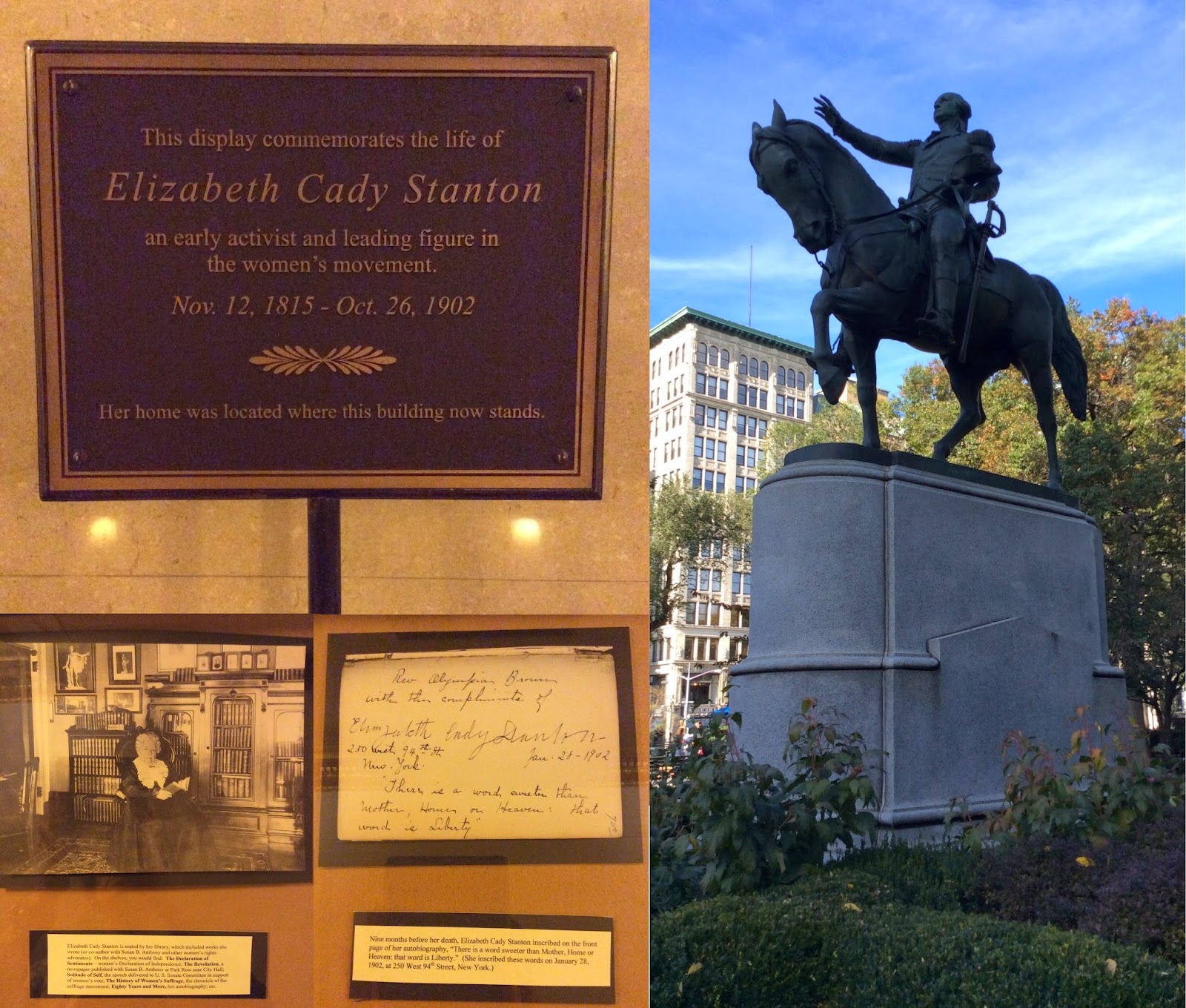
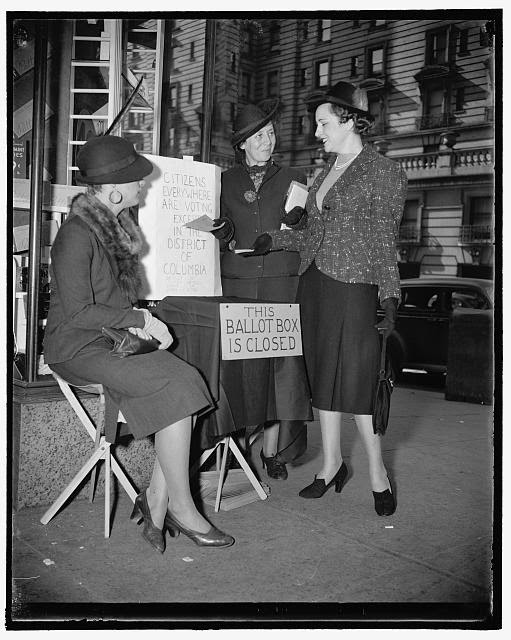
In my last travel blog series, following in the footsteps of great thinkers who changed the world, I explored New York City. I found statue after statue, monument after monument, portrait after portrait, of important men in American history: there were Lincolns, Jeffersons, Clintons, and Hamiltons galore, and speaking of horses, a multitude of Washingtons, often astride one. Yet search as I might, in this city that birthed and nurtured so many of the greatest American intellectual and reform movements, I was hard pressed to find such tributes to their female counterparts. Wait! there’s one: Eleanor Roosevelt, great humanitarian… and oh yes, wife and cousin to two American presidents.

Of course, Eleanor should be honored with this beautiful monument for the great things she did. But would she have been if it weren’t for the famous men in her life? Hmmm. It’s not that statues, monuments, and other public works of honorary art are necessary to show how important anyone’s achievements are, so long as we remember them and pass on their ideas. But they do provide a window into the values and interests of the people. Initiatives, petitions, and referendums are submitted, committees form, public collections are taken up, and wealthy people grant commissions to create these public works.

In short, these monuments go up when enough people care enough to publicly show how much they care.

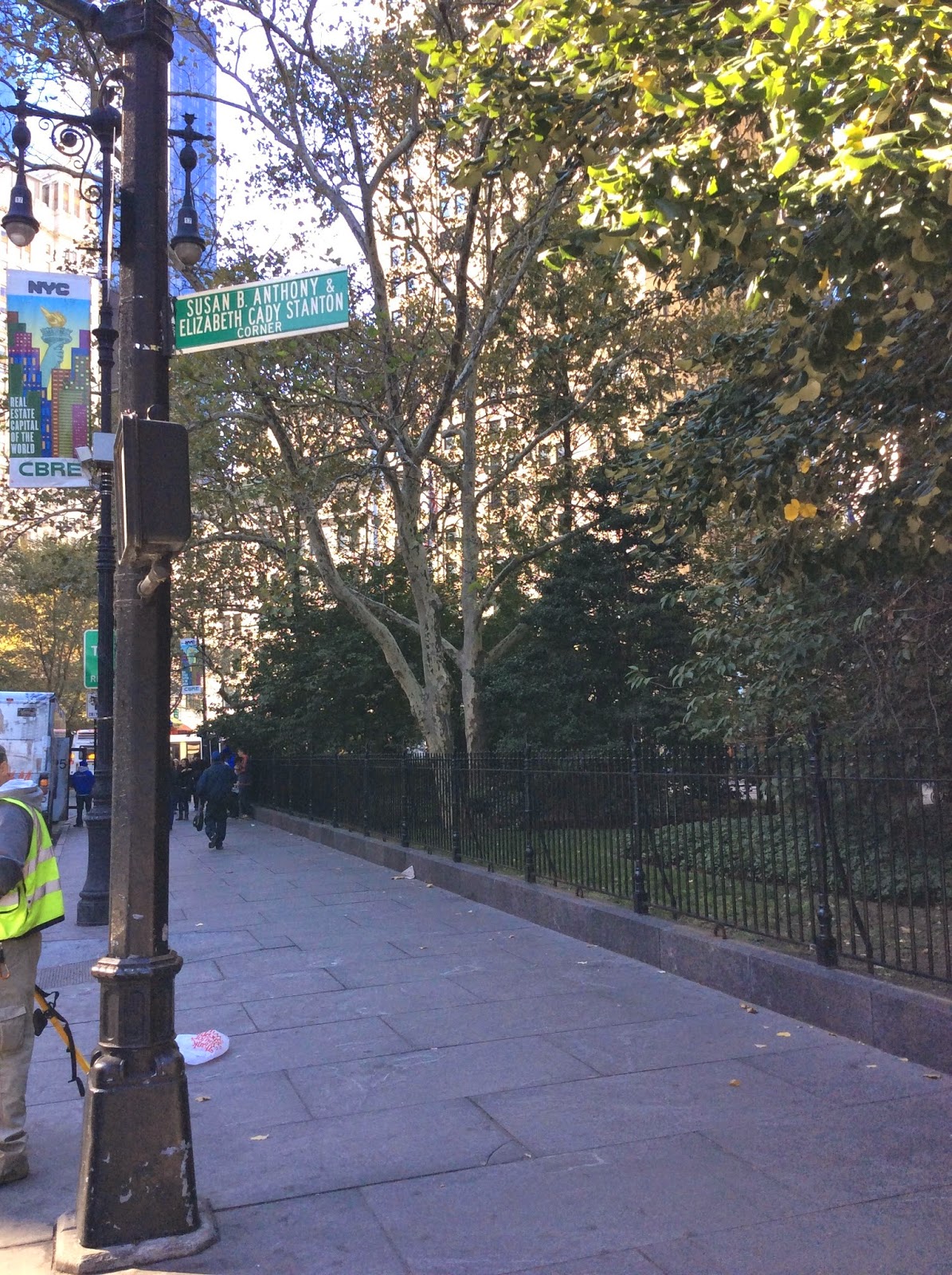
So how can it be that great women like Mary Wollstonecraft, Ernestine Rose, Sojourner Truth, Elizabeth Cady Stanton, and Margaret Sanger are commemorated so modestly or so seldom? (A little plaque or a sign on a street corner here, a dusty little cabinet display there.) When their efforts, arguably, liberated more people than anyone else? After all, women make up more than half of the human race, and prior to their life’s work, most women in the world lived almost completely under the subjugation of men, most with restricted education, all denied the full range of rights and opportunities accorded to men.

I feel a free woman, myself, in most ways. I read, think, work, play, procreate (or not!), travel, dress, and so forth, as I decide for myself. Thanks, brilliant, fearless, principled women of history! But their work is not done so long as great women are not honored equally as great men, and working women as much as working men, and women who need health care as much as men need health care, and so on.

Is feminism over? I’ll believe it when I see it. In marble, granite, brass… or in the office of the President of the United States. Maybe then.

*Listen to the podcast version here or on iTunes

The Wisdom of Crowds: How Voting Produces a Better Society

It’s easy to feel discouraged in the United States of America sometimes.

Recently, I was chatting with someone who suggested that a meritocracy might be better than the democracy (of sorts) which we have now. A democratic republic, rather, and a degraded one: our government seems more dysfunctional than ever, overrun with ideologues and pawns of a few moneyed interests, and hyperbole and unreason holds sway over public discourse. A meritocracy, where rulers are selected based only on their qualifications, be it education, political experience, or business acumen, might prove a welcome change.
Meritocracy is, pretty much, just a theoretical form of government. I expect everyone believes it would be best to have wise and qualified leaders (if we must have any at all), and most think it’s good to try to put such people in office. No government exists whose constitution specifically requires that only the smartest people rule. But imagine a real meritocracy, with strict laws in place to ensure that only the most able, most knowledgeable leaders are appointed. Perhaps public officials would be selected by undergoing a series of tests, or elected by a panel of experts in relevant fields of knowledge. Wouldn’t this increase the chance that no dummies, however slick, charming, or pandering, would be allowed to hijack the government and, through their incompetence, ruin it for everyone else?
Not all that long ago, this sounded pretty good to me. When I returned to college awhile back and studied political philosophy, I was very much in the mood for it, or something like it. Like just about everyone else, it felt that I was constantly slapping my forehead (as I still do) over the ludicrous statements and bad laws our politicians were cranking out. Wouldn’t it be much better if they all had to take IQ tests, plus general knowledge tests in political and legal theory, history, English, rhetoric, and the rules of basic courtesy before they were allowed to run for office? (I’m willing to bet that no politicians who call for ‘citizenship tests’ for voters also call for ‘leadership tests’ for themselves.) Like you, dear readers, I have a deep respect for learning, and would be thrilled to see more of it make its way into our government and into our political discourse, let alone into our (to my mind) overly-materialist culture.

Yet through the years, the more widely I read, and the more I listen to politicians, scholars, and other influential people discuss and debate any given topic in any given field of expertise, it doesn’t seem likely that anyone exists, however brilliant, who could know or understand enough about any subject to craft public policy on their own. No one mind can hold all the relevant knowledge that should be brought to bear in crafting a good law. It’s not just technical knowledge that’s the problem: an expert in a field could, at least theoretically, access enough of that sort of knowledge on their own, from their colleagues, their library, and the Internet, though it still seems unrealistic that one person could put it all together in a reasonable time frame. The far bigger problem is that no one person could escape their own biases sufficiently to craft laws that are just for everyone.

All societies are made up of people with different personalities, different points of view, different belief systems, different circumstances of life. Each, therefore, has different interests and different responsibilities, and have different rights they hold most dear. It’s not possible for any one mind to fully understand how the rights, responsibilities, and interests of all interact and conflict. Not only that: a wise leader must effectively predict the entire chain of events that might result from enforcement of the law, or system of laws. We might say well, of course, no one knows all these things. So what we need in order to create an effective meritocracy is many leaders, not one or just a few. Between them all, a governing body of a large number of experts should be able to work out these problems as least as well as the public at large, and probably better.
But here we run into problem of numbers. Aside from the inevitable clashes of ego, think of how many ‘meritocrats’ it would take to adequately take all of the relevant knowledge, all the possible outcomes, all the values and interests of all of its citizens into account while crafting legislation. Is it likely that any one group, so unrepresentative as they are of the general population, could create a society in which the rights and interests of all of society, rich and poor, educated and otherwise, men, women, and children, laboring and not, of all races, are fairly and equally represented? Could they do this even in theory, given the facts of human psychology? Almost everyone, almost all of the time, automatically favors their own interests and those of their peers over those of other groups, and it makes sense that they should. For one thing, they understand why their own interests are as they are, because they arise from their own particular life experience. For another, everyone is prone to availability bias: people form beliefs and make decisions based on examples they themselves can readily call to mind. Therefore, we are intellectually hostage, so to speak, to whatever set of information and experience we are privy to. However much we try to expand our knowledge of the world, we are always limited. These, and myriad other quirks of human psychology, make it inevitable that no one human being on their own, or a relatively small group of human beings, could make sufficiently fair, impartial, and fully informed decisions on policies that effect everyone.

Let’s consider pre-Revolutionary France for an extreme example of how a meritocratic but short-sighted few, ruling over a non-participatory citizenry, can bring about societal collapse. France, like other European societies at the time, was ruled by a heritable meritocracy of a monarch and an aristocracy, and an appointed clergy, who all had the wealth and leisure, unavailable to most people, to afford an education. These ruled a populace which they kept in strict subjection, for the people’s own good, of course. Yet these meritocrats could not put themselves into the sabots (wooden clogs of the peasantry) of the majority of the people. (The Estates General, made up of representatives from various classes, advised the king, but had little power to begin with, and it decreased over time; the Third Estate, made up of the poorest members of  French society, had the least power, and the burden of taxation fell almost entirely on them.) As they saw it, the classes of society were properly kept in their place to fulfill their respective roles, and to undermine this structure would be to undermine the delicate balance of a functioning society. They were proven wrong: the intolerable condition of their lives caused the laboring classes to revolt and overthrow their rulers. While the monarch, the aristocracy, and the clergy considered themselves best suited for rule, they lacked the knowledge, the insight available only through the experience of what it takes to make the life of a laboring person not only bearable enough forestall rebellion, but satisfying and remunerative enough to encourage more productivity. They lacked the epistemic humility that wise people have. If the ruling elites were more informed, say, by the input of the people they ruled over, perhaps they could have thought of ways to harness human energy and facilitate creativity as market societies would later do. But since they shut themselves off from the input of the majority of the population, their policies were ill-informed and short-sighted, and their society eventually collapsed. This was the fate of so many undemocratic societies, that it seems most likely to be the fate of all.

‘But wait a minute!’ you may object. Why would we expect better results in a democracy, when it’s at least as likely and probably more, that the average person’s vote is based on just as narrow, less-than-fully-informed self-interest as that of the aforementioned meritocrats?

 
In a democratic system, individual voters don’t have to be fully informed about everything for their votes to be valuable. Since the vote crowd-sources knowledge from the entire population, each person, even if voting out of narrow self-interest, informs society of the things they know most about. Our votes tell each other what we want, and indicate why. By the way people vote, we discover what individuals have learned from their own life experiences, from the work they do, their area of study or expertise, their family and peer groups, and the demands of the environment in which they live. We learn what people believe, what their interests are, how far they’re willing to go to help each other out, and where they want the line drawn to protect themselves. We learn how much people know (and how much they don’t), what values they hold, and what kind of leaders they admire.

So it’s not that the average voter must be wise or fair for their vote to count, though it’s better that they are, since this speeds up the process of creating a better government. What matters most is that society as a whole is well informed. A society can only become knowledgeable enough to create a government that’s well-functioning, impartial, and more conducive to the flourishing of all of its constituents, by this crowd-sourcing of information. Since no one mind, or no few minds, can hold enough information or understand enough points of view to do what’s best for everyone, it’s everyone who must provide the necessary knowledge.

This utilitarian argument, by the way, is not meant to replace moral arguments in favor of democracy: that proper respect for the moral equality of all persons entails the right to vote, or that it’s incumbent on all good citizens to fulfill their social obligations through political participation, and so on. I offer it as one of many excellent reasons to prefer a democratic system of government over any other: not only because it’s morally enlightened, it’s also the most practical. Democracy is best because it works best, and the evidence of history bears this out. In modern democratic societies, for example, war is relatively rare, since the transfer of power from one leader to the next is peaceful. Generally, the burdens of war disproportionately fall on the majority of society while a relative few reap the benefits; very few wars in history were revolutions that benefited the majority the most. For those of us dismayed at how many wars we still wage nowadays, compare the state of the world today with the history of Europe : nearly every time a ruler or rulers died, by fair means or foul, either a war would break out to decide who should rule next, or the new ruler(s) would embark on a war of conquest to prove their supremacy, or the favored religion of the new ruler(s) was forcibly, and bloodily, imposed. Most of Europe was at war most of the time, century after century, until their monarchies, aristocracies, and theocracies were replaced with modern, democratic, and largely secular governments. Modern democratic societies, while sometimes at war with other countries, aren’t at war with each other, and there are far fewer wars overall as a result.

Let’s consider a modern example of how not voting not only leads to more oppression, but to well-intentioned yet bad policy resulting from self-imposed ignorance: the disenfranchisement of convicts. Those convicted of serious crimes are punished with the loss of some of their civil rights, at least for awhile, and this often includes the right to vote. While I understand the deterrent effect of many types of punishment, including the loss of some rights and privileges, the loss of the vote does little good in this respect. Each individual prisoner loses little when they lose the vote, but society loses a lot: as we punish criminals by taking away their right to vote, we undermine our society by making it that much less informed.

As we are only significantly realizing now, our criminal justice system is not only rife with mistakes, but with affronts to human dignity and assaults on human rights. For example, we’re discovering that our ‘common-sense’ reliance on eyewitness testimony and police interrogation techniques has led to an unacceptable rate of false convictions. We’re finally discovering that our ‘tried-and-true’ methods of police interrogation and psychological questioning routinely generate false testimony and false confessions. This includes 20%-25% of exonerations for serious crimes based on DNA evidence (an alarming rate, since relevant DNA evidence is available only in a substantial minority of cases). There are a wealth of examples of people convicted because of the brain’s ability to create false memories, especially if an authority figure or medical ‘professional’ induces them, or because eyewitnesses misunderstand or misremember what they saw. Consider the rash of cases in the 1980’s and 1990’s where scores of childcare workers were falsely convicted of ritualistic child rape and torture. Or the Norfolk, Virgina murder/rape case, in which four grown military men (who had passed mental- and bodily-health tests to join the Navy) were coerced into giving contradictory confessions. The list of problems with our justice system does not end there, not by a long shot: there’s our long history of junk forensic science, prison overcrowding, official indifference to prison rape, solitary confinement-induced mental illness, and law-enforcement policies which generate higher recidivism rates and help turn petty criminals into hardened, violent ones through over-punishment.

Yet if those convicted of crimes had been informing the rest of us, through their votes, of their inside knowledge of the criminal justice system, the sooner we could have had the opportunity to recognize and correct these errors. It took centuries for policy makers and researchers and scientists to discover how prevalent, and how serious, these problems are, or to care enough to find out. Of course, it’s important to be tough on crime, and all members of a society have the right and responsibility to protect themselves and their loved ones. But this interest in self-protection must be balanced against the interests of those who have suffered the ill effects of over-zealous, ‘tough-on-crime’ policies. Every time an innocent person is convicted of a crime, the guilty one remains free to commit more, and every policy that encourages the abuse of prisoners and raises incarceration and recidivism rates, the more injustice we commit, the more criminality we foster, and the more taxes we pay.

None of this is to say that merit doesn’t matter, of course it does. In modern democratic societies, we not only vote directly for specific laws and taxes, we vote for representatives, specialists whose job it is to be better informed on the issues than the average person, or have expert advisers, or have achieved a higher level of education. A democratic republic such as ours can be seen as a type of meritocracy, since the idea is that the people, as a whole, elect representatives based on their merits as well as on the likelihood that they will best represent their constituents’ interests. But even so, the fact that they are voted in by all of the people still ensures that the whole range of interests are represented, and the widest possible range of knowledge is brought to bear.

To return to the degraded state of the United States’ democratic republic: the problem isn’t so much that uninformed voters are dragging the country down, though I think they, too, can impede progress. The bigger problem is that the votes of most people count less than ever, in this era where buying power makes right, and where the interests and values of the majority of people are not adequately represented. For example, we have a problem under-regulation, where powerful financial interests have over-ridden the interests of most of the population. These few financial interests, who have grown to such gargantuan proportions that they hold most of the nation’s capital in their (virtual) vaults, gamble with it freely for the sake their own personal gain, to the detriment of the nation’s economy, and of the world’s.We also have a problem with over-regulation, where special interests of a powerful few successfully hijack government, through financial enticements and pressure on elected officials, for the express purpose of crushing their competition. Here, again, the interests of most of the people are trumped by the outsize influence of a moneyed few.

Here’s my two cents on the matter: VOTE! You matter! Your interests, your input matter! Don’t just throw your hands up in the air, sigh, stay home, and play into the hands of those who have, in recent years, been throwing up roadblocks to keep certain people from the polls, disproportionately effecting the poor, those disabled by age or illness, and otherwise disadvantaged people. After all, do you think it’s likely that such an effort would be made by those in power if voting doesn’t matter? Think about it.

Listen to the podcast edition here or on iTunes

****************************************************************************

Sources and Inspiration:

Berlow, Alan. ‘What Happened in Norfolk.’ New York Times Magazine. August 19th, 2007.
http://www.nytimes.com/2007/08/19/magazine/19Norfolk-t.html

Childress, Sarah. ‘Why Voter ID Laws Aren’t Really About Fraud’. Oct 20, 2014. Frontline.
http://www.pbs.org/wgbh/pages/frontline/government-elections-politics/why-voter-id-laws-arent-...

‘Day-care sex-abuse hysteria’. (2014, December 29). In Wikipedia, The Free Encyclopedia.
http://en.wikipedia.org/wiki/Day-care_sex-abuse_hysteria

‘Estates General (France)’. (2014, October 5). In Wikipedia, The Free Encyclopedia
http://en.wikipedia.org/wiki/Estates_General_%28France%29

Fontevecchia, Agustino. ‘As New York City Crushes the Food Truck Business, Mexicue Pushes a New Model’. Forbes. May 23rd, 2014. ‘http://www.forbes.com/sites/afontevecchia/2014/05/23/...

Fraser, Scott. ‘Why Eyewitnesses Get It Wrong’ TED talk. May 2012
http://www.ted.com/talks/scott_fraser_the_problem_with_eyewitness_testimony

Kahneman, Daniel. Thinking, Fast and Slow. Farrar, Straus and Giroux, New York 2011.
https://books.google.com/books?id=ZuKTvERuPG8C&printsec=frontcover&dq=thinking...

Lightman, David. ‘Wall Street crisis is culmination of 28 years of deregulation’. McClatchyDC. Sept 15th, 2008. http://www.mcclatchydc.com/2008/09/15/52559/wall-street-crisis-is-culmination.html

Loftus, Elizabeth. “The Fiction of Memory” TED talk. June 2013.
http://www.ted.com/talks/elizabeth_loftus_the_fiction_of_memory?

‘Meritocracy’. Wikipedia, The Free EncyclopediaJan 8, 2015.
http://en.wikipedia.org/wiki/Meritocracy

Mills, Steve and Maurice Possley. ‘Man Executed on Disproved Forensics’. Chicago Tribune, Dec 9th, 2004. http://www.chicagotribune.com/news/nationworld/chi-0412090169dec09-story.html#page=1

Perrilo, Jennifer T. and Saul M. Kassin. ‘The Lie, The Bluff, and False Confessions’. Law and Human Behavior (academic journal of tje American Psychology-Law Society). Aug 24th, 2010.
https://www.how2ask.nl/wp-content/uploads/downloads/2011/10/Perillo-Kassin-The-Lie-The-Bluff

Perry, Marvin. Western Civilization: A Brief History, Vol II: From the 1400’s. Boston: Wadsworth, 2009 https://books.google.com/books?id=7SIKAAAAQBAJ&printsec=frontcover&dq=Perry,

Pinker, Steven. The Better Angels of Our Nature: Why Violence Had Declined. New York: Viking Penguin, 2011 https://books.google.com/books?id=J7ATQb6LZX0C&printsec=frontcover&dq=inauthor

Encourage a More Progressive Islam: The Peaceful Muslim Majority Should Dominate the Conversation

The debates around the Charlie Hebdo shooting have been raging hot and fast: should there be a stronger military response to militant Islamists? Does the Quran promote or at least allow violence, and if so, is Islam really a religion of peace? Are principles of the right to free speech and basic respect for the feelings of religious people compatible?
We’ve tried, and mostly failed, the military response tactic. Even where gains appear to have been made in the short term, a new crop of fanatics soon rise up to strike, as they feel their country’s honor has been violated by invaders who have no right to dictate what they should believe, what laws they should make, or what form of government they should create. It’s a fact of history that invasion, real or perceived, by foreign armies invariably provokes those disposed to violence to take up arms; these, in turn, convince the young, the aimless, and the self-righteous to join them in their ‘sacred’ cause. Even if the intention of the ‘invaders’ is to liberate or to protect (though I’m not convinced that’s entirely or even usually the case on the part of governments), these military interventions usually turn out worse for everyone in the long run. Consider the domino effect from our early intervention in Afghanistan against the Russians to our seemingly endless war(s) in the Middle East. While each intervention on its own seemed justified to many in the short term, the deeper all parties dig themselves in with more fighting, the more the bodies pile up and the deeper the tensions run, generating yet more conflict.
So how about the religion itself, and its holy book? The Quran indeed contains violent passages, allowing and even commanding its readers to kill those who violate certain commandments or who don’t believe. The Bible is also chock-full of both divinely tolerated and divinely commanded violence, including rape, murder, mutilation, and lots of genocide. Christians, for centuries, invaded other countries, overthrew rulers, tortured and killed heretics and ‘witches‘ (including little girls), and harshly oppressed the Jews, from baptizing and kidnapping their babies to murderous pogroms. All this with consent, by silence or by instruction, of religious authority figures, including the Pope.

So why does the western world widely consider Christianity a religion of peace, and Islam a religion of genocide? Well, Christianity has undergone a pretty thorough reformation through the influence of better philosophical and evidence-based ideas, starting with the Protestants, continuing with the Enlightenment, and up to the Age of Science and Human Rights. With widespread literacy and open trade came the awareness that the old dogmatic, sin-obsessed, holy-war-glorifying ways are actually quite awful for human well-being, and that hey, if God loves us, maybe he doesn’t actually want us to live that way. Now, except for abortion clinic bombers, the odd Timothy McVeigh or Anders Behring Breivik, and certain pundits, fundamentalists, and warmongers who seem to long for the days of the Crusades, Christianity is now, in comparison, mostly a benign family of religions of tolerance, peace, and good works. Even if, as I believe, they get a lot of stuff wrong (mostly the metaphysical stuff; otherwise, many of the ethical systems they promote are not half bad), Christian religions bear little resemblance to their forebears who enacted Old Testament values with gusto. Same goes for (most of) the Jewish family of religions.

This takes to our modern Age of Human Rights, in which the rights and interests of individual persons are of primary concern, so that any and all human institutions, be it religion, corporation, community, or government, is judged by how well it serves to protect and expand human rights. Is Islam compatible with this new understanding of the importance of human rights, in that they are at least on equal footing with religion, if not taking precedence over it? (From the religious viewpoint, of course: most modern, reformed, and mainstream religions seem to promote a robust conception of the centrality of human rights in their moral systems, and see no real conflict. The most progressive believers, as well as atheists and secularists, think that too many religions are still retrograde and unjust in their beliefs regarding gay, women’s, and children’s rights.) Should the threat of offending religious people be sufficient to limit that most sacred of human rights to the western world, free speech? We’re still figuring that one out when it comes to extreme cases, such as those that specifically incite violence, or ‘hate speech’. But for the most part, I think the general attitude of the western world towards free speech is the correct one: it should rarely be constrained, except when’s demonstrable that severe and direct harm will almost surely result from it. Even the speech of people with the most disgusting views must be tolerated in the interests of being an informed person, since it’s important to know who they are and what the bad ideas are that influence them. Most religions in the western world have become pretty comfortable with the idea of free speech and have come to value it highly, including the more moderate forms of Islam.

So how to stop the seeming spiral of parts of the Muslim world into an orgy of violence and the ideological dominance of its most extreme and retrograde forms? Encourage and promote those who stand against those violent ideologues. Most Muslims belong to this category of believers, and number among the most humane, thoughtful, and decent people you may care to meet. These are the Muslims who feel most, and most justifiably, beleaguered. They are as horrified as anyone else at all the atrocities committed in the name of the religion they identify with, perhaps more so since it’s other Muslims committing these crime, and like most Christians today, emphasize the nice parts of their holy book and interpret away the rest. And I’m sure they feel, as this thoughtful piece successfully argues, that it’s as ridiculous to blame Muslims as a group for the actions of Muslim killers, as it is to blame all Catholics for child-raping clerics, all Jews for the ultra-Orthodox few slinging feces at schoolgirls, or all atheists for Stalin’s genocide. It’s as ridiculous to expect all Catholics, Jews, and atheists to apologize and justify themselves following such atrocities, as it is to expect all Muslims to.

While there are still large parts of the Muslim world living under the rule of governments whose laws still carry out a retrograde understanding of justice, it’s just not true that most Muslims condone terrorist acts. Indeed, while doing research for this piece, I had a far harder time finding Muslim leaders who justify any kind of violence, even physical punishment for ‘apostates’ and criminals, than those that do. Outside of the rantings of pundits, who jump on the relatively rare examples of communities where a significant demographic believe violence is justified, it’s just not the case that Islam necessitates violence any more than Christianity does. Both revere holy books rife with passages promoting violence, but few Muslims and Christians are guided more by those passages than the peace-promoting ones. Yet it seems the pundits’ rantings dominate the major media outlets, while the voices of the peaceful majority of Muslims are all too often drowned out.

So if you’re one of those screaming and pointing fingers at ‘The Muslims’, let’s all stop being so damned self-righteous and smug in our own ‘enlightened’ point of view (yes, you too, my fellow atheists). Those of us who are interested in living in a more just, peaceful, tolerant, and free world should encourage such progress wherever it’s found, by praising it and trumpeting it from the rooftops. While I, too, feel that the world will be a better place when religion has lost its still too widespread dominance over the human heart and mind, I also know that many religious people feel a deep sense of identity with whatever faith they were brought up in, and this rarely changes quickly.

Who, then, will change the minds of those Muslims who hold beliefs contrary to principles of human rights and personal liberty? Will it be vitriolic Christians who point out the speck in their eye while ignoring the historical plank in their own? Will it be atheists who shout ‘Look, I told you so, that’s what happens when you consider ancient tribal texts the source of your morals’? I don’t think so, if history and a large body of research into why and how humans form their beliefs are any indication. The people who will change the mind of Muslims will generally be other Muslims.

So share widely every story of Muslims who hate violence and love tolerance, knowledge, and freedom, and let it it drown out the fundamentalists; I, for one, am rooting for their side in the fight over what broadly defines their religion. After all, they have the credentials and the inside knowledge of how it is to be a Muslim, to demonstrate to their fellow believers that the best way to be Muslim is to believe in a God of peace, tolerance, and justice. If you support these good people, you will become a help, and not a hindrance, on the journey of the human race, religious and secular alike, towards a more peaceful, tolerant, just, and wise world.

Here are prominent and influential Muslims and Muslim groups who stand against violence, to which I’ll keep adding as I discover them… and there are plenty to discover. Please share as widely as you can!

The Arab League and Al-Azhar condemn the Charlie Hebdo shooting:

The Council on American-Muslim Relations condemns the Charlie Hebdo shooting:
The Grand Mosque of Paris condemns the Charlie Hebdo shooting:
Imam Hassen Chalghoumi condemns the Charlie Hebdo shooting:
Imam Imtiaz Ahmed condemns the Charlie Hebdo shooting:
President Abdel Fattah al-Sisi condemns the Charlie Hebdo shooting: 
 
The Union of Islamic Organizations of France condemns the Charlie Hebdo shooting:

What Leaving Religion Has Done for Me

I grew up as a member of a large and generally very religious, very conservative Catholic family. As I describe in an earlier piece, both sides of my family are close-knit and traditional, with a tendency to insularity. When I was much younger, I loved it. Religion, especially in its more traditional and fundamentalist forms, has many upsides: a strong sense of community, a feeling of intimate belongingness in a group that shares a creed, a mythology, a history, and an identity. There are things I remember fondly: the warmth that suffuses family faith-based rituals, like putting on a fresh new dress for Easter morning, or the excitement of Christmas midnight mass, with its rich decorations, solemn rituals, and stirring hymns. We would return and light the tree, a luminous and dream-like vision to a child who just woke up from the wee-hours car ride home. There were pancake breakfasts and coffee socials after Mass, Sunday school friends, singing in the choir, and suppression of giggles as my brother, sisters, and I pulled faces at each other during the hour-plus long service.

I also remember that religious fervor, that soaring feeling, that high, that rush of heart-swelling emotion that would come over me sometimes as I sought connection with the divine. In my mid-teens, Jesus was my ‘drug’ of choice. (Not that I did much in the way of drugs later, ahhh-hem.) The Catholic religion has many elements that suit a romantic temperament: prayers and chants, candles and incense, a baroque artistic sense, a preoccupation with death, suffering, and self-sacrifice, and a deep veneration for martyrdom. And no-one is more romantic than a teenager.

But that feeling of belongingness can also lead to insularity, so that you feel removed to some degree from the broader human community and from the wider world of ideas. There was a feeling of loneliness sometimes, of separation from the world. I remember times when my religious compatriots and I would bad-mouth secular people: their music, clothing, slang, history, practices, and beliefs and ideas (I later learned we were mostly wrong about what they actually think and believe). It felt satisfying, in a way, as it made me feel part of some exclusive club, but it felt a bit mean too. We portrayed the rest of the world to ourselves as a lost, sad, evil place compared with what our religion had to offer. We could rest easy, satisfied that we knew the truth and could lead more meaningful, ‘holy’ lives, here on earth and after death. (Though, oddly enough, I feared death terribly in those years, and thought of it often. Try as I might, the always vague promise of the joys of heaven failed to console me. I thought perhaps God was testing me: tests of faith are an important theme in Catholicism.)

As I approached adulthood, and began to meet people from different backgrounds, with different beliefs, faith faded and gave way to doubt. I’d always been a curious person, but my youthful shyness and anxiety, combined with my insular upbringing, kept me mostly isolated from the world beyond family and church. It wasn’t until I entered the workforce, and then attended junior college, that I discovered the wider world, one of dazzling variety, and found it suited my personality to a T.

Slowly, I began to emerge from my religious shell. I began to let down my guard, thinking: if my religion is true, my faith will survive running the gauntlet of questions, challenges, and opposing ideas, gaining strength along the way. After all, if integrity and love of knowledge are virtues and God is good, God would prefer even an honest atheist to an intellectually lazy believer. So I opened myself up to discovery, to an enthralling diversity of beliefs, ideas, cultures, and practices, a world with a rich and varied history. Science, literature, philosophy, history, art, culture, religion itself, all became available to me to explore, to consider, and to critique, honestly, in its own terms, and on its own merits. There were no more heresies and dogmas: now, there were facts and theories, truth and falsehood, useful ideas and otherwise. There was no more sin and redemption: now, there were systems of ethics and self-improvement, and considered moral judgments derived from considerations of good and bad, help and harm, beneficence and selfishness, virtue and non-virtue. The supernatural gave way to the natural, certitude to a healthy skepticism, blanket acceptance of creed to understanding, faith to belief ‘wisely apportioned to the evidence’.

I came to value the sense of belonging to humanity as a whole over the sense of belonging to a narrower community of belief. My newfound cosmopolitanism broadened my sense of care for and responsibility to my fellow human beings beyond the scope of any one ideology. The world was no longer divided into ‘Us’ (in my case, Catholics) and ‘Them’, the poor benighted souls wandering this world lost, hopeless, and forlorn. Instead, I came to understand that all of these tools we’ve developed, from morality to literature to government to art to religion, are products of the great quest to better ourselves, to attain the happiness and fulfillment that all humans seek. Religion, like culture, language, and so on, I came to understand as a human creation, and no more or less important, sacred, or immune to change and criticism than any other artifact. Religion lost its magic: since humans made religion, humans can reform or unmake it. I could glean the best of what it has to offer, and explore its history, appreciate its role in moral progress, gain insight from its ethical and metaphysical theories, enjoy the creativity which gave rise to its fables and rituals, and discard the rest.

Likewise, the whole of the great treasure trove of human thought became available to me for study and consideration. There is no list of banned books, no heresies. Instead, there are good ideas and bad ideas: theories that better explain the workings of the universe, and those that do not; beliefs that accord with reality and with reason, and those that do not; ideologies that lead people to do good and to lead better lives, and those that do not; literature and art that arouse the best emotions and enrich understanding in us, and those that do not.

Many religions, including the brand of fundamentalist Catholicism in which I was raised, lead many adherents to restrict the education of their children to a cherry-picked, often distorted or flat-out-wrong, circumscribed array of ideas, scientific theories, and historical accounts that accord with the doctrines of their faith. Many of these children remain ignorant of the wider world of human thought and history until something in their experience or personality compels them to look beyond the teachings of their youth. For example, my own dear grandmother, out of love but misguided by her piety, did a disservice to the education of her grandchildren by attempting, and in some cases succeeding, to restrict our education in this way. Her religious beliefs led to her conviction that a broad, liberal education offered too many temptations to disbelief, so she felt compelled keep us from learning anything other than that which would accord with her fundamentalist Catholic faith. As I later discovered, she was right, not for the reasons she thought. Truth, in my opinion, holds fast in the face of challenges; it does not give way as easily as error does. Each new thing I learned, then, was not a temptation: it was a window of opportunity for growing in understanding, and for replacing bad ideas with better ones. Fortunately, I inherited, and was inspired by, her adventurous side, her love of people. Over time, I encountered and fell in love with the wider world of ideas, through the people I came to meet and the broader education I eventually received.

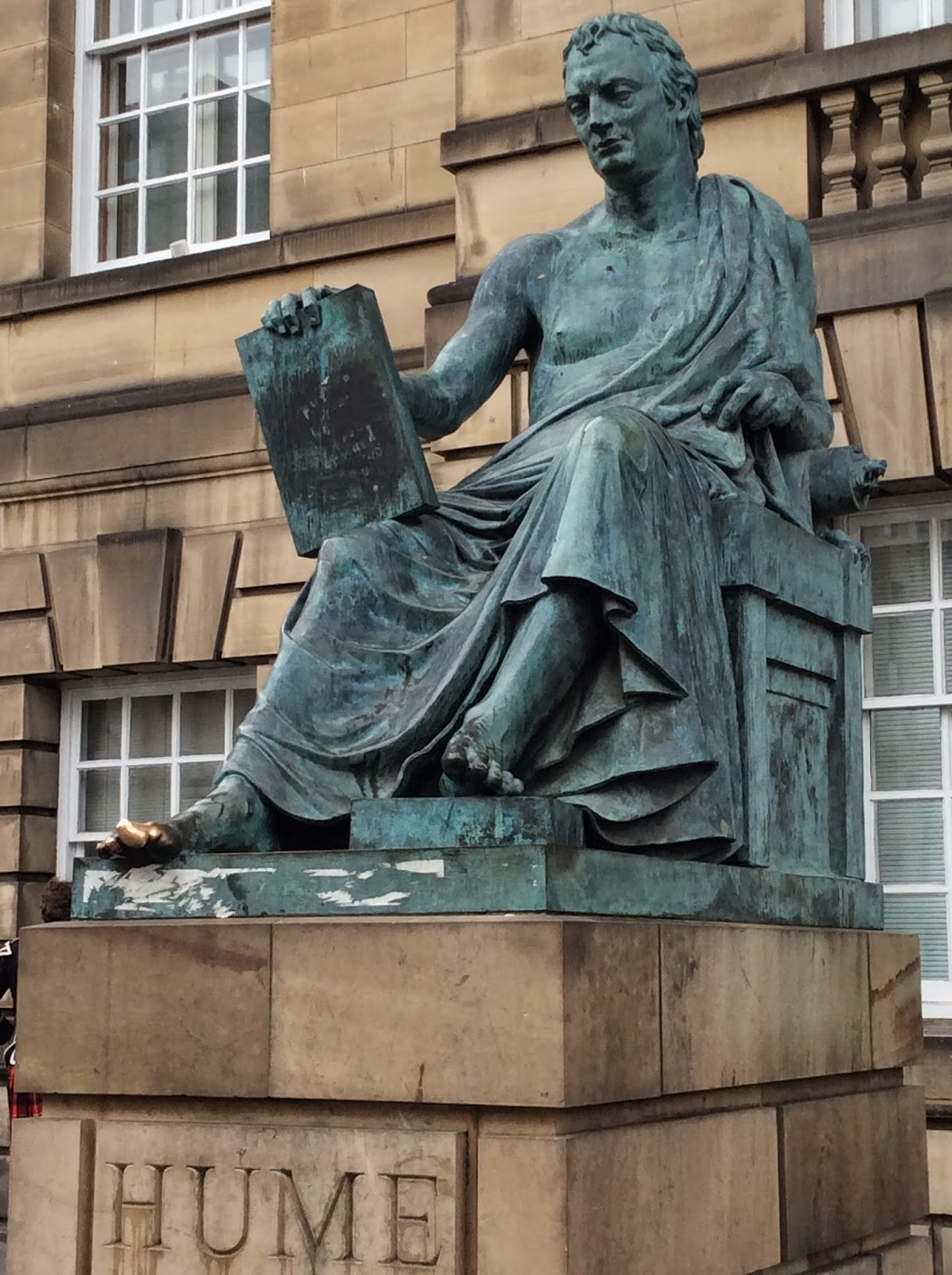
Now, in place of memorizing and reciting the Apostle’s Creed, I immerse myself in Aristotle and Mill, in Hume and Kant, in Wollstonecraft, Rose, Stanton, Jefferson, and Paine, in Avicenna and Aquinas, in Rawls, Pinker, Newberger Goldstein, and Hitchens. I can immerse myself in the teachings of religious founders as well, including the historical Jesus, endlessly more complex, fascinating, and inspiring than the blonde, haloed icon of the Baltimore Catechism. I have the opportunity to explore what all of these thinkers and reformers have to offer, to seek to understand their ideas on their own terms, putting aside those distorted accounts produced by religious rivalry. I can also, without fear of divine censure, explore the bad ideas people have conceived, from belief in witchcraft and satanic possession to the defense of torture, to racist ideologies, to ‘holy war’ and terrorism to social Darwinism (a sadly misleading term, does a disservice to a great thinker by associating his name with eugenics, a pseudoscientific theory contrary to his own ideas). I can try to enter the minds of those who created these dangerous and immoral ideas, in order to really understand how they came up with them, and to better explain why they are so terrible.

These days, I think of myself as a happier, more morally responsible, more intellectually honest, and more informed person than I would have been if I had remained religious. In that, I speak for myself only. Yet I know that this is true for many others, whose accounts celebrate the benefits of their own religious deconversions. It’s my impression that the most joyful, most passionate, and yes, the most resentful converts from religion are those who were brought up in more restrictive, fundamentalist belief systems. Critics say that such people gave up their religion because it was too hard, so they took the easy way out; or, that they just wanted to be able to ‘sin’ freely. I’ve had these accusations thrown at me many times. In a sense, they’re right, but not for the reasons they think. Many of these religions are too hard because their restrictions and demands are contrary to human nature since they’re based on deeply flawed accounts of it, and much of what they deem ‘sin’ is not wrong after all.

Many people attribute their own best qualities, of character, of behavior, of outlook on life, to religion, whether it’s the one they were brought up with or one they converted to. While I recognize the fact that religion can give a deep sense of fulfillment, the evidence indicates religiosity is not more of a predictor for good behavior than secularism. Study after study, personal account after personal account reveal that religious people commit most crimes at about the same rate, are about as generous, and behave about as morally overall than secular people.

My own observation is that people use religion to justify whatever way they are inclined to behave, good or bad. As the physicist Steven Weinberg points out, good people do good things, and evil people do evil things, regardless of religion. Many of the kindest, wisest, and most wonderful people I know are religious, and credit their religion with their moral successes. I’ve also known plenty of religious people use their beliefs to dodge responsibility for their bad behavior with excuses such as ‘the devil made me do it’ and ‘well, of course, I’m just a sinner’. They use this get-out-of-jail-free-card, such as this particular one available to Catholics (but of course, not necessarily endorsed by all Catholics): ‘I’ll just go to Confession later’. Some are otherwise good people who hold what I think are immoral beliefs, because they were taught to believe this way, and threatened with eternal punishment if they don’t. Others aren’t morally praiseworthy people in any sense of the term, and go through life doing only that which serves their own short-term self-interest. Religion, for these, is a matter of convenience or habit.

All of these things are basically true of the non-religious people I’ve come across, including my secular community of friends, family, and co-workers. Some are kinder than others, some are morally committed to doing good, some have a more nihilistic, selfish, or jaded view of the world. Yet here’s why I generally prefer a secular brand of morality over the religious: secular people generally take goodness more for granted. While this might sound counter-intuitive as an indicator of a better moral character or as a way of habituating oneself to better behavior, I think it’s excellent for both.

For example, when complimented on a good deed, a secular response is generally something along these lines: ‘well, obviously, it’s the right thing to do’, or, ‘it just feels right / good’, or, ‘of course, that’s how decent people behave’. These sorts of responses indicate that they see goodness as the default position, as required by reason, as a basic human instinct, or both. After all, human beings go through day to day life being decent to one another: we pay the asking price for the things we want, we step aside to let others pass on the sidewalk, we obey the rules of traffic, we say please and thank you, we lavish food, money, and medical care on strangers as well as family and friends, we spend huge amounts of our time communicating complex thoughts and ideas, and so on and so on. We take all this for granted, to our credit. When we compare the human species with all others, even to our closest relatives the chimpanzees, we find that our level of cooperation, generosity, and tolerance is quite remarkable. In all other species, some combination of predation, raiding, warfare, murder, infanticide, and/or indifference to suffering and the welfare of anyone besides close kin and allies are par for the course. With humans, however, such behavior makes the news.

Since goodness is the default, it’s badness has to be explained: by mental illness, alcohol or drugs, a bad upbringing, a momentary selfishness that overcame one’s better side, or by faulty ideology or culture. Therefore, most good deeds are not terribly remarkable: they are a natural product of sociability combined with reason. Sociability gives us the instincts to cooperate and help others; reason shows us that the more widely we extend our cooperation and good-naturedness, the better off everyone is in the long run.

Since secular people (as well as many liberal and progressive religious people) tend to believe in the basic goodness of human nature, they tend to be liberal in politics and morality, and broad in their conception of human nature. For example: since it’s everyone’s basic duty to help one another out, it’s right and just that we all pay taxes to create public welfare systems for those less fortunate than ourselves. To not institute public welfare systems is to say that it’s right that people should enjoy the benefits of civilized society, while being permitted to shirk their responsibility to care for those whom it hasn’t benefited. Another example: since most kinds of human behavior are good or at least morally neutral, there’s only a narrow range of behaviors that should be prohibited, namely those that actively harm others. Human nature, with its unique combination of advanced intelligence and strong social instincts, has evolved to include a wide variety of ways of being that are not only valid, but worthy of celebration, as they are indicative of the wonderfully fascinating, complex, endlessly inventive creatures that we are.

It’s no surprise, then, that secularists and adherents of the more liberal religions, which share this belief in basic human goodness and the broadness of human nature, have been on the forefront of reform and civil rights movements throughout history. Abolition of slavery, religious liberty, women’s, worker’s, and gay rights, indeed all of the great movements for reform and freedom, originated with the dissidents, the broad-minded, and the humanists. Religion is made for human beings, not the other way around.

An aside: there are certain leading secularists, such as Richard Dawkins and Sam Harris, who claim that the only ‘true’ religious believers are fundamentalists. They argue that liberal and reformed believers just want to pick and choose the ‘nice’ parts and discard the rest, which constitutes a betrayal of their religion. I think this view is not only historically inaccurate, it’s based on a more basic categorical error. Religions are not, and have never been, eternally ‘fixed’ systems that do, or ‘should’, remain constant over time. They are better understood as belonging to a category of things that include culture and language, all of which come gradually into being from thoughts and practices that are products of human nature, and change over time. Culture, language, and religion evolve as human nature evolves and as the totality of human knowledge and wisdom expands and is applied to current circumstances. It’s no more true to say that the only ‘true’ religion is that which remains wedded to a particular holy book or creed established by a synod, or a particular interpretation of these, than it is to say that the only ‘true’ communicator of English language is one who strictly adheres to the first Webster’s dictionary, or considers the Canturbury Tales or the works of Shakespeare as the eternal exemplar of ‘true’ English grammar and style.

Let’s contrast the more liberal, progressive, humanist views of secularists and moderate believers with the views of some of the more fundamentalist and hierarchical religions, usually descendants of tribal belief systems. This includes the brand of conservative Catholicism I grew up with (which is not reflective of all variants of Catholicism, some of which are quite tolerant and emphasize social justice). In these belief systems, humans are born in sin, ‘fallen’, weak and corrupt, and it’s only through the greatest struggle, and never without divine help, that we can achieve goodness. Their view of human nature is narrow: people are created to fulfill one of a number of comparatively few, narrowly defined roles, and behavior and proclivities that aren’t in accordance with these are sinful. Their view of life is one of spiritual warfare: we are beset on all sides by Satan and his agents as they vie with God for dominance over our souls. The way to redemption, then, is a lifetime of constant prayer, diligence, and suffering, battling one’s way to an eventual union with God that relatively few can achieve.

Secularism and the liberal religions, with their naturalist view of morality, emphasize the ordinariness of human goodness and the value of habitual, systematic, readily achievable goodness. The more rigid, fundamentalist religions, on the other hand, emphasize the difficulty of defeating evil and the value of relatively rare exploits of good deeds through heroic self-denial. While the latter may be more romantic and exciting, I think that the secularist and humanist view of human nature has been more conducive to human flourishing overall. It promotes a greater quantity of goodness in the world by making it understandable and accessible. This is readily apparent when we examine the evidence throughout history and up to the present time. Where we find tolerant governments and secular or progressive religious belief systems, we find less warfare, a higher standard of living, and a system of laws that protect all citizens from oppression, from each other as well as from government itself. Where we find civilizations dominated by religious fundamentalism, rigid ideologies, and aristocratic and ‘ordained’ hierarchies, on the other hand, we find the opposite.

In sum: leaving religion behind, for me, has proved not only emancipatory, but has provided a wonderful opportunity for learning, for critical thought, and for personal growth that I may never had had otherwise. I still have a residual distaste for religion, especially for its more ritualistic trappings, as one has a distaste for imbibing a substance one has overindulged in, or for fire after one has been burned. I shy away from churches, am creeped out by rote prayers, and feel depressed when listening to Gregorian chants and solemn hymns. (I feel very differently about other forms of sacred music, and wouldn’t you know it, I never heard any of them in the church of my youth.) Yet I seek wisdom from any source in which it may be found, and since I know that there is much to be found in religious traditions as there is in any arena of human thought, I look for it there, too, despite the inclinations I sometimes have against it. And one day, when my residual aversion to religion has finally worn away, I’ll be that much less in the sway of the kind of bias that blinds the intellect and blunts the understanding.

*Listen to the podcast version here or here on iTunes
*Also published at Darrow http://darrow.org.uk/2015/04/12/what-leaving-religion-has-done-for-me/

Activism is Not Enough: As Long As We Keep Shopping and Don’t Vote, It’s Our Fault Too!

I live in the San Francisco Bay Area, a wonderful place to live. It has a rich culture and a thriving music and arts scene and nightlife. It’s surrounded by great natural beauty in all directions: from oak forests to redwood groves, from chaparral to sandy beaches and sea cliffs. It has a fascinating history, plentiful and delicious food, beautiful architecture, and balmy weather. It’s also a liberal ‘bubble’, with an appetite for activism and, for better and for worse, a penchant for righteous outrage.

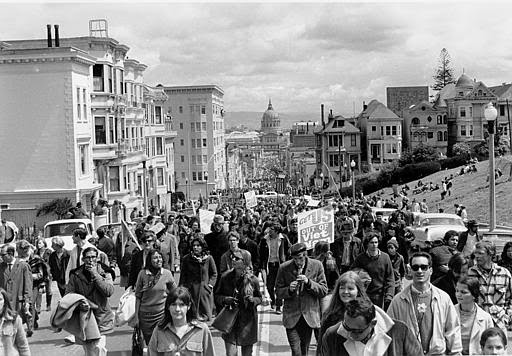
I admire and identify with the history and the culture of activism. Like the reformers of history and of today, the brave people who fight to create a more just world are among the finest the human race has ever produced. But I’ve been feeling something a bit lacking in activist movements lately. They still march in the streets, and we join them there and online by signing petitions for reform, posting blog pieces, and sharing videos bursting with righteous indignation. It’s exciting, it’s attention-getting, it makes the news. Historically, take-it-to-the-streets activism has been key in achieving the most important reforms (and breaking away to form our own nation in the first place!). The Occupy Movement, for one, was inspiring, and exciting, and it appeared that we were finally witnessing a harbinger of real change.

Sadly, it seemed to fizzle out before any substantial reform was achieved. Why? Because it wasn’t followed by practical action, which, of course, is much less exciting. Demonstrations of protest don’t do much lasting good unless they’re backed up by real, widespread change in attitudes, behavior, and civic engagment. Right now, the activist community is mainly pouring its energy into marches, inspiring songs, signs, slogans, and speech, and a few into blocking highways, smashing windows, and taunting riot police. But for actual reform to happen, we need to turn our collective accusatory gaze back on ourselves and realize we are the problem too…

How can we be the problem while we’re working and calling for reform? Because we keep supporting bad business through what we choose to buy, and we’re not reforming government by showing up at the polls.

It’s like protesting an assassination after we pitched in to pay the hit man and did nothing to stop him as he stole the getaway car.

For example, we’ve long known that many of our smartphones, tablets, and other gadgets are made in factories where people work terribly long hours for little pay, in conditions we’d never put up with ourselves. And we know that many or even most of our discarded electronics end up in some country, state, or town unprotected by regulations, or whose ‘recycling’ systems are really not effective in keeping up with the deluge, at keeping toxic heavy metals and chemicals out of the water supply, the ground, and the air. So we’ve signed online petitions and shared testimonies of abused workers on YouTube and Facebook. Yet we buy every new gadget as fast as they come along, throwing away our ‘old’ ones (cracked screen? doesn’t have the new games on it? too thick now since the new ones are 1/4″ thinner?) and buying a new one whether we ‘need’ it or not. When we purchase these things, we fund all operations of the companies that make them, and we send them the signal that we’ll buy them no matter how much their products pollute and how they treat their workers.

We also know, from the wealth of scientific information gathered and presented by the Intergovernmental Panel on Climate Change (IPCC) and our own National Climate Assessment, that we’re polluting our air to levels that present great threats to the health and future food security of ourselves and our progeny. We’ve also seen how air and other pollution causes respiratory ailments and even death in humans and animals, from pre-1970’s, pre-Clean Air Act Los Angeles, California, to Beijing, China of today. So again, we sign online petitions and share videos and speeches, and call on regulators to crack down on corporate polluters, on factories (industrial and farming), auto manufacturers, and the trucking industry. Yet it’s the commuter cars we drive and the emanations from animals we eat every day that pollute the most. We drive everywhere we want to go whether or not we need our car to get there, and gobble up more meat than is healthy for us and for the planet, all the while insisting that gas and meat stay cheap.

And so on, and so on, and so on. We want one thing, but do another. We say we want the world to be one way, but our actions help guarantee it won’t come to pass. It’s a hard pill to swallow, but here it is: we can’t justifiably blame corporations and the government for institutionalized racism, radical income inequality, pollution, climate change, poor wages and working conditions, poverty, and other social ills while at the same time we’re funding their operations, and are too politically apathetic to send more than a symbolic message by voting in the change we want.

There are two main ways we are undermining our own calls for reform:

We are a market-driven society, for better or for worse, and the market will always deliver what we want to buy, eventually. If we keep buying it, it will keep being made, whatever the good it does, or the harm. If we want things that cause harm, they will be made, ever more so as we keep buying them. And if we shop around for the lowest price, down prices will go, whether by benign means (improved technology) or not (driving down wages). Capitalism brings us wonderful things: safer and better machines for all kinds of purposes, warm comfortable clothing and plentiful food, information-sharing devices to educate and entertain, and best of all, technology that can better our lives while reducing waste. But it brings awful things as well: the supply and demand for plastic bottles and convenient packaging is trashing rivers and seas and killing fish; electronics, designed to quickly become obsolete and full of heavy metals, turns into masses of polluting trash our limited recycling systems can’t keep up with; plentiful, cheap meat pollutes the air and water and encourages animal cruelty; cheap fuel drives climates change and wars; cheap goods of all kinds drive down wages, degrades working conditions, and lead to overconsumption and massive waste. We know this, yet keep the demand going by gobbling it all up as quickly as they supply it.

Here’s an aside to my fellow progressives, liberals, and everyone who loves our world and don’t want to trash it: don’t pretend that recycling bins and boutique ‘green’ products will do the trick. Currently, recycling programs are akin to a cheap plastic Band-Aid applied to a gaping wound. Most recycling processes create nearly as much, sometimes even more, pollution than new products and packaging created in the first place. (Read this fantastic article by Andrew Handley: informative, succinct, and eloquent.)

Secondly, we are allowing the few, most moneyed interests to take over our government with scarcely a murmur. The ballot box, historically the most powerful tool for voicing our collective will, is being abandoned. We are voting in fewer and fewer numbers every year, with depressing results. I understand the Russell Brand type of argument, to ‘drop out’ of politics as an act of protest against systemic government corruption. But I don’t agree with his conclusion. It may be the case, as he points out and as we discover anew every voting season, that many or all of the candidates aren’t terribly inspiring. We may find that many of the initiatives won’t seem to do all the good we’d wish. But consider these facts: historically, the reforms sought by the great activist movements mostly became law because they continued their march right to the polls, and either voted in those laws themselves through referendums, and the rest were achieved indirectly, by voting better leaders into office. And think of what happens when we don’t vote. As someone who considers myself politically progressive, I’ve been dismayed as here in California, such laws as Prop 8 passed, banning gay marriage, because more people opposed to this unjust law (later overturned by the courts as unconstitutional) didn’t bother to get to the polls; ideologues, lavishly funded by a few interest groups, voted in droves while believers in liberal and progressive values (including many who held protest signs, I’ll bet) stayed home. For the same reason, capital punishment is still legal in California and marijuana use (other than medical) is not. I was also dismayed by the most recent general election, in which candidates that are aggressively status-quo and anti-reform were elected to office in droves. Why? Again: those who poll in favor of reform did not show up at the polls.

It’s true that too many candidates are overly motivated to please the interest groups that fund them, and don’t pay enough attention to the rights and the will of the average citizen. But that’s not just because of the money (initially provided by us, by the way, via the market): these candidates have been made well aware that we’ve grown a little too comfortable to make the effort to vote them out. So they make speeches to please us, and then we pass them around online and think we’ve done our duty. On election day, we stay home, and the next day, it’s business as usual.

In sum: so long as we put our own ease, comfort, and desire for luxuries ahead of our principles, we are stuck with the world that results. If our political system continues to grow ever more corrupt and our laws fail to protect the vulnerable, the poor, the immigrant, the disenfranchised, and the environment, yet we don’t vote the bad politicians out and the good laws in, we are to blame too. If corporations and other businesses make harmful products, endanger and underpay their workers, funnel all profits to a few at the top, and pollute, deforest, drive species to extinction, and hasten global warming, yet we keep buying their products, it’s our fault too. If police precincts become ever more militarized and continue to employ overly violent and coercive tactics on the streets and in the interrogation rooms, and we don’t vote them or those that appoint them, out of office, then we’re giving our tacit consent. If our political leaders, prosecutors, and judges continue to make, enforce, and uphold laws that are contrary to our constitutional rights, our best interests, and scientific evidence, and we keep putting them in office (or do nothing while special interest groups put them in office), then we aid and abet them with our neglect.

So what do we do about it? Do we all become ascetics, deny ourselves all pleasures that might conceivably cause harm, subsist in ‘hobbit homes’? Do we obsess over politics, wring our hands in despair daily or cast them in air as we give up in hopelessness? This doesn’t seem tenable: we want an easy, pleasant life filled with hope, comfort and plenty for ourselves, our loved ones, our children, for everyone.

Yet if we want our progeny and the rich, vibrant, diverse world of living things to survive and flourish, we need to change our habits. Our main stumbling block is this fact about human psychology: it’s extremely difficult for us to act idealistically when the long-term ramifications of our actions are not emotionally, immediately apparent at the time. But be it easy or be it hard, we need adopt new and better practices, or the world we love will suffer from our neglect. I’m as stuck in bad habits as much as anyone else, so I’m not playing a blame game here. When it comes to consumer waste: I’m lucky in that I worked in a salvage and recycling operation for some years, and that experience turned me off from enjoying shopping for cheap gadgets, and made me more frugal and more likely to preserve the tools I have for as long as I can repair them and make them work. (There’s nothing like working in a resale warehouse, or salvaging quality reusable goods from a mound of broken cheap crap and trash at the dump, to change one’s perspective on material goods. Now, in the rare occasions I go to Target or a department store, I perceive mostly a mound of thinly disguised future garbage.) But I continue to buy too many things with unnecessary packaging, I still drive my car more often than I really need to, and I buy and eat too much factory-farmed meat. When it comes to politics and law enforcement: I usually don’t do nearly enough homework on the issues or on candidates before I vote, and I miss valuable opportunities to make a difference by engaging in local politics, where individuals can have the most influence.

Let’s make a pact to honor our activists, and to join their ranks as true ones, by living out our desired reforms. Let’s stop buying water and drinks in plastic bottles and packaged goods so long as there’s an alternative; if enough people do this, companies will pay heed and provide their goods through better delivery methods. Let’s stop buying so much stuff, period, and divert our money to businesses and institutions that deliver quality goods that last and public goods that all can enjoy. (Less malls and big box and discount retailers, more small businesses, quality goods made to last, public works, humanitarian projects, and museums.) Let’s stop glorifying wealth and the trappings of wealth more than its due. Let’s vote in every election, for candidates and referendums that best represent our values: if we demonstrate that we will only vote for those that deliver on their promises for reform and will vote them out if they fail, the political arena of competition will shift as it favors less corruption.

Let’s put the act back in activism.

*Listen to the podcast version here or here on iTunes

Ordinary Philosophy and its Traveling Philosophy / History of Ideas series is a labor of love and ad-free, supported by patrons and readers like you. Please offer your support today!

~~~~~~~~~~~~~~~~~~~~~~~~~~~~~~~~~~

Sources and inspiration:

Ariely, Dan. ‘The Long-Term Effect of Short-Term Emotions‘. Mar 23, 2010. DanAriely.com

Brand, Russell. ‘On Revolution: “We No Longer Have the Luxury of Tradition”‘ Oct 24, 2013. TheNewStatesman.com

FlorCruz, Jaime. ‘Listen Up Beijing. This is What You Can Learn From Los Angeles About Fighting Smog‘. Dec 9th, 2014. CNN.com

Handley, Andrew. ‘10 Ways Recycling Hurts the Environment‘. Jan 27th, 2013. Listverse.com.

Parsons, Sarah.’Electronics Recycling 101: The Problem With E-Waste‘. Inhabitat.com

Silverman, Jacob. ‘Do Cows Pollute As Much as Cars?HowStuffWorks.com

Welcome to the Podcast Edition of Ordinary Philosophy!

Hello dear readers, and welcome to the
podcast version of Ordinary Philosophy!

You can listen to the podcast here, on Google Play, or subscribe in iTunes.

Like many of you, I’m a big fan of podcasts, mostly because my life is very busy. One day in the future, I hope to have a lot more time to do each task one at a time, to really be present, as they say, as I wash the dishes, straighten the house, do the laundry, and perform all those other tasks that take up time, but not much thought.

But at this time in my life, between my day jobs, my creative projects, and spending time with friends and family (which I don’t do enough of these days, sadly), I don’t have enough time to keep up the world of ideas as nearly much as I’d like to by sitting down and reading. Instead, I keep myself informed and increase my education by listening to lots of podcasts: discussions with my favorite authors and thinkers, audio renditions of books and essays, debates, recordings of classes on my favorite subjects, and so on. I listen to these podcasts while doing those aforementioned chores, and let me tell you: as one who is not fond at all of household chores like doing the dishes and washing the floor, the podcast is a marvelous invention: they transform boring chore time into great opportunities for learning and exploration. I’m also an avid hiker, and it’s a wonderful thing to be able to immerse myself in some fascinating ideas or discussion as I immerse myself in the beauties of nature.

To begin with, this podcast will simply consist of audio recordings of my Ordinary Philosophy pieces. Over time, I may add commentary and who knows, perhaps interviews and discussions with guests. We’ll see how it goes. In the meantime, here’s Ordinary Philosophy in audio form: I hope you find it interesting and enjoyable!

… And here’s episode 2: Is the Market Really the Most Democratic Way to Determine Wages?
Originally published as an essay Feb 6th, 2014

On Empathy, Sympathy, and Compassion

I was listening to an episode of Inquiring Minds podcast the other day, and in it, cognitive scientist Paul Bloom discusses his and others’ research on the earliest manifestations of morality in human babies, a hot topic in psychology and neuroscience these days.

Near the end of the (fascinating) interview, Bloom discusses the difference between compassion and empathy, as he sees it:

‘..I’m writing a book on empathy now, and I’m against it. I’m arguing that empathy’s a poor moral guide. And it’s… it’s like saying you hate kittens, or you’re in favor of Ann Coulter… it just sounds really weird. But I would make a distinction between empathy and compassion, where empathy is putting yourself in someone’s shoes and feeling their pain. And I think empathy can do good in the short term, but it tends to distort things. It’s racist and parochial, it’s a lot easier for me …to feel empathy for someone who looks like me and is adorable, than someone who scares me or lives far away and doesn’t look like me.

Empathy is innumerate, it tends to focus on the plight of individuals, not on groups. It’s because of empathy that societies like ours tend to care much more about a little girl stuck in a well than we do about global warming. Because I can empathize with the girl and her family. Global warming is some abstract thing. Yeah, it might kill billions of people, but show me one… and if you can’t, empathy has no moral pull. Compassion is valuing people, it’s valuing human life, and in a distant sort of way. And I think in every possible way, compassion trumps empathy. Even at the local level. So it’s not just contemporary doctors, but it’s actually Buddhist theologians [who] have long pointed out that feeling empathy for suffering people will exhaust you and will burn you out and make you useless, while a more distanced compassion, where they [people] have value, and you care about them and you want them to be better, but you don’t feel their pain, is actually better to be a good person.So I’m a big champion of compassion and very down on empathy.’ – Paul Bloom, ‘Babies and the Origins of Good and Evil’, Inquiring Minds #60, 46:38 – 48:24

I was edified by Bloom’s remarks: a few times over the last several months, I thought over what I’d written in a previous mini-essay, ‘Empathy for Immigrants‘. In it, I appealed to those who take a hard-line stance against amnesty for illegal immigrants, challenging them to imagine having to choose between obeying the law and trying to procure health, safety, and access to a better life for themselves and their children.

While I continue to think it important to be able to put ourselves in others’ shoes, to take their emotional perspective, to realize that their interests are just as important to them as ours are to us insofar as we can feel with them, I’ve been doubting that this is of primary importance. To think it is, is to imply that if we don’t feel emotionally attached to others’ interests, then they might not be important. Empathy, it seems, is too narrow, too dependent on us happening to feel like being good to others. What leads to empathy in the first place?

As I was thinking about it, over time, I realized that what I was really calling for in that piece was more like sympathy, or compassion. But let’s take a moment here to consider an objection that probably already arose in your mind, or was about to: isn’t it just a question of semantics to be picky about the meanings of empathy, sympathy, and compassion? Aren’t they more or less interchangeable terms? Or aren’t they close enough to the same that the differences aren’t worth worrying about?

It’s true that they are often used interchangeably, and in some cases, it doesn’t matter which term is used, if what’s being said comes across clearly enough through context. Other times, though, they’re used interchangeably and confusingly, as in the Wikipedia article which seems to mix up the meanings of ‘sympathy’ and ’empathy’ multiple times in the first paragraph alone, and the Dictionary.com article which contradicts psychotherapist Stephen Crippen. In any case, it’s not the semantics of the words themselves which are so important (though for clarity’s sake it helps to distinguish the differences, and use accordingly), of course: it’s the ideas these terms are meant to convey.

So how do these three terms differ, and why is it important to understand the difference?

Keeping in mind that it’s the ideas behind the words, not the semantics, that are important, I’ll be using the word empathy in the way that academics and researchers such as Bloom, Rebecca Saxe, and Steven Pinker tend to use it, to refer to a state of internalizing anothers’ mental state, of ‘putting yourself in their shoes’, of experiencing, if only for a moment, another’s pain, joy, or perplexities as your own. Sympathy, while a related concept, is more often used (according to my own experience and my admittedly rather perfunctory research) to refer to a state of general concern for or identification with anothers’ experience, without necessarily internalizing it. Pinker describes it as ‘aligning another entity’s well-being with one’s own, based on a cognizance of their pleasures and pains’ (576). In other words, when we sympathize, we still identify with another’s internal experiences and care about them, but it’s enough to know they have them: we don’t necessarily have to feel them ourselves. Sympathy, then, is more like compassion, which is to care about the well-being of others and desire to help them as a result of our convictions, regardless of whether we feel like it at the time.

So to go back to my objection about empathy: it seems too narrow, too contingent, to be more than a starting point, morally speaking. It can give us the original impetus to do good, but doesn’t go far enough. Empathy gives us patriotism, local-sports-team-fandom, a feeling of religious, racial, ethnic, cultural, and ideological identity. These can all be important; David Hume points out how central the passions or ‘sentiments’ are to human morality, including empathy (in his time, termed sympathy). (Book III, Sect 1, Pt 1) Without our empathetic responses first toward our families, then our immediate social circles, then our wider community, morality would probably not exist. Those instincts first show us in life how to care about other people, as it did our earliest pro-social ancestors. Caring about people like ourselves is relatively easy.

That’s because, as Bloom points out and as history shows us, our empathetic response is usually aroused by the cute and the familiar. Just about everyone wants to help big-eyed babies, dimpled little children, good-looking people, and members of our racial, national, religious, cultural, political party, or sports team ‘tribe’.

Yet, empathy does little for us when we encounter people from other groups. We don’t like to think about it, but we rejoice when we watch someone we don’t identify with take a fall; we don’t really want to help them most of the time. This is so common, we take it for granted so much, that we don’t even notice it happening. Gun enthusiasts rejoice when George Zimmerman is set free and mock Trayvon Martin’s defenders, and anti-gun activists feel a thrill when yet another school shooting adds weight to their argument, even as both groups speak regret for the victims. Conservatives gloat over Bengazi and liberals over Iran-Contra, and act as if each occurrence is a ‘proof’ of the rightness of their party and of the evilness of the other; we say little or nothing about the dead unless it serves to bolster our talking points. We beat up fans wearing the wrong sports jersey as we leave the game, ‘our’ team victorious, and we turn up our noses as we find ourselves having to share space with unsophisticated, poor, ‘uncool’, awkward, or otherwise ‘outsider’ people. We can’t, really, imagine what it would be like if ourselves or our children belong to groups who are more routinely beaten, imprisoned, or shot while committing the sort of petty crimes and youthful indiscretions, or having a public outbreak of mental illness, that our group routinely goes through unscathed. We bomb, declare war on, execute, allow to starve and die of illness in refugee camps and across the border, and otherwise treat our fellow human beings with an abundance of neglect and destruction, because we happen to not feel like caring for them. Empathy fails all the time.

It takes that leap of the imagination, inherent in sympathy or compassion, to want to help those who are not like us. Sympathy and compassion make us want to help people not just because we feel like it but because we believe in it for its own sake, for philosophical, religious, or other ideological reasons. Experiencing more kinds of people who are not like us, personally through travel and virtually through media, expands our opportunities and our instincts for empathy to some extent. Hume made this case somewhat controversially in his time, and our experience in our new cosmopolitan, digitally connected world bears this out. Yet sympathy/compassion can extend this capacity orders of magnitude more: it leads us to universalize the kindness and generosity that we naturally extend to our members of our close communities. Sympathy/compassion is the habit of  extending our concern for others based on our beliefs about justice, community, human rights, human flourishing, and so on. When we base our convictions on the right way to treat others on reason at least as much as on our pro-social instincts, we expand our moral characters, and not only increase our sympathy/compassion, we develop and expand our capacity for empathy as well.

*Also published at Darrow, a forum for culture and ideas

Ordinary Philosophy and its Traveling Philosophy / History of Ideas series is a labor of love and ad-free, supported by patrons and readers like you. Please offer your support today!

~~~~~~~~~~~~~~~~~~~~~~~~~~~~~~~~~~~~~

Sources and Inspiration:

Bloom, Paul. ‘Babies and the Origins of Good and Evil‘, Inquiring Minds podcast episode #60

Crippen, Stephen. ‘Empathy, Sympathy, and Compassion 101‘.

Hume, David. A Treatise of Human NatureVolume III – Of Morals (online). Originally printed for Thomas Longman in London, England, in 1740. (I had a glorious time referring to versions published in Hume’s own lifetime during my trip to Edinburgh!) 

Pinker, Steven. The Better Angels of Our Nature: Why Violence Had Declined. New York: Viking Penguin, 2011.

Saxe, Rebecca et al. ‘Finding Empathy‘, Video

Stueber, Karsten, “Empathy“, The Stanford Encyclopedia of Philosophy (Spring 2014 Edition), Edward N. Zalta (ed.)

What is the Difference Between Empathy and Sympathy?‘, Dictionary.com Word FAQs.

Philosophy and Early Feminist Thought

Ernestine Rose and Elizabeth Cady Stanton, two founders of modern feminism, are the subjects of my recent traveling philosophy series. While their advocacy for women’s rights, abolition of slavery, religious liberty, and other human rights issues was so important, wasn’t their work more about politics than anything else?

Why write about feminist activists for a philosophy blog?

It’s true, their focus was on achieving political goals: to establish laws protecting and empowering women and other classes of human beings in their property, their person, their range of opportunities, and their enfranchisement. But to accomplish this, they needed ideas: not only of their own, personal beliefs about the world and the way it should be, informed by facts and supported by reason; they needed to convince others that their ideas were not only interesting and desirable to themselves but good, true, and conducive to flourishing for all human beings.

The laws of their time, which barred most women from owning any property, which subjugated them and their children to husbands, fathers, and male relatives, and which failed to protect women as they sought to engage in traditionally ‘unwomanly’ activities such as voting, receiving a full education, pursuing any occupation other than housekeeping or teaching, speaking in public, taking leadership roles, and so on, were based on certain widely held ideas and beliefs about the nature and proper roles of women. 

Women in some states, especially married women, had few political rights in the era when Rose and Stanton began to agitate for them. In fact, many women in the United States, legally, had as few rights as many slaves did, which may surprise many of us today; I know it surprised me as I did my research. Not to suggest that slaves were better off: far from it. Cultural expectations required better behavior toward and treatment of (non-slave) women. Most husbands, then as now, treat their wives with respect and try to make them happy, and they had a degree of power and influence in the home in her position as mother and keeper of the house. Many states had laws protecting women in cases of abuse, and some had laws requiring men to provide for their wives in a ‘decent’ manner. And adult single women legally enjoyed a degree of personal liberty a slave could only dream of. But it was extremely difficult for any woman to earn a decent wage or find an interesting, full-filling, non-menial job, and women were generally denied access to a full education. 

While some states offered better protections for women than others with fairly liberal laws (for the standards of that time, not necessarily ours) concerning divorce, remarriage, and a woman’s right to some control of property she brought into a marriage, in many other states, women lost their individual identity upon marriage under coverture. The legal doctrine of coverture meant that a women’s identity was absorbed into, or ‘covered by’, that of her husband, and her rights were subsumed under those of her husband. In other words, they disappeared. As a result of coverture and other laws, if a married woman felt the desire or need to leave her husband for any reason, including abuse, cruelty, neglect, etc, she had no right whatsoever to her children, to any of her property besides the clothing she wore and utensils to cook with, or to keep any wages she would earn. Not only that, if she was apprehended, she could legally be forced to return, echoing the cruelty of the Fugitive Slave Law (Mistress of Herself, p 93-94, 185-86). It’s no wonder, then, that the early feminist movement rose out of, and in partnership with, the abolitionist movement, since many of the arguments in favor of emancipation of slaves applied to the liberation of women as well. Rose and Stanton’s sister feminists identified with their enslaved fellow women in this: married women had no identity as individual persons under the law, and all women were barred from choosing their own professions, fulfilling their intellectual and other capacities, and subject to laws to which they could not consent because they were not full citizens, or citizens at all.

And nowhere were women of any status permitted to vote. So how could they better their situation?

Rose, Stanton, and other human rights activists and reformers of their era recognized that laws and practices of their time that oppressed women, blacks and other racial minorities, religious dissenters, and immigrants, were all there, more or less, because of the same ideas. So to change the law, they had to change minds, not only with logical, well-supported, eloquent arguments, but with passion, which revealed the conviction behind the words. Their ideas inspired them, and in turn, inspired others. That’s where their philosophy comes in.

So what were these old ideas they wished to supplant? Why did they wish to supplant them? And with what?

Here are some of the most important ideas that underlie Ernestine Rose and Elizabeth Cady Stanton’s work; not comprehensive, to be sure, but central to their goals of attaining legal and cultural liberty and equality, and to their beliefs about human nature and what constitutes the good:

~ The nature of rights, and where they come from

Ernestine Rose and Elizabeth Cady Stanton both have similar, though not identical, views on the nature of human rights. Stanton believes in a divine creator*, and that all human beings are created with certain endowments and dignities, so to transgress against human nature was to transgress the divine will. Rose doesn’t believe in a divine creator, and doesn’t think it an important question in matters of ethics, law, or everyday life, as it would involve understanding a reality incomprehensible to the human mind. Since we can only comprehend this world, we are only responsible for life within it, and we must put all of our effort in making this life the best we can. For Rose, human nature is a product of nature, no supernatural explanation useful or necessary. To both of these thinkers, however, human rights are indissolubly linked to human nature, and one could no more be legitimately denied than the other, by the simple fact of the existence of human beings whose qualities and aspirations are clearly discernible to anyone. And both think that reason is all we need to describe these rights and put them into law. As Stanton says, ‘…Viewed as a woman, an equal factor in civilization, her rights and duties are still the same; individual happiness and development. ‘(Solitude Of Self)

Whether Rose and Stanton think human nature is primary and human rights are derived from it, or whether they think both exist equally as qualities or attributes of a human person, I haven’t been able to discern. For myself, I think human nature is primary, and rights are derived from it; that’s why we must formulate, fight for, and protect human rights, not merely observe them as facts of nature. Either view is consistent with Rose and Stanton’s writings, yet I suspect they perhaps would agree with me, or at least see my point, if we ever had a chance to sit down and thrash it out. What a delightful and invigorating afternoon that would be!

In any case, Rose says, one needs only to observe the world to discover the truth of the matter, and the evidence is available to anyone, anywhere, whatever one’s culture or belief system. In fact, one needs no education at all (though it helps!) to recognize what to her is so plain, if only one would put aside their biases for a moment. A young man once challenged Rose during a speech, claiming that divine revelation and authority are in opposition to the Women’s Rights movement platform and supportive of the traditional view of women’s rights and women’s ‘sphere’ in the home. Rose replied: ‘…I will show him the revelation from which we derive our authority, and the nature in which it is written, in living characters. It is true we do not go to revelations written in books… That revelation is no less than the living, breathing, thinking, feeling, acting revelation manifested in the nature of woman…Books and opinions, no matter from whom they came, if they are in opposition to human rights, are but dead letters’ (MOH, 227)

~ Individual identity

The legal doctrine of coverture, inherited from British law, remained more or less unchallenged in the United States until the early feminists, with Rose and Stanton, agitated for and finally pushed through laws protecting the property rights of married women in the mid-nineteenth century. Rose began the petition to the New York State Assembly in the 1930’s, where she was soon joined by other activists; Stanton’s efforts led to success in 1848, when the first Married Woman’s Property Act was passed into law in New York (MOH, 12). Coverture was widely justified on a Biblical basis: passages such as Ephesians 5:22-5:24 ‘Wives, submit yourselves unto your own husbands, as unto the Lord. For the husband is the head of the wife, even as Christ is the head of the Church…Therefore as the Church is subject unto Christ, so let the wives be to their own husbands in everything’ was used to demonstrate divine support for complete control of husbands over their wives. And not only wives: Stanton goes through the Bible line by line, and finds and critiques a multitude of verses in support of the idea that all women should be subjugated to men (The Woman’s Bible).

As we have seen, Rose does not accept the idea that any sort of ‘revelation’ trumps the evidence of nature, so she scorns the idea that a woman’s identity could be absorbed in another’s. ‘From the cradle to the grave she is subject to the power and control of man…At marriage she loses her entire identity, and her being is said to have become merged in her husband. Has nature thus merged it? Has she ceased to exist and feel pleasure and pain?…What an inconsistency, that from the moment she enters that compact, in which she assumes the high responsibility of wife and mother, she ceases legally to exist…’ (MOH, p 93). Since a woman feels her own feelings, thinks her own thoughts, and experiences her own selfhood, she is fully an individual as a man, whatever her relation to him. And since she is an individual person, she should have all the rights of an individual person, to the same extent as a man, and for the same reasons. Stanton concurs: ‘The point I wish plainly to bring before you on this occasion is the individuality of each human soul; our Protestant idea, the right of individual conscience and judgment; our republican idea, individual citizenship’ (SOS)

What drive Rose and Stanton is that same idea that drive all feminists to seek full human rights protections: the inner experience of our own selves as human persons in the fullest sense of the term. The differences between women and men, as they repeatedly point out, are of minor significance compared to the similarities.

~ The intellectual, emotional, and moral equality of women and men

All able human persons, say Rose, Stanton, and their fellow feminists, enjoy and experience an inner life made up of the same components: reason, emotion, and the moral instincts chief among them. While there is some difference in degree and quality from person to person, and some minor differences in tendencies between male and female, women and men are the same kind of being. Rose, again, appeals to the evidence of experience: ‘What has man ever done, that woman, under the same advantages, could not do? …Even now, where her mind has been called out at all, her intellect is as bright, as capacious, and as powerful as his…And do you ask for fortitude, energy, and perseverance? Then look at woman under suffering, reverse of fortune, and affliction…’ (MOH,  99). She recognized, as her fellow reformers did, that the intelligence and ability they found in their own selves contradicted the claims underlying the rigid belief system of her day regarding the ‘proper spheres’ of men and women. 

Instead of thinking of intelligent, ambitious, entrepreneurial, and independent women as ‘unwomanly’ freaks of nature, and women as subservient mother and housewife as ‘natural’, Rose and Stanton think of women as complex and rich in their interior lives as men, and have similar needs. For example, Stanton reveled in motherhood and was one seven times over, but she often felt stifled by the way motherhood, in her day, relegated her to a narrower arena of activity and intellectual stimulation than suited her. She is restless and curious thinker, deeply intelligent and active by nature, and while her family lived in Boston, her busy social life kept her satisfied in mind and body. When her family moved to Seneca Falls, a small town in upstate New York, however, her new life of a full-time homemaker often made her feel trapped (Jacoby, 88). Stanton doesn’t recognize herself as confined to a ‘sphere’, or conforming to the ideal of ‘true womanhood’ of the time. She thinks these ideas are not divinely inspired, but are human creations, derived from men’s need to carry on their legacy and keep the mothers of their children obediently at home under their control (TWB, Jacoby 195). Instead, like Rose, Stanton recognizes in herself and her fellow woman the full human intelligence that needs to be satisfied and developed, and the range of needs, desires, and challenges in life that, like men, can only be addressed by protecting and furthering their chances of pursuing their own goals, in law and cultural practice.

(I felt this very same way, growing up, regarding ideas about women I was brought up to believe. Beginning in my mid- to late teens, the ideal of the ‘proper sphere of women’ of the very traditional, conservative religion I was brought up in, felt alien to me. I just couldn’t believe that most, let along all, women wanted more or less the same things, and though I recognized that lifestyle made many women happy, it was not so for all women. As an adult, I’m much more interested in the experiences, the day-to-day joys and challenges of my friends and family who are mothers, yet I still don’t feel the desire to live that life myself, especially that of a homemaker, and it’s increasingly undesirable to me personally as the years pass. Yet I’m glad that so many women now have a choice: they are not forced into it, or out of it, by the state, and less and less by overbearing families or isolationist, fundamentalist communities.)

~ Women, men, and their capacities

In the period in which Ernestine Rose and Elizabeth Cady Stanton lived, the ‘myth of true womanhood’ held that each woman naturally has a specific and narrow set of capacities and tastes, all of which confine her to the choice of a few roles, the first two being primary: wife, mother, homemaker, and/or teacher (of children and other women, not of men), craftsperson in the ‘daintier’ arts, and nurse. But Rose and Stanton see things differently: while they allow there may be some differences in temperament and ability on the average, especially when it comes to physical strength, as we have seen, men and women are far more alike than they are different (intellectually, emotionally, and morally). Since women and men have similar capacities and aspirations in accordance with their human nature and their individual proclivities, so each individual should have equal opportunity to make the fullest use of them. The first and arguably most important method of developing ones capacity is a quality education, and the goal of their education should be to expand and fulfill the intellectual capacity of each individual person to the utmost.

And all persons should have full and equal access to engage in any occupation that suits their own tastes. As Rose says, in response to an influential lecturer who argues that women’s natural talents were confined to the ornamental arts, housekeeping, and the care and education of children, ‘…the great difficulty is, that …certain taste and adaptation or peculiar faculties are required for proficiency in any art or science…then it would be just as reasonable to expect all men to be painters, sculptors, or chemists, as to ask all women to be scientific cooks [chefs]. If men and women were educated in accordance with their predilections and tastes, it might so happen that some men might have the best capacity for the science of cooking, and some women for the science of government…’ (MOH, 115). In other words, preordaining and then imposing narrowly defined roles is, in fact, unnatural, and systematically wastes human potential.

~ Marriage and relationships between women and men

Rose and Stanton both believe that the traditional hierarchical view of marriage was wrong. It was still generally believed in their time that a marriage could only survive harmoniously if one partner was ultimately the authority figure, and many people in the world still believe that today (as in Paul’s doctrine of men as the ‘head’ of the family, for example, outlined in the Ephesians quote we considered earlier). Rose and Stanton, to the contrary, believe that sort of arrangement to be not only non-conducive to harmony (since it builds resentment, reduces serious consideration of the wishes and solutions to problems of the ‘subject’ partner, and encourages bullying in one and passivity in the other), but a to vow of obedience in marriage is to renege on one’s responsibilities as a moral agent:

Ernestine Rose has much to say about this subject. She was happily married for 57 years to a man who, like her, was radically egalitarian for the time, and also considered marriage a partnership between equals. She says, ‘But I assert that every woman …is bound to maintain her own independence and her own integrity of character; to assert herself, earnestly and firmly, as the equal of man, who is her only peer. This is her first right, her first duty: and if she lives in a country where the law supposes that she is to be subjected to her husband, and she consents to this subjection, I do insist that she consents to degradation: that this is sin…Marriage is a union of equals’ (MOH 275-276). She critiques the idea that blanket submission is a virtue: ‘Blind submission in woman is considered a virtue, while submission to wrong is itself wrong, and resistance to wrong is virtue alike in woman as in man’ (MOH 93). And she considers the vow of obedience in marriage not only wrong, but a lack of civilization:‘…who knows but the time may come when man and woman will be so far civilized as to agree to differ in an amicable and friendly way whenever they should not be able to agree?’ (MOH 119)

Stanton demonstrates her own commitment to the idea of marriage as a full and equal partnership not only in her writing, espousing the same principles as Rose, but likewise through action. She kept her own name upon marriage, adding her husband’s at the end. She thinks that referring to a married woman by ‘Mrs’ tacked onto the husband’s name, while leaving out hers, was a much a symbol of denigration and ownership as it was to refer a bondsperson by the name of their plantation or master. She agrees wholeheartedly that the vow of obedience was retrograde and against the true ideal of marriage as an equal partnership (Eighty Years 72). She lived a life of as much independence as her situation would allow during her years raising dependent children, and reveled in her freedom in later years, becoming more active than ever in her work for women’s rights.

~ The role of reform and progress in morality

Rose and Stanton hold somewhat different views of religion: to Rose, most religions oppressed women for so long, and their holy books contained so many anti-woman passages, that religions, in general, could only be considered more harmful than helpful, and were pretty much all antithetical to the women’s rights movement. Stanton is mildly religious, in the sense that she doesn’t identify with any particular sect of Christianity, and openly criticizes most of them for their support of retrograde laws and practices in respect to women. Yet she admires Jesus Christ himself, as a friend to the poor and oppressed, as a revolutionary, and as a promoter of tolerance (the story of Magdalene’s interrupted stoning, the Good Samaritan parable, and apostleship of the tax collector are some examples.) Both of them, in their day, would have been called freethinkers, and Stanton would also have been called an atheist by many, since that term was often used to refer to anyone who did not agree with orthodox ideas about God.

Many of the major religions go through more or less the same cycle: inspired by one (probably) historical figure 
who was some sort of inspirational radical (Abram, Siddhārtha Gautama, Jesus of Nazareth, Muḥammad ibn `Abd Allāh), evolving oral traditions and hagiography transformed these figures into gods or sacred beings with special moral authority (Abraham, the Buddha, Christ, The Prophet). As well as encouraging good behavior in their believers and often radically changing cultures for the better with their progressive ideas, eventually these belief systems rigidified, and were pressed into political service to enforce power structures which adopted them. Over time, culturally and legally, these religions were transformed from their reformist roots to dogmatic systems which enforced othodoxy of belief and rigidly proscribed behavior, with promises of reward and/or threats of punishment, by the divine and by the state. Sometimes this was beneficial to promoting pro-social behavior and attitudes; sometimes it led to such evils as religious wars, persecution of heretics, witch-hunts, and pogroms. Rose cites the cruel treatment of dissenters as one of her main criticisms of religion (MOH 76-77).

Over time, new reformists would spring up, challenging the more ugly, oppressive, or retrograde beliefs and practices religions had accumulated over time. Dissenters came from the fringes of that tradition (in the West, liberal anti-clerical Protestants such as Stanton, Deists such as Thomases Paine and Jefferson, Quakers such as Lucretia Mott and Susan B. Anthony, and Unitarians* such as William Lloyd Garrison) as well as from the outside (freethinkers, atheists, and agnostics such as Rose, Robert Ingersoll, and Charles Darwin). Time and time again, it would take these reformers, and the moral and rational arguments with which they won over popular opinion, to convince these the old religions to reform themselves, to become more liberal and to adopt more humanistic beliefs and practices, in order to stay relevant. This process has advanced much more with some religions than with others; it’s not hard to recognize which ones, by the standard of living and the human rights protections in those countries in which those religions are most dominant.

Rose and Stanton, despite their differences of opinion of the existence of the divine, think that dogma is antithetical to morality, properly understood. The capacity of a culture or a belief system to be reformed from outside, or better yet, contain within it ideas that generate self-reform, is a sign of its superiority, since it can adapt to solve problems in a changing world. A rigid, ‘eternal’ system, by contrast, is necessarily harmful, since it’s immune to new evidence, and attempts to solve new problems with old ideas that don’t apply. In Rose’s and Stanton’s day, science had made a major breakthrough, illuminating how natural laws can explain the evolution of human nature and in turn, human morality. In Biblical times, for example, a relatively rigid, harsh moral code, centered on sexual dominance, tribal loyalty, and the accumulation of property (be it through farming, herding, dowry, or plunder) evolved to aid the survival of small nomadic tribes in a similarly harsh landscape. In a modern industrial society, such a code no longer appropriate. But aside from the usefulness of a moral code, Rose and Stanton think that morality should be drawn from observations of human nature, and as human nature expands and evolves, so does morality. Religion, they think, has this backward: it codifies some idea about what human nature is and should be in relation to a wider reality, and this rigid system is then imposed upon everyone, regardless of how poorly it’s equipped to deal with any particular circumstance or new problem that arises, or how poorly it fits with the personality, interests, or abilities of particular individuals.

In sum: Rose, Stanton, and the ideas of the early feminists are as relevant and as important today as they ever were, since they so eloquently and convincingly make the case for the equality of legal rights for women, and for a cultural and religious reexamination of the predominant ideas about women in their time. The debate over the ideas that they opposed, and the better ideas with which they convinced most of the Western world, is still raging today. In many parts of the world, women are still subjugated to men, for many of the same reasons as they were in Rose and Stanton’s time, though the holy book these oppressive laws are often based on now is more often a different one.
And in the modern Western world, the rights of women to control their own bodies and their own minds is still under attack from some quarters. For example, traditional views about women still lead many to attack President Obama’s recent remarks on such reform by deliberating misrepresenting his views based on a grammatical unclarity in one sentence of a speech that otherwise promoted the economic rights of mothers. The reforms he was calling for in that speech would ultimately support a women’s right to choose to be a full-time stay at home mother, by limiting the negative economic impact such a choice would have on her future prospects. But the fervor of some traditionalists against the idea that a women’s choice to remain childless, or to be a working mother, or pursue other goals altogether, is a valid one, can lead to blanket opposition to all women’s rights reform, however just such reform appears on its face. Opposition to full rights for women is alive and kicking, as is opposition to full human rights for immigrants, prisoners, atheists, and other minority groups, so it’s important to keep the ideas of Rose, Stanton, and the early feminists alive since they still apply, in essence, to all of these.
~~~~~~~~~~~~~~~~~~~~~~~

*Note: it’s a little tricky to pin down Stanton’s religious views: she was, from early life, a liberal Protestant Christian, a believer in God and an admirer of Jesus Christ. Yet she was a fierce critic of the mainstream organized religions of her day which opposed rights for women, which were most of them, and did not consider the Bible the ultimate authority on questions of human rights or on morality generally. As she once remarked to Susan B. Anthony, she grew more radical in her opinions over the years, and later in life, may have been closer to a Deist or freethinking Theist than a Protestant (Eighty Years 44, Jacoby 194)

~ Listen to the podcast edition of this essay here or here in iTunes

Ordinary Philosophy and its Traveling Philosophy / History of Ideas series is a labor of love and ad-free, supported by patrons and readers like you. Please offer your support today!

~~~~~~~~~~~~~~~~~~~~~~~~~~~~~~~~
Sources and inspiration:

The Bible, King James version

Cassidy, Jessie J. ‘The Legal Status of Women’. New York, The National-American Woman Suffrage Association, 1897. Obtained from the Library of Congress website

Dorress-Worters, Paula. Mistress of Herself: Speeches and Letters of Ernestine Rose, Early Women’s Rights Leader.  The Feminist Press at CUNY, 2008

Duke, Selwyn. ‘Just Say No to Stay-At-Home Moms‘. The New American. Nov 2nd, 2014.

Elizabeth Cady Stanton‘. (2014, November 4). In Wikipedia, The Free Encyclopedia

Ernestine Rose‘. (2014, July 7). In Wikipedia, The Free Encyclopedia

Gordon, Ann D. ‘Elizabeth Cady Stanton‘. American Natinal Biography Online.

Jacoby, Susan. Freethinkers: A History of American Secularism. New York: Owl Books, 2004.

Married Women’s Property Laws‘, American Memory: American Women. Library of Congress website. http://memory.loc.gov/ammem/awhhtml/awlaw3/property_law.html

Obama, Barack. ‘On Women and the Economy‘ speech, Oct 30th, 2014. Retrieved from the White House website, Office of the Press Secretary

Salmon, Marylynn. ‘The Legal Status of Women, 1776–1830‘. Gilder Lehrman Institute of American History (website)

Stanton, Elizabeth et al. Declarations and Sentiments / Proceedings of the First Women’s Rights Convention at Seneca Falls, New York, 1848.

Stanton, Elizabeth Cady. Eighty Years And More: Reminiscences 1815-1897 New Jersey: Mershon Company Press, 1897.

Stanton, Elizabeth. ‘Solitude of Self‘. Address Delivered by Mrs. Stanton before the Committee of the Judiciary of the United States Congress, Monday, January 18, 1892.

Stanton, Elizabeth et al. The Woman’s Bible, 1898.

Review: Sweet Bar Bakery

Found another new cafe with wi-fi, plenty of space to write, and an excellent assortment of tasty treats; and apparently, so have many other others! This rainy afternoon drove a lot of people indoors, but I was still able to find a great window seat, of which there are many. They offer a bottomless cup of coffee for two bucks, perfect for those like me who intend to stay awhile, and I started with a delicious slice of apple crumble pie with whipped cream. The coffee is good, the pie better, and people behind the counter were even sweeter than the pie. And while the people who work here and who frequent this establishment, the warm and friendly atmosphere give it a significant advantage to a certain way-too-cool-for-you vibe of another nearby one which will remain unnamed, though you locals may easily guess.

Besides pies, cakes, cookies, and other sweets, they have plenty of savory snacks and smaller meals to choose from, too.

All around, a tasty experience, highly recommended! I got one of those stamp cards where you can earn a free drink, since I’ll most definitely be back.

Who: Sweet Bar Bakery
What and Why: Baked sweets and savories, coffee, tea, soup, pizza, and more
Where: 2355 Broadway, Oakland CA 94612 
When: Mon – Fri 8am – 8pm, Sat 8am – 7pm, Sun 9am -7 pm

In Her Own Words: A Defense of Atheism, by Ernestine Rose, 1861

My friends: –In undertaking the inquiry of the existence of a God, I am fully conscious of the difficulties I have to encounter. I am well aware that the very question produces in most minds a feeling of awe, as if stepping on forbidden ground, too holy and sacred for mortals to approach. The very question strikes them with horror, as is owing to this prejudice so deeply implanted by education, and also strengthened by public sentiment, that so few are willing to give it a fair and impartial investigation, –knowing but too well that it casts a stigma and reproach upon any person bold enough to undertake the task, unless his previously known opinions are a guarantee that his conclusions would be in accordance and harmony with the popular demand. But believing as I do, that Truth only is beneficial, and Error, from whatever source, and under whatever name, is pernicious to man, I consider no place too holy, no subject too sacred, for man’s earnest investigation; for by so doing only can we arrive at Truth, learn to discriminate it from Error, and be able to accept the one and reject the other.

No is this the only impediment in the way of this inquiry. The question arises, Where shall we begin? We have been told, that “by searching none can find out God” which has so far proved true; for, as yet, no one has ever been able to find him. The most strenuous believer has to acknowledge that it is only a belief, but he knows nothing on the subject. Where, then, shall we search for his existence? Enter the material world; ask the Sciences whether they can disclose the mystery? Geology speaks of the structure of the Earth, the formation of the different strata, of coal, of granite, of the whole mineral kingdom. –It reveals the remains and traces of animals long extinct, but gives us no clue whereby we may prove the existence of a God.

Natural history gives us a knowledge of the animal kingdom in general; the different organisms, structures, and powers of the various species. Physiology teaches the nature of man, the laws that govern his being, the functions of the vital organs, and the conditions upon which alone health and life depend…. But in the whole animal economy–though the brain is considered to be a “microcosm”, which which may be traced a resemblance or relationship with everything in Nature–not a spot can be found to indicate the existence of a God.

Mathematics lays the foundation of all the exact sciences. It teaches the art of combining numbers, of calculating and measuring distances, how to solve problems, to weigh mountains, to fathom the depths of the ocean; but gives no directions how to ascertain the existence of a God.

Astronomy tells us of the wonders of the Solar System–the eternally revolving planets, the rapidity and certainty of their motions, the distance from planet to planet, from star to star. It predicts with astonishing and marvelous precision the phenomena of eclipses, the visibility upon our Earth of comets, and proves the immutable law of gravitation, but is entirely silent on the existence of a God.

In fine, descend to the bowels of the Earth, and you will learn what it contains; into the depths of the ocean, and you will find the inhabitants of the great deep; but neither in the Earth above, nor the waters below, can you obtain any knowledge of his existence. Ascend into the heavens, and enter the “milky way,” go from planet to planet and to the remotest star, and ask the eternally revolving systems, Where is God? and Echo answers, Where?

The Universe of Matter gives us no record of his existence. Where next shall we search? Enter the Universe of Mind, read the volumes written on the subject, and in all the speculations, the assertions, the assumptions, the theories, and the creeds, you can only find Man stamped in an indelible impress his own mind on every page. In describing his God, he delineated his own character: the picture he drew represents in living and ineffaceable colors the epoch of his existence–the period he lived in.

It was a great mistake to say that God made man in his image. Man, in all ages, made his God in his own image, and we find that just in accordance with his civilization, his knowledge, his experience, his taste, his refinement, his sense of right, of justice, of freedom, and humanity, –so has he made his God. But whether coarse or refined; cruel and vindictive, or kind and generous; an implacable tyrant, or a gentle and loving father; it still was the emanation of his own mind –the picture of himself.

But, you ask, how came it to be that man thought or wrote about God at all? The answer is very simple. Ignorance is the mother of Superstition. In proportion to man’s ignorance he is superstitious–does he believe in the mysterious. The very name has a charm for him. Being unacquainted with the nature and laws of things around him, with the true causes of the effects he witnessed, he ascribed them to false ones–to supernatural agencies. The savage, ignorant of the mechanism of a watch, attributes the ticking to a spirit. The so-called civilized man, equally ignorant of the mechanism of the Universe, and the laws which govern it, ascribes it to the same erroneous cause. Before electricity was discovered, a thunderstorm was said to come from the wrath of an offended Deity. To this fiction of man’s uncultivated mind, has been attributed all of good and evil, or wisdom and of folly. Man has talked about him, written about him, disputed about him, fought about him,–sacrificed himself, and extirpated his fellow man. Rivers of blood and oceans of tears have been shed to please him, yet no one has ever been able to demonstrate his existence.

But the Bible, we are told, reveals this great mystery. Where Nature is dumb, and Man ignorant, Revelation speaks in the authoritative voice of prophecy. Then let us see whether that Revelation can stand the test of reason and of truth.–God, we are told, is omnipotent, omniscient, omnipresent, –all wise, all just, and all good; that he is perfect. So far, so well; for less than perfection were unworthy of a God. The first act recorded of him is, that he created the world out of nothing; but unfortunately the revelation of Science–Chemistry–which is based not on written words, but demonstrable facts, says that Nothing has no existence, and therefore out of Nothing, Nothing could be made. Revelation tells us that the world was created in six days. Here Geology steps in and says, that it requires thousands of ages to form the various strata of the earth. The Bible tells us the earth was flat and stationary, and the sun moved around the earth. Copernicus and Galileo flatly deny this flat assertion, and demonstrates by Astronomy that the earth is spherical, and revolves around the sun. Revelation tells us that on the fourth day God created the sun, moon, and stars. This, Astronomy calls a moon story, and says that the first three days, before the great torchlight was manufactured and suspended in the great lantern above, must have been rather dark.

The division of the waters above from the waters below, and the creation of the minor objects, I pass by, and come at once to the sixth day.

Having finished, in five days, this stupendous production, with its mighty mountains, its vast seas, its fields and woods; supplied the waters with fishes–from the whale that swallowed Jonah to the little Dutch herring; peopled the woods with inhabitants–from the tiger, the lion, the bear, the elephant with his trunk, the dromedary with his hump, the deer with his antlers, the nightingale with her melodies, down to the serpent which tempted mother Eve; covered the fields with vegetation, decorated the gardens with flowers, hung the trees with fruits; and surveying this glorious world as it lay spread out like a map before him, the question naturally suggested itself. What is it all for, unless there were beings capable of admiring, of appreciating, and of enjoying the delights this beautiful world could afford? And suiting the action to the impulse, he said, “let us make man.” “So God created man in his own image; in the image of God created he him, male and female created he them.”

I presume by the term “image” we are not to understand a near resemblance of face or form, but in the image or likeness of his knowledge, his power, his wisdom, and perfection. Having thus made man, he placed him (them) in the garden of Eden–the loveliest and most enchanting spot at the very head of creation, and bade them (with the single restriction not to eat of the tree of knowledge), to live, to love, and to be happy.

What a delightful picture, if we could only rest here! But did these beings, fresh from the hand of omnipotent wisdom, in whose image they were made, answer the great object of their creation, answer the great object of their creation? Alas! no. No sooner were they installed in their Paradisean home, than they violated the first, the only injunction given them, and fell from their high estate; and not only they, but by a singular justice of that very merciful Creator, their innocent posterity to all coming generations, fell with them! Does that bespeak wisdom and perfection in the Creator, or in the creature? But what was the cause of this tremendous fall, which frustrated the whole design of the creation? The Serpent tempted mother Eve, and she, like a good wife, tempted her husband. But God did not know when he created the Serpent, that it would tempt the woman, and that she was made of such frail materials, (the rib of Adam,) as not to be able to resist the temptation? If he did not know, then his knowledge was at fault; if he did, but could not prevent that calamity, then his power was at fault; if he knew and could, but would not, then his goodness was at fault. Choose which you please, and it remains alike fatal to the rest.

Revelation tells us that God made man perfect, and found him imperfect; then he pronounced all things good, and found them most desperately bad. “And God saw that the wickedness of man was great in the earth, and it grieved him at his heart.” “And the Lord said, I will destroy man whom I have created, from the face of the earth; both man and beasts, and the creeping things, and the fowls of the air, for it repenteth me that I have made them.”So he destroyed everything, except Noah with his family, and a few household pets. Why he saved them is hard to say, unless it was to reserve materials as stock in hand to commence a new world with; but really, judging of the character of those he saved, by their descendants, it strikes me it would have been much better, and given him far less trouble, to have let them slip also, and with his improved experience made a new world out of fresh and superior materials. (*see footnote)

As it was, this wholesale destruction even, was a failure. The world was not one jot better after the flood than before. His chosen children were just as bad as ever, and he had to send his prophets, again and again, to threaten, to frighten, to coax, cajole, and to flatter them into good behaviour. But all to no effect. They grew worse and worse; and having made a covenant with Noah after he sacrificed of “every clean beast and of every clean fowl,”–“The Lord smelt the sweet savour; and the Lord said in his heart, I will not again curse the ground any more for man’s sake; for the imagination of man’s heart is evil from his youth; neither will I again smite any more every living thing, as I have done.” And so he was forced to resort to  the last sad alternative of sending “his only begotten son,” his second self, to save them. But alas! “his own received him not,” and so he was obliged to adopt the Gentiles, and die to save the world. Did he succeed, even then? Is the world saved? Saved! From what? From ignorance? It is all around us. From poverty, vice, crime, sin, misery, and shame? It abounds everywhere.Look into your poor-houses, your prisons, your lunatic asylums; contemplate the whip, the instruments of torture, and of death; ask the murderer, or his victim; listen to the ravings of the maniac, the shrieks of distress, the groans of despair; mark the cruel deeds of the tyrant, the crimes of slavery, and the suffering of the oppressed; count the millions of lives lost by fire, by water, and by the sword; measure the blood spilled, the tears shed, the sighs of agony drawn from the expiring victims on the altar of fanaticism; –and tell me from what the world was saved? And why was it not saved? Why does God still permit these horrors to afflict the race? Does omniscience not know it? Could omnipotence not do it? Would infinite wisdom, power, and goodness allow his children thus to live, to suffer, and to die? No! Humanity revolts against such a supposition.

Ah! Not now, says the believer. Hereafter will he save them. Save them hereafter! From what? From the apple eaten by our mother Eve? What a mockery! If a rich parent were to let his children live in ignorance, poverty, and wretchedness, all their lives, and hold out to them the promise of a fortune at some time hereafter, he would justly be considered a criminal, or a madman. The parent is responsible to his offspring–the Creator to his creature.

The testimony of Revelation has failed. Its account of the creation of the material world is disproved by science. Its account of the creation of man in the image of perfection, is disproved by its own internal evidence. To test the Bible God by justice and benevolence, he could not be good; to test him by reason and knowledge, he could not be wise; to test him by the light of the truth, the rule of consistency, we must come to the inevitable conclusion that, like the Universe of matter and of mind, this pretended Revelation has also failed to demonstrate the existence of a God.

Methinks I hear the the believer say, you are unreasonable; you demand as impossibility; we are finite, and therefore cannot understand, much less define and demonstrate the infinite. Just so! But if I am unreasonable in asking you to demonstrate the existence of the being you wish me to believe in, are you not infinitely more unreasonable to expect me to believe–blame, persecute, and punish me for not believing–in what you have to acknowledge you cannot understand?

But, says the Christian, the world exists, and therefore there must have been a God to create it. That does not follow. The mere fact of its existence does not prove a Creator. Then how came the universe into existence? We do not know but the ignorance mind of man is certainly no proof of the existence of a God. Yet upon that very ignorance has it been predicated, and is maintained. From the little knowledge we have, we are justified in the assertion that the Universe never was created, from the simple fact that not one atom of it can be annihilated. To suppose a Universe created, is to suppose a time when it did not exist, and that is a self-evident absurdity. Besides, where was the Creator before it was created? Nay, where is he now? Outside of that Universe, which means the all in all, above, below, and around? That is another absurdity. is he contained within? Then he can only be a part, for the whole indeed includes all the parts. If only a part, then he cannot be the Creator, for a part cannot create the whole. But the world could not have made itself. True; nor could God have made himself; and if you must have a God to make the world, you will be under the same necessity to have another to make him, and others still to make them, and so on until reason and common sense are at a stand-still.

The same argument applies to a First Cause. We can no more admit of a first than a last cause. What is a first cause? The one immediately preceding the last effect, which was an effect to a cause in its turn–an effect to causes, themselves effects. All we know is an eternal chain of cause and effect, without beginning as without end.

But is there is no evidence of intelligence, of design, and consequently of a designer? I see no evidence of either. What is intelligence? It is not a thing, a substance, an existence in itself, but simply a property of matter, manifesting itself through organizations. We have no knowledge of, nor can we conceive of, intelligence apart from organized matter; and we find that from the smallest and simplest insect, through all the links and gradations in Nature’s great chain, up to Man–just in accordance with the organism, the amount, and the quality of brain, so are the capacities to receive impressions, the power to retain them, and the abilities to manifest and impart them to others; namely, to have its peculiar nature cultivated and developed, so as to bear mental fruits, just as the cultivated earth bears vegetation–physical fruits. Not being able to recognize an independent intelligence, I can perceive no design or designer except in the works of man.

But, says Paley, does the watch not prove a watchmaker–a design, and therefore a designer? How much more does the Universe?Yes; the watch shows design, and the watchmaker did not leave us in the dark on the subject, but clearly and distinctly stamped his design on the face of the watch. Is it as clearly stamped on the Universe? Where is the design, in the oak to grow to its majestic height? In the formation of the wing of the bird, to enable it to fly, in accordance with the promptings of its nature? or in the sportsman to shoot it down while flying? In the butterfly to dance in the sunshine? or its being crushed in the tiny fingers of a child? Design in man’s capacity for the acquisition of knowledge, or in his groping in ignorance? In the necessity to obey the laws of health, or in the violation of them, which produces disease? In the desire to be happy, or in the causes that prevent it, and make him live in toil, misery, and suffering?

The watchmaker not only stamped his design on the face of the watch, but he teaches how to wind it up when it runs down; how to repair the machinery when it is out of order; and how to put a new spring in when the old one is broken, and leave the watch as good as ever. Does the great Watchmaker, as he is called, show the same intelligence and power in keeping, or teaching others to keep, this complicated mechanism–Man–always in good order? and when the life-spring is broken replace it with another, and leave him just the same? If an Infinite Intelligence designed man to possess knowledge, he could not be ignorant; to be healthy, he could not be diseased; to be virtuous, he could not be vicious; to be wise, he could not act so foolish as to trouble himself about the Gods, and neglect his own best interests.

But, says the believer, here is a wonderful adaptation of means to ends; the eye to see, the ear to hear, &c. Yes, this is very wonderful; but not one more jot so, than if the eye were made to hear, and the ear to see. The supporters of Design use sometimes very strange arguments. A friend of mine, a very intelligent man, with quite a scientific taste, endeavored once to convince me of a Providential design, from the fact that a fish, which has always lived in the Mammoth Cave of Kentucky, was entirely blind. Here, said he, is strong evidence; in that dark cave, where nothing was to be seen, the fish need no eyes, and therefore has none. He forget the demonstrable fact that the element of light is indispensable in the formation of the organ of sight, without which it could not be formed, and no Providence, or Gods, could enable the fish to see. That fish story reminds me of the Methodist preacher who proved the wisdom and benevolence of Providence in always placing the rivers near large cities, and death at the end of life; for Oh! my dear hearers, said he, what could have become of us had he placed it at the beginning?

Everything is wonderful, and wonderful just in proportion as we are ignorant; that that proves no “design” or “designer”. But did things come by chance? It exists only in the perverted mind of the believer, who, while insisting that God was the cause of everything, leaves Him without any cause. The Atheist believes as little in the one as in the other. He knows that no effect could exist without an adequate cause, and that everything in the Universe is governed by laws.

The Universe is one vast chemical laboratory, in constant operation, by her internal forces. The laws or principles of attraction, cohesion, and repulsion, produce in never-ending succession the phenomena of composition, decomposition, and recomposition. The how, we are too ignorant to understand, to modest to presume, and too honest to profess. Had man been a patient and impartial inquirer, and not with childish presumption attributed everything he could not understand, to supernatural causes, given names to hide his ignorance, but observed the operations of Nature, he would undoubtedly have know more, been wiser, and happier.

As it is, Superstition has ever been the greatest impediment to the acquisition of knowledge. Every progressive step of man clashed against the two-edged sword of Religion, to whose narrow restrictions he had but too often to succumb, or march onward at the expense of interest, reputation, and even life itself.

But, we are told, that Religion is natural; the belief in a God universal. Were it natural, then it would indeed be universal, but it is not. We have ample evidence to the contrary. According to Dr. Livingstone, there are whole tribes or nations, civilized, moral, and virtuous; yes, so honest that they expose their goods for sale without guard or value set upon them, trusting to the honesty of the purchaser to pay its proper price.

Yet these people have not the remotest idea of a God, and he found it impossible to impart it to them. And in all the ages of the world, some of the most civilized, the wisest, and the best, were entire unbelievers; only they dared not openly avow it, except at the risk of their lives. Proscription, the torture and the stake, were found most efficient means to seal the lips of heretics; and though the march of progress has broken the infernal machines, and extinguished the fires of the Inquisition, the proscription, and the more refined but not less cruel and bitter persecutions of an intolerant and bigoted public opinion, in Protestant countries, as well as in Catholic, on account of belief, are quite enough to prevent men from honestly avowing their true sentiments upon the subject. Hence there are few possessed of the moral courage of a Humboldt.

If the belief in a god were natural, there would be no need to teach it. Children would possess it as well as adults, the layman as the priest, the heathen as much as the missionary. We don;t have to teach the general elements of human nature;–the five senses, seeing, hearing, smelling, tasting, and feeling. They are universal; so would religion be were it natural, but it is not. On the contrary, it is an interesting and demonstrable fact, that all children are Atheists, and were religion not inculcated into their minds they would remain so. Even as it is, they are great sceptics, until made sensible of the potent weapon by which religion has ever been propagated, namely, fear–fear of the lash of public opinion here, and a jealous, vindictive God hereafter. No; there is no religion in human nature, nor human nature in religion. It is purely artificial, the result of education, while Atheism is natural, and, were the human mind not perverted and bewildered by the mysteries and follies of superstition, would be universal.

But the people have been made to believe that were it not for religion, the world would be destroyed–man would become a monster, chaos and confusion would reign supreme. These erroneous notions conceived in ignorance, propagated by superstition, and kept alive by an interested and corrupt priesthood who fatten on the credulity of the public, are very difficult to be eradicated.

But sweep all the belief on the supernatural from the face of the earth, and the world would remain just the same. The seasons would follow each other in their regular succession; the stars would shine in the firmament; the sun would shed his benign and vivifying influence of light and heat upon us; the clouds would discharge their burden in gentle and refreshing showers; and cultivated fields would bring forth vegetation; summer would ripen the golden grain, ready for harvest; the trees would bear fruits; the birds would sing in accordance with their happy instinct, and all Nature would smile as joyously around us as ever. Nor would man degenerate. Oh! no. His nature, too would remain the same. He would have to be obedient to the physical, mental, and moral laws of his being, or to suffer the natural penalty for their violation; observe the mandates of society, or receive the punishment. His affections would be just as warm, the love of self-preservation as strong, the desire for happiness and fear of pain as great. He would love freedom, justice, and truth, and hate oppression, fraud, and falsehood, as much as ever.

Sweep all belief in the supernatural from the globe, and you would chase away the whole fraternity of spectres, ghosts, and hobgoblins, which have so befogged and bewildered the human mind, that hardly a clear ray of the light of Reason can penetrate it. You would cleanse and purify the heart of the noxious, poisonous weed of superstition, with its bitter, deadly fruits–hypocrisy, bigotry, and intolerance, and fill it with charity and forbearance towards erring humanity. You would give man courage to sustain him in trials and misfortune, sweeten his temper, give him a new zest for the duties, the virtues, and the pleasures of life.

Morality does not depend on the belief in any religion. History gives ample evidence that the more belief the less virtue and goodness. Nor need we go back to ancient times to see the crimes and atrocities perpetrated under its sanction. Look at the present crisis–at the South with 4,000,000 of human beings in slavery, bought and sold like brute chattels under the sanction of religion and of God, which the Reverends Van Dykes and Raphalls of the North fully endorse, and the South complains that the reforms in the North are owing to Infidelity. Morality depends on accurate knowledge of the nature of man, of the laws that govern his being, the principles of right, of justice, and of humanity, and the conditions requisite to make him healthy, rational, virtuous, and happy.

The belief in a God has failed to produce this desirable end. On the contrary, while it could not make man better, it has made him worse; for in preferring blind faith in things unseen and unknown to virtue and morality, in directing his attention from the known to the unknown, from the real tot he imaginary, from the certain here to a fancied hereafter, from the fear of himself, of the natural result of vice and crime, to some whimsical despot, it perverted his judgment, degraded him in his own estimation, corrupted his feelings, destroyed his sense of right, of justice, and of truth, and made him a moral coward and a hypocrite. The lash of a hereafter is no guide for us here. Distant fear cannot control present passion. It is much easier to confess your sins in the dark, than to acknowledge them in the light; to make it up with a God you don’t see, than with a man whom you do. Besides, religion has always left a back door open for sinners to creep out of at the eleventh hour. But teach man to do right, to love justice, to revere truth, to be virtuous, not because a God would reward or punish him hereafter, but because it is right; and as every act brings its own reward or its own punishment, it would best promote his interest by promoting the welfare of society. Let him feel the great truth that our highest happiness consists in making all around us happy, and it would be an infinitely truer and safer guide for man to a life of usefulness, virtue, and morality, than all the beliefs in all the Gods ever imagined.

The more refined and transcendental religionists have often said to me, if you do away with religion, you would destroy the most beautiful element of human nature–the feeling of devotion and reverence, ideality, and sublimity. This, too, is an error. These sentiments would be cultivated just the same, only we would transfer the devotion from the unknown to the known; from the Gods who, if they existed, would not need it, to man who does. Instead of reverencing an imaginary existence, man would learn to revere justice and truth. Ideality and sublimity would refine his feelings, and enable him to admire and enjoy the ever-changing beauties of Nature; the various and almost unlimited powers and capacities of the human mind; the exquisite and indescribable charms of a well-cultivated, highly refined, virtuous, noble man.

But not only have the priests tried to make the very term Atheism odious, as if it would destroy all of good and beautiful in Nature, but some of the reformers, not having the moral courage to avow their own sentiments, wishing to be popular, fearing lest their reforms would be considered Infidel, (as all reforms assuredly are,) shield themselves from the stigma, by joining in the tirade against Atheism, and associate it with everything that is vile, with the crime of slavery, the corruptions of the Church, and all the vices imaginable. This is false, and they know it. Atheism protests against this injustice. No one had a right to give the term a false, a forced interpretation, to suit his own purposes (this applies also to some of the Infidels who stretch and force the term Atheist out of its legitimate significance). As well we might use the terms Episcopalian, Unitarian, Universalist, to signify vice and corruption, as the term Atheist, which means simply a disbelief in a God, because finding no demonstration of his existence, man’s reason will not allow him to believe, nor his conviction to play the hypocrite, and profess what he does not believe. Give it its true significance, and he will abide the consequences; but don’t fasten upon it the vices belonging to yourselves. Hypocrisy is the mother of a large family!

In conclusion, the Atheist says to the honest conscientious believer, Though I cannot believe in your God which you have failed to demonstrate, I believe in man; if I have no faith in your religion, I have faith, unbounded, unshaken faith in the principles of right, of justice, and humanity. Whatever good you are willing to do for the sake of your God, I am full as willing to do for the sake of man. But the monstrous crimes the believer perpetrated in persecuting and exterminating his fellowman on account of differences of belief, the Atheist, knowing that belief is not voluntary, but depends on evidence, and therefore there can be no merit in the belief of any religions, nor demerit in a disbelief in all of them, could never be guilty of. Whatever good you would do without fear of punishment, the Atheist would do simply because it is good; and being so, he would receive the far surer and more certain reward, springing from well-doing, which would constitute his pleasure, and promote his happiness.

‘A Defense of Atheism’ by Ernestine Rose. Reproduced with permission from Women Without Superstition: No Gods – No Masters, The Collected Writings of Women Freethinkers of the Nineteenth and Twentieth Centuries. Edited by Annie Laurie Gaylor. Madison, Wisconsin 1997.
https://ffrf.org/shop/women-without-superstition-no-gods-no-masters

***************************************************************************

* Note: In the paragraph regarding the story of Noah’s flood, Ernestine Rose could be interpreted as having a negative view of human nature, or she could be satirizing religious views of human nature as intrinsically evil and in need of redemption from some power outside of itself. From her other writings, it appears to be the latter; in her writings overall, she reveals her more positive view of human nature. For example, consider this quote: “I have endeavored to the best of my powers and ability to serve the cause and progress of humanity, to advocate what seemed to be the truth; to defend human nature from the libel cast upon it by superstition…” (Dorress-Worters, Paula. Mistress of Herself: Speeches and Letters of Ernestine Rose, Early Women’s Rights Leader. The Feminist Press at CUNY, 2008, p. 208)