Interview with Ken Morris, Anti-Slavery Activist

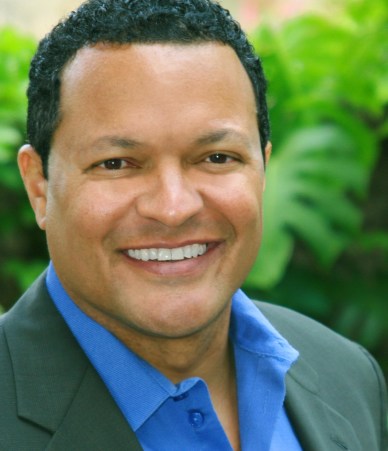
Ken Morris, image credit Kenneth Morris.jpgListen to this podcast episode here or on Google Play, or subscribe on iTunes

I’m honored and excited to introduce my next guest for Ordinary Philosophy’s 58th podcast episode, Ken Morris.

Ken Morris is closely linked to Frederick Douglass, the subject of my most recent history of ideas travel series, and carries on his legacy by working in a noble and very important cause, anti-slavery activism. He has an incredible family history and personal life story and array of accomplishments which you’ll be sure to find as impressive and fascinating as I do, but I’ll stop here and let him tell you all about it….

For more about Ken Morris and his work, please visit:

The Frederick Douglass Family Initiatives website
Bio: http://fdfi.org/ken
Facebook: https://www.facebook.com/FrederickDouglassFamilyInitiatives/
Twitter: https://twitter.com/kmorrisjr
and Picturing Frederick Douglass, to which Mr. Morris contributed and sales of which benefit the FDFI: http://fdfi.org/book

Ordinary Philosophy and its Traveling Philosophy / History of Ideas series is a labor of love and ad-free, supported by patrons and readers like you. Please offer your support today!

Basic Income: Scotland & Beyond, by Kallum Corke

4ef8b-moneycountingpaydayImagine, for a moment, that you received enough money each month to cover all of your basic needs – no strings attached, regardless of whether or not you chose to work.

What would you do?

The ‘radical’ idea that none of us should have to work to survive is the basis of the Universal Basic Income (UBI), a monthly stipend payable to every person, regardless of how they choose to spend their time. Designed to replace existing, means-tested benefit and create a stable ‘economic floor’ under each individual, UBI offers a range of advantages over our current welfare system. For starters, the single, unconditional payment would do away with the expensive means-testing and sprawling bureaucracy that currently distributes benefit, actually saving money. Other benefits (among many) include increasing individual bargaining power in an increasingly exploitative and precarious labour market, rewarding women’s ‘invisible labour’ in the home, facilitating entrepreneurship and stimulating innovation, oh – and of course, eradicating poverty outright.

Basic Income is a resurgent economic idea with a surprisingly long history; advocated by Thomas Paine (who argued for payments to every person “rich or poor” financed by a “ground-rent” paid by property owners) and Friedrich Hayek, (who believed a basic level of economic security would greatly increase individual freedom) among other famous advocates from both the left and right of the political spectrum, it has been tried in various forms throughout history. Experiments in Canada and the U.S. in the 1970s and Uganda in 2008, for example, have explored the idea of a guaranteed income (or, a negative income tax in the U.S. example). While the methods have varied, the results have generally been similar: increased school attendance among children, improved overall health, increased entrepreneurship and a slight reduction in hours worked.

And these experiments aren’t confined to the past – with renewed public and political interest in Basic Income come new studies, with governments in Finland and the Netherlands committed to pilot programmes over the next few years and this month’s historic referendum in Switzerland. In Scotland, on the 13th of May, Professor Guy Standing, author of The Precariat: The New Dangerous Class and international advocate for Basic Income, gave a speech to the RSA (Royal Society for the encouragement of Arts, Manufactures and Commerce) in Scotland where he argued that:

“It’s the year of the pilots, and that is why I would appeal to all of us in this room and many others in Scotland, to take the lead… I don’t mind the motive, but we need pilots and Scotland with the SNP’s new commitment to move in this direction has a fantastic opportunity to do something like this. It’s desperately needed and Scotland could set an example and if it does, I think you’ll see a fire of copycats. It’s something we all must encourage.”

Professor Standing is right; with pilot programmes launching across the world, the time is ripe for a Scottish experiment – and with a Scottish parliamentary majority comprised of Greens, actively advocating for a basic income and a Scottish National Party amenable to the idea, there has never been a better time to push for a Scottish study. Scotland’s unique characteristics, population density, GDP and economic diversity make it an ideal candidate for a national pilot.

The idea has been criticised as ‘utopian’, ‘unrealisable’ and fundamentally unaffordable – but with around sixteen percent of the Scottish population estimated to be living in poverty, a continued rise in reliance on food banks across the country and with ‘jobs growth’ under the current government confined to precarious, zero-hours positions in jobs soon to be lost to automated labour, it’s fast becoming a question of whether we can afford not to implement a basic income.

Recent scandals, such as the Panama Papers leaks (which I wrote about for my last Darrow piece) have demonstrated that the world’s financial and political elite, who preach austerity at every opportunity, are the very reason basic income seems so unaffordable. There are a great many ‘routes’ to financing a universal basic income, from a land or financial transaction tax to simply forcing businesses and individuals, hiding an estimated $32tn offshore, to pay their fair share in tax. And therein lies the greatest challenge on the road to basic income: not affordability, but attitudes towards poverty and social responsibility. The same individuals who hide their assets from the taxman, denying us hospitals, roads, and education, feed us a narrative which vilifies the benefits claimants as scroungers, even though poverty has proven systemic, structural and often, inescapable.

The money to pay for basic income exists, in one form or another, just out of reach.

The Panama Papers were a symbol of ever-increasing global inequality, a world in which the richest 1% of society now has as much wealth as the other 99% combined. Universal Basic Income has the potential to redress the balance and to resolve some of the most pressing issues of our time; to eradicate poverty, to more equitably reward women for their work, achieve the mythical fusion of Capitalism and Socialism and to future-proof our economy, just in time for ‘the rise of the machines’, providing each of us with the basic necessities of life and affording us the luxury of aspiration.

Basic Income is an idea whose time has come – and Scotland, were it to implement a pilot programme of its own, has the potential to kick-start a global movement.

So I’ll ask again: What would you do if your income was guaranteed?

Kallum Corke is a filmmaker, writer and visual artist whose varied creative output is chiefly concerned with issues of social justice, politics, arts and culture. (Bio credit: Darrow) Follow the author at @kallumcorke

This article was originally published on Darrow. Read the original article.

Ordinary Philosophy and its Traveling Philosophy / History of Ideas series is a labor of love and ad-free, entirely supported by patrons and readers like you. Please offer your support today!

Let Us Perish Resisting, by L.D. Burnett

Jefferson's Book Collection at the Library of Congress (cropped), photo 2016 by Amy CoolsA few years after I graduated from college, when I was short on cash, short on space, and short on hope that some significant portion of my days might ever again be spent in reading and writing and thinking about something beyond my immediate material circumstances and familial duties, I made a decision that I have wished many times to take back: I sold almost all of my textbooks. Not just the overpriced and (for me, anyhow) under-studied behemoth from Intro to Econ, nor my well-used but no longer useful grammar and exercise book from French I and II – those weren’t the only texts I culled from my little library.

I gathered up Robert Lowell and Alice Walker, Edmund Spenser and Harriet Beecher Stowe, Lucretius and Virginia Woolf, Lorraine Hansberry and Aristotle, Montaigne and Nietzsche, Flaubert, Boethius and Baudelaire, and many others besides – most of them authors I had never so much as heard of before I set foot on the Stanford campus. Norton critical editions, and anthologies of fiction and poetry, Penguin Classics, and mass market paperbacks I had acquired for classes — when I had been compelled to choose between buying my books and, say, eating more than one meal a day for a few weeks, I chose the books. I don’t regret those purchases.

Still, I wish I hadn’t sold them. Because what I let go of when I let go of those books was not just a visible reminder of lean years and tough choices. I also let go of my own history as a reader, as a learner – all the notes and exclamations and questions I had scrawled in the margins, the asterisks, the dog-ears, the passages underlined two or three times because they rang true to my young heart or my old soul.

But I didn’t sell all my books. Among the texts I kept were Augustine and Shakespeare, Dickens and Faulkner, Spoon River, Thomas Wyatt, Jane Austen and George Eliot and Thackeray so deft and droll, Dante and Cervantes and a few other stragglers besides, including Miguel de Unamuno.

Before I was an English major, I was a Spanish major, and I had been introduced to Unamuno in the second half of the Spanish lit survey at the end of my freshman year. Alas, the two volume anthology we used in the survey, with its excerpt from Unamuno’s beautiful Vida de Don Quijote y Sancho, was among the books I sold. But the standalone volume of Del sentimentio trágico de la vida – that I kept.

Unamuno’s existential anguish and his quest to find or fashion some hope in the face of the miserable fact of our mortality struck a chord with me. I might not have understood everything he was arguing — or arguing against– on my first read through, but I understood that.

In the face of certain disaster, what do we do?

That question, that problem, has been much on my mind lately, particularly as it relates to the state of higher education, the fate and future of the university as an institution or even as an idea.

What do we do?

Does it even matter?

Thinking of those questions, I was reminded this morning of a passage in Unamuno where he quotes Sénancour – somewhat disapprovingly, as it turns out, a fact lost on me the first time I read the chapter. Here is the quote, and my best attempt at a translation of it:

L’homme est périssable. Il se peut; mais, périssons en resistant, et, si le neant nous est réservé, ne faisons pas que ce soit une justice.

Man is perishable. That may be. But let us perish resisting, and, if Nonexistence is what awaits us, let us not act in a way that would make our fate seem just.

Unamuno, as it turns out, rejected Sénancour’s willingness to allow that “le neant” was our collective end. He would not surrender to nihilism. Still, Unamuno’s ensuing development of his own argument for faith – faith not instead of doubt but rooted in doubt and flowing from doubt — was a means of doing precisely what Sénancour urged, without conceding the rationale for it. Instead, Unamuno inverted that rationale, saying in effect, Let us resist despair together, and so perish not.

I sold my old books in a time of great financial distress and profound personal despair (the two were connected, as they often are). The paltry sum I received for them just exacerbated my sense of sorrow and loss. But at the time I didn’t know what else to do. I did know, however, that no matter how much of my little library I felt that I had to give up, there remained a portion that under no circumstance would I willingly surrender.

Somehow I knew that if I had let those last few books go, I would have gone right with them.

Let us resist perishing. But if we must perish, let us perish resisting. That’s not an ethos they teach in Intro to Econ, not even at Stanford – perhaps especially not there, fons et origo of Silicon Valley. Economic arguments for the value of a humanistic education will not save the humanities, and we should stop making them. The value of what we study, of what we teach and what we learn, is that such learning can help keep the human spirit alive. That may be the surest ground upon which we can stand. If that ground at the very heart of the university is lost, whatever still remains will hardly be worth keeping, whether or not we ourselves are by some miracle still standing.

L.D. Burnett received her PhD in Humanities/History of Ideas from the University of Texas at Dallas in Fall 2015. She has a B.A. in English from Stanford University. Her book, Canon Wars: The 1980s Western Civ Debates at Stanford and the Triumph of Neoliberalism in Higher Education, is under contract with University of North Carolina Press.

This entry was originally posted in .USIH Blog, licensed under a Creative Commons Attribution-NonCommercial-ShareAlike 3.0 Unported License. Bio credit .USIH Blog

Ordinary Philosophy and its Traveling Philosophy / History of Ideas series is a labor of love and ad-free, entirely supported by patrons and readers like you. Please offer your support today!


Breaking the Wall: Why Facing Depression is a Personal Choice, by James Spencer

Black doberman in the mist (cropped), photo credit patstatic, Creative Commons CC0 Public DomainDepression remains the last serious taboo in the West.

Some think it’s an illness, some think it’s less than it actually is and others deny its existence. Society is so keen to show that it is understanding of a medical condition, so keen to throw pills at it and to provide sufferers with legislative protection that it’s forgotten that depression is a very personal battle.

There remains a social undercurrent that refuses to see depression as more or less than a series of personal shortcomings or artistic affectations. Depression is a private question about how to handle the darkness when it pays you a visit. No amount of public discourse or sympathy will ever change that basic fact. It makes no difference what other people think, which is a simultaneously lonely and reassuring fact.

Happiness is contingent on being brave. It’s about conscientiously choosing to see the darkness as an illness and a series of landmines which can be contoured and identified. It’s about seeing patterns, and triggers and removing those things from your life that trigger episodes. It’s a brutal choice, a night of the long knives that has self-preservation at its heart.

Debates about whether or not depression is environmental or genetic hold no water for those who have and endure depression. The key to understanding the illness is to first recognise you have it. Treatment first begins with understanding what you have because like any illness, it can be triggered or the likelihood of getting it increases with certain decisions and behaviours.

Pills and antidepressants are not the first stop. Winston Churchill and Lord Byron are widely noted for their industrious creativity and are also the most oft-cited  men who dealt with what Churchill dubbed his ‘black dog’. Both offer insight into how someone with depression views the world.

Churchill’s melancholia is often remembered as a side effect of his greatness, but whether or not his greatness would have existed without his ‘black dog’ is another matter. Such is his legendary association with the illness that the book Mr Chartwell by Rebecca Hunt, imagined it as a literal walking, talking black dog that whispered convincing lies and downers that only Churchill could see and hear. For the  poetic licence of the book, it was an apt analogy for how Churchill explained his condition:

“I don’t like standing near the edge of a platform when an express train is passing through. I like to stand back and, if possible, get a pillar between me and the train. I don’t like to stand by the side of a ship and look down into the water. A second’s action would end everything. A few drops of desperation.”

If there is any positive in this whatsoever, Churchill’s misery allowed him to accomplish wonders because he was driven by an impossible drive to never fall into his own thoughts for worse he fell onto the train tracks.

Byron likewise suffered from depression, but with all the charm of a dead poet. His life was much the model and source for his creation of the romantic hero, sullen and brooding. The Byronic hero made an appearance in much of Byron’s work, but he best articulated the traits in his description of Conrad, the pirate hero of his The Corsair (1814):

That man of loneliness and mystery,
Scarce seen to smile, and seldom heard to sigh— (I, VIII)

He knew himself a villain—but he deem’d
The rest no better than the thing he seem’d;
And scorn’d the best as hypocrites who hid
Those deeds the bolder spirit plainly did.
He knew himself detested, but he knew
The hearts that loath’d him, crouch’d and dreaded too.
Lone, wild, and strange, he stood alike exempt
From all affection and from all contempt: (I, XI)

For all Churchill’s creatively, ego and verboseness he never embellished his illness with more than a moniker. Byron’s darkness was less so because his principal disposition was toward a spiritual melancholy that translated itself into a pantheon of literature. Churchill’s creative outlet was driving himself onward with activity and never, ever giving up.

What unites both men is that they made themselves more than the sum of the parts that encouraged their darkness. They utilised it as a goading reminder that prodigiousness was the only way to get over the part of themselves that whispered the worst and encouraged them to stop.

And this is the key: people with depression seldom know they have it. The voices in their head whispering negative things have the same normal voice of yourself but it’s been hijacked by a critical downer trying to guide the ship onto the rocks. The only way beyond this is to carry on, no matter the cost or the time involved because the darkness does eventually give way. Going on, and on, and on and never being cruel or cowardly is the only way to ensure that when you feel better destruction isn’t what remains.

Depression is like a violent blackout, you can wreck relationships or yourself during it but eventually you sober up to see what has been left behind. It’s a narrative of how you see your own story. When it becomes clouded then you have a problem because you lose an innate ability for self-assessment. It’s precisely why alcohol is both a depressive and an extremely dangerous consumption for someone who is in the throes of an episode.

Like Byron or Churchill, if there’s a heroic quality it comes from within. If a voice guided you in, you need to hold onto something to remind you to keep going through it. No one can help you except yourself. You have to hold on. Dizzying highs and devastating lows can make for a creative output of genius for some, but for most holding on means getting through a storm in such a way that when the lights do go back on, you see the world anew.

There’s a wonderful episode of Doctor Who where the eponymous hero is stuck in a maze of a castle that keeps resetting over, and over and over again. Each time he dies, he comes back; he runs the rat race again with no memory of the last time before being confronted with the truth that all the millions of skulls around him are versions of himself who lived and died.

All each version can do, before he dies and resets, is to hit an implacable wall a hundred metres thick of pure diamond. Every version makes a tiny dent before the cycle repeats.

Over and over and over again, for four billion years, each version makes a chink that eventually breaks the wall.

Depression is much the same. Whatever is being said, whatever is happening around you, stop for nothing, put the mind on autopilot and keep going because depression takes control of the head first, but it can never conquer the heart.

As someone once said ‘if you’re going through Hell, keep going’.

James Spencer attended the University of Edinburgh and graduated with a 2.1 in Politics. His interests include human rights, constitutional politics and cultural commentary. (Bio credit: Darrow)

~ This article was originally published on Darrow. Read the original article.

Ordinary Philosophy and its Traveling Philosophy / History of Ideas series is a labor of love and is ad-free, entirely supported by patrons and readers like you. Please offer your support today!

Seneca: On Tranquility of Mind, by Massimo Pigliucci

Another excellent piece by one of my favorite philosophers in the public square. I, for one, would do well to heed Seneca’s advice: I often find myself stressed and overwhelmed by running around too much and just doing, doing, doing, without enough reflection on whether or not it’s most conducive to my well-being and to the overall success of my endeavors. Thanks, Massimo, for bringing the wisdom of Stoicism to the hectic modern world!

David Hume, the Skeptical Stoic, by Massimo Pigliucci

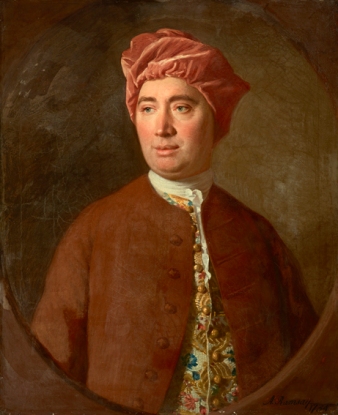
c9bd8-portrait2bof2bdavid2bhume2bby2ballan2bramsey252c2b1754252c2bscottish2bnational2bgallery252c2bpublic2bdomain2bvia2bwikimedia2bcommonsI have always been a philosophical fan of David Hume. His clear writing, commonsense approach to things, rejection of abstruse philosophizing, embracing of science, and constructive skepticism have been the sort of traits I have aspired to, however imperfectly (no, I assure you this ain’t false modesty), throughout my career. Hume’s idea that a wise person proportions beliefs to evidence, later popularized (and somewhat distorted) by Carl Sagan in the motto “extraordinary claims require extraordinary evidence” has guided me for many years, hopefully leading me to make as sound judgments as possible, as well as to change them when the cumulative evidence requires it. Add to this that le bonne David, as he was known in the Parisian salons of the Enlightenment, had a generally mild and pleasant character, and you get the features of an intellectual role model. A Stoic, however, David Hume certainly wasn’t. Or was he?

A recent article by Matthew Walker in the British Journal for the History of Philosophy (2013) tackles the question in an interesting way. Walker focuses on four essays in which Hume explores the nature of “the true philosopher,” simply entitled “The Epicurean,” “The Stoic,” “The Platonist,” and “The Sceptic.” Hume, who does not write in his own voice, but attempts an analysis of each school by writing as if he were a member (just like Cicero had done in his De Finibus, which Hume used as a model for his own essays), seems far more sympathetic to the Stoics and the Skeptics then to the Epicureans and the Platonists.

Walker, then, explores an apparent contradiction in the way Hume talks about Stoicism and Skepticism: on the one hand, he accepts the Stoic tenet that there is a way of life that the true philosopher attempts to follow, and that it is the best life possible. On the other hand, however, he also agrees with the Skeptics that there is no single way of achieving happiness. What gives? The answer, Walker suggests, lies in Hume’s flexible concept of how a true philosopher should live.

Let’s begin with Hume’s presentation of the Stoic point of view. It hinges on three theses: i) virtue-eudaimonism, the idea that virtue is the primary contributor to the happy life; ii) the reflection thesis, whereby the true philosopher guides his actions by reflection, the same way he develops and maintains his character; and iii) the supremacy thesis, the proposition that this is the best life for a human being.

Walker provides a nice analysis of Hume’s commitment to virtue-eudaimonism — the first of the three Stoic theses — albeit in a qualified fashion. He does think that the “sole purpose [of virtue] is, to make her votaries and all mankind … cheerful and happy,” but then distinguishes different virtues according to their specific contributions. So we have virtues that are immediately “agreeable” to oneself (cheerfulness and pride), those that free us from harmful behaviors (discretion, industry and frugality), virtues that are immediately good for others (wit), and those that are good for others in the long run (humanity, generosity, beneficence). Interestingly, Hume’s take come close to that of a minority opinion within ancient Stoicism, as expressed for instance by Panaetius, of whose thought Hume was aware.

Hume is also committed to the reflection thesis, the second one advanced by the Stoics. Here he takes a cue from a famous phrase by the poet Ovid: “A faithful study of the liberal arts humanizes character and permits it not to be cruel,” meaning that learning and reflection do make crucial contributions to a worthwhile human life. For Hume, philosophical reflection can help both negatively, by “extinguishing” violent passions, and positively, by improving our sensitivity to agreeable passions. Importantly, Hume doesn’t think that simply thinking about stuff improves our character and conduct, but he maintains that rational reflection can be used to change behavior and that, through repetition and habituation, one eventually can alter his character and disposition for the best. Needless to say, this is very similar to the Stoic doctrine of the gradual development and practice of virtue.

What about the supremacy thesis? That’s where things get interesting. Hume’s Skeptic answers the Stoic by saying that only a philosopher could be so blind as to think that the life of reflection is the only path to happiness. Plenty of people are happy by pursuing different lives, resulting in a type of pluralism that appears incompatible with the supremacy thesis. Moreover, Hume agrees with the Skeptic that the powers of philosophical reflection are limited, and so is their efficacy on strong passions like anger and ambition.

Hume attempts at synthesizing the two schools (just like Cicero’s before him), beginning with the contention that the Skeptic “carries the matter too far” in his criticism of philosophical reflection. Sure, one’s anger doesn’t go away because of one’s philosophizing, but critical reflection makes us see that anger is a destructive passion, therefore inducing us to take steps to curtail it, if not extinguish it. The Skeptic is right in thinking that reflection by itself cannot instill virtue, but the ancient Stoics did not think this either, hence their above mentioned developmental psychological account of virtue, from children before the age of reason to mature adults.

Also, Hume again agrees with the Skeptic that Stoicism can be used to conceal cold-heartedness and self-absorption, but counters that in effect those would be cases of bad Stoicism, as the philosophy itself only counsels a reasonable detachment from externalities, nothing more. Stoics, in other words, do not attempt to extirpate passions, but to moderate and redirect them.

The core of Walker’s argument, however, is that Hume reconciles Stoic and Skeptic positions, rescuing the supremacy thesis, by suggesting that there are two types of “philosophical” lives: narrow and broad. Walker’s analogy with religion here is brilliant and very helpful: we have no trouble understanding that religion can guide, and be central to, the lives of people. But we don’t translate that into the absurd idea that everyone should be a monk. Rather, we recognize a religious life narrowly defined, which is attractive to a few people, who achieve a meaningful existence through contemplation, prayer and the study of scriptures. But we also recognize a broadly defined religious life, which is practicable by most people, which still provides meaning and requires certain practices and studies, but that is also compatible with a number of other, non-religious aspects of existence. This is the case across religious traditions, from Christianity to Buddhism.

Analogously, says Hume, a few people can live the life of the philosopher in the narrow sense, i.e., spend most of their time reading and writing philosophy at a fairly abstract level, treating it almost as a monastic practice. But most of us can live a “philosophical” life in the sense of reading and reflecting about certain principles and attempting to put them into everyday practice, while at the same time engaging in other, more common, pursuits, what the Stoics call “preferred indifferents.”

The Stoic position, then, becomes untenable for Hume if they meant that only the narrow philosophical life is conducive to happiness. But they clearly did not. Just like there were Stoics who did live that life — Zeno, Chrysippus, Musonius Rufus, Epictetus — there were others who lived a Stoic life in the broad sense, including Cato and Marcus Aurelius.

As Walker concludes his essay, his analysis shows both that Hume keeps being fresh and relevant today, and that a Humean account of Stoicism-Skepticism demonstrates “how the ancient conception of philosophy as a way of life remains a conception worth examining even today.”

~ This piece was originally published on Massimo’s blog How to Be a Stoic on April 22, 2016

~ Massimo Pigliucci is K.D. Irani Professor of Philosophy at the City University of New York and member of the faculty at CUNY’s Graduate Center. Massimo has a background in evolutionary biology and philosophy of science. His most recent book, co-edited with Maarten Boudry, is Philosophy of Pseudoscience: Reconsidering the Demarcation Problem (Chicago Press).

~ Ordinary Philosophy and its Traveling Philosophy / History of Ideas series is a labor of love and ad-free, entirely supported by patrons and readers like you. Please offer your support today!

How Can We Answer for Answerability?, by Hannah Tierney

Measles illustration from The Practical Guide to Health by Frederick M. Rossiter, 1908, public domain via Wikimedia CommonsJenny McCarthy is a celebrity in the United States and a prominent anti-vaccine activist. She is the president of Generation Rescue, a non-profit that advocates the view that autism is at least partially caused by vaccines, and has written several books promoting this view. Since 2007, she’s been featured on several media outlets where she’s been asked to defend her views on the relationship between the Measles, Mumps, and Rubella (MMR) vaccine and autism. In many of these interviews, it’s clear that those questioning McCarthy are trying to hold her morally responsible for her view by demanding that she justify her position—by holding her answerable. Despite these numerous calls for McCarthy to justify herself, she hasn’t changed her view on vaccines (Although in a 2010 interview with Frontline, McCarthy clarifies the position of her group). In fact, calling on McCarthy to defend herself in the public sphere arguably only serves to legitimize her views and expose them to larger audiences. Though the CDC determined that measles was eliminated in 2000, due in large part to an increase in the refusal to vaccinate, a record number of measles cases were reported in 2014. If we think that McCarthy’s position on vaccines is incorrect and her advocacy of the position is blameworthy, how can we hold her responsible for her behavior without reinforcing the very behavior we find blam
eworthy?

Cases like these pose a problem for philosophers who work on moral responsibility. Following the work of T. M. Scanlon, many philosophers argue that there is a relationship between moral responsibility and answerability—the demand for justification. Of course, philosophers have argued about how exactly responsibility and answerability relate to each other. But both those who argue that moral responsibility should be identified with answerability (Smith 2012) and those who argue that answerability only captures one facet of moral responsibility (Shoemaker 2011) face a problem.

In many cases, when we attempt to hold someone morally responsible for an action by demanding that they answer for their behavior, the person, rather than see the error in their ways, can become even more confident in their reasons for action and refuse to alter their behavior. This can have quite damaging effects when the behavior in question is dangerous, violent, or qualifies as a public health risk. Such cases place those who defend the relationship between moral responsibility and answerability in a precarious position. If the very means by which we hold people responsible for blameworthy behavior only serves to worsen that blameworthy behavior, then it’s hard to see why we should hold people morally responsible in the first place. And, if the answerability account of moral responsibility can’t easily be operationalized, then perhaps we should look for another theory of moral responsibility. Though those who defend the answerability account have remained relatively silent on how to successfully hold an agent answerable, the behavioral sciences can help address this question. By developing an account of answerability that is informed by this research, answerability theorists can shield themselves from the worry that their view can never be successfully operationalized.

The case of Jenny McCarthy is not an isolated incident. Objecting to people’s beliefs is notoriously ineffective in changing those beliefs. Confirmation bias (Lord et al. 1979)—the tendency to accept evidence that supports one’s previously held beliefs and discount evidence that doesn’t—is a robust phenomena that has been found in a wide variety of contexts. The backfire effect is perhaps even more pernicious, indicating that when given evidence against a belief, people will reject the evidence and hold the original belief even more strongly (Nyhan & Reifler 2010). Asking people to give their reasons for their beliefs is also unsuccessful when it comes to changing their beliefs (Fernbach 2013). But if neither objecting to people’s views nor asking them to provide their reasons causes them to see the error in their ways, how are we to successfully hold people answerable? Is answerability a misguided account of moral responsibility?

Those who defend an answerability account of moral responsibility, whether they think answerability just is moral responsibility or answerability captures only a facet of moral responsibility, remain vague about how we can successfully hold people answerable. Angela Smith argues: “In my view, to say that an agent is morally responsible for some thing is to say that the agent is open, in principle, to demands for justification regarding that thing” (Smith 2012, 578). But we can demand justification in many different ways, and we can do so more or less successfully.  Though asking an agent to respond to arguments against her view or asking her to list her reasons are demands for justification, they are largely ineffective when it comes to getting agents to jettison morally problematic beliefs and curbing morally blameworthy behavior. Are there more effective ways to demand justification from moral agents? This is a question that the behavioral sciences can help illuminate.

One recent study indicates that asking people to explain their beliefs and the policies they endorse is more effective at reigning in extreme beliefs than asking people to respond to objections to their views or listing their reasons for their beliefs (Fernbach 2013). In particular, getting participants to explain the causal mechanisms at play in the political policies they endorse undermines the illusion of deep understanding many participants felt, which makes it more likely for participants to adopt less extreme policy beliefs. Fernbach and his collaborators also found that the call for explanation made it less likely for participants to donate money to organizations that supported their previously held political positions. Not only did the demand for explanation reign in extreme beliefs, it also played a role in changing participants’ behavior.

Answerability theorists may be right that holding people morally responsible should involve a demand for justification. But how we demand justification matters when it comes to altering people’s morally blameworthy beliefs and behavior. Thus, answerability theorists should focus on developing operational views of answerability, which are informed by the behavioral sciences.

~ Hannah Tierney is a Ph.D candidate in the Philosophy program at the University of Arizona. She has broad philosophical interests, but writes mainly on issues of moral responsibility, personal identity, and the self, and is also interested in experimental philosophy and cognitive science

~ Ordinary Philosophy and its Traveling Philosophy / History of Ideas series is a labor of love and is ad-free, entirely supported by patrons and readers like you. Please offer your support today!

~~~~~~~~~~~~~~~~~~~~~~~~~~~~~~~~~~~~

Works Cited

Fernbach, P., T. Rogers, C. Fox, and S. Sloman. 2013. Political extremism is supported by an illusion of understanding. Psychological Science 24: 939-946.

Lord, C., L. Ross, and M. Lepper. 1979. Biased assimilation and attitude polarization: The

effects of prior theories on subsequently considered evidence. Journal of Personality and Social Psychology 37: 2098-2109.

Nyhan, B. & Reifler, J. 2010. When corrections fail: The persistence of political

misperception. Political Behavior 32: 303-330.

Scanlon, T. M.  2008. Moral Dimensions: Permissibility, Meaning, Blame. Cambridge, MA: Belknap

Press of Harvard University Press.

Shoemaker, D. 2011. Attributability, answerability, and accountability: Toward a wider

theory of moral responsibility. Ethics 121: 602-632.

Smith, A. 2012. Attributability, answerability, and accountability: In defense of a unified

account. Ethics 122: 575-589.

Happy Birthday, Averroes (Ibn Rushd)! By Eric Gerlach

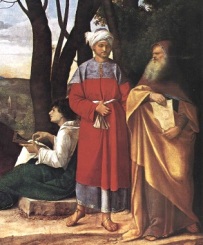
Averroes by Giorgione890 years ago today, on April 14th, the great Islamic philosopher, theologian, political theorist and scientist Ibn Rushd (1126 – 1198) was born, or as he is known via Latin in Europe, Averroes.  Among his many achievements, he is credited with popularizing the study of Aristotle in Europe, inspiring the work of Thomas Aquinas and the Christian Scholastics.  Averroes was known as “The Commentator” and Aristotle “The Philosopher” to Aquinas and the Scholastics, as Averroes wrote multiple commentaries to help others understand Aristotle’s thought.  Included here is an image of Averroes standing between and above an ancient Greek sage, likely Aristotle, and an Italian scholar of the Renaissance, sitting at their feet, painted by Giorgione of Venice.  Averroes was also a major influence on Maimonides, Giordano Bruno, Pico della Mirandola, and Baruch Spinoza, and was one of the great souls that Dante wrote was dwelling in limbo with the Greek sages who lived before Jesus.

Aquinas Averroes and Scholastics

Averroes’ grandfather and father both served as chief judge of Cordoba, the place where Averroes was born, which later became part of Spain.  Averroes wrote many works, twenty eight in matters of philosophy, as well as important works on law and medicine.  As a rationalist, Averroes argued that philosophy and religion teach the same truth and thus are not in conflict, such that intellectuals pursue the same matters that common people comprehend through religion and rhetoric.  He also argued that analytic thinking was important for the proper interpretation of the Quran, as Christian Scholastics would argue later about the Bible in Europe.  Averroes’ works were banned and burned in Islamic and Christian lands at different times, but they were revered enough to survive in both places.

Akhlaq-i_Nasiri

Averroes was opposed to the work of Al-Ghazali, the Sufi mystic and author of The Incoherence of the Philosophers.  Ghazali argued that philosophers such as Plato, Aristotle, Al-Farabi and Avicenna contradict each other, and are thus incoherent as a set, and also contradict the teachings of Islam.  Ghazali also argued that Aristotle and those who follow him are wrong to assert that nature proceeds according to established laws, as all things proceed directly through the will of God.  Averroes wrote his most famous work, The Incoherence of the Incoherence, in response to Ghazali.  Averroes defended Aristotle and argued that philosophy does lead to coherent truth, which is not in conflict with Islam, and that nature proceeds indirectly from God via the laws of nature, which God established during creation.

Spinoza

Averroes is also famous for his idea of monopsychism, that we all share the same divine soul, mind and awareness, with each taking a part such that the lower soul is individual and mortal but the higher soul is universal and immortal, the source of true inspiration and reason.  Spinoza, who said that each of us is like a wave on the great sea of being, was a pantheist, inspired in part by Averroes.  Much later, when Albert Einstein was asked if he believed in God, he said, “I believe in Spinoza’s god”.  Clearly, the history of human thought should continue to celebrate Averroes, as well as the many he inspired.

Cesar Chavez Day, by Alejandro Magana

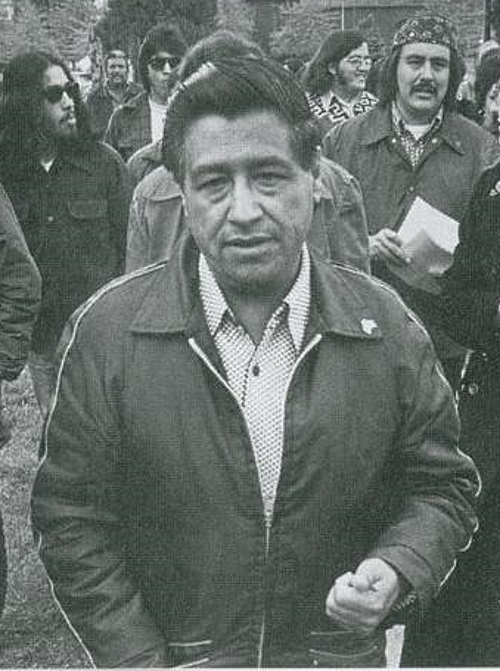
Cesar Chavez visits college - By Movimiento - Own work, cropped - CC BY-SA 3.0 httpcreativecommons.orglicensesby-sa3.0 via Wikimedia CommonsEvery year around Cesar Chavez’s birthday, as media outlets report of festivities in his honor, I’m reminded of a joke in a Simpsons episode and the strange sadness it elicited in me when I saw it: Homer Simpson is on his front lawn and is confronted with the apparition of a debonair, mustachioed man who introduces himself as, “the spirit of Cesar Chavez.”

In typical Homer confusion he asks, “Then why do you look like Cesar Romero?”

The ghost replies, “Because you don’t know what I look like!”

Cesar Chavez is certainly revered by many people, especially within the Latino community, but despite the steadily increasing ubiquity of his name across the United States, especially the American Southwest, there are still many Americans today who don’t really know who he is, let alone what he stood for, or what he accomplished.

Cesar Chavez was a Mexican-American community organizer turned labor leader and . A former migrant farmworker recruited by the Community Service Organization (CSO) in its heyday of the 1950s, he co-founded the National Farmworkers Association (NFWA,) which later became the United Farm Workers (UFW,) the first successful union for migrant farmworkers. The UFW’s membership consisted mostly of indigent Latinos and Filipinos, and their struggle for justice and dignity, fighting to gain higher wages and better conditions in the fields where they were deprived of basic needs such as clean drinking water and bathrooms, became a national moral cause under the stewardship of Chavez, who courted national and international sympathy using militant non-violent tactics in the vein of Mahatma Gandhi and Martin Luther King Jr, such as strikes, boycotts, fasts, and peaceful marches.

Chavez was not an imposing orator with the fire-and-brimstone timbre of the Reverend Dr. King, nor did he cut as iconoclastic a figure as Gandhi, but in his unassuming way he could be just as charismatic and endearing, and this often caught people off guard, as it did an interviewer for the New Yorker in 1973, who, “had expected, if not a Mexican-American Lenin…a young, hard, intense man bristling with revolutionary zeal. Instead we found Mr. Chavez to be a stocky man…about five feet seven …with Indian features…and a pleasant earnest manner.” With his trademark regular boys’ haircut parted on the side and wearing simple cardigans with button down plaid shirts and slacks, his fashion was more Mr. Rogers than Mr. Lenin. He looked the part of the humble Everyman that people felt they could relate to.

On a personal note, my parents actually met while working with Cesar Chavez in the early ‘70s, and when they tell stories of those days, they both recall how approachable he was with his easy but confident demeanor; how people were drawn to him and trusted him, even as he took them out of their comfort zones, like the time he sent my mom and a few other farmworkers to Chicago, to publicize and organize the Grape Boycott, even though they spoke very little English and were armed with just a few phone numbers of sympathizers there along with the names of some churches that might possibly provide them with food, room and board. They believed they could accomplish such ambitious plans because this diminutive, unpretentious man seemed capable of stopping the engine of the entire agricultural industry and took on Big Agribusiness all by himself. Before it became widely known as the slogan of Barack Obama’s presidential campaign, I grew up with my father reminding me, “¡Si se puede!” (Yes, you can!) a phrase Chavez often chanted before throngs of people at picket lines and marches.

Like Gandhi and King, he was intensely spiritual and absolutely committed to non-violence. In what may be his most recognizable aphorism, he said, “It is my deepest belief that only by giving our lives do we find life. I am convinced that the truest act of courage…is to sacrifice ourselves for others in a totally non-violent struggle for justice.” Self-immolation was a recurring theme in both word and deed: in 1968, during the Delano Grape Strike, after several tense confrontations at the picket lines nearly devolved into violence, he fasted for 25 days to encourage and remind the farmworkers that their fight was to be a non-violent one. He would fast for 24 days again in 1972, and in 1988 he fasted for 36 days(!) to bring attention to the pesticide poisoning of grape workers and their children. It is thought that his relatively early death at the age of 63 in 1993 was probably due to aggregated health complications suffered from these sacrifices. Still, even now, if you talk to people who marched with Chavez and the UFW back then, most speak of Chavez in reverential, even hagiographical ways, for to them he was como un santo: like a saint..

Throughout the 1960s and 1970s, as the UFW made sweeping legislative strides on behalf of organized farm labor, Chavez was also becoming the most widely known leader within the broader Chicano Movement, or “El Movimiento,” a civil rights movement which empowered Mexican Americans caught between two cultures, not quite Mexican enough for their Mexican immigrant forebears, nor seen as truly American by the white hegemony. The term “chicano” was originally a derogatory term for the American children of Mexican migrants, but in the Movement it was flipped, transmogrified, to be a badge of ethnic pride. Of course Chavez always made sure to situate the fight of the UFW as united with the struggle of “all farm workers across the country, the Negroes and poor whites, the Puerto Ricans, Japanese, and Arabians…the races that comprise the oppressed minorities of the United States,” but “The Plan de Delano,” a text co-authored by Chavez with Dolores Huerta and the Chicano playwright Luis Valdez, reifies and emboldens his ethnic heritage, declaring “We are sons of the Mexican Revolution.” To this day, the flag of the UFW, showing a black Aztec eagle on stark red background, is widely considered a symbol of Chicano or Latino pride. Those of us who wear this symbol, or even, as in my case, have it tattooed on their body, recognize that the life we have so firmly rooted in the United States, with access to resources and opportunities that our parents or grandparents did not have, is due to the hard work and vigilance of people like Cesar Chavez, Dolores Huerta, or my mother, Maria Saludado.

The identity politics that certainly began to swell in the 1960s have persisted despite reactionary criticism and remain particularly relevant today; an era in which the ugly scars of racism seem as starkly etched in our national consciousness as ever. As we near the end of the second term of America’s first ‘non-white’ President, as Mexican immigration continues to be a galvanizing and polarizing issue in the US, and the Latino vote is highly prized on both sides of the political aisle, conditions would seem fecund for a reboot of El Movimiento. In appropriate fashion, this year the Cesar Chavez Foundation, an offshoot of the UFW, began its annual celebration in San Fernando, the first city in the nation to commemorate Cesar Chavez Day with a paid holiday, with a rally and march to encourage activism to “Dump Trump.”

¡Que viva César Chávez!

~ Alejandro Magaña is a musician, poet, and songwriter some of the time, and a father and husband all of the time. He also works full-time as an office manager at Urban Ore in West Berkeley. He lives in North Oakland with his wife and son and books and records.

~ Ordinary Philosophy and its Traveling Philosophy / History of Ideas series is a labor of love and is ad-free, entirely supported by patrons and readers like you. Please offer your support today!

~~~~~~~~~~~~~~~~~~~~~~

Sources and Inspiration:

● My mother and father. ¡Que viva mis padres!
● Chasan, Daniel. “‘Marcher,’ an interview with Cesar Chavez,” The New Yorker, May 27, 1967.
● Chavez, Cesar, Huerta, Dolores, and Valdez, Luis. “The Plan of Delano,” El Malcriado, March 17, 1966.
● Chavez, Cesar. An Organizer’s Tale: Speeches Ed. Ilan Stevens. London: Penguin Books, 2008.

Confucianism & Daoism: The Basics

The following is a lecture I composed for teaching Confucianism and Daoism to my sister’s 6th grade History class at Star of the Sea School in San Francisco.
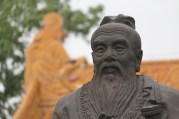
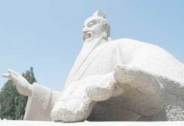
Confucius_Sculpture,_Nanjing

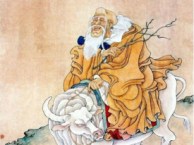
Confucius and Laozi, the philosophers who founded Confucianism and Daoism, lived just before the Warring States Period of ancient China (476 – 221 BCE), a time of war, tragedy and interest in philosophy.  Unfortunately, people’s lives are full of problems, but fortunately problems make people think about their lives, question the answers of authorities and experts, and reason beyond their understandings.
Laozi

Each of us, as individuals, should use both belief and doubt to become better, wiser people, but how should we go about doing this?  Confucianism and Daoism, the two great philosophies of ancient China, gave people opposing ways to gain wisdom.  Many in ancient and modern times used both to compliment and extend each other.

The Confucians say we should build ourselves up to be educated, compassionate and civilized, while the Daoists say we should clear ourselves out to become open-minded, patient and peaceful.  The Confucians say we should learn from others, reason for ourselves, and do what we know to be right.  The Daoists say we should seek less for ourselves and gain perspective beyond our own interests, reasons and actions.

Confucius, the Golden Rule & Learning from Everyone

Confucius Latin

When Catholic Jesuit missionaries arrived in China in the 1600s, they were astounded to find that Confucius, the most influential and central Chinese philosopher, was incredibly similar to Jesus in his sayings and teachings.  First and foremost, like Jesus, Buddha, Muhammad and other revered teachers, Confucius taught what has been called the Golden Rule: Do for others what you would want them to do for you, and do not do to others what you do not want done to yourself.  Confucius said that this was the single thing that should guide one’s life, and that compassion is the central thread running throughout his thinking.
chinese-scholars1

Confucius’ student Zigong once told his teacher, “I do not want to do to others what I do not want them to do to me.”  Confucius replied, “You have not come that far yet”, probably because none of us want others to simply tell us that they are amazing.  Another time, Confucius heard Zigong criticizing other people, and said, “Zigong must have already reached perfection, which affords him leisure I do not possess.”  Confucius is being sarcastic, as he often said that no one is perfect, but anyone can be excellent by continuously working to become better.

confucius-teaching-hillside-painting

Not only can anyone be excellent, but we can each learn from anyone about how to be better ourselves.  Confucius taught that when we see great people, we should seek to be like them, but when we see horrible people, we should seek how we are like them by examining ourselves.  Confucius said, “Put me with any two people at random and they will always have something to teach me, as I can take their qualities as a model and their defects as a warning.  Clearly, Confucius believed that we all share the same set of strengths and faults, no matter how talented (or horrible) we happen to individually be or where our talents are.
emperor-shun-of-china

Because no one is perfect and everyone can learn from anyone, there is no one who is above criticism, not even the prince of the state.  When asked by a duke if there is a single thing that could ruin a country, Confucius said that if the prince is never told when he is in error or contradicted, it could be the ruin of everyone.  About himself, Confucius said, “I am fortunate indeed… Whenever I make a mistake, there is always someone who notices it.”

chinese-painting-inquiring-about-the-dao

Daoism, Perspective & Less is More

laozi-water-buffalo

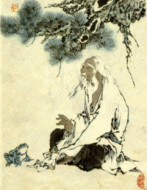
The legendary Daoist sages Laozi, Zhuangzi and Liezi taught that human perspectives are limited, and we should always keep this in mind.  Because we only have partial perspectives, we should keep in mind that others have their own perspectives which may not be the same as ours.  In one famous story, a turtle comes across a frog living in a well, and tells the frog about the sea, water that goes beyond the horizon with no walls in sight.  The frog refuses to believe the turtle, arguing that he has lived in water all his life and knows perfectly well that it comes in wells that are only so wide and have walls.  In Zhuangzi’s book, it says:
frog-with-zhuangzi

You can’t discuss the ocean with well frogs.  They’re limited by the space they live in.  You can’t discuss ice with summer insects.  They’re bound to a single season.  You can’t discuss the greater way of things with cramped scholars.  They’re shackled by their doctrines.  Now you have come out beyond your banks and borders and have seen the great sea, and so you realize how small you are.  From now on it will be possible to talk to you about the greater way of things.

japanese monkey painting

If someone sleeps in a damp place, their back aches and they ends up half paralyzed, but is this true of a carp?  If someone lives in a tree, they are terrified and shake with fright, but is this true of a monkey?  Of these three creatures, which knows the proper place to live?  We eat the flesh of grass-fed and grain-fed animals, deer eat grass, centipedes find snakes tasty, and hawks and falcons love mice.  Of these four, who knows how food ought to taste?  Monkeys pair with monkeys, deer go out with deer, and fish play around with fish.  Men claim that Mao-Qiang and Lady Li were beautiful, but if fish saw them they would dive to the bottom of the stream, if birds saw them they would fly away, and if deer saw them they would break into a run.  Of these four, which knows the standard of beauty for the world?

samurai-on-horseback-statue

Daoists also teach the idea of wu-wei, or non-action.  This does not mean that one should not act at all, but that often doing less is doing more.  Being patient and paying attention can save us from doing too much or having to do things over again.  In a Japanese story that illustrates this well, a local lord has three sons and must decide who should inherit his position.  He tests them by placing a pillow on the door to his room and calling them one at a time.  The eldest son enters and annihilates the pillow in a frenzy of skilled sword strikes.  The middle son draws his sword but sees the pillow in mid-air and catches it.  The youngest son sees the pillow on the door, tucks it under his arm and enters the room to the joy of his father.  The youngest son was paying attention, and so he did not even need to pull out his sword.

walking-in-nature-chinese-painting

There are many passages In the Dao De Jing and Zhuangzi, the two central texts of Daoism, that similarly teach that wanting too much and trying too hard is the wrong way to be:

Sages do not boast, and are thus admired by everyone, do not want to shine, and thus will be enlightened, do not seek excellence, and are thus excellent, and because they do not argue, no one can argue with them.

chinese-mountain-painting-stairs

Those who know do not speak.  Those who speak do not know.

Whoever knows how to lead well is not warlike.  Whoever knows how to fight well is not angry.  Whoever knows how to conquer enemies does not fight them.  Whoever knows how to use others well keeps themselves low.
archer-china

Those who divide fail to divide.  Those who judge are bad at judging.  What does this mean, you ask?  The sage embraces things.  Ordinary people judge between things and parade their judgements in front of others.  So I say, those who judge fail to see.

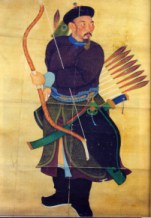
When you’re betting for cheap prizes in an archery contest, you shoot with skill.  When you’re betting for fancy belt buckles, you worry about your aim, and when you’re betting for real gold, you’re a nervous wreck.  Your skill is the same in all three cases, but because one prize means more to you than another, you let outside considerations weigh on your mind.  They who look too hard on the outside get clumsy on the inside.

~ Ordinary Philosophy and its Traveling Philosophy / History of Ideas series is a labor of love and is ad-free, entirely supported by patrons and readers like you. Please offer your support today!