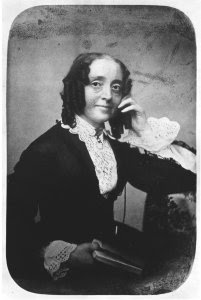
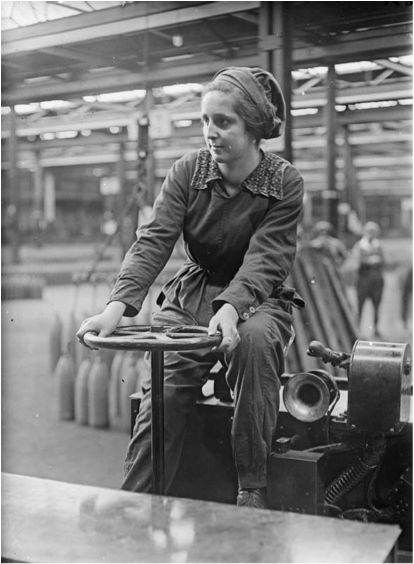
Ernestine Rose and Elizabeth Cady Stanton: A Brief History

With my first day of discovery under my belt, I’ll start by telling you a little about the two wonderful women who are the inspirations for and subjects of my project, in case you’re encountering them here for the first time.

Ernestine Rose was a Polish, immigrant, feminist, abolitionist, public-speaking, socialist, atheist Jewish woman. Unless she had happened to be black, she had nearly as many cards stacked against her chances of leading a successful and happy life in her time as one person could have. To a person like myself and I suspect like you, dear reader, such a list of attributes today indicate her utter awesomeness! Anyway, Rose did manage to make a career for herself in which she was widely admired and financially stable, even sometimes well off, regardless of the fact that she was such a controversial figure. That’s because she had the good fortune to receive a very good education, she was an inspiring and gifted public speaker, she had a lot of energy and a strong work ethic, (despite her frequent struggles with ill health), she such displayed fearlessness and integrity in her convictions, and it didn’t hurt that she was very attractive, especially by the standards of her day.

Ernestine, born in 1810, was the daughter of a rabbi, and was well read and precocious at a young age. For example: she convinced her father to teach her to read the Torah in its original language so that she could discuss and debate the meaning of the actual text with him. When she was a young woman, she escaped an arranged marriage by appealing to the Polish civil court (rather than the local Jewish court as was customary) and decided to make the most of her life by leaving her segregated, anti-Semitic native city. She went from Berlin, where she learned German and invented the perfumes and a room-scenting device that helped support the family, to London, where she met her dearly-loved, fellow liberal-progressive husband William Rose, and finally to the United States, where she and her husband soon opened up a ‘fancy’ shop selling her perfumes and his silversmithing creations, and where she threw herself whole-heartedly into public speaking, writing, and organizing in support of women’s rights, abolition, separation of church and state, and other human rights causes. Her public speaking was as controversial as her unorthodox beliefs, since at that time it was considered immodest and unwomanly, limited to men only; but it was her open and unapologetic atheism that was most controversial, and most unusual. She lived and worked in the United States, based in New York City, from 1836 to 1869, when she moved to England to (mostly) rest and retire from public life when her health began to give out for good.

Elizabeth Cady Stanton, born five years after Ernestine in central New York State, was as fearless and tireless in her activism as she was in motherhood. Like Ernestine, she was an outspoken and unapologetic feminist, abolitionist, and freethinker. After a thorough formal education, somewhat unusual for women in her time, she married at age 25 (leaving out the ‘obedience’ vow, since she viewed marriage as a partnership between two consenting, rational adults, rather than a hierarchical power arrangement) and raised seven children.
She wrote prodigiously, and since giving birth to and raising so many children kept her too busy for frequent travel and public speaking, she worked closely with Lucrecia Mott, another founding feminist, and entered into a longtime collaboration with a fellow feminist, Susan B. Anthony. While the two were very different in so many many ways (Elizabeth was fiery and impolitic in expressing her opinions, Susan was more tactful; Elizabeth was a skilled writer and orator but less skilled organizer, while Susan was the opposite; Elizabeth was an outspoken critic of religion and the Bible, Susan, like Lucretia, was a Quaker), they were extremely attached to one another, and their often opposing strengths made them probably the single most effective and influential team in feminist history. (Side note: if you are interested in the history of human rights and progressive activism in the United States, you may be struck by the prevalence of Quakers among their ranks. While there were many Quaker sects, they tended to hold radical beliefs for their day: they were egalitarian, pro-education, anti-war, and encouraged critical discussion and examination in matters of religion.)
With Lucretia’s, Susan’s, and others’ help, especially while she was still home bound with her young children, Elizabeth conceived of and put together numerous meetings and organizations, including the first women’s rights conference at Seneca Falls in 1848, numerous abolitionist and temperance events, the American Equal Rights Association, the International Women’s Council, and many more. She wrote the Woman’s Bible, A Declaration of Sentiments (modeled on the Declaration of Independence), Solitude of Self (often considered her greatest speech), History of Woman Suffrage (with others), and much more. She was the first woman to run for Congress, wrote and was the primary impetus behind the passage of the first federal bill protecting women’s property to pass into law (following Ernestine, who has campaigned for it earlier), and annually campaigned, unsuccessfully, for suffrage for women. (Though she lived a very long life, she did not live to see this victory achieved.) Like Ernestine, she was a rare outspoken critic of religion, and considered all of them anti-woman, especially the three religions of the Bible. She worked up to the day she died in 1902 (on October 27th, the date I flew in to NYC.)

Now that we have a brief history of those great women fresh in our minds, let’s follow in their footsteps!

Shortly to follow: an account of my first day in New York City. visiting sites associated with their lives here…..

~~~~~~~~~~~~~~~~~~~~
Sources and Inspiration:
Dorress-Worters, Paula. Mistress of Herself: Speeches and Letters of Ernestine Rose, Early Women’s Rights Leader. The Feminist Press at CUNY, 2008
Elizabeth Cady Stanton. (2014, November 4). In Wikipedia, The Free Encyclopedia. Retrieved 15:33, November 5, 2014, from  http://wikipedia.org/wiki/Elizabeth_Cady_Stanton
‘Elizabeth Cady Stanton Dies At Her Home’, On This Day, New York Times, Oct 7th, 1902. http://www.nytimes.com/learning/general/onthisday/bday/1112.html
Ernestine Rose. (2014, July 7). In Wikipedia, The Free Encyclopedia. Retrieved 15:34, November 5, 2014, from http://wikipedia.org/wiki/Ernestine_Rose
Freedman, Janet. ‘Ernestine Rose.’ Jewish Women’s Archive  http://jwa.org/encyclopedia/article/rose-ernestine
Kolmerten, Carol. The American Life of Ernestine L. Rose. Syracuse, N.Y., 1999.  http://books.google.com/books?id=0JkRzTh7QUsC&printsec=frontcover&source=gbs_atb#v=onepage&q&f=false
‘New Lanark: An Introduction’. Undiscovered Scotland: The Ultimate Online Guide. http://www.undiscoveredscotland.co.uk/lanark/newlanark/
Stanton, Elizabeth Cady, Susan B. Anthony, and Matilda Josyn Gage. History of Woman Suffrage, volumes 1 and 2. Rochester, N.Y., 1881,1887

To New York City I Go, In Search of Ernestine Rose and Elizabeth Cady Stanton

Hello, friends of Ordinary Philosophy!

I’m pleased and excited to announce my upcoming adventure: my second philosophical-historical themed adventure, this time to New York City!

In case you missed my first go-round in my series of philosophy-travel pieces, here’s my plan:

So I’m taking a series of trips to places around the world, where I explore the lives and ideas of great thinkers in the places where they lived and worked. I’ll follow in the footsteps of thinkers who are no longer alive, since those who are still telling their own stories. But those who are no longer alive in the body live on in the ideas that they pass on, and in the example they provide for us to follow.

For this next installment, I’ll be following Ernestine Rose and Elizabeth Cady Stanton, two of the greatest founders of the women’s rights movement. Elizabeth was born in New York state, and lived many years in New York City, where she also died. Ernestine was born in Poland (so at some point, I hope to make it to Poland and write an ‘Ernestine Rose, Part 2 series!) and lived for many years in New York City, and though she did not live in the United States for all of her life, much of her most important work on behalf of women was done here. So off to New York City I go! There, I’ll visit significant landmark associated with their lives, places where they lived, worked, died, thought, wrote, studied, and rested.

I’ll be traveling there from October 29th through November 2, and will be writing throughout the trip. I’ll be writing not only about their ideas, but about what I can discover about their everyday lives here, and whatever feeling of their time and place I manage to uncover.

If you have any questions for me to answer while I’m there, or pictures you’d like me to take for you, or any information you have that could help me with this project, I’d love to hear from you!

Follow Ernestine Rose and Elizabeth Cady Stanton with me:

Ernestine Rose and Elizabeth Cady Stanton: A Brief History
Ernestine Rose and Elizabeth Cady Stanton Sites, NYC, Part 1
Ernestine Rose and Elizabeth Cady Stanton Sites, NYC, Part 2
Ernestine Rose and Elizabeth Cady Stanton Sites, NYC, Part 3
In Her Own Words: Solitude of Self, by Elizabeth Cady Stanton, 1892
In Her Own Words: A Defense of Atheism, by Ernestine Rose, 1861

For more about Elizabeth Cady Stanton at Ordinary Philosophy, please visit:

Frederick Douglass Albany, Troy, and Syracuse NY Sites
Frederick Douglass Seneca Falls, Canandaigua, Honeoye, and Mt Hope Cemetery Sites
Is Feminism Passe? No! Cries A Distinct Lack of Statuary

And about Ernestine Rose and Elizabeth Cady Stanton:

Philosophy and Early Feminist Thought

Money and Human Worth

‘It’s just business.’

This is one of my least favorite phrases of all time. 
It seems to be used, generally, to explain away unpleasant, unkind, or unethical behavior, or to avoid addressing or dealing with the undesirable side effects of a difficult but necessary decision, in a situation where money is involved.

Yet just because the phrase ‘it’s just business’ might be used only in difficult or unpleasant situations, that doesn’t make it wrong, does it? Couldn’t it be a shorthand way of pointing out that it’s impossible to make everyone happy in every business transaction, since it involves two or more opposing sets of interests? In fact, the phrase could be revealing humane concern, a regret that there are often undesirable side effects to the other in conducting business.

Yes, I allow; the utterer could be expressing these sentiments, choosing this phrase because it’s a ready-made, widely understood part of our lexicon.

But we don’t hear it being used this way much, do we? It seems this phrase is almost always used to justify rudeness, treating human beings as if they’re merely a means to an end or taking advantage of an opportunity to exploit others; to explain away bribery, theft, extortion, bullying, abuse… It’s not generally used in cases of honest dealing, of courtesy and respect for other person(s) involved in a transaction, of doing one’s best to make sure an employee is treated or ‘let go’ in as just and fair a manner as possible. In such situations, no such disclaimer is necessary.

So why am I bringing this up? What’s caused me to think about why and how people use this phrase, and for it to rankle with me enough to write this essay?

Full disclosure: I have a working gal’s chip on my shoulder.

I’ve worked for a living my entire life, since I was about seventeen. Most of those years I worked in customer service. I’ve prepared and served food and drink, I’ve sold goods and services, I’ve made art and things to wear, I’ve lifted and carried loads, I’ve decorated and cleaned, I’ve answered phone calls, I’ve scheduled appointments and events… The list goes on. I consider it all honest work, and I think… no, I know, I’ve helped make life better for many, many people along the way.

All this is true, in fact, of most of the people in the world. Behind every counter and cash register, on the receiving end of every phone call and email, in every kitchen and factory and field and warehouse and office and hospital, other people’s work make our lives better. We depend on them for providing the necessities and the luxuries of life. Their hard work makes our lives enjoyable and even possible. Given this fact, it never fails to disappoint me, and sometimes still surprises me, how often people feel entitled to treat working people with condescension, disdain, and even abuse, from the first moment of interaction.

Now most people I’ve worked for and done business with have been decent, many more have been polite, friendly and supportive, and some have been the loveliest people I’ve ever had the pleasure to meet, some have become dear friends. I consider myself lucky that in so many ways, throughout the course of my working life, I’ve enjoyed a great deal of moral and financial support, others’ concern for my well-being, a richness of interesting experiences, of opportunities to improve my situation, of the goodness of other people, and of the chance to expand my talents, exercise my creativity and problem solving skills, and best of all, to never stop learning.

But I also couldn’t possibly begin to make a full account of the number of times I’ve felt dismissed, condescended to, treated like a machine or a servant, and attacked for all manner of disappointments and inconveniences (real or perceived) whether I was responsible for them or not, simply by virtue of being on the other side of that counter, that receipt book, that telephone, that paycheck. I am also keenly aware how instrumental I was, or at least tried to be, in making that person’s life better at that moment. And this, again, is true of every working person in the world. Without us working people, no one could eat food, drink water, keep themselves and their homes and cities clean, travel, heal their ills, enjoy any luxuries, and so on, in comfort and security. And of course, the category ‘us working people’ include the vast majority of humanity. Most of us work for a living, and each job we do involves at least some kind of business interaction. It’s work that provides the (real) goods and services for sale in any business transaction. And almost all of us who live in this world have had many occasions to bemoan ill treatment in our capacities as workers and engagers in business.

This is where we arrive at the connection between the phrase ‘it’s just business’ and why it bothers me so much. I detest it because it expresses an attempt to dehumanize the interaction and, by extension, the person one does business with. It implies that one can remove the ‘human element’, the consideration of the other as a being with moral worth to whom we have certain obligations, from the realm of business. And if it’s not really a human interaction, therefore, one does not have to act with kindness, fairness, or respect.

I argue that this the attempt to dehumanize business is impossible: business is entirely about people. All business transactions are a type of human interaction. It’s true that when we make a bargain, when we exchange money for something we want, certain elements are added to the interaction. There are problems of fairness to be resolved, there’s customer loyalty to be won, the need for expediency may be pressing, and so forth. But all types of human interaction contain unique elements: all involve a particular combination of expectations, obligations, etiquette, and other considerations. The fact that it’s a business transaction, and not another kind, does not subtract from the basic fact that all parties are human beings to whom we owe a basic level of respect and courtesy.

Business, in this sense, is always personal.

Most of us, most of the time, recognize this. Most business, day to day, is conducted in a reasonably courteous and decent way. We greet the other person, we say thank you (if not always ‘please’), we ‘shake hands on it’. We don’t usually lie, steal, or bully to get what we want. We treat our colleagues and employees with decency at least when we come into direct contact with them, we praise their work and give them raises and bonuses if we can, we usually feel regret, at least on some level, if we feel we need to fire them, and we hope they do well in the future. When we consider the phrase ‘it’s just business’, we realize that it holds little meaning when considered in light of how we usually behave. Understood as ‘it’s just a human interaction that involves money,’ we realize it’s a rather meaningless statement.

So it appears clear that we resort to this phrase when doing the right thing by the person we’re doing business with becomes difficult or inexpedient to getting what we want. And I fear it’s became far too widely, and far too unquestioningly, accepted when used this way. Why have we come to acquiesce to the idea that when money enters an interaction, that its appropriate to overlook or cast aside our concern for the cost in human dignity, in respect, well-being, rights, justice, and simple decency? I fear that in our enthusiasm for the benefits of the marketplace, we too easily become complacent to what can be lost.

What we can lose is the respect we should have, as a central feature of our character, for the moral worth of others, and that if we let that slip, we undermine ourselves as social creatures, and in turn, everyone’s prospects for well-being. If our dignity, our moral worth, is up for sale, then the marketplace, ideally a highly cooperative, mutually beneficial institution, devolves into an arms ace where the most ruthless thrive in the short term, while trust erodes and the whole system of collapses in the long run. We can recognize this by comparing and contrasting various societies and their market systems, contemporary and historical. Oligarchies, tyrannies, rigidly enforced class systems and aristocracies, ideologically-based planned economies, are all extreme examples of how the disregard of individual human worth and dignity cause a marketplace to lose its ability to benefit all, and ultimately to self-destruct.

So, from a matter as minor as rudeness to a salesperson, to as serious as slavery, the same principle applies. The exchange of money for something we want or need makes no difference, morally, to the basic way we should treat anyone. That’s because, while goods or services are marketable, a person’s moral worth can never be, and should never be, up for sale.

It’s true that we’re sometimes justified in expressing anger and disappointment when doing business. Sometimes others fail, a little or a lot, in performing their part of the bargain or duties of their job, and we feel quite unfriendly when that’s the case. Sometimes others fail to provide good customer service, and are rude and unhelpful from the start. Sometimes others provide ‘services’ and products that are faulty, useless, or even harmful. In these circumstances it’s just to criticize their work, or to withhold or take back payment if the terms of the exchange aren’t fulfilled, or to let them know that you won’t be patronizing their business again. It’s appropriate, in such cases, and to voice one’s displeasure.

But this just reaction to the failure of the other to fulfill their part of the bargain is not what I’m criticizing here. It’s the unspoken attitude, unfortunately too widespread in my observation, that the person with the money in the exchange is automatically entitled to be abrupt and impersonal, to always demand, command, act impatient, and even abuse those they’re paying, in a manner inconsistent with respect for human dignity. It’s implied in the adage ‘the customer is always right.’ Are you the recipient of a payment, for goods or services, or as an employee on the clock? If so, many think, you are immediately transformed into a legitimate target for frustration, impatience, desire, greed, and sense of entitlement, whether or not you were responsible for the disappointment. In this sense, it feels as if you are no longer a person to them. Because if they consider you a person, wouldn’t they feel that they should be polite, respectful, or at a minimum, not rude or hateful to you, just as they would any other person?


Again, to argue that business is not personal, that it removes much or even all of the human element, is to make a very serious claim, with dire repercussions. It would imply that the moral worth of a human being is calculable in dollars and cents, and that it can be bought and sold. I argue that the number value of money and the degree of significance of a human life can never be aligned, and that you can’t ‘pay away’ your moral obligations towards any human being. When you pay for a good or a service, that, and only that, is what you pay for. Your payment does not apply in any way to your moral obligation to respect others.

One might object: ‘I didn’t choose to enter into any kind of relationship with the person I’m doing business with, they just happened to be the one I had to interact with to get something I need or want. Shouldn’t relationships be a matter of choice? Why, then, can’t a business interaction be impersonal, especially if members of a society agree that it’s impersonal?’

To begin with, all human interactions ultimately belong in the category of unchosen relationships. We stumble upon interactions with people all the time, and it’s a fact of life that all relationships occur because of chance circumstances, at least at first. We don’t choose for ourselves who we pass by on the street, who the open seat on the subway is next to, who our classmates, colleagues, or the new neighbors will be, who the people we already know will introduce us to, or who our parents, siblings, and relatives are. They become part of our world via circumstances out of our control. Since all human interactions belong in the same category. I argue, the same basic obligation to be just, polite, and respectful applies equally in all human interactions.

Secondly: one can no more give away or sell one’s own moral worth than they can choose to negate or buy another’s. That’s because human worth, mutual obligations of respect and duty and mutual dependence, are not merely a part of some unspoken contract. They are a feature of human nature by virtue of the fact that we are social and rational, and therefore, moral beings. ‘X cannot buy or sell away the moral with of Y‘ is equally true, if we are indeed rational, social beings, whether the variables X and Y are replaced in that statement by ‘you’ or ‘I’. (1)

It’s a fundamental part of the human condition that we are all bound together in a mutual web of obligation and dependency. Without one another, we would not get very far in life, and all we achieve, all we do, are the result of the combination of our own efforts with the contributions of others. One needs the ingenuity and knowledge of physics of the inventor and the architect when one needs a car, a bridge, a home, and owes a debt of gratitude for the resulting vast improvement in the ease and comfort of life. The inventor and the architect, in turn, needs the labor of the miner, the smelter, and the carpenter, and owes not only money, but respect and gratitude for supplying the raw material, without which their designs could not be realized, and for being among their clients, without which their wealth could not be earned and their work would not be needed. One needs the knowledge and skill and of the physician when health fails, and owes to her gratitude, admiration, and respect for the services she provides, and the hard work and intelligence it required to attain her abilities to heal. The physician needs the fruit of the work of the laborer in the field to sustain her life, and owes the laborer gratitude, admiration, and respect for the difficulty of the work performed and the fact that her life is sustained through his labor. The exchange of money is simply the means by which the exchange is organized; the basic fact that we all depend on each other, and have moral obligations to each other, is not altered by its usage.

*****************************************************************************
(1) Pinker, Steven. The Better Angels of Our Nature, 2011, Viking Penguin, New York. pp 647-648

Gospel Songs, Negro Spirituals, and This Heathen

The great Mahalia Jackson

I’m a non-religious person, an atheist, a freethinker, a heathen…. whatever you want to call me, any of those terms suits me just fine. I also love a lot of ‘God-dy’, spiritual music.


I grew up Catholic, but for the most part, our church music didn’t ‘stay’ with me as an adult. I’m just not that into chants (I usually find them kinda depressing) and traditional Catholic and Christian hymns tend to be pretty chant-y, or too ponderous and formal for my taste. ‘Ave Maria’ is lovely, and some of the Christmas songs, but overall, that style just doesn’t do much for me. Nor did I ever like the more modern, multi-denominational Christian hymns: they’re mostly pretty corny, and are as artistically satisfying and pack as much of an emotional punch as a discount Hallmark card. The absolute worst of all: Christian rock, country, and pop music. ***shudder***

But let me tell you: if I had grown up in a Baptist church in the South, and heard that passionate, joyful gospel music every Sunday, or those soulful Negro spirituals, I may have remained a weekly churchgoer to this day. I just don’t know if I could have torn myself away from those songs, which alternately uplift the hearer to dizzying heights, or tears your heart apart with the most delicious pain as it simultaneously heals you.

Why do I love this brand of religious music? Why do I find it ranks right up there with the very best of human artistic accomplishments?

I’ve thought this over quite a bit, and I’ve come to the conclusion that there are three main reasons:

1) Time: Gospel songs and Negro spirituals were developed from centuries of earlier forms of music, from standard Christian church songs, American folk songs, and rhythmic African music. The crafters of these songs had a rich tradition to draw from, and this music was developed and perfected over centuries. Of course, this is true of all types of music one degree or another, so now we add the next basic element:

2) Indirectness: For some as yet poorly-understood reason rooted in human psychology, I find that the most sublime, most important emotional truths are rarely well conveyed if the language used is too literal. The words can be simple and seemingly direct, but what they’re ultimately alluding too, the deepest and most transcendent parts of human experience, are somehow out of reach of ordinary language. When it comes to religious music, it has a way of revealing the depths of pain, joy, gratitude, ecstasy, and connection with each other and the universe as it’s couched in the symbolic language of the supernatural. (To me, that is; to its authors, the supernatural imagery is often meant to be taken literally). Other forms of poetry do the same; that’s why similes, metaphors, and other linguistic forms of insinuation and suggestion are so universal. Like symbolism, they are incredibly effective in igniting the imagination and setting it free to roam the universe and explore our inner depths. Yet there’s one more element needed to really raise these forms of music to the heights of artistic expression:

3) Authenticity: Gospel songs and Negro spirituals (along with other related forms of American music, blues, country, and folk) are a direct outpouring of some of the greatest suffering, coupled with the deepest longing for redemption and relief from suffering, that humankind has ever known. There is little to no affectation in this music. Much of this music is the legacy of slavery, the outpourings of the tortured human spirit in the midst of oppression, torture, hopelessness, and despair resulting from one of the greatest evils the human race has ever inflicted on so many of its members. So it’s no wonder that the language of religious redemption, combined with the longing for liberty and freedom from pain on earth, and the joy at the thought of its attainment, resulted in some of the most transcendent, stirring music that our species has ever created.

That’s why I find, heathen that I am, that most freethought and atheist songs leave me cold: they are missing one or more of these elements. Steve Martin is just about right: ‘Atheists Don’t Have No Songs‘! They are too gimmicky, too ‘clever’, too literal, too simultaneously reactionary to and derivative from religious music. The few freethought songs I like are are almost always the funny ones, where cleverness is what the song’s all about, such as Roy Zimmerman’s Creation Science 101.

It’s no surprise that agnostic, atheist, irreverent songs are generally not very good, since freethought as a movement is still very young compared to religion. Give it some time and good songs will come, no doubt, once they’ve escaped the overly-rational, self-consciously non-spiritual constraints they’ve placed on themselves. Tim Minchin, by adding some heart to the mix with his witty and sweet White Wine in the Sun, moves freethought songcraft in the right direction.

So who cares about religion or no religion in music: all are created by human beings for the enjoyment of other human beings. Here’s a list of some of my very favorite gospel and spiritual songs (and songs inspired by that tradition) that I think are more moving than just about anything else you’re likely to hear:

He Must Have Known‘ – Mahalia Jackson – (Thanks for this one, Mike LaSalle)

Let It Shine‘ – Blind Willie Johnson

Didn’t It Rain‘ – Sister Rosetta Tharpe (and well, pretty much every other song she ever did!)


Sending Up My Timber‘ – Blind Willie McTell


I Saw The Light‘ – Hank Williams as Luke the Drifter


Com’ By H’Yere Good Lord – Nina Simone

I Must See Jesus – Snooks Eaglin


Uncloudy Day – The Staple Singers

I Was Standing By the Bedside of a Neighbor – Michelle Lanchester and Sweet Honey in the Rock

I’ll be adding to this list from time to time as I think of them, or find a new must-hear. In the meantime, dance, weep, jump up and down, sway, transcend, and enjoy!

Review: Lindgren’s Coffee and Cafe

Stumbled on this cozy little spot last week, and decided to come back and have me a little writing session with something hot and tasty to drink, as I am wont to do.

My cafe mocha is totally solid: classic, made with nice chocolate and rich but not too sweet, and the young man at the counter is friendly and thoughtful. They ran out of whipped cream, so he made me a lovely pile of foam instead. 
The place has a nice warm feeling to it, with lots of seating, plenty of options for snacks, meals, even cold beer, and a nice roomy back patio too. The decor is very nice: vintage look cafe banners, dark wood furniture, an aged brick wall.
Glad to have found another good Berkeley spot to write in. I’ll be back!

Who, What, Why, How: http://www.LindgrensCafe.com

Where: 2120 Dwight Way (at Shattuck), Berkeley, CA 94704

When: Every day 8am – 8:00 pm

Perhaps I’ll see you there sometime!

Let’s Have an Honest Debate About Abortion

Have you seen the image to the left on social media sites recently?

As an advocacy poster, it’s quite effective, isn’t it? It tugs at the heartstrings, it moves us to feel the best emotions we are capable of: care, sympathy, and protectiveness, as it portrays a tiny human life in a helpless position. It invites you to endorse its message by clicking on the image if you think it says something true, which it does. Abortion ends a life, and that life is human. At a glance, it makes a powerful case for the author’s position.

Now suppose we take another image

…and give it what appears to be nearly the same caption: ‘

Click if You Think Surgical Removal of Undeveloped Twin Ends Human Life.’

This phrase also contains at least some truth. Would it be effective in rallying people in protest against the surgery? The surgery could save the fully developed twin’s life, or at least give them some degree of freedom, opportunity, and good health not possible so long as the undeveloped twin remained attached.

At this point, on whatever side of the abortion-rights debate you are on, you’re probably already protesting against at least one of these. What point would you make, what argument would you use? ‘A fetus is not a human life yet!’? Or, ‘Abortion is not like surgery to remove a parasitic twin: one is meant to end a life, the other to save one!’? Or, ‘That makes no sense, to compare a beautiful human baby to an assemblage of non-functioning human parts!’? Or something else?

(Note: throughout this essay, I’ve decided not to use the terms commonly used by either side in this debate. They’re inaccurate, disparaging, and to my mind represent the dishonesty that pervades mainstream debate. ‘Pro-life’ implies that people who believe in abortion rights are against life generally; ‘pro-abortion’ implies that people think having an abortion is awesome and everyone should go get one recreationally, or as casually as a boob job; ‘pro-choice’ and ‘anti-choice’ imply that the other side thinks people should have no choices at all when it comes to reproduction. Instead of these terms, I’m using the purely descriptive terms ‘anti-abortion-rights’ and ‘pro-abortion-rights’.)

I’ll start by addressing the last of the objections listed above. While it’s true that the two captions imply a comparison between a fetus to a parasitic twin, they do so primarily in the sense that the subject of each shares this characteristic: they are both human life. They are both composed of active, functioning cells, they take in nutrients and excrete waste products, they do not decay. And if a biologist were to put their cells under a microscope, or a geneticist were to sequence their DNA, they would classify them as human and not as any other kind of living thing. Yet, as you undoubtedly realize, they are not alike in many other ways, especially this one: one is (presumably) developing in a manner that has the potential to become a fully functioning human individual; the other has no such potential.

But the human fetus, as well as the human embryo (yes, also human life) and the parasitic sometimes share other circumstances: in some cases, the fetus has some sort of abnormality that will prevent it from having the potential for consciousness or for living much time at all.  And sometimes, the presence of the fetus is deadly or potentially deadly to the mother, as in the case of an ectopic pregnancy, or in cases such as that of the unfortunate Indian woman who died in labor in Ireland a few years ago. In such circumstances, the fetus or the embryo shares this relationship with the mother as the parasitic twin does to the developed one: the one depends for its life on the other, but is also the cause of the other’s debilitation or death.

The contrast between the two images and their captions reveal one of the main problems with the commonly used terms in the debate: the phrase ‘human life’ is used without specifying what’s really being talked about, a sort of  ‘bait-and-switch’ tactic, in which sometimes it means one thing, and sometimes another. Is what’s being talked about in both images ‘human life’? Yes. Are they both referring to the same sort of human life? No.

In the first case, it’s pretty clear that the author means ‘human person’ or at minimum, ‘potential human person’ when he says ‘human life’. This is not at all the same thing as what’s meant when applying the term ‘human life’ to the parasitic twin. The parasitic twin, in the case of the photo above, as well as in most other cases where that term is used, is a un- or mis-developed twin that, if all had gone well, would have been a separate, individually sustaining organism, but as it turned out, lacks the characteristics of what we would normally refer to as a human person. A human person, generally understood, has a brain capable not only of sustaining a body’s basic functions, but of having or achieving some level of consciousness, to even if only to sense its surroundings, feel pain, and have some sort of capacity for instinct or emotion; it also has a body at least mostly capable of sustaining that brain.

The term ‘human life’ is actually very broad category, which the author of first image ignored when creating it. This category contains all of the following: a harvested organ, arecently severed arm, skin tissue grown in a petri dish for reconstructive surgery, sperm, eggs, human cells, a zygote, a  blastocyst, an embryo, a fetus, and last but not least, human persons.

I recognize many believe the last five in the list belong in the same category, so let’s explore that idea, which, in my opinion, is the crux of the debate: What’s the difference between a human person and a human life, if there is any difference?

Some might say it’s the possession of a soul that makes a person, a person. The term ‘soul’ is a nebulous one, generally a religious term referring to a supernatural, life-giving, consciousness-generating substance or principle that inhabits or in some way is enjoined with a human body. It’s also often used euphemistically to refer to consciousness itself, or rationality, or the feeling, emotional, instinctive part of a person. Yet for the purposes of law in a secular, religiously diverse society, we can’t rely on a concept such as ‘soul’ to decide the issue, not only because its existence can’t be proven empirically, but because not everyone is religious. But even if everyone, or most people, were religious, the fact that every religion, and each adherent of each religion, have different ideas about what the soul is and how and when it’s united with the body, renders it too nebulous an idea to derive law and policy from. For example, some believe that the soul enters the body at conception, while others believe it enters later, when the first breath is taken, when ‘quickening’ occurs, or when the brain is developed enough to attain consciousness. No, we must look to nature to inform the law in this matter, which most anti-abortion-rights activists now do.

Is it having unique DNA which makes a human life a person? I hear this argument used most frequently now that the basic science of genetics has become widely known. In my opinion, it’s the strongest argument used against abortion rights, since it’s the least nebulous, and based on strong empirical evidence. It does, in fact, support the idea of the individuality of a human in its earliest stages of life. If an embryo or a fetus is genetically distinct from the mother, aren’t we morally required to consider it a separate human being, and thus, it’s own person?

Yet the more we know about the biology of reproduction, we discover many facts that may undermine this argument. For one, embryos can split and produce twins, separately developing organisms that are genetically identical. Since genetic distinctness is what makes a life unique, should we think of them collectively as somehow one being, at least until later in life when they develop differentiating traits? A little less widely known: two (or more) fertilized eggs sometimes merge and develop as one organism, called a chimera. Genetically, the living product of this process looks like two individuals, with some cells, parts, or organs of the body possessing one set of chromosomes, and others another, yet it functions as a complete, individual organism. So is it two persons, or one, and if one, did one die, did one somehow ‘kill’ the other? And often, as an embryo develops, some cells separate and live on their own for awhile without developing into anything, though they have the capability to become another embryo; if that doesn’t happen, they die off. Was that individual human life a person yet? Many  zygotes never implant and begin development at all, and many embryos and fetuses (estimated as one-third to one-half) never develop to viability; instead, they die off and are absorbed into the mother’s body, or delivered stillborn. Should we be mourning the deaths (and unconscious cannibalism) of massive numbers of people, though such failed attempts at life are a routine feature of human development? The more we learn about reproduction, the more we find out it’s a messy business, full of false starts, blurry divisions, and multiples that become singulars and vice versa. Genetic uniqueness may not be enough, then, on its own, to demonstrate personhood, though it may be an important factor.

Perhaps it’s the potentiality of personhood that demands we should treat a developing human life as already a person. That positions seems a bit shakier: it creates an even larger number of problems when we consider how and why we should treat ‘potential’ things as real things, that do not admit of clear-cut or satisfactory answers. Should male ejaculate be zealously guarded as potential human life as well, and should we be dismayed by ‘nocturnal emissions’ or the removal of a testicle due to cancer? Should women live their entire lives ‘on eggshells’, avoiding all possible dangers to the point of not pursuing their pleasures or interests, as if they were already pregnant, given that they’re carrying all the eggs (potential offspring) she will ever produce inside her ovaries? Is it wrong for people to not be  trying to reproduce at any given moment, given that if a woman’s monthly cycle goes by without a pregnancy, an eggs and sperm die and are wasted? And why should we treat potentiality the same as actuality in reproduction if not in other areas of life? I think it’s difficult, if not impossible, to answer these questions in a way that supports the position that potential personhood is equal to actual personhood; in fact, I think it’s easy to find that most of the logical conclusions of this idea turn out to be ridiculous. If there is a good argument for it, I would be curious to hear it.

To move this debate forward, let’s go ahead Andy grant the idea of embryonic and fetal personhood here, so we can move on and consider the next big question: is it ever permissible not only to destroy non-person human life (such as discarding spare organs, destroying tumors, and excising parasitic twins), but to destroy the lives of human persons?

Most people, I think, would say yes, even if rarely. For example, take self-defense. In defense of one’s own life, or in defense of another innocent person’s life, most would agree that one would be justified in stopping an immediate threat, even if that could only be accomplished by using deadly force. Many others believe it’s permissible for soldiers to kill enemy combatants in a just war, or even if it’s unclear it’s a just war, so long as they don’t target civilians. Others believe it’s justified to take human life if they’re a real but perhaps not an immediate threat, such as assassinating the murderous Hitler or Saddam Hussein. Some would even say it’s permissible in some cases of euthanasia, such as the following: the doctor who painlessly puts to death his terminally ill patients before the approaching Nazis, known for their brutality and torturous human experimentation, can reach them; the slave mother who kills her infant daughter, conceived in rape, so that she will not have to endure the same life of rape, pain, and misery that her mother did; the terminally ill patient who chooses to die rather than endure pain, debilitation, or the knowledge that their family would be impoverished by medical bills. Many believe more mundane cases of euthanasia are okay too, such as ‘pulling the plug’ on a patient who’s entirely dead except for life processes maintained only with machines. A few would even say it’s okay to sacrifice the innocent life of another to save many, as in the famous thought experiment in which you push a very large man over a bridge to stop a runaway trolley, knowing you’ll save several other people further down the track, yet knowing you’ll kill him in the process.

Given, then, that most people think it’s at least sometimes permissible, or even right, to end the lives of human persons in some circumstances, are similar arguments applicable to cases of abortion? Let’s return to the case of the Indian Hindu woman who died in the Irish hospital. If we grant that the lives of two persons were at stake, we are left with the fact that we’re mourning the death of two people, where it might have been only one. In the case of women (and all to often, young girls) who find themselves in a situation where the offspring they’re carrying threatens their lives, would self-defense arguments apply? After all, most of us don’t think that the right of self-defense only applies when the threatener is consciously aware of being a threat: they could be innocent of wrongdoing but still justifiably ‘neutralized’, whether the threat is from someone who is operating in a state of brain damage, insanity, extreme immaturity, or in the case of a fetus, incapababilty of conscious thought.

At this point, we’ve considered many of the key arguments in favor of the anti-abortion-rights position, and raised objections. Let me pause here and critique what I think are problematic arguments commonly made by pro-abortion-rights advocates, a good one and, I think, a silly one:

Let’s start with the stupid one, to get it out of the way: ‘If you’re against abortion, don’t have one, but don’t take away a person’s right to choose.’ If you present say this (with bumper stickers or otherwise) to one who believes that human lives are human persons from the very earliest stages of development, you’re making a statement analogous to this one: ‘If you’re against murder, don’t commit one, but don’t take away a person’s right to choose,’ or, ‘If you’re against child molestation, don’t do it, but don’t take away a person’s right to choose.’ How silly, if not horrifying, do those last two sound? If no one buys the latter arguments, no one should buy the first, whatever side of the debate you’re on. I beg everyone who uses this slogan to please stop, it sounds as thoughtless as it is.

The better one, called the bodily rights argument, holds that a woman’s self-determination, her ability and her right to control her own life and her own destiny, depends on her right not to nurture another body inside of her own against her will. While on the face of it, it sounds compelling, but I must admit: I don’t buy it. I don’t buy it for the same reasons I don’t think it’s permissible to withhold care from any person who depends on you for survival. Human beings are social creatures and all of our lives depend on one another to some degree, especially the lives of children, the disabled, and the very elderly, who are entirely dependent on others. All humans use their own body, in one way or another, to nurture  other lives: it’s a central feature of the human condition. I think it’s a case of special pleading (a logical fallacy) to think we can ‘force’ parents to feed and shelter their offspring using their body only when their offspring are outside the body, and not in all other cases in which they’re entirely dependent. If the argument claims that our independence and integrity is dependent on our not having to nurture others, this makes our responsibility to our children merely a matter of the child’s location, and of which resources we feel like sharing at the time, which seems arbitrary. Unless you almost literally want to throw the baby out with the bathwater, this argument weakens upon examination, at least when used on its own. Human persons are their bodies, and are morally connected and responsible to one another, required to nurture their children, or they’re not. The argument as to whether or not embryos and fetuses are persons, that they have become children who we’re morally and legally obligated to nurture, is a separate one.

Whether or not we’ve made up our minds as to what makes a human life a human person, there are several positions we can take. Here are some:

One: we should refrain from purposefully ending human lives in general. And we probably take this position because we agree with one or more of these propositions, with or without qualifiers: all human life is precious, fragile, and should be intrinsically important to us as a social species dependent on one another for survival. We should protect and nurture all human life insofar as we are able, since, from its earliest stages, it has the potential to develop into a an interesting, unique, and valuable individual, and it’s this potential that makes human life worth protecting and nurturing; when we make exceptions and habituate ourselves to ending human life in its earliest stages, we can become ‘hardened’, over time, a little less disposed to treating human life, in all its forms, as if it’s valuable. This is by no means an exhaustive list, there are many more such propositions in favor of an anti-abortion-rights position. And some of the arguments that support these positions are not only compelling, but true.

Two: we should be circumspect about ending human life while recognizing that nurturing, protecting, and sometimes saving the lives of human persons sometimes necessitates ending human lives that are not persons, and sometimes, if rarely, ending lives of other human persons. We should be honest about the real difficulties and dangers of preserving the lives and liberties of human persons in a world where pregnancy, disease, and other people can threaten the health, life, and liberty of women or their other children, especially in parts of the world where women traditionally have little or no rights of control over their own bodies, and where child poverty, even starvation, is common because birth rates outstrip accessible resources. Even if we have not yet, as a society or as a species, clearly identified the criteria for what makes a human life a human person, we should make the best laws we can based on all of the best information we have, not based on a narrow ideology, and to always make it our concern to err in favor of preserving the lives of persons.

Three: we should not worry too much about whether or not the lives we take are those of human persons, so long as the difficult circumstances we are faced with give us compelling reasons to take those lives, that when we do so we endeavor to minimize suffering, and we have good reasons to put the interests of certain lives first: those of sentient, conscious beings; of members of species in danger of extinction; of members of communities other than our own who presents a danger to us.

This list is not exhaustive, of course there are many more. My own position is closest to the second of these.

However we all disagree on the matter, we must make it our priority to conduct the debate in the most honest way possible. First of all, it’s because we realize that the complexity of the matter make it often extremely difficult to discover what’s the right thing to do given the circumstances. But mostly, it’s because only an honest debate will bring the true facts of the matter, and the actual issues we face, out into the open. Only then do we have any hope of actually resolving this important moral and legal problem. Whatever side of the debate we’re on, human lives, and human happiness, are at stake.

Ordinary Philosophy and its Traveling Philosophy / History of Ideas series is a labor of love and ad-free, supported by patrons and readers like you. Please offer your support today!

~~~~~~~~~~~~~~~~~~~~~~~~~~~~~~~~~

Sources and inspiration:

“Chimera” – http://en.wikipedia.org/wiki/Chimera_(genetics)

“Ensoulment” http://en.m.wikipedia.org/wiki/Ensoulment

“Jury Cites Poor Care in Death of Woman Denied Abortion”
http://www.nytimes.com/2013/04/20/world/europe/jury-cites-poor-medical-care-in-death-of-indian-woman-in-ireland.html?_r=0

“The Twin Inside Me” (documentary) http://www.ovguide.com/tv_episode/extraordinary-people-season-4-episode-5-the-twin-inside-me-609631# (I watched this documentary several years ago, where I first learned of the phenomenon of chimerism)

“The Twin Within the Twin” (documentary) https://www.youtube.com/watch?v=xUrIQiqeTv0 (I watched this documentary several years ago as well)

Book Review: Darwin’s Ghosts: The Secret History of Evolution

Well, it’s sort of a book review. It’s more like a very informal description of a reaction to the book.

Which was: immense enjoyment.

My sister was nearly finished reading it when she left it behind at my house one day. In short order, I ‘accidentally’ forgot to bring it back to her the next time I saw her, or to remind her to take it with her when she came to visit. Perhaps I’m a bad sister, but that’s what she gets when she leaves such a marvelous book behind. Oh, the trials of having excellent taste in reading materials!

Anyway, I picked it up and started browsing through it, since she had already mentioned it to me, and from the start, I could hardly put it down. The long inward struggle that Charles Darwin went through prior to publishing his discovery of the evolution of species (or, rather, the primary mechanism that drives it), is well-known. Yet only the broad outline is really known: no-one can entirely imagine what goes through your mind at a time like that. What tortured thoughts must you wrestle with when you know a truth and believe it’s too important to remain untold, but are also shy, torn by loyalty to family and friends, and fear scorn, notoriety, and persecution?

The book begins with the story of Darwin around this time, just after he published On the Origin of Species, when he had finally been spurred on to do so after another naturalist, Alfred Wallace, made the same discovery independently sixteen or so years later. The book returns often to the story of Darwin’s struggles before publishing, since so many, whose stories are also told in this book, went through similar trials; it first opens with Darwin considering how best to acknowledge and properly credit those whose work contributed most to his theory.

The author proceeds to first takes us on a giant leap far back into the past, to ancient Greece, where the great natural philosopher Aristotle gathered sea sponges and fishes and was the first known to describe them systematically. Then she guides through a history, from Aristotle to Darwin, of the intensely curious, intellectually brilliant, and restless thinkers and observers who gave us modern science. Throughout, I was enthralled. Rebecca Stott tells of awkward, cranky loners who spent most of their time in dusty specimen cabinets or crawling about on hands and knees, meticulously recording the denizens of the natural world, of precocious, highly educated children of privilege who went on to lavish their money and leisure hours in the cause of scientific advancement, of pious priests and moralistic skeptics and atheists who considered the natural universe the most sacred and the most beautiful treasure trove of knowledge available to all, and of many more: a wide variety of people of various temperaments, backgrounds, advantages, types and levels of ability and creativity, are represented in this wonderful history of ideas and of discovery.

Among other scenes in book, I felt myself longing to have had the chance to take part in any, if just one, of those salons of Enlightenment Paris or Edinburgh. Fashionable, educated women and men hosted dinner parties to bring together the best and brightest minds, full of the most original, revolutionary, and fascinating ideas that human minds were creating. But these salons were not where it was all happening: some of the greatest discussions and intellectual achievements at the time happened in ordinary and humble studies, attics, homemade labs, lecture halls, monk’s rooms, coffee shops, and student’s quarters. It was a time when thinking and knowledge was, it seems to me, more widely and more highly valued. Not only familiarity with facts and factoids, but real understanding, was the greatest prize to be sought, the greatest goal in life.

If you want some of the best examples of how to be a part of that great quest, pick up this book and romp through the history of ideas with her. I think you’ll be as glad you did as I was.

*****************************

Stott, Rebecca. Darwin’s Ghosts: The Secret History of Evolution. Random House, New York 2012.
https://books.google.com/books?id=5Lt_MXhNJEoC&pg=PP5&dq=darwin%27s+ghost

The Little Way of Goodness

Growing up Catholic, my siblings and I were taught many stories of saints and their heroic exploits in their quest to attain union with God. One of these was Thérèse of Lisieux, a young Frenchwoman who became a nun at 16 and died of tuberculosis at the early age of 24. She was an especially beloved saint of my family; one of my sisters is named after her.

Thérèse was a romantic and an idealist, and as a young girl, admired the glorious deaths of Christian martyrs and wished to emulate them. Realizing that she was unlikely to find herself in a situation where she could likewise be killed for the sake of her religion, she devised her own system for attaining heaven. She called it her “Little Way”, in which she would regularly perform acts of holiness in day-to-day life. The trials and tribulations of ordinary life would be elevated and be made important by virtue of their being endured with patience and good grace, and opportunities for sacrificing oneself for the good of others would be seized and fulfilled to their utmost, in imitation of the life of Christ.

am a philosophical naturalist, and as such, I don’t share Thérèse’s enthusiasm for martyrdom, nor do I consider self-denialism a virtue in the way that she did. I believe that the natural world is all that exists and that the wonder of it consists in the fact that everything that does exist operates according to the same laws of nature everywhere throughout the universe. My sense of awe lies the realization that all of existence is intertwined in the complex interconnectedness of all of its parts, in one great cosmic ‘dance’. When I learn about some new amazing discovery or a wonderfully explanatory new philosophical or scientific theory, or spend time outdoors among the plants and animals or under the stars, I am transported as I never was in any religious service or activity I partook in when I was younger. In short, I find Spinoza’s God, unlike the God of Thérèse, the only admirable and wondrous one that has ever been proposed.

And as a member of an intelligent, hyper-social species, I also believe daily acts of generosity and kindness are not truly instances of self-denial but are a natural product of our psychology. Not only are we are at our best and happiest when we are good to one another, but our very survival is enhanced and more assured. Since we depend for our well-being and our very lives on the cooperation and respect of our fellow humans, kindness and generosity end up, naturally, being self-directed acts as well as acts performed for the sake of others, and vice-versa. I also believe that is wrong to throw away one’s life for the sake of an ideal: not only is life the most wonderful and precious ‘gift’ of the universe to be preserved and treasured, but it doesn’t belong only to oneself. One’s life also belongs to friends, family, and colleagues, and to a lesser but very important extent, to the rest of humanity and other living things. Our lives are not really our own to give, but to live, and I believe there are only very few circumstances in which it is best, or right, to self-immolate. The longer we live, the more opportunity we have to do good in this amazing universe we find ourselves in. That’s my ideal.

Yet I also think that Thérèse hit on something vital. Like Aristotle before her, she realized that habit is essential to the practice of virtue. The more we do good, the more likely we are to do more good. 

In this way, virtue or goodness-as-habit is analogous to the essential role of exercise and nutrition in sculpting and maintaining a strong, healthy body. While we are born with the ability to process food into tissue, to build muscle, to increase endurance, to prolong our lives (some of us with greater genetically-given potential for these than others), these abilities are only expressed and persist based on our daily practices. If they are not maintained, they are lost, and if they are not built up, they languish. For our bodies to perform well, we must exercise, eat nutritious food and not too much of it, drink enough water, moderate our intake of potentially toxic substances, and so on. Without these good health-building and health-sustaining habits, our bodies weaken and gradually wither away; if we have not maintained regular healthy habits, we find ourselves hard-pressed, if at all able, to perform acts of vigor and strength when suddenly called upon to do so. Likewise, a person who is not habitually generous, kind, patient, amiable, companionable, and so forth, will more likely react to daily circumstances much more poorly than if they had made it a habit to act well. 

So I propose that we take the best wisdom of Thérèse, combine it with that of Aristotle and the findings of modern evolutionary biology, neuroscience, and human psychology, and devise a new Little Way. Here, we can substitute ‘goodness’, with our focus on the flourishing and happiness of ourselves and those around us, for ‘holiness’, which is God-centered. We can consciously make goodness a habit, by doing our best to go through daily life choosing to do each thing the best way we can, to be kind, patient, and generous with one another in all the opportunities that daily life presents to us, and to take care of this beautiful world we find ourselves in.

Like Thérèse and I’m sure like many of you, dear readers, I often have idealistic longings to perform admirable, heroic exploits. Wouldn’t it be wonderful to play an essential role in finding the cure for cancer or malaria, or to solve the problems of child poverty, domestic violence, or world hunger, or to liberate women in societies that still subjugate and oppress them? Most of us, sadly, don’t have the money, time, or prodigious talent to accomplish these great tasks. We have the responsibility to earn money for ourselves and for our families, to keep ourselves mentally and physically healthy according to our needs, and to protect, nourish, and support the communities we find ourselves in. So for the most part, we must be content with living more or less ordinary lives.

But our lives can be meaningful and impactful, all the same. We can make one another that much happier and healthier by doing all those little things that all too often we neglect to do when we forget that each choice we make, each action we perform, can really have a big effect. We can make it our habit give a friendly smile to those who catch our eye as we pass them on the sidewalk. When we go out to eat, we can smile and greet our waiter politely, wait patiently when they’re busy and our food arrives a little late, and tip generously, always dining out according to the maxim that if we can’t afford to tip well, then we can’t afford to eat out (especially since in the United States, at least, people in the restaurant industry are poorly paid and depend on us tippers for decent wages). We can thank the salesperson in the store for trying to help us find what we are looking for, and avoid acting ‘entitled’ by taking our disappointment out on them when we think the price is too high or what we wanted is not in stock or available immediately, and we can avoid making a mess when looking through the racks and shelves. We can forgo frittering away quite so much money on luxuries and trifles (while remembering that treating ourselves sometimes is important to self-care), donating some of that money instead to worthy causes. We can do our best to tear ourselves away from Facebook clickbait or watching too much TV or other less important projects to give our loved one a call or drop them a line a little more often (I beg your forgiveness, by own loved ones, this sort of neglect is one of my besetting sins!). We can get to work a little earlier each day (lateness is another one of my besetting sins) and take some of the burden off our colleagues, and try to be as helpful and patient as we can when things get stressful and hectic. As my poor husband can attest, we can all help with the dishes a little more often (one of my most hated chores, so my beleaguered spouse all too often picks up on my slack in this regard). We can be less ‘trashy’ inhabitants of this beautiful world by bringing our own bags and travel cups when going out, buying less packaged goods, and picking up litter we find while out on a walk, hiking, or camping. We can neuter our pets, feed stray ones when appropriate, and always be kind and respectful to animals, as our fellow inhabitant of this rich and fascinating planet we are so lucky to find ourselves on.

By making goodness a habit in our daily lives, even in the little things, we can end up doing more good throughout our lives than we otherwise might have by focusing just on heroic and exciting exploits. And if we do find ourselves in a situation where more heroic action is needed, we will be ready, willing, and able to meet it, with our moral muscles strengthened, our patience of greater endurance, our energy increased and up to the task. The Little Way of Goodness, turns out, in the end, to be really not so little after all.

*Listen to the podcast version here or on Google Play, or subscribe on iTunes

– Dedicated to my sister Therese, our own little flower

Ordinary Philosophy and its Traveling Philosophy / History of Ideas series is a labor of love and ad-free, supported by patrons and readers like you. Please offer your support today!

~~~~~~~~~~~~~~~~~~~~~~~~~~~~~~~~~~~~~~~~~~

Sources and inspiration:

Aristotle. Nicomachean Ethics. Translated by W. D. Ross. 

Kraut, Richard, “Aristotle’s Ethics“, The Stanford Encyclopedia of Philosophy

Martin, Marie-Françoise-Thérèse. Story of a Soul: The Autobiography of St. Thérèse of Lisieux.

Nadler, Steven, “Baruch Spinoza“, The Stanford Encyclopedia of Philosophy 


Review: Tierra Mia Coffee

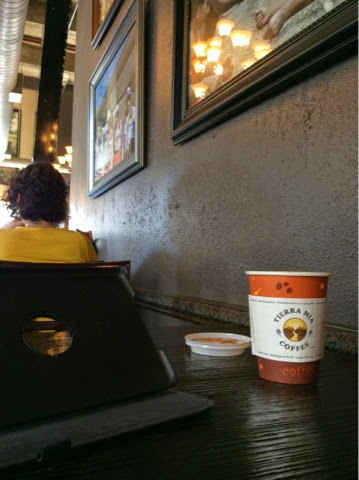
Rode a different way from work today, in hopes of stumbling across a new coffee shop to try out, in my ongoing search of homey, comfy, friendly places to sip and munch while I write, complete with wi-fi. away from the distractions of home.                                                            I’ve been finding this search to be a challenge, since it seems the trend in coffee shops is sleek, overpriced establishments with an edgy, painfully hip, even clinical feel, where apparently it’s a job requirement for baristas to give the distinct impression that they’re too cool for you and everyone else. And these cafes are usually filled to the rafters with affected self-conscious hipster types who pose together, coldly looking you up and down as you enter to see if you’re wearing one of five or so approved hipster uniforms, and that it passes muster.                                                                                   Fortunately, I discovered that the new coffee shop I stumbled upon today, Tierra Mia Coffee, is decidedly not one of these places. It’s roomy and airy, with high ceilings, classic European-style decor, plenty of seating, and a straightforward selection of classic espresso drinks and pastries, along with a wide assortment of pour-over specialty coffees to choose from. Not cheap, but not too expensive either. My mocha Mexicana was rich and delicious, though I was disappointed that it arrived in a paper cup. They do have mugs, you just have to remember to specifically request one. 
The clientele was refreshingly diverse, people from various age groups, socioeconomic statuses, and personal styles, like a cosmopolitan city downtown cafe, just on a smaller scale. That’s how I like it.
I would have stayed longer, but the wi-fi was glitchy. I didn’t hold that against them, though, it’s a common problem that I’m sure they’ll fix soon. I’ll be back next time I need a place to write when I’m in Uptown Oakland..

Who, What, Why, How: http://www.tierramiacoffee.com/

Where: 2001 Broadway, Oakland, CA 94612

When: Mon – Thu 6:30 am – 8:00 pm Fri 6:30 am – 9:00 pm Sat – Sun 8:00 am – 8:00 pm

Perhaps I’ll see you there sometime!


‘Flaunting’ is a Terrible Excuse for Crime

Have you ever heard the argument: ‘Well, she shouldn’t have worn that skimpy outfit / got drunk / flirted at that party. It’s (also) her fault she was raped / assaulted.’?

Compare that argument with this one: ‘Well, he shouldn’t have been wearing that Rolex / Versace suit / driven that Lexus. It’s (also) his fault he was held up / beaten to the ground and robbed.’

These are equally terrible arguments.

While one might have a point saying that a person acted impractically by wearing something in a situation where there might be predators around, that has nothing to do with the fact that it’s entirely the fault of the criminal for committing the crime.