OP Recommends: The Best Philosophy Books of 2017, Recommended by Nigel Warburton at Fivebooks

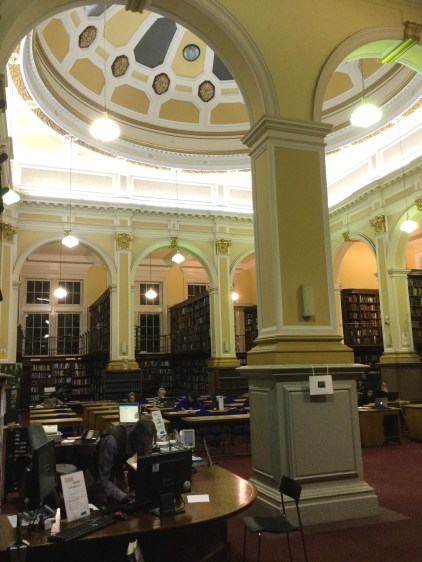
A view of Edinburgh Central Library’s Reading Room

Now that my papers are done and I have five weeks or so to choose my own reading, I’m heading to Edinburgh’s beautiful Central Library to pick up some books I’ve been itching to get into. One of them was already on my list: Dennis Rasmussen’s The Infidel and the Professor: David Hume, Adam Smith, and the Friendship That Shaped Modern Thought (one of my goals for the year is to learn as much about Scotland’s intellectual history as I can while I’m here). Nigel Warburton has made a list of his five favorite philosophy books of 2017, and Massimo Pigliucci’s book is among them. These are two excellent philosophers in the public square I’ve been following for a long time, and their philosophy podcasts are among my favorites.

Looks like I have four more books to add to my list; better get to it!

Ordinary Philosophy and its Traveling Philosophy / History of Ideas series is a labor of love and ad-free, supported by patrons and readers like you. Please offer your support today!

Welcome to the Podcast Edition of Ordinary Philosophy!

Amy Cools listening to podcast on a hike in Joaquinn Miller Regional Park, Oakland, CA, Oct 15, 2016, square

Podcasts: the perfect hiking accompaniment! Amy Cools listens to one on a hike in Joaquin Miller Regional Park, Oakland, CA, Oct 15, 2016

My first podcast episode was published three years ago today!

Amy M Cools's avatarOrdinary Philosophy

Hello dear readers, and welcome to the
podcast version of Ordinary Philosophy!

You can listen to the podcast here, on Google Play, or subscribe in iTunes.

Like many of you, I’m a big fan of podcasts, mostly because my life is very busy. One day in the future, I hope to have a lot more time to do each task one at a time, to really be present, as they say, as I wash the dishes, straighten the house, do the laundry, and perform all those other tasks that take up time, but not much thought.

But at this time in my life, between my day jobs, my creative projects, and spending time with friends and family (which I don’t do enough of these days, sadly), I don’t have enough time to keep up the world of ideas as nearly much as I’d like to by sitting down…

View original post 200 more words

Happy Birthday, Mark Twain!

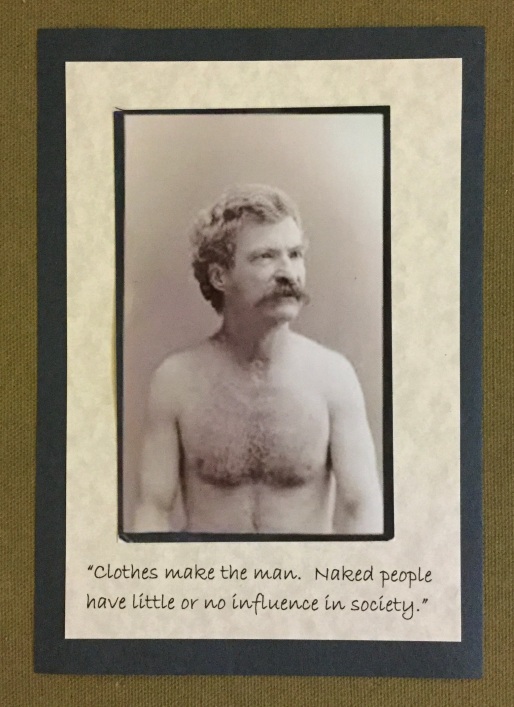
Mark Twain and ‘clothes make the man’ quote, at Mark Twain Birthplace State Historic Site, Florida, Missouri

As I work frantically on organizing my thoughts and assembling my notes for my three final semester papers (all due in a little over a week, gulp!), I can chuckle amid the stress when I think of Mark Twain’s quote ‘I have never let my schooling interfere with my education.’ In fact, he had a rib-tickling, snarky, or sarcastic witticism for just about any occasion.

But there’s so much more to Twain than his one-liners and his incredible body of work. This summer, on my way to Scotland to continue my university education, I crossed (and crisscrossed) the United States between Oakland and Chicago. My journey included following in the footsteps of the young Samuel Clemens, as he was named upon his birth on November 30, 1835, in Florida, Missouri. I have lots of notes and photos but alas, I haven’t been able to write up those parts of my journey in time to commemorate his birthday today. But I’ve found a way to work him into my studies in intellectual history here at the University of Edinburgh (I delivered a presentation on his work on Joan of Arc for one of my classes) and have gotten some additional reading done. I’ll turn the notes for that oral presentation into a written piece for Ordinary Philosophy as well as write up my travel pieces as soon as I can after turning in my papers, please stay tuned!

In this meantime, here’s the link to a bio of Twain by Thomas V. Quirk for Encyclopædia Britannica (my favorite online general encyclopedia) and to the webpage for Ken Burn’s excellent Twain documentary. And a shirtless (or shall I say, birthday suit?) photo of Twain captioned with a quote which I came across on one of my stops following his early life. Enjoy!

Ordinary Philosophy and its Traveling Philosophy / History of Ideas series is a labor of love and ad-free, supported by patrons and readers like you. Please offer your support today!
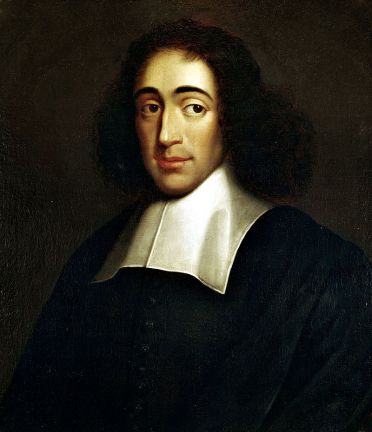
Happy Birthday, Baruch Spinoza!

Portrait of Baruch de Spinoza (1632-1677), ca. 1665, by an unknown artist

Baruch Spinoza was born on November 24, 1632, in Amsterdam, the Netherlands. He was the son of Michael and Hannah Spinoza, Portuguese Jews who were forced to convert to Christianity, then imprisoned and tortured by the Inquisition, then fled to relatively tolerant Amsterdam. The Spinozas became successful and respected members of Amsterdam’s Jewish community.

Their son Baruch (also called by his Latinized name Benedicto, also meaning ‘blessed’), was a precocious and brilliant boy who became an intellectually rigorous, curious, and free-thinking man. He wrote prodigiously, profoundly, and often obscurely while earning a humble living as a scientific instrument lens-grinder. He was excommunicated for his unorthodox beliefs (rather surprising still given the relative broad-mindedness of that synagogue), shunned and condemned by his fellow Jews and by Christians alike, and lived the rest of his too-short life in near-solitude, though in rich correspondence with a wide circle of friends and intellectuals.

His idea of God as a unified substance which, in some sense, can be understood as being the same as Nature or the Universe itself, is still widely beloved (the great physicist Albert Einstein and eloquent, outspoken atheist Christopher Hitchens, for example, were among his biggest fans), hated, and debated widely, especially insofar as it can be difficult to grasp the exact nature of Spinoza’s metaphysical and ethical ideas. Spinoza refused to repudiate his ideas despite the intense social pressure he had to deal with for the rest of his life. But however much his correspondents argued, cajoled, threatened with hellfire, or otherwise tried to convince him to abandon his beliefs, Spinoza responded with firmness, constancy, thoroughness, and courtesy.

Learn more about the integrious Baruch Spinoza at:

Baruch Spinoza ~ by Steven Nadler for The Stanford Encyclopedia of Philosophy

Baruch Spinoza (1632 – 1677) ~ in the Jewish Virtual Library

Benedict De Spinoza (1632—1677) ~ by Blake D. Dutton for the Internet Encyclopedia of Philosophy

Betraying Spinoza ~ Rebecca Goldstein on her book Betraying Spinoza: The Renegade Jew Who Gave Us Modernity

Benedict de Spinoza: Dutch-Jewish Philosopher ~ by Richard H. Popkin for the Encyclopædia Britannica

From Baruch to Benedicto! (Spinoza pt. 1) and Spinoza Part 2 ~ by Stephen West for Philosophize This! podcast

God Intoxicated Man – The Life and Times of Benedict Spinoza ~ by Michael Goldfarb for the BBC’s Sunday Feature

Spinoza ~ Melvin Bragg discusses Spinoza’s life and thought with Jonathan Rée, Sarah Hutton, and John Cottingham for In Our Time

The Heretic Jew ~ by Harold Bloom, book review of Rebecca Goldstein’s Betraying Spinoza: The Renegade Jew Who Gave Us Modernity for The New York Times

The Writings of Spinoza ~ at Internet Sacred Text Archive

Ordinary Philosophy and its Traveling Philosophy / History of Ideas series is a labor of love and ad-free, supported by patrons and readers like you. Please offer your support today!

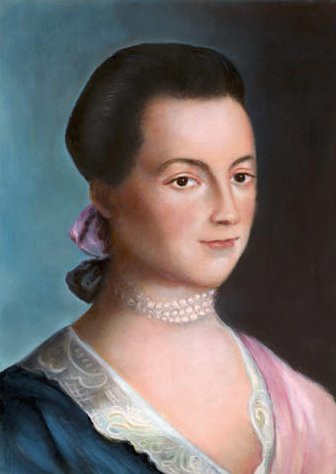
Happy Birthday, Abigail Adams!

Abigail Adams, the earliest known image of her painted near the time of her marriage in 1764

Abigail Adams, born on November 22, 1744 in Weymouth, Massachusetts, was wife and chief advisor to John Adams, American founding father and second president; early advocate for women’s rights and opponent of slavery; self-taught intellectual; mother to many children including another American president; and something I just learned today, a savvy and successful financial speculator. She is one of the most well-known figures in American history because of the voluminous and well-preserved correspondence between her and her husband John. While she remained at home raising the children and managing their home, John was frequently away for extended periods on matters of revolution and state. Their letters are famous: they were loving and forthright with one other on a rare level, and the ideas and advice these two brilliant people shared with one another illuminate and inspire readers still.

Learn more about our wise and indefatigable founding mother Abigail Adams at:

Abigail Adams ~ by Beckett Graham and Susan Vollenweider for The History Chicks podcast

Abigail Adams (1744 – 1818) ~ bio for the Adams National Historical Park, National Park Service website

Abigail Adams: American First Lady ~ by Betty Boyd Caroli for Encyclopædia Britannica

Abigail Adams: Revolutionary Speculator ~ Liz Covart interviews Woody Holton for Ben Franklin’s World: A Podcast About Early American History

Abigail Smith Adams ~ by Debra Michals for the National Women’s History Museum website

First Family: Abigail and John Adams ~ by Joseph J. Ellis for the Philadelphia Free Library

How Abigail Adams Proves Bill O’Reilly Wrong About Slavery ~ by David A. Graham for The Atlantic

John Adams ~ Miniseries by HBO, 2008

Ordinary Philosophy and its Traveling Philosophy / History of Ideas series is a labor of love and ad-free, supported by patrons and readers like you. Please offer your support today!

Happy Birthday, Voltaire!

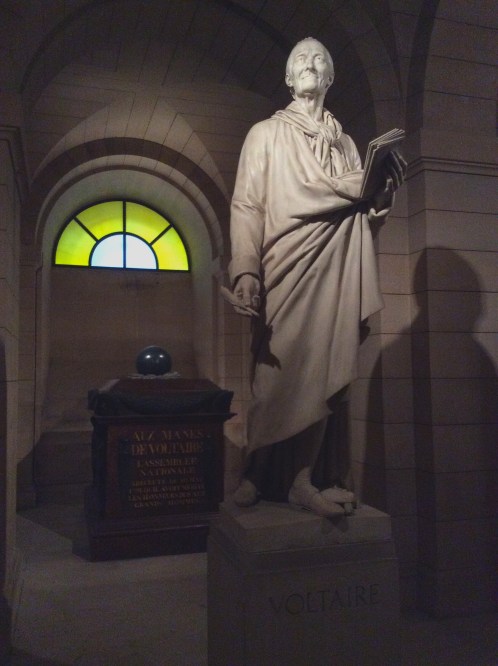
Voltaire’s statue and tomb in his crypt in the Pantheon, Paris, France

Voltaire was born on November 21, 1694, in Paris, France, where he died 83 1/2 years later. He’s buried in that great city of his birth and death, in a crypt below the beautiful Pantheon. He was a philosopher, playwright, poet, and much, much more; a generally prolific, wide-ranging, and creative writer. In his long life, Voltaire used his wealth of learning, urgent sense of justice, and merciless and ready wit to make the case for religious and intellectual tolerance, forbearance, science, and social reform. He is still considered one of the most influential and memorable thinkers the world has ever seen.

Learn more about the great Voltaire at:

Voltaire – an animated video by Alain de Botton and Nicholas Cronk for The School of Life

Voltaire ~ by J.B. Shank for The Stanford Encyclopedia of Philosophy

Voltaire ~ by René Henry Pomeau for the Encyclopædia Britannica

Voltaire and the One-Liner ~ by Nicholas Cronk for OUPBlog

Voltaire’s Candide ~ Melvin Bragg talks with David Wootton, Nicholas Cronk, and Caroline Warman for In Our Time

Voltaire’s Garden: The Philosopher as a Campaigner for Human Rights ~ by Adam Gopnik for The New Yorker (book review for Ian Davidson’s Voltaire in Exile

The Voltaire Foundation: a world leader for eighteenth-century scholarship

Broken on the Wheel: A Gruesome Legal Case turned Voltaire into a Crusader for the Innocent ~ by Ken Armstrong for the Paris Review

The Philosopher and the Prodigy: How Voltaire Fell in Love with a Remarkable Woman Mathematician ~ by Michelle Legro for Brain Pickings

Ordinary Philosophy and its Traveling Philosophy / History of Ideas series is a labor of love and ad-free, supported by patrons and readers like you. Please offer your support today!

Enlightenment Scotland: Adam Smith’s Grave at Canongate Kirkyard

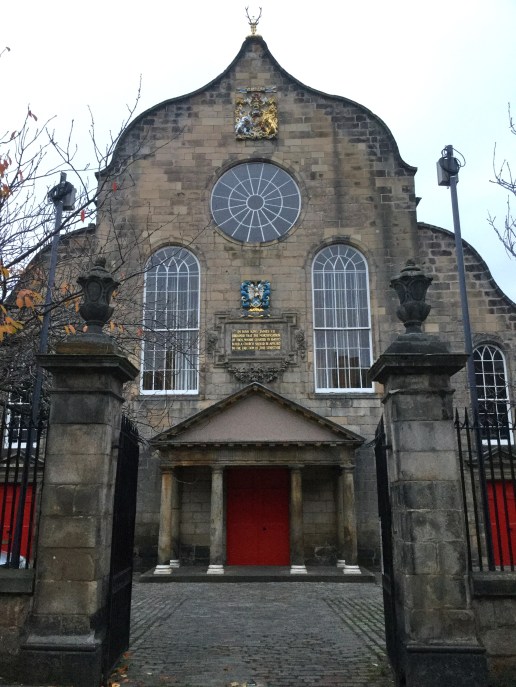
Canongate Kirk on the Royal Mile, Edinburgh, Scotland

Here in Edinburgh, where I’ve returned to University to earn my Master’s degree, I love to visit sites and monuments associated with the Enlightenment. As a lover of philosophy, the rich intellectual history of this city first brought me here: I followed (and still do) in the footsteps of David Hume for my first traveling philosophy/history of ideas series for O.P. I think it’s high time I share more of my explorations with you!

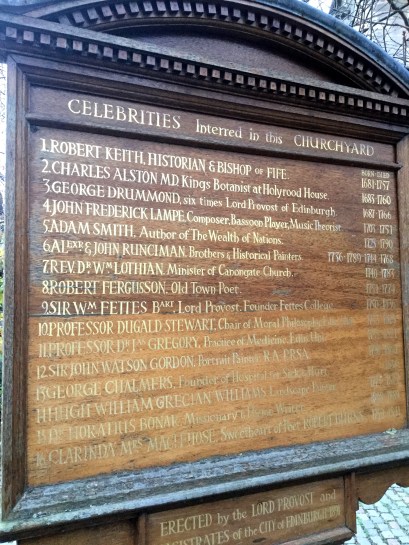
I’ll start with my visit yesterday afternoon to the great moral philosopher and economist Adam Smith‘s grave in Canongate Kirkyard on the Royal Mile. The lovely Kirk of the Canongate was built form 1688-1691, and is quite different in style than the other buildings on the Royal Mile. The graveyard behind it, however, is very like many others to be found behind kirks all over and around this great city, and includes the gravesites of many great Scots.

Canongate Kirkyard on the Royal Mile with Adam Smith’s grave center-left, Edinburgh, Scotland

Adam Smith’s grave in Canongate Kirkyard on the Royal Mile, Edinburgh, Scotland. Many of Adam Smith’s moral and political theories, and his ideas on trade and economics, were developed from the ideas of his great friend and mentor David Hume.

Canongate Kirk on the Royal Mile, Edinburgh, Scotland

List of famous people buried at Canongate Kirkyard on the Royal Mile, Edinburgh, Scotland

Ordinary Philosophy and its Traveling Philosophy / History of Ideas series is a labor of love and ad-free, supported by patrons and readers like you. Please offer your support today!
New Podcast Episode: Wounded Knee, Pine Ridge Reservation, South Dakota

Entering Pine Ridge Reservation via Bombing Range Rd (what a name!) from the Badlands, South Dakota.

Listen to this podcast episode here or on Google Play, or subscribe on iTunes

Wounded Knee, South Dakota, afternoon and evening of July 25th, 2017

From McLaughlin, Standing Rock Reservation, South Dakota, I make the 5-hour drive south to my next destination in the Pine Ridge Reservation, just a little ways north of the Nebraska border. My drive takes me through Badlands National Park, though only for a short while. What I see of it is beautiful, and I certainly plan to return.

My destination is Wounded Knee, named for Wounded Knee Creek and the site of a conflict between the United States Army and the band of Chief Spotted Elk, or Big Foot, as the U.S. army dubbed him… Read the written version here

Ordinary Philosophy and its Traveling Philosophy / History of Ideas series is a labor of love and ad-free, supported by patrons and readers like you. Please offer your support today!
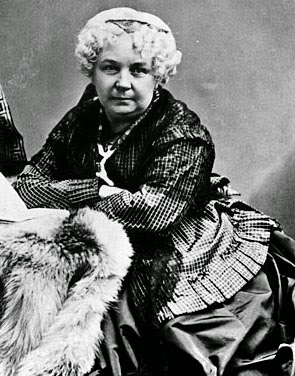
Happy Birthday, Elizabeth Cady Stanton!

In honor of the great feminist Elizabeth Cady Stanton’s birthday, I’m re-sharing the stories of some of my explorations of her life and ideas in the places she lived and worked, often in conjunction with her fellow feminists Ernestine Rose and Frederick Douglass.

To New York City I Go, In Search of Ernestine Rose and Elizabeth Cady Stanton

Enjoy, and I hope you find her story as fascinating, informative, and inspiring as I do!

Ordinary Philosophy and its Traveling Philosophy / History of Ideas series is a labor of love and ad-free, supported by patrons and readers like you. Please offer your support today!
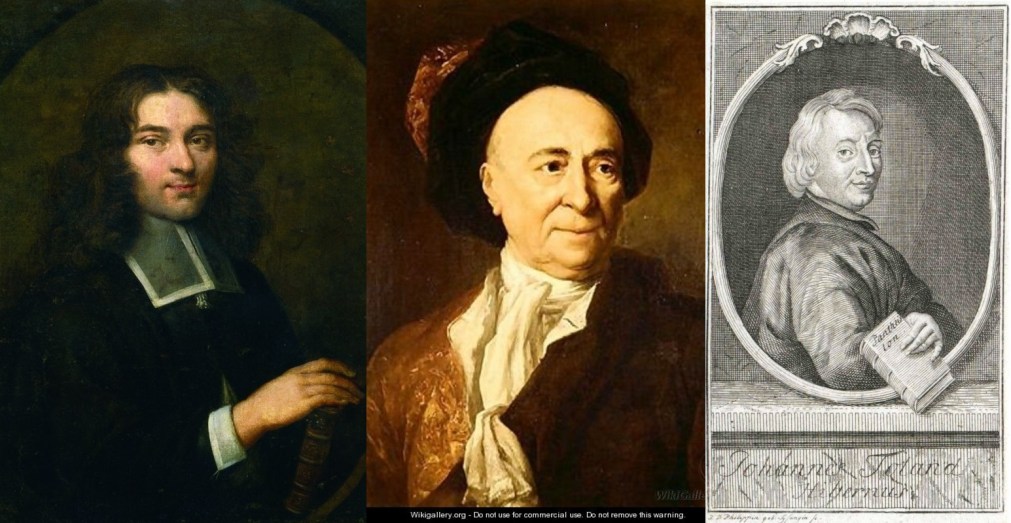
Rationality and the Origins of Myth: Bayle, Fontanelle, and Toland

Pierre Bayle, Bernard de Fontanelle, and John Toland; all images in the public domain or free for noncommercial use

This is an extended version of a blog post I recently wrote for my seminar class Myth and the History of Scholarship in Early Modern Europe. I thought I’d share it with you just in case you’re interested in what I’ve been working on at the University of Edinburgh lately ~ Amy

From the ancient philosophers of Greece and Rome to the European Renaissance to early modern Europe in the Age of Discovery, thinkers and scholars attempted to make sense of mythology and the multiplicity of belief from ancient to modern times, in light of their own understanding of the nature of God and the workings of the universe. The Renaissance saw the humanistic attempt to understand mythology as allegories, repositories of ancient wisdom in fable form which conveyed essential religious truths to those discerning enough to perceive them. Then, missionaries to the New World and theologians wrestled with the fact that vast numbers of human beings had no knowledge of the biblical God or of Jesus Christ. They attempted to reconcile this with their beliefs about God’s justice and mercy by recasting pagan myths as expressions of natural theology.

The years leading up to the Enlightenment saw another significant shift in ways of thinking, a rationalist approach that we now associate with the rise of skepticism and the scientific method. In the decades straddling the turn of the 17th century, Huguenot scholar Pierre Bayle, French scientist and writer Bernard de Fontanelle, and British freethinker and religious critic John Toland offered their own critical approaches to the myths of the ancients and of the New World.

‘…People began, in various countries, to write histories in a more reasonable manner and generally with more verisimilitude. So no new fables appear; people are satisfied with preserving the old ones. But can this ever stop those who are infatuated with antiquity? They imagine to themselves that under the fables are hidden secrets of the physical and moral world (Fontanelle 18)’

In On the Origin of Fables, Pierre Bayle (1647–1706) applies ‘natural reason’ and Aristotelian method to myths and ancient philosophy to determine whether they are worthy of belief or useful in promoting a rational understanding of God and the world. Bayle’s approach is to offer critical examinations of particular myths. Through these examples, Bayle intends to demonstrate that mythology is not a vessel of truth, allegorical or otherwise. For one, he considers the ancient Greek philosopher Anaximenes’ idea that the gods were produced by the air, which is the primary and original cause of everything. Bayle rejects this idea as absurd because natural reason doesn’t allow us to believe that a thing’s efficient cause (Aristotle’s term for that which is responsible for another thing’s state of being) to be inferior to that which gave rise to it (Bayle 110). Even more ridiculous, for Bayle, is the idea that a non-thinking thing like air could give rise to a thinking thing like a god (p 113). (I suspect that Bayle would have little use for the theory of evolution.) Other myths such as the birth of Venus, who arose from the foam created when Saturn cut off his father Chaos’ genitalia and threw them into the sea, or that  thunder and lightning is caused by Jupiter’s hurling thunderbolts to earth, aren’t only immoral and brutish, but entirely useless for understanding the rationality of the universe.

Bernard de Fontenelle (1657-1757) sees mythology as the product of the childishness of the human mind at the dawn of reason. When humans observed some amazing or unexpected thing that they couldn’t explain, they naturally embellished it a little so that they could (Fontanelle 11). These embellishments often consisted of positing beings with human-like capacities causing the phenomenon in some recognizable way. Fontanelle, like Bayle, uses the example of thunder and lightning, a mysterious phenomenon that could be explained by imagining a being very like a human but more powerful, who throws arrows of fire like humans do but much larger ones from higher up (p 11-12). He also uses the example of rivers: they originate somewhere, so why not from pitchers like these we use to make water flow? (p 11) But to make rivers, the being(s) who pour the pitchers must have much larger ones, with added power that can keep them flowing plentifully and with force. With each subsequent retelling of these stories, they took on more and more fantastic elements they passed from one person to the other (Consider Michel de Montaigne’s passage about un/reliable testimony in his essay ‘Of Cannibals’), resulting in elaborate and fantastic myths.

But Fontanelle doesn’t judge these almost accidental mythmakers harshly; rather, he makes an interesting and astute observation: it’s actually harder to adhere strictly to the truth than to embellish a tale, especially when it’s about something exciting. It’s harder because 1) ‘our imagination gets heated up with its subject’ (Fontanelle 11) and begins to elaborate the tale all on its own and 2) the more marvelous details you add, the more interest, encouragement, and admiration you arouse in your audience. But though rationality is hard and the imagination is lively (p 15), Fontanelle insists that it’s still essential that we resist ignorance. David Hume would later elaborate on Fontanelle’s idea about myths and miracles, making it one of the centerpieces of his skeptical philosophy in his Enquiry concerning Human Understanding.

John Toland’s (1670-1722) theory also cites human ignorance and frailty in the origins of myth, but he offers a less general account. In his view, myths spring from the honor paid to the dead. Worship of the gods is an extension of the respect, fear, and supplication of powerful rulers, warriors, magicians, and so on (Toland 72). He accepts Euhemerus’ idea that the gods of myth refer to real people but that, over time, their origins were forgotten (p 85). Toland observes that the honor paid to the gods closely resemble the honors paid to dead heroes and princes, so he postulates a common origin for these practices.

Toland further explains that the gods, based on exceptional humans now dead, are also based on human ideas and virtues (p 88). Here, both Toland and Bayle reflect the ancient philosopher Xenophanes, who argues that all gods are devised to resemble their creators. If animals had gods too, they would look, act, and have the same mental features as those animals—at least, the strongest, best, most admired animals among them. Fontanelle also takes a Xenophanean view in his description of how the gods evolve over time: the gods of the earliest, most primitive myths were as irrational, lustful, and brutal as the people themselves. But just as societies became more civilized, more rational, and more virtuous, so did the gods (Fontanelle 13).

Fontanelle, Toland, and Bayle all take a rationalist approach to the subject of myth, as they do to the sciences and all other areas of inquiry. All myths and idolatry are born from irrationality, and if we are to understand the world as it really is, as a rational place created and designed by a rational God, it’s important to demonstrate the irrationality of the myths and remove their power to promote irrationality in the general public. This will result in a more rational, moral, and free society.

Bayle, again, takes the approach of examining particular examples of myths to show that their origins are irrational and that they cannot, even as allegory, be seen to impart anything good or true, or to promote understanding in any way. He continues his exploration of ancient ideas about air, this time the myth that equates the goddess Juno with the air. Despite all attempts to understand this myth as a way of understanding a truth about the workings of the world, it does nothing but confuse and confound. Bayle again invokes Aristotle, who says that if it’s a thinking being, it must have a soul, and if that being is a part of nature and has a soul, it must be an animal. Therefore, if Juno is the air, she’s a sort of animal being constantly being torn and wounded by things passing through her, which he offers as such a patent absurdity that the myth couldn’t possibly promote a rational understanding of nature. (p 117-118)

Fontanelle argues that his time was one of the most intellectually vigorous (p 13), no doubt because he saw it as an age of rationality. He has a progressive view of the human capability for rationality (p 17), and sees it as the way of the world that all human societies will become more rational over time, just as the Greeks did, and just as he suspects that the Native Americans encountered by the Spanish would if given the time to develop their capabilities (p 16). This is consistent with Fontanelle’s view that creation itself is a rational system. It would make sense, then, that the more human beings come to understand it, the more rational they become as well. That’s why it’s a mistake to perpetuate irrationality by continuing to teach the myths through the arts such as poetry, fine arts, and theater (p 17).

Toland argues that a multiplicity of gods and objects of worship, which is characteristic of the less rational belief systems, is correlated with irrationality, less freedom, and more autocracy. The more gods a society creates, the more autocratic and the less free and rational the society – (Toland 98) (Noted scientist and religious skeptic Richard Dawkins would likely point out that in that case, the most free, rational, and democratic societies would have no gods at all.)

‘So [the well-meaning Philosophers] proceeded to explain away the rest of the Gods; and, as Allegorys are as fruitful as our Imaginations, scarce any two Authors cou’d wholly agree in their Opinions. But supposing the Truth of the matter had bin as any or all of ’em wou’d have it, yet their Religion was not a whit the better, and deserv’d to be abolished; since, what ever were the Speculations of a few among the Learned, ‘cis evident that the Vulgar took all these to be very real Gods, of whom they stood in mighty fear, and to whom they paid Divine Adoration…’ (p 122)

So even if the myths could be interpreted as allegories by the learned, their dissemination spread ignorance and irrationality and so did far more harm than good.

‘But if any shou’d wonder how Men cou’d leave the direct and easy Path of Reason ‘ton wander in such inextricable Mazes, let him but consider how in very many and considerable Regions the plain Institution of Jesus Christ cou’d degenerate into the most absurd Doctrins, unintelligible Jargon, ridiculous Practices, and inexplicable Mysterys…’ (p 129)

Bayle goes further than Toland, and believes that myth not only correlates with barbarous societies, but that they promote acceptance of bad behavior. The myth of Jupiter, for example, deifies a being guilty of just about every crime you can think of: murder, rape, incest, lies, and cruelty of every sort (Bayle 107). Fortunately, Bayle observes, most people behave better than the gods of mythology, an observation that extends beyond his close examination of many mythological beliefs.

Fontanelle also observes that belief does not necessarily inform moral convictions or behavior; in fact, they seem to be quite separate:

‘What is strange is that Christians, whose system of religion is so pure, yield almost nothing to the gentiles in respect to engaging in vices. It is a mistake to believe that the moral practice of a religion corresponds to the doctrines of its confession of faith. (p 107)’

People, then as now it seems, accept those religious beliefs that accord with their own principles and moral characters more than the other way around.

~ Thanks to Dr. Felicity Green for inspiration and insight

Bibliography

Bayle, Pierre, ‘Jupiter’, in Historical-Critical Dictionary: Selections [1697], trans. Richard Popkin (Indianapolis, 1991), pp. 107-119.

‘Bernard Le Bovier, sieur de Fontenelle.’ (2017, 25 January), In Encyclopædia Britannica. Retrieved from www.britannica.com/biography/Bernard-Le-Bovier-sieur-de-Fontenelle  ; accessed 09 November, 2017.

Falcon, Andrea, “Aristotle on Causality”, The Stanford Encyclopedia of Philosophy (Spring 2015 Edition), Edward N. Zalta (ed.). Retrieved from https://plato.stanford.edu/archives/spr2015/entries/aristotle-causality/ ; accessed 09 November, 2017.

Fontenelle, Bernard de, De l’origine des fables [wr. c.1691-99, pub. 1724]. English trans. Of the Origin of Fables by Burton Feldman and Robert D. Richardson, The Rise of Modern Mythology 1680-1860 (Indiana, 1972), pp. 10-18.

‘John Toland’. (2017, 17 August), In Encyclopædia Britannica. Retrieved from www.britannica.com/biography/John-Toland ; accessed 09 November, 2017.

Lennon, Thomas M. and Hickson, Michael, ‘Pierre Bayle’, In The Stanford Encyclopedia of Philosophy (Fall 2014 Edition), Edward N. Zalta (ed.), https://plato.stanford.edu/archives/fall2014/entries/bayle/ ; accessed 09 November 2017

Toland, John, Letters to Serena (London, 1704), part III

Ordinary Philosophy and its Traveling Philosophy / History of Ideas series is a labor of love and ad-free, supported by patrons and readers like you. Please offer your support today!