O.P. Recommends: Chimamanda Ngozi Adichie on Discovering America, from The New Yorker’s Politics and More Podcast

Summer 2014 issue of Ms. featuring Chimamanda Ngozi Adichie, by Ms. magazine, CC BY-SA 4.0

In this fascinating podcast episode, the brilliant and eloquent Chimamanda Ngozi Adichie discusses her American experience, the absurdity of racism, the increasing orthodoxy and silencing of dissent on the political left, and much more with The New Yorker’s David Remnick. I find Adichie one of the most mesmerizing speakers and conversationalists around today.

Enjoy, and if this podcast episode happens to be your introduction to Adichie’s insightfulness and complex set of perspectives, an internet search of her name will reveal a wealth of talks, interviews, and more… you’re in for one intellectual treat after another!

Ordinary Philosophy and its Traveling Philosophy / History of Ideas series is a labor of love and ad-free, supported by patrons and readers like you. Please offer your support today!

New Podcast Episode: Springfield, Illinois, in Search of Abraham Lincoln, Part 4

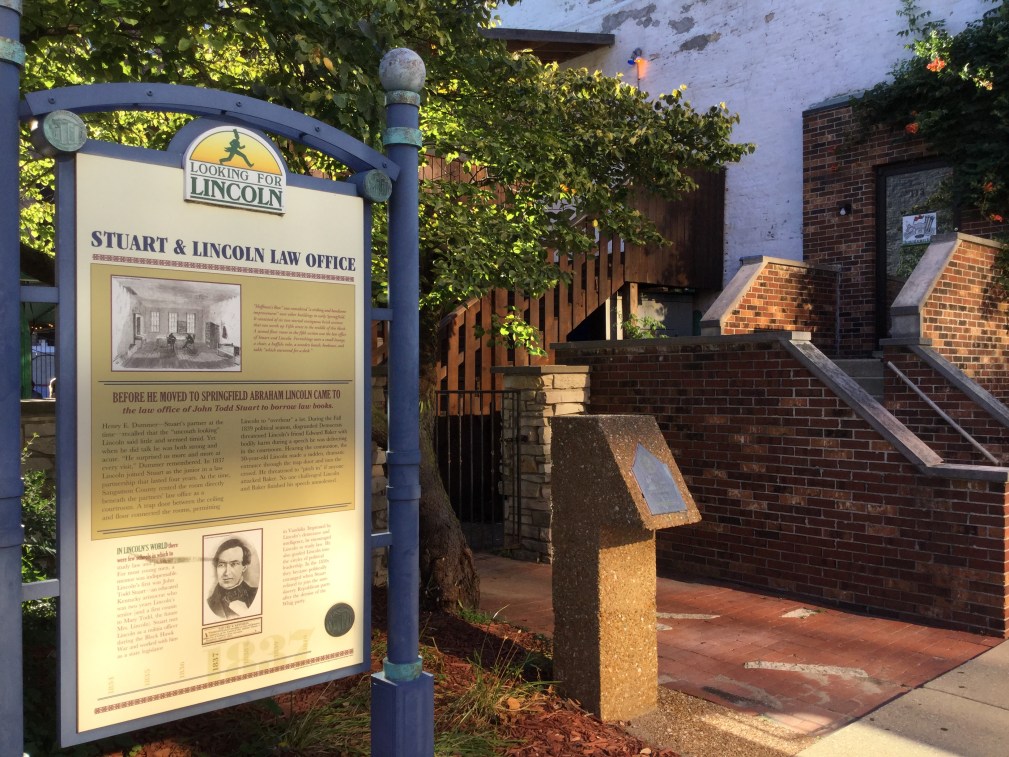
Site of Stuart & Lincoln law office at Hoffman’s Row, Springfield, Illinois

Listen to this podcast episode here or on Google Play, or subscribe on iTunes

Springfield, Illinois, Saturday, July 29th, 2017, continued

I leave the Myers Building at the former site of Joshua Fry Speed’s store and Abraham Lincoln’s last law office on S 5th Street, and head north, crossing E Washington St, and continue halfway up the block. On my left (west), at 109 N 5th St / NW Old State Capitol Plaza, is a historical marker for the Stuart & Lincoln Law Office. John Todd Stuart was Lincoln’s first law partner, the man from whom he borrowed the law books he needed for his legal training, and his future wife Mary Todd’s first cousin. Lincoln received his license to practice law two years after he began his studies, and joined Stuart’s law practice as a junior partner in April of 1837. He was living over Speed’s store, having moved here to Springfield to embark on his legal career, so he walked more or less the same route to get to work as I walk today from the Myers Building… Read the written version here

Ordinary Philosophy and its Traveling Philosophy / History of Ideas series is a labor of love and ad-free, supported by patrons and readers like you. Please offer your support today!

O.P. Recommends – The Good Wife: Gender and Sexuality in the Middle Ages, by Peter Adamson

Young Lady Writing in an Hymnal by Giacomo Pacchiarotto, turn of 16th c, Siena, Italy

One of Peter Adamson’s most recent podcast episodes for his History of Philosophy Without Any Gaps particularly delighted me, in the surprises sprinkled richly throughout and its thoughtful yet lively and sometimes humorous exploration of a wide range of religious, social, and literary topics. The history of sexuality and gender attitudes in the medieval Western world was more varied than we might realize, both in sacred and secular contexts.

And don’t stop with this one, by any means: every episode I’ve ever heard of Peter’s multitudinous podcasts are fantastic! Enjoy!

Ordinary Philosophy and its Traveling Philosophy / History of Ideas series is a labor of love and ad-free, supported by patrons and readers like you. Please offer your support today!
Happy Birthday, Thomas Paine!

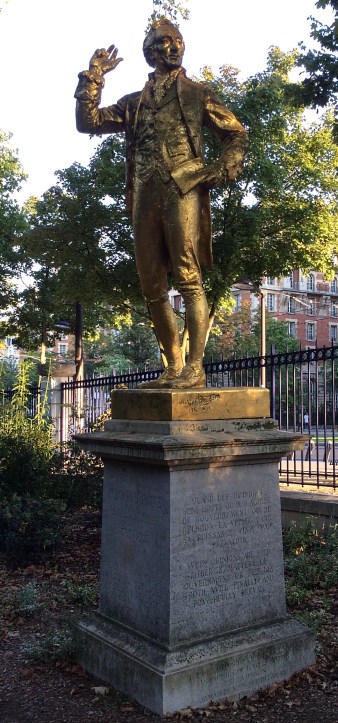
Statue of Thomas Paine by Gutzon Borglum, 1938, Parc Montsouris, Paris, photo 2015 by Amy Cools

Statue of Thomas Paine by Gutzon Borglum, 1938, Parc Montsouris, Paris, photo 2015 by Amy Cools

Let’s remember and salute the great Thomas Paine, father of our American identity, on his birthday. Born on January 29th, 1737, this British-American expatriate, former entrepreneur, and corset-maker’s pamphlets made the case for American independence from Britain, outlined his Lockean conception of human rights, and argued for the primacy of reason in epistemology, politics, science, and theology. He’s a primary influence in my own concept of America as a work-in-progress bastion of liberty, of reason, of freedom of conscience, of the idea that property rights entail the obligation to share the wealth with those who lack what they need.

Here are a few links to some articles and works of art by, about, and inspired by Thomas Paine, including some of my own work:

Common Sense – Thomas Paine (1776)

The American Crisis – Thomas Paine (1776-83)

The Rights of Man – Thomas Paine (1791)

The Age of Reason – Thomas Paine (1794)

Agrarian Justice – Thomas Paine (1795-96)

Thomas Paine – from The Stanford Encyclopedia of Philosophy

To Paris, France I Go, In Search of Revolution-Era Thomas Paine, Mary Wollstonecraft, and Thomas Jefferson – history of ideas travel series in which I follow Thomas Paine’s life and ideas in the era of the French Revolution

Thomas Paine on Basic Income, and Why Welfare is Compatible with an Individualist Theory of Human Rights – my essay on how Paine’s ideas about property rights led him to advocate the unconditional allocation of public funds for the support of the young, the old, and the disabled

Pretty Pink Rose – David Bowie and Adrian Belew (1990) – ‘She tore down Paris on the tail of Tom Paine, but the left wing’s broken, the right’s insane’

As I Went Out One Morning – Bob Dylan (1968) ‘As I went out one morning to breathe the air around Tom Paine’s, I spied the fairest damsel that ever did walk in chains’

Tom Paine’s Bones – Graham Moore (1995) Recorded by Dick Gaughan in 2001. ‘Well they say I preached revolution but let me say in my defence, all I did wherever I went was to talk a lot of Common Sense’

Ordinary Philosophy and its Traveling Philosophy / History of Ideas series is a labor of love and ad-free, supported by patrons and readers like you. Please offer your support today!

Robert Burns Letter at the National Library of Scotland in Honor of the Bard’s Birthday

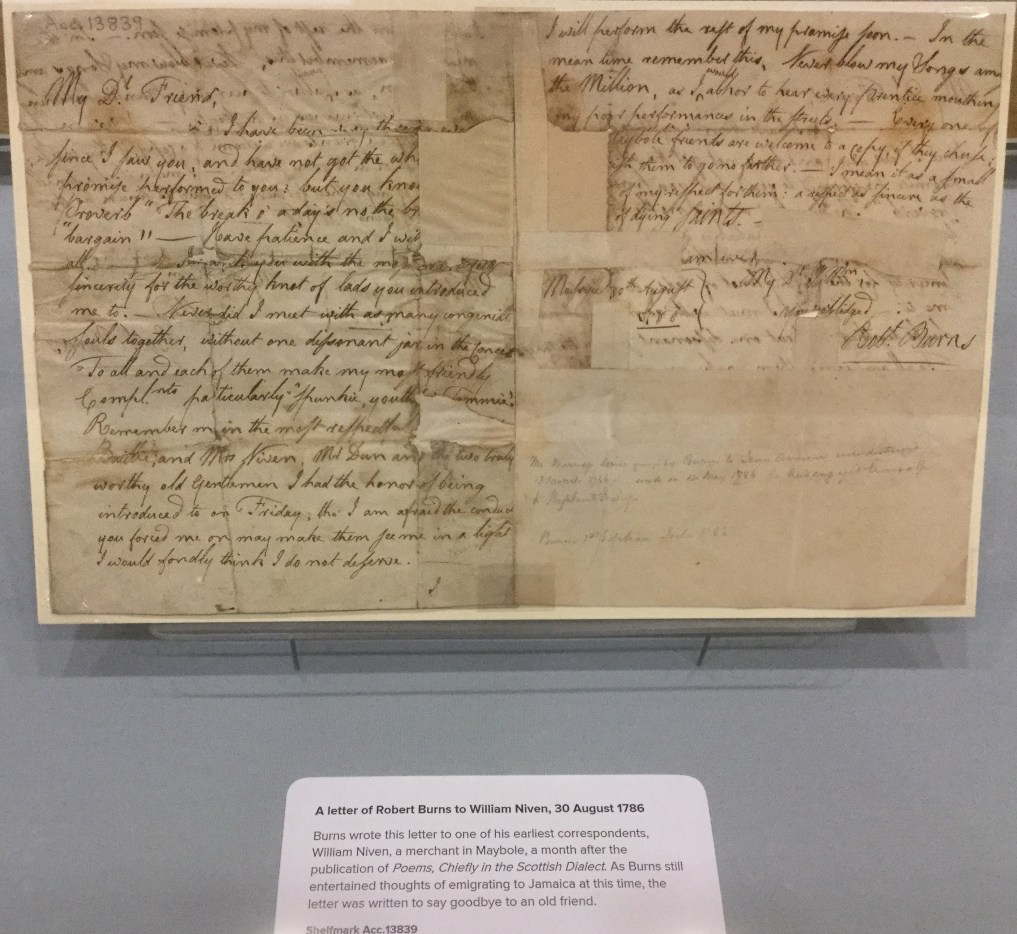
Robert Burns letter to William Niven, 30 August 1786, at National Library of Scotland, special showing 25 January 2018

Robert Burns, aka ‘the Bard’, is, as you may know, one of Scotland’s most honored sons. His poems and songs are widely regarded as among the most beautiful and resonant literary creations of all of Scotland’s people. Some of the people I’ve written about for Ordinary Philosophy were inspired and influenced by Burns, notably Abraham Lincoln and Frederick Douglass. I’ll be writing much more and regularly about Burns before long in the context of my upcoming Frederick Douglass in Scotland series and pieces on the Scottish history of ideas, stay tuned!

In honor of Robert Burns’s birthday celebration, aka Burns Night, the National Library of Scotland put one of his original letters on display for a few hours today, with a little informational card that provides a brief context. I’ll be elaborating on the significance of his planned emigration to Jamaica in my next Douglass series as well.

The letter reads:

My Dr Friend,

I have been very throng every since I saw you, and have not got the wh[ole of my] promise performed to you: but you know [the old] Proverb “The break o’ day’s no the bre[ak o’ a] bargain” – Have patience and I will [pay you] all. – I thank you with the most heart-felt sincerity for the worthy knot of lads you introduced me to. – Never did I meet with so many congenial souls together, without one dissonant jar in the Concert. To all and each of them make my friendly Complnts particularly “spunkie, youthfu’ Tammy.” Remember me in the most respectful [manner to the] Baillie, and Mrs Niven, Mr Dun, and the two truly worthy old Gentlemen I had the honor of being introduced to on Friday; tho’ I am afraid the conduct you forced me on may make them see me in a light I would fondly think I do not deserve. –

I will perform the rest of my promise soon. – In the mean time, remember this, never blow my Songs amo[ng] the Million, as I would abhor to hear every Prentice mouthing my poor performances in the streets. – Every one of [my] Maybole friends are welcome to a Copy, if they chuse; but [I w]ish them to go no farther. – I mean it as a small [mark] of my respect for them: a respect as sincere as the [faith] of dying SAINTS. –

I am ever, My Dr Willm Your oblidged,
Robt Burns

Ordinary Philosophy and its Traveling Philosophy / History of Ideas series is a labor of love and ad-free, supported by patrons and readers like you. Please offer your support today!
Say What? Colin MacLaurin on Evidence, Reason, and Knowledge

Left, logarithmic radial photo of the universe by Pablo Budassi. Right, Isaac Newton’s entry on ‘Furnace’ in his notebook, 1666, Special Collections University of Chicago Library, both public domain via Wikimedia Commons

‘It is not therefore the business of philosophy, in our present situation in the universe, to attempt to take in at once, in one view, the whole scheme of nature; but to extend, with great care and circumspection, our knowledge, by just steps, from sensible things, as far as our observations or reasonings from them will carry us, in our enquiries concerning either the greater motions and operations of nature, or her more subtle and hidden works.’

Colin MacLaurin, An Account of Sir Isaac Newton’s Philosophical Discoveries1748

Ordinary Philosophy and its Traveling Philosophy / History of Ideas series is a labor of love and ad-free, supported by patrons and readers like you. Please offer your support today!

New Podcast Episode: Springfield, Illinois, in Search of Abraham Lincoln, Part 3

1880’s Italianate building at the former site of the American House Hotel at 6th and Adams, Springfield, Illinois, renovated and restored by its current occupants, Delano Law Offices

Listen to this podcast episode here or on Google Play, or subscribe on iTunes

Springfield, Illinois, Saturday, July 29th, 2017, continued

After my visit to the Old State House, I notice one of those Looking for Lincoln historical placards on a building to my left as I walk towards my next destination. It’s an attractive three-story red and yellow brick Italianate building from the later 1800’s, too late to be from Lincoln’s time. I draw near and read the placard and the small house-shaped bronze plaque near it.

This building stands at the southeast corner of 6th and Adams, on the former site of the American House Hotel. It was the largest hotel in Illinois, admired for its huge size and praised for its lavish, exotic, ‘Turkish’ interior design. Despite its reputation and the fact that it was the hotel of choice for dignitaries and the better-off, there doesn’t seem to be any easy-to-find photos of it. There’s one on the placard of the Old State House with the plain white walls of the three-story, rather plain Hotel in the distance, but that’s about it. I can find no photos of its splendiferous interior either. It stood here from 1838-1870, a little too long ago for me to find a postcard image of it, my tried and true source type for images of historic buildings… Read the written version here

Ordinary Philosophy and its Traveling Philosophy / History of Ideas series is a labor of love and ad-free, supported by patrons and readers like you. Please offer your support today!

Happy Birthday, Emmanuel Chukwudi Eze!

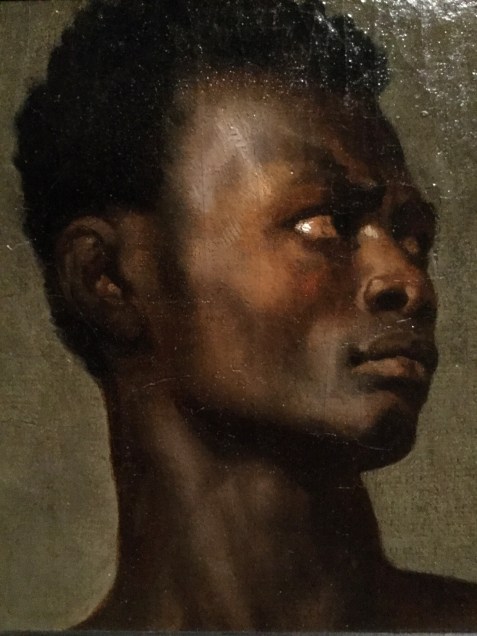
Study of an African’s Head, 1830 by Paul-Jean Flandron, Seattle Art Museum. I could not find a portrait of Dr. Eze that I could share, so I chose this powerful portrait instead. I used it to illustrate a piece shared here some weeks ago at O.P. by Dag Herbjørnsrud, which describes the ideas of the 17th-century Ethiopian philosopher Zera Yacob. Eze also studied Yacob’s ideas.

Emmanuel Chukwudi Eze, born in Nigeria on January 18th, 1963, made a deep study of systems of thought in Africa, Europe, and the Americas. Born of Catholic parents, he was educated in Jesuit colleges and universities. He read deeply and pushed at the limits of philosophy and human thought, mining it widely, regardless of origin, for the riches he could find there. He focused a great deal of his work on postcolonial thought in Africa and the Americas, and rejected attempts to relegate tools of thought to people of one culture or another. Instead, he emphasized the importance of difference and complexity in the practice of reason.

Learn more about Dr. Eze’s broad and rigorous approach to thought:

About Dr. Eze and his book On Reason: Rationality in a World of Cultural Conflict and Racism ~ Duke University Press

African Philosophy at the Turn of the Millennium ~  Emmanuel Chukwudi Eze in dialogue with Rick Lewis

Book review: Achieving our Humanity: The Ideal of the Postracial Future by Emmanuel Chukwudi Eze ~ by Cleavis Headley and Kibujjo M. Kalumba

The Color of Reason: The Idea of “Race” in Kant’s Anthropology ~ by Emmanuel Chukwudi Eze

A Defence of Emmanuel Chukwudi Eze’s Conception of Reason ~ by Mohammed Xolile Ntshangase

Emmanuel Chukwudi Eze ~ in Wikipedia, The Free Encyclopedia 

Emmanuel Chukwudi Eze, 1963-2007: A Personal Reflection ~ by Bruce B. Janz

Philosophia Africana ~ archive of the journal Dr. Eze edited and often published in at the Philosophy Documentation Center

Reading Reason with Emmanuel Eze ~ by John Pittman

Ordinary Philosophy and its Traveling Philosophy / History of Ideas series is a labor of love and ad-free, supported by patrons and readers like you. Please offer your support today!
Photobook: Jameson Jenkins and the ‘Slave Stampede’ Rescue

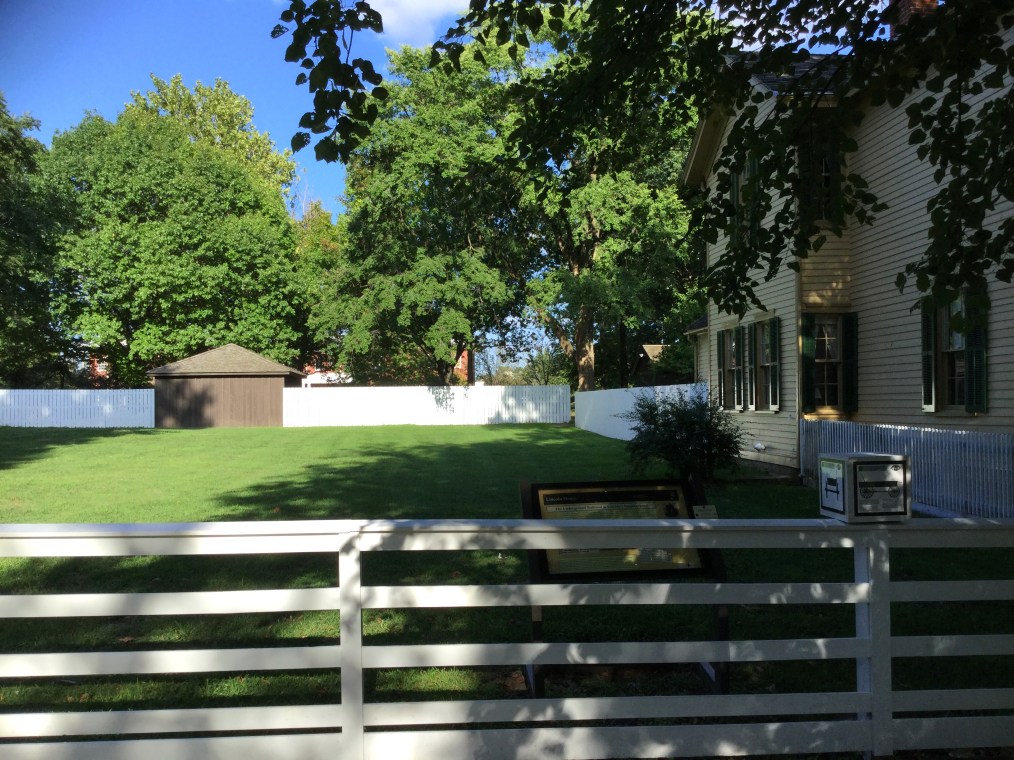
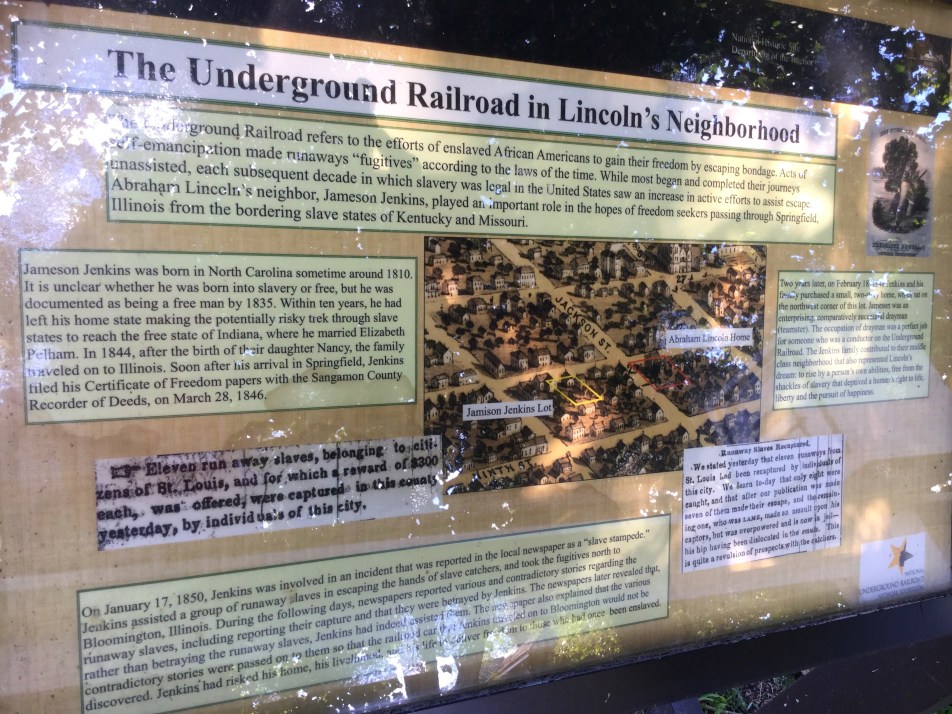
Jameson Jenkins’ lot in the Lincoln Home National Historic Site National Park in Springfield, Illinois, on 8th street next to the Henson Robinson House. On January 17th, 1850, Jenkins helped a group of 11 slaves escape northward, planting false rumors so that local papers would confuse the story and thus help the refugees evade capture. Jenkins was a drayman, and according to SangamonLink: History of the County of Sangamon, Illinois, ‘On Feb. 11, 1861, Jameson Jenkins drove [his near-neighbor] President-elect Abraham Lincoln on his last Springfield carriage ride, from the Chenery House at Fourth and Washington Streets to the Great Western Railroad depot — now the Lincoln Depot — as Lincoln began his trip to Washington, D.C.’.

The historical placard at Jameson Jenkins’ lot. The photograph is at an angle because the glare was so bright on the direct shots that most of the text and images were obscured

Ordinary Philosophy and its Traveling Philosophy / History of Ideas series is a labor of love and ad-free, supported by patrons and readers like you. Please offer your support today!
Happy Birthday, Benjamin Franklin!

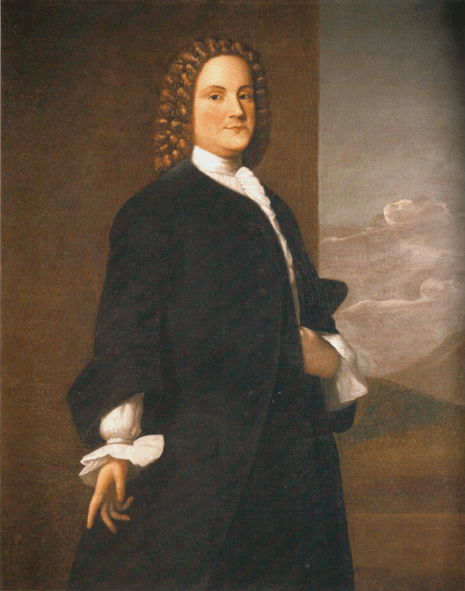
Benjamin Franklin, earliest known portrait by Robert Feke, 1738-1746, public domain via Wikimedia Commons

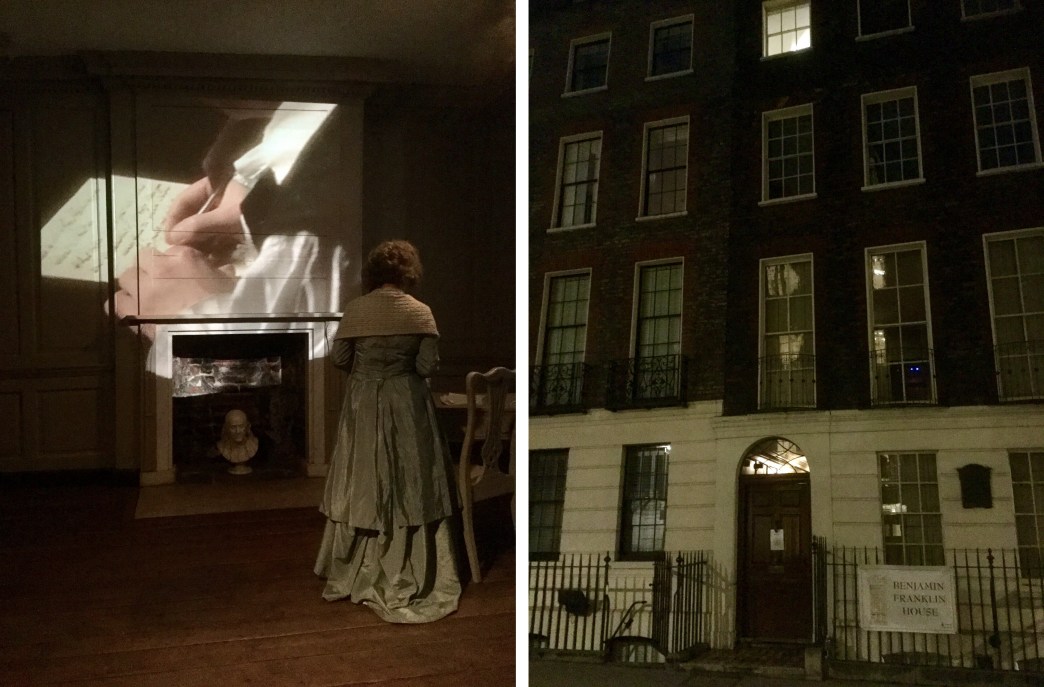
My philosophy and history of ideas travels and research have now led me to many, many sites associated with the life, ideas, friends, and colleagues of Benjamin Franklin in two continents and the United Kingdom, and I have more on my list to visit still. Just the other day, I visited Benjamin Franklin’s house in London (see below). And I’ve discovered more links between this man and other great thinkers and ideas that will be the topics of future stories, stay tuned!

This long-lived, very sociable polymath was born January 17th, 1706 and died April 17, 1790. He was a printer, writer, publisher, inventor, scientist, diplomat, and American founding father, mentor to many, friend to countless more, and mediator extraordinaire between rivals, colleagues, friends, and nations. Always on a quest to further expand and expound human knowledge, Franklin founded the American Philosophical Society, which persists to this day.

Learn more about this extraordinary man:

Autobiography of Benjamin Franklin ~ by Benjamin Franklin, 1791

Benjamin Franklin: American Author, Scientist, and Statesman ~ by Theodore Hornberger and Gordon S. Wood for Encyclopædia Britannica

Benjamin Franklin: An Extraordinary Life, an Electric Mind ~ PBS

Benjamin Franklin FAQ ~ The Franklin Institute Website

Benjamin Franklin Joins the Revolution ~ by Walter Isaacson for Smithsonian.com, July 2003

What Led Benjamin Franklin to Live Estranged From His Wife for Nearly Two Decades? ~ by Stephen Coss for Smithsonian.com, September 2017

Ordinary Philosophy and its Traveling Philosophy / History of Ideas series is a labor of love and ad-free, supported by patrons and readers like you. Please offer your support today!
Benjamin Franklin House in London, evening visit, left, interpretive tour, right, exterior