Welcome to the new Ordinary Philosophy!

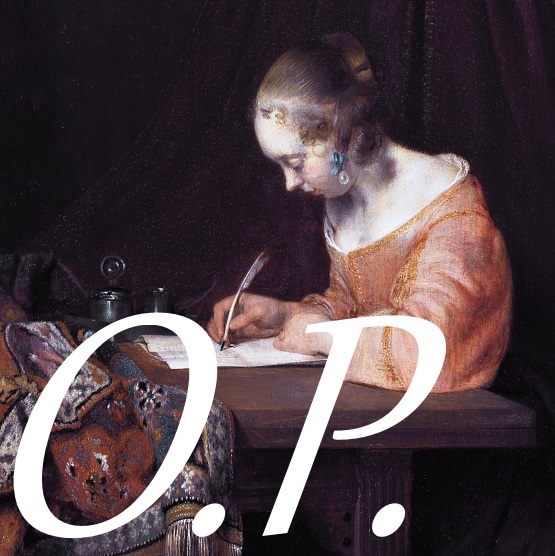
Ordinary Philosophy, Writing a letter *oil on panel *39 x 29.5 cm *signed b.c.: GTB *ca. 1655, assemblage by Amy Cools 2015Greetings to all,

On this New Year’s Day, which also happens to be my birthday and therefore, personally, doubly a day of new beginnings, I’m looking forward to a more expansive, more energetic future for Ordinary Philosophy!

What is Ordinary Philosophy?

It’s a series of explorations founded on the belief that philosophy is an eminently useful endeavor as well as a fascinating and beautiful one, and that citizen philosophers and academic philosophers alike share in making it so. A citizen philosopher myself, I found that my experiences as an avid reader, an artist, a working person, an entrepreneur, a student, and a writer filled my mind constantly with questions and new ideas, spurring me ever on in the search for answers. As I’ve always been a restless and hungry thinker, I fell in love with philosophy, especially, practical philosophy and the history of ideas.

What is Ordinary Philosophy’s mission?

It’s always been to share this love of philosophy and the history of ideas with you. In my explorations, I’ve encountered the most fascinating, innovative, and beautiful ideas from the curious, thoughtful, questing, and inventive world out there, from academic philosophy to science to history to current events to politics to the arts and so, so much more; so much more, in fact, that I can’t possibly process it all on my own.

So here at O.P.’s new home, I’ve broadened the mission.

While there have been occasional guest posts, there will be much more of an emphasis on providing a forum for many more voices at O.P., representing views from all walks of life. O.P. will also publish many more reviews, recommendations, and links directing readers to the great ideas proliferating out there that may be of special interest to O.P.’s audience.

The Traveling Philosophy / History of Ideas series will also expand. Each series will become more in-depth, with more detailed explorations of the life and ideas of each subject and more resources for further exploration and study. The podcast will expand in tandem: new audio recordings of longer pieces published in O.P. for those of you on the go who enjoy the ideas found here but don’t always have the time to sit down and read. As time goes by, I plan to expand the podcast as well to include interviews and a series of downloadable travel guides to accompany the History of Ideas series.

To better accomplish this expanded mission, I’ve moved O.P. here to its new platform: easier to read, use, and share. So if you love great ideas and the pieces you encounter here, please support O.P.’s expanded mission by sharing as widely as you can.

Lastly, dear readers, I appeal to you: Ordinary Philosophy is a labor of love, and depends entirely on your support. I’m determined to keep O.P. ad-free, but can’t do it without you. All financial contributions will be credited by name (unless anonymity is expressly preferred, of course!) on each project funded by their donations, and welcomed with deepest gratitude. Please support Ordinary Philosophy today!

Yours,

Amy Cools, founder and editor of Ordinary Philosophy

*Listen to the podcast version here or on iTunes

Compassion, Emptiness, and the Heart Sutra, by Ryan V. Stewart

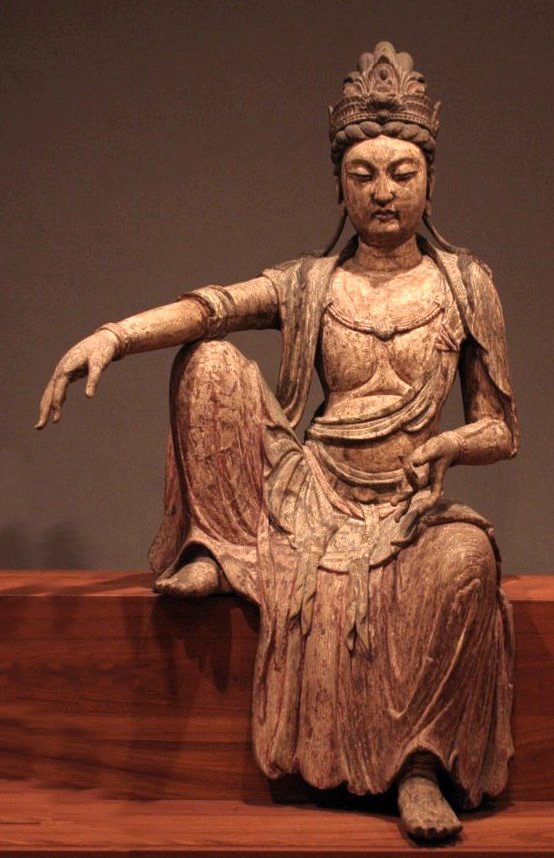
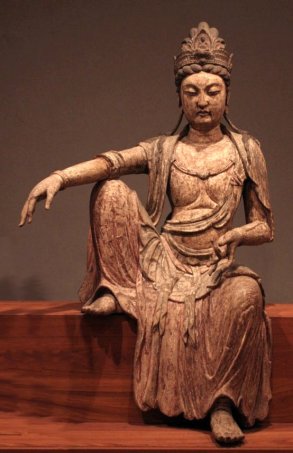
d1185-guanyin252c2bthe2bchinese2bexpression2bof2bavalokiteshvara252c2bnorthern2bsung2bdynasty252c2bchina252c2bc-2b1025252c2bwood252c2bhonolulu2bacademy2bof2barts252c2bpublic2b1One of the chief concerns of philosophy, since time immemorial, has been to properly address the question, “How do I live?” Namely, “How do I live well?” Naturally—for as long as our species has had the wherewithal to question its purpose and condition, the problem of ethics has found itself at the frontiers of human thought. Many moral philosophies have since rushed into that wide gulf between knowledge and truth, systems of understanding and action which attempt to conquer our ethical indecisiveness and color in a void where so much uncertainty exists.

Many traditions prescribe the ideal, virtuous, or noble life. From the ancient, academic, or political—e.g. Epicureanism, utilitarianism, humanism, or libertarianism—to the more mystical or overtly religious—e.g. Jainism, Christianity, or Taoism—many are concerned with how one acts (or can act), or at least how one views oneself in relation to others and to the world at large.

The Buddhist religion—though some prefer to see it as a philosophy—is one such tradition. An ancient and diverse faith, Buddhism is perhaps best known for its thorough and egalitarian moral philosophy. And while it is indeed diverse (containing a huge number of schools, most with their own interpretive methods and styles of meditation and ritual practice), compassion (or karuna) is treated as an important trait of an enlightened being, and a cornerstone of Buddhist thought, in all sects. Thus, throughout the various iterations of Buddhism—from the forest-monk Theravada of Thailand to the Zen habits of Japan—one finds a remarkably consistent system of normative ethics, and a conceptual framework for promoting the wellbeing of all sentient creatures.

That all being said, the ontological concepts which necessitate Buddhist compassion are perhaps most concisely expressed by the Mahayana (“great vehicle”) tradition—one of two or three major branches into which Buddhism is often divided. Buddhism maintains a unique connection between metaphysics and ethics, and the deeply profound philosophies of many Mahayana thinkers, and those presented in a number of the Mahayana sutras (Buddhist sacred texts), can be seen as an attempt to navigate and define that sort of connection.

Where does one begin in exploring such a notion? The corpus of Buddhist literature is impossibly vast, and anyone could spend a lifetime pondering so many mystical works and their commentaries. I would argue, however, that in order to form at least a basic understanding of the Mahayana ethical-metaphysical relationship, we need look no further than the ancient and seminal Heart Sutra.

Written as a dialogue and teaching, the Heart Sutra is a brief monologue on the part of a bodhisattva (an enlightened being who has postponed his or her salvation in order to remain in the world and aid sentient beings) by the name of Avalokiteshvara. Avalokiteshvara (known as Guanyin in China and Chenrezig in Tibet—the latter where the Dalai Lama is considered his living manifestation), whose name roughly translates to “the lord who looks down,”—that is, he looks down upon the world of the unenlightened with charity and love—is a bodhisattva representing perfect compassion. Befitting this disposition, the Avalokiteshvara of the Heart Sutra provides a mortal monk, Sariputra, with a profound teaching, a parcel of great wisdom intended to eradicate the suffering of sentient beings. Avalokiteshvara’s great revelation is that all phenomena are, in fact, “empty.” (Red Pine, p. 3.)

To clarify, the bodhisattva is saying that everything in the world lacks an inherent “self,” or essence. This concept finds its origin in the oldest, pre-Mahayana forms of Buddhism, and the Buddha himself noted that “no-self” is, along with impermanence (anicca) and unsatisfactoriness (dukkha), one of three “marks” which constitute the nature of reality. Anatta, for the historical Buddha, and for the older Theravada school, mostly implies that nothing in the world can be said to be one’s “self,” (atman), and thus identifying anything as representing the essence of oneself—a “self” made up only of non-self parts (cf. Hume’s “bundle theory”)—is delusory. The self-concept, for the Buddha, is an illusion of essence which binds human beings to false worldviews and causes them to misrepresent reality, thus barring them from enlightenment.

The falseness of self-hood forms a bedrock of Buddhist philosophy. In the “emptiness” (sunyata) of the Mahayana, however, we find anatta further developed. (Nagao, pp. 173-174.) We owe this development chiefly to Nagarjuna, a first-century Buddhist philosopher who founded the Madhyamaka school of Mahayana Buddhism, and developed the philosophies (one most notably being sunyata) inherent in the Mahayana Prajnaparamita sutras. In his text, Fundamental Verses on the Middle Way, Nagarjuna famously states, to this effect, “All is possible when emptiness is possible. Nothing is possible when emptiness is impossible.” Thus emptiness, in this sense, is not mere nothingness, but an open space in which all potential exists. Hence one cannot truly differentiate being and nonbeing, total emptiness and total “allness,” infinite nothing and infinite something. One implies, or necessitates, the other. In the Heart Sutra, Avalokiteshvara explains this to Sariputra when he says, “Form is emptiness, emptiness is form; emptiness is not separate from form, form is not separate from emptiness; whatever is form is emptiness, whatever is emptiness is form.” For the Mahayana school, emptiness is not merely the surrogate for essence, and a blank space where one imagines the self, but the numinous nature of all things.

Now, this emptiness implies another notion (this one common to Buddhism on the whole), “dependent origination.” (Pratityasamutpada.) According to this doctrine, all phenomena exist dependently, depending upon one another in order to maintain their existence. (Encyclopedia Britannica, n.p.) Thus, there is no free, permanent, inherent, and individual existence for any beings or objects. Their causes and conditions are inextricably linked to the unending web of phenomena arising and passing away in the universe. One thing cannot be said to be truly separate from anything else when it exists, in time and space, alongside all else, and when it requires for its existence the (falsely!) extraneous forces of nature, matter, and energy. Thomas J. McFarlane, writing in his 1995 essay “The Meaning of Sunyata in Nagarjuna’s Philosophy,” sums this up nicely when he states, “According to Madhyamika, the root of all suffering lies in… the error of mistaking the relative for the absolute, the conditioned for the unconditioned. We take imagined separation as real, supposed division as given.”

An easier, less flowery way to illustrate these three ideas—no-self, emptiness, and dependent origination—in tandem may be to imagine something made up of familiar parts: A tree, for instance. We all know that trees are made of a variety of components—trunk, roots, branches, leaves. Where, then, lies the “treeness” of the tree, in the tree? Is the tree its roots? Is the tree its leaves? No? Why not? One may say, “‘tree’ is the name we give to the sum of the parts of the tree,” but then, of course, “tree” is reduced to a mere name and concept, not a thing-in-itself. Whatever can be called a “tree” is ultimately made up of non-tree parts, and thus there is no “treeness” at all. Similarly, the self, though imagined as one’s essence or “soul,” can be divided into mental phenomena and parts of the body. (All of which are subject to constant change, hence anicca.) There is no “selfness” for this self, only the experience of a very familiar concept by the same name. Thus Avalokiteshvara tells Sariputra, “Whatever is form is emptiness, whatever is emptiness is form. The same holds for sensation and perception, memory and consciousness.”

We now have a grasp on no-self (anatta), and can see how easily it translates to no-essence-anywhere-at-all (sunyata) by analyzing everything down into its (non-) fundamental components, components which themselves are also made up of other components, and so on and so forth. One can continue dividing things and concepts forever, down to an infinitesimal. (Granted, this is a conceptual exercise, and the author omits any claims about concrete physics for lack of sincere knowledge of the subject. Regardless of Planck lengths and fundamental particles, confer “infinite divisibility.”)

But how does emptiness translate into connection, into pratityasamutpada? Let us continue with the metaphor of the tree, and observe how the tree is not only constructed of non-tree parts, but dependent on the conditions of the world at large for those very constructs: A tree, like all lifeforms, requires a number of inputs from its surrounding environment in order to survive and thrive. Water, soil, and sunlight most readily come to mind. Water, for instance, rains down from clouds, which themselves are formed from atmospheric water vapor. Soil is produced over many years by the degradation of organic matter, and organic matter is contained by other lifeforms, which exist by dint of their evolutionary ancestors. Sunlight reaches the Earth from the Sun, which itself was formed billions of years ago from sparse bits of matter produced in the Big Bang.

What sort of philosophical quandary do we run into here, then? For our purposes it is best to put the question this way: “At what point is the tree no longer itself?” That is to say, “At what point is any “one” thing separable from the causes and conditions that give rise to it, or the causes and conditions that it gives rise to?”

If we take this notion—this pratityasamutpada—to its logical conclusion, we come to recognize that we are, in order to exist, dependent upon components and conditions outside of ourselves; that everything, in fact, is; that the entire universe is one integrated system, and in some sense an entity-unto-itself.

One response to such a situation—and an understandable one, at that—may be that of deep compassion: the fact that we are dependent upon all else, and all else upon us, in some sense (and albeit in a small way), gives us reason to care for the world (and other beings especially) as if the welfare of other things and beings was the same as ours… as if we have no “self” apart from that of the world at large, the welfare of which—from crabs to carpenters—is our concern as beings endowed with the capacity for both suffering and empathy. No doubt, it’s this very suffering which binds us to one another. We, knowing our own pain, can experience it vicariously, through others. Philosophers as diverse as Marcus Aurelius, Hume, and Schopenhauer understood the universality of pain and empathy, and thus their importance in morality.

The Buddha, of course, realized the same. And while you may not find a be-all-end-all answer to the big ethical problems in one particular system, opting instead (as many do) for an eclectic approach to moral philosophy, you have to admit that Buddhism provides one of the most intricate (and practical) answers to our moral quandaries.

As long as human beings have questioned the nature of their freedom and manners of life and livelihood, philosophy has helped fill the void inherent in the realms of “good” and “evil” and everything in between. Buddhism presents us with one particularly bright light, helping to illuminate the murky and ever-indefinite realm of philosophical inquiry.

About the author ~ Ryan V. Stewart is a writer and student from Connecticut. He has been actively writing since 2006, and blogs about everything from mysticism and philosophy to environmental issues, the arts, and personal peeves at The Grand Tangent. He’s interested in the intersection of mysticism, comparative religion, and philosophical analysis (among other things). 

~ Ordinary Philosophy and its Traveling Philosophy / History of Ideas series is a labor of love and is ad-free, entirely supported by patrons and readers like you. Please offer your support today!

Bibliography

Red Pine, trans. The Heart Sutra. Washington, DC: Shoemaker & Hoard, 2004. Print.

Nagao, Gajin. Mādhyamika and Yogācāra: A Study of Mahāyāna Philosophies. Delhi, India: Sri Satguru Publications, 1992. Print.

“Paticca-samuppada.” Encyclopedia Britannica Online. Ed. Anonymous. Encyclopedia Britannica, n.d. Web. .

From Venus of Willendorf to Leonardo da Vinci: In Praise of Art That’sLess About Concept and More About Story and Craft

I love to make things, as anyone will tell you who’s known me very long. My two favorite kinds of things to create are written pieces, be they argumentative, explanatory, illustrative, narrative, and so on, and are usually essays; and artworks, now usually picture quilts, but for many years drawings, paintings, and occasionally sculptures. Though I’ve long loved the written word, my oldest creative love is art.

I’m also a populist by instinct, in the sense that I care a lot about sharing my life with many kinds of people, and relatively little about fitting in with or impressing a small, select group. When I’m in a scene that feels too cliquish, too elite, too cool, too exclusionary, too, well… ‘scene-y’, then I’m out. Not to say I don’t care about community: I do, deeply. But when it comes to anything I think is wonderful and lovable, the more widely I want to share it. That’s what I’m all about as a writer and as an artist.

And that’s why I’m just not that into conceptual art, on the whole. By conceptual art, I mean that which is created more with the intention of referring to or hinting at abstract concepts, and less for purpose of telling a story or of being a thing of beauty. The more conceptual a piece is, the more it leaves me cold, because to me, conceptual art is exclusionary in nature. This type of art is really only meaningful to, and therefore meant for, an exclusive circle, people who spend a lot of time in that sort of art culture, or in a moneyed elite, or in certain academic circles. (I value and respect academia, but to me, it fulfills a very different function than art does.) It’s made for people in a position to ‘get it’. Conceptual art speaks in jargon, in secret handshakes, in code, in insider-ese, in the language of moneyed leisure. All well and good for those who enjoy this sort of club atmosphere. But of art, I want more.

I want art that’s more like music, or poetry, or architecture, or myth: even if it’s originally meant only to communicate within a culture, it can and does communicate across time, space, culture, socioeconomic status, and language. To me, the more soul-stirring the art is, the more comprehensively it tells a story (in both senses of the word ‘comprehensive’). It’s that sort of universal human communication, like tears, laughs, sighs, or smiles, that makes art transcendent, that bridges those gaps between each other and between ourselves and all that exists, which we all ache to cross. 

I love folk art, and I love craftsmanship. They are the two sides of art that I think communicate most universally. 

By folk art, I mean that which is meant to communicate a story: of a person or persons, of an event, of a myth, of belief, of history. It can be crude or it can be finely wrought, but what makes it good is its ability to communicate to anyone, from anywhere or at any time, what’s going on in the mind and heart of the artist. 

By craftsmanship, I mean the art of creation which requires a high level of dexterity and skill, and which demonstrates the countless hours of practice and of mastery that demonstrates the artist’s deep love of the creative process itself. We all make things, so we are all able to recognize and appreciate, on some level, whatever level of care and ability that went into making the thing we see. And as makers, we invariably encounter the limits of our abilities, and in doing so, we realize how difficult it is transcend our own limits and make something well. When an artist accomplishes this superbly, we’re impressed, and delighted.

On the whole, I think the world of conceptual art is suffering too many of the ill effects of its own excesses. Craftsmanship is not valued nearly enough; indeed, I’ve heard artworks rich in it dismissed time and time again as not really art, they’re ‘just crafts’. Representations of people, places, and ideas that are widely recognizable are dismissed as ‘too literal’. I really think that most people who walk through galleries these days are often jaded, or bored, or amused, or bemused, and, as a whole, tired of being talked down to by artists and gallery curators. The public is getting tired of the art world’s pretensions: it often looks as if just about anything can be fastened to the wall, demanding the public’s praise and appreciation so long as it’s accompanied by a description that sounds obscurely profound enough. Conceptual art, on the whole, has grown too elitist and too removed from the most fundamental emotional needs that art, at its best, can fulfill.

I grant that there are some things of value in conceptual art, too. For one thing, as my husband points out, when it was a new movement, it allowed artists to break down artistic boundaries, many of which should have been broken down since they placed too many restraints on innovation and creativity. (I can always count on Bryan to play an effective devil’s advocate, to find the weak and missing points in my arguments; thanks, as always, for keeping me honest, babe!) There are subtle points that conceptual artists can make that are of value and difficult to express fully or eloquently through other means of communication. Sometimes, the concepts explored are important or interesting ones, even if they are too obscurely or affectedly expressed. There are also accidents of beauty and visual interest that occur when an artist is playing freely with materials trying to express something else. And so on and so on.

But nonetheless, I feel that the conceptual art world needs more critics. It needs some competition, it needs some opposition, and I feel just fine in my overall feeling of antipathy to it as it is right now. Conceptual art (with its cousin, abstract art) has its defenders in plenty: namely, nearly every art gallery and museum and patron with deep pockets out there. The representational artists, the visual storytellers, the communicators in paint and clay and fabric and stone and wood trying to reach the widest audience, they’re not honored so much these days, except in the hearts of the grateful public who’s always happy to find artists who are direct and honest with them, who desire to satisfy their longing for beauty and love of a good story. In short, conceptuality in art has become the new paradigm, the new standard, the new orthodoxy. Conceptual art doesn’t suffer from one less champion; the rest of the art world could do with more.

So from the roughest cave painting of our earliest human ancestors to the most finely wrought work by Leonardo da Vinci, from the earthy Venus of Willendorf to the most exquisitely sculpted Michelangelo, from the doll’s dress of the youngest stitcher-in-training to the Parisian couture gown, and from the memory rag-quilt sewn in the half-light of a bayou shack to the most intricate, hand-stitched fine textile work fit for a queen you ever saw: I want to say, I love you the most. Thank you for the joy you bring me, the delight to my senses, and most of all, the communion with the wider world of things and people. Thank you for bridging the gaps.

A Hike From Serpentine Prairie / Dream On, But Remember to Enjoy Today

Serpentine Prairie is a wonderful place to be in spring, and I started my hike there today.

It’s an open, hilly field adjacent to Redwood, a regional park in the Oakland hills, among the most beautiful places I’ve ever been, and I am so glad to live nearby.

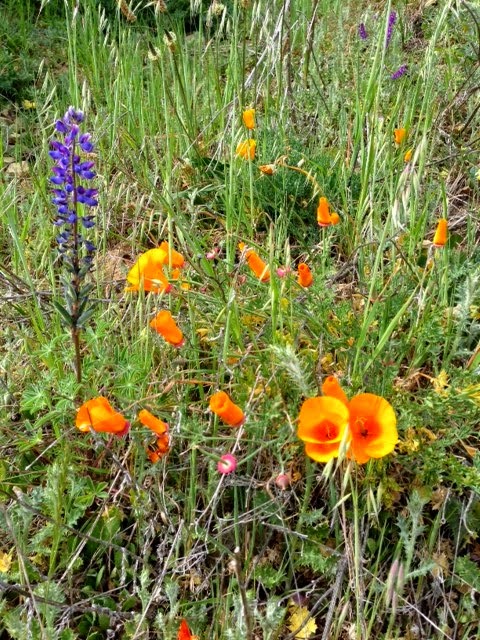
We’re in a drought here in California, but you would never know it from what I saw. The native California grasses are abundant, green and thick (and rare, having been choked out by imported Mediterranean species, but not here: the poor soil, made from the crumbled bedrock serpentine, is inhospitable to all but the native species which evolved to thrive on it), bright green new growth is bursting from branches left and right against the darker trees, and vines crawl, twist, and fling themselves across it all, reaching for the sun. The wildflowers are in full bloom, in shades of golden orange (poppies, of course!), yellow, purple, and white, except for the mottled purple-and-green ones, a little like umbrellas and a little like bells, leaning down to shade and guard their tender inner flowers. The variety of wildflowers is surprising when you look a little closer: just the white ones all look like so many sparky little stars, but are so different in the shade of green, leaf shape, and size of the plant they grow from.

There’s a little plant here and there, a fern I think, with bright lightly ruffled leaves shaped like those of the ginkgo tree in autumn. They hang on superthin stems, almost gossamer, of purplish-bluish-black, and they fluttered and shuddered when I blew on them. Watch out for poison oak! you who suffer from it, because it’s all over the place. I think I’ve grown immune from the time I’ve spent among it all, but it’s best to be careful. It’s all tangled up underfoot, lobed and shiny, among the wild strawberry and miner’s lettuce, waiting to grab at an unwary ankle.

So many kinds of trees grow here: the twisty madrones with their sexy ultra-smooth skin, peeling bark, and little white bells on for spring; the gnarled, ancient-looking oaks with their moss, the exotic eucalyptus keeping the earth in place, and the redwoods, soooooo tall, and so aloof from all the seasonal frenzy going on underfoot.

Daylight savings time has just started, and I’ve been chomping at the bit for it: on my shorter days at work, now that the evenings are long, I made a beeline for the hills as soon as I got off, so I can finish my hike before dark, as I will do every week now that the long evenings of daylight are here. I’m selfish: I hope the farmers lose the argument, and daylight savings time remains our national habit.

Earlier today, I had just realized, once again, that I had lately fallen into one of my bad old habits, born of my impatient and restless nature. I’ve been so irritated at not being able to do all that I want to do right now, that I’ve been forgetting to fully enjoy the things I love to do that I am doing.

My day has job gotten busier and more demanding in the past year, my workload and the hours required to do the job well increased, and I’ve been fretting because the essays I want to write, the things I want to to sew, the books I want to read, the places I want to visit, are piling up, as I have less and less time to give them and still get my rest.

But when isn’t this true, and for whom? Nearly all lives become ever busier, and the days seem to grow shorter, the father away you are from childhood. That’s just the way it is.

We can only control how busy we are so much, when we must work for a living, have families to take care of, and so on. But we have a little more control over how we approach it all, as we struggle to keep up with what we need to do and what we want to do.

I am restless, and impatient, and prone to daydream. This can be good, and for the most part, I think it is. I like it, anyway: these have pushed me to do things I look back on with satisfaction. But when I realized earlier today that I had fallen out of the habit of fully enjoying the good things I could be enjoying now, I remembered to engage in my with so much more of my attention, so as I was closely observing the little flowers, the leaves, and the vines, I was looking closely enough to see the little snake dart across the path and ‘hide’ in plain sight, camouflaged against the stems, just as I was stepping out of Serpentine Prairie and onto Golden Spike Trail. What perfect timing!

I’ll go to bed now, thankful to have my love to cuddle with, and a world to wake to, that I’m lucky enough to have the opportunity to enjoy, as long as I remember to do so.

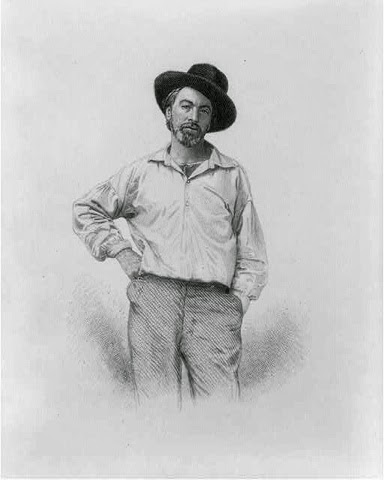
Walt Whitman, on Animals

I’ve been revisiting the poems of Walt Whitman lately, listening to them read aloud on Librivox by a skilled reader, enjoying every moment of them in their rich simplicity. This one especially struck me, and I feel compelled to share it with you.

From Song of Myself, Book 3

I think I could turn and live with animals, they are so placid and self-contain’d.
I stand and look at them long and long.
They do not sweat and whine about their condition,
They do not lie awake in the dark and weep for their sins,
They do not make me sick discussing their duty to God,
Not one is dissatisfied, not one is demented with the mania of owning things,
Not one kneels to another, nor to his kind that lived thousands of years ago,
Not one is respectable or unhappy over the whole earth.
So they show their relations to me and I accept them,
They bring me tokens of myself, they evince them plainly in their possession.

~~~~~~~~~~~~~~~~~~~~~~~~~~~~~~

You know me, dear readers, as one who enjoys mentally taking apart things to see how the world works, a little too obsessively at times, perhaps. Yet I am an animal too, just one who does that kind of thing. But it’s good to remember to be the kind of animal that just takes in, and enjoys, simply, sometimes

Welcome to the Podcast Edition of Ordinary Philosophy!

Hello dear readers, and welcome to the
podcast version of Ordinary Philosophy!

You can listen to the podcast here, on Google Play, or subscribe in iTunes.

Like many of you, I’m a big fan of podcasts, mostly because my life is very busy. One day in the future, I hope to have a lot more time to do each task one at a time, to really be present, as they say, as I wash the dishes, straighten the house, do the laundry, and perform all those other tasks that take up time, but not much thought.

But at this time in my life, between my day jobs, my creative projects, and spending time with friends and family (which I don’t do enough of these days, sadly), I don’t have enough time to keep up the world of ideas as nearly much as I’d like to by sitting down and reading. Instead, I keep myself informed and increase my education by listening to lots of podcasts: discussions with my favorite authors and thinkers, audio renditions of books and essays, debates, recordings of classes on my favorite subjects, and so on. I listen to these podcasts while doing those aforementioned chores, and let me tell you: as one who is not fond at all of household chores like doing the dishes and washing the floor, the podcast is a marvelous invention: they transform boring chore time into great opportunities for learning and exploration. I’m also an avid hiker, and it’s a wonderful thing to be able to immerse myself in some fascinating ideas or discussion as I immerse myself in the beauties of nature.

To begin with, this podcast will simply consist of audio recordings of my Ordinary Philosophy pieces. Over time, I may add commentary and who knows, perhaps interviews and discussions with guests. We’ll see how it goes. In the meantime, here’s Ordinary Philosophy in audio form: I hope you find it interesting and enjoyable!

… And here’s episode 2: Is the Market Really the Most Democratic Way to Determine Wages?
Originally published as an essay Feb 6th, 2014

Review: Farley’s East

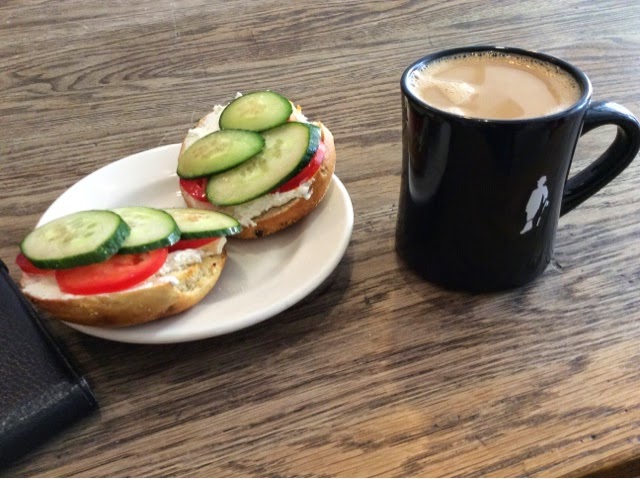
I love to write essays, and I also have the tendency to be easily distracted by having all the comforts and hobbies of home surrounding me, as well as the tendency to justify laziness after a day at work. Therefore, to avoid stopping off at home, I’m often on the hunt to find a workspace, a great coffee-shop / cafe that’s more or less on my way from work to the hills for my early evening hike, a place that’s homey, friendly, reasonably priced, has tasty small meals and snacks, and has wi-fi. 

 
Farley’s East has just joined the list of my favorite such places. 
 
Who, What, Why, How: http://www.farleyscoffee.com
 
Where: 33 Grand Ave, Oakland, CA 94612
 
When: Mon – Fri 7:00 am – 9:00 pm Sat – Sun 8:00 am – 9:00 pm
 
Perhaps I’ll see you there!

Great Thing About Family Is….

I belong to a large family. Like, very large. On my mom’s side, I am one among a pool of 18 first cousins, a number not too out of the ordinary, but last I heard, I am one of a whopping 70 or so cousins on my dad’s side (If that number is out of date, dear relation who may be reading this, let me know and I’ll update!) I have twenty-one (living) aunts and uncles, not including my dad and mom, and when it comes to my siblings’ and my cousins’ kids, their spouses, the great aunts and uncles and their families… you can imagine the sheer numbers of people I count among my relations.

And yet, I actually do know a substantial majority of them, though not necessarily well. But a great many of them I do know well.

Here’s another thing: I am very different than many, probably even most, members of my family, in temperament, habits, and beliefs, as is the case with most extended families, I expect. I even find many of the beliefs and opinions held by some of my relations distasteful or sometimes even downright abhorrent, as I suspect they do mine.

Regardless of this, I love and respect almost all of them, and I really like to spend time with them when I can.

People sometimes find it necessary to distance themselves from family for their own protection, to preserve their mental health and peace of mind, for example, or because their family members’s beliefs cause them to reject their atheist, or gay, or interracially-married, or religiously converted, or otherwise non-conformist relations. Some people abuse their family members, too, sometimes in most horrific ways. Every situation is different, and of course, many people really should sever ties when the relationships they have to family is destructive.

But I think it’s so important to preserve family relations if you can, because what they have to offer can be of immeasurable value.

First, there’s the wealth of love and support that comes with family. You acquire a posse of friends and allies just through the simple fact of being born. And as you go through life, you grow together with them, and get to share in their history, in a way unique from any other kind of relationship. A member of your family can understand you in a particular way that few others can, by virtue of each of you accompanying another as each grow and change. You, in turn, can have that particularly intimate sort of insight into what makes them tick.

But secondly, and I think at least as importantly, you have the opportunity to keep your mind that much more able to imagine and to understand other ways of seeing the world. For example, here in the Bay Area where I’ve made my home for well over a decade now, I live in a liberal, artsy, worldly, well-read, foodie, moderately out-doorsy, rather cosmopolitan ‘bubble’. My friends would all be readily characterized as such, and I love these things about them, as we share so many points of view in common, and enjoy doing and talking about the same sorts of things.

But there are other ways of experiencing the world,  and as we share our city, state, country, and planet, and therefore in many ways our fate with very different kinds of people, it’s imperative that we all be able to talk to each other. But how to do overcome these often vast differences, and bridge that gap, in order to be able to understand how others think? This problem is illustrated most strikingly in our public discourse, where in the media and on internet forums, citizens, pundits, and politicians shout past each other, and instead of convincing their ideological opponents, almost always just end up ‘singing to the choir’.

And that’s where the bonds of family loyalty and shared history can come in, to help you increase your patience and expand your understanding. Family is one of the few spheres where very different people can come together in mutual love and respect, overcoming their differences in order to preserve something even more important than simply agreeing with one another about everything.

I consider my dad, for example, the most important moral influence in my life, though the few times we’ve specifically talked about the issue, we find we have very different accounts about the nature and origin of morality. Yet, I find he embodies that which morality ultimately is for, and how it molds a genuinely, habitually virtuous person that I would recommend everyone emulate and admire.

Another example: one of my uncles, dear that he is, calls me regularly in an effort to convert me back to the Catholic religion of my upbringing. (He was my confirmation sponsor, a Catholic rite of passage somewhat like a Bat Mitzvah, and he takes it very seriously, though I’ve assured him time and again that I consider him released from that obligation: I was far too young, and lacked the relevant information, to make such a vow of fealty to any religion.) We end up having many frank, lengthy discussions and debates on all manner of religious, philosophical, and political topics, and rarely agree on anything beyond the most basic moral principles and standards of reason. But we end every conversation, no matter how heated it had gotten, on the friendliest of terms, and say good-bye amidst good-humored banter.

Most of the time, it feels as if there’s just not enough time and energy to go around spending a lot of time with people that don’t share many of your interests and beliefs. But without family, it’s unlikely that many of us would have the opportunity to really get to know people that are substantially different than we are. I’ve spent countless happy and enriching hours in friendly companionship eating, hiking, swimming, playing sports and games, and just chatting with relatives with whom I have few things even common, who disagree with me philosophically, politically, and aesthetically about so many things, and I with them. But ultimately, none of that mattered at the time: we were sharing time as fellow beings sharing a kind of close human relationship that could transcend all of that.

Funnily enough, that same family loyalty that historically has led so so much tribalism and in-group, insular thinking, can also be among the most important avenues for opening us up to a more tolerant, cosmopolitan mindset, so long as we have family that are open to maintaining a system of love and support while being very different in habit and thought. So if you can, stay close to family, keep the lines of communication open. You may very well become a much bigger person as a result.

My family has done so much for me in that line, even if unintentionally, and for that, among so many other things, I thank them, and owe them a great debt.

Free Will and the Self

Free will and the self. What are they? While they are the two most important phenomena to each and every one of us, they’re notoriously hard to describe. Of course, we ‘know’ what they are: respectively, they are the experience, the feeling, of being in control of our own actions, of our thoughts and behaviors, and of having an identity and a personality that exists over time. Without them, our lives seem pointless: if we have no free will, then we are mere automatons, and we can take no credit and no responsibility for anything we do. If we have no self, then there is no we, no ‘I’, at all.

Experiments and scholarship by neuroscientists, biologists, psychologists, and others have revealed some starling things about the workings of the brain and how human beings think, behave, and make decisions. The field of neuroscience has grown by leaps and bounds in the past few decades since the advent of technologies that allow us to observe the living brain at work, though we’ve been learning much about the brain over the last few centuries by observing the results of damage to its various parts. These results have, in turn, thrown traditional accounts of the self and free will into question.

Many have gone so far as to say that since we’ve discovered that our actions result from the cause-and-effect processes of a physical brain, then we have no free will: our actions and all our thoughts are determined by the cause-and-effect laws of nature. And since we’ve discovered that the sense of self arises from the confluence of the workings of the parts of the brain, and damage or changes to those parts can cause radical changes to our personalities and the ways we feel about the world and ourselves, that the self is an illusion too.

Yet, how can free will and the self not exist when we experience them throughout our lives? Since we can talk about them to one another, they must exist in some sense, at least. And it’s not that they exist in the way that fictional characters in a story exist, for example, or other artificial creations. We experience these phenomena intimately, from the time we attain consciousness early in life, until the time our brains are so aged or damaged that we are conscious no longer. The concepts of free will and the self are ubiquitous in our language, our culture, the very way we think. Read this paragraph again, review all the thoughts you’ve had in the last hour (and ever had, in fact) and you’ll find that the concepts of ‘I’, ‘you’, ‘we’ (distinct selves in the world), combined with the concept of some action or thought purposely performed by one’s self, are a constant theme. In fact, almost everything we talk and think about would be incoherent without these concepts, and all the purposes that drive us would disappear and render all we do meaningless.

So what gives? How do modern discoveries about the workings of the brain jibe with traditional concepts of free will and the self?

It appears the confusion results from the way we use the terms. There are actually two things we’re referring to. One is the actual experience of the phenomena we call ‘the self’ and ‘free will’. The other is how we account for them, how we define them and explain how they work.

Consider what we mean by other terms, such as ‘disease’. At one time or another, we had various explanations as to what these things are, and how they are caused. One popular explanation that convinced people for hundreds of years: disease is the result of the imbalance of the four humours of the body: blood, black and yellow bile, and phlegm. A physician’s job is to restore the balance and so bring about cure. Other explanations are vitalist (life and health are the result of the interaction between some sort of non-physical spiritual ‘force’ or ‘energy’ and a physical body), such as chiropractic and traditional Chinese medicine. Disease is cause by some sort of disruption in the body, and a physician’s job is to correct the alignment and communication channels of the parts of the body so that the vital force can flow freely and restore health. And the most pervasive and popular explanation of disease throughout human history, of course, is that it’s caused by the vengeance of an angry god or the maleficence of evil spirits (witch-burnings, anyone?).

Over time, human beings invented and developed the scientific method pioneered by Francis Bacon, and began to more carefully examine the correlations of disease symptoms with the circumstances in which they occurred (outbreaks of cholera mapped so that the epidemic was revealed to center on a polluted source of drinking water in 1830’s London; the correlation of damage to a particular parts of the brain to the symptoms of brain damaged patients; the dissection of corpses, comparing diseased organs to healthy ones). With the discoveries of the physical causes of disease, by pathogens and by damage to parts of the body, effective cures were finally able to be developed.

Given that the explanations for the origins of disease are based on the understanding that they’re natural, the result of physical processes, and traditional explanations, does that mean that disease can no longer be said to exist? Does that mean we have to come up with an entirely new terminology? I don’t think it does. The term ‘disease’ refers to instances of the body suffering in some way, not functioning as a healthy body does. What we do when we are confronted with the phenomenon of disease is the same as it ever was: we seek to avoid it, we detest being afflicted by it and seeing others afflicted by it, we seek to understand its causes, and we seek to cure it.

Similarly, the denial of the existence of free will and the self is based on the misguided assumption that understanding the inner workings of a thing, in a way incompatible with traditional explanations, is to deny that the phenomena exist at all. To understand that the mind is the product of a physical brain obeying the laws of nature rather than a sort of spirit or soul inhabiting a machine-body is not to say the mind doesn’t exist. The experience of free will and the self is the same either way, and whether what makes the ‘I’ an ‘I’ is better explained naturally or supernaturally makes no difference. We are still agents, it’s still what’s going on in our brains that cause everything we do, and we still make choices, and it’s still ‘we’ that make them.

In sum, discovering how the phenomena we experience that we’ve dubbed ‘free will’ and the ‘self’ really work doesn’t mean that they don’t exist; it just means we understand more about them now. And to me, as to other lovers of knowledge and understanding, that’s a good thing.

* Also published at Darrow, a forum on the cultural and political debates of today

~~~~~~~~~~~~~~~~~

Sources and inspiration:

Dennett, Daniel. ‘On Free Will Worth Wanting’. Interview on Philosophy Bites by David Edmunds and Nigel Warburton. http://philosophybites.com/2012/08/daniel-dennett-on-free-will-worth-wanting.html

Klein, Jürgen, “Francis Bacon”, The Stanford Encyclopedia of Philosophy (Winter 2012 Edition), Edward N. Zalta (ed.) http://plato.stanford.edu/entries/francis-bacon/

‘John Snow’, from BBC History series. http://www.bbc.co.uk/history/historic_figures/snow_john.shtml

Kean, Sean. Interview on Inquiring Minds podcast by Indre Viskontes and Chris Mooney, published June 12, 2014 https://soundcloud.com/inquiringminds/38-sam-kean-these-brains-changed-neuroscience-forever

Metzinger, Thomas. The Ego Tunnel: The Science of Mind and the Myth of the Self. New York: Basic Books, 2009 http://www.goodreads.com/book/show/5895503-the-ego-tunnel

Sharif, Azim F. and Kathleen D. Vohs. ‘What Happens to a Society That Does Not Believe in Free Will?’ Scientific American, June 2014. http://www.scientificamerican.com/article/what-happens-to-a-society-that-does-not-believe-in-free-will/

 Wikipedia (various authors): ‘Daniel David Palmer’ (founder of chiropractic), ‘Humorism’, and ‘Traditional Chinese Medicine’
http://en.wikipedia.org/wiki/Daniel_David_Palmer
http://en.wikipedia.org/wiki/Humorism
http://en.wikipedia.org/wiki/Traditional_Chinese_medicine