The Golden Rule

‘What is hateful to thee, do not do until thy fellow man; this is the whole Law. The rest is commentary’ – Hillel the Elder, ca. 30 BCE – 10 CE

This is a particularly beautiful iteration of the Golden Rule, as I remember hearing Christopher Hitchens point out. Rather than recommending that you do to others what you would want done to yourself, which assumes you know best what others would prefer, this Golden Rule is one of restraint and respect. Do not impose, it says: we do not always know what’s best, so live and let live, and do no harm.

Ordinary Philosophy and its Traveling Philosophy / History of Ideas series is a labor of love and ad-free, supported by patrons and readers like you. Please offer your support today!

~~~~~~~~~~~~~~~~~~~~~~~~~~~~~~
Source and inspiration: 

Kloppenburg, James T. Towards Democracy. New York: Oxford University Press, 2016, p. 41.


On Plastic Surgery and Other Cosmetic Interventions

I published this essay about a year ago today. Cosmetic medical intervention is a subject of special interest for me, and problems associated with it, especially those performed for non-functional or non-reconstructive purposes, are often brought to mind at the medical practice I work in.

Amy M Cools's avatarOrdinary Philosophy

I work for a dermatologist who focuses his practice on medical dermatology. While all treat many of the same medical conditions, an ever-increasing percentage of dermatologists devote a substantial portion of their time to performing cosmetic procedures, from Botox and filler injections, chemical peels, and laser treatments to surgeries: facelifts, chin implants, eyelid modifications, and so on. The sign on the door of the medical practice I work for, however, reads ‘Diseases of the Skin’.

To me, this is a reassuring message, as if to say to all who enter ‘We are here to try and cure what ails you.’ It contrasts sharply with the message I get from cosmetic dermatology and surgery ads: ‘We agree that you’re ugly and need to be altered.’

Now, of course, this is only what I read into those ads, especially in my more sensitive moods. I don’t for a moment speak for anyone…

View original post 4,456 more words

O.P. Recommends: Texas Picked an Ominous Date to Arm Its Public Colleges, by Rosa A. Eberly

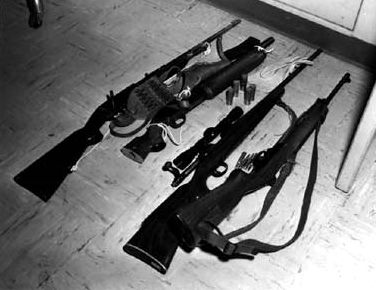
Charles Whitman's rifles and sawed-off shotgun used in University of Texas massacre of 8-1-1966, image free use under CCA 3.0As you may know, dear reader, I’ve long expressed deep concerns over my country’s obsession with guns, over the widespread conviction that guns are the solution to many problems that the proliferation of guns, in fact, manifestly worsens. We’re so awash in guns, culturally and historically, that we take them for granted and forget that there are other possible ways to live. Even the fact that high rates of gun ownership rarely correlate now or throughout history with relatively low rates of gun deaths, be it by state or country, doesn’t seem to matter. Our culturally-induced intuition that bad guys with guns will behave themselves out of fear of good guys with guns seems to render the preponderance of available evidence irrelevant, time after time after bloody time. There’s a particularly telling illustration of this going on right now, as Rosa Eberly writes in her recent piece for The Chronicle of Higher Education:

‘In what appears to be an audacious act of public forgetting, a controversial Texas campus-carry law allowing concealed guns in university buildings is scheduled to take effect on Monday, August 1, the 50th anniversary of the University of Texas tower shootings.

The first mass murder on a U.S. college campus, the tower shootings left 14 people dead, plus the gunman, and more than 30 wounded. As in other more recent examples of mass gun violence, the shooter first used deadly force in a domestic setting — he killed his wife and mother before ascending the tower with an arsenal…’

I dearly hope the students that don’t suffer the possible worst consequences of this very dangerous social experiment. But the evidence of history gives us very good reasons to worry that they will.

Ordinary Philosophy and its Traveling Philosophy / History of Ideas series is a labor of love and ad-free, supported by patrons and readers like you. Please offer your support today!

Empathy for Immigrants

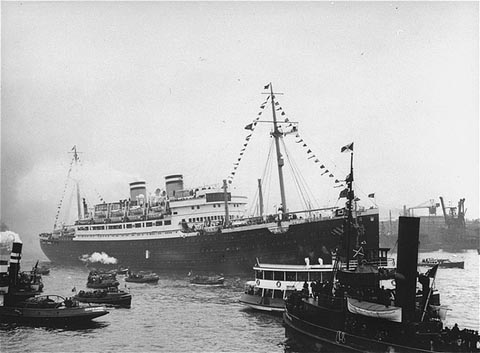
M.S. St. Louis, 1939, which carried 930 Jewish refugees who were turned away from the U.S, Canada, and Cuba

M.S. St. Louis, 1939, which carried 930 Jewish refugees who were turned away from the U.S, Canada, and Cuba

Here’s a very short piece I published almost exactly three years ago, and with the anti-immigrant rhetoric of a certain presidential nominee, I worry more than ever about the fate of those fleeing danger, severe want, and persecution. So many people in dire circumstances do not have the time or the money to wait around until they can emigrate legally. So it’s a matter of stay, suffer, and perhaps die, or go. The Smithsonian featured another article after I had originally posted this piece, about the U.S.’ history of hardline policies against refugees in the interest of national security: http://www.smithsonianmag.com/history/us-government-turned-away-thousands-jewish-refugees-fearing-they-were-nazi-spies-180957324/. But the larger question is this: if we are committed to protecting human rights in general, are we ever justified in preventing people from picking up and moving anywhere they wish to seek a happier and safer life? Last year, I shared an excellent podcast episode by Freakonomics which explored that very question: https://ordinaryphilosophy.com/2015/12/27/o-p-recommends-freakonomics-is-migration-a-basic-human-right/

Amy M Cools's avatarOrdinary Philosophy

M.S. St. Louis, 1939, which carried 930 Jewish refugees who were turned away from the U.S, Canada, and Cuba

M.S. St. Louis, 1939, which carried 930 Jewish refugees who were turned away from the U.S, Canada, and Cuba

To those hard-liners against amnesty for people who immigrated here illegally:

Remember that many, perhaps most, have done so because they’re rescuing themselves and their children from dire poverty, from murderous drug cartels, or from other dangers. They aren’t able to immigrate legally, even if they wanted to, due to the long wait times, high cost, and stringent requirements.

Do you think that all people, morally, should always place a higher value on obeying immigration laws than on the lives and well-being of themselves and their children?

This brings to my mind a famous example of people denied entrance to this country who were fleeing danger and oppression, and were forced to return to Nazi-terrorized Europe. Untold numbers of people died as a result.

Think of your own children, family…

View original post 60 more words

To Achieve Freedom Of or From Religion, Equal Protection is a Better Strategy Than Separation of Church and State

Dear readers: as I study for the GRE (oh, maths, I’d forgotten all about you!), I’ll be posting new pieces a little less frequently for a couple of weeks, though I’m still hard at work on the rest of the Douglass series. Here’s a piece I wrote about one year ago today, still a matter of concern though the recent spate of violence between police officers and enraged citizens has taken precedence in the news. We could all use to take a deep breath and commit ourselves anew to that generous-minded tolerance that makes us the envy of the world when and where it’s practiced. The spiraling rise of polarization around the recent shootings of citizens by police and vice versa, and around the presidential run of a self-worshipping fear-mongering pop-celebrity whopper-spouting icon, is undermining that great American tradition.

Amy M Cools's avatarOrdinary Philosophy

Generally, I’m a big fan of such organizations as the Freedom From Religion Foundation and Americans United for Separation of Church and State.

The former, founded in 1978, is headed by Annie Laurie Gaylor and Dan Barker, enthusiastic and principled atheists who believe that true religious freedom entails freedom from religious interference in matters of government or public goods. They carry out their mission in two main ways: through letter-writing and litigation when the establishment clause of the First Amendment to the Constitution (“Congress shall make no law respecting an establishment of religion…”) is violated, and through public awareness campaigns via social media, network news appearances, a radio show (also available as a podcast; I’m a regular listener), billboards, and ads.

The latter, founded in 1947, is headed by Reverend Barry Lynn, an ordained United Church of Christ minister. The AU pursues many of the same goals as the FFRF…

View original post 1,997 more words

Our Present and The Past, by Ben Alpers

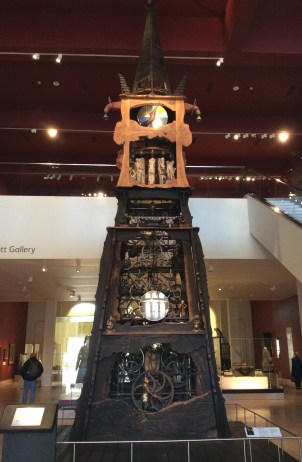
Millenium Clock, National Museum of Scotland, Edinburgh, 2014 by Amy Cools

Millennium Clock, National Museum of Scotland, Edinburgh

At times of great political upheaval, people suddenly start paying attention to history, grasping to find past events that might provide a kind of road map for what the world is going through in the present. The last several months and weeks feel extraordinary in so many ways. The steady stream of mass killings around the world, many of which are connected to ISIS. The nomination of Donald Trump, whose candidacy is clearly unusual and seems to many unusually disturbing. Norbert Hofer of Austria’s Freedom Party nearly becoming the first candidate of the far right to win a western European presidency since World War II … and getting a second bite at the apple when the election results get thrown out. The Brexit vote and the apparent meltdown of UK politics. Cops caught on video killing African Americans in this country with seemingly little cause. The shooting of five cops in Dallas. And today an attempted military coup in Turkey. On and on it goes.

1968 seems to have emerged in recent months as the go-to historical analogy for our current global political upheavals. In the spring, it was often raised by Democrats made nervous by the Bernie Sanders candidacy who wondered if this year’s convention in Philadelphia might fall apart like their party’s 1968 convention in Chicago did. Donald Trump, too, brought back memories of 1968, though more of third-party candidate George Wallace than of Republican Richard Nixon.

As things seem to have fallen apart around the world, the ’68 analogy has been extended beyond the presidential race itself, though most Americans who lived through that year remember it as much worse. “What’s happening now is terrible. 1968 incomparably worse: RFK & MLK assass, 17k US deaths VN, LBJ steps down etc,” tweeted James Fallows last week.

Over the weekend, Vox published an interview with the journalist Michael Cohen, who wrote a recent book on America in 1968. Acknowledging that the political unrest we’re experiencing leads to the analogy, Cohen, like most others who have tackled the question in recent weeks, thinks that 1968 was much worse, both because it was significantly more violent and because we have made so much social progress since then.
But what fascinates me about this whole debate is that it misses half of what 1968 was about. 1968 is such a painful memory because it was a year of dashed hopes. Johnson’s stepping down was a triumph for the anti-war movement. Martin Luther King, Jr. began the year planning a Poor People’s March that would broaden the scope of his movement. RFK emerged as a candidate who seemed potentially capable of bringing America together and end the war in Vietnam. Of course none of these things worked out.

1968 was a year of dashed hopes around the world, as well, The Prague Spring in Czechoslovakia. Student movements in France and Mexico. The sense of political defeat that set in by the end of the year was so strong precisely because the hopes had been so high.

For 1968 to stand only for things falling apart, for political promises unfulfilled, is something that could really only entirely emerge in hindsight. And there’s nothing particularly unusual about this. In fact, that’s why we do history. In the middle of a string of events, one simply doesn’t know how things are going to turn out.

And that’s very much the case for our experience of 2016. So far at least, if the political violence and despair, at least in the U.S., seem less acute this year than they did then, so too do the hopes for change. But we really don’t know, can’t know, how 2016 will turn out, let alone how we will remember it. There is an odd comfort in reaching for analogies, even when those analogies are very negative. If 2016 is 1968 redux, if Trump’s movement is fascism, then at least we know what we’re dealing with. But history never really repeats itself. We can certainly learn from the past. But this year, however it turns out, will end up being something new.

Ben Alpers is Reach for Excellence Associate Professor in the University of Oklahoma’s Honors College, whose faculty he joined in 1998. His primary teaching and research interests concern twentieth-century American intellectual and cultural history, with special interests in political culture and film history. Among the courses he offers in the Honors College are colloquia on World War II in history and memory and film noir, and Perspectives courses on American social thought and politics and culture in the Great Depression. Alpers is also affiliated with the History Department and the Film and Media Studies Program. He is the author of Dictators, Democracy, and American Public Culture: Envisioning the Totalitarian Enemy, 1920s-1950s (UNC Press, 2002) (Bio credit S-USIH.org)

~ This piece was originally published on July 15, 2016 at U.S. Intellectual History Blog

Ordinary Philosophy and its Traveling Philosophy / History of Ideas series is a labor of love and ad-free, entirely supported by patrons and readers like you. Please offer your support today!

Death Breeds Death in July of 2016

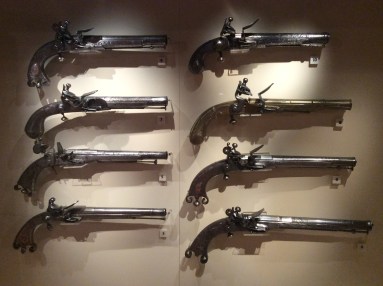
Guns at the National Museum of Scotland, Edinburgh, Photo by Amy Cools May 2014I’m sitting here tonight with a heart that’s sinking lower and lower. Two young men needlessly died this week, and it appears that one at least died with no real provocation at all. And tonight, four police officers (at least) were murdered just a little while ago, and many others wounded, at a protest held for those two young men.

On Tuesday, July 5th, Alton Sterling was wrestled to the ground by two police officers in response to a report that he was brandishing a gun in front of a convenience store where he often hung out selling CDs and videos. As the two officers pinned him down, still struggling a bit, one shouted something about a gun, then shot Alton many times in the chest. Alton died. The next day, his teenage son sobbed his heart out on TV.

On Wednesday, July 6th, Philando Castile had just gotten a birthday haircut and gone grocery shopping with his girlfriend and her daughter, when he was pulled over for a broken taillight. According to his girlfriend Diamond Reynolds, the officer ordered Philando to produce his license. Between Philando and Diamond, they told the officer that Philando carried a gun but had a permit to do so. As Philando reached for his back pocket, the officer shot him several times and he died. Diamond’s four year old daughter watched it all from the back seat.

Then just a little while ago, on this Thursday evening of July 7th, 2016, two snipers fired at police officers providing security at a protest in downtown Dallas, Texas. Four officers died, eleven officers were injured, and one civilian woman was wounded while shielding her children from the gunfire. And at the time I finish this piece, the standoff with at least one sniper continues.

What a hard evening this is, after such a hard week. What suffering and ugliness. So many shot and killed, these after so many others just this year in this country. I hate guns, personally. I never like holding one. I did try some informal target shooting with family a few years ago, and found I was a decent shot. But the experience did nothing for me emotionally after the initial fun of winning a little contest, and I was glad to have that gun leave my hands. Holding power over life and death like that makes me unhappy.

And I never identified with gun culture, though I’m familiar with it, mostly through some extended family. If the gun culture people are right, all of these people should be alive right now: everyone would be deterred from using their guns knowing that the others are also packing. Or, good guys with guns would have stopped bad guys with guns. Yet here are all these dead people, none of them ‘bad’ as far as we know. They were all some mixture of good and bad like the rest of us, surely, whatever we take those terms to mean. The shooters were not stopped by anyone, good or bad, and the first two young were shot because they had guns, and probably also because they were black. Double whammy, as the Black Panthers realized: for all the hue and cry over First Amendment rights, the moment that black people exercise them, the image of the armed patriot breaks down. Perhaps Alton showed some poor judgment here and there in the events that led up to his death. But as far as we can tell right now, he was not particularly more ‘bad’ than most people I know, at least, than most people, myself included, are and have been at times. Perhaps he did brandish a gun to make a man pestering him for money go away. Whatever. Open carry people do the same, flaunting their guns to deter others from messing with them. Most don’t get shot and killed for that. And every one of us, I think would instinctively struggle if someone tackled us to the ground, especially if we didn’t know why. Philando, apparently, did everything right, except obey the officer’s conflicting instructions in the right order. A split-second decision that any of us could make. And all of those officers killed and wounded in Dallas: we have no evidence that any of them did anything wrong, and we do know they perform an often thankless job doing the hard work dealing with our social dysfunction that most of us aren’t willing to do.

Here’s the common thread in all these killings: every person who fired shots thought that would solve a problem. All they did was create heartbreak and set us even more against one another. Anger, fear, vengeance, and self-righteousness will run amok. Perhaps we’ll listen to each other this time around, unlike the hundreds of times we’ve done nothing after mass shootings and police killings (by and of, though mostly by).

I don’t know what else to say. What a heartbreaking waste and morass of suffering. Like all of you, I’ll wrestle with all of this for a long time to come, especially as more details come out about these shootings. At this moment, I hear the helicopters whirl over the protesters in downtown Oakland from my apartment in neighboring Chinatown, as this city of protest and activism takes to the streets and blocks the freeway. I worry more violence may erupt. And I feel pretty sure of one thing: I can’t imagine ever wanting to carry a gun.

Ordinary Philosophy and its Traveling Philosophy / History of Ideas series is a labor of love and ad-free, entirely supported by patrons and readers like you. Please offer your support today!

~~~~~~~~~~~~~~~~~~~~~~~~~~~~~~~~~~~~~~~

Sources and inspiration:

4 Police Officers Dead After Shooting in Downtown Dallas: 3 Dallas officers, 1 DART officer confirmed killed in sniper fire following protest, police officials say. By NBC 5 Staff, Thu July 7, 2016. NBC 5 Dallas-Fort Worth.

Alton Sterling shooting: Homeless man made 911 call, source says. By Joshua Berlinger, Nick Valencia and Steve Almasy, 9:21 PM ET, Thu July 7, 2016, CNN.com

McLaughlin, Eliott C. Woman streams aftermath of fatal officer-involved shooting, 11:20 PM ET, Thu July 7, 2016, CNN.com

Minn. governor says race played role in fatal police shooting during traffic stop. 11:30 PM July 7, 2016, by Michael E. Miller, Wesley Lowery and Lindsey Bever. Washingtonpost.com

Frederick Douglass Chambersburg and Gettysburg PA Sites

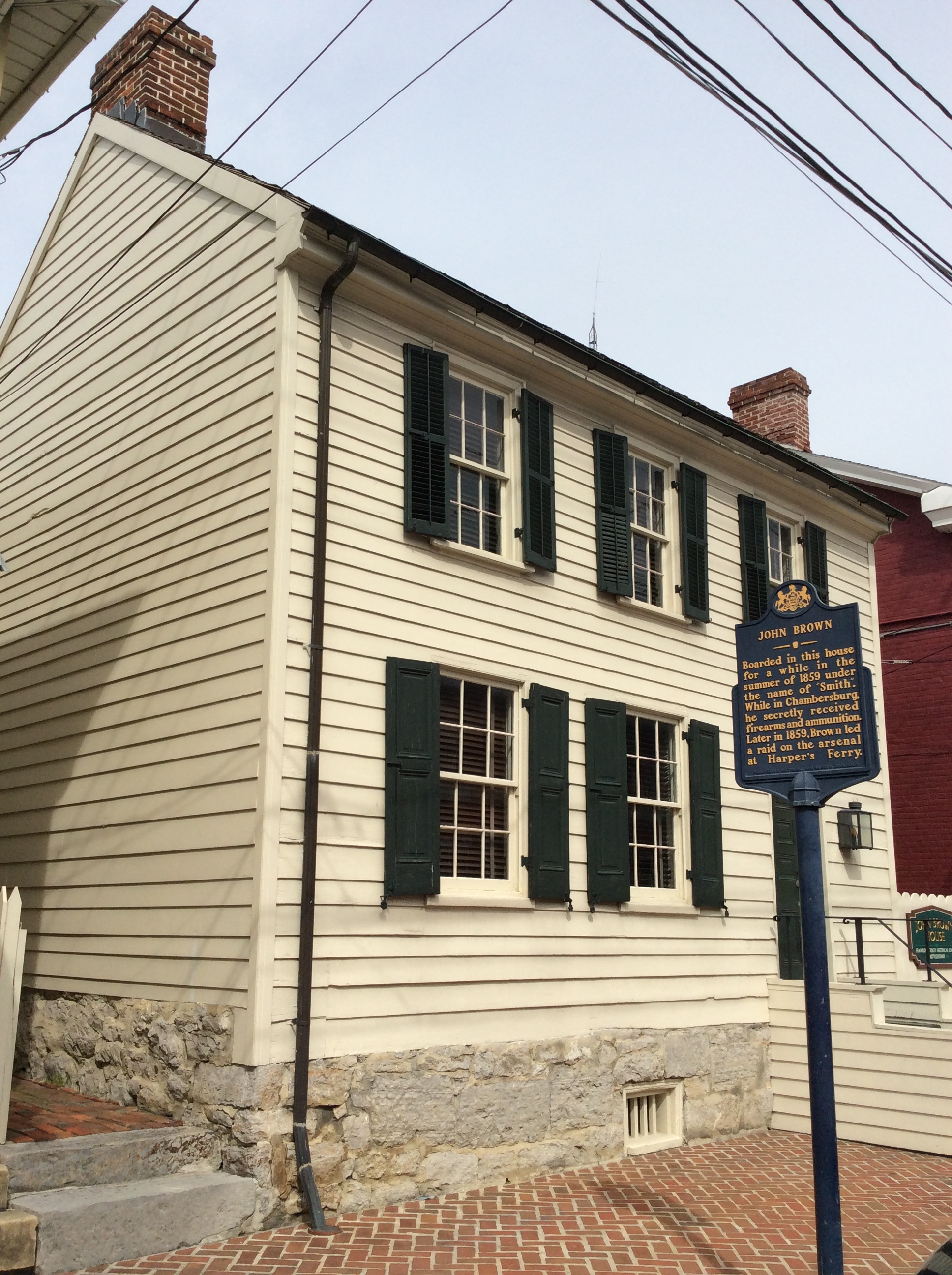
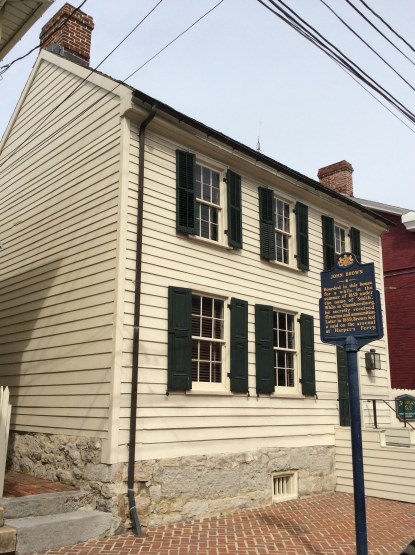
A view of the John Brown House in Chambersburg, PA

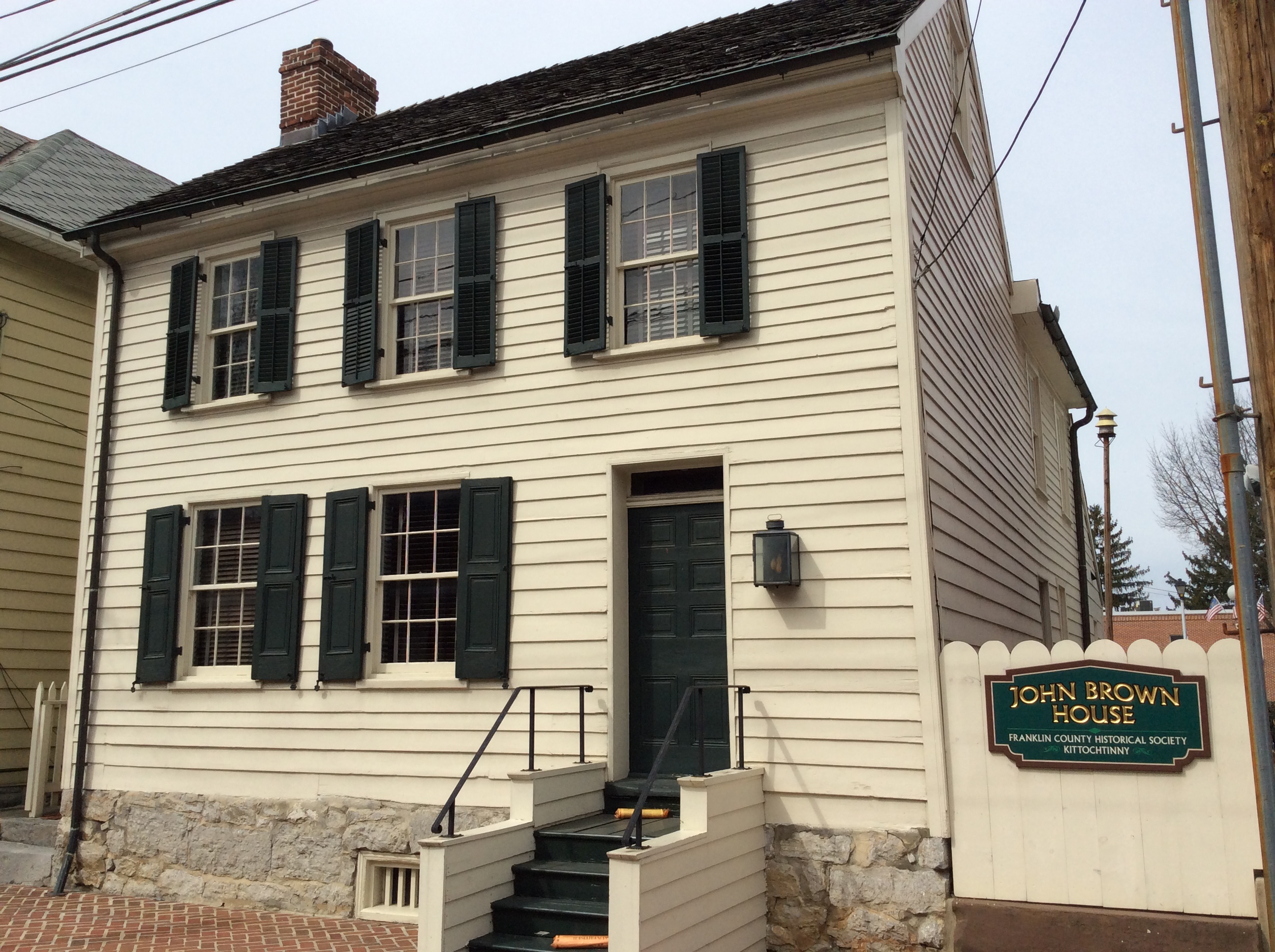
A view of the John Brown House at 225 E. King St, Chambersburg, PA

Twelfth Day, Thursday March 31st

It’s breezy, overcast, and warm the day I drive south from Rochester to Washington D.C., with a first stop in Chambersburg, Pennsylvania to visit two sites of special interest for my Frederick Douglass journey.

The first is a two story clapboard house at 225 E. King St, where John Brown rented a room in Mary Ritner’s boarding house in the summer of 1859, and where he planned his doomed raid on the federal arsenal at Harper’s Ferry. Unfortunately, I’m visiting during the off-season: the house is closed until the tourist season starts in May, but I find a blog with two nice photos of the interior posted. It happens to be a blog dedicated to Fredrick Law Olmsted, the great landscape architect who designed Highland Park, site of Frederick Douglass’ statue and memorial in Rochester.

Douglass had met Brown in September of 1847 while he was on a speaking tour, on the recommendation of other abolitionists. Brown had already developed a reputation as an especially fierce and dedicated one. In 1837, he had declared publicly “Here, before God, in the presence of these witnesses, from this time, I consecrate my life to the destruction of slavery.” By the time Brown met Douglass in 1847, he had already been engaged in activism for several years; for example, as you may remember from the account of my day in Lynn, MA, Brown used to speak at that town’s Sagamore Hall, which burned down in 1843, though there’s no evidence of their ever having met in Lynn. Brown invited Douglass to have dinner with him and his family in his plain, working-class Springfield Massachusetts home. He had started out as a tanner by trade, and after some financial failures, had become a successful merchant at that point. Douglass was at first surprised by the disparity between Brown’s ‘Spartan’ home, in such contrast to his prosperous-looking business office downtown, and then impressed by the fiery, righteous, single-minded, Biblically-minded (in the Old Testament sense) radical.

Douglass was still a pacifist Garrisonian at that time, but was as convinced as Brown that the political system was incapable of ending such an embedded, prejudice-ridden, and profitable (in certain contexts, such as the heavily agricultural South) system as slavery. Douglass and Brown likely had a lively discussion that evening in Springfield and on many occasions to follow, how slavery might be ended outside of the political system, and debated the relative merits of war and peace in reform. Brown visited Douglass at his South Avenue Rochester home on more than occasion and stayed with Douglass there awhile in early 1858 writing up a constitution for his planned mountain community of self-freed ex-slaves.
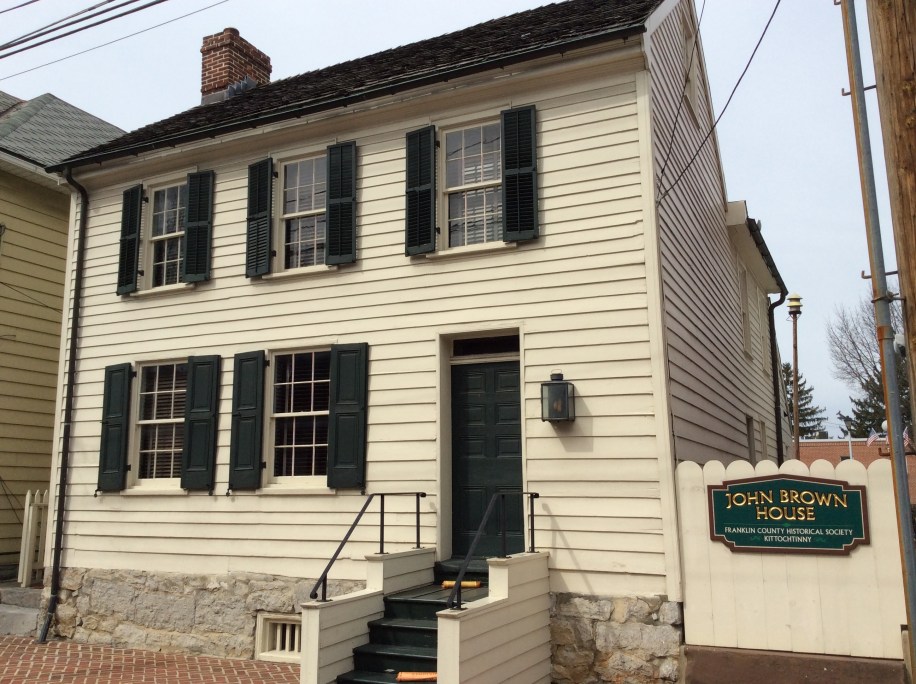
John Brown House (2) in Chambersburg, PA

Another view of the house where John Brown boarded in Chambersburg, PA

Douglass quoted Brown in his Life and Times as saying ‘God has given the strength of these [Alleghany] hills to freedom; they were placed here for the emancipation of the negro race; they are full of natural forts… The true object to be sought is first of all to destroy the money value of slave property… by rendering such property as insecure.’ So in 1847, he had already been planning to help slaves escape and remain free. In his remarks to Douglass, Brown displayed the fanaticism of the zealot in proclaiming that God not only ordained his plan, but placed just the right landscape right there where he could carry it out. But he also revealed his pragmatism and his business sense, which allowed him to astutely identify one of the bulwarks of slavery, the financial interests of a predominantly agricultural economy, then come up with a practical solution for undermining that bulwark. Slaves not only provided the necessary labor for these large farms, especially for labor-intensive crops like cotton, but were the dominant form of investment for Southern capitalists and living collateral for debt endemic to an agricultural economy. But if the financial incentive for slavery was removed by removing investment security, Brown thought, the institution would wither away.
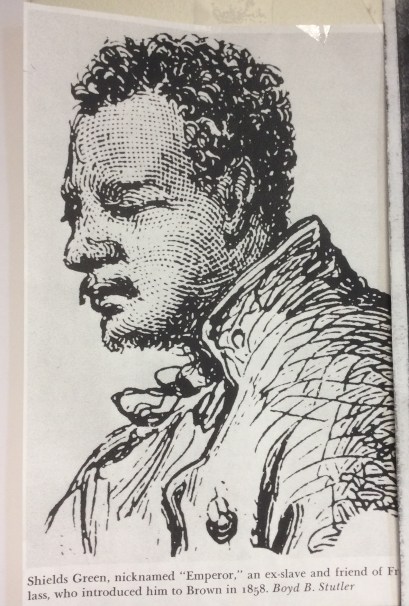
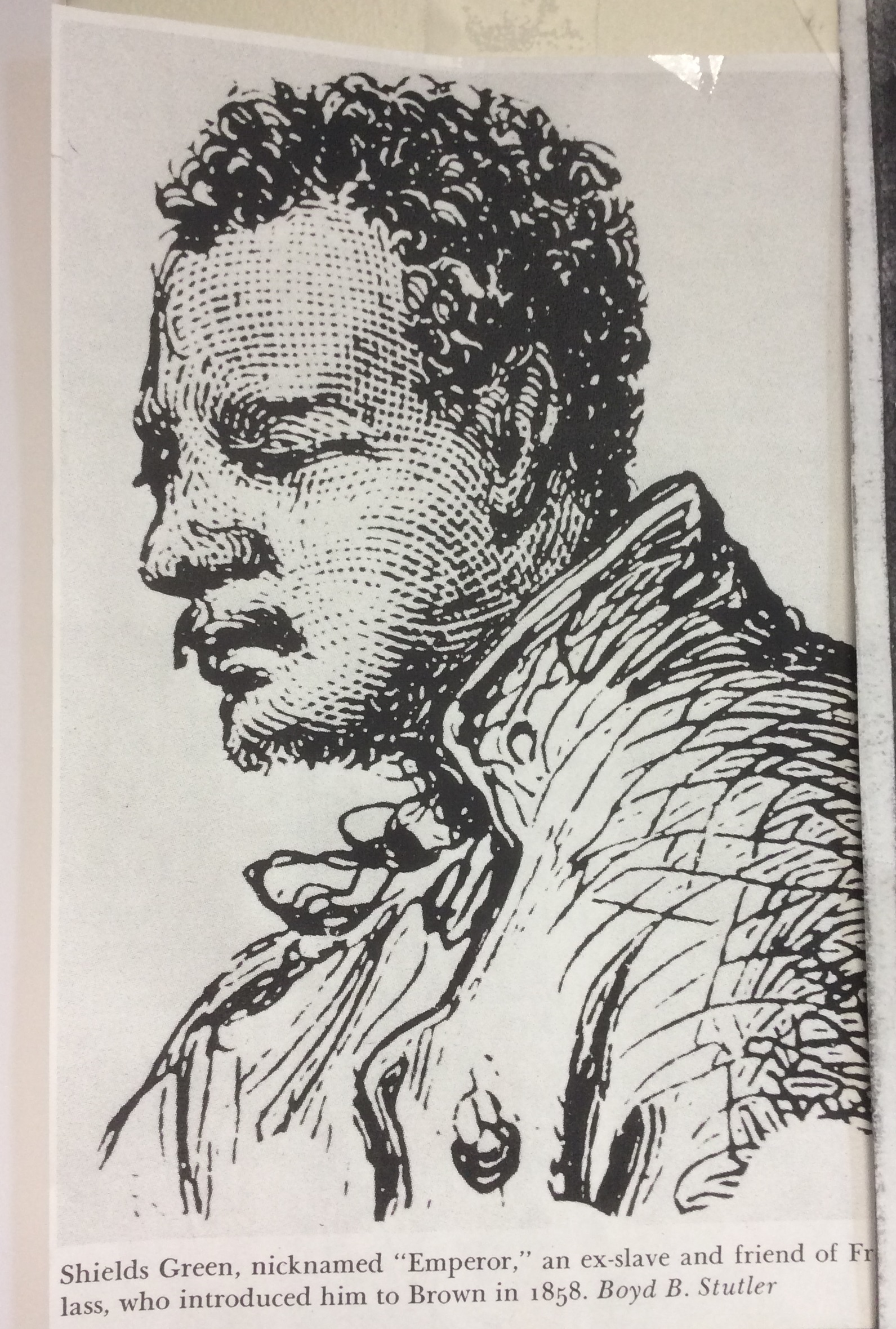
Poster of Shields Green in David Anderson's Nazareth College office

Poster of Shields Green in David Anderson’s Nazareth College office

But as you may have thought many times up to this point, it’s time I stop referring to the Harper’s Ferry plan and raid before explaining what it was and how it all went down.

Douglass and Brown’s mutual friend Shields Green accompanied Douglass from Rochester to Chambersburg in August of 1859, in response to John Brown Jr’s appeal for personal and financial support for Brown Sr’s soon-to-be-enacted operation. It had been postponed the year before due to an opportunist who volunteered his services to the venture then blackmailed potential supporters with threats of reporting the conspiracy, which in the end, he did. Douglass, now a longtime supporter and friend of Brown’s and sympathetic to his overall project of helping slaves escape, wanted to find out how the plan was progressing, how it may have changed, and how much support it had gathered. Along the way, Douglass gave some lectures as a cover for the purpose of his trip to Chambersburg and collected funds for the venture.

Quarry site historical marker where Douglass and Brown met, Chambersburg, 2016 Amy Cools

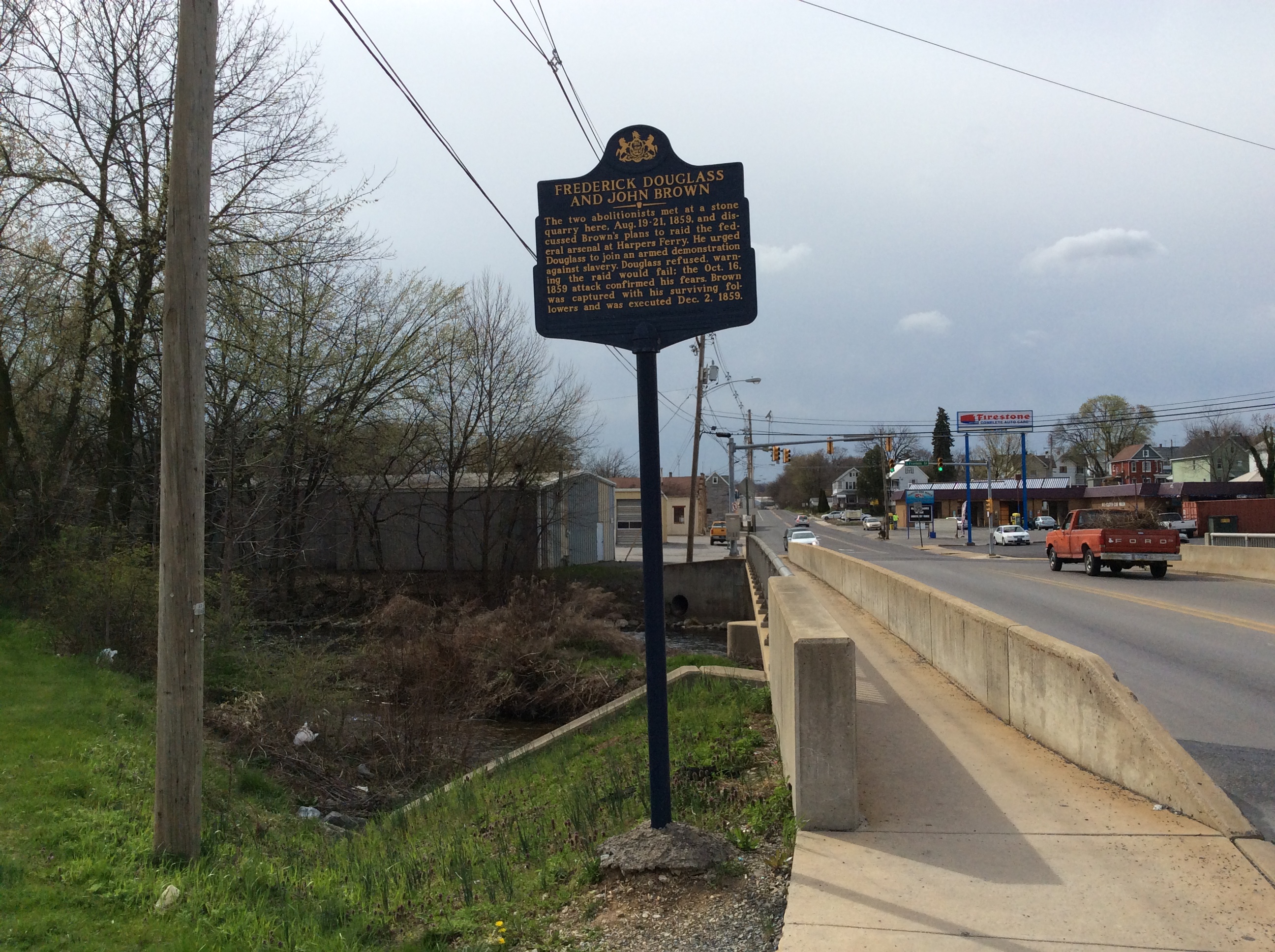
Quarry site historical marker where Douglass and Brown met in Chambersburg, PA, in August of 1859

The old Quarry site is generally listed as the place where Southgate Mall now stands at W. Washington St, but that’s not quite where you find the historical marker, though it is nearby. To find the marker, go to the east end of the bridge where Lincoln Highway (30) crosses over Conococheague Creek, between Cedar Ave and S. Franklin St. Loudon St is the next street to the north of W. Washington, and a broad open parking lot runs along the creek between the two, behind what’s currently a Rent-A-Center.

Portrait of John Brown by Born Torrington in National Portrait Gallery

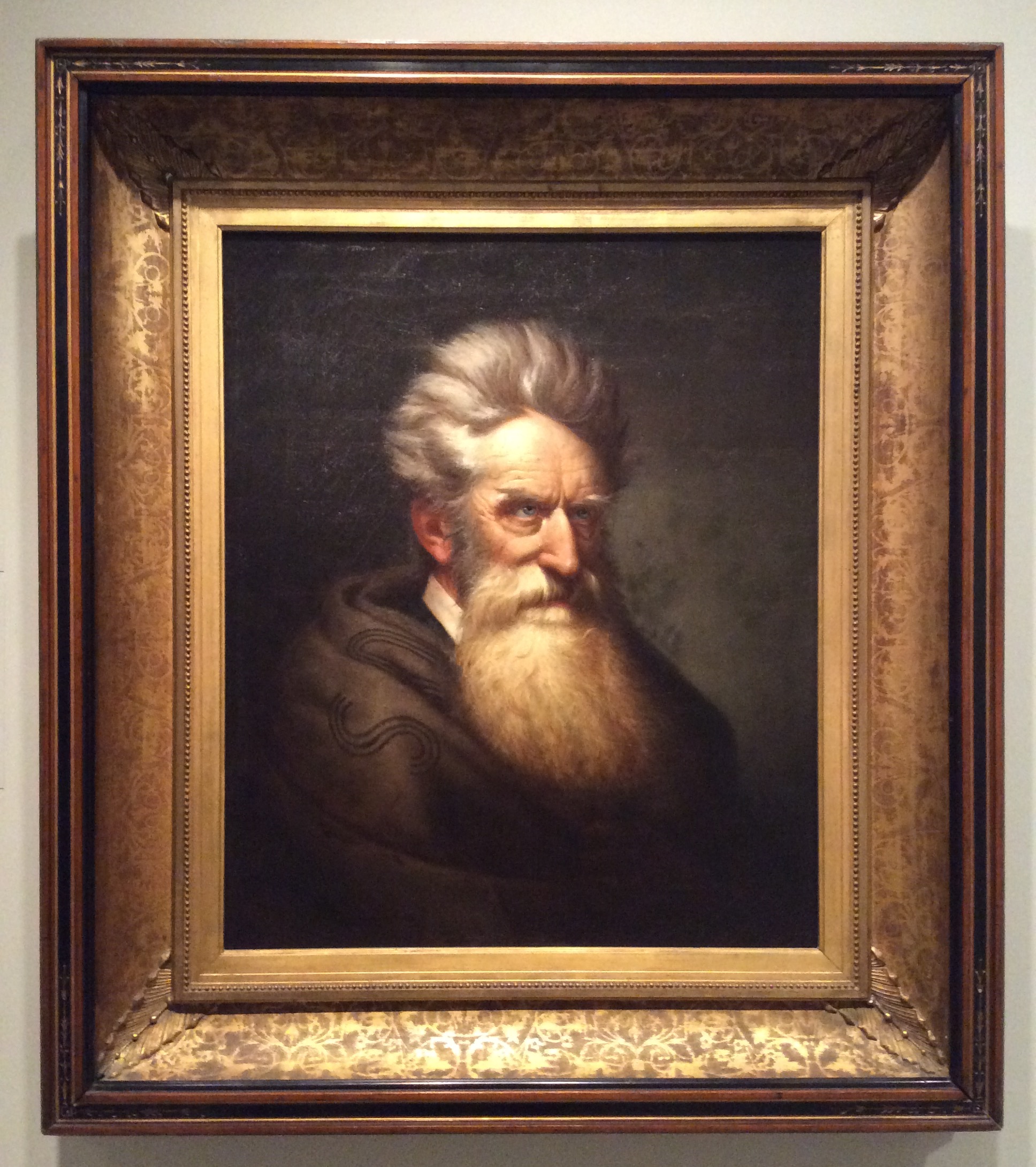
Portrait of John Brown by Ole Peter Hansen Balling, 1872, at the National Portrait Gallery in Washington, DC

Douglass met with Brown here, who was outfitted as a fisherman, a perfect disguise for a creekside meeting. They, along with Green, and Brown’s secretary John Kagi, sat on the rocks and discussed and argued about Brown’s plan for the raid, apparently all night, and continued to meet and discuss the raid over the next couple of days. Brown intended to seize and occupy the federal arsenal at Harper’s Ferry, Virginia, with the small force of 22 men he had convinced to fight with him, and hold it as a symbol of righteous revolt against an evil government which had betrayed and oppressed so many of its people. This, in turn, was intended to inspire courage and anger in the slave population, and spark a mass exodus from bondage. It’s easy to picture Brown, of the deepset eyes, lined face, and flowing beard, playing the part of the angry Moses. From what he heard of the plans now, which had come to sound very much like an outright rebellion, Douglass thought the raid would certainly fail by provoking an aggressive military response. He also feared that its failure would set back the abolitionist cause in the long term by provoking a political response to increase legal protections of slavery as well.

By this time, Douglass’ view on violence had shifted: he had come to accept that violence is sometimes necessary and justified if great enough injustices or harms are being done and if other means have been tried and failed. So it wasn’t the proposed violence alone that made him oppose the plan, it’s just that he thought this particular plan would fail. Though he refused to join the raid, he later spoke of John Brown as a martyr, and always had a high opinion of his moral integrity and courage. As David Anderson of Nazareth College discussed with me in our interview, Shields Green stayed behind to join Brown in the raid. Douglass described Green in his Life and Times as ‘a man of few words, and his speech was singularly broken; but his courage and self-respect made him quite a dignified character.’ ‘Dignified’: high praise from Douglass, who valued that quality so much and took great care to nurture and project it in his own person. Shields Green survived the raid, but was captured and executed ten days later. 

Both Brown and Douglass, as you can see if you read Brown’s own speech at his trial, and as you can gather from Douglass’ Life and Times discussion of Brown, insisted that the Harper’s Ferry plans all along were only to encourage individual slaves to escape, then provide the means to defend themselves and other escapees along the route east and north. They claimed that a general slave insurrection was never part of the plan. But as was the government’s position, it all looked very much intended to spark a rebellion. I would add, it would have been a justified one if one ever could be, far more justified than the United States’ original rebellion against the British. Systematized forced labor, wage theft, rape, child-stealing, complete disenfranchisement, imposition of hunger and thirst, beatings, and enforced ignorance is a more dire set of provocations than unpopular taxes imposed without sufficient representation, in my view.
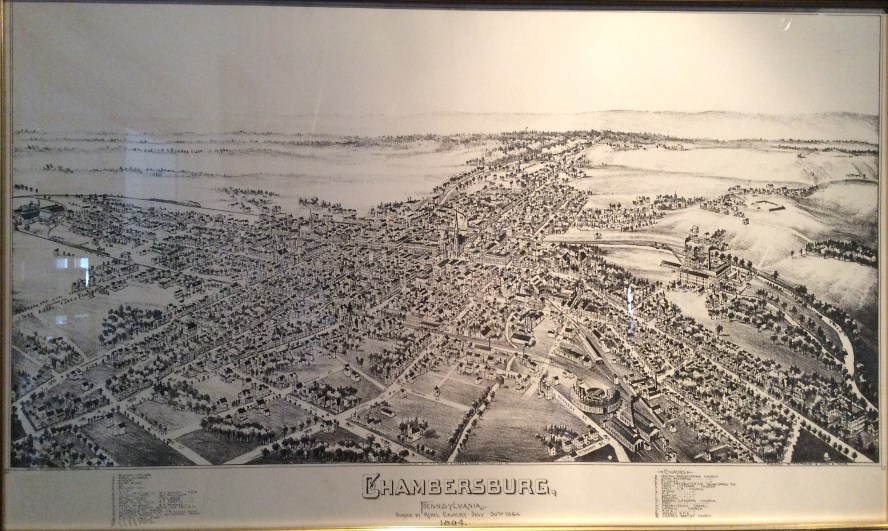
Chambersburg Map of 1894, Old Jail, Franklin County Museum, 2016 A Cools

Chambersburg Map of 1894, from the Franklin County Museum in the Old Jail, 175 E. King St.

I make a brief stop in the Franklin County Museum in the Old Jail building right down the street from the John Brown house at 175 East King Street, where I find a nice map of old Chambersburg. The town was burned by a rogue contingent of the Confederate army on July 30, 1864 (some soldiers were horrified at the senselessness of this attack against civilians and did their best to help save lives and possessions), but the Old Jail and the John Brown House both survived.

I grab a cup of coffee and jot down some notes, then continue on my way east to Washington D.C. via (you may have guessed it) Gettysburg, about 35 minutes away. Though this place is central to the legacy of Douglass’ friend and hero Abraham Lincoln, the link to Douglass’ life and ideas is a little more indirect. But I find this fascinating essay by David Blight, noted Douglass scholar. It’s a perfect accompaniment for this account, since it so well explains how Lincoln’s and Douglass’ ideas converged ever more closely as the Civil War continued, and really ties the places and themes I explore in this day’s journey together very well. Here’s a selection from that essay:

‘…Lincoln asked Douglass to lead a scheme reminiscent of John Brown and Harpers Ferry. Concerned that if he were not reelected, the Democrats would pursue a negotiated, proslavery peace, Lincoln, according to Douglass, wanted “to get more of the slaves within our lines.” Douglass went North and organized some twenty-five agents who were willing to work at the front. In a letter to Lincoln on August 29, 1864, Douglass outlined his plan for a “band of scouts” channeling slaves northward. Douglass was not convinced that this plan was fully “practicable,” but he was ready to serve. Because military fortunes shifted dramatically with the fall of Atlanta, this government-sponsored underground railroad never materialized. But how remarkable this episode must have been to both Douglass and Lincoln as they realized they were working together now to accomplish the very “revolution” that had separated them ideologically in 1861. Garry Wills has argued that Lincoln performed a “verbal coup” that “revolutionized the revolution” at Gettysburg. By 1864, that performance reflected a shared vision of the meaning of the war. Ideologically, Douglass had become Lincoln’s alter ego, his stalking horse and minister of propaganda, the intellectual godfather of the Gettysburg Address and the Second Inaugural.’ – from ‘“Your Late Lamented Husband”: A Letter from Frederick Douglass to Mary Todd Lincoln

I arrive at Gettysburg, and it’s cloudy, a bit gusty, and dropping scattered rain, but not cold. The air feels soft, and the light’s getting a bit low.
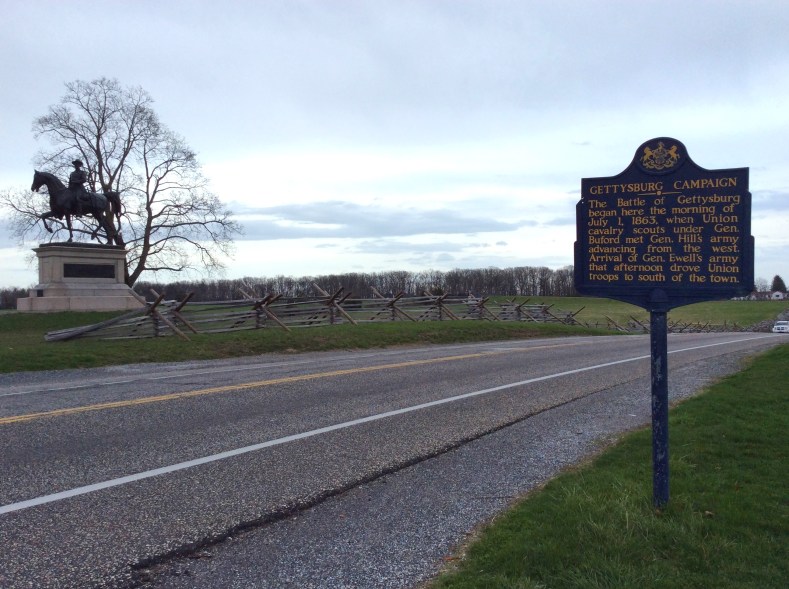
Gettysburg National Military Park, Gettysburg, PA
Gettysburg National Military Park, Gettysburg, PA

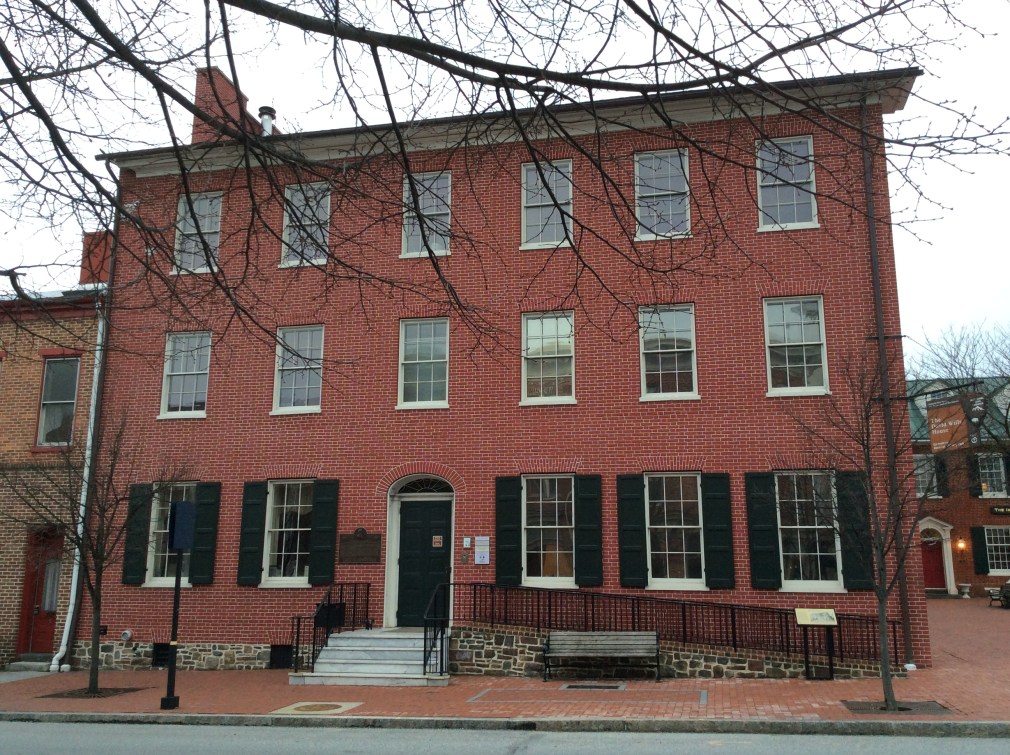
David Wills House where Lincoln stayed, Gettysburg PA, 2016 Amy Cools

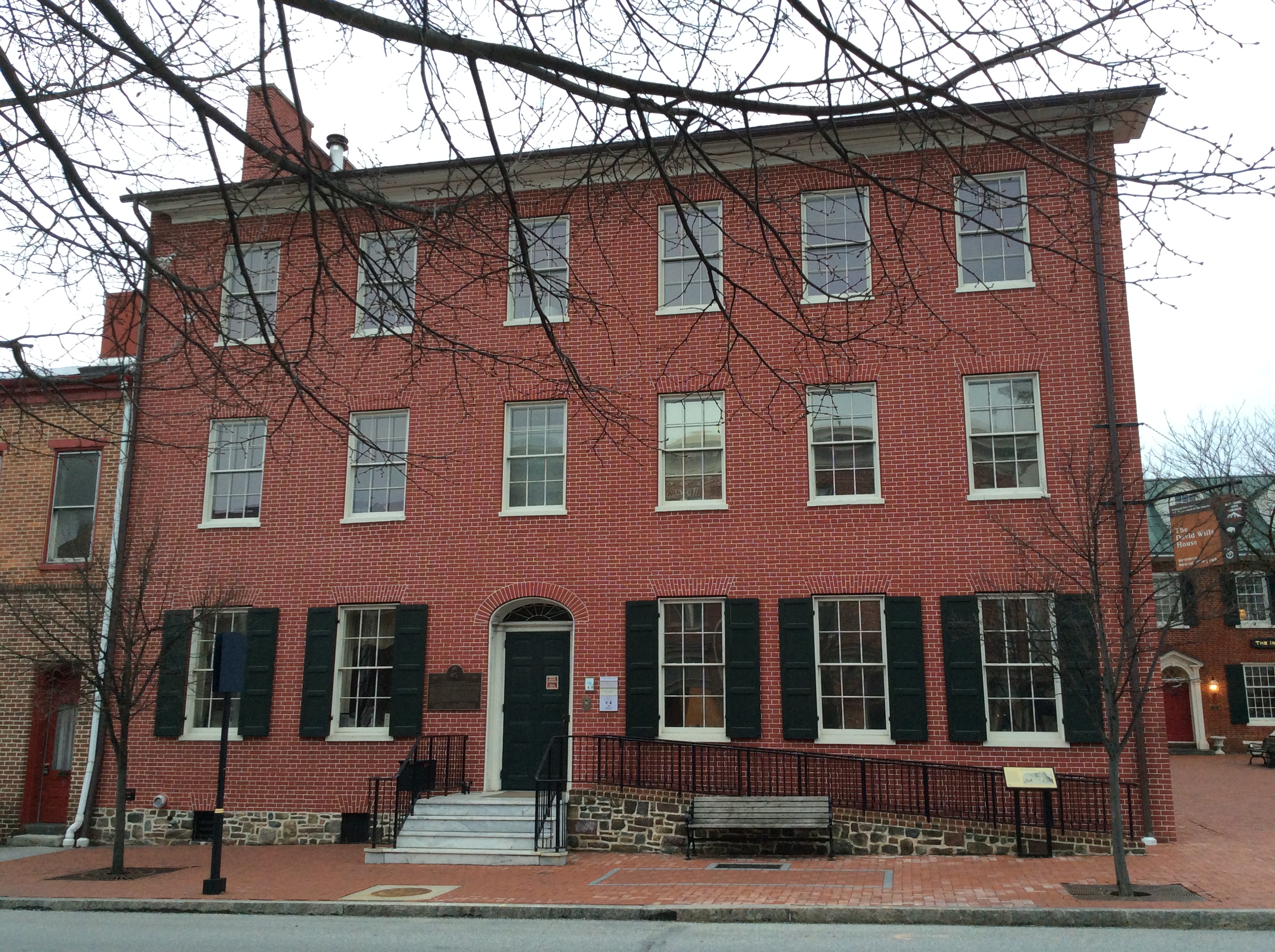
David Wills House where Lincoln stayed in Gettysburg, PA, the night before he delivered his address

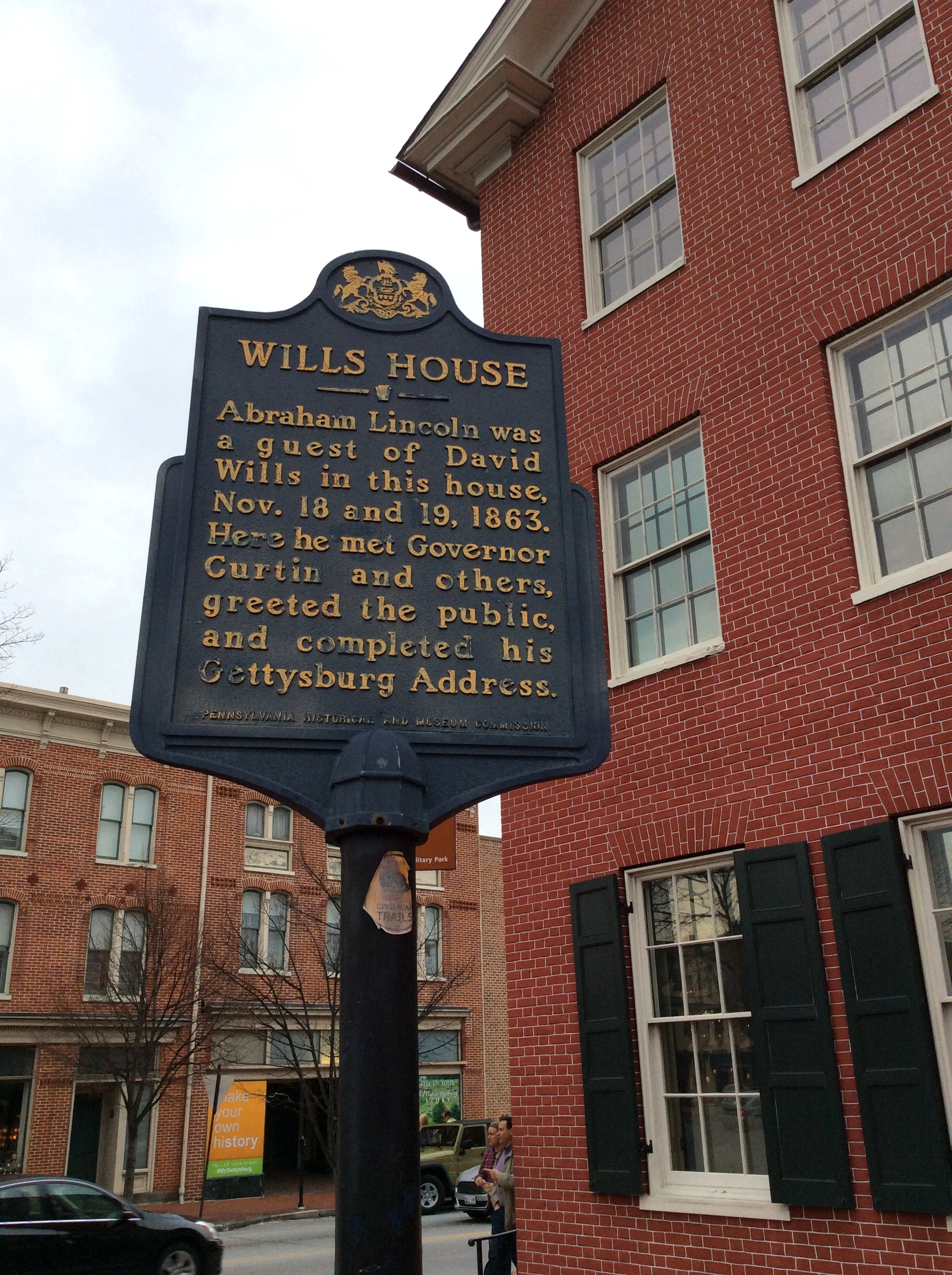
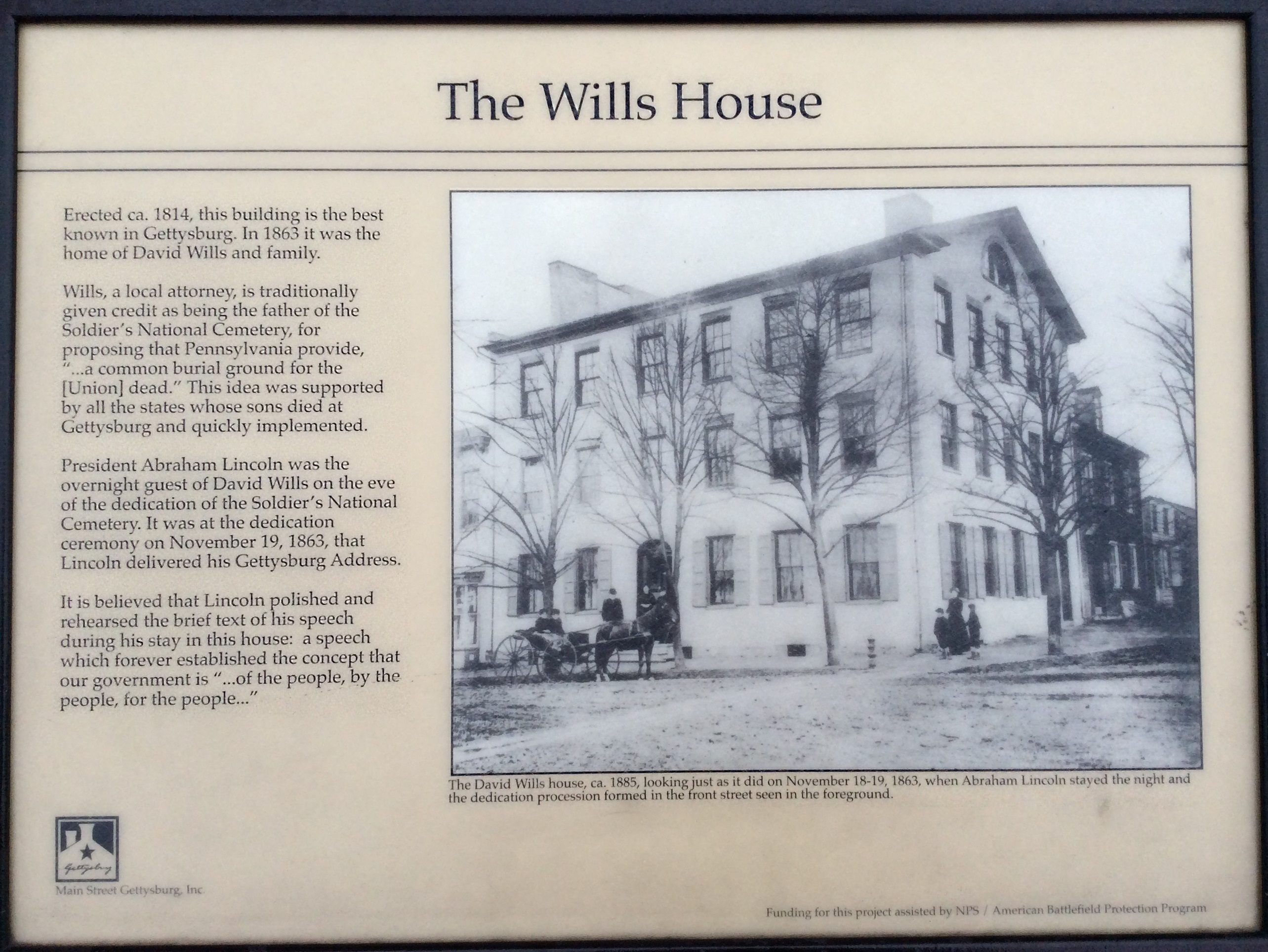
David Wills House historical marker, Gettysburg PA, 2016 Amy CoolsThe drive through the park is lovely, the grass is green, the park and its structures are beautifully maintained. I stop for a map, then head straight to the David Wills House. I arrive too late to go inside, however, though I do find another excellent blog, packed with photos of every part of the interior; scroll to the bottom of the page to find links to all of the posts in the series. Thanks, good people of the Gettysburg Daily!

Lincoln stayed the night before delivering the Gettysburg address, and likely gave it a final edit here. The house was packed with dignitaries and visitors here for the great event, the dedication of a national cemetery at the site of the bloodiest battle of the Civil War. Lincoln’s host David Wills was an attorney who had overseen the effort to recover the hastily buried bodies from the battlefield and re-inter them with more care at a specially dedicated Soldier’s National Cemetery to the east of the battlefield. This was no mean feat, as over 3,000 soldiers were killed in the Battle of Gettysburg, from July 1st to July 3rd, 1863.

Lincoln’s address was not the only one delivered that day; orator Edward Everett’s was two hours long and well-received. But Lincoln’s brief speech, with its readily memorizable brevity and eloquence, made it the one that not only made it into most of the newspapers first, people could quote from it and recite it to one another straight away. And Lincoln’s high-pitched voice carried very well. Short but eloquent speeches had become a hallmark of Lincoln’s style, as had religious and dramatic themes which were very familiar to the public, references that resonated with them and could convey volumes in only a few well-chosen words. Lincoln had become, at this point, a masterful rhetorician, and his address transformed, for so many distraught and angry Americans, a senseless slaughter into a noble sacrifice.
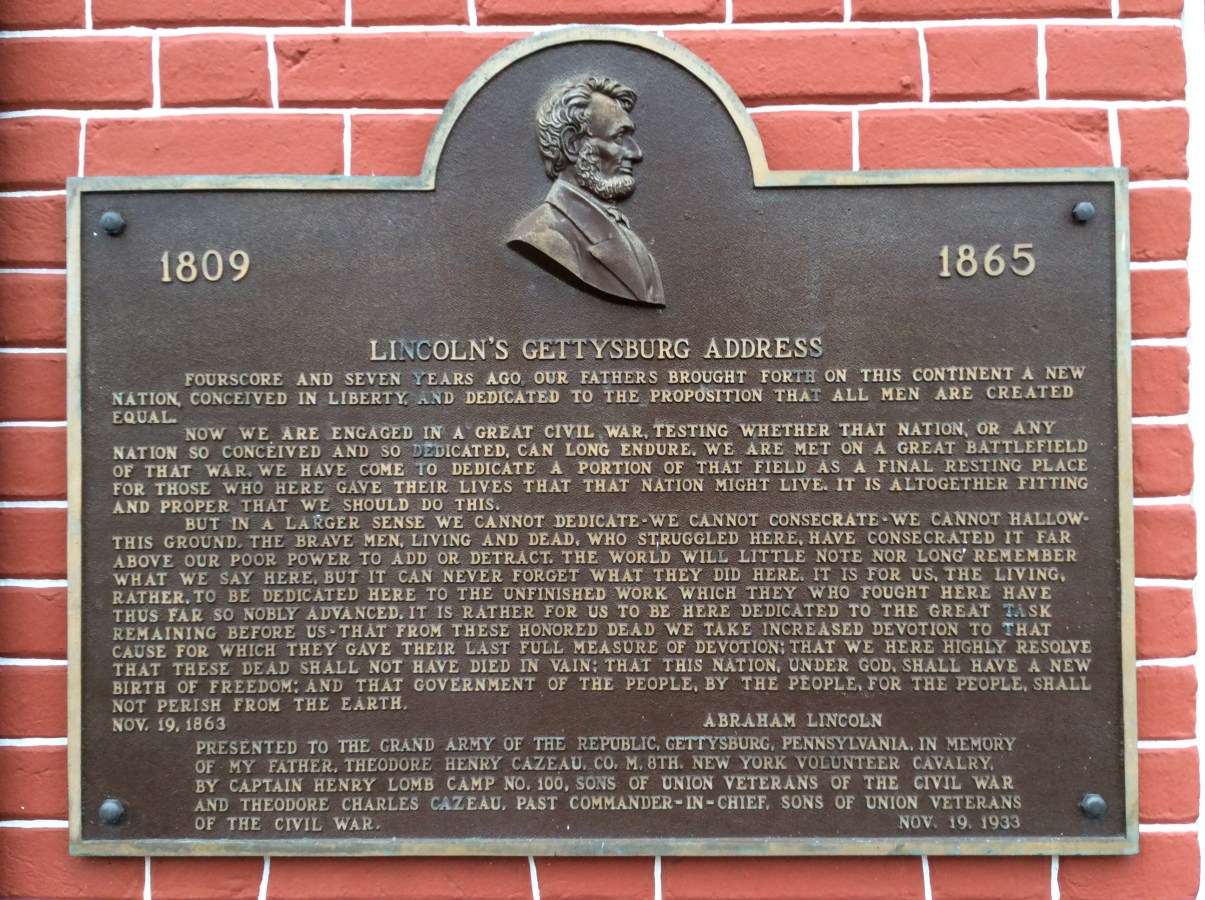
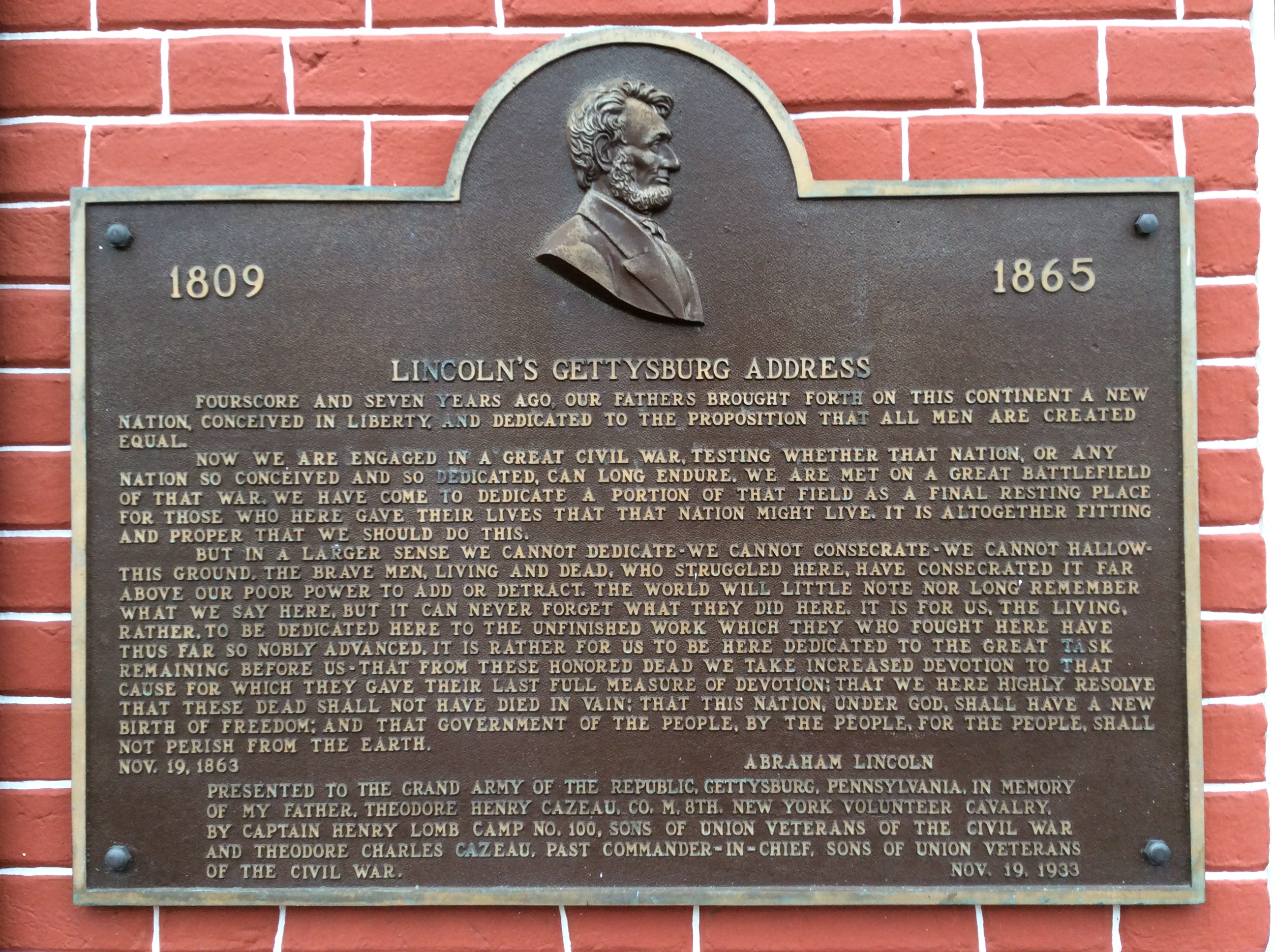
The Gettysburg Address on the Wills House wall


The Gettysburg Address on the Wills House wall

David Wills House sign, Gettyburg, PA, photo 2016 by Amy Cools

Gettysburg Train Depot, built in 1859, where Lincoln arrived on August 18th, 1863

Gettysburg Train Depot, built in 1859, where Lincoln arrived on November 18th, 1863

I head two blocks north to 35 Carlisle St, where the old Gettysburg Railroad Station still stands. Built in 1859, it also served as a field hospital and military transport during the Civil War. The Gettysburg Daily blog also includes a wealth of detailed photos of the Gettysburg depot and the original location of the tracks that Lincoln’s train rolled in on near dusk on November 18th, 1863.
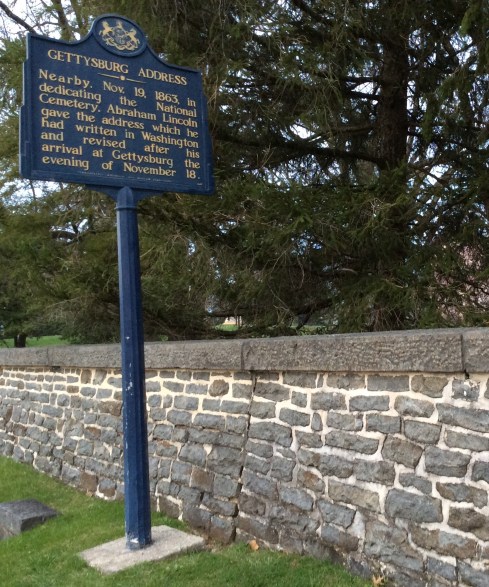
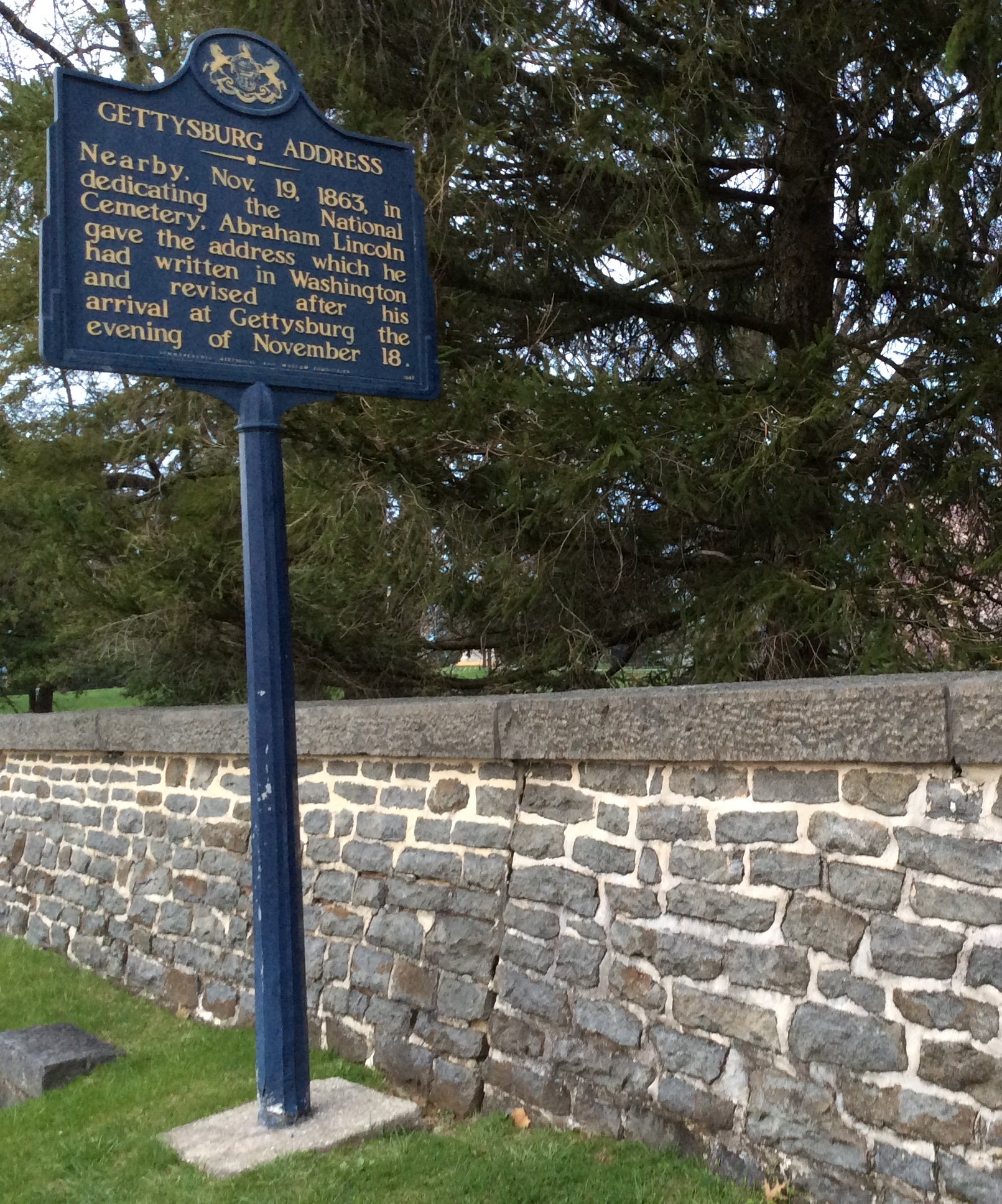
Gettysburg Address historical marker at Gettysburg National Cemetery

Gettysburg Address historical marker at Gettysburg National Cemetery

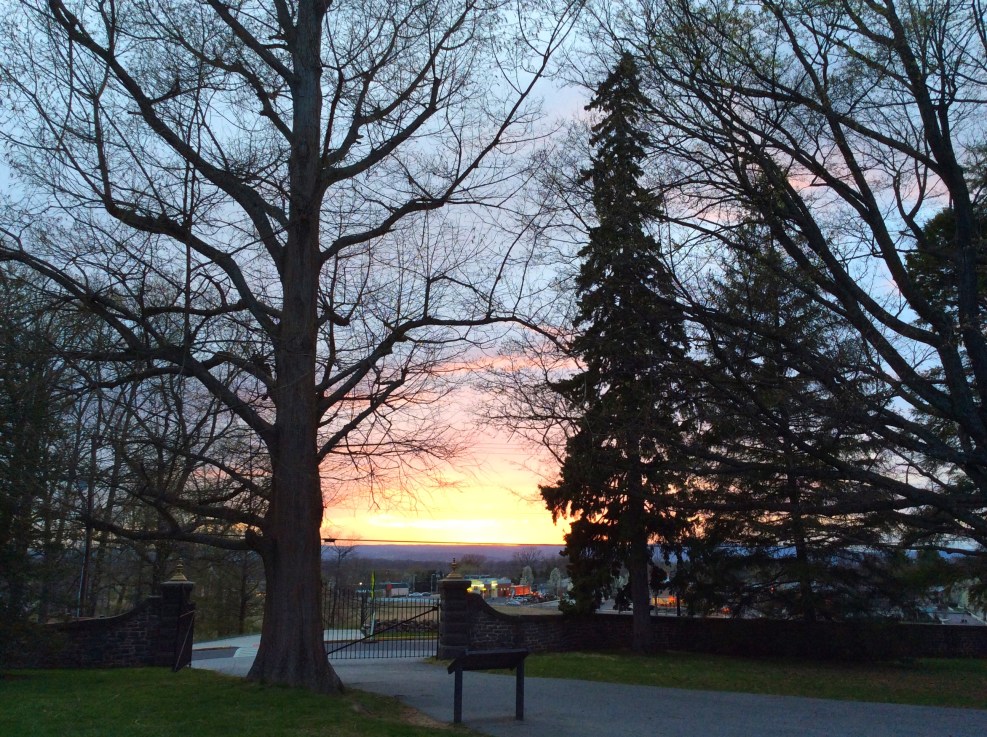
My last site to visit for the day takes me about a mile south, from Baltimore Street to Steinwehr Avenue to Taneytown Rd, aka Highway 134. There’s a handsome but simple old stone wall, originally built in 1864 and restored in 1980. There’s a gate about three quarters of the way down on my left, and a parking lot across the street on my right. I’m so glad I’m not continuing my drive yet, it’s just too nice outside to be content in a car. The clouds have cleared a little, and the setting sun makes quite a show on the clouds still there on the horizon, and the rain has gone.

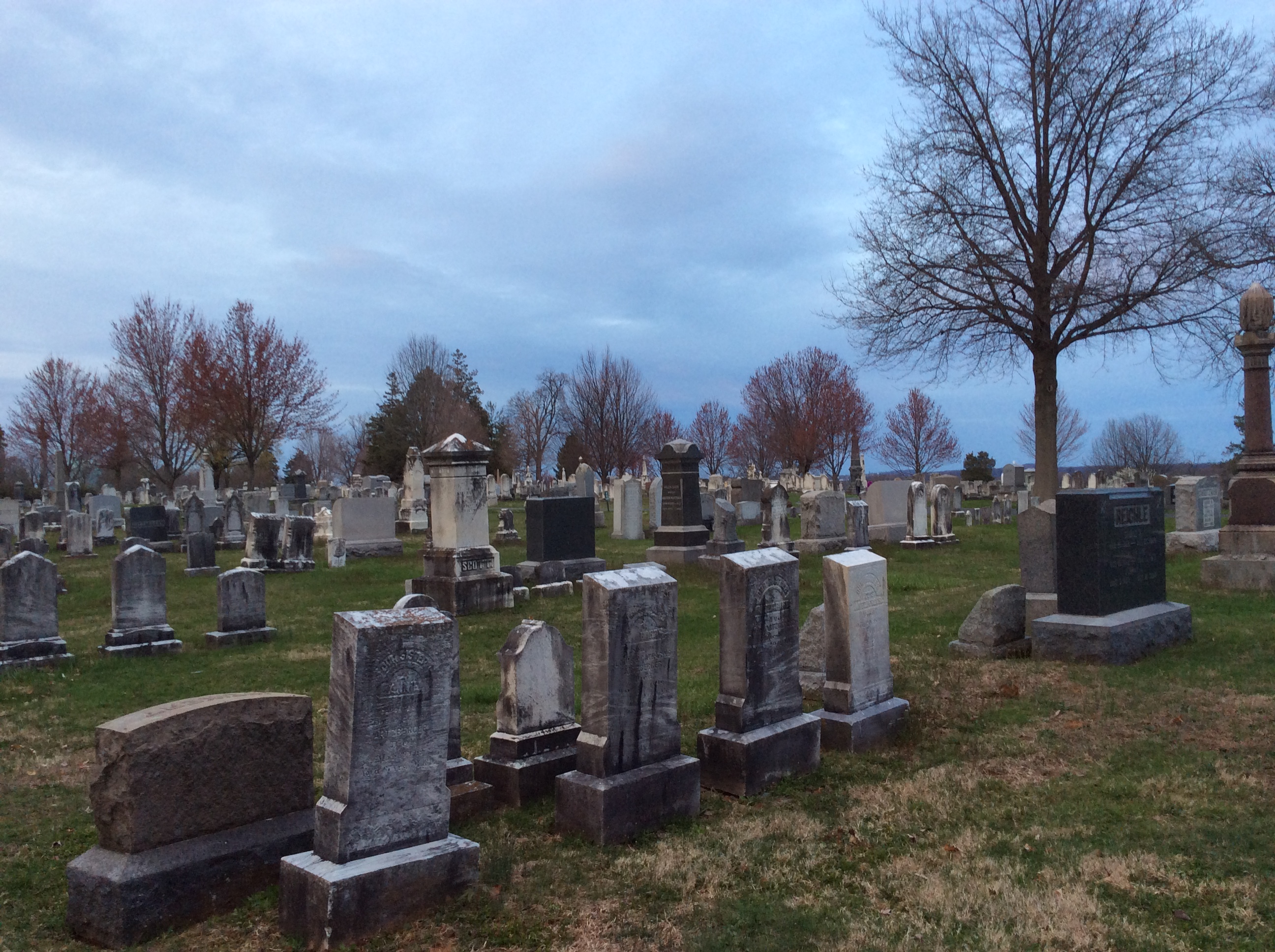
I enter the gate and find that Gettysburg National Cemetery is one of the most moving and beautiful monuments I have ever visited, more than I expected. The flowering trees are in bloom, in every shade of pink, white, and cream, among the evergreens and those which are still bare of leaves or buds. It’s peaceful in the low warm light of the evening.
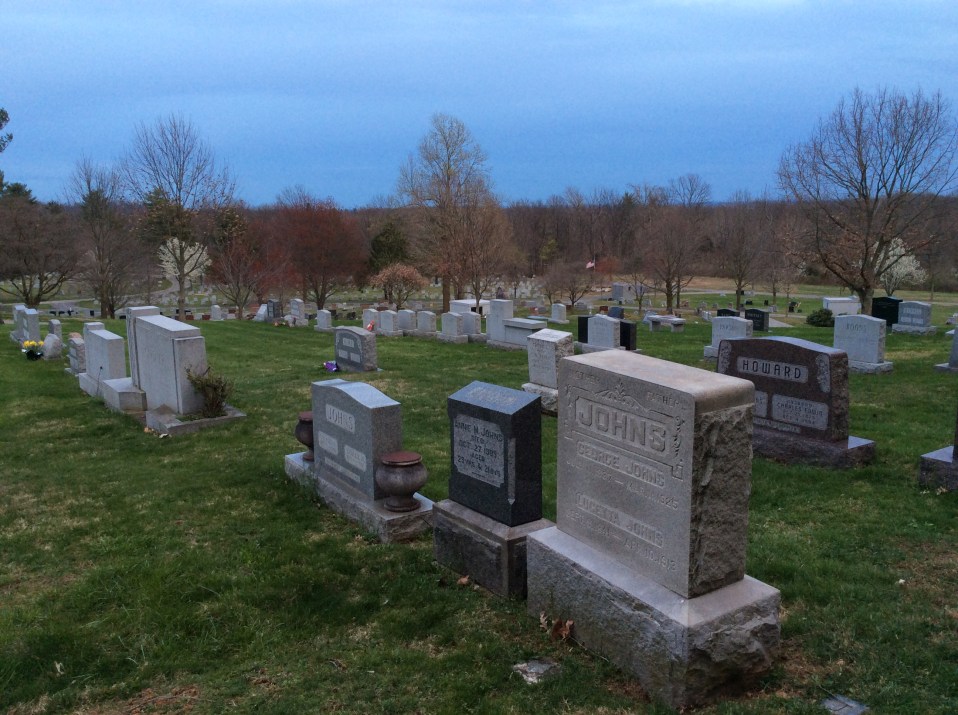
Headstones in Gettysburg National Cemetery
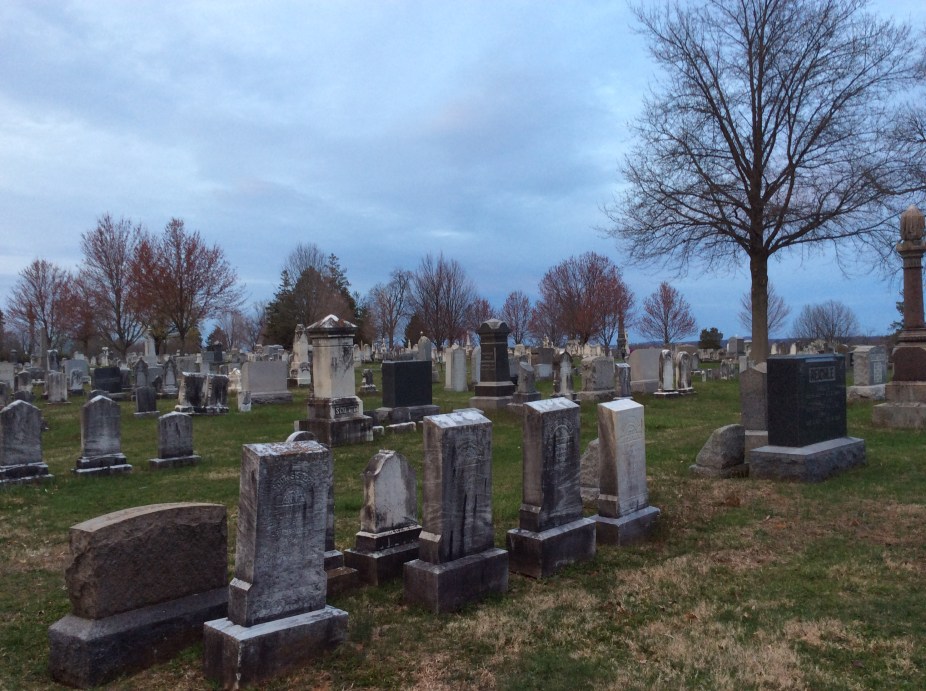
Headstones in Gettysburg National Cemetery

Headstones in Gettysburg National Cemetery (2), photo 2016 Amy Cools

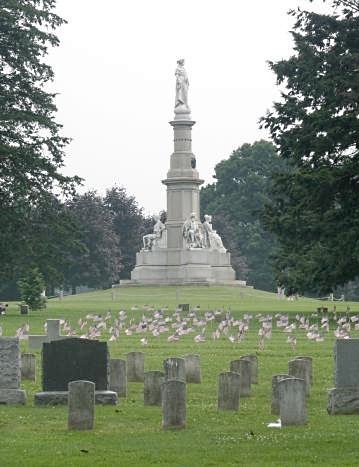
Soldiers National Monument, Gettysburg National Cemetery, photo by Henry Hartley, shared under Creative Commons Lic. 2.0

Soldiers National Monument, Gettysburg National Cemetery, photo by Henry Hartley, shared under Creative Commons License. 2.0

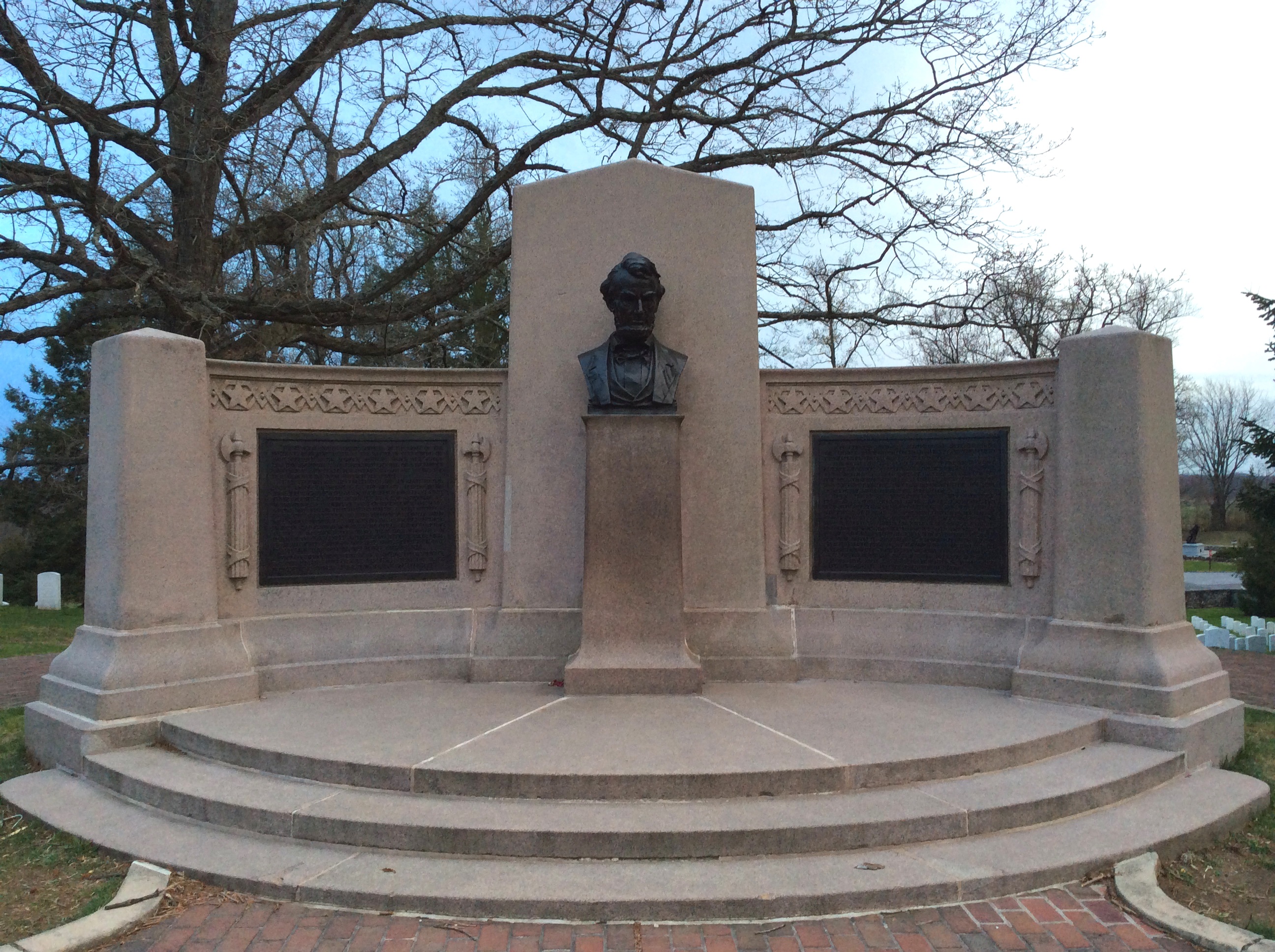
The sun in sinking fast, and the gates will be closing soon. I could continue my way down the path which winds around to my left to the tall white stone Soldiers National Monument, near the site where Lincoln delivered his address. But it’s a ways down and in the interests of time, I decide to start with a closer monument, to the right after you enter the gate. It’s a monument dedicated to the Gettysburg Address itself. The taller central stone is fronted by a strongly executed bust of Lincoln, flanked by two large plaques on the curved sides carved with stars and ceremonial hatchets. One plaque contains the Address, the other contains a selection from David Will’s letter to Lincoln, inviting him to participate in the dedication ceremony and to make some remarks. The letter was sent to Lincoln only 17 days before the ceremony, and scholars debate on the significance of the last-minute invitation. National cemeteries were a new thing, run by the states, and their dedications were usually officiated over by more local dignitaries; Wills may have thought it unlikely that the President, burdened with war cares, would be able to make it, only fully realizing Gettysburg’s true political significance as the event day drew near. In any case, Lincoln did grasp it, and contrary to popular mythology, prepared his remarks very carefully, as was his wont.
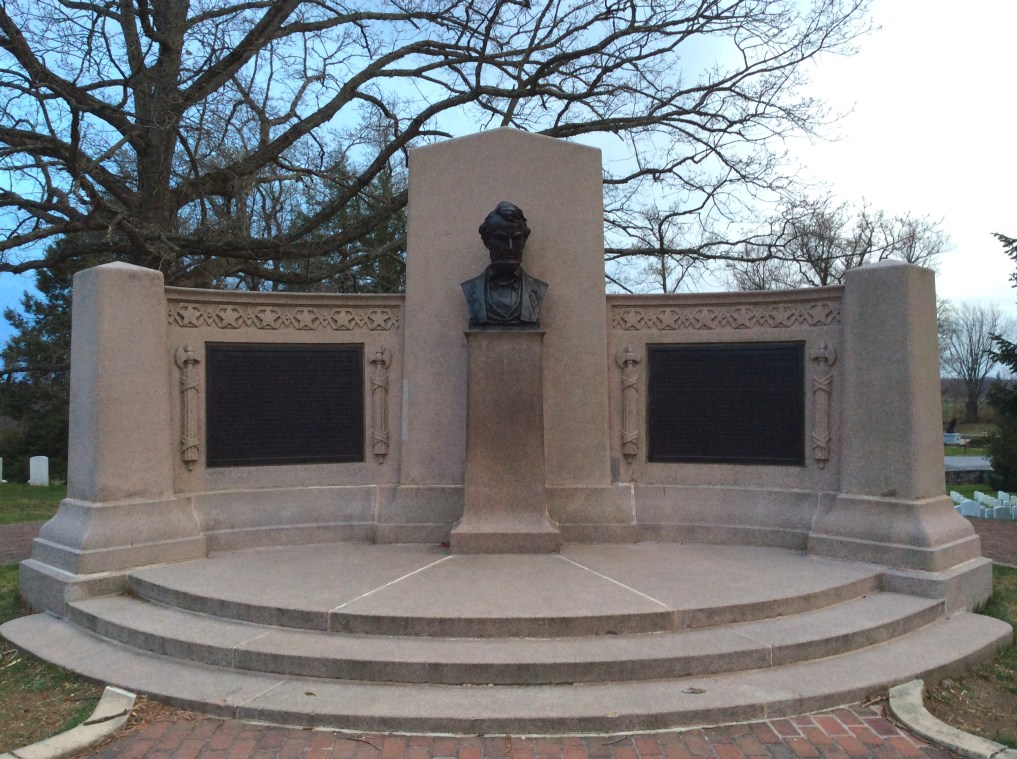
Lincoln's Gettysburg Address Memorial at Soldier's National Cemetery

Lincoln’s Gettysburg Address Memorial at Soldier’s National Cemetery

I find I’ve been lingering for awhile, and it’s closing time. I’m reluctant to go, but I suppose it’s for the best. I’m hungry and I don’t want to be searching for my lodgings late at night. So I continue the two hours further south to Washington D.C., looking forward to my next day’s adventures after a good night’s sleep.

Listen to the podcast version here or on Google Play, or subscribe on iTunesLooking out of the Gettysburg National Cemetery gate, photo 2016 by Amy Cools
Ordinary Philosophy and its Traveling Philosophy / History of Ideas series is a labor of love and ad-free, supported by patrons and readers like you. Please offer your support today!

~~~~~~~~~~~~~~~~~~~~~~~~~

Sources and Inspiration:

An Official Invitation to Gettysburg.’ American Treasures of the Library of Congress online exhibition

Blight, David W. ‘“Your Late Lamented Husband”: A Letter from Frederick Douglass to Mary Todd Lincoln‘. In The Gilder Lehrman Institute of American History website

Brown, John. ‘Address of John Brown to the Virginia Court…‘, Boston, Massachusetts, circa December, 1859. On The Gilder Lehrman Institute of American History website

Burning of Chambersburg Historical Marker.Explore PA History website

The Cotton Economy in the South‘. American Eras, 1997, c. Gale Research Inc, via Encyclopedia.com

Douglass, Frederick. The Life and Times of Frederick Douglass. Re-published 1993, Avenal, New York: Gramercy Books, Library of Freedom series.

Douglass, Frederick. My Bondage and My Freedom: 1855 Edition with a new introduction. Re-published 1969, New York: Dover Publications, Inc.

Foner, Philip S. The Life and Writings of Frederick Douglass, Vol. 1-4. New York: International Publishers, 1950.

Franklin County Historical Society: ‘Old Jail‘ and ‘John Brown House (Ritner Boarding House)‘, website

Gettyburg Daily, assorted articles on the David Wills House, Abraham Lincoln, and Gettysburg (scroll down to see list)

Gettysburg Lincoln Railroad Station‘, Destination Gettysburg Philadelphia website

Gettysburg National Cemetery‘. In Wikipedia, The Free Encyclopedia.

John Brown (abolitionist)‘. In Wikipedia, The Free Encyclopedia.

Linder, Douglas. ‘The Trial of John Brown: A Chronology.’ Famous Trials, an educational and non-commercial site maintained at the University of Missouri-Kansas City Law School

McFeely, William. Frederick Douglass. New York: W.W. Norton & Company, 1991.

The Register of the Lynn Historical Society, Volumes 8-12, by Lynn Historical Society

Resisting Slavery: St. John’s Congregational Church.’ in Our Plural History, a project of Springfield Technical Community College, MA

Rodríguez, Arlene. ‘Resisting Slavery: John Brown‘. in Our Plural History, a project of Springfield Technical Community College, MA

Shields Green‘. In Ohio History Central

The United States v. John Brown (all articles), 2010. University of Missouri-Columbia School of Law website

Wills, Garry. ‘The Words That Remade America: The Significance of the Gettysburg Address.’ Adapted from his book of the same name for The Atlantic, 2012

Affirmative Action and Balance

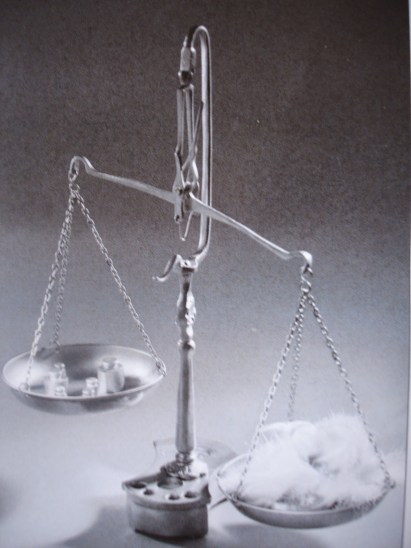
Justice et inégalité - les plateaux de la balance by Frachet, Jan 2010, Public Domain via Wikimedia CommonsThe recent Supreme Court decision in Fisher v. University of Texas at Austin, et al., was a cautious but significant one in favor of affirmative action. As Adam Liptak writes in his New York Times article ‘Supreme Court Upholds Affirmative Action Program at University of Texas‘, while ‘not all affirmative action programs will pass constitutional muster… the ruling’s basic message was that admissions officials may continue to consider race as one factor among many in ensuring a diverse student body.’

This opposes the central tenet of affirmative action opposition: admission to universities can only be based on merit, which in turn is determined mainly by grades buttressed by the quality of relative achievements; therefore, only color-blind admissions criteria are just and fair.

But as we all well know, educational institutions have been generally the purview of the wealthy, the connected, and the white for most of our history. Opponents of affirmative action say the only way to correct this historic injustice is to remove considerations of race and wealth in the admissions process itself, relying on other methods of promoting equal opportunity in education so as to make historically disadvantaged groups equally capable of high test scores and advanced achievement.

But I don’t agree, and am a proponent of some types of affirmative action, including the University of Texas’ well-designed and balanced method, for many reasons.

For one, some sort of affirmative action appears necessary to balance the historical wrongs of our educational system. I picture a classic scale, with a neutral, color-blind system based on merit alone as its fulcrum. For most of our history, the weights of racial, social, and economic privilege were piled almost entirely on one end. If the weights hadn’t been placed all at one end over time, then sure, color-blind admissions criteria might be fine. Opponents of affirmative action argue that the balance has already been corrected by other methods, such as a free public educational system, anti-discrimination laws, certain welfare and scholarship programs, and so on. But if it’s really been balanced, why the continued disparity in outcomes, within the schools and in relative chances of success after graduation in so many arenas of life? Putting the idea that some races are just naturally more gifted and capable of achievement than others aside for the moment, which I’ll consider shortly and (spoiler alert!) reject, the failure of equality in outcomes strongly suggest that color-blind policies don’t balance it all out. I think they are again, at best, the fulcrum of the scale, the default position. But the fact that race, money, and connections have been piled on one end over the centuries can’t be undone, so the balance can’t be reached by simply removing the weight of history. The weights with which to balance the other side are also selective policies, this time favoring those who are not part of historically advantaged groups, such as the wealthy, connected, and white. Of course, merit must count, as it’s always done; it would be a disservice to students to remove the challenge and expectation of excellence that propel learning and achievement, and this Supreme Court agrees. But it’s become clear that test-based merit can’t be the only consideration if we wish to right the balance.

To return to the idea that some racial and ethnic groups are naturally more intelligent or capable of advanced achievement than others: this claim has been shown by science and history to be deeply flawed, to say the least. All racial and ethnic groups have produced too many individuals of great intellectual ability and advanced achievement to make this claim convincing to anyone but the most hardened racists, and civilizations throughout history, made of up people of all races, have taken turns outperforming others in innovation and intellectual advances throughout world history. While test scores have shown that many racial and ethnic groups do, at times, perform lower on tests, the results change dramatically as the social circumstances of the test-takers do. If the ability to score high on tests is changeable, then it’s not likely to be simply genetic. And this is assuming that performance on such tests is the same thing, or a direct predictor of, merit as it relates to education, which is a huge and I think unjustifiable assumption, but this is a topic outside of the scope of this essay.

Furthermore, studies have also shown us is that student success and failure can depend not only intelligence and socioeconomic background, but on expectations of success on the part of teachers, of families, of communities, and most importantly, of the students themselves. To claim that a student has an equal opportunity to succeed whether or not they are part of a student body that includes a significant number of others like them, racially or otherwise, is untenable. There are a few particularly individualistic personalities who can and do achieve highly despite isolation on campus, despite racism, classicism, legal discrimination, and so forth. But as members of a highly social species, most human beings rely much more on the opinions of their fellow human beings, and on feelings of companionship and belonging. And when a student looks around campus and sees few or no-one like them, it’s unlikely they’ll expect to succeed where those like themselves have not.

The Supreme Court recognizes this simple fact: color-blind admissions programs are not always just in a society that’s not and never has been color-blind. Admissions programs admit real students into real campuses where they help prepare them for success in the real world – an often racist world. If an admissions program doesn’t succeed in making a campus look like an institution of a free and democratic society which values opportunity for all, it’s unlikely it could be a just and fair one.

Listen to the podcast version here or on Google Play, or subscribe on iTunes

Ordinary Philosophy and its Traveling Philosophy / History of Ideas series is a labor of love and ad-free, supported by patrons and readers like you. Please offer your support today!

~~~~~~~~~~~~~~~~~~~~~~~~

Sources and inspiration:

Affirmative Action: Court Decisions.’ National Conference of State Legislatures website

Booth, Margaret Zoller and Jean M. Gerard. Self-esteem and academic achievement: a comparative study of adolescent students in England and the United States, Sept 2011

The Black-White Test Score Gap. Edited by Christopher Jencks and Meredith Phillips,
Brookings Institution Press, 1998.

Lindsey, Brink. ‘Why People Keep Misunderstanding the ‘Connection’ Between Race and IQ.’ The Atlantic, MAY 15, 2013

Liptak, Adam. ‘Supreme Court Upholds Affirmative Action Program at University of Texas‘. The New York Times, June 23, 2016

Tauber, Robert T. Classroom Management: Sound Theory and Effective Practice. Westport: Greenwood Publishing Group, 2007

O.P. Recommends: Make it Stop, a Boston Globe Piece on Banning Assault Weapons

Assault rifle, image CC0 Public Domain, no attribution required, via PixabayI came across the link to this article on Leiter Reports, one of my go-to forums for news and ideas in the philosophy world, by Brian Leiter. Thanks for the share, Brian!

The Boston Globe editorial ‘Make it Stop‘ contains statistics on deaths inflicted by assault rifle, a list of senators who block gun control reform, and an essay on modern gun culture and how much has changed since the passage of the Second Amendment. You may find it helpful if you believe, as I do, that we Americans need to change some of our policies and attitudes about guns.

I believe a ban or serious restriction on assault weapons not only would save some lives, it would show how much we value the lives of our fellow Americans. And even if a ban on assault weapons fails to stop mass shootings since they may still be acquired illegally, I believe that signaling our moral commitment to protecting innocent lives, to each other and to the world, is a worthy goal in and of itself. Especially given that there’s no good reason for most civilians to own assault rifles that I can see. They give us no significant protection in case our own government turns tyrannical (the most paranoid among us think it already has) since those who promote Second Amendment literalism tend to be those who vote to keep our military and our police forces among the largest and most powerful in the world, the most well-equipped, and the most omnipresent. And for those who insist their rights to their fun little gun hobby takes precedence over all… well, I question their priorities.

Ordinary Philosophy and its Traveling Philosophy / History of Ideas series is a labor of love and ad-free, supported by patrons and readers like you. Please offer your support today!