Happy Birthday, Morton White!

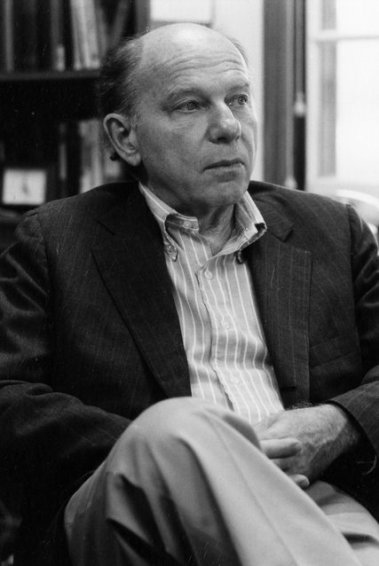
Morton White in 1981

The world lost Morton White (April 29, 1917 – May 27, 2016) less than a year ago as I write this today, and I first learned of him through reading his obituary in The New York Times. As I read, I knew this is a man and an approach to philosophy I must learn more about. Being immersed in other projects, I learned little about him in the intervening eleven months. Happily, I was just reminded by going through my list of significant dates in the lives of the world’s great thinkers (by no means comprehensive!) I placed two of his books on hold at the San Francisco Public Library and will commence reading them on this 100th anniversary of his birth.

White was a philosopher and historian of ideas. According to the Institute for Advanced Studies, ‘he maintained that philosophy of science is not philosophy enough, thereby encouraging the examination of other aspects of civilized life—especially art, history, law, politics and religion—and their relations with science’. And as William Grimes put it for TNYT, his ‘innovative theory of “holistic pragmatism” showed the way toward a more socially engaged, interdisciplinary role for philosophy’.

I studied philosophy with great love and enthusiasm as an undergraduate, yet I found myself then as now just as curious about other disciplines, especially history and the arts, and have often felt that the lines dividing these areas of study are sometimes artificial and even impediments to understanding. Since then, I’ve been pursuing my studies in the broader history of ideas as well, informally for the past few years, formally at the University of Edinburgh starting this fall. No doubt, White has influenced the direction my studies in intellectual history will take in ways I’ll learn as I go along, and in many more ways than I’ll ever know.

Learn more about White and his fascinating ideas with me:

Holistic Pragmatism and the Philosophy of Culture‘ – chapter 1 of A Philosophy of Culture: The Scope of Holistic Pragmatism, New Jersey: Princeton University Press 2002, in which White summarizes what his holistic pragmatism is all about

Morton White, Philosopher of Holistic Pragmatism, Dies at 99‘ – Obituary for the New York Times by William Grimes, June 10, 2016

Morton White 1917–2016 – His memorial page at the Institute for Advanced Study website, June 08, 2016

And you can find his selected bibliography at Wikipedia

Ordinary Philosophy and its Traveling Philosophy / History of Ideas series is a labor of love and ad-free, supported by patrons and readers like you. Please offer your support today!

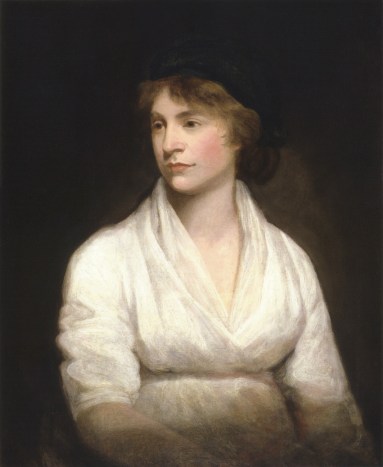
Happy Birthday, Mary Wollstonecraft!

In honor of Mary Wollstonecraft’s birthday, April 27, 1759, I share two works about this great feminist thinker which I’ve published here at Ordinary Philosophy.

One is the Traveling Philosophy series in which I followed the life and ideas of Wollstonecraft, Thomas Paine, and Thomas Jefferson in Revolution-era Paris, France in 2015.

The second is the following essay:

Mary Wollstonecraft, Champion of Reason, Passionate in Love

The life and work of Mary Wollstonecraft, mother of modern feminism, can seem to reveal a mass of contradictions.

Her seminal feminist work, A Vindication of the Rights of Woman, champions reason as the ultimate guide for a moral and productive life. She used reason to great effect to show why women should, and how they could, grow out of their socially constructed roles as under-educated coquettes and household drudges. She believed that reason should rule both individuals and societies because it’s the best tool we have to achieve justice and to perfect the self. Without reason, she thought, human beings are ruled by narrow self-interest, by prejudice born of ignorance, and by crude lust.

Yet the life Wollstonecraft chose to live was widely criticized both during her lifetime and over the two hundred plus years since her death. It’s not just because she didn’t conform to the mores of her time; her life choices are still considered unreasonable and even self-destructive by many. At times, they made her an object of scandal, impoverished, or deeply depressed, even in such desperate straits that she twice attempted suicide. That’s because she was also deeply passionate, devoted to retaining her personal and mental freedom while abandoning herself to loves which never failed to break her heart, be they revolution, family, friend, or lover. For Wollstonecraft, reason and passion are not opposites: they are two sides of the same coin. A truly reasonable person, she thought, is kind, affectionate, and generous as well, and a passionate lover of justice, truth, and beauty.
Wollstonecraft’s chosen role for herself was, first and foremost, a teacher, an advocate of knowledge and instiller of reason. While teaching was one of the few professions open to her as an eighteenth-century woman from a respectable but impoverished background, she brought her formidable powers of reason to bear on the problems with many of the educational and child-rearing practices of her day. After her first job as a companion, she became a teacher, first in the classroom at a school she founded with two of her sisters and her best friend, and then as a governess. When she became a mother twice over in her mid- and late thirties, she was a tender and hands-on mother, an advocate of breastfeeding and attentive parenting in an era of wet-nurses and governesses, when wealthy and middle-class parents participated relatively little in the care and instruction of their children even from infancy.

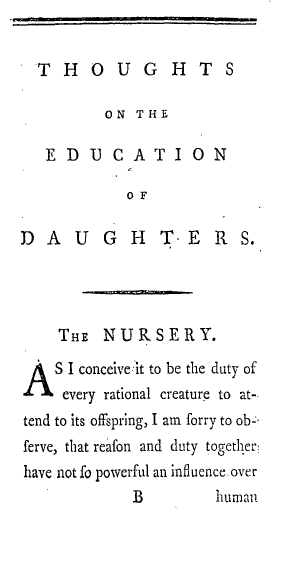
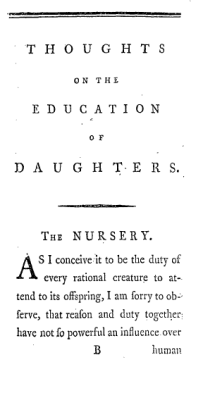
Her first book, Thoughts on the Education of Daughters, opens with her parenting advice and argues that girls should be taught how to run a household while also learning self-sufficiency. In Wollstonecraft’s time, women were not expected to support themselves; they were trained to raise a family, learning how to catch and keep a man first, to be household managers second, and to be educators of young children third. Single women, widows, and married women whose husbands, fathers, brothers, and other male relations could or would not support them had few employment options available to them, mostly directly related to one of the three roles they were trained for. Those jobs that women could respectably accept paid very little, so these working women nearly always lived a life of subservience and privation. Modern feminist thought, until very recently, equated domestic life with that housebound, nearly choiceless life most women were required to live. However, now that women’s basic moral right to self-determination has become so widely established, most have come to consider a domestic-centric life just as valid a choice for free women as a professional or public life. So in this sense, Wollstonecraft’s view of women was more progressive even than that of many modern feminists, even if by accident rather than foresight: she did not speak of a time when women would need to reject domesticity in order to free themselves from it, only to reclaim it by choice after their liberation.

Her ideas were inspired by her own experience: Wollstonecraft discovered firsthand how important it is never to assume that one’s self or one’s children will always have someone they can depend on for education, sustenance, or affection. Life’s too uncertain for that: parents, spouses, relatives, colleagues, and friends can become neglectful, estranged, impoverished, or disabled, and of course, sometimes they die. Wollstonecraft’s father squandered his inheritance and never bothered to learn how to earn an adequate living, leaving all of his children (except for his oldest son, who inherited what was left) to fend for themselves in adulthood, and his daughters without the dowry necessary for a respectable marriage. Knowing firsthand what it’s like to wrest a living from a world where women were ill-equipped for and mostly barred from nearly all employments that men were free to pursue, Wollstonecraft believed all girls should have a thorough education centered on self-sufficiency, from learning how to take care of a household, to learning how to think, to learning how to make a living. This not only gives women the freedom to choose a partner for better reasons than mere survival (Wollstonecraft equated the latter with prostitution), but leaves women free to live their lives as independently as they choose.

Until Wollstonecraft’s response to Edmund Burke’s critique of the French Revolution, her Vindication of the Rights of Men (1790), her published work continued on an educational vein, from original compositions to editorial work to translation. Beginning with The Rights of Men, through A Vindication of the Rights of Woman (1792), and up to her last work, Letters Written During a Short Residence in Sweden, Norway, and Denmark (1796), she transitioned from a teacher of ideas into an innovator, drawing on the wealth of knowledge she had obtained through her lifetime thus far of work and study. She was a semi-autodidact, her rather patchy childhood education supplemented in her teens by her own voracious reading and by friends who recognized her hunger for learning, and continued independently during her working years in the hours she could dedicate to her self-improvement. When she established herself as a professional author, she was finally able to immerse herself fully in the life of an intellectual, attending famous salons and becoming the friend and colleague of many of the brightest minds of her day.

One of the central themes in The Rights of Woman is women’s education. In this work, Wollstonecraft explained that it’s the nature of women, rather than their practical needs, that’s the ultimate justification for their rights, though she doesn’t minimize the importance of the latter. Since women possess reason just as men do, they also need education in order to be happy, fulfilled, and above all, moral. Infantilizing women by denying them a full education, she wrote, renders them not only financially helpless, entirely dependent on men whether or not they’re capricious, selfish, lazy, cruel, or just unlucky, but undermines them as moral beings. It’s reason, more than anything else, that determines the difference between right and wrong, and a quality, well-rounded education is required for using reason to its fullest capacity.

But outside of her moral reasoning, in her life as she lived it, Wollstonecraft displayed the often stark contrast between what one might expect a person ruled by reason would do, and what a person would do when driven by passion.

One of her earliest romantic interests, the Irish gentleman and songwriter George Ogle, ended up causing her no harm and probably doing her even more good than many might realize; not only did her cheer her with intellectual and witty conversation in her time as governess for the wealthy Kingsborough family in Ireland, a biographer credits him as the secret benefactor whose cash gift allowed her to return home to England and pursue writing in earnest. And her pursuit of the intellectual life she loved probably brought her more joy and fulfillment than anything else, with the possible exception of her daughter Fanny.

But most of her other loves did seem to bring her at least as much pain as joy. Her first deep attachment in her early teens was to her friend Jane Arden, who didn’t share her idealistic concept of the near-exclusive, passionate friendship of the soulmate. The more the young Mary sought to dominate her affections, the more Jane drew away. Fanny Blood, her dearest friend in adulthood, nearly lived up to her ideal, but her father’s shiftlessness kept her family impoverished, leaving Fanny with the responsibilities of main breadwinner as well as head housekeeper for her large family. Wollstonecraft saw her dreams for Fanny and herself mostly come true when they joined forces with Wollstonecraft’s sisters to found a school, but this didn’t last as long as she hoped. The distant and dithering suitor that Fanny had longed to marry for years finally carried her off to Portugal, leading to her painful death less than a year later as she succumbed simultaneously to her tuberculosis and the rigors of childbirth. The painter Henry Fuseli may have been a romantic interest: he later liked to claim this, and others echoed this claim, but much of the evidence also indicates that her interest in him was as an aesthetic and intellectual soulmate more than anything else. (At this time, she was still firmly opposed to marriage, and determined to keep herself free from the sort of entanglements that would hamper her mental and physical freedom.)

After a bit of scandal around her unconventional, and rejected, proposal to Fuseli and his wife (who was also her good friend) that she live with the two of them, she set off for Paris to witness the French Revolution firsthand. Wollstonecraft was an ardent supporter of the Revolution, as she saw it continuing the work of dismantling the tyranny of a parasitical monarchy, a corrupt and greedy church, and the oppressive social practices and mores that the American Revolution had started. By the time she arrived, the French Revolution had already taken a violent turn, but she held out hopes that this was a natural but temporary outcome of a people throwing off a tyranny that had ruthlessly oppressed them so badly and for so for so long. While she maintained throughout that a certain amount of violence is the natural byproduct of any truly transformative revolution, she became more and more disillusioned with its leadership and tactics over time, and finally, with her own hopes of its success. (She identified herself with the more moderate Girondin political persuasion throughout.) Wollstonecraft did not live long enough to see that the Revolution would end up ultimately succeeding in ushering in a new era of human rights-centered government in Europe, once some social balance was restored. But she did escape the Terror, probably narrowly, having fallen in love once again. She found herself pregnant and fleeing for her life, returning to England after giving birth her first child at age 35.

And it was Gilbert Imlay, the father of this child and the first deep romantic passion of her life, that caused her the most pain, more than the sisters with whom she was often at odds, more than her most cherished female friends who left her in one way or another, more than her ne’er-do-well brother and the Blood family, more than her self-important painter Fuselli, more than the school she founded that fell apart when she left to nurse Fanny in her final illness, leaving her deep in debt. Imlay presented himself as a man of adventure, an American frontiersman of rugged, self-sufficient, and honest character. These proved to be an illusion: he was actually primarily a man of business, sometimes (often?) of shady dealings, and one who frequently failed to keep his word. In Imlay, Wollstonecraft finally found an exciting sexual partner, a stimulating companion, and a fellow believer in truly living according to one’s personality. They never married because they didn’t believe in that institution, though they found it expedient at times to pass themselves off as husband and wife. In fact, this pretense may very well have saved Wollstonecraft’s life, since the perpetrators of the Terror, in its most insular stage, were executing many expatriate Britons; Americans, however, were still in good standing with the Revolution, and as Imlay’s ‘wife’ she was considered American as well. But it became clear over time that Imlay was not eager to embark on the happy domestic life her pregnancy caused her to long for, and he abandoned her slowly, in stages. It took her a long time to get over Imlay while struggling to get by as a single mother in 18th-century Europe; it was during this period she twice attempted suicide.

Her eventual husband and first biographer William Godwin called Wollstonecraft a ‘firmest champion’ of her sex. In Godwin, Wollstonecraft finally found the lasting sort of love she had been looking for. Their attraction was initially an intellectual connection which only later developed into romantic passion. Sadly, they only enjoyed a brief romance, less than two years, since she died of complications from giving birth to her second child. I think Godwin was right that she was a champion of reason, and I would add, of passion too, and a champion of seeking: of truth, of wisdom, of self-discovery, of new ideas and sources of knowledge, of experiences that expand the mind and the heart, of becoming the best human being one can be. To fully follow her example is very risky: she often flung prudent reasoning to the wind in favor of following her heart, in a time most dangerous for women to do so. Yet, though reasoned prudence is a virtue, it can be taken too far, holding you back, preventing you from taking chances and experiencing all the richness life can offer. She did not hold back.

~ Ordinary Philosophy is a labor of love and ad-free, supported by patrons and readers like you. Any support you can offer will be deeply appreciated!

~~~~~~~~~~~~~~~

Sources and inspiration:

Godwin, William. ‘Memoirs of the Author of A Vindication of the Rights of Woman‘. London, 1798.

Gordon, Lyndall. Vindication: A Life of Mary Wollstonecraft. New York: Harper Collins, 2006.

Jacobs, Diane. Her Own Woman: The Life of Mary Wollstonecraft. New York: Simon & Schuster, 2001. http://books.simonandschuster.com/Her-Own-Woman/Diane-Jacobs/9780743214704

Tomalin, Claire. The Life and Death of Mary Wollstonecraft. London: Weidenfield & Nicholson, 1974

Happy Birthday, Ludwig Wittgenstein!

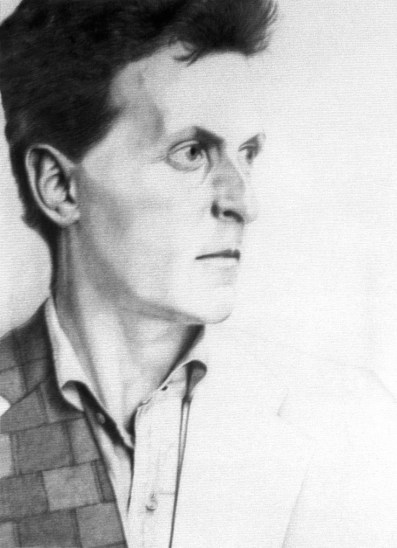
Drawing of Ludwig Wittgenstein by Christiaan Tonnism, pencil on board 1985, Creative Commons

In honor of Ludwig Wittgenstein’s birthday, Apr 26, 1889, let me share three fascinating discussions about the great philosopher’s life and ideas, one by Stephen West and two for the BBC, one by Matthew Parris and one by Melvin Bragg with their guests.

The first is by philosopher West for his podcast Philosophize This!, in which he discusses ‘…the limitations of language as described by Ludwig Wittgenstein. Considered by some to be the greatest philosopher of the 20th century, Ludwig Wittgenstein played a central, if controversial, role in 20th-century analytic philosophy. He continues to influence current philosophical thought in topics as diverse as logic and language, perception and intention, ethics and religion, aesthetics and culture….’ (this episode is only the first West will create about Wittgenstein)

The second is from the series Great Lives, hosted by Matthew Parris and featuring guests Raymond Tallis and Ray Monk. In this program, Parris, Tallis, and Monk discuss ‘Ludwig Wittgenstein, the fascinating and misunderstood genius who changed the course of philosophy…’

The thirdis  from the series In Our Time, hosted by Melvin Bragg and featuring guests Ray Monk, Barry Smith, and Marie McGinn. In this program, Monk, Bragg, Smith, and McGinn discuss ‘…the life, work and legacy of Ludwig Wittgenstein… Wittgenstein is credited with being the greatest philosopher of the modern age, a thinker who left not one but two philosophies for his descendants to argue over: The early Wittgenstein said, “the limits of my mind mean the limits of my world”; the later Wittgenstein replied, “If God looked into our minds he would not have been able to see there whom we were speaking of”. Language was at the heart of both. Wittgenstein stated that his purpose was to finally free humanity from the pointless and neurotic philosophical questing that plagues us all. As he put it, “To show the fly the way out of the fly bottle”.How did he think language could solve all the problems of philosophy? How have his ideas influenced contemporary culture?…’

Enjoy and be inspired, awed, puzzled, and enlightened!

Ordinary Philosophy and its Traveling Philosophy / History of Ideas series is a labor of love and ad-free, supported by patrons and readers like you. Please offer your support today!

Remembering Margaret Fell

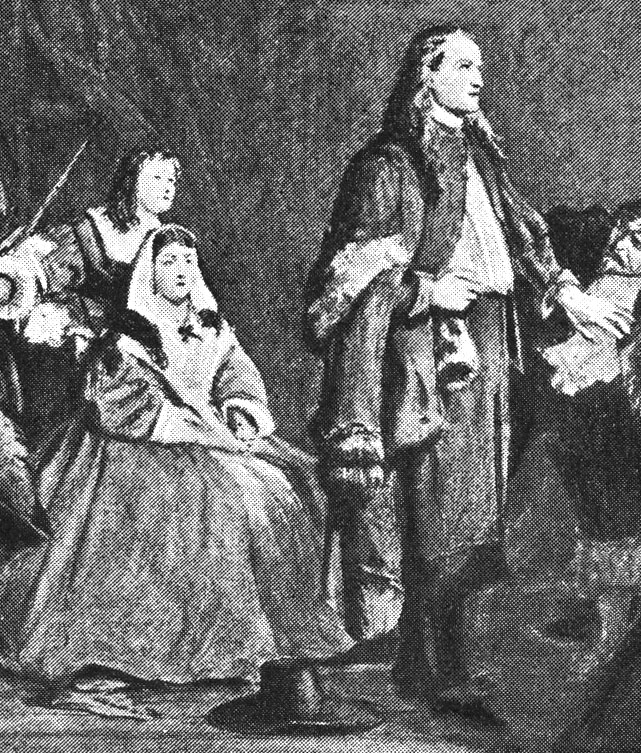
Margaret Fell, with George Fox before the judges, from a painting by J. Pettie 1663, public domain via Wikimedia Commons

Margaret Fell with George Fox before the judges, from a painting by J. Pettie, 1663

Margaret Fell was born on some unknown date in 1614, so let’s take this occasion to remember her on the date of her death, April 23rd, 1702.

Fell’s lived a life as passionate as it was long. She was an unconventional thinker for her time, a zealous and progressive religious activist at times imprisoned for her beliefs, a prolific writer, well-traveled, a mother of eight children and a wife twice.

An early adherent and eloquent promoter of Quakerism, Fell is now considered one of its founders. She converted to Quakerism after hearing a sermon by one of its most charismatic preachers, George Fox, and almost immediately launched into a lifetime of hosting Quaker meetings and speaking out on behalf of her new religion. After her husband died some years later, Fell married Fox, probably more as a co-missionary than as a romantic partner since their work, travels, and imprisonments kept them apart for much of their marriage.

As I’ve had a lifelong fascination with the history of human rights, I’ve long admired the Quakers because, along with Unitarians and Deists, so many have been leaders in the struggle to expand, establish, and promote them. That’s because these faiths emphasize the importance of individual conscience, the primacy of the human mind, God’s rational nature, and the moral equality of all human beings.

Fell believed in the Quaker doctrine of the Inner Light which God has caused to shine equally in the hearts of all beings; all we need do is heed it. Therefore, one does not need ministers, priests, or any other authorities or intercessors to achieve salvation. And because God has created everyone for the same purpose and gave everyone that light, everyone is spiritually equal and capable of understanding and proclaiming the Truth. We can see how this doctrine, central to Quakerism, readily aligns with human rights movements centered on a belief human spiritual and intellectual equality. The right of women to speak in church and write religious texts, in her time limited to men, was a cause particularly dear to Fell’s heart. While Fell’s belief in the equality of women was limited to their role as spiritual beings, Quakerism tended to encourage ever-more progressive beliefs in its adherents. Over time, Quakers came to be leaders in the abolitionist and pacifist movements, promoting the right of all to receive equal and universal education and for women’s rights in social and political spheres as well.

In light of her achievements as a female religious pioneer, and the human rights advances facilitated by the Quaker faith she helped found, Fell’s contributions should continue to be remembered and celebrated.

Ordinary Philosophy and its Traveling Philosophy / History of Ideas series is a labor of love and is ad-free, supported by patrons and readers like you. Please offer your support today!

~~~~~~~~~~~~~~~~~~~~~~~~~~

Sources and inspiration

Broad, Jacqueline, ‘Margaret Fell‘, The Stanford Encyclopedia of Philosophy, Edward N. Zalta (ed.)

Jacoby, Susan. Strange Gods: A Secular History of Conversion. New York: Pantheon, 2016 (see chapter on Margaret Fell)

Happy Birthday, John Muir!

John Muir National Historic Site, his home in Martinez, CA, where he lived the last two and a half decades of his life

In honor of John Muir’s birthday, April 21, 1838, I’ll share the story of my visit to an important place in his life last summer. It was June 26th, 2016, a hot, bright day in Martinez, CA.

The John Muir National Historic Site is just south of the Carquinez Strait, which links San Pablo and Suisun Bays. Benicia, California’s third but short-lived capital city, is just across the strait and was reached by ferry in Muir’s time. A lovely town with a well-preserved historic district, Benicia is well-situated on a waterway that permits easy passage for ships and ferries. In its early years, the strait allowed for easy passage of people, animals, and the products of this agricultural region and later industrial center, so it became a busy, thriving center of commerce. It enjoyed its first big boom with the Gold Rush, as it lay on an easy route between San Francisco and the gold fields.

Martinez was also a hub of Gold Rush activity. The ferry between Benicia and Martinez enjoyed a monopoly on getting all those gold-crazed fortune seekers south to the gold fields and north again to cash in. But Martinez was also an important agricultural town, and this site preserves just a little bit of that aspect of its history. It’s about a thirty-five-minute drive northeast of where I live in Oakland.

Physician, horticulturist, and father-in-law of John Muir, Dr. John Strentzel, among his orchards and vineyards in Martinez, CA. Photo credit: Sierra Club

A ripe peach from the orchards of John Muir National Historic Site, Martinez, CA

The grand house which stands here was first the home of Dr. John Strentzel, a Polish physician who emigrated to the United States in 1840. Like Benicia and Martinez, Strentzel made his early fortune in the Gold Rush, in his case through the practice of medicine. He later took up farming and achieved fame as a horticulturist. Strentzel settled in Alhambra Valley, just south of Martinez, with his wife Louisiana, daughter Louisa, and son John, in 1853. The Strentzels built their final home and grand farm here in Martinez from 1880-1882, with a veritable mansion made comfortable with the most modern amenities as they became available: indoor plumbing, gas lighting, two water closets, and eventually, a telephone and electricity. Louisa, nicknamed Louie, ferried to Benicia daily where she went to school and learned to play the piano expertly. Her brother John died at only nine years old in 1857.

The Martinez house was surrounded by acres and acres of rolling farmland, and several groves remain today. I see grapes, peaches, plums, pomegranates, and much more. Visitors can pluck and eat the fruit freely; the peaches and plums are ripe now, the latter richly red, dripping, and delicious.

John Muir’s ‘Scribble Den’, John Muir National Historic Site, Martinez, CA

John Muir met the Strentzels in 1874; he was already well known as a naturalist and just beginning his career as a writer. The year before, he moved to Oakland from Yosemite and published articles about California’s natural wonders. He often lamented how slowly his thoughts flowed through his pen though they bloomed as naturally and abundantly in his mind as the wild California flowers he loved.

Parts of Yosemite had already been set aside as public land by the federal government, protected by the state of California for public use and barred from development by private interests. Senator John Conness introduced the park bill in Congress in 1864 which passed quickly, and President Abraham Lincoln signed it that summer. Conness is an interesting and admirable person as well, an Irish immigrant who also got his start in the Gold Rush and remained on the right side of history in his political career. His advocacy for Chinese immigrants and for equal rights eventually destroyed his political career, but in the meantime he was respected as a champion of the ordinary American, native and immigrant, over the interests of the few and the wealthy, and was one of Lincoln’s pallbearers.

Yosemite Falls, Yosemite National Park

Yet the bill setting Yosemite aside as public land did not provide funds or the authority to protect it. It took Muir, another immigrant, to reveal the true sacredness of the natural world to the consciousness of his (now) fellow Americans, which in turn gave rise to the political will to care for it. An accident in the factory he worked at in 1867 damaged his eyes temporarily and he began to wander. He walked from Indianapolis to Florida, a thousand miles, and fell in love with the natural world and the transformative power of walking in nature. Muir heard that there were spectacular natural wonders in California, vast, and in many places still unexplored and unspoiled, and sailed to San Francisco in 1868. He walked to Yosemite and throughout the Sierras, writing a journal as he went. He emerged as a prophet, fearless, tireless, and rendered poetic by his baptism of the wind, trees, stones, wildlife, and water.

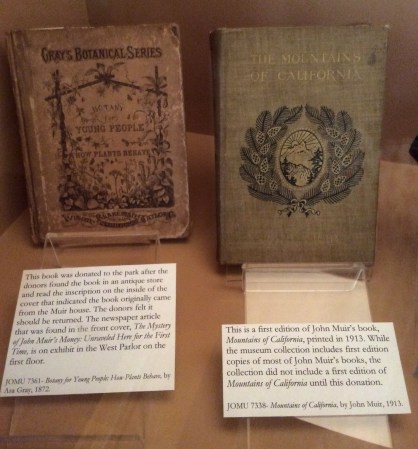
Two books, one written by and one owned by John Muir

But he realized that this great inspiration which transformed and ennobled his life would be unavailable to others if the entrepreneurs trespassing into the Yosemite valley and despoiling it were allowed to continue. So, again like the biblical prophets, Muir emerged from the wilderness to share the good news and cry out against those who defiled the great temples of creation for their own gain. He returned to civilization to spread the word, first through newspapers and then through books. 1874, the year he met the Strentzels at a mutual friend’s home in Oakland, saw his first success as a writer with his ‘Studies in the Sierra’ series. Muir had also discovered the evidence that the formations of Yosemite were created by glaciers, not wind and rain as previously thought, and over time, the scientific community were convinced of the truth of his theory.

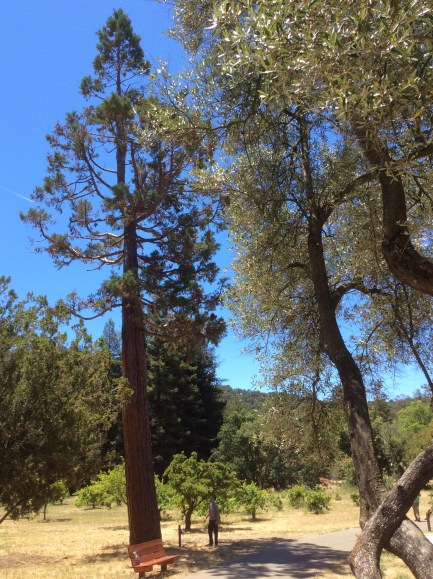
The sequoia that John Muir planted near his home is not doing too well, it’s too warm and dry here. Its natural habitat is in the higher, cooler Sierras

Muir married Louie Strentzel in 1879. Though her father and Muir had become good friends, the couple did not fall in love with each other on their own. Another mutual friend set them up and convinced each, separately, that the other would make a perfect companion for them. Muir began to help Dr. Strentzel run the Martinez farm when his health declined, and when he died in 1890, the Muirs established a life together here as ranchers with their two daughters. Muir turned out to be an excellent rancher and, like his father-in-law, was a hard and skilled worker, gifted at innovation and invention. Though Louie didn’t share Muir’s central passion for the wilderness, the couple were affectionate and generous with one another, and she insisted that Muir get away and spend time alone in his beloved wilderness when he needed it, which was often, and often for extended periods.

Like Muir, I love to walk, especially in nature, and when the weather and daylight hours permit, I go on hikes, long or short, two or three times a week. I would one day love to have the wherewithal, or lacking that, the courage to give up financial security and my belongings to wander the earth awhile in freedom, taking in what the journey has to offer. I am in the process right now of cutting my moorings and setting off on a new course in life, resuming my studies in Muir’s native Scotland and getting in as much walking and traveling as I can beforehand. I’m happy that I’ve walked in many of the places Muir has, or at least nearby: I’ve ascended Mount Diablo, by foot and by bicycle; I’ve done several hikes in Yosemite; I’ve lived in Oakland for over a decade and spent a lot of time in San Francisco; and on that beautiful summer day in June, I explored his old home and strolled through some of his orchards.

Amy in Yosemite National Park, above the falls on the El Capitan hike

The idea that Americans should own the most beautiful portions of their nation’s land in common is an idea that melds Muir’s belief in the sacredness of nature and Senator Conness’s belief in universal human rights. Each human soul needs and deserves a place of unspoiled beauty to immerse itself in, and everyone, not only the rich, the powerful, and the well-connected, should have the opportunity to fulfill and ennoble themselves this way. The National Parks, then, are among the greatest expressions of this democratic spirit.

*Listen to the podcast version here or on Google Play, or subscribe on iTunes

You can find more photos of the John Muir National Historic Site here

Ordinary Philosophy and its Traveling Philosophy / History of Ideas series is a labor of love and ad-free, supported by patrons and readers like you. Please offer your support today!

~~~~~~~~~~~~~~~~~~~~~~

Sources and inspiration

Burns, Ken. The National Parks: America’s Best Idea documentary series, and ‘John Muir (1838–1914)‘ from the documentary website

City of Benicia: Historic Context Statement, Sep 27, 2010. By City of Benicia Department of Public Works & Community Planning

John Muir National Historic Site: People‘, at NPS.gov

History of Martinez‘. From the Martinez Historical Society website

John Conness‘. In Wikipedia, The Free Encyclopedia.

The John Muir House‘. John Muir National Historic Site: People, at NPS.gov

Sierra Club: John Muir Exhibit, various articles: ‘Chronology (Timeline) of the Life and Legacy of John Muir‘; ‘Dr. John Theophile Strentzel’; ‘John Muir: A Brief Biography‘; ‘Louie Strentzel Muir: A Biography by Steve and Patty Pauly‘; ‘Who Was John Muir?

Thomas, Donna and Peter. Muir Ramble Route: Walking from San Francisco to Yosemite in the Footsteps of John Muir

Walsh, Victor A. ‘John Muir and the Family Ranch in Martinez‘. July 5, 2011. LiteraryTraveler.com 

Happy Birthday, Averroes (Ibn Rushd)! By Eric Gerlach

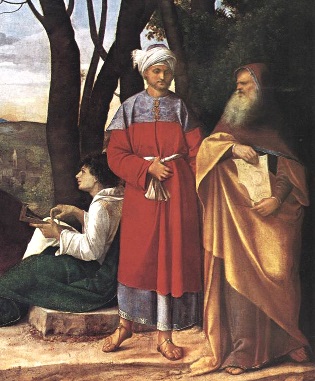
Averroes by Giorgione890 years ago today, on April 14th, 1126, the great Islamic philosopher, theologian, political theorist and scientist Ibn Rushd, or as he is known by the Latinate version of his name in Europe, Averroes, was born.
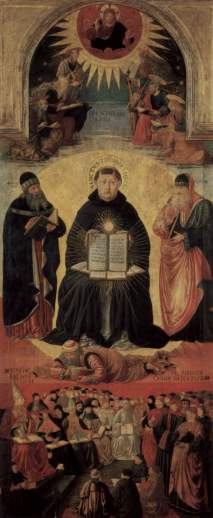
Among his many achievements, Averroes is credited with popularizing the study of Aristotle in Europe, inspiring the work of Thomas Aquinas and the Christian Scholastics.  Averroes was known as “The Commentator” and Aristotle “The Philosopher” to Aquinas and the Scholastics, as Averroes wrote multiple commentaries to help others understand Aristotle’s thought.  To the left is an image of Averroes standing between and above an ancient Greek sage, likely Aristotle, and an Italian scholar of the Renaissance, sitting at their feet, painted by Giorgione of Venice. Averroes was also a major influence on Maimonides, Giordano Bruno, Pico della Mirandola, and Baruch Spinoza, and was one of the great souls that Dante wrote was dwelling in limbo with the Greek sages who lived before Jesus.

Aquinas Averroes and Scholastics

Thomas Aquinas

Averroes’ grandfather and father both served as chief judge of Cordoba, the place where Averroes was born, which later became part of Spain.  Averroes wrote prolifically, twenty-eight works of philosophy as well as important treatises on law and medicine.  As a rationalist, Averroes argued that philosophy and religion teach the same truth and thus are not in conflict, such that intellectuals pursue the same matters that common people comprehend through religion and rhetoric.  He also argued that analytic thinking was important for the proper interpretation of the Quran, as Christian Scholastics would argue later about the Bible in Europe.  Averroes’ works were banned and burned in Islamic and Christian lands at different times, but they were revered enough to survive in both places.

Averroes was opposed to the work of Al-Ghazali, the Sufi mystic and author of The Incoherence of the Philosophers.  Ghazali argued that philosophers such as Plato, Aristotle, Al-Farabi and Avicenna contradict each other, and are thus incoherent as a set, and also contradict the teachings of Islam.  Ghazali also argued that Aristotle and those who follow him are wrong to assert that nature proceeds according to established laws, as all things proceed directly through the will of God.  Averroes wrote his most famous work, The Incoherence of the Incoherence, in response to Ghazali.  Averroes defended Aristotle and argued that philosophy doeslead to coherent truth, which is not in conflict with Islam, and that nature proceeds indirectly from God via the laws of nature, which God established during creation.

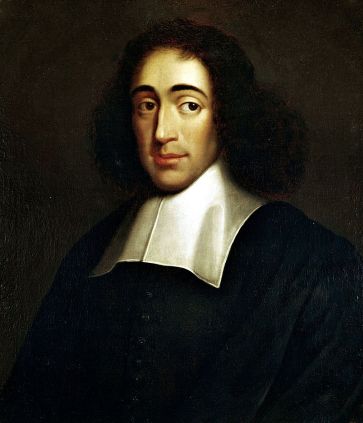
Portrait of Baruch de Spinoza (1632-1677), ca. 1665, by an unknown artist

Portrait of Baruch de Spinoza (1632-1677), ca. 1665, by an unknown artist

Averroes is also famous for his idea of monopsychism, that we all share the same divine soul, mind and awareness, with each taking a part such that the lower soul is individual and mortal but the higher soul is universal and immortal, the source of true inspiration and reason.  Spinoza, who said that each of us is like a wave on the great sea of being, was a pantheist, inspired in part by Averroes.  Much later, when Albert Einstein was asked if he believed in God, he said, in the spirit of Averroes, “I believe in Spinoza’s god”.

In these and countless other instances, we can discern the influence of Averroes throughout both Eastern and Western thought. Thank you for your wisdom and insight, Averroes!

~ Ordinary Philosophy is a labor of love and ad-free, supported by patrons and readers like you. Any support you can offer will be deeply appreciated!

*All views and opinions expressed by guest writers are their own and do not necessarily reflect those of Ordinary Philosophy’s editors and publishers

Happy Birthday, Thomas Jefferson!

Thomas Jefferson by Charles Bird King, 1836, after Gilbert Stuart, at the Smithsonian Portrait Gallery in Washington, D.C. Photo 2016 by Amy Cools

In remembrance of Thomas Jefferson (April 13, 1743 – July 4, 1826) on his birthday, I’ll share my tributes to his memory, his life, and his ideas: my traveling philosophy / history of ideas series

To Washington DC, Virginia, and Philadelphia I Go, In Search of Thomas Jefferson

and

To Paris, France I Go, In Search of Revolution-Era Thomas Paine, Mary Wollstonecraft, and Thomas Jefferson

and my thrilling interview with Clay Jenkinson, Jefferson scholar, last year

Interview with Clay Jenkinson as Thomas Jefferson

I hope you enjoy following me as I follow in the footsteps of Jefferson!

Ordinary Philosophy and its Traveling Philosophy / History of Ideas series is a labor of love and ad-free, supported by patrons and readers like you. Please offer your support today!

Paul Robeson, Black Dockworkers, and Labor-Left Pan-Africanism, by Peter Cole

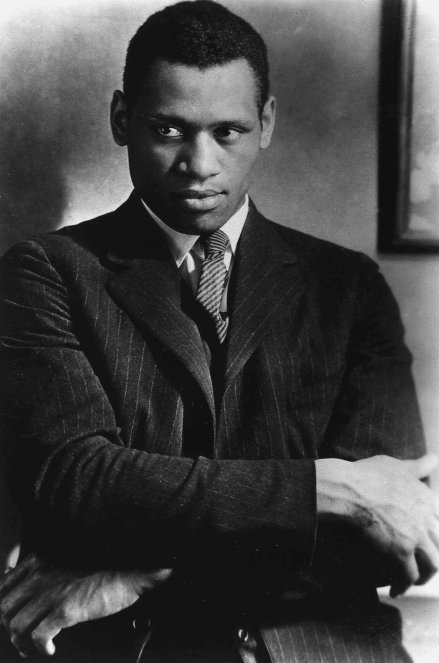
Actor Paul Robeson, photographed at Madame St. Georges studio in London in 1925 (AP Photo/Courtesy Paul Robeson Jr.). Click to hear Robeson’s incomparably beautiful baritone voice sing ‘Shenandoah’

In honor of singer, actor, and civil and labor rights activist Paul Robeson’s birthday, April 9, 1898, here’s an excellent piece by Peter Cole, originally published at the African American Intellectual History Society blog:

Paul Robeson was one of the greatest black internationalists of the twentieth century. A gifted actor and singer, he was also an unabashed leftist and union supporter. This resulted in his bitter persecution, destroying his career and causing, to a surprising degree, his disappearance from popular–if not academic–memory. Robeson’s connections to the fiery black dockworkers of the San Francisco Bay illuminate a form of black internationalism still left out of scholarly analyses –what I will refer to as Labor-Left Pan-Africanism.

Robeson’s life exemplified Pan-Africanism, a global movement of politically conscious black people who believed they shared much in common with all people of African descent in Africa and across the African Diaspora. In the 1930s, Robeson embraced this ideology, along with communism, and supported the Soviet Union. Robeson and other leftwing, Pan-African black intellectuals and activists—such as W. E. B. Du Bois, Eslanda Robeson, Vicki Garvin, and Hubert Harrison—fought long and hard for racial equality in the United States and for liberation of African and Caribbean nations abroad.

Robeson connected struggles for civil rights with socialism and working class politics. His interest in black equality first came from his father, William Drew Robeson, who was born a slave and successfully liberated himself. Robeson’s leftist politics emerged in the 1930s, first visiting the Soviet Union in 1934, and subsequently embracing socialism for treating black people as equals. He combined politics and artistry from then onwards.

In 1935, Robeson performed in the London debut of the American play Stevedore.1 The reviewer in the NAACP’s Crisis magazine concluded: “Stevedore is extremely valuable in the racial–social question—it is straight from the shoulder.” Later that year, he also played the lead in C. L. R. James’ take on Toussaint L’Ouverture, itself written shortly before James’ classic history of the Haitian Revolution, The Black Jacobins (1938).

In 1937, back in the United States, Robeson helped to establish the Council on African Affairs (CAA), which promoted African liberation in an era when few Americans actively engaged in such matters. Perhaps its greatest achievement came in 1946, when the CAA submitted a memorandum to the United Nations Commission on Human Rights in support of the African National Congress (ANC). Led by its US-educated President, Alfred Xuma, the ANC successfully fought to prevent the annexation of South-West Africa (now Namibia) by racist, white minority-ruled South Africa. Alas, the CAA was red-baited out of existence shortly after this victory.

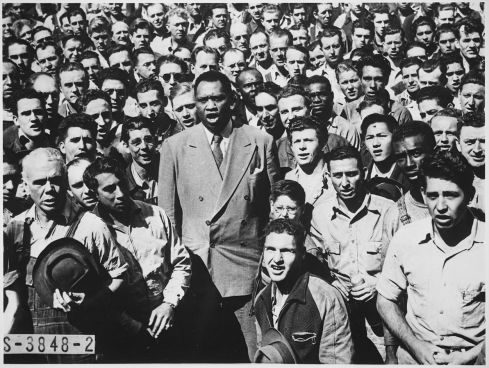
In 1942, during WWII, Robeson traveled to Oakland to champion the black and white union workers contributing to the Allied war effort on the home front. One of Robeson’s most famous photos shows him singing the “Star Spangled Banner” amidst a sea of black and white workers at Moore Shipyard in Oakland. The image captures his politics brilliantly, all the more so since Robeson had worked as a shipbuilder during WWI.

Paul Robeson, world famous baritone, at Moore Shipyard in Oakland, CA, leading workers in singing the Star Spangled Banner.

After WWII, the Cold War commenced and black people linked to communism, like Robeson and Du Bois, were persecuted by the US State Department, the FBI, and many so-called patriots intolerant of dissent. Historian Penny M. Von Eschen cites Robeson’s “extreme advocacy on behalf of the independence of the colonial peoples of Africa” as an explanation for his career’s destruction in the Red Scare. I would also add his labor activism.

Just like Robeson, many of the black dockworkers I study adhered to Labor-Left Pan-Africanism. In the San Francisco Bay Area, thousands of African Americans belonged to the International Longshore & Warehouse Union (ILWU).2  This leftwing union was renowned for its fierce and proud commitment to racial equality and black internationalism. Indeed, during WWII, Robeson became an honorary member of the ILWU. Robeson and the ILWU were, in many ways, a perfect fit.

The ILWU was—and remains—amongst America’s most radical unions, led for decades by its leftist President Harry Bridges and supported by many leftists in the rank-and-file. The union put socialism into action in its hiring halls, which dispatched members based upon a “low man out” system in which the person with the fewest amount of hours worked, that quarter, received the first available job.

In keeping with its politics, the ILWU attacked racism on the waterfront beginning with its initial “Big Strike” even though the workforce was 99% white in 1934. Local 10 welcomed thousands of African Americans during the WWII-induced shipping boom and these blacks, alongside leftist white allies, fully integrated their union and fought for civil rights in the Bay Area and nationwide. Due to their aggressive efforts, ILWU Local 10, which represents dockworkers in San Francisco, Oakland, and throughout the Bay Area, became black majority in the mid-1960s with blacks elected to every leadership position available. Truly, the ILWU embodied what historian Robert Korstad labeled “civil rights unionism.”

Robeson understood the significance of the ILWU as a platform from which to demand civil rights. Two of Robeson’s best friends– Joe Johnson and Revels Cayton— belonged to the ILWU. Together, these three black men articulated a commitment to Labor-Left Pan-Africanism.

The best example of its Pan-Africanism was ILWU’s commitment to the struggle against apartheid and, more broadly, for the liberation of all the peoples of southern Africa. In the 1950s and 1960s, the union repeatedly condemned white-minority rule in South Africa and also noted the ironic similarities with Jim Crow segregation in the States. In the 1970s and 1980s, rank-and-file members of ILWU Local 10 formed the Southern Africa Liberation Support Committee, which stood at the vanguard of black working class anti-apartheid activism during this period. Leo Robinson, Texas-born and a child of the 2nd Great Migration to Oakland, followed in his father’s footsteps to the waterfront in 1963. In Local 10 Robinson became a communist and activist who helped found the SALSC after the Soweto student uprising of 1976. Although Robeson died that same year, after declining health and decades in forced retirement due to McCarthyism, other radical longshoremen inspired by socialism and liberation movements in Africa joined Robinson and following in Robeson’s footsteps.

The black and white members of the SALSC fought for the liberation of black people in South Africa, Mozambique, Rhodesia, and elsewhere in the best way they knew how: direct action on the job. To leftist, Pan-African dockworkers, the most logical way to attack apartheid and racial capitalism was flexing their economic muscle, i.e. stop work. In 1962, 1977, and for eleven days in 1984 (shortly after Reagan’s landslide re-election), they refused to unload South African cargo. By contrast, other black Pan-Africanists embraced consumer boycotts or economic divestment. Local 10’s actions set the bar for US anti-apartheid activism and helped inspire many in the Bay Area to join the solidarity struggle. Nelson Mandela thanked the union on his first visit to Oakland in 1990 and Robinson received a posthumous award from the now-democratic South African government.

Long after his death, Paul Robeson continued to inspire African Americans in the ILWU including the Bay Area’s Alex Bagwell. Like Leo Robinson, Bagwell’s family moved to San Francisco during WWII. In the 1960s, he dropped out of college after admission to the union, which had elevated so many black folks into the middle class. Like Robeson, Bagwell was a leftist and active in the union’s anti-apartheid efforts. He and his wife, Harriet, belonged to a radical choir, Vukani Mawethu, founded by a South African who belonged to the ANC and had gone into exile. Alex and his wife were among those in Vukani who sang when Mandela visited Oakland.

In the early 1990s, though not yet retired, Bagwell finished his B.A. and then earned his M.A. in Creativity and Arts Education at San Francisco State University. For his graduate degree, he wrote a play on Robeson’s life, conducting interviews with twenty people who knew him including Local 10 member Joe Johnson, Robeson’s long-time friend.

After the birth of a multiracial, democratic South Africa, the Bagwells traveled to the country, as part of Vukani Mawethu, to perform there. Other black and white radicals in the ILWU did so, as well. The Pan-Africanism of these dockworkers clearly followed in the footsteps of Robeson, who first championed the rights of black South Africans in the 1940s. The spirit and ideals of Robeson continue to shape the Pan-Africanism of working class black dockworkers who now have established connections with black dockworkers in South African ports. Robeson would be proud.

  1.  Stevedore is an older term for dockworker or longshoreman, workers who load and unload cargo ships.
  2. The ILWU’s original name was the International Longshoremen’s & Warehousemen’s Union but, in 1997, a resolution was approved, unanimously at its biennial convention, that made its name gender-neutral. “What’s in a Name? For ILWU, it’s not ‘men’,Journal of Commerce, May 4, 1997

Peter Cole is a historian of the twentieth-century United States, South Africa and comparative history. Dr. Cole is Professor of History at Western Illinois University. He is the author of Wobblies on the Waterfront: Interracial Unionism in Progressive Era Philadelphia (University of Illinois Press, 2013) and currently at work on a book entitled Dockworker Power: Race, Technology & Unions in Durban and the San Francisco Bay Area. He writes on labor history and politics (Bio credit: AAIHS)

~ Ordinary Philosophy is a labor of love and ad-free, supported by patrons and readers like you. Any support you can offer will be deeply appreciated!

*All views and opinions expressed by guest writers are their own and do not necessarily reflect those of Ordinary Philosophy’s editors and publishers

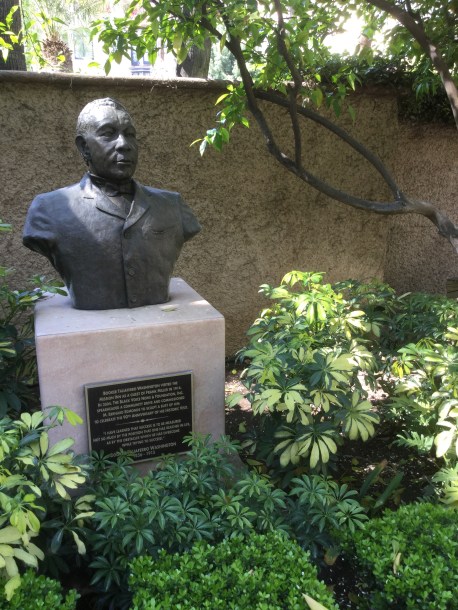
Happy Birthday, Booker T. Washington!

Booker T. Washington sculpture in the Mission Inn gardens, Riverside, CA, photo by Amy Cools 2017

‘My earliest recollection is of a small one-room log hut on a large slave plantation in Virginia. After the close of the war, while working in the coal-mines of West Virginia for the support of my mother, I heard in some accidental way of the Hampton Institute. When I learned that it was an institution where a black boy could study, could have a chance to work for his board, and at the same time be taught how to work and to realize the dignity of labor, I resolved to go there. Bidding my mother good-by, I started out one morning to find my way to Hampton, though I was almost penniless and had no definite idea where Hampton was. By walking, begging rides, and paying for a portion of the journey on the steam-cars, I finally succeeded in reaching the city of Richmond, Virginia. I was without money or friends. I slept under a sidewalk, and by working on a vessel next day I earned money to continue my way to the institute, where I arrived with a surplus of fifty cents. At Hampton I found the opportunity — in the way of buildings, teachers, and industries provided by the generous — to get training in the class-room and by practical touch with industrial life, to learn thrift, economy, and push. I was surrounded by an atmosphere of business, Christian influence, and a spirit of self-help that seemed to have awakened every faculty in me, and caused me for the first time to realize what it meant to be a man instead of a piece of property.’ ~ Booker T. Washington, ‘The Awakening of the Negro‘, Atlantic Monthly, Sept. 1896

Booker T. Washington was born on April 5, 1856, and went on to become one of America’s leading educators and social reformers. He was born a slave in a simple cabin and never knew his father; he and his family were freed by the end of the Civil War when he was nine years old. Washington lived the life he would go on to advocate for his fellow black citizens: one of self-determination, self-sufficiency, hard work, thriftiness, and compromise. He believed firmly in gaining the respect of others, including those predisposed to dismiss him because of his race, solely through his own character and accomplishments. Was Washington wrong to emphasize the importance of demonstrating one’s own worth by pulling one’s self up by the bootstraps over demanding equal legal rights as citizens? Perhaps the struggle for equality had always needed multiple lines of attack to crumble the whole structure of institutionalized legal, social, and subtly inculcated racism that has plagued and undermined this nation for so long. Perhaps he was simply misguided, even naive, though the latter is hard to accept given his intellectual prowess.

Be that as it may, Washington’s ideas drove him to work harder to create educational and economic opportunities for his fellow black citizens than just about anyone else we could name. And given his hard work, his integrity in staying true to his vision despite attacks from all sides, and his premature death by stress and overwork, the charge of ‘coward’ often leveled at him is, in my few, manifestly false and undeserved.

Learn more about the great yet controversial Booker T. Washington here, in fact, in praise, and in blame:

The Awakening of the Negro – by Booker T. Washington for the Atlantic Monthly, Sept. 1896

Booker T. Washington (1856-1915) – by Lawson Bush for Blackpast.org

Booker T. Washington and the White Fear of Black Charisma – by Jeremy C. Young for the African American Intellectual History Society Blog

Booker T. Washington: American EducatorEncyclopædia Britannica

Pride and Compromise – Shelby Steele’s review of Up From History: The Life of Booker T. Washington by Robert J. Norrell

Speech to the Atlanta Cotton States and International Exposition, Atlanta, Georgia – September 18, 1895 – Booker T. Washington radio broadcast at American Radio Works

*I had the honor of interviewing Kenneth Morris last year; he’s an activist against modern slavery (wage slavery, sex trafficking, and other forms of coercive exploitation) and a direct descendant of both Booker T. Washington and Frederick Douglass, each a preeminent figure in American civil rights history and each with a radically different approach to achieving equal civil status for their fellow black citizens. However, they had three things in common: an essential pragmatism combined with as much idealism, a deep love of their people, and an abiding trust that the universal human instinct for justice would win in the end.

Ordinary Philosophy and its Traveling Philosophy / History of Ideas series is a labor of love and ad-free, supported by patrons and readers like you. Please offer your support today

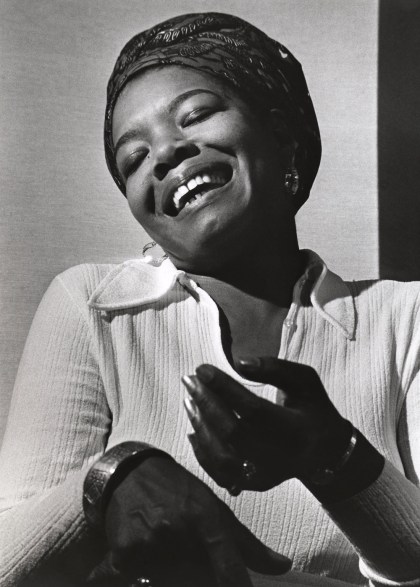
Happy Birthday, Maya Angelou!

Maya Angelou, author, poet, singer, dancer, activist, and so much more, was born on April 4th, 1928. We lost her only a few years ago, on May 28th, 2014.

There’s a wonderful Angelou biopic on PBS that I watched just a few weeks ago. In case you haven’t seen it, I highly, highly recommend it, and what better day to watch it than today? It’s only available now if you purchase a Passport subscription, but it’s very inexpensive and besides, our great public institutions like PBS need all the support we can give them in our current political climate of de-funding that which is not a weapon or a tax break for some special interest. I’ve long known of her and was aware of her prominence as an American author and civil rights leader, as most have, and had read and heard snippets by and about her over the years. This biopic, however, was my first sustained look at her life and accomplishments. How I went so long without more than a passing familiarity with her I know not. I am drawn in, and must discover more.

The Poetry Foundation’s page for Angelou is another excellent source for learning about her life and work and includes a short biography, lists of works by and about her, and some of her poetry.

What a fascinating woman.

Ordinary Philosophy and its Traveling Philosophy / History of Ideas series is a labor of love and ad-free, supported by patrons and readers like you. Please offer your support today!