Thomas Jefferson Sites, Part 1: Washington, D.C., First Day

First day, Sunday April 19th:

I get a late start on my first day. But that’s okay: I’ve long since made it my policy to get my rest at the beginning of a trip because three things happen when I’m sleep-deprived: 1) I’m cranky and don’t enjoy myself fully 2) It’s much harder to take in everything and remember it, and 3) I lose my sense of direction and ability to read maps. Since I need to have my good spirits and my thinking, remembering, and map-reading capabilities intact for the purposes of this trip, I sleep in. I get a late start on my first day. But that’s okay: I’ve long since made it my policy to get my rest at the beginning of a trip because three things happen when I’m sleep-deprived: 1) I’m cranky and don’t enjoy myself fully 2) It’s much harder to take in everything and remember it, and 3) I lose my sense of direction and ability to read maps. Since I need to have my good spirits and my thinking, remembering, and map-reading capabilities intact for the purposes of this trip, I sleep in.

When I finally get a move on, I head over to the Mall, and start with:

 
– The Jefferson Memorial 
It’s neoclassical in design, inspired by the ancient Greek and Roman architecture that Jefferson loved. It’s also tall, well-appointed, classy, and full of memorable quotes… like the man himself. He would also appreciate its open-air design, its setting among trees and on the water: he was quite the outdoorsman, as studious and writerly as he was. And he would love to see the crowds that visit the site continuously, people from all walks of life, admiring the building and the grounds, resting on the steps, discussing the thoughts expressed on the walls.

Jefferson would probably have protested the idea of setting up such a grand monument to himself, something so close to a shrine or a temple; he described himself as a modest man. But it’s also clear, despite his protestations to the contrary, that he enjoyed being admired, that he sought love and approval from others. I think he’d look on this monument with secret pride and gratification, and would praise its hospitable openness to the public, as available to them as he made himself and the White House during the years of his presidency, and its edification to the people’s sense of beauty and the intellect.

I visit the museum beneath the memorial, which gives an overview of his life, times, and ideas. Jefferson was born at Shadwell in Albemarle County, Virginia in 1743, his father a successful planter, his mother from a well-connected, wealthy family. Jefferson was educated at home by tutors and at boarding schools as a youth, and studied law at William and Mary College. He entered public life early, elected to Virginia’s House of Burgesses at age 25. His tenure as a public servant lasted over 40 years, from congressman to minister to France to Secretary of State to President. All the while, he was a farmer, amateur scientist, inventor, architect, writer, philosopher, and whatever else captured his imagination, more details of which will come up in later posts.

As I leave Jefferson’s memorial, I waver in deciding where to go next: do I abandon the Mall and go immediately in search of other sites associated with Jefferson’s life, or do I continue on my way? It’s really a beautiful day, a bit windy, perhaps, but it’s fairly warm and there’s still some cherry blossoms left on the trees and wildflowers scattered all around the Mall’s park grounds.

I decide do something a little different this time: I usually stick to writing about the sites more or less directly related to the people I’m writing about, be it sites they visited themselves or sites created by others in their memory. But it occurs to me that I’m surrounded by memorials to people who, in addition to carrying out their own vision, carried out something of Jefferson’s vision as well. Nearly all American civic and moral leaders since Jefferson’s time reference his ideas when promoting their own, and cite his authority in carrying out their political missions. That’s to be expected: none of the members of our nation’s founding generation addressed so many matters of public concern, wrote or helped to write so many of its founding documents, explained the philosophy behind our form of government and our bill of rights so throughly, helped formulate the political structure of our government, and personally lived out our promises, our strengths, our contradictions, and our weaknesses as a nation as Thomas Jefferson, with the possible exception of James Madison and John Adams.

And no others were as widely influential, and who, while a de facto aristocrat, was more of a man of the people than Jefferson, with the possible exception of… (and who, by the way, laid the cornerstone of the Jefferson Memorial…)

Franklin Delano Roosevelt Memorial

…FDR!A year or so ago, I first listened to an utterly fascinating episode of the Thomas Jefferson Hour discussing how Jeffersonian ideals may only be realizable by non-Jeffersonian means. It’s a radio show and podcast by Jefferson scholar and historian Clay Jenkinson (one of my all-time favorite podcasts, I’ve listened to every one that I could get ahold of at least once, often two or three times, except the ones about gardening, since I have no yard and hence, no garden). I recently went back and listened to again. It’s a discussion on Jefferson’s letters to Madison, and one in particular, after he had spent some years in Paris before the French Revolution. Jefferson discussed the dangerous political situation in France that resulted from a long history of a powerful and wealthy few systematically gobbling up most of the nation’s wealth and political power for themselves, leaving the majority of the population destitute. It was only a matter of time, Jefferson pointed out, before the people could take no more, and would inevitably rise up violently against their oppressors.

It’s always been the case that there will be some portion of a nation’s population that lack sufficient humanity, that are greedy and rapacious, and their thirst for power and hunger for wealth will drive them to spend their lives getting as much as they can, regardless of how many others they must harm to get it. Others might not be so purposeful in their predations, but their shortsighted efforts to increase their own personal gains without a though for the welfare of others, or a blind faith that the market will alwasy correct itself, often lead to the same harmful results. Because of this, Jefferson explains, it might very well be necessary for society to engage in some sort of redistribution of wealth.

Given Jefferson’s background as a passionate promoter of states’ rights and his fear of a too-powerful central government, this might come as a surprise to the modern reader, as it was to me when I first heard Jenkinson’s podcast on the subject, and read the letter for myself. But Jefferson was a believer in John Locke’s theory of natural rights, as Jenkinson explains, and in particular, in his theory of property rights. Our primary property right is the right of subsistence, to have enough to provide for one’s own needs, to preserve the health of one’s body and of mind. Our secondary property rights allows for the accumulation of wealth beyond that needed to maintain a happy and healthy existence, but we may only take advantage of secondary property rights if they do not infringe on the primary property rights of others.

This is the key point of property rights that many overlook today, especially those who select from Jefferson’s writings, especially his early writings before the evidence of the dysfunctional and unraveling French society tempered his views, to support their ideas about small government and absolute rights of property and contract. But Franklin Delano Roosevelt, like his progressive cousin Theodore Roosevelt, realized that the pursuit of personal gain without respect for to the primary property rights of others led to a society that systematically placed Jefferson’s ideals of a self-sufficient, educated, free citizenry out of the reach of too many people. Teddy Roosevelt, initially a more strait-laced conservative, had toured the slums of New York City, and had seen for himself how the ruthless, unrestrained pursuit of profit led to the impoverishment, sickness, and death of so many people, rendered easily exploitable by circumstance. In response, he changed his mind about the extent of rights of contract and made some reforms. Spurred on by the Great Depression, FDR carried forward the progressive vision of his cousin and overhauled the whole system, enlarging the government so it would work better for the ordinary citizen in the way Jefferson had hoped a small government would.

– Martin Luther King Jr Memorial

MLK was quite the wordsmith; besides revealing extraordinary personal bravery in the face of repeated and threatened imprisonment as well as death threats, he had a way, like Jefferson, of putting things.There are many of his memorable quotes engraved on the walls surrounding his memorial. One that’s not engraved on his memorial (but I think should be) is the one that links most directly to Jefferson and that stands out in both succinctness and explanatory power: his analogy of the promissory note from his great ‘I Have a Dream Speech’ of 1963.

At the time they were written and first put into action, the Declaration of Independence and the Constitution increased the liberty of very few people. In severing themselves from Great Britain, the leaders of our new country mostly secured more rights for themselves and those like them: landowners, lawyers, merchants, and so on. The ordinary colonist lived more or less the same life just after the Constitution was ratified as before. Most free men could not vote since they were not property owners and/or were not fully literate, and no women or slaves at all could vote. Same for members of some religious minorities; this situation was one of the first political injustices to be reformed. Taxes went to a new set of leaders almost as far removed from the reality of most Americans as before. In other words, ‘taxation without representation’ was still the rule rather than the exception in the newly United States of America.

As MLK pointed out, the promissory note promising ‘liberty and justice for all’ remained unpaid: for black people, for other ethnic and racial minorities, for women, for working people. He revealed, in an eloquent and moving way (aided by his experience as a preacher), how the words of the Declaration of Independence rang hollow since ‘all …are created equal’ was not manifested in law, attitudes, and practice in the lives of far too many American people.

While he reviled and wrote and fought against slavery as a young lawyer and politician, giving up the fight after years of unsuccessful opposition to (and I add, hypocritically enjoying the benefits of) of what he called the ‘abominable crime’ of slavery, Jefferson also believed the races could not live together in peace and friendship. MLK dreamed otherwise.

 Lincoln Memorial

Lincoln, unlike Jefferson, was a man brought up in poverty, and had little formal education in his youth. Like Jefferson, he was largely self-motivated and self-taught in his advanced education, and like Jefferson, hated slavery as a young man and spoke passionately and eloquently against it, only to waffle on the issue in his later years somewhat for reasons of personal bias, and even more for political reasons. Fortunately, yet again unlike Jefferson, he came back around, and did what Jefferson had hoped and predicted future generations would do.
The violence of the Civil War was as horrific as were the centuries of slavery that proceeded it; while it’s debatable whether it could have been averted or that it was the inevitable outcome of the discrepancy between the practice of slavery, the political and moral theory informing our founding documents, and the individual human longing for freedom, Lincoln, like MLK, recognized the societal moral debt that remained unpaid, using the rhetoric of blood redemption in the words of his second inaugural address, immortalized on the right wall of his memorial: ‘…shall [the Civil War] continue, until all the wealth piled by the bond-men’s two hundred and fifty years of unrequited toil shall be sunk, and until every drop of blood drawn with the lash, shall be paid by another drawn by the sword, as was said three thousand years ago, so still it must be said “the judgments of the Lord, are true and righteous altogether.”

And as Jefferson pointed out in his letters referring to the bloody Revolution in France, it would be unrealistic to expect that the struggle for freedom against such a deeply entrenched, cruel, and oppressive institution would be pleasant or easy. Jefferson famously wrote ‘The tree of liberty must be refreshed from time to time with the blood of patriots and tyrants. It is its natural manure.’ I hope he’s wrong when it comes to the future, though he was not wrong about the revolutions of his own time and about the worsening effects of slavery on society. There’s an excellent book I often refer to, Steven Pinker’s The Better Angels of Our Nature (a phrase borrowed from Lincoln) which, as the book’s subtitle Why Violence Has Declined suggests, indicate that, among other things, the free(ish) market world economy, the scientific and human rights revolutions, and the advances in communications are making the world a much more peaceful place than it ever has been. Perhaps these advances will give many more of us the potential to become as informed, as cosmopolitan, and as courteous as Jefferson himself.

I had come to the end of my tour of the memorials.
Between visiting the MLK and Lincoln Memorials, I had swung around to the left to see if I could stop by what is now know as Theodore Roosevelt Island, known in Jefferson’s time as Analostan. He used to visit his friend John Mason, who had a farm and mansion there. The 66 connects it to the mainland, and there’s a footpath on the bridge.

It was a blustery walk, to say the least, and I discovered that footpath reaches across, but not down to, the island. I’ll return to visit another time. But looking back, I could plainly see TJ’s memorial between the trees.My Uncle Bob, who lives in nearby Fall’s Church, Virginia, picked me up to take me on a little driving tour and then to dinner. I’m fond of my Uncle Bob, tall, handsome (a common trait of the Cools’), courteous, old-fashioned in his sensibilities and speech, seemingly grave and imposing with his deep and slightly thick voice (I was a little scared of him as a child, funny to think of that now!), but with an enthusiasm that would rival any small child’s when it comes to seeing something beautiful or discussing a subject he loves. He has a good sense of humor.
On our way around the Mall, we passed by the corner of C and New Jersey Streets, where Conrad and McMunn’s boarding house was. Jefferson lived there for a while when he was Vice President, but the building no longer stands. I check it off my list. The rest of the evening is devoted to non-Jeffersonian-themed touring and dinner.

To be continued….

*Listen to the podcast edition here or on iTunes

~~~~~~~~~~~~~~~~~~~~~~~~~~~~~~~~~

Sources and Inspiration: 

Jacoby, Susan. Freethinkers: A History of American Secularism. New York: Owl Books, 2004.
http://us.macmillan.com/freethinkers/susanjacoby

Jenkinson, Clay. The Thomas Jefferson Hour. Podcast.
http://www.jeffersonhour.com/listen.html

King, Martin Luther, Jr. ‘I Have A Dream’ Speech, 1963.
http://www.ushistory.org/documents/i-have-a-dream.htm

Meacham, Jon. Thomas Jefferson: The Art of Power. New York: Random House, 2012.
http://www.jonmeacham.com/books/thomas-jefferson-the-art-of-power/

‘Timeline of Jefferson’s Life’. Monticello.org. Website of the Thomas Jefferson Foundation.
http://www.monticello.org/site/jefferson/timeline-jeffersons-life

‘Washington, D.C.: Sites Associated with Thomas Jefferson’. Monticello.org. Wiki, Thomas Jefferson Foundation.

http://wiki.monticello.org/mediawiki/index.php/Washington,_D.C.
 

Traveling Philosophy Series, Thomas Jefferson Edition: Prologue

As I sit here in the airport terminal in Salt Lake City, waiting for one of my connecting flights to DC, I sleepily munch on French fries and watch the crowd go by. My ever-generous darling awoke with me at three thirty this morning to drive me to the airport, and though I’m almost too tired to think, I can’t sleep either, as is usually the case at the beginning of a trip (I can usually sleep on the way home).

So as I’m watching the crowd, I’ve got Thomas Jefferson in the back of my mind, as I’ve been immersing myself in biographies, lectures, discussions, and author’s talks about his life and thought over the last couple of weeks. On the first leg of my trip, I had just been re-reading the first chapters of Susan Jacoby’s marvelous Freethinkers: A History of American Secularism, in which Jefferson’s Enlightenment philosophy, his Deism, and his efforts to enshrine a robust conception of human rights and separation of church and state in state and federal law play a large role.

A strong belief in the basic natural goodness and perfectibility of humankind underlie Jefferson’s view of human nature and his political philosophy. In the airport, I see those traits personified which would justify Jefferson’s faith in humanity if they were as universal as he hoped. I see cooperation, courtesy, patience, and friendliness abound: people chat freely with others they just met; others stand in line and in crowded aisles with forbearance, and courteously let others go ahead of them, or step around them with a smile, if they are burdened with children or slowed by age or disability; still others helpfully pick up a bag or a scarf dropped by a fellow passenger in a hurry to get their things so as not to delay others. I just saw a man give up the standby seat he had just won to the woman who had forfeited it, who was on the verge of tears because she arrived mere moments before her flight was due to take off.

I also see a wide diversity of race, culture, and creed represented in the crowd peacefully assembled here, cooperating seamlessly with one another, which the slaveowning-yet-abolitionist-yet-repatriationist Jefferson thought impossible (more on these contradictions in a later piece). He didn’t think, for one thing, that people of different races could live harmoniously in one place, not to mention his dim view of women’s ability to fully engage in public life and the professional world! I see an elderly woman murmur fervent prayers in a low voice to an image of a Hindu saint (I think) perched on the bag in her lap, with no-one protesting or even batting an eye; I see a black woman with a cross prominently displayed on her bosom accept instructions from the woman of apparent Middle Eastern descent at the podium, and then share pleasantries with her; I see a young white apparently Mormon man praising the sweet looks and winning personality of the child of Indian parents across the aisle, comparing her virtues to those of his own children at home; I sit next to two women, smelling of stale smoke, missing a few teeth, and wearing cheap clothes, happy, chatting, and smiling about the adventure they’re embarking on, without any show of feeling out of place next to the obviously much wealthier woman sitting next to them on the other side (and who, in turn, shows no sign of noticing or even caring about ‘rubbing shoulders’ with those of a different economic class). I see a young female pilot stride confidently down the aisle, a young boy gazing at her admiringly.

This airport, right now, in so many ways, is the America of Jefferson’s dreams, in some ways realizing his rather idealistic view of human nature, and in many more ways surpassing it. I wish he could see it right now, to relish this justification of his hopes for what his country could be, and to learn that human nature is capable of being even better than he thought possible. But when I think about all that’s going on in the world right now, I know we still have a long way to go. For now, I’m not going to dwell on that. I’m just going to enjoy this microcosm of human goodness I find myself in right now.

*Listen to the podcast version here or on iTunes

On Jonathan Webber’s Discussion on Deception With Words: Honesty in Public Discourse Part II

I’ve been thinking quite a bit on the subject of lies, deception, and public trust since I wrote about some recent high-profile cases of deceivers in the media.

I recently gave Jonathan Webber’s podcast interview on Philosophy Bites ‘On Deception With Words’ a second and more attentive listen. I remembered that something he said struck me as not quite right. I agree with him on the importance of honesty in general, yet I take issue with his position on lying versus deceiving. In this discussion, as Webber defines the terms, lying refers to telling a brazen untruth, and deceiving refers to implying an untruth without specifically stating one.

When host Nigel Warburton asks Webber which of the two is worse, morally speaking, Webber answers (at about 5:15):

‘I think that lying is worse… well, more precisely, I think that we ought to have the attitude that lying is worse. So we ought to treat liars more harshly than we treat people when we catch them misleading us… I think the difference is that lying does more damage to your credibility than misleading does. The way we work as human beings, as a community of people, is that we exchange information all the time, that’s one important part of the way we work, and in order to do that, we need to be able to rely on each other as informants. So we need one another to be credible. I need to be able to believe what you say, and you need to be able to believe what I say.’

I disagree with him on this point for the same reason I think that, in comparing the lies and deceptions of Brian Williams, Bill O’Reilly, and Rush Limbaugh, Limbaugh is the one who systematically betrays the public trust in the worst way. It’s because he not only lies fairly often, blatantly telling falsehoods about facts of the matter and about the opinions of the people he disagrees with, but he also misleads by a bait-and-switch tactic of relying on his self-bestowed credentials as a truth-teller in one moment, and then at other moments falls on his credentials as an entertainer who misrepresent, exaggerates, and distorts for the purposes of entertainment or to make a wider point. He does this at will, without making a distinction at any given time which he’s doing. This not only reflects on his general credibility as a reliable truth-teller: it harms his audience more by making it that much more difficult to tell the lies from deceptions from truths. It creates a situation that his audience, which he invites to trust him, can’t tell when they’re being misled.

So to me, in general, making a moral distinction between lies (brazen untruths) and deceptions (implied untruths) is not very helpful, especially the attempt to say that one is generally more wrong than the other. For one thing, lies and deception are used for the same purpose: compare it to a claim that it’s more wrong to commit murder with a hammer than with an axe, and you’ll see where the problem lies. But even if Weber is right, and the most important moral factor is the credibility of the speaker, I don’t think he demonstrates that lying does, in fact, damages credibility more. As we see in my Limbaugh example, it seems that deception can and often does do more to damage credibility, because it gives the speaker a weaselly ‘way out’ or plausible deniability which allows him to evade any and all personal responsibility for causing the listener to believe something untrue.

More than damaging the credibility of the speaker, however, I think that deception can be worse in many cases because the harm done to the listener can be more egregious. For example, a blatant lie can more readily be identified and fact-checked by the speaker. A deception, however, is not always so easily fact-checked, and in fact, can’t always be identified as the conveyor of untruth that it is. That’s because, as Webber points out, deception is usually done through implicature, exploiting the linguistic tool of leading the hearer to believe the speaker means one thing when he says another. The very indirectness of the

I’m not the least bit Pollyanna-ish about lying. Like most people, and I would claim like most morally committed people, I think there are times when lies and deception are permissible, and times when dishonesty is the only right way to go. I would usually not tell the truth about the proverbial dress that makes the wearer’s butt look too big (though given the fashionableness of curvy posteriors now, this could be taken as a compliment!), and I would lie my head off to lead the proverbial Nazi stormtroopers away from the Jewish family hiding in the closet. That’s because communication, in these instances, is only a tool to accomplish valuable ends, in these cases easing the mind of the insecure dress-wearer, and saving lives from murderous thugs.

So here’s where we get to why I think Webber is mistaken about the relative wrongness of lies and deception: if language is only the means, and the end if its use is to convey truth to the listener, than it wouldn’t make much sense to say that lies and deception, as two means of conveying untruth. are generally morally distinct. It seems to me that the rightness or wrongness of what’s said is entirely contingent on the moral value of its purpose, and if a lie or a deception is wrong, we can judge how wrong it is based on how effectively it undermines the public trust, and how injurious it is to the hearer’s need to know the truth of the matter.

~~~~~
Sources and Inspiration: 

Webber, Jonathan. ‘On Deception With Words’. Philosophy Bites podcast interview March 01, 2015.
http://philosophybites.com/2015/03/jonathan-webber-on-deceiving-with-words.html

From Venus of Willendorf to Leonardo da Vinci: In Praise of Art That’sLess About Concept and More About Story and Craft

I love to make things, as anyone will tell you who’s known me very long. My two favorite kinds of things to create are written pieces, be they argumentative, explanatory, illustrative, narrative, and so on, and are usually essays; and artworks, now usually picture quilts, but for many years drawings, paintings, and occasionally sculptures. Though I’ve long loved the written word, my oldest creative love is art.

I’m also a populist by instinct, in the sense that I care a lot about sharing my life with many kinds of people, and relatively little about fitting in with or impressing a small, select group. When I’m in a scene that feels too cliquish, too elite, too cool, too exclusionary, too, well… ‘scene-y’, then I’m out. Not to say I don’t care about community: I do, deeply. But when it comes to anything I think is wonderful and lovable, the more widely I want to share it. That’s what I’m all about as a writer and as an artist.

And that’s why I’m just not that into conceptual art, on the whole. By conceptual art, I mean that which is created more with the intention of referring to or hinting at abstract concepts, and less for purpose of telling a story or of being a thing of beauty. The more conceptual a piece is, the more it leaves me cold, because to me, conceptual art is exclusionary in nature. This type of art is really only meaningful to, and therefore meant for, an exclusive circle, people who spend a lot of time in that sort of art culture, or in a moneyed elite, or in certain academic circles. (I value and respect academia, but to me, it fulfills a very different function than art does.) It’s made for people in a position to ‘get it’. Conceptual art speaks in jargon, in secret handshakes, in code, in insider-ese, in the language of moneyed leisure. All well and good for those who enjoy this sort of club atmosphere. But of art, I want more.

I want art that’s more like music, or poetry, or architecture, or myth: even if it’s originally meant only to communicate within a culture, it can and does communicate across time, space, culture, socioeconomic status, and language. To me, the more soul-stirring the art is, the more comprehensively it tells a story (in both senses of the word ‘comprehensive’). It’s that sort of universal human communication, like tears, laughs, sighs, or smiles, that makes art transcendent, that bridges those gaps between each other and between ourselves and all that exists, which we all ache to cross. 

I love folk art, and I love craftsmanship. They are the two sides of art that I think communicate most universally. 

By folk art, I mean that which is meant to communicate a story: of a person or persons, of an event, of a myth, of belief, of history. It can be crude or it can be finely wrought, but what makes it good is its ability to communicate to anyone, from anywhere or at any time, what’s going on in the mind and heart of the artist. 

By craftsmanship, I mean the art of creation which requires a high level of dexterity and skill, and which demonstrates the countless hours of practice and of mastery that demonstrates the artist’s deep love of the creative process itself. We all make things, so we are all able to recognize and appreciate, on some level, whatever level of care and ability that went into making the thing we see. And as makers, we invariably encounter the limits of our abilities, and in doing so, we realize how difficult it is transcend our own limits and make something well. When an artist accomplishes this superbly, we’re impressed, and delighted.

On the whole, I think the world of conceptual art is suffering too many of the ill effects of its own excesses. Craftsmanship is not valued nearly enough; indeed, I’ve heard artworks rich in it dismissed time and time again as not really art, they’re ‘just crafts’. Representations of people, places, and ideas that are widely recognizable are dismissed as ‘too literal’. I really think that most people who walk through galleries these days are often jaded, or bored, or amused, or bemused, and, as a whole, tired of being talked down to by artists and gallery curators. The public is getting tired of the art world’s pretensions: it often looks as if just about anything can be fastened to the wall, demanding the public’s praise and appreciation so long as it’s accompanied by a description that sounds obscurely profound enough. Conceptual art, on the whole, has grown too elitist and too removed from the most fundamental emotional needs that art, at its best, can fulfill.

I grant that there are some things of value in conceptual art, too. For one thing, as my husband points out, when it was a new movement, it allowed artists to break down artistic boundaries, many of which should have been broken down since they placed too many restraints on innovation and creativity. (I can always count on Bryan to play an effective devil’s advocate, to find the weak and missing points in my arguments; thanks, as always, for keeping me honest, babe!) There are subtle points that conceptual artists can make that are of value and difficult to express fully or eloquently through other means of communication. Sometimes, the concepts explored are important or interesting ones, even if they are too obscurely or affectedly expressed. There are also accidents of beauty and visual interest that occur when an artist is playing freely with materials trying to express something else. And so on and so on.

But nonetheless, I feel that the conceptual art world needs more critics. It needs some competition, it needs some opposition, and I feel just fine in my overall feeling of antipathy to it as it is right now. Conceptual art (with its cousin, abstract art) has its defenders in plenty: namely, nearly every art gallery and museum and patron with deep pockets out there. The representational artists, the visual storytellers, the communicators in paint and clay and fabric and stone and wood trying to reach the widest audience, they’re not honored so much these days, except in the hearts of the grateful public who’s always happy to find artists who are direct and honest with them, who desire to satisfy their longing for beauty and love of a good story. In short, conceptuality in art has become the new paradigm, the new standard, the new orthodoxy. Conceptual art doesn’t suffer from one less champion; the rest of the art world could do with more.

So from the roughest cave painting of our earliest human ancestors to the most finely wrought work by Leonardo da Vinci, from the earthy Venus of Willendorf to the most exquisitely sculpted Michelangelo, from the doll’s dress of the youngest stitcher-in-training to the Parisian couture gown, and from the memory rag-quilt sewn in the half-light of a bayou shack to the most intricate, hand-stitched fine textile work fit for a queen you ever saw: I want to say, I love you the most. Thank you for the joy you bring me, the delight to my senses, and most of all, the communion with the wider world of things and people. Thank you for bridging the gaps.

To Washington DC, Virginia, and Philadelphia I Go, In Search of Thomas Jefferson

Hello, friends of Ordinary Philosophy!

From time to time, I take a trip to some corner of the globe, to explore the lives and ideas of great thinkers in the places where they lived and worked. For this series, I follow in the footsteps of thinkers who are no longer alive, since those who are still telling their own stories. But those who are no longer alive in the body live on in the ideas that they pass on, and in the example they provide for us to follow.

I’m pleased and excited to announce my third philosophical-historical themed adventure, this time in Washington DC, Philadelphia, and various sites in Virginia to follow in the footsteps of…. you may have guessed it… Thomas Jefferson!

Thomas Jefferson was born on April 13th, 1743, and in his long life, he accomplished more than most. He was a founding father of the United States, and went from being a young scholar, lawyer, and representative in the Virginia House of Burgesses, to writing the Declaration of Independence and the Virginia Statute for Religious Freedom, to public service as a congressman, as Minister to France, as Secretary of State, as Vice President to friend and rival John Adams, and finally as third president of the United States. Throughout his life, among many other things, he was an inventor, amateur scientist, farmer, avid reader, architect, naturalist, author, founder of the University of Virginia, and of course, philosopher.

He was a fascinatingly complex and contradictory figure: a self-described shy and modest man with a distaste for politics, who time and time again re-entered the strident political arena of his day to eventually reach the highest office in the land; a critic of the national debt and of too much federal power and a strict Constitutional constructionist, who helped create a stronger national government in the first place, and who flouted the Constitution and further indebted the nation to make the Louisiana Purchase; a promoter of personal liberty and a slaveowner; an idealist and a pragmatist.

So off to the east coast I go! There, I’ll visit landmarks associated with his life, and places where he lived, worked, died, thought, wrote, studied, and rested.

I’ll be traveling there from April 18th through the 26th, and will be writing throughout the trip. I’ll be writing not only about his ideas, but about what I can discover about his everyday life in these places, and whatever feeling of the time and place I can capture.

Here’s the story of the trip, and related essays about Jefferson and his ideas:

Should A Minor Be Tried as an Adult Due to the Seriousness of the Crime?

Here’s a case, currently in the news, in which a young girl helps murder her mother because her mother was trying to break up her relationship with her much older boyfriend.

In this case, the girl charged is 14 years old. A long series of text messages, along with forensic evidence, the timeline of events, and the girl’s own testimony indicate that she and her boyfriend did in fact commit the murder (though, of course, this must be proved in court).

Here’s what troubles me most besides the cruel and terrible murder itself: the girl is being charged as an adult. And she’s being charged as an adult, apparently, due to the seriousness of the crime, a practice that’s been allowed in many states for decades. The main argument in favor of this practice goes something like this: if the crime is serious, or ‘adult’ enough (whatever that means), the punishment should be proportionate. Adult crimes, in other words, merit adult punishment.

But wait a minute! In what way does the seriousness of the crime indicate that the girl is capable of the level of reasoning, impulse control, emotional maturity, and therefore moral accountability, of a fully functioning adult? It seems to me that in this case, the seriousness of the crime compared with the triviality of the reasons the girl gives for committing the murder indicates that she is not yet capable of an adult level of understanding.

As my regular readers may know, I hold a rather robust view of personal responsibility. But that’s not the same thing as believing that adolescents, lacking the fully developed brain structures of a person in their early 20’s, should be held to the same standard of accountability as an adult. To me, this is piling one injustice on top of another, if we believe that true justice necessarily includes not only the principle of proportionality of crime to punishment, but of punishment to culpability.

What do you think?

Ordinary Philosophy Recommends: IQ2 Debate – Are Liberals Stifling Intellectual Diversity on Campus?

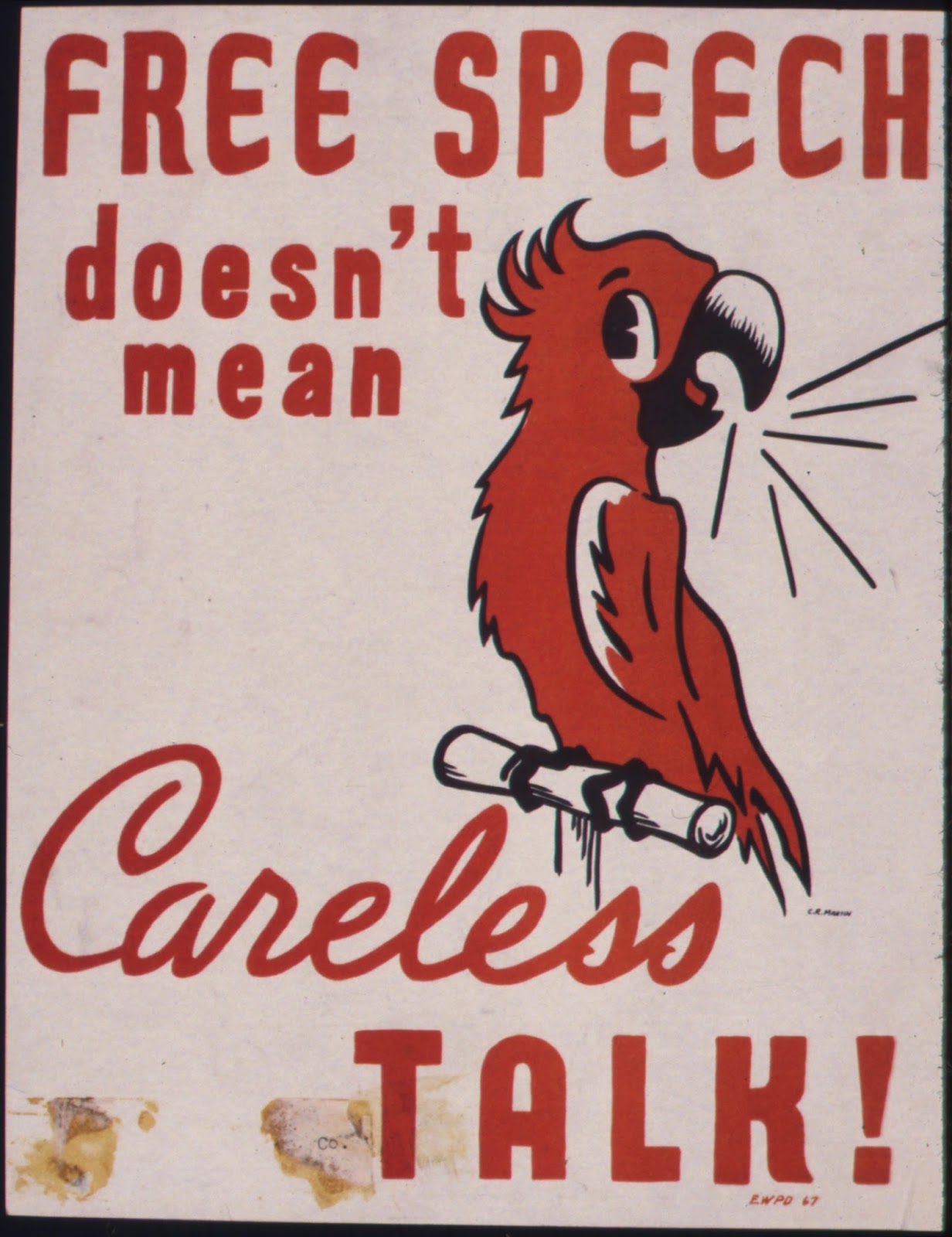
Office for Emergency Management War Production Board Free speech doesn't mean careless talk circa 1942 1943 Public Domain via Wikimedia CommonsWhen I first read the title of this debate, my immediate reaction was ‘Yup!’

I consider myself more of a liberal than otherwise, yet I found myself generally in agreement with the proposition ‘Liberals are stifling intellectual diversity on campus’.

Many of the examples of effective censorship were already familiar to me: the students who called for UC Berkeley to dis-invite Bill Maher to deliver a commencement speech; constant overzealous insistence on ‘politically correct’ terminology; the perceived need to prefix nearly every class lecture or statement with ‘trigger warnings’ so that students’ feelings, apparently of the delicacy of fine china within their tender little minds, wouldn’t suffer in the slightest.

If I sound sarcastic in the latter remarks, it’s intentional: all this hyper-sensitivity, I fear, is helping to dumb down public discourse, which is especially worrisome in the very institutions whose mission it is to enlighten. It’s important to understand the difference between respect for others, which I think includes the respect for their intellect which informs open and honest discourse, and the squeamish fear of arousing any emotional response beyond placid approval.

To be fair, there’s plenty of non-liberal censorship going on too, as the debaters against the motion pointed out, and were some examples of purported liberal censorship that I don’t think are valid. For example, Kirstin Powers, in favor of the motion, referred to universities refusing to approve student club constitutions that require their members or leaders to hold certain beliefs, such as at Vanderbilt University. I don’t think this is an example of censorship at all. The reasons students are not allowed to command belief in their members are derived from generally applicable laws and principles that prioritize full participation in the public square. An institution that accepts money and resources from the public, such as a university, is well within its rights to say that a club can’t accept those resources and then turn around and allocate them in a discriminatory way. Likewise, the university, and in turn its approved clubs, can’t command their members not to believe certain things either. The students who decide to join these clubs will thus freely self-select their own membership, and those who join who hold dissenting beliefs will bring in a little healthy debate and strengthen the club’s own grasp of the ideas they promote. That’s how the marketplace of ideas works.

Likewise, the students who call for dis-invitations of speakers they don’t agree with would show themselves much more faithful to true liberal values if they support the right of people with opposing views to speak at their campus. If they disagree with the views and actions of the speaker, they should show up to the speech and challenge the views of the speaker in person, in the question and answer session, or with signs for the speaker and audience to read, or if no other means of expression is available to them, plainly express their dissent by getting up en masse and walking out.

~~~~~~~~
Sources and Inspiration
‘Liberals are Stifling Intellectual Diversity on Campus’, Intelligence Squared U.S. debate, Feb 24, 2015.
http://intelligencesquaredus.org/debates/past-debates/item/1310-liberals-are-stifling-intellectual….

‘Vanderbilt University: Refusal to Approve Constitutions of Student Groups that Require Leaders to Share Beliefs’, FIRE (Foundation for Individual Rights in Education) website, 2012.
http://www.thefire.org/cases/vanderbilt-university-refusal-to-approve-constitutions-of-student

How the Brain Works (and Doesn’t) vs Our Justice System

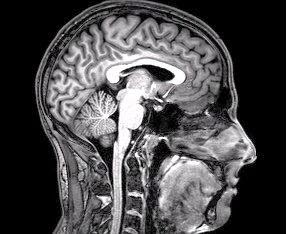
We’re learning new and surprising things about our brains all the time. Psychologists, behavioral economists, and other scientists have sophisticated new tricks to reveal what’s going on inside our skulls, and their findings are publicized more widely than ever before. We reveal what we think we’re thinking through polls and quizzes, we’re ‘tricked’ into revealing what we’re really thinking through rigged puzzles and tests (exposing our biases, misconceptions, etc), we have easy access to massive databases of recorded human thought, and most amazingly, neuroscientists can now peer inside our brains while we’re thinking. And some of what we’re learning shows us that we’ve been wrong about ourselves in some really important ways.

So: do changes in our understanding of how the brain works mean we have to change, even to overhaul, how our justice system works too?

Our justice system! WHAT?!? Why would we want to change something so equitable, so honorable, it’s defined by the word ‘justice’?

Seriously, though: to many, this question is almost too scary to ask. 

Won’t we send the signal that we’re no longer tough on crime by even proposing such a project? Isn’t our justice system pretty good as it is? Occasional ‘bad apple’ cops, perjuring witnesses, and corrupt prosecutors aside, our justice system is founded on the wholesome principle of personal responsibility: if we do wrong, we pay the price. A central feature of our justice system, after all, is the right to a fair trial by a jury of our peers. And as a society, we’ve taken great pains to ensure that everyone charged with a crime can get a fair trial. Our standards of evidence are pretty high: there must be eyewitness testimony and plenty of it. Forensic evidence is carefully collected and thoroughly analyzed, from blood to fingerprints to DNA to the tiniest of hairs and fibers. Everyone is entitled to legal counsel, even if the taxpayers have to foot the bill. Children and the mentally disabled are, properly, not tried as if they have the same level of responsibility as fully capable adults. The convicted have a right to appeal if they present evidence that their trial was unfair or if they can demonstrate innocence. And so on.

Even granting all of these and setting them aside for now, a common objection to the current justice system in general is that the underlying concept of personal responsibility is a myth. We’re not responsible since everything we think and do is determined by laws of cause and effect. So, we have no free will, and if we have no free will, the whole concept of moral accountability, of responsibility for our actions, doesn’t make sense. The justice system ends up, then, having nothing to rightfully judge or punish. Let’s explore this for a moment.

What do we mean by personal responsibility? We mean that it’s we that did the thing, it’s we who understand that there are alternatives available to us, and it’s we that could, at least conceivably, have done otherwise. This is true even if our personalities, past experiences, and current circumstances make it unlikely we would have chosen otherwise. It’s reasonable to assign responsibility for actions, since it deters us from making bad choices, and motivates us to inculcate better habits in ourselves. Assigning responsibility does not mean we must ruthlessly punish all who do wrong; it means that we can make reasonable demands of one another as the circumstances warrant, be it punishment, recompense, an apology, or an acknowledgement of responsibility.


Who’s responsible for our actions, then? We all are, so long as we are capable of understanding what we should do and why (whether or not we understood at the time), and so long as we could have chosen to do otherwise. Unless immaturity, injury, or illness makes it impossible, or nearly impossible, to control our actions, all persons who are free to make their own choices can and should be held responsible for those choices. (I argue for this more fully in ‘But My Brain Made Me Do It!’)

By the way, that’s why I disagree with many who think that psychopaths shouldn’t be held responsible for their actions. Although it may be more difficult for the psychopath to do the right thing, to respect the rights of others, it’s still in their power to do so, so long as they are capable of reason. We don’t let other people off the hook just because they don’t feel like doing the right thing; and all people, psychopaths or not, often find the wrong thing to do irresistibly attractive, and the right thing difficult. As long as anyone demonstrates sufficient intelligence to understand that the rules apply to them, it doesn’t matter that they wish it didn’t, or feel like it shouldn’t. After all, psychopathy is characterized by lack of empathy, not intelligence. The impartiality that underlies all morality, as in A owes a moral or legal duty to B, so B owes an equal moral or legal duty to A, is a simple and logical equation that any minimally intelligent adult person can grasp, psychopath or not.

So if the concept of personal responsibility, or moral accountability, is generally a good one, and our society is so committed to creating a fair justice system, what’s the problem with it?Here’s one of the main problems: many of our laws and practices are based on a poor understanding of how memory works, and an underestimation of how often it doesn’t work. For example, many of our law enforcement tactics are virtually guaranteed to result in unacceptably high rates of false convictions through their tendency to influence or convince suspects and eyewitnesses to remember details and events that never happened. Police interrogators can and do legally lie to their subjects in the attempt to ‘get them to talk’, under the assumption that false information has little to no effect on the person being interrogated other than to coax or scare the truth out of them. Until very recently, we didn’t understand how malleable memory really is, how easy it is in many circumstances to get others to form false memories by feeding them information. Courts all over the United States, even the Supreme Court, have upheld such deceptive techniques as lawful, yet we have mounting evidence to show these techniques have the opposite of their intended effect – unless, of course, the intended effect is any conviction for crime, not just the true one.

The fact that human memory is as undependable as it it seems counterintuitive, to say the least. It’s true that we can be forgetful, that we trip up on unimportant details such as the color of a thing, or the make of a car, or someone’s height. But surely, we can’t forget the really important things, like what the person who robbed or raped us looks like, or whether a crime happened at all, especially if we’ve committed it ourselves. Yet sometimes it’s the accumulation of small, relatively ‘unimportant’ misremembered details that leads us to ultimately convict the wrong people, and the evidence piling up also reveals that we do, in fact, misremember important things all the time. And people are losing their reputations, their liberty, their homes and money, even their lives, because of it.
 
Before we look at this evidence, let’s explore, briefly, how we think about memory, and what we are learning about it.

Not so long ago, working theories of human memory rather resembled descriptions of filing systems or of modern computers; many still think of it that way. We thought of the brain as something like a fairly efficient librarian or personal secretary neatly and efficiently storing important bits of information, such as memories of things that

happened to us, images of the people and places we know or encounter in significant moments in our lives, and so on, in a systematic way that would facilitate later retrieval, and most importantly, retrieval of reliable information. ‘Unimportant’ memories, or the less significant details of memorable events, were thrown away by forgetting, so that brain power wouldn’t be wasted on useless information. Sometimes we’d find old memories stuffed away in the back of the file or pushed off to a corner somewhere, a little difficult to retrieve after much time had passed, but still accessible with some effort. But important memories were stored more or less intact and discrete from one another, so if we remembered something at all, we’d remember it fairly correctly, or at least, the most important details of it. After all, it wouldn’t make sense for our internal secretary to rip up the memory file into little pieces and stash it all over the place helter-skelter, or to cross out random bits or even doctor the files from time to time, would it? And we certainly couldn’t remember things as if they actually happened to us if they didn’t. It seems all wrong, that evolution (or an intelligent designer, if that’s your thing) would give us an inefficient, inaccurate, dishonest, or mischievous keeper of that most cherished, most self-defining component of ourselves, our life’s memories.

But now we know that memory works differently in many ways than we thought. How do we know this? For one, we’re now looking inside the brain as we think, and brain scans show that the process of recalling looks different in practice than we might have expected if some of our old theories were true. But more revealingly, we’re taking a closer look at our cognitive blunders. Like many other discoveries in science, we find out more and more about how something works, honing in on it so to speak, by examining instances where it doesn’t work as it should if our theories, or common sense, were correct.

As we’re finding out that memory doesn’t work as we thought, we’re also realizing how heavily our justice system relies on memory and on first-person accounts of what happened. We place a very high value on eyewitness testimony and confessions in pursuing criminal convictions, again, based on faulty old assumptions about how memory works, and how accurately people interpret the evidence of their senses. Yet as we’ll see, people have been falsely convicted because of these, even when other evidence available at the time contradicted these personal accounts of what happened. As our justice system places undue faith in memory and perception, despite their flaws, in what other ways is it built on wrong ideas about how the mind works?

Neuroscience, the quest to understand the brain and how it works, was founded on case studies of how the mind to appeared to change when the brain was injured. Traditionally, the mind was thought of as a unified thing that inhabits or suffuses our brain somewhat as a ghost haunts an old house. If part of the house burns down, the ghost is the same: it can just move to another rooms. But careful observers, early scientists, noticed that an injury to a part of the brain affects the mind itself. When particular parts of the brain were injured, patients lost specific capabilities (to form new memories, for example, or to recognize faces, or to keep their temper). Sometimes, the personality itself would change, like from friendly to unfriendly or vice-versa. Or in the case of split-brain patients, they would simultaneously like and dislike, believe and not believe, or be able and not able to do certain things, depending on how you ask, or sometimes just depending on what side of the body you address them from! Gradually, we came to understand that the mind is something that emerges from a physical brain, from the way the brain’s parts work together, and is entirely dependent on the brain itself for its qualities and for its very existence. 


And as we discussed, it’s not only neuroscientists with their fMRIs that are revealing how the brain works. The criminal justice system has amassed mountains of evidence that shows us how often the human brain does its job and helps us ‘get the right guy’, and how often it fails. With advances in technology, such as DNA testing, more sophisticated firearms testing, expanded access to files and records, and many other newly available forensic tools, we’re discovering an alarming number of false convictions, not only of people currently imprisoned, but sadly, of those we’re too late to help. Most of these are the direct result of basic errors of our own faulty brains. 

(I’ve more briefly discussed the issue of false convictions for crime in an earlier piece, stressing the importance of knowing the ways our criminal justice system fails, and one of the most effective ways society can keep itself informed.)

Two of the main culprits in false convictions are false memory and misperception, the one resulting from errors in recall, the other resulting from bias or the misinterpretation of sense evidence.

For example, let’s consider the case of a rape victim and the man she falsely accused, who went on to work together for reform in certain law enforcement practices. For years, Jennifer Thompson-Cannino was absolutely sure that Ronald Cotton had raped her, and her identification of him led to his conviction for the crime. After all, as she said, and as the court agreed, one couldn’t forget the face of someone who had done this to you, committed such an intimate crime inches away from one’s own eyes, could they? Eleven years later, the real rapist was identified when the original rape kit sample was re-tested to confirm a DNA match. Over time, Thompson-Cannino had convinced herself, honestly by all accounts, that Cotton’s face was the one she originally saw, and each time she looked at it, the more she ‘recognized’ it as that of her rapist, and the more strongly she associated this recognition with the rest of her memories of the crime. Fortunately, she’s one of those rare people who are able to fully admit such an egregious mistake, and she has joined with Cotton to call on police jurisdictions to change the way suspect lineup identifications are conducted. Thompson-Cannino and Cotton learned a hard lesson about the fallibility of memory, and how preconceived notions (in this case, that the police must be right) can withstand the rigors of the courtroom and still lead to very wrong conclusions.

But we can imagine that such a mistake must happen from time to time, as in Cotton’s case, when the supposed criminal looks quite a bit like the real one, and the array of circumstances that led to the whole mix-up were so unusually convoluted. But, surely, a lot of people couldn’t all remember the same crime, or series of crimes, wrongly, and describe it mostly the same way when questioned separately? Well, that happens too
. The McMartin case of the early 1980’s was just the first of a string of cases which resulted in hundreds of people being convicted for the rape and torture of small children, usually entirely based on the purported evidence of the ‘victims’ ‘ own memories, or those of their family members. The ‘victims’, mostly young children, told detailed, lurid, horrific stories of events that most people would consider beyond the imaginative scope of innocent children. Over time, as those convicted of the crimes were pardoned, exonerated, or usually just had the charges dropped without apology (some still languish in prison, or are confined to house arrest, or are barred from being with children, including those of their own family), videos and transcripts of ‘expert’ interviews with these children found them leading their interviewees on. Professional psychologists and interrogators were found to be influencing children to form their own false memories, even planting them whole-cloth, rather than drawing them out as most people thought they were doing. This includes the professionals themselves! Some of these children, now grown, still ‘remember’ these events to this day, even those who now know they never happened.

Okay, now we’re talking about children, and we all know children are impressionable. But usually it’s adults who give evidence in such important cases, and though they might be fuzzy on the details when it comes to what other people did, they know what they themselves did, right? Well, here again, no, not necessarily. In Norfolk, Virginia, eight people were convicted of crimes relating to the rape and murder of one woman, based on the first-person confessions and testimony of four military men. These men, who had tested sound enough of mind and body to join the Navy, were convinced by police interrogators, one by one, to ‘reveal’ that they and several others had, by a series of coincidences, formed an impromptu gang-rape party that managed to conduct a violent crime that lasted for hours, while leaving little destruction or evidence behind. Although these confessions didn’t match the evidence found in the crime scene, didn’t match the other confessions, or were contradicted by alibis, all were found guilty on the common-sense and legal assumptions that sane, capable people don’t falsely accuse themselves.Yet as in the Norfolk case, the case history of our criminal justice system reveals that with the right combination of pressure, threats, assertion of authority, and personality type, just about anyone can be pushed to confess to committing even a terrible crime, and worse yet, become convinced that they did it (as one of the men did in the Norfolk case). The Central Park Five, as they are often called, were five teenage boys, aged 14 to 16, who were convicted of the rape, torture, and attempted murder of a woman in Central Park in New York City. The justifiably horrified public outrage at this crime, combined with frustration over a rash of other crimes throughout the city, put a lot of pressure on law enforcement to solve the crime in a hurry. These five boys had already been picked up by police officers in suspicion of committing other crimes that night, of robbery and assault, among other things, and when the unconscious, severely beaten woman was found, the police hoped they had her attackers in custody already. After hours of intensive untaped interrogation, all five eventually confessed, implicating themselves and each other. They were convicted, despite the fact that the blood evidence matched none of them, and their confessions contradicted each other in important details. 

False memories and false confessions are only two of the ways our fallible brains can lead us astray in the search for truth. Human psychology, so effective at so many things, is also short-sighted, self-serving, and wedded to satisfying and convenient narratives, to a fault. Law enforcement officials in all of these cases were convinced that their theories of effective interrogation were right, and that their perceptions of the suspects were right. The prosecutors were convinced that the police officers had delivered the right suspects for trial. The legislators that made the laws, and the courts that upheld them, were convinced they were acting in the best interest of justice. And as we’ve seen, all of these were wrong.

As just about everyone was who were involved in bringing Todd Willingham to court, and in condemning him to die for the murder of his own children by arson. By all accounts, Willingham didn’t act as people would expect a grieving father to act, especially one who had escaped the same burning house his children had died in. Yet it was one faulty theory after anotherfrom pop psychology and preconceived notions about that ‘real’ grief looks like, from bad forensics to a poor understanding of how an exceedingly immature and awkward man might only appear guilty of an otherwise unbelievable crime, that led to his conviction and execution by lethal injection.

But the problem of false conviction for crime is much, much larger than we might suppose from the cases we’ve considered here: these were all capital crimes, and as such were subject to much more rigorous scrutiny than in other cases. If wrongful convictions are known to happen so often in the case of major crimes, we can reasonably extrapolate a very high number of false arrests, undeserved fines, and especially, false plea deals, in which people innocent of the relatively minor crimes they’re accused of are rounded up, charged, and sentenced. Plea bargaining presents a special problem: suspects are persuaded to plead guilty and accept a lesser sentence than the frighteningly harsh one they’re originally threatened with, and in jurisdiction after jurisdiction, we’re finding that huge numbers of innocent people are sent to prison every year through this method. All of this results from a blind zeal to promote justice, or at least, the appearance of justice in the interest of feeling secure, of more firmly establishing authority, or of fulfilling the emotional need to adhere to comforting social traditions.

So how do we need to change our attitude towards our criminal justice system, in the pursuit of actual justice? A proper spirit of epistemic humility, a greater concern for those who may have been wrongfully convicted, and a real love of justice itself (rather than the mere show of caring about justice that the ‘tough on crime’ too often consists of).

But we still are left with the practical task of protecting ourselves and one another. Positive action must be taken, or crime will run rampant, being unopposed. But that doesn’t mean hold on to old ideas and practices because we like them, because they are familiar and ‘time-tested’, and make us feel safe. This includes the death penalty, which shuts out all possibility that we can remedy our mistakes.

Here’s one general solution: approach criminal justice as we do science itself, where we accept conclusions based on the best evidence at the time, but founded on the idea that all conclusions are contingent, are revisable if better, compelling, well-tested evidence comes along. We need a justice system that assumes the fallibility of memory and perception, and builds in systematic corrections for them.

And we need a system that doesn’t just pay homage to this idea: we need to build one that allows for corrections, and not in such a way that it takes years, if ever, to release someone from prison or clear someone’s name if the evidence calls for it. Many would say that the system already works this way: look at how many appeals are available to the convicted, and how many hundreds of people have already been exonerated of serious crimes. But it doesn’t work that way in almost all circumstances. It takes anywhere from months to several years after actual innocence is established to actually release a wrongfully convicted person from prison. For all those not so lucky as to have their innocence proved: most cases don’t have DNA evidence available to test to begin with, at least that would definitively prove guilt or innocence. And even in the rare cases such evidence is available, most is never re-tested to begin with, since the bar for re-evaluation of evidence is so high. Or, the evidence that was available is destroyed after the original conviction and is unavailable for re-examination. Or, legal jurisdictions are so determined that their authority remain unchallenged that they make it extremely difficult, if not impossible, for prosecutors and law enforcement officers to be held accountable in any way if they make a mistake, and bend over backwards to make sure such mistakes are never revealed. And so on.

In short: we don’t just need a justice system that brings in science to help out; we need a justice system whose laws and practices emulate the self-correcting discipline of science, which, in turn, is derived from the honest acknowledgement of the limitations of our own minds.

*Listen to the podcast version here or on iTunes

* Also published at Darrow, a forum for thoughts on the cultural and political debates of today

~~~~~~~~~~~~~~~~~~~~~~

Sources and Inspiration

‘About the Central Park Five’ [film by Ken Burns, David McMahon and Sarah Burns], PBS.org.
http://www.pbs.org/kenburns/centralparkfive/about-central-park-five/Berlow, Alan. ‘What Happened in Norfolk.’ New York Times Magazine. August 19th, 2007.
http://www.nytimes.com/2007/08/19/magazine/19Norfolk-t.html

‘The Causes of Wrongful Convictions’. The Innocence Project.
http://www.innocenceproject.org/causes-wrongful-conviction

Celizic, Mike. ‘She Sent Him to Jail for Rape; Now They’re Friends’ Today News, Mar 3, 2009.
http://www.today.com/id/29613178/ns/today-today_news/t/she-sent-him-jail-rape-now-th

Eagleman, David. ‘Morality and the Brain’, Philosophy Bites podcast, May 22 2011.
http://philosophybites.com/2011/05/david-eagleman-on-morality-and-the-brain.html

‘The Fallibility of Memory’, Skeptoid podcast #446. Dec 23, 2014.
http://skeptoid.com/episodes/4446

Fraser, Scott. ‘Why Eyewitnesses Get It Wrong’ TED talk. May 2012
http://www.ted.com/talks/scott_fraser_the_problem_with_eyewitness_testimony

Grann, David. ‘Trial by Fire: Did Texas Execute an Innocent Man?’ The New Yorker, Sep 7, 2009
http://www.newyorker.com/magazine/2009/09/07/trial-by-fire

Hughes, Virginia. ‘How Many People Are Wrongly Convicted? Researchers Do the Math’. National Geographic: Only Human, Apr 28, 2014.
http://phenomena.nationalgeographic.com/2014/04/28/how-many-people-are-wrongly-

Jensen, Frances. ‘Why Teens Are Impulsive, Addiction-Prone And Should Protect Their Brains’. Fresh Air interview, Jan 28th, 2015.
http://www.npr.org/blogs/health/2015/01/28/381622350/why-teens-are-impulsive-...

Kean, Sam. ‘These Brains Changed Neuroscience Forever’. Interview on Inquiring Minds, 

Lilienfeld, Scott O. and Hal Arkowitz. ‘What “Psychopath” Means’. Scientific American,
Nov 28, 2007. http://www.scientificamerican.com/article/what-psychopath-means/

Loftus, Elizabeth. Creating False Memories.’ Scientific American, Sept 1,1997. http://faculty.washington.edu/eloftus/Articles/sciam.htm
and ‘The Fiction of Memory’ TED talk. June 2013.
http://www.ted.com/talks/elizabeth_loftus_the_fiction_of_memory?

 
Nelkin, Dana K., ‘Moral Luck’, The Stanford Encyclopedia of Philosophy. Edward N. Zalta (ed.) http://plato.stanford.edu/entries/moral-luck/
 
Perrilo, Jennifer T. and Saul M. Kassin. ‘The Lie, The Bluff, and False Confessions’. Law and Human Behavior (academic journal of the American Psychology-Law Society). Aug 24th, 2010.
https://www.how2ask.nl/wp-content/uploads/downloads/2011/10/Perillo-Kassin-The-Lie

Possley, Maurice. ‘Fresh Doubts Over a Texas Execution’. The Washington PostAug 3, 2014.
http://www.washingtonpost.com/sf/national/2014/08/03/fresh-doubts-over-a-texas-execution/

Robertson, Campbell. ‘South Carolina Judge Vacates Conviction of George Stinney in 1944 Execution’, The New York TimesDec. 17, 2014. http://www.nytimes.com/2014/12/18/us/judge-vacates-convict

Shaw, Julia. ‘False Memories Creating False Criminals’. Interview, Point of Inquiry podcast.
March 2nd, 2015. http://www.pointofinquiry.org/false_memories_creating_false_criminals_with_dr..

‘The Trial That Unleashed Hysteria Over Child Abuse.’ New York Times, Mar 9th, 2014.
and video ‘McMartin Preschool: Anatomy of a Panic | Retro Report’

Book Review / Summary: The Birth of the Pill

In The Birth of the Pill, Jonathan Eig tells the fascinating story of the four people whose combined efforts, arguably more than any others, made birth control effective, affordable, widely available, and perhaps most importantly (since it makes all the others possible), socially acceptable: Margaret Sanger, Dr. Gregory Pincus, Dr. John Rock, and Katherine McCormick.

At the time the contraceptive pill was being developed, human reproduction was still very poorly understood. Prudish attitudes and obscenity laws hampered scientific research, discouraged and in many cases prevented doctors from educating their patients, and kept women from having any significant degree of control over their own bodies or the decision to become pregnant. It took a few independent-minded, morally driven people of unusual character to achieve change in the arena of reproductive rights.

Two of these four had spent years caring for people whose unchecked fertility threatened their own life and health, and the well-being of their families. Women, especially poor women, found themselves pregnant again and again before their bodies had recovered from earlier pregnancies, had medical conditions caused or exacerbated by pregnancy and childbirth, or could not afford adequate food, clothing, shelter, and health care for their rapidly growing families. Many women also found too many pregnancies burdensome, as they were prevented from pursuing an education or a career, or suffered from exhaustion, depression, and feelings of hopelessness as they found themselves caring for more children than they could cope with.

Margaret Sanger and Dr. John Rock encountered all of these problems up close and personal; their birth control activism was the direct result of their experiences as reproductive health care providers. Sanger worked for many years as a nurse caring for the poorest people in the slums and tenements of New York City. She was so moved by the plight of these women that she risked fines and imprisonment to open the first ‘birth control’ clinic (as she coined the term). Countless poor women, who had often already fled starvation, poverty, and disease in their home countries, found themselves unable to escape the cycle of repeated pregnancies and deepening poverty as their own bodies weakened and their meager resources were stretched ever thinner in the face of anti-immigrant bias, pittance wages, and filthy, overcrowded, and dangerous living and working conditions. This was also an era when women had no right of refusal of sex to their husbands. They faced the awful choice of risking another pregnancy, injury or death by self-performed abortion, or being abandoned when few jobs were available to women, and few jobs paid women enough to live on themselves, let alone support a family. And charity organizations, try as they might, could not keep up with even a fraction of the demand for assistance. Despite repeated arrests and fines, Sanger continued to provide birth control devices and information to the who women flocked to her clinic, pouring out their life stories in person and in letters like this one (original spelling):

‘… I am thirty years old have been married 14 years and have 11 children… I have kidney and heart disease, and every one of my children is defictived and we are very poor. Now Miss Sanger can you please help me… I am so worred and and I have cryed my self sick …I know I will go like my poor sister she went insane and died. …the doctor won’t do anything for me … if I could tell you all the terrible things that I have been through with my babys and children you would know why I would rather die than have another one. Please no one will ever know and I will be so happy and I will do anything in this world for you and your good work …Doctors are men and have not had a baby so they have no pitty for a poor sick Mother. You are a Mother and you know so please pitty me and help me. Please Please.’

I can only imagine what Sanger felt as she read this letter as she worked with so many women struggling under these same burdens, while social mores and the law opposed her efforts to help them.

Dr. John Rock was an obstetrician and fertility specialist. While one of his main focuses was on helping women with fertility problems become pregnant, he also worked with many other women for whom pregnancy, childbirth, and child care was detrimental to their physical and mental health, for various reasons. He became a staunch activist for birth control, and worked to convince the public and the Catholic church, of which he was a committed member, that effectively planning families and regulating childbirth is not only practical, but of the highest moral worth, since it promotes bodily and spiritual health, and a loving family life in which all children can be well cared for. He thought he could convince the church hierarchy that the hormonal method of birth control is consistent with Catholic teaching, since it’s simply an extension of the natural cycle that occurs in a woman’s body, rather than a barrier method with was doctrinally forbidden; his rhythm-method clinic taught the only form of birth control other than abstinence that was sanctioned by his religion, but as he observed, neither worked very well. His efforts to help women control their rates of pregnancy would eventually prove effective, but his efforts to convince the Church, until this day, have been in vain.

Yet birth control was not only linked to beliefs in reproductive rights and health: it was linked to a change in sexual mores. Sanger, Pincus, Rock, and McCormick all held what we’d now call ‘sex-positive’ beliefs: they thought sex could and should be a wonderful thing, among the most joyous, intimate, and healthy means by which humans connect with one another. In a time when sex was often regarded as shameful, depraved, and for the sake of men (I would argue that while it’s re-branded, it still is, as ‘liberated’, ‘powerful’ women painfully squeeze themselves into bustiers and stilettos and straighten, curl, bleach, and cut their hair and bodies to fit into a few stereotypical male fantasy body types as possible, in our crudely sex-obsessed, tabloid, misogynistic culture — yes, I’m talking about you too, Beyonce), they thought it could and should be a loving, freeing, and transcendent experience for both partners.

Dr. Gregory Pincus, the scientist who would ultimately formulate the first effective, FDA-approved birth control pill, was an unusually independent-minded, freethinking, colorful personality from an early age. As a young researcher at Harvard, he was widely publicized for his frank and unapologetic views on the benefits of revolutionizing human reproduction through scientific intervention. The sensationalist, brave-new-world ‘news’ stories led to Harvard’s kicking him out of their faculty and their labs, as a reputation-defense measure. Pincus went on to found his own research institute,. where he continued his research into hormones and their effects in reproduction. Arguably, it was this very political and financial independence from any large mainstream establishment that enabled him to succeed in his goal to produce the first birth control pill.

It also took money, and lots of it, as it does with any new pharmaceutical. Planned Parenthood could only provide limited funding for Pincus’s work, so it dragged on slowly, until Katherine McCormick, wealthy heiress, came along. She had discovered, shortly after she married, that her new husband suffered from severe mental illness. McCormick was well-educated, an MIT graduate at the time of her marriage, and was fascinated by all things science. When she learned of her husband’s mental illness, she poured time, money, and research into finding a cure, especially in the fields of hormonal research and heritability. She was also dedicated to women’s rights causes, and by the time of her husband’s death, her interests and fields of study and activism led to her single-minded determination to aid in the cause of making birth control effective and widely accessible. It was she, more than any other, who provided Pincus the funds to pursue more lab research, and for he and Rock to conduct more clinical trials.

Eig’s book is not a simple hero story: he reveals the history and personalities of each with their complex set of motivations, warts and all. Sanger was a eugenicist, for example. It was not uncommon for progressives, scientists, and those in the medical field to subscribe to the principles of eugenics at that time; many thought (mistakenly, as it turned out) that it was the only way science could really ‘cure’ disability and disease once and for all. Medical science, humanitarian groups, and governments had not yet offered systematic or effective solutions to the dangers of pregnancy and childbirth, diseases caused by overcrowding and malnourishment, and mental health issues, and were simply unable to keep up with the demands of the humanitarian crisis in affected communities. Eugenics, on the other had, seemed to offer the only sure and straightforward solution, until the application of its principles by fascist governments revealed how faulty a ‘science’ (really a pseudoscience) it was. Sanger was also a neglectful mother, unsuited by personality to the stay-at-home role mothers were restricted to in her time. Pincus was a media hound, and conducted some of his trials in what today would be considered an unethical manner. Rock was willing to mislead some of his patients when he found that public attitudes made most women unwilling to participate in contraceptive studies, if presented as such. And McCormick, like Sanger, had a marked tendency to elitism.

Yet the contributions of these four unusual, passionate, driven crusaders towards improving women’s health and social and legal emancipation can hardly be stressed enough. Women can now have as many children as they choose when they choose, and are not subject to the whims of men when it comes reproductive issues (still mostly true despite discouraging recent regrettable, retrograde legal decisions, for example, regarding the mandate that insurance companies pay for full reproductive health care). Sanger’s, Pincus’s, Rock’s, and McCormick’s belief that birth control would ultimately improve and save the lives of women, and improve the standard of living for families, have been vindicated over the years. For example, women on the pill live longer, on average, than other women, and the results of decades of study leads the World Health Organization to promote birth control as an important means of improving health and relieving poverty around the world.

With his excellent book, Eig not only compellingly tells the story of how the pill came to be, but also of the human dramas behind its invention. The history of the pill, the circumstances which gave rise to its invention, and the ideas of its creators show us how and why ready access to effective birth control is as important today as it ever was.

~~~~~~~~~~~~~~~~~~~~~~~~~~~

Sources and inspiration: 
Eig, Jonathan. The Birth of the Pill: How Four Crusaders Reinvented Sex and Launched a Revolution. W.W. Norton & Company, New York, 2014. http://books.wwnorton.com/books/The-Birth-of-the-Pill/

Kelland, Kate, Ed Jon Hemming ‘Women On the Pill Live Longer: Study’. Reuters, Mar 12 2010
http://www.reuters.com/article/2010/03/12/us-contraceptive-pill-risk-idUSTRE62B01R20100312

World Health Organization website, ‘Reproductive Health’.
http://www.who.int/topics/reproductive_health/en/

A Hike From Serpentine Prairie / Dream On, But Remember to Enjoy Today

Serpentine Prairie is a wonderful place to be in spring, and I started my hike there today.

It’s an open, hilly field adjacent to Redwood, a regional park in the Oakland hills, among the most beautiful places I’ve ever been, and I am so glad to live nearby.

We’re in a drought here in California, but you would never know it from what I saw. The native California grasses are abundant, green and thick (and rare, having been choked out by imported Mediterranean species, but not here: the poor soil, made from the crumbled bedrock serpentine, is inhospitable to all but the native species which evolved to thrive on it), bright green new growth is bursting from branches left and right against the darker trees, and vines crawl, twist, and fling themselves across it all, reaching for the sun. The wildflowers are in full bloom, in shades of golden orange (poppies, of course!), yellow, purple, and white, except for the mottled purple-and-green ones, a little like umbrellas and a little like bells, leaning down to shade and guard their tender inner flowers. The variety of wildflowers is surprising when you look a little closer: just the white ones all look like so many sparky little stars, but are so different in the shade of green, leaf shape, and size of the plant they grow from.

There’s a little plant here and there, a fern I think, with bright lightly ruffled leaves shaped like those of the ginkgo tree in autumn. They hang on superthin stems, almost gossamer, of purplish-bluish-black, and they fluttered and shuddered when I blew on them. Watch out for poison oak! you who suffer from it, because it’s all over the place. I think I’ve grown immune from the time I’ve spent among it all, but it’s best to be careful. It’s all tangled up underfoot, lobed and shiny, among the wild strawberry and miner’s lettuce, waiting to grab at an unwary ankle.

So many kinds of trees grow here: the twisty madrones with their sexy ultra-smooth skin, peeling bark, and little white bells on for spring; the gnarled, ancient-looking oaks with their moss, the exotic eucalyptus keeping the earth in place, and the redwoods, soooooo tall, and so aloof from all the seasonal frenzy going on underfoot.

Daylight savings time has just started, and I’ve been chomping at the bit for it: on my shorter days at work, now that the evenings are long, I made a beeline for the hills as soon as I got off, so I can finish my hike before dark, as I will do every week now that the long evenings of daylight are here. I’m selfish: I hope the farmers lose the argument, and daylight savings time remains our national habit.

Earlier today, I had just realized, once again, that I had lately fallen into one of my bad old habits, born of my impatient and restless nature. I’ve been so irritated at not being able to do all that I want to do right now, that I’ve been forgetting to fully enjoy the things I love to do that I am doing.

My day has job gotten busier and more demanding in the past year, my workload and the hours required to do the job well increased, and I’ve been fretting because the essays I want to write, the things I want to to sew, the books I want to read, the places I want to visit, are piling up, as I have less and less time to give them and still get my rest.

But when isn’t this true, and for whom? Nearly all lives become ever busier, and the days seem to grow shorter, the father away you are from childhood. That’s just the way it is.

We can only control how busy we are so much, when we must work for a living, have families to take care of, and so on. But we have a little more control over how we approach it all, as we struggle to keep up with what we need to do and what we want to do.

I am restless, and impatient, and prone to daydream. This can be good, and for the most part, I think it is. I like it, anyway: these have pushed me to do things I look back on with satisfaction. But when I realized earlier today that I had fallen out of the habit of fully enjoying the good things I could be enjoying now, I remembered to engage in my with so much more of my attention, so as I was closely observing the little flowers, the leaves, and the vines, I was looking closely enough to see the little snake dart across the path and ‘hide’ in plain sight, camouflaged against the stems, just as I was stepping out of Serpentine Prairie and onto Golden Spike Trail. What perfect timing!

I’ll go to bed now, thankful to have my love to cuddle with, and a world to wake to, that I’m lucky enough to have the opportunity to enjoy, as long as I remember to do so.