To New York City I Go, In Search of Ernestine Rose and Elizabeth Cady Stanton

Happy Birthday, Ernestine Rose! Well, happy belated birthday: I was so busy yesterday finishing my tasks at work and preparing for my week’s travel that I overlooked the day’s significance!

A little over two and a half years ago, I followed Ernestine Rose and her intellectual heir Elizabeth Cady Stanton through their history in New York City. Here’s the story in case you missed it!

Oh, and there’s an exciting new book coming out about Rose, called The Rabbi’s Atheist Daughter, which I can hardly wait to read.

Here’s to you, Ernestine Rose, and your fight for human rights!

Amy M Cools's avatarOrdinary Philosophy

Hello, friends of Ordinary Philosophy!

I’m pleased and excited to announce my upcoming adventure: my second philosophical-historical themed adventure, this time to New York City!

In case you missed my first go-round in my series of philosophy-travel pieces, here’s my plan:

So I’m taking a series of trips to places around the world, where I explore the lives and ideas of great thinkers in the places where they lived and worked. I’ll follow in the footsteps of thinkers who are no longer alive, since those who are still telling their own stories. But those who are no longer alive in the body live on in the ideas that they pass on, and in the example they provide for us to follow.

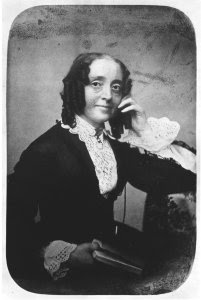
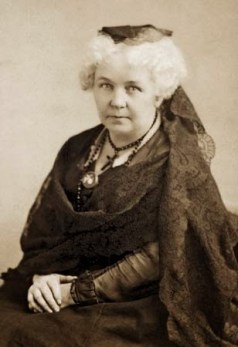
For this next installment, I’ll be following Ernestine Rose and Elizabeth Cady Stanton, two of the greatest founders of the women’s rights movement. Elizabeth was born in New York state, and…

View original post 253 more words

Margaret Sanger NYC Sites, Day 3 Part 2

24 Post Ave near Dyckman St, Inglewood, Manhattan, NYC, 2016 by Amy Cools

34 Post Ave near Dyckman St, Inglewood, Manhattan, NYC, 2016 by Amy Cools

Thursday, October 20th, 2016, continued

I exit the A train at the Dyckman St station, the second to the last stop on the line, and walk a couple of blocks to 34 Post Ave. Margaret Sanger moved into ‘an inexpensive little flat’ here in January of 1914 leaving her husband William, or Bill as she called him, behind in Paris. The Sangers had lived there for a few months as Sanger researched and wrote and William worked to establish himself as a painter. En route to Paris, they stopped in Glasgow, Scotland, so that Sanger could observe and write about the effects of municipal ownership, a system of public ownership often endorsed by Socialists, for a newspaper assignment. While in Paris, Sanger met with many socialists and activists, all the while researching French methods of contraception. But she was growing bored and restless, eager to get back to work and engage in activism once again. She and the three children returned to New York City around the New Year, leaving William behind to continue his artistic pursuits.
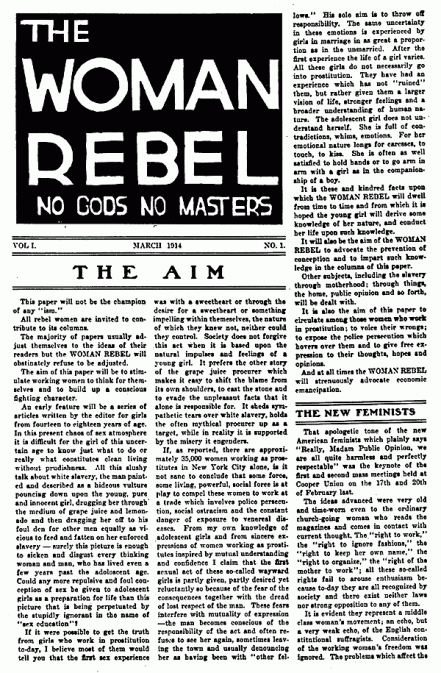
The Woman Rebel, First Edition, March 1914

The Woman Rebel, First Edition, March 1914, directed that inquiries be sent to Sanger’s 34 Post St address

The lady in the photo above, in the black and white checked jacket, is standing in the doorway of today’s number 34, but this building does not date to Sanger’s time here: it was built in 1920. Sanger’s apartment in the former building was small, cheap and according to Sanger, dingy. But big things would happen here. On the return voyage from Paris to New York City, she had conceived of a journal that was, as her biographer Ellen Chesler describes it, ‘dedicated to working women and intended to challenge Comstock’s prohibition of information about sexuality and contraception’. Sanger and a group of like-minded radical thinkers and activists launched The Woman Rebel from the kitchen table of that little apartment, publishing the first edition in March of 2014. One of those radicals, Otto Bobstein, invented the term ‘birth control’ which Sanger seized on and popularized, often claiming to have invented it. Perhaps she lied, or perhaps this is an example of one of those memories that longtime friends or siblings argue over, of a favorite term or phrase used often and long enough that no-one can remember who really came up with it first.

In a speech at Hotel Brevoort given a few years later on January 17th, 1917, Sanger agreed with the magazine’s critics that The Woman Rebel was ‘..badly written; …crude; …emotional, and hysterical; that it mixed issues; that is was defiant, and too radical. Well, to all of these indictments I plead guilty!’ She was proud nevertheless of the passion and sturdy defiance expressed in its pages. And what was printed on those pages led to her first indictment on obscenity charges, which drove her right back to Europe by the end of the same year she had returned and established this journal.
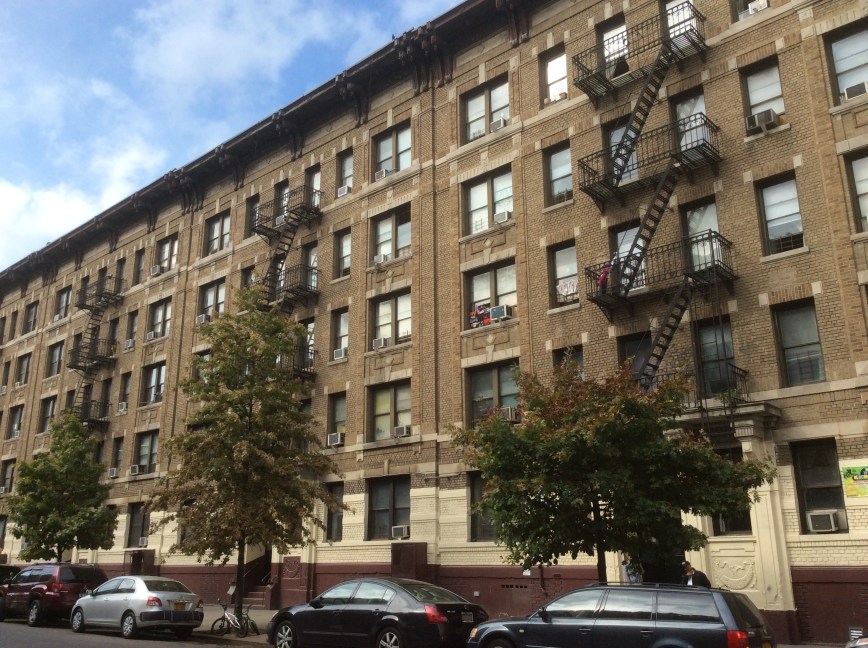
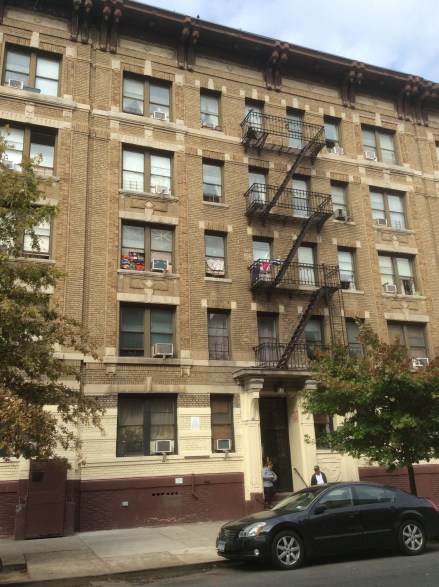
Apartment buildings which include 34 Post Ave near Dyckman St, NYC, 2016 by Amy Cools

Apartment buildings which include 34 Post Ave near Dyckman St, in Inwood, upper Manhattan. The row continues for most of the block, all identical, including the site of Ethyl Byrne’s place at 26 Post Ave.

A few doors west in the same apartment row of identical buildings, heading back towards Dyckman St and the subway station, is number 26 Post Ave. Sanger stayed here with her sister and fellow birth control activist Ethel Byrne for a time in 1915. Sanger’s daughter Peggy had died of pneumonia just a short time before on Nov 6th, 1915.
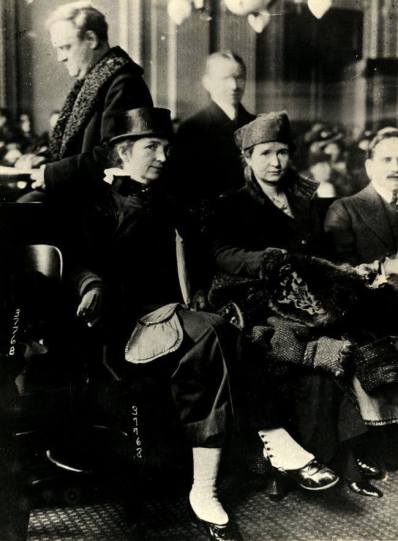
Margaret Sanger and Ethel Byrne in court, 1916, image public domain

Margaret Sanger, left, and Ethel Byrne, right, in court in 1916

Sanger and her sister Byrne enjoyed a close relationship in their early lives and into the nineteen-teens. Byrne, who left her husband and children to pursue her own nursing career, was very involved with Sanger’s early birth control activism. She had gone on a hunger strike when imprisoned for her own role in Sanger’s Brownsville clinic, to the point of seriously endangering her health. And Byrne had often helped care for Sanger’s children while Sanger was in exile in Europe and out of town as she was very frequently. However, their relationship deteriorated over later years. Byrne was a direct, no-frills woman who thrived on practical work and remained a nurse for the rest of her life; Sanger had given up nursing in favor of theory and activism. Byrne disapproved of Sanger’s solicitation of wealthy society women for the cause; Sanger was willing to accept help, connections, and most crucially, money, wherever they were offered. It seems easy to pick sides in this divide, and I’m tempted to take Sanger’s on the grounds that I think Frederick Douglass would, according to my understanding of his pragmatist views: to eschew practical and political concerns in favor of staying true to the highest ideals of a cause is to show a commitment to the ideals themselves and not necessarily to the cause’s success. This won’t do when it comes to the liberty, health, and very lives of actual human beings. But it also takes people such as Byrne to make a successful cause: the idealistic, uncompromising, hard workers who are driven to perform many of the most laborious, tedious, and thankless tasks. Here’s to you, Byrne, and all your hard work!
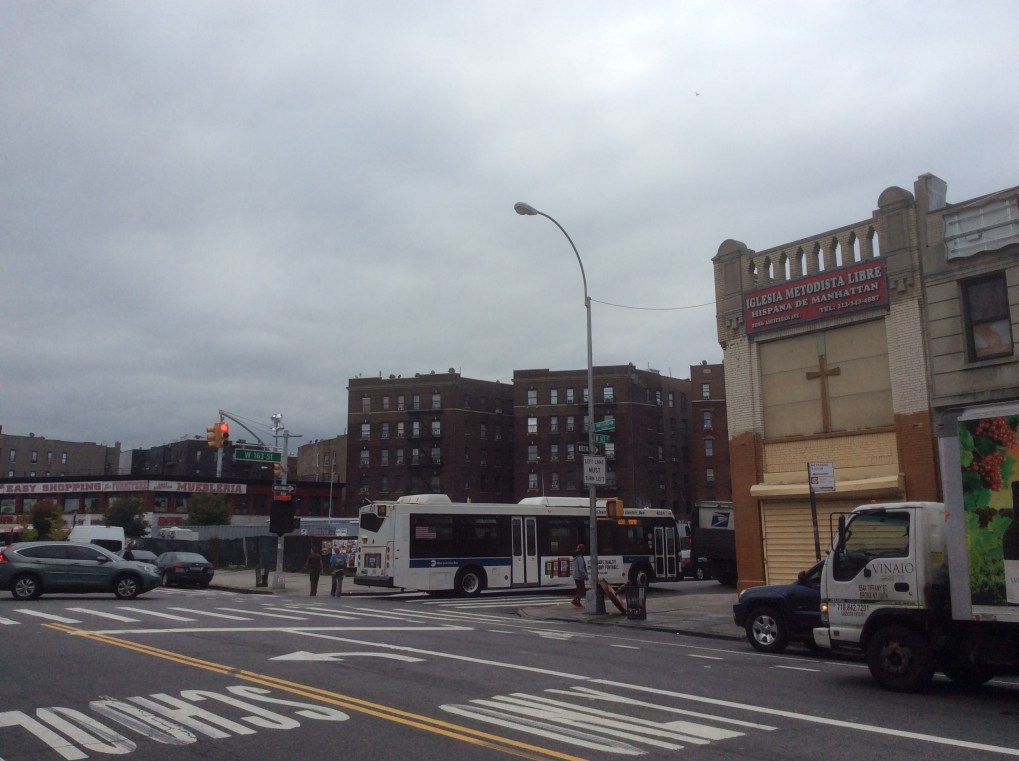
163rd St at Amsterdam. 503 163rd St. used to face where the bus is now. NYC, 2016 Amy Cools

163rd St at Amsterdam. 503 163rd St. used to face where the bus is now.

I take the A train back south a few stops to the station at 163rd and walk to 502 W. 163rd St at Amsterdam. According to Bromley’s Atlas of that same year, the building that once stood at 502 was on the north end of a wedge-shaped lot, now vacant, at the intersection of 163rd, Amsterdam, and St Nicholas Ave /Juan Pablo Duarte Blvd. This section of St Nicholas Ave is another busy section of the street, crowded with small shops, fruit and vegetable stands, and sidewalk vendors.

Sanger spoke at the Free Synagogue here on Sunday, April 22nd, 1923. Rabbi Louis A. Mischkind, a socially conscious, progressive, even radical religious leader, had invited Sanger to speak on birth control at the Tremont Temple. When his superiors objected, he moved the talk here to the Free Synagogue but was still demoted for his disobedience. Sanger’s Birth Control Review extolled his decision as an act of free speech heroism.
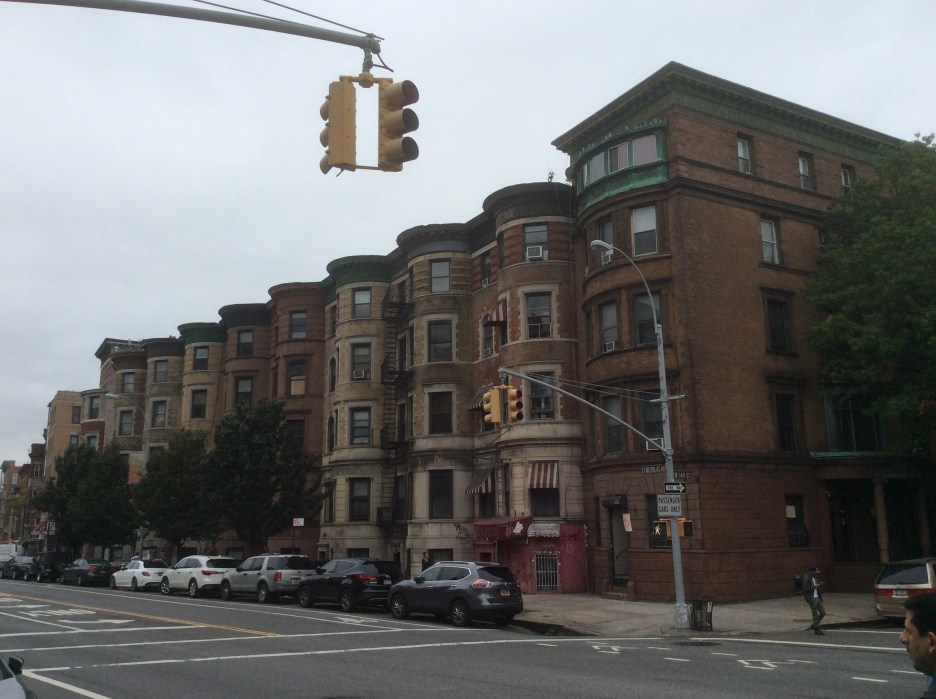
St. Nicholas Avenue at 149th Street, Broadbelt houses built in the late 1800's, NYC, 2016 by Amy Cools

St. Nicholas Avenue at 149th Street, Broadbelt houses built in the late 1800’s.
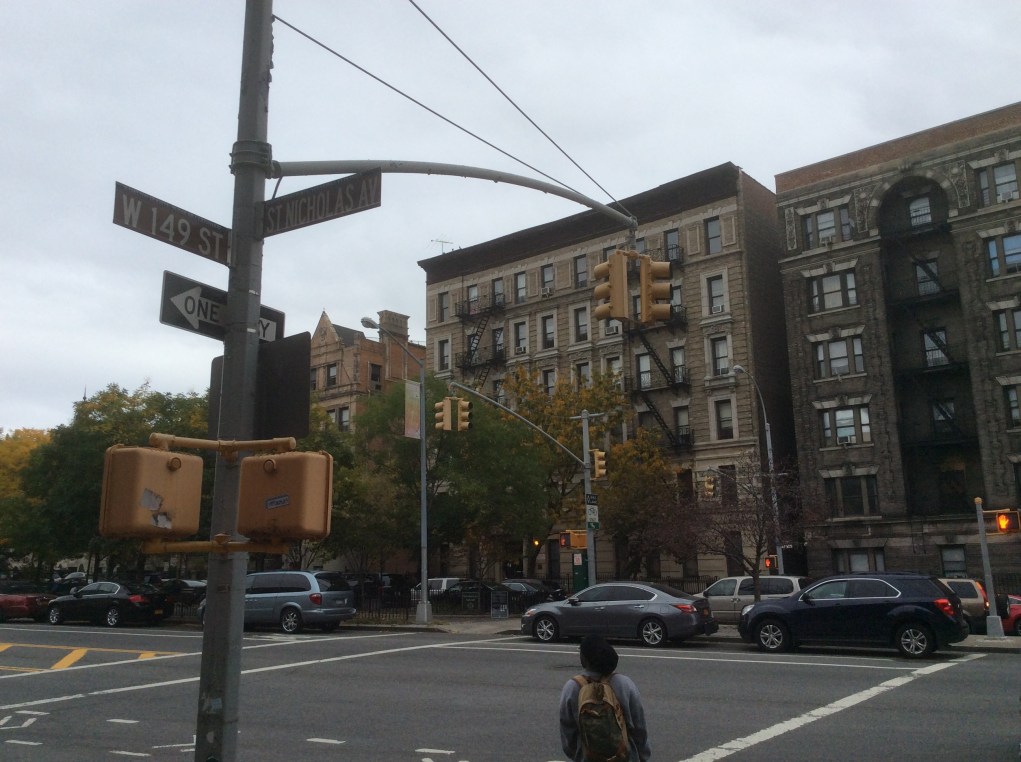
St Nicholas Avenue at 149th, more apartments which date to Sanger's time, NYC, 2016 Amy Cools

Apartments on St Nicholas Avenue at 149th, some of which date to Sanger’s time here or shortly after

Next, I walk a little over two-thirds of a mile south to where Sanger, newly wedded to William (she called him Bill), moved into a “practically suburban” “little apartment on St. Nicholas Avenue at 149th Street” shortly after their wedding on August 28th, 1902. As of the time I write this, I’ve found no exact address for their apartment here, just this little description she wrote in her autobiography. Their first son Stuart was born here on November 28th, 1903. The strain of his birth added to her general poor health, already worn out by a tough bout of her recurrent tuberculosis. She was also terribly despondent, with what her description indicates was post-partum depression. After she recuperated for some months in a farmhouse and a sanitarium, the couple moved to Hastings-on-Hudson. As we’ve seen, however, the suburban life did not suit the Sangers in the long run, especially Margaret, and they returned to New York City in 1910.

I continue south on St Nicholas, turn left on on 138th St, and go about two long blocks until I make a brief right on 7th Ave, also called Adam Clayton Powell Blvd. Here at 2352 7th Ave, Sanger opened the Harlem branch of the Birth Control Clinical Research Bureau on May 23, 1930. The BBCRB’s locations further south in Manhattan mainly served local women of European descent but Sanger believed that many other women needed the help of her clinics. She decided to open this northern branch to serve them.
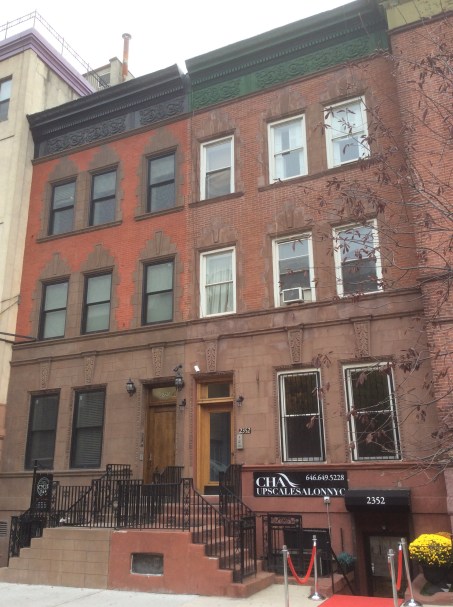
On the right, 2352 7th Ave (Adam Clayton Powell) at 138th St, NYC, photo 2016 by Amy Cools

On the right, 2352 7th Ave (Adam Clayton Powell) at 138th St, NYC, the site of the Harlem branch BBCRB clinic

This clinic in Harlem was actually Sanger’s second attempt to open a clinic in New York for black and other underserved women; she had briefly opened one in west Midtown, in a small, predominantly black, impoverished neighborhood called Columbus Hill. I have not yet found an address for its former location. This first clinic was not a success and closed after only a few months; Sanger thought it would be best to conserve resources to open a clinic in a place where she might reach more people. She had the support of many black leaders throughout these efforts, including the influential Reverend Adam Clayton Powell of the Abyssinian Baptist Church (for whom this street has been renamed), Mary Bethune, and W. E. B. DuBois. DuBois spoke here on one occasion that fall, on November 21st, 1930.

Interestingly, a rumor that persists to this day, that Sanger’s efforts to provide reproductive services for black women were racist, may have originated with an intellectual and tactical foe of DuBois’. A Harlem preacher named Marcus Garvey believed that the black and white races could never get along and must be separated. He founded a shipping company called ‘The Black Star Line’ with the ultimate goal of taking all African descendants back to their home continent to found a racially pure black nation. To this end, he opposed all forms of contraception or childbirth limitation for black people: the nation of his dreams would need as many citizens as black women could bear to make it a vibrant and strong one. Garvey attacked Sanger’s clinics and all efforts to help black women control their fertility as genocidal projects. DuBois took the opposite view, believing that black people could and should live as equal citizens in the United States and wherever else they wanted to live, and that black families could better gain their rights as their financial and physical health improved through judiciously constrained childbearing. Of course, Sanger and DuBois were in agreement on this, as they were on matters of racial equality.

The Harlem clinic was more successful than the Columbus Hill one, but still only stayed open for about seven years. Though Sanger hired a black doctor and social worker to run the clinic, there was likely enough Garvey-inspired rumor and suspicion of their motives that the clinic not as widely welcomed as they hoped. No wonder, then, that she wrote that infamous line in a 1939 letter regarding her efforts to serve black women in the South: ‘We don’t want word to go out that we want to exterminate the Negro population…’ The ‘word’, untrue and unjustified as it was, had already ‘gone out’ for her Harlem clinic several years before.

Interior of 2352 7th Ave at 138th St, now CHA Upscale Salon, NYC, photo 2016 by Amy Cools

Interior of 2352 7th Ave at 138th St, now CHA Upscale Salon

There’s now a hair salon at the on the lower level of the Harlem clinic site called Cha, and I go in. I find myself in a shining, sparkling lobby filled with mirror-lined and white furniture, a rhinestone chandelier, and white lilies in rhinestone vases. It promises pampering, which sounds glorious to this footsore woman. I see no one for a moment, then a voice calls, ‘Can I help you?’ A few steps in takes me to another stylist’s both, where a woman with a flowing, waved, luxuriant ‘do’ was doing another woman’s hair. I very briefly explain that I’m doing a history project and ask if I can take a quick photo of her lobby. She says yes, kindly, but distracted, focused on her client. I don’t catch her name as I don’t want to interrupt her task any further, but if you happen to read this, hospitable lady, thank you! Your salon is so lovely and welcoming.
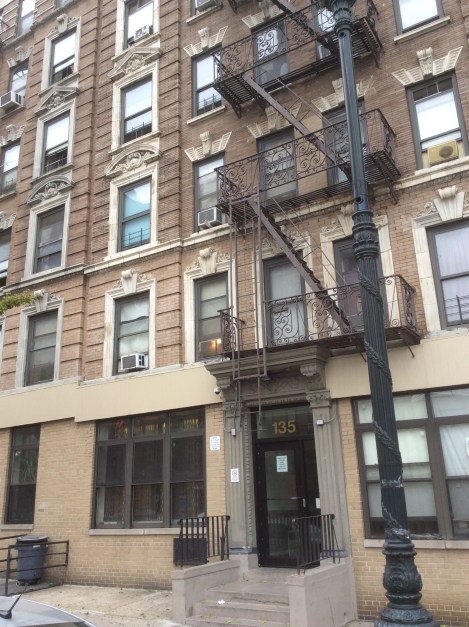
135 W. 135th St, between Malcolm X and Adam Powell Blvds, where Sanger and family lived in 1911, 2016 Amy Cools

135 W. 135th St, between Malcolm X and Adam Powell Blvds, where Sanger and family lived in 1911

I continue to make my way south and a little east to 135 W. 135th St, between Malcolm X and Adam Powell Blvds, where Sanger and her family lived in 1911. The year before, the Sangers returned to New York City. The house Bill had designed and built for them suffered a fire which damaged the house and destroyed many of the furnishings. The expenses of repairing the house and replacing their lost things severely damaged their already precarious finances. While the situation was stressful and Sanger was frustrated with her husband’s inability to make a steady, reliable income, she was also bored and frustrated with her quiet, domestic suburban life. Upon returning to urban life, Sanger resumed nursing and Bill got into politics; both became very active in the bohemian Socialist scene. As we’ve discovered, it was Sanger’s experiences in these years that most inspired her birth control cause, from her Socialist activism on behalf of New York City’s beleaguered working class to the struggles of the poor mothers and families in the largely immigrant slums of the Lower East Side.
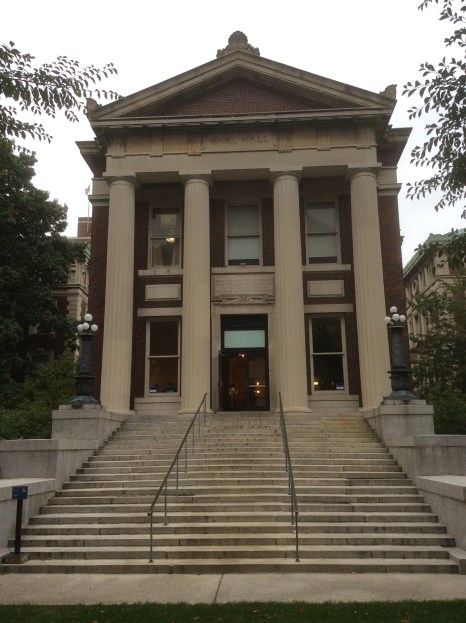
Earl Hall at Columbia University, New York City, photo 2016 by Amy Cools

Earl Hall at Columbia University, New York City

As I head west on 135th St to the St Nicholas Ave station, I pass by a site I visited last time I was here: Ida Wells’ New York Age newspaper offices which published Wells’ groundbreaking Southern Horrors: Lynch Law in All Its Phases, and where Frederick Douglass likely met with her on at least onceI smile at the memory.

I enter the subway station where 135th St meets St. Nicholas Park and exit 116th, walking west across Morningside Park and up the hill to the Columbia University campus. It’s a beautiful walk; the park is lush and green, and the campus is an inspiring and lovely place, with broad lawns and elegant buildings in so many styles: Beaux-Arts, neo-classical, and Gothic Revival, to name a few.
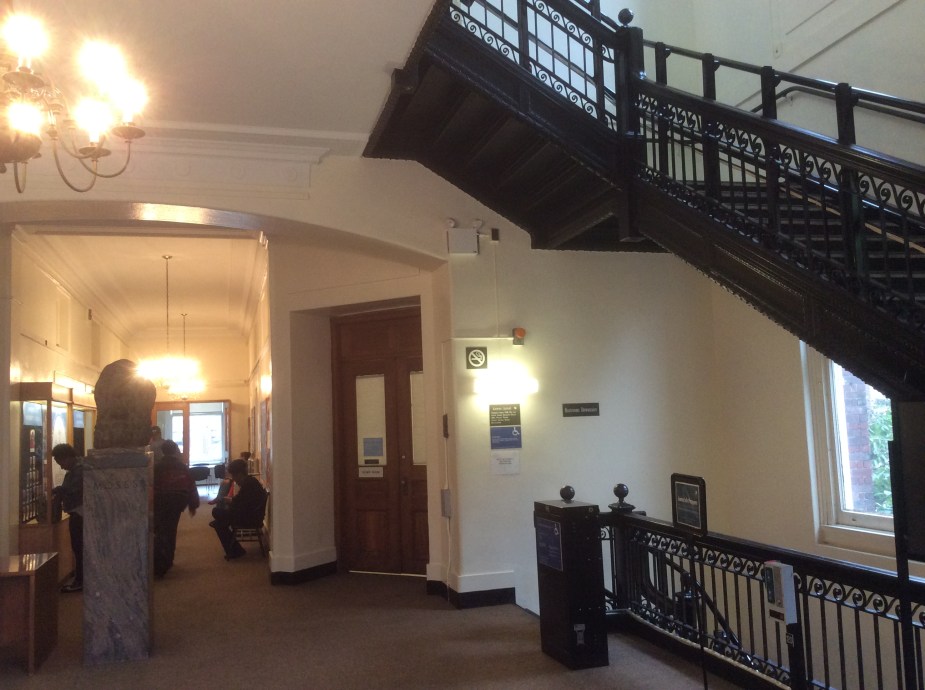
Interior of Earl Hall, Columbia University New York, Amy Cools 2016

Interior of Earl Hall, Columbia University, NYC
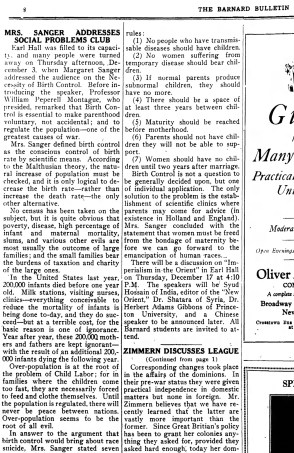
Sanger at Earl Hall, Barnard Bulletin, New York, Fri Dec 11, 1925

Newspaper account of Sanger’s talk at Earl Hall, from The Barnard Bulletin, New York, Fri Dec 11, 1925. Click to read a larger version.

I head to Earl Hall at 2980 Broadway, a little north of 116th St. On December 3rd, 1925, Sanger addressed the Social Problems Club here. She delivered her lecture ‘The Necessity of Birth Control’ at 4 pm to a packed house. According to the Columbia Daily Spectator, at this event, birth controlwas discussed for the first time on the Columbia Campus’. That is, at least officially. The necessity of birth control was outlined in terms of major social problems that club would likely have discussed frequently: infant and maternal mortality rates, disease, crowding, poverty, crime, and women’s rights. The Barnard Bulletin published a detailed outline of the talk and its main topics (see the image and link to the right).

I take an indirect route to my next destination a mile away via Amsterdam Ave so I can see the spectacular Cathedral of Saint John the Divine on my way; it’s south of Columbia University on the west wide of Morningside Park. The cathedral is as wonderful as it’s been described to me by so many. I add my recommendation to theirs to visit if you haven’t yet.

I continue east from the cathedral heading for 141 W. 111th St. The doorway and its stoop of the building I find here is flanked on either side by classical columns with ‘Kenosha’ spelled out overhead; the others in an identical row of four apartment buildings (though this is the only one whose ground floor is painted white) have porches which read ‘Manitou’, ‘Pacific’, and ‘Mariposa’. I’m unable to discover any particular reason why they’re named this way. According to the Municipal Archives division of the NYC Department of Records, in answer to my inquiry, building names ‘were typically applied by the building architect or owner based on what you might today call “marketing-strategy”‘.
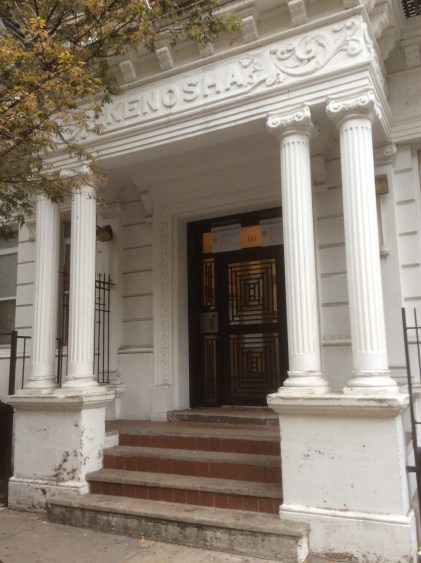
Porch of the Kenosha building at 141 W. 111th St, Harlem, NYC

Porch of the Kenosha building at 141 W. 111th St, Harlem, NYC

Here in the Kenosha building, Sanger attended meetings of the Women’s Committee of the Local New York Socialist Party in 1911 through 1912. According to Mari Jo Buhle, writing for the journal Radical America in 1970, Sanger ‘regularly attended local meetings with her husband, but only inadvertently did she become one of the most important activists in the movement. She was asked to replace an ailing speaker at one of the local women’s meetings [of the Women’s Committee of the LNYSP]. Although she had never given a public speech before, she accepted on the condition that her topic be of her own choice. She had little confidence about her understanding of Marxian theory and decided to speak about her own speciality, sex education and hygiene.’ As discussed earlier, Sanger and her husband William threw themselves eagerly into the Socialist scene upon their return to New York City from Hastings-on-Hudson. This place is just a little under a mile-and-a-half, thirty-minute walk from the 135 W. 135th St apartment I visited just before Earl Hall, where the Sanger family lived at the time.
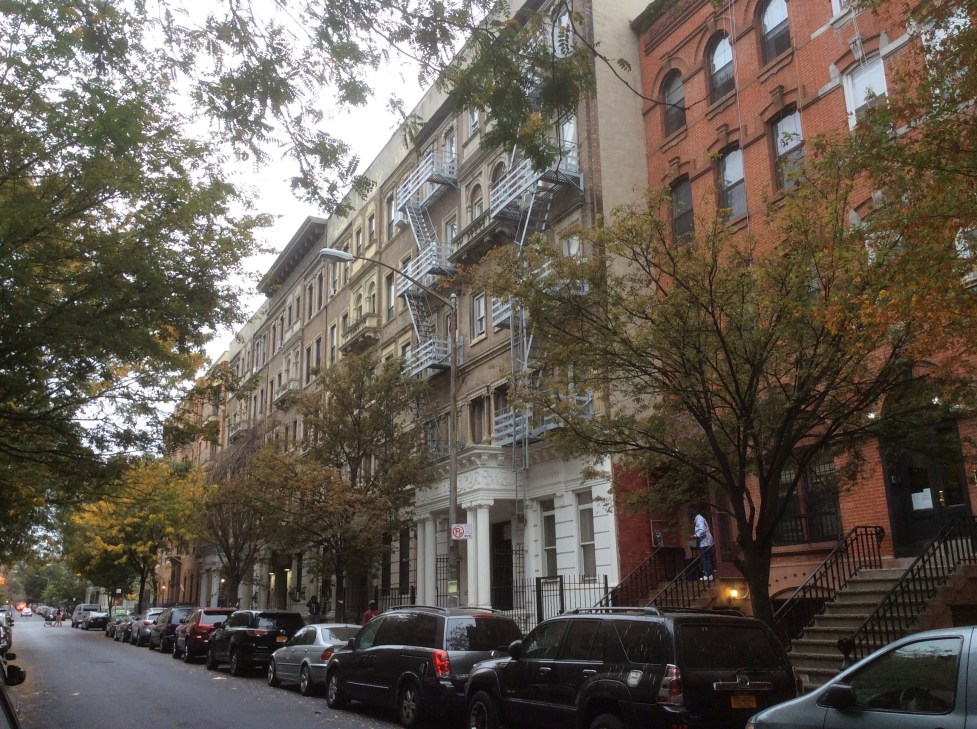
141 W. 111th St, Harlem, NYC, at center with white Kenosha porch, photo by Amy Cools 2016

141 W. 111th St, Harlem, NYC, at center, with white porch which reads ‘Kenosha’
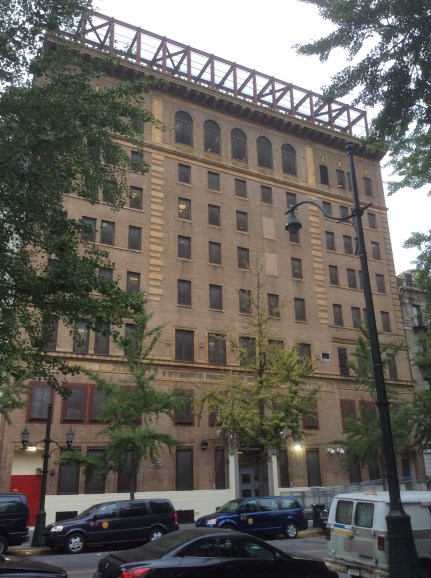
Lincoln Correctional Facility at the northeast end of Central Park, NYC, photo 2016 Amy Cools

Lincoln Correctional Facility at the northeast end of Central Park, NYC

A long block east, short block south, and half a long block east again takes me back to Central Park, this time to the northeast end. I’m looking for 31 W. 110th St, between Malcolm X and Park Ave, near NE corner of Central Park. I’m surprised to find myself looking at a placard across the front lintel which reads ‘Lincoln Correctional Facility’. It’s a minimum security prison, not an institution one would expect to find facing onto Central Park. It was once the headquarters of New York City’s Young Women’s Hebrew Association, from 1914 until the late 1930’s, when the Y.W.H.A. leased the building to the U.S. Army in World War II. That explains why it doesn’t look like a prison. It was a community center, with classrooms, meeting rooms, and gym facilities including an indoor pool.

On April 1, 1924, Sanger addressed the Guardian Mothers of Young Women’s Hebrew Association here; as of this time, I find no record of what she said here that day.
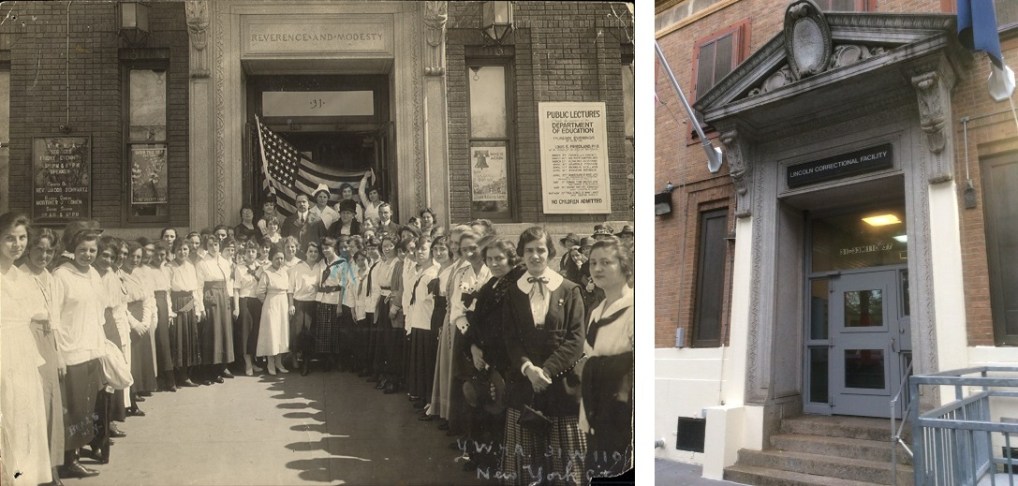
Left, Young Women's Hebrew Association Flag Ceremony at 31 West 110th Street, 1918. Right, LCF doorway at this address today

Left, Young Women’s Hebrew Association Flag Ceremony at 31 West 110th Street, 1918. Right, Lincoln Correctional Facility doorway at this address today. You can see the details and shape of the corbels supporting the overhang, the decorations around the door, and the placement and shape of the windows that it’s the same doorway
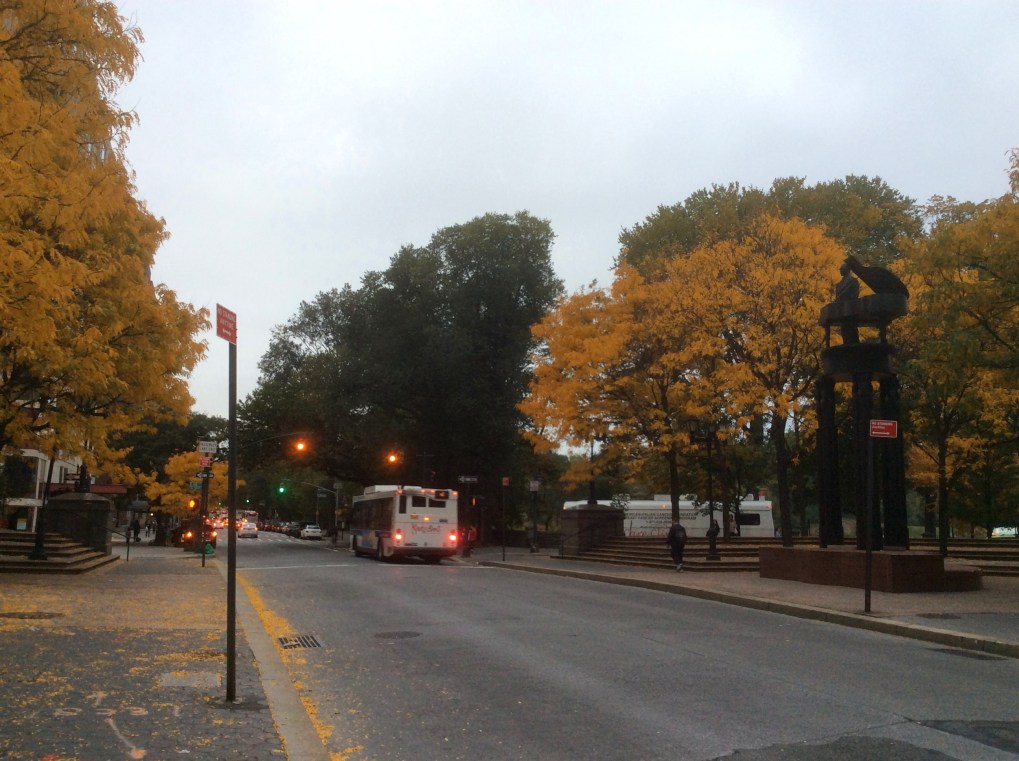
Duke Ellington Circle at 5th Ave and 110th St. Notice his statue on the tall pedestal to the right

Duke Ellington Circle at 5th Ave and 110th St. Notice his statue on the tall pedestal to the right

Just a half block east on 110th St to where it meets 5th Ave, I arrive at Duke Ellington Circle. There’s a statue of the great jazz pianist and his instrument on a very tall pedestal in a stepped, paved, and grassy park surrounded by a traffic circle and split down the center by 5th Ave, north to south. The circle surrounded by a couple of plain brick highrises, an artistically modern building which houses The Africa Center, a few plain old mixed use buildings, and small vacant lot.

I’m seeking the site of Parkview Palace, which, according to Pokorski’s Mapping Margaret Sanger, was at 110th and 5th. There is no building now of that name and indeed, none at all that appear to be of the right vintage. I consult G.W. Bromley’s 1916 Atlas and find it named ‘Parkway Palace’ there. I spend a long time searching for photos or some other information about the Parkview Palace. I find lots of brief references to it, mostly in Socialist and anarchist history books since it was a popular meeting place for non-mainstream political thinkers and activists, and in old newspaper announcements for other events happening there. However, I find no photos of the Parkview at all. I do find a photo of the apparently more well-known Harlem 5th Avenue Theatre next door, but none that show the adjoining Parkview.
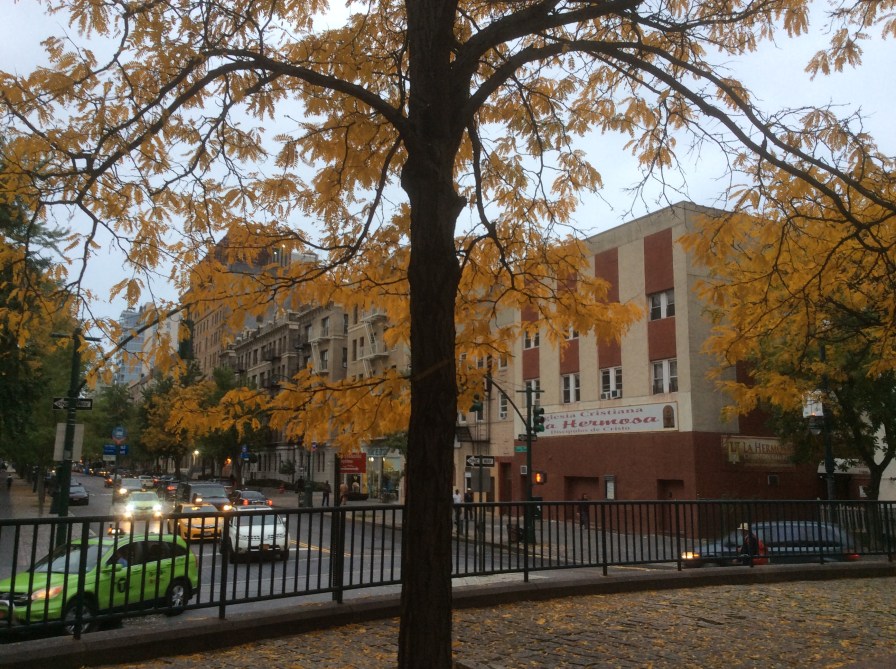
110th at 5th Ave, NW corner of intersection at Duke Ellington Circle. The Parview Palace likely stood where the Hermosa is. 2016 Amy Cools

110th at 5th Ave, NW corner of intersection at Duke Ellington Circle. The Parview Palace likely stood where the Iglesia Christiana La Hermosa stands now, the red and cream building to the right
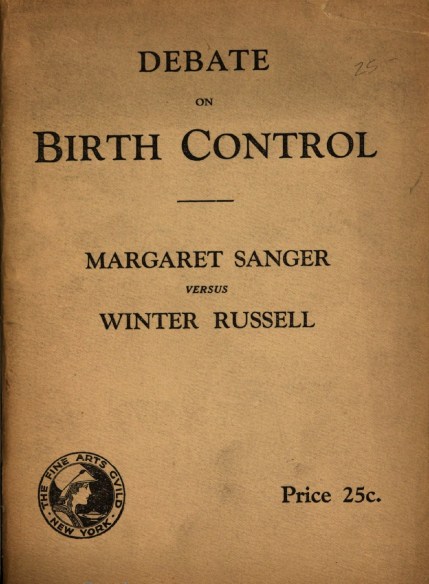
Debate on Birth Control, Margaret Sanger versus Winter Russell

Debate on Birth Control, Margaret Sanger versus Winter Russell. Click to read the whole debate online

I’m seeking this place because Sanger debated with John Winter Russell on birth control here on December 12th, 1920. Russell was a lawyer and recent convert to Catholicism, and as we’ve considered in this series, Sanger was no particular fan of the Catholic church, to say the least. She was not a frequent debater, but she agreed to this one for two likely reasons. One, her participation fee. Since the Depression hit, she had to work harder to raise funds for herself and her cause. Second, this was another good opportunity to publicly refute arguments based on Catholic teaching. Sanger had many run-ins with Catholicism in the form of its influence on public policy as well as in the press and in local governments and police forces, as we saw in the Town Hall raid debacle. She likely relished the opportunity to demonstrate debating skills as a seasoned, well-informed birth control activist against this new convert to the Catholic religion. The entire debate was published by the Fine Arts Guild of New York City and is available online.

Russell gave Sanger many opportunities to defeat his arguments. For example: he equated the use of birth control with lack of sexual control, when the use of birth control actually requires a good deal of control in the form of foresight, planning, and proper use; he characterized sex without allowing for reproduction as animalistic and therefore unworthy of human beings, though it’s only all other  animals besides humans which don’t use birth control; he conflated abortion with other forms of birth control though that characterization is not scientifically feasible and as Sanger pointed out, birth control prevents the need for abortion; he argued that pleasure can’t and shouldn’t be enjoyed without its counterpart of pain even though it’s generally only the woman who suffers it; and so forth. In the end, Russell more or less delivered the sort of arguments Sanger expected, which were, as she perceived them, rooted in a narrow and rigid brand of religiosity, sexual prudery, misogyny, and lack of scientific understanding. She and many other believed that she won this debate handily.

I’ve come to the end of my third day in New York City following Sanger, and it’s been an especially long and interesting one. I’ve decided to return to Greenwich Village and enjoy the offerings of a couple of its long-established eateries and watering holes, to read and rest my weary feet as I fill my empty belly and warm my chilly self. Until tomorrow, then!

Listen to the podcast version here or on Google Play, or subscribe on iTunes

Ordinary Philosophy and its Traveling Philosophy / History of Ideas series is a labor of love and ad-free, supported by patrons and readers like you. Please offer your support today!

~~~~~~~~~~~~~~~~~~~~~~~~~~~

Sources and inspiration: 

Adams, Michael Henry. ‘The Best Address: St. Nicholas Avenue and Place, Part I‘, Jul 17, 2012.

Another Look at Margaret Sanger and Race‘, Feb 23, 2012. From The Margaret Sanger Papers Project at NYU

Bromley, G.W. and Co. Atlas of the Borough of Manhattan, City of New York. Desk and Library edition, 1916, Plate 129 and Plate 167. Retrieved from Lionel Pincus and Princess Firyal Map Division Digital Collection, The New York Public Library.

Buhle, Mari Jo. ‘Women & the Socialist PartyRadical America, Feb 1970, Vol, IV, 4F2, via National Progressive Review

Chesler, Ellen. Woman of Valor: Margaret Sanger and the Birth Control Movement in America. New York: Simon & Schuster, 1992

Debate on Birth Control / Margaret Sanger versus Winter Russell, by Margaret Sanger, Winter Russell, and Emma Sargent Russell. New York, NY: Fine Arts Guild, 1921.

East 110th Street [31 West 110th Street]. Y.W.H.A., detail of steps, interior. Photo by Wurts Bros. (New York, N.Y.), from Museum of the City of New York’s digitized archives

Eig, Jonathan. The Birth of the Pill: How Four Crusaders Reinvented Sex and Launched a Revolution. W.W. Norton & Company, New York, 2014.

Goldberg, Michelle. ‘Awakenings: On Margaret Sanger‘ Feb 7, 2012, The Nation

Gray, Christopher. ‘Built With the Ladies In Mind‘, Oct. 25, 2012, New York Times: Streetscapes

Grimaldi, Jill. ‘The First American Birth Control Conference‘, Nov 12, 2010. The Margaret Sanger Papers Project at NYU

House Tour Preview: Margaret Sanger’s Window.’ Apr 22, 2010, Hastings Historical Society blog

Katz, Esther. ‘Margaret Sanger and The Woman Rebel, 1914-1916: Historical Essay‘, 1999. From The Margaret Sanger Papers Electronic Edition, eds. Esther Katz, Cathy Moran Hajo and Peter Engelman (Columbia, S.C.: Model Editions Partnership, 1999)

Latest News‘ The Birth Control Review, May 1923, Vol VII, No. 5

Mrs. Sanger Addresses Social Problems Club‘, Barnard Bulletin (New York, New York) · Fri, Dec 11, 1925

Mrs. Sanger Glad She Was Indicted‘, New York Tribune, Feb. 21, 1916, p. 2, via The Margaret Sanger Papers Project, NYU

Mrs. Sanger to Talk on Birth Control‘, Columbia Daily Spectator, Volume XLIX, Number 58, 3 December 1925

Muigai, Wangui. ‘Looking Uptown: Margaret Sanger and the Harlem Branch Birth Control Clinic‘. Newsletter #54 (Spring 2010)  of The Margaret Sanger Papers Project at NYU

On the Road with Birth Control‘, Newsletter #21 (Spring 1999) of The Margaret Sanger Papers Project at NYU

Pokorski, Robin. ‘Mapping Margaret Sanger‘ from The Margaret Sanger Papers Project at NYU

Revolutionary and Subversive Movements Abroad and at Home, (vol. I-II). By New York (State). Legislature. Joint Committee (address of Parkview Palace on p. 2020). J.B. Lyons: Albany, 1920

Risen, Clay. ‘Prison on the Park.’ Jul 9, 2002, The Morning News, New York, New York.

Sanger, Margaret. ‘Birth Control: Then and Now,’ 1944, Typed Article. Source: Margaret Sanger Papers, Sophia Smith Collection

Sanger, Margaret. ‘Hotel Brevoort Speech,” Jan 17, 1916. From The Margaret Sanger Papers Project at NYU

Sanger, Margaret. Margaret Sanger, an Autobiography. Cooper Square Press: New York 1999, originally published by W.W. Norton & Co: New York, 1938

Sanger, Margaret. The Pivot of Civilization, 1922. Free online version courtesy of Project Gutenberg, 2008, 2013

Sanger, Margaret. Woman and the New Race, 1920. Free online version courtesy of W. W. Norton & Company

Sanger v. Famous Father of 18!‘ Newsletter #29 (Winter 2001/2002) of The Margaret Sanger Papers Project at NYU

Sciancalepore, Victoria. ‘Rebels of Post Avenue‘, Jan 15, 2014, Margaret Sanger Papers Project

Silver, Rabbi Samuel. ‘Why I Became a Rabbi‘. Jewish Post, Indianapolis, Jan 28, 2004

Soclof, Adam. ‘Planned Parenthood Controversy‘, February 2, 2012

W. E. B. Du Bois, “The Black Star Line,” Crisis, September 1922, 210–214, via History Matters website (with introduction)

New Podcast Episode: Margaret Sanger NYC Sites, Day 2, Part 2

79 and 71 W. 12th Street, New York City. 77 woy

79 and 71 W. 12th Street, New York City.

Listen to this podcast episode here or on Google Play, or subscribe on iTunes

Wednesday, October 19th, 2016, continued

The next site I seek is right across the street from the New School on W. 12th St near 6th Ave. The address was number 77, but as you can see, there’s no building with that number here anymore. According to Robin Pokorski of the Margaret Sanger Papers Project, Sanger made her first public appearance here on January 6th, 1916 after returning from her self-imposed exile in Europe to escape obscenity charges. She eventually decided to return and face them, however: her husband had already done so on behalf of her cause the month before, and her chances in court were better now since birth control had become a much more regular topic in the press. I find no record of her talk nor a history of a public venue here. I do find a listing for 77 W 12th St in the Catalogue of the First Exhibition of the Society of Independent Artists, Volume 1, published in 1917. It’s the address of Caroline Speare, who has two pieces of art pictured in the catalogue. Looking through it for more about Speare, which I don’t find, I stumble across an early charcoal work by Georgia O’Keeffe, which is a delightful find. Perhaps talks were held at Speare’s place as well as displays of her art, but I can find no evidence of this at this time.

I do find a form letter which Sanger had written the previous day, on Jan. 5th, 1916, to send out to friends. In it, she writes about the indictments against her over her distribution the year before of her magazine The Woman Rebel and its so-called obscene subject matters: the sexual liberty of women and birth control…. Read the written version here:

Ordinary Philosophy and its Traveling Philosophy / History of Ideas series is a labor of love and ad-free, supported by patrons and readers like you. Please offer your support today!

The Tragedy–and Hope–of African American History, by Robert Greene II

Obamas on Inauguration Day 2013 by P. Souza, Public domain via Wikimedia Commons

Obamas on Inauguration Day 2013 by P. Souza, Public domain via Wikimedia Commons

In 2007, Andrew Sullivan wrote a cover essay for The Atlantic in which he argued that the rise of Barack Obama to the national stage meant an end to the divisive cultural politics that defined American politics since 1968. Sullivan argued at the time, “he could take America—finally—past the debilitating, self-perpetuating family quarrel of the Baby Boom generation that has long engulfed all of us.” Reflecting on the events of the last eight years, it now seems this assumption about Obama’s rise was naïve and misplaced. Now, as we transition from an “Age of Obama” to an “Age of Trump” everyone has spilled much ink—both real and digital—trying to explain how we got here.

A keen reading of African American history, especially intellectual history, offers us much to consider in this debate. The recent Ta-Nehisi Coates essay, “My President Was Black,” offers one of the better meditations on Obama’s presidency and its possible legacy. The responses to it—in particular Tressie McMillian Cottom’s—have all been useful to also think about Obama’s failings and successes in office. Along with this is a reflection among historians and others about what kind of era we’re entering. Indeed, Coates’ body of work—from his essay on Bill Cosby and Black America to this most recent piece—offer a fascinating take on post-1945 African American history. While I will leave that for another post down the road, I do want to tackle the ways in which history is being discussed in the public sphere in 2016.

Historical comparison is a cottage industry unto itself. After November’s election, pundits and historians alike began casting a wide net to make comparisons with the past. Jamelle Bouie compared the events of November 8, 2016 to the backlash to Reconstruction. This comparison soon caught on with other writers. Barret Holmes Pitner, at The Daily Beast, made a similar argument. In concern about potential backlash to racial progress, I can sympathize with this comparison. This reminds me of earlier comparisons made between Black Lives Matter and the Civil Rights and/or Black Power Movements. But I also vehemently disagree with it.

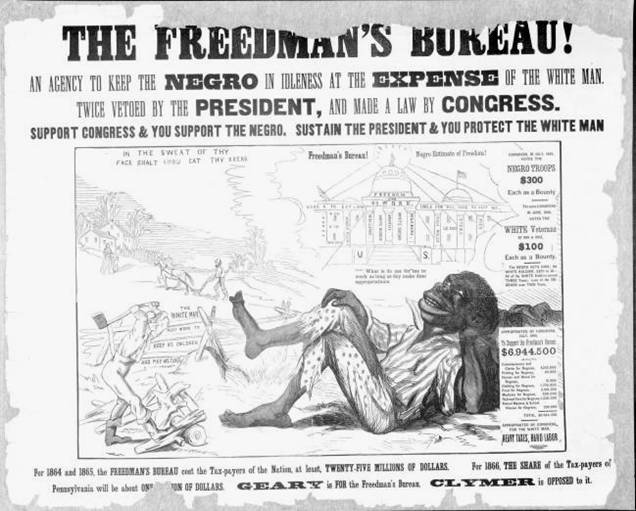
Backlash against racial progress is central to the story of America–as you can see with this political advertisement from 1866. Whether or not it was the reason for Trump’s victory, the interminable problem of racism and democracy in American society remains with us.

Historical analogies are useful, but we also need to recognize how they are limited in speaking to the present moment. Both Bouie and Pitner acknowledge this. History never repeats itself. It doesn’t even necessarily rhyme. But we can “use” history to think harder about the present. History, taught well, teaches us that the present is never easy to understand. There are never any simple answers or quick victories. Historical comparison, of course, is nothing new. C. Vann Woodward, among many others, referred to the Civil Rights Movement as a “Second Reconstruction.” Today, the theologian and activist Rev. Dr. William Barber of North Carolina refers to the present day as a “Third Reconstruction.” Others may also argue that the here and now is a “second Nadir of African American history,” in comparison with the low point in African American history from 1890 to 1930 written about and described as such by Rayford Logan.

The comparison with another nadir is not new. The historian Sundiata Keita Cha-Jua argued, in a The Black Scholar essay in 2010, that Black America was already suffering through a second nadir. There, he argued that African Americans were already in a nadir due to a variety of factors. Most notably, the changes in American political economy since the mid-1970s due to the rise of neoliberalism and its associated policies of austerity—coupled with cultural and political debates over colorblindness and racism—have damaged the progress made by African Americans in the immediate aftermath of the Civil Rights Movement. Cha-Jua argued that events such as the 2000 election (and allegations of voter suppression in Florida), the federal response to Hurricane Katrina, and the collapse of the housing market in 2007-08 (which destroyed the slowly-built up wealth of the African American middle class) were all symbols of the modern nadir. This was all before Obama’s election in 2008—which Cha-Jua argued was “contrasted but not off set by” the events previously mentioned.

I disagreed with this analysis of a “new Nadir” when it first came out. Today, I am tempted to argue that it is the best analysis of the present moment. Economic factors of the damage done to African Americans over the last three decades lend some credence to Cha-Jua’s analysis. And, to be blunt, I worry that any administration in the White House may not provide the answers to helping millions of Americans—regardless of race—recover from the 2008-09 Great Recession. The debate about voter suppression across the country, highlighted by recent events in North Carolina, also make the “new Nadir” take a tempting one.

I still reject a wholesale comparison with that era, for a variety of reasons. But it is not out of any sense that things are fine today. On the contrary. Historical comparisons are not to be discarded. They can and do serve a purpose. Comparisons across historical eras make the present day easier to understand. In that sense, African American history is critically useful. After all, African American history offers a bitterly learned lesson—that democracy and progress are always built in American history on a foundation of sand. Freedom cannot be taken for granted. Most importantly, the whiggish idea of history as a march of progress has been laid bare, once again. Much of human history proves this. For Americans, however, to simply look to the history of African Americans—or, for that matter, Native Americans, women, Hispanics, a multitude of groups—is to realize that “progress” and “hope” are not natural to human history.

And so we plunge into 2017, unsure of the future and groping for lessons from the past to help us. The urge to make historical comparisons is understandable. Just remember that the differences between eras is important too.

~ Originally published at Society for U.S. Intellectual History Blog, on January 1st, 2017

~ Robert Greene II is a PhD. student at the University of South Carolina. He studies American history after 1945 with a focus on the American South, political history, and memory. (Bio credit: S-USIH Blog)

Ordinary Philosophy and its Traveling Philosophy / History of Ideas series is a labor of love and ad-free, supported by patrons and readers like you. Please offer your support today!

Making the Perfect the Enemy of the Good

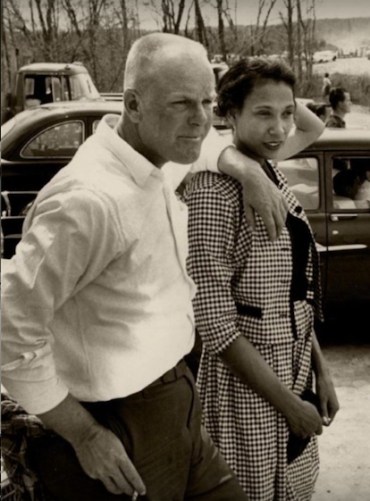
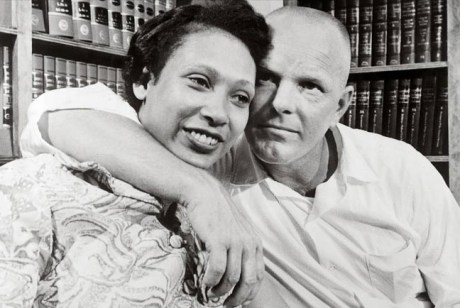
richard-and-mildred-lovingIt’s not generally a very wise thing to do, but I entered into a little dispute on Facebook a little while ago. It was about Mildred and Richard Loving of Virginia. A friend shared a discussion thread which was mostly very critical of the way that the Lovings are portrayed in their recent namesake movie. The Lovings’ marriage was illegal in 1950’s Virginia because Mildred was a woman of color and Richard was white. They knew this, so a pregnant, 19-year-old Mildred and 25-year-old Richard traveled to Washington, D.C. to be married. But this didn’t help them when it came to state law: marrying out-of-state to avoid Virginia’s anti-miscegenation laws, then returning to live as husband and wife, was also illegal.

The young man who initiated the Facebook thread (I won’t name names here, since this piece is only about the ideas expressed) invited a discussion of this fact stated in Mildred Loving’s 2008 obituary in Legacy.com:  “Mildred Jeter was 11 when she and 17-year-old Richard began courting“. My friend who shared the thread, an African-American scholar, was also particularly concerned with another aspect of this story, as many others were: Mildred identified herself at the time of her marriage and for the rest of her life as ‘Indian’, not ‘Black’ or ‘Negro’.

The outrage generated by the very young age of Mildred at the beginning of their relationship resulted in the longest string of angry and shocked responses in the thread. One person wrote ‘Look…are we honestly gonna sit here and act like this white man didn’t see a vulnerable young girl and prey on her specifically because she was too young to know better and too Black for anyone to care otherwise? Like come on y’all. This is gross.‘; ‘Why are we pivoting away from it just being predatory behavior for 17yr old young adults to be romantically interested in 11yr old children?; and ‘He was a fucking child molester. It’s starting to make sense to me of why they were allowed to marry…’

Some took the trouble to establish essential facts before passing judgment, asking such important questions as: ‘I’m trying to understand. Do we know if they had sex when she was a child?’ One person quickly responded ‘Does that matter? He began courting her with those intentions at 11, when most girls have yet to even start puberty. He was grooming her, so it doesn’t matter whether he touched her or not, give the psychological implications.’ An even more excitable person cited the marriage itself as evidence that Richard’s interest in Mildred was sexual from the very beginning. And when a particularly fair-minded young man asked people to pause and consider whether the assumption was correct that the ‘courting’ referred to by the obituary necessarily implied sexual interest, such as the way we use the term ‘dating’ today, he was soon accused of  ‘excus[ing] this predatory behavior’ and even lumped in with ‘rape deniers and apologists‘.

But the issue of Mildred’s denying her black ancestry (which, according to the sources I’ve read did exist, however much she denied or downplayed it) generated the most hurt and personal anger: ‘…Mildred Loving was extremely anti-black. Her entire argument was that she was Native American Not black and she never self-identified as black.‘ and from the initiator of the post: ‘…this film looks like and all the press surrounding it has undoubtedly been “post-racial”, white partner fetishist, anti-black trash.’

As I read this thread, I became more and more upset, and more and more defensive of the Lovings. I responded, impetuously, to my friend who shared the thread on Facebook:

This thread is awful. The character assassination of these two is unconscionable, especially given the fact that they did so much to give us freedoms we now take so much for granted, and because they are not here to defend themselves. If the obituary is correct in that they started dating [here, I made the same initial mistake as many others by conflating ‘courting’ with ‘dating’] when Mildred was very young, that was another time and place when early dating and marriage was both socially and legally acceptable, and we have no evidence that they had sex before the age of consent at the time. It’s unjust to impose our current laws and standards on them and to pretend we know whatever else was going on. She professed love for him for the rest of her life, and this is evidence that she did not feel that he abused or took advantage of her in any way. In this case, I look to Mildred for the evidence: she, the woman, gets to tell us whether she was sexually abused or harassed. The other issue is Mildred’s self-identification as a Native American. We can assume, to satisfy our own self-righteous feelings, that her motives were ‘anti-black’, and again, it’s an assumption we should be careful in making since she’s not here to ask. But if her grandson is right, she had more Native American ancestors than black ones, so identifying herself as a Native American would make sense. Would she be ‘anti-Native American’, then, if she identified as black, rejecting her predominantly Native American ancestry? The people in this thread are setting her up, in a case of identity politics gone awry, for failure no matter what. Perhaps she identified more with her Native American ancestry, perhaps her chosen self-identity was a method of survival in a society that so oppressed black people, perhaps she thought she was more likely to be able to share a life with Richard if she was Native American rather than black. Again, we can only guess. This thread is one of the most unjust, unfair, intellectually dishonest, anti-woman, anti-Native American, and I argue anti-black verbal-character-lynchings I’ve read in a long time.

Why did I (and do) feel so defensive towards the Lovings? My closing sentence went over the top, I suppose. But I think my instinctive reaction was so strong because I’ve admired them and been fascinated by them for so long. I took an avid interest in civil rights history in the sixth grade and this interest has never left me. I’m a bit of a romantic and an optimist, and it’s always been heroes such as the Lovings and other civil rights activists and leaders who have redeemed the human race for me since so many have acted cruelly and unjustly throughout history. But part of my reaction against so many of the things said in this post was the blind ingratitude and self-righteousness I perceived, as I do in so many similar discussions. There’s a distinct and I believe worrying trend of reconsidering all of our social heroes in light of their flaws and to take them down a peg or two, even to the point of destroying their historical reputations. With the exception of a particularly honest few, who also defended the Lovings on consideration of the circumstances and social pressures of their time, so many were ready and even eager to insist that because the Lovings were not perfect, we have the right to assume the worst about their motives and their characters, and therefore, to denigrate their efforts.

I was particularly interested in this response, I’ll call the writer S: ‘It is time that the reality of the lives of this seminal and historical case comes to light. Incidentally, Mildred also did not consider herself Black and did not want too much to do with Black people. I think we need to separate the legal aspects of this case from the personal lives of these people though, because it was critical in overturning the laws of miscegenation and was not just about white men being able to have their way with women of color. It was also critical for protecting Black men in mixed race marriages.‘ I think she’s right that the ‘incidents’ of the case, the details of the personal lives of the people involved, don’t really impact the historical importance of the Supreme Court’s decision in the lives of so many Americans at the time and for the future of the country. The Court’s decision rejected the underlying presumption of anti-miscegenation laws, that ‘blood’ can be ‘corrupted’ by marrying a person of another race, and it more firmly established the American ideal of marriage as a free and equal partnership between two free people, leading to the legalization of gay marriage half a century later. As Justice Earl Warren wrote in his decision in Loving vs. Virginia, ‘The freedom to marry has long been recognized as one of the vital personal rights essential to the orderly pursuit of happiness by free men.’

Yet, by the way, ‘Loving’ the movie, which I thought was beautifully done, is all about the people involved in the case. So while I agree with S’s point that the importance of the case doesn’t hinge on the details of their lives, it’s also true that the movie isn’t about many of the details discussed in the thread, either. It’s not about the wider reality of a rural, impoverished, labor-intensive society in which work and starting a family were preoccupations from an early age, so that courting likewise started very early. It’s not about the myriad social pressures on Mildred that likely caused her to deny or de-emphasize her blackness in a time and place where being black meant she couldn’t have the life she wanted. It’s about the personal experience of Mildred and Richard of loving one another, and how this drove them to sustain a relationship for so many years despite public prejudice and opposition; to marry anyway; and then to become involved in a series of major court cases that so disrupted the peaceful life they desired so much. That’s why the movie is simply called ‘Loving’.

Mildred Jeter and Richard Loving, June 12, 1967, by Bettmann/Corbis via New York Times, public domain via Wikimedia Commons

Mildred Jeter and Richard Loving, June 12, 1967, by Bettmann/Corbis via New York Times, public domain via Wikimedia Commons

In doing research for this piece, I was struck again by the number of photos in which Richard is supported by Mildred, sometimes leaning an arm across her shoulder, sometimes laying his head on her lap. After all, the fight for their rights began with Mildred, who wrote of their plight to Robert Kennedy, which in turn gained the attention of the ACLU who took the case, and she was the driving force behind their continued fight. Richard’s leaning on Mildred also reminds me of the way we’re all held up by others. That’s true for all the people in the Facebook discussion thread, myself, for all Americans: we discuss these problematic issues from a relatively safe place because we’re raised up on the shoulders of so many giants. We have free speech rights, the right to marry who we love, the right to cohabitate freely with partners if marriage isn’t our thing, and so on, because of people like the Lovings. Thanks to them and others like them, we will never be arrested for marrying a person of the wrong race or sex, or for drinking from the wrong fountain, or for denying that we can be owned by another person. For the latter two, I myself would never have been arrested for those things in the United States, due to an unfair privilege I would have enjoyed by accident of birth. But there are other things I would have been arrested for at one time: for voting, for leaving an abusive relationship, or for trying to control my own reproduction.

And why do we get to take it for granted that we can talk and live relatively freely? Well, it’s because people like Mildred and Richard had the moral imagination to make a great leap beyond the mores, the legal strictures, the personal biases and learned behaviors of their time and in their own lives. I still love the Lovings, flaws and all, because I think they’re basically good people, and that’s what enabled them to become moral heroes. I think of a hero not as a perfect being, but one who does that rare and exceedingly difficult thing: not only transcend the time they’re in, but themselves in some important and essential way. In the attempt to see the world and our history honestly, it’s not necessary or desirable to whitewash our heroes or the complexity of the issues they face, as many of the arguers in this thread pointed out. But it’s also not necessary to tear them down as persons or hold their legacies hostage to the moral strictures of our time, moral strictures that their ideas and efforts helped us form in the first place.

*Listen to the podcast version here or on Google Play, or subscribe on iTunes

Ordinary Philosophy and its Traveling Philosophy / History of Ideas series is a labor of love and ad-free, supported by patrons and readers like you. Please offer your support today!

~~~~~~~~~~~~~~~~~~~~~~~~~~~~~~~~~~~~

Sources and inspiration:

Coleman, Arica L. ‘What You Didn’t Know About Loving v. Virginia‘. June 10, 2016, Time.com

Loving v. Virginia‘, Supreme Court decision No. 395, Argued: April 10, 1967, Decided: June 12, 1967. Via Cornell University Law School’s Legal Information Institute

Loving v. Virginia‘. In Wikipedia, The Free Encyclopedia.

Martin, Douglas. ‘Mildred Loving, Who Battled Ban on Mixed-Race Marriage, Dies at 68‘. May 6, 2008, The New York Times

Mildred Loving Obituary‘. 2008, from Legacy.com

New Podcast Episode: Margaret Sanger NYC Sites, Day 2, Part 1

Waverly Pl and University at Washington Square, Manhattan, NY

Waverly Pl and University at Washington Square, Manhattan, NY

Listen to this podcast episode here or on Google Play, or subscribe on iTunes

Wednesday, October 19th, 2016

I take the E train north from where I’m staying in NYC’s Soho neighborhood of Manhattan to Washington Square. It’s a lovely, warm, and soft day, the sky blue and thickly scattered with puffy, small, wispy clouds like spilled cheap cotton balls.

On March 1, 1926, Margaret Sanger delivered a lecture titled ‘The Need for Birth Control in America’ to New York University’s Liberal Club. It takes a bit of digging to find out where the Liberal Club met at this time, but I finally discover it in a letter written to Sanger’s supporter and sometimes collaborator W.E.B. DuBois…. Read the written version here:

Ordinary Philosophy and its Traveling Philosophy / History of Ideas series is a labor of love and ad-free, supported by patrons and readers like you. Please offer your support today!


Happy New Year, and a Personal Reflection at the Close of My Fourth Decade

Signs on a post off Mountain View Road, rising out of the Anderson Valley, California

Today is the last day of 2016, and my last day in my 30’s.

It feels significant, somehow, turning 40.

Perhaps it’s because my love of history and my long background in collecting, buying and selling vintage goods. They’ve put me in the habit of organizing things into chunks of time: decades, centuries, eras. It’s a useful tool, even if a blunt one, since of course events and styles don’t come into and out of existence based on the turn of a calendar page. But the human mind looks for patterns existent in nature, which leads to the impulse to impose more precise ones on top of those, artificial even as they’re based on natural phenomenon. The calendar year traces the earth’s yearly rotation around the sun, and units of ten reflect the number of fingers we’ve used to count since our infancy.

As I enter my fifth decade of life, I’m looking forward to big changes. It’s been my habit generally to follow my whims, whatever sparked my interest and excited my imagination at the moment, wherever they’ve led, much as the Native Americans of the plains (which I’m reading about now) followed wherever the buffalo herds, fresh water, and new grasses led them. This free-spirit predisposition has given me a varied life, often an exciting one. But my tendency to take the short view has also hampered me in many ways, since pursuing a meaningful career, achieving larger goals, and making enough money to fund them usually demands strategic planning and sacrificing short term needs and desires. And the lack of long term strategy and planning has often severely frustrated my deeper desires for the former. Sometime luck smooths our way and facilitates our talents and passions, such as landing the right job, meeting the people who can help us, inheriting money or having the knack for making it, or hitting upon the right invention or idea which meets the need or captures the imagination of the public. But sometimes, we need to make our own luck in other ways.

I love what I do and pursue my interests as avidly as time allows, but I’ve found myself driven and bothered by a sense of ambition new to me. I suppose I’m one of those late bloomers, at least I hope so. I wish, no, need, to bloom. I’m not satisfied any longer cramming the pursuit of my deepest interests into the scraps of time left to me before and after the hours I’m busy making a living. Don’t get me wrong, I value what I do for a living: I believe I’ve done good, honest work, I’ve learned so much from my jobs, and I’m grateful for the opportunities. But I also believe I can accomplish some things more in line with my particular talents and passions if I impose more and much-needed discipline upon myself, and place myself in situations where I can meet others who share my passion for this kind of learning. I have so much learning to do, knowing only enough to realize I know so little.

So I’ve prepared for my return to academic studies and applied to many grad schools, casting my nets widely and ambitiously, waiting with baited breath to see what comes of it. My education is drawn out and rather piecemeal, but I’m hoping some great institution(s) of learning will do me the honor of finding my body of work, both academic and independent, compelling enough to place their faith in me. The last time I returned to university was one of the richest, most exciting, and most satisfying parts of my life, and I’m looking forward to my next immersion in learning with the greatest excitement.

In the meantime, I’m celebrating the turn of the year and of the next decade of my life quietly on a little camping trip, one of my favorite things to do. I’m feeling reflective so I’m not partying, which I’ve so enjoyed doing for past New Years’. I love carefree conversation, carousing a little, and dancing with my friends. But somehow, this feels like a different sort of occasion.

Happy New Year, my dear friends, family, and all of you who take an interest in my work. I thank you all sincerely, and with much love. I hope this year satisfies the deepest needs and desires of your minds and hearts.

~ Amy Cools

Margaret Sanger NYC Sites, Day 3 Part 1

Margaret Sanger with Fania Mindell inside Brownsville clinic, forerunner of Palanned Parenthood, Oct. 1916, public domain via Library of Congress

Margaret Sanger with Fania Mindell inside Brownsville clinic, forerunner of Planned Parenthood, Oct. 1916

Thursday, October 20th, 2016

I get out in decent time to start the day’s explorations, just after eight, but it’s not long before I realize I’m tired and hence, a little cranky. My friends and I watched the third Hillary Clinton and Donald Trump debate last night and some of the commentary which followed, then finally went to sleep very late after we talked about what we just watched, and other things. I’m mostly on New York time now, but not quite.

The abortion issue came up almost immediately in the debate since the first question from the moderator was about the Supreme Court and the appointment of justices. Trump pledged to nominate only strongly anti-abortion candidates. Clinton was adamant that Roe v. Wade and laws protecting women’s access to birth control and abortion (with appropriate limitations) be upheld. Clinton also strongly endorsed Planned Parenthood, praising the services it provides and criticizing all efforts to defund it. I, for one, am grateful to Planned Parenthood, the organization that Margaret Sanger founded. Like the women Sanger made it her mission to help, I needed health care that I could not yet afford when I was still in my late teens and early twenties. I found it at Planned Parenthood. I’m grateful to the warm and caring providers there, and I simply did not find what many of the organization’s opponents describe: a ruthlessly pro-abortion, anti-life organization. Instead, I met women who gave me wise and medically-correct advice on all aspects of women’s health, including ways to prevent the need for abortion. That’s entirely in keeping with Sanger’s mission. She was, in fact, anti-abortion, with certain qualifications.

201 and 207 E 57th St, Manhattan NYC, former site of Bandbox Theater, 2016 Amy Cools

201 and 207 E 57th St, Manhattan NYC, former site of the Bandbox Theatre

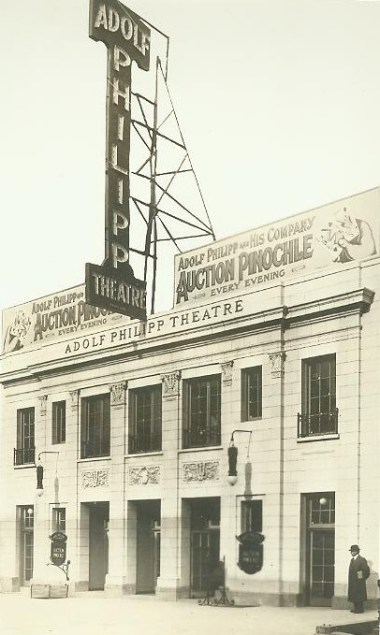
Adolph Phillip's Fifty-Seventh Street Theater, later the Bandbox Theater, courtesy of Schubert Archives

Adolph Phillip’s Fifty-Seventh Street Theater, later the Bandbox Theater, courtesy of Schubert Archives

I plan to head all the way to White Plains today, but as I’m preparing to buy the ticket at Grand Central Station, I pause to reconsider my day’s plans. In the end, I decide to put the trip on hold: it wouldn’t put my funds and time to best use since I was unable to discover the White Plains site location I sought at the New York Public Library yesterday. I’ll see if I’m more successful when I do more research tonight and perhaps go tomorrow. Instead, I decide to cover the northernmost Manhattan sites on my list after I hit up a few near the southwest end of Central Park that I didn’t get to yesterday.

I walk north towards Central Park and then east, and stop first at 205 E. 57th St near 3rd Ave where the Bandbox Theatre used to stand. Originally named Adolf Philipp’s Fifty-Seventh Street Theatre, the theater that became the Bandbox was built in 1912, closed in 1926, and demolished in 1969. Now there’s a Design Within Reach store and a high rise apartment building here.

On Feb 20th, 1916, Sanger and her supporters held a victory celebration at the Bandbox Theatre. The court had just dismissed the obscenity charges against her for publishing The Woman Rebel that had caused her to flee to Europe the year beforeWhile she was away, many papers had begun to discuss birth control and sex a little more openly, and as you may remember, her daughter had just died suddenly the previous November, soon after Sanger’s return from Europe. Public opinion was swinging to Sanger’s side, and the court no longer had the appetite to pursue a case against her. What had once seemed a public defense against immorality would more likely be perceived as an attack on free speech and emerging modern, scientific attitudes about human sexuality. Even without the court case, however, the arrest and indictments proved an enormous boost to Sanger’s cause. She was portrayed, by herself as well as others, as a sort of free speech and humanitarian martyr, a persecuted champion of the cause of women, especially the poorest and most downtrodden.

14 E 60th Street, with the green awning, NYC, photo 2016 Amy Cools.JPG

14 E. 60th Street, Manhattan, New York City

Then I head northwest to 14 E. 60th St between 5th and Madison Aves. It’s a 13-floor building erected in 1903. Two restaurants, Rotisserie Georgette and Avra Madison Estiatorio, occupy the ground floor, and apartments above. Sanger had been staying at the Ambassador Hotel but moved to one of the apartments at this address on December 17, 1936. Her move here followed on the heels of the birth control movement’s victory in the Dec 7th decision in the One Package case, and not long before Sanger attended the Conference on Contraceptive Research and Clinical Practice that met at the Roosevelt Hotel which, as you may remember, I visited on my first day following Sanger here in New York City.

1935 and 1936 were busy years for Sanger. In addition to the One Package trial, she toured India, speaking to women’s groups and conferences and debating Gandhi there in December of 1935. She continued on to Hong King, then Japan. In Japan, she visited Tokyo’s fledgling birth control clinic founded by her Japanese counterpart Shidzue Ishimoto, and reviewed birth control methods that had been developed in that country since her 1922 visit. While the birth control movement was also beleaguered in that country by law and custom, many Japanese health care professionals were working on new and effective methods of birth control in that island nation where population growth was a constant and pressing concern. In 1932, she had met a Japanese physician at a birth control conference who had developed a new type of diaphragm. He had sent her that package which was intercepted in customs and led to the One Package case finally litigated three years later. She planned to continue her travels in China and Malaysia but had to cut her trip short due to recurring gallbladder trouble, then a broken arm. She stopped for a short visit in Hawaii, then returned to mainland U.S. to rest and recuperate.

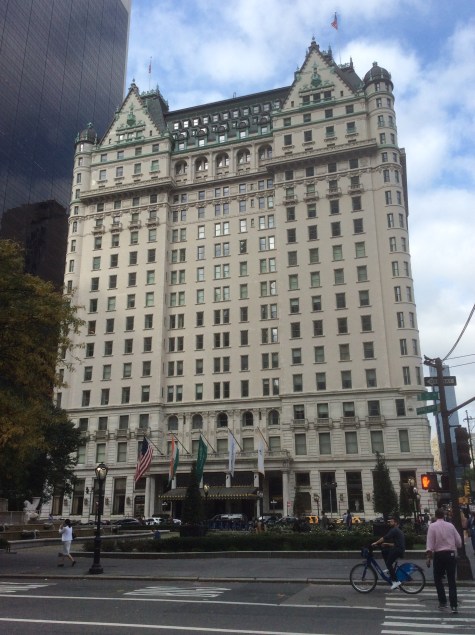
The Plaza Hotel, Manhattan, New York City, photo 2016 by Amy Cools

The Plaza Hotel, Manhattan, New York City

I head west towards Central Park then veer south towards its southeast corner to 768 Fifth Ave at 59th St. Three occasions bring me here to the grand Plaza Hotel.

On March 15th, 1917, the National Birth Control League held a luncheon for her here in celebration of her release from Queens County Penitentiary. She had been imprisoned there for 30 days, convicted of violating anti-obscenity laws while operating her birth control clinic in Brownsville, Brooklyn.

Then from November 11th – 13th, 1921, the First American Birth Control Conference, organized by Sanger, was held here. The conference was widely attended by medical professionals, social scientists, humanitarians, authors, suffragists, socialists, and socialites. Its list of sponsors was likewise distinguished, including famed Parliamentarian and future Prime Minister Winston Churchill. Sanger gave the opening address, in which she called on the medical profession to join social workers and birth control activists in addressing the sexual dimensions of problems of hunger, poverty, and overpopulation. As she often pointed out, there were plenty of people working hard to alleviate poverty and disease, but there were very few paying attention to their primary root causes: the human need for love and sex. This was the conference which launched the future Planned Parenthood and concluded with the Town Hall event which turned into a police raid. Between the conference and the publicity following the raid, Sanger was firmly placed as the United States’, and indeed the world’s, preeminent birth control activist and spokesperson.

An interior view of the beautiful Plaza Hotel, Manhattan, NYC, 2016 Amy Cools

An interior view of the beautiful Plaza Hotel, Manhattan, NYC

Several years later, on February 26th, 1929, Sanger presided over a dinner promoting the Birth Control Clinical Research Bureau. In her opening speech, Sanger outlined the history of her own birth control activism and the struggles and legal battles of the birth control movement in the United States from 1915 until that day. She also credited John Stuart Mill and Francis Place as founders of the modern birth control movement, about a century before her own activism began. Like Sanger, Mill was moved to support birth control by personal horror at the worst effects of children conceived in poverty: at age 17, he came across the corpse of a strangled infant discarded in a park. And like Sanger, Mill believed that when the poor had more children to help make money for the family, wages were inevitably driven down by the glut of laborers seeking employment, leading to a downward spiral of impoverishment and immiseration. So in 1823, young Mill and a friend distributed birth control pamphlets written by his father’s friend and social reformer Francis Place, and were arrested and imprisoned for their trouble.

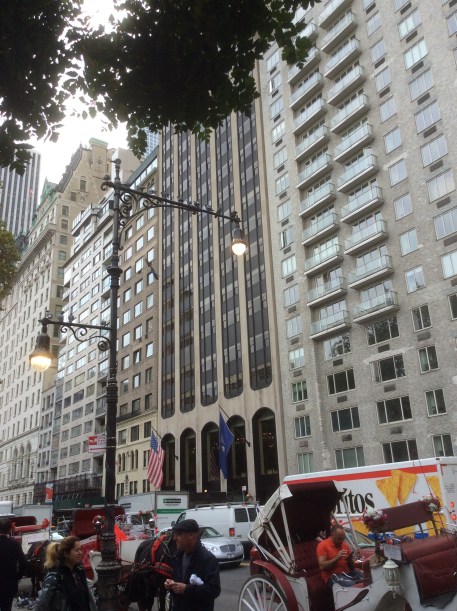
The Park Lane Hotel and adjoining buildings, Manhattan, New York City, 2016 Amy Cools

The Park Lane Hotel (with the blue flags) and adjoining buildings

I walk a little ways west along the southern end of Central Park to 36 Central Park South, a.k.a. 59th St. Here at the Park Lane Hotel, Sanger delivered her speech ‘My Way to Peace’ to the New History Society on January 17, 1932. In my view, it’s a nasty speech. While Sanger generally insisted that birth control be entirely voluntary, the result of education and the right of women to have control over their own bodies, in this speech she called for coercive sterilization of ‘the unfit’. As Nazism was developed and implemented in the years to come, Sanger opposed it staunchly, sharply criticizing its racial doctrines and opposing its coercive practices. Though she justified it on the grounds of improving public health and decreasing mortality rates, to my mind she was never able to sufficiently explain how her earlier call in ‘My Way to Peace’ for coercive sterilization of ‘mental defectives’, people with certain diseases, and convicted criminals was morally superior to Hitler’s fascist system when it came to these unfortunate and marginalized groups.

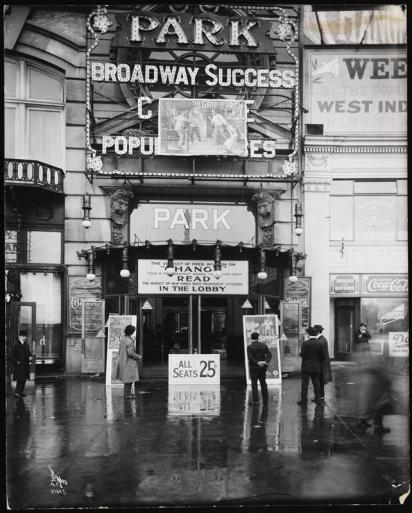
New York Tribune Fri Nov 18 1921, Park Theater Cox Speech

New York Tribune, Fri Nov 18 1921, Announcement of Park Theater Margaret Sanger and Harold Cox appearance

One place I miss on this trip is the former site of the nearby Park Theater, near the southwest corner of Central Park, where Harold Cox delivered the Sanger speech he was prevented from making at the Town Hall five days earlier. A New York Tribune announcement describes the location as ‘Columbus Circle near 59th and B’way’ (Broadway). As I consult the 1923 Bromley atlas I’ve been consulting for much of this series, I don’t find the Park Theater. Later, I search through an earlier edition of the Bromley Atlas and this time, I’m in luck. The Park Theater, renamed the Cosmopolitan Theater by 1923, was on 58th St, the second address to the west of Eighth Ave, its northeast corner at Columbus Circle at the southwest edge of Central Park. It stood where the Time Warner Center now faces onto 58th St, about where Google Maps identifies 322 W. 58th St.

In 1944, Sanger reminisced:

‘…Birth control, fifteen, twenty years ago was a lurid and sensational topic… The very term was one not mentioned in polite society, thanks to Anthony Comstock who had Congress classify it with “obscene, and filthy literature”… Our struggles lacked the dignity they have today. Back in 1921, Harold Cox, brilliant member of the English Parliament and Editor of the Edinburgh Review was to speak with me at that early forum of free speech, Town Hall. Our subject was “Birth Control: Is it Moral?”

Entrance of the Park Theater, formerly the Majestic, Columbus Circle, 59th St, NY, courtesy of MCNY

Entrance of the Park Theater, formerly the Majestic, at Columbus Circle, photo courtesy of MCNY

With astonishing directness Roman Catholic Archbishop Patrick J. Hayes, through his emissary Monsignor Joseph P. Dineen, closed the meeting before it even opened. We had grown accustomed to opposition, from the combination of the Comstock group …with the Roman Catholic hierarchy, but never had the interference been so brutally direct before. Time and again theatres, ballrooms where I was to speak were ordered closed before the meeting could be held. In city after city this occurred during the years 1916, ‘17 and ‘18, but the climax was the now famous Town Hall incident which raised the issue throughout the country. Can one in public office use the power of that office to further his personal religious beliefs?

Mr. Cox and I were met at the steps of the Town Hall that evening by policemen, barred from entering and told, “There ain’t gonna be no meeting. That’s all I know…

We had the hierarchy to thank for so publicizing our meeting that the second held shortly after, at the big Park Theatre in Columbus Circle was packed fifteen minutes after a single door was opened. Two thousand people, many of whom had never heard of birth control before Cardinal Hayes gave it nation-wide publicity, stood outside clamoring to get in…”

I descend into the subway station at Columbus Circle and take the A train north, almost to the top of Manhattan Island. There are many sites on my list from Inglewood all the way back down to the southern end of Central Park, so I decide to visit them from north to south…

To be continued….

*Listen to the podcast version here or on Google Play, or subscribe on iTunes

~~~~~~~~~~~~~~~~~~~~~~~~~~~

Sources and inspiration: 

14 East 60th Street‘, from 42Floors website

About Sanger: Biographical Sketch‘, from The Margaret Sanger Papers Project at New York University.

Another Look at Margaret Sanger and Race‘, Feb 23, 2012. From The Margaret Sanger Papers Project at NYU

Bandbox Theatre: East 57th Street near Third Avenue, New York, NY‘, International Broadway Database

Blake, Aaron. ‘The Final Trump-Clinton Debate Transcript, Annotated.’ Oct 19, 2016, The Washington Post: The Fix

Bromley, G.W. and Co. Atlas of the Borough of Manhattan, City of New York. Desk and Library edition, 1916, Plate 87 . Retrieved from Lionel Pincus and Princess Firyal Map Division Digital Collection, The New York Public Library.

Bromley, G.W. and Co. Atlas of the City of New York, 1921 – 1923, Plate 82 and Plate 87. Retrieved from Lionel Pincus and Princess Firyal Map Division Digital Collection, The New York Public Library.

Chesler, Ellen. Woman of Valor: Margaret Sanger and the Birth Control Movement in America. New York: Simon & Schuster, 1992

Eig, Jonathan. The Birth of the Pill: How Four Crusaders Reinvented Sex and Launched a Revolution. W.W. Norton & Company, New York, 2014.

Gopnik, Adam. ‘Right Again: The Passions of John Stuart Mill‘. Oct 6 2008, The New Yorker

Grimaldi, Jill. ‘The First American Birth Control Conference‘, Nov 12, 2010. The Margaret Sanger Papers Project at NYU

Guillin, Vincent. Auguste Comte and John Stuart Mill on Sexual Equality. Brill: Boston, 2009.

International Theatre: 5 Columbus Circle (W. 58th & 59th), New York, NY‘, International Broadway Database

Mrs. Sanger Glad She Was Indicted‘, New York Tribune, Feb. 21, 1916, p. 2, via The Margaret Sanger Papers Project, NYU

New-York Tribune, two selections from Nov 18, 1921, page 11: ‘Birth Control Appeal Fails to Move Enright‘ and ‘You Are Invited to Hear Margaret Sanger… New York, New York. Via Newspapers.com

On the Road with Birth Control‘, Newsletter #21 (Spring 1999) of The Margaret Sanger Papers Project at NYU

Pokorski, Robin. ‘Mapping Margaret Sanger‘ from The Margaret Sanger Papers Project at NYU

Regan, Margaret. ‘Margaret Sanger: Tucson’s Irish Rebel.Tucson Weekly, Mar 11, 2004.

Sanger, Margaret. ‘Birth Control: Then and Now,’ 1944, Typed Article. Source: Margaret Sanger Papers, Sophia Smith Collection

Sanger, Margaret. ‘Gandhi and Mrs. Sanger Debate Birth Control,’ Recorded by Florence Rose, published in Asia magazine, Vol. 26, no. 11, Nov. 1936, pp. 698-702

Sanger, Margaret. ‘My Way to Peace,’ Jan. 17 1932. From The Margaret Sanger Papers Project at NYU

Sanger, Margaret. Margaret Sanger, an Autobiography. Cooper Square Press: New York 1999, originally published by W.W. Norton & Co: New York, 1938

Sanger, Margaret. ‘Opening Address for Birth Control Clinical Research Bureau Dinner‘, Feb 26, 1929. Source: Margaret Sanger Papers, Sophia Smith Collection, Smith College, Margaret Sanger Microfilm S71:153.

Sanger, Margaret. The Pivot of Civilization, 1922. Free online version courtesy of Project Gutenberg, 2008, 2013

Sanger, Margaret. Woman and the New Race, 1920. Free online version courtesy of W. W. Norton & Company

New Podcast Episode: Margaret Sanger NYC Sites, Day 1 Part 3

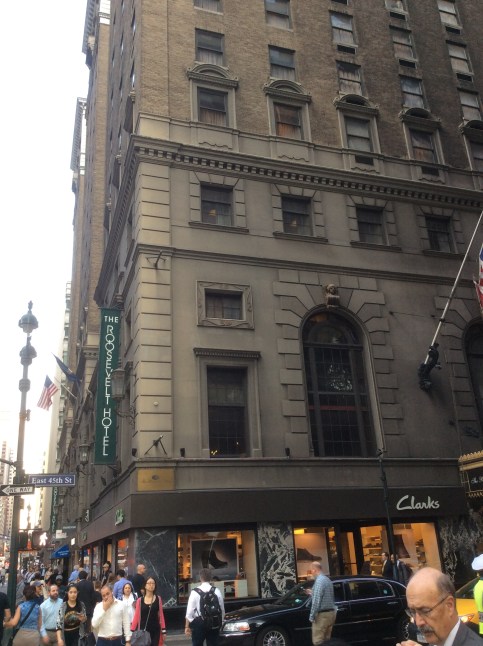
roosevelt-hotel-exterior-view-manhattan-nyc-photo-by-amy-cools-2016

Listen to this podcast episode here or on Google Play, or subscribe on iTunes

Tuesday, October 18th, 2016, continued

I continue north to the Roosevelt Hotel at Madison Ave and E. 45th Street. Margaret Sanger attended the Conference on Contraceptive Research and Clinical Practice that met here on December 29th and 30th, 1936. She delivered a welcoming speech on the 29th and spoke on a panel the next day which discussed technical and medical birth control issues. While The New York Times reported optimistically on the effectiveness of birth control methods available at the time and Sanger spoke proudly of the ‘56,000 women who have voluntarily appealed to us for help’, she and many of the attendees knew that the lack of access to and effectiveness of birth control remained big problems. It was still fairly expensive; anti-obscenity laws were barriers to access and information in those pre-Griswold years; and too many of the methods were only moderately effective since they were not always easy to use correctly, especially in well, you know, the heat of the moment…. Read the written version here:

Ordinary Philosophy and its Traveling Philosophy / History of Ideas series is a labor of love and ad-free, supported by patrons and readers like you. Please offer your support today!

A Woman’s Work: Ann Plato’s Republic, by Sara Georgini

phillis-wheatley-silhouette-william-kingShe was named for the ship that stole her away. At seven years old, Phillis Wheatley crossed the Atlantic from West Africa, another dot in the mosaic of roughly six million enslaved Africans who landed in the Americas between 1700 and 1808. Small and so young, she became Boston merchant John Wheatley’s gift to wife Susannah. Early on, Phillis’ talent shone. She mastered Latin and Greek, earning transatlantic praise for her Poems on Various Subjects, Religious and Moral, the first book of poetry by an African-American, published in London in 1773. She sat for an author portrait, toured England, met George Washington, and, finally, secured her freedom before dying, impoverished, in 1784.

Early Americans and early Americanists have pored over her too-brief career ever since. Phillis Wheatley’s byline alone, threading together her sacrifice and her sale, bears hard history in it. As an African-American founding mother of our national literary tradition, Wheatley owns a leading role in survey classes, public statues, and cultural memory. Wheatley’s last manuscript, 300 pages of poetry, may be lost; but we hold pieces of her legacy intact. Here at the Massachusetts Historical Society, I pass by her writing desk nearly every day. It’s not the one in her formal portrait. Rather, it’s the mahogany “card or tea table” that John Wheatley gifted Phillis with sometime during her long servitude. Ball-and-claw feet grip the carpet. A neat apron-front drawer has room enough for cards, ink, and a few cottony sheets of colonial paper. Sold at auction to settle her heavy debts, the poet’s desk is a rich artifact of literary technology, an Enlightenment-era laptop. Polished and bare, Phillis Wheatley’s desk raises the question: Who took up her pen?

Today, resuming my series on early American women intellectuals, I’ll focus on Ann Plato, a Hartford, Conn., schoolteacher who was, in many ways, Wheatley’s direct heir. Or so argued the abolitionist preacher James W.C. Pennington in his opening attestation of Plato’s 1841 Essays; Including Biographies and Miscellaneous Pieces, in Prose and Poetry. Pennington, then deep at work on his own book, The Origin and History of the Colored People (1841), made a compelling case for Plato’s historical significance. Of African-American and Native American ancestry, Plato (fl. 1824-1870), had, according to Pennington, suffered in order to persevere as a literary artist. By his lights, Ann Plato therefore joined the ranks of Wheatley, the Roman playwright Terence, and the Jamaican poet Francis Williams. “These all served in adversity,” Pennington reminded readers, “and afterwards found that nature had no objection, at least to their serving the world in high repute as poets… But as Greece had a Plato why may we not have a Platoess?”

For researchers, the long-forgotten, local “Platoess” has proved near-mythic to examine. A great deal of excellent biographical spadework has been done by Ron Welburn, in Hartford’s Ann Plato and the Native Borders of Identity (Albany: SUNY Press, 2015). Ann Plato presents a critical dilemma for scholars, as Welburn points out, since she “left neither entry nor exit signs,” opting to blur her contributions within the historical record. Tracing Plato’s education from eastern Long Island to her Connecticut teaching career, Welburn weaves in the intellectual “places in between,” where Ann Plato also thrived: praying at the Talcott Street (Colored) Congregational Church, publishing poetry in The Colored American newspaper, and––like so many other Americans––possibly wending her way West, to Iowa, in the Reconstruction era. To deal with Plato on any critical level is tough. Though she produced several shorter (and often near/anonymous) pieces, Ann Plato’s legacy rises or falls on her single volume, Essays. Between her conduct book’s rote lines lies a wealth of African-Americans’ sense of experience, education, history. A pastiche of prose parables, morality tales, advice for youths, and poetry humming with political and religious commentary: Ann Plato’s book is at home in the early republic.

Plato’s Essays split along three paths, marked out “Prose,” “Biographies,” and “Poetry.” To read Plato is to sink fully into the antebellum schoolroom. The first section instructs the reader via “lessons from nature,” outlining the Christian principles of education, diligence, and obedience needed to frame a good character. Youth remains the best “season” to cultivate ideal habits. Plato’s voice steers the narrative; she is quiet but firm. In one essay, she frets that her female pupils will favor making a “showy appearance” more than “prizing the gift” of entrance into the “temple of knowledge.” In another piece, she urges students to excel, since “mediocrity is a proof of weakness; and perfection may always be purchased by application.” Like her literary peers, Ann Plato keeps her “Prose” primly aspirational with “Eminence from Obscurity,” a listicle of “great” European men who have “risen from humble stations” and laboring lives to become artists and scholars.

Plato wraps up “Prose” with a trinity of tragic reflections. “Life is Short” documents the first moments of new orphans, in freefall after a family funeral. “Death of the Christian,” a shorter and more ambitious work, namechecks a set of classical and modern references (Caesar, Pollok, Byron, Chesterfield, Addison). There, Plato reels in cultured readers with her impressive grasp of Anglo-American literature. Then she steps back, sealing her conclusion with an appeal to godly virtue. “Learn with what superior dignity of mind a Christian can die,” Plato writes. Certainly, Pennington’s “authoress” knew her audience, for Plato folds lost friends into her saga. The second part, “Biographies,” features short eulogies of four women, all local acquaintances who died young (likely of consumption). Using their lives to reinforce cherished notions of Christian morality and youthful piety, Plato attempts women’s biography with sentimental verve. Industrious, mild, and ever sweetened by death’s approach, Plato’s subjects melt and sway into one another’s path. Plato is more interested in presenting a template than a person, putting her work in line with the religious tracts, advice books, and “manners” novels that fellow New Englanders enjoyed. Then, in the space of a few stanzas, Plato turns inward, and against the crowd.

Ann Plato is best known for her poem, “The Natives of America,” an eloquent reflection on her biracial identity, which features prominently in her Essays’ final pages. Go ahead, read it. Plato opens in a familiar, Longfellow-esque tone, with a child begging for a story from her father’s lap. But the narrative she learns is one of conquest and loss. Here is a key sample: “Wars ensued. They knew the handling of firearms. / Mothers spoke,––no fear this breast alarms, / They will not cruelly us oppress, / Or thus our lands possess. / Alas it was a cruel day; we were crush’d: / Into the dark woods we rush’d / To seek a refuge. / My daughter, we are now diminish’d, unknown, / Unfelt! Alas! no tender tone / To cheer us when the hunt is done; / Fathers sleep––we’re silent every one.” If Plato’s individual eulogies run drab, embroidered with obligatory accents of Christian piety, her reconstruction of the Native American experience is raw, powerful, and worth your read.

Part of why I began this project was to read more early American thinkers who sensed their histories, like Phillis Wheatley’s or Ann Plato’s, were diminished, unfelt, unknown. Reading Ann Plato’s republic is a way to understand the kind of historical figure extolled by Anna Julia Cooper in A Voice From the South (1892), the “open-eyed but hitherto voiceless Black Woman of America.” It’s also a route to retrace how early American women wrote about themselves en route to Seneca Falls, through the Civil War, beyond the cultural upheavals of Reconstruction, and into a modern realm of world literature that Phillis Wheatley glimpsed, far too briefly. For, as “A Lady from Philadelphia,” asked in an 1885 issue of Lippincott’s Monthly Magazine: “Why should not the coming novelist be a woman as well as an African? She––the woman of that race––has some claims on Fate which are not yet paid up.”

~ Sara Georgini is a Historian & Series Editor, Adams Papers, @MHS1791. Ph.D., #BU. Views=mine, #history for all (Bio notes credit: author’s own on her Twitter page)

~ This piece was originally published in the Society for U.S. Intellectual History Blog on December 21st, 2016

Ordinary Philosophy and its Traveling Philosophy / History of Ideas series is a labor of love and ad-free, supported by patrons and readers like you. Please offer your support today!