Happy Birthday, Ludwig Wittgenstein!

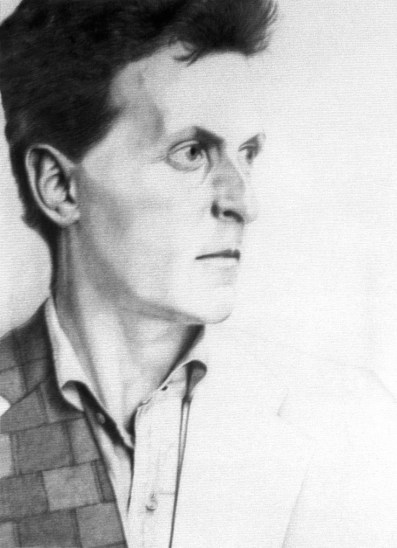
Drawing of Ludwig Wittgenstein by Christiaan Tonnism, pencil on board 1985, Creative Commons

In honor of Ludwig Wittgenstein’s birthday, Apr 26, 1889, let me share three fascinating discussions about the great philosopher’s life and ideas, one by Stephen West and two for the BBC, one by Matthew Parris and one by Melvin Bragg with their guests.

The first is by philosopher West for his podcast Philosophize This!, in which he discusses ‘…the limitations of language as described by Ludwig Wittgenstein. Considered by some to be the greatest philosopher of the 20th century, Ludwig Wittgenstein played a central, if controversial, role in 20th-century analytic philosophy. He continues to influence current philosophical thought in topics as diverse as logic and language, perception and intention, ethics and religion, aesthetics and culture….’ (this episode is only the first West will create about Wittgenstein)

The second is from the series Great Lives, hosted by Matthew Parris and featuring guests Raymond Tallis and Ray Monk. In this program, Parris, Tallis, and Monk discuss ‘Ludwig Wittgenstein, the fascinating and misunderstood genius who changed the course of philosophy…’

The thirdis  from the series In Our Time, hosted by Melvin Bragg and featuring guests Ray Monk, Barry Smith, and Marie McGinn. In this program, Monk, Bragg, Smith, and McGinn discuss ‘…the life, work and legacy of Ludwig Wittgenstein… Wittgenstein is credited with being the greatest philosopher of the modern age, a thinker who left not one but two philosophies for his descendants to argue over: The early Wittgenstein said, “the limits of my mind mean the limits of my world”; the later Wittgenstein replied, “If God looked into our minds he would not have been able to see there whom we were speaking of”. Language was at the heart of both. Wittgenstein stated that his purpose was to finally free humanity from the pointless and neurotic philosophical questing that plagues us all. As he put it, “To show the fly the way out of the fly bottle”.How did he think language could solve all the problems of philosophy? How have his ideas influenced contemporary culture?…’

Enjoy and be inspired, awed, puzzled, and enlightened!

Ordinary Philosophy and its Traveling Philosophy / History of Ideas series is a labor of love and ad-free, supported by patrons and readers like you. Please offer your support today!

Ordinary Philosophy’s 4th Anniversary

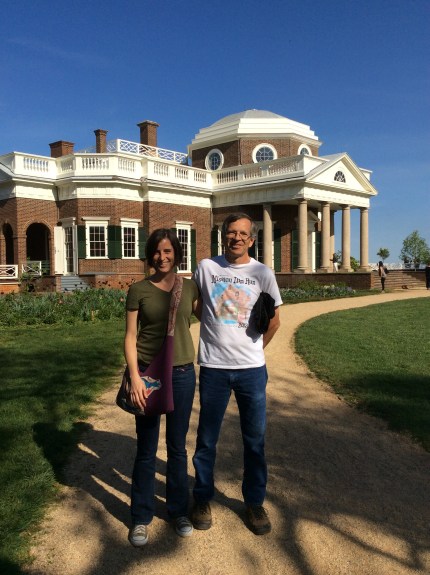
At Monticello, VA, with my Dad, John Cools, in 2015 for my history of ideas series following Thomas Jefferson in America

I published my first post for Ordinary Philosophy four years ago today, on April 23rd, 2013. Thank you, dear readers and listeners, for your kind attention, your encouragement, your corrections, your patience as I learn with and from you, and your hospitality and financial support (you know who you are!) for all of my traveling philosophy / history of ideas series.

Ordinary Philosophy has been one of the most satisfying projects of my life, and I look forward to continuing to share my love of philosophy, history, ideas, and travel for many more years to come, whatever form this will take.

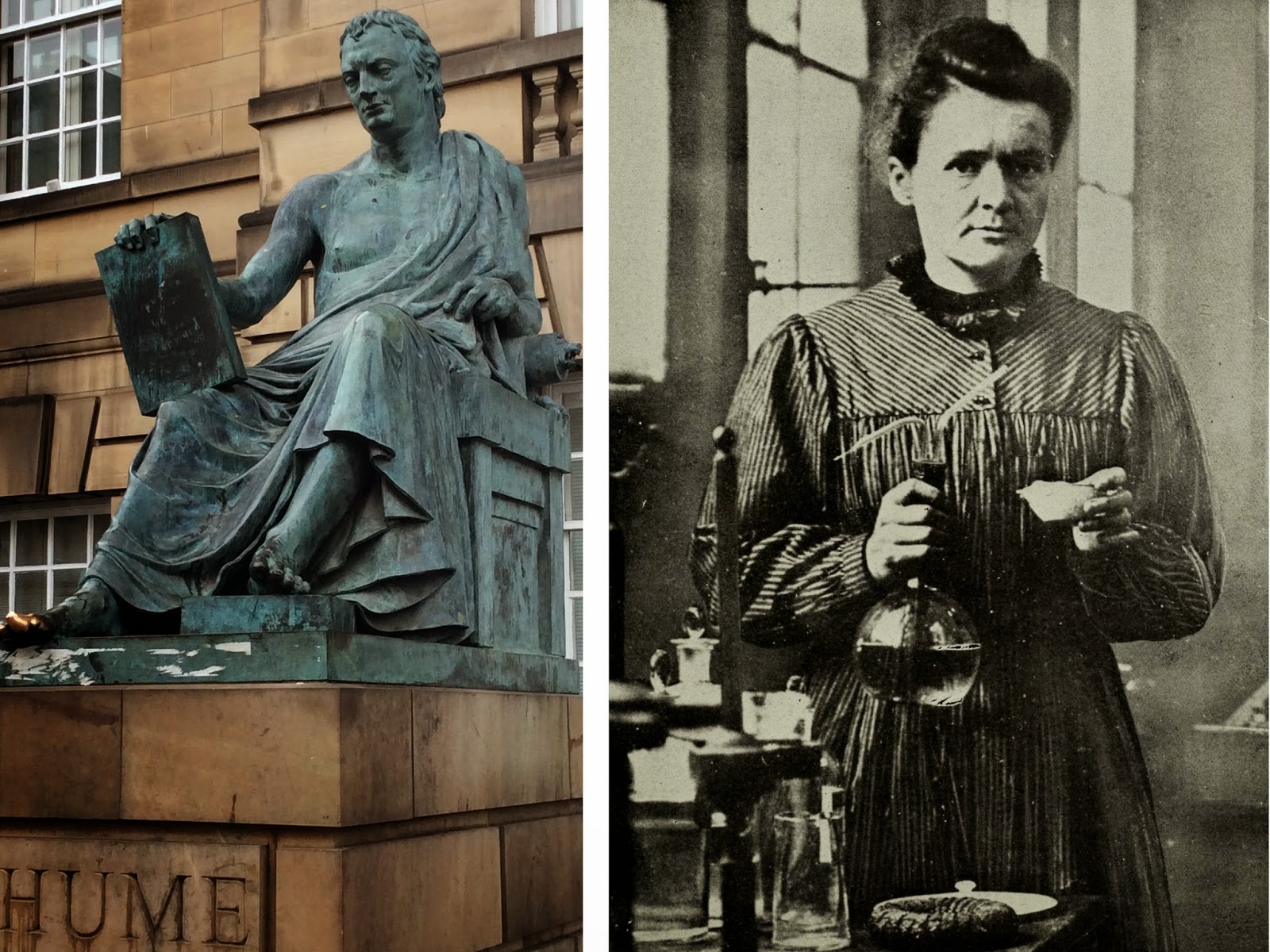
I’m thrilled to share the news with you that I’ll be resuming my formal education at the University of Edinburgh this fall. What an adventure this will be! I’ll be living and studying in the center of the Scottish Enlightenment and the city of David Hume. He brought me here three years ago when I followed his life and ideas for my first history of ideas travel series. I’ll take this opportunity continue my Hume series as well. Though my studies will demand a great deal of my energy and attention, I dearly hope I’ll be able to devote more time to share more with you here at Ordinary Philosophy, not less, as I once again pour the bulk of my time, energy, and love into the world of ideas.

Yours, as ever, Amy Cools

Ordinary Philosophy and its Traveling Philosophy / History of Ideas series is a labor of love and ad-free, supported by patrons and readers like you. Please offer your support today!

Selfie in the beautiful Rose Room of the New York Public Library, 2016 Amy Cools

In the beautiful Rose Room of the New York Public Library. Thank you, friends, for supporting my New York projects too! Ahhh, what a town…

New Podcast Episode: O.P. Recommends: Why Radio’s Feminism as Philosophy, Politics, and Friendship with Guests Gloria Steinem and Suzanne Braun Levine

Gloria Steinem and Suzanne Braun Levine, image via Why? Radio podcast website

Listen to this podcast episode here or on Google Play, or subscribe on iTunes

I was recently thrilled to discover Why? Radio‘s podcast. It’s about time I did, since it’s eight years and more than 100 episodes in. Thanks for the share, Laura of Bismarck, ND!

For the 100th episode this February, host and creator Jack Russell Weinstein interviews Gloria Steinem, co-founder of Ms. magazine, journalist, writer, and feminist extraordinaire; and Suzanne Braun Levine, first editor of Ms. magazine, author, and authority on feminism and gender issues. The topics covered in this episode are summarized in the title ‘Feminism as Philosophy, Politics, and Friendship‘. Weinstein is a Professor of Philosophy at the University of North Dakota and created the IPPL radio show and podcast Why? Philosophical discussions about everyday life for very similar reasons I created Ordinary Philosophy, as you can see from the subtitle…. Read the written version here

Ordinary Philosophy and its Traveling Philosophy / History of Ideas series is a labor of love and ad-free, supported by patrons and readers like you. Please offer your support today!


Raconteur Street Blues, by East Street Prophet

Painting on a wall, photo by East Street Prophet at 518 Song of My People

I grew up around some of the great narcissists of our time. History won’t remember them, so I have to. They were great storytellers, who forged a knack for survival into an unequivocal hunger to live like kings. They spoke of riches and wealth that they couldn’t have possibly known, yet painted a picture so alluring we had no choice but to believe. They were raconteurs, wizards possessed of a singular illusion that painted the world in their image and presented it to us, as if it were ours.

A Raconteur is a person who excels in telling anecdotes. Also, an anecdote (Please note: I don’t want to insult anyone’s intelligence. I mean to provide clarity.) is a usually short narrative of an interesting, amusing, or biographical incident. A raconteur is a great storyteller. I’ve always considered the word to be closer to ‘being a good bullshitter’, which is worth its weight in gold. Anyone can tell a story, but getting people to care is a miracle akin to walking on water.

Storytellers are plentiful. You can see them in coffee shops behind laptops, biding their time until they have a chance to share, connect and separate. It’s in that singular moment, where we connect, that things change. They can become dangerous in a moment’s notice, as they infect your mind with complex riddles that the storytellers have been working on since the dawn of time. You might wonder, ‘why would a person share such a riddle?’ you can’t think like that. It’s how any good storyteller wants you to think. They want you to assume they have no reason to hurt you. There’s no harm in believing what they believe. There’s no harm in believing them without question.

The thing that all decent ‘raconteurs’ must ask themselves periodically is ‘do I care more about myself than I do the story?’ I’ve lived among some of the great bullshitters of modern history. We heard plenty of stories growing up, yet so few of them added up in a way that it could make me care. The raconteurs possessed this trait that added depth to their stories, not just with what images they infused, but with how they made us feel. We felt involved. They tugged on our heartstrings and moved us toward an end that we couldn’t see. They possessed our future, as we waited for these mindless heathens to comb through the vast wasteland of their psyches in search of an end to whatever narrative they were painting.

Any good story comes from a single point. It’s not the beginning. It’s just a point. They wanted to make a point. They’d lie about having sex, so they’d present a narrative that made the possibility of them having sex seem possible. They’d plant a few mental images here and there, forming past and future around this premise. Ultimately, their goal was to forge a real, however unlikely, narrative, in order to make us believe.

The raconteurs believed what they said. The proof was in their words. They told us to take it from there, because taking a man at his word is as good as taking it in blood… at least when you’re a child. When we were kids we lied and it helped. We had impossible things to accomplish in a collapsing world full of poverty and the imminent threat of some incomprehensible bullshit. We had to hide sensitive information from our parents, while taking advantage of our God-like inertia, limitless energy and simple-mindedness. We had to prove to other kids that we were cool, while, at the same time, making our parents think we’d never do the cool things that get you into trouble. It added to our personal mystique, having accomplished nothing, we needed something to set us apart. We’d lie about drinking and drugs, losing our virginity, feats of the utmost stupidity… you know… harmless bullshit.

Truth is the trickiest thing. Everyone says they want it, but when it’s not something they agree with they have a reaction that makes you wonder. Truth. It’s a funny thing, because I could write out the truth as I see it and (hopefully) half of you would love me and the other would hate me. The trick for any good raconteur is understanding the right formula, while having as full an understanding as you can of the truth. I believe that you can’t write a decent story, even if it sounds like nonsense, without a sense of truth. It has to be written, spoken and lived with conviction. Truth has to appear in every word, exactly as you’ve seen it, while managing not to conflict with the truth, as it is. You should, as a good storyteller, align yourself with the truth in order to make your narrative more honest and compelling.

I never thought about truth when I was young enough to fall for these stories. The morality of lying, as one presents it to himself, so that he might further his ends, has become all the more staggering as I’ve reached adulthood. I’ve been trying to think of the right way to word this question. I doubt it’s perfect, but it needs to be asked. I’m curious as to what everyone believes:

Can you have a moral premise without any evidence?

Some raconteurs have no regard for the truth. In all honesty, as a kid I didn’t care. I was surrounded by some of the greatest storytellers of my time. I couldn’t be bothered to figure out how some of these impossible stories could be real. I believed with all my heart, because I was a stupid kid who still believed in Santa. (FYI I believed in ghosts for longer than I believed in Santa, but I also assumed the ghosts would grant a wish or needed my help or whatever.) These are men who have learned to lie in a way that ‘everyone believes that you believe what you say’. You believe them, no matter the evidence to the contrary, because they, not their narrative, hold up well against the barrage of truth that assaults them on all sides.

They’re not not-sympathetic characters. Their truth is a depressing harangue of emotion and pain that most couldn’t understand. What’s worse, they keep it to themselves. They keep it! They hide all that pain and suffering, but even more, they hide the truth! They move with such intent when they tell their stories, as if revealing a deeper, more significant wisdom, while simultaneously hiding it from the world. It’s in their emphatic gestures, their movements, as if their bodies shift depending on the tone of their narratives, not to mention their eyes… it’s in all these things that those of us who were forced to listen HAD to believe.

We believed it all the more, because we lived it. They borrowed from our lives and, in this way, we added to the false narrative. Storytelling is a necessary skill. It made us feel good in a time where people were laughing at us, because our river was full of poison and visitors had no reason to… visit. The pain of being alive could’ve shown itself in crime and self abuse. For us, it showed itself in acceptance of nonsensical bullshit and downright lies.

Near-possible realities were a simple narrative that captured our attention, which begs the question: why do they need our attention? Evil raconteurs are like evil yogis. You can assume they don’t exist, as if there is no darkness when there is also light, but this is another simple narrative that’s easy to digest. The simple narrative is used to ensnare. You don’t need to talk about angels to be a good raconteur. You have to make people believe. This is that much more significant. You MAKE people believe. You take them on a journey, where they start out as a skeptic and then, through a few twists and turns… holy shit… you just made someone believe in angels.

(Also, if you don’t make them believe, you at least allow them to suspend reality for a time, which is kinda the same, although I admit there are differences.)

Making people believe and sharing with them a deeply personal truth is about as different as water and oil.

For what it’s worth, they thought they were kings, but that never stopped them from fighting to become that oh-so-desirable, and unquestioned ruler of the universe. They lied and stole and fought, but the stories to me became all the more touching. These people, the Raconteurs, were at war with themselves, as well as the truth and as well as a circumstance of poverty and extreme depravity, which was plentiful, in our ever-collapsing society. They fought for freedom: the freedom to be as insane and harmful to oneself as you can get. They fought to make the world a weird place.

Originally published at 518 – Song of My People

East Street Prophet 518 writes beautifully about hometown Rensselaer, just across the Hudson River from Albany, NY, and their experiences within the 518 area code: Albany, Rensselaer, and Troy, and various outlying places as well. They’ve been having a lot of fun with it and creating a bit of ‘folklore’ from local stories at 518 – Song of My People

~ Ordinary Philosophy is a labor of love and ad-free, supported by patrons and readers like you. Any support you can offer will be deeply appreciated!

*All views and opinions expressed by guest writers are their own and do not necessarily reflect those of Ordinary Philosophy’s editors and publishers

Happy Birthday, Elizabeth Anscombe!

‘Elizabeth Anscombe, [born Mar 18, 1919] was considered by some to be the greatest English philosopher of her generation. She was professor of philosophy at Cambridge from 1970 to 1986, having already, as a research fellow at Oxford in the 50s, helped change the course of moral philosophy. Also influential in philosophy of mind, she pioneered contemporary action theory, and the pre-eminent philosopher Donald Davidson called her 1957 monograph Intention the best work on practical reasoning since Aristotle. The philosophical world owes her an enormous debt, too, for bringing Wittgenstein, probably the greatest philosopher of the 20th century, to public knowledge…. from Jane O’Grady’s obituary for The Guardian

Let us honor Elizabeth Anscombe on the anniversary of her birth by learning more about this important, influential, and trailblazing philosopher:

G. E. M. Anscombe (1919—2001) – by Duncan Richter for the Internet Encyclopedia of Philosophy

Gertrude Elizabeth Margaret Anscombe – by Julia Driver for The Stanford Encyclopedia of Philosophy

Elizabeth Anscombe – A BBC Programme Woman’s Hour episode in which Sarah Woolman speaks to Dr Rosalinde Hursthouse and Professor Philippa Foot

The Golden Age of Female Philosophy – A recent episode of Philosopher’s Zone which discusses Anscombe’s work along with the work of other great contemporary women philosophers

Anscombe Bioethics Centre – ‘a Roman Catholic academic institute that engages with the moral questions arising in clinical practice and biomedical research’

G.E.M. Anscombe Bibliography – by José M. Torralba for Universidad de Navarra

~ Ordinary Philosophy is a labor of love and ad-free, supported by patrons and readers like you. Please offer your support today!

In Memory of Hypatia of Alexandria

Detail of the death portrait of a wealthy woman, c. 160-170 AD near modern-day Er-Rubayat in the Fayum, public domain via Wikimedia CommonsHypatia’s birthday is somewhere between 350 and 370 AD; a range of dates indicating great uncertainty, to be sure, but original sources that old are hard to come by, especially from a city as turbulent and violence-torn as the Alexandria of her day. The day of her death is better known, sometime in March of 415 AD. Since the latter date is more precise, we’ll break with our birthday remembrance tradition here and celebrate the memory of Hypatia in the month of her tragic and violent death instead of on the date of her birth.
She was a mathematician, astronomer, teacher, and philosopher who wrote commentaries on important works in geometry and astronomy with her father Theon, likely contributing original work of her own. Hypatia was a Neoplatonist, a philosophy with mystical overtones which posits that everything derives its being from the One, an ultimately conscious yet nonmaterial, non-spacial entity which is the pure ideal of everything that is. She was a scholar and teacher in a field and in a male-dominated world, and historians from her day to ours emphasize her extraordinary talents and her femininity with a nearly equal mix of awe and bemusement.

So let us remember and honor Hypatia for her great contributions to human knowledge and to the history of women’s liberation, living proof that women are equals in intellect and courage.

And let us also remember her sad death as a cautionary tale against those who inflame popular sentiment to seize power for themselves. Hypatia met her death at the hands of a Christian mob caught up in the anti-pagan hysteria of the day; Alexandria itself was caught up in a power struggle between civic and religious authority. The mob of extremists who dragged Hypatia from her carriage, torture and kill her with roofing tiles, and defile her body are inspired by their partisanship with theocratic bishop Cyril to kill this pagan philosopher, this mathematician and astronomer (then often equated with sorcerer), this woman who dared teach men, this friend of Cyril’s rival Orestes, civic leader of Alexandria. According to Hypatia scholar Micheal Deakin, “Cyril was no party to this hideous deed, but it was the work of men whose passions he had originally called out. Had there been no [earlier such episodes], there would doubtless have been no murder of Hypatia.”

From a certain millionaire we all know* who rose to power whipping up populist support throughout his presidential race with extremist racial and religious rhetoric, back to Hypatia’s time and beyond, power-hungry opportunists plead innocence from the very violence they inspire. Yet it appears hard to justify that plea when reason and the lessons of history plainly reveal the nearly inevitable results of fomenting sectarian strife. Extremism in the defense of liberty or anything else is a vice** because of the way it drives away reason and sympathy, and after all, nothing is as liberty-destroying as mob violence and death.

* ‘What If Trump Wins?’ by Jeet Heer in New Republic, Nov 24, 2015

** in reference to the quote ‘Extremism in the defense of liberty is no vice’ from Barry Goldwater’s 1964 presidential nomination acceptance speech 

Read more about the great Hypatia of Alexandria:

Deakin, Michael.’Hypatia of Alexandria‘ from Ockham’s Razor radio program of Radio National of Australia (transcript), Sun August 3rd 1997. (click ‘Show’ across from ‘Transcript’)

O’Connor, J J and E F Robertson. ‘Hypatia of Alexandria‘, from the School of Mathematics and Statistics, University of St Andrews, Scotland website.

‘O’Neill, Tim. ‘“Agora” and Hypatia – Hollywood Strikes Again‘. Armarium Magnum blog, Wed May 20, 2009

Zielinski, Sarah. ‘Hypatia, Ancient Alexandria’s Great Female Scholar‘. Smithsonianmag.com, Mar 14, 2010.

…and about Neoplatonism

Wildberg, Christian, “Neoplatonism“, The Stanford Encyclopedia of Philosophy (Spring 2016 Edition), Edward N. Zalta (ed.)

~ Ordinary Philosophy is a labor of love and is ad-free, supported by patrons and readers like you. Please offer your support today!

~ A version of this piece was originally published here at Ordinary Philosophy one year ago

Happy Birthday, Watsuji Tetsurô!

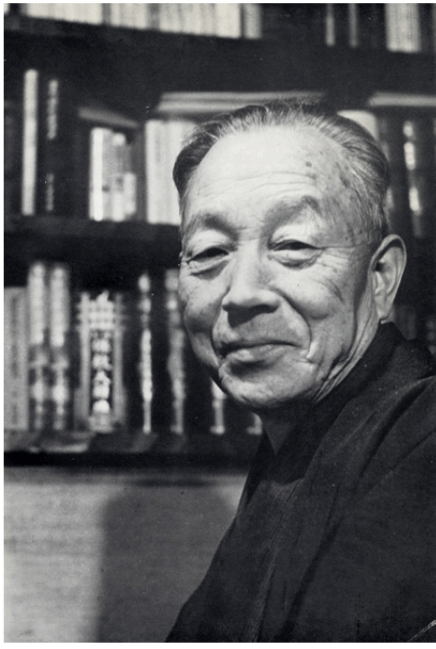
Tetsuro Watsuji, photo via Alchetron, Creative Commons CC BY-SA

Tetsuro Watsuji, photo via Alchetron, Creative Commons CC BY-SA

Let us remember the philosopher Watsuji Tetsurô on the anniversary of his birth, March 1, 1889.

Robert Carter and Erin McCarthy wrire for The Stanford Encyclopedia of Philosophy:

‘Watsuji Tetsurô was one of a small group of philosophers in Japan during the twentieth century who brought Japanese philosophy to the world. He wrote important works on both Eastern and Western philosophy and philosophers, from ancient Greek, to Schopenhauer, Nietzsche, Kierkegaard and Heidegger, and from primitive Buddhism and ancient Japanese culture, to Dōgen (whose now famous writings Watsuji single-handedly rediscovered), aesthetics, and Japanese ethics. His works on Japanese ethics are still regarded as the definitive studies.

Influenced by Heidegger, Watsuji’s Climate and Culture is both an appreciation of, and a critique of Heidegger. In particular, Watsuji argues that Heidegger under-emphasizes spatiality, and over-emphasizes temporality. Watsuji contends that had Heidegger equally emphasized spatiality, it would have tied him more firmly to the human world where we interact, both fruitfully and negatively. We are inextricably social, connected in so many ways, and ethics is the study of these social connections and positive ways of interacting….’ Read the full bio of Watsuji Tetsurô here

… and learn more from and about this great philosopher who wrote extensively about personhood and our place in the world, and one who bridged Eastern and Western thought:

Climate and Culture: A Philosophical Study – by Watsuji Tetsurô

Summary / SUNY Press page for Rinrigaku (Ethics) by Watsuji Tetsuro (translation by Seisaku Yamamoto and Robert E. Carter) – The Cambridge Encyclopedia of Philosophy describes Tetsurô’s Ethics as ‘the premier work in modern Japanese moral theory [which] develops a communitarian ethics in terms of the “betweenness” (aidagara) of persons based on the Japanese notion of self as ningen, whose two characters reveal the double structure of personhood as both individual and social.’ (p 449)

Watsuji Tetsurō: Japanese Philosopher and Historian – in Encyclopædia Britannica

Watsuji Tetsuro – in New World Encyclopedia

Ordinary Philosophy and its Traveling Philosophy / History of Ideas series is a labor of love and ad-free, supported by patrons and readers like you. Please offer your support today!

Science and Philosophy, a Beautiful Friendship: A Response to Michael Shermer

From the archives, two years ago…

Amy M Cools's avatarOrdinary Philosophy

There’s been some very public dig-taking between the science and philosophy camps lately. Lawrence KraussNeil DeGrasse TysonStephen Hawking, and other scientists are saying philosophy’s become irrelevant, little more than an esoteric old boy’s club. On the other hand, philosophers, theologians, politicians, and others criticize ‘scientism‘, the conviction that science, and only science, can and should be the ultimate source for all human knowledge; that all truth claims, that all ethical, metaphysical, and political beliefs, should not only be informed by or founded on, but entirely determined by, empirical evidence.

Michael Shermer’s article ‘A Moral Starting Point: How Science Can Inform Ethics‘ (Scientific American, February 2015) doesn’t dismiss philosophy so directly. He includes philosophy in a list of three other arenas of human thought, with religion and political theory, as those to which most people turn for answers in matters of right and…

View original post 3,485 more words

O.P. Recommends: The Great Arab-American Painter, Poet, and Philosopher Kahlil Gibran on Why Artists Make Art, by Maria Popova

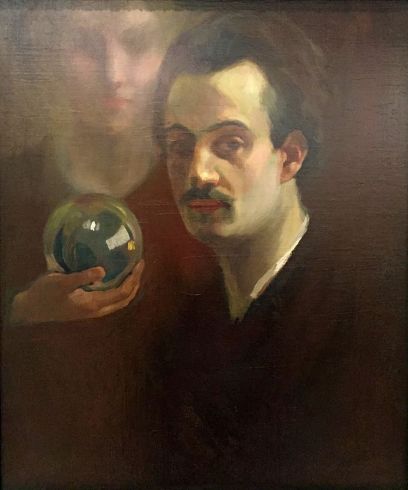
Khalil Gibran, Autorretrato Con Musa, 1911, public domain via Wikimedia Commons

Khalil Gibran, Autorretrato Con Musa, 1911, public domain via Wikimedia Commons

As happens so often, I’ve just discovered another wonderful thing because of the great Maria Popova of Brain Pickings. If there is only one website or blog you follow, I recommend that one be Brain Pickings. Literature, history, philosophy, art, poetry, children’s books, all of these and more are topics of discussion there, and the writing is beautiful.

This time, the discovery is the artist, writer, and philosopher Kahlil Gibran, and his take on a question I and I’m sure all other artists and writers ask ourselves from time the time: why we constantly feel the driving need to create things.

Popova writes:

The questions of why we humans create — why we paint caves and canvases, why we write novels and symphonies, why we make art at all — is so perennial that it might indeed fall within the scope of what Hannah Arendt considered the “unanswerable questions” central to the human experience. And yet some memorable answers have been given — answers like Pablo Neruda’s stirring childhood allegory of the hand through the fence.

Another exquisite answer comes from the great Arab-American artist, poet, and philosopher Kahlil Gibran (January 6, 1883–April 10, 1931) in Beloved Prophet (public library) — the collection of his almost unbearably beautiful love letters to and from Mary Haskell…

Read the article in full at Brain Pickings

Ordinary Philosophy and its Traveling Philosophy / History of Ideas series is a labor of love and ad-free, supported by patrons and readers like you. Please offer your support today!