Simone de Beauvoir’s Political Philosophy Resonates Today, by Skye C Cleary

Simone de Beauvoir is rightly best known for declaring: ‘One is not born, but rather becomes, woman.’ A less well-known facet of her philosophy, particularly relevant today, is her political activism, a viewpoint that follows directly from her metaphysical stance on the self, namely that we have no fixed essences.

The existential maxim ‘existence precedes essence’ underpins de Beauvoir’s philosophy. For her, as for Jean-Paul Sartre, we are first thrown into the world and then create our being through our actions. While there are facts of our existence that we can’t choose, such as being born, who our parents were, and our genetic inheritance, we shouldn’t use our biology or history as excuses not to act. The existential goal is to be an agent, to take control over our life, actively transcending the facts of our existence by pursuing self-chosen goals.

It’s easy to find excuses not to act. So easy that many of us spend much of our lives doing so. Many of us believe that we don’t have free will – even as some neuroscientists are discovering that our conscious will can override our impulses. We tell ourselves that our vote won’t make any difference, instead of actively shaping the world in which we want to live. We point fingers at Facebook for facilitating fake news, instead of critically assessing what we’re reading and reposting. It’s not just lazy to push away responsibility in such ways, but it’s what de Beauvoir called a ‘moral fault’.

Since we’re all affected by politics, if we choose not to be involved in creating the conditions of our own lives this reduces us to what de Beauvoir called ‘absurd vegetation’. It’s tantamount to rejecting existence. We must take a side. The problem is, it’s not always clear which side we ought to choose. Even de Beauvoir failed to navigate through this question safely. She adopted questionable political stances: she once, for example, dismissed Chairman Mao – responsible for the murder of over 45 million people – as being ‘no more dictatorial’ than Franklin D Roosevelt. De Beauvoir’s philosophy of political commitment has a dark side, and she personally made some grave errors of judgement, yet within her philosophy, there’s an opening to address this issue.

In The Ethics of Ambiguity (1947) she argues that to be free is to be able to stretch ourselves into an open future full of possibilities. Having this kind of freedom may be dizzying, but it doesn’t mean we get to do whatever we like. We share the earth, and have concern for one another; if we respect freedom for ourselves, then we should respect it for others, too. Using our freedom to exploit and oppress others, or to support the side that promotes such policies, is inconsistent with this radical existential freedom.

With oppressive regimes, de Beauvoir acknowledged that individuals usually pay a high price for standing up to dictators and the tyranny of the majority, but demonstrated concretely – through her writing and political engagement – the power of collective action to bring about structural change. An intellectual vigilante, de Beauvoir used her pen as a weapon, breaking down gendered stereotypes and challenging laws that prohibited women from having control over their own bodies. She authored and signed the Manifesto of the 343 in 1971, which paved the way for birth control and abortion in France. Her most famous work, The Second Sex (1949), sparked a new wave of feminism across the world.

Today more than ever it’s vital to recognise that freedom can’t be assumed. Some of the freedoms that de Beauvoir fought so hard for in the mid-20th century have since come under threat. De Beauvoir warns that we should expect appeals to ‘nature’ and ‘utility’ to be used as justifications for restrictions on our freedom. And she has been proved correct. For example, the argument that Donald Trump and others have used that pregnancy is inconvenient for businesses is an implicit way of communicating the view that it is natural and economical for women to be baby-making machines while men work. However, de Beauvoir points out ‘anatomy and hormones never define anything but a situation’, and making birth control, abortion, and parental leave unavailable closes down men’s and women’s ability to reach beyond their given situations, reinforcing stereotypical roles that keep women chained to unpaid home labour and men on a treadmill of paid labour.

In times of political turmoil, one may feel overwhelmed with anxiety and can even be tempted with Sartre to think that ‘hell is other people’. De Beauvoir encourages us to consider that others also give us the world because they infuse it with meaning: we can only make sense of ourselves in relation to others, and can only make sense of the world around us by understanding others’ goals. We strive to understand our differences and to embrace the tension between us. World peace is a stretch, since we don’t all choose the same goals, but we can still look for ways to create solidarities – such as by working to agitate authoritarians, to revolt against tyrants, to amplify marginalised voices – to abolish oppression. Persistence is essential since, as de Beauvoir says, ‘One’s life has value so long as one attributes value to the life of others, by means of love, friendship, indignation and compassion.’ De Beauvoir is surely right that this is the risk, the anguish, and the beauty of human existence.Aeon counter – do not remove

Skye C Cleary is a lecturer at Columbia University, the City College of New York, and Barnard College, and is the managing editor of the American Philosophical Association’s blog. Her latest book is Existentialism and Romantic Love (bio credit: Aeon)

This article was originally published at Aeon and has been republished under Creative Commons.

~ Ordinary Philosophy is a labor of love and ad-free, supported by patrons and readers like you. Any support you can offer will be deeply appreciated!

*All views and opinions expressed by guest writers are their own and do not necessarily reflect those of Ordinary Philosophy’s editors and publishers

Why I Am Not Going to Buy a Cellphone, by Philip Reed

by-terimakasih0-public-domain-via-pixabay-croppedIt is mildly subversive and perhaps a little quaint when someone clings to their flip phone and refuses a smartphone. Refusing both kinds of phones is viewed as downright lunacy, especially if the person refusing was born after the mid-1970s. But I’ve never had a cellphone and I’m not going to get one. I have several reasons, and they are good ones.
The first is cost. No cellphone means no monthly bill, no possibility for an upgrade, no taxes, and no roaming charges (whatever those are). In an era of stagnant wages and growing income inequality, it is remarkable that people unthinkingly spend $75 or more per month on something that we hardly knew existed 15 years ago, much less counted as a necessity.

The second is concern for the environment. The manufacture of mobile phones (including raw material acquisition), the power they consume, and the energy used to transmit calls and access the internet all produce significant carbon dioxide emissions. The idea that cellphones are good only for a couple of years is widespread, increasing the number of phones that end up in landfills and leak toxic heavy metals such as copper and lead into the soil and groundwater.

The decisive reason, however, for me to refuse a cellphone is the opposite of everyone else’s reason for having one: I do not want the omnipresent ability to communicate with anyone who is absent. Cellphones put their users constantly on call, constantly available, and as much as that can be liberating or convenient, it can also be an overwhelming burden. The burden comes in the form of feeling an obligation to individuals and events that are physically elsewhere. Anyone who has checked their phone during a face-to-face conversation understands the temptation. And anyone who has been talking to someone who has checked their phone understands what is wrong with it.

Communicating with someone who is not physically present is alienating, forcing the mind to separate from the body. We see this, for example, in the well-known and ubiquitous dangers of texting while driving, but also in more mundane experiences: friends or lovers ignoring each other’s presence in favour of their Facebook feeds; people broadcasting their entertainment, their meals, and their passing thoughts to all who will bear witness; parents capturing their daughter’s ballet performance on their phones rather than watching it live; people walking down the street talking animatedly to themselves who turn out to be apparently healthy people using their Bluetooth.

The cellphone intrudes into the public and private realms, preventing holistic engagement with what is around us. Smartphones only perfect their predecessors’ ability to intrude.

The disembodying and intrusive effects of cellphones have significant implications for our relationships to the self and to others. Truly knowing and understanding others requires patience, risk, empathy, and affection, all of which are inhibited by cell phones. Cellphones also inhibit solitude, self-reflection, and rumination (formerly known as ‘waiting’ and ‘boredom’), which I think are essential for living a good life.

Long before cellphones, human beings were good at diverting themselves from disciplined attention. ‘The sole cause of man’s unhappiness,’ observed the French philosopher Blaise Pascal in the 17th century, ‘is that he does not know how to stay quietly in his room.’ This propensity for diversion was notably confirmed in a recent study where subjects preferred to give themselves electric shocks rather than occupy themselves with their own thoughts for 15 minutes.

Pascal believed that the height of human dignity is thought, and that the order of thought begins with oneself, one’s creator, and one’s end. He linked this kind of thought inextricably to genuine rest and happiness. Avoiding a cellphone allows, for me, space for thinking and so enables a richer, more fulfilling way of life. With fewer tasks to perform and preferences to satisfy, life slows to a pace compatible with contemplation and gratitude.

A cellphone-free life not only helps to liberate the mind, but also the body. The ancient Greek philosopher Anaxagoras presents a different view of human nature from Pascal: ‘It is by having hands that man is the most intelligent of animals.’ We can be pretty sure that Anaxagoras was not anticipating the advent of smartphones. On the contrary, refusing a cellphone enables one to use one’s hands to carry out meaningful activities (playing the piano, gardening, reading a book) in such a way that one is fully absorbed in those activities, so that they reach their height of meaning.

Without a mobile phone, it is easier to concentrate on what is in front of me: my spouse and children, my work, making dinner, going for a walk. I try to choose my activities thoughtfully, so when I do something, I don’t want to be somewhere else. What cellphone users call multitasking does not interest or impress me.

Of course, it’s true that cellphones can be used responsibly. We can shut them off or simply ignore the incoming text. But this takes extraordinary willpower. According to a recent Pew survey, 82 per cent of Americans believe that cellphone use in social situations more often hurts than helps conversation, yet 89 per cent of cell owners still use their phones in those situations. Refusing a cellphone guarantees that I won’t use it when I shouldn’t.

Some people will insist that if I’m going to refuse a cellphone, I should also refuse a regular telephone. It is true that using a landline introduces similar disembodying, mediated experiences as to mobile phones. But there have always been natural and physical limits placed on the use of a regular phone, which is clear from the name ‘landline’. The cellphone’s mobility introduces a radical form of communication by making its alienating effects pervasive. I want to protect what unmediated experiences I have left.

The original meaning of ‘connect’ indicated a physical relationship – a binding or fastening together. We apply this word to our cellphone communications now only as metaphor. The ‘connections’ are ethereal; our words and thoughts reach the upper regions of space next to the cell tower only to remain there, as our devices disconnect us from those with whom we share space. Even though we have two hands, I’m convinced that you can’t hold a cellphone and someone else’s hand at the same time.Aeon counter – do not remove

This article was originally published at Aeon and has been republished under Creative Commons.

Philip Reed is an associate professor of philosophy at Canisius College in Buffalo, New York State. His scholarly interests are in ethics and moral psychology. (Bio credit: Aeon)

~ Ordinary Philosophy is a labor of love and ad-free, supported by patrons and readers like you. Any support you can offer will be deeply appreciated!

*All views and opinions expressed by guest writers are their own and do not necessarily reflect those of Ordinary Philosophy’s editors and publishers

How a Hackneyed Romantic Ideal is Used to Stigmatise Polyamory, by Carrie Jenkins

There’s no longer anything unusual about wanting an open relationship. Many who consider themselves progressive about sex, gender, love and relationships know this. It’s just that almost nobody in an open relationship wants to be open about it. What’s surprising is that so many people feel the need for secrecy.

I’ve been out as polyamorous for years. Because of this, non-monogamous people who aren’t out often feel able to talk to me about their own situations. When I go to conferences, I can’t help noticing all the philosophers who are in closeted non-monogamous relationships. This discrepancy between reality and socially acknowledged reality can be disorienting; the ‘official’ number of non-monogamous people in the room is almost always one (me).

So what’s going on? No doubt there are several factors at work, but I want to talk about one that’s both powerful and insidious: non-monogamy isn’t considered ‘romantic’.

Romantic love is widely considered to be the best thing life has to offer: ‘failing’ at romance is often construed as failing at life. Amatonormativity is a name for the attitude that privileges lives based around a focal monogamous romantic relationship. What gets called ‘romantic’ isn’t just about classification; it’s about marking out those relationships and lives we value most.

This monogamous ideal is supposed to appeal to women especially. According to the stereotypes, single women are desperate to ‘lock down’ a man, while men are desperate to avoid commitment. There’s nothing new here: monogamy has historically been gendered. Even in situations where marrying more than one woman has been illegal, it has often been normal for men to have mistresses, but different rules have applied to women. This is unsurprising: in a patriarchal society with property inheritance passing along the male line, paternity is key, and enforced female monogamy is an effective way to control it.

Women’s sexuality can also be policed by developing a feminine model that includes a ‘natural’ desire for monogamy, plus social benefits for conforming to that model (and penalties for non-conformity). This model can then be internalised by women as a ‘romantic’ ideal inculcated via fairytales. In a similar vein, rather than allowing only men to have more than one partner, we can instill a subtler cultural belief that men’s infidelity is ‘natural’ and therefore excusable, while women’s infidelity is not.

Our language undermines gender-related optimism about monogamous romantic ideals: there is no word for a male ‘mistress’; romantic comedies are ‘chick flicks’. ‘Romance’ novels are marketed to and consumed by women. Brides are ‘given away’ by men to other men. We never hear about ‘crazy old cat gentlemen’. And how many married men do you know who’ve taken their wife’s surname? These attitudes persist not just in word but in deed: wives in hetero marriages still do more housework than their husbands, even if they earn more (which they rarely do).

Recent growing acceptance of same-sex love as ‘romantic’ has presented challenges to gendered norms. But this has happened alongside another change: monogamy has become an even more powerful ‘romantic’ ideal by including same-sex relationships. And its impact is intensely gendered.

Women who enter voluntarily into non-monogamous relationships are a direct challenge to the idea that women are ‘naturally’ monogamous. They are socially penalised to maintain the status quo. A non-monogamous woman will be portrayed as debased and disgusting – a ‘slut’. When I have discussed my open relationships online, I have been called a ‘cum-dumpster’, a ‘degenerate herpes-infested whore’, and many other colourful names.

My internet trolls focus on sex, partly because presenting non-monogamous relationships as ‘just sex’ makes it easier to degrade them, and partly because women who violate the monogamy norm – whose sexuality is out of (someone’s) control – are a threat to an ancient feeling of entitlement over women’s sexuality and reproductive potential. In contrast, a non-monogamous man is, at least sometimes, liable to be regarded as a ‘stud’.

Apart from monogamy, the only other relationship structure that controls paternity in a similar way is patriarchal polygamy, which is stigmatised in contemporary North America, for reasons including bona fide feminism as well as racism and cultural imperialism. One effect of this is that monogamy is seen as the only fair and liberal alternative.

Actually, there are many alternatives. But to tolerate them is to tolerate widespread social uncertainty about who is having sex with whom. This would extend to everything sex is entangled with, and everything it represents. Our ideals of ‘romantic’ love regulate not just our expectations about sex but also our conceptions of family and the nature of parenthood.

Ultimately, what we call ‘romantic’ is a philosophical issue that touches on the core of who we (think we) are, and what we value. I believe that the ‘romantic-ness’ of romantic love is largely socially constructed, and as such malleable. We collectively write the ‘script’ that determines the shape of the privileged (‘romantic’) relationship style. This script has changed, and will continue to change. But currently that process goes on largely below the radar: we aren’t supposed to see it happening, or realise that we can control it. Romantic love maintains a wholly ‘natural’ image, evading challenge or critical scrutiny by seeming inevitable, incomprehensible and wonderful.

We must get beyond this. We need to question the limits we have placed on what counts as a ‘romantic’ relationship. Freedom to love – the right to choose one’s own relationships without fear, shame or secrecy – is critical, not just for individuals but for us all collectively. Non-conformity is the mechanism that reshapes the social construct to better represent who we are, and who we want to be. Instead of forcing our relationships to conform to what society thinks love is, we could force the image of love to conform to the realities of our relationships.

But it won’t be easy. If the love of a polyamorous triad is seen as ‘romantic’, and hence as valuable as the love of a monogamous couple, then the triad should have the same social and legal privileges as the couple. How could we deny them the right to be co-parents? How could we defend the legal or financial benefits of monogamous marriage, or the lack of legal recourse for anyone fired for being polyamorous? These are the privileges by which we signal to monogamous couples and nuclear family units that theirs are the most socially valuable social configurations.

Nor could we defend the countless ways in which non-monogamous people are stigmatised and rejected. My boyfriend’s father no longer speaks to him about anything but the weather because he is in a polyamorous relationship with me. An extended family member literally prayed over me when she learned that I was non-monogamous, feeling an urgent need to ask Jesus to ‘save’ me from this ‘culture’. Stigma against non-monogamy is beyond a joke: researchers have uncovered assumptions that the non-monogamous are just bad people: less likely to walk their dogs, or floss their teeth.

It’s far easier to pretend that this is not really happening. Or that it’s not really a big deal. Perhaps you feel that way right now: perhaps you’re thinking you don’t know any non-monogamous people. But I wouldn’t be too sure. Until quite recently, an awful lot of people thought that all their friends and relatives were straight.Aeon counter – do not remove

Carrie Jenkins is a writer and philosopher. She is working towards an MFA in creative writing at the University of British Columbia. Her latest book is What Love Is and What it Could Be (2017). She lives in Vancouver. (Bio credit: Aeon)

~ This article was originally published at Aeon and has been republished under Creative Commons.

Listen to Carrie Jenkins discuss romantic love with Joe Gelonesi at The Philosopher’s Zone

~ Ordinary Philosophy is a labor of love and ad-free, supported by patrons and readers like you. Any support you can offer will be deeply appreciated!

*All views and opinions expressed by guest writers are their own and do not necessarily reflect those of Ordinary Philosophy’s editors and publishers

Bad Things Happen for a Reason, and Other Idiocies of Theodicy, by Jason Blum

Ancient of Days by William Blake

Ancient of Days by William Blake

The problem of evil is a classic dilemma in the philosophy of religion. The relative ease with which the problem can be stated belies the depth of the challenge that it presents to traditional monotheism. Roughly, it can be summarised as follows:

If God is omnipotent, then He has the power to create a world without evil.

If God is omniscient, then no moment of evil goes divinely unnoticed.

If God is omnibenevolent, then He has the desire to rid the world of evil.

Therefore, the world should be perfect, or at least free of undeserved suffering. Yet, a cursory glance reveals a world that clearly is not inherently just or free from undeserved suffering.

Hence, the problem of evil: how can a perfect deity allow such injustice and rampant evil in the world that He created?

Many solutions to the problem of evil – called ‘theodicies’ – have been proposed. There is the argument of free will, attributing evil not to God but to humanity’s misuse of its own freedom. Others have argued that certain kinds of moral goodness – compassion, for instance – are not possible in a world without evil, and the value of these types of goodness outweighs the evils on which their existence depends. There is also what I call ‘the big-picture defence’, claiming that evil only appears as such from our limited perspectives. Were we able to see things from the perspective of God, we would see that, in the grand scheme of things, every apparent evil plays a necessary role in making the world more perfect.

The philosopher Gottfried Leibniz’s simple solution was to argue in 1710 that this world is necessarily the best of all possible worlds. Leibniz depicts God assessing in His infinite mind all the various possible worlds that He could create. Because He is a loving God, the one He chooses to create is surely the ‘best of all possible worlds’. Leibniz’s argument suggests that it is ultimately meaningless to complain about this evil or that injustice; because this is the best of all possible worlds. We should take comfort in the fact that everything is, in the final analysis, as good as it can possibly be.

Voltaire derided Leibniz’s solution, writing a book to satirise it. In Candide (1759), the eponymous hero and his companions stumble through the world, constantly beset by bad luck and predations. They witness even greater tragedies in the world around them. Their troubles arise from the uncaring forces of the natural world, but also from the naiveté of Candide, who is constantly assured by his mentor, Professor Pangloss, that this is indeed the best of all possible worlds. In juxtaposing vivid depictions of myriad cruelties and Professor Pangloss’s blind insistence on the ultimate goodness of the universe, Voltaire demonstrates that there is a poignant reality to the experience of suffering that cannot be rationalised away. The claim that justice naturally inheres in the order of things does not bear scrutiny.

There is also a profound moral danger to certain types of theodicy.

The essential difficulty of the problem of evil is how to reconcile its apparent existence with a loving, all-powerful deity. One popular method has been to reassert the inherent justice of the world, implying, if not explicitly claiming, the righteousness of the suffering that we witness throughout it. The result is, essentially, a theological form of victim-blaming.

For example, the American evangelical preacher Pat Robertson explained the 2010 earthquake in Haiti – which killed between 220,000-316,000 people, and injured another 300,000 – as the fault of the Haitian people. The people of Haiti had apparently sworn a pact with Satan in exchange for delivering them from French rule, and the earthquake was divine retribution for that bargain (delivered approximately two centuries later). Robertson similarly suggested that both Hurricane Katrina and terrorism were divine punishment for the fact that abortion is still legal in the United States. Robertson, of course, is not alone. An Iranian mullah has blamed earthquakes on women dressing immodestly; a New York rabbi blamed the advancement of gay rights in the US for another earthquake in 2011; many Burmese Buddhists blamed a 2008 cyclone that killed approximately 130,000 people on bad karma.

The desire that motivates these interpretations is understandable. Natural disasters and terrorist attacks are either random events in a chaotic world, or they are explicable events within a discernible pattern. In the former case, we inhabit an essentially amoral universe: bad things happen to good people, children die premature deaths, and tragedy strikes without remorse, all without rhyme or reason. In the latter case, we inhabit a much more hospitable universe where there is some sort of inherent order: a place where morality is inscribed into the very fabric of things, assuring us that, if only we play by the rules, evil will be punished, goodness will be rewarded, and justice will reign supreme.

It is easy to understand the attraction of that vision. But it has a substantial dark side. Like any theodicy, it cannot simply unmake suffering, and so it instead tries to justify it. The claim that the universe is inherently just then implies that those who suffer deserve it. The existence of a just God and a moral universe is gained at the cost of condemning victims of misfortune as blameworthy. And so, hundreds of thousands of Haitians died because their ancestors made a pact with the devil. Women and homosexuals agitating for equal rights are blamed for deadly natural disasters.

Such a worldview conveniently scapegoats someone, usually whatever population someone wishes to demonise: women, homosexuals, the poor, etc. It also normalises social ills that could otherwise be addressed and meliorated. In a dark irony, holding that the universe is ultimately a just place ends up condoning the suffering and injustice that happens within it, often on the backs of those most in need.

Visions of a just universe need not function this way. Theodicy authorises only the suffering of the less fortunate when it indulges in willful blindness and insists on justice as a foregone conclusion, denying reality in favour of comforting ignorance. Alternatively, when justice is construed as hope – as a vision of what the world could possibly be – it functions as a lodestar. This acknowledges the disturbing realities with which we are surrounded, and refuses to be disillusioned by them. By regarding justice as an ideal rather than a present reality, one’s vision of the inequalities and brutalities of the present moment remains unobstructed, allowing them to be faced. The just universe in which we should believe is the one that can be created only through dedicated effort and real action on our part. But that can happen only if we refuse to take shelter in soothing fantasies. Aeon counter – do not remove

This article was originally published at Aeon and has been republished under Creative Commons.

Jason Blum is a visiting assistant professor on the college writing programme at Davidson College in North Carolina. His first book is Zen and the Unspeakable God (2015). (Bio credit: Aeon)

~ Ordinary Philosophy is a labor of love and ad-free, supported by patrons and readers like you. Any support you can offer will be deeply appreciated!

*All views and opinions expressed by guest writers are their own and do not necessarily reflect those of Ordinary Philosophy’s editors and publishers

Happy Birthday, Angelina Weld Grimké!

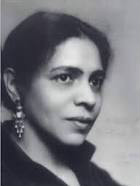
angelina-weld-grimke-image-public-domain

Angelina Weld Grimké

El Beso

Twilight—and you
Quiet—the stars;
Snare of the shine of your teeth,
Your provocative laughter,
The gloom of your hair;
Lure of you, eye and lip;
Yearning, yearning,
Languor, surrender;
Your mouth,
And madness, madness,
Tremulous, breathless, flaming,
The space of a sigh;
Then awakening—remembrance,
Pain, regret—your sobbing;
And again, quiet—the stars,
Twilight—and you.   (via Poets.org)

Let us celebrate the memory of the wonderful and far-too-unknown author of this gorgeous poem and so many other wonderful works of art and literature on her birthday!

Alix North of Island of Lesbos writes of Grimké:

Angelina Weld Grimké was born [on February 27th, 1880] in Boston, the only child of Archibald Grimké and Sarah Stanley. Angelina had a mixed racial background; her father was the son of a white man and a black slave, and her mother was from a prominent white family. Her parents named her after her great aunt Angelina Grimké Weld, a famous white abolitionist and women’s rights advocate.

Angelina received a physical education degree at the Boston Normal School of Gymnastics in 1902. She worked as a gym teacher until 1907, when she became an English teacher, and she continued to teach until her retirement in 1926. During her teaching career, she wrote poetry, fiction, reviews, and biographical sketches. She became best known for her play entitled “Rachel.” The story centers around an African-American woman (Rachel) who rejects marriage and motherhood. Rachel believes that by refusing to reproduce, she declines to provide the white community with black children who can be tormented with racist atrocities. “Rachel” was the only piece of Angelina’s work to be published as a book; only some of her stories and poems were published, primarily in journals, newspapers, and anthologies.

Only her poetry reveals Angelina’s romantic love toward women. The majority of her poems are love poems to women or poems about grief and loss. Some (particularly those published during her lifetime) deal with racial concerns, but the bulk of her poems are about other women, and were unlikely to be published for this reason. Only about a third of her poetry has been published to date… Read the complete bio and a wonderful selection of poems here

angelina-weld-grimke…and learn more about Angelina Weld Grimké at:

Angelina Weld Grimké – in Encyclopedia of African American Women Writers, edited by Yolanda Williams Page

Angelina Weld Grimké – by Judith Zvonkin for The Black Renaissance in Washington, D.C.

Angelina Weld Grimké – from Encyclopædia Britannica

Grimke, Angelina Weld (1880-1958) – by Claudia E. Sutherland for Blackpast.org

Grimkè’s Life and Career: The Introduction to The Selected Works of Angelina Weld Grimké – by Carolivia Herron for Modern American Poetry at the Department of English, University of Illinois at Urbana-Champaign

Further reading: Selected Women Writers of the Harlem Renaissance: A Resource Guide – Angelina Weld Grimké 

Ordinary Philosophy and its Traveling Philosophy / History of Ideas series is a labor of love and ad-free, supported by patrons and readers like you. Please offer your support today!

There Is a Moral Argument for Keeping Great Apes in Zoos, by Richard Moore

Who's Who in the Zoo Illustrated natural history prepared by the WPA Federal Writers Project, 1937-38, public domain via Library of Congress

Who’s Who in the Zoo Illustrated natural history prepared by the WPA Federal Writers Project, 1937-38, public domain via Library of Congress

I get apprehensive whenever someone asks me about my job. I’m a philosopher who works on the question of how language evolved, I reply. If they probe any further, I tell them that I work with the great apes at Leipzig zoo. But some people, I’ve discovered, have big problems with zoos.

Plenty of philosophers and primatologists agree with them. Even the best zoos force animals to live in confined spaces, they say, which means the animals must be bored and stressed from being watched all the time. Other critics claim that zoos are wrong even if the creatures aren’t suffering, because being held captive for human entertainment impugns their dignity. Such places ‘are for us rather than for animals’, the philosopher Dale Jamieson has written, and ‘they do little to help the animals we are driving to extinction’.

But I want to defend the value of zoos. Yes, some of them should certainly be closed. We’ve seen those terrible videos of solitary apes or tigers stalking barren cages in shopping malls in Thailand or China. However, animals have a good quality of life in many zoos, and there’s a strong moral case for why these institutions ought to exist. I’ve come to this view after working with great apes, and it might not extend to all species equally. However, since great apes are both cognitively sophisticated and human-like in their behaviour, they offer a strong test case for evaluating the morality of zoos in general.

The research my colleagues and I conduct isn’t harmful to the animals and, if it goes well, it will help us get a better grasp on the cognitive differences between humans and apes. For example, we did a study with pairs of orangutans in which we tested their ability to communicate and cooperate to get rewards. We hid a banana pellet so that one orangutan could see the food but couldn’t reach it. The other orangutan could release a sliding door and push the pellet through to her partner, but wasn’t able to take it for herself. They did okay (but not great) when playing with me, and they mostly ignored each other when playing together. We then performed a similar set of studies with human two-year-olds. Compared with the apes, the two-year-olds were very good at getting the reward (stickers) when they played with an adult.

Taken together, these studies tell us something about human evolution. Unlike apes, humans are good at pooling their talents to achieve what they can’t do alone. It’s not that the apes don’t care about getting the food – they got frustrated with one another when things were going wrong, and one orangutan in particular would turn his back and sulk. However, unlike humans, they don’t seem to be able to harness this frustration to push themselves to do better.

The value of research aside, there’s an argument for zoos on the grounds of animal welfare. In the best zoos, such as Leipzig, great apes live in spacious enclosures modelled on their natural habitats, and are looked after by zookeepers who care about them deeply. Large jungle gyms keep them stimulated and stave off boredom; they’re also kept busy with ‘enrichment’ puzzles, which they can unlock with tools to get food. Zoos recognised by the two main accrediting bodies in Europe and the United States are rigorously vetted and required to take part in education and conservation programmes. And there’s no solid evidence that apes living in well-designed enclosures get stressed or disturbed by human observation.

Of course, zoos can’t provide their animals with conditions such as those in an untouched forest. But for the great apes in captivity, there’s rarely a viable alternative. There are estimated to be more than 4,000 great apes living in zoos worldwide. Most of the regions where they are found in the wild – orangutans in Indonesia, chimpanzees and gorillas in Central and West Africa, bonobos in the Democratic Republic of Congo (DRC) – are ravaged by habitat loss, civil war, hunting and disease. As few as 880 remaining mountain gorillas survive, in two small groups in the eastern reaches of the DRC, while orangutan habitats have declined 80 per cent in the past 20 years. While some conservationists dream of rehoming zoo apes in the wild, these vanishing forests mean that it’s rarely feasible. The orangutans in Leipzig are certainly better off than they would be trying to survive in forests razed to make way for palm-oil plantations.

Since zoo apes cannot be returned to their natural environments, specialised sanctuaries are another option. But these require large plots of land that are both safe and uninhabited by existing populations, and such locations are scarce. As things stand, sanctuaries are already struggling to survive because they’re almost exclusively dependent on charitable donations. And most of them are full. In Africa and Indonesia, inhabitants are typically orphans that have been taken from the forest by hunters or palm-oil workers, who kill larger apes and kidnap the babies to sell or keep as pets. Elsewhere, sanctuaries are overflowing with retired lab apes or rescued pets. These institutions lack the capacity to accommodate the thousands of apes currently living in zoos, let alone the money that would be needed to support them.

Given the obstacles and the great expense of rehoming apes, very few places try to do so. Damian Aspinall of Howletts Wild Animal Park in England leads one of the few programmes that release gorillas back into the wild, by taking them to a protected reserve in Gabon. His intentions are heroic and hopefully the plan will succeed. Some gorillas have resettled well. But the results so far have been mixed; in 2014, five members of a family of 11 were found dead within a month of their release. We also don’t really know whether zoo-born apes possess the skills they need to survive, including the ability to retrieve different local foods, and knowledge of edible plants. Young apes learn these skills in the wild by watching the knowledgeable adults around them – but that’s an opportunity that creatures in captivity simply don’t have.

Now, all of this isn’t necessarily an ethical argument for continuing to breed apes in zoos. You might argue that if we can’t save the apes already in captivity, we should at least end breeding programmes and let the existing populations die out. However, captive breeding helps preserve the genetic diversity of endangered species. Moreover, research shows that visiting zoos makes people more likely to support conservation efforts – an effect that’s amplified by more naturalistic enclosures. So first-person encounters in zoos serve to educate visitors about the incredible lives animals lead, and to raise money for wild conservation programmes.

Allowing the ape populations in zoos to wither assumes – without justification – that their current lives are so bad as to be not worth living. It also risks inflicting harm. Boredom is a real risk for zoo animals, and it’s widely believed (although not yet scientifically established) that the presence of infants brings both interest and happiness to the families. Mixed-aged groups create collective dynamics that more closely resemble those in the wild. If we care about the welfare of captive apes, we should allow them to breed – at least in controlled ways.

One day, the prospect of returning captive apes to their natural habitats or housing them in well-funded, spacious sanctuaries might be realistic. Currently, it is not. Instead of condemning zoos, we should dedicate our efforts to supporting them: to pushing bad zoos to reform or close; to funding more research into the welfare of captive animals; and to encouraging all zoos to strive to do more for their inhabitants. That way, perhaps, I will no longer need to shy away from telling strangers what I do.Aeon counter – do not remove

Richard Moore is a post-doctoral researcher at the Berlin School of Mind and Brain. His work has been published in journals including Biology and Philosophy and Animal Cognition. (Bio credit Aeon)

This article was originally published at Aeon and has been republished under Creative Commons.

~ Ordinary Philosophy is a labor of love and ad-free, supported by patrons and readers like you. Any support you can offer will be deeply appreciated!

*All views and opinions expressed by guest writers are their own and do not necessarily reflect those of Ordinary Philosophy’s editors and publishers

Q&A With Singer: A Philosopher On His Craft and Practicing it at Princeton, by Michael Hotchkiss

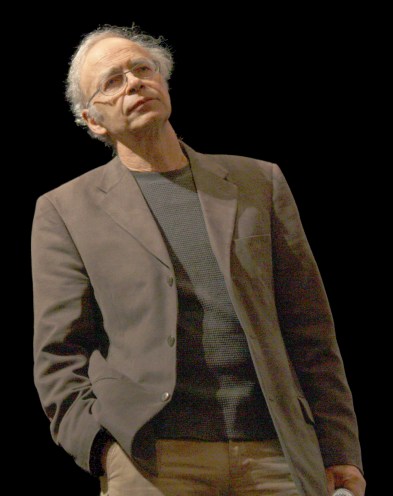
Peter Albert David Singer at The College of New Jersey in 2009, by Bbsrock, Creative Commons BY-SA 3.0 via Wikimedia Commons

Peter Albert David Singer at The College of New Jersey in 2009, by Bbsrock, Creative Commons BY-SA 3.0 via Wikimedia Commons

Peter Singer is one of the world’s best-known philosophers, recognized for his thought-provoking views on topics including animal rights, bioethics and the plight of the world’s poorest people.

Since 1999, he has been the Ira W. DeCamp Professor of Bioethics in the University Center for Human Values at Princeton University. He splits his time between Princeton and the University of Melbourne in his native Australia, where he is Laureate Professor.

Singer’s influential books include “Animal Liberation,” “Practical Ethics” and “Rethinking Life and Death.” His book “The Life You Can Save” challenges readers to help improve the lives of the world’s poorest people, and he is the co-founder of a nonprofit group by the same name that is devoted to effective philanthropy to serve people living in extreme poverty.

Singer also regularly writes brief essays on topics related to current events. A new book, “Ethics in the Real World,” compiles many of those essays with other reflections to explore, in an easily accessible form, some of the deepest philosophical questions.

Singer recently answered questions about his book, philosophy and teaching at Princeton.

~~~~~~~~~~~~~~~~~~~~~~~~~~~~~~~~~~~~~~~~~~~~~~~~~~~~~~~~~

Why do you write the kinds of brief, topical essays that are compiled in “Ethics in the Real World”?

Singer: I think it’s important to play a role in contributing to public debates and hopefully trying to improve the standard of those debates. In many areas of academic life — but perhaps particularly in ethics — there’s a lot of debate that goes on and a lot of it is to a rather low standard. If you can contribute to showing people how it’s possible to have reasoned discussion of ethical issues, I think it’s a valuable thing to do. A lot of people think ethics is all just subjective, a matter of taste. They think you can’t really say anything, therefore you might as well just abuse your opponents. I think there are other possibilities.

What does it mean to do philosophy?

Singer: I think doing philosophy really means learning to think more deeply and rigorously about hard questions that cannot be answered by straightforward empirical investigation. There are many things people think hard and rigorously about — physics, history or whatever it might be. In some of those fields you can answer questions by doing an experiment or finding the relevant documents. Generally speaking, you can’t run experiments to settle the kind of questions philosophers talk about. And you’re not going to turn up documents in some archive that are going to solve them either. So you have to think. The discipline of thinking, of recognizing good and bad arguments, of recognizing fallacies and where an argument is rigorous or where its weak points are, that’s something you can be trained in and can develop through practicing. That’s why we want people to do philosophy, to talk about it and write about it, not simply to learn what other philosophers of the past have said.

What does it mean to do philosophy at Princeton?

Singer: I think this is a great environment for doing philosophy, particularly for the area I work in, which is practical or applied ethics. Having the University Center for Human Values sitting alongside the philosophy department and the politics department produces a substantial body of people who are very good at discussing a range of practical and applied ethical questions. Plus, of course, we have really excellent students. For me, that’s one of the most rewarding things about being at Princeton. You get truly outstanding students who are very rewarding to teach, and that is just the undergraduate level. Many of them are also really enthusiastic about the role they are hoping to play in the world. When you get to the graduate level, you get yet another level of discussion. All of that makes a really exciting combination.

“‘Ethics in the Real World: 82 Brief Essays on Things That Matter’ by Peter Singer” book jacket

In his new book, Singer compiles brief essays on topics related to current events that explore some of the deepest philosophical questions. (Courtesy of Princeton University Press)

What are the most important tools you have at your disposal to engage people?

Singer: The primary tool is the ability to express ideas. As a teacher, you will mostly do that using your voice, speaking, though sometimes you will get students to read things. As a public intellectual, I’m much more likely to do that in writing. Being able to express yourself clearly is the most important tool for what I do. I’m grateful for my education in analytic philosophy at the University of Melbourne and Oxford because of the emphasis placed on clarity of expression. If something you said wasn’t clear, then it wasn’t good even though there might be some deep thing lurking there. You had to try to bring that out. It’s a contrast that exists to this day between most English language philosophy that comes out of that analytic tradition and that which comes out of what you might call a continental tradition, where clarity is not really prized and it seems to me at least that profundity is hinted at through ways of expression that might be clever but certainly aren’t clear.

The course description for your undergraduate class ‘Practical Ethics’ is full of questions: Should we be trying to live our lives so as to do the most good? Does a human embryo have a greater claim to protection than a chimpanzee? Should we be able to choose to end our own life, if we are terminally ill? Why do you take that approach?

Singer: I ask questions because I see the role of the course as challenging students to think about issues that otherwise they might not think about a great deal. I do not simply want to get them to absorb the truth, whatever the truth might be on these ethical questions. I certainly don’t want to encourage the idea of professors as authorities from which they just take statements and write them down. I want to challenge their way of thinking so they may come to see that what they’ve been thinking is superficial and they need to go deeper.

What are the questions you find your students engage with the most?

Singer: We have a lot of spirited discussions. Probably in recent years the two topics that have been most spirited have been questions about the treatment of animals and whether we ought to be eating them, and questions about global poverty and what we ought to do about that. Do we, as comfortably well-off people in an affluent nation, have an obligation to actually do something, to contribute some of our wealth to people to whom it can make a much bigger difference than it makes to us?

Many academics have critics, and you have your share. In the ‘Practical Ethics’ course, you assign a book called ‘Peter Singer Under Fire’ that features essays critiquing your views and your responses. Why do you bring your critics right into the classroom?

Singer: That book is listed because it has critical essays about me. And if students are going to get my views from me firsthand they need to have ways of pushing back and seeing what other people have said that is different. Those essays are specifically written to criticize Peter Singer’s views. A lot of the reading, not just the essays from that book, is opposed to what I think. There are a number of other books on the reading list that are written by people who have a very different perspective, people who differ from me. Those views do get represented in my courses, always.

Do you find a lot of students become really engaged with your ideas and pursue them further? What’s that like for you?

Singer: I find a significant number of students do become engaged and continue to live in ways that are influenced by some of the thoughts that maybe they started thinking in my classes or reading some of my works. In fact, one example just came up recently. It’s not the majority of students who become as engaged as that, of course, but a few individuals can have a very big impact on many people. I find that rewarding. I find it really encouraging when I discover my teaching has made a significant difference, changed someone’s life in some important way, perhaps, or just reinforced them in going down a path they were going down anyway. If that’s a positive path, as it is generally, I feel pleased because I have indirectly made a positive contribution to the world.

In the book, you mention that you learned from some of your students about the racist parts of Woodrow Wilson’s legacy. What else do you learn from your students?

Singer: I learn lots of things from my students. You get a range of people I would not ordinarily meet and get to talk with. You also learn a lot about the way young people think. I consider myself very fortunate to be always mixing with young people both in the classroom and out of the classroom because it keeps me fresh in terms of what’s going on in the world and what people are thinking about. I think it’s easy to be mixing mostly with people of your own age group and not really be aware of what 20-year-olds are likely to be thinking.

You came to Princeton from Australia in 1999. What have you taken from that experience?

Singer: It’s a pretty cosmopolitan campus, really. We have a lot of international students. We have other students who are immigrants or children of recent immigrants. I really value that. I think it’s tremendously important that we think about the world as a whole and that we be a truly cosmopolitan place. That connects with some of the essays in the book, which talk about how we should be thinking about the world, globalization, global poverty, what we should be doing about it. I value the “service of humanity” aspect of the University’s informal motto and the experience of Princeton because they point the way to getting beyond just a focus on the United States. When you come to the United States as I did, it’s one of the things you discover. Because you have come to a really big and important country, it’s natural that the media are going to be more focused on the United States here than the media would be on Australia in Australia, for example. Even having said that, I think the lack of attention on other parts of the world where America’s interests are not directly affected is something that’s pretty deplorable, and I think it’s important that universities try to counterbalance that by having international breadth and international understanding.

In one of the essays in your book, you describe the experience of learning to surf later in life. Why is that kind of experience important?

Singer: My experience with surfing shows that even if you think you might be too old to learn something new, that’s not necessarily going to be the case. Sure, you may never be really good at it. I’ll never be really good at surfing. But I can do it well enough to enjoy it and get a lot of satisfaction out of it. There is a lesson there for people at any stage of life: Don’t think things have passed you by. Obviously, objectively some things will have passed you by. I’m never going to become a footballer, but there are a lot more things that are still open as you go through life. More people are realizing that. You can change career directions later in life. If there’s something you want to do but you’ve thought it’s too late, think about it. Maybe it’s not.

Originally published in News At Princeton, at Princeton University’s website

~ Michael Hotchkiss, social sciences writer, went to Princeton in 2012 after seven years as an editor at The Wall Street Journal. He earned a bachelor’s degree in journalism from the University of Missouri in 2000 but really learned the ropes of writing and editing at Mississippi community newspapers… At Princeton, he develops news and editorial content about the teaching, research and service missions of the University, with a special emphasis on the social sciences. (Bio credit: Princeton University)

Ordinary Philosophy and its Traveling Philosophy / History of Ideas series is a labor of love and ad-free, supported by patrons and readers like you. Please offer your support today!

Civil Rights and Healthcare: Remembering Simkins v. Cone (1963), by Ezelle Sanford III

Dr. George Simkins, Jr.

Dr. George Simkins, Jr.

Upon her release from L. Richardson Memorial Hospital’s maternity ward in Greensboro, North Carolina, my grandmother, Ann Wilson Scales, walked a few short steps to her mother’s home with a small baby in hand. She had just given birth to my mother, La Tanya Wilson Sanford, in the city’s Black hospital. It was 1965. Unbeknownst to either of them, a small group of L. Richardson’s physicians, dentists, and patients had waged a quiet war against segregation two years earlier. The city was the site of arguably one of the more consequential yet little-known civil rights battles in American history. No, it was not the beginning of the student sit-in movement initiated by North Carolina A&T students in 1960. Rather, this small contingent fought in district and circuit courts to desegregate U.S. healthcare. At issue was where medical professionals could practice and where patients could access care: in the older, segregated L. Richardson Hospital, or in the newer, more modern (and better funded) Moses H. Cone Memorial Hospital.

In 1962, dentist George Simkins, Jr. unsuccessfully attempted to admit a patient to Moses H. Cone Memorial Hospital, one of two private white hospitals in the city supported by tax dollars. Combining his role as community dentist and President of the Greensboro chapter of the NAACP, Simkins initiated a class-action lawsuit against both Moses Cone and Wesley Long Community Hospitals. The NAACP’s Legal Defense Fund assisted in litigating the test case. Not only were African American patients barred from these institutions, Black physicians were barred from practicing there, even as both institutions received state and federal funds provided by the 1946 Hill-Burton Hospital Survey and Construction Act. Hill-Burton emerged from President Harry Truman’s failed healthcare reform and promised to rebuild and modernize the U.S. healthcare infrastructure. However, this program included a loophole where states that engaged in de jure racial segregation could use the money to build segregated facilities. Cone and Long Hospitals both benefitted from this program and its segregation loophole. This is not to say that segregated hospitals did not exist before the Hill-Burton Program, however; historian Vanessa Gamble chronicles the movement to establish Black hospitals from 1920–1945.

Initially, the district court of North Carolina sided with the defendant hospitals; however, the Fourth Circuit Court of Appeals (and later the United States Supreme Court, which refused to hear the case) deemed that the two hospitals’ policies of racial discrimination for both patient admissions and visiting physician staff privileges violated the fifth and fourteenth amendments of the Constitution.

Last September, the CEO of Cone Health Network, of which Moses Cone Memorial Hospital and Wesley Long Hospitals are now a part, issued a public apology to the last surviving plaintiff of the historic court ruling. Dr. Alvin Blount, 94, graciously accepted the long overdue apology from the health system, initiating local reflections on racial discrimination in healthcare. This is not the first apology issued to acknowledge the long-strained history of race and racism associated with medicine and healthcare. In May 1997, former President Bill Clinton formally apologized for the United States Public Health Service’s “Tuskegee Study of Untreated Syphilis in the Negro Male” (1932–1972). In 2008, the American Medical Association (AMA) officially apologized for its exclusion of Black physicians from membership, an important acknowledgment given that AMA membership became increasingly important for hospital admitting privileges, licensure, and broader steps in professional development. As historian Thomas Ward notes, until the AMA desegregated in 1968, Black physicians were barred from white hospitals and denied opportunities for continuing medical education, thereby justifying their own professional societies and medical schools. All of these apologies were too little, too late, and their legacies continue to influence healthcare to date.

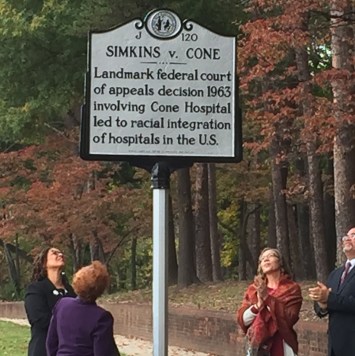
Historical marker for landmark decision of Simkin v. Cone, 1963

Historical marker for landmark decision of Simkin v. Cone, 1963

Cone Health commemorated the legacy of the Simkins decision by allocating $250,000 in scholarship funds for students pursuing healthcare professions. Guilford County commemorated the case by placing a marker outside Cone Hospital and a bronze statue of George Simkins on the grounds of the Guilford County Courthouse. These symbolic gestures speak to the case’s broad importance, defining Simkins not only as a significant battle for civil rights in medicine, but also as a touchstone moment in a much larger movement for freedom and liberation. Simkins was decided only months before the Civil Rights Act of 1964 was ratified; the Title VI of this act and Medicare funding forced the desegregation of healthcare facilities almost overnight, as historian David Barton Smith argues. In a short documentary produced by Cone Health, Dr. Blount recalled that the Simkins case “ended ‘separate but equal’ forever.”

Yet, the Simkins decision does not figure prominently in many popular renditions of civil rights history.1 Contrary to the aforementioned Clinton and AMA apologies, which received national attention, the Simkins apology did not move beyond the local media. In many of these local reflections, the Simkins case was likened to the historic 1954 Brown v. Board ruling. Though both cases ostensibly achieved similar ends, eliminating separate but equal institutions in education and healthcare, respectively, the comparison obscures more than it reveals. Even I am guilty of this shorthand, an easy way to communicate the gravity and significance of this decision. But this shorthand has the unintended effect of perpetuating Simkins’ invisibility.

History plays a role in why Brown lives on in the popular imaginary and Simkins does not. A majority of Americans interacted with both systems as they each cared for the nation’s most vulnerable: children and the infirm. Desegregating American education, however, was a very public battle, as images and video captured the Little Rock Nine or Dorothy Counts (who integrated my high school, Harding University High School in Charlotte, North Carolina) confronting inflamed white mobs. Brown was not simply waged in court; debates around school segregation seeped into American homes and into popular discourse. On the other hand, Dr. Blount remembered that the Simkins plaintiffs wanted to engage in a quiet challenge to segregated healthcare.2Although their fiscal independence allowed some physicians, like T. R. M. Howard, to jump to the fore of a broader movement, others sought to challenge their exclusion from the medical establishment in a more dignified manner.

While the Supreme Court heard Brown, it did not take the Simkins case. Until the Civil Rights Act months later, the lower Circuit Court’s ruling stood as jurisprudence only in the Fourth Circuit’s Mid-Atlantic region. Moreover, the two cases had distinct legal questions at their heart; Brown questioned the separate but equal doctrine established in 1896, while Simkins questioned whether public funding of private institutions counted as “state action.” Undoubtedly, Brown was an essential step leading to the Simkins decision. Without its challenge to the separate but equal doctrine, Simkins may have failed. Finally, the speed by which institutions in the fields of education and healthcare were desegregated differed dramatically. In the words of Chief Justice Earl Warren, school desegregation was ordered with “all deliberate speed,” while the Simkins case, combined with the Civil Rights Act and Medicare legislation, helped to desegregate many hospitals rather quickly. Political scientist and historian David Smith’s The Power to Heal: Civil Rights Medicare, and the Struggle to Transform America’s Healthcare System (2016) recovers this connection and situates health policy implementation in the broader movement for equality, employment, and rights.

Though the Simkins case is lauded for bringing about a swift end to segregation in healthcare, among other things, it led to the decline of Black community hospitals. While some, like Grady Memorial in Atlanta, successfully negotiated the new terrain of race relations, federal monies, power, and increased opportunities for Black medical students and doctors elsewhere, others like Homer G. Phillips Hospital of St. Louis and L. Richardson Hospital shuddered under the burden of increasing medical costs, lack of staff, and changing ideas around the importance of these institutions. In effect, Black hospitals were an anachronism in the post-Simkins era. Where some Black patients could, like my grandmother, walk to and from their community hospitals, such an action is almost inconceivable today given the large, distant campuses of many contemporary urban hospitals and medical centers.

Cone Health’s apology, though overdue, came at just the right moment. Dr. Alvin Blount passed away earlier this year, only months after his former legal foe recognized and applauded his pioneering work. The silences around the Simkins decision demonstrate that more work still needs to be done on our understanding of the history and legacy of Black liberation. Specifically, the nexus between civil rights and health remains fertile ground for scholarly inquiry. We must heed the warning of W. Montague Cobb, physician, anthropologist, editor, activist, and intellectual, “lest we forget.”

This piece was originally published at The African American Intellectual History Society (AAIHS) blog

Ezelle Sanford III is a fourth-year graduate student at Princeton University in the Department of History, Program in the History of Science. He is currently a Visiting Scholar in the Center for Humanities at Washington University in St. Louis working on his dissertation project, “A Source of Pride, a Vision of Progress: The Homer G. Phillips Hospital of St. Louis, MO.” (Bio credit: AAIHS)

~ Ordinary Philosophy is a labor of love and ad-free, supported by patrons and readers like you. Any support you can offer will be deeply appreciated!

*All views and opinions expressed by guest writers are their own and do not necessarily reflect those of Ordinary Philosophy’s editors and publishers

O.P. Recommends: Bettany Hughes At 5×15 – Socrates And The Good Life

One of my favorite historians, broadcasters, and speakers, Bettany Hughes, gives a wonderful talk here on Socrates. Enjoy!

~ Ordinary Philosophy is a labor of love and ad-free, supported by patrons and readers like you. Any support you can offer will be deeply appreciated!

*All views and opinions expressed by guest writers are their own and do not necessarily reflect those of Ordinary Philosophy’s editors and publishers

History As A Communal Act: The History of Black History Month, by Stephen G. Hall

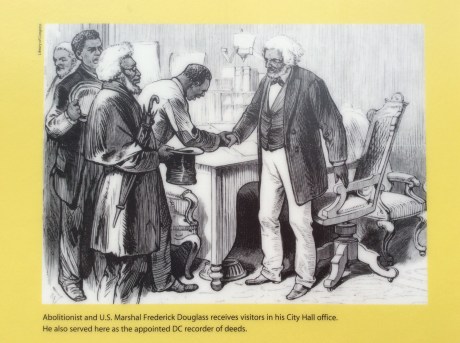
Frederick Douglass as US Recorder of Deeds, Library of Congress image, sign at D.C. Court of Appeals

Frederick Douglass as US Recorder of Deeds, Library of Congress image, sign at D.C. Court of Appeals

African Americans have always imagined and constructed history as a communal act. At the inception of the African American historical enterprise in the early 19th century, Jacob Oson’s Search for Truth (1817), one of the first examples of a textual African American historical production, offers insights into these communal sensibilities. Oson delivered the address in New Haven and New York, the locations of two dynamic free black communities, addressing communal concerns such as the African past, contemporary treatment, and identity. He also received help in publishing the address from Christopher Rush, Bishop in the African Methodist Episcopal Zion Church, one of the largest black church organizations in the country. From inception to publication, history existed not as the purview of the few, but as a communal product.

Oson’s work was no mere isolated incident. Writers were largely community advocates: ministers, abolitionists, autodidacts, and bibliophiles. James W.C. Pennington’s A Textbook of the Origin and History of the Colored People (1841)  offered important insights into African American history. Maria Stewart’s speeches blended piety with calls for communal action and awareness of racial injustice. Robert Benjamin Lewis’s interracial heritage (Native American and African) served as a springboard for his humanistic and universal history of African-descended people titled Light and Truth (1844). Black writers also envisioned their community as transnational. They engaged the African past as well as the complexities of the African Diaspora. They ruminated on the history of Haiti and Latin America. For these writers, African Americans were more than mere products of North American slavery. Their history was intertwined with the social, political, and cultural fabric of Africa and the Diaspora. In short, African American intellectuals understood their unique role as African-descended people whose history shaped the global experience.

Communal engagement proved central in dramatizing and reflecting the sentiments of historical periods. As African Americans laid the groundwork in the nation’s transition from slavery to freedom, Black history heralded these changes. William Wells Brown’s The Black Man (1863) and The Negro in the American Rebellion (1867) provided the first blueprints for the future. William Still’s The Underground Railroad (1871) reconstructed black heroism in the fight to end slavery. Black remembrance of the past focused less on individual achievements and more on the community’s collective ability to overcome obstacles to achieve clear goals. Freedom’s advent emanated from and served communal purposes.

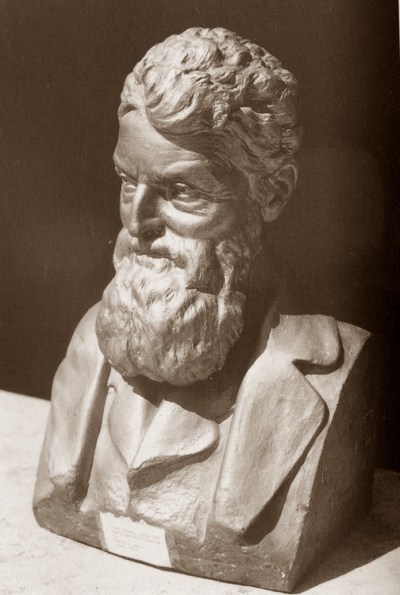
Sculpture of John Brown by Edmonia Lewis

Sculpture of John Brown by Edmonia Lewis

Black history’s communal manifestations were not merely textual. West Indian Independence Day and Juneteenth and Emancipation Day Celebrations, to name a few, permeated the communal landscape throughout the 19th and into the 20th centuries. Artistic representations, especially the work of Edmonia Lewis and Meta Vaux Warrick Fuller, were very important. Both of these women used sculpture to powerfully reconstruct the black past. Lewis’s John Brown (1864–65) and Robert Gould Shaw (1867–68, marble) depict historical figures subsequently revered in black communities. Her communal representation, Forever Free (1867, marble), celebrated the ratification of the 13th Amendment. The original title of the piece was “Morning of Liberty.” Fuller’s Ethiopia Awakening (1914), Mary Turner (Silent Protest Against Mob Violence) (1919) and Ethiopia Awakening (1930) highlight themes of racial pride, cultural awareness, and awakening and resilience in the face of adversity.

The outgrowth of these communal sensibilities naturally impacted the growth of the professionalized African American history project. Carter G. Woodson’s establishment of the Association of the Study of Negro Life and History (ASNLH) in 1915, the Journal of Negro History (1916), and the Associated Publishers in 1916 built on preexisting traditions of communal engagement and representation. These traditions were already extant in the African American historical enterprise for at least a century prior to their professionalization. Woodson used the “Documents” and “Notes” sections of the JNH to present communal offerings, the living and breathing history found in the attics and basements of African Americans around the country. Due to the small number of professionally trained historians, Woodson understood that the African American historical project must embrace the larger community as well as the professional and lay classes. Woodson utilized the broadest cross-section of the black community, drawing on everyone from K-12 educators and administrators to physicians, politicians, and pastors and ordinary people who displayed an interest in the historical past.Black literary and historical societies, bibliophiles, and collectors were also prominent in this regard. Groups such as the American Negro Academy, the Negro Society for Historical Research, and the Mu-So Lit Club played a prominent role in promoting the study of history. Their efforts were complimented by bibliophiles such as Arthur Schomburg and Jesse Moorland. Schomburg, a Puerto-Rican immigrant, collected books about the global black experience in his Harlem apartment. His extensive collection was purchased by the New York Public Library in 1925. Today it comprises the nucleus of the Schomburg Collection in Harlem, New York. Jesse Moorland, an avid bibliophile, YMCA activist, and close friend of Carter G. Woodson, donated his sizable collections to the institution, which today are housed at Howard University’s Moorland-Springarn Room.

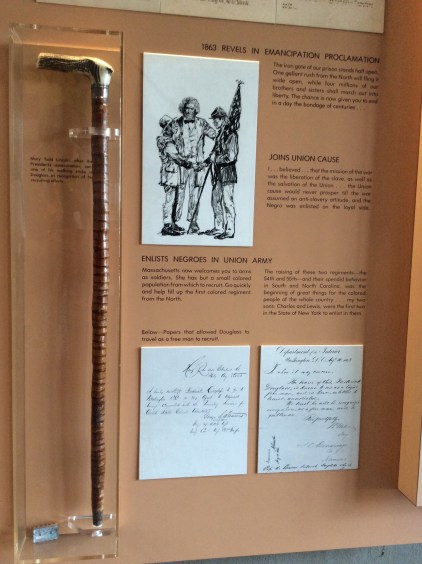
Abraham Lincoln's walking stick, Mary Todd Lincoln's gift to Frederick Douglass

Abraham Lincoln’s walking stick, Mary Todd Lincoln’s gift to Frederick Douglass

Given more than a century of deep engagement with history in black communities in textual, commemorative, artistic, organizational (literary and historical societies and libraries and repositories), and professional projects, it is not surprising that Negro History Week (1926) and later Black History Month (1980) emerged. Instituted as a communal celebration of black possibility and reality, Negro History Week continued earlier themes of accentuating black communal achievements, charting communal possibility and using institutional spaces to shape historical understanding within black communities and more important, in the national and global spheres. Its celebration in February acknowledges its communal roots. February is the birth month of two revered figures in African American life and history in the 19th and early 20th centuries: Frederick Douglass and Abraham Lincoln. Douglass and Lincoln loomed large in the black imagination because of their associations, tangible and symbolic, with Emancipation. The commemorative celebrations of the Emancipation Proclamation and the 13th Amendment, as well as the long communal struggle to eradicate slavery from the order of things, resonated in the chords of memory in African-descended populations well into the 20th century.

In 1926, the Annual Meeting of the ASNLH was held at Morgan State College (now university) in Baltimore. A “Negro History Week Roundtable” featured educators primarily from the State of Maryland and the District of Columbia. Given the prominence and activism of the black communities in these two locales, they serve as a representative sample for how “the movement,” as it was commonly labeled, impacted black communities. The comments of the educators, one of whom was Dr. Otelia Cromwell, Head of the Department of History and English in the public schools in the District of Columbia, emphasized the importance of the work. They also highlighted the impact of the celebration on young people in urban and rural communities. According to Cromwell, the observance of Negro History Week not only proved of great interest to students, faculty, and staff in the District of Columbia, but it also “had the effect of improving the tone and atmosphere of the school room.” The summation of Cromwell’s remarks unquestionably demonstrates the immeasurable nature of history’s communal reach. The report read: “These results which cannot be easily set forth in words or mathematically measured she believed to be the most important of all.” Cromwell knew that history’s import and meaning transcended the solidarity of a single moment in time. It permeated the classroom and seeped into the collective strivings of untold generations. It informed one hundred years of historical engagement and interrogation. It gave rise to textual writing, commemorative celebrations, artistic representations, literary and historical societies, black bibliophiles and collectors, and finally the professionalization of African American history in the first half of the twentieth century.

These same communal sensibilities informed the rise of the African American museum movement in the 1960s: The DuSable Museum of African American History (1961), the International Afro-American Museum in Detroit (1965), the Anacostia Community Museum in Washington (1967), and the African American Museum of Philadelphia (1976). Other community-inspired projects include The Blacks in Wax Museum in Baltimore (1983) and the National Afro American Museum and Cultural Center in Wilberforce, Ohio (1987). All of these museums used history and historical artifacts to dramatize the black past and present it to the community. These efforts culminated in the creation of the National African American Museum on the National Mall in 2016.

Our contemporary moment has witnessed the continuation of these communal projects. It has spawned the use of digital spaces (Internet and social media such as Twitter, Facebook, Tumblr, Pinterest, Snapchat, Instagram) to present African American history and historical ideas in new and dynamic ways. The construction of syllabi to educate diverse publics about contemporary events is a direct outgrowth of this communal focus. These efforts are too numerous to name them all, but a few examples will suffice: Dr. Marcia Chatelain’s #Ferguson Syllabus and the work of Drs. Chad Williams, Kidada Williams, and Keisha Blain with the #CharlestonSyllabus, The D.A.TT Freedom Summer 2015 Syllabus, the #BlackPantherSyllabus, the #The Baltimore Syllabus, the BlackLivesMatter Syllabus, the Welfare Reform Syllabus, the Trump Syllabus 2.0, and the Trump Syllabus 2.0: Supplementary List.

Black History Month, then, is more than a month-long celebration or an obligatory relic of an outmoded past. Rather it is and continues to serve as the catalyst for the transmission of a dynamic historical memory embedded in the collective striving of a global people to celebrate their historical past, affirm their humanity, and share the richness and vibrancy of their history as a communal act.

This piece was originally published at The African American Intellectual History Society (AAIHS) blog

Stephen G. Hall is the Program Coordinator of History at Alcorn State University. He is the author of A Faithful Account of the Race: African American Historical Writing in Nineteenth-Century America (UNC Press, 2009).  He is currently completing an edited book entitled History as A Communal Act: African American Historians and Historical Writing Past and Present (Routledge Press, forthcoming). His second book project is entitled Global Visions: African American Historians Engage the World, 1885–1960. (Bio credit: AAIHS)

Ordinary Philosophy and its Traveling Philosophy / History of Ideas series is a labor of love and ad-free, supported by patrons and readers like you. Please offer your support today!