Say What? Montaigne on Accuracy

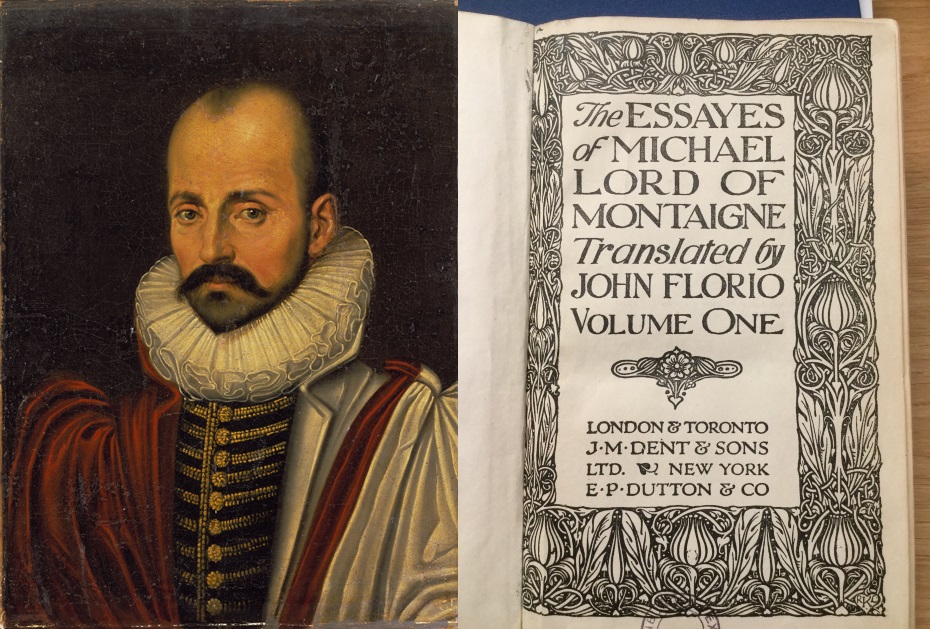
Michel de Montaigne and the frontispiece to an early 1900’s publication of Florio’s translation of his ‘Essayes’. Below is a later one by Donald Frame

‘This man I had [stay at my house] was a simple, crude fellow–a character fit to bear true witness: for clever people observe more things and more curiously, but they interpret them; and to lend weight and conviction to their interpretation, they cannot help altering history a little. They never show you things as they are, but bend and disguise them according to the way they have seen them; and to give credence to their judgment and attract you to it, they are prone to add something to their matter, to stretch it out and amplify it. We need a man either very honest, or so simple that he has not the stuff to build up false inventions and give them plausibility; and wedded to no theory.’

– From Michel de Montaigne’s Essays: ‘Of Cannibals’

Ordinary Philosophy and its Traveling Philosophy / History of Ideas series is a labor of love and ad-free, supported by patrons and readers like you. Please offer your support today!

He Died as He Lived: David Hume, Philosopher and Infidel, by Dennis Rasmussen

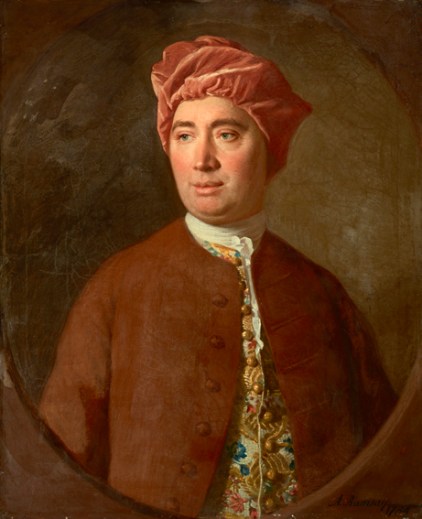
As the Scottish philosopher David Hume lay on his deathbed in the summer of 1776, his passing became a highly anticipated event. Few people in 18th-century Britain were as forthright in their lack of religious faith as Hume was, and his skepticism had earned him a lifetime of abuse and reproach from the pious, including a concerted effort to excommunicate him from the Church of Scotland. Now everyone wanted to know how the notorious infidel would face his end. Would he show remorse or perhaps even recant his skepticism? Would he die in a state of distress, having none of the usual consolations afforded by belief in an afterlife? In the event, Hume died as he had lived, with remarkable good humour and without religion.

The most famous depiction of Hume’s dying days, at least in our time, comes from James Boswell, who managed to contrive a visit with him on Sunday, 7 July 1776. As his account of their conversation makes plain, the purpose of Boswell’s visit was less to pay his respects to a dying man, or even to gratify a sense of morbid curiosity, than to try to fortify his own religious convictions by confirming that even Hume could not remain a sincere non-believer to the end. In this, he failed utterly.

‘Being too late for church,’ Boswell made his way to Hume’s house, where he was surprised to find him ‘placid and even cheerful … talking of different matters with a tranquility of mind and a clearness of head which few men possess at any time.’ Ever tactful, Boswell immediately brought up the subject of the afterlife, asking if there might not be a future state. Hume replied that ‘it was possible that a piece of coal put upon the fire would not burn; and he added that it was a most unreasonable fancy that we should exist for ever’. Boswell persisted, asking if he was not made uneasy by the thought of annihilation, to which Hume responded that he was no more perturbed by the idea of ceasing to exist than by the idea that he had not existed before he was born. What was more, Hume ‘said flatly that the morality of every religion was bad, and … that when he heard a man was religious, he concluded he was a rascal, though he had known some instances of very good men being religious.’

This interview might show Hume at his brashest, but in the 18th century it remained mostly confined to Boswell’s private notebooks. The most prominent and controversial public account of Hume’s final days came instead from an even more famous pen: that of Adam Smith, Hume’s closest friend. Smith composed a eulogy for Hume soon after the latter’s death in the form of a public letter to their mutual publisher, William Strahan. This letter was effectively the ‘authorised version’ of the story of Hume’s death, as it appeared (with Hume’s advance permission) as a companion piece to his short, posthumously published autobiography, My Own Life (1776).

Smith’s letter contains none of the open impiety that pervades Boswell’s interview, but it does chronicle – even flaunt – the equanimity of Hume’s last days, depicting the philosopher telling jokes, playing cards, and conversing cheerfully with his friends. It also emphasises the excellence of Hume’s character; indeed, Smith concluded the letter by declaring that his unbelieving friend approached ‘as nearly to the idea of a perfectly wise and virtuous man, as perhaps the nature of human frailty will permit’.

Though relatively little known today, in the 18th century Smith’s letter caused an uproar. He later proclaimed that it ‘brought upon me 10 times more abuse than the very violent attack I had made upon the whole commercial system of Great Britain’ – meaning, of course, The Wealth of Nations (1776). Throughout his life, Smith had generally gone to great lengths to avoid revealing much about his religious beliefs – or lack thereof – and to steer clear of confrontations with the devout, but his claim that an avowed skeptic such as Hume was a model of wisdom and virtue ‘gave very great offence’ and ‘shocked every sober Christian’ (as a contemporary commented).

Boswell himself deemed Smith’s letter a piece of ‘daring effrontery’ and an example of the ‘poisonous productions with which this age is infested’. Accordingly, he beseeched Samuel Johnson to ‘step forth’ to ‘knock Hume’s and Smith’s heads together, and make vain and ostentatious infidelity exceedingly ridiculous. Would it not,’ he pleaded, ‘be worth your while to crush such noxious weeds in the moral garden?’

Nor did the controversy subside quickly. Nearly a century later, one prolific author of religious tomes, John Lowrie, was still sufficiently incensed by Smith’s letter to proclaim that he knew ‘no more lamentable evidence of the weakness and folly of irreligion and infidelity’ in ‘all the range of English literature’.

In the 18th century, the idea that it was possible for a skeptic to die well, without undue hopes or fears, clearly haunted many people, including Boswell, who tried to call on Hume twice more after their 7 July conversation in order to press him further, but was turned away. Today, of course, non-believers are still regarded with suspicion and even hatred in some circles, but many die every day with little notice or comment about their lack of faith. It takes a particularly audacious and outspoken form of non-belief – more akin to the Hume of Boswell’s private interview than to the Hume of Smith’s public letter – to arouse much in the way of shock or resentment, of the kind that attended the death of Christopher Hitchens some years ago. (Indeed, there were a number of comparisons drawn between Hitchens and Hume at the time.) The fact that in the 18th century Smith endured vigorous and lasting abuse for merely reporting his friend’s calm and courageous end offers a stark reminder of just how far we have come in this regard.Aeon counter – do not remove

This article was originally published at Aeon and has been republished under Creative Commons.

Dennis Rasmussen is an associate professor in the department of political science at Tufts University in Massachusetts. He is the author of The Infidel and the Professor: David Hume, Adam Smith, and the Friendship That Shaped Modern Thought (2017). (Bio credit: Aeon)

~ Ordinary Philosophy is a labor of love and ad-free, supported by patrons and readers like you. Any support you can offer will be deeply appreciated!

*All views and opinions expressed by guest writers are their own and do not necessarily reflect those of Ordinary Philosophy’s editors and publishers

The New Black Radical Moment, by Robert Greene II

Robert Greene II. Photo: Society for US Intellectual History Blog

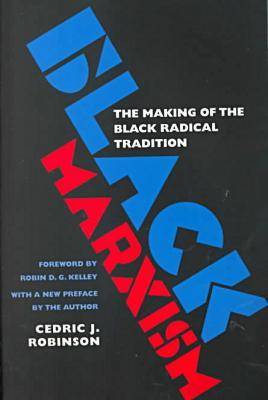
Recent weeks have seen the release of several books that, have in some form or fashion, something to do with the Black Radical Tradition. While much fanfare has preceded the release of the new Ta-Nehisi Coates book, We Were Eight Years in Power (and with good reason), other books also speak to a renewed interest in African American radical thought. Where Coates seeks to describe the past and present of black history in America (in a discourse that ranges between center-left and radical), these other works offer a distinctly radical viewpoint of race and modern life. The rise of Black Lives Matter, Donald Trump’s election, and qualms about the limits of the Barack Obama administration have all played key roles in this new Black Radical moment in modern intellectual discourse. Within the academy, growing interest in the works of Cedric Robinson—most notably Black Marxism but also his other works The Terms of Order and Black Movements in America, among others—coupled with deep, penetrating critiques of capitalism’s relationship to race, class, gender, and sexual orientation, have provided some of the intellectual fuel for this moment. The “Black Perspectives” blog has also filled an important role in this, being a clearing house for all manner of scholars of the African American experience to talk about these various political and cultural intersections for a wide audience. This is all a long, and winding, way towards saying that everyone who reads this blog should take time, sooner or later, to read the edited collection Futures of Black Radicalism.

The edited collection, curated by Gaye Theresa Johnson and Alex Lubin, plays off of Cedric Robinson’s landmark book and gives scholars and lay readers alike the chance to think about what the term “black radicalism” actually means. To their credit, Johnson and Lubin don’t try to offer an ironclad answer to that question. As they put it in the introduction, their goal is “merely archiving a moment in Black radical thought, one which exceeds the pages of this book, and which is always more expansive than the people writing here.”[1] What stands out about this book is the richness of intellectual discourse within its pages. A variety of historians, sociologists, and other scholars all tackle a central question: what, precisely, does the Black Radical Tradition say about life in the twenty-first century?  In the pursuit of these questions, the scholars featured in Futures of Black Radicalism—which is a who’s who of scholars that study political economy, history, sociology, and other fields—demonstrate a determination to enter the kinds of public debates that scholars have argued for years we should join in earnest. In that sense, they speak to another essential tradition from the African American intellectual tradition: the need for scholars to go beyond the academy and join debates in the broad public concerning race, politics, and other intertwined fields.

Another book, coming out soon, also promises to shake up discourse about the Black Radical Tradition. Keeanga-Yamahtta Taylor’s new collection of essays and interviews, How We Get Free: Black Feminism and the Combahee River Collective will be a valuable work for reminding people of the importance of the Combahee River Collective’s radical interpretation of feminism in the 1970s. The Collective was founded by African American women who wanted to make sure feminism did not remain an ideology linked exclusively to white, moderately liberal political discourse. More importantly, the name alone—Combahee River—recalls radical action and liberation (Combahee River was also the location of a famous raid led by Harriet Tubman during the American Civil War). It’s no surprise Taylor is doing work like this—her previous book, From #BlackLivesMatter to Black Liberation was also a crucial entry into modern debates about black radicalism and American society.

Other books also promise to open new avenues of thought on the long history of black radicalism. Works such as Brittney Cooper’s Beyond Respectability: The Intellectual Thought of Race Women offers much to think about when considering the history of African American intellectuals. The forthcoming work from Ashley Farmer, Remaking Black Power: How Black Women Transformed an Era, will be an exciting—not to mention much-needed—evaluation of the role black women played in various Black Power-organizations and movements. We’ve already had a few works tackle this topic—most impressively The Revolution Has Come by Robyn C. Spencer—but I doubt we’ll ever have enough books about African American women and the role they played in various social movements in the twentieth century. Speaking of, Keisha Blain’s Set the World on Fire: Black Nationalist Women and the Global Struggle for Freedom, which is slated for release early next year, follows this same vein.

The Black Radical Tradition lives on through both the scholarship of historians and activism in the streets. It is no coincidence that whenever the struggle for black freedom heats up in American society, the scholars and intellectuals always provide the literary firepower necessary to further the fight for justice. We are living in another such time—one that, I believe, will be both an exciting time for intellectual curiosity and a dangerous time to be an honest, opinionated intellectual.

[1] “Introduction,” Gaye Theresa Johnson and Alex Lubin, in Futures of Black Radicalism. London: Verso Books, 2017. P. 13.

This article was originally published at The Society for U.S. Intellectual History Blog

Ordinary Philosophy and its Traveling Philosophy / History of Ideas series is a labor of love and ad-free, entirely supported by patrons and readers like you. Please offer your support today!

Black Issues in Philosophy – A New Series Presented by the American Philosophical Association Blog

Here’s the announcement by the APA:

‘Dear Readers:

We here introduce Black Issues in Philosophy: Blog of the APA Committee on the Status of Black Philosophers.

The purpose of this series is to offer announcements, discussions, critical reviews, opinionated statements (op-eds), and philosophical suggestions, ideas, or explorations relevant to the status of philosophers of African descent and readers interested in such issues….’

You can read articles, find out how to contribute, and more at the APA’s website

Ordinary Philosophy and its Traveling Philosophy / History of Ideas series is a labor of love and ad-free, entirely supported by patrons and readers like you. Please offer your support today!

Say What? Francis Bacon Quotes Cicero On Cato and Government

‘Cato means well: but he does hurt sometimes to the State; for he talks as if he were in the republic of Plato and not in the dregs of Romulus.’

– Marcus Cicero, as quoted by Francis Bacon in Wisdom of the Ancients

Ordinary Philosophy and its Traveling Philosophy / History of Ideas series is a labor of love and ad-free, entirely supported by patrons and readers like you. Please offer your support today!

Happy Birthday, Gwendolyn Marie Patton!

Gwendolyn Marie Patton, photo from Trenholm State Community College Libraries

To celebrate the memory of activist and scholar Dr. Gwendolyn Marie Patton, born October 14, 1943, I share here an excellent article by Ashley Farmer, assistant professor at Boston University and a regular contributor to the African American Intellectual History Society’s blog Black Perspectives. By the way, if you also seek to learn more about the contributions of great thinkers like Dr. Patton who are not widely known or celebrated enough in popular culture, Dr. Farmer is an excellent author to follow.

Remembering Gwen Patton, Activist and Theorist, by Ashley Farmer

“Ideas are powerful,” Dr. Gwendolyn Patton used to say when she talked to the younger generation about civil rights and political organizing. This simple but powerful notion undergirded Patton’s incredible activist life, one that spanned much of the late 20th century and many different facets of the Black Freedom Struggle. Patton always contended that access to knowledge, and in particular, theoretical frameworks for understanding oppression and liberation, were key sites of protest and contestation. Weaving together a powerful life of theorizing and activism, she was and remains one of the most profound black thinkers of our lifetimes.

Patton was born outside Detroit, Michigan in 1943. Her early childhood was characterized by the dialectic between the trappings of middle-class life and insurgent black politics. She grew up in a comfortable black neighborhood and spent her summers with her grandmother in Montgomery, a hotbed of civil rights activism in the early 1950s. In 1960, after her mother passed away, she became a full-time Montgomery resident. As a teenager, she volunteered with the Montgomery Improvement Association (MIA), the organization responsible for the Rosa Parks-led boycott in 1955. When Patton went off to college at nearby Tuskegee University, she brought this zeal for activism with her. She joined several student-led organizations and protests and eventually became the first woman student body president of the university.

At Tuskegee, Patton was part of what she called a “close-knit, intellectual student movement” that engaged in public accommodation desegregation battles and voter registration work…’ Read more:

And to learn more:

Dr. Gwendolyn Marie Patton, 1943-2017 ~ by Brian Jones via Academia.edu

Gwendolyn M. Patton ~ Interview for the Civil Rights History Project conducted by Joseph Mosnier in Montgomery, Alabama, 6/1/2011 for the Library of Congress

Gwendolyn M. Patton ~ Bio and interview at The HistoryMakers website

Ordinary Philosophy and its Traveling Philosophy / History of Ideas series is a labor of love and ad-free, entirely supported by patrons and readers like you. Please offer your support today!

The Triage of Truth: Do Not Take Expert Opinion Lying Down, by Julian Baggini

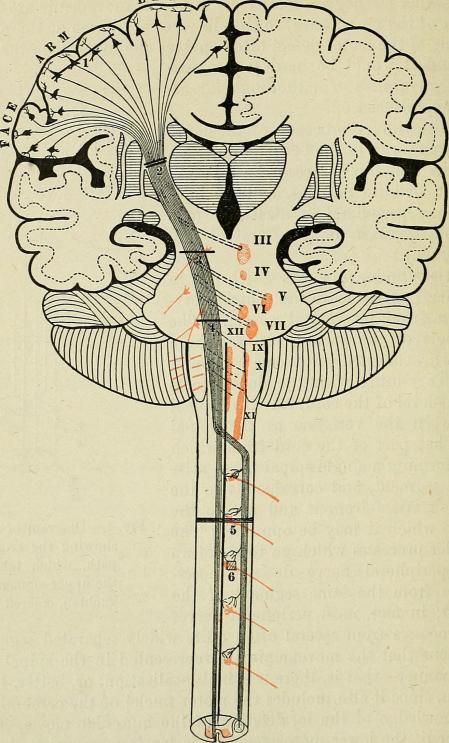
Brain illustration from The Principles and Practice of Medicine…’ by W Osler, 1904, public domain via Wikimedia Commons

The thirst for knowledge is one of humankind’s noblest appetites. Our desire to sate it, however, sometimes leads us to imbibe falsehoods bottled as truth. The so-called Information Age is too often a Misinformation Age.

There is so much that we don’t know that giving up on experts would be to overreach our own competency. However, not everyone who claims to be an expert is one, so when we are not experts ourselves, we can decide who counts as an expert only with the help of the opinions of other experts. In other words, we have to choose which experts to trust in order to decide which experts to trust.

Jean-Paul Sartre captured the unavoidable responsibility this places on us when he wrote in Existentialism and Humanism (1945): ‘If you seek counsel – from a priest, for example – you have selected that priest; and at bottom you already knew, more or less, what he would advise.’

The pessimistic interpretation of this is that the appeal to expertise is therefore a charade. Psychologists have repeatedly demonstrated the power of motivated thinking and confirmation bias. People cherry-pick the authorities who support what they already believe. If majority opinion is on their side, they will cite the quantity of evidence behind them. If the majority is against them, they will cite the quality of evidence behind them, pointing out that truth is not a democracy. Authorities are not used to guide us towards the truth but to justify what we already believe the truth to be.

If we are sincerely interested in the truth, however, we can use expert opinion more objectively without either giving up our rational autonomy or giving in to our preconceptions. I’ve developed a simple three-step heuristic I’ve dubbed ‘The Triage of Truth’ which can give us a way of deciding whom to listen to about how the world is. The original meaning of triage is to sort according to quality and the term is most familiar today in the medical context of determining the urgency of treatment required. It’s not infallible; it’s not an alternative to thinking for yourself; but it should at least prevent us making some avoidable mistakes. The triage asks three questions:

  •  Are there any experts in this field?
  •  Which kind of expert in this area should I choose?
  •  Which particular expert is worth listening to here?

In many cases there is no simple yes or no answer. Economic forecasting, for example, admits of only very limited mastery. If you are not religious, on the other hand, then no theologian or priest can be an expert on God’s will.

If there is genuine expertise to be had, the second stage is to ask what kind of expert is trustworthy in that domain, to the degree that the domain allows of expertise at all. In health, for example, there are doctors with standard medical training but also herbalists, homeopaths, chiropractors, reiki healers. If we have good reason to dismiss any of these modalities then we can dismiss any particular practitioner without needing to give them a personal assessment.

Once we have decided that there are groups of experts in a domain, the third stage of triage is to ask which particular ones to trust. In some cases, this is easy enough. Any qualified dentist should be good enough, and we might not have the luxury of picking and choosing anyway. When it comes to builders, however, some are clearly more professional than others.

The trickiest situations are where the domain admits significant differences of opinion. In medicine, for example, there is plenty of genuine expertise but the incomplete state of nutritional science, for example, means that we have to take much advice with a pinch of salt, including that on how big this pinch should be.

This triage is an iterative process in which shifts of opinion at one level lead to shifts at others. Our beliefs form complex holistic webs in which parts support each other. For example, we cannot decide in a vacuum whether there is any expertise to be had in any given domain. We will inevitably take into account the views of experts we already trust. Every new judgment feeds back, altering the next one.

Perhaps the most important principle to apply throughout the triage is the 18th-century Scottish philosopher David Hume’s maxim: ‘A wise man … proportions his belief to the evidence.’ Trust in experts always has to be proportionate. If my electrician warns me that touching a wire will electrocute me, I have no reason to doubt her. Any economic forecast, however, should be seen as indicating a probability at best, an educated guest at worst.

Proportionality also means granting only as much authority as is within an expert’s field. When an eminent scientist opines on ethics, for example, she is exceeding her professional scope. The same might be true of a philosopher talking about economics, so be cautious about some of what I have written, too.

This triage gives us a procedure but no algorithm. It does not dispense with the need to make judgments, it simply provides a framework to help us do so. To properly follow Immanuel Kant’s Enlightenment injunction ‘Sapere aude’ (Dare to know), we have to rely on both our own judgment and the judgment of others. We should not confuse thinking for ourselves with thinking by ourselves. Taking expert opinion seriously is not passing the buck. No one can make up your mind for you, unless you make up your mind to let them.Aeon counter – do not remove

This article was originally published at Aeon and has been republished under Creative Commons.

~ Julian Baggini is a writer and founding editor of The Philosophers’ Magazine. His latest book is A Short History of Truth (2017). (Bio credit: Aeon)

Ordinary Philosophy and its Traveling Philosophy / History of Ideas series is a labor of love and ad-free, entirely supported by patrons and readers like you. Please offer your support today!

Happy Birthday, Philippa Foot!

‘Philippa Foot [, born on October 3rd, 1920, was] a philosopher who argued that moral judgments have a rational basis, and who introduced the renowned ethical thought experiment known as the Trolley Problem…’ William Grime’s New York Times obituary of this philosopher, far less widely known than she is influential, is an excellent introduction to the life and ideas of the brilliant Foot.

You can also learn more about Philippa Foot at

Philippa Foot – by Martin L. White for Encyclopædia Britannica

Philippa Foot ~ Interview by Rick Lewis for Philosophy Now, conducted in the autumn of 2001

Philippa Foot (1920-2010) ~ by Lawrence Solum for Legal Theory Blog

Philippa Foot Obituary: A ‘Grande Dame of Philosophy’, She Pioneered Virtue Ethics – by Jane O’Grady for The Guardian, October 5th, 2010

Philippa Foot: Trolleys and Natural Goodness ~ by Edward Harcourt for Prospect magazine, Oct 7, 2010

Professor Philippa Foot: Philosopher Regarded as Being Among the Finest Moral Thinkers of the Age ~ by Peter J Conradi and Gavin Lawrence for The Independent, Oct 18th, 2010

and a multitude of citations in Stanford Encyclopedia of Philosophy entries

Ordinary Philosophy and its Traveling Philosophy / History of Ideas series is a labor of love and ad-free, supported by patrons and readers like you. Please offer your support today!

O.P. Recommends: Speaking Ill of Hugh Hefner, by Ross Douthat

‘No doubt what Hefner offered America somebody else would have offered in his place, and the changes he helped hasten would have come rushing in without him.

But in every way that mattered he made those changes worse, our culture coarser and crueler and more sterile than liberalism or feminism or freedom of speech required….

Now that death has taken him, we should examine our own sins. Liberals should ask why their crusade for freedom and equality found itself with such a captain, and what his legacy says about their cause. Conservatives should ask how their crusade for faith and family and community ended up so Hefnerian itself — with a conservative news network that seems to have been run on Playboy Mansion principles and a conservative party that just elected a playboy as our president.’

Read this article in full in the New York Times‘ Opinion Page for Sep 30th, 2017

~ One thing I’d like to make clear: I don’t at all endorse the ageism I discern in many of the articles I’ve read that are critical of Hefner, including this one. So many of these writers imply that Hefner’s sexuality was distasteful, at least in part, because of the physical attributes associated with aging. For example, Douthat mocks Hefner’s ‘papery skin’ and ‘decrepitude’ as if they were among those things the reader should be disgusted by. I don’t believe it’s any more justified to stereotype older people as it is to stereotype women based on narrow conceptions of what desirable or likable people should look like.

Ordinary Philosophy and its Traveling Philosophy / History of Ideas series is a labor of love and ad-free, supported by patrons and readers like you. Please offer your support today!

Happy Birthday, Confucius!

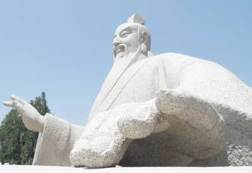
Confucius_Sculpture,_Nanjing

In honor of Confucius’ birthday on September 28th, 551 BCE*, I’m republishing a piece originally published here last year by one-time regular contributor Eric Gerlach. Following his interesting piece, you’ll find a list of great online sources and articles for learning about this seemingly timeless sage: so many of his words of wisdom seem as pertinent today as in his own time.

Confucianism & Daoism: The Basics, by Eric Gerlach

The following is a lecture I composed for teaching Confucianism and Daoism to my sister’s 6th grade History class at Star of the Sea School in San Francisco.

Confucius and Laozi, the philosophers who founded Confucianism and Daoism, lived just before the Warring States Period of ancient China (476 – 221 BCE), a time of war, tragedy and interest in philosophy.  Unfortunately, people’s lives are full of problems, but fortunately problems make people think about their lives, question the answers of authorities and experts, and reason beyond their understandings.
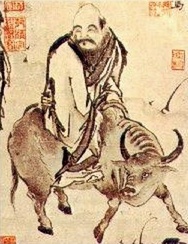
Laozi

Each of us, as individuals, should use both belief and doubt to become better, wiser people, but how should we go about doing this?  Confucianism and Daoism, the two great philosophies of ancient China, gave people opposing ways to gain wisdom.  Many in ancient and modern times used both to compliment and extend each other.

The Confucians say we should build ourselves up to be educated, compassionate and civilized, while the Daoists say we should clear ourselves out to become open-minded, patient and peaceful.  The Confucians say we should learn from others, reason for ourselves, and do what we know to be right.  The Daoists say we should seek less for ourselves and gain perspective beyond our own interests, reasons and actions.

Confucius, the Golden Rule & Learning from Everyone
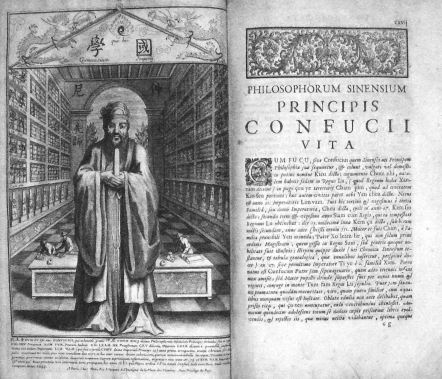
Confucius Latin

When Catholic Jesuit missionaries arrived in China in the 1600s, they were astounded to find that Confucius, the most influential and central Chinese philosopher, was incredibly similar to Jesus in his sayings and teachings.  First and foremost, like Jesus, Buddha, Muhammad and other revered teachers, Confucius taught what has been called the Golden Rule: Do for others what you would want them to do for you, and do not do to others what you do not want done to yourself.  Confucius said that this was the single thing that should guide one’s life, and that compassion is the central thread running throughout his thinking.
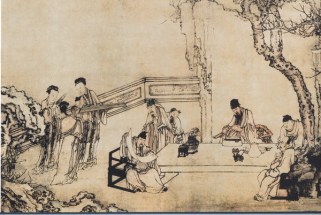
chinese-scholars1

Confucius’ student Zigong once told his teacher, “I do not want to do to others what I do not want them to do to me.”  Confucius replied, “You have not come that far yet”, probably because none of us want others to simply tell us that they are amazing. Another time, Confucius heard Zigong criticizing other people, and said, “Zigong must have already reached perfection, which affords him leisure I do not possess.”  Confucius is being sarcastic, as he often said that no one is perfect, but anyone can be excellent by continuously working to become better.
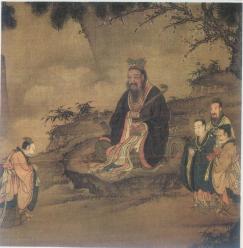
confucius-teaching-hillside-painting

Not only can anyone be excellent, but we can each learn from anyone about how to be better ourselves.  Confucius taught that when we see great people, we should seek to be like them, but when we see horrible people, we should seek how we are like them by examining ourselves.  Confucius said, “Put me with any two people at random and they will always have something to teach me, as I can take their qualities as a model and their defects as a warning.  Clearly, Confucius believed that we all share the same set of strengths and faults, no matter how talented (or horrible) we happen to individually be or where our talents are.
emperor-shun-of-china

Because no one is perfect and everyone can learn from anyone, there is no one who is above criticism, not even the prince of the state.  When asked by a duke if there is a single thing that could ruin a country, Confucius said that if the prince is never told when he is in error or contradicted, it could be the ruin of everyone.  About himself, Confucius said, “I am fortunate indeed… Whenever I make a mistake, there is always someone who notices it.”

chinese-painting-inquiring-about-the-dao

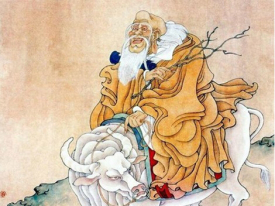
laozi-water-buffalo

Daoism, Perspective & Less is More

The legendary Daoist sages Laozi, Zhuangzi and Liezi taught that human perspectives are limited, and we should always keep this in mind.  Because we only have partial perspectives, we should keep in mind that others have their own perspectives which may not be the same as ours.  In one famous story, a turtle comes across a frog living in a well, and tells the frog about the sea, water that goes beyond the horizon with no walls in sight.  The frog refuses to believe the turtle, arguing that he has lived in water all his life and knows perfectly well that it comes in wells that are only so wide and have walls.  In Zhuangzi’s book, it says:
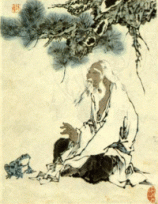
frog-with-zhuangzi

You can’t discuss the ocean with well frogs.  They’re limited by the space they live in.  You can’t discuss ice with summer insects.  They’re bound to a single season.  You can’t discuss the greater way of things with cramped scholars.  They’re shackled by their doctrines.  Now you have come out beyond your banks and borders and have seen the great sea, and so you realize how small you are.  From now on it will be possible to talk to you about the greater way of things.
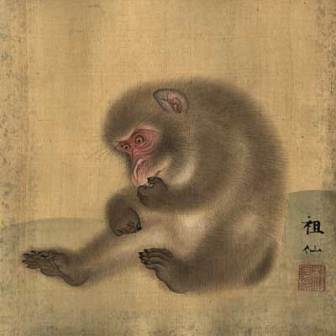
japanese monkey painting

If someone sleeps in a damp place, their back aches and they ends up half paralyzed, but is this true of a carp?  If someone lives in a tree, they are terrified and shake with fright, but is this true of a monkey?  Of these three creatures, which knows the proper place to live?  We eat the flesh of grass-fed and grain-fed animals, deer eat grass, centipedes find snakes tasty, and hawks and falcons love mice.  Of these four, who knows how food ought to taste?  Monkeys pair with monkeys, deer go out with deer, and fish play around with fish.  Men claim that Mao-Qiang and Lady Li were beautiful, but if fish saw them they would dive to the bottom of the stream, if birds saw them they would fly away, and if deer saw them they would break into a run.  Of these four, which knows the standard of beauty for the world?
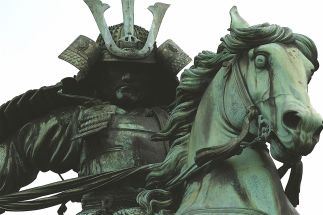
samurai-on-horseback-statue

Daoists also teach the idea of wu-wei, or non-action.  This does not mean that one should not act at all, but that often doing less is doing more.  Being patient and paying attention can save us from doing too much or having to do things over again.  In a Japanese story that illustrates this well, a local lord has three sons and must decide who should inherit his position.  He tests them by placing a pillow on the door to his room and calling them one at a time.  The eldest son enters and annihilates the pillow in a frenzy of skilled sword strikes.  The middle son draws his sword but sees the pillow in mid-air and catches it.  The youngest son sees the pillow on the door, tucks it under his arm and enters the room to the joy of his father.  The youngest son was paying attention, and so he did not even need to pull out his sword.

walking-in-nature-chinese-painting

There are many passages In the Dao De Jing and Zhuangzi, the two central texts of Daoism, that similarly teach that wanting too much and trying too hard is the wrong way to be:

Sages do not boast, and are thus admired by everyone, do not want to shine, and thus will be enlightened, do not seek excellence, and are thus excellent, and because they do not argue, no one can argue with them.

chinese-mountain-painting-stairs

Those who know do not speak.  Those who speak do not know.

Whoever knows how to lead well is not warlike.  Whoever knows how to fight well is not angry.  Whoever knows how to conquer enemies does not fight them.  Whoever knows how to use others well keeps themselves low.

Those who divide fail to divide.  Those who judge are bad at judging.  What does this mean, you ask?  The sage embraces things.  Ordinary people judge between things and parade their judgements in front of others.  So I say, those who judge fail to see.
archer-china

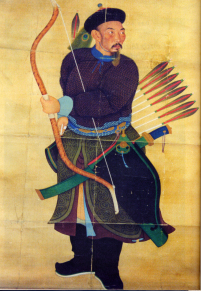
When you’re betting for cheap prizes in an archery contest, you shoot with skill.  When you’re betting for fancy belt buckles, you worry about your aim, and when you’re betting for real gold, you’re a nervous wreck.  Your skill is the same in all three cases, but because one prize means more to you than another, you let outside considerations weigh on your mind.  They who look too hard on the outside get clumsy on the inside.

~~~~~~~~~~~~~~~~~~~~~

Learn more about the great Confucius:

Confucius ~ by Jeffrey Riegel for The Stanford Encyclopedia of Philosophy

Confucius ~ by the editors for the Encyclopædia Britannica

Confucius (551—479 B.C.E.) ~ by Jeff Richey for the Internet Encyclopedia of Philosophy

Why Is Confucius Still Relevant Today? His Sound Bites Hold Up ~ by Simon Worrall for the National Geographic, March 25, 2015

*By the way, it may seem rather amazing that we’d have an exact date for Confucius’ birthday. I’m just guessing that there might have been a cultural reason to assign this date to his birth later on. Here’s the source for that date: Confucius: A Guide for the Perplexed by Yong Huang, 2013, p. 3.

~ Ordinary Philosophy and its Traveling Philosophy / History of Ideas series is a labor of love and ad-free, supported by patrons and readers like you. Please offer your support today!