Second Day in Paris Following Thomas Paine, Mary Wollstonecraft, and Thomas Jefferson, Part 2

At Passage Des Petits Peres and Place Des Petites Peres

Monday, August 10th, 2015, continued

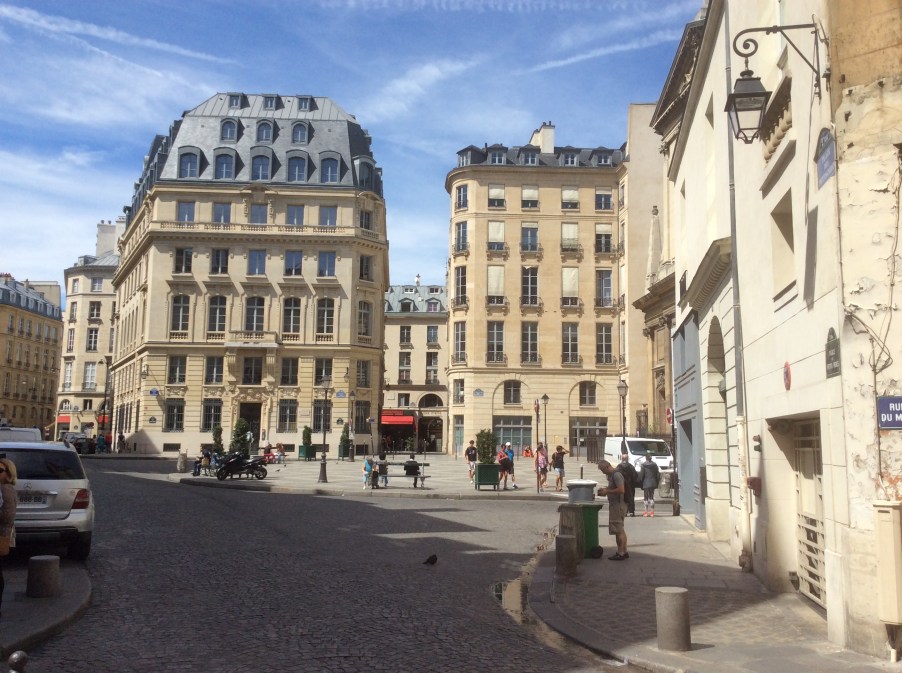
…From the Opera Comique (formerly Theatre des Italiens), I head south towards the Seine and past the Bourse (a center of commerce) to White’s Hotel, Hôtel d’Angleterre in French, also called the Hôtel de Philadelphie at that time, perhaps because of the French admiration for the new American experiment in self-government centered in Philadelphia. Mary Wollstonecraft, initially a little depressed and lonely at the house on rue Meslay, began to meet with a group of expatriates who gathered and dined here at 7 Passage des Petits Pères, just off the square in front of Basilique Notre-Dame des Victoires.

The Square In Front of Notre Dame Des Victoires at Place Des Petites Peres, Paris, France

One of these expatriates was our man Thomas Paine, who lived here intermittently in 1792 and 1793. I don’t find a building with this address on it, though it appears it would have been to the left hand side of east-west entrance to the Galerie Victoire, at the end of the passage farther from the basilica. Paine finished the first part of The Age of Reason here, where he moved again after his stay at the mansion farmhouse on rue du Faubourg Saint-Denis. He smuggled the manuscript to his friend, diplomat and poet Joel Barlow (who I mentioned in my previous Thomas Jefferson series), for safekeeping at the time of his arrest in December of 1793, in hopes that Barlow could have it published while he was imprisoned.

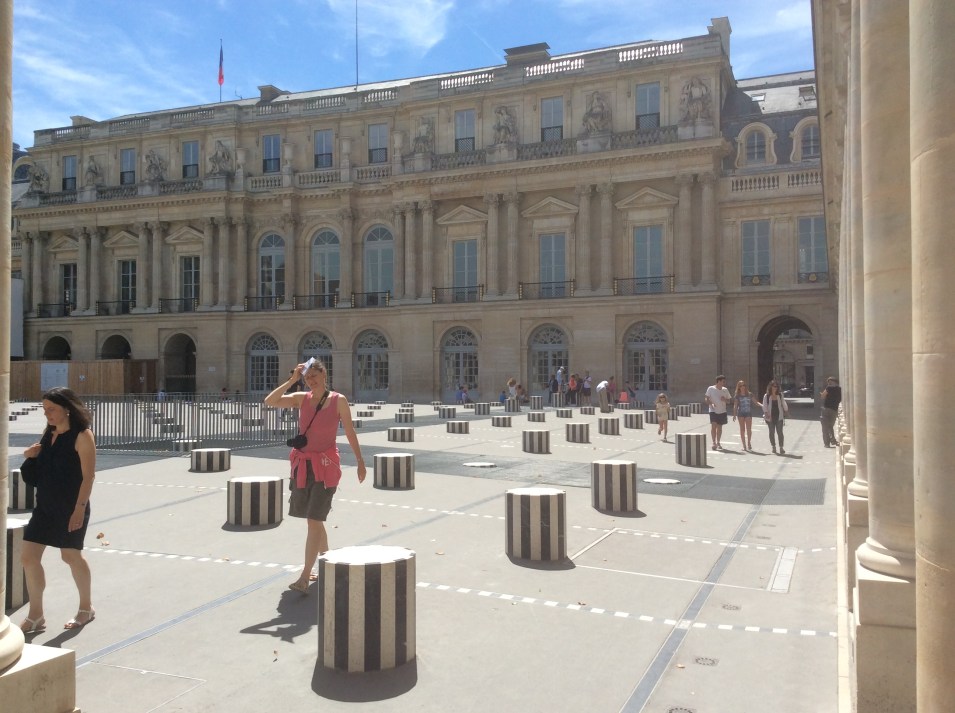
The Colonnade Behind the Palais Royal, Paris, France

The next site I visit is the Palais Royal, just down the way towards the river. Thomas Jefferson visited the Palais Royal on August 6th, 1786 and other occasions (it’s especially easy to track the movements of Jefferson, being a prolific letter writer and meticulous record keeper). The Palais was a public shopping, entertainment, arts, and business center, originally the home of Cardinal Richelieu for whom the street that runs parallel to it is named, then expanded and updated by the Dukes d’Orleans. It was known for attracting revolutionaries, dissidents, writers, Freemasons, and prostitutes. I approach it from the back garden area, enclosed and crisscrossed by collonades in a classical style, a later addition that Jefferson would certainly have approved of. It’s a lovely shady spot to rest in on this hot day.

The Courtyard Behind the Palais Royal

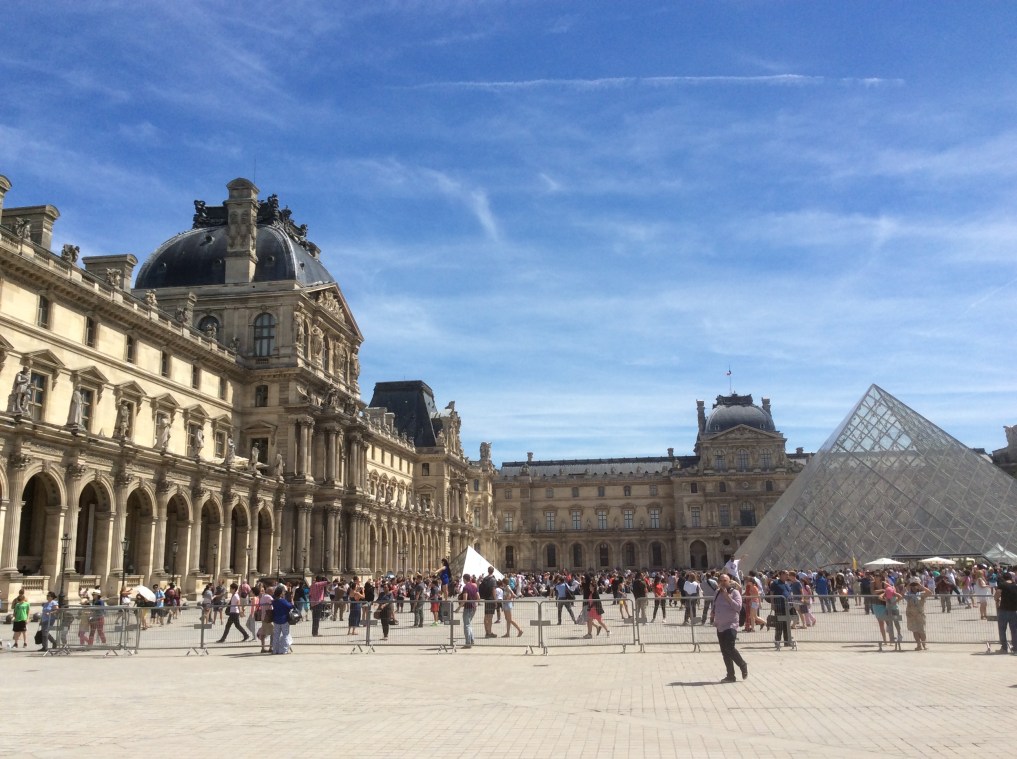
I continue on towards the Seine and pass through the front courtyard of the Louvre, where the main entrance and the famous glass pyramid is. Thomas Paine visited the Louvre several times some years before the dangerous period of the French Revolution.

A view of the Louvre with the glass pyramid, Paris, France

After the American Revolutionary War ended, he found himself without an active cause to support, and turned to science, one of his other main interests. He was elected into the American Philosophical Society in 1785, founded by his great friend and mentor Benjamin Franklin (I write about my visit to the APS headquarters in an earlier piece), which was an illustrious company of scientists, inventors, and other innovators in various fields. Paine had been inspired, during his previous visit to Paris in 1780 to help negotiate a loan for the American revolutionary cause, by a design proposal for a new type of pier-less iron bridge; the usual materials used at the time were wood and stone. He thought he could improve the design, and spent about a year working it out and creating a detailed model with a craftsman named John Hall. When it was finished, he was disappointed to find that no one was willing to fund the building of such a bridge in Philadelphia or anywhere else in America; it was just too expensive and risky an undertaking when just about everyone with means found their resources strained by war debt.

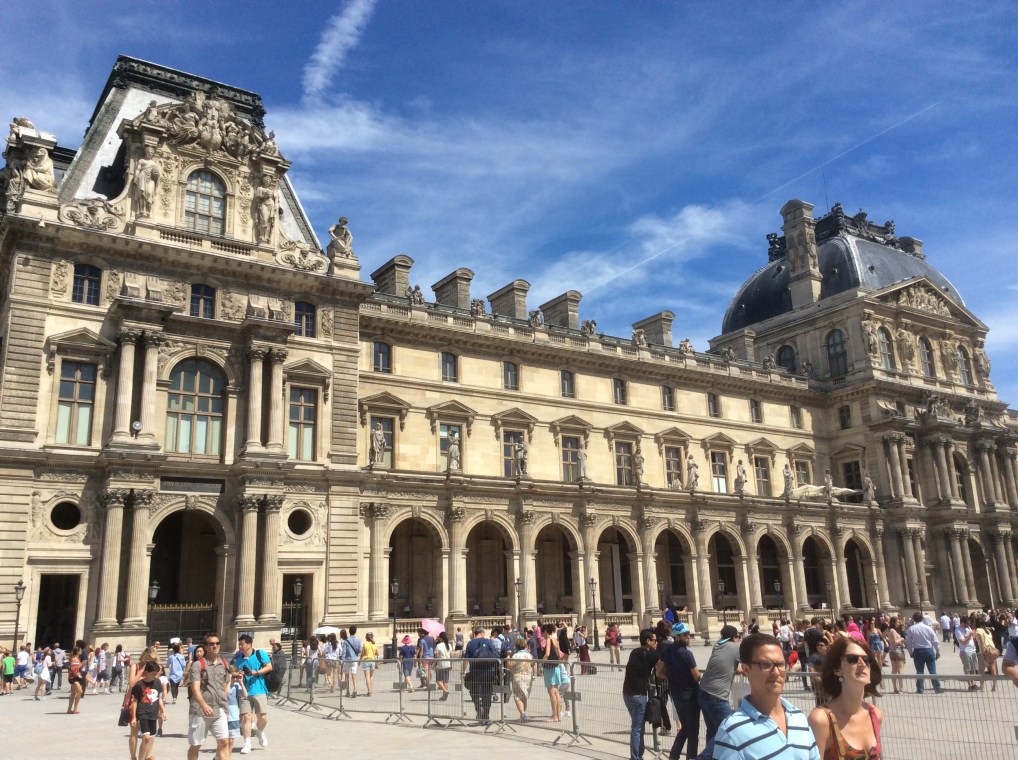
A view of the Musée du Louvre

So Thomas Paine went to Paris again in 1787 for a time to present his plans for the iron bridge to the Academie des Sciences of France, which met here in the Louvre until the 1790’s. Perhaps the French, who had so lavishly supported the American cause, would like to be the first have such a marvelously inventive new type of bridge over the Seine, surely they could use one more in such a busy riverside metropolis.

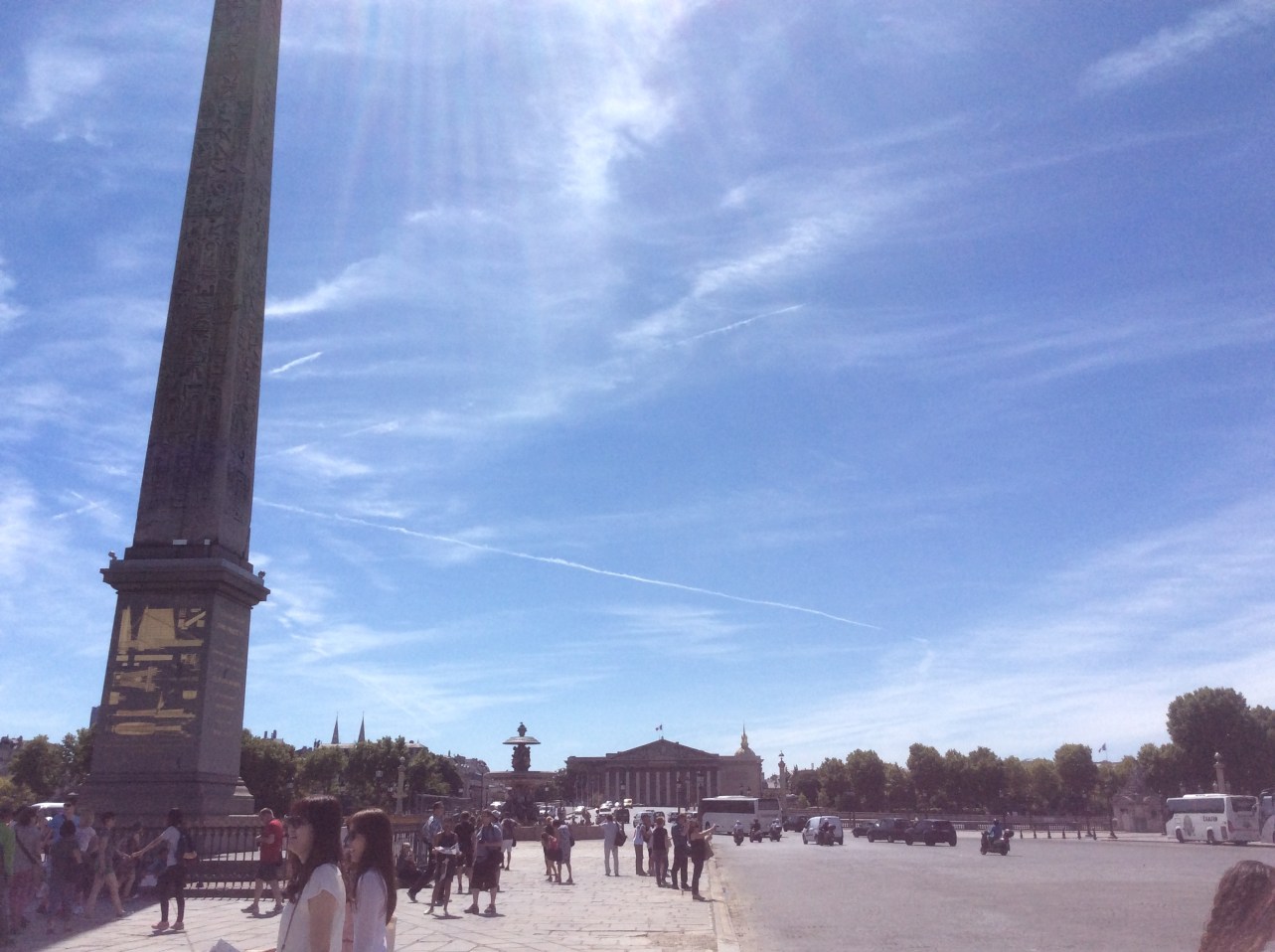
The Obelisk at Place de la Concord, Paris, France

I walk along the Tulieries gardens in front of the Louvre (more on this place in a later piece, since it has significance for my visit, but there’s something I’d like to confirm first), headed for the Place de la Concorde. In June of 1793, Mary Wollstonecraft moved to Neilly-sur-Seine, west of the city and north of the Bois de Boulonge. She had fallen deeply in love with an adventurer, and as it turned out, womanizer, named Gilbert Imlay. For a person who described herself as so wedded to reason, she was prone to allow her emotions to overwhelm her when it came to love, and no one would do but exciting yet unsuitable men who broke her heart every time. Imlay was one of these, and she went to Neilly-sur-Seine both to escape the deadly excesses that the French Revolution was falling into, and to pursue her love affair in private. Imlay remained in Paris, but they would pass back and forth to visit one another.

She would enter Paris through a gate at the Place de Louis Quinze, now called the Place de la Concorde. She described, on one occasion, slipping in the blood of executed victims of the Terror as she passed through the gate, as a well-used guillotine was set up here. Like Paine, the Revolution broke her heart: it was so full of promise, yet here its leaders were, becoming the oppressors they had professed to hate.

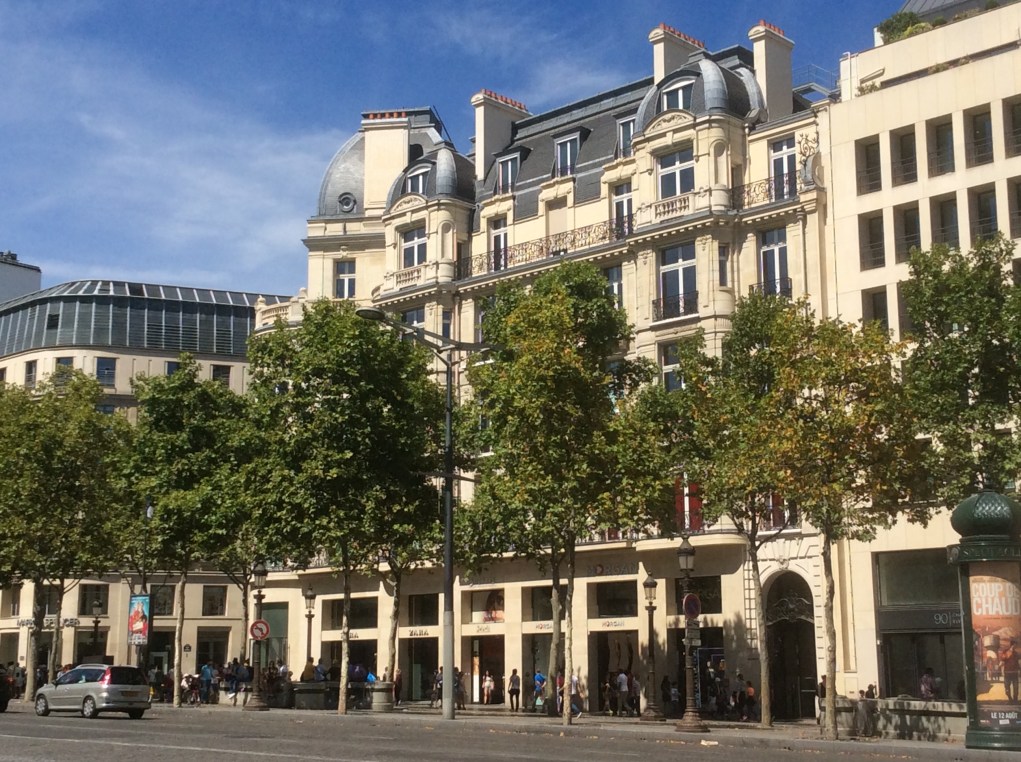
Side view of the building where Hôtel de Langeac once stood, on the Avenue Des Champs-Elysees, Paris, France

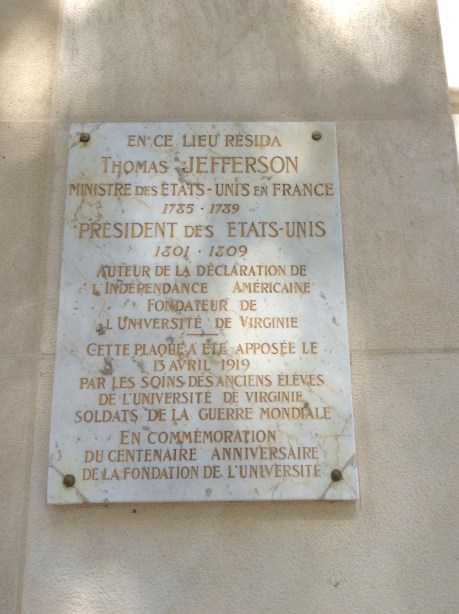
Next, I head east along the Champs-Élysées, where Thomas Jefferson finally settled down in the autumn of 1785. He lived here at the Hôtel de Langeac until he returned to America in September 1789. It’s right on the corner of Champs-Élysées and Rue de Berri, in the new quarter named Faubourg du Roule that Louis XV had built. He had moved from place to place in his first year here in Paris, renting rooms, staying with friends, and remodeling the Hotel Taitbout to suit his tastes. He changed his mind about living there, however, since it was so expensive, and he had already spent a quarter of his yearly budget on the place. Jefferson habitually lived far beyond his means, and American Congress, having little power to tax, did not regularly pay expenses of its ministers.

An entrance to the building where Hôtel de Langeac once stood. Thomas Jefferson lived here, on the Avenue Des Champs-Elysees

Plaque on the wall where Hôtel de Langeac, former residence of Thomas Jefferson, once stood

So, Jefferson sold up and moved to the Hôtel de Langeac. It turned out to be a perfect compromise between his love of culture and its refinements, and his moral preference for rural living. At that time, it was on the outer edges of Paris, halfway between the bustle of the city and the peace of the Bois (woods) de Boulogne, which he visited nearly every day. Horseback riding was among his favorite forms of exercise, and he could let the horse really go in this natural setting. Now, however, the full bustle of Paris has enveloped Hôtel de Langeac’s street corner and beyond. As I was absorbed in finding a good angle to photograph the building, I was startled to realize that some of the honking and shouting I was hearing in the background was aimed at me: turns out I was standing right in the driveway of a subterranean parking garage, which lets out right in the middle of a wide sidewalk. Oops.

At this point, I’m regretting the pace at which I toured the city today. My knees ache terribly, especially the right one, and I’m disappointed in myself. I’m an avid hiker and consider myself an able and enthusiastic walker, but today’s tour did me in. Then I remember: I had just been sitting for hours sleeping with my legs all twisted up in the cramped space in front of my airplane seat, so my knees had likely been strained. Next time, I’ll pace myself appropriately. In the meantime, I buy a tall can of Hoegaarden (a favorite ‘easy beer’) and some snacks, and sit by the Seine writing notes under a shade tree; it’s a lovely way to rest. I recover a bit, then stroll some more through the Latin Quarter. It’s touristy to the nth degree. I wish I could have seen it decades ago when it was still bohemian and more interesting, but I do appreciate seeing so many people out on holiday having a good time.

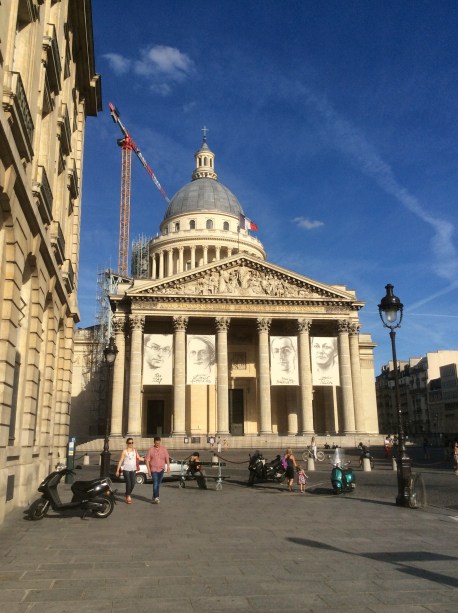
Street view of the Pantheon of Paris

I pass by at the Pantheon, which so inspired Thomas Jefferson, in the early evening, after I had resumed my stroll but paused my historical explorations, simply wandering wherever street, garden, or structure beckoned. At this hour, it’s closed to the public.

I consider where to go next: I’ll be meeting up with my husband at Gare du Nord tomorrow morning, so I need to get out the house in good time. He’s flying in with his fellow randonneurs and his bike and cycling gear to ride Paris-Brest-Paris, a 1200-kilometer cycling event that’s been put on every four years for over a century. Before the big ride, we’re taking a detour to Berlin to visit family for a few days, then I’ll see him off on his ride and return to Paris. I’ll be returning to the Pantheon then for a real visit, and to continue my adventures following Thomas Paine, Mary Wollstonecraft, and Thomas Jefferson.

Stay tuned!…  >>> Third Day 

~~~~~~~~~~~~~~~~~~~~~~~~~~~

Sources and inspiration:

Adams, William Howard. The Paris Years of Thomas Jefferson. New Haven/London: Yale University Press, 1997.

Bell, David. ‘5 Myths About the French Revolution‘, New York Post, Jul 9th, 2015.

French Revolution.’ Wikipedia, The Free Encyclopedia., Jul. 17 2015.

Gordon, Lyndall. Vindication:  A Life of Mary WollstonecraftNew York: Harper Collins, 2006.

Jacobs, Diane. Her Own Woman: The Life of Mary Wollstonecraft. New York: Simon & Schuster, 2001.

Jacoby, Susan. Freethinkers: A History of American Secularism. New York: Owl Books, 2004.

Nelson, Craig. Thomas Paine: Enlightenment, Revolution, and the Birth of Modern Nations. New York: Viking Penguin, 2006.

Palais-Royal‘, Wikipedia, The Free Encyclopedia.

Todd, Janet. Mary Wollstonecraft: A Revolutionary Life. New York: Columbia University Press, 2000

Tomalin, Claire. The Life and Death of Mary Wollstonecraft. London: Weidenfield & Nicholson, 1974.

Williamson, Audrey. Thomas Paine: His Life, Work, and Times. New York: St. Martin’s Press, 1973.

Second Day in Paris Following Thomas Paine, Mary Wollstonecraft, and Thomas Jefferson, Part 1

22 rue Meslay, Paris. Mary Wollstonecraft may have lived here at Aline Filliettaz’s house from December 1792 through June 1793. See update to the search for the Filliataz house

Monday, August 10th, 2015

I get up at a decent hour, though of course not too early: I discovered early on when I began to travel in earnest that proper rest is essential for clear thinking, map-reading capabilities, and the good humor necessary for enjoying the day.

Since there’s such a huge number of sites to visit on my itinerary, I’ve decided to visit them in an order determined not by subject nor in any kind of chronological order, but by proximity to one another, so I can better cover them all.

I make my way from my temporary digs on Boulevard Voltaire up toward Republique, then make a soft left and head for 22 rue Meslée (now called the rue Meslay). Mary Wollstonecraft lived here at her friend Aline Filliettaz’s house from December 1792 through June of 1793, shortly after arriving in Paris. Wollstonecraft was full of hope for the Revolution and longed to be a part of it, and thought that the humanitarian and egalitarian Enlightenment principles she espoused were more likely to take hold there before they would in her home country of England, as they had (to an extent) in America. By the time she arrived in Paris, she was a self-made woman, a governess and schoolmarm who had become the bestselling author of two progressive and highly influential books, A Vindication of the Rights of Men, 1790 (a scathing rebuttal to Edmund Burke’s Reflections on the Revolution in France) and A Vindication of the Rights of Woman, 1792.

In fact, her Rights of Men was published the year before Paine’s Rights of Man, which was also a response to Burke, but Paine’s became the most famous by far. However, Wollstonecraft held her own with Rights of Woman, as it’s now widely considered the founding work of modern feminism. Wollstonecraft was lonely and blue when she first lived at this house, since her hosts were away and the servants behaved haughtily and uncooperatively towards her, but she soon cheered up when she began to get out more and hang out with her expatriate friends and their Parisian social circle. (More on that soon.)

Building where 22 rue Meslay is now located in Paris, France

The Fillattaz house is on a little side street in the Marais district, near the medieval Temple where the royal family was held during the French Revolution, before the King was guillotined in December of 1793 and Marie Antoinette was sent to the Concierge. Wollstonecraft wrote in her account of this period in her life that she saw the King being taken from the Temple prison to his trial at the Hôtel de Ville, where the Convention Nationale was held, from her window at this house. See update to the search for the Filliataz house

By the way, it’s important to make this point at the beginning: as is the case with all private residences and some other sites I visit during this tour, unless I can find a clear indicator of the history of the building (in accounts I have access to, on plaques, on cornerstones, etc), it’s very possible that I may not have found the exact location, especially if it’s not a public building with a clearly documented history. Many of my sources list an address without specifying whether it’s the modern address or the historical one and numbers change over time, and some streets are re-routed or disappear entirely, as do many of the original buildings, and records are not always consistently kept or may have been lost in the intervening years. Since my subjects were all here well over two centuries ago, it’s likely that at least a few of these locations are approximate, rather than the exact sites, despite my best efforts to discover them. This is especially true of Mary Wollstonecraft since she’s the only one of my subjects who never held public office or had any government appointments.

Courtyard behind 22 rue Meslay

63 rue Faubourg St-Denis, Paris, France. It’s the right address but not actually the site of Paine’s once-time residence, since the address had changed since his time. You can the story of how I find the true site here.

For example, poking around for historical details of the rue Meslay, I found that George Sands was born on that same street, and the address was 15 in her time, 46 now. I didn’t find any info as to whether Wollstonecraft’s 22 address is the new one, old one, or just that same address in different sources, but since she described seeing the King’s carriage pass by her window on the way to trial, it may be that the Filliettaz house was further up the street, in a taller building or at a higher elevation, so that she could see as far over as Boulevard Saint-Martin, the next street over and the route he would taken. But another source describes the house as having six stories, and the house now at 22 matches this description.

If I have time, I might swing back over there for further explorations since the place I’m staying now and the place I’ll be staying when I return to Paris (I’ll be joining my husband Bryan tomorrow for a quick family visit to Berlin, then to Saint Quentin en Yvellines where he’ll commence the Paris-Brest-Paris cycling event) are not too far away.

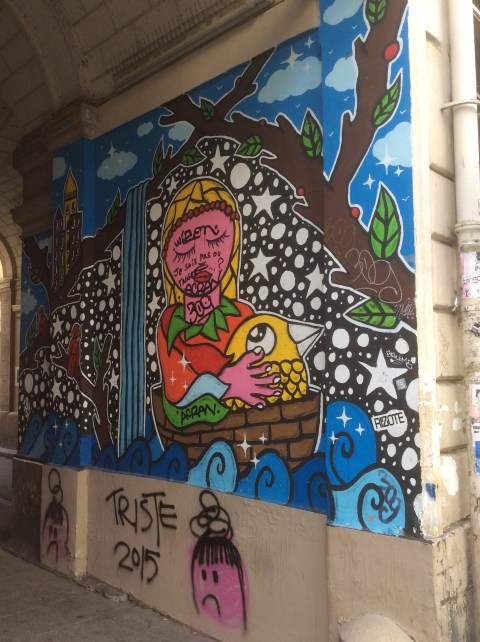
A mural on a wall on rue Faubourg St-Denis

Next, I head for 63 rue Faubourg St-Denis, at rue des Petits Ecuries, where Thomas Paine moved in 1793 to share the ground floor of a ‘mansion farmhouse’ with six friends. Paine wrote in glowing terms of the lifestyle there, and they had farm animals and grew fruits and vegetables, as that area was still pretty rural, and they would romp in the garden to take their minds off the tumult and violence in Paris. He was living here when he, with a committee of nine others, drafted a new constitution for France, though this one was unsuccessful: the Girondin faction which Paine worked with were moderates, while the radical Jacobins were gaining power and, over time, took over the Revolution entirely, instituting the Reign of Terror. (See update on the search for the rue Faubourg Saint-Denis house).

It’s unlikely that any part of the building that stands here now is original, either in whole or in part, given Paine’s description of it, and the current address may not the same as the historical one [this turns out to be the case]. The only fruits and vegetables to be obtained here now are from the colorful produce shops that line this now urban, rough-around-the-edges but vibrant and colorful part of the city. I think this neighborhood is wonderful, and it reminds me in many ways of the Mission district of San Francisco before it became mostly taken over by hipsters and tech people.

A view of rue Faubourg St-Denis

At 101 rue de Richelieu, Paris, France.

Next, I head down to rue de Richelieu in search of the place where Thomas Paine moved in with James Monroe’s family in November 1794. Monroe had finally secured Paine’s release from his eight-month imprisonment at the Luxembourg (I’ll return to this subject after I’ve visited that palace-turned-prison-turned-Senate house). Paine lived with the Monroes for about 2 years, not all of them here, since they moved more than once. At the time of his release, they lived at 101 rue de Richelieu, which begins at Bd. Montmarte where it meets Bd. Poissonere, in the 2nd Arrondissement.

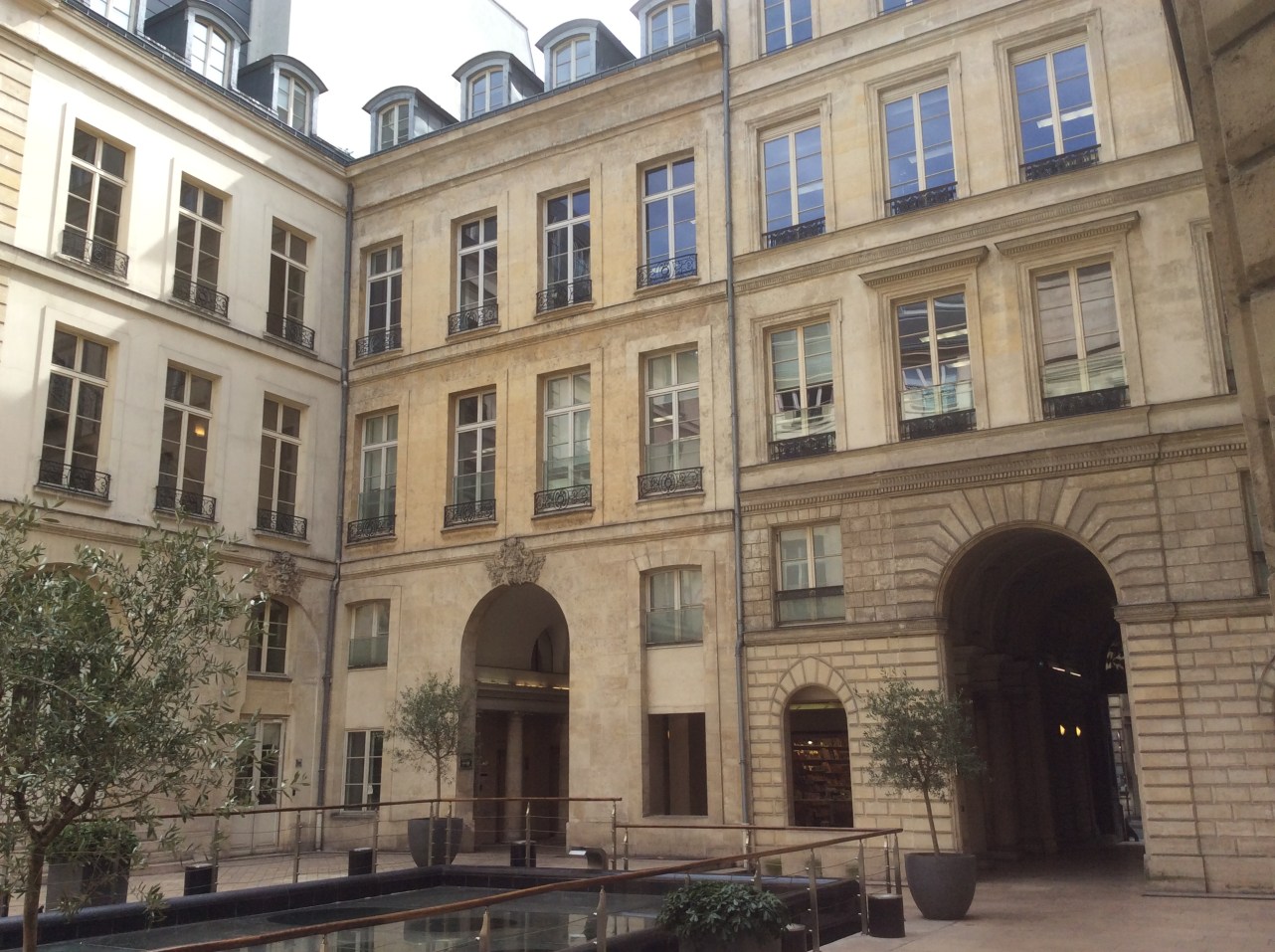
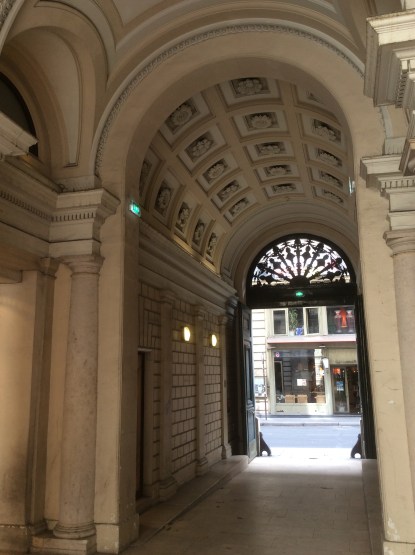
At 101, I find a classy place, fit for an honored foreign dignitary, with a lovely courtyard with a lovely arched entryway, updated with a modern reflecting pool. Again, I’ll return to this street soon for further explorations, which will be easier next time since I’m now getting very familiar with this corner of Paris, and as I find more source material with which to confirm whether the numbers have changed. (See update to the search for the Monroe house on rue de Richelieu.)

Courtyard at 101 rue de Richelieu

An entryway to 101 rue de Richelieu

When Paine was released from prison, he was broken down in health and spirits: he had nearly died from typhus, and he had an open ulcer on his side that wouldn’t heal. He had also felt that his American friends in high places had deserted him, not doing what they could to rescue him from his predicament. He was especially upset with Gouverneur Morris, the ambassador (then ‘Minister Plenipotentiary’) to France at the time, and with president George Washington. Morris was the primary author of the preamble to the United States Constitution as well as many of its other sections and he was an able statesman, but the French government lacked confidence in him; he was recalled after they repeatedly requested he be replaced by another. From their writings, it appears that Paine and Morris alternately liked, respected, and loathed one another. Morris often writes very sarcastically about Paine, and though I’m quite the Paine fan-girl, I find some of his remarks very funny and witty, though others are just plain bitchy and catty.

While Paine did offer valuable assistance to Monroe (Morris’ replacement) in his role as the new American ambassador, Paine was at this time also, as an aftereffect of his imprisonment and disillusionment with the French Revolution, given to depression, anger, and paranoia, and as a result of all of these, binge drinking. He was to acquire a reputation as an alcoholic, but since these accusations came almost entirely from his political enemies during and after his lifetime, this characterization is suspect. His friends and colleagues describe him as a social drinker, wont to make merry in the evenings and engage in enthusiastic discussions about politics, science, and philosophical topics as long as anyone was willing.

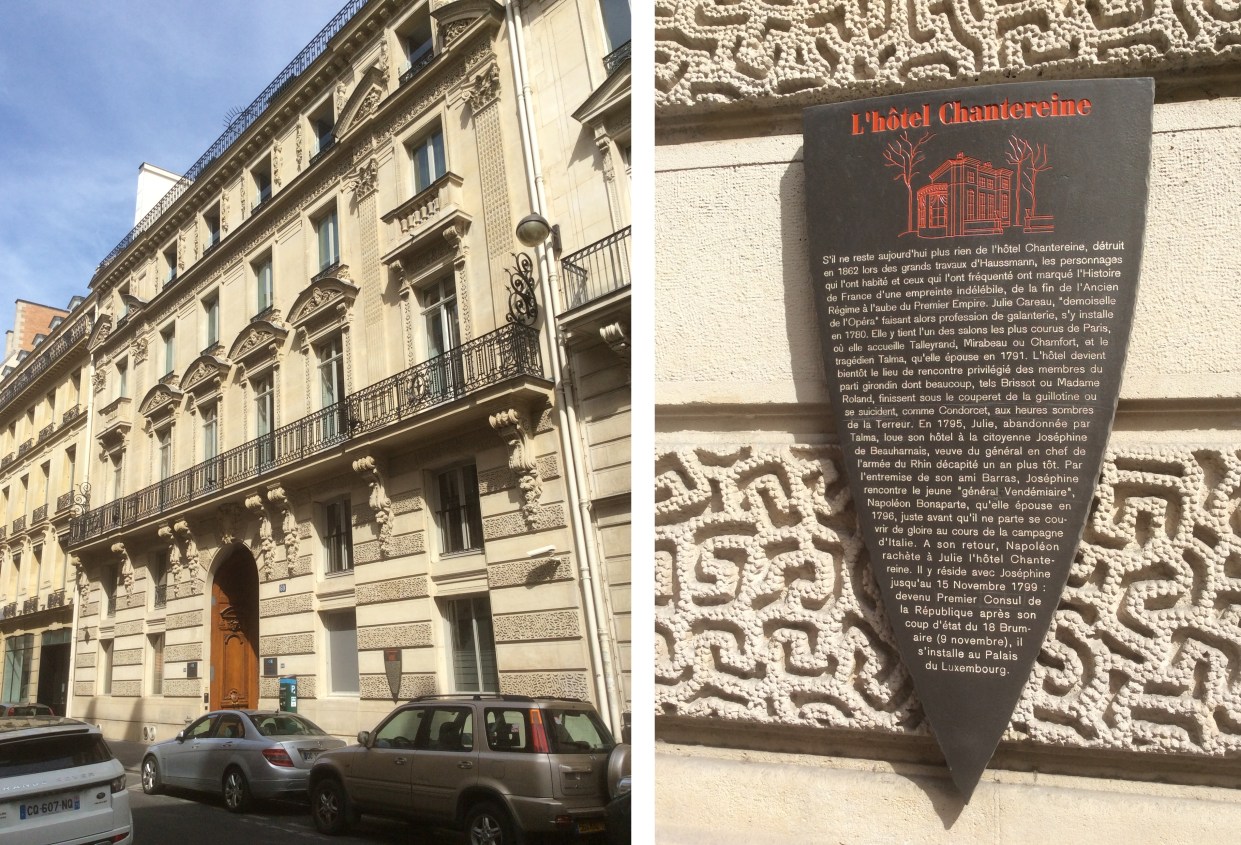
I next head north to rue Taitbout and turn left on rue de la Victoire, and go to the grand house at 60 rue de la Victoire, which was 6 rue Chantereine in Paine’s time, in the 9th Arrondissement.

60 rue de la Victoire, once 6 Rue Chantereine, former Home of Napoleon and Josephine Bonaparte

It was likely in this house that Paine attended a party thrown by Julie and Francois-Joseph Talma in October 1792. The house was owned by Mrs. Talma, formerly Louise-Julie Carreau, and she held a famous salon here. Her husband was a well-known actor and passionate Revolutionary, friends with Jacques-Louis David (who, I was surprised to discover was among those who voted in favor of executing the King) and Napoleon Bonaparte, who moved into this house in 1796 with his new wife Josephine). Like Paine and Wollstonecraft, the Talmas were Girondinist in their sympathies, yet there was a ruckus between Paine and other attendees of the party, many of whom had begun to turn on this once-beloved muse and author of two revolutions.

Two Details of 60 rue de la Victoire, former Home of Napoleon and Josephine Bonaparte

The history of the French Revolution is, among other things, a prime example of how people, even as they see themselves pursuing the same lofty goals and are members of the same political party, just can’t seem to avoid petty infighting. This sort of thing undermines so many important projects, and as we see all too often, petty disagreements can devolve to self-righteousness and even blind radicalism over time. French culture, in that era especially, placed a high value on ‘sensibility’, valuing the free expressions of both raw and cultivated emotions. As we have also seen in the French Revolution, unbridled passion was very often allowed to trump reason. To Paine’s dismay, he watched the beloved Enlightenment campaign for rational democratic government, that he served so enthusiastically and so well, turn into a bloody campaign of vengeance and terror.

View of Église Notre-Dame de Lorette from Rue Lafitte, Paris, France

Side view of Opera Comique, Formerly Theatre Des Italiens

It was very near this place that Thomas Jefferson moved for awhile, eight years earlier in October 1784, on the cul-de-sac (impasse) Taitbout off rue La Fayette near rue St Georges. He signed a long-term lease at Hotel Landron, also called Hotel Taitbout, but only ended up living here for about one year. I explore this area very thoroughly, peeking into every courtyard, driveway, and byway I can find, but a hotel by this name is nowhere to be found so far as I can see. (By the way, ‘hotel’ wasn’t used in the same sense as we use it today: It could refer to a grand house or a large public building.) This area is very near where I’ll be staying next week, so I’ll return if I find more leads, and I’m looking ever more forward to doing so, it’s such a beautiful neighborhood.

Jefferson was an avid patron of the arts, and attended the theatre often while living in Paris to see plays and musical performances. He often went to the Theatre des Italiens, very near his Taitbout place on Boulevard des Italiens. There is no theatre today with that name, but I find Opera Comique in just about the right place. Could this be the same building? The building appears to be of the right vintage. I look into it, and sure enough, it is! It’s in the process of getting a facelift and a good cleaning, but the side entrance is in good repair and attractive with its lovely cast iron lacy canopy.

Opera Comique, formerly Theatre Des Italiens, Paris, France, under repair

I still have many sites I’ll be visiting throughout the course of the day, so I’ll take a break here.

To be continued in Part 2:  >>>

~~~~~~~~~~~~~~~~~~~~~~~~~~~

Sources and inspiration:

Adams, William Howard. The Paris Years of Thomas Jefferson. New Haven/London: Yale University Press, 1997.

Bell, David. ‘5 Myths About the French Revolution‘, New York Post, Jul 9th, 2015.

Gordon, Lyndall. Vindication:  A Life of Mary Wollstonecraft. New York: Harper Collins, 2006.http://www.harpercollins.com/9780060957742/vindication

Grossman, Ira. ‘The House on the Rue de la Victoire
Jacobs, Diane. Her Own Woman: The Life of Mary Wollstonecraft. New York: Simon & Schuster, 2001.

Jacoby, Susan. Freethinkers: A History of American Secularism. New York: Owl Books, 2004.

Nelson, Craig. Thomas Paine: Enlightenment, Revolution, and the Birth of Modern Nations. New York: Viking Penguin, 2006.

Todd, Janet. Mary Wollstonecraft: A Revolutionary Life. New York: Columbia University Press, 2000

Tomalin, Claire. The Life and Death of Mary Wollstonecraft. London: Weidenfield & Nicholson, 1974.’

French Revolution.’ Wikipedia, The Free Encyclopedia., Jul. 17 2015.

Williamson, Audrey. Thomas Paine: His Life, Work, and Times. New York: St. Martin’s Press, 1973.

First Day in Paris Following Thomas Paine, Mary Wollstonecraft, and Thomas Jefferson

My first rented room in Paris, France, following Paine, Wollstonecraft, and Jefferson

Sunday, August 9th, 2015

I arrive at Charles De Gaulle airport on Sunday afternoon, fairly well rested for once. Usually, I don’t sleep well on planes, and stumble off the walkway groggy and stupified. This time I slept about two thirds of the way through the 10 1/2 hour flight …not well, mind you, but much better than nothing. I attribute it to the ibuprofen tablets I took shortly before boarding, making the cramped quarters less painful to sleep in: my travel tip of the day! It was great to arrive and feel competent to navigate the trains, find my destination, and go out and start enjoying myself without delay.

At about 6pm, I meet my host Aurelia at 46 Rue Voltaire, a couple blocks down from Oberkampf station, in the 11th Arrondissement. She is sweet and helpful, and a practiced Airbnb-er: she has a series of photos on her iPhone at the ready so she can show me how to navigate the passageways, six flights of stairs, and unmarked doors to reach my mini apartment. The place is tiny, with the loft bed over the desk, the toilet tucked into a cubbyhole beside the shower, and the whole place the size of a small bedroom. On the whole, it suits me just fine, since it’s clean, private, and in a great neighborhood at a cheap price, but being somewhat tall and not used to these close quarters, I whack my head often.

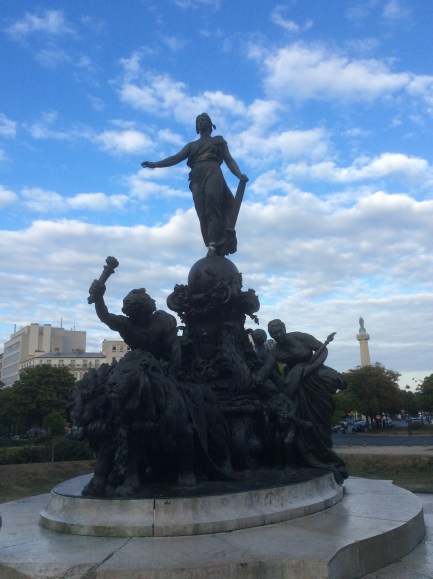
Triomphe de la République, the sculpture at the Place de la Nation

I decide not to dive right in my historical adventures, but to take an aimless walk around instead, to get my bearings, wake up a little more, and re-immerse myself in this city which I last visited seven years ago on honeymoon. Right away, I find myself feeling a little wistful, feels odd to be here without Bryan. He’ll be joining me in a couple of days, so I console myself and head out.

I walk down Boulevard Voltaire in search of something better to eat than airplane food, which takes me awhile: most places are closed (usual in late July to mid-August, as my host informs me), until I get closer to Place de la Nation, which is is getting busier as the night crowd are starting to emerge. I find a boulangerie, where I pick up a butter croissant and another sweet one for tomorrow’s breakfast. I admire the sculpture, then turn up Boulevard Diderot, sit down for an Edelweiss (lightly tart beer), a couple of smokes (an old habit I like to indulge myself in on special occasions) and a little people-watching. It’s a lovely warm evening.

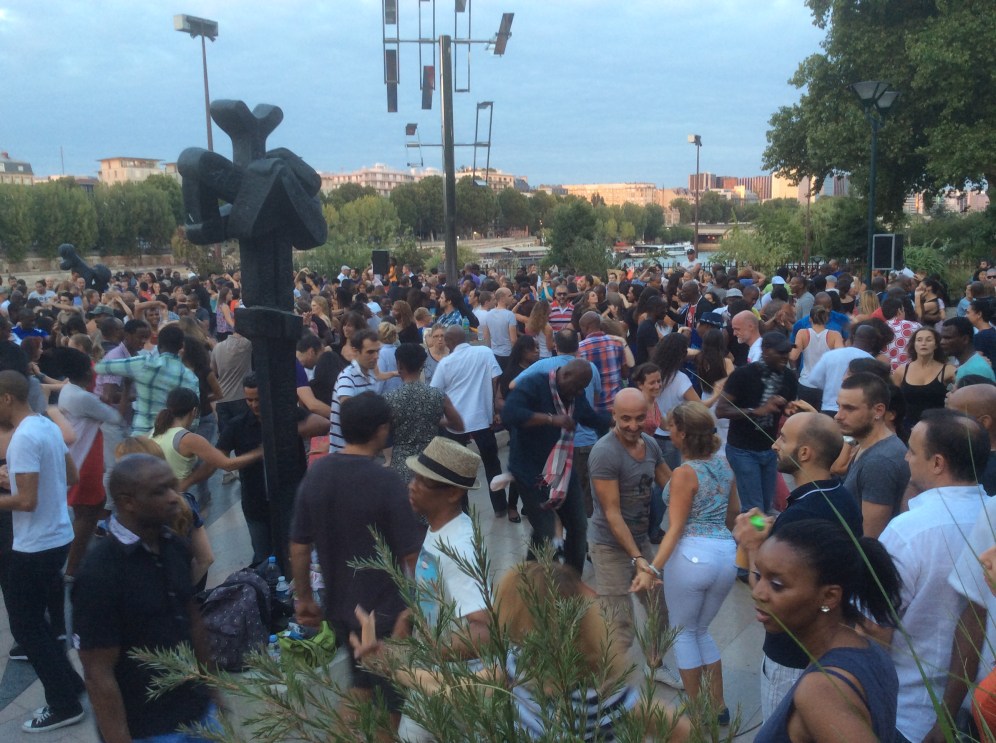
Latin dancers at the Quai St-Bernard along the Seine, Paris, France

I continue on towards the Seine, cross the Pont d’Austerlitz, and walk east along the river. In the park and sculpture garden on Quai St-Bernard, I happen upon masses of people dancing on three dance floors: the first was dedicated to the foxtrot, the other two to Latin dancing. One was huge, must have been well over a hundred people dancing until the sweat was dripping, ringed by crowds of spectators. I dare not join in the dancing: I can’t seem to learn steps to save my life, last time I took a dance class I caught the teacher apologizing to my assigned dance partner, probably for the bruises I pounded into his feet with my own.

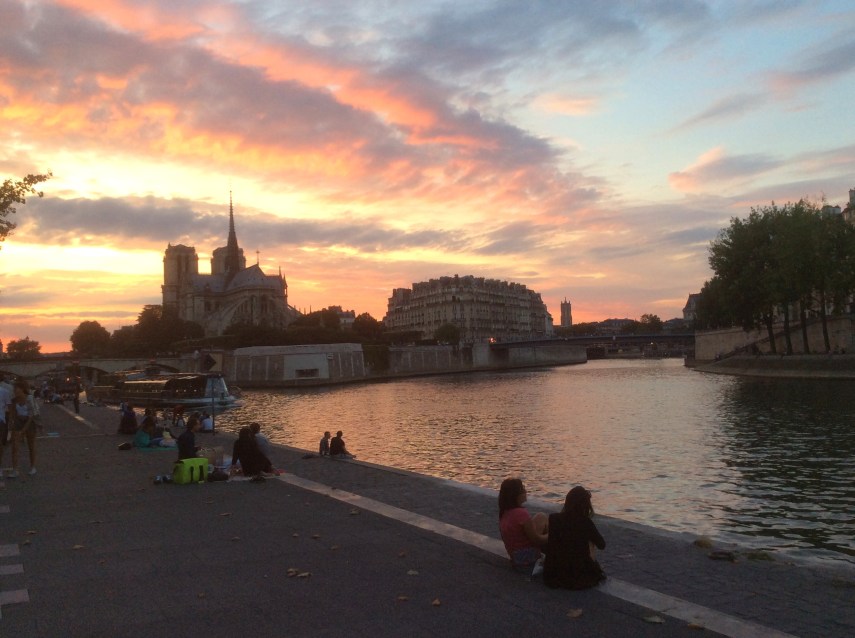
The sunset is pink, orange, and gold against the blue sky and above the silver Seine as I pass by Notre Dame.

Gazing at the Île de la Cité from the Left Bank of Paris, France

On the bridge to the Île de la Cité, there was another crowd clapping and cheering for three performers, two on roller skates and one on rollerblades. In turn, they speed-skate up a ramp and over a crossbar set very high in the air, perhaps 15 feet or so.

As I’m reminded constantly on my evening stroll, Paris, like our Washington D.C., has not forgotten its nation’s Revolution. Its heroes and events are memorialized in the names of street after boulevard after avenue, in monument after statue after city square: Rue La Fayette, Place de la Bastille, Place de la Republique. So are its philosophes: along with Voltaire and Diderot, there’s Jean Jacque Rousseau, Montesquieu… even our own Thomas Jefferson is an honorary member of this elite company: his larger-than-life bronze sculpture adorns the Left Bank of the Seine.

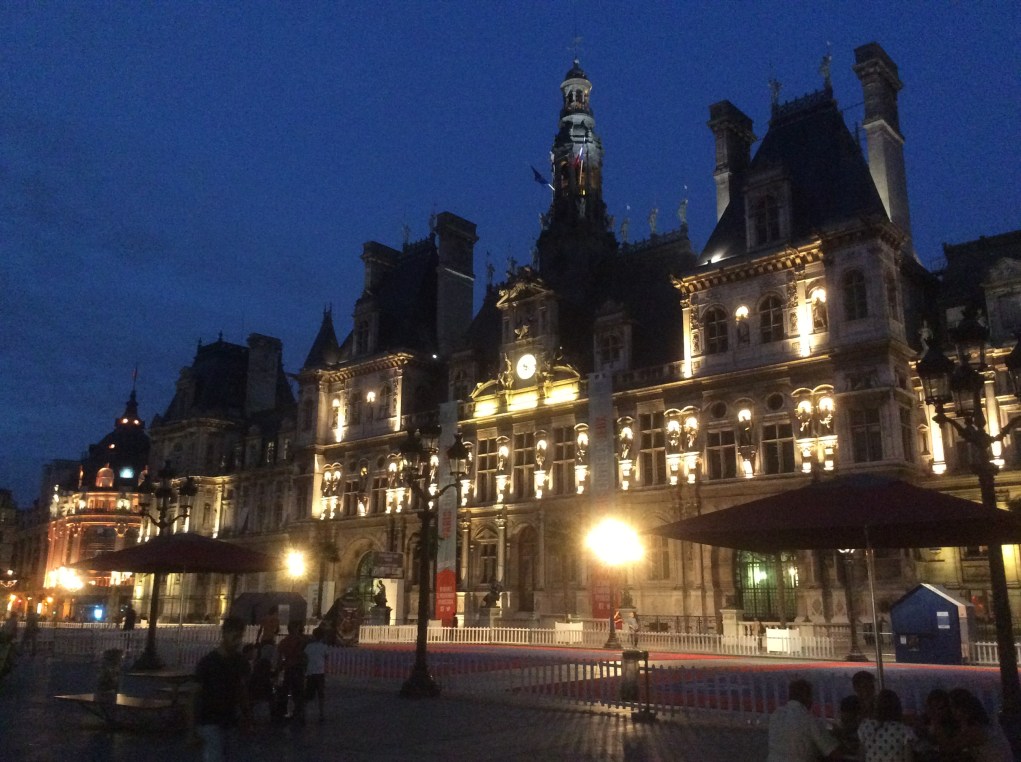
Hôtel de Ville, Paris, France, on the right bank of the Seine

Other than some of the street names and monuments, my evening stroll took me by only one site
associated with a subject of my trip: the Hôtel de Ville, which has several connections with the life of Thomas Paine. It’s a very grand building, and looks both lovely and impressive all lit up at night, but it’s not the original building of Paine’s time. That one was burned down in another French revolution in 1871, in the same round of anti-monarchical arsonists that claimed the Tuileries palace and nearly claimed the Louvre.

I walk around the building to see if one of the statues in its many niches was Paine, but I can’t find one. It’s pretty dark out, though; the statues I see whose caption I can see in the half-light are all Frenchmen. However, Paine was a celebrity in France following his publication of Common Sense, which offered a comprehensive philosophical defense for the rightness of the cause for American Revolution, and again when he wrote The Rights of Man. His arguments resonated with many of the French people, who felt themselves chafing under a rigid hierarchical structure and high taxation maintained and imposed by an unchallengeable monarchy, aristocracy, and clergy. So it was at the Hotel de Ville on August 26, 1790 that the Paris Commune voted to make Paine an honorary citizen. When he returned to Paris in September of 1792, he was elected to the French National Convention; no matter that he couldn’t really speak French, one who so eloquently speaks for human freedom and dignity speak to all. So though he might be properly honored by a sculptural portrait here, so far as I can find out, he has none among the niches.

More to come soon: my next day in Paris is entirely dedicated to following in the footsteps of Thomas Paine, Mary Wollstonecraft, and Thomas Jefferson. Stay tuned!  > Second Day, Part 1
~~~~~~~~~~~~~~~~~~~~~~~~~~~

Sources and inspiration:

Adams, William Howard. The Paris Years of Thomas Jefferson. New Haven/London: Yale University Press, 1997.

Bell, David. ‘5 Myths About the French Revolution‘, New York Post, Jul 9th, 2015.

French Revolution.’ Wikipedia, The Free Encyclopedia.

Gordon, Lyndall. Vindication:  A Life of Mary WollstonecraftNew York: Harper Collins, 2006.

Jacobs, Diane. Her Own Woman: The Life of Mary Wollstonecraft. New York: Simon & Schuster, 2001.

Jacoby, Susan. Freethinkers: A History of American Secularism. New York: Owl Books, 2004.

Nelson, Craig. Thomas Paine: Enlightenment, Revolution, and the Birth of Modern Nations. New York: Viking Penguin, 2006.

Todd, Janet. Mary Wollstonecraft: A Revolutionary Life. New York: Columbia University Press, 2000

Tomalin, Claire. The Life and Death of Mary Wollstonecraft. London: Weidenfield & Nicholson, 1974.

Williamson, Audrey. Thomas Paine: His Life, Work, and Times. New York: St. Martin’s Press, 1973.

To Paris, France I Go, In Search of Revolution-Era Thomas Paine, Mary Wollstonecraft, and Thomas Jefferson

Hello, friends of Ordinary Philosophy!

From time to time, I take a trip to some corner of the globe, to explore the lives and ideas of great thinkers in the places where they lived and worked. For this series, I follow in the footsteps of thinkers who are no longer alive, since those who are still telling their own stories. But those who are no longer alive in the body live on in the ideas that they pass on, and in the example they provide for us to follow.

I’m pleased and excited to announce my fourth philosophical-historical themed adventure, this time in Paris, France to follow in the footsteps of Thomas Paine, Mary Wollstonecraft, and Thomas Jefferson at the time of the French Revolution.

The French Revolution, following on the heels of the American Revolution, inspired and horrified many. The financial crisis, caused by over-expenditures in recent wars (including assistance to the Americans) and food shortages, caused by a series of crop failures, led to an uprising mostly of professionals and merchants, joined later by members of the laboring classes. The movement for reform called for disestablishment of the monarchy, who entangled the nation in wars and continued to spend lavishly in times of want, and for ending the special privileges of the aristocracy and clergy, whose tax exemptions often placed the heaviest financial burden on those who could least afford it.

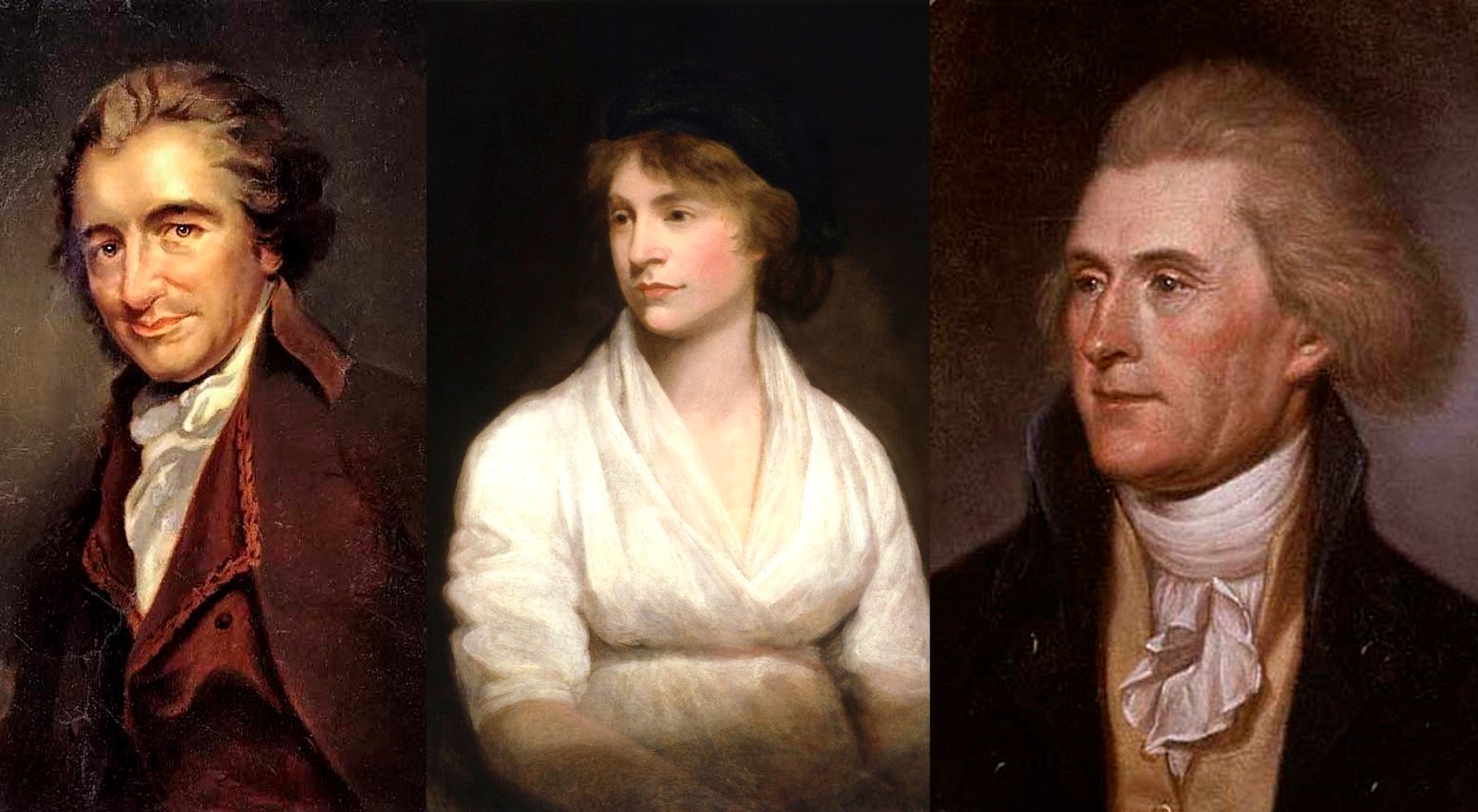
Thomas Paine, Mary Wollstonecraft, and Thomas Jefferson were three Enlightenment thinkers whose work is central in the intellectual legacy of modern human rights movements, and who were heavily influenced by the French Revolution. Paine, a British-born corset-maker who became involved in local politics and reform movements in his native country, in America, and in France, set down his political theory and freethought philosophy in Common Sense, The Rights of Man, and The Age of Reason. Mary Wollstonecraft, who was also born in England and also moved to Paris to take part in the revolutionary activism taking place there, followed Paine’s The Rights of Man with her Vindication of the Rights of Woman, now considered the founding work of the modern feminist movement. Thomas Jefferson, founding father of the United States and eventual President, was an American statesman living in Paris as the events leading up to the French Revolution unfolded, and continued to defend its core democratic values, if not all its tactics, even as it devolved to the bloody Terror.

So off to the Paris I go! There, from August 9th through the 21st, I’ll visit landmarks associated with their lives at this time, and see how the events that occurred at that time in the places where they lived, worked, died, thought, wrote, studied, rested, and played contributed to their thought during and after the Revolution.

~ Thank you, Ronnie Ruedrich and Mark Sloan, for your generous support

Here’s the story of the trip and related essays about these three thinkers and their ideas:

To Achieve Freedom Of or From Religion, Equal Protection is a Better Strategy Than Separation of Church and State

Generally, I’m a big fan of such organizations as the Freedom From Religion Foundation and Americans United for Separation of Church and State.

The former, founded in 1978, is headed by Annie Laurie Gaylor and Dan Barker, enthusiastic and principled atheists who believe that true religious freedom entails freedom from religious interference in matters of government or public goods. They carry out their mission in two main ways: through letter-writing and litigation when the establishment clause of the First Amendment to the Constitution (“Congress shall make no law respecting an establishment of religion…”) is violated, and through public awareness campaigns via social media, network news appearances, a radio show (also available as a podcast; I’m a regular listener), billboards, and ads.

The latter, founded in 1947, is headed by Reverend Barry Lynn, an ordained United Church of Christ minister. The AU pursues many of the same goals as the FFRF, also through legal and public awareness campaigns, and also with the stated mission of upholding the establishment clause. Lynn’s and the AU’s emphasis is more on freedom of religion, pointing out how the creation of a purposefully and innovatively secular government led to less religious persecution and greater freedom of conscience in the United States than had been achieved in any other Western society up to that point.

The FFRF and the AU have done a lot of good, especially when it comes to such matters as the misrepresentation of religion as science in the public school classroom, keeping government representatives from proselytizing in their official roles, and preventing religious views from infringing on certain civil rights. That’s because they do their work in a culture which strongly values religious liberty and within a system of laws that’s designed to protect it, and they do it well. However dominated by Christianity at its outset, our nation’s origins, rife with religious dissenters championing freedom of conscience, led to the United States largely abandoning its religious favoritism and oppression in favor of religious liberty.

Yet, though the religiously non-affiliated, atheists/agnostics, and those critical of political action by religious organizations are a rapidly growing demographic, it seems that the FFRF and the AU still aren’t achieving their goals as effectively as they might. For example, many government meetings still commence with sectarian prayers, private religious opinions can still trump those of the professional medical field when it comes to access to reproductive health care, organized religions can still get special tax breaks and other perks that non-religious organizations can’t get, religious charities (such as adoption agencies) can collect public money while discriminating against some citizens on religious grounds, and American officials still seem required to pepper their rhetoric with pious references to retain public favor.

How can this be? Why do the FFRF and AU fail to achieve many of their goals when our national legal and cultural commitment to religious liberty is so robust?

It’s because of the simple fact that it’s impossible to separate our core beliefs, be they philosophical, scientific, skeptical, religious, or otherwise, from our politics. Politics is how we go about organizing our lives as members of society, which is always composed of people with conflicting interests and beliefs, and the positions we take on how we go about doing this are based on what we believe about justice, fairness, and our purpose in life. It makes no more sense to demand that people keep their religious beliefs out of politics than it is to demand they keep their other beliefs out, because our beliefs, whatever the source, are the catalysts for our opinions and actions. Forcing people to artificially separate only religious belief from political action or speech, then, is a form of unjustified religious discrimination, because it prevents some people, and not others, from public expression of their true beliefs specifically on religious grounds. For those who might object that religiously motivated politics serve to oppress people of other religions or of no religion, I reply that this is no more or no less true than it is of other belief-motivated politics. You can just as well say that liberals are trying to oppress conservatives because they act on their liberal beliefs, or that conservationists are trying to oppress free-market proponents because they act on their conservationist beliefs, and so on.

Well, then, what do we make of the world history of actual religious oppression, when people of some religious beliefs were oppressed by people of other religious beliefs? This, sadly, is not just a part of world history: it continues to this day, though in this country more often by individuals than by government. But I would say the problem has not been caused just by people forcing their religious beliefs on others through law. It’s more that people tried to force everyone to act and believe according to the tenets of only one religion, or of a very few. It’s not religion, per se, that’s the problem. We can recognize this when considering the history of religiously committed people who were the original champions of religious liberty in the United States. It makes no sense to say that religion in politics is always oppressive when it’s often been the case that religion in politics is what led to expanding religious and other civil liberties in the first place. The problem is the exclusivity and favoritism that some religiously-motivated politics call for.

So how do we attain full religious liberty while allowing the free expression of religion in politics?

We start answering this when we consider what religious liberty and religious freedom is is the first place. Freedom both of and from religion requires that people be able to express their beliefs and live according to them except as it limits the freedom of others to do so, and vice versa. Those laws and practices which protect our ability to enjoy religious freedom without infringing on the rights of others determine our religious liberty. While the principle of separation of church and state, which the First Amendment is often interpreted to express, is meant to protect religious liberty, I find that attempt to put this principle into practice often defeats the purpose, which is to achieve real religious freedom. Too many of the efforts to keep religion out of politics cross over or tread too close to the line between separating church from state, and end up unfairly suppressing government workers’ and political candidates’ freedom to publicly express their beliefs in their public life. This not only tramples on their civil rights, it also prevents the public from being informed of the true motivations behind the politics of their representatives.

It seems to me that the equal protection clause of the Fourteenth Amendment (“No State shall…deny to any person within its jurisdiction the equal protection of the laws”) would do a much better job of systematically and effectively protecting religious freedom not only because it doesn’t make the impossible demand of segregating our core beliefs from our politics, but because it’s so straightforward. Does the proposed law take every religious consideration under account, or can it, within reason? If the answer is yes, then it does not infringe on religious freedom. If the answer is no, the law must be rejected, or it must be derived from universal principles only, such as those which all philosophies and religions can generally agree on: justice, fairness, beneficence, and so on.

In other words, the principle of equal protection can generate a clear decision procedure to determine whether a law or practice is commensurate with religious freedom, in a way that the principle of separation of church and state can’t. 

In sum: when it comes to equal protection, what’s good for the goose is good for the gander. If all religions can be represented in a generally applicable law, or receive tax breaks, or be represented by a public monument on public property, well and good. If they can’t all be represented, then none can. Equal protection means: all or none.

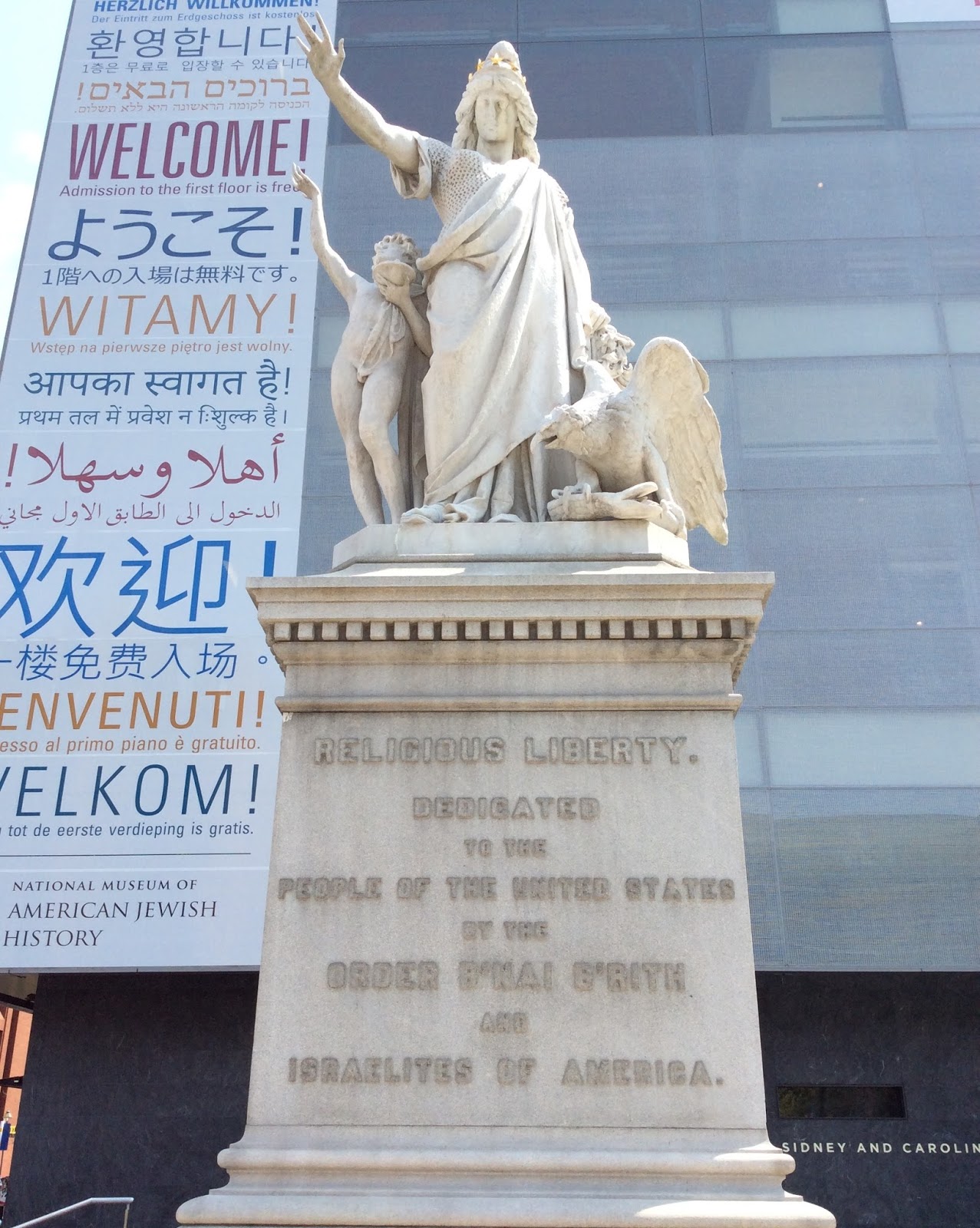
There’s a case still under way, in which the legality of a Ten Commandments monument erected on state property is being challenged on the grounds it violates the principle of church and state. While the ACLU is challenging the Ten Commandments monument on establishment clause grounds, Lucien Greaves of the Satanic Temple is making a different argument: the Ten Commandments monument should stay …if, of course, a seven foot bronze statue of Baphomet can go up next to it, along with all other religious monuments people want to erect. It doesn’t take much imagination to picture what a crowded mess public lawns and buildings would become if plaques, statues, engravings, and every other sort of representation of the religious beliefs of all Americans were to be represented in every one. Some argue that pride of place of religious monuments should be given to those that have a special significance in American history. If that case won out (though many of the founding Christians didn’t believe in graven images), public lawns could still become very crowded with Abrahams, Moseses, Virgin Marys, Martin Luthers, Joseph Smiths, crucifixes, angels, innumerable saints, and much, much more. But would that really represent what religious freedom means to us, to give favored and exclusive access to a few religions to the walls and lawns of our public spaces and to our laws? That looks like the bad old religiously oppressive Europe many of our forebears fled from in the first place. No, if the expression of belief is to find a place in the public sphere, it must be universal, representing the myriad disparate beliefs of all, or those which are universal to all.

Now imagine the equal protection principle applied to access to health care, to education, to adoption agencies, and so on. If certain religious individuals or organizations want to influence the outcome of regulations to reproductive health care, they can send lobbyists if representatives of all belief groups have the same opportunity to participate in the discussion (secondary to the relevant medical experts, of course). If these religious individuals and organizations don’t want other views to be represented, then it’s in their interests to prudently withdraw.

Many religious organizations seem to be in a bit of a panic today in the United States, especially those with a long and distinguished pedigree. If they aren’t in a favored position to promote their views in the public square, they seem to think, their very survival is threatened. I think they’re shooting themselves in the foot with these tactics. For one thing, they appear a bit bullying, a bit usurping, and more than a bit desperate, and serve more to alienate people than otherwise. Secondly and most importantly, there’s that overall deep cultural American attachment to religious freedom. So although a number of the more zealous advocate for more government support of their own religion, it appears that most Americans see this as a betrayal of core religious principles (“Give to Caesar that which is Caesar’s…”, “My kingdom is not of this world…”, “But when you pray…pray in secret…”) and of our heritage of ever-more-vigorous religious tolerance.

So while the ‘wall of separation’ might appear a lovely fiction to many, it’s no more realistically or navigably erectable than a gaggle of religious monuments in a town square, not in a nation that believes so strongly in the freedom to think and act on one’s conscience in every sphere of private and public life. It’s best to stick more closely with our more laudable pluralistic tradition and proclaim: as a people, we can either favor everyone’s right to believe, or no-one’s. That’s why all religiously motivated people should freely participate in voting, running for office, and making laws, so long as the laws are applicable to everyone and safeguard the rights of all individuals equally, and they should feel at liberty to say what beliefs motivate them. In fact, that’s invaluable information the electorate shouldn’t be deprived of by contrived, impossible to enforce separation of belief laws.

In the end, forcible separation of the people into a nation of “our beliefs vs. theirs” won’t lead to more freedom of or from religion, but the principle of equality will.

Ordinary Philosophy and its Traveling Philosophy / History of Ideas series is a labor of love and ad-free, supported by patrons and readers like you. Please offer your support today!

~~~~~~~~~~~~~~~~~~~~~~~~~~~~~~~~~

Sources and Inspiration:

‘About Americans United for the Separation of Church and State’. AU website. https://www.au.org/about ‘About FFRF: Welcome to the Freedom from Religion Foundation’. FFRF website. http://ffrf.org/about

Baker, John. ‘Establishment of Religion’, The Heritage Guide to the Constitution.
http://www.heritage.org/constitution#!/amendments/1/essays/138/establishment-of-religion

Christian, Carol. ‘Satanic Temple’s statue of Satanic figure under way for Oklahoma capitol’, Houston Chron.com, May 6, 2014. http://www.chron.com/news/nation-world/article/Satanic-Temple-s-statue….

‘“Nones” on the Rise’, Pew Research Center: Religion and Public Life. Oct 9th, 2012 http://www.pewforum.org/2012/10/09/nones-on-the-rise/

Nussbaum, Martha. “Equal Respect for Conscience: The Roots of a Moral and Legal Tradition” https://www.youtube.com/watch?v=UChBe5sNQbk

Political Maneuver or Not, I Think Hillary’s Call for Automatic,Universal Voting Registration Is a Great Idea

As you may know, I am a staunch advocate of voting: I think voting rights should be expansive, that as a nation we should encourage and facilitate voting as much as possible, and that voting is not only a right, it’s responsibility.

When we don’t vote, we do an injustice to ourselves and our fellow citizens by failing to uphold our democracy, we act as pawns of those who try to limit access to voting (in recent years, these efforts have been especially aimed at minorities, the poor, the elderly, and the young, go figure), and we betray those whose labor and personal sacrifices made it possible for us to vote in the first place. Next time you feel lazy or tempted by Russell-Brand-style ‘principled’ slacktivism, think of Frederick Douglas, Carrie Chapman Catt, and Miguel Trujillo, and imagine how lame you’d sound if you had to stand before them and explain why you’re sitting out on voting day.

Hillary Clinton’s call for universal, automatic voter registration addresses both the rights and the responsibility aspects of voting, and outlines some concrete steps we can take to support both. Her proposal, to automatically enroll every citizen as a voter when they turn 18 unless they opt out, and to extend the time window for voting, has many things going for it, and few against it:

– it reduces the chance of voter fraud because everyone will be enrolled; if anyone tries to vote more than once, or as an individual who doesn’t really exist, they’ll get caught by the system. While voter fraud is actually very rare nowadays, many people just feel better about elections that are more likely to be as close to 100% free of voter fraud as possible. In recent years, voter fraud been more of a right-wing issue than anything, so honest Republicans should support the idea. And if they object to universal voting registration as being somehow too invasive or imperious, well…

– it’s no more or less invasive than any other ID laws (passports, state ID, etc). Universal voter registration could be done by the federal government, but if this idea is too scary, it could become a national requirement for states take on the responsibility. If each state can be responsible for making sure every adult has an ID, it’s not too much of a stretch that they could tie this into voter rolls.- it makes voting more accessible to working people. Honest Republicans should like this as much as anyone from any other political party, for obvious reasons: it would help the hardworking, taxpaying, . As it is, it’s often very hard for working people to get to the polls on the one day they’re open, often only during work hours and/or the time they drop their kids off and pick them up from school; this is especially true for people working in healthcare, in emergency services, in low-paying jobs where people can ill afford even an hour off, and so on. Universal voter registration would make sure that busy working people are already signed up to vote in case they can grab some time to run down to the polls, and will make it that much easier to create an electronic voting system that will allow everyone to vote when and if they can. (I still think the fact that voting days are not holidays is a shame and an embarrassment to a nation that touts itself as greatest democracy in the world.)

– and voting, generally, makes for a smarter, more just society, since it not only helps ensure that the rights of every citizen are respected, but that information about the circumstances, beliefs, and interests of the entire citizenry, necessary for crafting wise and fair policy, is revealed as fully as possible. The more people who can more easily vote, then, the better. And not just the working people: it should include the poor, the elderly, the disabled, the formerly incarcerated… every single citizen whose fate, like it or not, is intertwined with our own.

Ordinary Philosophy and its Traveling Philosophy / History of Ideas series is a labor of love and ad-free, supported by patrons and readers like you. Please offer your support today!

~~~~~~~~~~~~~~~~~~~~~~~~~~~~

Sources and inspiration:

Keith, Tamara. ‘Returning to Roots, Clinton Lays Out Proposal to Expand Voting‘. It’s All Politics, NPR. June 4, 2015.

Levitt, Justin. ‘The Truth About Voter Fraud.‘ Brennan Center for Justice website, November 9, 2007.

Merica, Dan and Eric Bradner. ‘Clinton calls out GOP opponents by name on voting rights’, CNN website, June 5, 2015 Clinton calls out GOP opponents by name on voting rights

Freedom, Liberty, and the Inevitable Interconnectedness of Human Life

As a citizen of the United States, I’ve spent more than a little time wondering if it’s entirely a good thing that our culture is so very individualistic.

American individualism does originate from some excellent roots. The colonies that became the United States were largely founded by farmers, entrepreneurs, dreamers, the dispossessed, and others with a bold, adventurous spirit that animated them to cross the seas and start a new life from scratch in an unknown country.

These migrants included religious dissenters who struck out on their own and founded new faiths, devising theological arguments to demonstrate the righteousness of their doing so. Their arguments would later be adopted for secular purposes as they were used, barely altered, to support the right to freedom of thought and speech, and were embraced widely by many independent-minded communities. They were also open to new ideas, and were often more ready to accept innovative moral and political theories of the Enlightenment which emphasized individual rights and self-sovereignty over traditional authoritarian and elitist social systems than were their European counterparts, and more ready and able to implement them. Thomas Paine’s Common Sense and The Rights of Man, the Declaration of Independence, the United States Constitution, and the Bill of Rights are all essentially Enlightenment documents, embodying that intellectual movement’s conception of human nature and of the just society founded upon individual human rights.

The American project has always depended on free, forward-thinking individuals, and our national creed is founded on these three core beliefs: that individual human lives are valuable for their own sake, and that human rights not only exist, their defense should be our highest priority, and that all legitimate governmental authority originates with the people as a whole. Political systems founded on these beliefs, conceived in Britain and established first in America, reveal the strength of this view, and over time proved that individuals and society alike benefit enormously when the rights and interests of individuals take highest priority.

Over time, as free-market economics and other liberalizing social forces have expanded the rights and opportunities of the individual, some have come to believe that society, as a concept and as an institution, should play a secondary role in matters of public policy and morality. Margaret Thatcher, for one, famously claimed there’s no such thing. ‘Society’, to Thatcher and others whose views of human social arrangements might best be called atomist, is more or less a shorthand term for a population of individuals in a certain place and time. In this view, it’s the individual, not the group, that matters. Focus on protecting the the rights and interests of individuals, they say, and everything else will fall into place.

For one thing, they claim, the more individual rights are emphasized, the better off everyone is. Compare constitutional democracies, republics, and free-market societies which emphasize individual rights with societies that emphasize the interests of the group, and we can see that the former do a much better job overall of enhancing people’s lives. There’s more wealth, less poverty,  more opportunity, and greater autonomy in the former. The reason it works out that way, they argue, is because human nature is naturally individualistic first, and social second. For example, Michael Shermer, a well-known science writer who leans libertarian, argues that just as the individual is the object or target of evolutionary selection (or in other words, what selection acts upon), so it is the individual who should be the object or target of ethical concern and legal protection. (See my response to Shermer’s article here.)

Some such individualists, which often identify as libertarians and some as classical liberals, object to all or most taxation, saying it amounts to a sort of slavery because it forces individuals to pay for, and hence to work for, things they didn’t personally choose to contribute to. Others also object to public debt; Thomas Jefferson famously did so (though as President, the realities of governing the infant nation caused him to mitigate his views) saying it also amounts to further enslavement of future generations by forcing them, through their labor, to pay a debt they played no part in incurring. Still others object to laws limiting the ownership of guns, to the military draft, to eminent domain, to all manner of laws that subordinate the liberties of individuals to the interests of the group.

But there are some problems with these arguments. For one thing, it’s not historically true that societies that have done the most to improve lives focus almost exclusively on individual rights without regard to the interests of society. The laws of the United States, for example, are very concerned with the interests of the society as a whole as well, and are structured so as to find the correct balance between the rights of individuals and the interests and responsibilities of the people. ‘We the people’, a collective term, was chosen to as the introduction to the United States Constitution, not ‘we the individual persons’! In fact, the Bill of Rights, enumerating the rights of individuals, was only added after the Constitution, balancing the rights and interests of the people as a whole, was adopted, though its eventual inclusion was a condition for many states to agree to ratify it. The weakness of the United States government under its original Articles of Confederation, a document paying lip service to the political unity of the states without giving the federal government much real authority, was quickly recognized by leaders of the new nation struggling to maintain its newfound autonomy as it struggled to fund the American Revolution and to pay its debts, defend itself, and establish viable systems of trade. The original problem facing the infant United States, in other words, was too much concern for individual liberty and not enough for the welfare of all. The Constitution was adopted to correct this imbalance.

For another, we find that most societies generally considered anti-individualist and generally referred to as socialist, communist, or authoritarian, have not actually promoted the interests of society over individuals, for all their proclamations that that’s what they’re doing. Historically, they have exclusively promoted the ideology of one individual leader or a small group of elites, and imposed a political structure derived from it on the rest of society by crushing political dissent and severely restricting both individual and collective rights. If their policies ended up harming society as a whole, as they generally did, it didn’t matter much, so long as they carried out the will of the leader or the ruling elites. In fact, these sorts of governments could be better described as hyper-individualistic, promoting the interests of one or a few individuals regardless of the cost to society.

So how do we make sense of it all? How can we live together in societies, as we invariably do, and organize ourselves so that we can be as free as possible from the oppression of government and of other individuals? How do we achieve both negative freedom, freedom from interference, and positive freedom, freedom achieved through purposeful action? For human beings, we find that the ability to live a full and free life is tied up with our interconnectedness with our fellow humans as well as with respect for everyone else as individual persons whose worth is equal to our own. Any definition of human freedom or conception of human rights that doesn’t take sufficient account of both of these is incoherent, and not useful for understanding or for devising a better way of living, for individuals or societies.

To see this, let’s imagine what life might be life if the radical individualist view of human nature we just described won out and society operated on the principle that it (society) didn’t really exist. Imagine if the tax-equals-slavery argument was turned around so it was applied consistently: if those who built our tax-funded cities and infrastructure didn’t expressly consent to our personally using them, we shouldn’t be allowed to use them, since we would be benefiting from the fruits of their labor without their consent. This goes for anything paid for by public debt as well: since consent is central to the argument, it’s the consent itself that matters, not the money per se. In fact,So this would apply to anything achieved by collective action if people were compelled by law to contribute.


So in this scenario, we’d need to remove everything that collective action built and taxes and public debt paid for. Remove most roads and bridges, except the small ones on private property built by their owners. Remove the internet. Remove the armed forces, except for local militias. Remove police forces. Remove the polio vaccine, other vaccines, indeed, all medical advances that were achieved through the NIH and as a result of the space race and wars, both tax-funded, hugely expenses, large-scale government endeavors. Remove public lands, national and regional parks, and so on.
And we’d have to go further: remove all other laws of positive obligation which require us to do certain things, and leave only those of negative obligation, which prevent us from interfering with one another’s personal autonomy. Remove laws which require individuals to care for children, the elderly, the incapacitated, and the mentally ill. Remove Good Samaritan laws. Remove laws which require doctors, product manufacturers, food producers, pharmaceutical companies, and others to provide, in good faith and to the best of their knowledge, goods and services that won’t harm their clients.

Now imagine the ‘free’ life of the individual living in such a society. We go around constantly on the alert, knowing everyone else is armed, and while there might be laws against harming one another, the only ones who can enforce the law is ourselves. We must remain vigilant at all times, knowing that while most people, due to our evolved human nature as social creatures, don’t wish to kill or hurt one another most of the time, there are always a certain number who are able and willing to hurt others to further their own short-term interests. We may be crippled or die early from polio, or tuberculosis, or a virulent flu, or some other microbe-caused illness unless it just so happens that an enormously wealthy, long-lived philanthropist comes along willing to bankroll the decades-long, probably never-profitable project of discovering the microbe that causes it and developing vaccines which must constantly be updated due to evolution. We would probably never have the opportunity to see a buffalo, almost certainly extinct along with many other species killed in droves in the interests of short-term personal gain.

We can only travel roads, such as they are, by permission of the owner, and will likely have to stop often along the way and pay the tolls necessary to fund their building and upkeep. Because of this, most small businesses would have a terribly difficult time getting their supplies in shipped in or their products shipped out and probably never get off the ground, if runaway monopolies, never limited or broken up by government, didn’t eliminate their competition in the first place. Unless enough people happened to band together voluntarily or one extremely wealthy philanthropic person came along to make such a gigantic land purchase at the right time, we could not choose to rest our bodies and feast our eyes at great, rare natural landscapes such as Yosemite and Yellowstone; such places would be closed off at the whim of the owners; only the wealthy could afford the exorbitant entry fees the owner decided to charge; or they might have been destroyed if, say, an owner at some point decided they could make more money with Half Dome by dynamiting it for its rock or carving it into an image of his own face. The internet may have come into being at some point, but was was the case with the polio and other vaccines, the vast expenditures of time, money, and cooperation of effort required to develop it may have prevented it from ever existing except as funded by a superbusiness, and therefore, entirely controlled by it.

None of this goes to show that only a significant level of taxation and a strong government of laws could ever achieve all of the great advances of civilization and promote the use and preservation of natural resources to their fullest advantage. History shows us that while many liberties and freedoms were only ever obtained when governments intervened, it also tells us that many were brought about through other means: revolution and public unrest, markets, social institutions such as religions and universities, and so on. What this thought experiment does reveal is the intimate ways in which our lives are tied up together with those of others: what others chose or don’t choose to do provides opportunities and places limits on our freedom to choose, and vice versa.
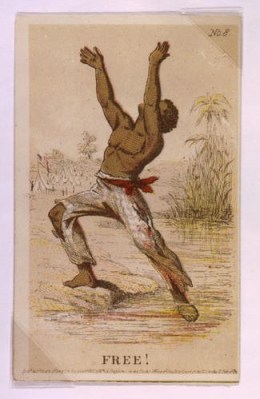
This thought experiment also helps us see how easy it is to think that freedom and liberty are the same. I make this disclaimer from here on out: the two are often used interchangeably, in everyday as well as academic use. But I think that’s a mistake: to help explore the importance issues related to them, we need two words that are related to one another but which contain different shades of meaning, and freedom and liberty are ready and widely understood candidates. So, I’ll use them here more or less as I’ve often otherwise encountered them. Freedom, which enables one to actually chose and act upon as many alternatives that will enhance one’s ability to live a good and happy life as possible, can often come into direct conflict with liberty, which allows one to chose from the widest range of options regardless of consequences. Sometimes, when one is granted the liberty to do as they choose, they restrict the freedom of others. Consider the history of states’ rights’ activism in the United States, ostensibly all about promoting the rights of states to make most of their own laws (do states really have rights?), we find it was actually about giving states free rein to effectively strip away the Constitutional rights of certain of its citizens, and granting individuals license to do the same to one another.

Let’s consider libertarianism, a political philosophy which appears to promote personal liberty as the primary object of a society, sometimes to the extent that freedom seems relegated to a side effect or by-product. Why do I say this? Libertarianism calls for far less restriction of individual liberties than any other political philosophy except anarchism, often regardless of consequences except how it effects the liberty of others. A famous example is the issue of gun rights: libertarians generally regard the right to own guns a fundamental individual right, regardless of the evidence that more gun ownership in a population almost always correlates with far higher rates of gun-related death and injury. So while the liberty of people to own guns is protected, the total amount of freedom enjoyed by people is reduced because, of course, no one gets to enjoy freedom while they’re dead (Those who believe in life after death may disagree, but here I’m speaking in matters of law and society, which belongs entirely to the realm of the living.) There are also less demands placed on individual persons to pitch in and create public goods which enhance people’s lives, give people more choices, relieve people of the burdens of merely maintaining one’s survival, and otherwise promote the freedom to do more things even while specific liberties, such as how to allocate all of one’s own earnings, are curtailed. Whether or not more freedom is achieved, then, appears to be almost beside the point, since individual liberties are sacrosanct, not to be limited or regulated regardless of how this affects the total freedom of the individual or of society as a whole.

My intention is not to pick on libertarianism, since it’s not the only political philosophy whose adherents often fail to recognize the degree to which freedom and liberty can often diverge and to emphasize how much human individuality depends on interpersonal cooperation. While this movement is based on a fundamentally flawed conception of how freedom is best attained, it’s often modified to such as extent that many of its adherents hold very reasonable and enlightened views, and they do right to protest against governmental and corporate abuses of power. We all make such mistakes, on the left as well as on the right of the political spectrum. Many liberals demand more social responsibility in terms of tax-and-spend welfare and government investment in green technology while refusing to vaccinate their children, resulting in epidemics of easily preventable disease, and insist on muzzling people who voice unpopular or uncomfortable opinions by demanding they be fired for what they say in private and disinvited from speaking at universities, and so on. Many conservatives demand that markets remain free from government intervention while voting for legislation that gives corporations free rein to form monopolies and stifle competition, and champion religious freedom while demanding that the religious views of some people take precedence over others in matters of public policy, and enshrined to the exclusion of others in publicly funded spaces, and so on.

I, for one, value actual freedom over actual liberty, since the first is a good which directly affects my ability to live a full and happy life, and liberty is instrumental, valuable only insofar as it promotes actual freedom. And that’s why I, for one, prefer a political system that values freedom over liberty as it simultaneously values liberty as among the most freedom-promoting social good we can bestow on ourselves and one another.
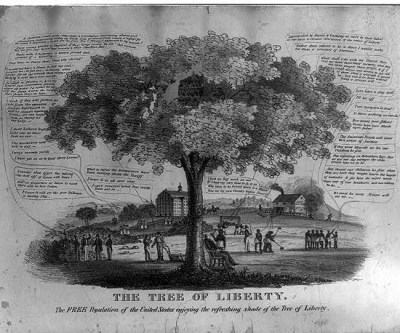
Liberty is not the only way to freedom, far from it. That’s why, politically, I think I could best be described as a progressive, or a democratic republican socialist, since I believe political systems such as these do the best job of balancing individual rights with social well-being, which I think means making the increase of freedom, not just liberty, the primary goal. The reason progressive governments are on balance so successful, I believe, is that they best reflect the reality of the human condition as I’ve just described it: the desire of each individual for complete personal liberty is often in conflict with the ability of each individual to enjoy actual freedom. They protect the individual from unjustified governmental encroachment on their rights; they prevent individuals from encroaching on the rights of one another; they coordinate human efforts in great projects which reap huge benefits for huge numbers of people which smaller-scale efforts are unlikely to achieve; they have a built-in system of public input and of checks and balances through voting, taxation, appointment and hiring of experts in relevant fields of expertise, recall or impeachment of government officials, and so on.

And as we look around the world, where we find societies in which the largest number of individuals and groups enjoy the most freedom and liberty, we also find a constitution with a built-in system for amendment, robust enforcement of the rule of law, equal rights protections which neither the government or citizens are allowed to infringe on, a mixed economy, and a welfare system. And looking throughout history, we fail to find either an autocratic or a libertarian nation that achieved this balance of liberty and freedom through an infrastructure which facilitates both. Either the rights and interests of individuals are routinely ignored and trampled upon by governments in the interests of a few elites (monarchist, communist, and fascist governments fit into this category, even if they present themselves as acting in the name of the people), or individuals routinely ignore and trample upon the rights and interests of other individuals because the government is too weak and ineffectual to defend the people from each other, let alone from other nations (the United States in its first decades of existence, and countless other infant democracies and developing nations). While I find it difficult to imagine how a libertarian or autocratic society could achieve all of these things, I would be interested to see if it could be done. After all, the United States was an experiment in governance, and it did much better than many other nations at protecting individual freedom for many, if not for all; that’s why Abraham Lincoln was so anxious to keep the country together. But frankly, given human psychology and the lessons of history, I’m not holding my breath.
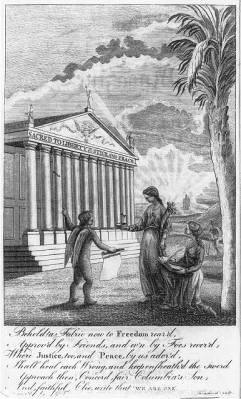
To many, the trick of attaining maximum freedom while simultaneously engendering maximum liberty for all seems like a tall order, if not impossible. That’s why, I suspect, so many of us so readily lean so far to one side or another, since the two seem disparate. But since the two are intertwined and inseparable due to the deep interconnectedness of humanity, for better or for worse, we need to think of the two as just different aspects of the same thing.

There are simple, practical ways of carrying this out, in legislation and in the ways we interact with others in day to day life. When it comes to policy, a good classic example of effectively balancing personal liberty with overall freedom was the old practice of restrictions on carrying guns in American towns. In the country and in their homes, people depended on their guns for food and protection and could have them handy to fight in militias if they choose to join up. However, law enforcement well knew, the close quarters people found themselves in in town could lead to a person with a gun to, in a fit of anger, drunkenness, accident, or poor judgement, permanently remove every freedom another could ever enjoy with the simple squeeze of a trigger. Therefore, when people chose to enter within town limits, they were required to give up their guns so that all could enjoy the freedom of going about their business unhampered by fear, knowing that while in town, no-one’s packing. The liberty of the gun owner was temporarily suspended in favor of the freedom of the many without placing too much of a hindrance on the gun owner’s ability to sustain their daily life. While the distribution of American society has changed, with most Americans now living in urban and suburban communities, a balance different in kind but similar in purpose might be struck. Perhaps all Americans could be allowed to own a gun if and only if they joined a state militia or local reserve branch of the military (as the actual wording of the Second Amendment provides for) so that all gun owners would be registered, trained, recognizable, and publicly accountable.

Thus far, we’ve discussed freedom and liberty extensively without once talking about rights. What are rights, and how are they related to freedom and liberty? A right is a much more nebulous concept, much harder to define or identify, and much more difficult to trace to its origin. For example, is it just something we’re born with? If so, why have human societies differed so much on what they are and whether we even have them, and why must we fight to get them? Are they, then, something we create? If so, why create some and not others? The topic of rights really needs to be the subject of another piece, one which I plan on writing about and about which countless others have written far more ably than I feel sure I ever could. But when we start discussing much more difficult cases in which freedom and liberty conflict, the subject of rights inevitably, and must, come up, if for no other reason that the concept of rights is a cornerstone of American law as it it for all nations who value and promote freedom and liberty. In the meantime, let’s talk about rights as some sort of thing tied up with personhood, we won’t say exactly what, without which persons enjoy neither freedom nor liberty. I think that’s a pretty good starting place, more or less reconcilable with every conception of right I’ve ever explored.

So sometimes, we find that in nature as well as politics, individual human freedom is intimately bound up with the rights and liberty of others, and it sometimes seems nearly impossible to tease out where individual interests, freedom, liberty, and rights begin and end. To explore this, let’s consider an ultimate doozy of a political and moral issues, one that perennially absorbs and divides the public like no other issue: abortion. Particularly, we’ll consider probably the most common argument commonly used in its favor, and perhaps, the most difficult to challenge.

This argument is the bodily rights argument, which holds that an individual’s right to their own body is inviolate. That being the case, a pregnant women has the right to expel or separate anything from her body that she doesn’t want there, just as anyone else would. This must, if that right really is inviolate, includes a fetus. In other words, no-one can ‘force’ a women to remain pregnant if she doesn’t want to be, since that would be a violation of her right to do with her own body as she sees fit.

But do we really believe that our rights to use our own bodies can and should be be unlimited? That’s not the case either. The law, just like other human beings and in fact, nature itself, ‘forces’ us to do things with our own bodies all the time. In fact, there is no such thing as moral or social obligations at all without some sort of demand on our bodies, since, of course, everything we think and do involves its use. For human beings, our freedom, our rights, and our very lives depend on whether or not others support our existence, at least some of the time, with their own bodies. There is no other law that I can think of where the bodily rights argument is the be-all-end-all.

For example, in addition to parental instinct, society uses enforcement of the law to compel parents to care for their children if social expectations haven’t done the trick, and rightly so. A parent must feed, clothe, house, and protect their children, and every single one of these obligations is dischargeable only by the use of the parent’s body, requiring labor, proximity of the parent to the child, and so on. The reason why we demand this is that we believe the child has the right to live, to enjoy the freedom and liberty that only life can bring, but no child can live without the help of their parents or other adults responsible for their care. We would not allow a mother to withhold breastfeeding, for example, if it was the only way a child could survive, or withhold cuddling, embraces, and all other physical manifestations of affection which we know children can’t be deprived of and still grow up healthy. In response to all of this, a bodily rights proponent could object that the fact that the fetus is inside the body, using the resources of the body itself, makes the case of a pregnant woman different and the demands of the fetus more egregious than we can force the mother to accept. However, I don’t see why these objections are particularly compelling, as this is a mere matter of location, not of demands on the body. All parental obligations place significant demands on the parents’ bodies whether or not the fetus’ physical location is within or without; in the case of very young children especially, these obligations hold round-the-clock. In fact, caring for a newborn or offspring of any age is often far more exhausting, far more expensive, demanding, and stressful to the mind and body that rearing a fetus inside the body.

I have yet, in fact, to encounter a defense of the bodily rights argument that’s convincing when it comes to abortion and not convincing in other matters. (‘Officer, I refuse to let you arrest me, since placing me in handcuffs and imprisoning me violates my bodily rights.’ ‘No, judge, I didn’t take my mother to the hospital or call 911 when I observed she was having a heart attack since that’s not what I decided to do with my own body.’ ‘May it please the court to note that when my client purposefully slammed their body into that other person, knocking them off the bridge, they were merely exercising the right to do with their body as they saw fit.’ Etcetera, etcetera.)
The inevitable interconnectedness of human life and its intimate relation to human freedom and liberty is what makes all societies function and upon which all law is built. It’s why, when it comes to arguments for unfettered personal liberty, including abortion rights, I don’t accept arguments such as the bodily rights argument as sufficient justification, since such arguments are derived from artificially atomistic, hyperindividualistic views of human nature,. In the case of abortion, it takes further arguments, such as whether a fetus is a person or whether the mother has the right of self-defense against the fetus that’s putting her life in jeopardy, to decide whether or not a mother has the moral obligation to provide for the development of another human life within her body. (I think that there are arguments that justify abortion in some circumstances; I explore this issue more fully in another piece.)

In all matters of law and order, of personal liberty and freedom for all, of the individual and society, the question of what we want to do, what we should do, and what we allow ourselves and others to do can only be satisfactorily and successfully addressed if our answers are informed by the basic assumption that, for each and every one of us, for there to be any I, we depend on them, and vice versa.

*Listen to the podcast reading of this essay here or on iTunes

~~~~~~~~~~~~~~~~~~~~~~~~~~~~~~~~~~~~~~~~~~~

Sources and Inspiration:

Carter, Ian, “Positive and Negative Liberty”, The Stanford Encyclopedia of Philosophy (Spring 2012 Edition), Edward N. Zalta (ed.) http://plato.stanford.edu/archives/spr2012/entries/liberty-positive-negative/

Nussbaum, Martha. “Equal Respect for Conscience: The Roots of a Moral and Legal Tradition”
https://www.youtube.com/watch?v=UChBe5sNQbk

Shermer, Michael. ‘How Science Can Inform Ethics and Champion Sentient Beings’, Scientific American, Jan 20, 2015 http://www.scientificamerican.com/article/how-science-can-inform-ethics

Thatcher, Margaret. ‘Interview for Woman’s Own (“no such thing as society”)’, Sep 23 1987, archived at MargaretThatcher.org http://www.margaretthatcher.org/document/106689

Wenar, Leif, “Rights”, The Stanford Encyclopedia of Philosophy (Fall 2011 Ed.), Edward N. Zalta (ed.) http://plato.stanford.edu/archives/fall2011/entries/rights/

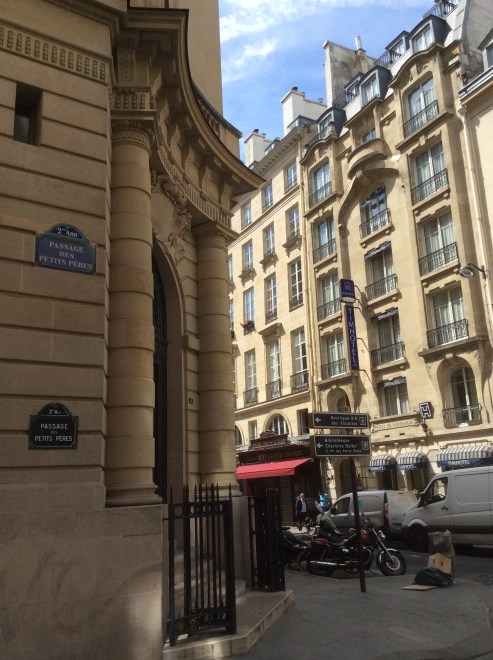
On Today’s Supreme Court Ruling Striking Down State Bans on Gay Marriage

Congratulations to all of my fellow Americans in love who, until today, have been denied the equal protection that’s their Constitutional and moral right. This so happens to be the week I celebrate eight years of happy marriage with the love of my own heart, and I’m so glad that that our society is affirming the love and commitment of so many more people. Here’s to all you lovers out there!

In Defense of the Introverts

I just listened to this podcast episode from Australia’s Radio International series Big Ideas, and let me tell you, it was a breath of fresh air. It’s called ‘Extrovert bias: it’s all around us’, and it’s a rebroadcast from a 2012 recording of Susan Cain’s discussion of her book Quiet: The Power of Introverts in a World That Can’t Stop Talking at the RSA, or the Royal Society for the encouragement of Arts, Manufactures and Commerce.
 
The book had slipped under my radar, but I’m glad to have encountered her ideas in this talk. In her book (which I plan to read), Cain discusses the personal and social value of introversion, and she worries that extroversion has come to be valued in school, the workplace, and in the arts sometimes to the near-exclusion of all else. While she agrees that both introversive and extroversive personality traits are valuable, she thinks we would all benefit from renewed appreciation of the great creative and intellectual accomplishments introversion can help us attain.
 
As was abundantly clear from audience questions and from Cain’s summaries of her readers’ emails, many find her insights helpful and validating. There are just so many introverted people out there navigating a society which often seems structured to exclude them. It seems that you can hardly get a job, get a promotion, or get your inventions, your work, and your ideas taken seriously without running the rigorous gauntlet of ‘putting yourself out there’: schmoozing, gathering contacts, selling yourself, and otherwise being a go-getter. For an extrovert, this process is generally lots of fun; for an introvert, it can often be awkward, embarrassing, tedious, terrifying, or just plain miserable.
 
Sometimes I feel that way because I’m an introvert too… I think. Or at least partly so. As Cain points out, introversion and extroversion are not really manifested in people as a simple dichotomy. Extroverts are not 100% extroverted all the time, it’s just that people consider themselves or others extroverts because, on balance, they tend to exhibit extrovert traits. Same goes for introverts. So how do we know whether we are extroverts, introverts, or that diplomatically conceived third category, ambiverts (people who exhibit both types of personality traits more or less equally)?

And anyway, why should we care? 
 
Let’s address both questions by exploring what people generally mean by introversion and extroversion, and see if we can find anything useful by exploring the distinction.
 
Here’s how the Myers and Briggs Foundation website (after Isabel Briggs Myers and Katharine Briggs, creators of the famous Myers-Briggs Type Indicator personality test derived from Carl Jung’s theories) briefly summarizes the difference between the two: ‘Do you prefer to focus on the outer world or on your own inner world? This is called Extraversion (E) or Introversion (I).’
 
To find out more, let’s take the introvert / extrovert Myers-Briggs test to see what happens. Now, I, for one, don’t place much stock in the results of personality tests like these nor do I plan any part of my life around them. However, job applicant tests, marriage counseling, workplace policies, and so on are often crafted around these tests, so as a practical matter, it’s important to know if they’re useful, useless, or even downright harmful. So how about we give them a little trial run?
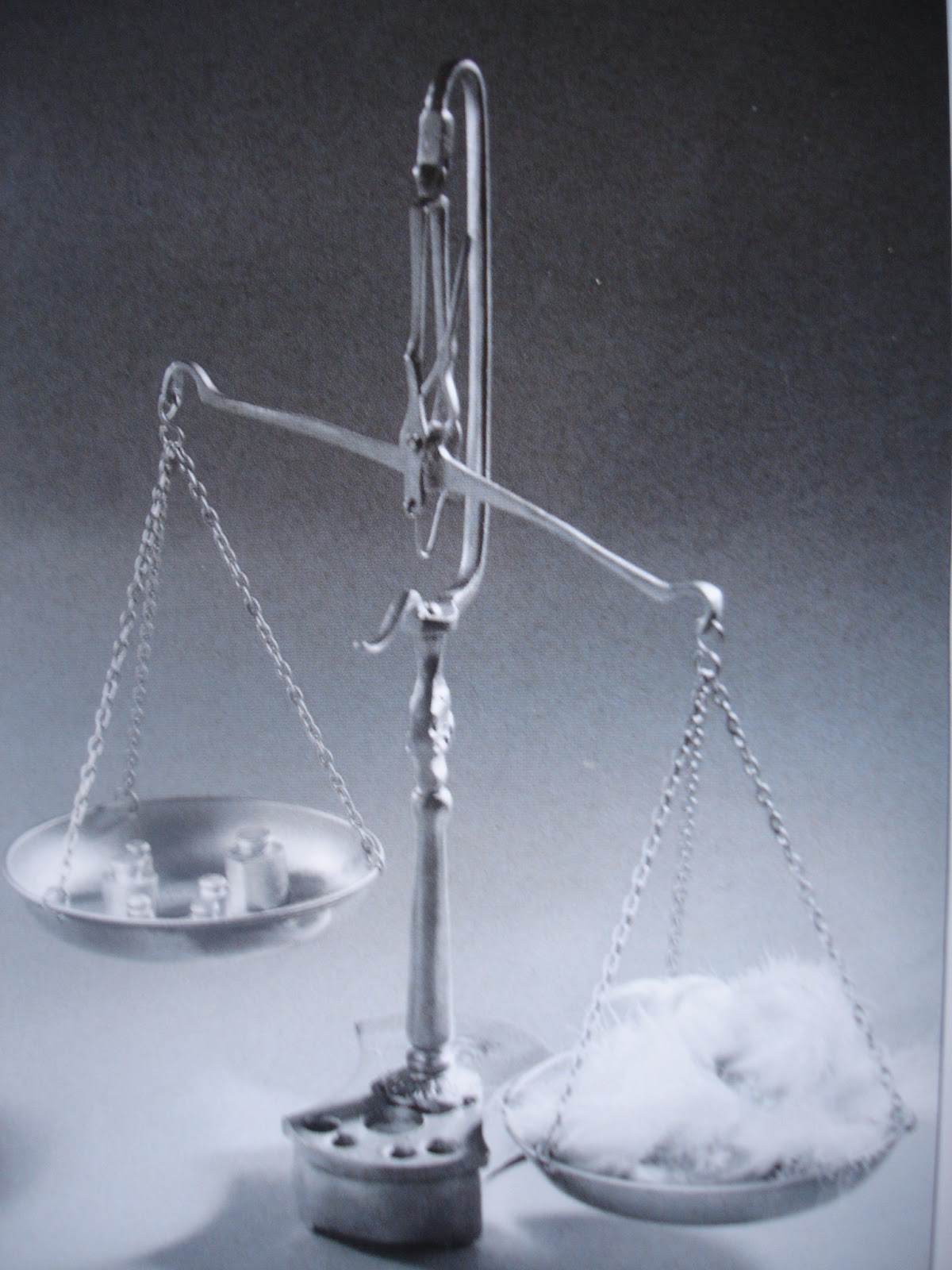
 
Well, I didn’t end up taking the Myers-Briggs MBTI test on the official(?) website since I’m too frugal (cheap?) to spend the $50 they’re charging, but I took several other similar free tests based on their work, and I get the same result every time: INTP. Let’s all take one and see what happens.
Here’s how one site described my results: ‘The INTP personality type is fairly rare, making up only three percent of the population, which is definitely a good thing for them, as there’s nothing they’d be more unhappy about than being “common”. INTPs pride themselves on their inventiveness and creativity, their unique perspective and vigorous intellect. Usually known as the philosopher, the architect, or the dreamy professor, INTPs have been responsible for many scientific discoveries throughout history.’
 
Now for a person with my interests, I find the results pleasing and even flattering, and find much to identify with in this description. I also feel quite certain that these personality type descriptions are written to pander and seem applicable to just about everyone who reads them, like horoscopes, so that their satisfied audience keeps coming back for more.

So are the terms introvert and extrovert (and ambivert) useless, a load of BS, little more than psychobabble? Perhaps they are. Or, perhaps they may have been originally, but have come to refer to more useful and interesting concepts since they entered into common discourse. The way Cain uses the terms in her talk seem more to have to do with common sense, day to day observations of people by other people. Maybe they’re closer in meaning to everyday terms like ‘shy’, ‘reserved’, or ‘outgoing’: less technical and categorical, with more shades of meaning. Thinking of the terms this way, I like them better already.

We can also test the introversion/extroversion hypothesis another way: we can look at how we go about our to day to day lives and self-sort our habits of personality into the introverted, having to do with the time we spend alone, in our own heads, and at a distance from other people, and the extroverted, having to do with the time we spend with other people and feeling connected to them, and see which term might fit our overall personalities best. Or, we can run this test with others, by giving others a list of our behaviors and having our friends sort them. Think of those general behaviors that mostly make up how you spend your day, and see what you come up with. Here are some of mine, self-sorted:
 
I spend quite a bit of time alone, love to have lots of projects and tasks to work on, and tend to most enjoy those which can just as well or even better alone. I love to write, but never end up going to writer’s circles, workshops, or reading clubs though I constantly tell myself I should. I spend months apiece making art quilts that rarely make it onto a wall, because I can’t bring myself to go to galleries and ‘sell’ my work by trying to convince people I’m a ‘real’ artist who deserves to have my work shown. I’m uncomfortable with cliques and generally avoid them, and the moment I feel pressured to adopt the interests, attitudes, and tastes of a group of people, I flee. I’m very interested in many social, political, and intellectual movements and follow theme closely, but I never feel like going to marches and protests even if I support the cause, and I’ve spent many miserable hours at the socializing portions of such otherwise interesting events as Skepti-Cal and Meet a Scientist because I can’t bring myself to jump in on others’ conversations, so then I feel out of place, and then, remembering the uncomfortable awkwardness, I don’t go back. Same goes for Meetup groups organized around interests I share. I generally spend at least the first half of my first day off my day job alone, and often the whole day, even if I had been telling myself all week I really, really need to get out more. So, with all this alone time I like to spend, and with my awkwardness and shyness in so many social situations, I must be an introvert.
 
And yet… I have many friends, because in addition to enjoying the security and peace of lots of alone time, I love people. I find them fascinating and I crave companionship, and can’t go more than a few days without socializing before I start to feel lonely and depressed. I love hanging out with friends, of course, especially one on one and in small groups. I also love going to small to medium size parties so long as good friends are there, and/or as long as there are hosts that are solicitous of guests, spotting those who are bashfully hanging out in the corner, inviting and facilitating but not forcing them to take part in conversation. I really love meeting interesting strangers. I love to travel, and almost always pick large cities as my destination, spending almost the whole day every day out and about exploring. And most of all, I love getting deeply into conversation, and enjoy it much more than small talk; in fact, I find the latter boring. As long as all parties involve share a real interest in the subjects under discussion and so long as they’re being genuine, I’m the first to show up and the last to leave. So… I must be an extrovert too.
 
How would you sort these traits? Would you sort them as I do here? And do you think that, given these list of traits, I would fall more on one side of the divide than the other?
Or, am I an ambivert?

Perhaps. But I’m willing to bet that most of you who took the self-test easily found a substantial list of introverted and extroverted traits manifested in your own life, and probably wouldn’t class yourself as mostly one or the other. Besides, separating these personality traits into two categories may be a mistake in the first place, since many traits generally considered introversive contain both self-contained and social aspects (after all, isn’t reading a book alone also intimately getting to know what another person thinks and feels, and doesn’t that make it a social activity? Isn’t that also true for preferring to stay home and write pieces for others to read instead of public speaking, or donating to worthy causes instead of personally appearing at protests, and so on?) and vice versa. It’s probably true that most people consider themselves a combination of introvert and extrovert, although there have been many studies on introversion, extroversion, and related traits that seem to indicate there are real phenomena of personality that these concepts usefully point to, originating from the way our brains are structured and probably influenced quite a bit by personal experience.

So what to do with all this often nebulous, often contradictory information? Despite the problems of talking about introversion and extroversion as distinct things, I think Cain is on to something, both in what she says specifically and what I think she hints at. Even if we can’t neatly divide the world into introverts and extroverts (and even ambiverts, which I get the impression she doesn’t think is as useful as the the other two categories), we can look at how different personality traits can offer something of value to the individual as well as to the rest of us. Categorizing personality traits can simply be a useful way of exploring how we can integrate seemingly disparate ways of being ourselves in the interests of personal growth, in becoming the people we want to be, even if the categories seem clunky or artificial.


Cain suggests we look a little closer and see what introversion has to offer both for the individual and to society. She offers, among many, many others, the famous example of Steve Wozniak and Steve Jobs, super-duo of the tech world. Jobs, with his outgoing and outsized personality, made Apple become one of the most successfully marketed products ever made. Wozniak, with his intense powers of concentration and habit of undistracted bouts of problem-solving, came up with the basic concept and design to begin with in the countless hours he spent alone in his personal space. And it’s not just amazing new gadgets that can be the products of introversion; they can be as grand as new discoveries in science and physics or as humble yet delightful and enriching to the mind as any lovely, clever, and insightful little poem by the ultra-introvert Emily Dickinson.

Cain’s insights can help us stop taking it for granted that having a quiet and reserved personality means a person is antisocial, or is ‘no fun’, or doesn’t care about others or can’t work with them, or any other negative stereotype often assigned to the non-extrovert. That’s because exploring the differences between personality traits can reveal how interconnected they are even as we recognize and explain how they fulfill different needs and perform different roles in our psyches.
 
Yet, I find there’s even more to be gleaned from what she has to say. She hints that even if introversion has no instrumental value, valuable only insofar as it facilitates or creates something else, it’s just as valid a way of being as is any other way of being. The marvelously rich variety of human nature, from introversion to extroversion and what’s in between, can all be reveled in and enjoyed for its own sake. There’s no need for the introvert to feel left out, to feel excluded, to feel ‘lacking’ in an extroverted world: there are great riches to be discovered and explored within ourselves too, which we all would do much better not to forget and neglect.

~~~~~~~~~~~~~~~~~~~~~~~~~~

Sources and inspiration:

Cain, Susan. ‘Extrovert Bias- It’s All Around Us’, RSA discussion on Big Ideas podcast, Radio National Australia  http://www.abc.net.au/radionational/programs/bigideas/susan-cain/6495096


‘Extraversion or Introversion’, Myers and Briggs Foundation website, 1997.
http://www.myersbriggs.org/my-mbti-personality-type/mbti-basics/extraversion-or-introversion.htm

‘Study Sheds Light on What Makes People Shy’, Live Science Staff, April 06, 2010
http://www.livescience.com/6291-study-sheds-light-people-shy.html