New Podcast Episode: On the Recent Intelligence Squared U.S. Debate About Basic Income

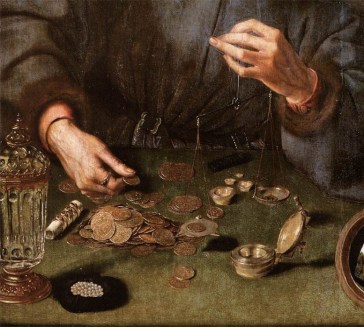
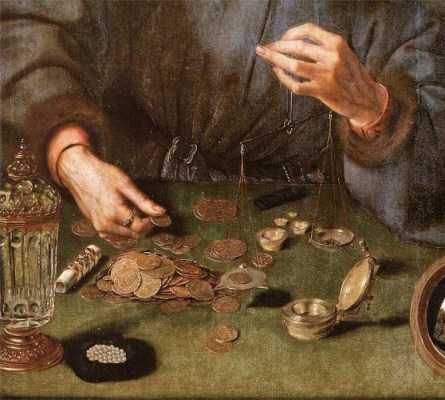
The Moneylender and his Wife by Quinten Massijs (detail)
This weekend, on the BART ride to San Francisco and on the walk to and from my destination there, I listened to this fascinating debate on Intelligence Squared U.S.: The Universal Basic Income Is The Safety Net Of The Future. (It’s also available as a podcast.) It was so thought-provoking that my walk turned into a rather long one, as I stopped every few blocks to sit down and scribble some notes in response to what I heard.
The debaters in favor of the motion are the libertarian political scientist Charles Murray, infamous in many

Listen to this podcast episode here or on Google Play, or subscribe on iTunes

This weekend, on the BART ride to San Francisco and on the walk to and from my destination there, I listened to this fascinating debate on Intelligence Squared U.S.:  The Universal Basic Income Is The Safety Net Of The Future. (It’s also available as a podcast.) It was so thought-provoking that my walk turned into a rather long one, as I stopped every few blocks to sit down and scribble some notes in response to what I heard.

The debaters in favor of the motion are the libertarian political scientist Charles Murray, infamous in many circles for co-authoring The Bell Curve, and labor leader Andrew Stern. These two make surprising debate partners, but of course, that’s part of the fun!

The debaters against the motion are Jared Bernstein and Jason Furman, both economic advisors to the Obama administration, and both more on the liberal / progressive end of the economic spectrum, which also adds to the interesting contrasts between audience expectations and the arguments made…. Read the written version here

Ordinary Philosophy and its Traveling Philosophy / History of Ideas series is a labor of love and ad-free, supported by patrons and readers like you. Please offer your support today!


New Podcast Episode: Frederick Douglass Baltimore Sites

About a year ago…

Amy M Cools's avatarOrdinary Philosophy

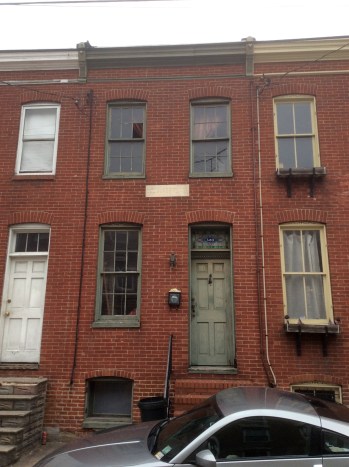
Listen to this podcast episode hereDouglass Place with engraved marker, Fell's Point Baltimore MD, photo 2016 Amy Cools or subscribe on iTunes

First day, Sunday March 20th

So here I am on the East Coast, commencing my Frederick Douglass history of ideas travel adventure in earnest! I’m thrilled, and know I’ll learn and see a lot, since I have so many sites I plan to visit already and know I’ll discover more as I go along.

…In a very important way, it’s fitting to begin with Douglass’s life here in Baltimore, centered in the waterfront district of Fell’s Point, since this is where Frederick Douglass had one of the most formative experiences of his life.

… Read the original travel account here

Ordinary Philosophy and its Traveling Philosophy / History of Ideas series is a labor of love and is ad-free, entirely supported by patrons and readers like you. Please offer your support today!

View original post

On the Recent Intelligence Squared U.S. Debate About Basic Income

The Moneylender and his Wife by Quinten Massijs (detail)

This weekend, on the BART ride to San Francisco and on the walk to and from my destination there, I listened to this fascinating debate on Intelligence Squared U.S.:  The Universal Basic Income Is The Safety Net Of The Future. (It’s also available as a podcast.) It was so thought-provoking that my walk turned into a rather long one, as I stopped every few blocks to sit down and scribble some notes in response to what I heard.

The debaters in favor of the motion are the libertarian political scientist Charles Murray, infamous in many circles for co-authoring The Bell Curve, and labor leader Andrew Stern. These two make surprising debate partners, but of course, that’s part of the fun!

The debaters against the motion are Jared Bernstein and Jason Furman, both economic advisors to the Obama administration, and both more on the liberal / progressive end of the economic spectrum, which also adds to the interesting contrasts between audience expectations and the arguments made.

Here’s the summary of the debate from the IQ2 website:

Imagine getting a check from the government every month. $600 guaranteed. It’s happening in Finland, where a pilot program is being launched to test what’s known as a “universal basic income.” As technology transforms the workplace, jobs and income will become less reliable. The idea is that a universal basic income could serve as a tool to combat poverty and uncertainty in a changing society, and provide a cushion that empowers workers, giving them latitude to take risks in the job market. But some argue a guaranteed income would take away the incentive to work, waste money on those who don’t need it, and come at the expense of effective programs like Social Security, Medicare and Medicaid. Is the universal basic income the safety net of the future?

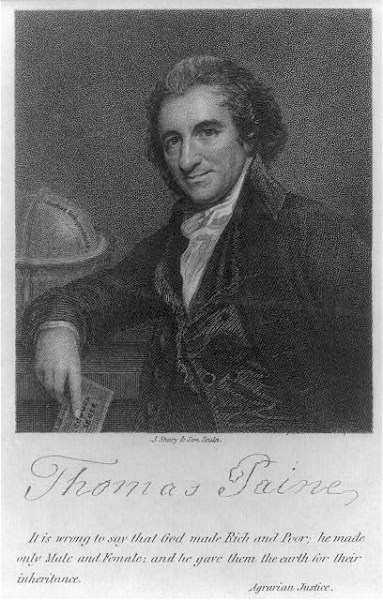
I’ve written about basic income before in light of Thomas Paine’s case for a social welfare system, broadly distributed to the point that we’d call it basic income today, in his pamphlet Agrarian Justice of 1796. I’m broadly sympathetic to the case for basic income especially insofar as I’m convinced by two of his major arguments.

One, Paine argues that the right to private property is not an intrinsic right or derived from nature, or even from moral convictions about deservingness or our duties toward those less fortunate. Rather, property rights are artificial rights we’ve created for efficiency’s sake: it’s a way to incentivize people to be as productive as possible to the benefit of both individual and society. But whatever efficiencies property rights promote, Paine observes just as we observe now, they too often deprive people of the very thing they promise to provide. Economies based on property rights deny most people direct access to the world’s natural resources while sometimes failing to reward them proportionally.

This is true not only of those who produce the most necessary, useful goods and services such as growing and preparing food, building and maintaining our cities, towns, and homes, and caring for the disabled and sick; they are often the ones who receive the lowest wages. In the meantime, others who create such frivolous and even arguably harmful things as casinos, violent video games, and poor quality trinkets that become trash almost as soon as they’re made can often make money hand over fist. Some people are not able to make money even if they were willing: they may be disabled or aged, or the skilled work they’ve done all their lives becomes obsolete. Worst of all, those who raise children, care for the disabled and aged, and otherwise keep the home generally receive no pay, though their work benefits society most of all. The amount of money we can bring in generally determines the resources we have access to, so if we have no money, we have no property. Property rights, then, guarantee us the right to property without any consideration as to whether or not we actually end up be able to obtain or keep any. Therefore, Paine argues, we owe every person compensation for denying them their natural right to equal access to the world’s resources.

Two, Paine argues that a universal income is better than discretionary welfare, such as that based solely on need, because it prevents the inevitable jealousies and complaints of unfairness that can erode social cohesion and undermine mutual trust. If everyone starts out at the same basic level, we may not have all of the same chances in life just as we don’t now, advantages or disadvantages that we can’t do much about: we may have rich parents, poor parents, or none at all; we may be able-bodied or we may not; we may be beautiful, smart, or have other attributes that society rewards. But, we’ll all have the same basic chance that we can give one another: the freedom and well-being guaranteed by a basic level of economic security.

But back to the debate…. Why this digression, you might ask? I return to Paine because he makes the first sustained modern argument (that I’m aware of) in favor of a basic income and because his basic points, or closely related ones, are brought up throughout this debate. In the question and answer session, Andrew Stern refers to the way perceived unfairness, such as Paine discusses, has long politically undermined need-based programs, from publicly-funded unemployment benefits to health care insurance for those with low income. Stern also points out that many people already enjoy ‘undeserved’ basic income, such as those born to parents who can afford to provide it. If we have no problem with those people reaping the benefits of work they didn’t do, why not everyone? Charles Murray adds the element of personal responsibility to the question of perceived unfairness of needs-based welfare. If everyone were given the same basic level of resources, people could no longer justly claim victimhood for not having the same chances as everyone else. If we collectively provide the same benefits to everyone, we can hold people to a basic equal accountability for all who could work and contribute more than they do.

Murray, as you may guess from his emphasis on opportunities for traditional marriage and the preeminence of personal responsibility, is much more conservative than the other participants in the debate, and introduces a free market argument that many political conservatives might like just as well as pro-labor liberals and progressives. This argument is founded on the importance of competition in a well-functioning economy. To harness the benefits of competition, Murray proposes that if people have ‘walking – away’ money, employers will have to compete with one another for employees, and in doing so, they will have to innovate to make jobs appealing. Employers would have to offer good wages, provide a pleasant and safe working environment, and make the work seem meaningful and appreciated. This is a sort of competition that serves drives wages, standards, and productivity up, not sending wages and working conditions spiraling in the race to the bottom that so many unregulated job markets, mostly competing to lower prices, have exhibited throughout the history of capitalism.

Jared Bernstein repeats the argument throughout the debate, like a mantra, that a dollar given to someone that doesn’t need it is a dollar taken away from someone that does. Many in the audience seem to find this argument convincing, but I don’t, at least without much more justification than he provides. For one thing, neither Bernstein nor his debate partner Jason Furman addresses the vast expenditures of time and money of a bureaucracy required to administer large-scale need-based welfare. It’s expensive for government as well as for individuals, who are required to provide proofs of their need, which is multi-dimensional and subjective and therefore difficult and time-consuming to demonstrate. (Murray does address problems with this kind of bureaucracy, but he emphasizes its unpleasantness and the way it re-introduces a form of serfdom, creating a class of people whose freedom is limited by this system.) For another thing, neither Bernstein nor Furman directly addresses the fact that universal basic income would vastly expand the number of people with disposable income for the first time, much more vastly than needs-based programs do. Most of this money, in turn, would go straight back into the economy, rather than into the ever-inflating bank accounts of the ever-fewer, ever-wealthier wealthiest individuals who are now gobbling up an ever-larger share of the economic pie. Our targeted redistribution system has been entirely unable to resolve this inefficiency, and in fact, may exacerbate it.

The side arguing in favor of the motion, which, as I’ve already mentioned, I’m more sympathetic to for aforementioned reasons, does not, in the end, convince the audience. They’re handily defeated, as the side arguing against the motion not only convinces most of the undecided but also wins over some of the basic income supporters. I suspect that Murray hurts his side a bit by spending too much time on arguments that I think are beside the point, such as whether more people could afford to get married (it doesn’t have to be expensive!) and on very subtle, not-very-well expressed arguments that were lost among the rest. But I would like to hear another major debate in which basic income is supported by stronger arguments, more convincing answers to objections, and most of all, better evidence. As Stern points out, there are small-scale and short-term experiments in basic income happening all over, in Alaska, Finland, and Toronto, for example, but the results are not in yet. I agree that such a major social program should be rolled out with some caution, given the potential fallout from unforeseen as well as foreseen potential side effects. But perhaps smaller experiments can’t reveal the benefits that a complete reinvention of a large economy would reveal, especially if effectiveness is entirely a matter of scale. For example, such a well-balanced, sturdy, and beautifully functioning thing as a termite mound couldn’t happen without an incredibly large number of factors contributing, namely the weather, millions of termites, many square miles of dirt, and so on. If you took a small pile of dirt and a small number of termites, a well-functioning termite mound would not result.

Our American re-invention of government was another such experiment founded on the idea that people can govern themselves and on the ideal of universal human rights (the ideal, mind you, not yet the reality). Many societies before and for some time since had tried to correct abuses and oppressions with one reform here, one reform there, or with a wholesale chaotic and violent overthrow after societal cohesion had already collapsed through famine and extreme corruption (such as, famously, the French Revolution). But it took a large number of fair-minded people to come together and lay the foundation for an entirely new system of government based on the ideal that all human beings have the right to life, liberty, and the pursuit of happiness, or as John Locke originally formulated it, life, liberty, and property. Or in the case of universal basic income, to actual property.

Ordinary Philosophy and its Traveling Philosophy / History of Ideas series is a labor of love and ad-free, supported by patrons and readers like you. Please offer your support today!

~~~~~~~~~~~~~~~~~~~~~

Sources and Inspiration:

Labor Theory of Property.” Wikipedia, The Free Encyclopedia

Locke, John. Two Treatises of Government, 1689

Paine, Thomas. Agrarian Justice, 1796.

Paine, Thomas. The Rights of Man, 1791.

The Universal Basic Income Is The Safety Net Of The Future. Intelligence Squared U.S. Debate, March 22, 2017

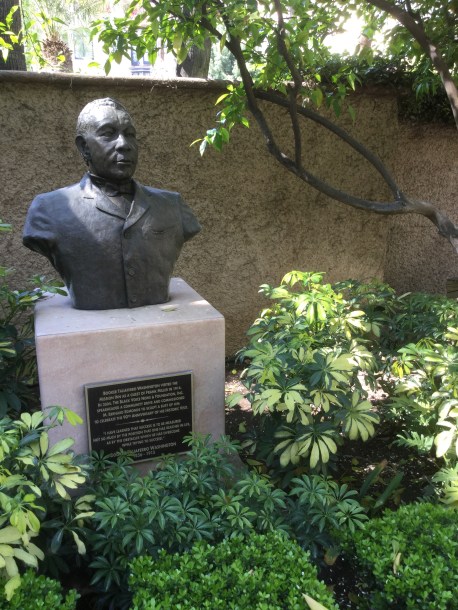
Happy Birthday, Booker T. Washington!

Booker T. Washington sculpture in the Mission Inn gardens, Riverside, CA, photo by Amy Cools 2017

‘My earliest recollection is of a small one-room log hut on a large slave plantation in Virginia. After the close of the war, while working in the coal-mines of West Virginia for the support of my mother, I heard in some accidental way of the Hampton Institute. When I learned that it was an institution where a black boy could study, could have a chance to work for his board, and at the same time be taught how to work and to realize the dignity of labor, I resolved to go there. Bidding my mother good-by, I started out one morning to find my way to Hampton, though I was almost penniless and had no definite idea where Hampton was. By walking, begging rides, and paying for a portion of the journey on the steam-cars, I finally succeeded in reaching the city of Richmond, Virginia. I was without money or friends. I slept under a sidewalk, and by working on a vessel next day I earned money to continue my way to the institute, where I arrived with a surplus of fifty cents. At Hampton I found the opportunity — in the way of buildings, teachers, and industries provided by the generous — to get training in the class-room and by practical touch with industrial life, to learn thrift, economy, and push. I was surrounded by an atmosphere of business, Christian influence, and a spirit of self-help that seemed to have awakened every faculty in me, and caused me for the first time to realize what it meant to be a man instead of a piece of property.’ ~ Booker T. Washington, ‘The Awakening of the Negro‘, Atlantic Monthly, Sept. 1896

Booker T. Washington was born on April 5, 1856, and went on to become one of America’s leading educators and social reformers. He was born a slave in a simple cabin and never knew his father; he and his family were freed by the end of the Civil War when he was nine years old. Washington lived the life he would go on to advocate for his fellow black citizens: one of self-determination, self-sufficiency, hard work, thriftiness, and compromise. He believed firmly in gaining the respect of others, including those predisposed to dismiss him because of his race, solely through his own character and accomplishments. Was Washington wrong to emphasize the importance of demonstrating one’s own worth by pulling one’s self up by the bootstraps over demanding equal legal rights as citizens? Perhaps the struggle for equality had always needed multiple lines of attack to crumble the whole structure of institutionalized legal, social, and subtly inculcated racism that has plagued and undermined this nation for so long. Perhaps he was simply misguided, even naive, though the latter is hard to accept given his intellectual prowess.

Be that as it may, Washington’s ideas drove him to work harder to create educational and economic opportunities for his fellow black citizens than just about anyone else we could name. And given his hard work, his integrity in staying true to his vision despite attacks from all sides, and his premature death by stress and overwork, the charge of ‘coward’ often leveled at him is, in my few, manifestly false and undeserved.

Learn more about the great yet controversial Booker T. Washington here, in fact, in praise, and in blame:

The Awakening of the Negro – by Booker T. Washington for the Atlantic Monthly, Sept. 1896

Booker T. Washington (1856-1915) – by Lawson Bush for Blackpast.org

Booker T. Washington and the White Fear of Black Charisma – by Jeremy C. Young for the African American Intellectual History Society Blog

Booker T. Washington: American EducatorEncyclopædia Britannica

Pride and Compromise – Shelby Steele’s review of Up From History: The Life of Booker T. Washington by Robert J. Norrell

Speech to the Atlanta Cotton States and International Exposition, Atlanta, Georgia – September 18, 1895 – Booker T. Washington radio broadcast at American Radio Works

*I had the honor of interviewing Kenneth Morris last year; he’s an activist against modern slavery (wage slavery, sex trafficking, and other forms of coercive exploitation) and a direct descendant of both Booker T. Washington and Frederick Douglass, each a preeminent figure in American civil rights history and each with a radically different approach to achieving equal civil status for their fellow black citizens. However, they had three things in common: an essential pragmatism combined with as much idealism, a deep love of their people, and an abiding trust that the universal human instinct for justice would win in the end.

Ordinary Philosophy and its Traveling Philosophy / History of Ideas series is a labor of love and ad-free, supported by patrons and readers like you. Please offer your support today

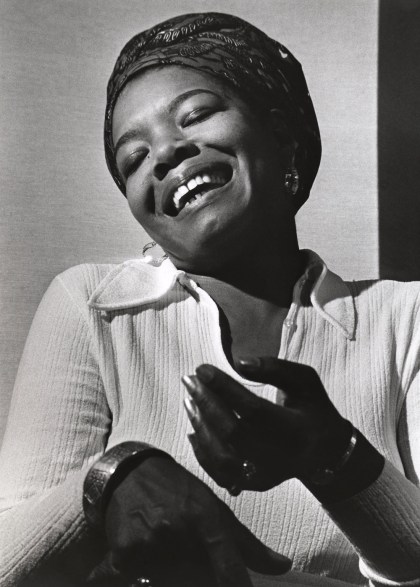
Happy Birthday, Maya Angelou!

Maya Angelou, author, poet, singer, dancer, activist, and so much more, was born on April 4th, 1928. We lost her only a few years ago, on May 28th, 2014.

There’s a wonderful Angelou biopic on PBS that I watched just a few weeks ago. In case you haven’t seen it, I highly, highly recommend it, and what better day to watch it than today? It’s only available now if you purchase a Passport subscription, but it’s very inexpensive and besides, our great public institutions like PBS need all the support we can give them in our current political climate of de-funding that which is not a weapon or a tax break for some special interest. I’ve long known of her and was aware of her prominence as an American author and civil rights leader, as most have, and had read and heard snippets by and about her over the years. This biopic, however, was my first sustained look at her life and accomplishments. How I went so long without more than a passing familiarity with her I know not. I am drawn in, and must discover more.

The Poetry Foundation’s page for Angelou is another excellent source for learning about her life and work and includes a short biography, lists of works by and about her, and some of her poetry.

What a fascinating woman.

Ordinary Philosophy and its Traveling Philosophy / History of Ideas series is a labor of love and ad-free, supported by patrons and readers like you. Please offer your support today!

New Podcast Episode: Margaret Sanger in the San Francisco Bay Area, California

Scottish Rite Temple mosaic, above the doorway of what’s now the Regency Center, San Francisco

Listen to this podcast episode here or on Google Play, or subscribe on iTunes

Fairly early on in my research for my history of ideas series on Margaret Sanger in New York City, I discover that she delivered one of her more famous addresses here in Oakland. Practically just around the corner from where I live, in fact!

So I’ve long had the idea of doing a follow-up Sanger project here in the San Francisco Bay Area, certain I’d find she’s been here more than once. That turns out to be the case. And not only do I discover that she visited here several times, I find that the excellent library at the University of California at Berkeley has some great resources for filling in some gaps in my information about Sanger in NYC. So, this story will have two parts: the first part is about sites associated with Sanger here, and the second part is about some discoveries I make in U.C. Berkeley’s archives following up on two NYC sites… Read the written version here

Ordinary Philosophy and its Traveling Philosophy / History of Ideas series is a labor of love and ad-free, supported by patrons and readers like you. Please offer your support today!

Margaret Sanger in the San Francisco Bay Area, California

Scottish Rite Masonic Temple mosaic, above the doorway of what’s now the Regency Center, San Francisco

Fairly early on in my research for my history of ideas series on Margaret Sanger in New York City, I discover that she delivered one of her more famous addresses here in Oakland. Practically just around the corner from where I live, in fact!

So I’ve long had the idea of doing a follow-up Sanger project here in the San Francisco Bay Area, certain I’d find she’s been here more than once. That turns out to be the case. And not only do I discover that she visited here several times, I find that the excellent library at the University of California at Berkeley has some great resources for filling in some gaps in my information about Sanger in NYC. So, this story will have two parts: the first part is about sites associated with Sanger here, and the second part is about some discoveries I make in U.C. Berkeley’s archives following up on two NYC sites.
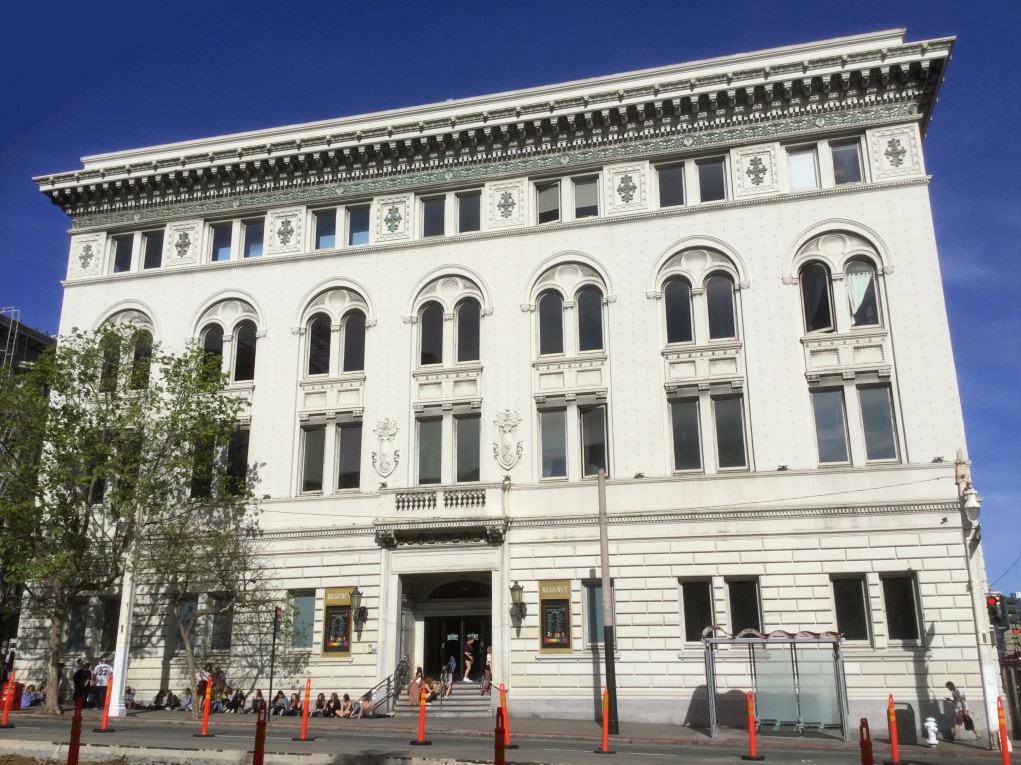
Scottish Rite Masonic Temple, now the Regency Center, at Sutter and Van Ness in San Francisco, CA

Stairway and elevator at the Regency Center, formerly the Scottish Rite Temple at Sutter and Van Ness, San Francisco

I: Sanger in Oakland and San Francisco

Friday, March 31st, 2017

I head first to San Francisco, a quick and easy trip on BART (Bay Area Rapid Transit System, our subway/ell) across the Bay, and take a pleasant walk on this spring day from Montgomery Street station east, first along Post through Union Square, then on Sutter. December 16th, 1928, Sanger spoke at the Scottish Rite Hall in San Francisco, at Sutter and Van Ness. The Scottish Rite Masonic Temple moved into its new quarters in the early 1960’s, and this building became the Regency Center, a multi-purpose venue. In fact, I was here just a few years ago when I saw John Cale, one of my very favorite musical artists of all time, perform in the ballroom, but Sanger likely spoke in the Social Hall. It’s also likely she delivered more or less the same speech she delivered at Oakland Civic Auditorium three days later, the story of that speech will follow below. Perhaps the speeches and corrections she scribbled onto the speech, which I link to here, constitute the differences between her addresses at the San Francisco and Oakland venues.

Small upper room in the Scottish Rite Temple, now the Regency Center, San Francisco

I write to people who manage and organize events at the Regency Center but am unable to line up a day to meet soon that will work with all of our schedules.

But since I have this free afternoon on a glorious spring day, I head over anyway, in case I luck out and end up there at a good time. Turns out, the very helpful man I find here, who’s in charge of setting up events, regretfully tells me there’s just too much going on for me to head upstairs and poke around to the rooms where she may have spoken; various contemporary sources designate the venue as the Scottish Rite ‘Hall’ and ‘Auditorium’, so the exact site is unclear. So I take photos in the places he allows me to wander: the hallway, the main stairway, and a meeting room just off the main landing now converted into a small bar.

About 22 years earlier, in August of 1916, Sanger wrote to her friends Charles and Bessie Drysdale, ‘In San Francisco [on a birth control lecture tour] I had a collapse, and was three days in bed under medical care, but recovered sufficiently to hold six meetings.’ As you may recall, Sanger suffered from recurrent tubercular infections, and from time to time they made her quite ill and exhausted. I have yet to find a record of specific locations she visited or stayed in San Francisco on that trip. Sanger didn’t mention her time in Oakland in this letter, though she may have meant to include the greater Bay Area when she said ‘San Francisco’, as visitors often do. Since she delivered her Oakland speech only three days after this San Francisco tour, this may have been one of the six meetings she spoke of.

So I return to Oakland to follow in Sanger’s footsteps there.

Margaret Sanger Hotel Oakland appearance, Oakland Tribune, Thu Jun 15, 1916, evening edition, front page. For the full article, click here. The drawing looks nothing like Sanger, and what’s up with the silhouette of celery? Yes, I know it’s meant to be a vase…

Hotel Oakland Ballroom, vintage postcard via Hotel Oakland Village website

On June 15, 1916, Sanger gave a speech in the ballroom of the Hotel Oakland at 270 13th St. I don’t find a transcript of this speech, but I do find a newspaper article about this event, which includes a summary of its main points as well as a review. The speech was well received by the audience, according to Gene Baker, writing for the Oakland Tribune. He compared Sanger favorably to Emma Goldman, Sanger’s one-time friend and ally from whom, truth be told, Sanger co-opted the mantle of birth control advocate-in-chief. As Baker commented in his article, Sanger was much more traditionally ‘feminine’ than Goldman in appearance, ‘slight’ and prettily dressed. Sanger was both a committed sex-positivist and a straight woman and saw no contradictions between her feminist convictions and in making herself attractive to men. Baker also described Sanger as speaking with intensity (which indicates she was feeling better since her collapse in San Francisco) and with scientific coldness. Perhaps she did convey a sense of scientific detachment, given her habit of buttressing her calls for action with a barrage of facts and statistics, or perhaps he perceived her keen grasp of the issues and her memory for detail as unfeminine and therefore ‘cold.’

Baker also wrote of her outspoken opposition to Theodore Roosevelt’s beliefs about childbearing in this speech; she frequently published rebukes and rebuttals to the President’s public stances against birth control and in favor of large families. (Baker mentioned that she spoke out against Roosevelt in San Francisco as well.) Both Sanger and Roosevelt were eugenicists but of different types: Sanger believed in negative eugenics, in curing human ills through having less children, especially if the parents were ill, disabled, or too poor to bring up well-nourished, well-educated, and well-housed children, and Roosevelt believed in positive eugenics, improving the human race through intelligent and hardworking people having as many children as possible.
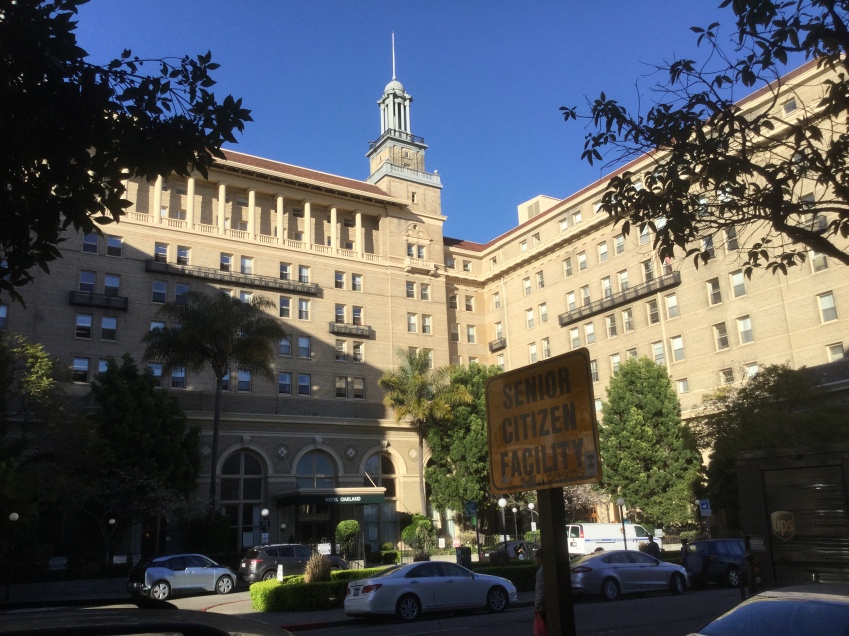
Hotel Oakland, now Hotel Oakland Village senior citizen community


Hotel Oakland Village main lounge, Oakland, CA

Hotel Oakland, vintage postcard via Hotel Oakland Village website

Hotel Oakland Historical Plaque, Oakland, CA

The Hotel Oakland, which opened as a luxury hotel on December 23rd, 1912, is now a senior community residence. Its grand edifice is little changed, but its garden is no longer so sumptuous and much of its interior is much plainer, having been stripped of its chandeliers and fancy furniture and painted plain white, though the lounge ceiling is painted a lovely antique-gold color. I sign in at the desk and walk around the first floor, greeting each person I see with a hello, a smile, and a nod, everyone is friendly and welcoming, and no one questions my presence. I take photos freely on the ground floor except in the large back room converted into an activity and physical therapy area, which, it so happens, appears to be the former ballroom I seek. I ask the person who works there if I may take pictures; she’s a Spanish speaker, and I ask in that language (unforgivably clumsily, given that I’m a California native and I should be more adept) if I may take pictures. She explains that the person that could authorize this won’t be back in until Monday, so I depart. As much as I am historically nosy, I make it my practice never to infringe on the territory of working people. They have enough to worry about without wondering if they could get in trouble on my behalf.

I do, however, take photos of the front lobby, in full view of everyone there who appears not the least concerned with my presence except to return my smile when they happen to catch my eye. Most of the residents are Chinese. This is no surprise since the Hotel Oakland Village, as it’s now named, borders Chinatown, and like the neighborhood in general, it is family-oriented, with visitors of all ages coming and going, often taking the elderly residents for local outings, such infirmities as they have lovingly supported by wheelchairs, walkers, arms, and hands. The parks in this neighborhood often contain large groups, sometimes very large, of older people going through the graceful, slow, deliberate movements of Tai Chi. It’s likely they include many of the residents of this hotel. The sight of these people, something like colorful wildflowers waving in the wind, something like windmills if windmills were endowed with personalities, intention, and rich history and could move deliberately to music, warms my heart on my morning walks.

Oakland’s Chinatown at the time of the Hotel Oakland’s heyday; many of these old houses stand today. This photo is on the wall of the Oakland Hotel Village main hallway

Margaret Sanger Speeches, Announcement for Oakland and S.F, in the Oakland Tribune, Sun Dec 16, 1928

Margaret Sanger Speeches, Announcement for Oakland and S.F, in the Oakland Tribune, Sun Dec 16, 1928

Next, I visit the Oakland Civic Auditorium, later called the Kaiser Convention Center, also just a few blocks from my house, near Lake Merritt. On December 19th, 1928, Sanger delivered the speech ‘The Necessity for Birth Control‘ here. It was a least as dedicated to eugenics-based arguments about the ill effects of ‘feeble-minded’, ill, disabled, and poor people having children to whom they passed down these traits and which they could not care for properly, as it was about preventing suffering.

The eugenics arguments and opinions she used in this speech are hard to take now, just as they were for many then. Yet to be fair to Sanger, we must remember that her arguments were informed by her experiences working as a visiting nurse in the slums where the poorest of the working poor lived in NYC, where the best efforts of public charities often seemed to hardly make a dent in relieving suffering, especially when, as Sanger believed, so much of it was preventable:

In her speech, Sanger said:

To define Birth Control, we say it is the conscious control of the birth-rate by scientific means that prevent the conception of human life. Prevent, remember. Prevent does not mean to interfere. It does not mean to destroy. There is no more interference with life through birth control than there is to remain unmarried or to live a celibate life. We also say “to control.” Control does not mean that you limit. When you control your furnace you do not have to put the fire out. When you control your motor you do not necessarily stop your car. To control the birth rate means that there shall be the same right for those who do not wish to have children as for those who do wish to have them. There are no objections to those who wish to increase the size of their families, but on the other side there seems to be a great deal of question and controversy as to the right of those who wish to limit or control the number of their children. ~ Margaret Sanger, ‘The Necessity for Birth Control’

Booklet for the Oakland Civic Auditorium and Opera House, now Kaiser Convention Center, Oakland Public Library

Oakland Civic Auditorium as it appears today

The Oakland Civic Auditorium had stood for 14 years when Sanger spoke here in 1928 and she had become very well known indeed in the dozen intervening years since she spoke at the Hotel Oakland. The Auditorium is a huge venue, as we can see in historical photos: it held Buffalo Bill’s Wild West Show and the Barnum and Bailey circus, symphony orchestras, and other large-scale entertainments. The history of this place is wonderful, with so many other amazing activists, artists, speakers, and performers appearing here over the years: Isadora Duncan, Duke Ellington, Marian Anderson, Paul Robeson, Johnny Cash, Elvis Presley, Martin Luther King, Jr, the Grateful Dead… It’s no longer in use, standing empty since just before the turn of this century, but I hope this beautiful Beaux-Arts edifice is reclaimed, restored, and put to as good a use as it once was.

Buffalo Bill Wild West Show at the Oakland Civic Auditorium, photo from booklet at Oakland Public Library

II: More About Sanger in NYC at U.C. Berkeley’s Doe Memorial Library

Research & photos: gathered on various dates from November 2016 to March 2017

And now, here’s my follow-up on two sites associated with Sanger in NYC:

Margaret Sanger Letter to Noah Slee on Barclay Hotel Stationery, excerpt, from the Sophia Smith Microfilm Collection

From Day 1, Part 3‘I track down a listing in the Margaret Sanger Papers Microfilm Edition: Smith College Collection Series catalog for a microfilm of a letter Sanger received from the Barclay hotel, but I don’t have access to it at the moment. It’s not available online and I’ve not yet had a chance to visit the library at the University of California at Berkeley, which has a copy’

I finally get around to tracking down the microfilm collection, stored deep in the archives at the Doe Memorial Library at U.C. Berkeley, with the assistance of the ever- kind and helpful Nancy Oanh Tran. In looking through the microfilms of documents dated around the time of Sanger’s stay at the Barclay Hotel, I find a phone message for Sanger and many chatty letters to her husband Noah Slee written on Barclay Hotel stationery. The letters discussed visits to and from friends, a visit from her son Grant, how much less pleasant it was to drive a car in New York City than in Tucson, how disorganized she was, and so on. Most of the contents of these letters are of little interest to anyone outside of their relationship, their circle of friends, and of course, dedicated historians, except, I think, for one thing: she begs him not to join her in New York City, and not to ask her to leave her work there yet. In her second marriage, she demanded the freedom she wanted that she did not find enough of in her first, and she got it through endearments, compliments, even sappiness, so that Noah would feel loved and not abandoned; through cajoling; through explanations and arguments about the importance of her work and her need to do it unimpeded; and even through what reads to me like a guilt trip.

o I American Eugenics Society journal, Doe Memorial Library at U.C. Berkeley

From Day 2, Part 2: ‘According to Robin Pokorski’s Mapping Margaret Sanger, ‘The Hotel Astor was the site of the National Birth Control Conference of November 19 and 20, 1929. The conference was sponsored by the American Birth Control League.’ I find few contemporary references online to the talks and attendees of this conference other than a few remarks in some contemporary newspapers and a brief excerpt from Eugenics: A Journal of Race Betterment, Volumes 3-4, 1930, published by the American Eugenics Society. An article from The Capital Times of Madison, Wisconsin outlines some of the topics of discussion, such as the Comstock laws and the current science of reproduction, and lists some of the headliners of the conference, which include ‘famous educators, doctors, and pastors.’ ‘

In doing further research, I find there’s a copy of the American Eugenics Society journal also in the collections of U.C. Berkeley’s Doe Memorial Library.

Mary Louise Inman, who wrote an account of and commentary on the meeting for the Eugenics Journal, wrote:

‘Most of our adult generation can remember when [the birth control movement] was chiefly characterized by determined looking ladies selling The Birth Control Review on metropolitan street corners, Margaret Sanger being held up for her propaganda, and a general feeling in the lay breast that the whole thing was not quite respectable.

Here we see before our eyes the evolution of an idea. That the movement has undergone a decided moral, social, and intellectual transformation is evidenced by the presence on the speaker’s platform of some of our foremost religious leaders, together with eminent writers, physicians, educators and scientists, as well as other professional and non-professional men and women of the highest social standing.’ ~ Inman, Eugenics, Jan 3oth ed, p 12

As I read further, I take notes. They go:

National Birth Control article for Eugenics journal by Mary Inman, 1930

‘In his speech, one Dr. E. Bord Barrett, a former Jesuit and still a practicing Catholic, held out hope that the Church would be flexible and adaptable on the birth control issue. He was a believer in the social benefits of birth control, and based his hope on the fact that so many Catholics used birth control, that Church-mandated celibacy for priests and others indicated that the Church recognized it was not always in the best interests of individuals and communities for everyone to have children, and that the Church blessed marriages of couples who could not have children.

Dr. Hannah Stone, director of the Birth Control Clinical Research Bureau and Sanger’s long-time colleague who was arrested in the raids on the W. 15th Street clinic, was among the speakers, but her talk was not recorded or described in Inman’s article.

Ministers and rabbis voiced their support for birth control on humanitarian and personal responsibility grounds.

The second day of the conference was dedicated to issues related to eugenics. They discussed the questions of whether it was desirable to ‘breed geniuses at will’, if it could be done at all; who would be qualified to decide what are ‘desirable’ human traits and types beyond those which impart health and the ability to take care of ones’ self; whether ‘spiritual values’ should be brought to bear on the issues, and much more.

Albert Edward Wiggam, worried that birth control might exacerbate a differential birth rate between those who are prudent, far-sighted, intelligent and self-controlled enough to be more likely to use birth control, and those who conceive and bear children thoughtlessly. He believed these traits were largely transmissible, predicting the likely behavior of the next generation. To counteract this problem, Wiggam believed that birth control needed to be universally and readily available as well as easy to use.’

Margaret Sanger, from Eugenics journal, Doe Memorial Library at U.C. Berkeley

The article ends by noting that Margaret Sanger could not attend the conference, which surprises me! Instead, she sent a telegram which was read to the attendees since her attendance was sorely missed given her role as a founder of the movement and the most important activist of her time for women’s rights, since the suffragists. Inman predicted that birth control would become as readily accepted in society as women’s right to vote, however controversial its past. She was mostly right. Though many Americans are uncomfortable with publicly funding birth control since we believe so firmly in the right to religious dissent, most Americans actually do use birth control, at least at some point in their lives. And as Sanger hoped, it has become readily available, easy to use, mostly every cheap, and all very safe. And she played a very significant role in bringing this about.

Thank you, Margaret Sanger.

Listen to the podcast version here or on Google Play, or subscribe on iTunes

Ordinary Philosophy and its Traveling Philosophy / History of Ideas series is a labor of love and ad-free, entirely supported by patrons and readers like you. Please offer your support today!

~~~~~~~~~~~~~~~~~~~~~~

Sources and Inspiration:

Duchsherer, Aimee. ‘Better Babies or More Babies?: Theodore Roosevelt, Margaret Sanger, and the Birth Control Movement‘. July 16, 2015, Theodore Roosevelt Center at Dickenson State University blog.

The Hotel Oakland Village website: ‘History: Grand Hotel‘ and ‘Historical Photos

Inman, Mary Louise. ‘The National Birth Control Conference’ from Eugenics: A Journal of Race Betterment, Volumes 3-4, January 1930, pp 12-17.

Kaiser Convention Center‘. In Wikipedia, The Free Encyclopedia.

The Margaret Sanger Papers Electronic Edition: Margaret Sanger and The Woman Rebel, 1914-1916, eds. Esther Katz, Cathy Moran Hajo and Peter Engelman (Columbia, S.C.: Model Editions Partnership, 1999)

The Margaret Sanger Papers Microfilm Edition: Smith College Collection, eds. Esther Katz, Cathy Moran Hajo, Peter Engelman, and Anke Vass Hubbard, 1996. #Microfilm 77685 , S15:0042. Reel S15: May 1938 – Nov 1938

Brochure for the Kaiser Center, one the old Oakland Civic Auditorium, Oakland Library collection


‘The Regency Ballroom: About‘, from their website

The Regency Center‘. In Wikipedia, The Free Encyclopedia.

Regency Center: Venue Overview: History‘, from their website

Sanger, Margaret. ‘A “Birth Control” Lecture Tour‘, Aug 9, 1916. Published article: Malthusian, Sept. 1916, 83-84. (Sanger’s letter to Charles and Bessie Drysdale published as an article)

Sanger, Margaret. ‘The Necessity for Birth Control,’ Dec 19, 1928. Typed Draft Speech. Source: Margaret Sanger Papers, Library of Congress, Library of Congress Microfilm 130:0226

Social Hall SF: Venue Info‘, from their website (part of the Regency Center)

Tillmany, Jack. ‘Regency I: 1320 Van Ness Avenue, San Francisco, CA 94109‘. Cinema Treasures website

Happy Birthday, Moses Maimonides!

Maimonides medallion, photo by T. Horydczak, approx. 1950, sculpture over the door of the gallery of House chamber, U.S. Capitol. Photo public domain via Library of Congress

‘Moses Maimonides… [born on March 30, 1135]… is the greatest Jewish philosopher of the medieval period and is still widely read today. The Mishneh Torah, his 14-volume compendium of Jewish law, established him as the leading rabbinic authority of his time and quite possibly of all time. His philosophic masterpiece, the Guide of the Perplexed, is a sustained treatment of Jewish thought and practice that seeks to resolve the conflict between religious knowledge and secular….’ ~ Kenneth Seeskin, Stanford Encyclopedia of Philosophy

Read and hear more about this great philosopher and religious thinker at:

Jewish Philosophy: Maimonides – Joe Gelonesi interviews Steven Nadler for The Philosopher’s Zone podcast

Maimonides – by Melvyn Bragg and his guests John Haldane, Sarah Stroumsa, and Peter Adamson for In Our Time BBC Radio 4 podcast

Maimonides – by Kenneth Seeskin for Stanford Encyclopedia of Philosophy

Maimonides (1138—1204) – by Jonathan Jacobs for the Internet Encyclopedia of Philosophy

Maimonides (Rambam) and His Texts – by Danny Moss for My Jewish Learning website

Moses Maimonides | Jewish Philosopher, Scholar, and Physician – by Ben Zion Bokser for Encyclopædia Britannica

Oath and Prayer of Maimonides – Bioethics – The Sheridan Libraries at Johns Hopkins University website

Sarah Stroumsa on Maimonides – Conversation with Peter Adamson for History of Philosophy Without Any Gaps podcast

Ordinary Philosophy and its Traveling Philosophy / History of Ideas series is a labor of love and ad-free, supported by patrons and readers like you. Please offer your support today!

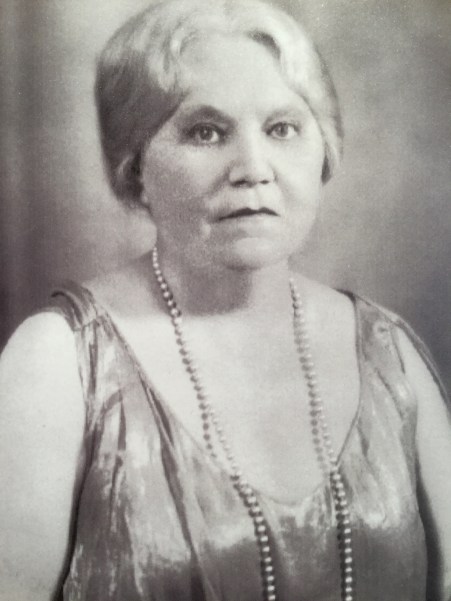
Happy Birthday, Minerva Hamilton Hoyt, and Thank You for Joshua Tree National Park!

Minerva Hoyt

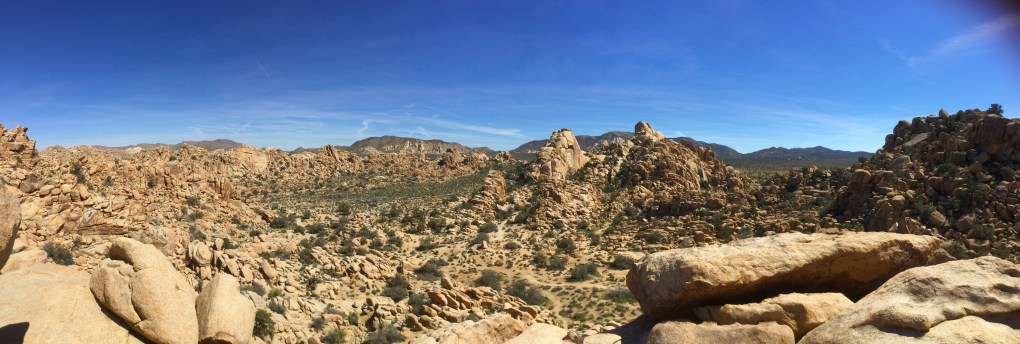
Just last week, I returned to one of my favorite places in the world: Joshua Tree National Park.

A native of Southern California, I have visited it many, many times throughout my life, ever since I was a young girl: with family, with friends, and alone. This place is full of wonder, beauty, and a clear clean vastness which tricks your eyes and makes you never quite certain if the rock, rise, or Joshua tree you see in the distance is close enough to touch or miles and miles away. I’ve hiked here, camped here, explored here, laughed and talked here, sighed, embraced, and frolicked with my first love here; I’ve experienced companionship, loneliness, solitude, joy, pain, and peace here. Joshua Tree played a great role in the development of my mind, soul, and heart. The beauty and richness of this place have thus affected so many others, including and especially one other woman, and it shaped her life:

There was once a natural wonder in the California desert — one you may not have heard of — that was essentially destroyed 90 years ago because people wanted desert plants for their own gardens.

One Pasadena-based environmental activist was horrified at that destruction. Her response forever changed the way Californians look at the desert, and earned her a permanent place in the pantheon of California environmentalist women… – Chris Clarke

A young Joshua Tree, cholla, creosote, and yucca at Joshua Tree National Park

…This woman was Minerva Hoyt.

Not many will recall Minerva Hamilton Hoyt and her tireless efforts on behalf of California desert protection. In fact, without her leadership, Joshua Tree National Park might never have become part of the National Park System. How a transplanted southern belle born on a Mississippi plantation became a staunch backer of the protection of desert landscapes is perhaps one of the more unlikely stories in the annals of national park history.

Minerva Hamilton led a genteel early life attending finishing schools and music conservatories. Her marriage to Dr. Sherman Hoyt led her away from the deep south to New York and eventually to South Pasadena where she immersed herself in southern California high society and civic causes. She demonstrated talent as an organizer of special charity events and developed a passion for gardening, which introduced her to some of the native desert vegetation commonly used in southern California landscaping. Trips to the desert instilled in Ms. Hoyt a strong appreciation for the austere beauty and wonderful inventiveness of desert plants that somehow managed to thrive in the harsh climate. She also saw the widespread destruction of native desert plants by thoughtless people who dug up, burned, and other wise destroyed so many of the cacti and Joshua trees that Minerva found beautiful.

Following the deaths of her son and husband, Minerva dedicated herself to the cause of protecting desert landscapes… – Joseph W. Zarki

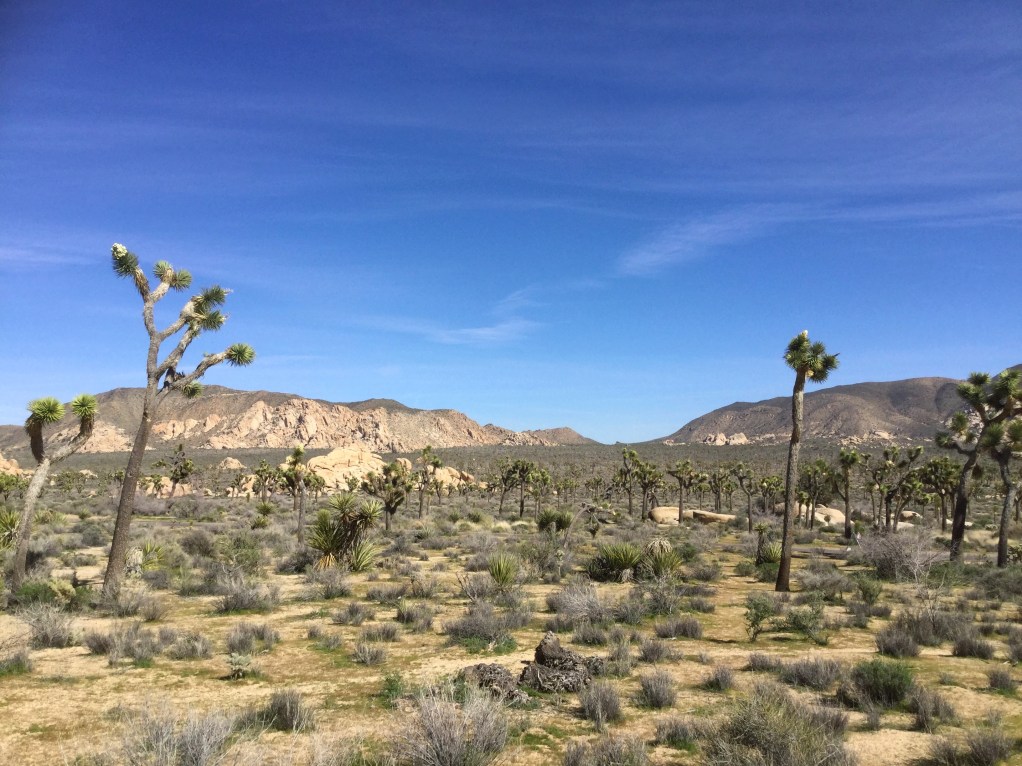
A Joshua tree in bloom

Here’s a photo journal of some of the beauties I marveled at on my latest visit, including the marvelous desert plants Minerva Hoyt loved so well. There were some wildflowers already in bloom, but this was mid-March, a little early for wildflowers at the higher, cooler, western Mohave Desert end of the park. I heard they were in full bloom at the eastern, lower, warmer Colorado Desert end of the park, but I was with a large family group during this visit and we were unable to round everyone up to make the additional drive.

Following these photos, you’ll find links to articles and books where you can read more about this hero of conservation. The political climate we find ourselves in in the United States does not bode well for the conservation of our greatest national wonders. Yet I hope the great vision of Minerva Hoyt, John Muir, Theodore Roosevelt (and later his cousin Franklin, who established Joshua Tree National Park by proclamation), and so many others who fought the good fight on its behalf, fueled by the love of nature which ennobles every heart it finds a home in, continues to win over the hearts and minds of all Americans. This is our pride and our heritage, and once gone, it may never return.

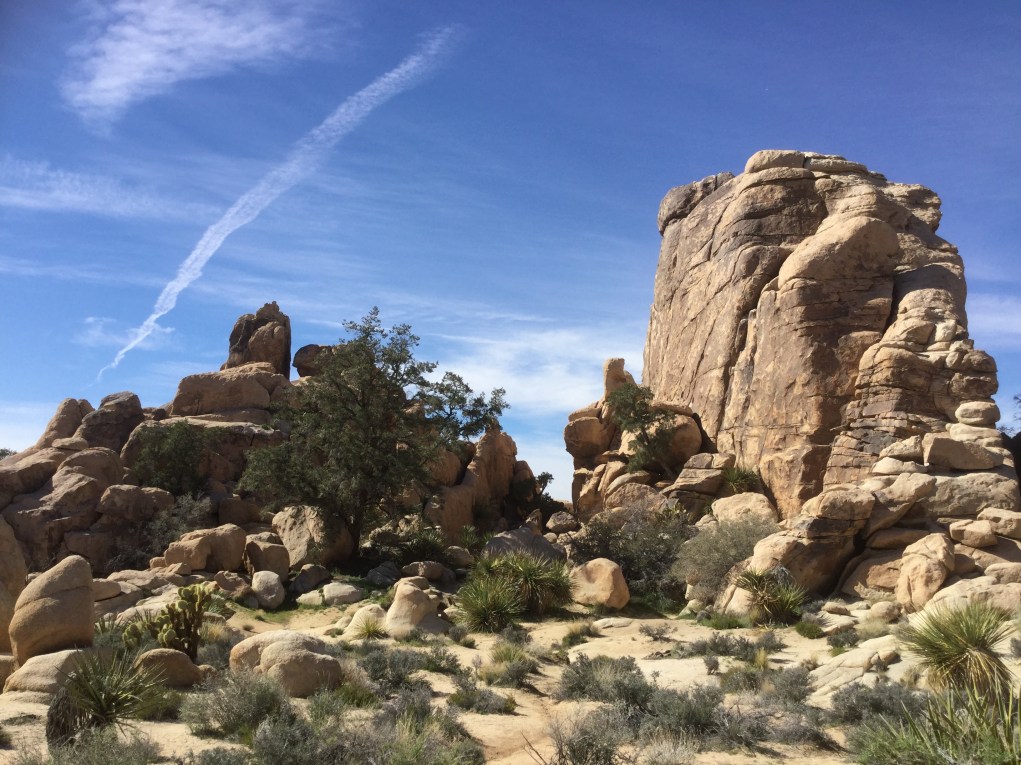
A natural sphinx stands tall among the sunrays and above the yucca plants in Hidden Valley, Joshua Tree National Park

Early blooming cactus, Joshua Tree National Park

Panoramic view of Hidden Valley in early spring, Joshua Tree National Park

A beautiful arrangement of stone, sky, cactus, and creosote, Joshua Tree National Park

Stone, flora, and sky in Hidden Valley, Joshua Tree National Park

Western tent caterpillars in a creosote bush, Joshua Tree National Park

A young Joshua tree forest, Joshua Tree National Park

Another view of Hidden Valley, Joshua Tree National Park

Sources and Inspiration

Bishop, Kim. ‘How One Tireless Advocate Protected Joshua Tree National Park‘. Aug 8, 2016, San Bernardino County Sun

Clarke, Chris. ‘The Woman Who Saved The California Desert‘. March 11, 2016, KCET.org

Kaufman, Polly Welts. National Parks and the Woman’s Voice: A History. University of New Mexico Press, 2006.

Zarki, Joseph W. Joshua Tree National Park, for Images of America book series. Arcadia, 2015

Zarki, Joseph W. ‘Minerva Hoyt‘. For the National Park Service at nps.gov

Ordinary Philosophy and its Traveling Philosophy / History of Ideas series is a labor of love and ad-free, supported by patrons and readers like you. Please offer your support today!

New Podcast Episode: Michel de Montaigne

Michel de Montaigne, public domain via Wikimedia Commons

Listen to this podcast episode here or on Google Play, or subscribe on iTunes

Michel de Montaigne, who lived from February 28, 1533 to September 13, 1592, was a thinker after my own heart.

Montaigne was a deeply philosophical thinker, though he never developed a complete philosophical system or moral theory. He invented, or at least popularized, a revolutionary way of writing: the essay. In his Essays, he wrote about anything and everything he found interesting enough to observe and think deeply about which was …well, just about everything, especially his inner life. His Essays are a rich source of wonderful philosophical and moral insights. As the Stanford Encyclopedia of Philosophy describes: “… under the guise of innocuous anecdotes, Montaigne achieved the humanist revolution in philosophy. He moved from a conception of philosophy conceived of as theoretical science, to a philosophy conceived of as the practice of free judgment’. Judgment, in this sense, involves applying both our cultivated moral sense and our reason, enriched with knowledge, to navigating the complexity and variety of situations we face throughout our lives; it also refers to the expansive, tolerant attitude we should display towards each other and towards the whole of reality…. Read the written version here

Ordinary Philosophy and its Traveling Philosophy / History of Ideas series is a labor of love and ad-free, supported by patrons and readers like you. Please offer your support today!