Thomas Jefferson Sites, Part 6: Charlottesville, and Last Day in D.C.

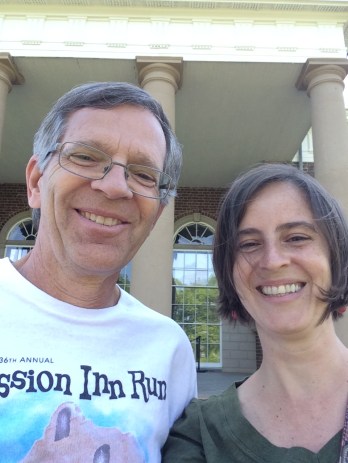
John and Amy Cools at Monticello, 2015 by Amy Cools

I’m at Monticello with my dad, John Cools! I’m one happy gal

Sixth day, April 24th, 2015.

Today, I’m heading south of D.C., and have only two destinations for the day, and that’s a good thing: it’ll take every hour I have to explore them, and make me wish I have more to spend. These places tell the story of what Thomas Jefferson’s all about more than any of the other sites I visited, with the possible exception of the Library of Congress (though he never visited the building, of course, since it was built decades after his death).

And this time, I’m pleased to say, I have a travel companion, that very special person I told you I was meeting yesterday: my darling Dad, John Cools! He’s one of my very favorite people in the whole world, and I can’t imagine a better person to go on a history tour with. He’s also handsome, like his big brother Bob, who lives in nearby Falls Church and took me on the little driving tour on the first D.C. day of this trip.
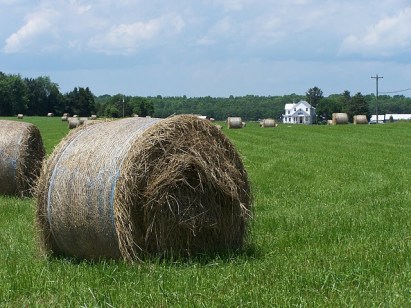
Groves Store, Somerville Post Office, farmland in Fauquier County, Virginia, image Emridou via Wikimedia Commons

Groves Store, Somerville Post Office, farmland in Fauquier County, Virginia, photo by Emridout via Wikimedia Commons

Groves Store and Somerville Post Office, surrounded by farmland in Fauquier County, Virginia, is itself the self-described “Downtown Somerville”. Photo by Emridout via Wikimedia Commons

We drive to Charlottesville via the smaller highways that take us through the beautiful Virginia farmlands, lush and green and still colorful with wildflowers. We lose a few extra minutes getting out of town, since we’re so busy chatting and laughing that we miss a couple of turns. After these brief false starts, we’re on our way.

Since I’m driving and absorbed in conversation with my Dad, I forget to ask him to be my photographer, and have no photos from the drive to share. However, I find a great one online that’s in the public domain; thank you, Emridout! Remove the hay bales, and you’re seeing more or less what we see during our drive.

Thomas Jefferson's final site plan for Monticello on display at the visitor center museum, 2015 by Amy Cools

Thomas Jefferson’s final site plan for Monticello on display at the visitor center museum

We arrive at Monticello, Jefferson’s stately home on the hill in Albemarle County, Virginia, just a few miles away from where he was born at Shadwell. (Monticello is Italian for ‘little mountain’.) His childhood home burned down when he was in his mid-twenties, and though I was tempted to find the site, I think it’s best to first see the main places we came to to see, and stop by Shadwell if we have time later. Turns out, we don’t.

First, we head to the ticket machine for the house tour.We’re scheduled for a tour a few hours later, so we start with the museum. It’s an excellent one.
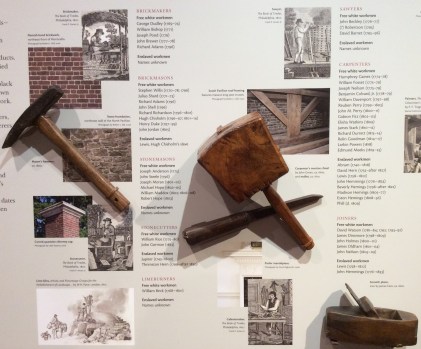
Tools like these would have been used in the building of Monticello, on display at the visitor center museum, 2015 by Amy Cools

Tools like these would have been used in building Monticello, on display at the visitor center museum

We start with the exhibit which shows how Monticello was designed and built in stages. In fact, it was never really finished. Jefferson was an experimental architect, and I guess he’d be considered an amateur, in the sense that although he designed buildings, he wasn’t paid to do it for a living and he wasn’t formally trained. It was one of his lifelong interests, however, and at Monticello, he’d often build up part of the house, only to see a building or illustration which gave him a better idea. So, he’d tear part of it down from time to time, redesign, and rebuild it.

Thomas Jefferson's standing desk, in the Monticello museum, photo 2015 by Amy Cools

Thomas Jefferson’s standing desk, in the Monticello museum. Doesn’t look like it would have been quite tall enough for his six-foot-two-inch self!

My Dad is a construction superintendent and started out in his professional life framing houses and building room additions; he’s also built or assisted in building many houses from the ground up. He used to take us kids with him to work sometimes, usually one or two at a time, and we would play with the wood scraps and little round metal cutouts from electrical boxes (which make perfect coins for buried treasure). Dad often says how much he misses building with his own hands, but a superintendent commands a much better salary and he had a family to support, so a superintendent he became. If Jefferson were here, they’d have a lot to talk about.

This exhibit is right up my Dad’s alley, and he pores over the displays in great interest. I’m interested too, but I’m more drawn to Jefferson’s standing desk displayed in the center of the room, as antique furniture is a little more my forte. It’s both elegant and practical; I would love to own it. With its tilt top and pull-out additional work surface, it’s just as great for the laptop and reference books I’m working with as it was for Jefferson’s pen and paper. My day job is in a medical office, and I often regret the number of hours I spend sitting down. This would be a perfect solution.
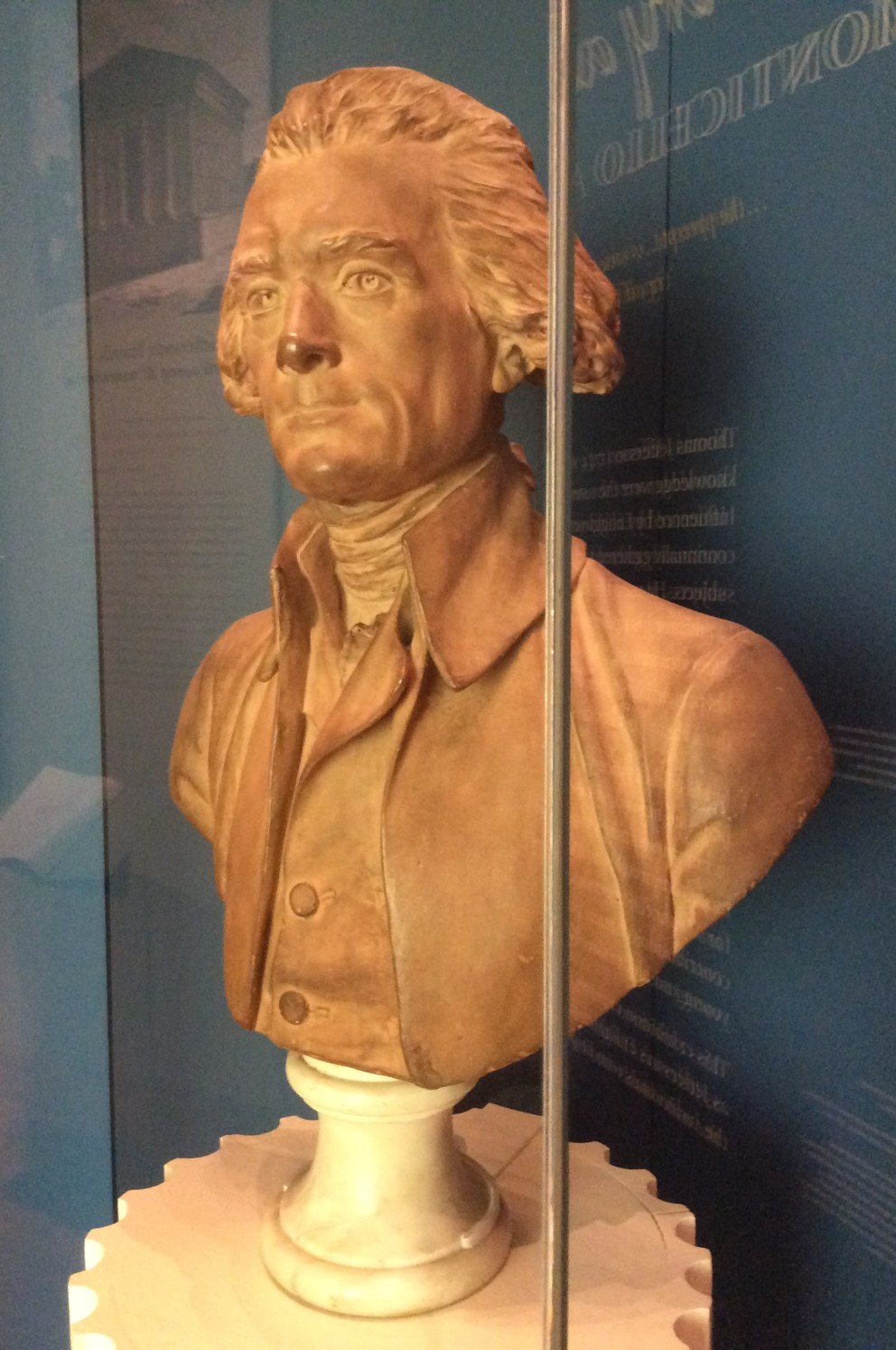
Bust of Thomas Jefferson at the Monticello museum, photo 2015 by Amy Cools

Bust of Thomas Jefferson by Jean-Antoine Houdon, 1789

We head for the gallery across the hall whose displays focus on the daily lives of all who lived and worked at Monticello. There’s a handsome bust of Jefferson at the front of gallery, and I find I like the face. It’s very expressive, a little handsome, with hair that looks awkward to my modern eyes, swept outward from either side of his face.
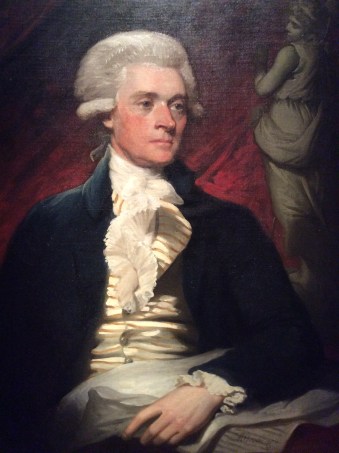
Thomas Jefferson portrait by Mather Brown, at Washington DC portrait gallery, photo 2016 by Amy Cools

Portrait of Thomas Jefferson by Mather Brown (original), at Washington DC’s National Portrait Gallery

I recall a portrait of Thomas Jefferson by Mather Brown, the first known portrait of him painted in London in 1786, which doesn’t look that much to me like the man portrayed in this bust or most of the other portrayals I’ve seen. A copy of this portrait hangs here at Monticello somewhere; the original is on display at the National Portrait Gallery in Washington DC.

I’ve heard the Brown portrait described as more handsome than Jefferson in real life: he was tall, lanky, with red hair and freckles and a long nose. But I like the face portrayed in the bust much better: it looks a bit patrician but with rough edges, the face of an energetic man who spends a lot of time outdoors or doing something else interesting. The Brown portrait looks stuffy and a little haughty in comparison, and I never did like the powdered look.
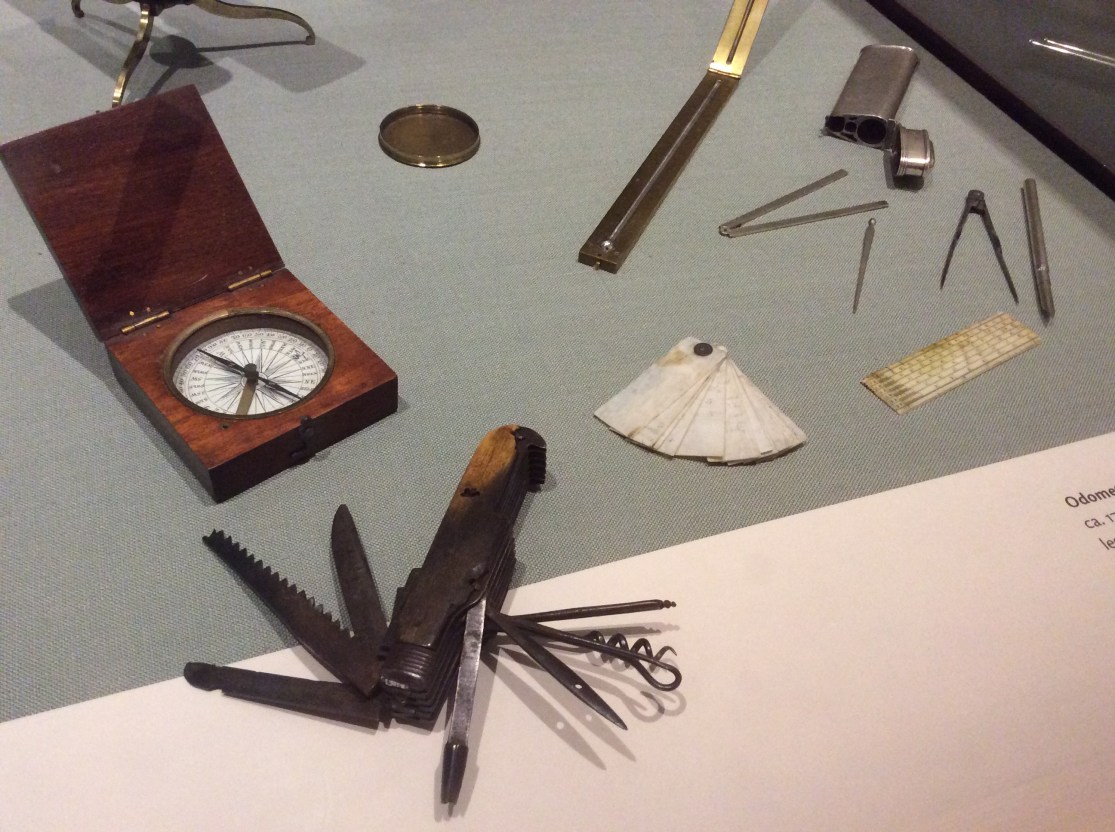
Thomas Jefferson tools and gadgets on display at Monticello museum, 2015 by Amy Cools

Thomas Jefferson’s pocket tools and gadgets

A project-oriented, outdoorsy man like Jefferson needed a toolkit, and we see a nifty one in this gallery. There’s a pocketknife, drafting instruments with a little silver case, architect’s scale, and most interesting to me, a sort of tiny notebook made of ivory. It fans out like a lady’s fan, and what’s nifty about it is that you can write notes on it in pencil, and then erase the marks by rubbing them off with your finger, making it available to use again. I use the Pages app on my mini iPad in sorta the same way during my travels.

The gallery has many, many more great exhibits, way too many to picture here!

The graveyard at Monticello as seen from the path from the museum to the house, 2015 Amy Cools

A view of the graveyard at Monticello, as seen from the path from the museum up to the house

Completing our tour of the museum, we grab a bite to eat at the cafe (they actually have very tasty, reasonably priced food, sometimes even serving vegetables raised in the restored Monticello gardens) and then head up the hill toward the house. It’s a nice little stroll, I think preferable to the shuttle, since it gives you time in nature to refresh yourself between the mental effort of taking in all that history; interesting as it is, it’s fatiguing after awhile, and the break is welcome. The path winds through a pretty little patch of woods, and it’s spring, so the leaves are still small and bright green, and you can see quite a ways through the trees and get a pretty good view of the lay of the land.
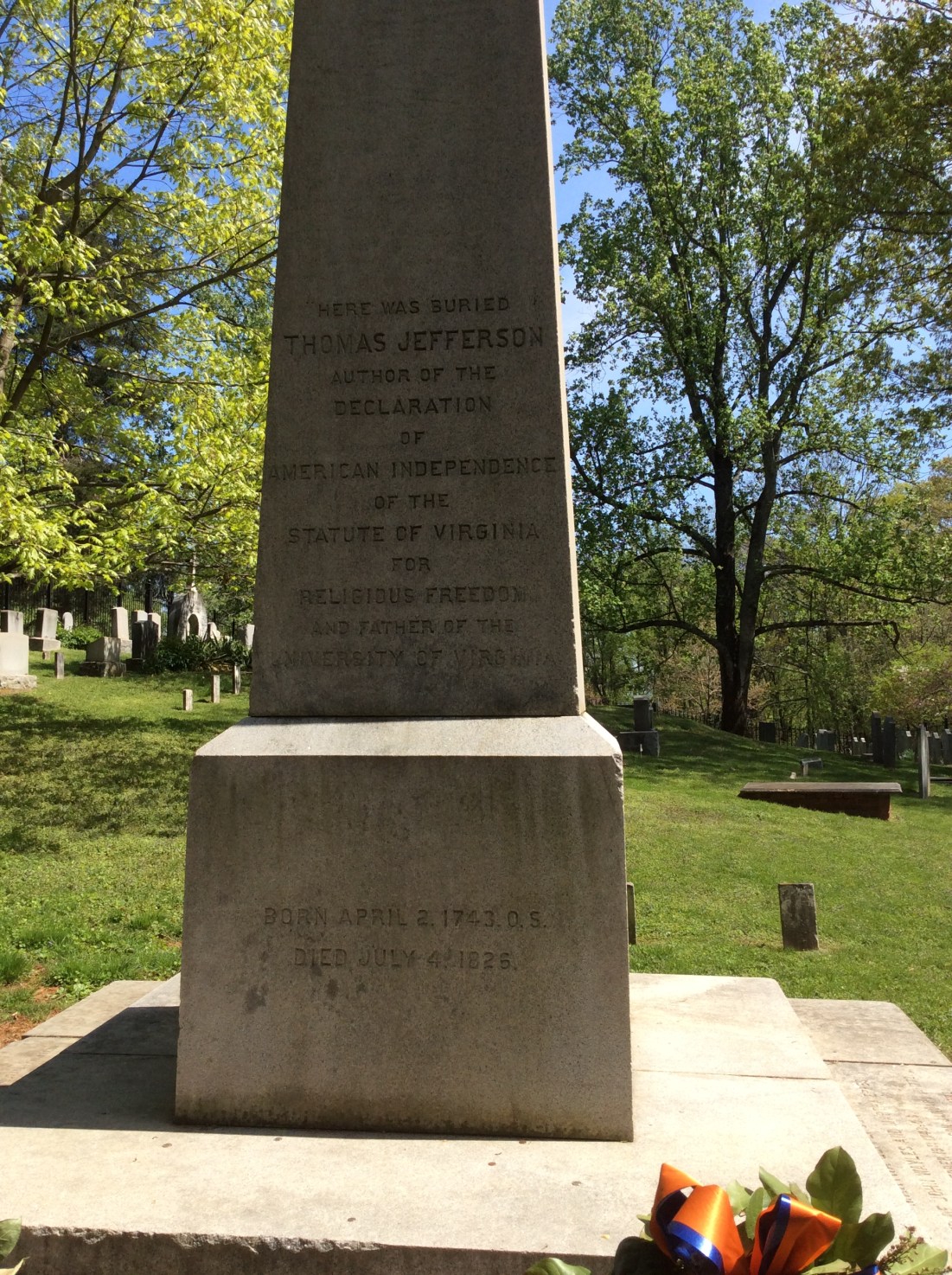
A closer view of Thomas Jefferson's obelisk-tombstone at Monticello, 2015 by Amy Cools

A closeup of Thomas Jefferson’s obelisk-tombstone, listing the three self-selected accomplishments he was most proud of

The Jefferson family graveyard is about halfway up the hill to the house from the welcome center, and Jefferson, his wife Martha Wayles Skelton Jefferson, his mother Jane Randolph Jefferson, his sister Martha Jefferson Carr, and her husband, his brother-in-law and best friend Dabney Carr. Carr and Jefferson studied law together and both were members of the Virginia House of Burgesses. They were very close since childhood, and would hang out on the hill that would later become the site of Monticello, often reading and talking under the shade of a favorite oak tree. They promised that whoever died first, the other would bury him under that oak. Carr, sadly, died at the early age of thirty, so it was up to Jefferson to fulfill that vow.
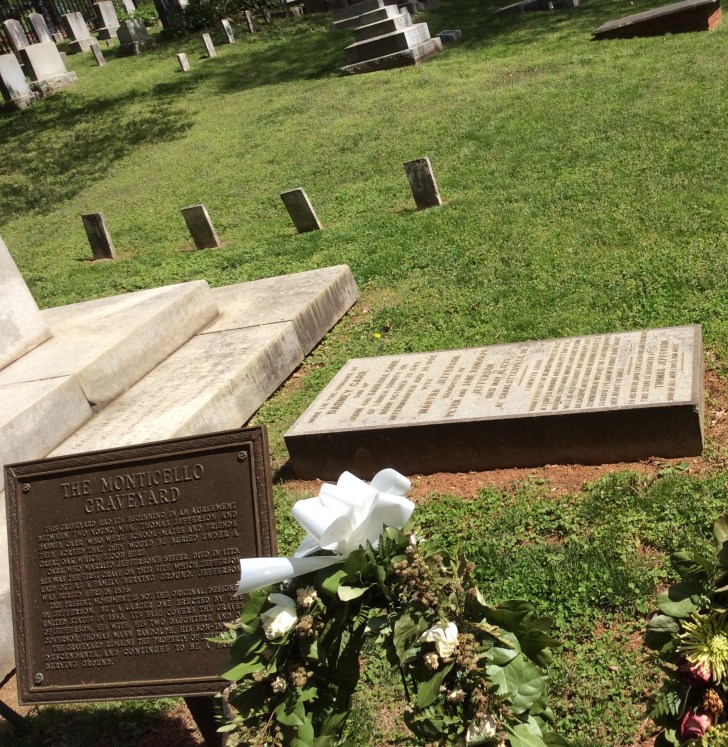
Dabney Carr's grave, first to be buried at Monticello, photo 2015 by Amy Cools.jpg

Dabney Carr’s grave; he was the first to be buried at Monticello

This graveyard grew up around that first burial, and over the years, his mother-in-law, nieces, nephews, cousins and other family, his wife Martha 38 years later, and finally Jefferson himself, were buried.

The obelisk that is Jefferson’s tombstone towers high above the rest, and besides his name and birth and death dates, it’s carved with a list of his three proudest accomplishments: author of the Declaration of Independence and the Virginia Statute for Religious Freedom, and founder of the University of Virginia. Not the presidency of the United States, or his diplomatic service to France, or any of his other achievements in politics, scholarship, law practice, legislation, agriculture, science, architecture, invention, or philosophy, none of these made it onto that stone.

Whatever his flaws, the fact that he directed only these three to be carved on his tombstone increases my respect for him quite a bit. Rights-based government; freedom of conscience; public access to a liberal education: it’s hard to come up with a list of three more valuable social goods. Jefferson did more than most to promote these in his lifetime; even where he didn’t carry out his goals or conceive of better ones, he helped lay the groundwork so that others could implement his ideals of a more enlightened, rational, humane society more fully.
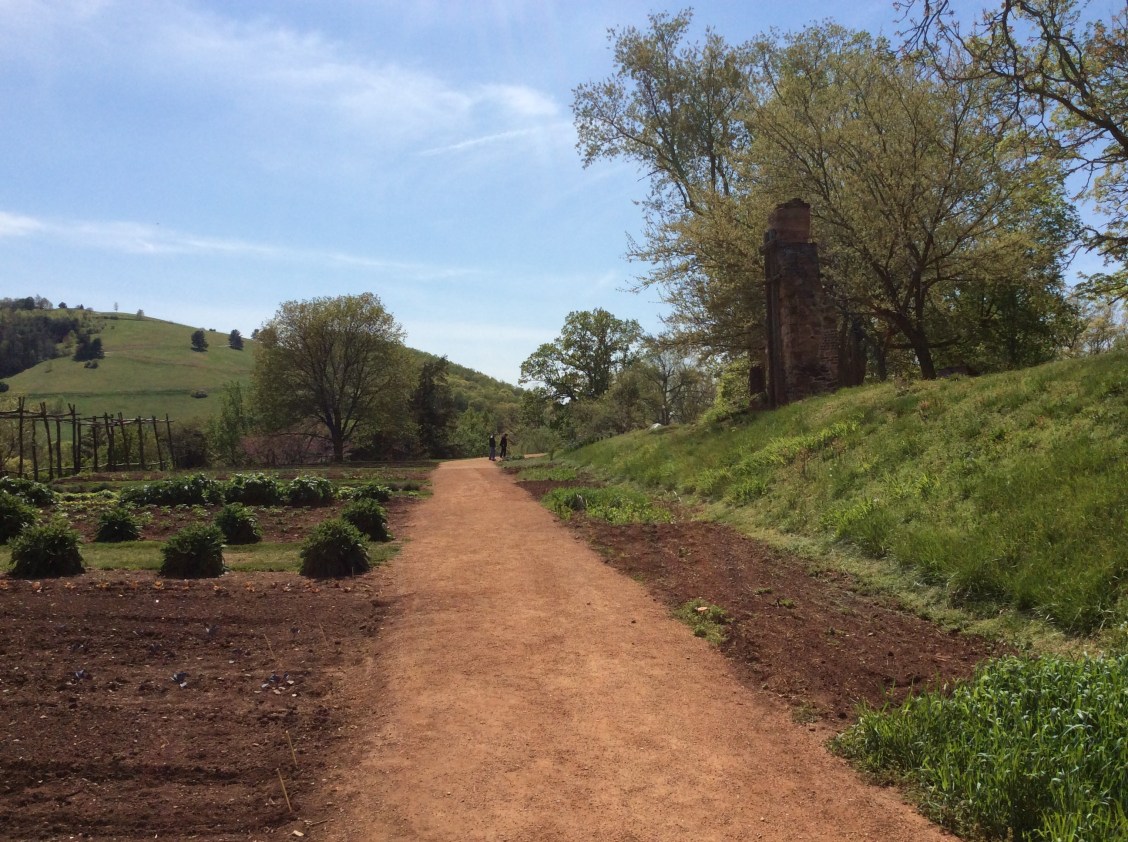
Mulberry Row path and gardens at Monticello, photo 2015 by Amy Cools

Mulberry Row path and gardens at Monticello

Dad and I pause, gaze, and reflect a little while here, then we continue up the hill. We arrive next at the gardens and Mulberry Row, where many of Jefferson’s slaves and hired contractors lived and worked, including his slave, departed wife’s half-sister, and mistress of 38 years Sally Hemings. The gardens and the Row run side by side to the south of the house.

The gardens are fully restored, laid out in the same way as in Jefferson’s time in accordance with his notes and drawings, and as much as possible, grow what Jefferson’s farm grew, and are as carefully tended.

Chimney and foundation of the joiner's shop on Mulberry Row, 2015 by Amy Cools

Chimney and foundation of the joiner’s (woodworker’s) shop on Mulberry Row

Mulberry Row is a fascinating place: there’s been extensive archaeological work done, with many of the foundations of the original structures laid bare and described by signs, interspersed by a few reconstructions. Most of the buildings on the Row burned down or were pulled down when they fell into disrepair, but there are a few structures still standing that are original.

On the west end of the Row stands the chimney and bits of the walls of the joiner’s shop, where the fine woodworking was done: wood molding, furniture, carriages, doors, windows, and so on, from wood that had been imported or felled on the plantation and cut into lumber elsewhere, then brought here. If he needed skilled work done, the practical Jefferson would hire an expert, often from Europe, then apprentice one of his slaves to him so that they could provide the same services in the future. For example, Sally Heming’s half-brother John Hemings became Monticello’s master woodworker after acquiring the skill under the tutelage of David Watson, a hired Scotsman.

Uriah Phillips Levy's mother's gravesite on Mulberry Row, Monticello, 2015 by Amy Cools

Uriah Phillips Levy’s mother’s gravesite on Mulberry Row

One creative and lovely use of one of the crumbling structures on the Row is Uriah Phillips Levy’s mother’s gravesite wall. Levy believed that great people’s homes should be preserved in their memory, and as the first Jewish naval officer in the U.S. who also advocated for religious liberty and against flogging, was a great admirer of Jefferson’s. So, he bought Monticello in the 1830’s to restore and preserve it. When his mother died here, Levy buried her here in this site overlooking the gardens and vista of the woods and green farmlands below.

Textile workshop on Mulberry Row, Monticello, 2015 by Amy Cools.JPG

Textile workshop on Mulberry Row

There are two buildings on Mulberry Row that are original and still more or less intact: the workmen’s house which at some point became a small textile factory, and one of the stables.
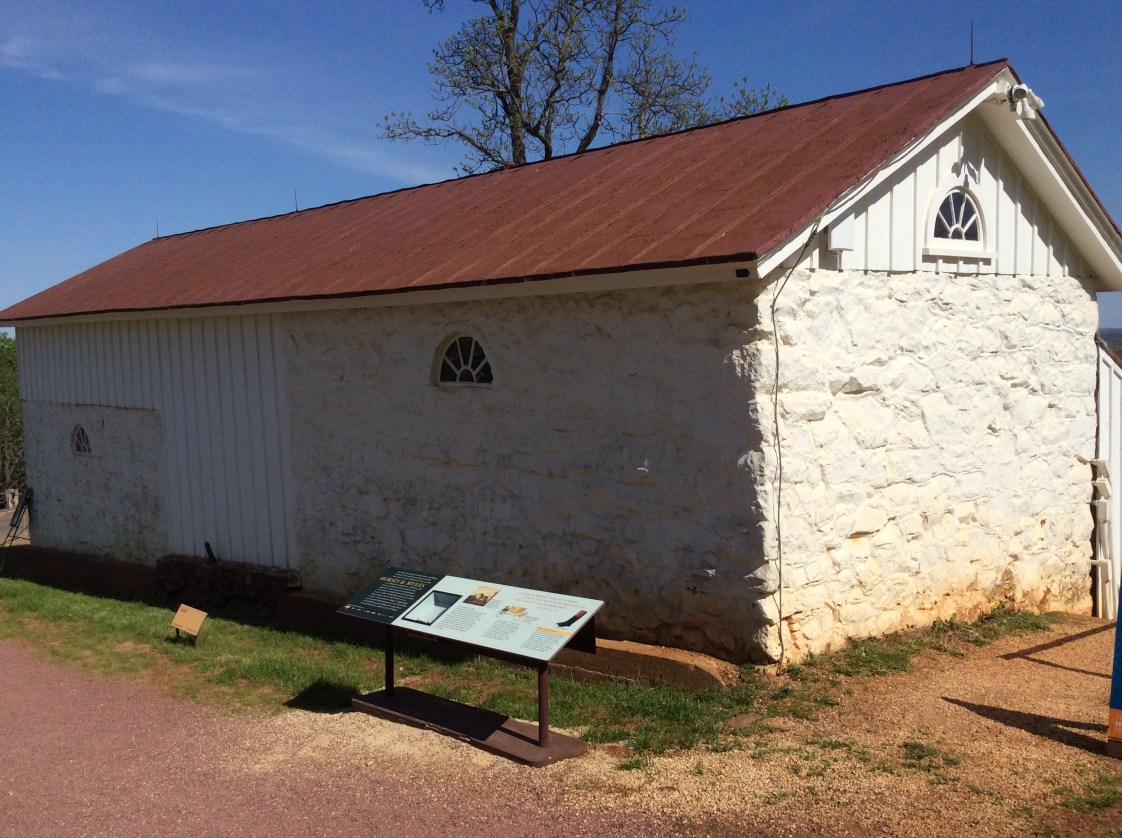
Remaining section of stables on Monicello's Mulberry Row, 2015 Amy Cools.JPG

Remaining section of the stables on Mulberry Row

The workmen’s house / textile workshop was first built in the 1770’s, and the stables in 1808. The latter was originally a larger, L-shaped building; this is what’s left.

We’re so absorbed in exploring Mulberry Row that we almost don’t notice those that the few hours we had to wait to tour the house had quickly passed. We scurry on over to join our tour group.

Monticello is preserved and run by a private non-profit, the Thomas Jefferson Foundation, and many of the artifacts contained in the house are on loan by private collectors. The tour guide explains that since the Foundation has not received permission from the owners of all the artifacts, no photography is allowed inside. So I contact the Foundation and receive permission to use a limited number of the Foundation’s images of the interior.John Cools and tour group at Monticello, 2015 by Amy Cools
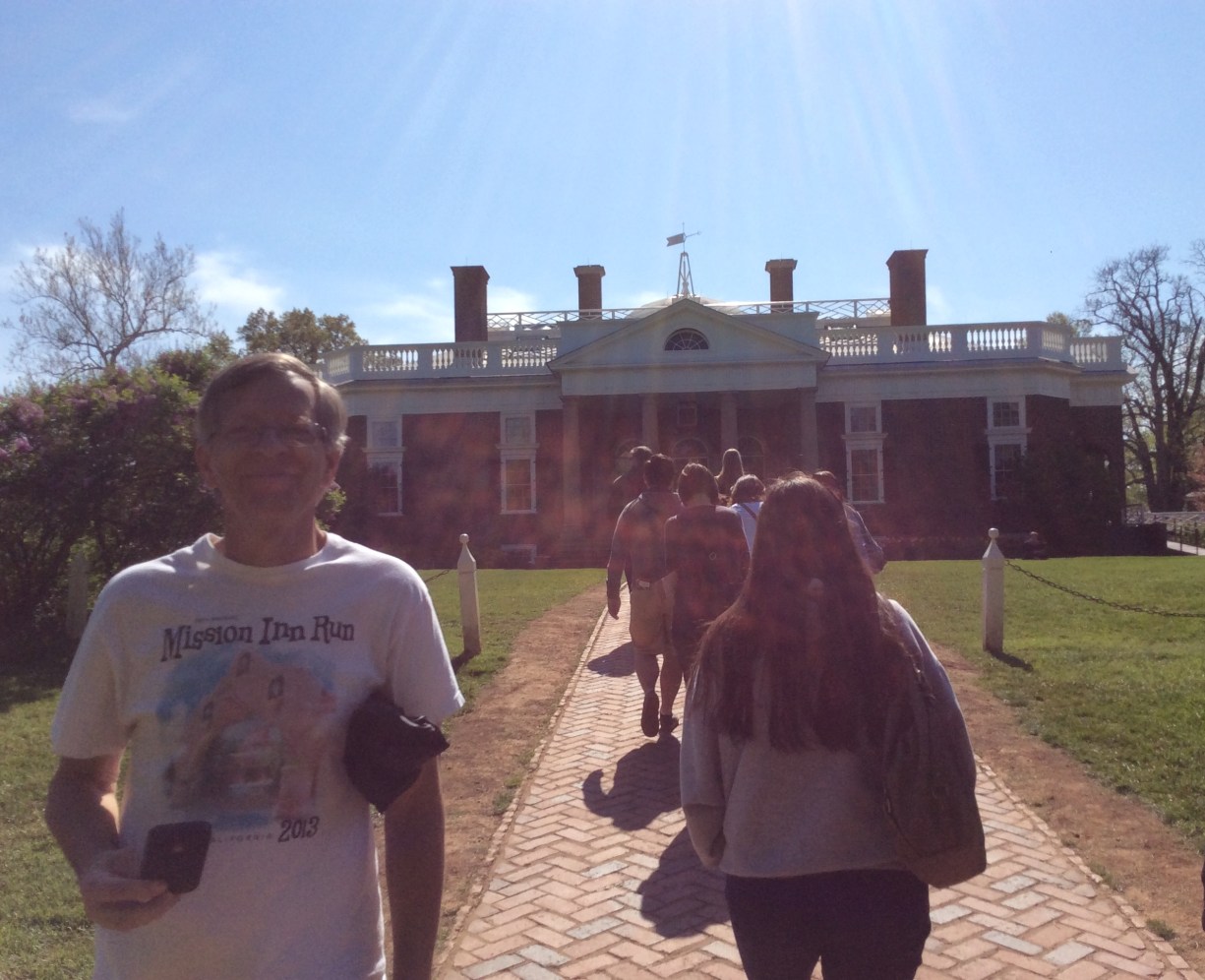
This may sound like heresy to many, but while Monticello is a very interesting and even impressive house, I don’t consider it particularly beautiful or graceful. It looks just like what it is: a concoction of an experimental architect who loves all things classical and equally loves invention and values practicality, constructed in a piecemeal fashion so that these two aspects of Jefferson’s taste are never reconciled. There are beautiful details and fine craftsmanship throughout the house, even some lovely rooms. But many of the elements don’t fully harmonize with one another and overall, it just doesn’t hang together. That’s fine by me: because it’s such a quirky place, very much a product of an individualist, I find it all the more interesting to explore, and I think it’s a really… well, nifty place.
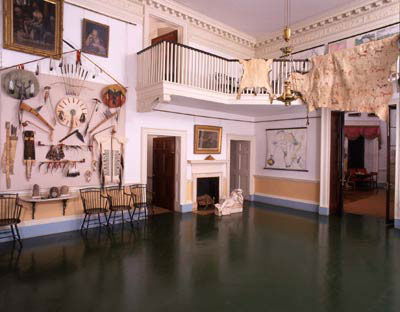
Monticello Entrance Hall © Thomas Jefferson Foundation at Monticello 2, photo by Robert Lautman

Monticello Entrance Hall © Thomas Jefferson Foundation at Monticello 2, photo by Robert Lautman, used by permission

We enter the front of the house through a large portico with a pointed lintel, topped with a large weather vane. While the weather vane looks rather funny with the neoclassical design, it pierces the roof and attaches to a dial on the portico ceiling so that the detail-oriented Jefferson could step out onto the front porch and see which way the wind was blowing just by glancing up.

There’s also a giant clock over the inside front door of the entrance hall, which tells not only the time of day but the day of the week, again, somewhat awkwardly. Since the weights suspended from overly long chains hang down through holes cut in the floor, he’d have to go down to the basement to check the day of the week on Saturdays and Sundays if his calendars hadn’t already alerted him. Again, over-the-top tech nerdy gear, still in the process of development, for the 18th century gadget-head.
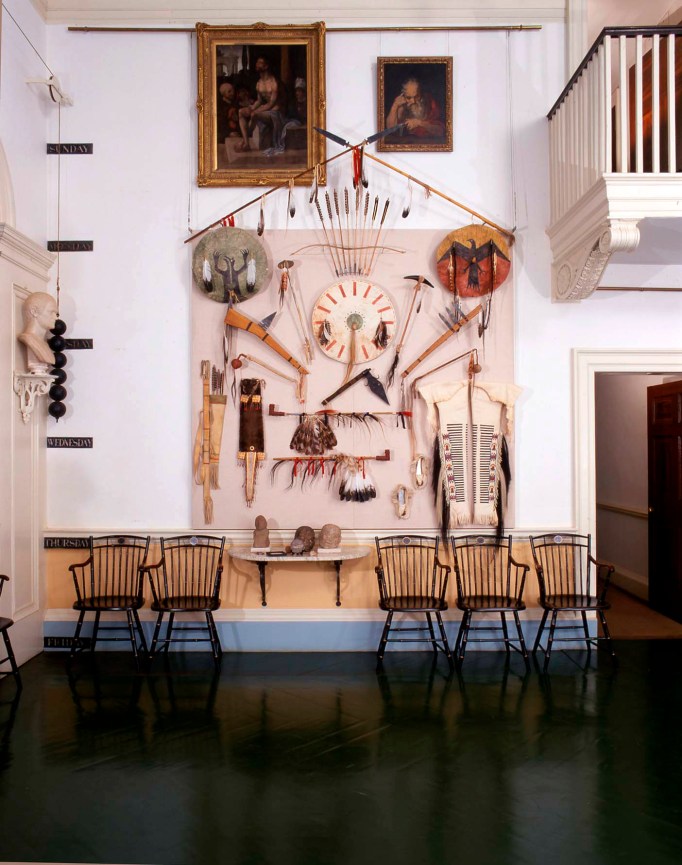
Monticello Entrace Hall South Wall 2, © Thomas Jefferson Foundation at Monticello

Monticello Entrace Hall South Wall 2, © Thomas Jefferson Foundation at Monticello, used by permission

 As we enter the entrance hall, Jefferson’s fascination with the natural world and the history of local cultures is manifest in the beautifully presented and preserved fossils and Indian artifacts that fill the room. Painted animal skins hang from the interior balcony, shields, spears, pipes, clothing, and the heads and skulls of animals hang on the walls, fossil remains of animals cover tables. Jefferson was an innovator and pioneer in many fields, including archaeology; he’s credited with directing the first scientific archaeological dig in the Americas.

Among the busts and portraits that ring the room, his own is placed across the room from Alexander Hamilton’s, Jefferson’s ideological foe and political nemesis. While he long thought Hamilton’s political beliefs would spell disaster for the new republic if carried out, he ended up using some of Hamilton’s methods to accomplish his own goals as President, such as taking on more national debt to pay for the Louisiana Purchase. Hamilton was a Federalist, and believed that a strong central government, a standing army, industry, and a national debt were necessary for any nation’s success and the liberty and well-being of its inhabitants; Jefferson believed that a small national government, largely independent agrarian states, no standing army, and freedom national debt would accomplish these ends much better. Let that be a lesson to us, as I’m sure it was to Jefferson; it’s always important to remember that others many have insight we haven’t yet had occasion to see clearly for ourselves, and to be ready and able to change our minds when the circumstances reveal that we’re wrong.

Monticello Book Room © Thomas Jefferson Foundation at Monticello

Monticello Book Room © Thomas Jefferson Foundation at Monticello, used by permission

We pass thorough a pretty, small blue parlor to the next room that really represents something that Jefferson’s all about: the book room. You may be surprised that Jefferson had such a large library as this in his later years considering he’d sold all his books to Congress in 1815. But as he wrote to John Adams, he couldn’t live without books, so he promptly resumed accumulating more debt by building a new library.

The book collection here is composed of only a few from Jefferson’s actual collection; the rest are identical titles that others had owned. The room does hold one of Jefferson’s actual high-backed easy chairs and an original portrait of Jefferson in profile by Gilbert Stuart, which Jefferson’s friends and family said looked more like him than just about any other portrait.

Monticello Jefferson Cabinet © Thomas Jefferson Foundation at Monticello

Monticello Jefferson Cabinet © Thomas Jefferson Foundation at Monticello, used by permission

Then through a beautiful, plant-filled, well-lit greenhouse and hobby room to Jefferson’s ‘cabinet’, or personal office, connected to his bedroom by two passageways. He was a busy man, disciplined in his reading, writing, and keeping of accounts, and wished to be able to get right back to what he was working on as efficiently as possible. So he devised two ways to get from one to the other: one, the standard little hallway which is the one we walk through and two, his alcove bed was set into the dividing wall, so he could roll out of bed to the left into his bedroom, or to the right straight into his office. It’s also the bed he died in, so there would have been plenty of space for his loved ones to bid him goodbye from whatever direction they came. I feel, for a moment, a little like an intruder, since Jefferson was a very private man in many ways, especially concerning matters of the bed, so to speak. But as he said, the world belongs to the living, not the dead, and we the living are here to learn from what he left behind.

Jefferson’s office is an especially interesting and revealing room. It’s full of scientific instruments, an orrery (model of the solar system), a polygraph (a mechanical device which makes a copy of the letter you’re writing while you’re writing it), and gadget-y furniture, including a revolving bookstand which allowed Jefferson to quickly consult several volumes at once, an adjustable-top desk which could be raised, lowered, and angled to suit the needs of the moment, and revolving chair and table. My good friend Alex, who simply must to have or at least try out every new invention that comes along, would drool over this room.

Like the entrance hall, it’s also ringed by portrait busts and images of his friends and influences, including George Washington, James Monroe, and, like Hamilton, a Federalist, but unlike Hamilton, a friend, John Adams. Adams and Jefferson met at the Second Continental Congress in 1775 and became close friends. While they shared a commitment to the Revolution and to the cause of political and personal liberty in general, they differed sharply in some particulars in how this could best be accomplished. Adams held a more pessimistic view of human nature, and thought that a free people needed a stronger government, stricter laws with greater social accountability, and a more aristocratic, pomp-and-circumstance-orientated leadership to inspire and impress. Jefferson held a more optimistic view of human nature, and thought that the people could be trusted to govern themselves if mostly left alone, with government interference only when people infringed on one another’s natural rights. Both emphasized the importance role of education, believing that an uninformed and uneducated populace would always remain vulnerable to exploitation and oppression. Adams thought it should be fully financed at public expense, and Jefferson was a founder of the American system of public higher education (more on that shortly).

At Monticello with my Dad, John Cools, photo 2015 by Amy Cools.JPGWe pass through many other interesting and handsome rooms, including the parlor, lined floor to ceiling with portraits, again of Jefferson’s friends and influences. If I were to describe all the rooms in detail, this account would go on far too long, so I refer you to Monticello’s website’s excellent virtual online tour, or better yet, go see it in person! I assure you, you will not be disappointed.

Leaving the house, we chat just a little with some other tourists. Since we all want photos of ourselves and our companions in front of the house, we oblige one another in turn, and I pose with my handsome Dad and favorite travel buddy. We pause for a little break outside, and take in the view looking down from the hill at the scenery all around. Peering through a little break in the trees, we can see, far off in the distance, our next destination after Monticello.West (rear) entrance of Monticello, photo 2015 by Amy Cools.JPG

 But we still have some exploring to do here. Monticello is also composed of an L-shaped wing on either side of the house, with the long ends extending past the rear portico. These wings are set below the house, built into the base of the hillock the main house is on with the entry doors facing out, and connect with the basement on either side; the roofs of each these wings form a terrace. At the tail end of each L, there’s a two-story brick building, or pavilion.
View north from Monticello's west lawn, 2015 by Amy Cools

View north from Monticello’s west lawn. If you look hard, you can just make out the University of Virginia through the trees

The south pavilion was the first finished house structure at Monticello, composed of two rooms, a combination bedroom and sitting room over a kitchen. Because Shadwell had burned two years earlier, Jefferson moved into this building in 1772, before schedule, with his new wife Martha and his infant daughter, also named Martha but called Patsy. They lived in this little house for nearly two years, until the main house was built up enough to be habitable in 1794.

We head on down below the terrace. The basement and both lower wings of Monticello house more slaves’ quarters, the smokehouse, the dairy, the kitchen, the wine cellar and brewery, the ware room, stables, the wash house, a privy, and numerous other rooms, all full of interesting exhibits showing how a large plantation community raised and produced food, ran a great house, manufactured goods for sale and for consumption, and so on. Again, I very, very highly recommend a visit!

After thoroughly exploring this fascinating place, we realize that a couple more hours had flown by and we needed to skedaddle if we were to reach our next destination in time to tour it in daylight.
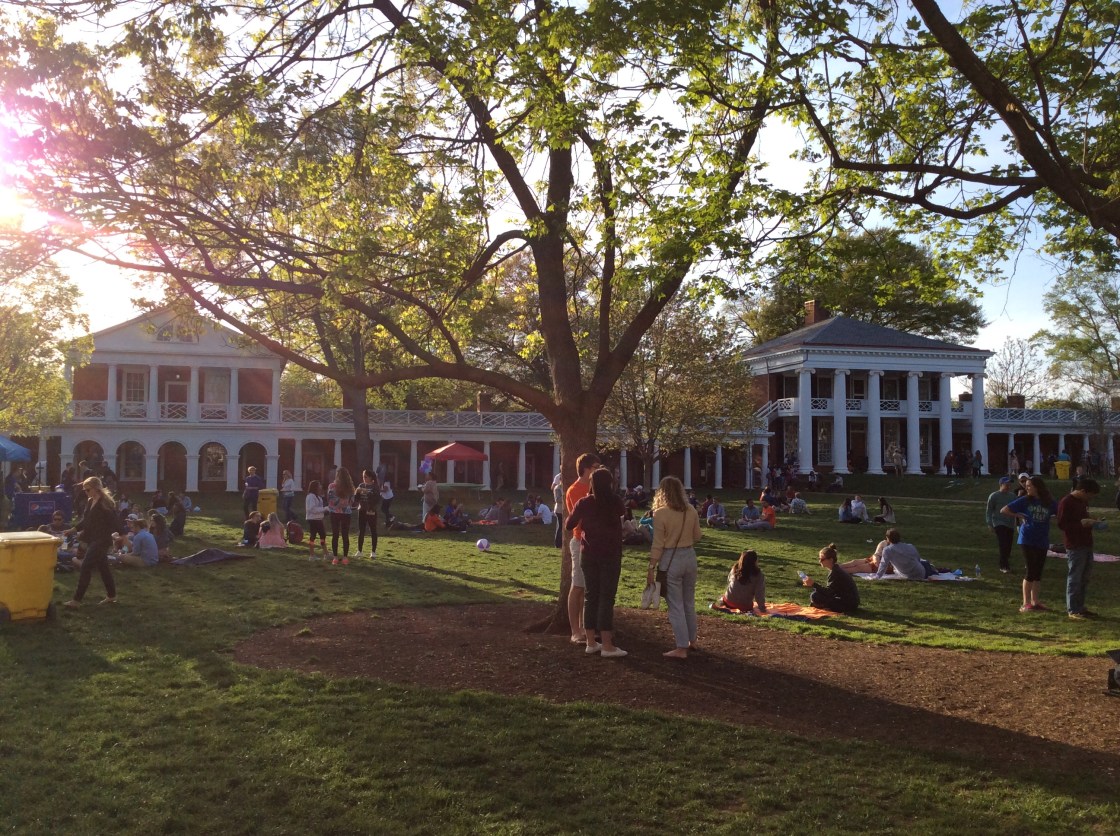
Students attending festivities in The Lawn at the University of Virginia, 2015 Amy Cools.JPG

Students attending festivities winding down on the Lawn at the University of Virginia
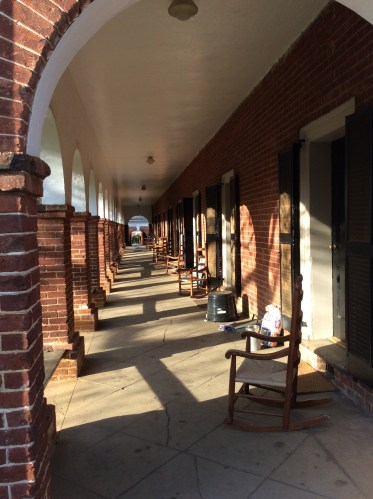
Long porch of student housing at the Pavilion, University of Virginia, 2015 by Amy Cools

Long porch of students’ quarters at the University of Virginia. The Academical Village was designed to place students and teachers in close proximity and therefore, frequent discourse

We wind our way down the hill toward the University of Virginia, which Jefferson founded in 1819. As aforementioned, you can see the domed roof of the Rotunda between the trees from Monticello looking northwest. I’d bet he kept the trees trimmed from time to time in that direction so that he could look upon what he considered one of the most important accomplishments of his life.

As were so many of Jefferson’s brainchildren, the University was an innovative institution. It was nonsectarian; it was among the first to adopt the elective system; it focused on educating students qualified entirely on the basis of merit, not wealth or social standing; it emphasized the study of the sciences as well as the humanities; and it was built as an ‘academical village’, which emphasized a close association between instructors and students but with private lodgings for the latter, facilitating peaceful study and healthful rest. When we arrive, it’s not exactly peaceful: it appears we’ve caught the tail end of a daytime festival, with tents and booths scattered around, groups of students standing or lolling on picnic blankets, and a live band playing.
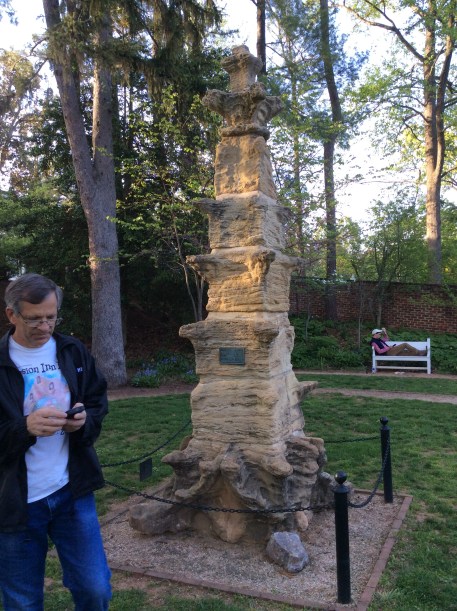
A pinnacle of Merton College Chapel tower, erected 1451, in the gardens at University of Virginia, 2015 Amy Cools

A worn pinnacle from Merton College Chapel tower, erected 1451, in one of the University of Virginia’s gardens

The center of the University is arranged around a grand rectangular Lawn, where the festivities are winding down, with the Rotunda Building at the head. It’s a very handsome building, modeled after the Pantheon and exactly half its height and width, where Jefferson much more successfully married the local red brick look with classical design than at Monticello. Jefferson not only designed the Rotunda (with help), he designed the Academical Village, many of the other buildings, the overall layout, even, as I discover on a plaque on one of them, the whimsical wavy garden walls.

The University is a lovely place to stroll, built on hilly green grounds with lots of trees, enchanting little gardens tucked behind student buildings, many containing interesting sculptures or old architectural relics. One has at its center an original ancient, heavily weathered stone spire from Merton College at Oxford dating from 1451. It’s about to turn Friday evening, and the students are out in droves to start off their weekend dressed to impress, laughing, chatting, and jostling their buddies.The Rotunda at the University of Virginia, undergoing extensive renovation, 2015 Amy Cools.JPGUniversity of Virginia stands on site of James Monroe's first farm, historical marker, 2015 Amy Cools.JPGMy Dad and I wander and chat, discussing what I had learned before the trip of the history of the University and its architecture. It also works out well that our visit coincides with the Rotunda building’s restoration, since, as aforementioned, my Dad has spent his life working in construction. Even though we can’t see the interior, we can observe the process of restoration as well as see many of the Rotunda’s underlying structures exposed, which he finds very interesting.
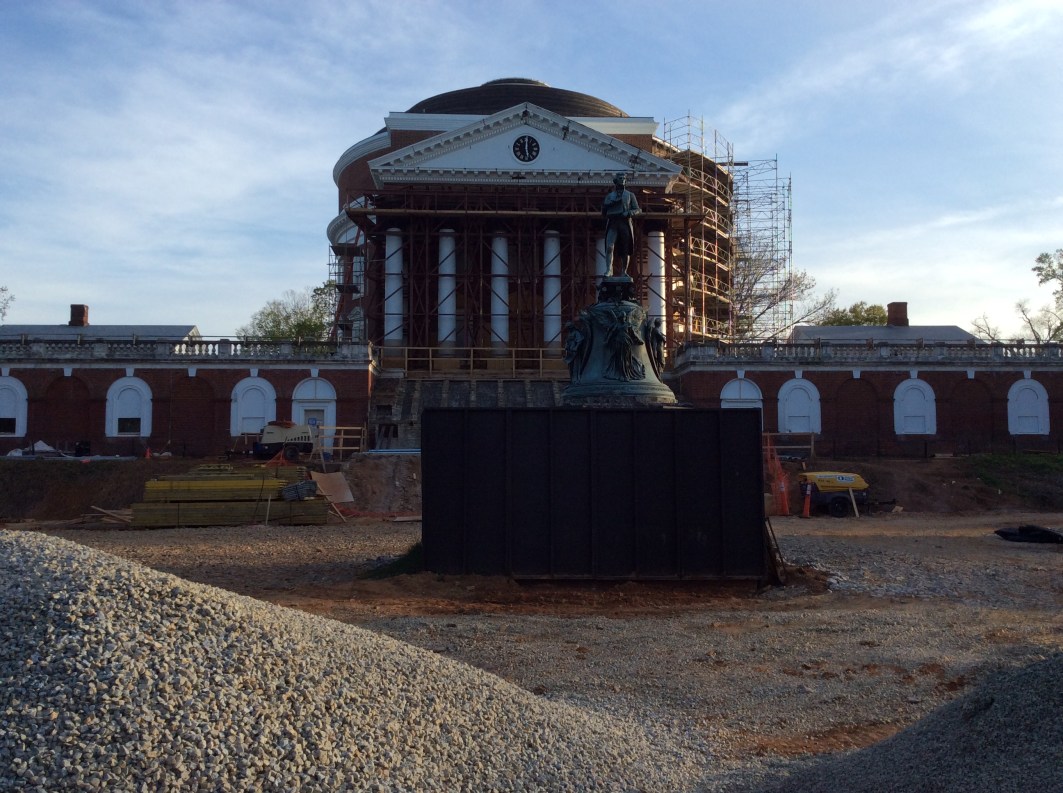
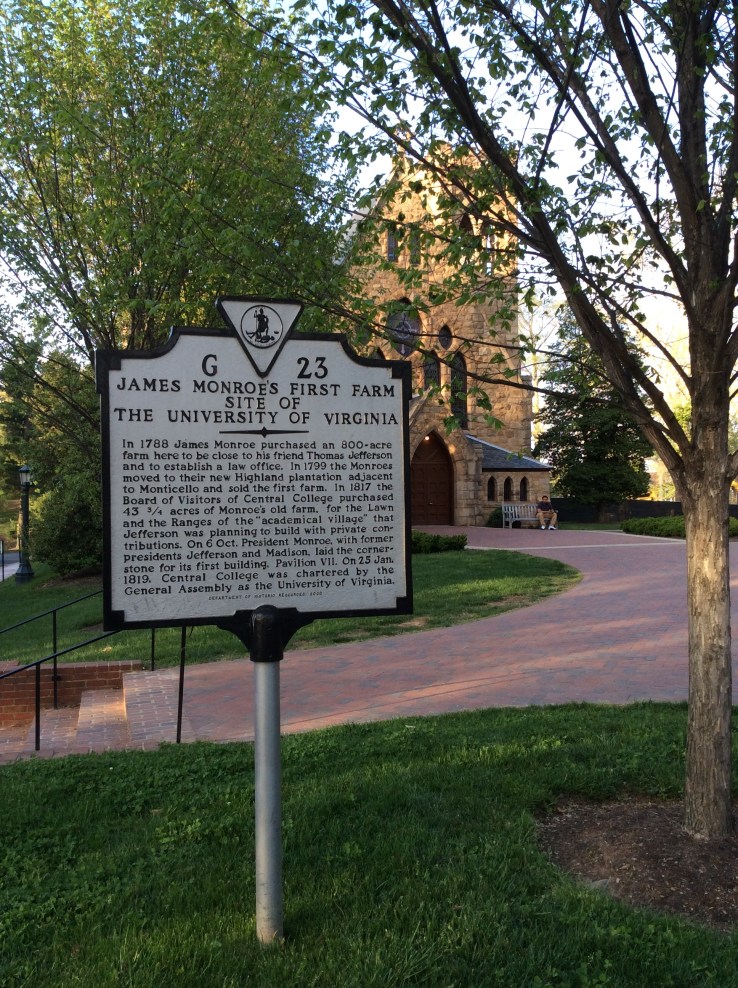
We learn various other interesting facts as we explore; there are historical markers aplenty throughout the college grounds. Part of the grounds of the University is located on the site of Jefferson friend and colleague James Monroe’s old farm, one sign explains. Another informs us that Edgar Allen Poe attended for one term in 1826, dropping out because his adopted father would not pay all of his debts. Imagine becoming so famous that briefly attending and dropping out of a prestigious university would earn you a historical marker there!

Dusk arrives, and it’s time to seek out dinner before the two-hour-plus drive back. It’s been an excellent day, and I couldn’t ask for better company. If you couldn’t tell already, I’m a bit of a daddy’s girl.
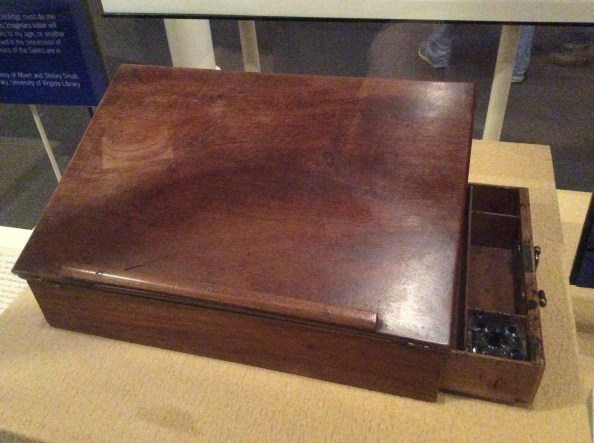
Thomas Jefferson's lap desk, on which he wrote the Declaration of Independence, 2015 by Amy Cools

Thomas Jefferson’s lap desk, which he designed himself and on which he wrote the Declaration of Independence

Seventh day, April 25th.

The last day of my trip is dedicated to visiting museums with my Dad, and I put my project on hold for the time being. However, I return to the Jefferson Building of the Library of Congress with my Dad to show him around because I know he’ll absolutely love it. (He does.)
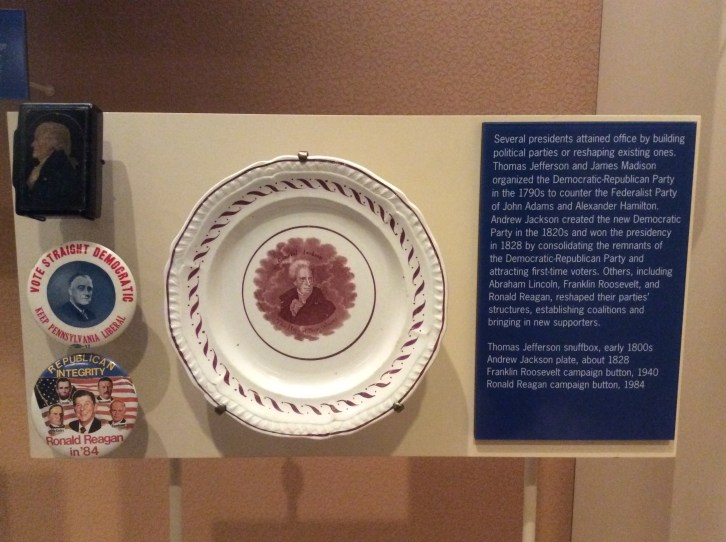
Presidential Souvenirs at the Smithsonian, including a Jefferson snuffbox at upper left, 2015 by Amy Cools

Presidential Souvenirs at the Smithsonian, including an early 1800’s snuffbox painted with Jefferson’s portrait at upper left

In the course of the day, we visit the National Museum of American History of the Smithsonian, where I make sure to visit the American Presidency gallery. I find some Jefferson artifacts among the collection, including the original portable desk on which he wrote the Declaration of Independence (which I already know is here, having visited the Smithsonian some years before), and a great little snuffbox from the early 1800’s painted with Jefferson’s likeness, which I don’t remember from my earlier visit.

There’s one more stop I do have to make before I finish my Jefferson tour. Of course, that’s the White House.

Amy Cools with father John Cools in front of the White House, photo 2015 by Amy Cools.jpgWhile he didn’t list his Presidency among his proudest accomplishments, Jefferson’s time in the White House significantly influenced the way the United States government would function in the future. Though he downsized the size of government following Washington and Adams’ Federalist administrations and reduced the national debt, he increased it again with the Louisiana Purchase and adopted Federalist (or in today’s terms, big-government) policies when he deemed it necessary for national security or the well-being of the nation as a while. He insisted on entertaining foreign dignitaries in a egalitarian and casual manner, with everyone free to seat themselves where they liked rather than being seated according to importance, and insisted on being addressed like any ordinary citizen, without honorific. The latter innovations, while initially shocking and offensive to European sensibilities, helped set the tone for American cultural egalitarianism as well as the spread of democracy in the centuries ahead, even if only in their tiny way.

While Jefferson stooped to some shady political back-handedness during his bid for the presidency (estranging his friends John and Abigail Adams in the process), he struck the right tone in his First Inaugural Address in 1801 when he said ‘…Every difference of opinion is not a difference of principle… We are all Republicans, we are all Federalists.’ We could all use a little more of Jefferson’s rational, conciliatory idealism amidst the partisan bickering, conspiracy-theorizing, extremist, unkind rhetoric that over-saturates our public discourse today.

So ends the account of my Jefferson travels. But in following in his footsteps, learning more about his life and thought, and putting it all together in a narrative, many questions arose and trains of thought were initiated. There will be many more reflections on Jefferson to come in future essays, you can be sure of that.

*Listen to the podcast version here or on iTunes. 

~~~~~~~~~~~~~~~~~~~~~~~~~~~~

Sources and Inspiration:

Brandt, Lydia Mattice. ‘The Architecture of the University of Virginia’
http://www.encyclopediavirginia.org/University_of_Virginia_The_Architecture_of_the

Founders Online: Correspondence and Other Writings of Six Major Shapers of the United States,
Website. http://founders.archives.gov/

‘Gilbert Stuart’, article, National Gallery of Art website.
https://www.nga.gov/exhibitions/2005/stuart/washington.shtm

Hirst, K. Kris. History of Archaeology: The Series. About.com.
http://archaeology.about.com/od/historyofarchaeology/a/history_series.htm

Jacoby, Susan. Freethinkers: A History of American Secularism. New York: Owl Books, 2004.
http://us.macmillan.com/freethinkers/susanjacoby

Jefferson, Thomas. Writings. Compiled by The Library of America, New York: Penguin Books.
http://www.loa.org/volume.jsp?RequestID=67

Jenkinson, Clay. The Thomas Jefferson Hour. Podcast.
http://www.jeffersonhour.com/listen.html

Meacham, Jon. Thomas Jefferson: The Art of Power. New York: Random House, 2012.
http://www.jonmeacham.com/books/thomas-jefferson-the-art-of-power/

‘Short History of the University of Virginia’, University of Virginia website.
http://www.virginia.edu/uvatours/shorthistory/

‘Timeline of Jefferson’s Life’. Monticello.org. Website of the Thomas Jefferson Foundation.
http://www.monticello.org/site/jefferson/timeline-jeffersons-life

Zakaria, Fareed. In Defense of a Liberal Education. New York: W.W. Norton, 2015
http://books.wwnorton.com/books/In-Defense-of-a-Liberal-Education/
 

Thomas Jefferson Sites, Part 5: Washington, D.C., Third Day

 Fifth day, April 23rd

I map out my route, then make a timely departure from my temporary home this morning: I have lots to do before I meet up with someone very special this evening, and I don’t want to be late.

I’ll be traveling today by car, since I have so many places to go throughout the day that aren’t close to one another, but that’s okay, none of my destinations are downtown.

I start with Kalorama, site of an opulent home belonging to Thomas Jefferson’s friend and fellow statesman Joel Barlow, who purchased the property on Jefferson’s advice in 1807. Barlow made extensive additions and improvements to the house originally on the site, and Jefferson, always the enthusiastic gardener and improver of homes, offered his advice for the gardens and orchards too, and visited the estate many times. Kalorama, by the way, is Greek for ‘fine view’.

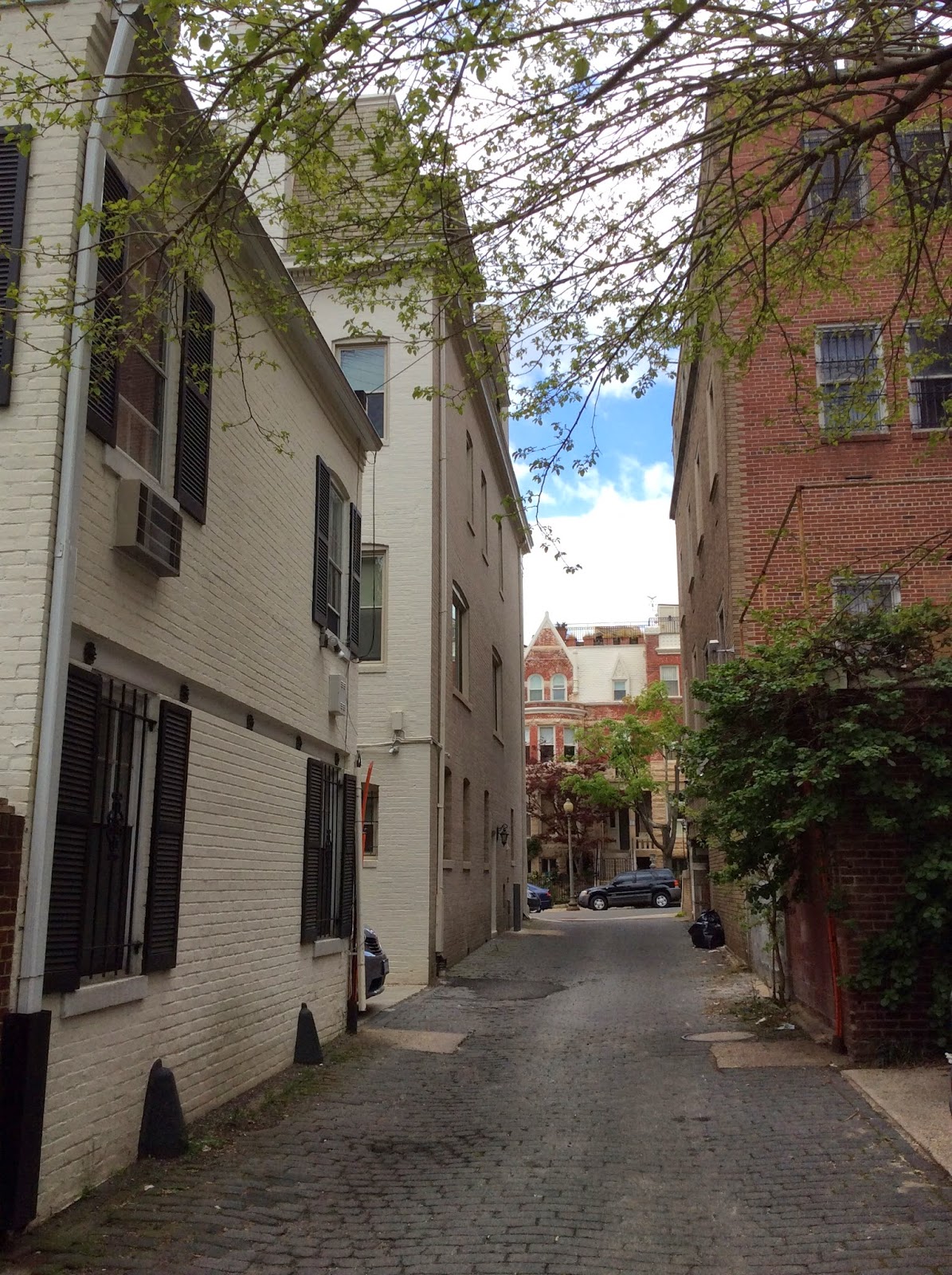
The mansion and its associated buildings are long gone, the main house finally torn down in the late 1800’s to make way for city expansion in that area. The intersection of Massachusetts and Florida Avenues where I was directed to by one source, and where I park, turns out to be closer to where the gatehouse stood at the entrance to the grounds. The main house actually stood closer to 23rd and S Streets. I explore the streets and alleys about a block radius to the north and west of where my car is, and an alley I photograph seems to be oriented in the same direction as the gatehouse used to be, but south about a block.

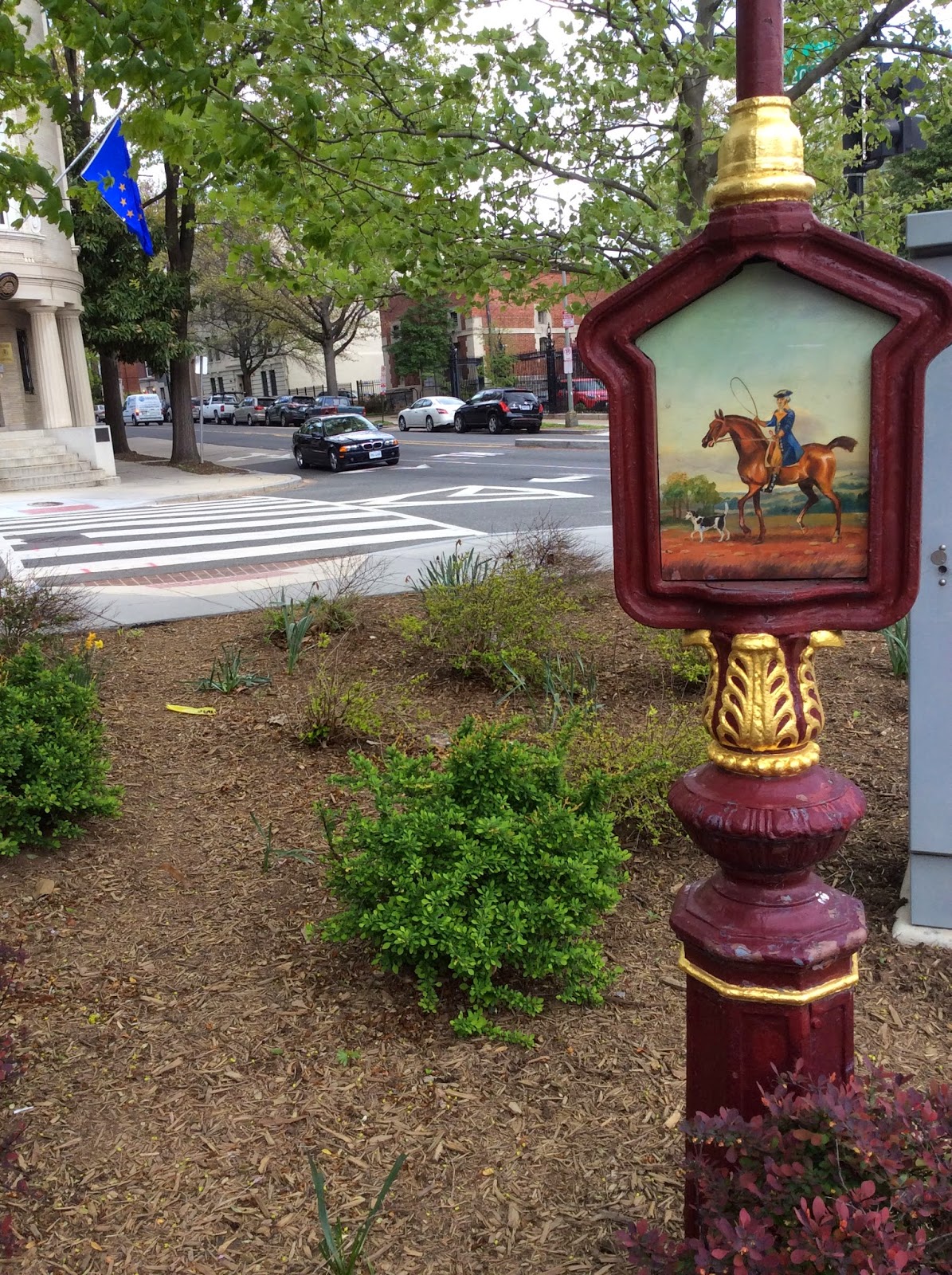
In my poking around, I find this great little antique call box, painted by Peter Waddell, who specializes in images of 18th and 19th century Washington’, according to the little plaque on the back. It portrays George Washington, who never lived in D.C.; his nephew, however, is the man Barlow bought Kalorama from.

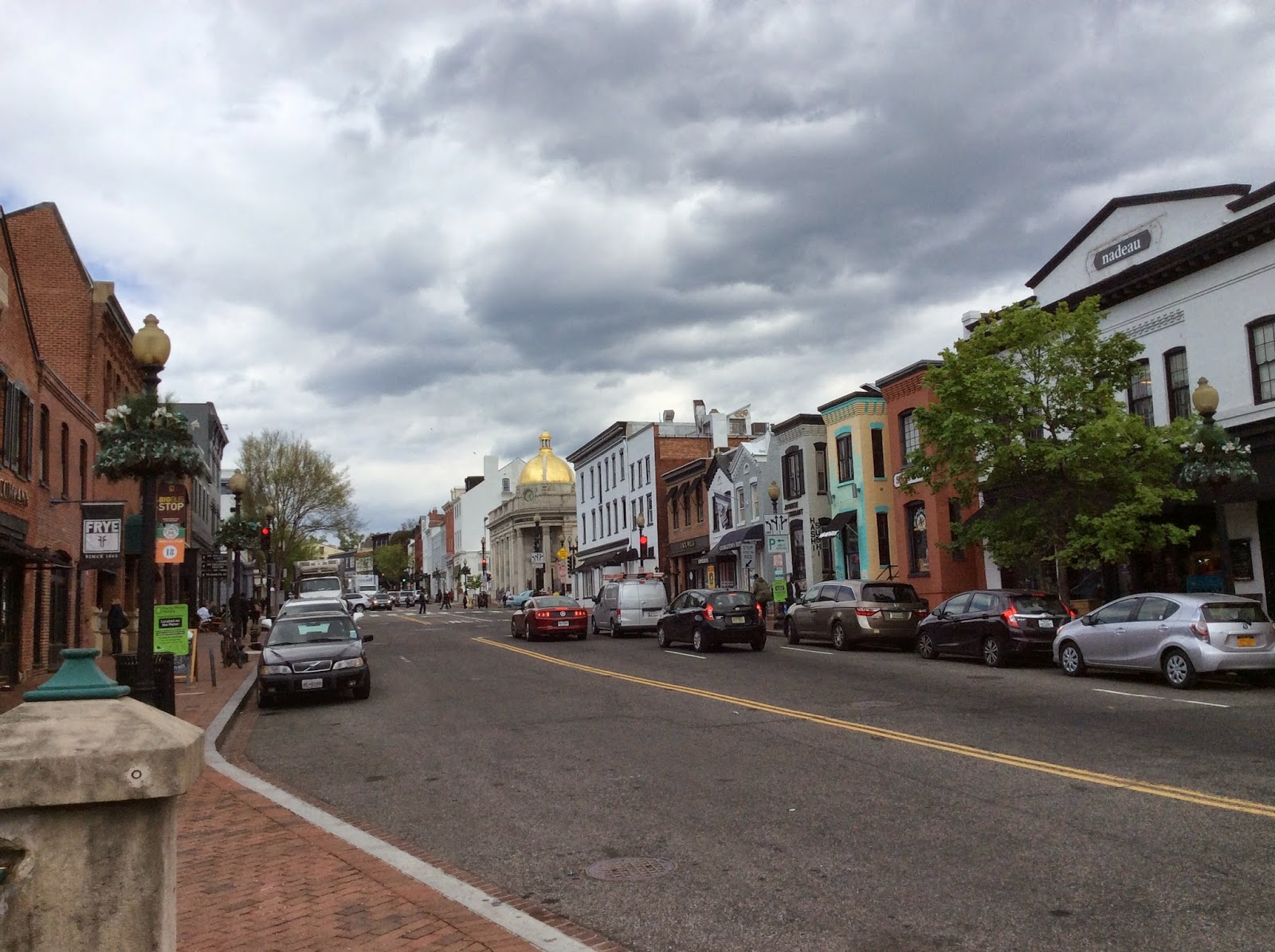
My next destination is Georgetown, formerly known as George Town before it became a district of D.C.. It’s now known for the university of the same name, its history as a commercial and industrial center for the area, its canal, and its elegant shops and restaurants.


I’m headed first for the site of Suter’s tavern, where Jefferson stayed on his travels back and forth from Philadelphia, and wrote of the delicious glasses of wine he enjoyed there (Jefferson loved wine). There’s nothing apparently left of that building, either, except many stories, since it was a very popular inn at the time and many famous people stayed there. There are also many claims that it’s actually still standing (including one made by a business that’s in the building in question. Marketing tool?). There’s an old photo, supposedly of Suter’s tavern in the Library of Congress, but it seems that neither the photo nor the rest of these claims can be substantiated. John Suter, the proprietor, didn’t actually own the building, so there are no property records to back any of these claims up. From what I can find, it seems there’s a consensus that it was probably on or near what’s now Wisconsin Ave just north of the canal.

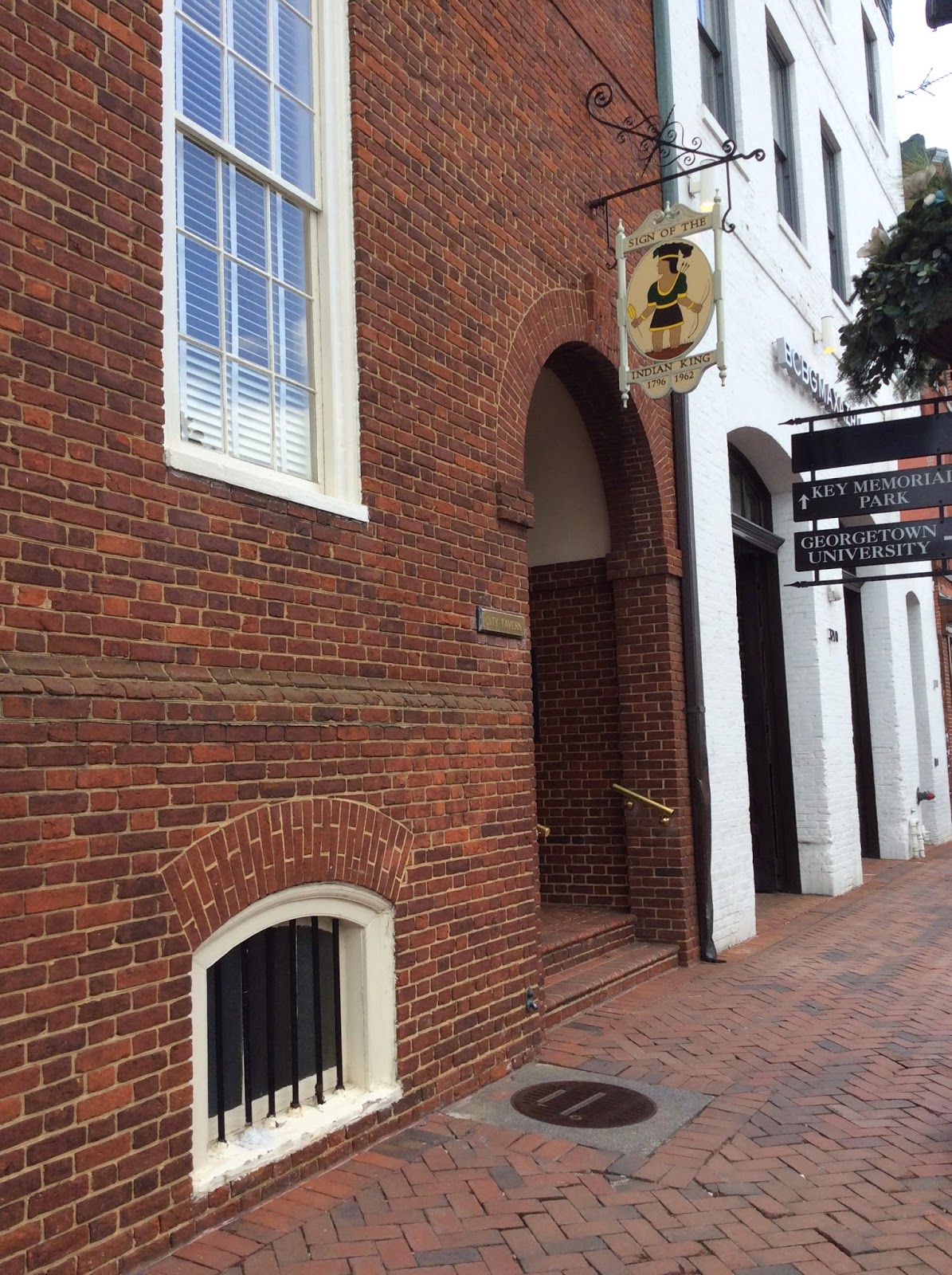
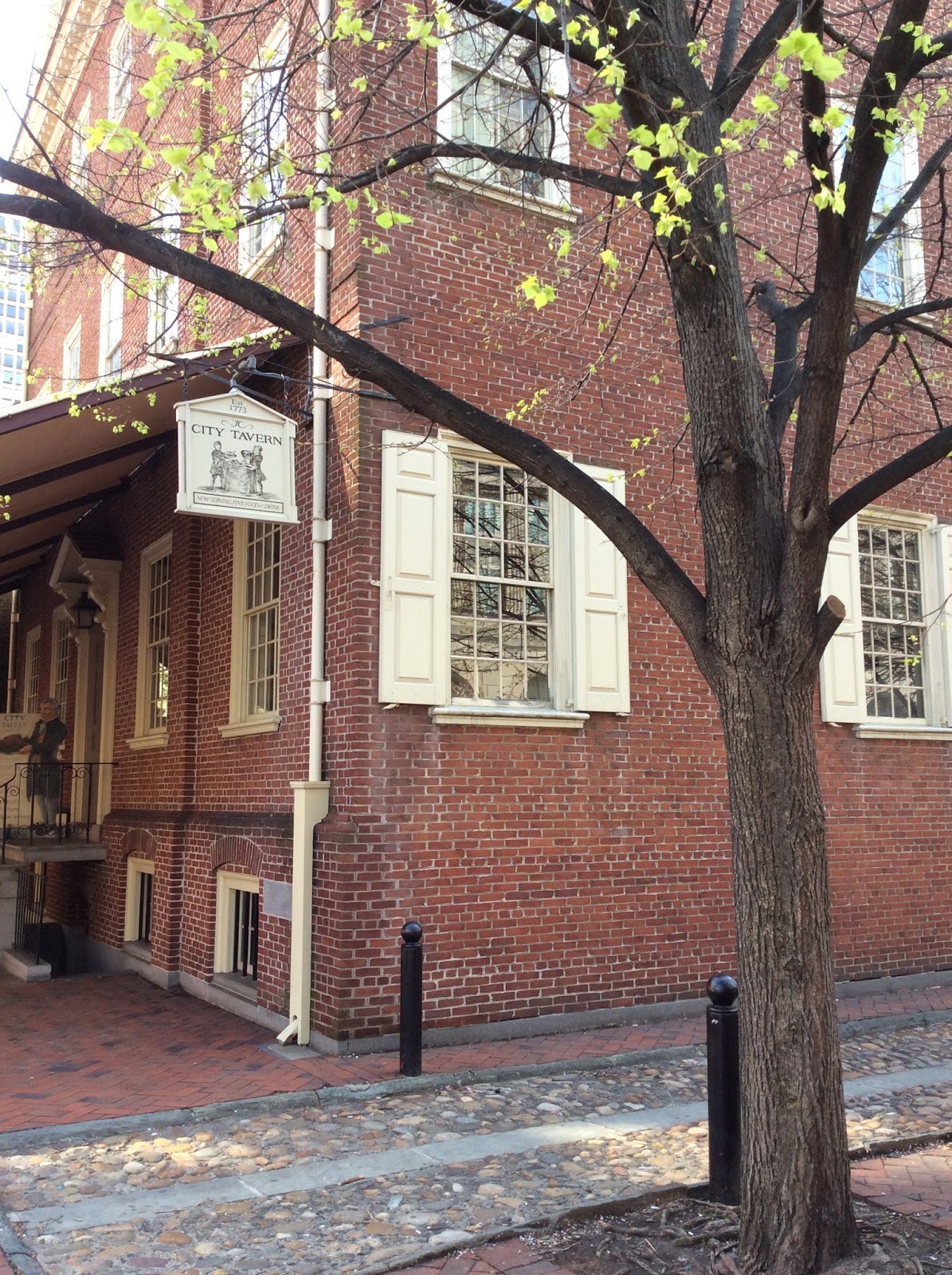
As I head west on M Street to make my way to my next destination just a few blocks away, I’m scanning the scene as I’ve been doing the whole trip, looking for markers indicating historical sites and buildings that appear to date to the right time period.Here, it pays off. To my left, I spot a sign with a stylized old-fashioned image of a Native American on it, with the dates 1796 and 1962. I look up and, yes, the building looks promising. I quickly locate the plaques that identify it as The City Tavern and date its original construction to 1796. Great! It’s the right place, the right time …even the right name: as you may remember, Jefferson frequented the City Tavern in Philadelphia too. Okay, okay, the name doesn’t matter, it’s so generic that any city Jefferson visited is fairly likely to have a tavern of that name. Seriously, though, I think it likely that he’d be associated with it for the same reasons I came up with that Jefferson version of the Six Degrees of Kevin Bacon game: he seemed to know just about everyone, or have professional or social connections with everyone.Sure enough, it turns out Jefferson is associated with this City Tavern too: he probably came here to at least to dine and attend events, since around this time he lived close to the White House while he was Vice President (the White House was still called the President’s House at the time) and then in the White House. He may even have had occasion to stay the night now again, even if it was not far from home: he was a busy, social man with lots of friends, and even short distances to us seemed a lot farther in Jefferson’s time of travel by horse and carriage

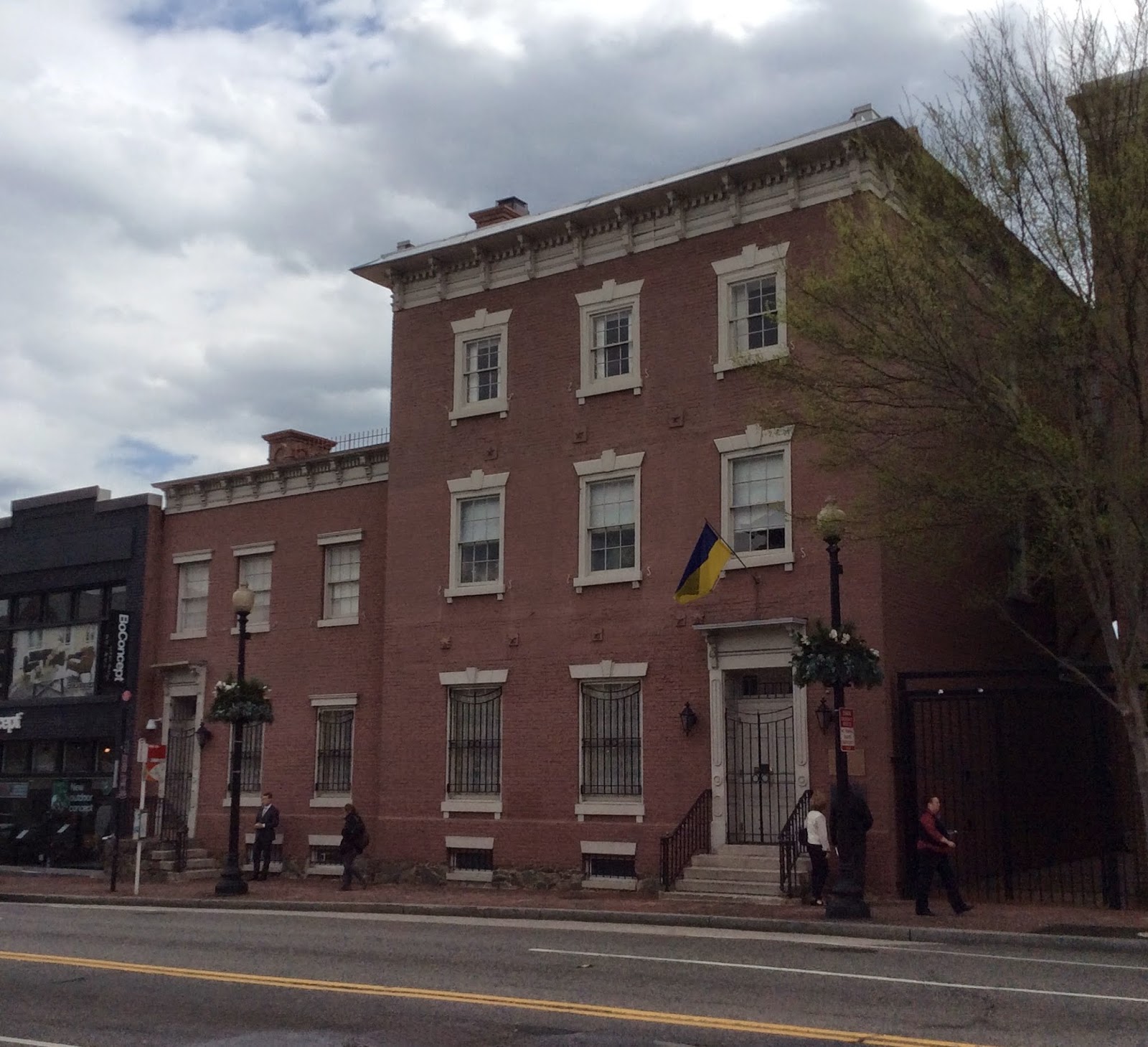
I continue on my way to my next stop: Uriah Forrest’s house, AKA the Forrest-Marbury House, AKA the Ukranian Embassy. Jefferson dined at Forrest’s house and apparently stayed the night, along with Madison and others (though my primary source for this indicates that Jefferson spent the night in Georgetown, it’s not clear whether it was elsewhere, such as nearby Suter’s, or this house). They were on that same trip that took them to nearby Notley Young’s house visiting local landowners in preparation for building the new capital city there. Jefferson and company took the time for a little pleasure trip, to take a tour of the area and visit some small waterfalls about four miles away, according to a letter of a contemporary describing the day’s outings.

While the house is named for Uriah Forrest, who was one of the party when Jefferson was there in 1790, he actually didn’t live in that house yet; he moved in in 1792. Another member of the group did, the original owner who had it built in 1788, Secretary of the Navy Benjamin Stoddert. Like so many of the other Federal style buildings featured in this series, it’s a tall, somewhat plain but still handsome house of red brick. It’s one of the few buildings that date before the turn of the 19th century still standing in Georgetown.

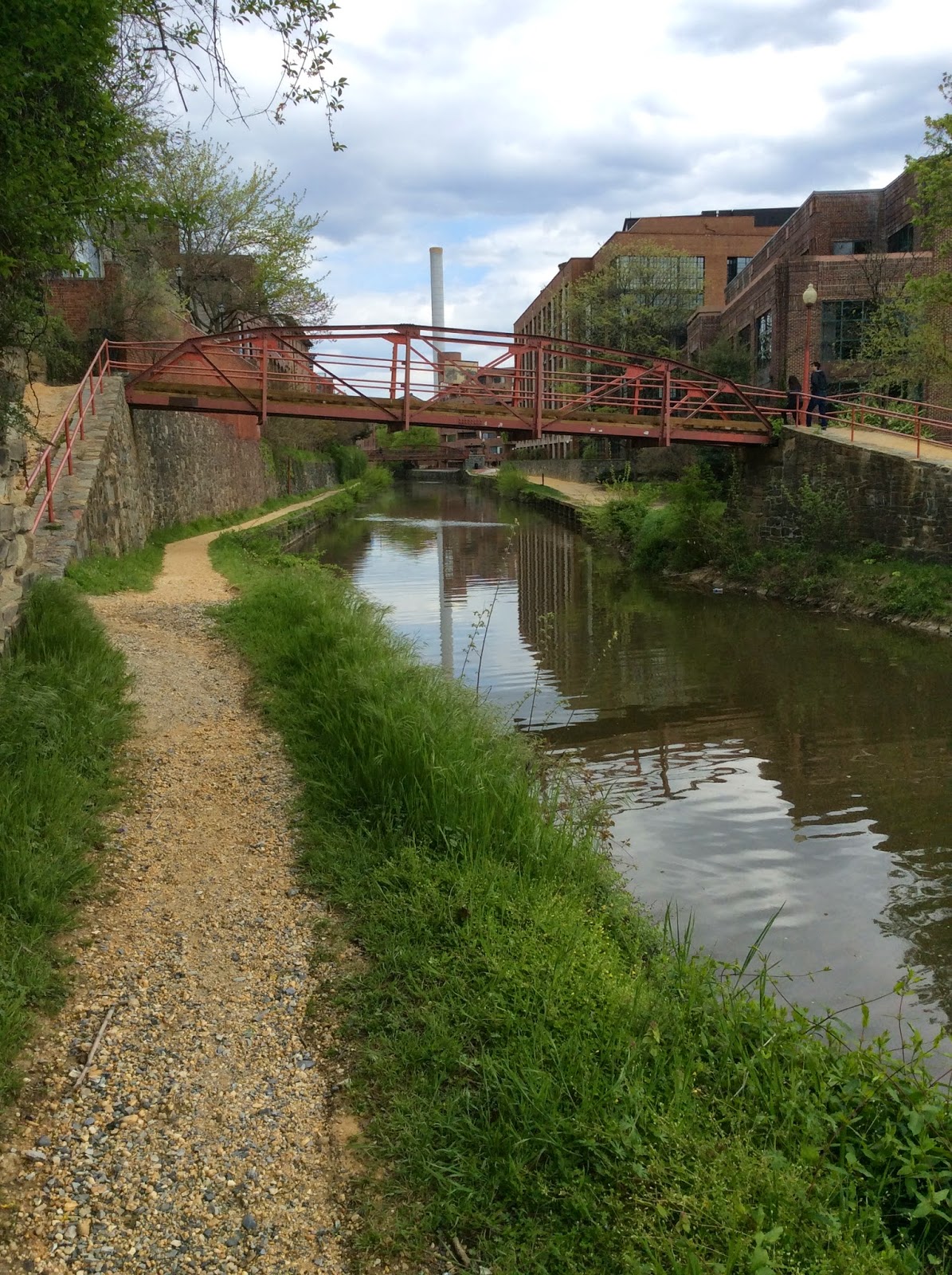
I decide to take the long way back to my car, via Francis Scott Key Park and the canal walk (I’ll add a photobook with more images of Georgetown soon). It’s a lovely stroll, via simple gravel paths along either side of the grass-lined canal, crossed by steel bridges painted that same rusty-red color of the Golden Gate bridge in San Francisco, and hemmed by old red brick warehouses, industrial buildings, and stone walls. Georgetown, originally a port town and trading center along the Chesapeake & Ohio Canal, became a bustling industrial center in the 19th century. Over time, the railroads and then flooding rendered the canal useless as a shipping route.

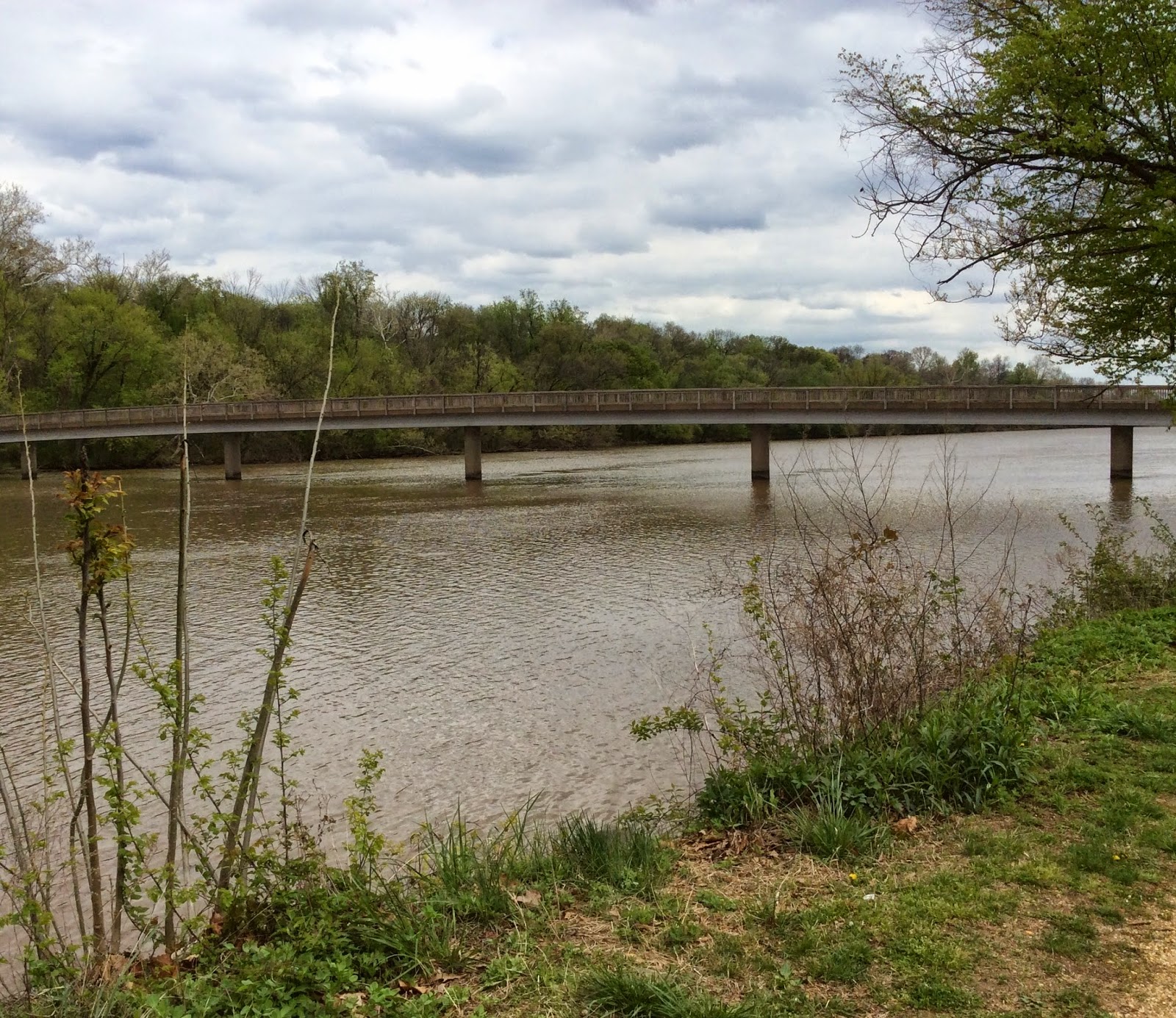
After my happy stroll, I continue on to my final destination of the afternoon before the person I’m going to meet arrives. I’m heading for Analostan Island, which I had stood over, but not on, when I attempted to reach it by the Interstate 66 bridge footpath a few days before. This time I’m successful, but reach it very circuitously, as I miss the turn at the other end of the Francis Scott Key Memorial Bridge that would put me on George Washington Parkway, and end up going around and through Arlington National Cemetery. But I’m okay with that: I like getting lost sometimes, I find out interesting things that way.

 As I mentioned earlier in this series, Jefferson visited Analostan Island many times. His friend John Mason, son of George Mason (who was a member of the Constitutional Convention and contributed to the writing of the Constitution, but in the end, refused to sign it), built a mansion on Analostan in the 1790’s. The island, now named Theodore Roosevelt Island, retains no apparent traces of its history as the site of a plantation, luxury home, and getaway spot. It’s mostly grown wild, except for the hiking paths that crisscross its perimeter, length, and breadth, and the Theodore Roosevelt Memorial perhaps half a mile from the island end of the footpath that reaches it.

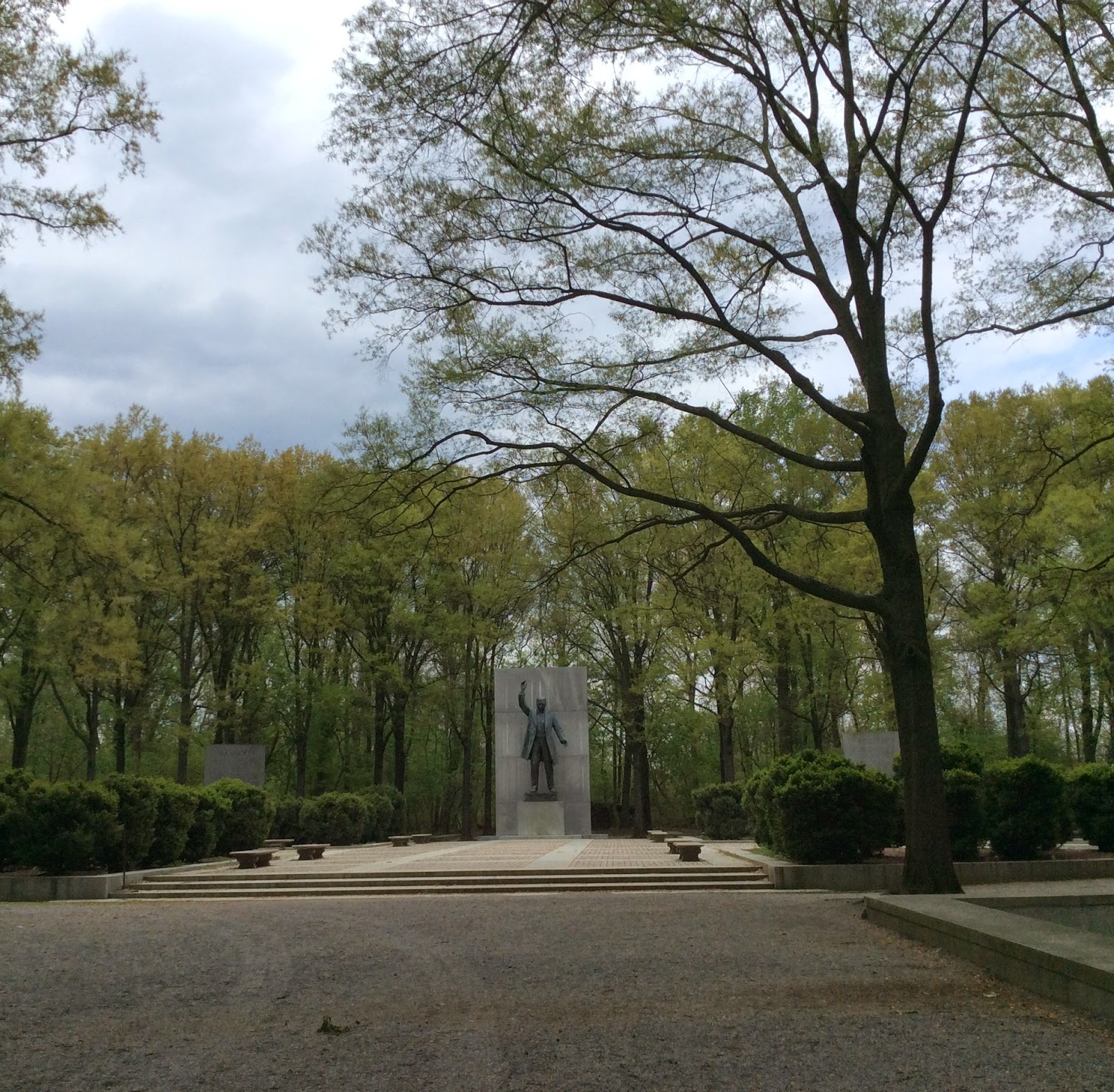
The memorial appears just a little neglected: there are weeds growing through the spaces between the flagstones, and the fountain is waterless and scattered with debris, mostly just dead plant stuff. Theodore Roosevelt’s likeness, large and a little menacing-looking (calls to mind the phrase ‘bully pulpit’, though more in today’s sense of the term than his), is portrayed in the act of delivering some impassioned speech, one arm upraised. If there were a crowd here, the statue’s demeanor would be fitting; the island being nearly empty this afternoon, it looks oddly out of place with its peaceful surroundings, with no sound but birds chirping and the wind blowing through the trees (it’s another blustery day).

There are large stones carved with phrases praising bold, courageous ‘manliness’ which I find a bit annoying; my feminist side protests that I and many of my fellow women are more bold and courageous than many men, and that these are human traits, not ‘manly’ ones. I’m also aware of the warmongering, reckless side of his personality, which I don’t find admirable. I prefer Jefferson’s philosophy, which places a far higher value on courtesy, reason, and compromise, with war a measure of absolute last resort (though not so for spontaneous revolution of the people when they find their natural rights are being trampled upon, that’s another matter; he considered this a desirable thing sometimes). I remember, however, that Roosevelt often used his power to promote the rights of the poor and to protect our natural resources. Parks like this, for example, as are many of the places I’ve visited this trip, are an extension of his legacy, publicly funded preservations of natural beauty and historical places that market forces nearly caused the destruction of. I forgive him and move on.

My main goal for this island hike is to find some remnant of the Mason house, since it’s the artifact directly associated with Jefferson here, and then skedaddle and swing by Alexandria, home of Gadsby’s tavern where Jefferson stayed once, on my way to the place I’m meeting someone later. But once I start tramping round the island, my inner hiker, having been starved of her exercise and natural scenery for over a week now, demands a longer stay. So I forego the Alexandria stop (which I never end up making, oh well) and hike vigorously for a couple of hours.

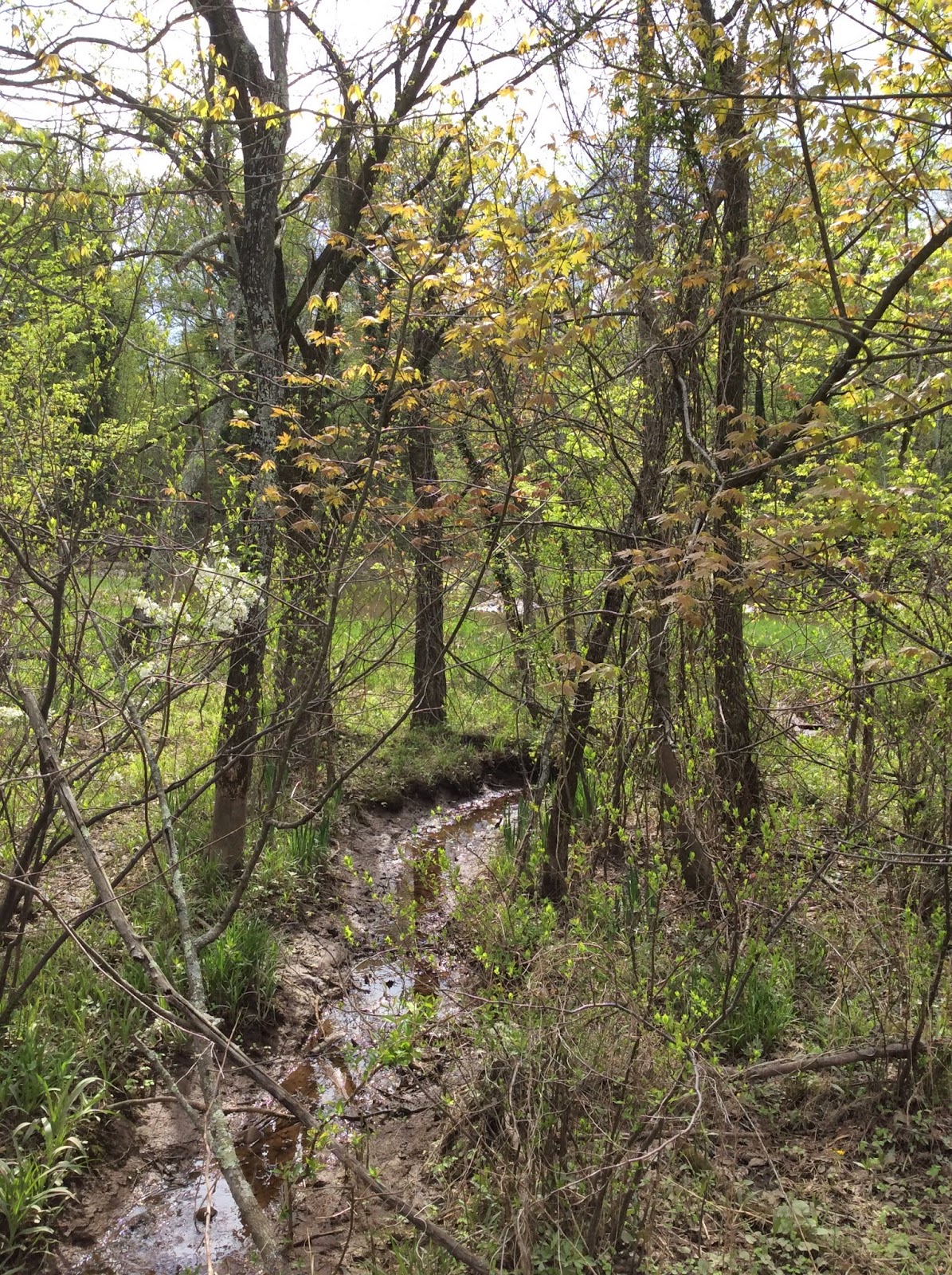
It’s mostly forest, with large area of marshland along its south and eastern end; I start my hike on the trail that goes through it from end to end, counterclockwise around the island. Much of this path consists of a wooden boardwalk to keep the hiker out of the water. There are birds galore, many of which I’ve never seen before and whose unusual calls I try to memorize so I can find out more about them later.

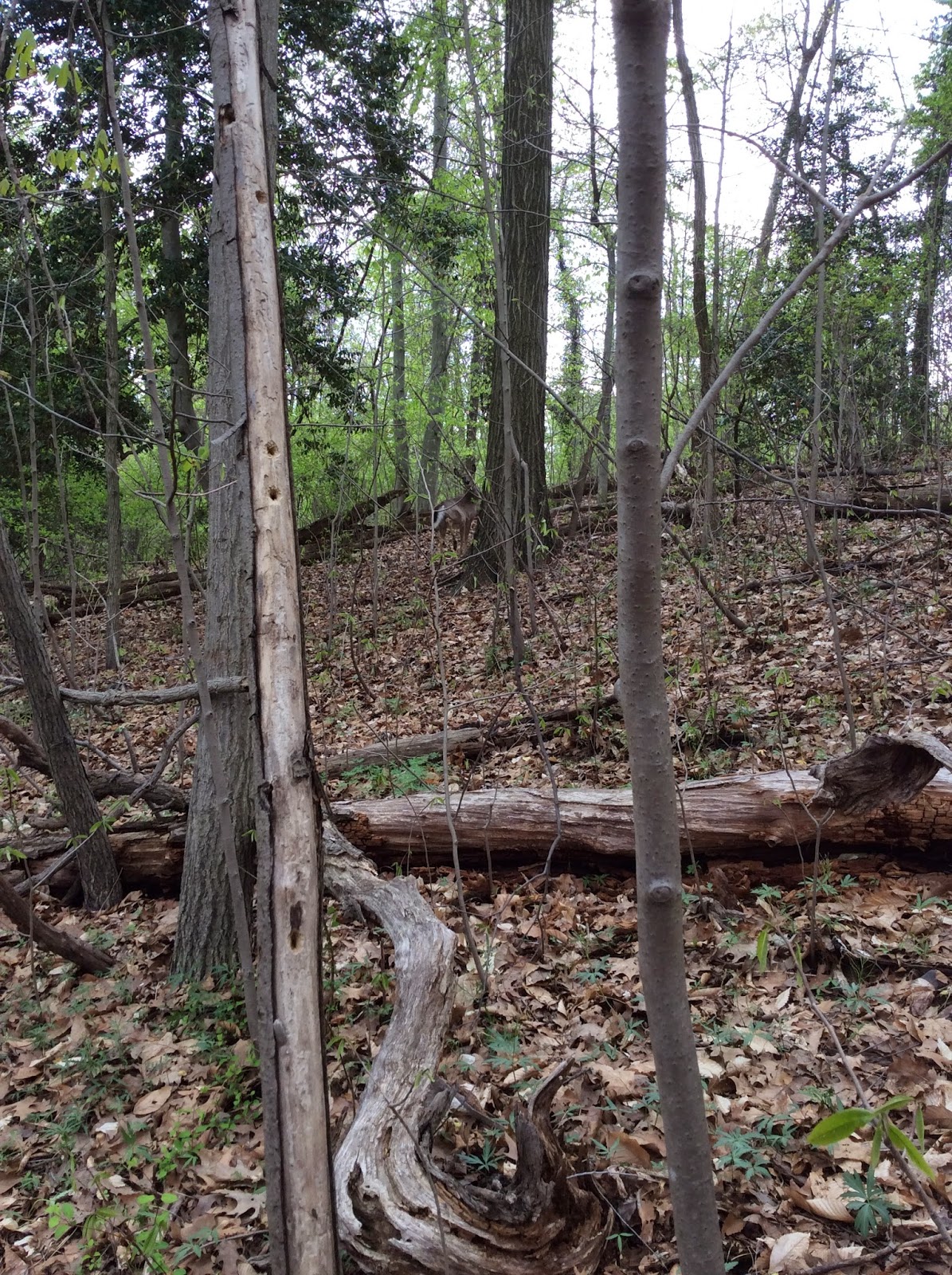
At the end of the marsh walk, I return to the woods, and I crisscross the entire island time and again. I think I walked every single official trail on the island, some more than once, and some unofficial little narrow ones as well. A herd of deer and I spooked one another when I was on one of these little narrow ones. Most bounded away to my left toward the marsh, but one bounded across my path and ended up very close to me on my right. We stared at one another for awhile, then she moved on.

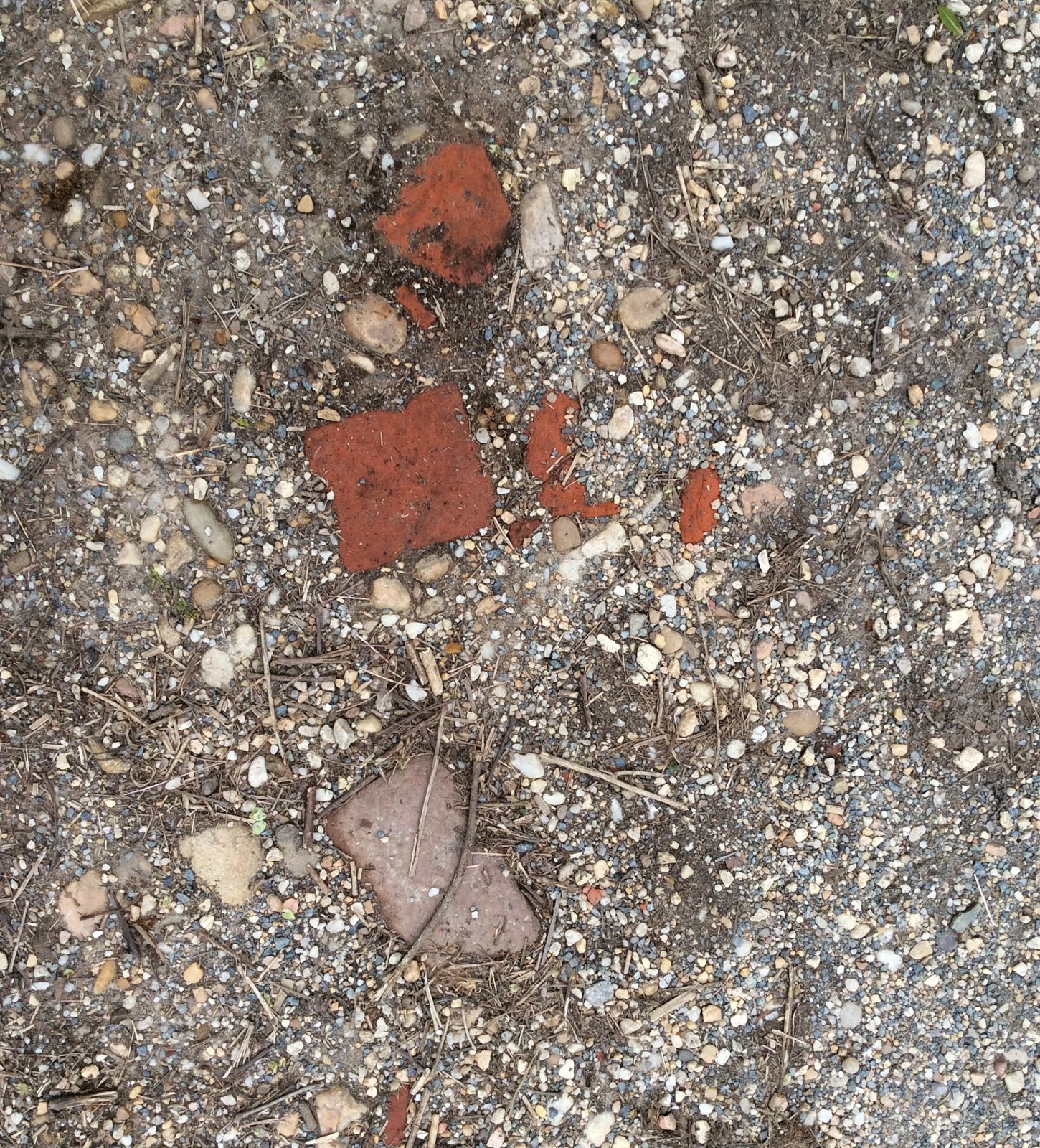
Finally I come across what I’m looking for, sort of. I find a National Park Service Sign indicating the little rise where the mansion stood. I ascend the rise, and among the trees, find the only sign that indicates there was once a structure here: a few broken remnants of old brick. Perhaps there’s some remains below ground; how fun it would be to dig it up, if so! However, since I never did fulfill that childhood dream of becoming an archaeologist, I suppose I better not.

I find the site just in time, since the time has come to leave the island for the meeting I spoke of. But you’ll have to wait ’til the next installment of my Jefferson adventure to find out who with!

Stay tuned….

*Listen to the podcast version here or on iTunes. 

Sources and Inspiration:

‘Analostan Island’, George Mason’s Gunstan Hall website.
http://www.gunstonhall.org/georgemason.

‘City Tavern Club: History’, City Tavern Club website.
http://www.citytavernclubdc.org/Default.aspx?p=DynamicModule&pageid=335988...

DeFerrari, John. Lost Washington, Part 3. Charleston, SC: The History Press, 2011
http://books.google.com/books/about/Lost_Washington.html?id=NTvO0u1JzK8C

Hansen, Stephen A. ‘General John Mason House, Analostan Island’
http://analostan.dchistoricdesigns.com/
and ‘The Kalorama Estate: A Brief History’
http://kalorama.dchistoricdesigns.com/

‘History of the Forrest-Marbury House’, Embassy of Ukraine website.
http://usa.mfa.gov.ua/en/embassy/history

Jacoby, Susan. Freethinkers: A History of American Secularism. New York: Owl Books, 2004.
http://us.macmillan.com/freethinkers/susanjacoby

Jefferson, Thomas. Writings. Compiled by The Library of America, New York: Penguin Books.
http://www.loa.org/volume.jsp?RequestID=67

Jenkinson, Clay. The Thomas Jefferson Hour. Podcast.
http://www.jeffersonhour.com/listen.html

Meacham, Jon. Thomas Jefferson: The Art of Power. New York: Random House, 2012.
http://www.jonmeacham.com/books/thomas-jefferson-the-art-of-power/

Shippen, Thomas Lee. ‘Letter to William Shippen, Sep. 15. 1790’. Founders Online, website
http://founders.archives.gov/documents/Jefferson/01-17-02-0136-0004

‘Timeline of Jefferson’s Life’. Monticello.org. Website of the Thomas Jefferson Foundation.
http://www.monticello.org/site/jefferson/timeline-jeffersons-life

‘Washington, D.C.’ Thomas Jefferson Encyclopedia, Monticello.org website.
http://www.monticello.org/site/research-and-collections/washington-dc

Thomas Jefferson Sites, Part 4: Washington, D.C., Second Day

Fourth day, April 22nd

I wake up a little late, having not gotten much sleep the day before, and spend the morning going through countless photos I’ve snapped so far, jotting down notes, and writing up some of my reflections from the memorial tour on my first day visiting sites in Washington, D.C..

Then, I take the Metro to L’Enfant Plaza station, and walk south towards my first destination.

By the way, DC has a very good subway system: comprehensive, easy to use, clean, and safe. Driving in DC, by contrast, is kind of a drag: the streets and freeways form a big tangled spiderweb, so it’s easy to get lost. As a nearsighted person, I also find the street signs too small, nearly impossible to read when the only one there is located all the way on the opposite side of the intersection, especially when it’s dark or raining.

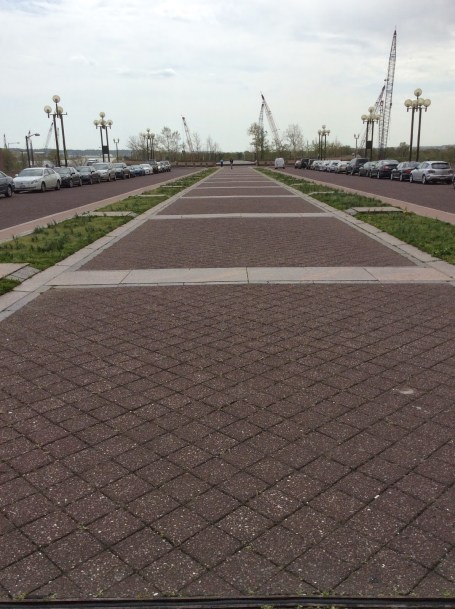
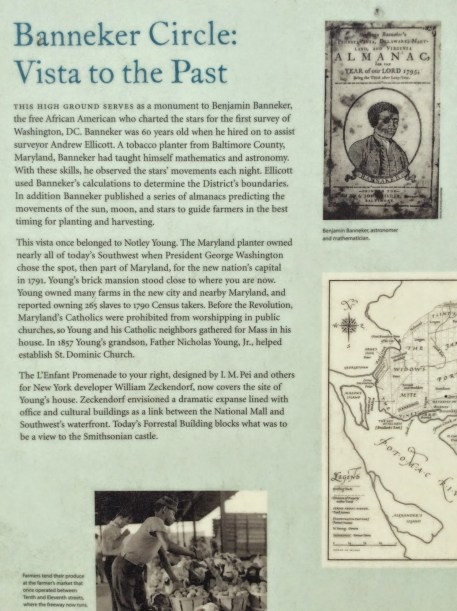
I’m heading to G Street between 9th and 10th, where a man named Notley Young owned a house that Thomas Jefferson visited in the fall of 1790. Young owned a large plantation which bordered on the Potomac and extended northeast from the river. His land, along with neighboring plantations, was obtained by an act of Congress to build the new capital city on. Jefferson, Secretary of State to President George Washington, was appointed to help with planning out the city, and the 1790 visit was part of the trip to visit landowners in the area in preparation. The first stone formally marking out one of the new capital’s boundary lines was laid the following April, 1791. There’s a promenade parallel to 10th St which, according to a sign I find here, covers the original site of the Young house.
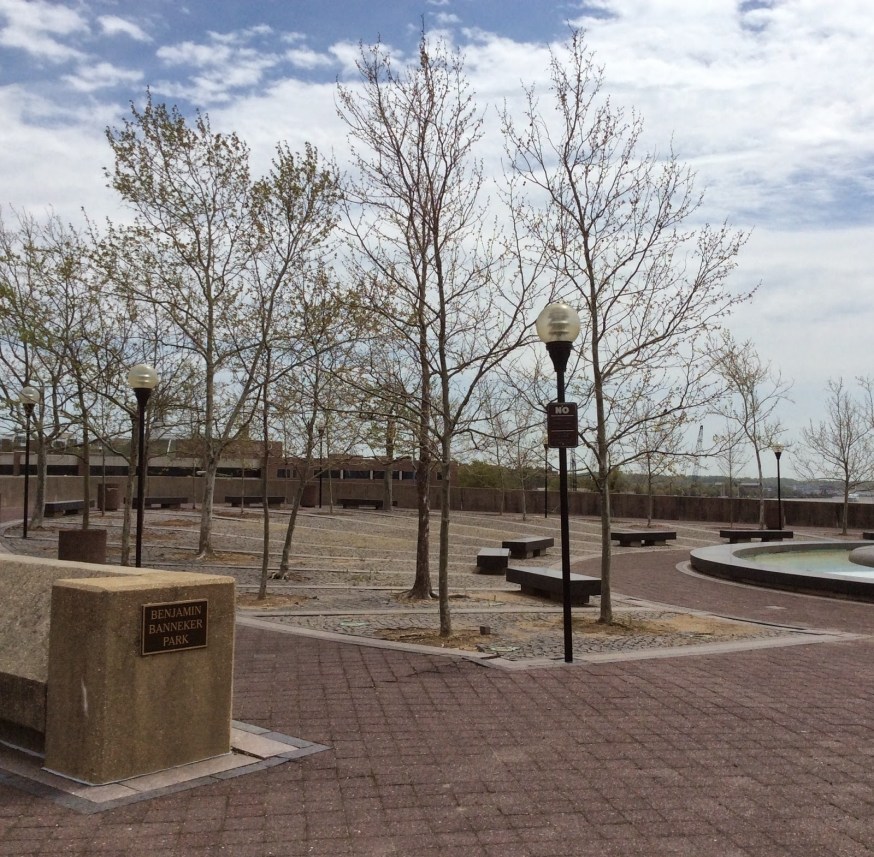
The promenade ends at Benjamin Banneker Park, which overlooks the river and is named for another Jefferson connection.

You know, you could easily play a sort of Six Degrees of Kevin Bacon game around here, but for this trip, we could change it to, say, Three Degrees of Thomas Jefferson.

In case you hadn’t heard of it, the Kevin Bacon game challenges you to link him to any given movie in the smallest number of steps via the actors who co-starred in them. For example, challenged with the movie Excaliber, you might answer: ‘Gabriel Byrne played Uther Pendragon in Excaliber and he also appeared in The Usual Suspects with Benicio Del Toro; Benicio Del Toro appeared in Things We Lost in the Fire with Halle Berry; Halle Berry appeared in Cloud Atlas with Tom Hanks, Tom Hanks appeared in Apollo 13 with Kevin Bacon’. (Excalibur being a campy early 1980’s movie, I bet a real movie buff could make the connection much more quickly.)

Similarly, if you took any public landmark associated with any historical person from 1750’s – 1820’s America, you could make the connection with Jefferson using very few links every time, as he had an even longer, more prolific career in public life than Bacon has had as an actor. If I were to follow every Jefferson connection, my trip and my account of it would go on interminably, but since Banneker’s link to Jefferson is an especially interesting and illuminating one, it’s well worth exploring.

This park named for Banneker, by the way, is a rather un-parklike-park, all concrete, with a dry fountain and some sparse-looking trees. I can see there’s some construction work going on around it and it’s still spring; if the trees fill out, the work is done, and the fountain turned back on, it might be very nice. It used to have a good view, I’m sure, but now it’s marred by the freeway.

I had heard of the famous letter Benjamin Banneker once wrote to Thomas Jefferson challenging his views on race; back to that in a moment. What I learn doing further research is what prompted the letter in the first place.

Banneker, a largely self-educated man of impressive mathematical, scientific, mechanical, and other accomplishments, accompanied Major Andrew Ellicott in 1791 to help survey the land in preparation for building Washington DC. Ellicott was working on this project with Jefferson, who, as we discussed, was another of these city planners. Someone at the time noticed, and having read Jefferson’s Notes on Virginia, editorialized the story, pointing out the discrepancy between Jefferson’s stated view that black people possessed inferior intelligence, and Banneker’s accomplishments in all manner of skilled and intellectual pursuits.

So Banneker took the opportunity to use this as a teaching moment, writing to Jefferson himself. In the letter, he points out the incongruity between Jefferson’s demanding that Britain give the American colonists their freedom while he’s denying this to his own slaves. While he compliments Jefferson on his past as a champion for the rights of black Americans, he shows the inconsistency between Jefferson’s recent stated views on the innate inferiority of intelligence of black people, and the evidence, that black people can achieve as much as any white person so long as their capacities are nurtured by education. Banneker even offers to send a manuscript of his work written out in his own handwriting, in case Jefferson is distrustful. As a fellow man of science in the age of Enlightenment, he knows that Jefferson can’t just ignore evidence that’s right in front of his eyes.

Jefferson writes a polite and rather evasive response, saying that he’s glad to see that Banneker presents a challenge to ideas of inferiority ‘which have been entertained of’ the intellectual capacities of black people. Notice how he uses the passive voice, as if he wasn’t among those not only ‘entertaining’, but very publicly voicing such ‘doubts’! I think Jefferson responds this way not only because he’s scrupulously polite in most circumstances, but because he knows he has no good response. Most of the arguments Banneker makes regarding the universal longing for freedom, the commonality of the cause between slaves and the colonists, and the evidence that slavery generally equates to enforced ignorance, are the same or similar to arguments Jefferson himself made as a young lawyer and politician, even as he wrote the original draft of the Declaration of Independence. Since Jefferson can’t defend himself in this case, he’s silent. (I’ll soon write a piece about Jefferson and slavery, stay tuned.)

I head back, via the promenade, towards the east end of the National Mall, and pass the Capitol Building through the park. The clouds are blowing in, and the predicted rain which leads me to select this day as perfect for my next destination, appears imminent.

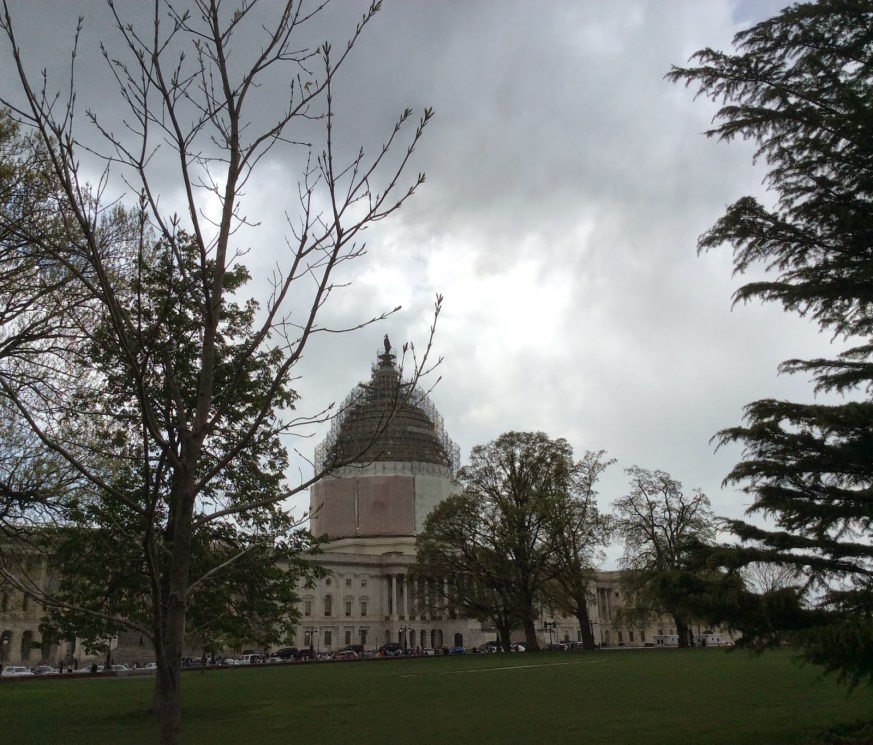
As you can see, the Capitol dome is surrounded by scaffolding as it’s being restored. It’s made of cast iron, and in the mid-1800’s, replaced the original one, disproportionately small since the building’s many expansions. The first part of the Capitol Building was finished in 1800, the year the United States government moved to its official new home.

Jefferson and President George Washington held a contest for the design, but none of the original entries won. A later entry by a doctor was approved, and many of Jefferson’s classical design elements, especially those inspired by the Pantheon, were included.

I pass by the Capitol without going in. (Who wants to compete for space with several hundred schoolkids on field trips anyway?)

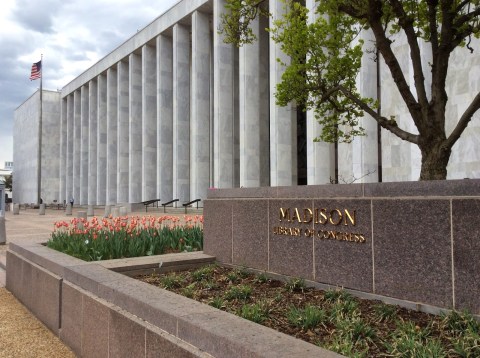
My main and final destination for the day is the Library of Congress. The LOC is founded on Jefferson’s original library of 6,487 books, purchased by Congress in 1815 from Jefferson at a discount, its original collection having been destroyed by the British during the War of 1812. It was a mutually beneficial arrangement: Congress needed a new library, and the idealistic, projects-oriented, often impractical Jefferson needed some debt relief (he was always in debt, he loved to live large).

It’s fitting that the largest private book collection of Jefferson’s time would become the seed collection of what’s now the largest library in the world. As for me, the LOC is my go-to source for published images in the public domain with which to illustrate my essays, as well as material for research.
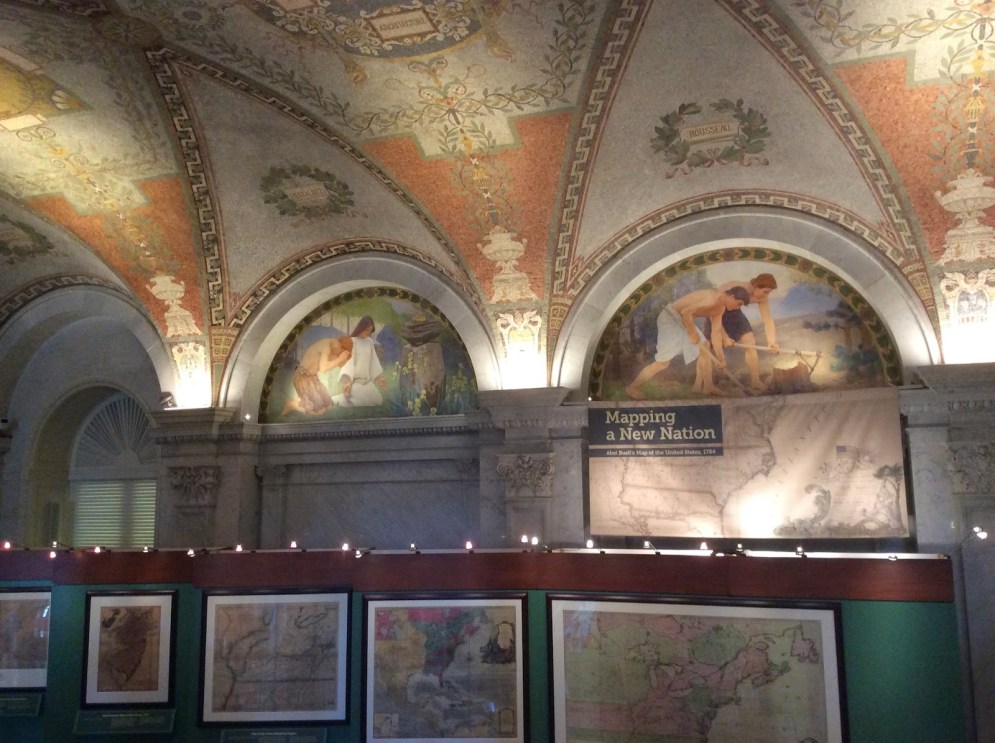
And oh my goodness: the Jefferson Building of the Library of Congress, the first and still main building, is one of the most beautiful works of architectural art I’ve ever been in in my life. I might place it next in line to Sainte-Chapelle in Paris, in fact. There may very well be more beautiful buildings than these, and if so, I look forward to visiting them!

The floor and ceiling are covered with intricate mosaics, in lovely shades of rose, soft green, golden maize, gray, and white, of neoclassical decorative elements and the names of great authors and scientists, interspersed with gorgeous neoclassical and Art Nouveau paintings, allegorical and representative, representing moments in history and fields of inquiry.

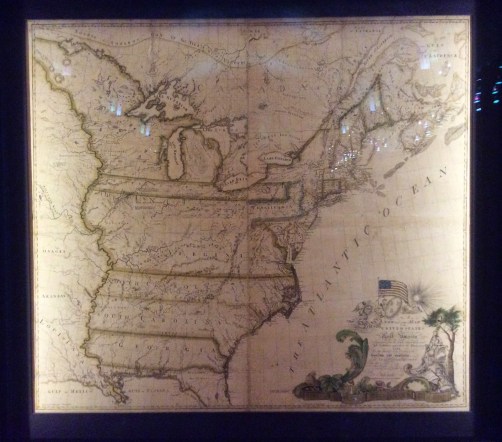
After my first good, long gaze at the atrium and first floor hallway, a sign caches my eye, and I follow it to an exhibit which features the first published map of the United States.
It was drawn by Abel Buell, and published in 1784. As you can see, the western sides of the states follow lines of latitude past a certain point, and end at the Mississippi River. Much of the land was as yet unsettled by colonists, and not thoroughly explored by non-native people; lines of latitude, then, was a practical way of defining state borders beyond the areas originally colonized.

The gallery at the southwest corner of the second floor is really what I’m looking for, and I head upstairs.
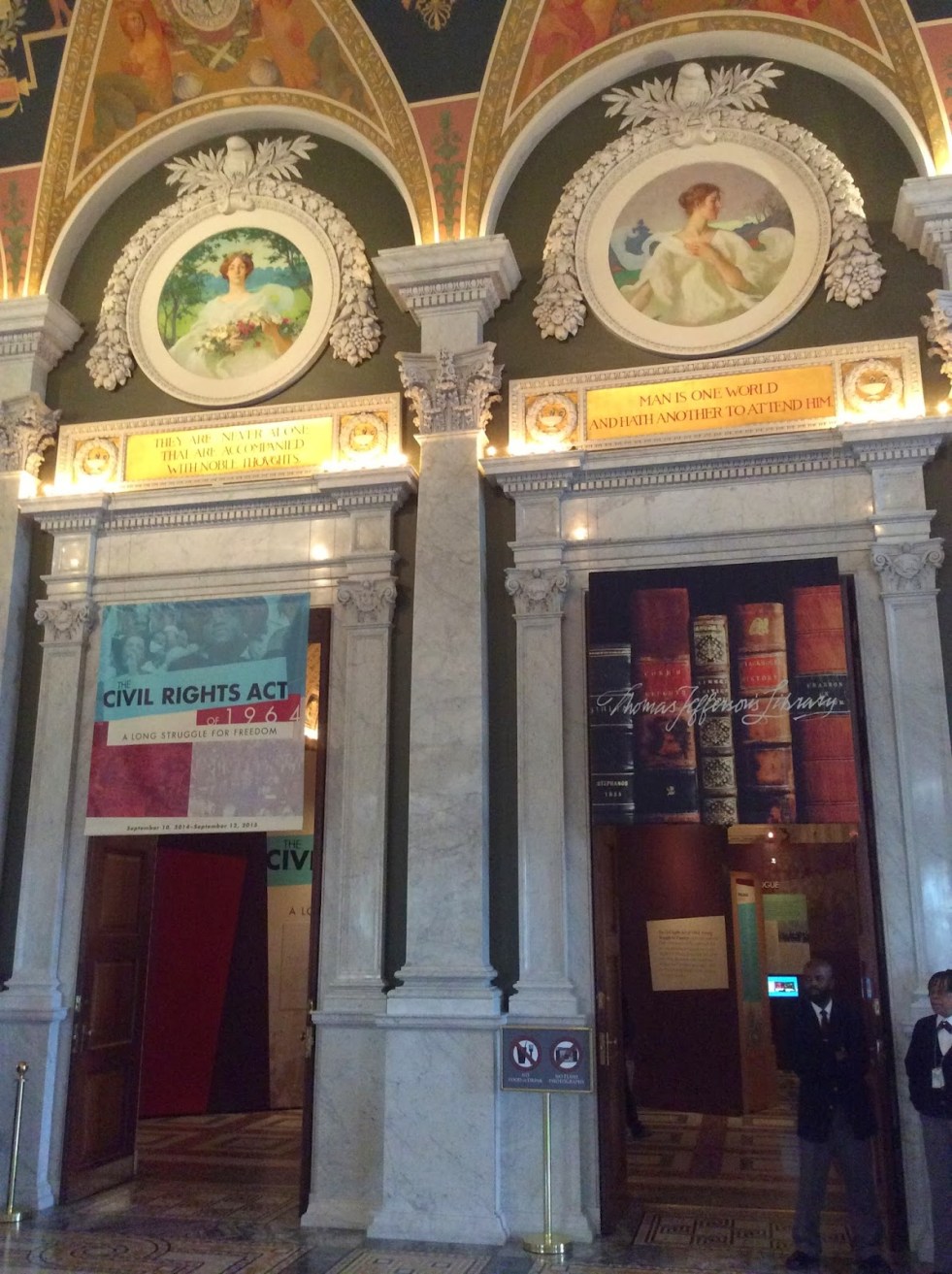
I see a sign at the entrance of the Jefferson gallery announcing a special exhibit. It covers the history leading up to the Civil Rights Act of 1964. I’m particularly interested in the history of civil rights movements, so I’m excited to see it.

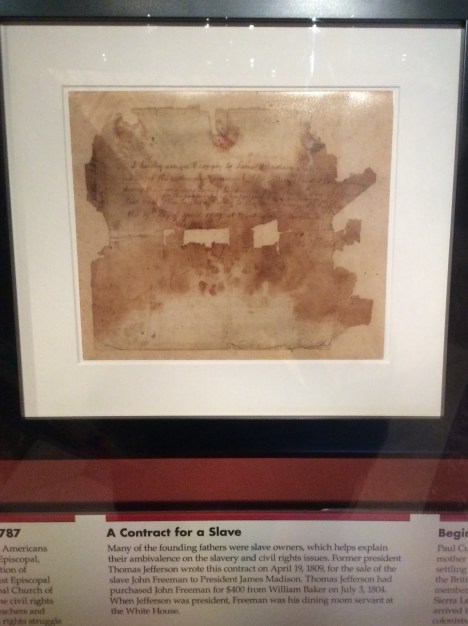
Among countless fascinating artifacts and the accompanying historical accounts, I’m struck by one which directly relates to the subject of my trip. It’s a contract between Jefferson and James Madison, drawing up the terms of a slave sale. There’s something extra disheartening about the fact that it was drawn up in 1809, after both men had served so many years in public office.

This is a fascinating exhibit with so many significant artifacts, including the anti-lynching flag that used to fly over New York City from the windows of the NAACP office in the 1930’s, each time a new one occurred. Reading simply, ‘A Man Was Lynched Yesterday’, they had to stop hanging it at a certain point or lose their lease. Isn’t that amazing? Make a simple statement of fact, and get kicked out. But then again, think of how Billie Holiday was hounded until she died, persecuted by government officials just for singing ‘Strange Fruit’.

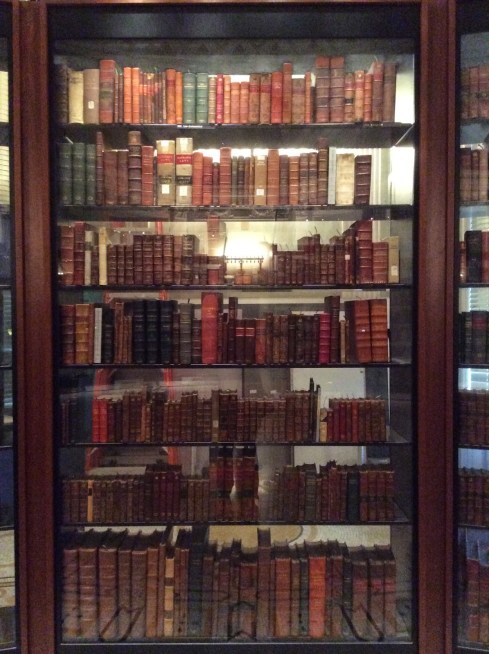
The Jefferson Gallery holds what remains of the original Jefferson collection; about two-thirds of it was lost in a fire in 1851. The LOC is currently rebuilding the original collection, seeking out original copies, in sufficiently good condition, of the same books in the same edition that Jefferson originally collected, if they can be obtained.
The collection is beautifully arranged, in a wide open spiral of shelves walled by glass, in the same order that Jefferson arranged them on his own shelves. Instead of an alphabetical system, he used a system modeled after that of Francis Bacon, organizing them by three broadly defined subject categories. For Bacon, it was ‘Memory’, ‘Reason’, and ‘Imagination’; Jefferson personalized it as ‘History’, ‘Philosophy’, and ‘Fine Arts’. The books are marked with little colored ribbons tucked into them like bookmarks: green means it’s from the original Jefferson collection, gold means it’s recently been purchased to replace the original, and no ribbon means it’s been replaced by a more or less identical book Congress already owned in another collection. There are little book-size boxes too, with the names and descriptions printed on their ‘spines’, of books that have not been located to replace the originals yet. Jefferson was a meticulous, some might say obsessive, record-keeper, so knowing exactly what needs to be replaced is pretty straightforward. Not only did he write down which books he owned, he described them in detail, with notes about their contents, even their measurements!

I love to find connections between the ideas of thinkers I admire, as well as between various theories and historical people and places. So, I search the shelves for books that he would have read, especially by people who have been featured in one of my traveling philosophy series, or will be. I know that Jefferson was very critical of David Hume’s history of England, describing it as too ‘Tory’, but I wonder if he ever read any of Hume’s philosophy, and if so, what he thought of it. (More on this shortly.) I find he owns work by Baruch Spinoza, Condorcet, and Voltaire, along with books on women’s rights, anti-slavery books, and of course, much, much more: the classics, science, philosophy, government, art, you name it. The man, as we’ve discussed before, was well-read.
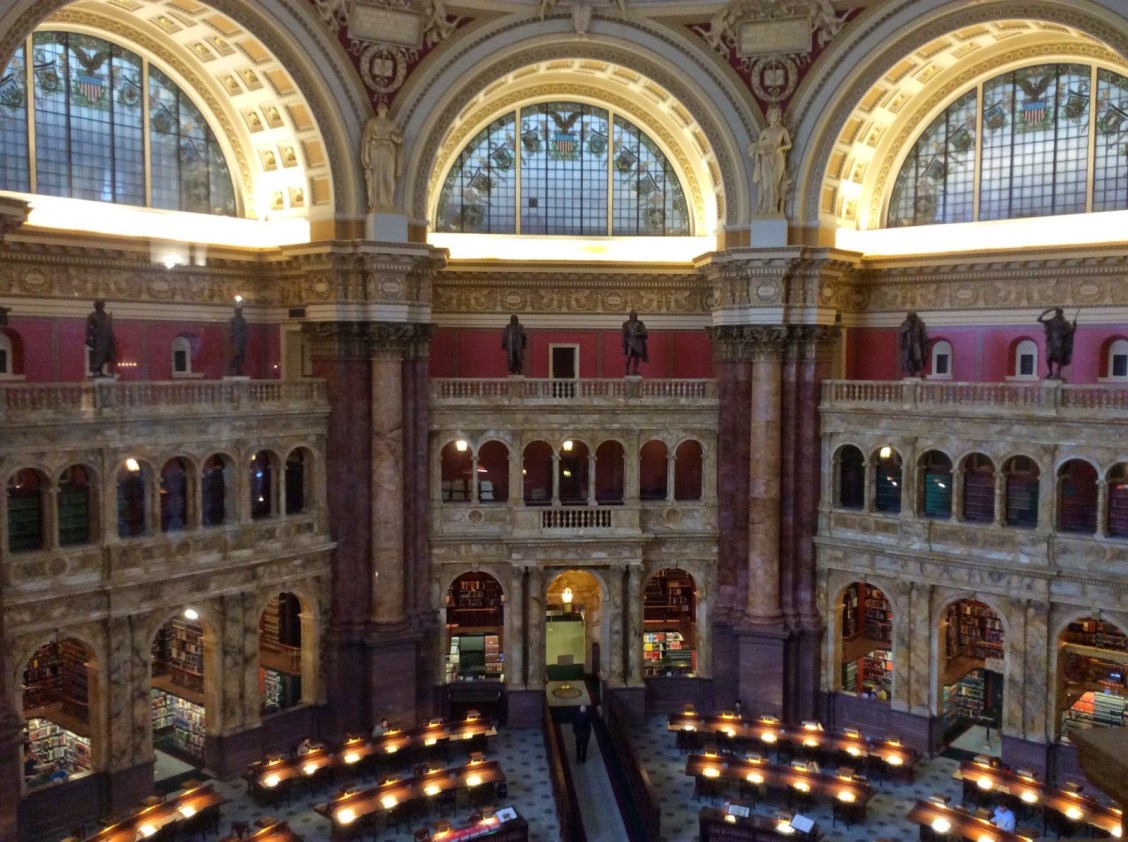
I pore over the shelves for a good long while, then decide I needed to take a break and look at something purely decorative for a moment again while I walk around. I see a little crowd gathering and think, oh, yes, whatever it is, I’ll look at it too. It turns out it’s the line to get to the balcony that overlooks the Main Reading Room. Great. It was my plan all along to find out more about how I could access the collection and do some research. So I stand in line, get onto the balcony, and see a vaulted, domed library room, the most gorgeous I’ve ever seen. Through thick protective plexiglass.
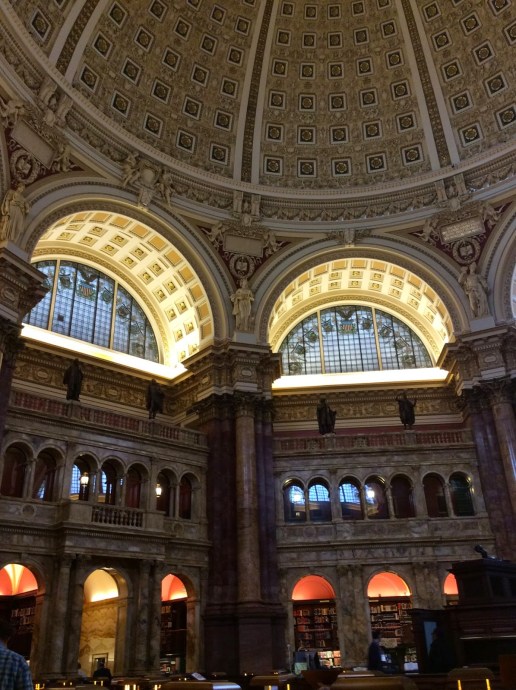
So I think, well, that’s where I’m going next. I’m here to do research, so research is what I’ll do, and it will be in that beautiful room.

I go back down and ask the lady at the front service desk how I go about this. She looks at me doubtfully, repeats several times that the room is just for doing research, and finally directs me to the Madison Building across the street to sign up. So that’s where I go, and find, as I expected, it’s very like the process of signing up to do research in the National Library of Scotland’s rare books room, takes some time, must have the proper ID, and so on. I go through the process, grab a cub of coffee, and prepare for a lovely and informative evening.

I return to Jefferson Building through the tunnel which shortcuts under the street (there was a little rain falling when I had left it earlier) and turn in all my things, except writing materials, to the coat check.
Guided by what I had discovered in the searchable guide accompanying Jefferson’s collection, I gather up a volume of the annotated complete catalog of the Jefferson collection, a collection of his papers, and his correspondence with Abigail and John Adams. In the catalog, I find more evidence that he had, in fact, owned some of Hume’s essays, but the notation, unusually, is incomplete, so there doesn’t seem to be evidence of which exact essays he read. Then I turn to his letters and find that he wrote to his son-in-law Thomas Mann Randolph, in May of 1790: ‘In political oeconomy (sic) I think Smith’s wealth of nations the best book extant. In the science of government Montesquieu’s spirit of laws is generally recommended. It contains indeed a great number of political truths; but also an equal number of political heresies: so the reader must be constantly on his guard. … Locke’s little book on government is perfect as far as it goes. Descending from theory to practice there is no better book than the Federalist. … Several of Hume’s political essays are good also…’ (p. 449) While this isn’t a ringing endorsement, compared with his often harsh criticism of Hume’s History, it’s almost fulsome praise. But however I search in the time I have, I can’t find any mention of whether he read Hume’s philosophical work, or what he thought of it.

So this might, now, be the second most beautiful room I’ve ever been in in my life. (Still doesn’t top Sainte-Chapelle.) I do get some research done, but not as nearly as much as I might considering the amount of time I spend here; I happen to be there on a day the Reading Room is open late, and I stay for a few hours all told. Between my reading, I gaze, marveling and a little drop-jawed, at the loveliness around me, made more intense by my awareness of how vast the records of human inquiry and inventiveness are contained within its walls.

*Listen to the podcast version here or on iTunes.

~~~~~~~~~~~~~~~~~~~~~~~~~~~~~
Sources and Inspiration:

Benjamin Banneker‘, Africans in America, PBS.org, Letter to Jefferson, and Jefferson’s responseHistory of the Library‘, Library of Congress website.

Jacoby, Susan. Freethinkers: A History of American Secularism. New York: Owl Books, 2004.

Jefferson, Thomas. Writings. Compiled by The Library of America, New York: Penguin Books.

Jenkinson, Clay. The Thomas Jefferson HourPodcast.

Meacham, Jon. Thomas Jefferson: The Art of Power. New York: Random House, 2012.

The Papers of Thomas Jefferson. Volume 16, 30 November 1789 to 4 July 1790. Ed Julian P. Boyd. 1961 Princeton, New Jersey

Moore, Joseph West. Picturesque Washington: Pen and Pencil Sketches of Its Scenery, History…, 1884.

Timeline of Jefferson’s Life‘. Monticello.org. Website of the Thomas Jefferson Foundation.

U.S. Capitol‘, Washington D.C.,  National Park Service website.

‘Washington, D.C.: Sites Associated with Thomas Jefferson’. Monticello.org. Wiki, Thomas Jefferson Foundation. http://wiki.monticello.org/mediawiki/index.php/Washington,_D.C.

Thomas Jefferson Sites, Part 3: Philadelphia

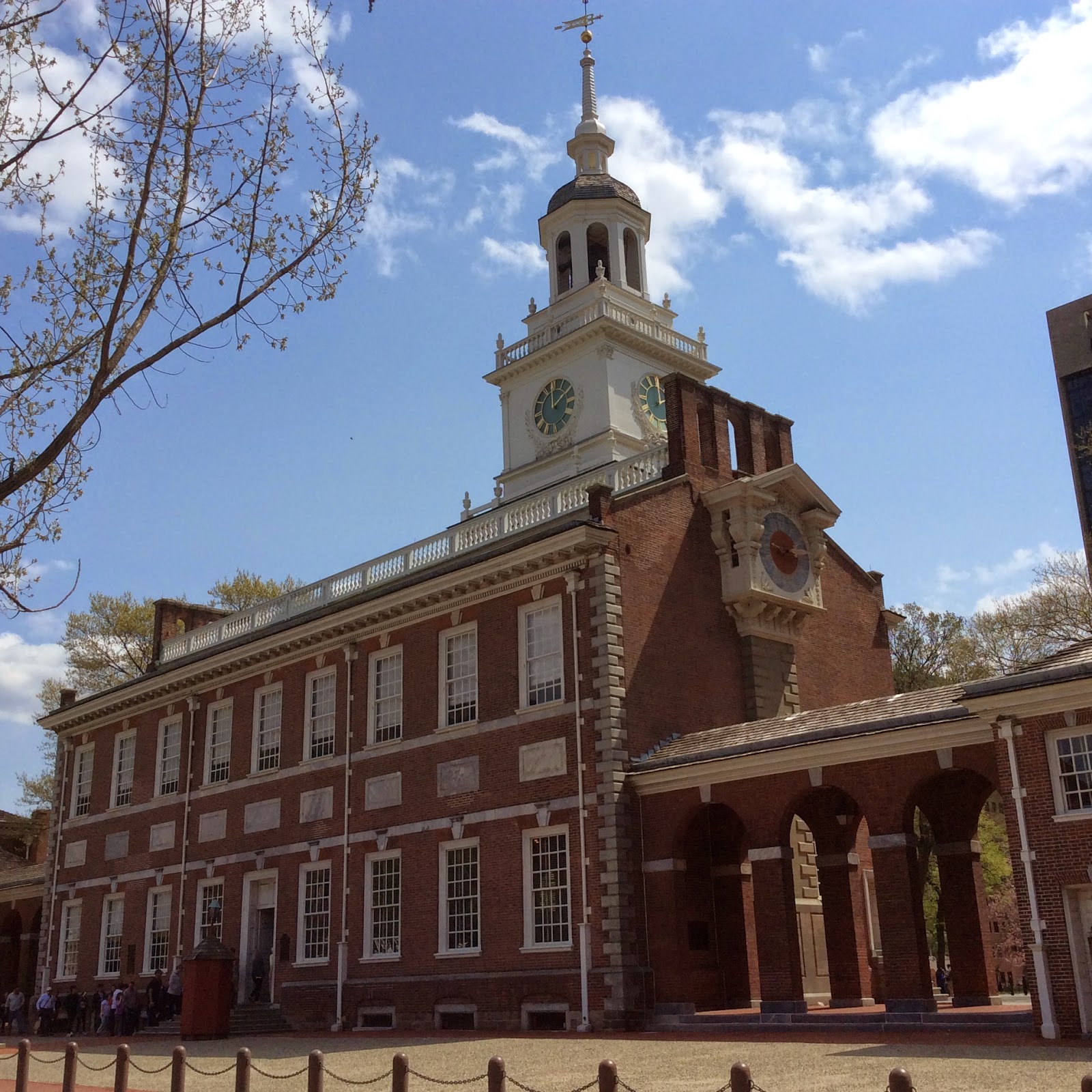
Independence Hall, Philadelphia

Third day, April 21st, 2015

I wake up very early to beat rush hour traffic and head northeast to Philadelphia.

My husband Bryan and I visited Philadelphia several years ago and had explored the Old City, so I have a fairly clear memory of the general layout and some of the sites I’m looking for. But we hadn’t seen Independence Hall, where the Declaration of Independence and later the Constitution was signed, because 1) it was being renovated at the time, and the front of it was covered by scaffolding and a gigantic dropcloth printed with an image of the facade and 2) it was a weekend day during tourist season and they were mobbed by tourists, out of tickets to tour the inside by the time we got there. I had learned my lesson, and this time around, I make a beeline for the visitor’s center to get my ticket. Even on a Tuesday in April, there was an over three-hour delay between the time I get my ticket and the time I will be admitted. That’s no problem since I have plenty of exploring to do, but if you plan to go sometime, my advice is to get your ticket as far ahead of time as possible.

The President’s House Site, Old City Philadelphia

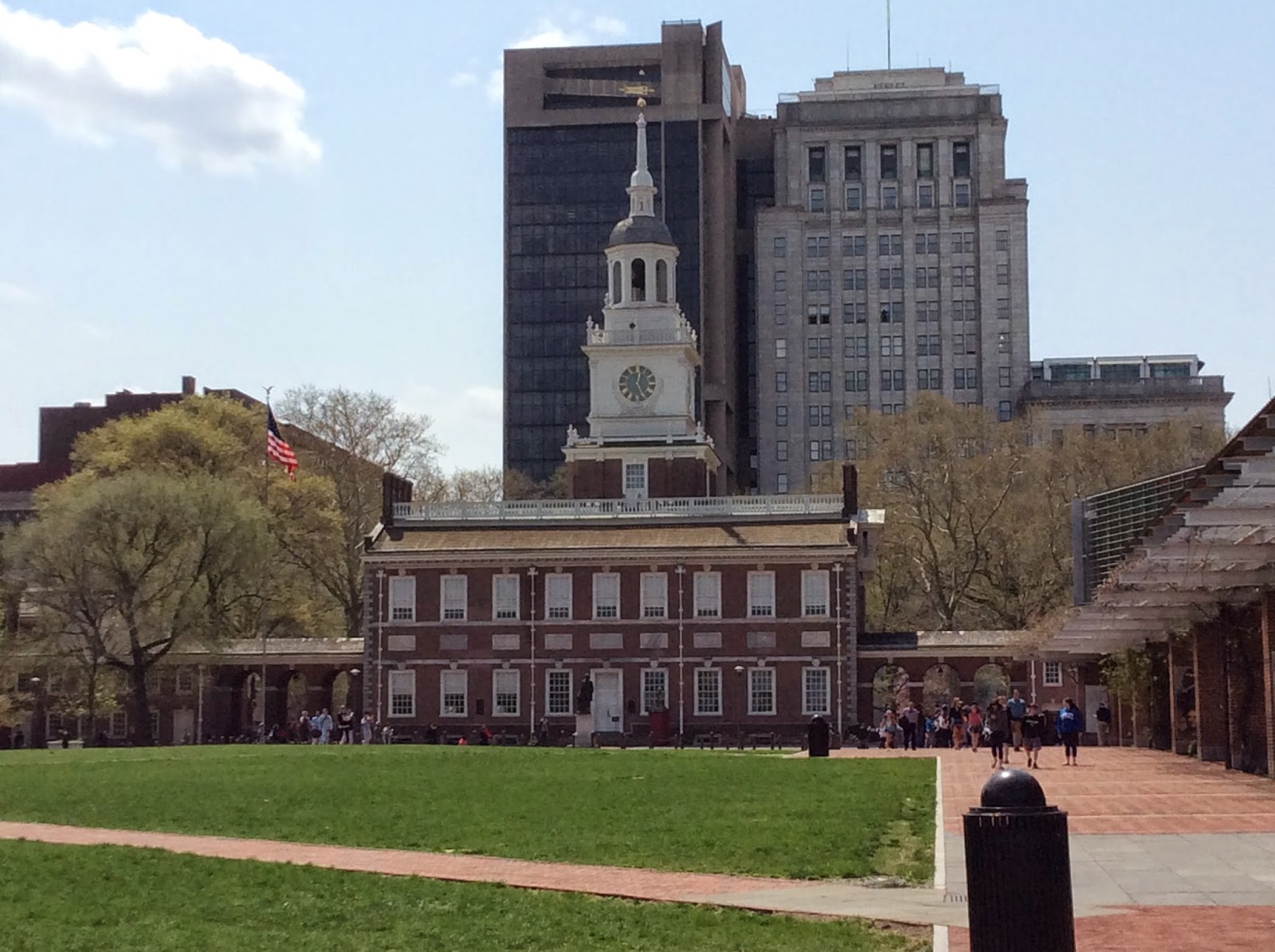
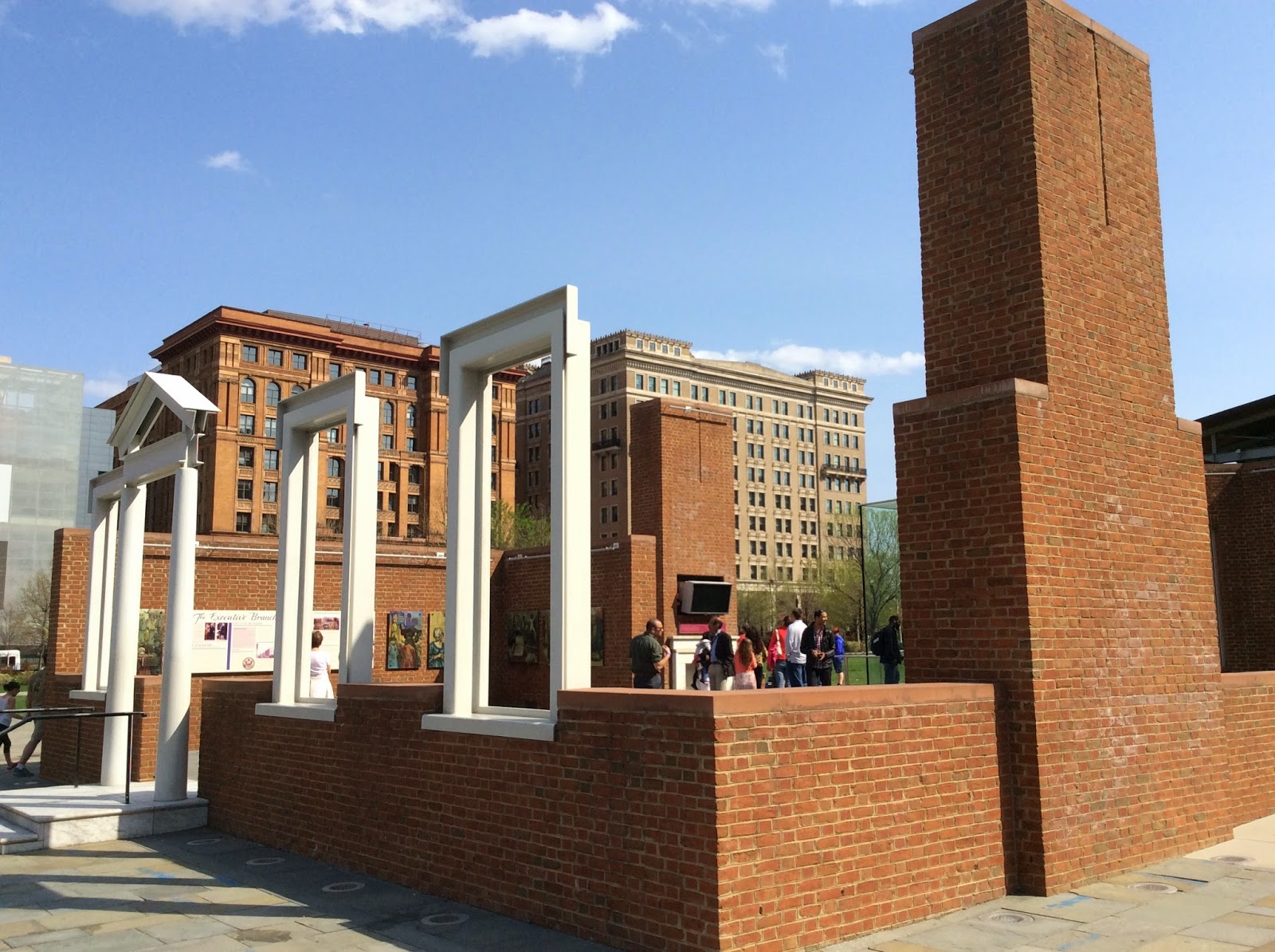
I start my wanderings with the President’s House site, where the first two Presidents of the United States, George Washington and John Adams, had lived while the White House was being built. (Adams moved in to the unfinished White House in 1800, during the last months of his presidency.) Jefferson visited this house many times during both of their administrations. The foundations exist and were excavated and studied, and now have an open-air exhibit there, which was brand-new when we were there years ago.

It’s a lovely exhibit, not only describing the house and the presidents and their families that lived there, but telling the stories of Washingtons’ slaves, left out of history until recently. More on this in a later piece.

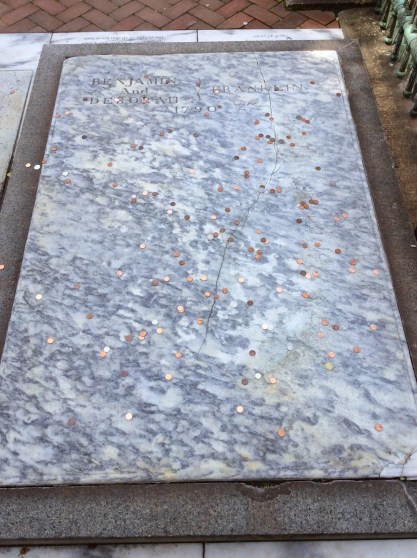
Benjamin Franklin’s Grave, Christ Church Burial Ground, Old City Philadelphia

Next, I visit the Christ Church burial ground across from the Free Quaker Meeting House, where Jefferson’s friend and personal idol Benjamin Franklin is buried. I head first to Franklin’s tomb, where he lies with his wife and members of his family. Franklin had the virtues Jefferson admired most: he was a curious, adventurous, learned, and sociable man; a gifted politician, diplomat, storyteller, and above all, a scientist. In other words, Franklin was the embodiment of the ideal Enlightenment man. More about Franklin to come.

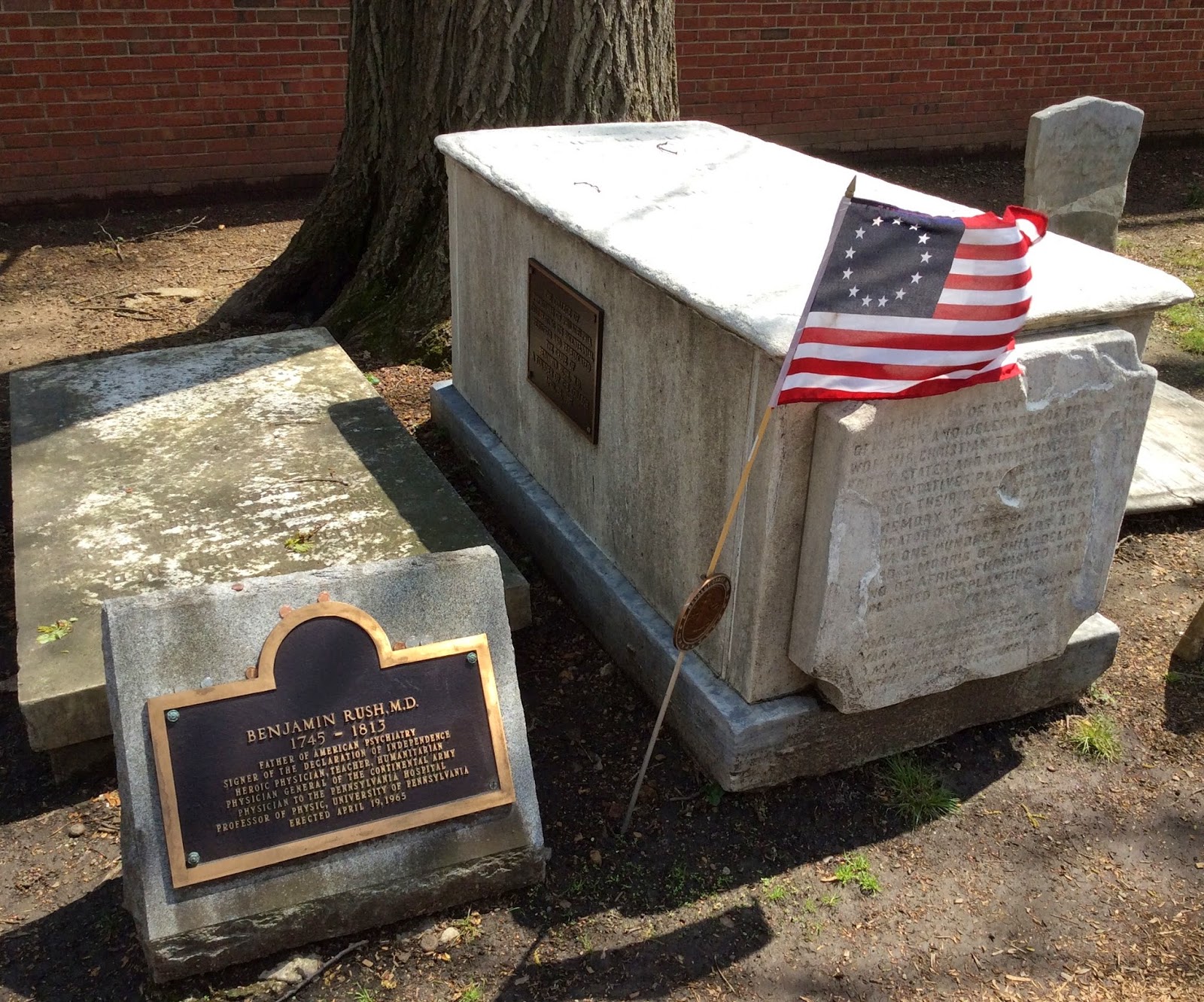
When I ask one of the men attending the gate where another of Jefferson’s colleagues, Dr. Benjamin Rush, is buried, he’s very glad to show me the way, exclaiming that Rush is his favorite among those notables buried here. Rush was also a great friend of Jefferson’s and frequent correspondent, and without his efforts, Jefferson and John Adams may never have resumed their friendship, which had been strained by the infighting among Washington’s administration between Adams and Federalists and Jefferson’s Republicans, and broken by their contentious presidential races.

Benjamin Rush’s Grave, Christ Church Burial Ground, Old City Philadelphia

The man who showed me the way is right: I would find Rush an excellent subject of another history series like this in his own right, as he lived a long, fascinating life. In addition to his role as a founding father of the United States, he cared deeply about important social issues and founded or served in several public service organizations. He was also curiously backward-thinking and innovative at the same time as a physician: for example, he continued to practice and promote blood-letting as a medical cure even as the medical field was doubting its efficacy and phasing it out, and had rather medieval-sounding theories about how disease is spread; yet, he was a pioneer in the study of mental disorders, describing them diseases of the mind instead of ‘spiritual’ maladies, and is often referred to as the founder of American psychiatry.

I discover that Francis Hopkinson is buried here as well. He was another good friend of Jefferson’s, a fellow signer of the Declaration of Independence and fellow member of the American Philosophical Society; he helped lead its revival after the Revolution. ‘Philosophical’, in that time, was a broader term than it is today, referring to inquiry into everything that exists and how it all works; scientific inquiry was included. Franklin put it this way: the APS was a foundation dedicated to ‘the promotion of useful knowledge’. (I prefer Franklin’s description to today’s conception of philosophy and approach it much the same way.) More on the APS shortly.

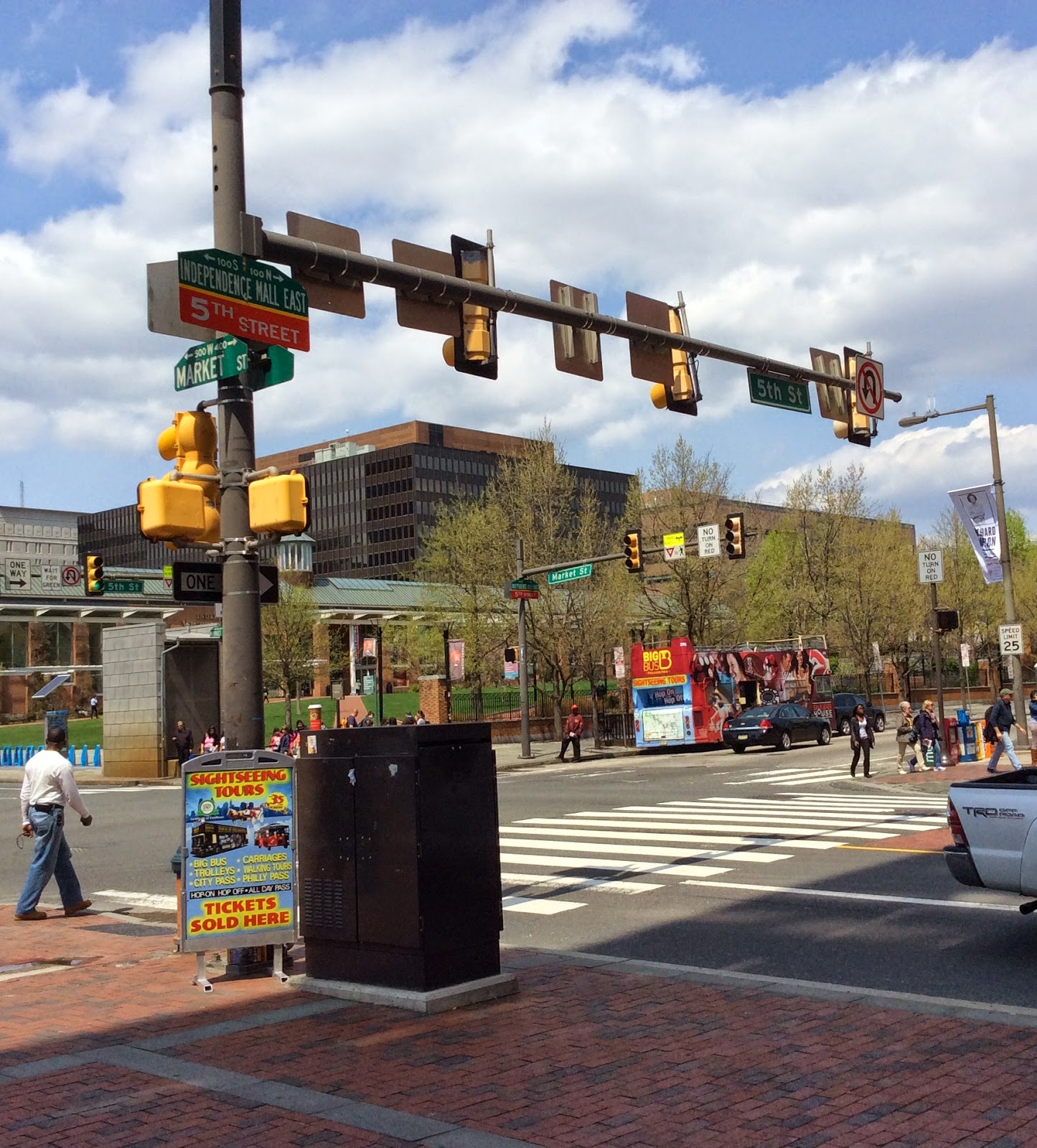
5th and Market Streets, Old City Philadelphia

Then on to the corner of 5th and Market, where Mary Houses’ boarding house stood. There’s nothing now marking the site that I could find. After the death of his wife (Martha Wayles Skelton Jefferson to the rest of the world, Patty to him) in September of 1782, he was inconsolable for awhile. His friend and protege James Madison helped persuade him to go to France, where he could assist in negotiations with Britain over the Treaty of Paris. He took his oldest daughter Patsy with him. The two had grown very close after Martha’s death, and he wished her to receive some of her education in Europe. The treaty ended up being finished before the weather would allow for the journey overseas, and after a stay of a couple months or so, he returned to Monticello, then on to other government positions. He was appointed minister to France in 1784, and returned to stay at Mrs. Houses’s, with Patsy, on their way to Paris again that summer.

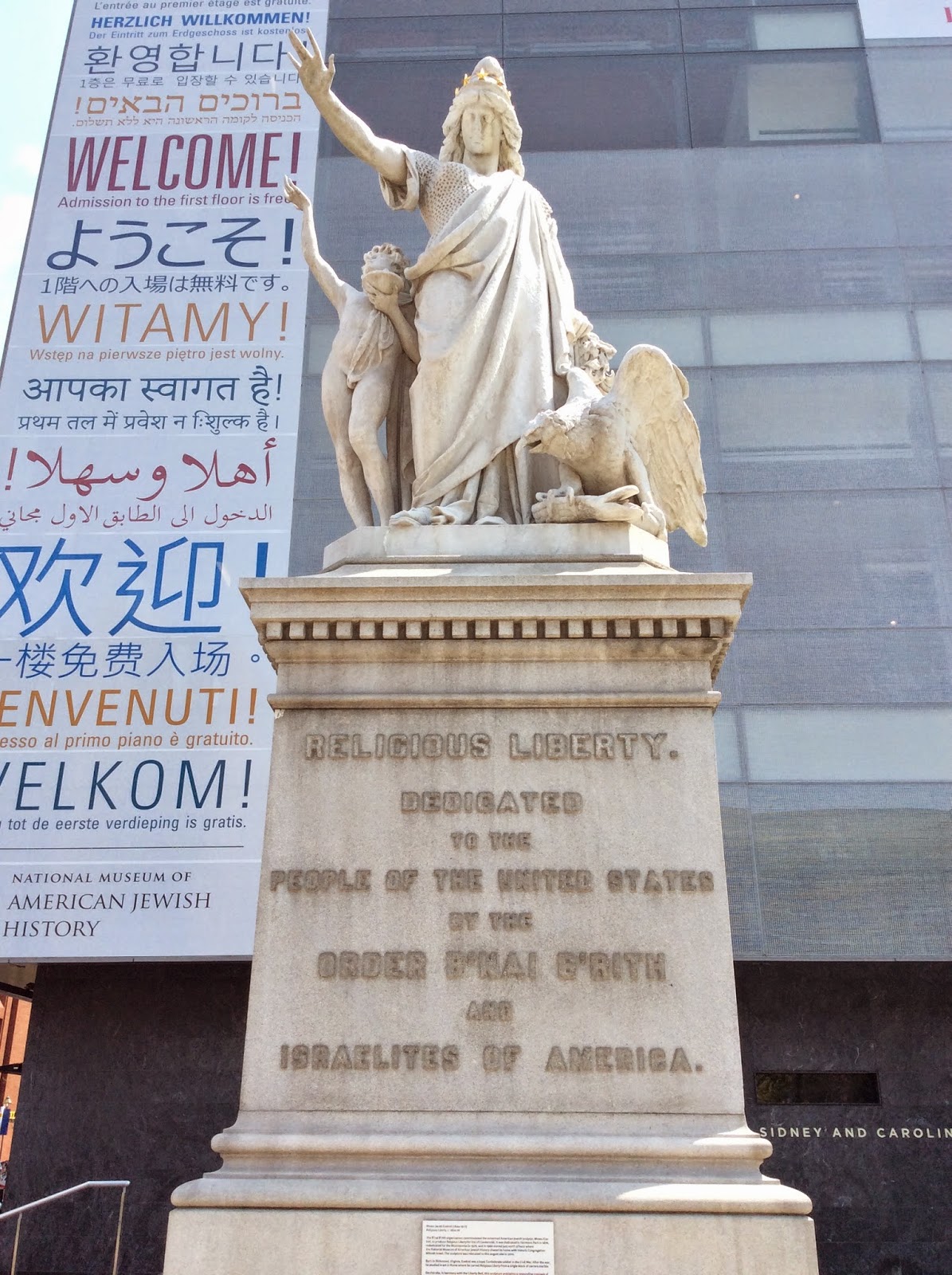
Statue in Honor of Religious Liberty, Old City Philadelphia

As I turn around to head to my next destination, I notice a beautiful statue in front of the National Museum of American Jewish History, across the street from where the boarding house had been. It’s entitled ‘Religious Liberty’.

There was a historic exchange between George Washington and his administration, of which Jefferson was Secretary of State, and the Jewish community of Newport, Rhode Island, which was an important moment in the new nation’s history of establishing a completely secular government which tasked itself with defending the right to complete religious liberty. (We’re still figuring out how to best go about it to this day.) Jefferson had made the establishment of religious freedom among the most important missions in his life; he directed that his authorship of the Virginia Statute for Religious Freedom be one of only three of his accomplishments carved on his tombstone. For a nation which had just separated themselves from the Old World, torn apart with one bloody religious conflict after another over for centuries, religious liberty was a wonderfully freeing, invigorating, humanistic social experiment.

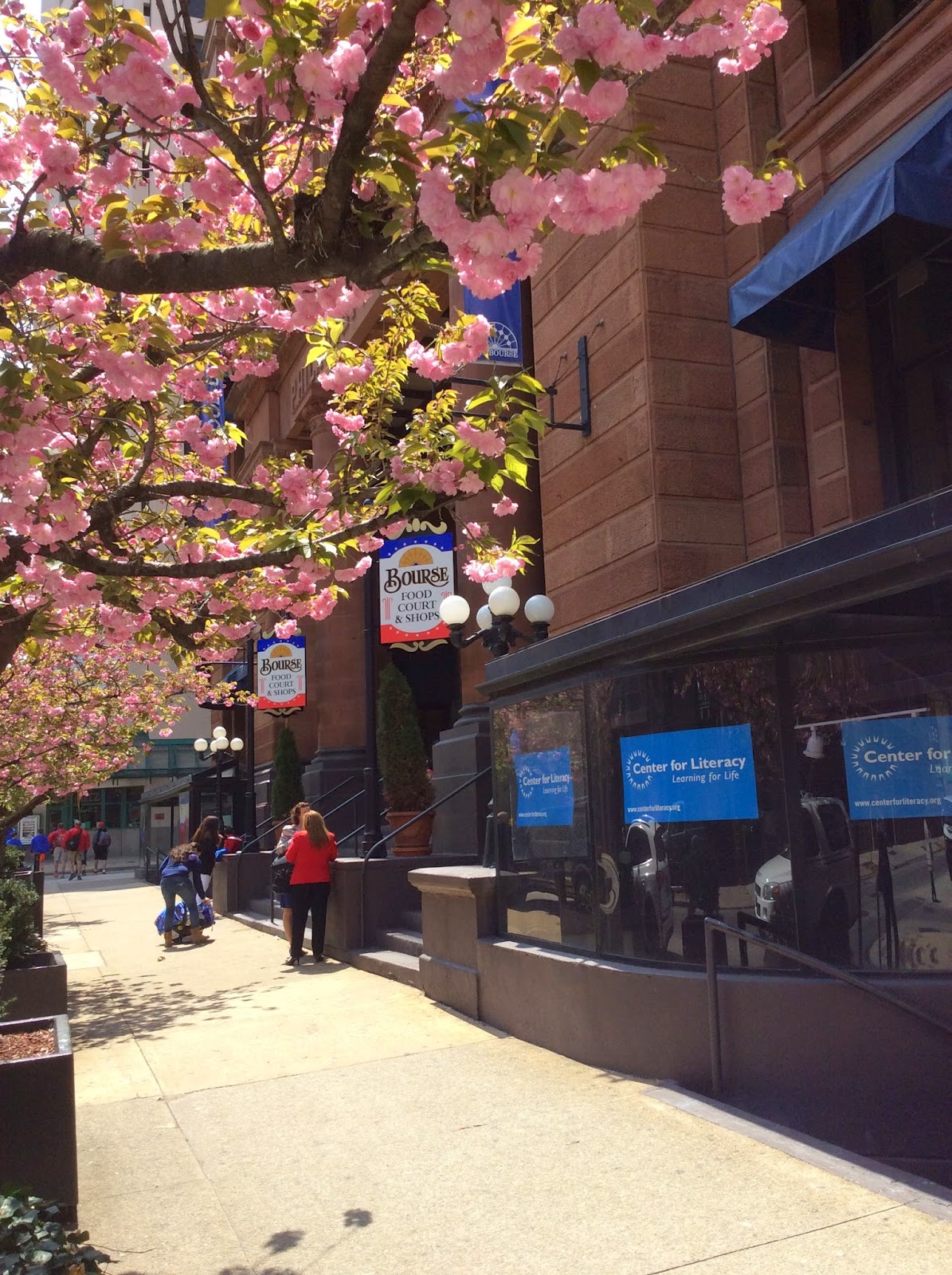
Near the Bourse, Old City Philadelphia

Then on to a site at the east end of the Bourse, a funny name for the old commodities exchange building, now a retail, dining, and business center. (It’s so nice inside, I’m tempted to stop here for refreshment, but it’s still early and I have much to see.) Francis’s Tavern used to stand here, on Fourth Street between Market and Chestnut. Jefferson lived here for awhile while he was Vice President in the late 1790’s until the government moved to the new capital in 1800. John Adams and many other government officials stayed there as well.

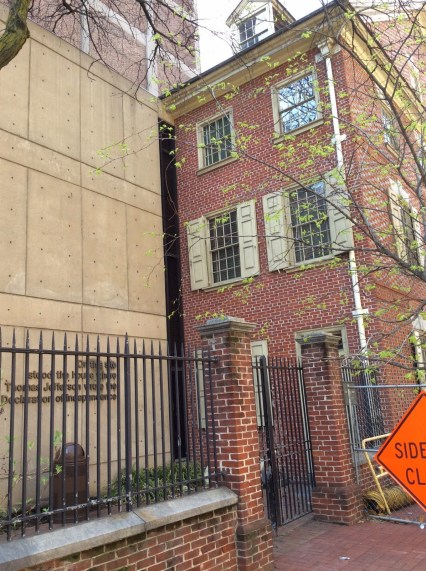
I go next in search of the site where Benjamin Randolph’s house used to stand: I know it’s not there anymore but I’m hoping for a plaque. After all, it was the first place Jefferson stayed in Philadelphia; he rented rooms from Randolph, cabinet maker, in 1775 when he arrived on June 11 as a newly elected member of the Second Continental Congress.

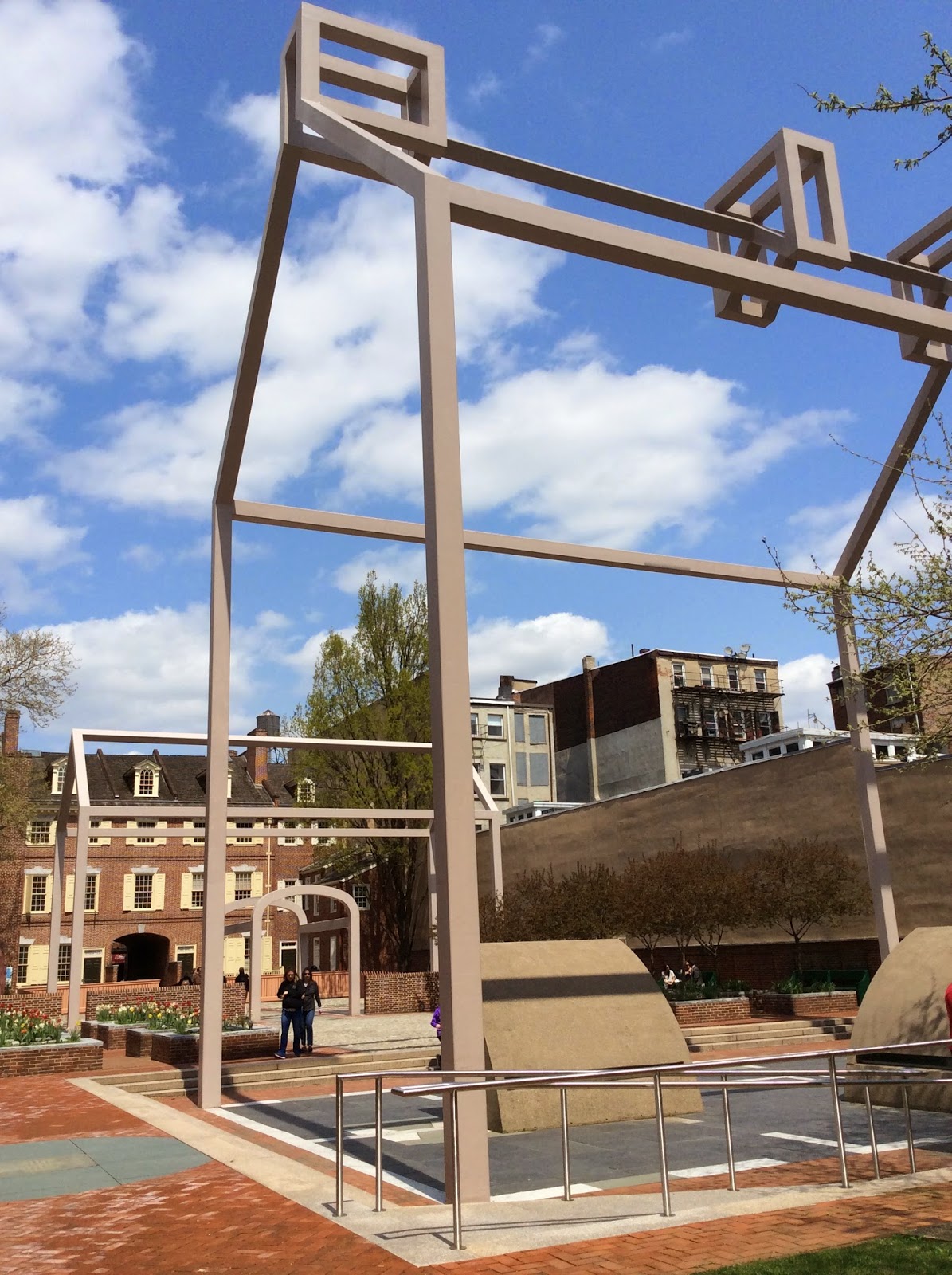
Benjamin Franklin’s house site near Chestnut between 3rd & 4th, Old City Philadelphia

It’s somewhere between 3rd and 4th on Chestnut. But I don’t know exactly where, and I find nothing indicating where it had been. Instead, I’m drawn to a sign indicating the site of two buildings Ben Franklin owned and lived in with his family the last five years of his life is located just down an alley next to the National Liberty Museum. I take a peek. Those curved concrete structures you see among the steel outlines of the original shapes of the buildings are windows into the archaeological excavations of the sites. So interesting. I love archaeology; I wanted to be an archaeologist when I was a kid. (Like most kids of the Indiana Jones generation, I’m sure!)

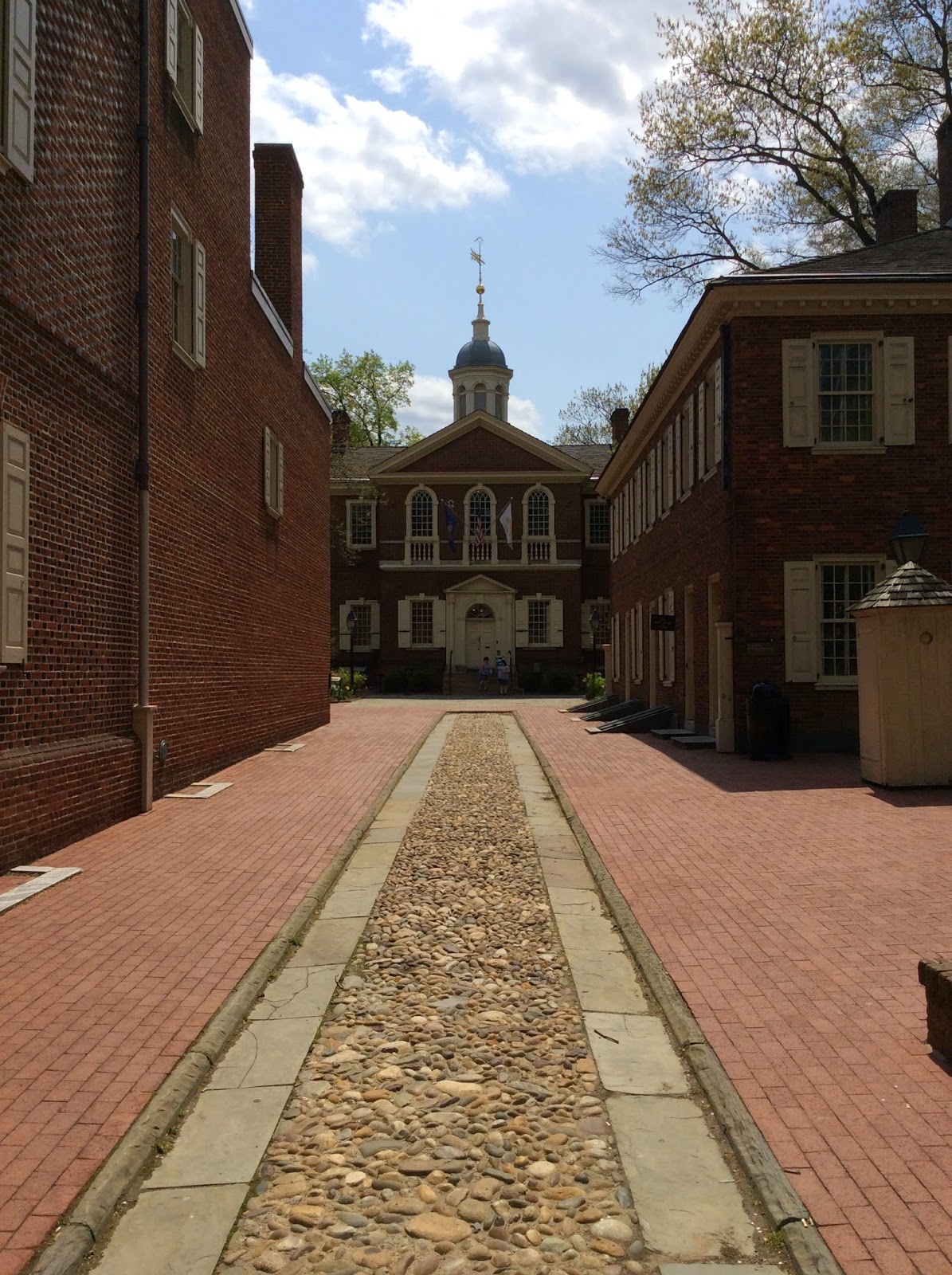
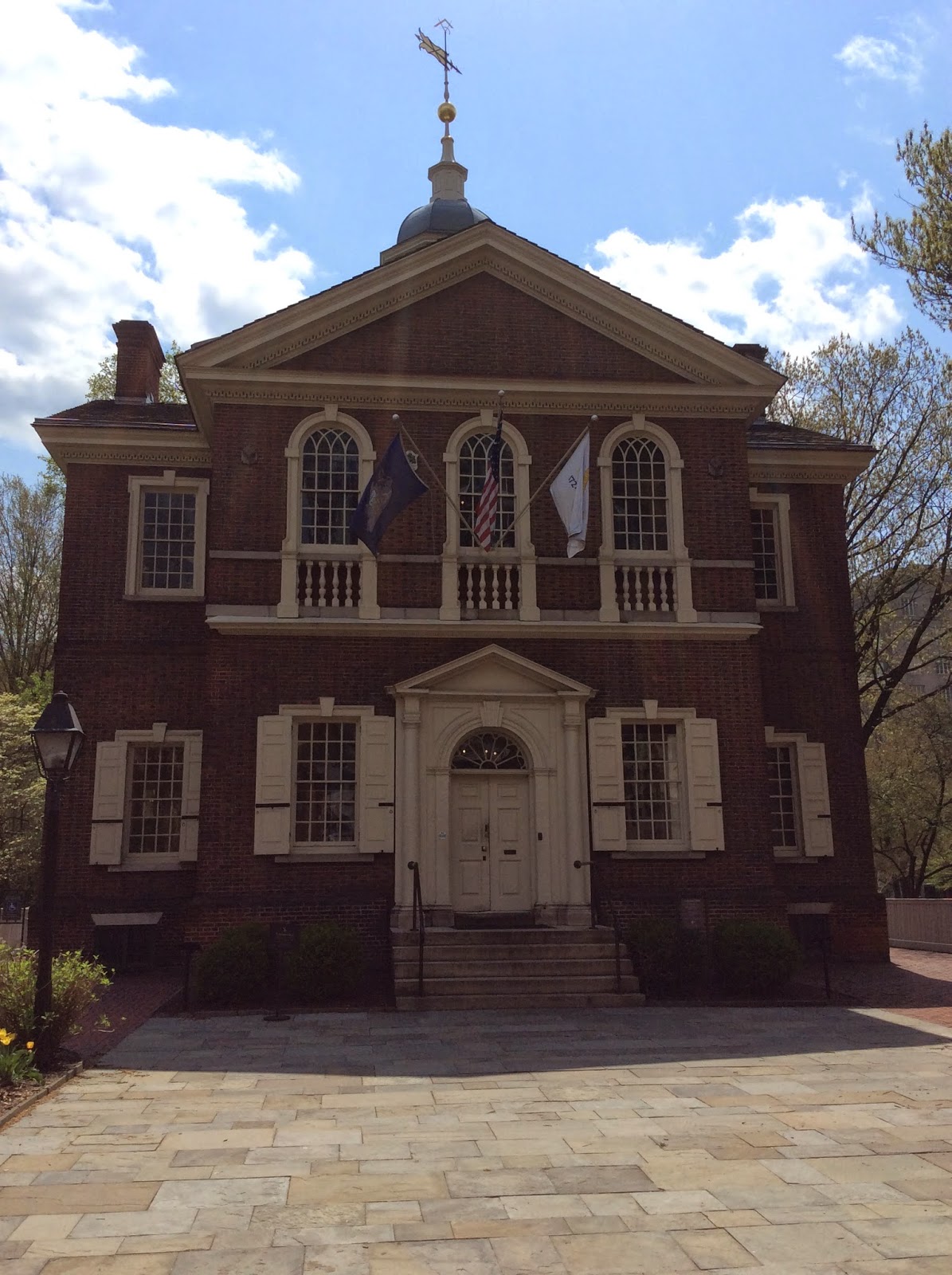
Carpenter’s Hall and surrounding buildings, Old City Philadelphia

Across the street, I find Carpenter’s Hall, where the First Continental Congress met. Jefferson wasn’t a delegate to that first one in 1774, but he wrote ‘A Summary View of the Rights of British America’ that year which Washington and Adams, who attended, admired and passed around to the other delegates. It was among the reasons Jefferson was eventually asked to write the Declaration of Independence since he had already done such an excellent job on what Washington called ‘Mr. Jefferson’s Bill of Rights.’

The Hall is open to the public, so I go inside. I ask a man attending the door, and a woman working behind a counter, if either of them knows of the site I’m looking for, but they don’t. The woman helpfully goes to her computer to see if she can find anything, but no luck.

I’m glad I asked though. By way of explanation as to why the site may be lost to history, the man tells me a brief history of how the National Park service took over Independence Hall and the Old City area of Philadelphia in the 1950’s, and the shockingly careless and reckless way they went about ‘restoring’ it (by today’s standards). The old buildings were crumbling and crowded by shabby, more modern buildings, and the city quickly had many of them condemned so they could be cleared away and the character of the old city could be revealed.

Carpenter’s Hall, Old City Philadelphia

So, the man continues, the National Park Service ‘marked everything with an X’ that wasn’t immediately identifiable as having to do directly with the founding of the nation, and the wreckers went to work. Philadelphians who knew the city and its history better, however, started flooding the NPS and city officials with letters, informing them that they were knocking down important historical buildings, among them the first military building of the new nation, to the right and in front of Carpenter’s Hall (which they rebuilt from the rubble they had just made of it; you can see it in the first photo of the Hall above, to the right of the cobblestone alley) and Gilbert Stuart’s house, painter of some of the most iconic portraits of Jefferson, Washington, and other founders. OOOPS!!!

The man’s story reminds me of what I discovered in NYC in my Rose and Stanton series, that until very recently, we Americans had a distinct lack of appreciation for our historical architecture. In the restless pursuit of progress, we went about knocking our old buildings down with wild abandon, as long as someone could make a few bucks by doing so. Much of our history has been lost in this way, and in my opinion, many United States cities have been uglified as a result. Sigh. I wonder if this is part of the reason why Europeans historically have disliked and distrusted American tourists. I’m glad to say we’re much better about such things these days.

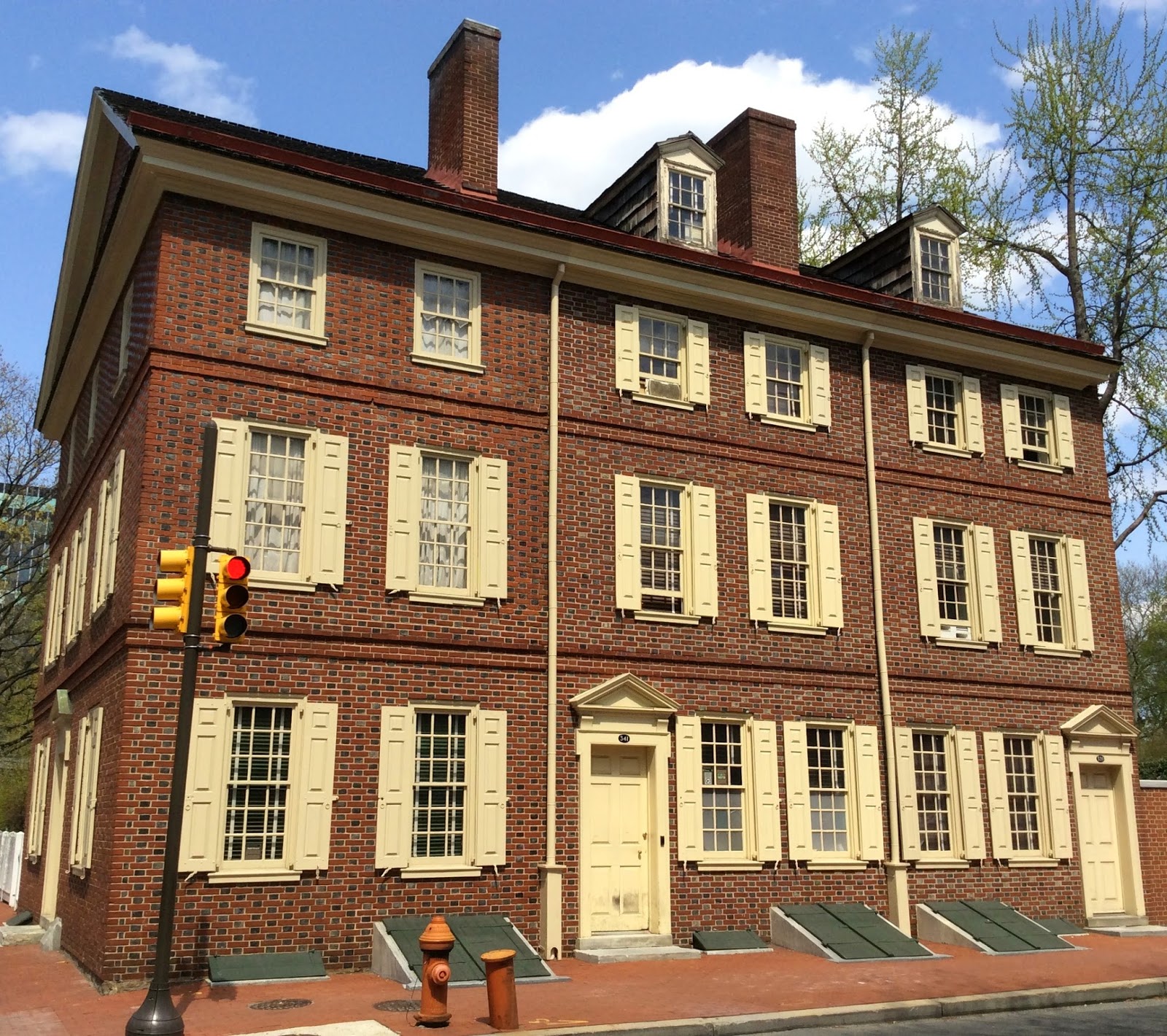
The Todd House, Old City Philadelphia

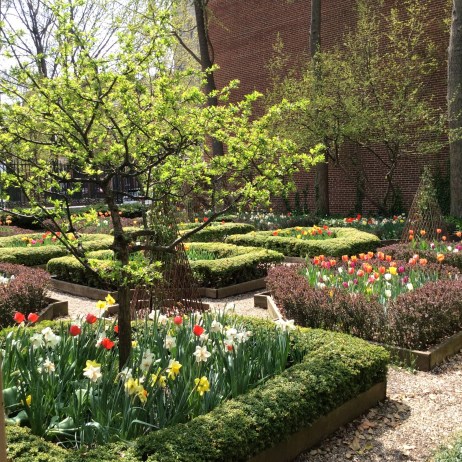
Reconstructed 18th century garden behind the Todd House, Old City Philadelphia

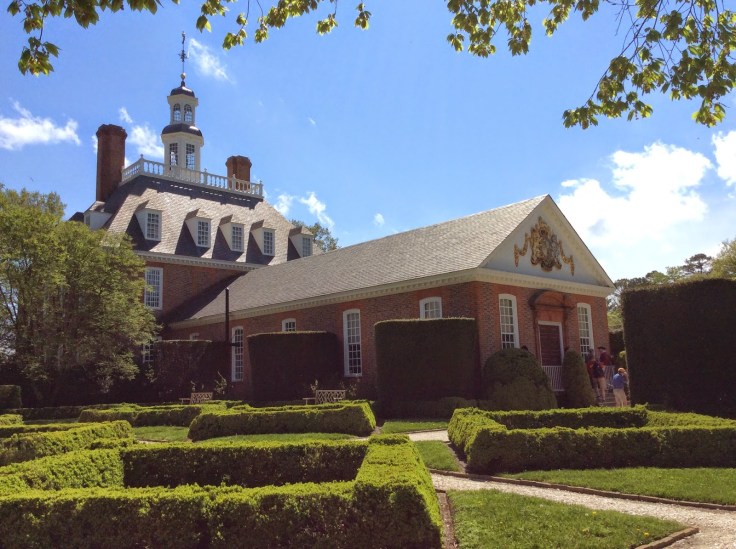
Then to a reconstructed 18th century garden behind the old Todd house. The garden is pretty, with lots of gorgeous tulips and trees with their new tender springtime leaves, but like the old-style gardens behind the Governor’s Palace in Williamsburg, too rigidly geometric in design for my taste. John Todd’s young widow Dolley married Jefferson’s close friend, protege, and ‘Father of the Constitution’ James Madison just a year after Todd’s death in 1793. (If it seems a little heartless to move on so quickly, well, what else could a woman do in those days? It was either be married and have social standing and financial support, or single, jobless, and unless you inherited money, penniless.) Anyway, it’s a handsome house, but just like the others.

Philosophical Hall, Home of the American Philosophical Society, Old City Philadelphia

To my amusement, a plaque I come across states more or less the same observation I’ve been making in my historical tour of this area. In 1799, a visiting British diplomat reported ‘The regularity of Philadelphia is so great, the streets are so much like each other and the houses so nearly the same size (being built of one coloured brick) that I do not think there is anything else worthy of remark about it.’

I suddenly notice how quickly time’s passing, and I hurry back to the Independence Hall square to queue up for my visit, since there’s a security inspection first. After I’m cleared and waiting with the tour group, I find I’m actually standing right next to my next intended destination, Philosophical Hall (one of the two halls of the American Philosophy Society), behind and to the left of Independence Hall if you’re facing it from the front.

Independence Hall, Old City Philadelphia

I’m so disappointed to find that the APS museum, which has an amazing-looking Jefferson-and-science exhibition going on right now, is closed, and will not be open again till Thursday. So, so sad! because I won’t have the chance to get back before I leave. My first big disappointment of the trip.

But anyway, I do get to go inside Independence Hall, beautifully restored. I discovered that the only original artifact here, besides the building itself and its architectural accoutrements, is the large chair on which Washington sat, presiding over the room on its dais in the center of the long wall. Here, Congress conceived of the Constitution, debated its contents, signed it, and voted it into law. Cool.

Congressional Meeting Room, Independence Hall, Old City Philadelphia

First Senate Building, site of Washington’s and Adam’s presidential swearings-in, next to Independence Hall

After wandering around Independence Hall and getting a good look at it from all sides, I find, in front and to the right, the place where Jefferson’s hero Washington (hero in integrity and military prowess, but not politically or even intellectually) was sworn in as the first President of the United States, as was Jefferson’s dear friend and despised political enemy Adams. The first sessions of the Senate and House of Reps were also held here, until the new capitol building in Washington D.C. was finished in 1800.

I leave the Independence Hall grounds and continue my tour around the corner down 5th Street, where the American Philosophical Society’s beautiful Library Hall stands (across the street from Philosophical Hall). It’s a reproduction of the original, with a grand statue of its founder presiding over its facade in a large central niche over the front entrance.

The American Philosophical Society Library, Old City Philadelphia

‘Jefferson’s Three Greatest Men’ (Locke, Newton, and Bacon), The American Philosophical Society Library

As aforementioned, the APS was founded in 1743 by America’s most-loved brainiac, Ben Franklin. Franklin was America’s native scientist extraordinaire, and spent his life conducting scientific experiments, disseminating knowledge to the public as widely as possible, participating in politics, and traveling the world. In other words, he lived out the virtues and carried out the practices of Jefferson’s designated ‘Three Greatest Men’ Francis Bacon, Sir Isaac Newton, and John Locke. Jefferson admired Bacon for his primary role in inventing the scientific process of observation, theory formulation, and experiment; Newton, for his brilliance in mathematics and logical reasoning and his radical new approach to physics; and Locke, for re-evaluating human nature and their rights and formulating a new political theory more in keeping with human dignity.

Dr. Benjamin Rush house site, Old City Philadelphia

The exhibits in the main entry hall are fascinating and beautifully laid out.

I leave Library Hall and return to where I had left the Todd house earlier to hurry back for my Independence Hall tour. I find what I’m looking for: the site of the aforementioned Dr. Benjamin Rush’s house, down the street from the Todd house on Walnut, at the 3rd Street end of the block. Jefferson visited this house regularly.

I continue my tour to the site of Robert Bell’s print shop. The first edition of Thomas Paine’s ‘Common Sense’ was printed here in January of 1776. As you probably know, Paine’s pamphlet was the most famous and most eloquent exposition of the colonies’ cause for independence from Britain, and did more to popularize and gather support for it than any other publication. Jefferson was a great friend and admirer of Paine, and shared not only his political views, but many (yet not all) of Paine’s progressive religious views, probably best described as Deistic with shades of Unitarianism.

Site of Robert Bell’s print shop, which created the first printing of Tom Paine’s Common Sense, Old City Philadelphia

Declaration House (formerly Jacob Graff’s house), Old City Philadelphia

In fact, Jefferson remained a staunch supporter of Paine even after his reputation suffered and most of his friends abandoned him following his publication of his anti-clerical, unorthodox ‘The Age of Reason’. Always the champion of freethought and religious liberty, Jefferson put his money where his mouth was and put his own political career at risk by welcoming Paine as an honored visitor to the White House.

I realize I’ve been a little haphazard in my site-seeking, and should skedaddle back to re-visit Declaration House, a little museum where Jacob Graff’s house used to stand, just outside of the Old City area at 7th and Market. Jefferson lived here in 1776, where he wrote the Declaration of Independence. I had visited this site a few years ago during my visit years ago with Bryan, but this journey I’m on won’t really be complete unless I return for at least a brief visit. Graff’s actual house is no longer standing, just the house that was next to it, but I remember that the original rooms were carefully re-created. I arrive to find that the Declaration House, the museum, the old house next to it, and the grounds are closed ’till summer at least, according to the guard standing watch, due to construction around the site.

I return to Old City, to the corner of Market and 2nd near Christ Church, where John Dunlap’s print shop used to stand, which printed the first broadside of the Declaration of Independence. I can’t find a plaque or anything else to indicate exactly where it stood. (I subsequently discover there is a small, rather obscure plaque marking the site, on the building you can see in the far left of my photo: it’s to the right of the right-hand door that’s obscured by the white tile-covered structure. So hurray, I take a picture of the correct building without realizing it!)

Ale, soup, and bread at City Tavern, Old City Philadelphia

Last but not least, I return to City Tavern, where, because I can very sentimental at times, I pay way too much for a ‘Thomas Jefferson ale’ as I had when I was here years ago with Bryan, and accompanied it with some indifferent (yet welcome, since I was tired and hungry) soup and bread. Jefferson spent a lot of time in the original City Tavern, and ate a lot of his meals here, as did Adams and Franklin, among others; the one I’m sitting in is a reproduction, built very recently in 1975, but faithful enough to the original style that it’s hard to tell at a glance that it’s not an original artifact.

Then off on a happy early evening stroll across Philadelphia’s beautiful and vibrant downtown, to grab a coffee and sit down in the lovely Belle Arts public Free Library to type up my notes.It’s been a very long, fascinating day.

*Listen to the podcast version here or on iTunes.

~~~~~~~~~~~~~~~

Sources and Inspiration:

American Philosophical Society website.

Benjamin Rush‘, Penn Biographies, Penn University Archives and Reference Center website.

George Washington and his Letter to the Jews of Newport‘, Touro Synagogue website.

Gilbert Stuart: The Complete Works. Website

Jacoby, Susan. Freethinkers: A History of American Secularism. New York: Owl Books, 2004.

James Madison‘, White House website.

Jefferson: Writings. Compiled by The Library of America, New York: Penguin Books.

Jefferson’s Walking Tour of Philadelphia‘. apsmuseum.org: website of the American Philosophical Society

Jenkinson, Clay. The Thomas Jefferson HourPodcast.

Meacham, Jon. Thomas Jefferson: The Art of Power. New York: Random House, 2012.

Religious Liberty‘, article, History page of the National Museum of American Jewish History website.

Thompson, Mary V. “The Private Life of George Washington’s Slaves“, Frontline, PBS.org

Timeline of Jefferson’s Life‘. Monticello.org. Website of the Thomas Jefferson Foundation.

Philadelphia Free Library, Philadelphia, Pennsylvania

Thomas Jefferson Sites, Part 2: Williamsburg

Second day, April 20th

I drive down to Williamsburg, where Thomas Jefferson received much of his higher education, read law, and embarked on his political career. It’s a long drive of almost three hours each way, and I take advantage of much of the time to catch up on some research via podcast. (Thank you, inventor(s) of the podcast, I can’t tell you how many of my hours you made fascinating and happy!). The rest of the time, as is my wont, I sing loudly to myself.

Colonial Williamsburg is partly authentic restoration and partly tourist-pandering attraction: at times, it feels just a little more like a historically-themed street in Disneyland than a historical site. Perhaps because it’s a little too clean and tidy, with actors in period costumes incongruously mingling with tourists and very stage-ily reinacting Revolutionary-era colonial Virginia scenes. Many of the buildings are very obviously dedicated to hawking souvenirs.

But oh well, best not to be a hater. In a perfect world, perhaps, the public might fully finance the expensive restoration and upkeep of historic sites like this through taxes or donations. As it’s not a perfect world, ‘ye olde historickal shoppes’ and entertainment help keep the place afloat, and in the end, what matters is that it’s still here to be studied and enjoyed. The souvenir shops are not nearly as obnoxious as many others I’ve seen, the buildings are in excellent repair, the grounds are lovely and well cared for, and on the whole, I’m satisfied.

I make a loop around Colonial Williamsburg after buying maps and a vintage postcard for my mother-in-law (who’s trying her best to instill in me the virtue of thoughtfully sending postcards while traveling. It’s still tucked among my maps and notes. Sighhhh.). I start off with ice cream cone in hand, as it’s fairly hot and muggy for a spring day to a California gal like me. But there’s a nice breeze blowing, and the sky is blue.

I begin with George Wythe’s house.

Wythe was a lawyer and teacher, and instructed Jefferson in the law. He also helped Jefferson get started in politics, and was a co-revolutionary and lifelong friend as well. Like Jefferson, he believed that reason should determine who’s fit to rule, rather than heredity. He may have been, in fact, the single most influential person in Jefferson’s life which he actually met (in other words, not counting those whose ideas he studied), with the possible exception of James Madison.

Not only did Jefferson spend a good deal of time in this house in his years as a young law student in the early 1760’s, he lived in this house with his wife and little daughter for a while in 1776, soon after he drafted the Declaration of Independence, while he served in the Virginia House of Delegates.It’s a simple but handsome house, and I’d like to go inside but it’s a Monday just before the tourist season begins in earnest, and it’s closed for the day.

The Governor’s Palace, however, is open, and I take the tour. It’s a much more decorative building than most I’ve seen, but still made of the inevitable red bricks of native Virginia clay. It was designed and originally built in the early 1700’s.

But this actual building’s a reconstruction: the original building burned down in late 1781, almost 3 years after Jefferson moved into the Palace as governor of Virginia. A little under a year into his tenure, he moved out again, the government having moved to Richmond as a safety measure. The Revolutionary War was raging, the British were bringing the fight ever farther inland, and Jefferson had a young family now to protect.

Though Jefferson only lived in this house for about a year, he had already spent a lot of time here in as a student (he was a member of one of Virginia’s elite families) and later in his years as a lawyer and government official. He loved to play the violin, and Francis Fauquier, governor at the time, was a music enthusiast as well. Along with Wythe and another of Jefferson’s most beloved and admired teachers William Small, Fauquier took the talented young man under his wing, and the four would gather frequently under this roof (well, the original one anyway).Later on, Jefferson made many drawings of the Governor’s palace, ostensibly with the view of remodeling or upgrading it for his own planned tenure there, but the war changed his plans. Jefferson’s drawings would later aid in the reconstruction of the building in the 1930’s.

The gardens in the back of the palace are more formal than I like, laid out in geometric lines and aggressively pruned, but still nice to walk in on this sunny spring day.

I continue on, and make a counterclockwise loop around the town. It’s a lovely walk between the Governor’s palace and the next site I visit: I wander among green fields sprinkled with wildflowers, crisscrossed with paths, and bound with rough hewn fences; handsome old trees with tender young leaves, little bridges over winding streams, and Georgian and Federal style grand homes mostly made of that inevitable red brick interspersed with quaint little wood houses and outbuildings. I forget to take a picture of Peyton Randolph’s house, an imposing dark red brick, long, angular house, startled as I am by a carriage laden with sightseers which passes by me more closely than I would have liked. In fairness to the driver, I was distracted by site-seeking and more unaware of my general surroundings than safety might require. Randolph was a distant cousin and fellow Virginia politician, and Jefferson would surely have visited his house regularly.

Then to the Capitol Building.

Like the Governor’s Palace, the building that now stands is a meticulous reconstruction from the 1930’s, of the original building as it would have looked in Jefferson’s time and earlier. The British used it for military purposes during the Revolutionary War, since the government of Virginia had moved inland to Richmond, and the building fell into ruin from subsequent disuse. I really like its design, with its rounded ends and archways; it’s a refreshing break from the nearly unrelieved squareness of the rest of the architecture I’ve seen around here.

The original Capitol building witnessed many scenes of immense historical importance to the American colonies. Patrick Henry’s speech against the Stamp Act was greatly inspiring to Jefferson, who attended debates at the Capitol while still a law student, and who continued to admire Henry as an orator, if not as a serious intellectual or lawyer, for the rest of his life. Jefferson also spent a lot of time there as a member of the House of Burgesses, and with George Wythe, George Washington, and other leaders, debated and discussed issues related to the growing tensions with Britain, and how a possible split from the mother country could be brought about.

Then down the street to the Raleigh Tavern, this one a clapboard affair, and a reconstruction of the original.
As I arrive, I see a performance in progress, of several costumed ‘townspeople’ debating political issues of the days leading up to the Revolutionary War. I pick my way among the crowd and get as close a look as possible. Again, to my disappointment, it’s closed at the moment.

The Raleigh Tavern, like the Capitol building, also hosted many historically fraught scenes. Virginia and other colonial leaders met there regularly; George Washington frequented it often. Jefferson spent a lot of time there too: not only studying, lawyering, and politicking, but also wooing one of his earliest love interests. He was a romantic and a man of healthy sexual appetite, evidenced not only by the frequency of his wife’s pregnancies (which helped bring about her early death in 1782, at age 33) and his decades-long affair with Sally Hemings, but also the number of his romantic interests. At age 20, he danced there with Rebecca Burwell, where she rejected his (self-described) awkward declarations of love and devotion.Then onward along the square and across the row of pubs (which I note for future reference) to the Wren building at the College of William and Mary.
Jefferson enrolled here in 1760, a few days before he turned 17, to study moral philosophy, natural philosophy (as science was known then), and mathematics, until he went on the study law under (the aforementioned) George Wythe (William and Mary Colleges’ first law professor). He lived and studied in the Wren building itself. Ten years after he graduated, Jefferson drew up plans to improve and expand the Wren building, but as was the case with the Governor’s Palace, the Revolutionary War intervened, and the building looks like it did when Jefferson was a student, and not as Jefferson the architect imagined it.

The classrooms have a cozy or closed-in appearance, depending on your taste or mood, with dark, heavy wood paneling, lined with benches. Jefferson acquired much of the education he valued most highly at William and Mary under the instruction of his dearly loved teacher and friend William Small. In later years, he was sometimes admiring of, and sometimes critical of, the college in his writings. He thought it among the best educational institutions American parents could send their children to, because it had such excellent professors as Small and Wythe. Yet he was critical of the addition of its school for Christianizing Native Americans, and thought its location and resources insufficient for providing adequately for the intellectual and physical well-being of its students. As he critiqued William and Mary, he formulated plans for an institution of higher learning which he would later realize (more in a later post about that).

For all its Jefferson-described limitations, this college boasts many of the most famous graduates in early American history (as you can see from the Wren building’s proudly displayed plaques pictured below): Thomas Jefferson, George Washington, Payton Randolph, George Wythe, and Edmund Randolph, among others.
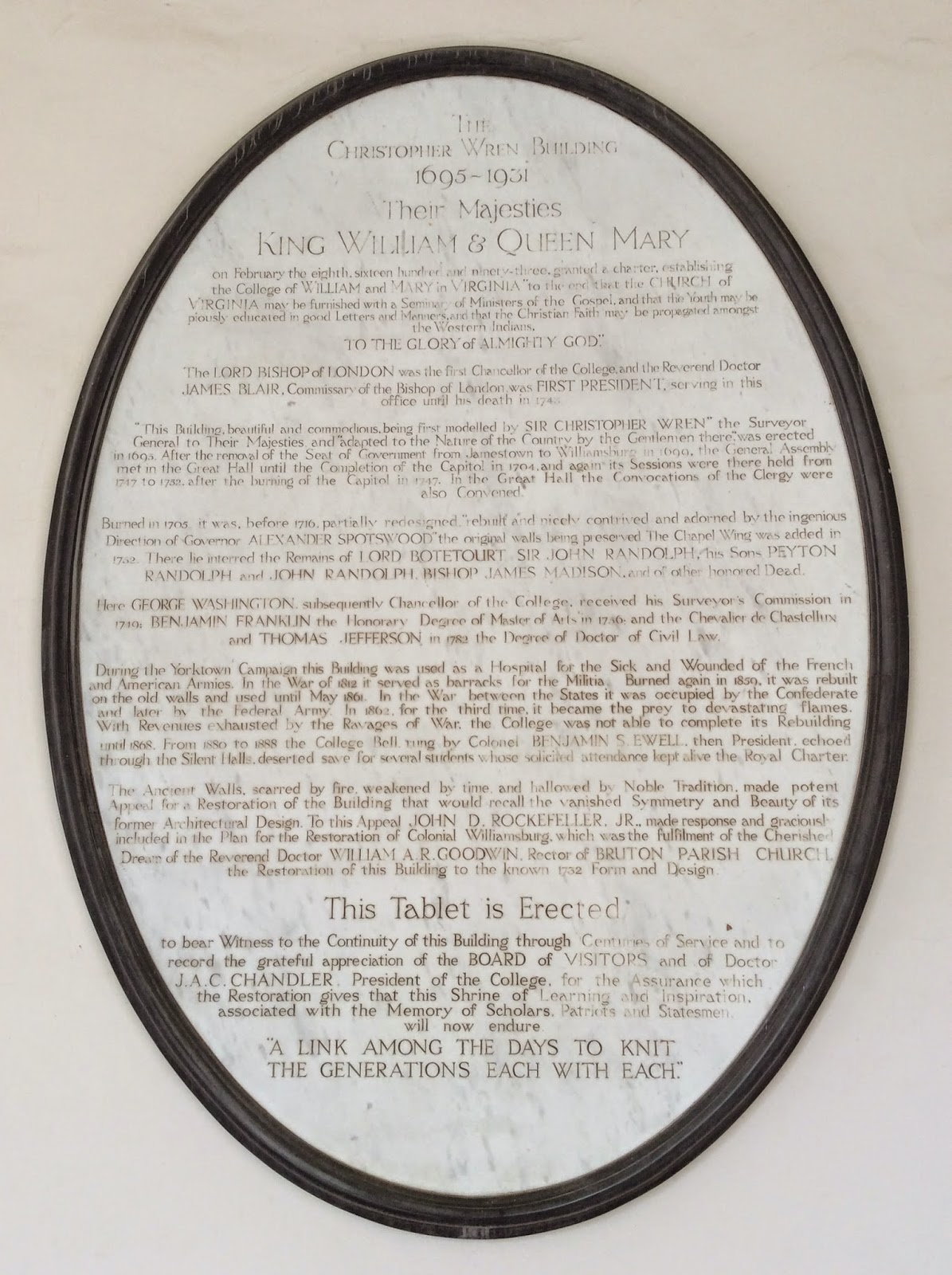
After touring the central rooms of the building, open to the general public even though classes are in session as I explore, I leave the Wren building and William and Mary grounds and return to the row of pubs I had passed a little while ago. I choose the Trellis Bar and Grill, since the charmingly named Dog Street Pub with the cute sign isn’t seating people outside at the moment; they seem to be setting up for the dinner beer garden. The Trellis serves a favorite ale of mine (Ommegang Hennepin saison) and after all, one can’t visit a college town and not have a beer, right?

I cool my throat with the tasty cold brew and relax my slightly achy traveling feet as I edit my photo roll and write up some notes of today’s trip.

The breeze, having turned into a gusty wind, bring clouds and a few drops; the air feels soft and velvety and seems to indicate a coming storm. Time to make the long drive back to Takoma Park, where I’m staying, at the north edge of D.C. On the way home, I witness the most spectacular lightning storm I’ve seen in years (we don’t see those much in California) and a fairly brief yet dramatic hail-and-rain-and-wind-storm. Though I’m a little nervous as the wind shakes my tiny little rental car around and the rain renders me a little blind, I’m enjoying it more than not as I take shelter in a fast-food barbecue joint (kinda good, kinda gross, as you might expect), and feel it’s been an excellent adventuresome day.

To be continued…

*Listen to the podcast version here or on iTunes

~~~~~~~~~~~~~~~~~~~~~~~~~~~~~~~~~

Sources and Inspiration: 

“Capitol (Williamsburg, Virginia).” Wikipedia contributors. Wikipedia, The Free Encyclopedia. http://en.wikipedia.org/wiki/Capitol_%28Williamsburg,_Virginia%29

Colonial Williamsburg, website of The Colonial Williamsburg Foundation.


Jefferson: Writings. Compiled by The Library of America, New York: Penguin Books.
http://www.loa.org/volume.jsp?RequestID=67

Jenkinson, Clay. The Thomas Jefferson Hour. Podcast.
http://www.jeffersonhour.com/listen.html

Meacham, Jon. Thomas Jefferson: The Art of Power. New York: Random House, 2012.
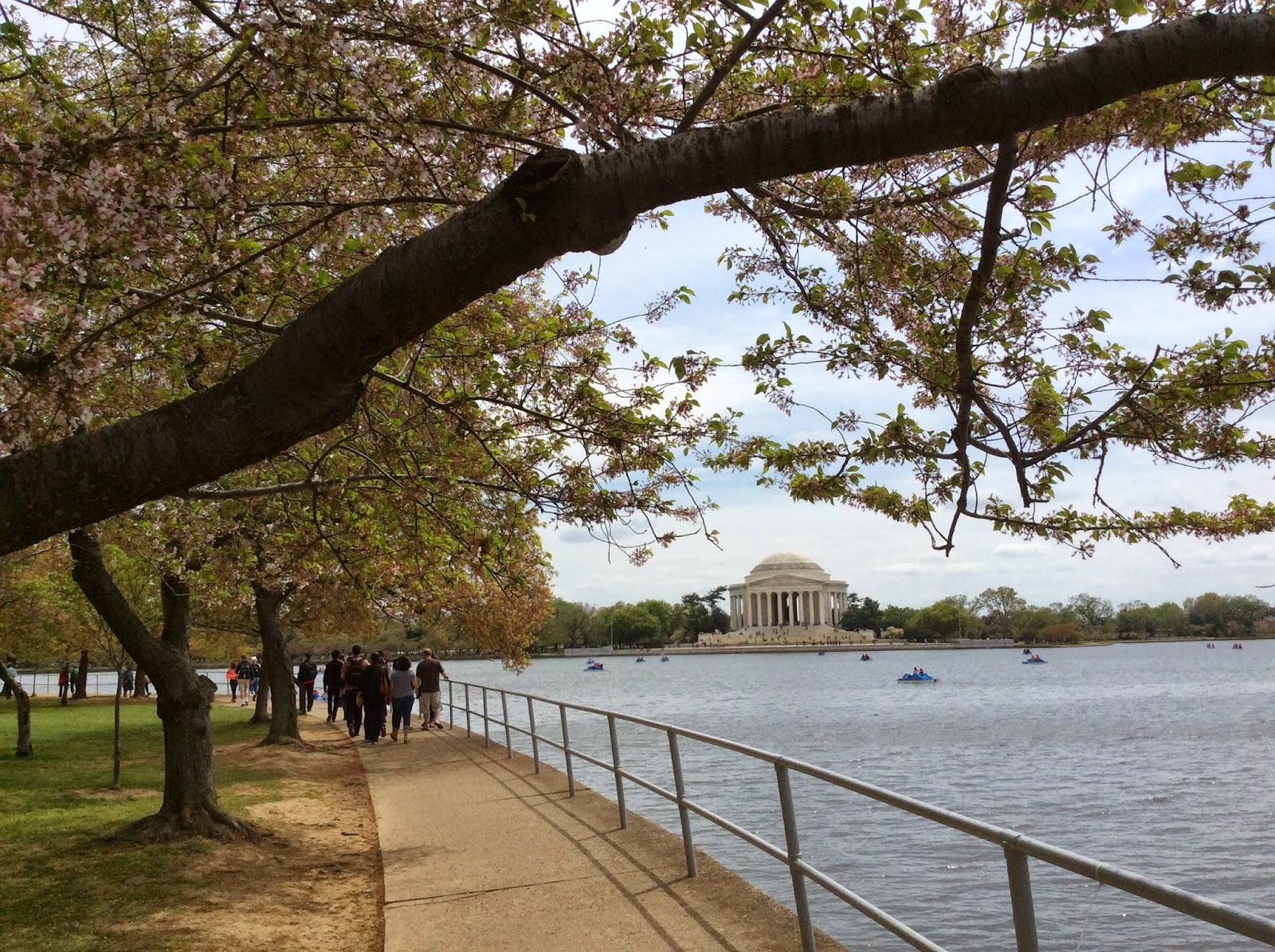
http://www.jonmeacham.com/books/thomas-jefferson-the-art-of-power/

‘Timeline of Jefferson’s Life’. Monticello.org. Website of the Thomas Jefferson Foundation.
http://www.monticello.org/site/jefferson/timeline-jeffersons-life

Thomas Jefferson Sites, Part 1: Washington, D.C., First Day

First day, Sunday April 19th:

I get a late start on my first day. But that’s okay: I’ve long since made it my policy to get my rest at the beginning of a trip because three things happen when I’m sleep-deprived: 1) I’m cranky and don’t enjoy myself fully 2) It’s much harder to take in everything and remember it, and 3) I lose my sense of direction and ability to read maps. Since I need to have my good spirits and my thinking, remembering, and map-reading capabilities intact for the purposes of this trip, I sleep in. I get a late start on my first day. But that’s okay: I’ve long since made it my policy to get my rest at the beginning of a trip because three things happen when I’m sleep-deprived: 1) I’m cranky and don’t enjoy myself fully 2) It’s much harder to take in everything and remember it, and 3) I lose my sense of direction and ability to read maps. Since I need to have my good spirits and my thinking, remembering, and map-reading capabilities intact for the purposes of this trip, I sleep in.

When I finally get a move on, I head over to the Mall, and start with:

 
– The Jefferson Memorial 
It’s neoclassical in design, inspired by the ancient Greek and Roman architecture that Jefferson loved. It’s also tall, well-appointed, classy, and full of memorable quotes… like the man himself. He would also appreciate its open-air design, its setting among trees and on the water: he was quite the outdoorsman, as studious and writerly as he was. And he would love to see the crowds that visit the site continuously, people from all walks of life, admiring the building and the grounds, resting on the steps, discussing the thoughts expressed on the walls.

Jefferson would probably have protested the idea of setting up such a grand monument to himself, something so close to a shrine or a temple; he described himself as a modest man. But it’s also clear, despite his protestations to the contrary, that he enjoyed being admired, that he sought love and approval from others. I think he’d look on this monument with secret pride and gratification, and would praise its hospitable openness to the public, as available to them as he made himself and the White House during the years of his presidency, and its edification to the people’s sense of beauty and the intellect.

I visit the museum beneath the memorial, which gives an overview of his life, times, and ideas. Jefferson was born at Shadwell in Albemarle County, Virginia in 1743, his father a successful planter, his mother from a well-connected, wealthy family. Jefferson was educated at home by tutors and at boarding schools as a youth, and studied law at William and Mary College. He entered public life early, elected to Virginia’s House of Burgesses at age 25. His tenure as a public servant lasted over 40 years, from congressman to minister to France to Secretary of State to President. All the while, he was a farmer, amateur scientist, inventor, architect, writer, philosopher, and whatever else captured his imagination, more details of which will come up in later posts.

As I leave Jefferson’s memorial, I waver in deciding where to go next: do I abandon the Mall and go immediately in search of other sites associated with Jefferson’s life, or do I continue on my way? It’s really a beautiful day, a bit windy, perhaps, but it’s fairly warm and there’s still some cherry blossoms left on the trees and wildflowers scattered all around the Mall’s park grounds.

I decide do something a little different this time: I usually stick to writing about the sites more or less directly related to the people I’m writing about, be it sites they visited themselves or sites created by others in their memory. But it occurs to me that I’m surrounded by memorials to people who, in addition to carrying out their own vision, carried out something of Jefferson’s vision as well. Nearly all American civic and moral leaders since Jefferson’s time reference his ideas when promoting their own, and cite his authority in carrying out their political missions. That’s to be expected: none of the members of our nation’s founding generation addressed so many matters of public concern, wrote or helped to write so many of its founding documents, explained the philosophy behind our form of government and our bill of rights so throughly, helped formulate the political structure of our government, and personally lived out our promises, our strengths, our contradictions, and our weaknesses as a nation as Thomas Jefferson, with the possible exception of James Madison and John Adams.

And no others were as widely influential, and who, while a de facto aristocrat, was more of a man of the people than Jefferson, with the possible exception of… (and who, by the way, laid the cornerstone of the Jefferson Memorial…)

Franklin Delano Roosevelt Memorial

…FDR!A year or so ago, I first listened to an utterly fascinating episode of the Thomas Jefferson Hour discussing how Jeffersonian ideals may only be realizable by non-Jeffersonian means. It’s a radio show and podcast by Jefferson scholar and historian Clay Jenkinson (one of my all-time favorite podcasts, I’ve listened to every one that I could get ahold of at least once, often two or three times, except the ones about gardening, since I have no yard and hence, no garden). I recently went back and listened to again. It’s a discussion on Jefferson’s letters to Madison, and one in particular, after he had spent some years in Paris before the French Revolution. Jefferson discussed the dangerous political situation in France that resulted from a long history of a powerful and wealthy few systematically gobbling up most of the nation’s wealth and political power for themselves, leaving the majority of the population destitute. It was only a matter of time, Jefferson pointed out, before the people could take no more, and would inevitably rise up violently against their oppressors.

It’s always been the case that there will be some portion of a nation’s population that lack sufficient humanity, that are greedy and rapacious, and their thirst for power and hunger for wealth will drive them to spend their lives getting as much as they can, regardless of how many others they must harm to get it. Others might not be so purposeful in their predations, but their shortsighted efforts to increase their own personal gains without a though for the welfare of others, or a blind faith that the market will alwasy correct itself, often lead to the same harmful results. Because of this, Jefferson explains, it might very well be necessary for society to engage in some sort of redistribution of wealth.

Given Jefferson’s background as a passionate promoter of states’ rights and his fear of a too-powerful central government, this might come as a surprise to the modern reader, as it was to me when I first heard Jenkinson’s podcast on the subject, and read the letter for myself. But Jefferson was a believer in John Locke’s theory of natural rights, as Jenkinson explains, and in particular, in his theory of property rights. Our primary property right is the right of subsistence, to have enough to provide for one’s own needs, to preserve the health of one’s body and of mind. Our secondary property rights allows for the accumulation of wealth beyond that needed to maintain a happy and healthy existence, but we may only take advantage of secondary property rights if they do not infringe on the primary property rights of others.

This is the key point of property rights that many overlook today, especially those who select from Jefferson’s writings, especially his early writings before the evidence of the dysfunctional and unraveling French society tempered his views, to support their ideas about small government and absolute rights of property and contract. But Franklin Delano Roosevelt, like his progressive cousin Theodore Roosevelt, realized that the pursuit of personal gain without respect for to the primary property rights of others led to a society that systematically placed Jefferson’s ideals of a self-sufficient, educated, free citizenry out of the reach of too many people. Teddy Roosevelt, initially a more strait-laced conservative, had toured the slums of New York City, and had seen for himself how the ruthless, unrestrained pursuit of profit led to the impoverishment, sickness, and death of so many people, rendered easily exploitable by circumstance. In response, he changed his mind about the extent of rights of contract and made some reforms. Spurred on by the Great Depression, FDR carried forward the progressive vision of his cousin and overhauled the whole system, enlarging the government so it would work better for the ordinary citizen in the way Jefferson had hoped a small government would.

– Martin Luther King Jr Memorial

MLK was quite the wordsmith; besides revealing extraordinary personal bravery in the face of repeated and threatened imprisonment as well as death threats, he had a way, like Jefferson, of putting things.There are many of his memorable quotes engraved on the walls surrounding his memorial. One that’s not engraved on his memorial (but I think should be) is the one that links most directly to Jefferson and that stands out in both succinctness and explanatory power: his analogy of the promissory note from his great ‘I Have a Dream Speech’ of 1963.

At the time they were written and first put into action, the Declaration of Independence and the Constitution increased the liberty of very few people. In severing themselves from Great Britain, the leaders of our new country mostly secured more rights for themselves and those like them: landowners, lawyers, merchants, and so on. The ordinary colonist lived more or less the same life just after the Constitution was ratified as before. Most free men could not vote since they were not property owners and/or were not fully literate, and no women or slaves at all could vote. Same for members of some religious minorities; this situation was one of the first political injustices to be reformed. Taxes went to a new set of leaders almost as far removed from the reality of most Americans as before. In other words, ‘taxation without representation’ was still the rule rather than the exception in the newly United States of America.

As MLK pointed out, the promissory note promising ‘liberty and justice for all’ remained unpaid: for black people, for other ethnic and racial minorities, for women, for working people. He revealed, in an eloquent and moving way (aided by his experience as a preacher), how the words of the Declaration of Independence rang hollow since ‘all …are created equal’ was not manifested in law, attitudes, and practice in the lives of far too many American people.

While he reviled and wrote and fought against slavery as a young lawyer and politician, giving up the fight after years of unsuccessful opposition to (and I add, hypocritically enjoying the benefits of) of what he called the ‘abominable crime’ of slavery, Jefferson also believed the races could not live together in peace and friendship. MLK dreamed otherwise.

 Lincoln Memorial

Lincoln, unlike Jefferson, was a man brought up in poverty, and had little formal education in his youth. Like Jefferson, he was largely self-motivated and self-taught in his advanced education, and like Jefferson, hated slavery as a young man and spoke passionately and eloquently against it, only to waffle on the issue in his later years somewhat for reasons of personal bias, and even more for political reasons. Fortunately, yet again unlike Jefferson, he came back around, and did what Jefferson had hoped and predicted future generations would do.
The violence of the Civil War was as horrific as were the centuries of slavery that proceeded it; while it’s debatable whether it could have been averted or that it was the inevitable outcome of the discrepancy between the practice of slavery, the political and moral theory informing our founding documents, and the individual human longing for freedom, Lincoln, like MLK, recognized the societal moral debt that remained unpaid, using the rhetoric of blood redemption in the words of his second inaugural address, immortalized on the right wall of his memorial: ‘…shall [the Civil War] continue, until all the wealth piled by the bond-men’s two hundred and fifty years of unrequited toil shall be sunk, and until every drop of blood drawn with the lash, shall be paid by another drawn by the sword, as was said three thousand years ago, so still it must be said “the judgments of the Lord, are true and righteous altogether.”

And as Jefferson pointed out in his letters referring to the bloody Revolution in France, it would be unrealistic to expect that the struggle for freedom against such a deeply entrenched, cruel, and oppressive institution would be pleasant or easy. Jefferson famously wrote ‘The tree of liberty must be refreshed from time to time with the blood of patriots and tyrants. It is its natural manure.’ I hope he’s wrong when it comes to the future, though he was not wrong about the revolutions of his own time and about the worsening effects of slavery on society. There’s an excellent book I often refer to, Steven Pinker’s The Better Angels of Our Nature (a phrase borrowed from Lincoln) which, as the book’s subtitle Why Violence Has Declined suggests, indicate that, among other things, the free(ish) market world economy, the scientific and human rights revolutions, and the advances in communications are making the world a much more peaceful place than it ever has been. Perhaps these advances will give many more of us the potential to become as informed, as cosmopolitan, and as courteous as Jefferson himself.

I had come to the end of my tour of the memorials.
Between visiting the MLK and Lincoln Memorials, I had swung around to the left to see if I could stop by what is now know as Theodore Roosevelt Island, known in Jefferson’s time as Analostan. He used to visit his friend John Mason, who had a farm and mansion there. The 66 connects it to the mainland, and there’s a footpath on the bridge.

It was a blustery walk, to say the least, and I discovered that footpath reaches across, but not down to, the island. I’ll return to visit another time. But looking back, I could plainly see TJ’s memorial between the trees.My Uncle Bob, who lives in nearby Fall’s Church, Virginia, picked me up to take me on a little driving tour and then to dinner. I’m fond of my Uncle Bob, tall, handsome (a common trait of the Cools’), courteous, old-fashioned in his sensibilities and speech, seemingly grave and imposing with his deep and slightly thick voice (I was a little scared of him as a child, funny to think of that now!), but with an enthusiasm that would rival any small child’s when it comes to seeing something beautiful or discussing a subject he loves. He has a good sense of humor.
On our way around the Mall, we passed by the corner of C and New Jersey Streets, where Conrad and McMunn’s boarding house was. Jefferson lived there for a while when he was Vice President, but the building no longer stands. I check it off my list. The rest of the evening is devoted to non-Jeffersonian-themed touring and dinner.

To be continued….

*Listen to the podcast edition here or on iTunes

~~~~~~~~~~~~~~~~~~~~~~~~~~~~~~~~~

Sources and Inspiration: 

Jacoby, Susan. Freethinkers: A History of American Secularism. New York: Owl Books, 2004.
http://us.macmillan.com/freethinkers/susanjacoby

Jenkinson, Clay. The Thomas Jefferson Hour. Podcast.
http://www.jeffersonhour.com/listen.html

King, Martin Luther, Jr. ‘I Have A Dream’ Speech, 1963.
http://www.ushistory.org/documents/i-have-a-dream.htm

Meacham, Jon. Thomas Jefferson: The Art of Power. New York: Random House, 2012.
http://www.jonmeacham.com/books/thomas-jefferson-the-art-of-power/

‘Timeline of Jefferson’s Life’. Monticello.org. Website of the Thomas Jefferson Foundation.
http://www.monticello.org/site/jefferson/timeline-jeffersons-life

‘Washington, D.C.: Sites Associated with Thomas Jefferson’. Monticello.org. Wiki, Thomas Jefferson Foundation.

http://wiki.monticello.org/mediawiki/index.php/Washington,_D.C.
 

Traveling Philosophy Series, Thomas Jefferson Edition: Prologue

As I sit here in the airport terminal in Salt Lake City, waiting for one of my connecting flights to DC, I sleepily munch on French fries and watch the crowd go by. My ever-generous darling awoke with me at three thirty this morning to drive me to the airport, and though I’m almost too tired to think, I can’t sleep either, as is usually the case at the beginning of a trip (I can usually sleep on the way home).

So as I’m watching the crowd, I’ve got Thomas Jefferson in the back of my mind, as I’ve been immersing myself in biographies, lectures, discussions, and author’s talks about his life and thought over the last couple of weeks. On the first leg of my trip, I had just been re-reading the first chapters of Susan Jacoby’s marvelous Freethinkers: A History of American Secularism, in which Jefferson’s Enlightenment philosophy, his Deism, and his efforts to enshrine a robust conception of human rights and separation of church and state in state and federal law play a large role.

A strong belief in the basic natural goodness and perfectibility of humankind underlie Jefferson’s view of human nature and his political philosophy. In the airport, I see those traits personified which would justify Jefferson’s faith in humanity if they were as universal as he hoped. I see cooperation, courtesy, patience, and friendliness abound: people chat freely with others they just met; others stand in line and in crowded aisles with forbearance, and courteously let others go ahead of them, or step around them with a smile, if they are burdened with children or slowed by age or disability; still others helpfully pick up a bag or a scarf dropped by a fellow passenger in a hurry to get their things so as not to delay others. I just saw a man give up the standby seat he had just won to the woman who had forfeited it, who was on the verge of tears because she arrived mere moments before her flight was due to take off.

I also see a wide diversity of race, culture, and creed represented in the crowd peacefully assembled here, cooperating seamlessly with one another, which the slaveowning-yet-abolitionist-yet-repatriationist Jefferson thought impossible (more on these contradictions in a later piece). He didn’t think, for one thing, that people of different races could live harmoniously in one place, not to mention his dim view of women’s ability to fully engage in public life and the professional world! I see an elderly woman murmur fervent prayers in a low voice to an image of a Hindu saint (I think) perched on the bag in her lap, with no-one protesting or even batting an eye; I see a black woman with a cross prominently displayed on her bosom accept instructions from the woman of apparent Middle Eastern descent at the podium, and then share pleasantries with her; I see a young white apparently Mormon man praising the sweet looks and winning personality of the child of Indian parents across the aisle, comparing her virtues to those of his own children at home; I sit next to two women, smelling of stale smoke, missing a few teeth, and wearing cheap clothes, happy, chatting, and smiling about the adventure they’re embarking on, without any show of feeling out of place next to the obviously much wealthier woman sitting next to them on the other side (and who, in turn, shows no sign of noticing or even caring about ‘rubbing shoulders’ with those of a different economic class). I see a young female pilot stride confidently down the aisle, a young boy gazing at her admiringly.

This airport, right now, in so many ways, is the America of Jefferson’s dreams, in some ways realizing his rather idealistic view of human nature, and in many more ways surpassing it. I wish he could see it right now, to relish this justification of his hopes for what his country could be, and to learn that human nature is capable of being even better than he thought possible. But when I think about all that’s going on in the world right now, I know we still have a long way to go. For now, I’m not going to dwell on that. I’m just going to enjoy this microcosm of human goodness I find myself in right now.

*Listen to the podcast version here or on iTunes

To Washington DC, Virginia, and Philadelphia I Go, In Search of Thomas Jefferson

Hello, friends of Ordinary Philosophy!

From time to time, I take a trip to some corner of the globe, to explore the lives and ideas of great thinkers in the places where they lived and worked. For this series, I follow in the footsteps of thinkers who are no longer alive, since those who are still telling their own stories. But those who are no longer alive in the body live on in the ideas that they pass on, and in the example they provide for us to follow.

I’m pleased and excited to announce my third philosophical-historical themed adventure, this time in Washington DC, Philadelphia, and various sites in Virginia to follow in the footsteps of…. you may have guessed it… Thomas Jefferson!

Thomas Jefferson was born on April 13th, 1743, and in his long life, he accomplished more than most. He was a founding father of the United States, and went from being a young scholar, lawyer, and representative in the Virginia House of Burgesses, to writing the Declaration of Independence and the Virginia Statute for Religious Freedom, to public service as a congressman, as Minister to France, as Secretary of State, as Vice President to friend and rival John Adams, and finally as third president of the United States. Throughout his life, among many other things, he was an inventor, amateur scientist, farmer, avid reader, architect, naturalist, author, founder of the University of Virginia, and of course, philosopher.

He was a fascinatingly complex and contradictory figure: a self-described shy and modest man with a distaste for politics, who time and time again re-entered the strident political arena of his day to eventually reach the highest office in the land; a critic of the national debt and of too much federal power and a strict Constitutional constructionist, who helped create a stronger national government in the first place, and who flouted the Constitution and further indebted the nation to make the Louisiana Purchase; a promoter of personal liberty and a slaveowner; an idealist and a pragmatist.

So off to the east coast I go! There, I’ll visit landmarks associated with his life, and places where he lived, worked, died, thought, wrote, studied, and rested.

I’ll be traveling there from April 18th through the 26th, and will be writing throughout the trip. I’ll be writing not only about his ideas, but about what I can discover about his everyday life in these places, and whatever feeling of the time and place I can capture.

Here’s the story of the trip, and related essays about Jefferson and his ideas:

Welcome to the Podcast Edition of Ordinary Philosophy!

Hello dear readers, and welcome to the
podcast version of Ordinary Philosophy!

You can listen to the podcast here, on Google Play, or subscribe in iTunes.

Like many of you, I’m a big fan of podcasts, mostly because my life is very busy. One day in the future, I hope to have a lot more time to do each task one at a time, to really be present, as they say, as I wash the dishes, straighten the house, do the laundry, and perform all those other tasks that take up time, but not much thought.

But at this time in my life, between my day jobs, my creative projects, and spending time with friends and family (which I don’t do enough of these days, sadly), I don’t have enough time to keep up the world of ideas as nearly much as I’d like to by sitting down and reading. Instead, I keep myself informed and increase my education by listening to lots of podcasts: discussions with my favorite authors and thinkers, audio renditions of books and essays, debates, recordings of classes on my favorite subjects, and so on. I listen to these podcasts while doing those aforementioned chores, and let me tell you: as one who is not fond at all of household chores like doing the dishes and washing the floor, the podcast is a marvelous invention: they transform boring chore time into great opportunities for learning and exploration. I’m also an avid hiker, and it’s a wonderful thing to be able to immerse myself in some fascinating ideas or discussion as I immerse myself in the beauties of nature.

To begin with, this podcast will simply consist of audio recordings of my Ordinary Philosophy pieces. Over time, I may add commentary and who knows, perhaps interviews and discussions with guests. We’ll see how it goes. In the meantime, here’s Ordinary Philosophy in audio form: I hope you find it interesting and enjoyable!

… And here’s episode 2: Is the Market Really the Most Democratic Way to Determine Wages?
Originally published as an essay Feb 6th, 2014

Ernestine Rose and Elizabeth Cady Stanton Sites, NYC, Part 3

Jerome Ave Gate of Woodlawn Cemetery, NYC

Sunday, November 2nd, 2014

This is my last day in NYC on my Ernestine and Elizabeth pilgrimage.

First, I head north on the number 4 train, to the last stop at Woodlawn. It takes me right across the street from the gate to Woodlawn Cemetery, at 517 E 233rd St, The Bronx, New York City, NY 10470, where Elizabeth Cady Stanton is buried.

It’s a cold, windy day, and I’m so glad I piled on all the wool clothes I brought with me; Californian that I am, I was overly optimistic about the weather when I packed for the trip, as I am wont to do. But the sky is a beautiful azure blue, and Woodlawn is a beautiful place, the fall leaves adding vibrancy to a scene of serene green lawns and gray marble. Elizabeth is buried here with her husband and other family.

From the Jerome Avenue gate, I walk down Central, with one beautiful view before me after another, after another…

A View at Woodlawn Cemetery, NYC

A View at Woodlawn Cemetery, NYC

Observatory and Central Sign at Woodlawn Cemetery, NYC

A friendly man who works here had given me directions, and after I walk for a little while, he’s about to pass me in his little work car. He’s driving around the park grounds, clearing the drives and paths of the large branches that the strong winds were knocking off the trees. He pulls up and offers me a ride to a spot nearer Elizabeth’s grave, since he sees me apparently looking around and wondering if I’m going the right way. I accept his offer so I can hear any stories he might have to tell about the cemetery and those resting there. Instead, we chat a little about sports and the weather, between stops now and again to clear another branch, and about California, about which he has a lot of questions.

He drops me off near her final resting place between Observatory and Lake, a few plots east of Observatory, on the north side of the road.


Elizabeth Cady Stanton and Family Gravestones at Woodlawn Cemetery, New York City, Photo 2014 by Amy Cools

Stanton Family Monument, Woodlawn Cemetery, NYC

As you can see in the photo above, the simple stone between Henry Brewster Stanton’s on the left (her husband) and Daniel Cady Stanton’s on the right (her son) is Elizabeth’s, with her initials and years of life etched on the top. Some of her story, of her seven children, and other descendants, is etched into the large monument:

As you can see, many of her female descendants felt free and inspired to pursue careers and interests that were closed to women on Elizabeth’s time, and were unusual even in theirs, decades later. Harriet Stanton Blatch, as told in my previous piece, carried on her mother’s work as a suffragette, as did her granddaughter, Nora Stanton Blatch, who became a civil engineer as well.

As I stand at Elizabeth’s grave, and call to mind all that she did to make my life and all the lives of my fellow women free and independent, I feel deeply moved.

Stanton Family Monument, Woodlawn Cemetery, NYC

I am so, so grateful, and humbled by her boldness and bravery when she took such a stand against centuries of oppression of women, when few stood with her on that side of the struggle. Every woman, be she single, coupled, or married, professional or full-time homemaker, a mother or without children, have her to thank, because she did so much to make it possible for her to choose her own way, and to prevent men from forcing her to live according

to their whims and desires.

She did it all: she was a stay-at-home mother of a large brood of seven children for many years before she became a professional public speaker and author; she was a wife who pursued her own interests independently of her husband when her children were sufficiently grown, and had a vibrant and active single life after his death; she was an intellectual outside of academia; she was a fierce critic of religion who was a close ally of religious leaders so long as their beliefs supported the cause for women’s liberty.

Stanton Family Monument, Woodlawn Cemetery, NYC

Elizabeth, in short, was a powerhouse.

Then onto the last visit of my trip: the site of the original Church of the Puritans, where the ‘old Tiffany store’ stood, which I had missed on my second day of site-hunting. of 15th St and Broadway (download the PDF to see the 1911 New York Times article showing the original church and its location at the southeast corner).

There’s a series of bronze plaques embedded into the sidewalk around the perimeter of the park, with scenes of the park in its various phases. This one shows the southeast corner of Union Square, and if you compare the image of the central building portrayed in the plaque, the tallest one with the pointy tower on the left and the flat-top tower on the right, you can see it’s the same Church of the Puritans that would have stood there in 1866 convention, at the time of the convention.

Union Square Park, Showing View From 1850, New York

The southeast section of Union Square Park, near the George Washington Equestrian Statue and to the left if you’re heading southward, was built where the church stood; as you can see from the 1911 New York Times article and the plaques, Union Square Park changed in size and shape many times over its history.

As you may recall, the Church of the Puritans (it’s also referred to as Dr. Cheever’s church in many of the old sources) was the site of the eleventh Women’s Rights National Convention, where the American Equal Rights Association was formed, where Elizabeth discussed her plans to run as the first female candidate for Congress, and both Ernestine and Elizabeth were featured speakers. (See my previous piece for more of the story.)

In Union Park, NYC, facing south, photo 2014 Amy Cools

Union Square Park, NYC, facing south

Thus ends my voyage of discovery in New York City, and again, I’ve had the most marvelous time, and learned so much, following in the footsteps of some of my favorite thinkers. There really is something about visiting actual locations where these important things happened and these wonderful people went about their lives; it centers you, focuses you, in much the same way religious idols or artifacts inspire the believer and the archaeologist. But I’ll soon be returning to Ernestine and Elizabeth’s most important legacy: their ideas, and the story of their work on behalf of the liberation of all women and of all dispossessed and disenfranchised people. Until then….

~~~~~~~~~~~~~~~~~~~~~~~~~

Sources and Inspiration:

“American Equal Rights Association (AERA)”. Encyclopædia Britannica. Encyclopædia Britannica Online. Encyclopædia Britannica Inc., 2014.
http://www.britannica.com/EBchecked/topic/19648/American-Equal-Rights-Association-AERA

Belden, E. Porter. New York, Past, Present, and Future: Comprising a History of the City of New York. New York, 1849. http://books.google.com/books/about/New_York_Past_Present_and_Future.html?id=Jv-nXd8W8b0C

The Church of the Puritans, Presbyterian: 130th Street, near 5th Ave, New York. Anonymous. 1889. https://archive.org/details/churchofpuritans00chur

‘Contrasts in New York City Development Strikingly Seen Around Union Square’. New York Times, May 21st 1911. (Download PDF to see full article)http://query.nytimes.com/gst/abstract.html?res=9B0DEFDA1431E233A25752C2A9639C946096D6CF

Dorress-Worters, Paula. Mistress of Herself: Speeches and Letters of Ernestine Rose, Early Women’s Rights Leader. The Feminist Press at CUNY, 2008

http://wikipedia.org/wiki/Elizabeth_Cady_Stanton” target=”_blank” rel=”noopener”>Elizabeth Cady Stanton. (2014, November 4). In Wikipedia, The Free Encyclopedia

Ernestine Rose. (2014, July 7). In Wikipedia, The Free Encyclopedia

Find A Grave (website)  http://www.findagrave.com/cgi-bin/fg.cgi?page=gr&GRid=73495804

Freedman, Janet. ‘Ernestine Rose.’ Jewish Women’s Archive. 
http://jwa.org/encyclopedia/article/rose-ernestine“Harriot Stanton Blatch,” Biography.com (website) 2014

http://www.biography.com/people/harriot-stanton-blatch-9215141

‘Nora Stanton Blatch’. IEEE Global History Network (website) 
http://www.ieeeghn.org/wiki/index.php/Nora_Stanton_Blatch

Burns, Ken. Not For Ourselves Alone: The Story of Elizabeth Cady Stanton and Susan B. Anthony. Documentary film (1999, November 7). ” href=”http://en.wikipedia.org/wiki/Not_for_Ourselves_Alone”>http://en.wikipedia.org/wiki/Not_for_Ourselves_Alone
Stanton, Elizabeth Cady, Susan B. Anthony, and Matilda Josyn Gage. History of Woman Suffrage, volumes 1 and 2. Rochester, N.Y., 1881 and 1887
https://archive.org/stream/historyofwomansu01stanuoft#page/n11/mode/2up

https://archive.org/stream/historyofwomansu02stanuoft#page/n5/mode/2upThe Woodlawn Cemetery (website) http://www.thewoodlawncemetery.org/” target=”_blank” rel=”noopener”>http://www.thewoodlawncemetery.org/”>http://www.thewoodlawncemetery.org/