Happy Birthday, Aimé Césaire!

Aimé Fernand David Césaire, photo credit manomerci.comAimé-Fernand-David Césaire was a poet, playwright, philosopher, and politician from Martinique. In his long life (1913-2008), Césaire accomplished much in each of these roles, a rare feat as they rarely coincide in one person!

In turn mayor of Fort-de-France, deputy to the French National Assembly for Martinique, and President of the Regional Council of Martinique, this prolific writer and intellectual was also co-founder of Négritude, a ‘literary movement of the 1930s, ’40s, and ’50s that began among French-speaking African and Caribbean writers living in Paris as a protest against French colonial rule and the policy of assimilation.’ (Encyclopædia Britannica). The Stanford Encyclopedia of Philosophy describes Négritude as ‘the self-affirmation of black peoples, or the affirmation of the values of civilization of something defined as “the black world” as an answer to the question “what are we in this white world?”’. The term was chosen so as to be provocative, a way of re-claiming the word nègre, which had become a racial slur, while simultaneously shocking those who heard or read it into paying attention. Through his philosophy, political writing, and especially his poetry and plays, the world pays attention still.

Learn more about the great Aimé Césaire through the resources below; an excellent place to start is with Meredith Goldsmith’s article from The Poetry Foundation.

Ordinary Philosophy and its Traveling Philosophy / History of Ideas series is a labor of love and ad-free, supported by patrons and readers like you. Please offer your support today!

~~~~~~~~~~~~~~~~~~~~~~~~

Sources and inspiration:

Aime Cesaire‘. In Encyclopædia Britannica.

Chidi, Sylvia Lovina. The Greatest Black Achievers in History, chapter 1

Diagne, Souleymane Bachir, ‘Négritude‘. In The Stanford Encyclopedia of Philosophy

Goldsmith, Meredith. ‘Aimé Fernand Césaire‘, 1913–2008. In The Poetry Foundation


Affirmative Action and Balance

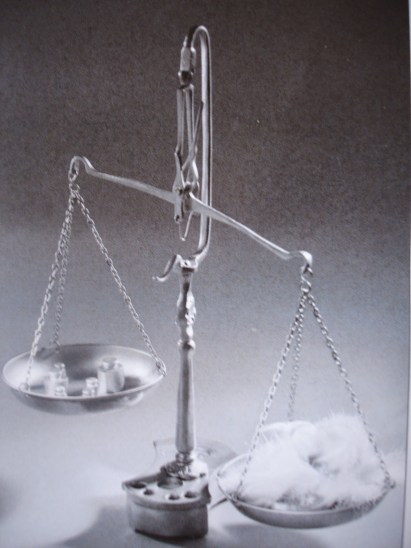
Justice et inégalité - les plateaux de la balance by Frachet, Jan 2010, Public Domain via Wikimedia CommonsThe recent Supreme Court decision in Fisher v. University of Texas at Austin, et al., was a cautious but significant one in favor of affirmative action. As Adam Liptak writes in his New York Times article ‘Supreme Court Upholds Affirmative Action Program at University of Texas‘, while ‘not all affirmative action programs will pass constitutional muster… the ruling’s basic message was that admissions officials may continue to consider race as one factor among many in ensuring a diverse student body.’

This opposes the central tenet of affirmative action opposition: admission to universities can only be based on merit, which in turn is determined mainly by grades buttressed by the quality of relative achievements; therefore, only color-blind admissions criteria are just and fair.

But as we all well know, educational institutions have been generally the purview of the wealthy, the connected, and the white for most of our history. Opponents of affirmative action say the only way to correct this historic injustice is to remove considerations of race and wealth in the admissions process itself, relying on other methods of promoting equal opportunity in education so as to make historically disadvantaged groups equally capable of high test scores and advanced achievement.

But I don’t agree, and am a proponent of some types of affirmative action, including the University of Texas’ well-designed and balanced method, for many reasons.

For one, some sort of affirmative action appears necessary to balance the historical wrongs of our educational system. I picture a classic scale, with a neutral, color-blind system based on merit alone as its fulcrum. For most of our history, the weights of racial, social, and economic privilege were piled almost entirely on one end. If the weights hadn’t been placed all at one end over time, then sure, color-blind admissions criteria might be fine. Opponents of affirmative action argue that the balance has already been corrected by other methods, such as a free public educational system, anti-discrimination laws, certain welfare and scholarship programs, and so on. But if it’s really been balanced, why the continued disparity in outcomes, within the schools and in relative chances of success after graduation in so many arenas of life? Putting the idea that some races are just naturally more gifted and capable of achievement than others aside for the moment, which I’ll consider shortly and (spoiler alert!) reject, the failure of equality in outcomes strongly suggest that color-blind policies don’t balance it all out. I think they are again, at best, the fulcrum of the scale, the default position. But the fact that race, money, and connections have been piled on one end over the centuries can’t be undone, so the balance can’t be reached by simply removing the weight of history. The weights with which to balance the other side are also selective policies, this time favoring those who are not part of historically advantaged groups, such as the wealthy, connected, and white. Of course, merit must count, as it’s always done; it would be a disservice to students to remove the challenge and expectation of excellence that propel learning and achievement, and this Supreme Court agrees. But it’s become clear that test-based merit can’t be the only consideration if we wish to right the balance.

To return to the idea that some racial and ethnic groups are naturally more intelligent or capable of advanced achievement than others: this claim has been shown by science and history to be deeply flawed, to say the least. All racial and ethnic groups have produced too many individuals of great intellectual ability and advanced achievement to make this claim convincing to anyone but the most hardened racists, and civilizations throughout history, made of up people of all races, have taken turns outperforming others in innovation and intellectual advances throughout world history. While test scores have shown that many racial and ethnic groups do, at times, perform lower on tests, the results change dramatically as the social circumstances of the test-takers do. If the ability to score high on tests is changeable, then it’s not likely to be simply genetic. And this is assuming that performance on such tests is the same thing, or a direct predictor of, merit as it relates to education, which is a huge and I think unjustifiable assumption, but this is a topic outside of the scope of this essay.

Furthermore, studies have also shown us is that student success and failure can depend not only intelligence and socioeconomic background, but on expectations of success on the part of teachers, of families, of communities, and most importantly, of the students themselves. To claim that a student has an equal opportunity to succeed whether or not they are part of a student body that includes a significant number of others like them, racially or otherwise, is untenable. There are a few particularly individualistic personalities who can and do achieve highly despite isolation on campus, despite racism, classicism, legal discrimination, and so forth. But as members of a highly social species, most human beings rely much more on the opinions of their fellow human beings, and on feelings of companionship and belonging. And when a student looks around campus and sees few or no-one like them, it’s unlikely they’ll expect to succeed where those like themselves have not.

The Supreme Court recognizes this simple fact: color-blind admissions programs are not always just in a society that’s not and never has been color-blind. Admissions programs admit real students into real campuses where they help prepare them for success in the real world – an often racist world. If an admissions program doesn’t succeed in making a campus look like an institution of a free and democratic society which values opportunity for all, it’s unlikely it could be a just and fair one.

Listen to the podcast version here or on Google Play, or subscribe on iTunes

Ordinary Philosophy and its Traveling Philosophy / History of Ideas series is a labor of love and ad-free, supported by patrons and readers like you. Please offer your support today!

~~~~~~~~~~~~~~~~~~~~~~~~

Sources and inspiration:

Affirmative Action: Court Decisions.’ National Conference of State Legislatures website

Booth, Margaret Zoller and Jean M. Gerard. Self-esteem and academic achievement: a comparative study of adolescent students in England and the United States, Sept 2011

The Black-White Test Score Gap. Edited by Christopher Jencks and Meredith Phillips,
Brookings Institution Press, 1998.

Lindsey, Brink. ‘Why People Keep Misunderstanding the ‘Connection’ Between Race and IQ.’ The Atlantic, MAY 15, 2013

Liptak, Adam. ‘Supreme Court Upholds Affirmative Action Program at University of Texas‘. The New York Times, June 23, 2016

Tauber, Robert T. Classroom Management: Sound Theory and Effective Practice. Westport: Greenwood Publishing Group, 2007

O.P. Recommends: Make it Stop, a Boston Globe Piece on Banning Assault Weapons

Assault rifle, image CC0 Public Domain, no attribution required, via PixabayI came across the link to this article on Leiter Reports, one of my go-to forums for news and ideas in the philosophy world, by Brian Leiter. Thanks for the share, Brian!

The Boston Globe editorial ‘Make it Stop‘ contains statistics on deaths inflicted by assault rifle, a list of senators who block gun control reform, and an essay on modern gun culture and how much has changed since the passage of the Second Amendment. You may find it helpful if you believe, as I do, that we Americans need to change some of our policies and attitudes about guns.

I believe a ban or serious restriction on assault weapons not only would save some lives, it would show how much we value the lives of our fellow Americans. And even if a ban on assault weapons fails to stop mass shootings since they may still be acquired illegally, I believe that signaling our moral commitment to protecting innocent lives, to each other and to the world, is a worthy goal in and of itself. Especially given that there’s no good reason for most civilians to own assault rifles that I can see. They give us no significant protection in case our own government turns tyrannical (the most paranoid among us think it already has) since those who promote Second Amendment literalism tend to be those who vote to keep our military and our police forces among the largest and most powerful in the world, the most well-equipped, and the most omnipresent. And for those who insist their rights to their fun little gun hobby takes precedence over all… well, I question their priorities.

Ordinary Philosophy and its Traveling Philosophy / History of Ideas series is a labor of love and ad-free, supported by patrons and readers like you. Please offer your support today!

Jefferson and Slavery

Another piece from the archives until I catch up on research and writing after my recent tour of three great national parks: Zion, Bryce Canyon, and Yosemite! I wrote this one as part of my Thomas Jefferson history of ideas series from last year.

Amy M Cools's avatarOrdinary Philosophy

Throughout my history of ideas travel series following Thomas Jefferson, slavery was on my mind a lot: the institution as a whole, and Jefferson’s relationship to it. I was reminded of it constantly: by an original book from his own collection titled ‘The Horrors of Slavery’ now in the Library of Congress, which also displays a slave sale contract between himself and James Madison from 1809; the slave quarters and artifacts at Monticello; museum displays and plaques in D.C., Williamsburg, and Philly; and signs telling the story of his brief but telling correspondence with Benjamin Banneker.

As every student of American history learns early on, Jefferson’s words in the Declaration of Independence and his stated beliefs contrast sharply with his life as a slaveowner. And nearly every place I find something written about Jefferson, this contradiction is addressed but never really resolved.

Jefferson was in favor of the abolition of slavery…

View original post 1,705 more words

Basic Income: Scotland & Beyond, by Kallum Corke

4ef8b-moneycountingpaydayImagine, for a moment, that you received enough money each month to cover all of your basic needs – no strings attached, regardless of whether or not you chose to work.

What would you do?

The ‘radical’ idea that none of us should have to work to survive is the basis of the Universal Basic Income (UBI), a monthly stipend payable to every person, regardless of how they choose to spend their time. Designed to replace existing, means-tested benefit and create a stable ‘economic floor’ under each individual, UBI offers a range of advantages over our current welfare system. For starters, the single, unconditional payment would do away with the expensive means-testing and sprawling bureaucracy that currently distributes benefit, actually saving money. Other benefits (among many) include increasing individual bargaining power in an increasingly exploitative and precarious labour market, rewarding women’s ‘invisible labour’ in the home, facilitating entrepreneurship and stimulating innovation, oh – and of course, eradicating poverty outright.

Basic Income is a resurgent economic idea with a surprisingly long history; advocated by Thomas Paine (who argued for payments to every person “rich or poor” financed by a “ground-rent” paid by property owners) and Friedrich Hayek, (who believed a basic level of economic security would greatly increase individual freedom) among other famous advocates from both the left and right of the political spectrum, it has been tried in various forms throughout history. Experiments in Canada and the U.S. in the 1970s and Uganda in 2008, for example, have explored the idea of a guaranteed income (or, a negative income tax in the U.S. example). While the methods have varied, the results have generally been similar: increased school attendance among children, improved overall health, increased entrepreneurship and a slight reduction in hours worked.

And these experiments aren’t confined to the past – with renewed public and political interest in Basic Income come new studies, with governments in Finland and the Netherlands committed to pilot programmes over the next few years and this month’s historic referendum in Switzerland. In Scotland, on the 13th of May, Professor Guy Standing, author of The Precariat: The New Dangerous Class and international advocate for Basic Income, gave a speech to the RSA (Royal Society for the encouragement of Arts, Manufactures and Commerce) in Scotland where he argued that:

“It’s the year of the pilots, and that is why I would appeal to all of us in this room and many others in Scotland, to take the lead… I don’t mind the motive, but we need pilots and Scotland with the SNP’s new commitment to move in this direction has a fantastic opportunity to do something like this. It’s desperately needed and Scotland could set an example and if it does, I think you’ll see a fire of copycats. It’s something we all must encourage.”

Professor Standing is right; with pilot programmes launching across the world, the time is ripe for a Scottish experiment – and with a Scottish parliamentary majority comprised of Greens, actively advocating for a basic income and a Scottish National Party amenable to the idea, there has never been a better time to push for a Scottish study. Scotland’s unique characteristics, population density, GDP and economic diversity make it an ideal candidate for a national pilot.

The idea has been criticised as ‘utopian’, ‘unrealisable’ and fundamentally unaffordable – but with around sixteen percent of the Scottish population estimated to be living in poverty, a continued rise in reliance on food banks across the country and with ‘jobs growth’ under the current government confined to precarious, zero-hours positions in jobs soon to be lost to automated labour, it’s fast becoming a question of whether we can afford not to implement a basic income.

Recent scandals, such as the Panama Papers leaks (which I wrote about for my last Darrow piece) have demonstrated that the world’s financial and political elite, who preach austerity at every opportunity, are the very reason basic income seems so unaffordable. There are a great many ‘routes’ to financing a universal basic income, from a land or financial transaction tax to simply forcing businesses and individuals, hiding an estimated $32tn offshore, to pay their fair share in tax. And therein lies the greatest challenge on the road to basic income: not affordability, but attitudes towards poverty and social responsibility. The same individuals who hide their assets from the taxman, denying us hospitals, roads, and education, feed us a narrative which vilifies the benefits claimants as scroungers, even though poverty has proven systemic, structural and often, inescapable.

The money to pay for basic income exists, in one form or another, just out of reach.

The Panama Papers were a symbol of ever-increasing global inequality, a world in which the richest 1% of society now has as much wealth as the other 99% combined. Universal Basic Income has the potential to redress the balance and to resolve some of the most pressing issues of our time; to eradicate poverty, to more equitably reward women for their work, achieve the mythical fusion of Capitalism and Socialism and to future-proof our economy, just in time for ‘the rise of the machines’, providing each of us with the basic necessities of life and affording us the luxury of aspiration.

Basic Income is an idea whose time has come – and Scotland, were it to implement a pilot programme of its own, has the potential to kick-start a global movement.

So I’ll ask again: What would you do if your income was guaranteed?

Kallum Corke is a filmmaker, writer and visual artist whose varied creative output is chiefly concerned with issues of social justice, politics, arts and culture. (Bio credit: Darrow) Follow the author at @kallumcorke

This article was originally published on Darrow. Read the original article.

Ordinary Philosophy and its Traveling Philosophy / History of Ideas series is a labor of love and ad-free, entirely supported by patrons and readers like you. Please offer your support today!

Behind the Veil: Rawls, Locke, de Tocqueville, and Human Connection in a Liberal Society

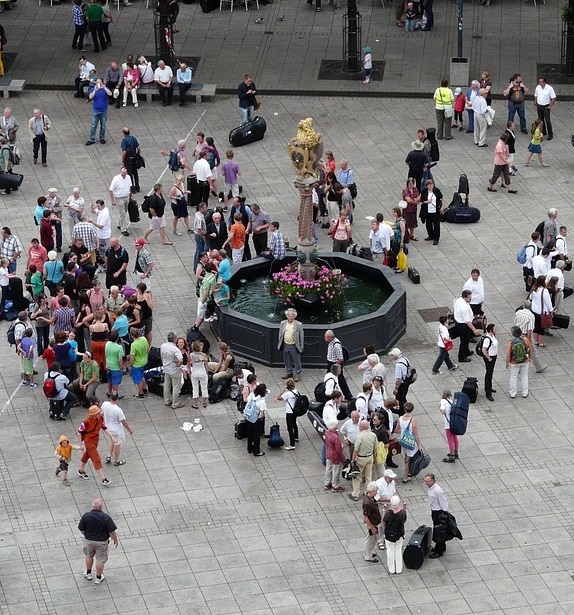
People in a Public Square, cropped, Image Creative Commons CCO Public Domain via PixabayI’ve been listening to this excellent series from a favorite podcast of mine, the Philosopher’s Zone on Australia’s RN (Radio National), hosted by Joe Gelonesi. There’s this recent series called Political Philosophy in the World, hosted by guest host Scott Stephens, which considers and critiques seven important topics in political philosophy. I just listened to the last one, Political Philosophy in the World: Liberalism and the End of the World as We Know It.

In it, interviewee Patrick Deneen offers a series of critiques of liberalism, his own and others’ over its roughly five century history. (We’re speaking here not of liberalism as commonly understood in the U.S., as political positions on the left of the spectrum, but of classical liberalism, a political philosophy which focuses on liberty and the primacy of the individual.) From the beginning, liberal philosophers and their critics have identified and described possible contradictions in the system itself, and ways in which it may end up being self-defeating in the real world. For example, John Locke, a founding father of liberalism, recognizes that it would require a strong state to protect the autonomy of the individual from competitors and from the ‘querulous and contentious’, and that individual autonomy in a marketplace, unfettered by other constraints, will lead to conditions that foster inequality, discontent, and revolution (at about 4:40 and 14:40, then 10:30). Alexis de Tocqueville observes that though individuals enjoy this autonomy at the beginning, they are left weakened and alone by the erosion of those institutions that create bonds of loyalty and affection in a society, such as family, tradition, and belief (at about 15:00). Deneen, in sum, describes these and various other ways in which liberalism can fail to achieve its end of liberating the individual to achieve their potential to the fullest possible extent.

The discussion in its entirety is absolutely fascinating, but my attention is caught particularly by Deneen’s observation of a problem with the great liberal political philosopher John Rawls’ famed ‘veil of ignorance’ thought experiment (starting at about 19:00). Rawls’ veil of ignorance is a beautifully elegant method of envisioning and crafting a just society. Imagine you’re looking at a society from the outside knowing you’ll be placed in it with no idea what you’ll be: rich, poor, or middle-class; tall or short; intelligent or not; of which gender; outgoing or shy; of which race; employed or not and at what kind of job; and so on. Given this hypothetical situation, what cultural practices, laws, policies, governmental system, economic system, and so on, would you put into place? Behind that veil of ignorance, you’d be motivated to to design a society that’s just and fair, that benefits everyone to the greatest degree possible, since of course, you could be the one who suffers the ill effects of any injustice built into the system.

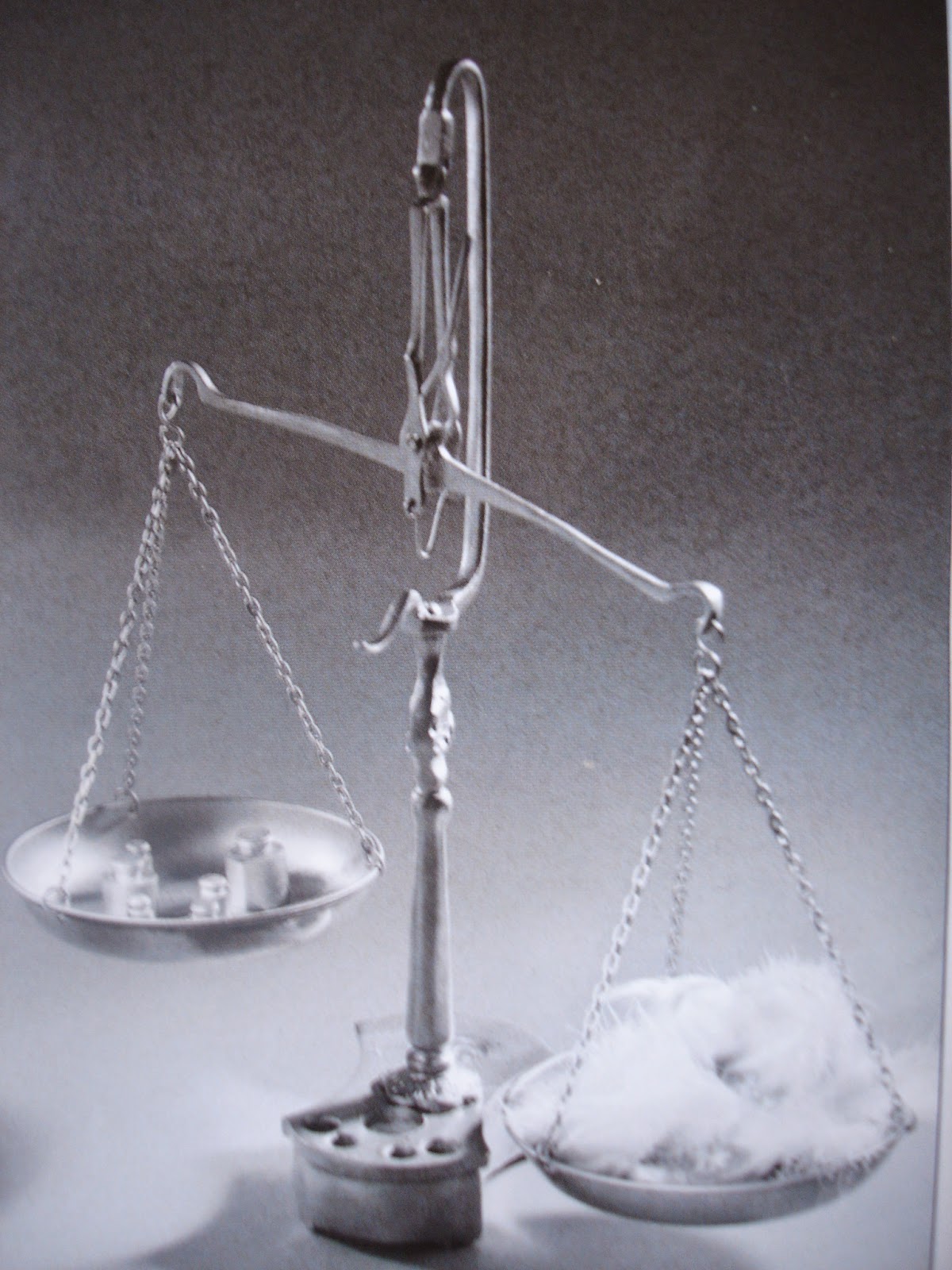
8694d-justice2bet2binc3a9galitc3a92b-2bles2bplateaux2bde2bla2bbalance2bby2bfrachet2c2bjan2b20102c2bpublic2bdomain2bvia2bwikimedia2bcommonsAs Deneen points out, Rawls, like other liberal political philosophers, recognizes that people in a liberal society may, over time, act not out of true freedom, but as slaves of their individual desires and passions. Since liberalism promotes the idea that society is and should be made of up autonomous individuals freely pursuing their own ends, the values of individuals in that society may become self-serving to the point of destructiveness. This destruction can be of social institutions that provide support and meaning, such as family, tradition, and belief, of liberalism’s own key institutions such as the free markets of goods and ideas, and as we now recognize, of the very environment from which all of this is derived. Rawls posits the veil of ignorance as a way to free ourselves from this trap, by transforming ourselves, in thought, into benevolent, self-effacing avatars of justice. But, Deneen points out, Rawls never really provides an explanation of why we we’d all want to go behind the veil of ignorance in the first place. After all, Rawls’ entire theory of justice-as-fairness as described in his magnum opus A Theory of Justice, which the view from behind the veil reveals to us, depends on the participation of everyone. If even one person remains aloof, that person’s interests and motivations aren’t considered or checked by those of others, which, in turn, is not fair.

From within the thought experiment, the motivation to go behind the veil makes sense: since liberalism is meant to promote the liberty and well-being of all individuals, it makes sense to envision and design a society where some individuals are not allowed to enjoy advantages that limit or even destroy the liberty and well-being of others. But this still doesn’t account for why we’d all want to go behind the veil in the first place. In a liberal society in the real world, only those suffering its ill effects will be motivated to do so, since those who have found relative success within its parameters will be ever more motivated to keep the pursuit of their own interests free from the demands and constraints of others until it serves them otherwise.

With the disconnection from other people which liberalism can tend to foster in mind, as described by de Toqueville and Rawls, I picture a whole society of people behind Rawls’ veil of ignorance. Then something in this picture strikes me: behind this veil, all the people are looking in the same direction, encircled around the society they must share. They are united, not separated by competing interests nor from the bonds of family, tradition, and belief. They are cooperating as equals, with a shared goal and a shared ethic: the liberty to achieve the fullest degree of perfection that an individual is capable of, with others’ interests as much in mind as their own so far as possible. These interests can and invariably do include family, tradition, and belief. Those with a narrow view of liberalism often speak only of individual interests as involving the individual pursuit for food and shelter, money, comfort, wealth, and prestige, and dismiss family, tradition, and belief as impediments to human liberty. But of course, this is not necessarily so, as we observe their lasting power and meaningfulness in the real world throughout history and to this day, even where liberalism as an institution is most robust. Material comfort and prestige are not and have never been the only and or even, for many, the primary motivators of thought and action in any society.

Behind the veil, then, is that deep need for human connection fulfilled in the context of an idealized liberalism, that the institution of liberalism in the real world can undermine if uncorrected by the state or by an ethic such as Rawls’ justice-as-fairness. Does Rawls have this picture of a united humanity in mind as he devises his thought experiment, though he doesn’t describe it per se? Perhaps Rawls does recognize this motivation for going behind the veil: our realization that while the pursuit of our own individual interests can be fulfilling, it can also undermine our potential of fulfilling our deepest humanity, not only tied to the destinies of others but with a deep emotional need for deep and lasting connections with one another. Behind the veil of ignorance, we are thus united, connected, bonded, sharing a vision, in a state of equal humanity, of a good and just world for all of us.

*Listen to the podcast version here or subscribe on iTunes

~ Also published at Darrow, a forum for culture and ideas

Ordinary Philosophy and its Traveling Philosophy / History of Ideas series is a labor of love and ad-free, entirely supported by patrons and readers like you. Please offer your support today!

~~~~~~~~~~~~~~~~~~~~~~~~~~~~~~

Sources and Inspiration:

Alexis de Tocqueville‘, in Encyclopædia Britannica Online.

Gaus, Gerald, Courtland, Shane D. and Schmidtz, David, ‘Liberalism‘, in The Stanford Encyclopedia of Philosophy

Political Philosophy in the World: Liberalism and the End of the World as We Know It.’ from The Philosopher’s Zone Podcast, Sun May 15 2016, Radio National, Australia. Host: Joe Gelonesi

Rawls, John. A Theory of Justice. Cambridge: Harvard University Press, 1971.

Uzgalis, William, “John Locke“, in The Stanford Encyclopedia of Philosophy

Happy Birthday, Karl Marx!

Marx by Sam Kaprielov, 76x61cm, oil on canvas, 2015, image used by permission of the artist

Marx by Sam Kaprielov, 76x61cm, oil on canvas, 2015, http://www.samkaprielov.com/

Born on May 5 1818, few thinkers have been as influential as Karl Marx. Philosopher, theoretician of history, economist, sociologist, journalist, and revolutionary socialist, he was a prolific thinker and writer, widely lauded, criticized, and misunderstood, especially by those who claimed to act in his name.

In honor of his birthday, here is a series of pieces about Karl Marx, a recent painting by an artist whose work my good friend just introduced me to, and a song that I love.

The World Isn’t Fair, by Randy Newman

Karl Marx (1818 – 1883), a very brief bio at BBC: History

Karl Marx, 1818-1883, by Steven Kreis at The History Guide

Karl Marx, by Jonathan Wolff, at the Stanford Encyclopedia of Philosophy

Karl Marx, Wikipedia

~ Ordinary Philosophy and its Traveling Philosophy / History of Ideas series is a labor of love and ad-free, entirely supported by patrons and readers like you. Please offer your support today!

Frederick Douglass Lynn, Massachusetts Sites

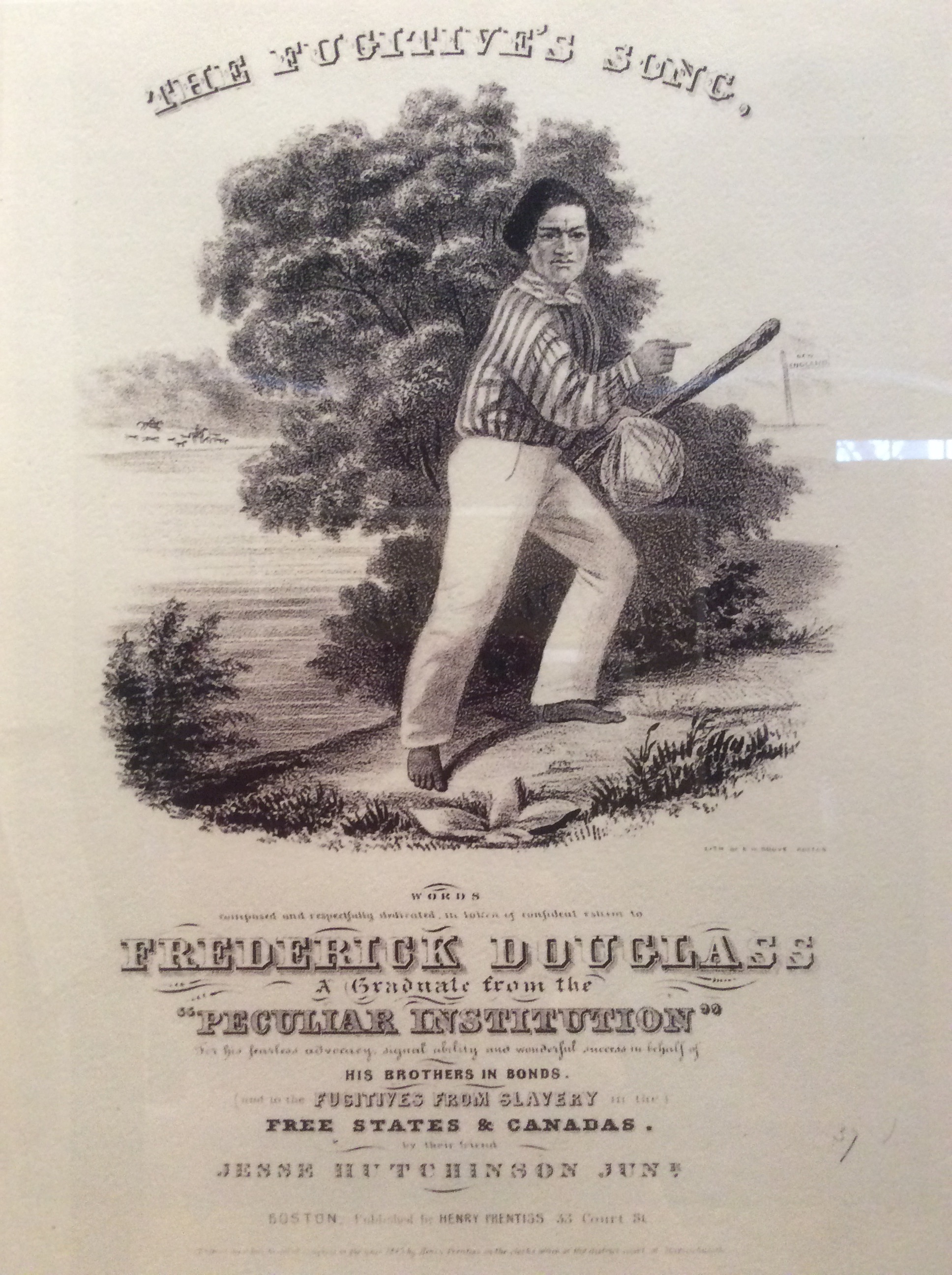
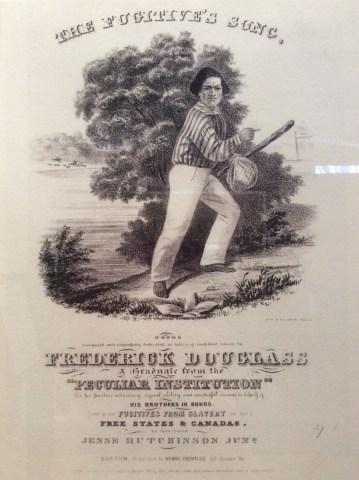
John Hutchinson Song Dedicated to Frederick Douglass Cover Page from Lynn Museum ExhibitJohn Hutchinson Song Dedicated to Frederick Douglass Cover Page, 2016 Amy Cools

Jesse Hutchinson song dedicated to Frederick Douglass, cover page print from Lynn Museum exhibit (a fanciful illustration: in real life, he wore shoes and escaped by train and ferry)

Seventh Day, Saturday March 26th

I drive from Boston to Lynn, Massachusetts, only about 25 minutes north by car.

Not long after Frederick Douglass began his public speaking career, he and his family moved here to Lynn from New Bedford. They lived here from the fall of 1841 through about November 1847. Well, actually, for much of that time, it was mostly Anna and the kids who lived here. First, Douglass was often on tour as a speaker, which took him away from home for long stretches. Secondly, he was away on a tour of the British Isles from 1845-1847, which is why many sources say Douglass himself only lived here until 1845. He returned only briefly to Lynn before moving himself and his family to Rochester near the end of 1847. His ‘industrious and neat companion‘ Anna took care of the household while he was away, and often took in piecework from Lynn’s thriving shoemaking industry to make sure the kids were always cared for and the bills paid on time.

Douglass wrote his Narrative of the Life of Frederick Douglass, An American Slave here in Lynn, and it was published by the Boston Anti-Slavery Society on May 28th, 1845. It sold well, and he became more than a bit nervous: he enjoyed freedom so much, of course, and now he had a family, he had even more to lose if he was to be captured and returned to slavery. After all, as discussed, he had said some not too nice things in his Narrative about his former master (who legally, still was), and who knows how badly Thomas Auld wanted to have him back in bondage! So, to avoid capture now that he publicly named his master and his whereabouts were more widely known, he sailed to England on August 6th, 1845, and embarked on an 18 month lecture tour of England and Ireland. Eventually, his abolitionist friends raised enough money to buy his freedom, or, as he conceived of it, to pay his ransom, and he was able to return home, arriving back in Lynn on April 20th, 1847. Though he was away so much, Lynn still played a significant role in his life.
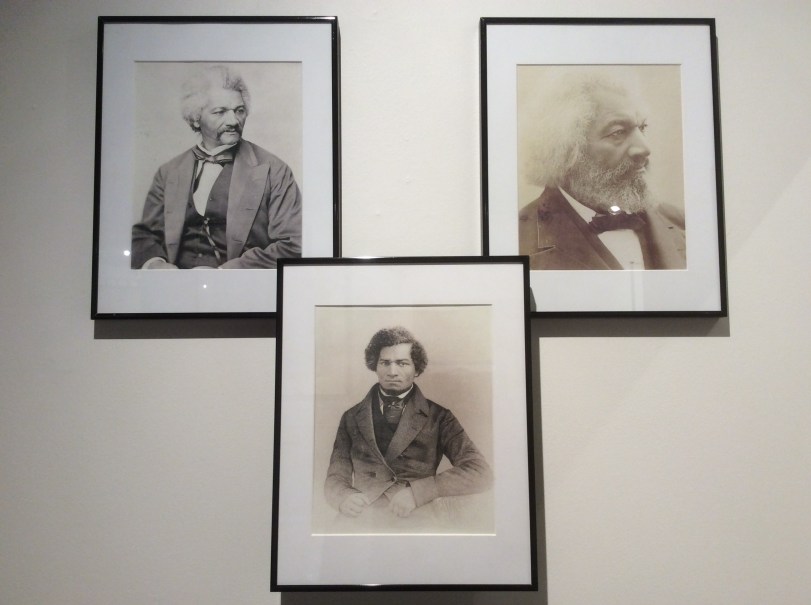
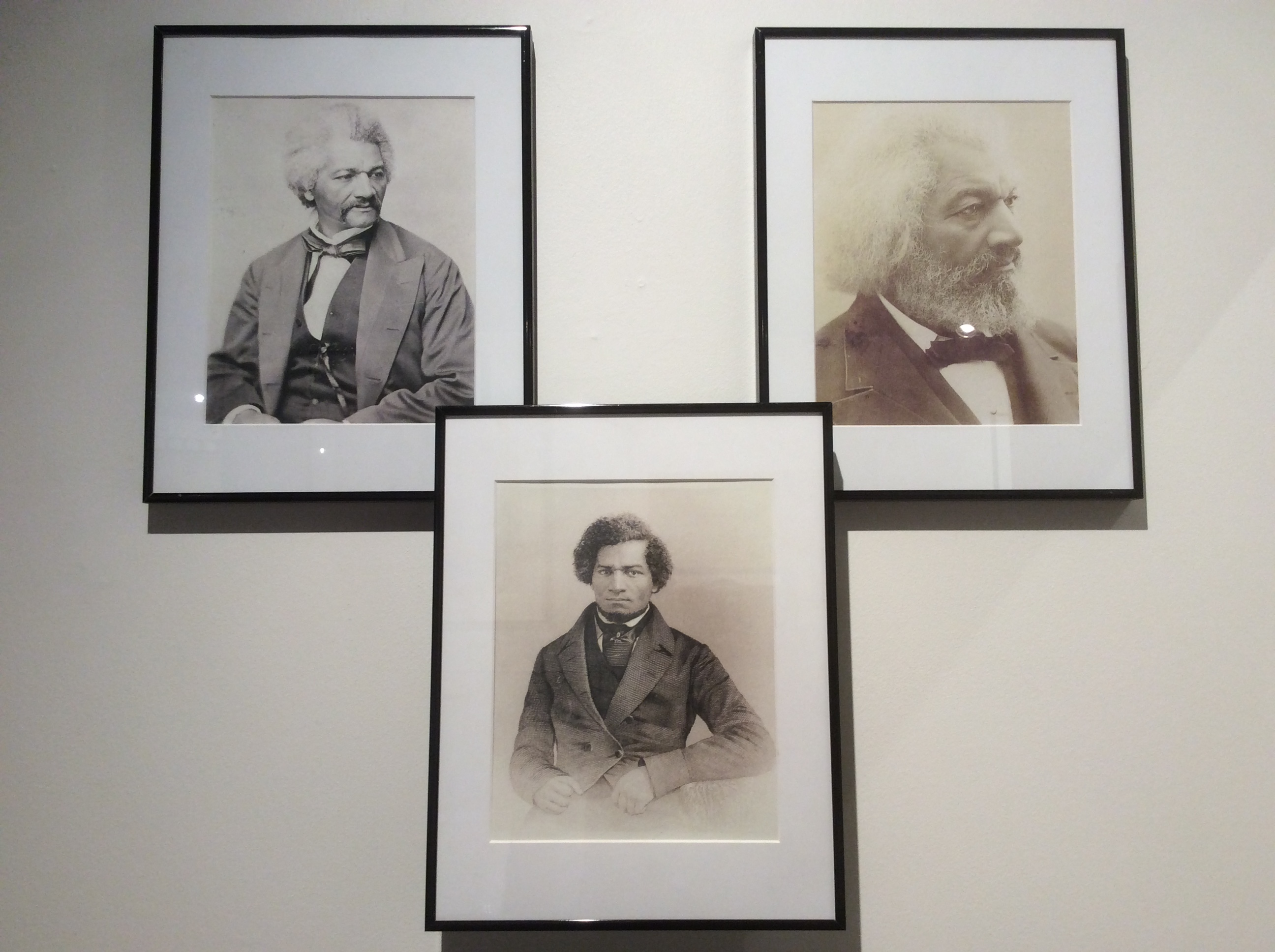
Three Portraits of Frederick Douglass at the Lynn Museum & Historical Society

Three portraits of Frederick Douglass at the Lynn Museum & Historical Society

Lynn proves to be a Douglass treasure trove for me, primarily thanks to the Lynn Museum and Historical Society. Thank you so much to Nicole Breault for arranging my visit, Britt Bowen who gave me access to historical artifacts for study, the kind ladies who greeted me and showed me around, and to everyone else there who make this place a beautiful place to visit and a great resource! In fact, my visit to the museum was so full of wonderful discoveries that it needs its own separate piece, which will follow shortly.
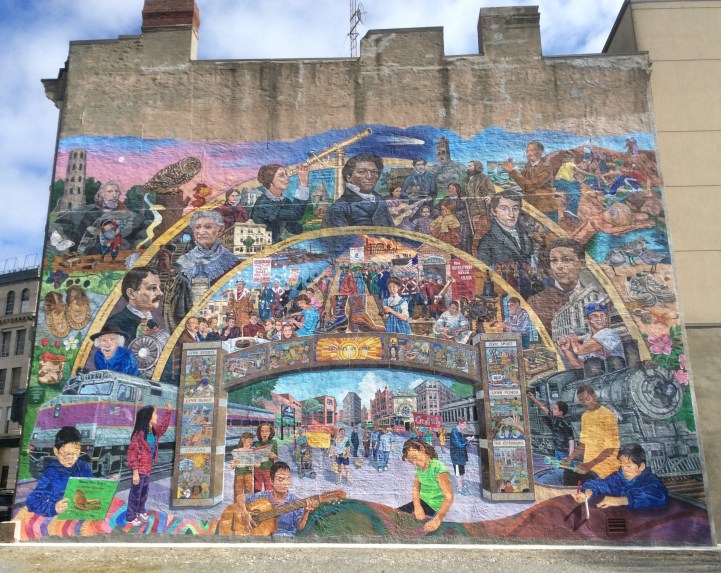
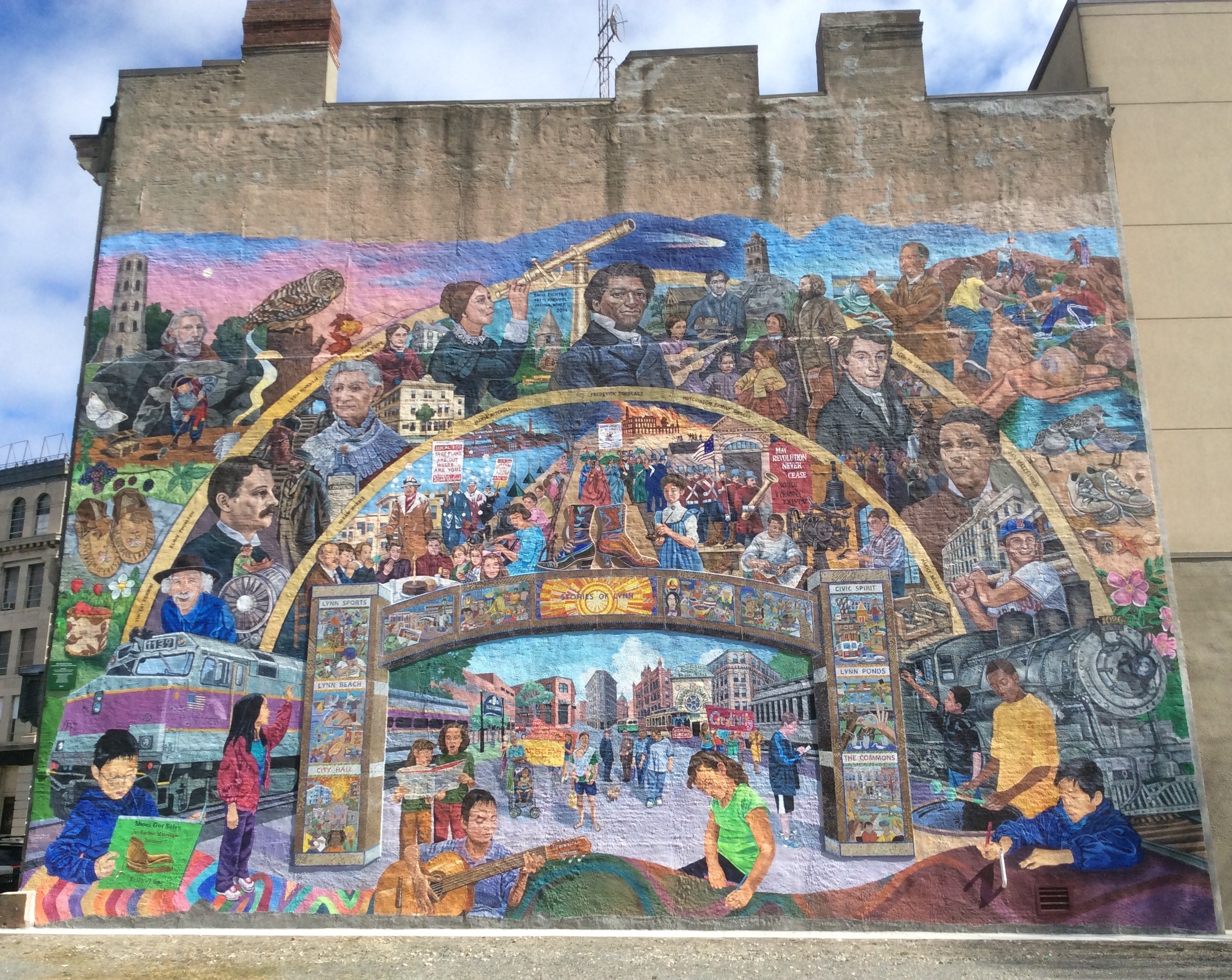
Mural on wall of Lynn's greats on the side of Lynn Arts Building, crowned by portrait of Frederick Douglass Portrait, Lynn MA

Mural on wall of Lynn’s greats on the side of the Arts Building, crowned by portrait of Frederick Douglass Portrait

After I tear myself away from the museum (if it wasn’t closing just then, I don’t know how I’d tear myself away and get to visiting the sites on my itinerary!) and go eat a bit of lunch, I head for my first destination. On the way, my attention is caught by this vibrant mural on the side of the Lynn Arts Building at 25 Exchange St, where a portrait of Douglass presides over images of Lynn’s historical figures and creative and curious children (and other people) of today.
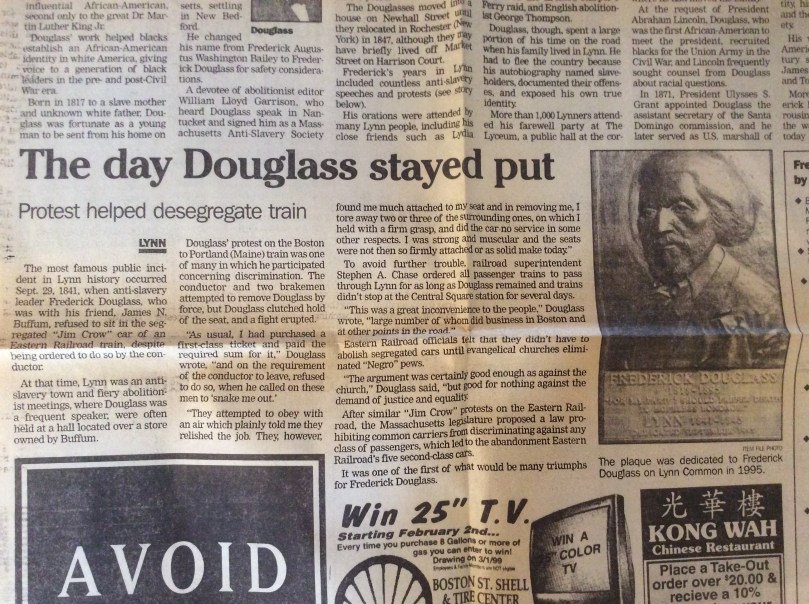
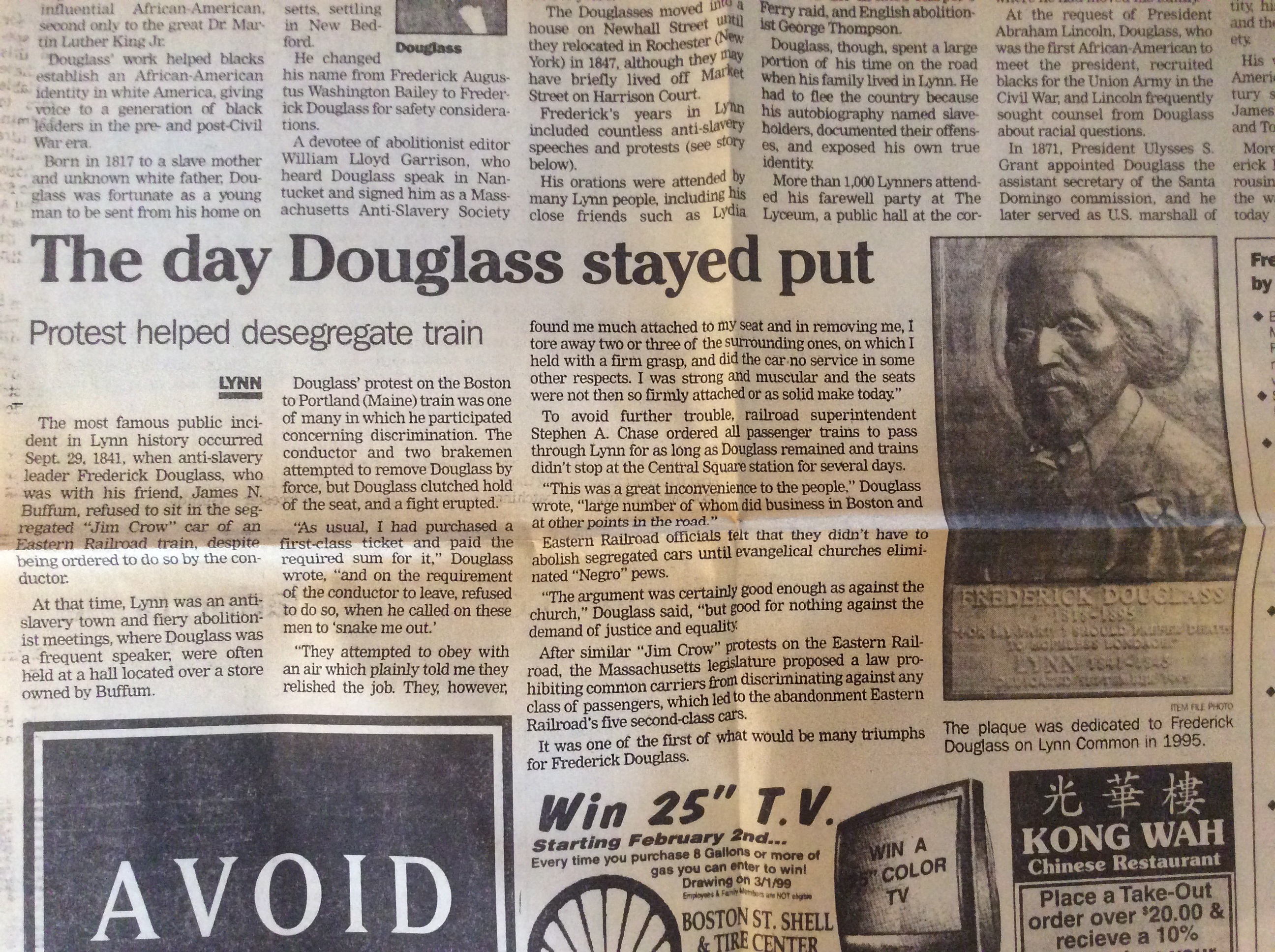
Newspaper clipping from the Lynn Museum and Historical Society about Frederick Douglass' train car sit-in

Old newspaper clipping from the archives at the Lynn Museum and Historical Society about Frederick Douglass’ Rosa Parks moment

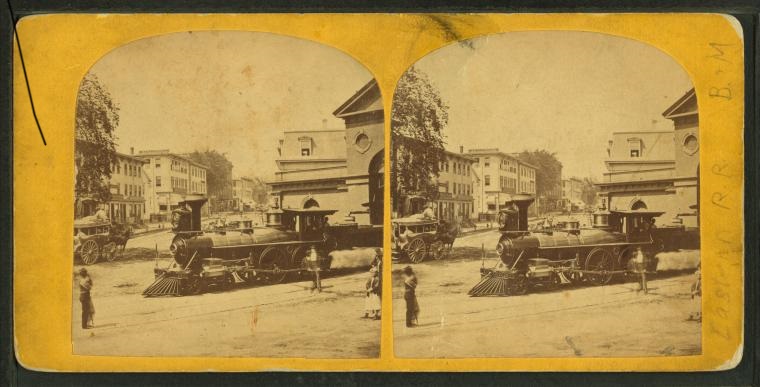
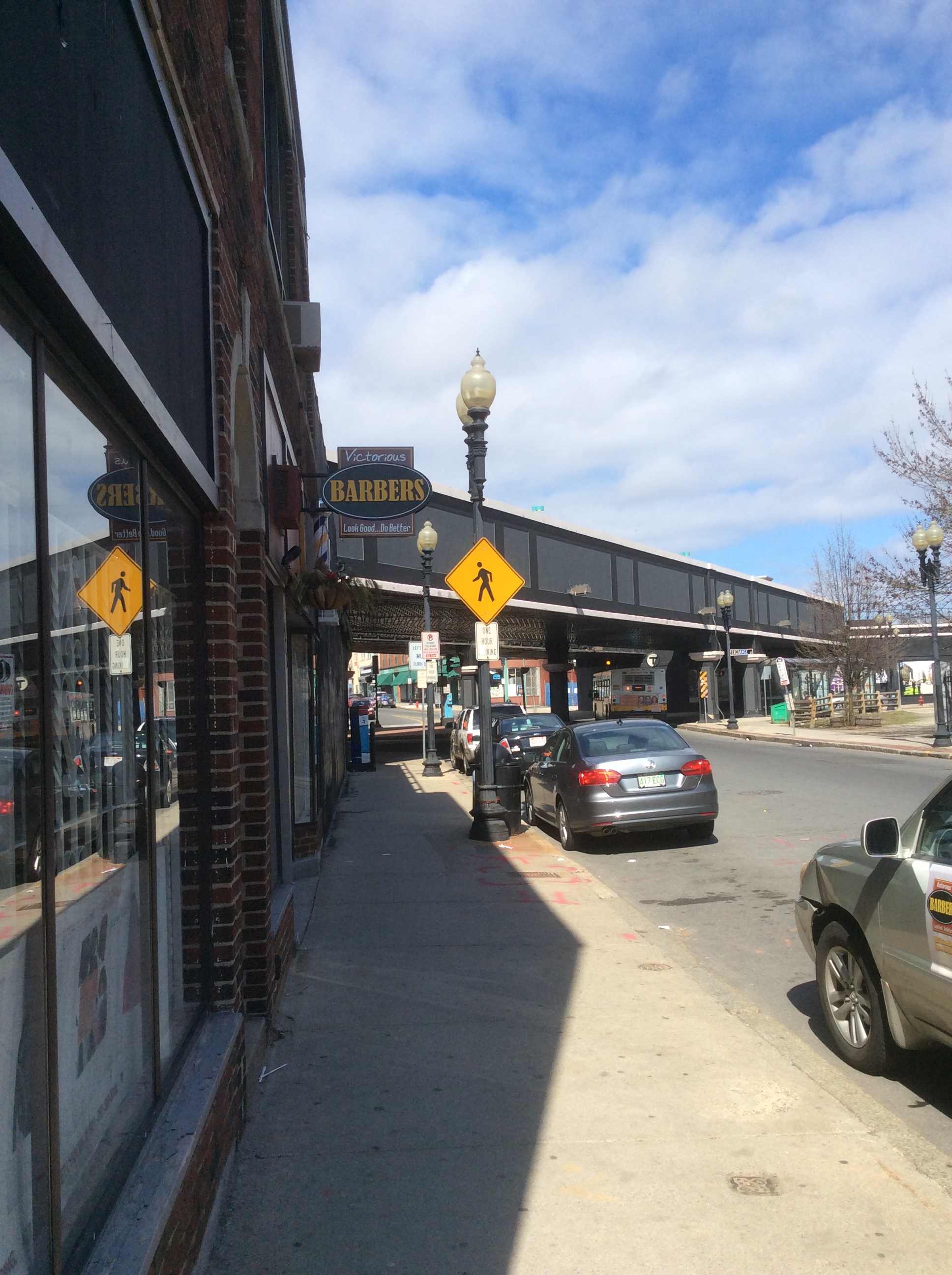
I’m heading for the site of the old Central Square train station. Downtown Lynn is not easy for a first time visitor to navigate: no two streets seem to join at right angles. It takes me a few go-rounds to orient myself generally, yet I still often find myself often a little lost among the tangled streets. A man who tends a little restaurant called Capitol Diner, which looks like an old red train car, helps confirm that the place where the elevated tracks run above where Central Square meets Union and Exchange Streets is just about directly over the site of the early 1800’s train depots (there was a series of them), across the street from the mural on the side of the Arts Building.
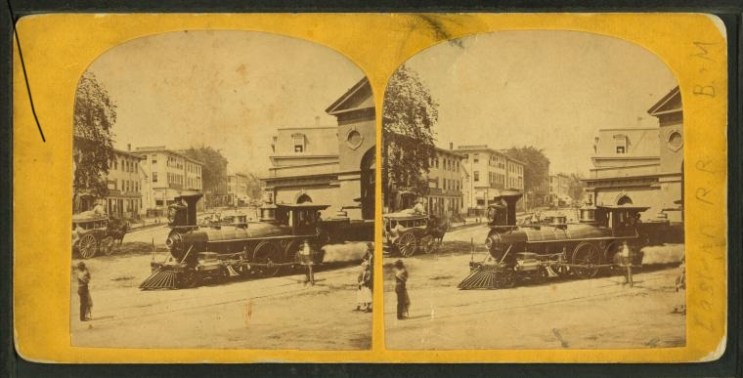
Old Lynn Central Square and depot, photo by William T. Webster, via Wikimedia Commons
Old Lynn Central Square and depot, photo by William T. Webster, via Wikimedia Commons

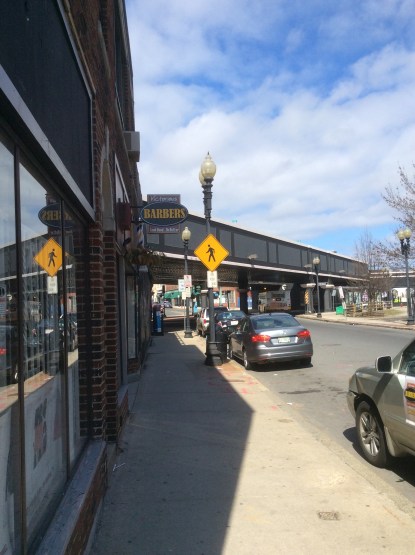
Central Square Train Station raised platform

Central Square Train Station raised platform where the old train depot and Sagamore Hall once stood, to the right of the photo

According to Wikipedia, ‘The first depot at the Central Square location, built in 1838, was a small wooden building. It was replaced in 1848 with a brick building with a 2-track train shed.’

So it was in that smaller wooden incarnation that an incident occurred at this stop of a train between Boston and Portland. Douglass resisted being forced into a Jim Crow segregated car on September 28, 1841, while he was riding the train with his friend James N. Buffum, who would later become mayor of Lynn and who had inspired him to move to Lynn in the first place. Douglass simply refused to leave his seat, and when employees of the railroad company tried to remove him by force, he hung onto the seat until they were ripped and torn out of place.  As Edward Covey the slavebreaker had discovered some years earlier, Douglass was physically strong and no pushover.

Over time, he ended up doing this sort of protest often, to raise awareness. His letter about this experience was published in the newspaper, and local indignation and protests over this incident helped lead to the eventual end of segregated train cars in New England. It’s hard to imagine, to a modern reader in such an interconnected world, that there would be such a patchwork of racial sentiment in a geographic area that it took me only a few hours to cross by car. In Maryland, he was a slave; in New York City, he was free but in danger of being beaten or captured; in Boston, his Narrative was published in the same city where he was denied entry to the menagerie on Boston Common because ‘We don’t allow niggers in here!’ (as he reported); in Lynn, the trains were desegregated over rude treatment of a black customer. Amazing.
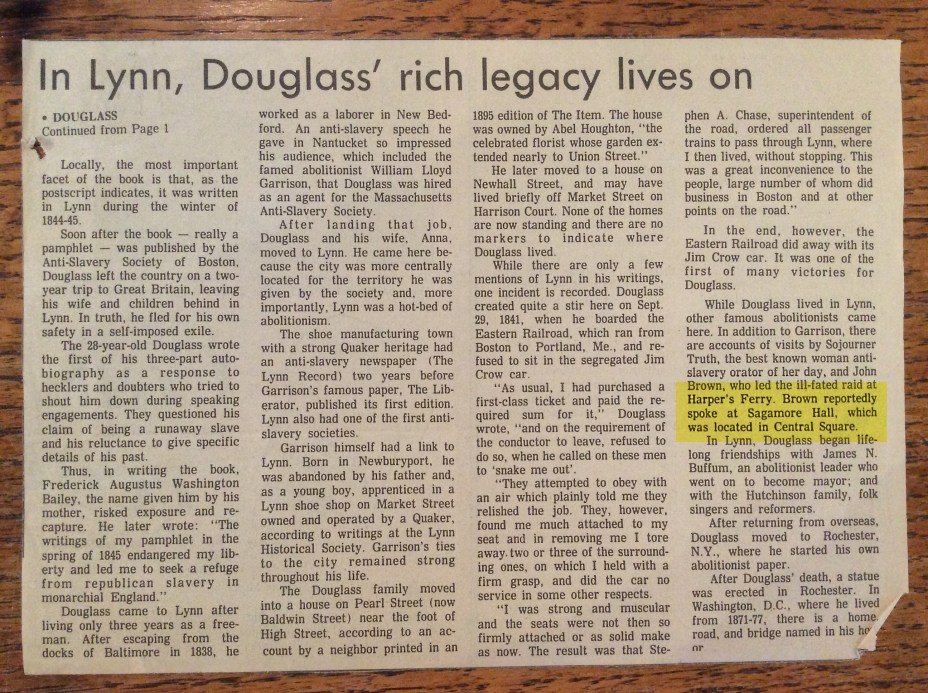
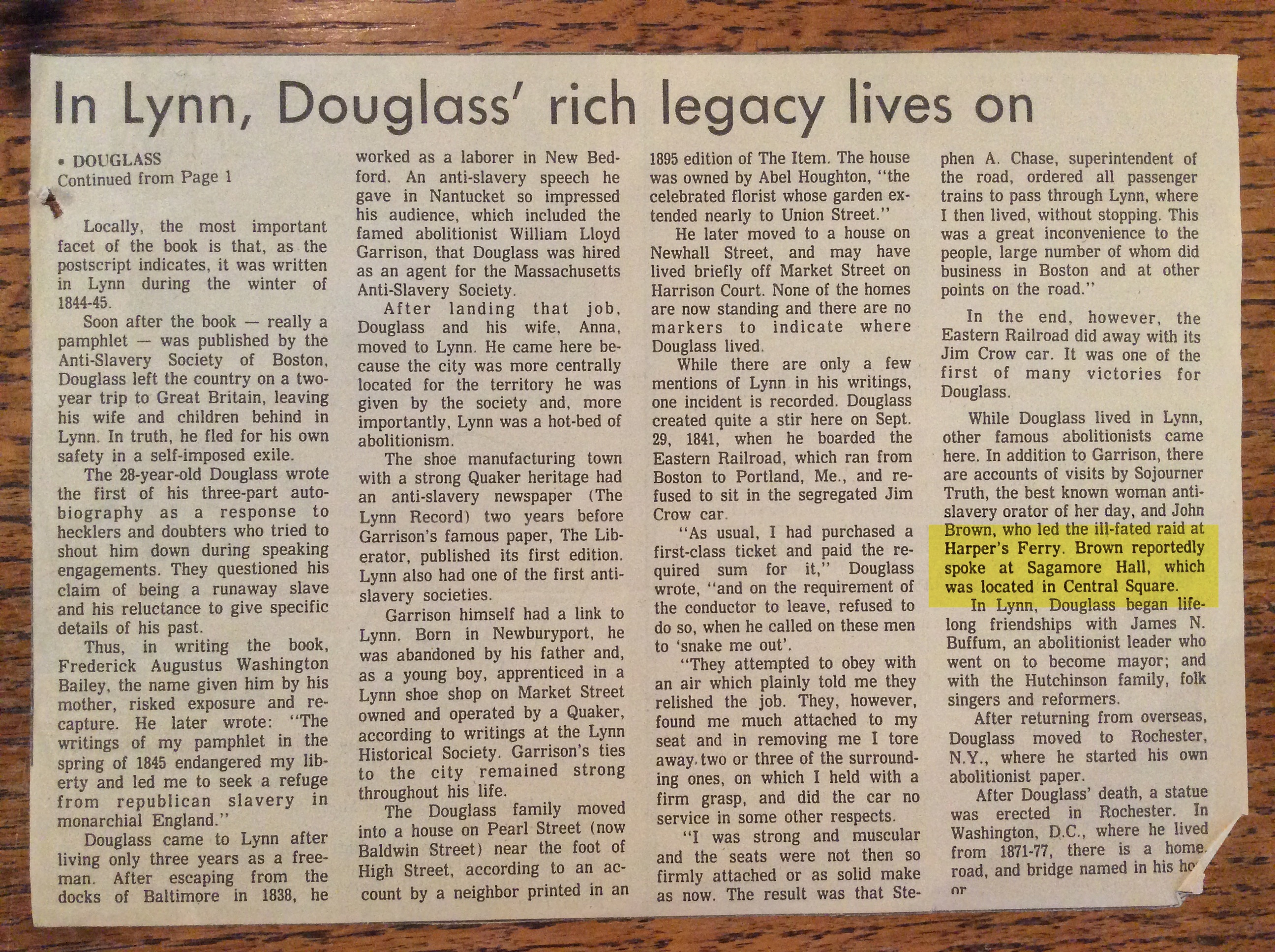
Clipping from Lynn Historical Society about Douglass' life in Lynn and Sagamore Hall

Clipping from Lynn Historical Society about Douglass’ life in Lynn and Sagamore Hall
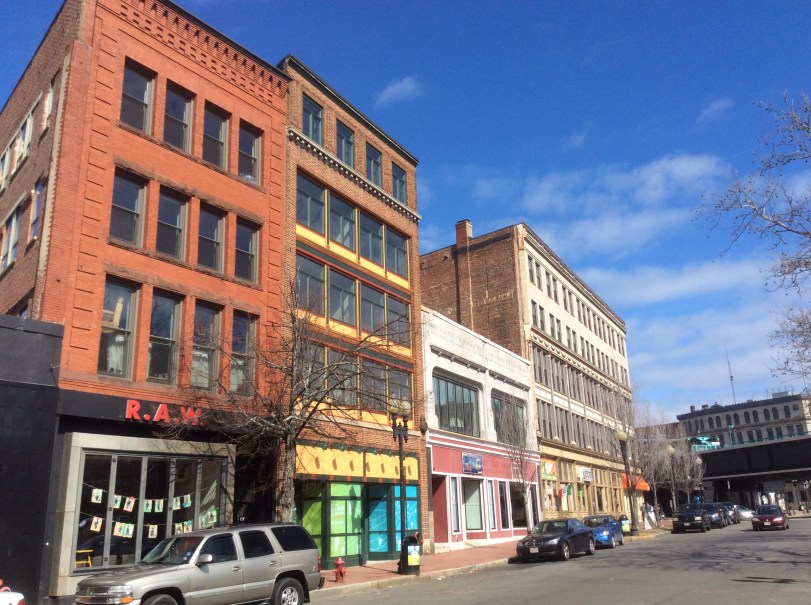
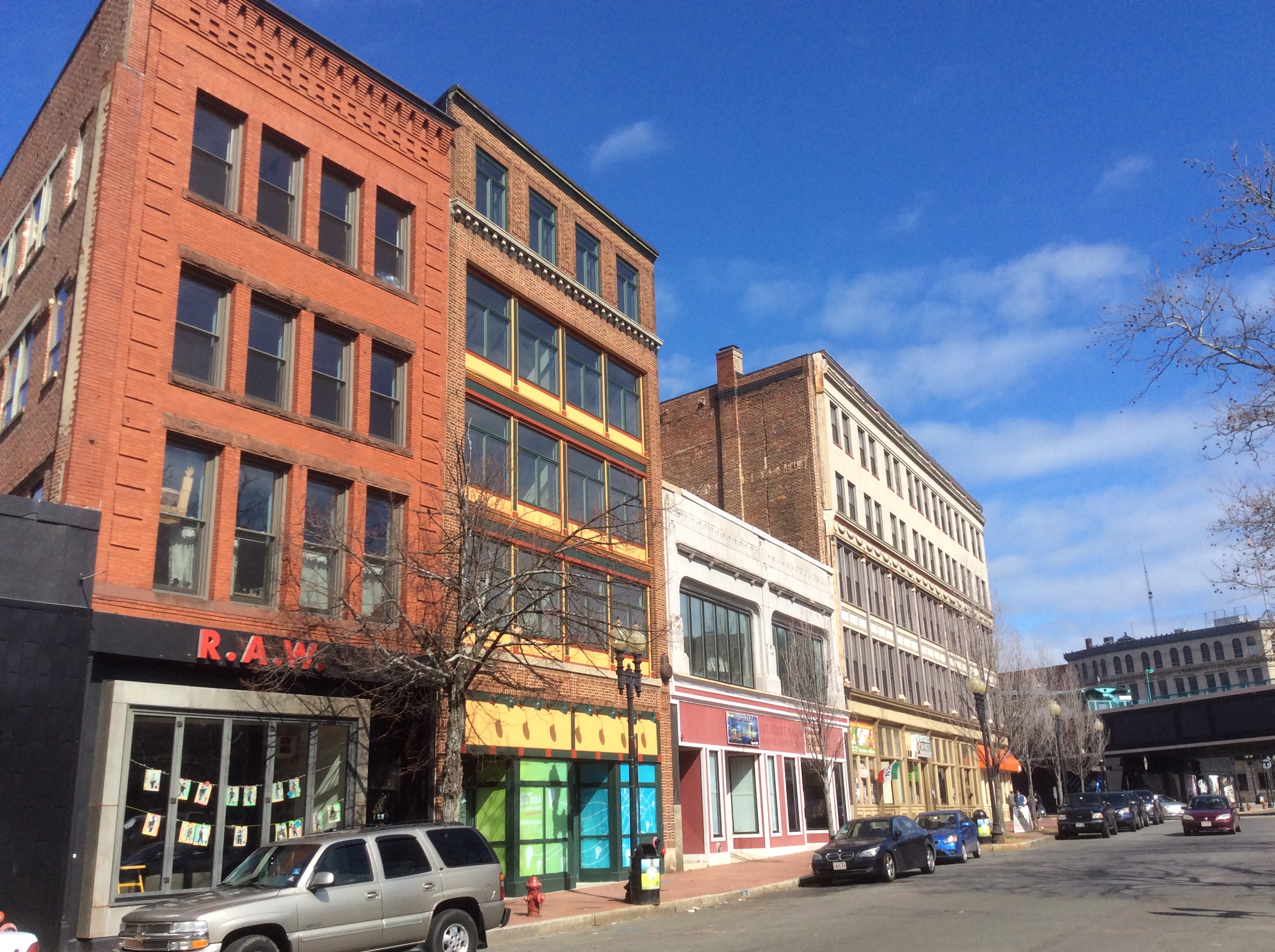
A row of buildings on Central Square in Lynn, MA

A row of buildings on Central Square in Lynn, MA; the elevated train tracks at the right pass over the site of the old depot, and Sagamore Hall stood just beyond the tall white-faced brick building

In Central Square, I’m close to the site of Sagamore Hall where John Brown, fiery abolitionist, and friend and hero of Douglass, used to speak. Sagamore Hall was close and to the west of the depot, between Union and Mt Vernon Streets north of Exchange, also where that part of the elevated track structure now stands. If you look closely at the photo of the mural we looked at earlier, you’ll see the image of a burning building just under Douglass’ portrait: that’s Sagamore Hall burning down on November 25th, 1843. I’ll tell more about how John Brown figured in Douglass’ life, which was very significantly, before long. You’ve likely heard of him:  he led the unsuccessful raid on Harper’s Ferry from October 16th -18th 1859, in hopes of jump-starting a slave insurrection by providing them with a source of arms, and was hanged as a traitor for his trouble.

But when Douglass lived here throughout the early- to mid- 1840’s, he had not yet met John Brown, though they were here in Lynn contemporaneously. As Douglass tells it in his Life and Times, they would meet later, when Douglass lived in Rochester NY.
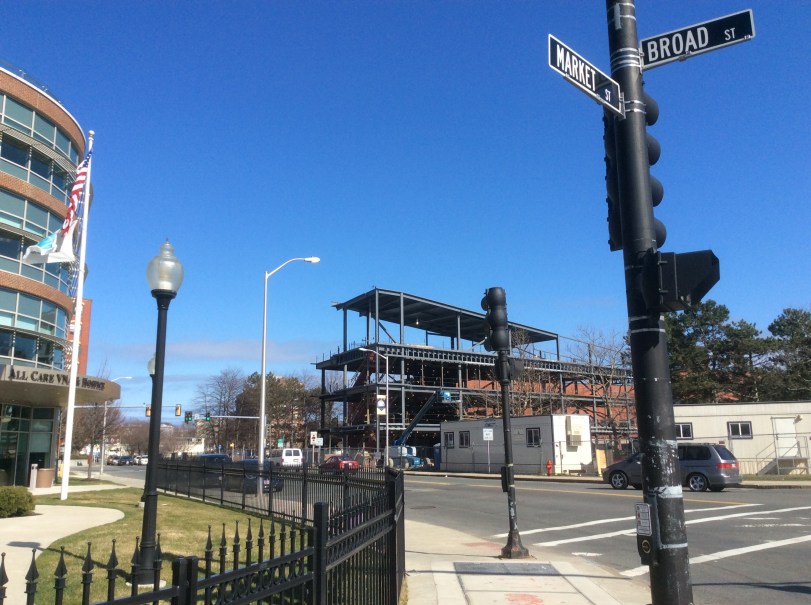
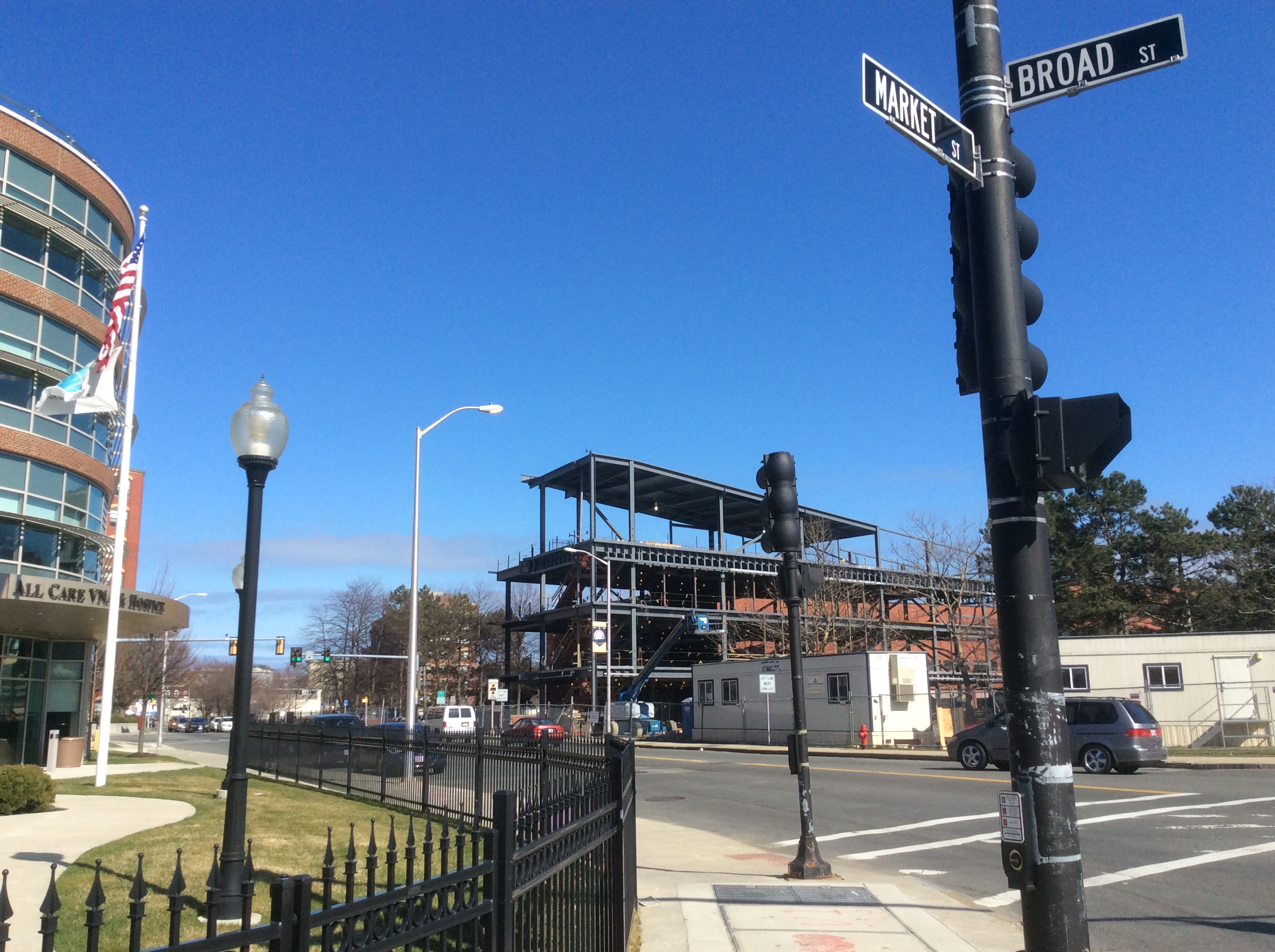
Market and Broad Streets near site of 1st Douglass family home in Lynn, 2016 Amy Cools

Market and Broad Streets, near the site of the first Douglass family home in Lynn, MA; their house would have been somewhere to the right of the iron structure
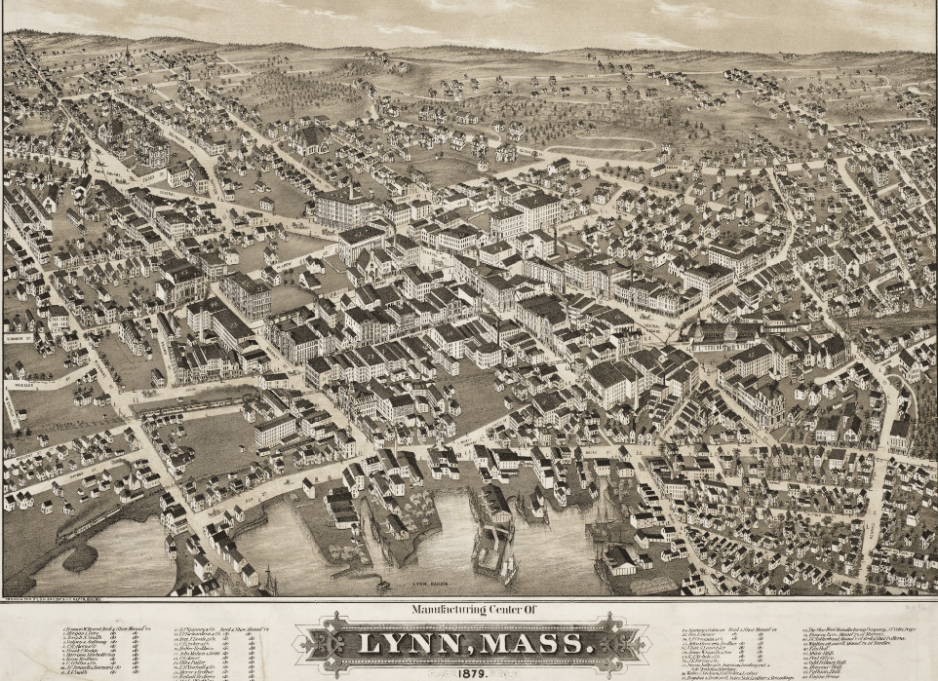
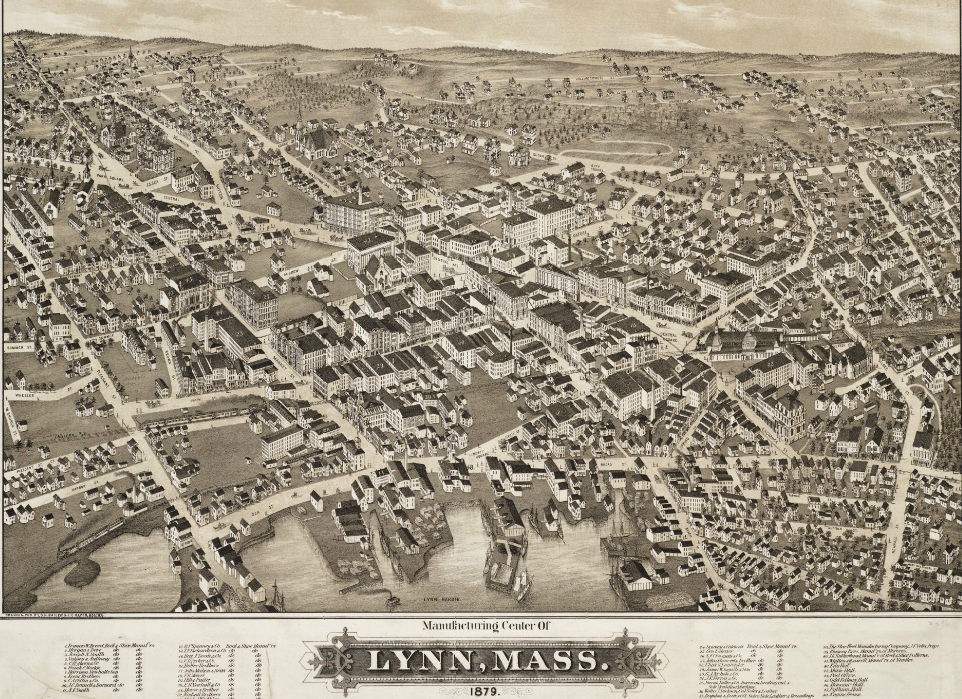
Manufacturing center of Lynn, Mass, by Bailey, O. H. (Oakley Hoopes) & J.C. Hazen Publisher: Bailey, O. H. & J.C. Hazen, 1879

Manufacturing center of Lynn, MA, 1879, by Bailey, Oakley Hoopes & J.C. Hazen
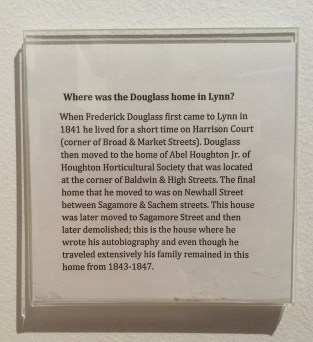
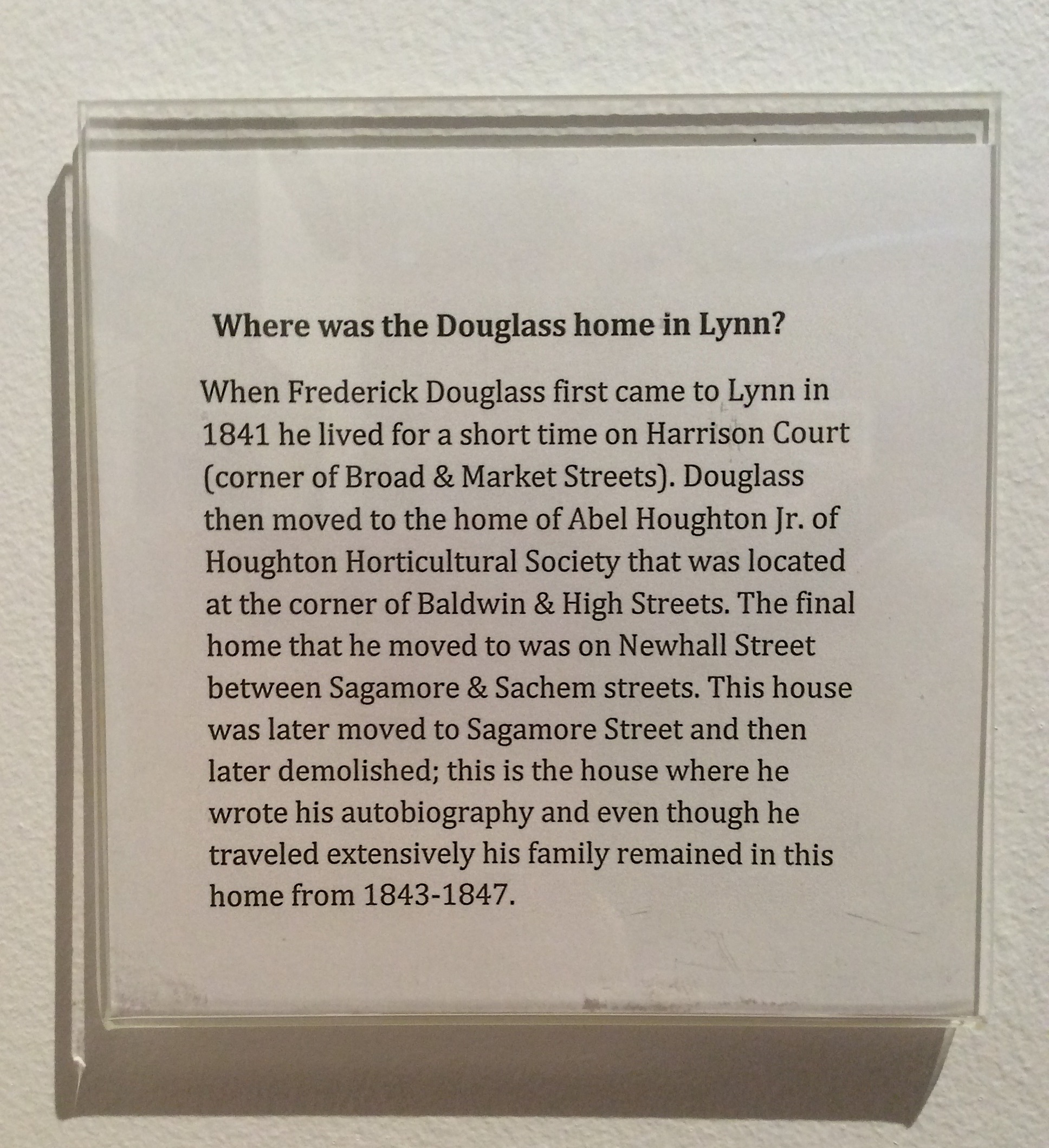
Douglass family homes in Lynn, MA, Lynn Museum & Historical Society placard

Douglass family homes in Lynn, MA, Lynn Museum & Historical Society placard

Then I head to the corner of Broad and Market Streets near the site of Harrison Court, where the first of the three Douglass family homes in Lynn used to stand. (I’m visiting the three Douglass home sites in chronological order).

There’s not much of historical interest here now: commercial buildings, broad highways, the big train station, and the iron skeleton of some new structure under construction. There are some great old photos of the area near Market and Broad Street at the Longyear Museum website’s Mary Baker Eddy photo gallery page; she lived a few blocks east of here at 8 Broad Street, and that home still stands. And if you look at these maps of Lynn from 1852 and from 1872, you can see where Harrison Court used to stand (I include both because, though the older one is closer to the Douglasses’ time here and more accurate for our purposes, the later one shows more detail when you zoom in). Look to the center bottom, just above the waterline and a little to to the right where two large streets come together in the point of a wedge. Click on that part to zoom in, and Harrison Court stood between the point of the wedge and the next main street running north and south to the left (Market), below Harrison St. Though none of the buildings from that time remain today, in any case, the modern openness of this place with the grassy Carroll Parkway, bright blue sky, and sea breeze is nice.

The unmarked V intersection at High and Baldwin Streets, near site of Frederick Douglass' second home in Lynn, MA

The unmarked V intersection at High and Baldwin (formerly Pearl) Streets, near site of Frederick Douglass’ second home in Lynn, MA

Then I take a brisk walk to my next destination, briefly east on Broad St then left (north) up Union St, then left again on Baldwin to the corner of Baldwin and High Streets. This is near the place where the Douglass family’s second home in Lynn used to stand. There are no street signs at all at this corner; missing street signs here and there is another reason I’ve been having a little trouble finding some places, hooray for GPS!) There’s now a tire and car care business, a white house with solar panels on its sharply pointed roof, and a three floor red brick building with arched windows. High and Baldwin streets meet here to make a ‘v’. The house, owned by Abel Houghton Jr., and where the Douglasses lived only briefly, stood somewhere near this corner. If you look at that 1872 map again), you can see the area where this house used to stand by following Union St from the point of that wedge where it meets Market to the northwest, then see where Pearl St (now Baldwin), meets it, running north and south with a crooked angle like a bent arm (Baldwin), High Street meeting it at the angle (inner elbow). Referring to the 1852 map, I don’t find the name of Abel Houghton Jr., or his Horticultural Society listed there, but it’s hard to read some of the names, or it may have changed hands in the approximate decade between between the time the Douglasses lived here and the time the map was drafted.
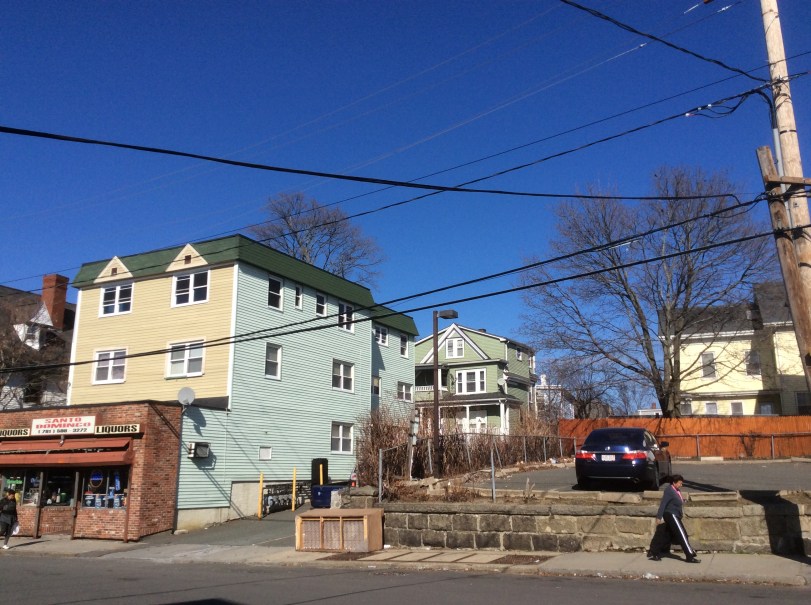
Newhall St between Sagamore and Sechem Streets, 3rd of Douglass family homes in Lynn MA, where Douglass wrote his Narrative

Newhall St between Sagamore and Sechem. The third Douglass family home in Lynn, from 1843-47, used to stand here where the parking lot is now. Douglass wrote his Narrative here in 1845

Then I head southeast on Silsbee St, which turns into Newhall St. I follow Newhall south to a stretch between Sagamore and Sechem Streets, where the third Douglass family home in Lynn once stood. This is where he wrote his Narrative, where his family lived while he was in the British Isles from August 1845 to April 1847, and where he returned home (after arriving in Boston on April 20th). When she saw me looking around and taking photos, a lady named Crystal (‘born and raised here!’) helpfully confirmed that the parking lot on Newhall between Santo Domingo liquor store and Sechem Streets, where Amity St ends, is the site where the Douglass home stood. As the old maps show, it’s where or about where someone named Chase lived. As the Douglass home placard in the Lynn Museum (see above) describes, it was moved once to Sagamore St nearby but eventually demolished.
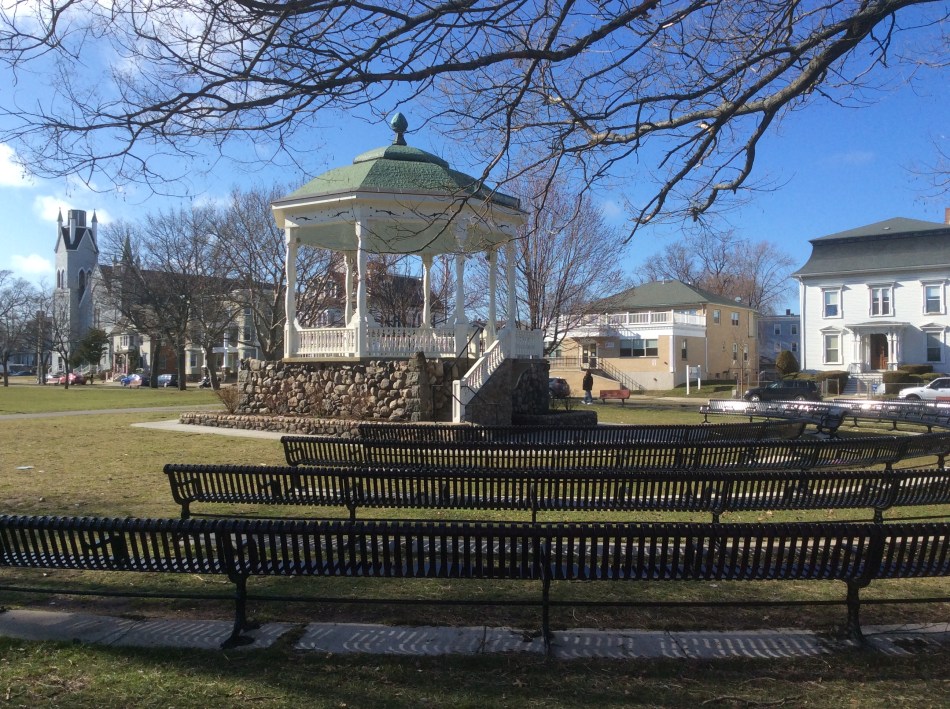
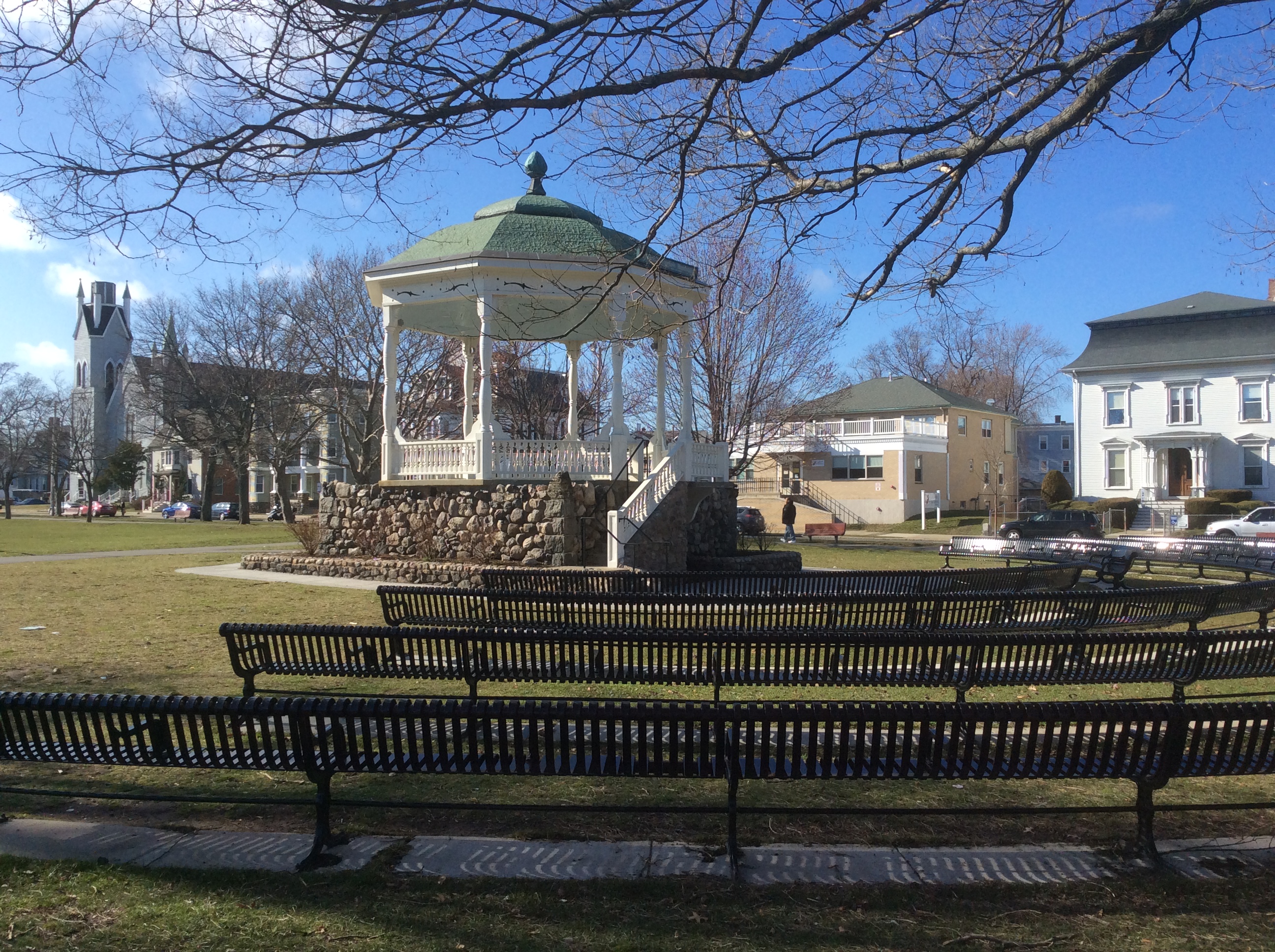
Lynn Commons Frederick Douglass Bandstand and Ampitheatre near Frederick Douglass memorial
Lynn Commons Frederick Douglass Bandstand and Ampitheatre near Frederick Douglass memorial

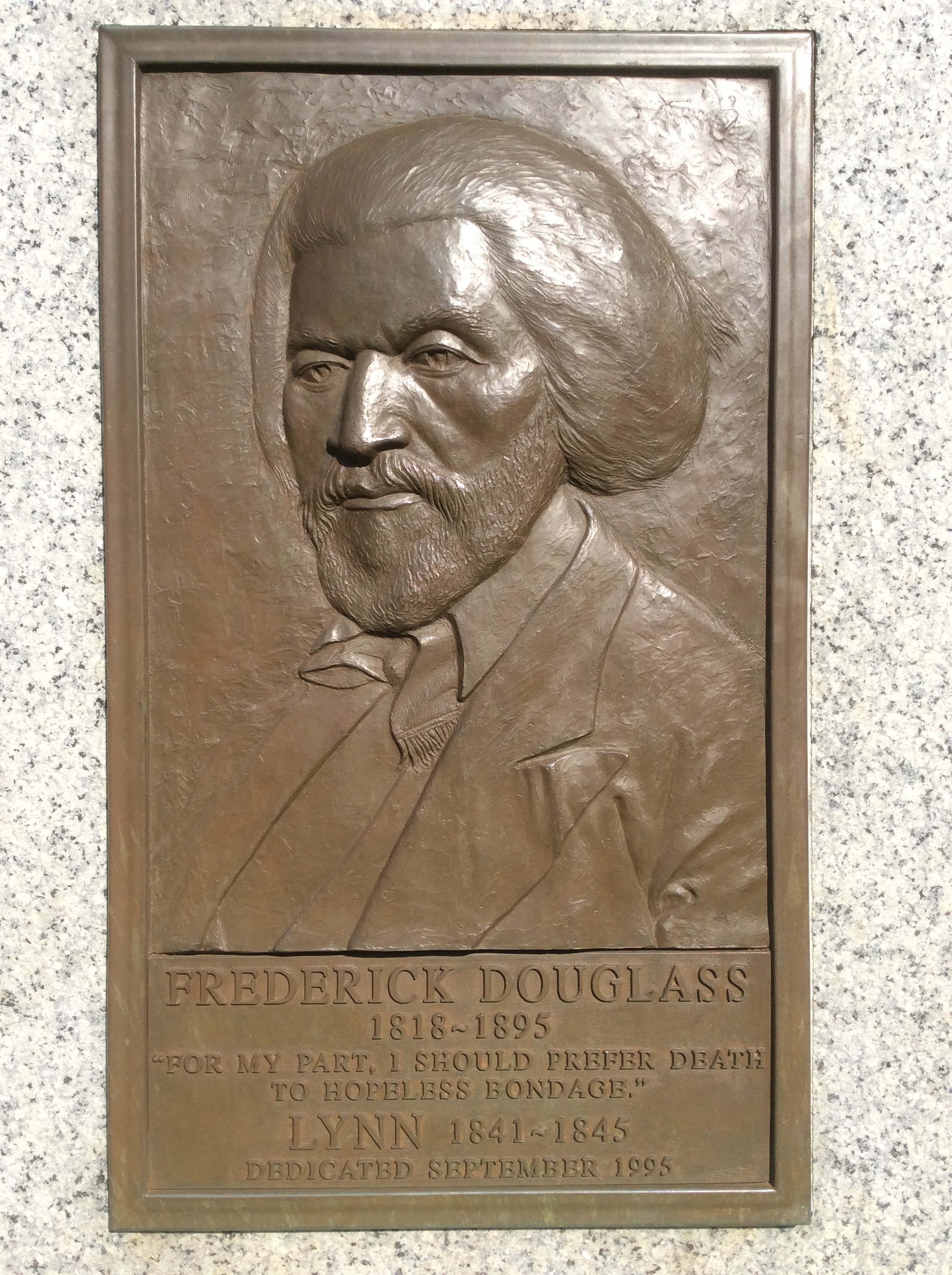
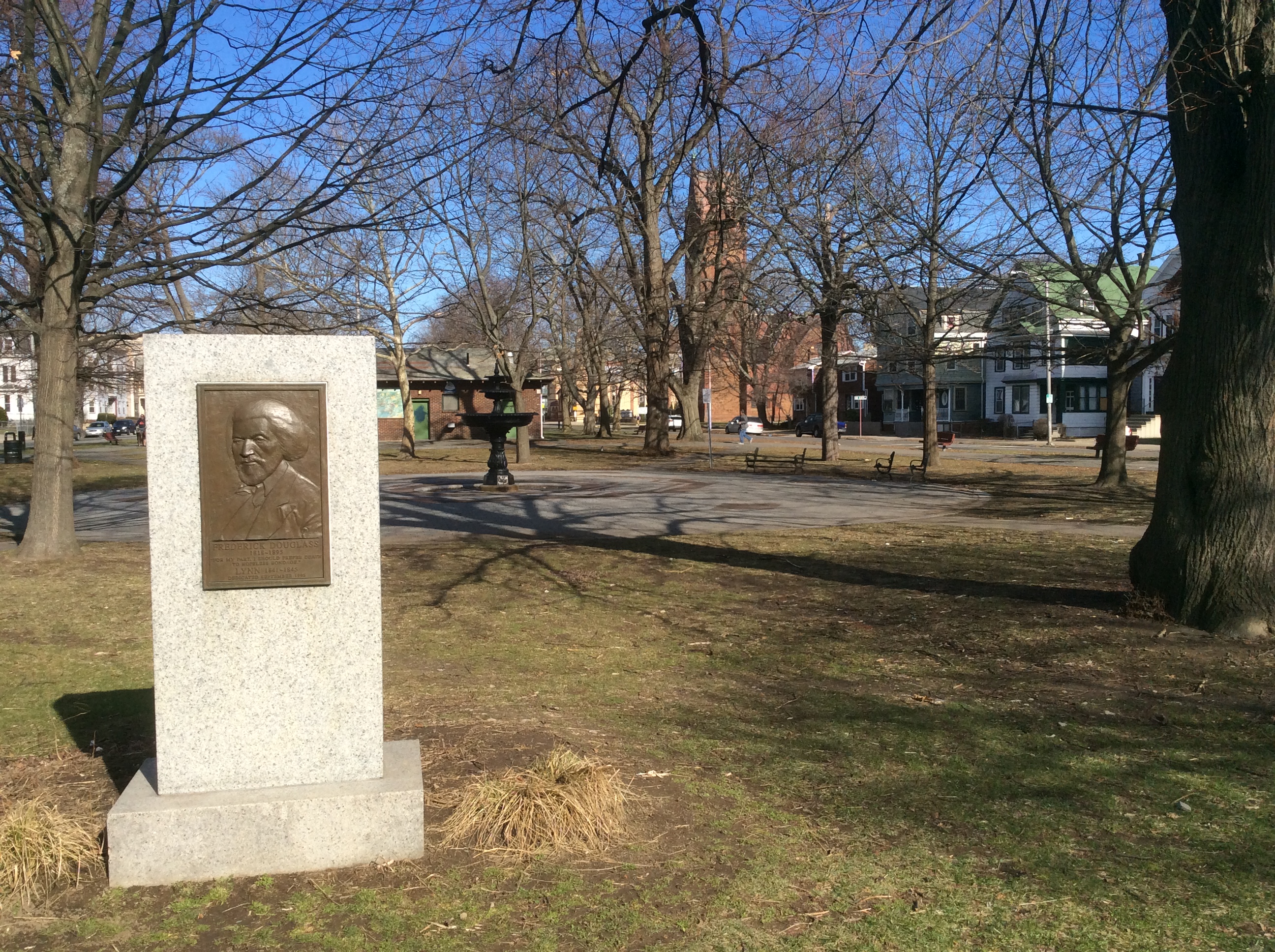
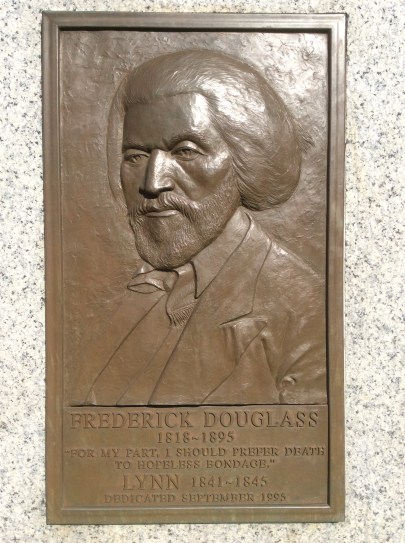
 Frederick Douglass Memorial plaque in Lynn Commons

Frederick Douglass Memorial plaque in Lynn Commons

Then I return to the car and drive just over 5 minutes away to Lynn Commons, which runs between the one-ways streets of North and South Common, and park along South Common near Shepard St. I walk east on S. Common a little ways and turn left on the path that cuts across the park and ends at Harwood St on the other side. Halfway across the commons, before I would reach Harwood St, to my left, there’s a white raised gazebo surrounded by benches to create a little amphitheater, and on my right stands a stone and brass monument to Frederick Douglass.

The raised gazebo is the Frederick Douglass Bandstand, built in 1887 near the site where Douglass used to deliver many anti-slavery speeches here from an earlier structure, which was perhaps on or near the spot where the memorial is now.
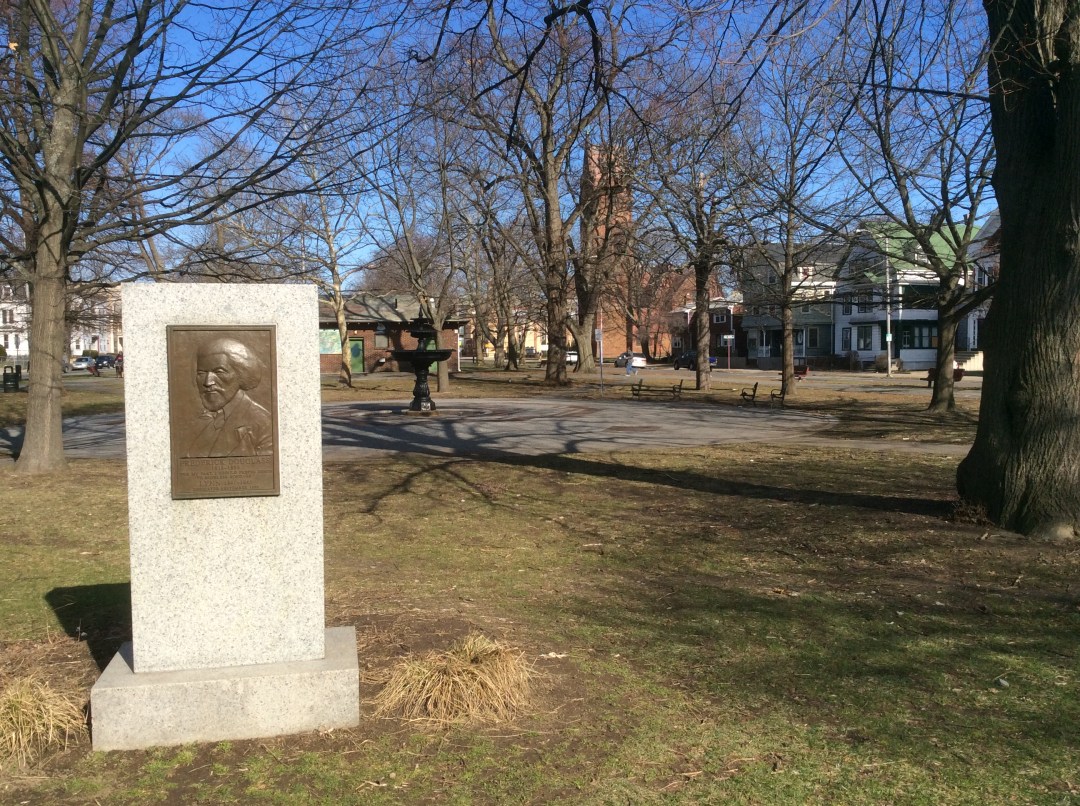
Frederick Douglass Memorial across from the gazebo in Lynn Commons
Frederick Douglass Memorial across from the gazebo in Lynn Commons

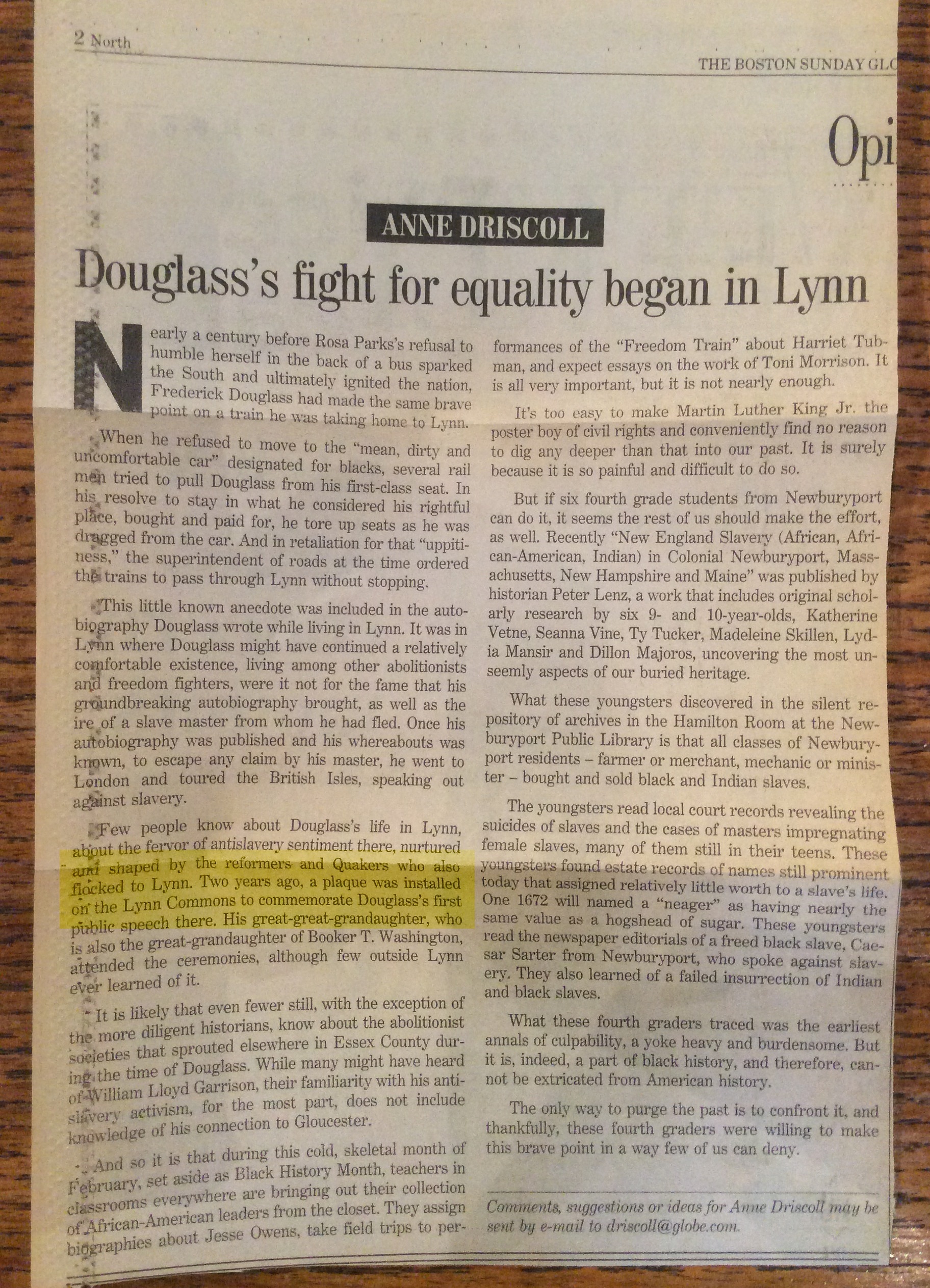
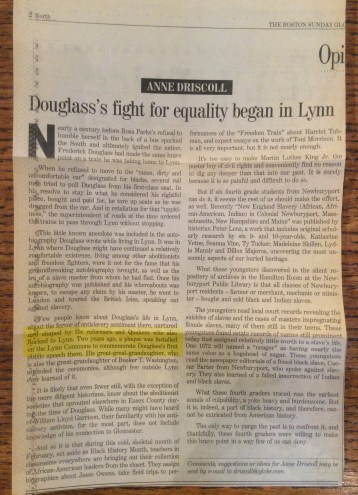
Boston Sunday Globe article about Douglass mentioning plaque on Lynn Commons, Lynn Museum, photo 2016 by Amy Cools

Boston Sunday Globe article about Douglass which mentions his plaque on Lynn Commons, clipping from the archives at Lynn Museum

So ends my eventful day in Lynn, Massachusetts, but really, there’s much more to come. Remember, I haven’t yet finished telling the whole story of today’s journey which includes a couple fascinating hours in the Lynn Museum and Historical Society this morning (soon to follow), and I’m only halfway through my trip, there are still seven days to go!

*Listen to the podcast version here or on iTunes

~ Ordinary Philosophy and its Traveling Philosophy / History of Ideas series is a labor of love and ad-free, supported by patrons and readers like you. Please offer your support today!

~~~~~~~~~~~~~~~~~~~~~~~~~~~~

Sources and Inspiration:

Bailey, Oakley Hoopes & J.C. Hazen, 1879 map of Lynn from the Norman B. Leventhal Map Center of the Boston Public Library

Blassingame, J. (Ed.). The Frederick Douglass Papers, Series One: Speeches, Debates, and Interviews. 4 volumes, and The Frederick Douglass Papers, Series 2: Autobiographical Writings. 3 volumes. New Haven and London: Yale University Press, 1979-1999

D.G. Beers & Co., 1872 map of Lynn from the Norman B. Leventhal Map Center of the Boston Public Library

Douglass, Frederick. The Life and Times of Frederick Douglass. Re-published 1993, Avenal, New York: Gramercy Books, Library of Freedom series.

Douglass, Frederick. My Bondage and My Freedom: 1855 Edition with a new introduction. Re-published 1969, New York: Dover Publications, Inc.

Fichter, David. Lynn Mural Project: Stories of Lynn, 50 ft. X 60 ft. Lynn, Massachusetts [Acrylic paint and mosaic]. From davidfichter.com

Foner, Philip S. The Life and Writings of Frederick Douglass, Vol. 1-4. New York: International Publishers, 1950.

Frederick Douglass Chronology‘. From Frederick Douglass National Historic Site District of Columbia, National Park Service website

Levine, David. ‘Lynne, MA: Frederick Douglass Bandstand‘. History Stands Still: The Background of Bandstands Throughout New England blog

Lewis, Alonzo. The History of Lynn: Including Nahant. (p. 257) Boston: Samuel N. Dickinson, 1844.

Lynn (MBTA Station)‘. In Wikipedia, The Free Encyclopedia.

McFeely, William. Frederick Douglass. New York: W.W. Norton & Company, 1991.

McIntyre, Henry. Plan of the City of Lynn Mass. from Actual Surveys, 1852. From the Norman B. Leventhal Map Center of the Boston Public Library

The Miriam and Ira D. Wallach Division of Art, Prints and Photographs: Photography Collection, The New York Public Library. Central Square and Depot: 1848 Central Square station in Lynn, Webster, William T., Publisher

Rosenberg, Steven A. ‘City Embraces its Civil War Connections. May 31, 2012. TheBostonGlobe.com

Walker, G.H. City of Lynn, Massachusetts, 1891. Atlas Map. Pub. Geo.H. Walker & Co. From David Rumsey Historical Map Collection at davidrumsey.com

Rededication of the Frederick Douglass Bandstand and Marker‘. General Orders, Issue 68, Sep 2015, Published at 58 Andrew St, Lynn MA

The Register of the Lynn Historical Society, Volumes 8-12, by Lynn Historical Society

On Martyrdom

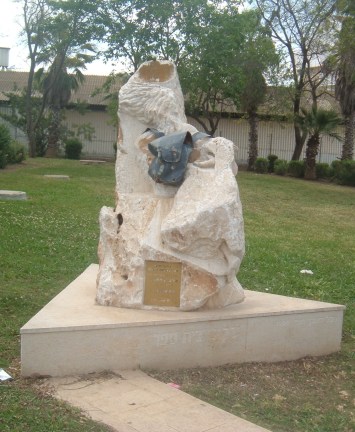
Memorial at Ben Gurion High school in Afula for students murdered in a suicide bombing in April 1994, by Almog (cropped), public domain via Wikimedia CommonsThe school shooting at Oregon’s Umpqua Community College on October 1st, 2015 ended with nine dead and many more injured. The shootings may have been religiously motivated: according to some reports, the gunman commanded some of the students to stand up, asked if they were Christian, and when they responded ‘yes’, he shot them down.

Some have praised these murder victims as Christian martyrs dying for their faith. In one sense, it’s a plausible, and in any sense, an understandable interpretation of what happened: the gunman shot them down after they responded ‘Yes’ to his question ‘Are you a Christian?’ Other survivors tell the story a little differently. In any case, the martyr interpretation is tricky: if it did happen as described above, the murder victims wouldn’t have known ahead of time whether ‘yes’ or ‘no’ was the right answer, as at least one survivor pointed out. Though they may have intended to defy death rather than deny their faith, they could instead have thought that the truthful answer of ‘yes’ would save them from death. Sadly, we can never really know.

I’ve found myself discomfited at the way many have used the horrific murders at Umpqua as a vindication of their own world view, often by portraying it as a tale of heroic martyrdom triumphing over evil. The account of the shooting itself is a very important story to tell: it’s one in a series of so many others in our country and around the world where disturbed young men channel their obsessions and their rage through the barrel of a gun and into the bodies of other people. There are so many similarities between the circumstances and motivations of the shooters that we have no choice, if we’re honest, but to acknowledge there’s a serious problem. We’ve seen too many times that maleness, youth, ideological extremism, mental disturbance, social alienation, and obsession with guns are a deadly mix. But when examples of mass killings and terrorism such as the Umpqua shooting are recast as tales of martyrdom, the motivation they should inspire in us, to do all we can to stop the killing, can for others become lost in the romanticism of idealized self-sacrifice.

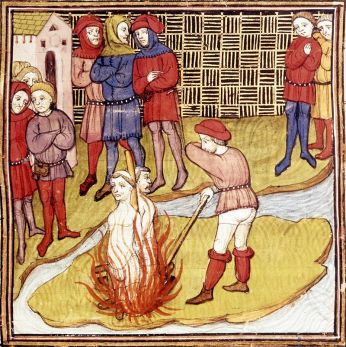
Detail of a miniature of the burning of the Grand Master of the Templars and another Templar. From the Chroniques de France ou de St Denis, Public Domain via Wikimedia CommonsThat’s because we’re still under the influence of a very old, even primal idea: that death is rendered not only glorious but a worthy goal if it’s for a cause. Nearly all ideologies and belief systems still prize their martyrs, and we see, worryingly, the resurgence of this idea in some parts of the world are leading to ever more deadly results. Martyrdom has long been such a potent symbol of belief and an effective recruitment tool that if there aren’t any genuine ones to hold up for emulation, it’s a sure bet some will be created. The Umpqua tragedy may be an example of this, of recasting the horrific murder of innocent people as a romantic tale of holy self-immolation in defiance of evil personified. The memory of the lives of the innocents who died there, and the heroism of those who risked themselves to protect others from harm, can become lost in the ideological rhetoric.
But what of beautiful, inspiring, authentic examples of martyrdom? How about Father Damien of Hawaii’s Molokai Island, who ministered to the leper colony quarantined there until he died from contracting the disease himself? How about Quảng Đức, who immolated himself in protest of the South Vietnamese government’s persecution of Buddhists? How about Joan of Arc (who’s long been an subject of my admiration and fascination), who was executed for refusing to betray her own beliefs about her mission to deliver the French from English rule? How about countless soldiers who have thrown themselves on mines and grenades and dashed through enemy fire to save innocent civilians and their comrades in arms? There are so many moving accounts of people who suffer and die because they will not compromise or allow themselves to speak or act otherwise than their sense of self and honor will allow. I, too, am deeply moved by the beauty and strength of their courage.

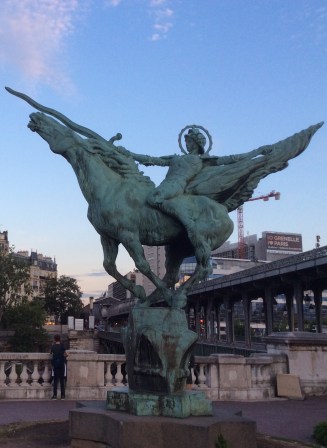
Joan of Arc statue in Paris, France, photo 2015 by Amy CoolsYet I am simultaneously wary of glorifying these cases of martyrdom for martyrdom’s sake, even when the circumstances of deaths such as these appear most moving, most noble, and most beautiful. That’s because I can’t forget, and I believe none of us can afford to forget, that what makes death or suffering count as martyrdom depends entirely on your frame of reference. My martyr may be your heretic; your martyr may be my traitor who deserved death; my martyr may be the holy warrior who attacked your corrupt and sinful country in the name of all that’s holy and your deadly foe it’s your patriotic duty to destroy. Martyrdom of this sort, understood as the ultimate sacrifice of the death-defying, uncompromising champion of the ultimate good, knows no side and every side. Every side claims their own, and every side who has martyrs to claim (creating them if necessary) treats them as their trump card, the ultimate demonstration of the rightness and superiority of their own beliefs. There’s Father Damien, and there are kamikaze pilots. There’s Quảng Đức, and there are suicide bombers. There’s Joan of Arc, and there are Crusaders, jihadists, those who carried out pogroms, and youth who still flock every day to join the ranks of ISIS and fight to deliver sacred territory from the hated infidels.
But surely there’s a distinction between those whose form of martyrdom imposes death and suffering on others, and those who choose suffering and death for themselves alone?

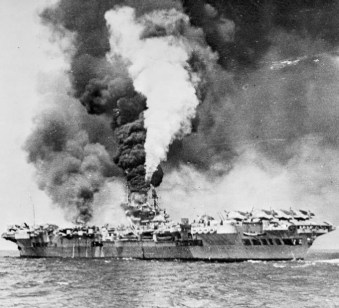
Kamikaze attack left HMS Formidable burning, 1945, by Royal Navy photographer aboard HMS Victorious (cropped), public domain via Wikimedia CommonsBut here’s the problem: if it’s okay to sacrifice one person, even if that person is one’s own self, then it’s more than just a slippery slope to thinking it’s okay to sacrifice others. As we can see in such cases as kamikaze pilots, crusaders, holy warriors, and suicide bombers, the glorification of martyrdom has always had the unfortunate tendency to inspire willingness to sacrifice others along with ourselves. After all, if it’s good to sacrifice one person for the greater good, isn’t it at least as good or even better to sacrifice more people? But self-inflicted martyrdom which simultaneously kills others is generally not driven by this sort of calculation, of each side just upping the ante. When we consider martyrdom, we must also consider the ideologies and belief systems that inspire or at least allow for it. And nearly all not only involve a belief in an afterlife, they believe this world is merely a proving ground for that afterlife, so death counts for little in comparison to eternity. Furthermore, most ideologies and faiths who glorify martyrdom base their beliefs on sacred books in which holy war and violent destruction of the nonbeliever, the godless, the idolator, and the infidel is celebrated as much or even more than personal martyrdom. In the end, we end up with the same old world full of mutually hostile martyr/holy warrior belief systems that have led to centuries of violent religious and ideological conflict and ethnic cleansing.

Martyrdom of Four Crowned Martyrs by Mario Minniti, San Pietro dal Carmine, at Siracusa, Sicily, public domain via Wikimedia CommonsAnd who’s to say who’s right? Which religion, which ideology has the correct view of martyrdom? Which, if any, can be demonstrated to inspire true martyrdom, to the exclusion of others? Bertrand Russell, philosopher and ardent pacifist, is often quoted as saying ‘I would never die for my beliefs because I might be wrong’. Many have described this as cynical or revealing a weakness of character, an inability to form convictions. I think a more fair and charitable interpretation is that Russell believed everyone should practice proper epistemic humility. Especially when it comes to such a momentous question as preserving human life, our own and others: we should do so whenever possible, since whatever our other beliefs, we can all readily demonstrate, whatever our other beliefs, that other human beings suffer grief when we die and that we can surely help others when we’re around to do so. It’s far more difficult to demonstrate, for example, that God likes it even better when we die in his name or that we can help those on earth from beyond the grave, as believers in intercessory prayer or spiritualists hold. Better all around, when it comes to our safety as well as our chances of not believing in things that are terribly wrong, when we’re accountable to one another for the larger consequences of our beliefs.
But how if we take religion and ideology out of it, and consider only those cases where the martyr’s entire cause is the well-being of others? Even in these cases, the problem is a simple matter of justice: it’s difficult to see how one can truly believe that all persons have equal rights and dignity and are therefore deserving of care, and still believe it’s okay to sacrifice one’s own well-being when that sacrifice can be avoided. There are times in which it can’t be: the example of heroic soldiers throwing themselves on grenades to save others comes to mind as a paradigm example of justifiable self-sacrifice, since equal concern for all logically allows for sacrificing one’s self to save many. Others are not so clear: Father Damien was clearly motivated by a noble desire to help his fellow human beings as he ministered to the exiled lepers at Molokai. He made it a point to embrace and kiss the lesions of patients to show a Christlike love, but the ideology of martyrdom that also drove him may have robbed him of an even better opportunity, the opportunity to show that love to more of his fellow human beings by keeping himself alive to serve them. If he had taken reasonable precautions to care for his own well-being and avoid contracting the disease, known in his time to be contagious, he likely would have lived much longer to serve the people who loved and counted on him; kissing of lesions and other reckless exposure to contagion is not an unavoidable requirement for showing our deep concern for others. Martyrdom, though it may not be apparent, involves at least to some degree the inequitable valuing of the lives of persons, at the very least our own.

And this leads us to consider whether martyrdom is really the ultimate altruistic, selfless act it’s so often characterized to be. It’s hard to see how there can be such a thing as truly selfless martyrdom in a world in which human lives are so intertwined. Through death, parents are deprived of a child, children of a parent, siblings of a sibling, friends of a friend, citizens of a fellow citizen, the needy of a benefactor, the world of a unique life that has something to offer. It seems to me, then, our lives are not fully our own: they are given to us by others, are largely sustained by the efforts of others, and provide emotional support for others, and vice versa. There is no human being that doesn’t rely on the support and contributions of others to sustain it and make it secure and happy. As in the case of Father Damien, when we choose death over life, we remove ourselves from the human community of inter-reliance we all belong to. I’m speaking here in the worldly sense; according to many religions, we can help others after death by interceding with God or by providing personal supernatural guidance, such as in spiritualist beliefs. But as we’ve already considered, this view of martyrdom as a holy thing is hard to justify consistently, and even worse, it necessarily values supernatural concerns over worldly ones, allowing for the same disdain for life that underlies all forms of martyrdom, from the self-sacrificer to the jihadist. So even when it appears that a martyr is sacrificing nothing but their own life and happiness, this is rarely if ever the case. And if this is so, our right to sacrifice our own life and well-being appears very tenuous in all but those very special circumstances, such as the case of those grenade-blocking soldiers who can’t help others unless they risk themselves.

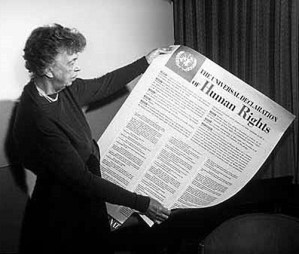
Eleanor Roosevelt and Human Rights Declaration, public domain via Wikimedia CommonsIn a world where religiously-, politically-, and ideologically-motivated terrorism and mass shootings are again on the rise, we need to let go of our old cherished ideal of martyrdom as the ultimate holy and noble act. If we want to instill in ourselves and others the value that all lives matter, the glorification of any kind of martyrdom appears as toxic to this as the old belief in the curative powers of bleeding and purging was to health. This seems like a call for rejecting our long-loved heroes, our Joans and Quảngs and Damiens, but I don’t believe it is. We have a robust capacity for understanding that context matters, and just as we can believe George Washington’s doctors did their best to cure him the only (turns out wrong) way they knew how, we can simultaneously revere the courage and conviction of martyrs of the past while believing that in the age of universal human rights and ethics of care, martyrdom is the wrong way to go and should not be glorified, praised, or used as evidence of the superiority of our own beliefs over others.

*Listen to the podcast version here or subscribe on iTunes

Ordinary Philosophy and its Traveling Philosophy / History of Ideas series is a labor of love and is ad-free, entirely supported by patrons and readers like you. Please offer your support today!

~~~~~~~~~~~~~~~~~~~~~~~~~~~~~~~~~~~~~~~~~~~~~~~~~~~~~~~~~~~

Sources and Inspiration:

The Death of George Washington‘, The George Washington Digital Encyclopedia

Father Damien‘. In Wikipedia, The Free Encyclopedia.

Sidner, Sara and Kyung Lah, Steve Almasy and Ralph Ellis. ‘Oregon Shooting: Gunman was Student in Class Where He Killed 9’. CNN (online), October 2, 2015. 

‘The “Werther-effect”: Legend or Reality?’ (abstract). Neuropsychiatr. 2007;21(4):284-90. Source: PubMed.gov http://www.ncbi.nlm.nih.gov/pubmed/18082110

Turkewitz, Julie. ‘Oregon Gunman Smiled, Then Fired, Student Says’
The New York Times (0nline), Oct. 9, 2015

Vanderhart, Dirk and Kirk Johnson and Julie Turkewitz. ‘Oregon Shooting at Umpqua College Kills 10, Sheriff Says’, The New York Times (0nline), Oct. 1, 2015.

Happy Birthday, Rosa Luxemburg!

Rosa Luxemburg, By unknown photographer around 1895-1900 [Public domain], via Wikimedia CommonsRosa Luxemburg, Mar 5 1871 – Jan 15 1919, is the great Marxist theorist, writer, economist, revolutionist, anti-war and anti-capital-punishment activist, and philosopher who was murdered during the German Revolution of 1918–1919.

Though she’s an anti-war activist, Luxemburg is also critical of the idea that a just society can be brought about by incremental reforms through established political systems. If she were to be involved in the 2016 Democratic primary race between Hillary Clinton and Bernie Sanders, she would very likely back Bernie, with his more revolutionary style and rhetoric: she’s sharply critical of the Social Democratic Party of Germany, to which she belongs (in its left wing) for favoring a Hillary-style reformist approach. However, her internationalism takes Marxist thinking beyond the point where leading Marxists of her day had progressed, with their focus on unique formulations of Marxist political theory tailored to their own particular national identities and histories. She would likely find fault, then, with Bernie’s protectionism.

Luxemburg’s other great contribution to Marxist thought is her theory about the accumulation of capital. Since capitalism’s primary fuel is constant and ever-increasing consumption, she thinks it’s a mechanism for the ultimate destruction of our material capabilities to sustain ourselves, starting with the ecosystems on which indigenous people, the poor, and the working class depend. Here as well, her progressive thinking takes her far beyond Marx himself, and her concerns in this timely issue makes her as relevant now as ever.

Read more about the brilliant and fearless Luxemburg:

‘Who’s Who – Rosa Luxemburg’ at First World War.com

‘The Dialectic of the Spatial Determination of Capital: Rosa Luxemburg’s Accumulation of Capital Reconsidered’ by Peter Hudis

The Crisis of German Social Democracy (The Junius Pamphlet) by Rosa Luxemburg, 1915

‘Rosa Luxemburg’, from Wikipedia, the free encyclopedia

Ordinary Philosophy and its Traveling Philosophy / History of Ideas series is a labor of love and is ad-free, entirely supported by patrons and readers like you. Please offer your support today!