New Podcast Episode: Margaret Sanger NYC Sites, Day 2, Part 1

Waverly Pl and University at Washington Square, Manhattan, NY

Waverly Pl and University at Washington Square, Manhattan, NY

Listen to this podcast episode here or on Google Play, or subscribe on iTunes

Wednesday, October 19th, 2016

I take the E train north from where I’m staying in NYC’s Soho neighborhood of Manhattan to Washington Square. It’s a lovely, warm, and soft day, the sky blue and thickly scattered with puffy, small, wispy clouds like spilled cheap cotton balls.

On March 1, 1926, Margaret Sanger delivered a lecture titled ‘The Need for Birth Control in America’ to New York University’s Liberal Club. It takes a bit of digging to find out where the Liberal Club met at this time, but I finally discover it in a letter written to Sanger’s supporter and sometimes collaborator W.E.B. DuBois…. Read the written version here:

Ordinary Philosophy and its Traveling Philosophy / History of Ideas series is a labor of love and ad-free, supported by patrons and readers like you. Please offer your support today!


New Podcast Episode: Margaret Sanger NYC Sites, Day 1 Part 3

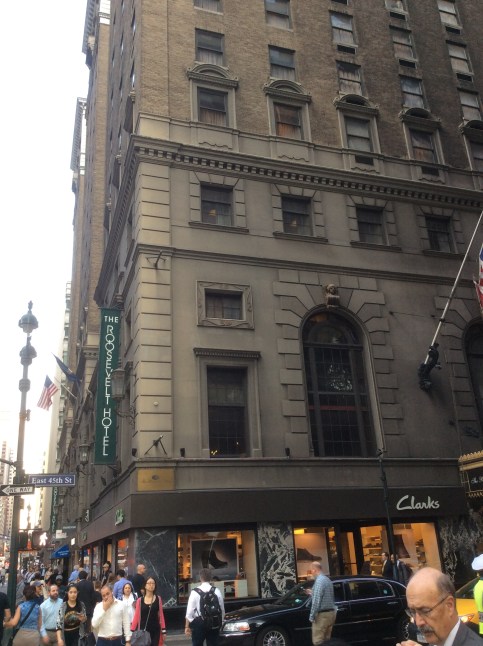
roosevelt-hotel-exterior-view-manhattan-nyc-photo-by-amy-cools-2016

Listen to this podcast episode here or on Google Play, or subscribe on iTunes

Tuesday, October 18th, 2016, continued

I continue north to the Roosevelt Hotel at Madison Ave and E. 45th Street. Margaret Sanger attended the Conference on Contraceptive Research and Clinical Practice that met here on December 29th and 30th, 1936. She delivered a welcoming speech on the 29th and spoke on a panel the next day which discussed technical and medical birth control issues. While The New York Times reported optimistically on the effectiveness of birth control methods available at the time and Sanger spoke proudly of the ‘56,000 women who have voluntarily appealed to us for help’, she and many of the attendees knew that the lack of access to and effectiveness of birth control remained big problems. It was still fairly expensive; anti-obscenity laws were barriers to access and information in those pre-Griswold years; and too many of the methods were only moderately effective since they were not always easy to use correctly, especially in well, you know, the heat of the moment…. Read the written version here:

Ordinary Philosophy and its Traveling Philosophy / History of Ideas series is a labor of love and ad-free, supported by patrons and readers like you. Please offer your support today!

New Podcast Episode: A ‘Light’ That Obscures: The Misrepresentation of Secular Thought in Pope Francis’s First Encyclical

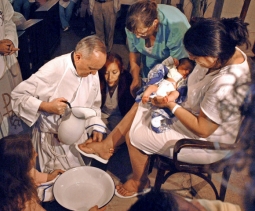
foot-washing-255x212Listen to this podcast episode here or on Google Play, or subscribe on iTunes

Like many, I’ve found myself pleasantly surprised and impressed by many of the sayings and doings of the new Pope. He emphasizes helping the needy and is critical of over-judgmentalism and of hyper-materialism (he practices what he preaches by driving a cheap car and living in a simple apartment). He also goes out of his way to spend time with ordinary people, be it in a correctional facility, in processions, or on the phone. Often dubbed ‘The People’s Pope’, he’s making the most of his promotion, on a mission to do real good in the world. Catholic or not, most people are thrilled that such an influential person is providing such an excellent example of how to live a life of service and of mercy.

But I wasn’t quite as pleased the author of an article in the Huffington Post about Pope Francis’ first encyclical Lumen Fidei (The Light of Faith) co-authored with the previous Pope, Benedict XVI. The author says that the encyclical ‘…reflects Francis’ subtle outreach to nonbelievers’. While I consider myself an atheist, I’m a cultural Catholic, brought up with that religion. Since so many of my loved ones are observant Catholics and the Catholic church is so influential in the world, I’m very interested in what goes on in it. The first encyclical of a new Pope is a big deal, and this encyclical does a good job of promoting Catholic teaching with inspirational language and metaphors. However, the authors also resort to bad arguments to make their point… Read the written essay here:

Ordinary Philosophy and its Traveling Philosophy / History of Ideas series is a labor of love and ad-free, supported by patrons and readers like you. Please offer your support today!
New Podcast Episode: Why So Much Hatred for Margaret Sanger?

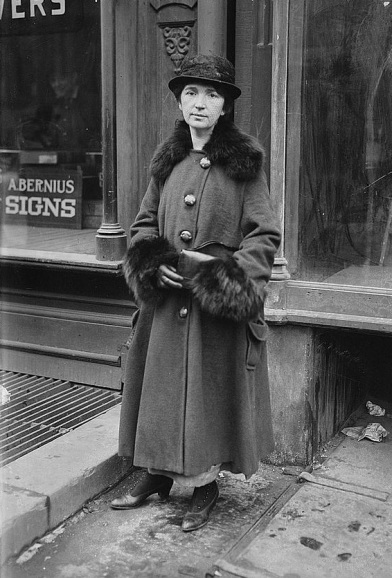
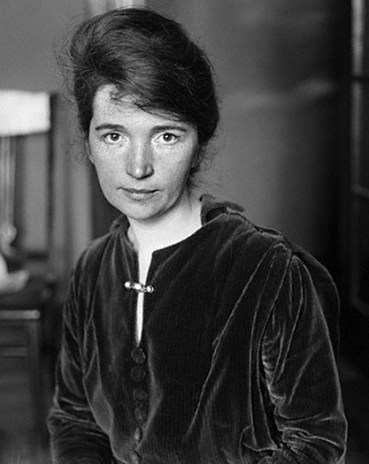
Margaret Sanger, photo probably taken Jan 30th 1917, photo courtesy of the Library of Congress

Margaret Sanger, photo probably taken Jan 30th 1917, photo courtesy of the Library of Congress

Listen to this podcast episode here or on Google Play, or subscribe on iTunes

There’s been a widespread and concerted effort to vilify Margaret Sanger and remove her name from the public roll of great contributors to human rights history. In my research for the Sanger project I’m working on, I find scores of examples of this effort every single time I do an internet search using her name.

Last year, for example, Ted Cruz and other conservative senators called for her portrait to be removed from the Smithsonian’s National Portrait Gallery in Washington DC, where her portrait bust is included in the Struggle for Justice exhibition. In justification of his campaign, Cruz used part of a quote lifted from its original context and presented it as saying something nearly opposite of what it was originally meant to say. In a letter to a friend, Sanger expressed her worry that her birth control clinic project in the South might be misperceived and misrepresented as racist; Cruz lifted a few words from this letter to ‘prove’ that it was. He may have borrowed this idea from Michael Steele, former chairman of the Republican Party, and Ben Carson and Herman Cain, one-time Republican presidential hopefuls. These three influential conservative men, in turn, received this bit of distorted wisdom from Angela Davis and some others in the black power movement who, concerned that the reproductive justice movement might have ill effects in the long run on the empowerment of black people, (mis)represented Sanger’s words, works, and character in the worst possible light…

….So let’s first consider Margaret Sanger’s [actual] beliefs and whether they justify her inclusion among the great freedom leaders. Then, let’s consider her beliefs in the light of her own time and whether they deserve admiration today, on the whole, or are at least understandable given the circumstances of her time…. Read the written version here:

Ordinary Philosophy and its Traveling Philosophy / History of Ideas series is a labor of love and ad-free, supported by patrons and readers like you. Please offer your support today!
New Podcast Episode: Margaret Sanger NYC Sites, Day 1 Part 2

The Chrysler Building at Lexington and 42nd in Manhattan, NYC

The Chrysler Building at Lexington and 42nd in Manhattan, NYC

Listen to this podcast episode here or on Google Play, or subscribe on iTunes
Tuesday, October 18th, 2016, continued

Let me preface this second part of the story of today’s journey with full credit and a note of gratitude to Robin Pokorski, who worked with The Margaret Sanger Papers Project for a time. As with the MSPP overall, I found Pokorski’s project Mapping Margaret Sanger to be an absolutely invaluable resource…

…I exit Grand Central Station, where I’ve just returned to Manhattan from the Sanger clinic site in Brownsville, Brooklyn. I follow the signs to the exit which lets me out right underneath the Chrysler Building at 405 Lexington Ave, just north of 42nd St. I’ve long been curious about this building but for one reason or another, had never made it here. It’s fully as handsome on the outside and lovely on the inside as I’ve heard. It shoots up to the sky enthusiastically and towers overhead with almost aggressive confidence and optimism. I love its Art Deco style, and I’m excited to see all the wonderful architecture and art of this period that this trip will take me to…

Pokorsky writes, ‘At 4.30pm on April 20, 1939, Sanger met with Bill Melon at the Chrysler Building.’ I have not been able to discover who Melon was or why she met him here yet; I await her response to my inquiry…. Read the written version here:

Ordinary Philosophy and its Traveling Philosophy / History of Ideas series is a labor of love and ad-free, supported by patrons and readers like you. Please offer your support today!

New Podcast Episode: Margaret Sanger NYC Sites, Day 1 Part 1, and a 100 Year Anniversary

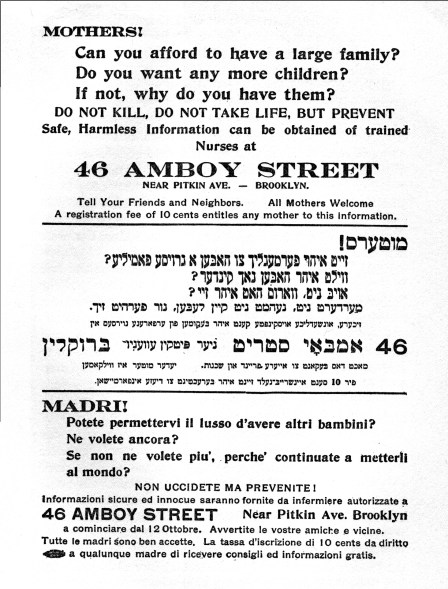
Flyer for Sanger Clinic, Brownsville, Brooklyn, image courtesy of the Margaret Sanger Papers Project

Flyer for Sanger Clinic, Brownsville, Brooklyn, image courtesy of the Margaret Sanger Papers Project

Listen to this podcast episode here or on Google Play, or subscribe on iTunes
Tuesday, October 18th, 2016

I start the morning preparing my itinerary for the day as I fortify myself with coffee and the first half of a sandwich.

My first stop is also the furthest east I’ll go this trip, to the Brownsville neighborhood of Brooklyn. I take the C train to the Rockaway station, head south on Saratoga, and wander around getting a feel for the neighborhood. It’s predominantly black, solidly working class, with lots of handsome old buildings, mostly well worn with peeling paint. I see lots of mothers and grandparents with strollers and very small children (it’s around noon during work hours), people taking smoke breaks in backdoors, and some very poor and homeless people. Reaching Pitkin’s busy sidewalk, I see shoppers, people going out for lunch, and shop and cafe proprietors in front doorways under brightly colored signs, and I hear many accents and many languages spoken, English, Spanish and French, and many others I don’t recognize. It reminds me of neighborhoods I frequent at home in Oakland. I turn north on Amboy Street, which runs north and south between Pitkin and E. New York Ave.

At 46 Amboy Street, just north of Pitkin, Margaret Sanger opened the United States’ first birth control clinic two days less than 100 years ago, on Oct 16th, 1916. Though just a  little late for the anniversary, I’m happy to be here at this historic place, humble as it now appears…. Read the written version here:

Ordinary Philosophy and its Traveling Philosophy / History of Ideas series is a labor of love and ad-free, supported by patrons and readers like you. Please offer your support today!

New Podcast Episode: Goodbye, Dear Leonard Cohen!

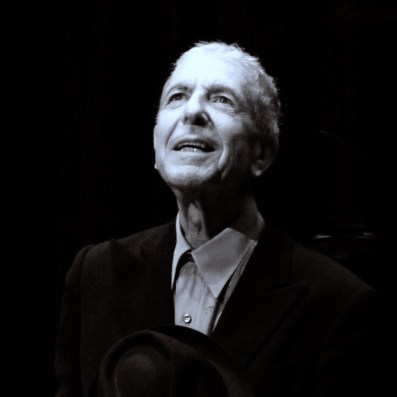
leonard-cohen-2008-by-rama-own-work-cc-by-sa-2-0-via-wikimedia-commons

Listen to this podcast episode here or on Google Play, or subscribe on iTunes

‘I’ve been listening
To all the dissension
I’ve been listening
To all the pain
And I feel that no matter
What I do for you
It’s going to come back again
But I think that I can heal it
I’m a fool, but I think I can heal it
With this song’

– Leonard Cohen, ‘Minute Prologue’ from Live Songs, 1973

I heard of Leonard Cohen’s death when I returned home from work yesterday evening. Thursdays are my long day at the doctor’s office, and by the time I left, we had cared for about sixty patients, and I had just enough time on my short break to do a little reading and quickly tuck a little lunch away. No time for social media or news and no interest in them either, weary from election coverage and its aftermath.

So I learned of his death not from the cold glow of a screen but from the living face of my husband Bryan, who is also one of my oldest friends. We’ve sung Cohen’s songs together countless times over the years as he played guitar, or a capella while driving, which I especially love to do…. Read the full written version here

Ordinary Philosophy and its Traveling Philosophy / History of Ideas series is a labor of love and ad-free, supported by patrons and readers like you. Please offer your support today!

New Podcast Episode: To New York City I Go, in Search of Margaret Sanger

margaret-sanger

Listen to this podcast episode here or on Google Play, or subscribe on iTunes

Hello, friends of Ordinary Philosophy!

From time to time, I take a trip to some corner of the globe, to explore the lives and ideas of great thinkers in the places where they lived and worked. For this series, I follow in the footsteps of thinkers who are no longer alive, since those who are still telling their own stories. But those who are no longer alive in the body live on in the ideas that they pass on, and in the examples they provide for us to follow.

I’m pleased and excited to announce my sixth philosophical-historical themed adventure, a rather impromptu trip to New York City to follow in the footsteps of Margaret Sanger.

Though the timing was spur of the moment, I’ve read and thought about Sanger quite a bit over the years and have some of the research done already for this long-planned trip. So when this little window of time opened up in my schedule, I happily seized the opportunity! As central to the history of women’s rights, free speech rights, and rights to sexual self-determination and privacy as she is, Sanger’s also the most problematic figure in the history of ideas I’ve followed so far for this series, with the possible exception of the brilliant but slave-owning Thomas Jefferson. She’s certainly the first that sparked immediate controversy when I casually mentioned my plans for following her on social media…. Read the written version here:

Ordinary Philosophy and its Traveling Philosophy / History of Ideas series is a labor of love and ad-free, supported by patrons and readers like you. Please offer your support today!

New Podcast Episode: The Little Way of Goodness

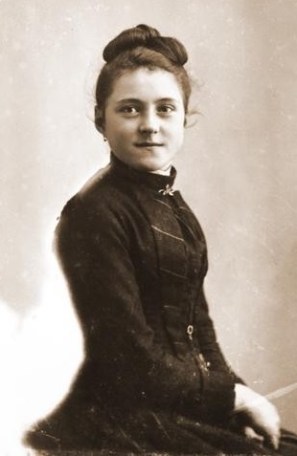
therese-of-lisieuxListen to this podcast episode here or on Google Play, or subscribe on iTunes

Growing up Catholic, my siblings and I were taught many stories of saints and their heroic exploits in their quest to attain union with God. One of these was Thérèse of Lisieux, a young Frenchwoman who became a nun at 16 and died of tuberculosis at the early age of 24. She was an especially beloved saint of my family; one of my sisters is named after her.

Thérèse was a romantic and an idealist, and as a young girl, admired the glorious deaths of Christian martyrs and wished to emulate them. Realizing that she was unlikely to find herself in a situation where she could likewise be killed for the sake of her religion, she devised her own system for attaining heaven. She called it her “Little Way”, in which she would regularly perform acts of holiness in day-to-day life. The trials and tribulations of ordinary life would be elevated and be made important by virtue of their being endured with patience and good grace, and opportunities for sacrificing oneself for the good of others would be seized and fulfilled to their utmost… Read the written piece here:

Ordinary Philosophy and its Traveling Philosophy / History of Ideas series is a labor of love and ad-free, supported by patrons and readers like you. Please offer your support today!

New Podcast Episode: Philosophy as Love of Wisdom and in the Public Sphere

Sophia, goddess of wisdom

Sophia, goddess of wisdom

Listen to this podcast episode here or on Google Play, or subscribe on iTunes

Some years ago, the economic downturn inspired me to put aside my business endeavors and return to school to study philosophy. I had loved philosophy for as long as I can remember, before I even knew what to call it, and later as I understood it in its broadest sense: the love and pursuit of wisdom. Wisdom was pursued through asking questions about everything, from the metaphysical and theological sort of questions that my religious and argumentative family used to debate around the dinner table and family gatherings (I credit these discussions and arguments, more than anything, with inspiring my philosophical curiosity) to all other questions about what’s true and false, just and unjust, good and bad, right and wrong. Wisdom was found through reading and learning as much as possible, then applying this learning to carefully thinking through possible answers to these questions. And wisdom was loved not because it brought understanding and meaning to life, but rather because its pursuit seemed beautiful to me.

Because my love of philosophy was formed prior to any introduction as a school of thought and my formal education was rather piecemeal, my approach was whimsical, idiosyncratic, unsystematic. Any and all subjects that aroused my curiosity and admiration could be brought to bear on what I understood as philosophical inquiry: literature, history, art, love of nature, social activism, law and justice, ethics, travel, architecture, science, in fact, every subject that involves human thought and appreciation…. Continue reading

This piece was written for the American Philosophical Association blog, originally published there on Sept. 22nd, 2016, and edited by Skye Cleary.

~ Ordinary Philosophy and its Traveling Philosophy / History of Ideas series is a labor of love and ad-free, entirely supported by patrons and readers like you. Please offer your support today!