Ordinary Philosophy’s 4th Anniversary

At Monticello, VA, with my Dad, John Cools, in 2015 for my history of ideas series following Thomas Jefferson in America

I published my first post for Ordinary Philosophy four years ago today, on April 23rd, 2013. Thank you, dear readers and listeners, for your kind attention, your encouragement, your corrections, your patience as I learn with and from you, and your hospitality and financial support (you know who you are!) for all of my traveling philosophy / history of ideas series.

Ordinary Philosophy has been one of the most satisfying projects of my life, and I look forward to continuing to share my love of philosophy, history, ideas, and travel for many more years to come, whatever form this will take.

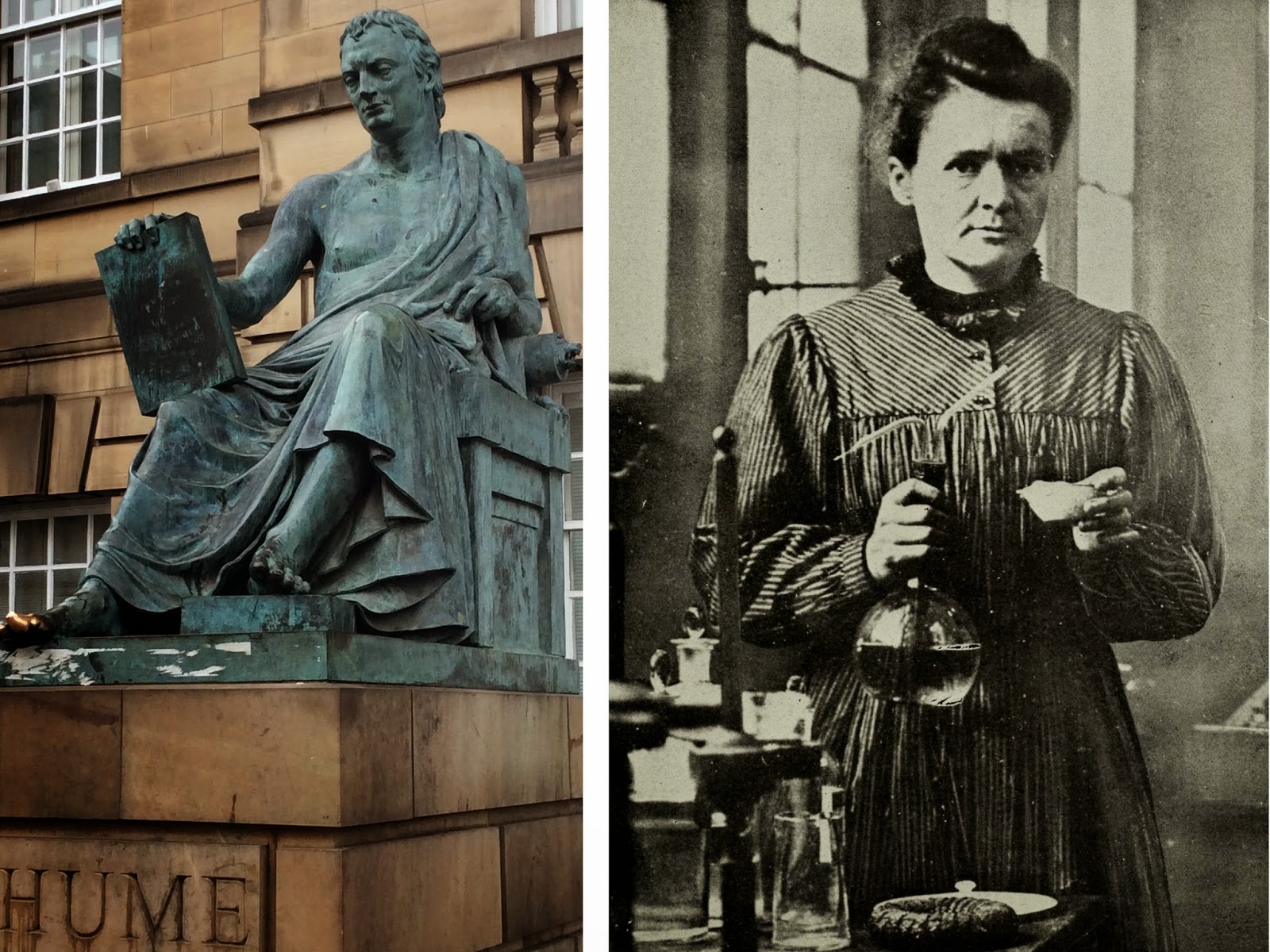
I’m thrilled to share the news with you that I’ll be resuming my formal education at the University of Edinburgh this fall. What an adventure this will be! I’ll be living and studying in the center of the Scottish Enlightenment and the city of David Hume. He brought me here three years ago when I followed his life and ideas for my first history of ideas travel series. I’ll take this opportunity continue my Hume series as well. Though my studies will demand a great deal of my energy and attention, I dearly hope I’ll be able to devote more time to share more with you here at Ordinary Philosophy, not less, as I once again pour the bulk of my time, energy, and love into the world of ideas.

Yours, as ever, Amy Cools

Ordinary Philosophy and its Traveling Philosophy / History of Ideas series is a labor of love and ad-free, supported by patrons and readers like you. Please offer your support today!

Selfie in the beautiful Rose Room of the New York Public Library, 2016 Amy Cools

In the beautiful Rose Room of the New York Public Library. Thank you, friends, for supporting my New York projects too! Ahhh, what a town…

Raconteur Street Blues, by East Street Prophet

Painting on a wall, photo by East Street Prophet at 518 Song of My People

I grew up around some of the great narcissists of our time. History won’t remember them, so I have to. They were great storytellers, who forged a knack for survival into an unequivocal hunger to live like kings. They spoke of riches and wealth that they couldn’t have possibly known, yet painted a picture so alluring we had no choice but to believe. They were raconteurs, wizards possessed of a singular illusion that painted the world in their image and presented it to us, as if it were ours.

A Raconteur is a person who excels in telling anecdotes. Also, an anecdote (Please note: I don’t want to insult anyone’s intelligence. I mean to provide clarity.) is a usually short narrative of an interesting, amusing, or biographical incident. A raconteur is a great storyteller. I’ve always considered the word to be closer to ‘being a good bullshitter’, which is worth its weight in gold. Anyone can tell a story, but getting people to care is a miracle akin to walking on water.

Storytellers are plentiful. You can see them in coffee shops behind laptops, biding their time until they have a chance to share, connect and separate. It’s in that singular moment, where we connect, that things change. They can become dangerous in a moment’s notice, as they infect your mind with complex riddles that the storytellers have been working on since the dawn of time. You might wonder, ‘why would a person share such a riddle?’ you can’t think like that. It’s how any good storyteller wants you to think. They want you to assume they have no reason to hurt you. There’s no harm in believing what they believe. There’s no harm in believing them without question.

The thing that all decent ‘raconteurs’ must ask themselves periodically is ‘do I care more about myself than I do the story?’ I’ve lived among some of the great bullshitters of modern history. We heard plenty of stories growing up, yet so few of them added up in a way that it could make me care. The raconteurs possessed this trait that added depth to their stories, not just with what images they infused, but with how they made us feel. We felt involved. They tugged on our heartstrings and moved us toward an end that we couldn’t see. They possessed our future, as we waited for these mindless heathens to comb through the vast wasteland of their psyches in search of an end to whatever narrative they were painting.

Any good story comes from a single point. It’s not the beginning. It’s just a point. They wanted to make a point. They’d lie about having sex, so they’d present a narrative that made the possibility of them having sex seem possible. They’d plant a few mental images here and there, forming past and future around this premise. Ultimately, their goal was to forge a real, however unlikely, narrative, in order to make us believe.

The raconteurs believed what they said. The proof was in their words. They told us to take it from there, because taking a man at his word is as good as taking it in blood… at least when you’re a child. When we were kids we lied and it helped. We had impossible things to accomplish in a collapsing world full of poverty and the imminent threat of some incomprehensible bullshit. We had to hide sensitive information from our parents, while taking advantage of our God-like inertia, limitless energy and simple-mindedness. We had to prove to other kids that we were cool, while, at the same time, making our parents think we’d never do the cool things that get you into trouble. It added to our personal mystique, having accomplished nothing, we needed something to set us apart. We’d lie about drinking and drugs, losing our virginity, feats of the utmost stupidity… you know… harmless bullshit.

Truth is the trickiest thing. Everyone says they want it, but when it’s not something they agree with they have a reaction that makes you wonder. Truth. It’s a funny thing, because I could write out the truth as I see it and (hopefully) half of you would love me and the other would hate me. The trick for any good raconteur is understanding the right formula, while having as full an understanding as you can of the truth. I believe that you can’t write a decent story, even if it sounds like nonsense, without a sense of truth. It has to be written, spoken and lived with conviction. Truth has to appear in every word, exactly as you’ve seen it, while managing not to conflict with the truth, as it is. You should, as a good storyteller, align yourself with the truth in order to make your narrative more honest and compelling.

I never thought about truth when I was young enough to fall for these stories. The morality of lying, as one presents it to himself, so that he might further his ends, has become all the more staggering as I’ve reached adulthood. I’ve been trying to think of the right way to word this question. I doubt it’s perfect, but it needs to be asked. I’m curious as to what everyone believes:

Can you have a moral premise without any evidence?

Some raconteurs have no regard for the truth. In all honesty, as a kid I didn’t care. I was surrounded by some of the greatest storytellers of my time. I couldn’t be bothered to figure out how some of these impossible stories could be real. I believed with all my heart, because I was a stupid kid who still believed in Santa. (FYI I believed in ghosts for longer than I believed in Santa, but I also assumed the ghosts would grant a wish or needed my help or whatever.) These are men who have learned to lie in a way that ‘everyone believes that you believe what you say’. You believe them, no matter the evidence to the contrary, because they, not their narrative, hold up well against the barrage of truth that assaults them on all sides.

They’re not not-sympathetic characters. Their truth is a depressing harangue of emotion and pain that most couldn’t understand. What’s worse, they keep it to themselves. They keep it! They hide all that pain and suffering, but even more, they hide the truth! They move with such intent when they tell their stories, as if revealing a deeper, more significant wisdom, while simultaneously hiding it from the world. It’s in their emphatic gestures, their movements, as if their bodies shift depending on the tone of their narratives, not to mention their eyes… it’s in all these things that those of us who were forced to listen HAD to believe.

We believed it all the more, because we lived it. They borrowed from our lives and, in this way, we added to the false narrative. Storytelling is a necessary skill. It made us feel good in a time where people were laughing at us, because our river was full of poison and visitors had no reason to… visit. The pain of being alive could’ve shown itself in crime and self abuse. For us, it showed itself in acceptance of nonsensical bullshit and downright lies.

Near-possible realities were a simple narrative that captured our attention, which begs the question: why do they need our attention? Evil raconteurs are like evil yogis. You can assume they don’t exist, as if there is no darkness when there is also light, but this is another simple narrative that’s easy to digest. The simple narrative is used to ensnare. You don’t need to talk about angels to be a good raconteur. You have to make people believe. This is that much more significant. You MAKE people believe. You take them on a journey, where they start out as a skeptic and then, through a few twists and turns… holy shit… you just made someone believe in angels.

(Also, if you don’t make them believe, you at least allow them to suspend reality for a time, which is kinda the same, although I admit there are differences.)

Making people believe and sharing with them a deeply personal truth is about as different as water and oil.

For what it’s worth, they thought they were kings, but that never stopped them from fighting to become that oh-so-desirable, and unquestioned ruler of the universe. They lied and stole and fought, but the stories to me became all the more touching. These people, the Raconteurs, were at war with themselves, as well as the truth and as well as a circumstance of poverty and extreme depravity, which was plentiful, in our ever-collapsing society. They fought for freedom: the freedom to be as insane and harmful to oneself as you can get. They fought to make the world a weird place.

Originally published at 518 – Song of My People

East Street Prophet 518 writes beautifully about hometown Rensselaer, just across the Hudson River from Albany, NY, and their experiences within the 518 area code: Albany, Rensselaer, and Troy, and various outlying places as well. They’ve been having a lot of fun with it and creating a bit of ‘folklore’ from local stories at 518 – Song of My People

~ Ordinary Philosophy is a labor of love and ad-free, supported by patrons and readers like you. Any support you can offer will be deeply appreciated!

*All views and opinions expressed by guest writers are their own and do not necessarily reflect those of Ordinary Philosophy’s editors and publishers

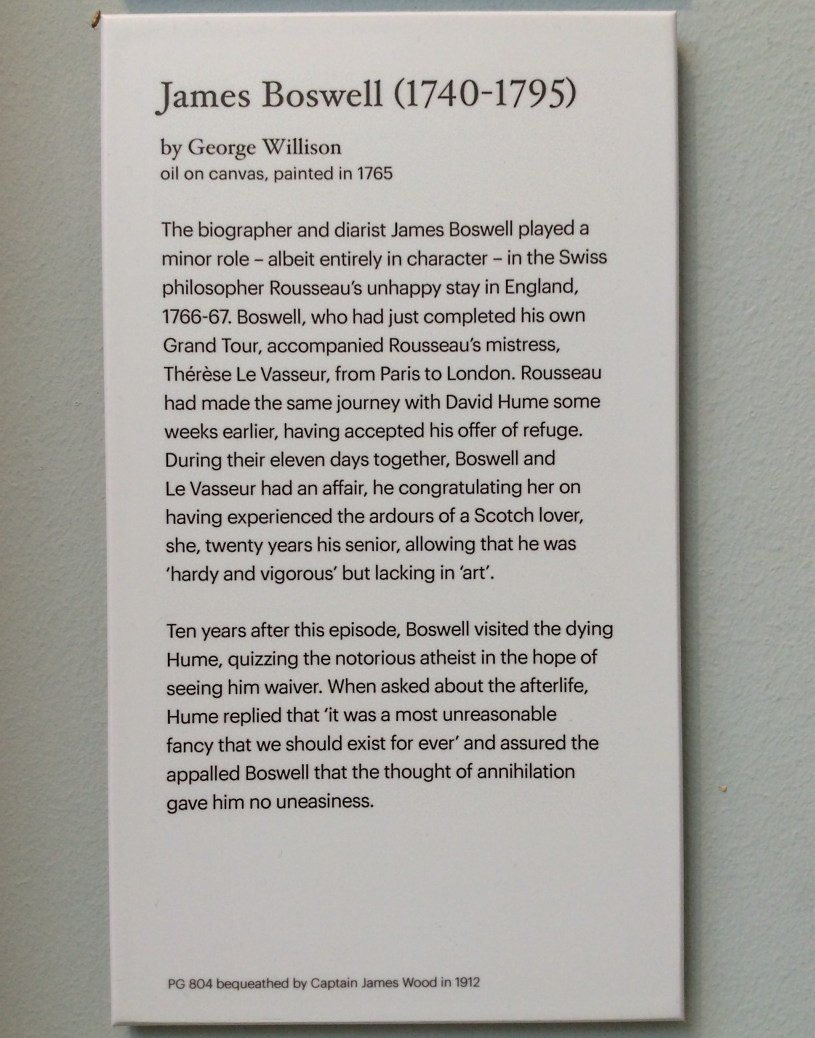
Photobook: Portrait of James Boswell, National Portrait Gallery, Edinburgh

James Boswell portrait in the National Portrait Gallery, Edinburgh, 2014 Amy Cools

James Boswell portrait in the National Portrait Gallery, Edinburgh, Scotland. Boswell’s diary of Samuel Johnson has been called the greatest biography in the English language. I visited this portrait during my journey to Edinburgh in 2014 following the life and ideas of David Hume, my favorite philosopher, if I had to name just one. Boswell sat at the bedside of the dying Hume and marveled at his composure in the face of suffering and death.


Ordinary Philosophy and its Traveling Philosophy / History of Ideas series is a labor of love and ad-free, supported by patrons and readers like you. Please offer your support today!

O.P. Recommends: Hi-Phi Nation Podcast by Barry Lam

A few weeks ago, I discovered this oh-so-enjoyable philosophy podcast, one right up my alley and the alley of anyone who loves philosophy in the public square. It’s called Hi-Phi Nation, ‘a philosophy podcast that turns stories into ideas.’

Created by Barry Lam, its mission is to demonstrate the revelatory power of philosophical thinking through its application to real-life situations, from what soldier-turned-philosopher Mike Robillard calls ‘moral exploitation’ in the military to what constitutes valid scientific inquiry, from the morality of wills and trusts (why should the wishes of the dead ever have priority over the interests of the living?) to what a certain musical subgenre reveals about the nature of art. The latter, in fact, is one of my personal favorite episodes, as philosophy and art are both central in my life.

The style of the podcast is closely modeled on This American Life and other story-driven podcasts. As Lam points out, people love stories, so if one wants to convey philosophical ideas to the public at large, especially complex or subtle ones, there’s no better way to do it than in the context of a good tale. For example, take morality: from Plato and his Republic and Ring of Gyges, to Jesus Christ and his parables, to Louisa May Alcott’s tales of the tribulations and joys of a progressive-minded family living through the Civil War, the most influential moral thinkers and teachers bring their ideas to comprehensible, identifiable, sympathetic life for their audiences.

There are two excellent articles about Lam and the show by Larry Hertz for Vassar Stories (of Vassar College, where Lam is an associate professor), and by Brett Tomlinson for Princeton Alumni Weekly.

Enjoy! I know you will…

~ Ordinary Philosophy is a labor of love and ad-free, supported by patrons and readers like you. Please offer your support today!

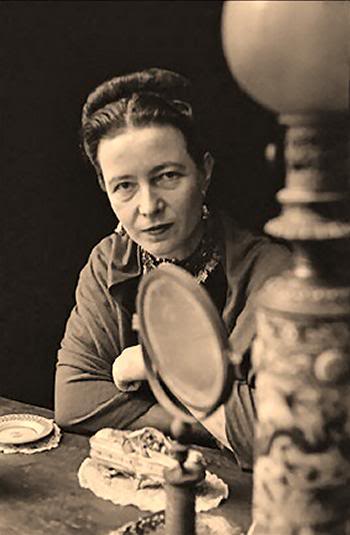
Simone de Beauvoir’s Political Philosophy Resonates Today, by Skye C Cleary

Simone de Beauvoir is rightly best known for declaring: ‘One is not born, but rather becomes, woman.’ A less well-known facet of her philosophy, particularly relevant today, is her political activism, a viewpoint that follows directly from her metaphysical stance on the self, namely that we have no fixed essences.

The existential maxim ‘existence precedes essence’ underpins de Beauvoir’s philosophy. For her, as for Jean-Paul Sartre, we are first thrown into the world and then create our being through our actions. While there are facts of our existence that we can’t choose, such as being born, who our parents were, and our genetic inheritance, we shouldn’t use our biology or history as excuses not to act. The existential goal is to be an agent, to take control over our life, actively transcending the facts of our existence by pursuing self-chosen goals.

It’s easy to find excuses not to act. So easy that many of us spend much of our lives doing so. Many of us believe that we don’t have free will – even as some neuroscientists are discovering that our conscious will can override our impulses. We tell ourselves that our vote won’t make any difference, instead of actively shaping the world in which we want to live. We point fingers at Facebook for facilitating fake news, instead of critically assessing what we’re reading and reposting. It’s not just lazy to push away responsibility in such ways, but it’s what de Beauvoir called a ‘moral fault’.

Since we’re all affected by politics, if we choose not to be involved in creating the conditions of our own lives this reduces us to what de Beauvoir called ‘absurd vegetation’. It’s tantamount to rejecting existence. We must take a side. The problem is, it’s not always clear which side we ought to choose. Even de Beauvoir failed to navigate through this question safely. She adopted questionable political stances: she once, for example, dismissed Chairman Mao – responsible for the murder of over 45 million people – as being ‘no more dictatorial’ than Franklin D Roosevelt. De Beauvoir’s philosophy of political commitment has a dark side, and she personally made some grave errors of judgement, yet within her philosophy, there’s an opening to address this issue.

In The Ethics of Ambiguity (1947) she argues that to be free is to be able to stretch ourselves into an open future full of possibilities. Having this kind of freedom may be dizzying, but it doesn’t mean we get to do whatever we like. We share the earth, and have concern for one another; if we respect freedom for ourselves, then we should respect it for others, too. Using our freedom to exploit and oppress others, or to support the side that promotes such policies, is inconsistent with this radical existential freedom.

With oppressive regimes, de Beauvoir acknowledged that individuals usually pay a high price for standing up to dictators and the tyranny of the majority, but demonstrated concretely – through her writing and political engagement – the power of collective action to bring about structural change. An intellectual vigilante, de Beauvoir used her pen as a weapon, breaking down gendered stereotypes and challenging laws that prohibited women from having control over their own bodies. She authored and signed the Manifesto of the 343 in 1971, which paved the way for birth control and abortion in France. Her most famous work, The Second Sex (1949), sparked a new wave of feminism across the world.

Today more than ever it’s vital to recognise that freedom can’t be assumed. Some of the freedoms that de Beauvoir fought so hard for in the mid-20th century have since come under threat. De Beauvoir warns that we should expect appeals to ‘nature’ and ‘utility’ to be used as justifications for restrictions on our freedom. And she has been proved correct. For example, the argument that Donald Trump and others have used that pregnancy is inconvenient for businesses is an implicit way of communicating the view that it is natural and economical for women to be baby-making machines while men work. However, de Beauvoir points out ‘anatomy and hormones never define anything but a situation’, and making birth control, abortion, and parental leave unavailable closes down men’s and women’s ability to reach beyond their given situations, reinforcing stereotypical roles that keep women chained to unpaid home labour and men on a treadmill of paid labour.

In times of political turmoil, one may feel overwhelmed with anxiety and can even be tempted with Sartre to think that ‘hell is other people’. De Beauvoir encourages us to consider that others also give us the world because they infuse it with meaning: we can only make sense of ourselves in relation to others, and can only make sense of the world around us by understanding others’ goals. We strive to understand our differences and to embrace the tension between us. World peace is a stretch, since we don’t all choose the same goals, but we can still look for ways to create solidarities – such as by working to agitate authoritarians, to revolt against tyrants, to amplify marginalised voices – to abolish oppression. Persistence is essential since, as de Beauvoir says, ‘One’s life has value so long as one attributes value to the life of others, by means of love, friendship, indignation and compassion.’ De Beauvoir is surely right that this is the risk, the anguish, and the beauty of human existence.Aeon counter – do not remove

Skye C Cleary is a lecturer at Columbia University, the City College of New York, and Barnard College, and is the managing editor of the American Philosophical Association’s blog. Her latest book is Existentialism and Romantic Love (bio credit: Aeon)

This article was originally published at Aeon and has been republished under Creative Commons.

~ Ordinary Philosophy is a labor of love and ad-free, supported by patrons and readers like you. Any support you can offer will be deeply appreciated!

*All views and opinions expressed by guest writers are their own and do not necessarily reflect those of Ordinary Philosophy’s editors and publishers

In Memory of Hypatia of Alexandria

Detail of the death portrait of a wealthy woman, c. 160-170 AD near modern-day Er-Rubayat in the Fayum, public domain via Wikimedia CommonsHypatia’s birthday is somewhere between 350 and 370 AD; a range of dates indicating great uncertainty, to be sure, but original sources that old are hard to come by, especially from a city as turbulent and violence-torn as the Alexandria of her day. The day of her death is better known, sometime in March of 415 AD. Since the latter date is more precise, we’ll break with our birthday remembrance tradition here and celebrate the memory of Hypatia in the month of her tragic and violent death instead of on the date of her birth.

She was a mathematician, astronomer, teacher, and philosopher who wrote commentaries on important works in geometry and astronomy with her father Theon, likely contributing original work of her own. Hypatia was a Neoplatonist, a philosophy with mystical overtones which posits that everything derives its being from the One, an ultimately conscious yet nonmaterial, non-spacial entity which is the pure ideal of everything that is. She was a scholar and teacher in a field and in a male-dominated world, and historians from her day to ours emphasize her extraordinary talents and her femininity with a nearly equal mix of awe and bemusement.

So let us remember and honor Hypatia for her great contributions to human knowledge and to the history of women’s liberation, living proof that women are equals in intellect and courage.

And let us also remember her sad death as a cautionary tale against those who inflame popular sentiment to seize power for themselves. Hypatia met her death at the hands of a Christian mob caught up in the anti-pagan hysteria of the day; Alexandria itself was caught up in a power struggle between civic and religious authority. The mob of extremists who dragged Hypatia from her carriage, torture and kill her with roofing tiles, and defile her body are inspired by their partisanship with theocratic bishop Cyril to kill this pagan philosopher, this mathematician and astronomer (then often equated with sorcerer), this woman who dared teach men, this friend of Cyril’s rival Orestes, civic leader of Alexandria. According to Hypatia scholar Micheal Deakin, “Cyril was no party to this hideous deed, but it was the work of men whose passions he had originally called out. Had there been no [earlier such episodes], there would doubtless have been no murder of Hypatia.”

From a certain millionaire we all know* who rose to power whipping up populist support throughout his presidential race with extremist racial and religious rhetoric, back to Hypatia’s time and beyond, power-hungry opportunists plead innocence from the very violence they inspire. Yet it appears hard to justify that plea when reason and the lessons of history plainly reveal the nearly inevitable results of fomenting sectarian strife. Extremism in the defense of liberty or anything else is a vice** because of the way it drives away reason and sympathy, and after all, nothing is as liberty-destroying as mob violence and death.

* ‘What If Trump Wins?’ by Jeet Heer in New Republic, Nov 24, 2015

** in reference to the quote ‘Extremism in the defense of liberty is no vice’ from Barry Goldwater’s 1964 presidential nomination acceptance speech 

Read more about the great Hypatia of Alexandria:

Deakin, Michael.’Hypatia of Alexandria‘ from Ockham’s Razor radio program of Radio National of Australia (transcript), Sun August 3rd 1997. (click ‘Show’ across from ‘Transcript’)

O’Connor, J J and E F Robertson. ‘Hypatia of Alexandria‘, from the School of Mathematics and Statistics, University of St Andrews, Scotland website.

‘O’Neill, Tim. ‘“Agora” and Hypatia – Hollywood Strikes Again‘. Armarium Magnum blog, Wed May 20, 2009

Zielinski, Sarah. ‘Hypatia, Ancient Alexandria’s Great Female Scholar‘. Smithsonianmag.com, Mar 14, 2010.

…and about Neoplatonism

Wildberg, Christian, “Neoplatonism“, The Stanford Encyclopedia of Philosophy (Spring 2016 Edition), Edward N. Zalta (ed.)

~ Ordinary Philosophy is a labor of love and is ad-free, supported by patrons and readers like you. Please offer your support today!

~ A version of this piece was originally published here at Ordinary Philosophy one year ago

Q&A With Singer: A Philosopher On His Craft and Practicing it at Princeton, by Michael Hotchkiss

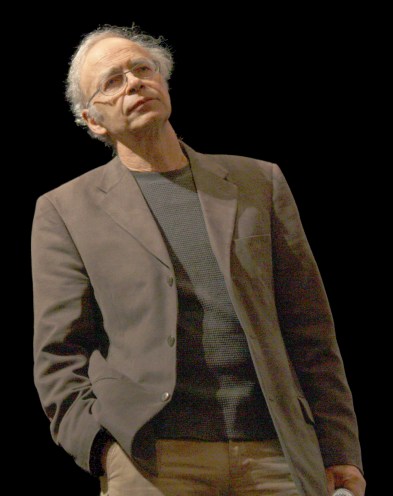
Peter Albert David Singer at The College of New Jersey in 2009, by Bbsrock, Creative Commons BY-SA 3.0 via Wikimedia Commons

Peter Albert David Singer at The College of New Jersey in 2009, by Bbsrock, Creative Commons BY-SA 3.0 via Wikimedia Commons

Peter Singer is one of the world’s best-known philosophers, recognized for his thought-provoking views on topics including animal rights, bioethics and the plight of the world’s poorest people.

Since 1999, he has been the Ira W. DeCamp Professor of Bioethics in the University Center for Human Values at Princeton University. He splits his time between Princeton and the University of Melbourne in his native Australia, where he is Laureate Professor.

Singer’s influential books include “Animal Liberation,” “Practical Ethics” and “Rethinking Life and Death.” His book “The Life You Can Save” challenges readers to help improve the lives of the world’s poorest people, and he is the co-founder of a nonprofit group by the same name that is devoted to effective philanthropy to serve people living in extreme poverty.

Singer also regularly writes brief essays on topics related to current events. A new book, “Ethics in the Real World,” compiles many of those essays with other reflections to explore, in an easily accessible form, some of the deepest philosophical questions.

Singer recently answered questions about his book, philosophy and teaching at Princeton.

~~~~~~~~~~~~~~~~~~~~~~~~~~~~~~~~~~~~~~~~~~~~~~~~~~~~~~~~~

Why do you write the kinds of brief, topical essays that are compiled in “Ethics in the Real World”?

Singer: I think it’s important to play a role in contributing to public debates and hopefully trying to improve the standard of those debates. In many areas of academic life — but perhaps particularly in ethics — there’s a lot of debate that goes on and a lot of it is to a rather low standard. If you can contribute to showing people how it’s possible to have reasoned discussion of ethical issues, I think it’s a valuable thing to do. A lot of people think ethics is all just subjective, a matter of taste. They think you can’t really say anything, therefore you might as well just abuse your opponents. I think there are other possibilities.

What does it mean to do philosophy?

Singer: I think doing philosophy really means learning to think more deeply and rigorously about hard questions that cannot be answered by straightforward empirical investigation. There are many things people think hard and rigorously about — physics, history or whatever it might be. In some of those fields you can answer questions by doing an experiment or finding the relevant documents. Generally speaking, you can’t run experiments to settle the kind of questions philosophers talk about. And you’re not going to turn up documents in some archive that are going to solve them either. So you have to think. The discipline of thinking, of recognizing good and bad arguments, of recognizing fallacies and where an argument is rigorous or where its weak points are, that’s something you can be trained in and can develop through practicing. That’s why we want people to do philosophy, to talk about it and write about it, not simply to learn what other philosophers of the past have said.

What does it mean to do philosophy at Princeton?

Singer: I think this is a great environment for doing philosophy, particularly for the area I work in, which is practical or applied ethics. Having the University Center for Human Values sitting alongside the philosophy department and the politics department produces a substantial body of people who are very good at discussing a range of practical and applied ethical questions. Plus, of course, we have really excellent students. For me, that’s one of the most rewarding things about being at Princeton. You get truly outstanding students who are very rewarding to teach, and that is just the undergraduate level. Many of them are also really enthusiastic about the role they are hoping to play in the world. When you get to the graduate level, you get yet another level of discussion. All of that makes a really exciting combination.

“‘Ethics in the Real World: 82 Brief Essays on Things That Matter’ by Peter Singer” book jacket

In his new book, Singer compiles brief essays on topics related to current events that explore some of the deepest philosophical questions. (Courtesy of Princeton University Press)

What are the most important tools you have at your disposal to engage people?

Singer: The primary tool is the ability to express ideas. As a teacher, you will mostly do that using your voice, speaking, though sometimes you will get students to read things. As a public intellectual, I’m much more likely to do that in writing. Being able to express yourself clearly is the most important tool for what I do. I’m grateful for my education in analytic philosophy at the University of Melbourne and Oxford because of the emphasis placed on clarity of expression. If something you said wasn’t clear, then it wasn’t good even though there might be some deep thing lurking there. You had to try to bring that out. It’s a contrast that exists to this day between most English language philosophy that comes out of that analytic tradition and that which comes out of what you might call a continental tradition, where clarity is not really prized and it seems to me at least that profundity is hinted at through ways of expression that might be clever but certainly aren’t clear.

The course description for your undergraduate class ‘Practical Ethics’ is full of questions: Should we be trying to live our lives so as to do the most good? Does a human embryo have a greater claim to protection than a chimpanzee? Should we be able to choose to end our own life, if we are terminally ill? Why do you take that approach?

Singer: I ask questions because I see the role of the course as challenging students to think about issues that otherwise they might not think about a great deal. I do not simply want to get them to absorb the truth, whatever the truth might be on these ethical questions. I certainly don’t want to encourage the idea of professors as authorities from which they just take statements and write them down. I want to challenge their way of thinking so they may come to see that what they’ve been thinking is superficial and they need to go deeper.

What are the questions you find your students engage with the most?

Singer: We have a lot of spirited discussions. Probably in recent years the two topics that have been most spirited have been questions about the treatment of animals and whether we ought to be eating them, and questions about global poverty and what we ought to do about that. Do we, as comfortably well-off people in an affluent nation, have an obligation to actually do something, to contribute some of our wealth to people to whom it can make a much bigger difference than it makes to us?

Many academics have critics, and you have your share. In the ‘Practical Ethics’ course, you assign a book called ‘Peter Singer Under Fire’ that features essays critiquing your views and your responses. Why do you bring your critics right into the classroom?

Singer: That book is listed because it has critical essays about me. And if students are going to get my views from me firsthand they need to have ways of pushing back and seeing what other people have said that is different. Those essays are specifically written to criticize Peter Singer’s views. A lot of the reading, not just the essays from that book, is opposed to what I think. There are a number of other books on the reading list that are written by people who have a very different perspective, people who differ from me. Those views do get represented in my courses, always.

Do you find a lot of students become really engaged with your ideas and pursue them further? What’s that like for you?

Singer: I find a significant number of students do become engaged and continue to live in ways that are influenced by some of the thoughts that maybe they started thinking in my classes or reading some of my works. In fact, one example just came up recently. It’s not the majority of students who become as engaged as that, of course, but a few individuals can have a very big impact on many people. I find that rewarding. I find it really encouraging when I discover my teaching has made a significant difference, changed someone’s life in some important way, perhaps, or just reinforced them in going down a path they were going down anyway. If that’s a positive path, as it is generally, I feel pleased because I have indirectly made a positive contribution to the world.

In the book, you mention that you learned from some of your students about the racist parts of Woodrow Wilson’s legacy. What else do you learn from your students?

Singer: I learn lots of things from my students. You get a range of people I would not ordinarily meet and get to talk with. You also learn a lot about the way young people think. I consider myself very fortunate to be always mixing with young people both in the classroom and out of the classroom because it keeps me fresh in terms of what’s going on in the world and what people are thinking about. I think it’s easy to be mixing mostly with people of your own age group and not really be aware of what 20-year-olds are likely to be thinking.

You came to Princeton from Australia in 1999. What have you taken from that experience?

Singer: It’s a pretty cosmopolitan campus, really. We have a lot of international students. We have other students who are immigrants or children of recent immigrants. I really value that. I think it’s tremendously important that we think about the world as a whole and that we be a truly cosmopolitan place. That connects with some of the essays in the book, which talk about how we should be thinking about the world, globalization, global poverty, what we should be doing about it. I value the “service of humanity” aspect of the University’s informal motto and the experience of Princeton because they point the way to getting beyond just a focus on the United States. When you come to the United States as I did, it’s one of the things you discover. Because you have come to a really big and important country, it’s natural that the media are going to be more focused on the United States here than the media would be on Australia in Australia, for example. Even having said that, I think the lack of attention on other parts of the world where America’s interests are not directly affected is something that’s pretty deplorable, and I think it’s important that universities try to counterbalance that by having international breadth and international understanding.

In one of the essays in your book, you describe the experience of learning to surf later in life. Why is that kind of experience important?

Singer: My experience with surfing shows that even if you think you might be too old to learn something new, that’s not necessarily going to be the case. Sure, you may never be really good at it. I’ll never be really good at surfing. But I can do it well enough to enjoy it and get a lot of satisfaction out of it. There is a lesson there for people at any stage of life: Don’t think things have passed you by. Obviously, objectively some things will have passed you by. I’m never going to become a footballer, but there are a lot more things that are still open as you go through life. More people are realizing that. You can change career directions later in life. If there’s something you want to do but you’ve thought it’s too late, think about it. Maybe it’s not.

Originally published in News At Princeton, at Princeton University’s website

~ Michael Hotchkiss, social sciences writer, went to Princeton in 2012 after seven years as an editor at The Wall Street Journal. He earned a bachelor’s degree in journalism from the University of Missouri in 2000 but really learned the ropes of writing and editing at Mississippi community newspapers… At Princeton, he develops news and editorial content about the teaching, research and service missions of the University, with a special emphasis on the social sciences. (Bio credit: Princeton University)

Ordinary Philosophy and its Traveling Philosophy / History of Ideas series is a labor of love and ad-free, supported by patrons and readers like you. Please offer your support today!

Happy Birthday, Jeremy Bentham!

Jeremy Bentham's Auto-Icon at University College London, 2003 by Michael Reeve, GNU Free Documentation License Version 1.2

Jeremy Bentham’s Auto-Icon at University College London, photo 2003 by Michael Reeve

Jeremy Bentham, the great English moral and legal philosopher born on February 15, 1748, was a very strange man. A brilliant one, but strange nonetheless. He was a precocious child and advanced in his studies very early, finding Westminster and Queen’s College at Oxford too easy and therefore rather boring. He was trained as a lawyer but decided not to practice law after hearing William Blackstone’s lectures. Blackstone’s treatise Commentaries on the Laws of England is still considered one of the most authoritative and foundational works on English law, so for a guy to consider them so flawed that he’d want to give up his career seems a bit… well, presumptuous. But he demonstrated his own great intellectual capacities through his lifetime of prolific writing, mostly on legal theory, moral philosophy, and social reform. In the end, he earned the right to a certain degree of arrogance.

Bentham is generally considered the father of utilitarianism, the moral philosophy which judges anything that can be judged as right or wrong, good or evil, according to how conducive it is to ‘the greatest happiness of the greatest number.’ Utilitarianism, then, is a type of consequentialism, which holds that a thing is right or wrong based on its consequent harms or benefits. Bentham did not invent the principles of utilitarianism; he discovered them in the writings of Cesare Beccaria (who authored the ‘greatest happiness’ axiom), David Hume, Claude Helvétius, and Joseph Priestley. But he spent a lifetime synthesizing these principles into a cohesive, fleshed-out moral philosophy founded on utility, whether a law or action increases or decreases pleasure or happiness. This principle can seem too subjective to apply to matters of law or public policy; after all, what makes one happy can make another less so, and how can we determine whether the happiness of one is greater, or more important, than the happiness of another? Bentham, careful and systematic in his approach to this as he was to everything else, devised his ‘Felicific Calculus’ to solve this problem. Bentham believed that pleasure, a natural phenomenon like everything else in the world, was likewise quantifiable. He hoped his method of assigning unitary measurements to pleasure, then determining their relative values through mathematics, was a way to make his moral philosophy practicable, conducive to real social reform.

To many, the idea that pleasure and happiness could be reduced to mathematical formulas seems very strange; some think he may have had Asperger’s syndrome or another cognitive feature that caused Bentham to view emotion with such scientific detachment. But as socially awkward as he and his ideas often were, his utilitarian philosophy led to him to some moral conclusions that we now consider extremely progressive and much more caring than those typical of his times. For example, he was an early proponent of racial equality, women’s rights, and animal rights. As to animal rights, just as for all classes of human beings, considering only the pleasure and pain of some sentient beings and not others when it comes to morals is unscientific and therefore unjustifiably biased. After all, animals, like all human beings, have feelings too, and their feelings are just as important to them as ours are to us. So, a moral system based on feelings must consider all equally important, so that one unit of pig happiness, for example, is just as morally significant as one unit of human happiness. The only correct way to balance them out in matters of morals and public policy is to apply the Felicific Calculus to determine how much pleasure or pain each experience in any given situation.

At the end of his long and productive life, the committed naturalist arranged to have his body publicly dissected, both for scientific inquiry and to provide an example to others; he believed that a perfectly good body should never go to waste and that everyone should donate their body to science. He also arranged to have his head and skeleton preserved, dressed in his clothes and stuffed to look as lifelike as possible, to be displayed in some public place. The preservation of Bentham’s head, with its glass eyes he had purchased some years before, left much to be desired; the expression it ended up with creeped people out. So his Auto-Icon, as he called it, sits today in its glass case at University College, London with a nice lifelike wax head in its place. His real head is safely stored away where students, prone to stealing over the years in a series of pranks, can no longer get to it.

Read more about the brilliant and eccentric Bentham at:

Jeremy Bentham – by James E. Crimmins for The Stanford Encyclopedia of Philosophy

Jeremy Bentham – University College London website

Jeremy Bentham on the Suffering of Non-Human AnimalsUtilitarianism.com

Ordinary Philosophy and its Traveling Philosophy / History of Ideas series is a labor of love and ad-free, supported by patrons and readers like you. Please offer your support today!

O.P. Recommends: Bettany Hughes At 5×15 – Socrates And The Good Life

One of my favorite historians, broadcasters, and speakers, Bettany Hughes, gives a wonderful talk here on Socrates. Enjoy!

~ Ordinary Philosophy is a labor of love and ad-free, supported by patrons and readers like you. Any support you can offer will be deeply appreciated!

*All views and opinions expressed by guest writers are their own and do not necessarily reflect those of Ordinary Philosophy’s editors and publishers

Science and Philosophy, a Beautiful Friendship: A Response to Michael Shermer

From the archives, two years ago…

Amy M Cools's avatarOrdinary Philosophy

There’s been some very public dig-taking between the science and philosophy camps lately. Lawrence KraussNeil DeGrasse TysonStephen Hawking, and other scientists are saying philosophy’s become irrelevant, little more than an esoteric old boy’s club. On the other hand, philosophers, theologians, politicians, and others criticize ‘scientism‘, the conviction that science, and only science, can and should be the ultimate source for all human knowledge; that all truth claims, that all ethical, metaphysical, and political beliefs, should not only be informed by or founded on, but entirely determined by, empirical evidence.

Michael Shermer’s article ‘A Moral Starting Point: How Science Can Inform Ethics‘ (Scientific American, February 2015) doesn’t dismiss philosophy so directly. He includes philosophy in a list of three other arenas of human thought, with religion and political theory, as those to which most people turn for answers in matters of right and…

View original post 3,485 more words