Civil Rights and Healthcare: Remembering Simkins v. Cone (1963), by Ezelle Sanford III

Dr. George Simkins, Jr.

Dr. George Simkins, Jr.

Upon her release from L. Richardson Memorial Hospital’s maternity ward in Greensboro, North Carolina, my grandmother, Ann Wilson Scales, walked a few short steps to her mother’s home with a small baby in hand. She had just given birth to my mother, La Tanya Wilson Sanford, in the city’s Black hospital. It was 1965. Unbeknownst to either of them, a small group of L. Richardson’s physicians, dentists, and patients had waged a quiet war against segregation two years earlier. The city was the site of arguably one of the more consequential yet little-known civil rights battles in American history. No, it was not the beginning of the student sit-in movement initiated by North Carolina A&T students in 1960. Rather, this small contingent fought in district and circuit courts to desegregate U.S. healthcare. At issue was where medical professionals could practice and where patients could access care: in the older, segregated L. Richardson Hospital, or in the newer, more modern (and better funded) Moses H. Cone Memorial Hospital.

In 1962, dentist George Simkins, Jr. unsuccessfully attempted to admit a patient to Moses H. Cone Memorial Hospital, one of two private white hospitals in the city supported by tax dollars. Combining his role as community dentist and President of the Greensboro chapter of the NAACP, Simkins initiated a class-action lawsuit against both Moses Cone and Wesley Long Community Hospitals. The NAACP’s Legal Defense Fund assisted in litigating the test case. Not only were African American patients barred from these institutions, Black physicians were barred from practicing there, even as both institutions received state and federal funds provided by the 1946 Hill-Burton Hospital Survey and Construction Act. Hill-Burton emerged from President Harry Truman’s failed healthcare reform and promised to rebuild and modernize the U.S. healthcare infrastructure. However, this program included a loophole where states that engaged in de jure racial segregation could use the money to build segregated facilities. Cone and Long Hospitals both benefitted from this program and its segregation loophole. This is not to say that segregated hospitals did not exist before the Hill-Burton Program, however; historian Vanessa Gamble chronicles the movement to establish Black hospitals from 1920–1945.

Initially, the district court of North Carolina sided with the defendant hospitals; however, the Fourth Circuit Court of Appeals (and later the United States Supreme Court, which refused to hear the case) deemed that the two hospitals’ policies of racial discrimination for both patient admissions and visiting physician staff privileges violated the fifth and fourteenth amendments of the Constitution.

Last September, the CEO of Cone Health Network, of which Moses Cone Memorial Hospital and Wesley Long Hospitals are now a part, issued a public apology to the last surviving plaintiff of the historic court ruling. Dr. Alvin Blount, 94, graciously accepted the long overdue apology from the health system, initiating local reflections on racial discrimination in healthcare. This is not the first apology issued to acknowledge the long-strained history of race and racism associated with medicine and healthcare. In May 1997, former President Bill Clinton formally apologized for the United States Public Health Service’s “Tuskegee Study of Untreated Syphilis in the Negro Male” (1932–1972). In 2008, the American Medical Association (AMA) officially apologized for its exclusion of Black physicians from membership, an important acknowledgment given that AMA membership became increasingly important for hospital admitting privileges, licensure, and broader steps in professional development. As historian Thomas Ward notes, until the AMA desegregated in 1968, Black physicians were barred from white hospitals and denied opportunities for continuing medical education, thereby justifying their own professional societies and medical schools. All of these apologies were too little, too late, and their legacies continue to influence healthcare to date.

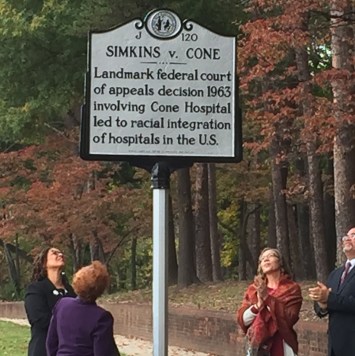
Historical marker for landmark decision of Simkin v. Cone, 1963

Historical marker for landmark decision of Simkin v. Cone, 1963

Cone Health commemorated the legacy of the Simkins decision by allocating $250,000 in scholarship funds for students pursuing healthcare professions. Guilford County commemorated the case by placing a marker outside Cone Hospital and a bronze statue of George Simkins on the grounds of the Guilford County Courthouse. These symbolic gestures speak to the case’s broad importance, defining Simkins not only as a significant battle for civil rights in medicine, but also as a touchstone moment in a much larger movement for freedom and liberation. Simkins was decided only months before the Civil Rights Act of 1964 was ratified; the Title VI of this act and Medicare funding forced the desegregation of healthcare facilities almost overnight, as historian David Barton Smith argues. In a short documentary produced by Cone Health, Dr. Blount recalled that the Simkins case “ended ‘separate but equal’ forever.”

Yet, the Simkins decision does not figure prominently in many popular renditions of civil rights history.1 Contrary to the aforementioned Clinton and AMA apologies, which received national attention, the Simkins apology did not move beyond the local media. In many of these local reflections, the Simkins case was likened to the historic 1954 Brown v. Board ruling. Though both cases ostensibly achieved similar ends, eliminating separate but equal institutions in education and healthcare, respectively, the comparison obscures more than it reveals. Even I am guilty of this shorthand, an easy way to communicate the gravity and significance of this decision. But this shorthand has the unintended effect of perpetuating Simkins’ invisibility.

History plays a role in why Brown lives on in the popular imaginary and Simkins does not. A majority of Americans interacted with both systems as they each cared for the nation’s most vulnerable: children and the infirm. Desegregating American education, however, was a very public battle, as images and video captured the Little Rock Nine or Dorothy Counts (who integrated my high school, Harding University High School in Charlotte, North Carolina) confronting inflamed white mobs. Brown was not simply waged in court; debates around school segregation seeped into American homes and into popular discourse. On the other hand, Dr. Blount remembered that the Simkins plaintiffs wanted to engage in a quiet challenge to segregated healthcare.2Although their fiscal independence allowed some physicians, like T. R. M. Howard, to jump to the fore of a broader movement, others sought to challenge their exclusion from the medical establishment in a more dignified manner.

While the Supreme Court heard Brown, it did not take the Simkins case. Until the Civil Rights Act months later, the lower Circuit Court’s ruling stood as jurisprudence only in the Fourth Circuit’s Mid-Atlantic region. Moreover, the two cases had distinct legal questions at their heart; Brown questioned the separate but equal doctrine established in 1896, while Simkins questioned whether public funding of private institutions counted as “state action.” Undoubtedly, Brown was an essential step leading to the Simkins decision. Without its challenge to the separate but equal doctrine, Simkins may have failed. Finally, the speed by which institutions in the fields of education and healthcare were desegregated differed dramatically. In the words of Chief Justice Earl Warren, school desegregation was ordered with “all deliberate speed,” while the Simkins case, combined with the Civil Rights Act and Medicare legislation, helped to desegregate many hospitals rather quickly. Political scientist and historian David Smith’s The Power to Heal: Civil Rights Medicare, and the Struggle to Transform America’s Healthcare System (2016) recovers this connection and situates health policy implementation in the broader movement for equality, employment, and rights.

Though the Simkins case is lauded for bringing about a swift end to segregation in healthcare, among other things, it led to the decline of Black community hospitals. While some, like Grady Memorial in Atlanta, successfully negotiated the new terrain of race relations, federal monies, power, and increased opportunities for Black medical students and doctors elsewhere, others like Homer G. Phillips Hospital of St. Louis and L. Richardson Hospital shuddered under the burden of increasing medical costs, lack of staff, and changing ideas around the importance of these institutions. In effect, Black hospitals were an anachronism in the post-Simkins era. Where some Black patients could, like my grandmother, walk to and from their community hospitals, such an action is almost inconceivable today given the large, distant campuses of many contemporary urban hospitals and medical centers.

Cone Health’s apology, though overdue, came at just the right moment. Dr. Alvin Blount passed away earlier this year, only months after his former legal foe recognized and applauded his pioneering work. The silences around the Simkins decision demonstrate that more work still needs to be done on our understanding of the history and legacy of Black liberation. Specifically, the nexus between civil rights and health remains fertile ground for scholarly inquiry. We must heed the warning of W. Montague Cobb, physician, anthropologist, editor, activist, and intellectual, “lest we forget.”

This piece was originally published at The African American Intellectual History Society (AAIHS) blog

Ezelle Sanford III is a fourth-year graduate student at Princeton University in the Department of History, Program in the History of Science. He is currently a Visiting Scholar in the Center for Humanities at Washington University in St. Louis working on his dissertation project, “A Source of Pride, a Vision of Progress: The Homer G. Phillips Hospital of St. Louis, MO.” (Bio credit: AAIHS)

~ Ordinary Philosophy is a labor of love and ad-free, supported by patrons and readers like you. Any support you can offer will be deeply appreciated!

*All views and opinions expressed by guest writers are their own and do not necessarily reflect those of Ordinary Philosophy’s editors and publishers

Happy Birthday, Jeremy Bentham!

Jeremy Bentham's Auto-Icon at University College London, 2003 by Michael Reeve, GNU Free Documentation License Version 1.2

Jeremy Bentham’s Auto-Icon at University College London, photo 2003 by Michael Reeve

Jeremy Bentham, the great English moral and legal philosopher born on February 15, 1748, was a very strange man. A brilliant one, but strange nonetheless. He was a precocious child and advanced in his studies very early, finding Westminster and Queen’s College at Oxford too easy and therefore rather boring. He was trained as a lawyer but decided not to practice law after hearing William Blackstone’s lectures. Blackstone’s treatise Commentaries on the Laws of England is still considered one of the most authoritative and foundational works on English law, so for a guy to consider them so flawed that he’d want to give up his career seems a bit… well, presumptuous. But he demonstrated his own great intellectual capacities through his lifetime of prolific writing, mostly on legal theory, moral philosophy, and social reform. In the end, he earned the right to a certain degree of arrogance.

Bentham is generally considered the father of utilitarianism, the moral philosophy which judges anything that can be judged as right or wrong, good or evil, according to how conducive it is to ‘the greatest happiness of the greatest number.’ Utilitarianism, then, is a type of consequentialism, which holds that a thing is right or wrong based on its consequent harms or benefits. Bentham did not invent the principles of utilitarianism; he discovered them in the writings of Cesare Beccaria (who authored the ‘greatest happiness’ axiom), David Hume, Claude Helvétius, and Joseph Priestley. But he spent a lifetime synthesizing these principles into a cohesive, fleshed-out moral philosophy founded on utility, whether a law or action increases or decreases pleasure or happiness. This principle can seem too subjective to apply to matters of law or public policy; after all, what makes one happy can make another less so, and how can we determine whether the happiness of one is greater, or more important, than the happiness of another? Bentham, careful and systematic in his approach to this as he was to everything else, devised his ‘Felicific Calculus’ to solve this problem. Bentham believed that pleasure, a natural phenomenon like everything else in the world, was likewise quantifiable. He hoped his method of assigning unitary measurements to pleasure, then determining their relative values through mathematics, was a way to make his moral philosophy practicable, conducive to real social reform.

To many, the idea that pleasure and happiness could be reduced to mathematical formulas seems very strange; some think he may have had Asperger’s syndrome or another cognitive feature that caused Bentham to view emotion with such scientific detachment. But as socially awkward as he and his ideas often were, his utilitarian philosophy led to him to some moral conclusions that we now consider extremely progressive and much more caring than those typical of his times. For example, he was an early proponent of racial equality, women’s rights, and animal rights. As to animal rights, just as for all classes of human beings, considering only the pleasure and pain of some sentient beings and not others when it comes to morals is unscientific and therefore unjustifiably biased. After all, animals, like all human beings, have feelings too, and their feelings are just as important to them as ours are to us. So, a moral system based on feelings must consider all equally important, so that one unit of pig happiness, for example, is just as morally significant as one unit of human happiness. The only correct way to balance them out in matters of morals and public policy is to apply the Felicific Calculus to determine how much pleasure or pain each experience in any given situation.

At the end of his long and productive life, the committed naturalist arranged to have his body publicly dissected, both for scientific inquiry and to provide an example to others; he believed that a perfectly good body should never go to waste and that everyone should donate their body to science. He also arranged to have his head and skeleton preserved, dressed in his clothes and stuffed to look as lifelike as possible, to be displayed in some public place. The preservation of Bentham’s head, with its glass eyes he had purchased some years before, left much to be desired; the expression it ended up with creeped people out. So his Auto-Icon, as he called it, sits today in its glass case at University College, London with a nice lifelike wax head in its place. His real head is safely stored away where students, prone to stealing over the years in a series of pranks, can no longer get to it.

Read more about the brilliant and eccentric Bentham at:

Jeremy Bentham – by James E. Crimmins for The Stanford Encyclopedia of Philosophy

Jeremy Bentham – University College London website

Jeremy Bentham on the Suffering of Non-Human AnimalsUtilitarianism.com

Ordinary Philosophy and its Traveling Philosophy / History of Ideas series is a labor of love and ad-free, supported by patrons and readers like you. Please offer your support today!

Margaret Sanger and Race

Dr Dorothy Ferebee - Planned Parenthood as a Public Health Measure for the Negro Race, speech for Birth Control Federation of America, 1942

Dr Dorothy Ferebee – Planned Parenthood as a Public Health Measure for the Negro Race, speech for Birth Control Federation of America, 1942

Since the earliest days of her birth control activism, Margaret Sanger has been often accused of being a racist, among other things. To many of her critics, her birth control advocacy must be understood as a nefarious plot to undermine human morals and decency, and any means of twisting her message to convey this are fair game. As I discuss in an earlier piece, a favored method of attack, which persists to this day, is to present a sentence or phrase of Sanger’s out of context to ‘prove’ her ‘true’ beliefs about people of other races. Her detractors even claim that she was on a genocidal mission to reduce or even exterminate black people, Jews, and other immigrant groups by destroying future generations. Never mind that Martin Luther King, Jr. praised her work on behalf of his beleaguered people. Never mind that she worked closely with civil rights leaders such as Mary McLeod Bethune and W.E.B. DuBois. Never mind that she opened clinics to serve black and other minority women because so many existing clinics refused to serve anyone but whites. Never mind that she wrote in 1944:

‘We must protect tomorrow’s Chinese baby and Hindu baby, English and Russian baby, Puerto Rican, Negro and white American babies who will stand side by side… to bring promise of a better future’.

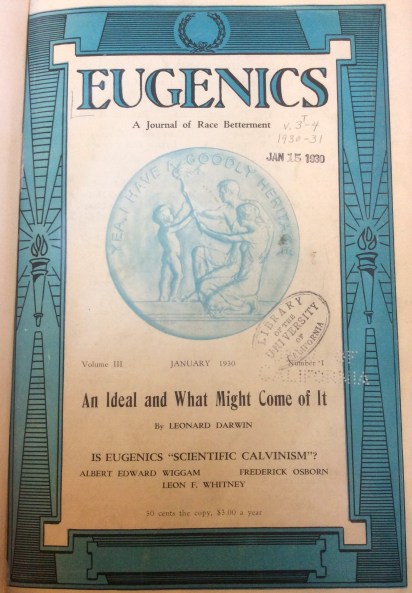
Eugenics journal, photo 2017 by Amy CoolsNow, as a eugenicist, Sanger did make herself an easy target for her accusers despite her decades of work with underserved and marginalized people, first as a nurse in the slums of the Lower East Side of New York City and then as a birth control pioneer. Eugenics, enthusiastically adopted by many who considered themselves scientific, progressive, and enlightened in the first half of the 20th century, is now recognized as pseudoscience, (mis)applying the evolutionary process of (unguided) natural selection to utopian social engineering theories. Eugenicists believed that the ills of humanity could be cured preemptively by breeding them out of existence while breeding in favor of ‘desirable’ traits. Despite the rosy vision of transforming humanity into the most vigorous, hyper-intelligent, and disease free race the world had ever seen, eugenics principles actually produced very ugly results when instituted as social policy. Here in the United States, government programs incarcerated mentally ill, disabled, and socially maladjusted people and forcibly sterilized them. Then the world’s most infamous eugenicists, the Nazis, took those principles to their most extreme logical conclusion, borrowing a page from the United States’ eugenics book in instituting the most horrific, murderous selective-breeding process the world has ever seen, inflicting untold and untellable quantities of human suffering and bloodshed.

Little wonder, then, that eugenics has a very bad name. Though the desire to reduce human suffering caused so many to embrace it, eugenics was based on a fundamental misunderstanding of Darwin’s great theory. Its proponents understood natural selection just well enough to appreciate its power for change but missed the greater point: the wide variety of human traits and capabilities is itself a long-evolved, complexly-balanced, and very very successful web of adaptations developed and attuned over hundreds of thousands of years. Human beings, necessarily self-centered and short-sighted, are very inept judges of trait selection in comparison with Nature itself.

Buck v Bell Virginia Historical Marker Q 28, Courtesy of Historical Collections, Claude Moore Health Sciences Library, University of VirginiaSanger, like many other eugenicists, was inconsistent in her attitudes about who should have children, when, and who should decide. Generally, she advocated for the right to self-determination in reproductive matters, calling for mass education and for cheap, reliable, widely available methods of birth control. In many instances, however, she advocated coercive sterilization for violent criminals and for those who she believed could not make this important decision for themselves, such as the mentally ill and cognitively disabled. She backed away from the latter, though, as the Nazis rose to power and instituted coercive, violent eugenics practices on a grand scale. Sanger was an early, ardent, and very vocal opponent of Nazism, and its policies alerted her to the problems of her short-sighted views on forced sterilization for anyone. As the logical-extreme beliefs of Nazism revealed, eugenics had its limits, and even the most non-coercive, most benign brands of eugenics were discarded by most of its former proponents over time.

But there are two other things Sanger was very consistent about.

One was her dismay at the sheer quantity of human suffering in the world and her desire to reduce it if she could. I find that oft-cited Sanger quotes, particularly from her book Woman and the New Race, refer to her observation that poor immigrants were especially likely to have more children than they could afford, and her claim that they were more likely therefore to produce ‘unfit’ children. ‘Unfit’, as Sanger described them, are those who are malnourished, diseased, undereducated, and in countless other ways ill-equipped to lead happy, flourishing lives. Yet, as is often the case with politically- and ideologically-motivated attacks, Sanger’s words are presented out of the context in which she wrote them, inspired by the plight of the immigrants she had in mind, mostly the Eastern Europeans she worked with in New York City’s Lower East Side. Before her time as a birth control activist, Sanger worked for them as a visiting nurse. As a Socialist activist and as a health care provider, she was driven by her special concern for the working poor that she observed were abused, often taken advantage of, in their desperation, by rapacious employers who offered them meager wages and terrible working conditions in exchange for backbreaking hours of miserable labor. These families were broken down from disease, hard labor, malnutrition, and, for the women, numerous pregnancies that often ended disastrously from these very health-destroying circumstances. One of Sanger’s most infamous quotes from Woman and the New Race, ‘The most merciful thing that the large family does to one of its infant members is to kill it’, so often used to ‘prove’ that Sanger was both racist and genocidal, is understood as a sarcastically-despairing remark when presented within the chapter in which it appears. That chapter describes the horror and suffering that preceded the all-too-frequent deaths of the immigrant poor, especially children and their mothers, and laments society’s lack of concern in preventing all this suffering and death. Even the next sentence alone will do: ‘The same factors which create the terrible infant mortality rate, and which swell the death rate of children between the ages of one and five, operate even more extensively to lower the health rate of the surviving members.’

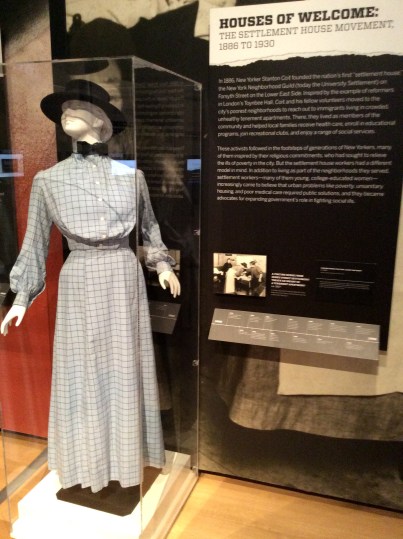
Nurse's uniform, ca. 1905, of Lilian Wald visiting service to the Lower East Side tenements of NYC

Nurse’s uniform, ca. 1905, of Lilian Wald visiting service to the Lower East Side tenements of NYC. Sanger would likely have worn an updated version of this uniform when she worked there in 1911

Second, Sanger believed all human beings should be given the same care and opportunities as everyone else. That’s why she opened her first birth control clinic in the racially diverse Brownsville neighborhood of Brooklyn in 1916, opened clinics to serve black and Latina women in Columbus Hill and Harlem neighborhoods in the late 1920’s and early 1930’s, and expanded her mission to help black communities in the American South in 1939. While there might be more than a shade of paternalism (maternalism?) in these efforts, her own writings, as well as the support of black civil rights leaders, demonstrate that her motives were, at least on the whole, motivated by her concern that justice be done for these underserved people.

As Sanger wrote to her friend Albert Lasker in 1939:

‘You are quite right in assuming that poor white people down South are not much better off than the Negroes, but there has been at least a start in several states to help the poor whites and as there is not sufficient time for a nurse, nor the material left over, for the Negroes, they are just left out of the service in most of the states. That is why I was anxious to have a special fund directed for the Negroes…’

Returning to Woman and the New Race, Sanger gave another reason why she was driven to improve lives in the disadvantaged communities she worked with and advocated for:

‘They would not be here if they did not bear within them the hardihood of pioneers, a courage of no mean order… And they have something else. The cell plasms of these peoples are freighted with the potentialities of the best in the Old World civilization. They come from lands rich in the traditions of courage, of art, music, letters, science, and philosophy… The immigrant brings the possibilities of all these things to our shores, but where is the opportunity to reproduce in the New World the cultures of the old? What opportunities have we given to these peoples to enrich our civilization? We have greeted them as “a lot of ignorant foreigners,” we have shouted at, bustled, and kicked them… What hope is there for racial progress in this human material, treated more carelessly and brutally than the cheapest factory product?’

In other words, America’s immigrants carry greatness in their very genetics, which our factories and farms have too often exploited, quashed, and wasted over the centuries by treating them as little more than wealth-generating fodder before kicking them to the curb or the ditch.

And in her article ‘Love or Babies: Must Negro Mothers Choose?’ Sanger wrote:

‘The Negro race has reached a place in its history when every possible effort should be made to have every Negro child count as a valuable contribution to the future of America. Negro parents, like all parents, must create the next generation from strength, not from weakness; from health, not from despair.’

Civil rights leader W.E.B. Dubois shared this view with Sanger: that if oppressed people were to overcome the social forces arrayed against them, they needed to forge their way from a position of strength: of health, of education, of increased wealth, and birth control was one of the ways to get there. And Sanger and DuBois both believed that they all could get there because they were just as capable of greatness as anyone else, given the same chances.

This doesn’t sound like racism to me.

*Listen to the podcast version here or on Google Play, or subscribe on iTunes

Ordinary Philosophy and its Traveling Philosophy / History of Ideas series is a labor of love and ad-free, supported by patrons and readers like you. Please offer your support today!

~~~~~~~~~~~~~~~~~~~~~~~~~~~~~~~~~~~

Sources and inspiration:

Another Look at Margaret Sanger and Race‘, Feb 23, 2012. From The Margaret Sanger Papers Project at NYU

Birth Control or Race Control? Sanger and the Negro Project‘ The Margaret Sanger Papers Project Newsletter #28 (Fall 2001)

Ferebee, Dorothy Boulding, d. 1980, “Speech by Dorothy Boulding Ferebee, M.D. entitled “Planned Parenthood as a Public Health Measure for the Negro Race,” January 29th, 1942,” Smith Libraries Exhibits

Margaret Sanger and the African American Community‘, compiled by Anna Holley, SisterSong Intern, July 2010, TrustBlackWomen.org

Marlin, George. ‘Margaret Sanger: “Abortion is Dangerous and Vicious”‘ Dec 14, 2011, The Catholic Thing blog

A Negro Number, June 1932 edition of Birth Control Review, by various authors.

Reed, Miriam. ‘Margaret Sanger: Correcting the False Narratives of Racism‘, June 30, 2016. Church and State

Sanger, Margaret, 1879-1966, “Letter from Margaret Sanger to Albert Lasker, November 12, 1939,” Smith Libraries Exhibits, Margaret Sanger Papers, Sophia Smith Collection.

Sanger, Margaret. ‘Love or Babies: Must Negro Mothers Choose?‘ Source: Negro Digest, August 1946, pp.3-8, via The Margaret Sanger Papers Project at NYU

Sanger, Margaret. ‘Population – Everybody’s Business,’ Published Article. Source: Tomorrow, 1944, pp. 16-18, Margaret Sanger Microfilm S72:0480, via The Margaret Sanger Papers Project at NYU

The Truth About Margaret Sanger‘, Blackgenocide.org

Happy Birthday, Thomas Paine!

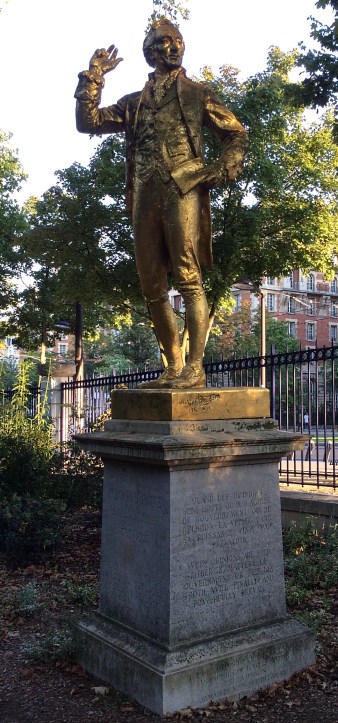
Statue of Thomas Paine by Gutzon Borglum, 1938, Parc Montsouris, Paris, photo 2015 by Amy Cools

Statue of Thomas Paine by Gutzon Borglum, 1938, Parc Montsouris, Paris, photo 2015 by Amy Cools

Let’s remember and salute the great Thomas Paine, father of our American identity, on his birthday. Born on January 29th, 1737, his great pamphlets made the case for American independence from Britain, outlined his Lockean conception of human rights, and argued for the primacy of reason in epistemology, politics, science, and theology. He’s a primary influence in my own concept of America as a bastion of liberty, of reason, of freedom of conscience, of the idea that property rights entail the obligation to share our wealth with those who lack what they need.

Here are a few links to some articles and works of art by, about, and inspired by Thomas Paine, including some of my own work.

Common Sense – Thomas Paine (1776)

The American Crisis – Thomas Paine (1776-83)

The Rights of Man – Thomas Paine (1791)

The Age of Reason – Thomas Paine (1794)

Agrarian Justice – Thomas Paine (1795-96)

Thomas Paine – from The Stanford Encyclopedia of Philosophy

To Paris, France I Go, In Search of Revolution-Era Thomas Paine, Mary Wollstonecraft, and Thomas Jefferson – history of ideas travel series in which I follow Thomas Paine’s life and ideas in the era of the French Revolution

Thomas Paine on Basic Income, and Why Welfare is Compatible with an Individualist Theory of Human Rights – my essay on how Paine’s ideas about property rights led him to advocate the unconditional allocation of public funds for the support of the young, the old, and the disabled

Pretty Pink Rose – David Bowie and Adrian Belew (1990) – ‘She tore down Paris on the tail of Tom Paine, but the left wing’s broken, the right’s insane’

As I Went Out One Morning – Bob Dylan (1968) ‘As I went out one morning to breathe the air around Tom Paine’s, I spied the fairest damsel that ever did walk in chains’

Tom Paine’s Bones – Graham Moore (1995) Recorded by Dick Gaughan in 2001. ‘Well they say I preached revolution but let me say in my defence, all I did wherever I went was to talk a lot of Common Sense’

Ordinary Philosophy and its Traveling Philosophy / History of Ideas series is a labor of love and ad-free, supported by patrons and readers like you. Please offer your support today!

The Right to Be Poor, by Peter Adamson

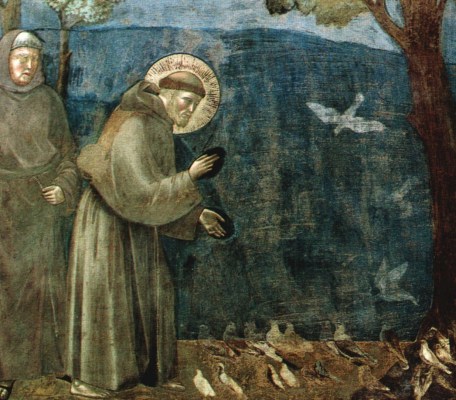
St Francis of Assisi by Giotto

St Francis of Assisi by Giotto

Peter Adamson just published a most fascinating and insightful essay in Philosophy Now about an aspect of the property rights debate that we rarely address: the right to own nothing. It’s an important question, especially in this culture of hyper-consumerism and the conviction that property ownership is essential to personal and political freedom. But as a certain innovative and humble friar realized in the early 13th century, property ownership can also be a burden, alienating us from one another and from the unencumbered pursuit of spiritual perfection. Perhaps Thomas Jefferson, when writing the Declaration of Independence, had a similar insight as St Francis of Assisi and his mendicants when he adapted John Locke’s principle of ‘life, liberty, and property’ as essential human rights as ‘life, liberty, and the pursuit of happiness’.

Adamson writes:

‘One of my favorite things about the history of philosophy is finding out that ideas we now take for granted originally emerged in surprising ways. I can think of no better example than the notion of a right to own property. Not that we can take it for granted that we have such a right, if we consider the history of communism in the Twentieth Century. Still, it seems such an obvious concept that it must surely always have been with us. But you can make a good case that it was first explicitly articulated in the later Middle Ages. And here’s the surprising part: the thinkers who first explored this notion were actually concerned with their right to own nothing.

They were members of the mendicant orders, especially the Franciscans. Following the example of their founder, Francis of Assisi, Franciscans argued that spiritual perfection requires the voluntary embrace of poverty. Like Blanche in A Streetcar Named Desire, they depended on the kindness of strangers, living on charitable donations. Hence the term ‘mendicant’, meaning, ‘given to begging’. Christ and his Apostles, the Franciscans argued, had shown the way by giving up all their possessions. Furthermore, ownership of property is a consequence of the Fall. In a state of innocence there would be no need for possessions, since by generosity of spirit all things would be shared. However, as well as an individual religious commitment, the embrace of poverty amounted to an implicit and sometimes explicit political critique, since the medieval church as an institution most certainly did not embrace poverty. The mendicants’ very existence was a rebuke to the opulence and worldliness of the papal court and the rest of the ecclesiastical hierarchy….’

Read the full article in Philosophy Now

Ordinary Philosophy and its Traveling Philosophy / History of Ideas series is a labor of love and ad-free, supported by patrons and readers like you. Please offer your support today!

Margaret Sanger NYC Sites, Day 4

Planned Parenthood Clinic at Margaret Sanger Square, Mott and Bleeker Streets, NYC

Planned Parenthood Margaret Sanger Center at Margaret Sanger Square, Mott and Bleeker Streets, NYC

Friday, October 21st, 2016

It’s cold and rainy, so I spend a long morning with my coffee as I do more research. Try as I might, I just can’t identify, with any certainty, the exact site of the Queens County Penitentiary, Long Island City, where Margaret Sanger was imprisoned for thirty days in 1917 for operating her Brownsville birth control clinic. Nor do I locate the site of the original White Plains Hospital where Sanger trained as a nurse. I had pored over the atlases of that town, from that time, in the New York Public Library map division, and I searched assiduously in their digitized records this morning. No luck.

So I finish my account of the first site I visited on Tuesday and publish it, then head out. It keeps raining, but oh well, it’s not a terribly long walk and besides, I welcome a walk in the rain, under my umbrella, of course. The drought back home had been mostly unrelenting for ages and it’s nice to experience a good rain again.

My first destination is Planned Parenthood’s Margaret Sanger Center at Mott and Bleecker Streets. The rain is really coming down and I’m fairly wet by the time I get here, so I hurriedly enter the lobby. Immediately, a man approaches me and asks what I’m looking for, while another man at the desk trains his eye on me. Not unfriendly, but alert. I explain my mission and present my driver’s license and business card. He makes a call upstairs to see if the director of the center has a moment to meet with me, but she’s heading out for a meeting. I ask if I can take a photo of the colorful mural on the lobby wall, but they say no: for security reasons, no photos are allowed inside the building. I express my understanding: after all, such establishments are under constant threats of terrorism and negative, often distorted and falsified media. I’m content with taking photos of the outside, and note the array of security cameras.

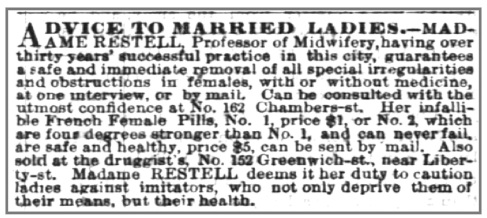
Advice to Married Ladies Madame Restell abortion ad in the New York Times, Nov 9th 1865

‘Advice to Married Ladies’, Madame Restell abortion ad in the New York Times, Nov 9th, 1865

New York City has a long history as a place where a woman can more readily obtain an abortion than just about anywhere else. In his detailed article on the subject, Robert Nizza wrote for New York magazine:

‘In many ways, the story of abortion in the United States is the story of abortion in New York. There were no laws against the procedure until the 1820s. Before that, British common law allowed abortions before “quickening,” or the moment when the fetus first moved. It was in New York in 1828 that America’s first real abortion law was passed. The debate of the day wasn’t driven by religious concerns about when life begins. Instead, as James C. Mohr’s classic history of the subject, Abortion in America, explains, Albany responded to pressure from doctors who were aghast at quacks’ butchering women and scamming them with phony abortifacient potions. The law was really about medical regulation, and, according to Mohr, it went completely unenforced.’

Sanger opposed abortion on the same health and safety grounds as the medical community Nizza refers to. We can only guess what her stance would be on abortion today, though based on her stated reasons for opposition to the practice as well as her refusal to condemn the women who sought abortions, I think her position would echo Bill Clinton’s: that abortion should be safe, legal, and through the ready availability of safe, legal, and affordable birth control, rare.

http://www.nyu.edu/pages/projects/sanger/articles/sanger_on_trial.php

The Pleasure Chest ‘Free Pleasure’ painted storefront window, New York City

I take the subway to my next destination, which is close enough so that I’d ordinarily walk but I don’t want to spend the day in soaking wet pants; I’m already very damp from my first long walk. On my way from the station, just around the corner from where I’m headed, I’m amused to see a sex shop storefront that’s vibrantly painted with the words ‘Free Pleasure’ surrounded by cartoon-like images of pleasure devices. It’s apropos to the birth control debate that I’ve been considering throughout this journey. Each side might find it illustrates their views: those who share Sanger’s view that sex and reproduction are not and should not be necessarily linked, and those that oppose all forms of artificial birth control on the grounds that they’re contrary to nature and to God’s will. The latter also find the idea of sex unmoored from reproduction repellent because they believe it will lead to irresponsible and extramarital sex, and corrode family values and ideals of sexual purity. They might interpret the colorful shop window as a negative demonstration of the cheapening of sex from permissive birth control laws and secular sexual mores. Sanger, like her fellow sex-positivists, believed instead that unmooring sex from reproduction leads to happier, more romantic and less stressful marriages, and to healthier and more prosperous families while providing a broader scope for women to enjoy and explore their sexual natures. They would likely interpret this painting as a positive demonstration of sexual freedom.

4 Perry St, Manhattan, New York City

4 Perry St, Manhattan, New York City

Just around the corner, I arrive at 4 Perry Street, where according to Robin Pokorski of NYU’s Mapping Margaret Sanger project, Sanger lived for a short while in 1914, between Waverly Place and Greenwich Ave in Greenwich Village. A couple of other sources mention this as well. Yet aside from brief statements of this fact in those secondary and tertiary sources, I’m unable to discover anything else about her time here with online research alone, including the exact stretch of time she lived here, but there’s plenty of readily available evidence that shows where Sanger lived elsewhere that same year. Sanger’s correspondence, both to and from, were addressed ’34 Post Ave’ from March to October of that year, and her journal The Woman Rebel directs all inquiries be sent there. She arrived in New York City from Paris in early January 1914. According to her autobiography, she rented the apartment on Post St ‘as soon as possible’ after she arrived, and she left New York for Europe again in late October to flee another obscenity trial for her Woman Rebel publications. That pretty much leaves January and February of 1914 as the time frame in which she could have lived here on Perry St. In these first two months of the year, she was reestablishing herself as an activist, now for birth control. As you many remember, she had just left her husband William behind in Paris to do so.

I duck into an inviting establishment right down the way on Greenwich Ave at Perry, lured by the promise of handmade meatballs and a tasty ale. This is my last day in NYC this trip, and I’m going to slow down and take it easier today. I write notes and linger over my meal, hoping the rain will stop. I like the rain, but it’s very difficult to take photos I require for this project since that requires both hands. I balance my umbrella over my head with the handle tucked under my arm, but it tends to flop over as I move to get the best shots. So I linger until the rainfall lightens, though it doesn’t really stop for awhile.

Carnegie Hall, Manhattan, New York City

Carnegie Hall, Manhattan, New York City

Margaret Sanger, Ethel Byrne, Carnegie Hall, New York Times Jan 29th, 1917, p 1

Margaret Sanger, Ethel Byrne, Carnegie Hall, The New York Times, Jan 29th, 1917, p 1. To see this article continued on p 3, click here

My next destination is another landmark I’ve been wanting to visit: Carnegie Hall. There are three particular Sanger-related occasions which bring me here to 881 Seventh Ave at 56th St.

On the afternoon of Jan 29th, 1917, there was a protest rally and mass meeting here at Carnegie Hall. Sanger’s sister Ethel Byrne had been sentenced to 30 days in jail the week before for running the Brownsville birth control clinic with Sanger. Sanger and nurse Fania Mandeil went on trial on the day of the Carnegie Hall protest; Sanger was certain she would be convicted and imprisoned, outcomes she did nothing to avoid. Byrne and Sanger were both determined to attract as much attention as possible to their cause, be it fame, notoriety, or otherwise. Byrne, tried, convicted, and imprisoned first, went on a hunger strike. She was forcibly fed after several days without food and water left her in terrible shape, even close to death. Sanger, initially supportive of her sister’s decision to hunger strike, changed her mind when she observed its awful toll on her health. She decided not to go on her own planned hunger strike after all, as she was determined to fight tirelessly for her cause. Instead, Sanger passed out copies of the first edition of the Birth Control Review to the attendees of the protest at Carnegie Hall, and announced to the press that there would be five hundred babies and their mothers present to demonstrate that their work was, in fact, pro-baby and pro-family. Sanger, Byrne, and Mandeil certainly had the support of very many mothers, as well as non-mothers, in the Brownsville community they served.

The New York Times published a transcript of the brief speech she delivered here that day. It goes:

‘I come to you tonight from a crowded courtroom, from a vortex of persecution. I come not from the stake at Salem, where women were burned for blasphemy, but from the shadow of Blackwell’s Island, where women are tortured for “obscenity.”

Birth control is the one means by which the working man shall find emancipation. I was one of eleven children. My mother died when I was 17 because she had had too many children and had worked herself to death. I became a nurse to help support my family, and I soon discovered that 75 per cent of the diseases of men and women are due to sex ignorance. I determined that when I was able I would do what I could to solve that problem. I found that the average person was as ignorant of sex matters as our most primitive ancestors. There has been progress in every department of our lives except in the most important–creation. So I came to the conclusion that the greatest good I could do was to help poor women to have fewer children to be brought up in want and poverty. I threw my nurse’s bag away and swore I would take it up no more. I went to Europe and studied the birth control clinics there and came back to America to do what I could.

Colonel Roosevelt goes all about the country telling people to have large families and he is neither arrested nor molested. But can he tell me why I got sixty-three letters in one week from poor mothers in Oyster Bay asking me for birth control information? No woman can call herself free until she can choose the time she will become a mother.

My purpose in life is to arouse sentiment for the repeal of the law, State and Federal. It is we women who have paid for the folly of this law, and it is up to us to repeal it. It is only by birth control that woman can prepare with man, her brother, for the emancipation of the race.’

Margaret Sanger and her son in Japan, 1922, public domain via Library of Congress

Margaret Sanger and her son Grant in Japan, 1922, public domain via Library of Congress

Some years later, on October 11th, 1922, the American Birth Control League hosted a ‘Welcome Back’ event for Sanger here. She had returned in August from a tour of Japan, Korea, China, Hong Kong, Egypt, Yemen, and London that year. She commenced her journey in Japan, setting sail in late February and arriving on March 10th. The Japanese government initially denied her a visa on the grounds that her birth control message was contrary to their official position: strong population growth was necessary for the military and political strength of Japan. But Sanger, ever energetic, and persuasive, forceful, and charming as the circumstances called for, bought passage on a ship bound for China via Japan. During the voyage, she finagled a way in, prevailing upon Japanese officials she met on board to use their influence to get her a visa. Upon arrival, she was welcomed by a large crowd of citizens, reporters, police, and other government officials, many welcoming but some not. In the end, she was able to speak, travel, and tour Japan’s fledgling community of birth control providers as planned, and continued in like vein throughout Asia. While in Japan, she stayed with Shidzue Ishimoto, a fellow feminist, activist, and proponent of birth control, and they would work together throughout the years. While on this world tour, she also attended the Fifth International Neo-Malthusian and Birth Control Conference at Kingsway Hall in London, from July 11th-14th.

Margaret Sanger, Dorothy Bocker, and Anne Kennedy

Margaret Sanger (center), Dorothy Bocker (right), and Anne Kennedy

Sanger also spoke at a birth control meeting held here at Carnegie Hall on December 6th, 1924, introducing many of her friends and fellow activists in the birth control movement. One of the speakers she introduced was her colleague Dr. Dorothy Bocker, who worked with her at the first iteration of the Birth Control Clinical Research Bureau, founded almost two years before. As Sanger often pointed out, much of the opposition to birth control stemmed from ignorance, especially on the part of the medical and scientific community. Strange as it may seem today, this ignorance was mostly born of squeamishness and a fear of offending prevailing views of sexual propriety. Now, we’d think of a physician or scientist’s interest in sex and reproduction as worthy examples of proper scientific and humanitarian interest, but this was rarely the case in Sanger’s time. So she decided that her second birth control clinic needed to be staffed by a licensed physician and that this physician would gather clinical data so thoroughly and systematically that it could be accepted as evidence by the medical and scientific community. Over time, Bocker and Sanger differed in their methods of evidence gathering sufficiently that, according to Sanger, she and Dr. Bocker ‘agreed to part company in December of the second year’, which is the very month this conference was held here at Carnegie Hall. Sanger pushed for far more rigorous record keeping and longer-term patient follow-up than Bocker was willing to undertake. However much they were disagreeing at the time of this Carnegie Hall meeting, Sanger introduced Dr. Bocker warmly, if succinctly. Dr. Hannah Stone, who was rounded up in the raid on the 46 W. 15th Street location in 1929, replaced Dr. Bocker as medical director early the next year.

353 W. 57th Street, formerly the American Women's Association Clubhouse, NYC

353 W. 57th Street, formerly the American Women’s Association Clubhouse, NYC

Margaret Sanger with H.G. Wells (right), 1920

Margaret Sanger with H.G. Wells (right) and Otis Skinner, 1920

I have one site left on my list to visit for my Margaret Sanger journey here in NYC: the former location of the American Women’s Association Clubhouse. There are two occasions which bring me here. The first is an event on November 12, 1931, when Sanger received the Medal of Achievement from the American Women’s Association. According to Pokorski of the Mapping Margaret Sanger project, Eleanor Roosevelt spoke at this event. Roosevelt was a supporter of birth control, and along with her husband Franklin, was a friend of Sanger’s. But when Franklin Roosevelt was running for the presidency and then, once he had won it, neither he nor Eleanor would publicly endorse birth control on the advice of his staff and political supporters. This AWA event was, then, was one of the last occasions where Eleanor would publicly endorse this movement until the Roosevelt presidency was far behind her.

Almost half a year later, on April 20, 1932, the AWA also gave a testimonial dinner here in Sanger’s honor. Sanger was deeply moved as so many of her friends and colleagues extolled her hard work and thanked her for it; her great friend and occasional lover H.G. Wells extolled her as ‘the greatest revolutionary bacteriologist the world has ever known.’

I have now completed this particular journey following the life and ideas of Margaret Sanger in New York City. But I am not done with her life and ideas by any means. Please stay tuned as I continued to explore her ideas and the ways in which they change the world! And thank you for accompanying me thus far…

*Listen to the podcast version here or on Google Play, or subscribe on iTunes

Ordinary Philosophy and its Traveling Philosophy / History of Ideas series is a labor of love and ad-free, supported by patrons and readers like you. Please offer your support today!

~~~~~~~~~~~~~~~~~~~~~~~~~~~

Sources and inspiration: 

Advice to Married Ladies‘, Madame Restell abortion ad in The New York Times, Nov 9th, 1865, via Newspapers.com

Bromley, G.W. and Co. Atlas of the Borough of Manhattan, City of New York. Desk and Library edition, 1916, Plate*** and Plate***. Retrieved from Lionel Pincus and Princess Firyal Map Division Digital Collection, The New York Public Library.

Buhle, Mari Jo. ‘Women & the Socialist PartyRadical America, Feb 1970, Vol, IV, 4F2, via National Progressive Review

Chesler, Ellen. Woman of Valor: Margaret Sanger and the Birth Control Movement in America. New York: Simon & Schuster, 1992

Engelman, Peter C., ““Dangerous Thoughts”? Margaret Sanger’s World Trip Journal, Japan, 1922” (2010). Documentary Editing: Journal of the Association for Documentary Editing (1979-2011). Paper 28.

Eig, Jonathan. The Birth of the Pill: How Four Crusaders Reinvented Sex and Launched a Revolution. W.W. Norton & Company, New York, 2014.

Gray, Christopher. ‘Streetscapes/The Henry Hudson Hotel, 353 West 57th Street; From Women’s Clubhouse to WNET to $75 a Night.’ The New York Times, Jan. 4, 1998

Lizza, Ryan. ‘The Abortion Capital of America: As the Pro-Life Movement Intensifies Nationwide, New York Contemplates its History and Future as a Refuge‘. New York magazine, June 2014

Margaret Sanger and Eleanor Roosevelt – The Burden of Public Life‘, The Margaret Sanger Papers Project Newsletter #11 (Winter 1995)

Margaret Sanger On Trial – Will Hunger Strike‘. The Day Book, Chicago, Jan 29, 1917, last edition, Image 29, via LOC’s Chronicling America

Moran Hajo, Cathy. ‘What Happened Next? A Look at Birth Control Organizing in China Following Margaret Sanger’s 1922 visit’. Jan 9, 2014, The Margaret Sanger Papers Project at NYU

Mrs. Byrne to Have a Feeding Schedule‘, The New York Times, Jan 29th 1917, pp 1, 3, via Newspapers.com

Pokorski, Robin. ‘Mapping Margaret Sanger‘ from The Margaret Sanger Papers Project at NYU

Sanger on Trial: The Brownsville Clinic Testimony‘. Newsletter #25 (Fall 2000) of The Margaret Sanger Papers Project at NYU

Sanger, Margaret. ‘American Women’s Association Testimonial Dinner Address,’ April 20th, 1932. Margaret Sanger Papers, L.O.C., LCM 128:0237B-243A, The Margaret Sanger Papers Project at NYU

Sanger, Margaret. ‘Carnegie Hall Address,’ Jan 29, 1917. Source: Mrs. Sanger Defies Courts Before 3,0000, New York Times, Jan. 30, 1917, via The Margaret Sanger Papers Project at NYU

Sanger, Margaret. ‘Individual and Family Aspects of Birth Control‘, Report of the Fifth International Neo-Malthusian and Birth Control Conference, July 11-14, 1922. From The Margaret Sanger Papers Project at NYU

Sanger, Margaret. Margaret Sanger, an Autobiography. Cooper Square Press: New York 1999, originally published by W.W. Norton & Co: New York, 1938

Sanger, Margaret. ‘Opening Remarks at Carnegie Hall Meeting‘, Dec 6th, 1924. Source: Margaret Sanger Papers, Library of Congress, Microfilm 130:701, via The Margaret Sanger Papers Project at NYU

Sanger, Margaret. The Pivot of Civilization, 1922. Free online version courtesy of Project Gutenberg, 2008, 2013

Sanger, Margaret. Woman and the New Race, 1920. Free online version courtesy of W. W. Norton & Company

Samples from The Margaret Sanger Papers Project for the Model Editions Partnership, eds. Esther Katz, Cathy Moran Hajo and Peter Engelman (Columbia, S.C.: Model Editions Partnership, 1999)

What Every Girl Should Know About Nursing‘. The Truth About Nursing, Oct 15, 2006

Margaret Sanger NYC Sites, Day 3 Part 2

24 Post Ave near Dyckman St, Inglewood, Manhattan, NYC, 2016 by Amy Cools

34 Post Ave near Dyckman St, Inglewood, Manhattan, NYC, 2016 by Amy Cools

Thursday, October 20th, 2016, continued

I exit the A train at the Dyckman St station, the second to the last stop on the line, and walk a couple of blocks to 34 Post Ave. Margaret Sanger moved into ‘an inexpensive little flat’ here in January of 1914 leaving her husband William, or Bill as she called him, behind in Paris. The Sangers had lived there for a few months as Sanger researched and wrote and William worked to establish himself as a painter. En route to Paris, they stopped in Glasgow, Scotland, so that Sanger could observe and write about the effects of municipal ownership, a system of public ownership often endorsed by Socialists, for a newspaper assignment. While in Paris, Sanger met with many socialists and activists, all the while researching French methods of contraception. But she was growing bored and restless, eager to get back to work and engage in activism once again. She and the three children returned to New York City around the New Year, leaving William behind to continue his artistic pursuits.
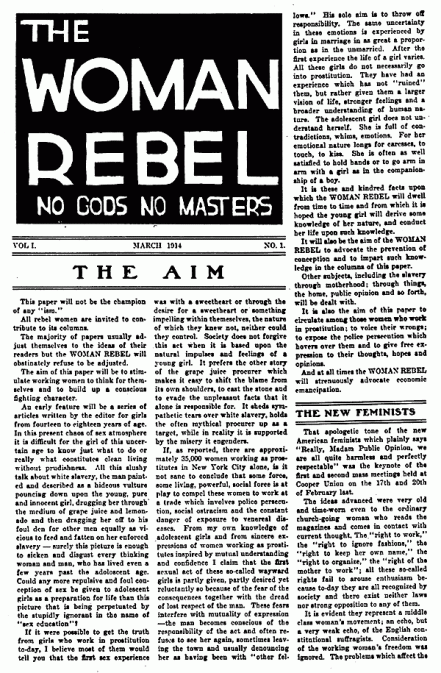
The Woman Rebel, First Edition, March 1914

The Woman Rebel, First Edition, March 1914, directed that inquiries be sent to Sanger’s 34 Post St address

The lady in the photo above, in the black and white checked jacket, is standing in the doorway of today’s number 34, but this building does not date to Sanger’s time here: it was built in 1920. Sanger’s apartment in the former building was small, cheap and according to Sanger, dingy. But big things would happen here. On the return voyage from Paris to New York City, she had conceived of a journal that was, as her biographer Ellen Chesler describes it, ‘dedicated to working women and intended to challenge Comstock’s prohibition of information about sexuality and contraception’. Sanger and a group of like-minded radical thinkers and activists launched The Woman Rebel from the kitchen table of that little apartment, publishing the first edition in March of 2014. One of those radicals, Otto Bobstein, invented the term ‘birth control’ which Sanger seized on and popularized, often claiming to have invented it. Perhaps she lied, or perhaps this is an example of one of those memories that longtime friends or siblings argue over, of a favorite term or phrase used often and long enough that no-one can remember who really came up with it first.

In a speech at Hotel Brevoort given a few years later on January 17th, 1917, Sanger agreed with the magazine’s critics that The Woman Rebel was ‘..badly written; …crude; …emotional, and hysterical; that it mixed issues; that is was defiant, and too radical. Well, to all of these indictments I plead guilty!’ She was proud nevertheless of the passion and sturdy defiance expressed in its pages. And what was printed on those pages led to her first indictment on obscenity charges, which drove her right back to Europe by the end of the same year she had returned and established this journal.

Apartment buildings which include 34 Post Ave near Dyckman St, NYC, 2016 by Amy Cools

Apartment buildings which include 34 Post Ave near Dyckman St, in Inwood, upper Manhattan. The row continues for most of the block, all identical, including the site of Ethyl Byrne’s place at 26 Post Ave.

A few doors west in the same apartment row of identical buildings, heading back towards Dyckman St and the subway station, is number 26 Post Ave. Sanger stayed here with her sister and fellow birth control activist Ethel Byrne for a time in 1915. Sanger’s daughter Peggy had died of pneumonia just a short time before on Nov 6th, 1915.
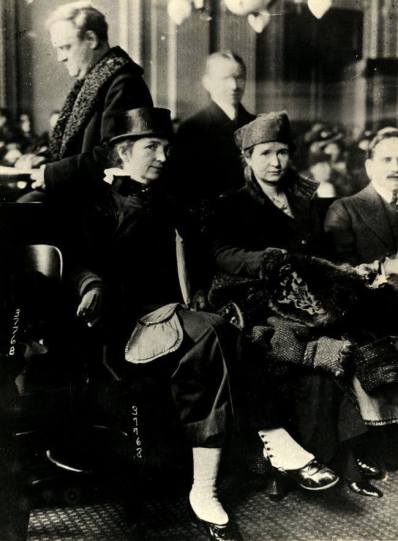
Margaret Sanger and Ethel Byrne in court, 1916, image public domain

Margaret Sanger, left, and Ethel Byrne, right, in court in 1916

Sanger and her sister Byrne enjoyed a close relationship in their early lives and into the nineteen-teens. Byrne, who left her husband and children to pursue her own nursing career, was very involved with Sanger’s early birth control activism. She had gone on a hunger strike when imprisoned for her own role in Sanger’s Brownsville clinic, to the point of seriously endangering her health. And Byrne had often helped care for Sanger’s children while Sanger was in exile in Europe and out of town as she was very frequently. However, their relationship deteriorated over later years. Byrne was a direct, no-frills woman who thrived on practical work and remained a nurse for the rest of her life; Sanger had given up nursing in favor of theory and activism. Byrne disapproved of Sanger’s solicitation of wealthy society women for the cause; Sanger was willing to accept help, connections, and most crucially, money, wherever they were offered. It seems easy to pick sides in this divide, and I’m tempted to take Sanger’s on the grounds that I think Frederick Douglass would, according to my understanding of his pragmatist views: to eschew practical and political concerns in favor of staying true to the highest ideals of a cause is to show a commitment to the ideals themselves and not necessarily to the cause’s success. This won’t do when it comes to the liberty, health, and very lives of actual human beings. But it also takes people such as Byrne to make a successful cause: the idealistic, uncompromising, hard workers who are driven to perform many of the most laborious, tedious, and thankless tasks. Here’s to you, Byrne, and all your hard work!

163rd St at Amsterdam. 503 163rd St. used to face where the bus is now. NYC, 2016 Amy Cools

163rd St at Amsterdam. 503 163rd St. used to face where the bus is now.

I take the A train back south a few stops to the station at 163rd and walk to 502 W. 163rd St at Amsterdam. According to Bromley’s Atlas of that same year, the building that once stood at 502 was on the north end of a wedge-shaped lot, now vacant, at the intersection of 163rd, Amsterdam, and St Nicholas Ave /Juan Pablo Duarte Blvd. This section of St Nicholas Ave is another busy section of the street, crowded with small shops, fruit and vegetable stands, and sidewalk vendors.

Sanger spoke at the Free Synagogue here on Sunday, April 22nd, 1923. Rabbi Louis A. Mischkind, a socially conscious, progressive, even radical religious leader, had invited Sanger to speak on birth control at the Tremont Temple. When his superiors objected, he moved the talk here to the Free Synagogue but was still demoted for his disobedience. Sanger’s Birth Control Review extolled his decision as an act of free speech heroism.
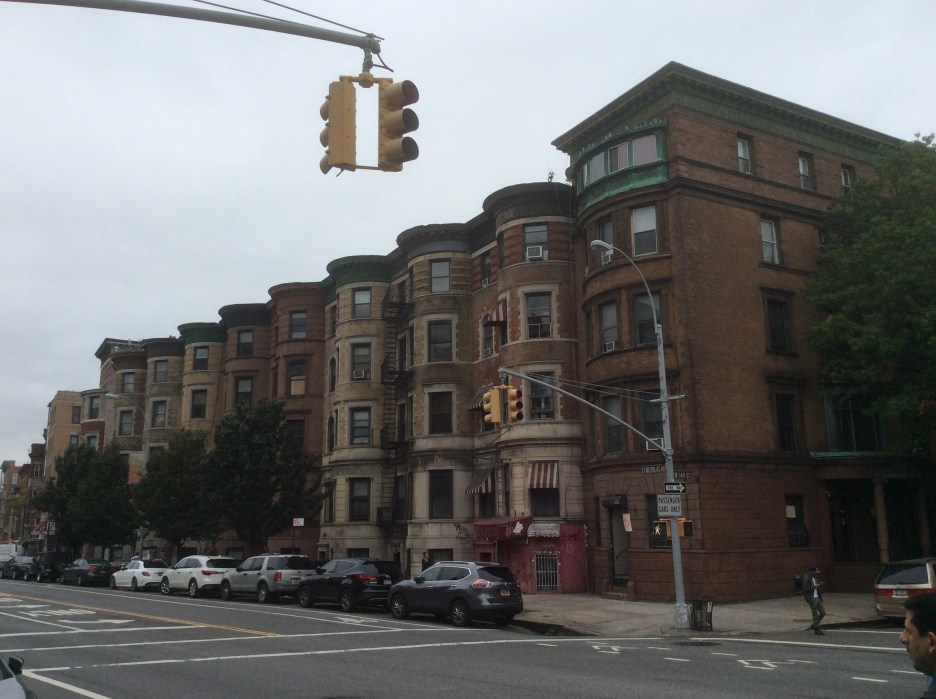
St. Nicholas Avenue at 149th Street, Broadbelt houses built in the late 1800's, NYC, 2016 by Amy Cools

St. Nicholas Avenue at 149th Street, Broadbelt houses built in the late 1800’s.
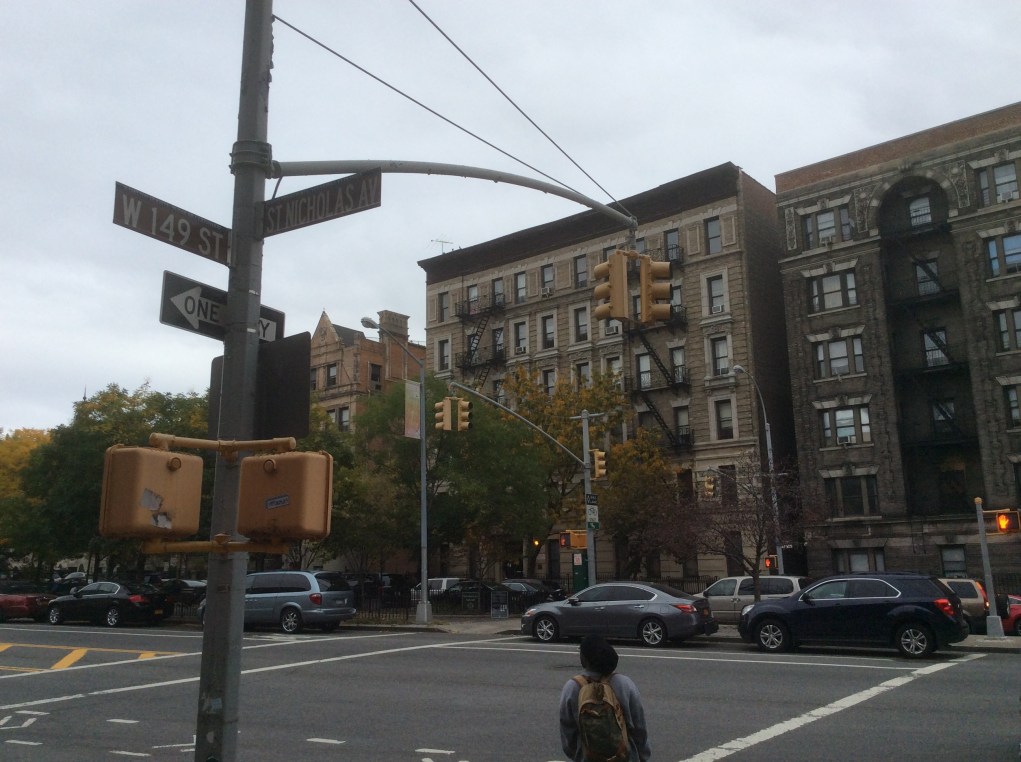
St Nicholas Avenue at 149th, more apartments which date to Sanger's time, NYC, 2016 Amy Cools

Apartments on St Nicholas Avenue at 149th, some of which date to Sanger’s time here or shortly after

Next, I walk a little over two-thirds of a mile south to where Sanger, newly wedded to William (she called him Bill), moved into a “practically suburban” “little apartment on St. Nicholas Avenue at 149th Street” shortly after their wedding on August 28th, 1902. As of the time I write this, I’ve found no exact address for their apartment here, just this little description she wrote in her autobiography. Their first son Stuart was born here on November 28th, 1903. The strain of his birth added to her general poor health, already worn out by a tough bout of her recurrent tuberculosis. She was also terribly despondent, with what her description indicates was post-partum depression. After she recuperated for some months in a farmhouse and a sanitarium, the couple moved to Hastings-on-Hudson. As we’ve seen, however, the suburban life did not suit the Sangers in the long run, especially Margaret, and they returned to New York City in 1910.

I continue south on St Nicholas, turn left on on 138th St, and go about two long blocks until I make a brief right on 7th Ave, also called Adam Clayton Powell Blvd. Here at 2352 7th Ave, Sanger opened the Harlem branch of the Birth Control Clinical Research Bureau on May 23, 1930. The BBCRB’s locations further south in Manhattan mainly served local women of European descent but Sanger believed that many other women needed the help of her clinics. She decided to open this northern branch to serve them.

On the right, 2352 7th Ave (Adam Clayton Powell) at 138th St, NYC, photo 2016 by Amy Cools

On the right, 2352 7th Ave (Adam Clayton Powell) at 138th St, NYC, the site of the Harlem branch BBCRB clinic

This clinic in Harlem was actually Sanger’s second attempt to open a clinic in New York for black and other underserved women; she had briefly opened one in west Midtown, in a small, predominantly black, impoverished neighborhood called Columbus Hill. I have not yet found an address for its former location. This first clinic was not a success and closed after only a few months; Sanger thought it would be best to conserve resources to open a clinic in a place where she might reach more people. She had the support of many black leaders throughout these efforts, including the influential Reverend Adam Clayton Powell of the Abyssinian Baptist Church (for whom this street has been renamed), Mary Bethune, and W. E. B. DuBois. DuBois spoke here on one occasion that fall, on November 21st, 1930.

Interestingly, a rumor that persists to this day, that Sanger’s efforts to provide reproductive services for black women were racist, may have originated with an intellectual and tactical foe of DuBois’. A Harlem preacher named Marcus Garvey believed that the black and white races could never get along and must be separated. He founded a shipping company called ‘The Black Star Line’ with the ultimate goal of taking all African descendants back to their home continent to found a racially pure black nation. To this end, he opposed all forms of contraception or childbirth limitation for black people: the nation of his dreams would need as many citizens as black women could bear to make it a vibrant and strong one. Garvey attacked Sanger’s clinics and all efforts to help black women control their fertility as genocidal projects. DuBois took the opposite view, believing that black people could and should live as equal citizens in the United States and wherever else they wanted to live, and that black families could better gain their rights as their financial and physical health improved through judiciously constrained childbearing. Of course, Sanger and DuBois were in agreement on this, as they were on matters of racial equality.

The Harlem clinic was more successful than the Columbus Hill one, but still only stayed open for about seven years. Though Sanger hired a black doctor and social worker to run the clinic, there was likely enough Garvey-inspired rumor and suspicion of their motives that the clinic not as widely welcomed as they hoped. No wonder, then, that she wrote that infamous line in a 1939 letter regarding her efforts to serve black women in the South: ‘We don’t want word to go out that we want to exterminate the Negro population…’ The ‘word’, untrue and unjustified as it was, had already ‘gone out’ for her Harlem clinic several years before.

Interior of 2352 7th Ave at 138th St, now CHA Upscale Salon, NYC, photo 2016 by Amy Cools

Interior of 2352 7th Ave at 138th St, now CHA Upscale Salon

There’s now a hair salon at the on the lower level of the Harlem clinic site called Cha, and I go in. I find myself in a shining, sparkling lobby filled with mirror-lined and white furniture, a rhinestone chandelier, and white lilies in rhinestone vases. It promises pampering, which sounds glorious to this footsore woman. I see no one for a moment, then a voice calls, ‘Can I help you?’ A few steps in takes me to another stylist’s both, where a woman with a flowing, waved, luxuriant ‘do’ was doing another woman’s hair. I very briefly explain that I’m doing a history project and ask if I can take a quick photo of her lobby. She says yes, kindly, but distracted, focused on her client. I don’t catch her name as I don’t want to interrupt her task any further, but if you happen to read this, hospitable lady, thank you! Your salon is so lovely and welcoming.

135 W. 135th St, between Malcolm X and Adam Powell Blvds, where Sanger and family lived in 1911, 2016 Amy Cools

135 W. 135th St, between Malcolm X and Adam Powell Blvds, where Sanger and family lived in 1911

I continue to make my way south and a little east to 135 W. 135th St, between Malcolm X and Adam Powell Blvds, where Sanger and her family lived in 1911. The year before, the Sangers returned to New York City. The house Bill had designed and built for them suffered a fire which damaged the house and destroyed many of the furnishings. The expenses of repairing the house and replacing their lost things severely damaged their already precarious finances. While the situation was stressful and Sanger was frustrated with her husband’s inability to make a steady, reliable income, she was also bored and frustrated with her quiet, domestic suburban life. Upon returning to urban life, Sanger resumed nursing and Bill got into politics; both became very active in the bohemian Socialist scene. As we’ve discovered, it was Sanger’s experiences in these years that most inspired her birth control cause, from her Socialist activism on behalf of New York City’s beleaguered working class to the struggles of the poor mothers and families in the largely immigrant slums of the Lower East Side.

Earl Hall at Columbia University, New York City, photo 2016 by Amy Cools

Earl Hall at Columbia University, New York City

As I head west on 135th St to the St Nicholas Ave station, I pass by a site I visited last time I was here: Ida Wells’ New York Age newspaper offices which published Wells’ groundbreaking Southern Horrors: Lynch Law in All Its Phases, and where Frederick Douglass likely met with her on at least onceI smile at the memory.

I enter the subway station where 135th St meets St. Nicholas Park and exit 116th, walking west across Morningside Park and up the hill to the Columbia University campus. It’s a beautiful walk; the park is lush and green, and the campus is an inspiring and lovely place, with broad lawns and elegant buildings in so many styles: Beaux-Arts, neo-classical, and Gothic Revival, to name a few.

Interior of Earl Hall, Columbia University New York, Amy Cools 2016

Interior of Earl Hall, Columbia University, NYC
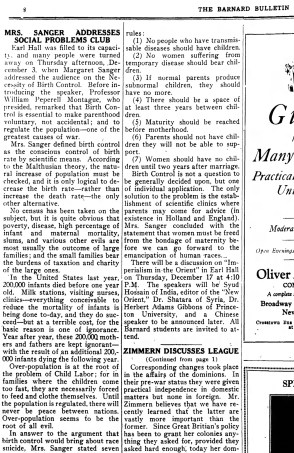
Sanger at Earl Hall, Barnard Bulletin, New York, Fri Dec 11, 1925

Newspaper account of Sanger’s talk at Earl Hall, from The Barnard Bulletin, New York, Fri Dec 11, 1925. Click to read a larger version.

I head to Earl Hall at 2980 Broadway, a little north of 116th St. On December 3rd, 1925, Sanger addressed the Social Problems Club here. She delivered her lecture ‘The Necessity of Birth Control’ at 4 pm to a packed house. According to the Columbia Daily Spectator, at this event, birth controlwas discussed for the first time on the Columbia Campus’. That is, at least officially. The necessity of birth control was outlined in terms of major social problems that club would likely have discussed frequently: infant and maternal mortality rates, disease, crowding, poverty, crime, and women’s rights. The Barnard Bulletin published a detailed outline of the talk and its main topics (see the image and link to the right).

I take an indirect route to my next destination a mile away via Amsterdam Ave so I can see the spectacular Cathedral of Saint John the Divine on my way; it’s south of Columbia University on the west wide of Morningside Park. The cathedral is as wonderful as it’s been described to me by so many. I add my recommendation to theirs to visit if you haven’t yet.

I continue east from the cathedral heading for 141 W. 111th St. The doorway and its stoop of the building I find here is flanked on either side by classical columns with ‘Kenosha’ spelled out overhead; the others in an identical row of four apartment buildings (though this is the only one whose ground floor is painted white) have porches which read ‘Manitou’, ‘Pacific’, and ‘Mariposa’. I’m unable to discover any particular reason why they’re named this way. According to the Municipal Archives division of the NYC Department of Records, in answer to my inquiry, building names ‘were typically applied by the building architect or owner based on what you might today call “marketing-strategy”‘.

Porch of the Kenosha building at 141 W. 111th St, Harlem, NYC

Porch of the Kenosha building at 141 W. 111th St, Harlem, NYC

Here in the Kenosha building, Sanger attended meetings of the Women’s Committee of the Local New York Socialist Party in 1911 through 1912. According to Mari Jo Buhle, writing for the journal Radical America in 1970, Sanger ‘regularly attended local meetings with her husband, but only inadvertently did she become one of the most important activists in the movement. She was asked to replace an ailing speaker at one of the local women’s meetings [of the Women’s Committee of the LNYSP]. Although she had never given a public speech before, she accepted on the condition that her topic be of her own choice. She had little confidence about her understanding of Marxian theory and decided to speak about her own speciality, sex education and hygiene.’ As discussed earlier, Sanger and her husband William threw themselves eagerly into the Socialist scene upon their return to New York City from Hastings-on-Hudson. This place is just a little under a mile-and-a-half, thirty-minute walk from the 135 W. 135th St apartment I visited just before Earl Hall, where the Sanger family lived at the time.

141 W. 111th St, Harlem, NYC, at center with white Kenosha porch, photo by Amy Cools 2016

141 W. 111th St, Harlem, NYC, at center, with white porch which reads ‘Kenosha’

Lincoln Correctional Facility at the northeast end of Central Park, NYC, photo 2016 Amy Cools

Lincoln Correctional Facility at the northeast end of Central Park, NYC

A long block east, short block south, and half a long block east again takes me back to Central Park, this time to the northeast end. I’m looking for 31 W. 110th St, between Malcolm X and Park Ave, near NE corner of Central Park. I’m surprised to find myself looking at a placard across the front lintel which reads ‘Lincoln Correctional Facility’. It’s a minimum security prison, not an institution one would expect to find facing onto Central Park. It was once the headquarters of New York City’s Young Women’s Hebrew Association, from 1914 until the late 1930’s, when the Y.W.H.A. leased the building to the U.S. Army in World War II. That explains why it doesn’t look like a prison. It was a community center, with classrooms, meeting rooms, and gym facilities including an indoor pool.

On April 1, 1924, Sanger addressed the Guardian Mothers of Young Women’s Hebrew Association here; as of this time, I find no record of what she said here that day.
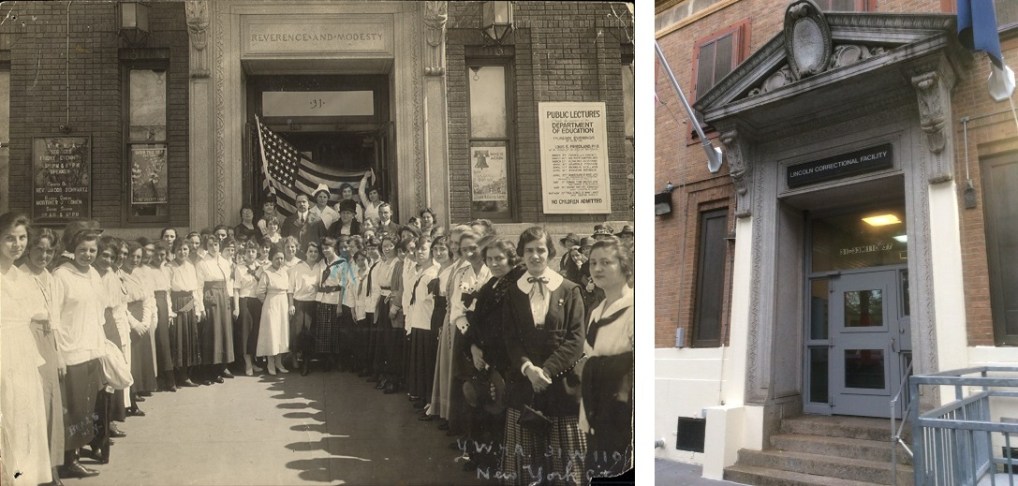
Left, Young Women's Hebrew Association Flag Ceremony at 31 West 110th Street, 1918. Right, LCF doorway at this address today

Left, Young Women’s Hebrew Association Flag Ceremony at 31 West 110th Street, 1918. Right, Lincoln Correctional Facility doorway at this address today. You can see the details and shape of the corbels supporting the overhang, the decorations around the door, and the placement and shape of the windows that it’s the same doorway

Duke Ellington Circle at 5th Ave and 110th St. Notice his statue on the tall pedestal to the right

Duke Ellington Circle at 5th Ave and 110th St. Notice his statue on the tall pedestal to the right

Just a half block east on 110th St to where it meets 5th Ave, I arrive at Duke Ellington Circle. There’s a statue of the great jazz pianist and his instrument on a very tall pedestal in a stepped, paved, and grassy park surrounded by a traffic circle and split down the center by 5th Ave, north to south. The circle surrounded by a couple of plain brick highrises, an artistically modern building which houses The Africa Center, a few plain old mixed use buildings, and small vacant lot.

I’m seeking the site of Parkview Palace, which, according to Pokorski’s Mapping Margaret Sanger, was at 110th and 5th. There is no building now of that name and indeed, none at all that appear to be of the right vintage. I consult G.W. Bromley’s 1916 Atlas and find it named ‘Parkway Palace’ there. I spend a long time searching for photos or some other information about the Parkview Palace. I find lots of brief references to it, mostly in Socialist and anarchist history books since it was a popular meeting place for non-mainstream political thinkers and activists, and in old newspaper announcements for other events happening there. However, I find no photos of the Parkview at all. I do find a photo of the apparently more well-known Harlem 5th Avenue Theatre next door, but none that show the adjoining Parkview.

110th at 5th Ave, NW corner of intersection at Duke Ellington Circle. The Parview Palace likely stood where the Hermosa is. 2016 Amy Cools

110th at 5th Ave, NW corner of intersection at Duke Ellington Circle. The Parview Palace likely stood where the Iglesia Christiana La Hermosa stands now, the red and cream building to the right
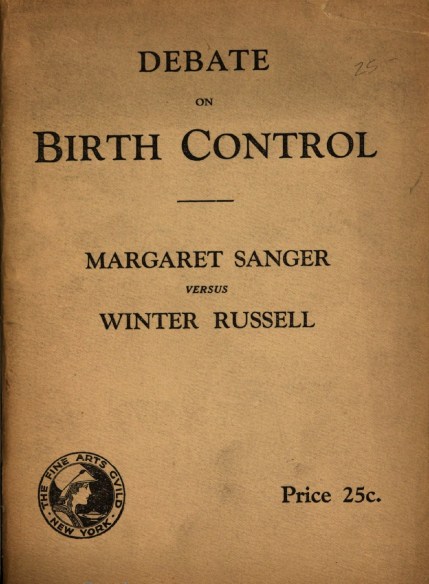
Debate on Birth Control, Margaret Sanger versus Winter Russell

Debate on Birth Control, Margaret Sanger versus Winter Russell. Click to read the whole debate online

I’m seeking this place because Sanger debated with John Winter Russell on birth control here on December 12th, 1920. Russell was a lawyer and recent convert to Catholicism, and as we’ve considered in this series, Sanger was no particular fan of the Catholic church, to say the least. She was not a frequent debater, but she agreed to this one for two likely reasons. One, her participation fee. Since the Depression hit, she had to work harder to raise funds for herself and her cause. Second, this was another good opportunity to publicly refute arguments based on Catholic teaching. Sanger had many run-ins with Catholicism in the form of its influence on public policy as well as in the press and in local governments and police forces, as we saw in the Town Hall raid debacle. She likely relished the opportunity to demonstrate debating skills as a seasoned, well-informed birth control activist against this new convert to the Catholic religion. The entire debate was published by the Fine Arts Guild of New York City and is available online.

Russell gave Sanger many opportunities to defeat his arguments. For example: he equated the use of birth control with lack of sexual control, when the use of birth control actually requires a good deal of control in the form of foresight, planning, and proper use; he characterized sex without allowing for reproduction as animalistic and therefore unworthy of human beings, though it’s only all other  animals besides humans which don’t use birth control; he conflated abortion with other forms of birth control though that characterization is not scientifically feasible and as Sanger pointed out, birth control prevents the need for abortion; he argued that pleasure can’t and shouldn’t be enjoyed without its counterpart of pain even though it’s generally only the woman who suffers it; and so forth. In the end, Russell more or less delivered the sort of arguments Sanger expected, which were, as she perceived them, rooted in a narrow and rigid brand of religiosity, sexual prudery, misogyny, and lack of scientific understanding. She and many other believed that she won this debate handily.

I’ve come to the end of my third day in New York City following Sanger, and it’s been an especially long and interesting one. I’ve decided to return to Greenwich Village and enjoy the offerings of a couple of its long-established eateries and watering holes, to read and rest my weary feet as I fill my empty belly and warm my chilly self. Until tomorrow, then!

Listen to the podcast version here or on Google Play, or subscribe on iTunes

Ordinary Philosophy and its Traveling Philosophy / History of Ideas series is a labor of love and ad-free, supported by patrons and readers like you. Please offer your support today!

~~~~~~~~~~~~~~~~~~~~~~~~~~~

Sources and inspiration: 

Adams, Michael Henry. ‘The Best Address: St. Nicholas Avenue and Place, Part I‘, Jul 17, 2012.

Another Look at Margaret Sanger and Race‘, Feb 23, 2012. From The Margaret Sanger Papers Project at NYU

Bromley, G.W. and Co. Atlas of the Borough of Manhattan, City of New York. Desk and Library edition, 1916, Plate 129 and Plate 167. Retrieved from Lionel Pincus and Princess Firyal Map Division Digital Collection, The New York Public Library.

Buhle, Mari Jo. ‘Women & the Socialist PartyRadical America, Feb 1970, Vol, IV, 4F2, via National Progressive Review

Chesler, Ellen. Woman of Valor: Margaret Sanger and the Birth Control Movement in America. New York: Simon & Schuster, 1992

Debate on Birth Control / Margaret Sanger versus Winter Russell, by Margaret Sanger, Winter Russell, and Emma Sargent Russell. New York, NY: Fine Arts Guild, 1921.

East 110th Street [31 West 110th Street]. Y.W.H.A., detail of steps, interior. Photo by Wurts Bros. (New York, N.Y.), from Museum of the City of New York’s digitized archives

Eig, Jonathan. The Birth of the Pill: How Four Crusaders Reinvented Sex and Launched a Revolution. W.W. Norton & Company, New York, 2014.

Goldberg, Michelle. ‘Awakenings: On Margaret Sanger‘ Feb 7, 2012, The Nation

Gray, Christopher. ‘Built With the Ladies In Mind‘, Oct. 25, 2012, New York Times: Streetscapes

Grimaldi, Jill. ‘The First American Birth Control Conference‘, Nov 12, 2010. The Margaret Sanger Papers Project at NYU

House Tour Preview: Margaret Sanger’s Window.’ Apr 22, 2010, Hastings Historical Society blog

Katz, Esther. ‘Margaret Sanger and The Woman Rebel, 1914-1916: Historical Essay‘, 1999. From The Margaret Sanger Papers Electronic Edition, eds. Esther Katz, Cathy Moran Hajo and Peter Engelman (Columbia, S.C.: Model Editions Partnership, 1999)

Latest News‘ The Birth Control Review, May 1923, Vol VII, No. 5

Mrs. Sanger Addresses Social Problems Club‘, Barnard Bulletin (New York, New York) · Fri, Dec 11, 1925

Mrs. Sanger Glad She Was Indicted‘, New York Tribune, Feb. 21, 1916, p. 2, via The Margaret Sanger Papers Project, NYU

Mrs. Sanger to Talk on Birth Control‘, Columbia Daily Spectator, Volume XLIX, Number 58, 3 December 1925

Muigai, Wangui. ‘Looking Uptown: Margaret Sanger and the Harlem Branch Birth Control Clinic‘. Newsletter #54 (Spring 2010)  of The Margaret Sanger Papers Project at NYU

On the Road with Birth Control‘, Newsletter #21 (Spring 1999) of The Margaret Sanger Papers Project at NYU

Pokorski, Robin. ‘Mapping Margaret Sanger‘ from The Margaret Sanger Papers Project at NYU

Revolutionary and Subversive Movements Abroad and at Home, (vol. I-II). By New York (State). Legislature. Joint Committee (address of Parkview Palace on p. 2020). J.B. Lyons: Albany, 1920

Risen, Clay. ‘Prison on the Park.’ Jul 9, 2002, The Morning News, New York, New York.

Sanger, Margaret. ‘Birth Control: Then and Now,’ 1944, Typed Article. Source: Margaret Sanger Papers, Sophia Smith Collection

Sanger, Margaret. ‘Hotel Brevoort Speech,” Jan 17, 1916. From The Margaret Sanger Papers Project at NYU

Sanger, Margaret. Margaret Sanger, an Autobiography. Cooper Square Press: New York 1999, originally published by W.W. Norton & Co: New York, 1938

Sanger, Margaret. The Pivot of Civilization, 1922. Free online version courtesy of Project Gutenberg, 2008, 2013

Sanger, Margaret. Woman and the New Race, 1920. Free online version courtesy of W. W. Norton & Company

Sanger v. Famous Father of 18!‘ Newsletter #29 (Winter 2001/2002) of The Margaret Sanger Papers Project at NYU

Sciancalepore, Victoria. ‘Rebels of Post Avenue‘, Jan 15, 2014, Margaret Sanger Papers Project

Silver, Rabbi Samuel. ‘Why I Became a Rabbi‘. Jewish Post, Indianapolis, Jan 28, 2004

Soclof, Adam. ‘Planned Parenthood Controversy‘, February 2, 2012

W. E. B. Du Bois, “The Black Star Line,” Crisis, September 1922, 210–214, via History Matters website (with introduction)

The Tragedy–and Hope–of African American History, by Robert Greene II

Obamas on Inauguration Day 2013 by P. Souza, Public domain via Wikimedia Commons

Obamas on Inauguration Day 2013 by P. Souza, Public domain via Wikimedia Commons

In 2007, Andrew Sullivan wrote a cover essay for The Atlantic in which he argued that the rise of Barack Obama to the national stage meant an end to the divisive cultural politics that defined American politics since 1968. Sullivan argued at the time, “he could take America—finally—past the debilitating, self-perpetuating family quarrel of the Baby Boom generation that has long engulfed all of us.” Reflecting on the events of the last eight years, it now seems this assumption about Obama’s rise was naïve and misplaced. Now, as we transition from an “Age of Obama” to an “Age of Trump” everyone has spilled much ink—both real and digital—trying to explain how we got here.

A keen reading of African American history, especially intellectual history, offers us much to consider in this debate. The recent Ta-Nehisi Coates essay, “My President Was Black,” offers one of the better meditations on Obama’s presidency and its possible legacy. The responses to it—in particular Tressie McMillian Cottom’s—have all been useful to also think about Obama’s failings and successes in office. Along with this is a reflection among historians and others about what kind of era we’re entering. Indeed, Coates’ body of work—from his essay on Bill Cosby and Black America to this most recent piece—offer a fascinating take on post-1945 African American history. While I will leave that for another post down the road, I do want to tackle the ways in which history is being discussed in the public sphere in 2016.

Historical comparison is a cottage industry unto itself. After November’s election, pundits and historians alike began casting a wide net to make comparisons with the past. Jamelle Bouie compared the events of November 8, 2016 to the backlash to Reconstruction. This comparison soon caught on with other writers. Barret Holmes Pitner, at The Daily Beast, made a similar argument. In concern about potential backlash to racial progress, I can sympathize with this comparison. This reminds me of earlier comparisons made between Black Lives Matter and the Civil Rights and/or Black Power Movements. But I also vehemently disagree with it.

Backlash against racial progress is central to the story of America–as you can see with this political advertisement from 1866. Whether or not it was the reason for Trump’s victory, the interminable problem of racism and democracy in American society remains with us.

Historical analogies are useful, but we also need to recognize how they are limited in speaking to the present moment. Both Bouie and Pitner acknowledge this. History never repeats itself. It doesn’t even necessarily rhyme. But we can “use” history to think harder about the present. History, taught well, teaches us that the present is never easy to understand. There are never any simple answers or quick victories. Historical comparison, of course, is nothing new. C. Vann Woodward, among many others, referred to the Civil Rights Movement as a “Second Reconstruction.” Today, the theologian and activist Rev. Dr. William Barber of North Carolina refers to the present day as a “Third Reconstruction.” Others may also argue that the here and now is a “second Nadir of African American history,” in comparison with the low point in African American history from 1890 to 1930 written about and described as such by Rayford Logan.

The comparison with another nadir is not new. The historian Sundiata Keita Cha-Jua argued, in a The Black Scholar essay in 2010, that Black America was already suffering through a second nadir. There, he argued that African Americans were already in a nadir due to a variety of factors. Most notably, the changes in American political economy since the mid-1970s due to the rise of neoliberalism and its associated policies of austerity—coupled with cultural and political debates over colorblindness and racism—have damaged the progress made by African Americans in the immediate aftermath of the Civil Rights Movement. Cha-Jua argued that events such as the 2000 election (and allegations of voter suppression in Florida), the federal response to Hurricane Katrina, and the collapse of the housing market in 2007-08 (which destroyed the slowly-built up wealth of the African American middle class) were all symbols of the modern nadir. This was all before Obama’s election in 2008—which Cha-Jua argued was “contrasted but not off set by” the events previously mentioned.

I disagreed with this analysis of a “new Nadir” when it first came out. Today, I am tempted to argue that it is the best analysis of the present moment. Economic factors of the damage done to African Americans over the last three decades lend some credence to Cha-Jua’s analysis. And, to be blunt, I worry that any administration in the White House may not provide the answers to helping millions of Americans—regardless of race—recover from the 2008-09 Great Recession. The debate about voter suppression across the country, highlighted by recent events in North Carolina, also make the “new Nadir” take a tempting one.

I still reject a wholesale comparison with that era, for a variety of reasons. But it is not out of any sense that things are fine today. On the contrary. Historical comparisons are not to be discarded. They can and do serve a purpose. Comparisons across historical eras make the present day easier to understand. In that sense, African American history is critically useful. After all, African American history offers a bitterly learned lesson—that democracy and progress are always built in American history on a foundation of sand. Freedom cannot be taken for granted. Most importantly, the whiggish idea of history as a march of progress has been laid bare, once again. Much of human history proves this. For Americans, however, to simply look to the history of African Americans—or, for that matter, Native Americans, women, Hispanics, a multitude of groups—is to realize that “progress” and “hope” are not natural to human history.

And so we plunge into 2017, unsure of the future and groping for lessons from the past to help us. The urge to make historical comparisons is understandable. Just remember that the differences between eras is important too.

~ Originally published at Society for U.S. Intellectual History Blog, on January 1st, 2017

~ Robert Greene II is a PhD. student at the University of South Carolina. He studies American history after 1945 with a focus on the American South, political history, and memory. (Bio credit: S-USIH Blog)

Ordinary Philosophy and its Traveling Philosophy / History of Ideas series is a labor of love and ad-free, supported by patrons and readers like you. Please offer your support today!

Making the Perfect the Enemy of the Good

richard-and-mildred-lovingIt’s not generally a very wise thing to do, but I entered into a little dispute on Facebook a little while ago. It was about Mildred and Richard Loving of Virginia. A friend shared a discussion thread which was mostly very critical of the way that the Lovings are portrayed in their recent namesake movie. The Lovings’ marriage was illegal in 1950’s Virginia because Mildred was a woman of color and Richard was white. They knew this, so a pregnant, 19-year-old Mildred and 25-year-old Richard traveled to Washington, D.C. to be married. But this didn’t help them when it came to state law: marrying out-of-state to avoid Virginia’s anti-miscegenation laws, then returning to live as husband and wife, was also illegal.
The young man who initiated the Facebook thread (I won’t name names here, since this piece is only about the ideas expressed) invited a discussion of this fact stated in Mildred Loving’s 2008 obituary in Legacy.com:  “Mildred Jeter was 11 when she and 17-year-old Richard began courting“. My friend who shared the thread, an African-American scholar, was also particularly concerned with another aspect of this story, as many others were: Mildred identified herself at the time of her marriage and for the rest of her life as ‘Indian’, not ‘Black’ or ‘Negro’.

The outrage generated by the very young age of Mildred at the beginning of their relationship resulted in the longest string of angry and shocked responses in the thread. One person wrote ‘Look…are we honestly gonna sit here and act like this white man didn’t see a vulnerable young girl and prey on her specifically because she was too young to know better and too Black for anyone to care otherwise? Like come on y’all. This is gross.‘; ‘Why are we pivoting away from it just being predatory behavior for 17yr old young adults to be romantically interested in 11yr old children?; and ‘He was a fucking child molester. It’s starting to make sense to me of why they were allowed to marry…’

Some took the trouble to establish essential facts before passing judgment, asking such important questions as: ‘I’m trying to understand. Do we know if they had sex when she was a child?’ One person quickly responded ‘Does that matter? He began courting her with those intentions at 11, when most girls have yet to even start puberty. He was grooming her, so it doesn’t matter whether he touched her or not, give the psychological implications.’ An even more excitable person cited the marriage itself as evidence that Richard’s interest in Mildred was sexual from the very beginning. And when a particularly fair-minded young man asked people to pause and consider whether the assumption was correct that the ‘courting’ referred to by the obituary necessarily implied sexual interest, such as the way we use the term ‘dating’ today, he was soon accused of  ‘excus[ing] this predatory behavior’ and even lumped in with ‘rape deniers and apologists‘.

But the issue of Mildred’s denying her black ancestry (which, according to the sources I’ve read did exist, however much she denied or downplayed it) generated the most hurt and personal anger: ‘…Mildred Loving was extremely anti-black. Her entire argument was that she was Native American Not black and she never self-identified as black.‘ and from the initiator of the post: ‘…this film looks like and all the press surrounding it has undoubtedly been “post-racial”, white partner fetishist, anti-black trash.’

As I read this thread, I became more and more upset, and more and more defensive of the Lovings. I responded, impetuously, to my friend who shared the thread on Facebook:

This thread is awful. The character assassination of these two is unconscionable, especially given the fact that they did so much to give us freedoms we now take so much for granted, and because they are not here to defend themselves. If the obituary is correct in that they started dating [here, I made the same initial mistake as many others by conflating ‘courting’ with ‘dating’] when Mildred was very young, that was another time and place when early dating and marriage was both socially and legally acceptable, and we have no evidence that they had sex before the age of consent at the time. It’s unjust to impose our current laws and standards on them and to pretend we know whatever else was going on. She professed love for him for the rest of her life, and this is evidence that she did not feel that he abused or took advantage of her in any way. In this case, I look to Mildred for the evidence: she, the woman, gets to tell us whether she was sexually abused or harassed. The other issue is Mildred’s self-identification as a Native American. We can assume, to satisfy our own self-righteous feelings, that her motives were ‘anti-black’, and again, it’s an assumption we should be careful in making since she’s not here to ask. But if her grandson is right, she had more Native American ancestors than black ones, so identifying herself as a Native American would make sense. Would she be ‘anti-Native American’, then, if she identified as black, rejecting her predominantly Native American ancestry? The people in this thread are setting her up, in a case of identity politics gone awry, for failure no matter what. Perhaps she identified more with her Native American ancestry, perhaps her chosen self-identity was a method of survival in a society that so oppressed black people, perhaps she thought she was more likely to be able to share a life with Richard if she was Native American rather than black. Again, we can only guess. This thread is one of the most unjust, unfair, intellectually dishonest, anti-woman, anti-Native American, and I argue anti-black verbal-character-lynchings I’ve read in a long time.

Why did I (and do) feel so defensive towards the Lovings? My closing sentence went over the top, I suppose. But I think my instinctive reaction was so strong because I’ve admired them and been fascinated by them for so long. I took an avid interest in civil rights history in the sixth grade and this interest has never left me. I’m a bit of a romantic and an optimist, and it’s always been heroes such as the Lovings and other civil rights activists and leaders who have redeemed the human race for me since so many have acted cruelly and unjustly throughout history. But part of my reaction against so many of the things said in this post was the blind ingratitude and self-righteousness I perceived, as I do in so many similar discussions. There’s a distinct and I believe worrying trend of reconsidering all of our social heroes in light of their flaws and to take them down a peg or two, even to the point of destroying their historical reputations. With the exception of a particularly honest few, who also defended the Lovings on consideration of the circumstances and social pressures of their time, so many were ready and even eager to insist that because the Lovings were not perfect, we have the right to assume the worst about their motives and their characters, and therefore, to denigrate their efforts.

I was particularly interested in this response, I’ll call the writer S: ‘It is time that the reality of the lives of this seminal and historical case comes to light. Incidentally, Mildred also did not consider herself Black and did not want too much to do with Black people. I think we need to separate the legal aspects of this case from the personal lives of these people though, because it was critical in overturning the laws of miscegenation and was not just about white men being able to have their way with women of color. It was also critical for protecting Black men in mixed race marriages.‘ I think she’s right that the ‘incidents’ of the case, the details of the personal lives of the people involved, don’t really impact the historical importance of the Supreme Court’s decision in the lives of so many Americans at the time and for the future of the country. The Court’s decision rejected the underlying presumption of anti-miscegenation laws, that ‘blood’ can be ‘corrupted’ by marrying a person of another race, and it more firmly established the American ideal of marriage as a free and equal partnership between two free people, leading to the legalization of gay marriage half a century later. As Justice Earl Warren wrote in his decision in Loving vs. Virginia, ‘The freedom to marry has long been recognized as one of the vital personal rights essential to the orderly pursuit of happiness by free men.’

Yet, by the way, ‘Loving’ the movie, which I thought was beautifully done, is all about the people involved in the case. So while I agree with S’s point that the importance of the case doesn’t hinge on the details of their lives, it’s also true that the movie isn’t about many of the details discussed in the thread, either. It’s not about the wider reality of a rural, impoverished, labor-intensive society in which work and starting a family were preoccupations from an early age, so that courting likewise started very early. It’s not about the myriad social pressures on Mildred that likely caused her to deny or de-emphasize her blackness in a time and place where being black meant she couldn’t have the life she wanted. It’s about the personal experience of Mildred and Richard of loving one another, and how this drove them to sustain a relationship for so many years despite public prejudice and opposition; to marry anyway; and then to become involved in a series of major court cases that so disrupted the peaceful life they desired so much. That’s why the movie is simply called ‘Loving’.

Mildred Jeter and Richard Loving, June 12, 1967, by Bettmann/Corbis via New York Times, public domain via Wikimedia Commons

Mildred Jeter and Richard Loving, June 12, 1967, by Bettmann/Corbis via New York Times, public domain via Wikimedia Commons

In doing research for this piece, I was struck again by the number of photos in which Richard is supported by Mildred, sometimes leaning an arm across her shoulder, sometimes laying his head on her lap. After all, the fight for their rights began with Mildred, who wrote of their plight to Robert Kennedy, which in turn gained the attention of the ACLU who took the case, and she was the driving force behind their continued fight. Richard’s leaning on Mildred also reminds me of the way we’re all held up by others. That’s true for all the people in the Facebook discussion thread, myself, for all Americans: we discuss these problematic issues from a relatively safe place because we’re raised up on the shoulders of so many giants. We have free speech rights, the right to marry who we love, the right to cohabitate freely with partners if marriage isn’t our thing, and so on, because of people like the Lovings. Thanks to them and others like them, we will never be arrested for marrying a person of the wrong race or sex, or for drinking from the wrong fountain, or for denying that we can be owned by another person. For the latter two, I myself would never have been arrested for those things in the United States, due to an unfair privilege I would have enjoyed by accident of birth. But there are other things I would have been arrested for at one time: for voting, for leaving an abusive relationship, or for trying to control my own reproduction.

And why do we get to take it for granted that we can talk and live relatively freely? Well, it’s because people like Mildred and Richard had the moral imagination to make a great leap beyond the mores, the legal strictures, the personal biases and learned behaviors of their time and in their own lives. I still love the Lovings, flaws and all, because I think they’re basically good people, and that’s what enabled them to become moral heroes. I think of a hero not as a perfect being, but one who does that rare and exceedingly difficult thing: not only transcend the time they’re in, but themselves in some important and essential way. In the attempt to see the world and our history honestly, it’s not necessary or desirable to whitewash our heroes or the complexity of the issues they face, as many of the arguers in this thread pointed out. But it’s also not necessary to tear them down as persons or hold their legacies hostage to the moral strictures of our time, moral strictures that their ideas and efforts helped us form in the first place.

*Listen to the podcast version here or on Google Play, or subscribe on iTunes

Ordinary Philosophy and its Traveling Philosophy / History of Ideas series is a labor of love and ad-free, supported by patrons and readers like you. Please offer your support today!

~~~~~~~~~~~~~~~~~~~~~~~~~~~~~~~~~~~~

Sources and inspiration:

Coleman, Arica L. ‘What You Didn’t Know About Loving v. Virginia‘. June 10, 2016, Time.com

Loving v. Virginia‘, Supreme Court decision No. 395, Argued: April 10, 1967, Decided: June 12, 1967. Via Cornell University Law School’s Legal Information Institute

Loving v. Virginia‘. In Wikipedia, The Free Encyclopedia.

Martin, Douglas. ‘Mildred Loving, Who Battled Ban on Mixed-Race Marriage, Dies at 68‘. May 6, 2008, The New York Times

Mildred Loving Obituary‘. 2008, from Legacy.com