
Another excellent piece by one of my favorite philosophers in the public square. I, for one, would do well to heed Seneca’s advice: I often find myself stressed and overwhelmed by running around too much and just doing, doing, doing, without enough reflection on whether or not it’s most conducive to my well-being and to the overall success of my endeavors. Thanks, Massimo, for bringing the wisdom of Stoicism to the hectic modern world!
Category Archives: History of Ideas
Mary Wollstonecraft, Champion of Reason, Passionate in Love
In honor of Mary Wollstonecraft’s 257th birthday (she was born on April 27, 1759), here’a piece I wrote about her last fall, following my history of ideas travel series following this great feminist and champion of human rights’ time in Paris. Enjoy!

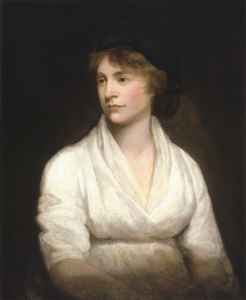
The life and work of Mary Wollstonecraft, mother of modern feminism, can seem to reveal a mass of contradictions.
Her seminal feminist work, A Vindication of the Rights of Woman, champions reason as the ultimate guide for a moral and productive life. She used reason to great effect to show why women should, and how they could, grow out of their socially constructed roles as under-educated coquettes and household drudges. She believed that reason should rule both individuals and societies because it’s the best tool we have to achieve justice and to perfect the self. Without reason, she thought, human beings are ruled by narrow self-interest, by the prejudice born of ignorance, and by crude lust.
Yet the life Wollstonecraft chose to live was widely criticized both during her lifetime and over the two hundred plus years since her death. It’s not just because she didn’t conform to the mores…
View original post 2,185 more words
Frederick Douglass Lynn, Massachusetts Sites
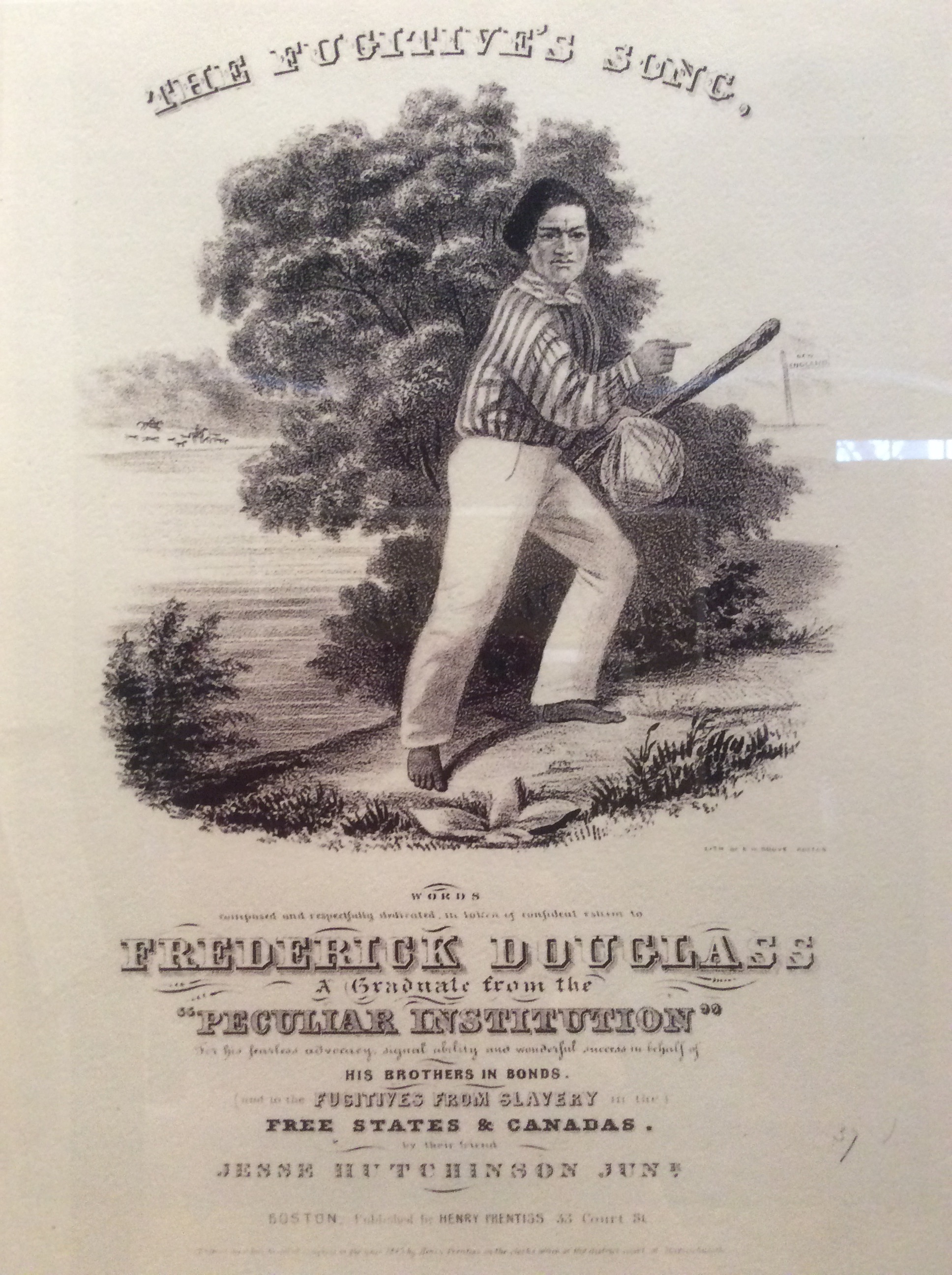
Jesse Hutchinson song dedicated to Frederick Douglass, cover page print from Lynn Museum exhibit (a fanciful illustration: in real life, he wore shoes and escaped by train and ferry)
Seventh Day, Saturday March 26th
I drive from Boston to Lynn, Massachusetts, only about 25 minutes north by car.
Not long after Frederick Douglass began his public speaking career, he and his family moved here to Lynn from New Bedford. They lived here from the fall of 1841 through about November 1847. Well, actually, for much of that time, it was mostly Anna and the kids who lived here. First, Douglass was often on tour as a speaker, which took him away from home for long stretches. Secondly, he was away on a tour of the British Isles from 1845-1847, which is why many sources say Douglass himself only lived here until 1845. He returned only briefly to Lynn before moving himself and his family to Rochester near the end of 1847. His ‘industrious and neat companion‘ Anna took care of the household while he was away, and often took in piecework from Lynn’s thriving shoemaking industry to make sure the kids were always cared for and the bills paid on time.
Douglass wrote his Narrative of the Life of Frederick Douglass, An American Slave here in Lynn, and it was published by the Boston Anti-Slavery Society on May 28th, 1845. It sold well, and he became more than a bit nervous: he enjoyed freedom so much, of course, and now he had a family, he had even more to lose if he was to be captured and returned to slavery. After all, as discussed, he had said some not too nice things in his Narrative about his former master (who legally, still was), and who knows how badly Thomas Auld wanted to have him back in bondage! So, to avoid capture now that he publicly named his master and his whereabouts were more widely known, he sailed to England on August 6th, 1845, and embarked on an 18 month lecture tour of England and Ireland. Eventually, his abolitionist friends raised enough money to buy his freedom, or, as he conceived of it, to pay his ransom, and he was able to return home, arriving back in Lynn on April 20th, 1847. Though he was away so much, Lynn still played a significant role in his life.
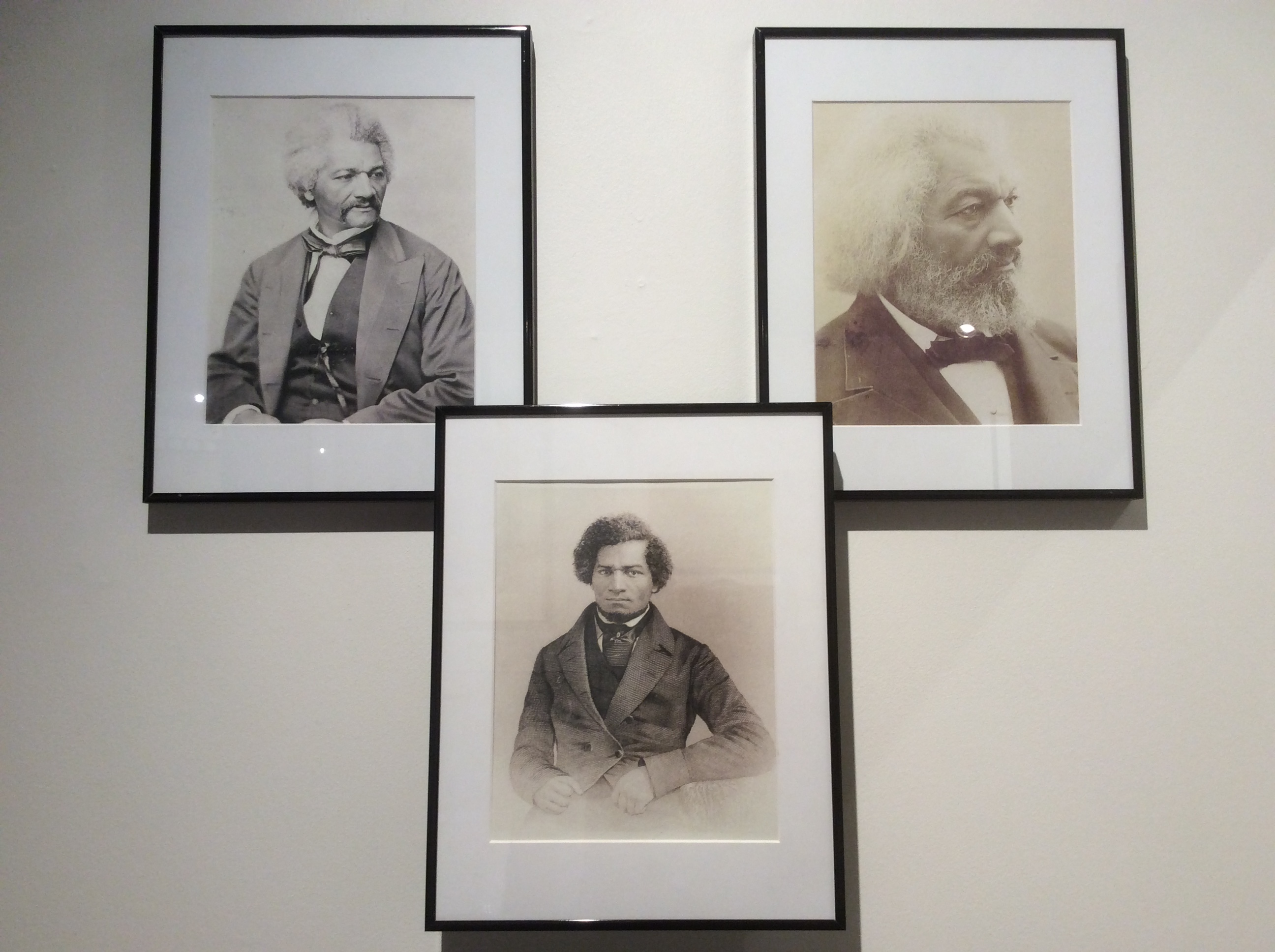
Three portraits of Frederick Douglass at the Lynn Museum & Historical Society
Lynn proves to be a Douglass treasure trove for me, primarily thanks to the Lynn Museum and Historical Society. Thank you so much to Nicole Breault for arranging my visit, Britt Bowen who gave me access to historical artifacts for study, the kind ladies who greeted me and showed me around, and to everyone else there who make this place a beautiful place to visit and a great resource! In fact, my visit to the museum was so full of wonderful discoveries that it needs its own separate piece, which will follow shortly.
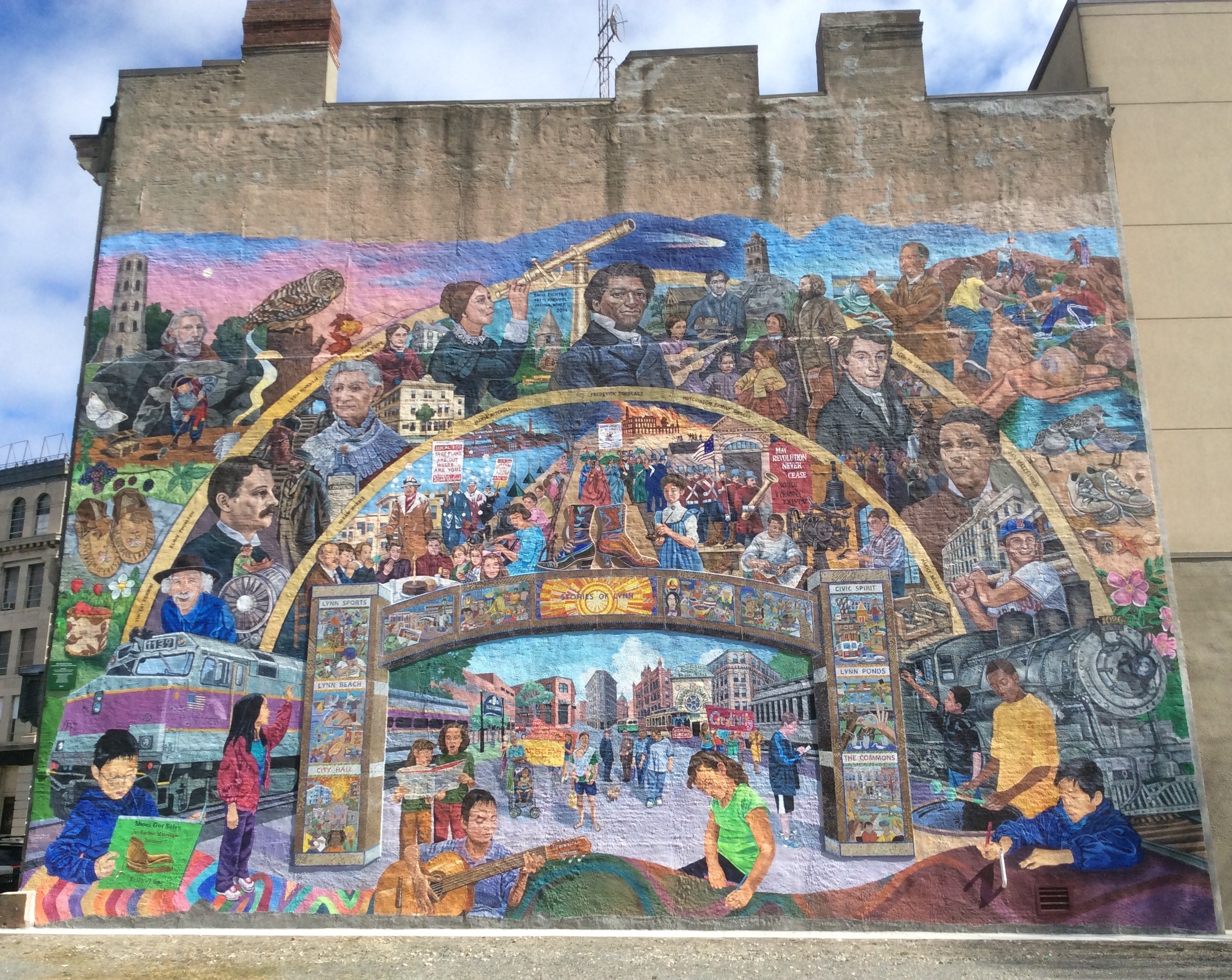
Mural on wall of Lynn’s greats on the side of the Arts Building, crowned by portrait of Frederick Douglass Portrait
After I tear myself away from the museum (if it wasn’t closing just then, I don’t know how I’d tear myself away and get to visiting the sites on my itinerary!) and go eat a bit of lunch, I head for my first destination. On the way, my attention is caught by this vibrant mural on the side of the Lynn Arts Building at 25 Exchange St, where a portrait of Douglass presides over images of Lynn’s historical figures and creative and curious children (and other people) of today.
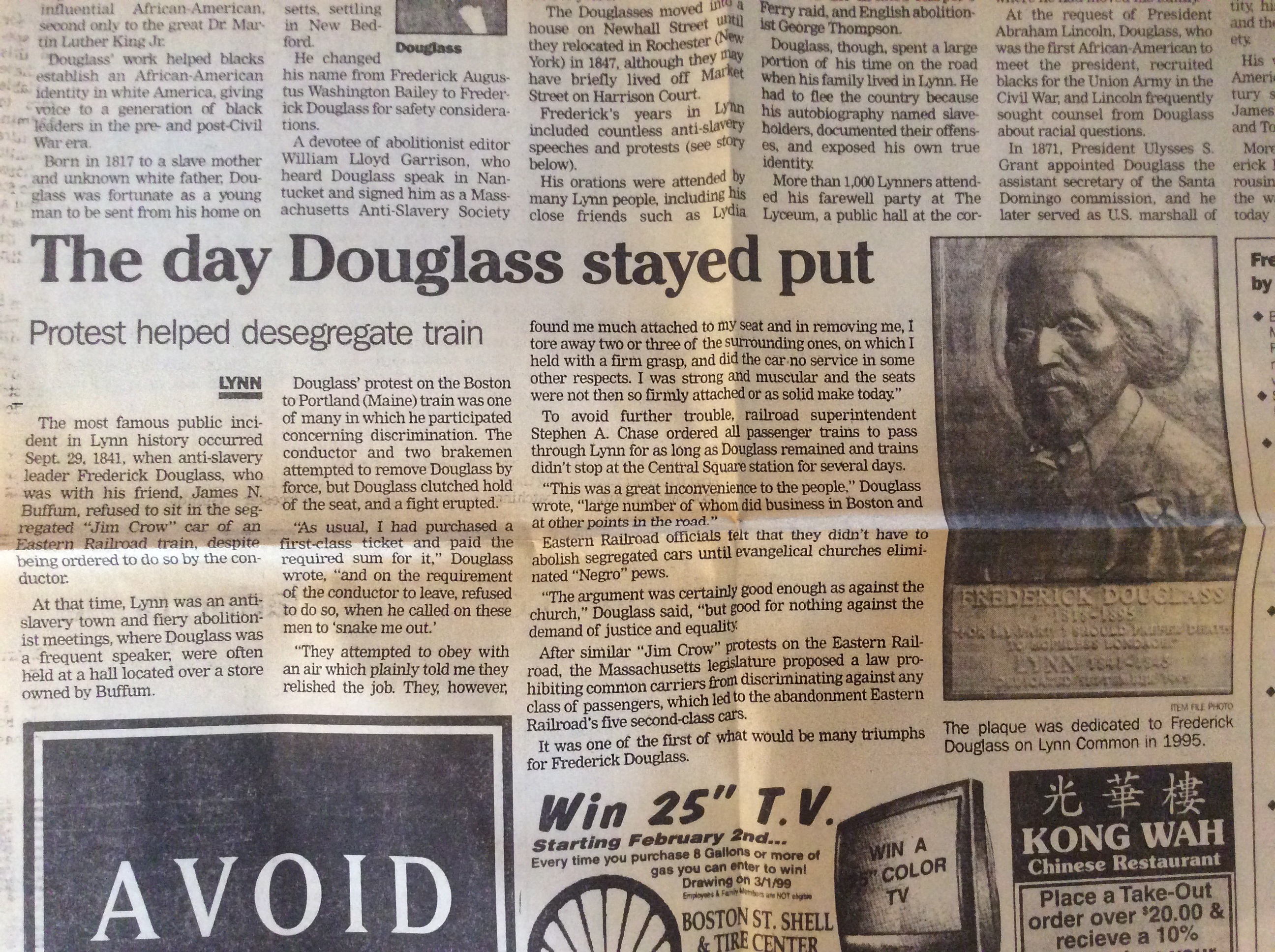
Old newspaper clipping from the archives at the Lynn Museum and Historical Society about Frederick Douglass’ Rosa Parks moment
I’m heading for the site of the old Central Square train station. Downtown Lynn is not easy for a first time visitor to navigate: no two streets seem to join at right angles. It takes me a few go-rounds to orient myself generally, yet I still often find myself often a little lost among the tangled streets. A man who tends a little restaurant called Capitol Diner, which looks like an old red train car, helps confirm that the place where the elevated tracks run above where Central Square meets Union and Exchange Streets is just about directly over the site of the early 1800’s train depots (there was a series of them), across the street from the mural on the side of the Arts Building.
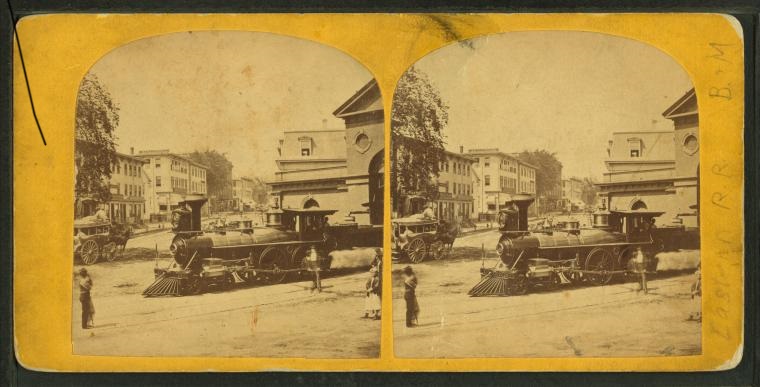
Old Lynn Central Square and depot, photo by William T. Webster, via Wikimedia Commons
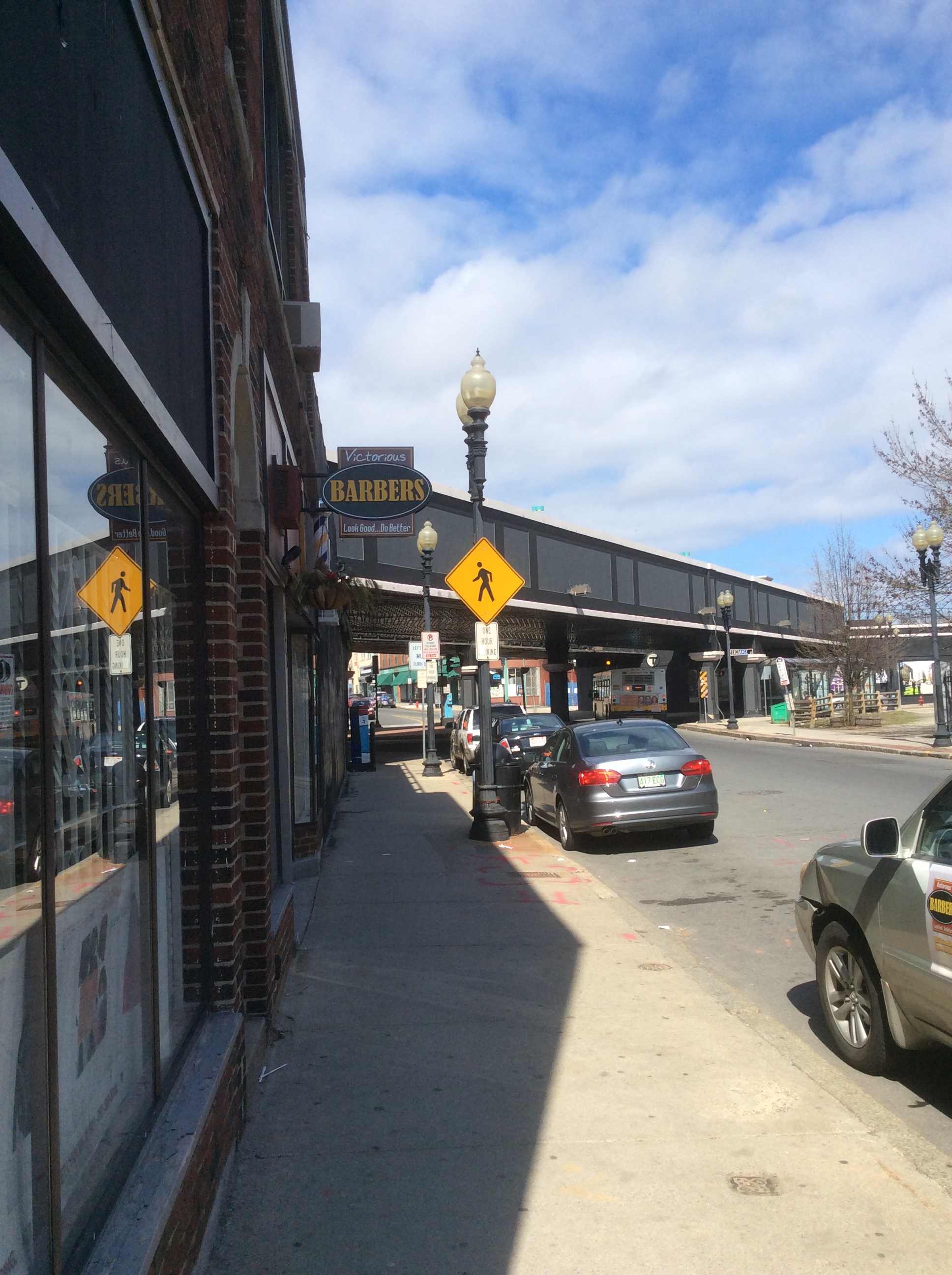
Central Square Train Station raised platform where the old train depot and Sagamore Hall once stood, to the right of the photo
According to Wikipedia, ‘The first depot at the Central Square location, built in 1838, was a small wooden building. It was replaced in 1848 with a brick building with a 2-track train shed.’
So it was in that smaller wooden incarnation that an incident occurred at this stop of a train between Boston and Portland. Douglass resisted being forced into a Jim Crow segregated car on September 28, 1841, while he was riding the train with his friend James N. Buffum, who would later become mayor of Lynn and who had inspired him to move to Lynn in the first place. Douglass simply refused to leave his seat, and when employees of the railroad company tried to remove him by force, he hung onto the seat until they were ripped and torn out of place. As Edward Covey the slavebreaker had discovered some years earlier, Douglass was physically strong and no pushover.
Over time, he ended up doing this sort of protest often, to raise awareness. His letter about this experience was published in the newspaper, and local indignation and protests over this incident helped lead to the eventual end of segregated train cars in New England. It’s hard to imagine, to a modern reader in such an interconnected world, that there would be such a patchwork of racial sentiment in a geographic area that it took me only a few hours to cross by car. In Maryland, he was a slave; in New York City, he was free but in danger of being beaten or captured; in Boston, his Narrative was published in the same city where he was denied entry to the menagerie on Boston Common because ‘We don’t allow niggers in here!’ (as he reported); in Lynn, the trains were desegregated over rude treatment of a black customer. Amazing.
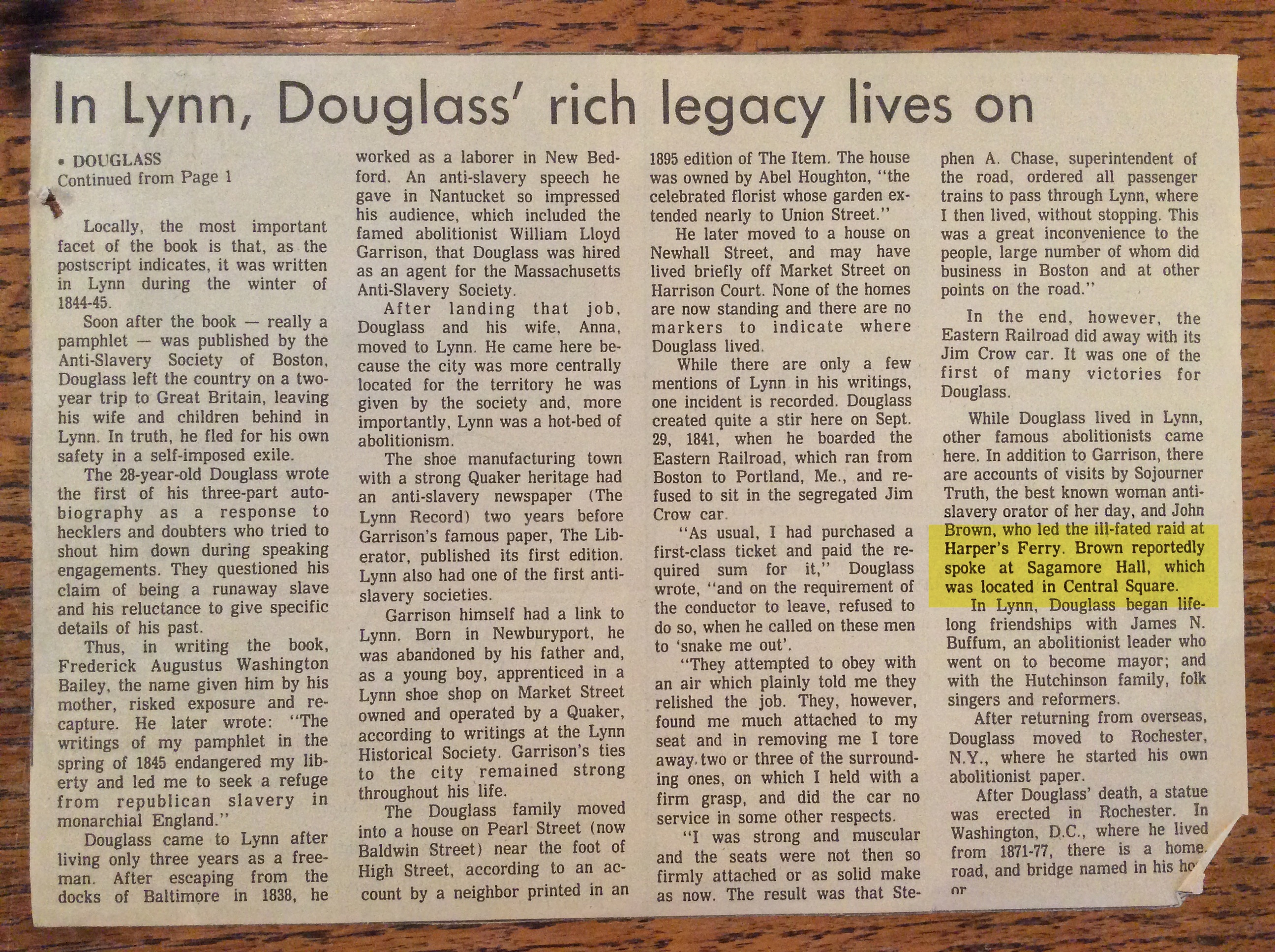
Clipping from Lynn Historical Society about Douglass’ life in Lynn and Sagamore Hall
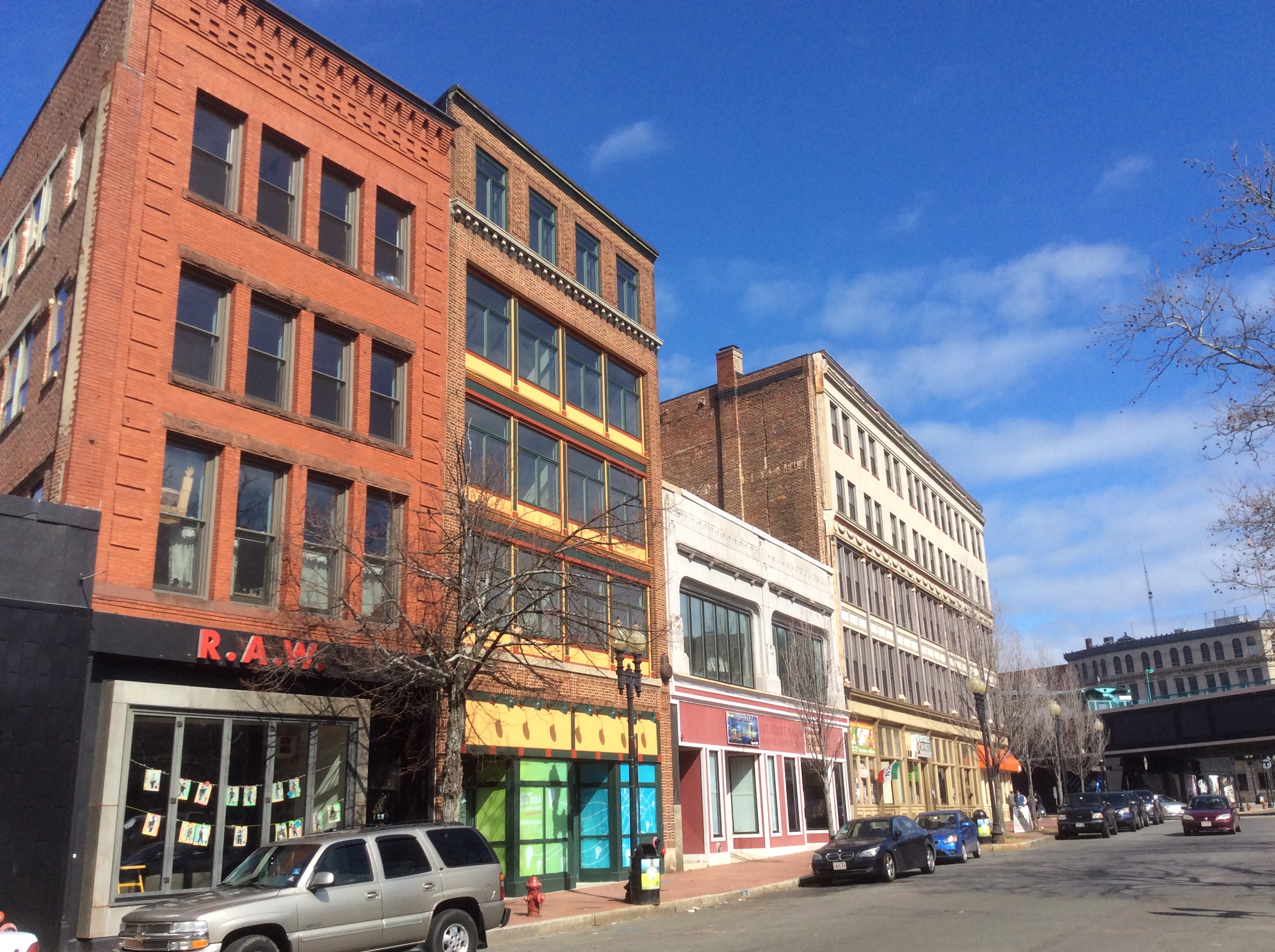
A row of buildings on Central Square in Lynn, MA; the elevated train tracks at the right pass over the site of the old depot, and Sagamore Hall stood just beyond the tall white-faced brick building
In Central Square, I’m close to the site of Sagamore Hall where John Brown, fiery abolitionist, and friend and hero of Douglass, used to speak. Sagamore Hall was close and to the west of the depot, between Union and Mt Vernon Streets north of Exchange, also where that part of the elevated track structure now stands. If you look closely at the photo of the mural we looked at earlier, you’ll see the image of a burning building just under Douglass’ portrait: that’s Sagamore Hall burning down on November 25th, 1843. I’ll tell more about how John Brown figured in Douglass’ life, which was very significantly, before long. You’ve likely heard of him: he led the unsuccessful raid on Harper’s Ferry from October 16th -18th 1859, in hopes of jump-starting a slave insurrection by providing them with a source of arms, and was hanged as a traitor for his trouble.
But when Douglass lived here throughout the early- to mid- 1840’s, he had not yet met John Brown, though they were here in Lynn contemporaneously. As Douglass tells it in his Life and Times, they would meet later, when Douglass lived in Rochester NY.
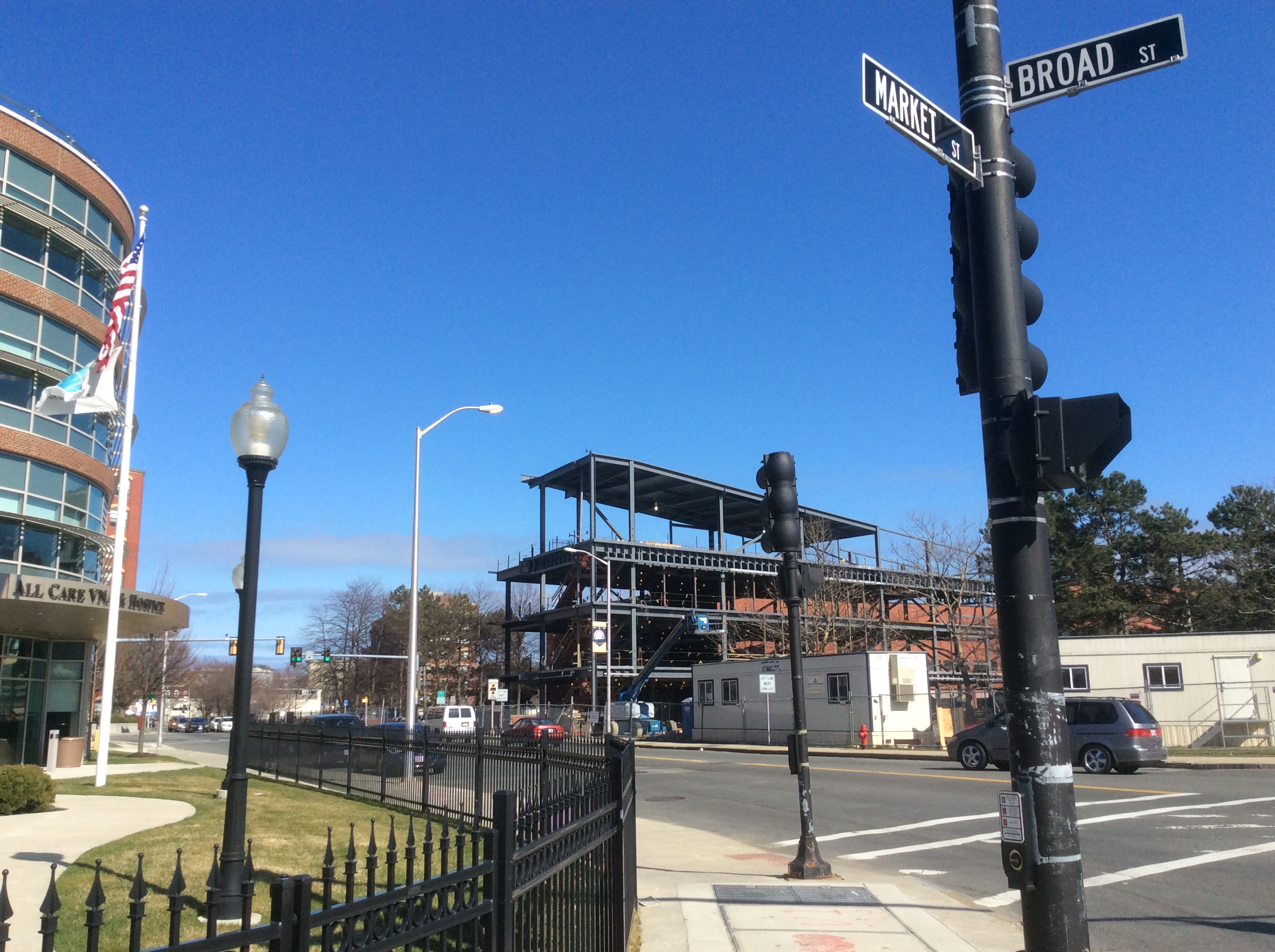
Market and Broad Streets, near the site of the first Douglass family home in Lynn, MA; their house would have been somewhere to the right of the iron structure
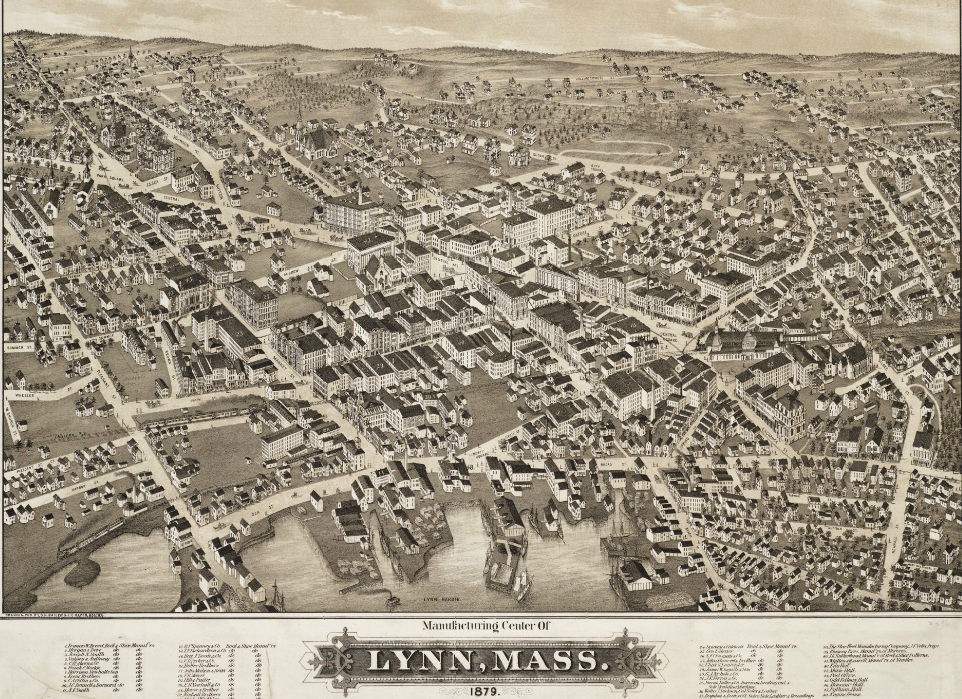
Manufacturing center of Lynn, MA, 1879, by Bailey, Oakley Hoopes & J.C. Hazen
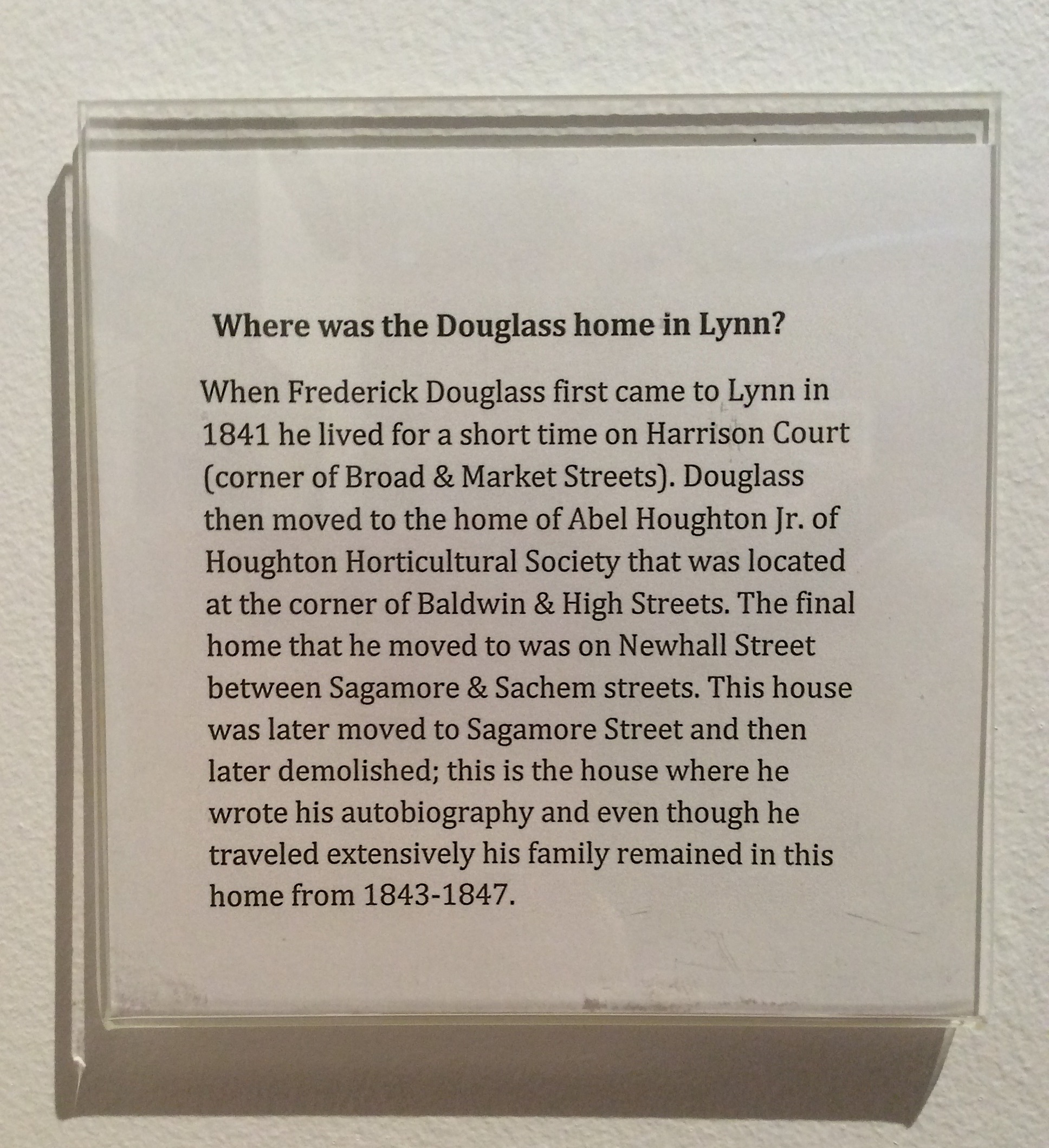
Douglass family homes in Lynn, MA, Lynn Museum & Historical Society placard
Then I head to the corner of Broad and Market Streets near the site of Harrison Court, where the first of the three Douglass family homes in Lynn used to stand. (I’m visiting the three Douglass home sites in chronological order).
There’s not much of historical interest here now: commercial buildings, broad highways, the big train station, and the iron skeleton of some new structure under construction. There are some great old photos of the area near Market and Broad Street at the Longyear Museum website’s Mary Baker Eddy photo gallery page; she lived a few blocks east of here at 8 Broad Street, and that home still stands. And if you look at these maps of Lynn from 1852 and from 1872, you can see where Harrison Court used to stand (I include both because, though the older one is closer to the Douglasses’ time here and more accurate for our purposes, the later one shows more detail when you zoom in). Look to the center bottom, just above the waterline and a little to to the right where two large streets come together in the point of a wedge. Click on that part to zoom in, and Harrison Court stood between the point of the wedge and the next main street running north and south to the left (Market), below Harrison St. Though none of the buildings from that time remain today, in any case, the modern openness of this place with the grassy Carroll Parkway, bright blue sky, and sea breeze is nice.
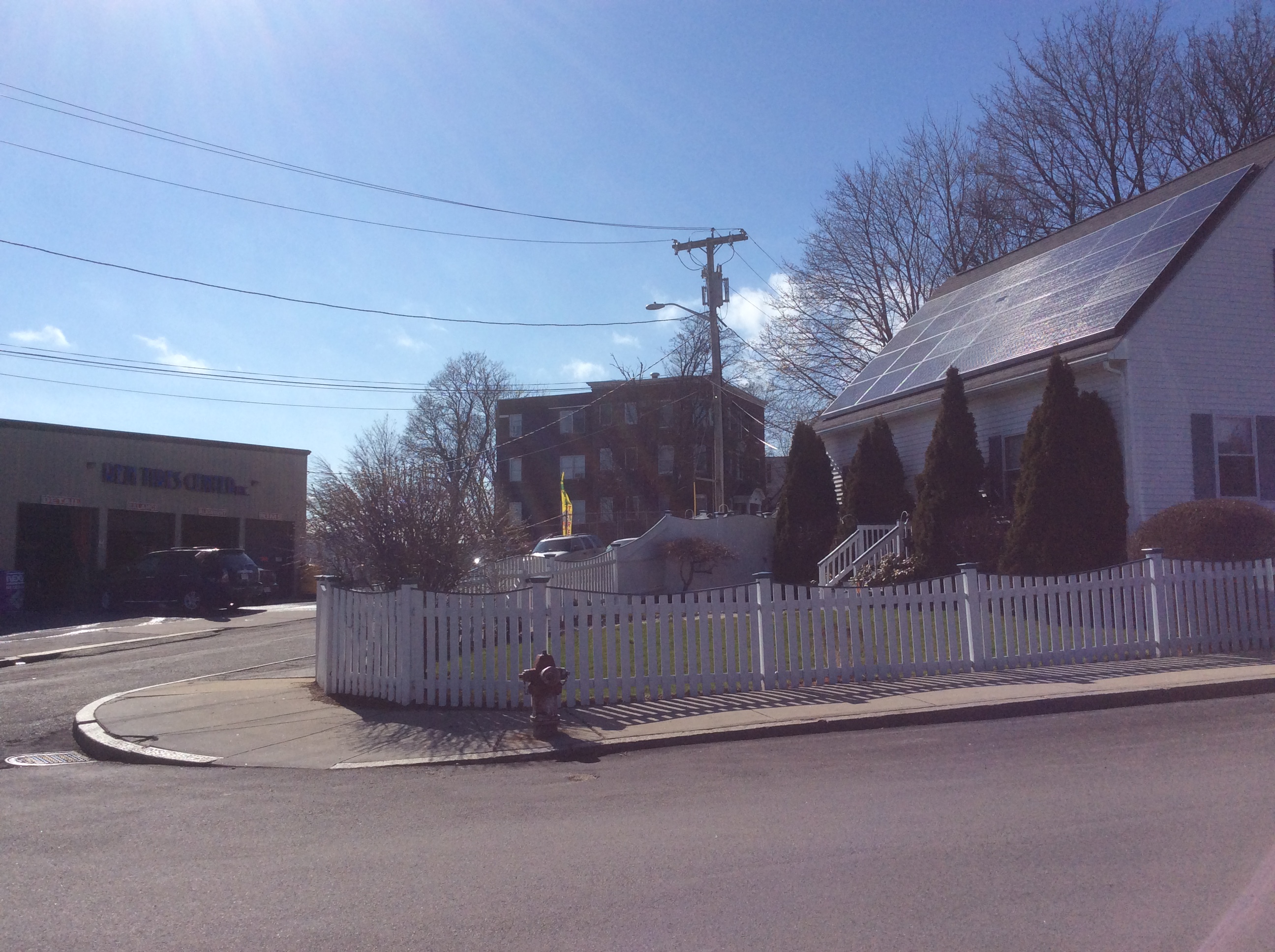
The unmarked V intersection at High and Baldwin (formerly Pearl) Streets, near site of Frederick Douglass’ second home in Lynn, MA
Then I take a brisk walk to my next destination, briefly east on Broad St then left (north) up Union St, then left again on Baldwin to the corner of Baldwin and High Streets. This is near the place where the Douglass family’s second home in Lynn used to stand. There are no street signs at all at this corner; missing street signs here and there is another reason I’ve been having a little trouble finding some places, hooray for GPS!) There’s now a tire and car care business, a white house with solar panels on its sharply pointed roof, and a three floor red brick building with arched windows. High and Baldwin streets meet here to make a ‘v’. The house, owned by Abel Houghton Jr., and where the Douglasses lived only briefly, stood somewhere near this corner. If you look at that 1872 map again), you can see the area where this house used to stand by following Union St from the point of that wedge where it meets Market to the northwest, then see where Pearl St (now Baldwin), meets it, running north and south with a crooked angle like a bent arm (Baldwin), High Street meeting it at the angle (inner elbow). Referring to the 1852 map, I don’t find the name of Abel Houghton Jr., or his Horticultural Society listed there, but it’s hard to read some of the names, or it may have changed hands in the approximate decade between between the time the Douglasses lived here and the time the map was drafted.

Newhall St between Sagamore and Sechem. The third Douglass family home in Lynn, from 1843-47, used to stand here where the parking lot is now. Douglass wrote his Narrative here in 1845
Then I head southeast on Silsbee St, which turns into Newhall St. I follow Newhall south to a stretch between Sagamore and Sechem Streets, where the third Douglass family home in Lynn once stood. This is where he wrote his Narrative, where his family lived while he was in the British Isles from August 1845 to April 1847, and where he returned home (after arriving in Boston on April 20th). When she saw me looking around and taking photos, a lady named Crystal (‘born and raised here!’) helpfully confirmed that the parking lot on Newhall between Santo Domingo liquor store and Sechem Streets, where Amity St ends, is the site where the Douglass home stood. As the old maps show, it’s where or about where someone named Chase lived. As the Douglass home placard in the Lynn Museum (see above) describes, it was moved once to Sagamore St nearby but eventually demolished.
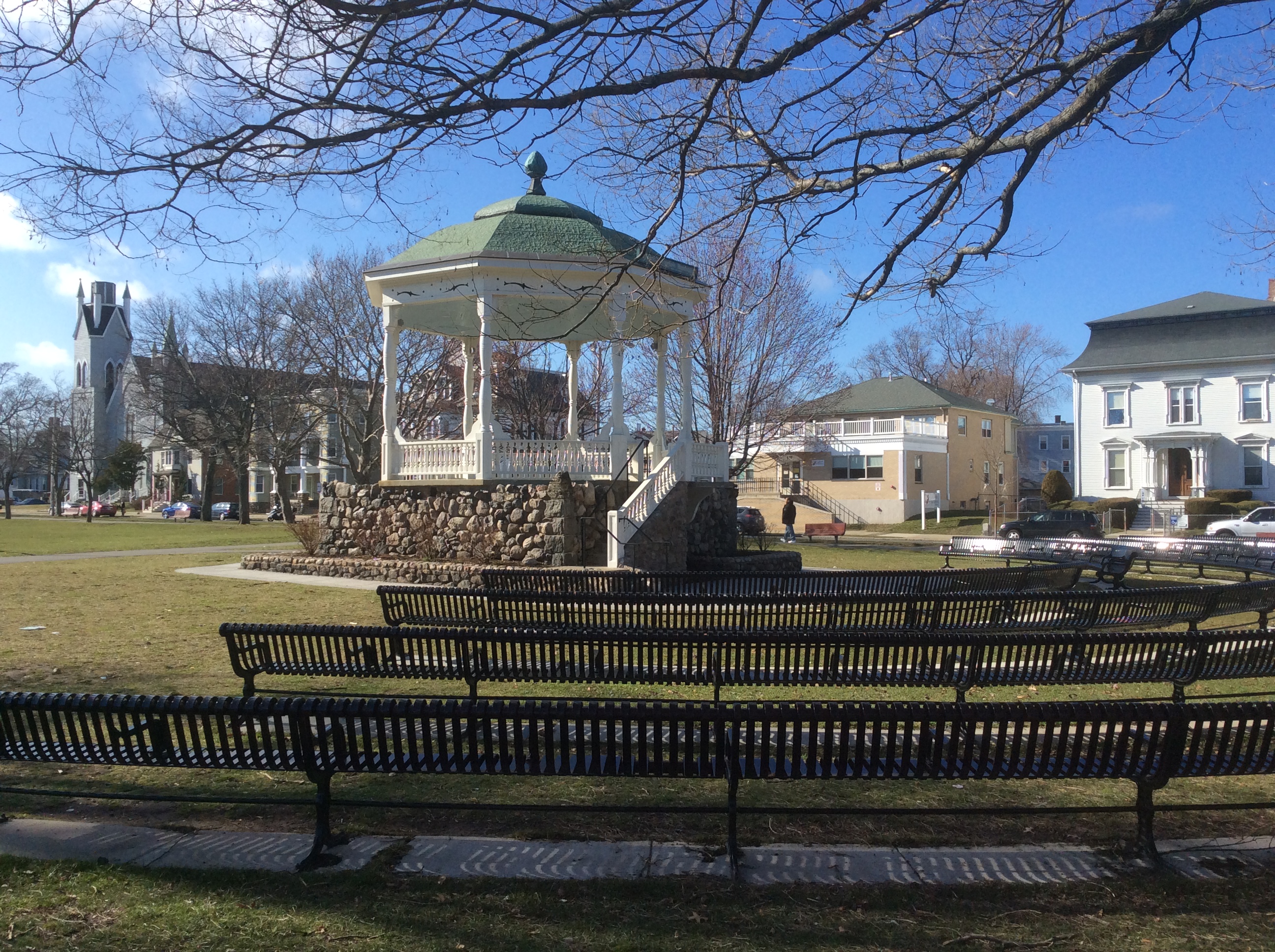
Lynn Commons Frederick Douglass Bandstand and Ampitheatre near Frederick Douglass memorial
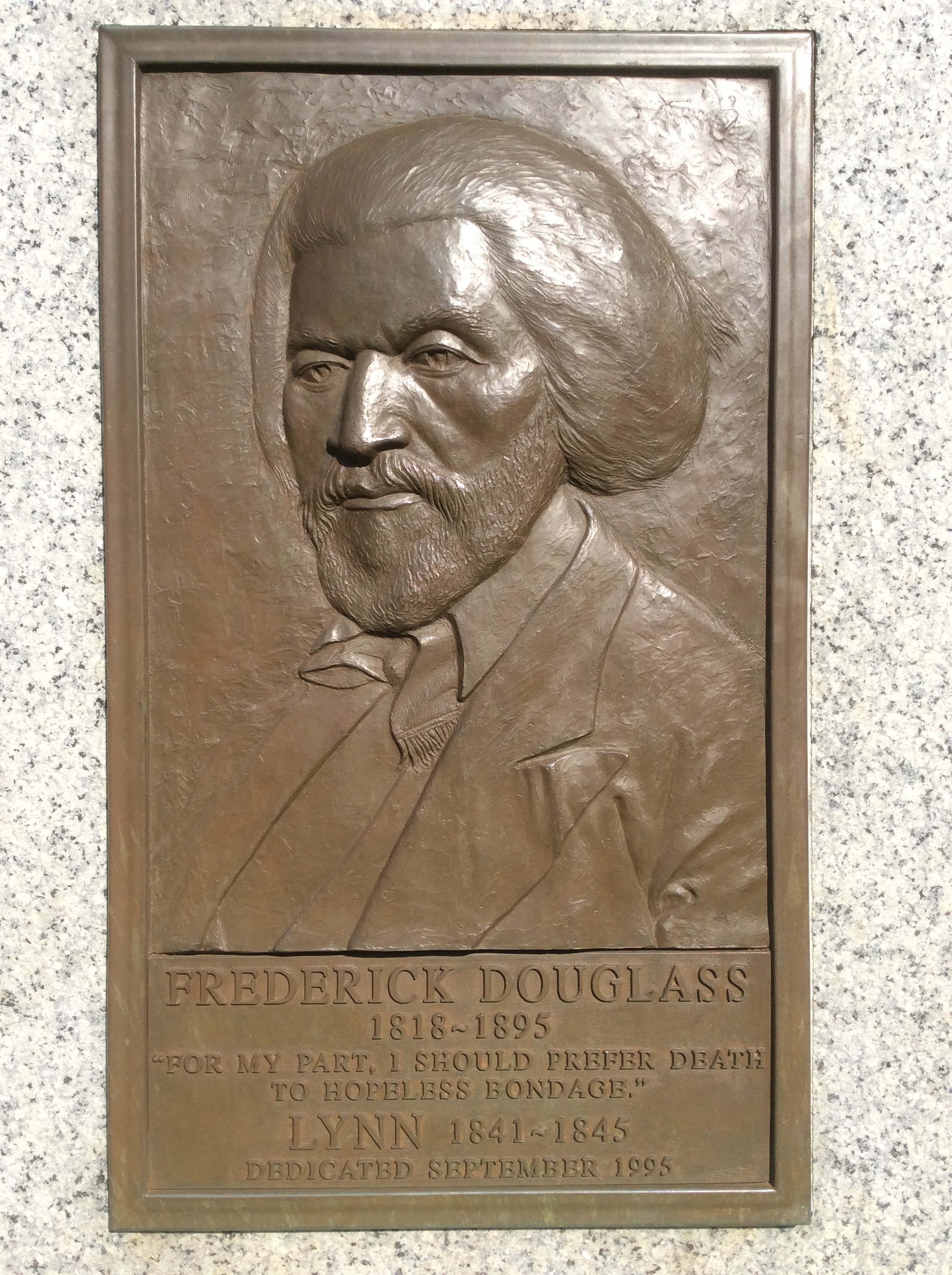
Frederick Douglass Memorial plaque in Lynn Commons
Then I return to the car and drive just over 5 minutes away to Lynn Commons, which runs between the one-ways streets of North and South Common, and park along South Common near Shepard St. I walk east on S. Common a little ways and turn left on the path that cuts across the park and ends at Harwood St on the other side. Halfway across the commons, before I would reach Harwood St, to my left, there’s a white raised gazebo surrounded by benches to create a little amphitheater, and on my right stands a stone and brass monument to Frederick Douglass.
The raised gazebo is the Frederick Douglass Bandstand, built in 1887 near the site where Douglass used to deliver many anti-slavery speeches here from an earlier structure, which was perhaps on or near the spot where the memorial is now.
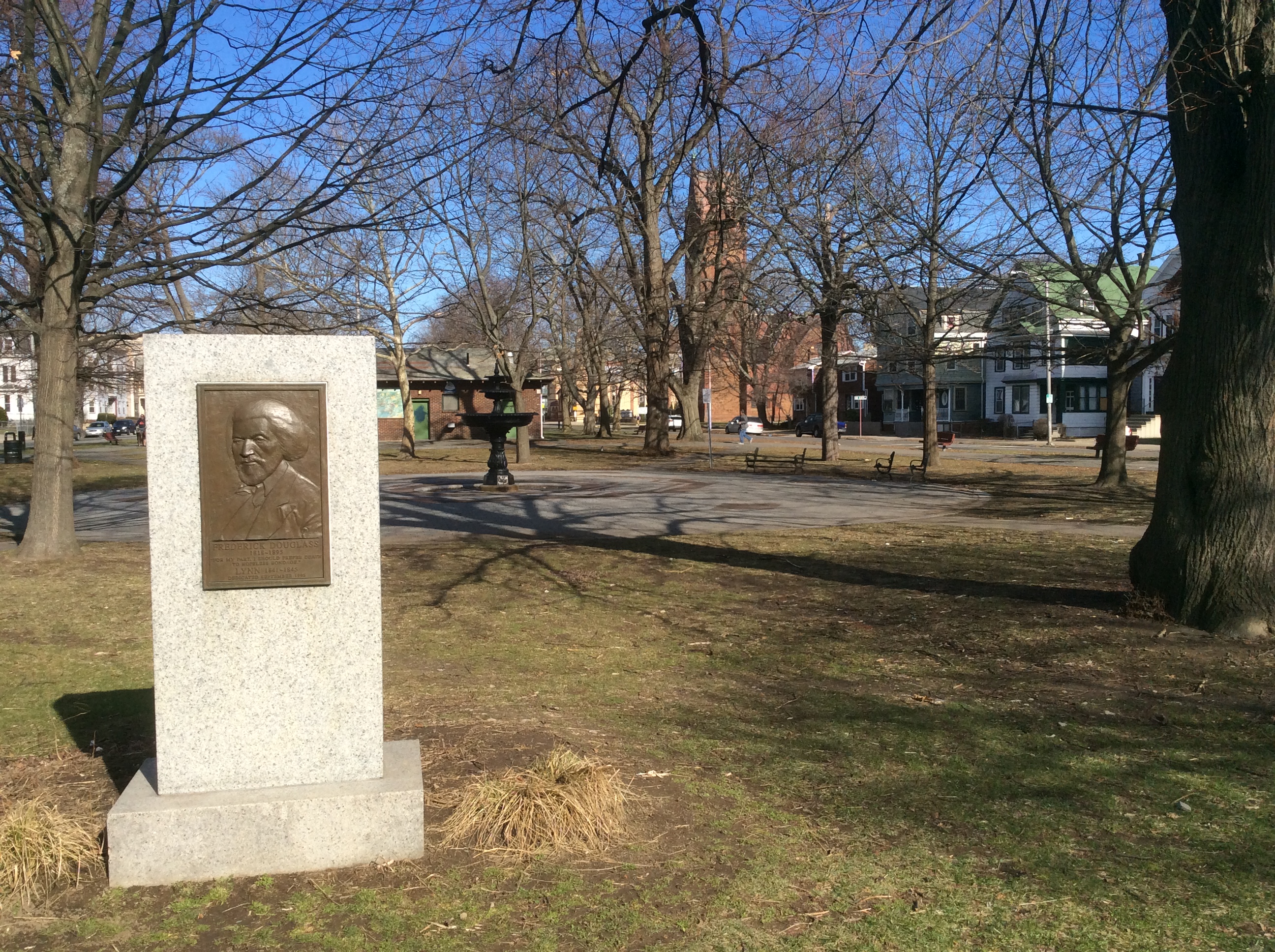
Frederick Douglass Memorial across from the gazebo in Lynn Commons
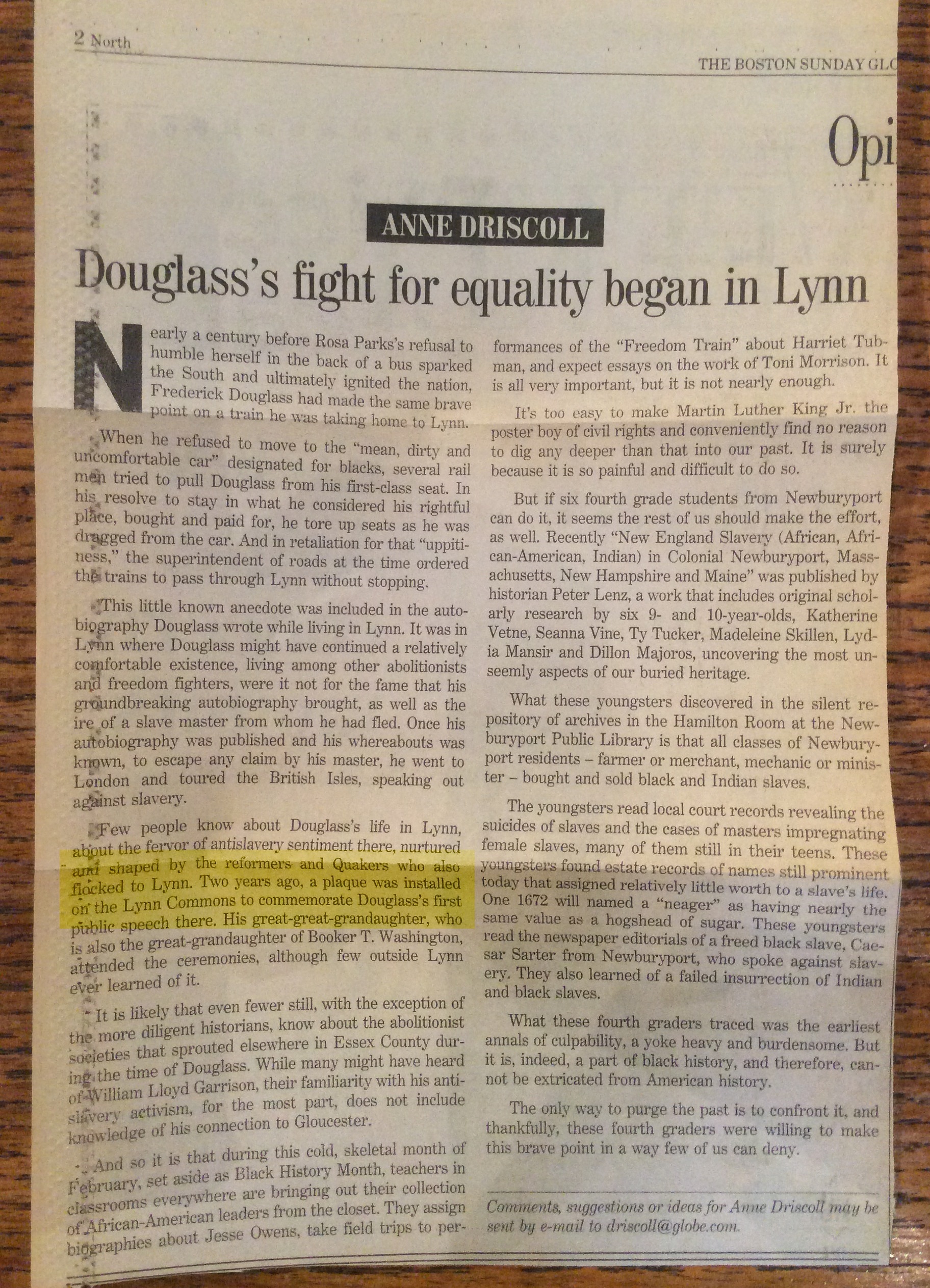
Boston Sunday Globe article about Douglass which mentions his plaque on Lynn Commons, clipping from the archives at Lynn Museum
So ends my eventful day in Lynn, Massachusetts, but really, there’s much more to come. Remember, I haven’t yet finished telling the whole story of today’s journey which includes a couple fascinating hours in the Lynn Museum and Historical Society this morning (soon to follow), and I’m only halfway through my trip, there are still seven days to go!
*Listen to the podcast version here or on iTunes
~ Ordinary Philosophy and its Traveling Philosophy / History of Ideas series is a labor of love and ad-free, supported by patrons and readers like you. Please offer your support today!
~~~~~~~~~~~~~~~~~~~~~~~~~~~~
Sources and Inspiration:
Bailey, Oakley Hoopes & J.C. Hazen, 1879 map of Lynn from the Norman B. Leventhal Map Center of the Boston Public Library
Blassingame, J. (Ed.). The Frederick Douglass Papers, Series One: Speeches, Debates, and Interviews. 4 volumes, and The Frederick Douglass Papers, Series 2: Autobiographical Writings. 3 volumes. New Haven and London: Yale University Press, 1979-1999
D.G. Beers & Co., 1872 map of Lynn from the Norman B. Leventhal Map Center of the Boston Public Library
Douglass, Frederick. The Life and Times of Frederick Douglass. Re-published 1993, Avenal, New York: Gramercy Books, Library of Freedom series.
Douglass, Frederick. My Bondage and My Freedom: 1855 Edition with a new introduction. Re-published 1969, New York: Dover Publications, Inc.
Fichter, David. Lynn Mural Project: Stories of Lynn, 50 ft. X 60 ft. Lynn, Massachusetts [Acrylic paint and mosaic]. From davidfichter.com
Foner, Philip S. The Life and Writings of Frederick Douglass, Vol. 1-4. New York: International Publishers, 1950.
‘Frederick Douglass Chronology‘. From Frederick Douglass National Historic Site District of Columbia, National Park Service website
Levine, David. ‘Lynne, MA: Frederick Douglass Bandstand‘. History Stands Still: The Background of Bandstands Throughout New England blog
Lewis, Alonzo. The History of Lynn: Including Nahant. (p. 257) Boston: Samuel N. Dickinson, 1844.
‘Lynn (MBTA Station)‘. In Wikipedia, The Free Encyclopedia.
McFeely, William. Frederick Douglass. New York: W.W. Norton & Company, 1991.
McIntyre, Henry. Plan of the City of Lynn Mass. from Actual Surveys, 1852. From the Norman B. Leventhal Map Center of the Boston Public Library
The Miriam and Ira D. Wallach Division of Art, Prints and Photographs: Photography Collection, The New York Public Library. Central Square and Depot: 1848 Central Square station in Lynn, Webster, William T., Publisher
Rosenberg, Steven A. ‘City Embraces its Civil War Connections. May 31, 2012. TheBostonGlobe.com
Walker, G.H. City of Lynn, Massachusetts, 1891. Atlas Map. Pub. Geo.H. Walker & Co. From David Rumsey Historical Map Collection at davidrumsey.com
‘Rededication of the Frederick Douglass Bandstand and Marker‘. General Orders, Issue 68, Sep 2015, Published at 58 Andrew St, Lynn MA
The Register of the Lynn Historical Society, Volumes 8-12, by Lynn Historical Society
David Hume, the Skeptical Stoic, by Massimo Pigliucci
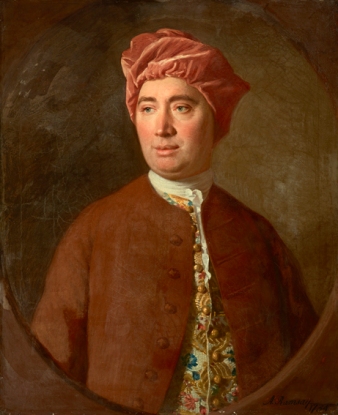 I have always been a philosophical fan of David Hume. His clear writing, commonsense approach to things, rejection of abstruse philosophizing, embracing of science, and constructive skepticism have been the sort of traits I have aspired to, however imperfectly (no, I assure you this ain’t false modesty), throughout my career. Hume’s idea that a wise person proportions beliefs to evidence, later popularized (and somewhat distorted) by Carl Sagan in the motto “extraordinary claims require extraordinary evidence” has guided me for many years, hopefully leading me to make as sound judgments as possible, as well as to change them when the cumulative evidence requires it. Add to this that le bonne David, as he was known in the Parisian salons of the Enlightenment, had a generally mild and pleasant character, and you get the features of an intellectual role model. A Stoic, however, David Hume certainly wasn’t. Or was he?
A recent article by Matthew Walker in the British Journal for the History of Philosophy (2013) tackles the question in an interesting way. Walker focuses on four essays in which Hume explores the nature of “the true philosopher,” simply entitled “The Epicurean,” “The Stoic,” “The Platonist,” and “The Sceptic.” Hume, who does not write in his own voice, but attempts an analysis of each school by writing as if he were a member (just like Cicero had done in his De Finibus, which Hume used as a model for his own essays), seems far more sympathetic to the Stoics and the Skeptics then to the Epicureans and the Platonists.
Walker, then, explores an apparent contradiction in the way Hume talks about Stoicism and Skepticism: on the one hand, he accepts the Stoic tenet that there is a way of life that the true philosopher attempts to follow, and that it is the best life possible. On the other hand, however, he also agrees with the Skeptics that there is no single way of achieving happiness. What gives? The answer, Walker suggests, lies in Hume’s flexible concept of how a true philosopher should live.
Let’s begin with Hume’s presentation of the Stoic point of view. It hinges on three theses: i) virtue-eudaimonism, the idea that virtue is the primary contributor to the happy life; ii) the reflection thesis, whereby the true philosopher guides his actions by reflection, the same way he develops and maintains his character; and iii) the supremacy thesis, the proposition that this is the best life for a human being.
Walker provides a nice analysis of Hume’s commitment to virtue-eudaimonism — the first of the three Stoic theses — albeit in a qualified fashion. He does think that the “sole purpose [of virtue] is, to make her votaries and all mankind … cheerful and happy,” but then distinguishes different virtues according to their specific contributions. So we have virtues that are immediately “agreeable” to oneself (cheerfulness and pride), those that free us from harmful behaviors (discretion, industry and frugality), virtues that are immediately good for others (wit), and those that are good for others in the long run (humanity, generosity, beneficence). Interestingly, Hume’s take come close to that of a minority opinion within ancient Stoicism, as expressed for instance by Panaetius, of whose thought Hume was aware.
Hume is also committed to the reflection thesis, the second one advanced by the Stoics. Here he takes a cue from a famous phrase by the poet Ovid: “A faithful study of the liberal arts humanizes character and permits it not to be cruel,” meaning that learning and reflection do make crucial contributions to a worthwhile human life. For Hume, philosophical reflection can help both negatively, by “extinguishing” violent passions, and positively, by improving our sensitivity to agreeable passions. Importantly, Hume doesn’t think that simply thinking about stuff improves our character and conduct, but he maintains that rational reflection can be used to change behavior and that, through repetition and habituation, one eventually can alter his character and disposition for the best. Needless to say, this is very similar to the Stoic doctrine of the gradual development and practice of virtue.
What about the supremacy thesis? That’s where things get interesting. Hume’s Skeptic answers the Stoic by saying that only a philosopher could be so blind as to think that the life of reflection is the only path to happiness. Plenty of people are happy by pursuing different lives, resulting in a type of pluralism that appears incompatible with the supremacy thesis. Moreover, Hume agrees with the Skeptic that the powers of philosophical reflection are limited, and so is their efficacy on strong passions like anger and ambition.
Hume attempts at synthesizing the two schools (just like Cicero’s before him), beginning with the contention that the Skeptic “carries the matter too far” in his criticism of philosophical reflection. Sure, one’s anger doesn’t go away because of one’s philosophizing, but critical reflection makes us see that anger is a destructive passion, therefore inducing us to take steps to curtail it, if not extinguish it. The Skeptic is right in thinking that reflection by itself cannot instill virtue, but the ancient Stoics did not think this either, hence their above mentioned developmental psychological account of virtue, from children before the age of reason to mature adults.
Also, Hume again agrees with the Skeptic that Stoicism can be used to conceal cold-heartedness and self-absorption, but counters that in effect those would be cases of bad Stoicism, as the philosophy itself only counsels a reasonable detachment from externalities, nothing more. Stoics, in other words, do not attempt to extirpate passions, but to moderate and redirect them.
The core of Walker’s argument, however, is that Hume reconciles Stoic and Skeptic positions, rescuing the supremacy thesis, by suggesting that there are two types of “philosophical” lives: narrow and broad. Walker’s analogy with religion here is brilliant and very helpful: we have no trouble understanding that religion can guide, and be central to, the lives of people. But we don’t translate that into the absurd idea that everyone should be a monk. Rather, we recognize a religious life narrowly defined, which is attractive to a few people, who achieve a meaningful existence through contemplation, prayer and the study of scriptures. But we also recognize a broadly defined religious life, which is practicable by most people, which still provides meaning and requires certain practices and studies, but that is also compatible with a number of other, non-religious aspects of existence. This is the case across religious traditions, from Christianity to Buddhism.
Analogously, says Hume, a few people can live the life of the philosopher in the narrow sense, i.e., spend most of their time reading and writing philosophy at a fairly abstract level, treating it almost as a monastic practice. But most of us can live a “philosophical” life in the sense of reading and reflecting about certain principles and attempting to put them into everyday practice, while at the same time engaging in other, more common, pursuits, what the Stoics call “preferred indifferents.”
The Stoic position, then, becomes untenable for Hume if they meant that only the narrow philosophical life is conducive to happiness. But they clearly did not. Just like there were Stoics who did live that life — Zeno, Chrysippus, Musonius Rufus, Epictetus — there were others who lived a Stoic life in the broad sense, including Cato and Marcus Aurelius.
As Walker concludes his essay, his analysis shows both that Hume keeps being fresh and relevant today, and that a Humean account of Stoicism-Skepticism demonstrates “how the ancient conception of philosophy as a way of life remains a conception worth examining even today.”
~ This piece was originally published on Massimo’s blog How to Be a Stoic on April 22, 2016
~ Massimo Pigliucci is K.D. Irani Professor of Philosophy at the City University of New York and member of the faculty at CUNY’s Graduate Center. Massimo has a background in evolutionary biology and philosophy of science. His most recent book, co-edited with Maarten Boudry, is Philosophy of Pseudoscience: Reconsidering the Demarcation Problem (Chicago Press).
~ Ordinary Philosophy and its Traveling Philosophy / History of Ideas series is a labor of love and ad-free, entirely supported by patrons and readers like you. Please offer your support today!
New Podcast Episode: Frederick Douglass Boston Sites
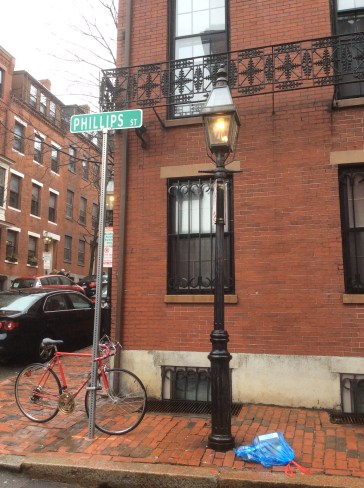
I commence my Frederick Douglas Boston journey on Phillips St, and long for my bike. Mine is blue. Sigghhh
Listen to this podcast episode here or subscribe on iTunes
Sixth Day, Friday March 25th
As I am quick to discover, parking is at a premium in central Boston and its environs. I’ve decided not to pay the high garage rates and stick with metered parking (reasonably priced but harder to find). It’s to be expected in an awesome, busy, historically important city, of course, just be prepared! It’s such a handsome city, so much to look at, and I long for my bike: fleet, nimble, with uninterrupted view, parkable anywhere there’s a pole. At times such as this, a car feels like little but an expensive burden.
Frederick Douglass never did live here in Boston, but this city has many connections with his life: he and his family lived just a few miles north of here in Lynn from 1841-47. Douglass visited, worked, and spoke here often, and the Boston Anti-Slavery Society published his Narrative which, combined with his speaking tour of the British Isles and the United States that followed, catapulted him to fame and made him the leading African American abolitionist of his time… Read the original account here
Ordinary Philosophy and its Traveling Philosophy / History of Ideas series is a labor of love and is ad-free, entirely supported by patrons and readers like you. Please offer your support today!
New Podcast Episode: Frederick Douglass New Bedford, Massachusetts Sites
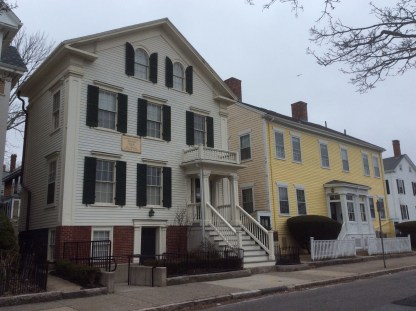
Nathan and Polly Johnson House (and adjoining) at 21 Seventh St, New Bedford MA, 2016 Amy Cools
Listen to this podcast episode here or subscribe on iTunes
Fifth Day 5, Thursday March 24th
When I arrive in the old whaling town of New Bedford, Massachusetts, it’s overcast and very chilly. I had so enjoyed the respite from the cold in New York City’s balmy weather I was already a little spoiled. But I’m wearing lots of wool and my shearling boots, so I think I’m prepared. I start with the New Bedford Whaling National Historical Park visitor center, run by the National Park Service. Several of the town’s buildings of historical interest are also preserved by the NPS, including one of particular interest for my journey today. The visitor center is housed in the Old Third District Courthouse constructed in 1835, a handsome Greek Revival building.
I’m assisted by the kind and knowledgeable Diane Altman Berube, and when I describe the purpose of my trip, she immediately supplies me with information, advice, a map, some pamphlets about Frederick Douglass, the town’s Underground Railroad and abolitionist history (a strong one!), and another about the 54th Regiment of the Union Army and an accompanying collection of cards, like baseball cards, with images and stories of men involved…
… Read the original account here
Ordinary Philosophy and its Traveling Philosophy / History of Ideas series is a labor of love and ad-free, entirely supported by patrons and readers like you. Please offer your support today!
New Podcast Episode: Frederick Douglass New York City Sites
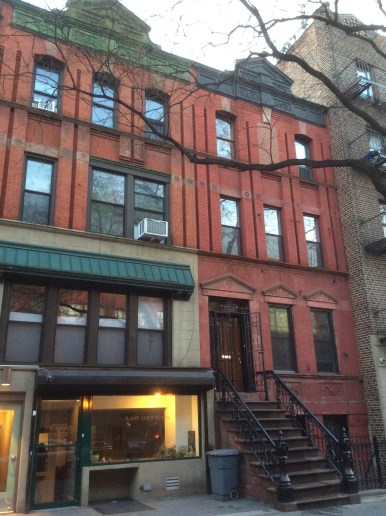
230 and 232 W. 135th St, Harlem, New York City
Listen to this podcast episode here or subscribe on iTunes
Fourth Day, Wednesday March 23rd
I arrived yesterday afternoon in New York City and had a good hangout with my friend with whom I’m staying (thanks, Devin!).
After doing more research and mapping out today’s journey, I head to my first destination. I take the subway to lower Manhattan to the Brooklyn Bridge stop, zigzag my way southeast to Wall and William Streets, then down to S. William St. Wall Street was the northern border of the city when it was still young, so I decide it’s as good a way as any to get a feel for the old city, though really, the truly old intact buildings in NYC are scattered, and few. I’m only looking back to the 1830’s for this trip, but as you may know or may remember from my earlier series on Ernestine Rose and Elizabeth Cady Stanton, this city has a long history of tearing everything down regularly and starting fresh…
… Read the original account here
Ordinary Philosophy and its Traveling Philosophy / History of Ideas series is a labor of love and ad-free, entirely supported by patrons and readers like you. Please offer your support today!
New Podcast Episode: Frederick Douglass Havre de Grace and Philadelphia Sites
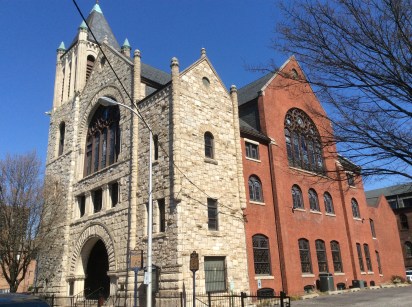
Mother Bethel A.M.E. Church, Old City Philadelphia
Listen to this podcast episode here or subscribe on iTunes
Third day, Tuesday March 22nd
I head north, the direction of freedom for the American slave of the antebellum south. Spoiler alert: so did Frederick Douglass! To his and all of our great benefit, he took his life and whatever fortunes he could hope to enjoy in Maryland into his own hands, and made his risky bid for freedom in September 1838 at age 20.
Douglass was a particularly clever young man, and by this time, had educated himself to an impressive degree for anyone his age, let alone one who had to get his learning on the sly while working more than full time. He had honed his skills, become more resourceful, and gained a wider circle of friends, and he counted on all of these to make this attempt more successful than the first…
… Read the original account here
Ordinary Philosophy and its Traveling Philosophy / History of Ideas series is a labor of love and ad-free, entirely supported by patrons and readers like you. Please offer your support today!
New Podcast Episode: Frederick Douglass’s Birthplace, Easton, and St Michaels, Maryland’s Eastern Shore Sites
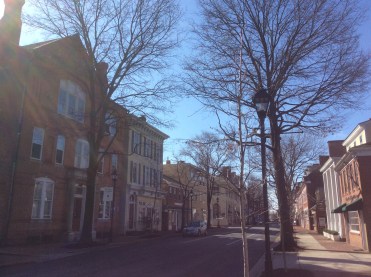
Easton, MD on a bright spring morning in March
Listen to this podcast episode here or subscribe on iTunes
Second day, Monday March 21st
I wake up early, and make my way to Maryland’s east shore, looking forward to a beautiful day in the country. It’s windy and very cold, but clear and sunny. I head for downtown Easton: the route from there to my first destination is easiest to follow for a non-local like me. And I can use all the help I can get: this will be the first site I visit in any of my history travels where I will rely both on maps that predate the turn of the 20th century and natural landmarks to locate it.
… Read the original travel account here and here (originally published in two installments)
Ordinary Philosophy and its Traveling Philosophy / History of Ideas series is a labor of love and ad-free, entirely supported by patrons and readers like you. Please offer your support today!
Frederick Douglass Boston Sites

I commence my Frederick Douglas Boston journey on Phillips St, and long for my bike. Mine is blue with upright bars for better sightseeing. Sigghhh.
Sixth Day, Friday March 25th
As I’m quick to discover, parking is at a premium in central Boston and its environs. I’ve decided not to pay the high garage rates and stick with metered parking (reasonably priced but harder to find). It’s to be expected in an awesome, busy, historically important city, of course, just be prepared! It’s such a handsome city, so much to look at, and I long for my bike: fleet, nimble, with uninterrupted view, parkable anywhere there’s a pole. At times such as this, a car feels like little but an expensive burden.
Frederick Douglass never did live here in Boston, but this city has many connections with his life: he and his family lived just a few miles north of here in Lynn from 1841-47. Douglass visited, worked, and spoke here often, and the Boston Anti-Slavery Society published his Narrative which, combined with his speaking tour of the British Isles and the United States that followed, catapulted him to fame and made him the leading African American abolitionist of his time.
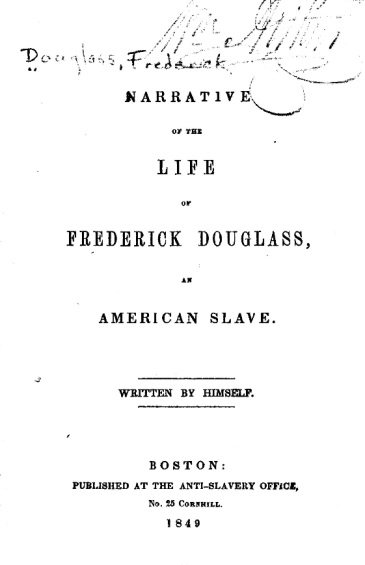
Narrative of the Life of Frederick Douglass, published by Boston Anti-Slavery Society, image: Library of Congress. It was published on Cornhill St which no longer exists, but I passed near its old location while walking through City Hall Plaza
As I discussed an earlier piece on Frederick Douglass and the Constitution, Douglass had a falling-out over time with the abolitionist movement of William Lloyd Garrison in the early 1850’s. The Garrisonians rejected the Constitution as a pro-slavery document and as a result, considered the government unjust and therefore illegitimate; Douglass came to believe that the Constitution, if interpreted correctly, is an anti-slavery document, and the government must be reclaimed from its pro-slavery element by seizing power through political channels if possible, through violence if necessary. The advent of the Civil War changed everything; in the face of this monumental upheaval and national crisis, political and theoretical disagreements no longer seemed so important. (Douglass demonstrates, to my mind, that one can be fully both a fiery revolutionary and a pragmatist.)
In November of 1861, the Emancipation League organized in Boston, where Douglass, the followers of Gerrit Smith (who influenced Douglass to reexamine the way he interpreted the Constitution) and the Garrisonian abolitionists formally reconciled so they could rally and unite their efforts in the cause of the Civil War cause for national union and the end of slavery. Try as I might, I’m unable to locate any exact addresses where they assembled, though I find many newspaper accounts from the time announcing their meetings and relating their activities in Boston and elsewhere. These activities included petitioning the Senate to commence emancipation efforts in earnest.
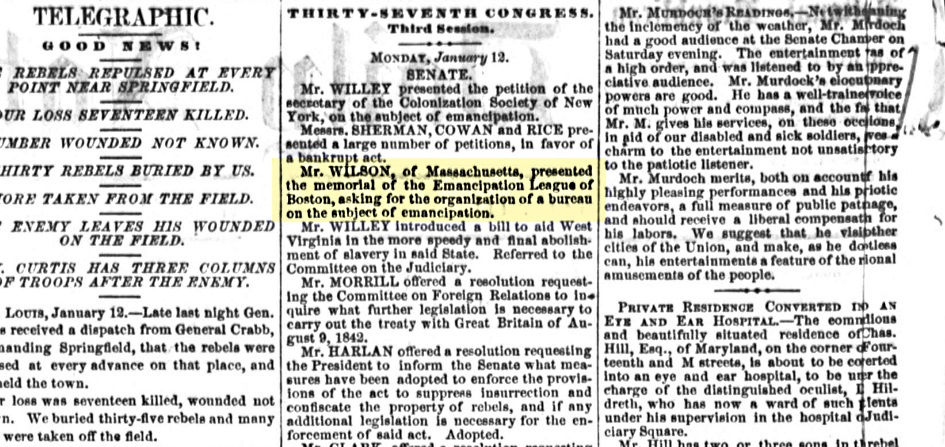
From the Daily National Republican, January 12, 1863 2nd edition from Chronicling America, Library of Congress
I begin my day’s journey by heading up Beacon Hill, where many of Boston’s abolitionists and black people settled, to 43-47 Phillips St, one block north of Cambridge between Grove and Anderson. I start here for efficiency’s sake since it’s right up the way from the coffee shop where I’m marking out my map with some new details I’ve just learned. However, it doesn’t make sense to start my story here since what happens at this site is the second part of a two-part event, so I’ll tell you about it shortly.

Museum of Afro-American History in front of the African Meeting House, Beacon Hill, Smith Ct, Boston
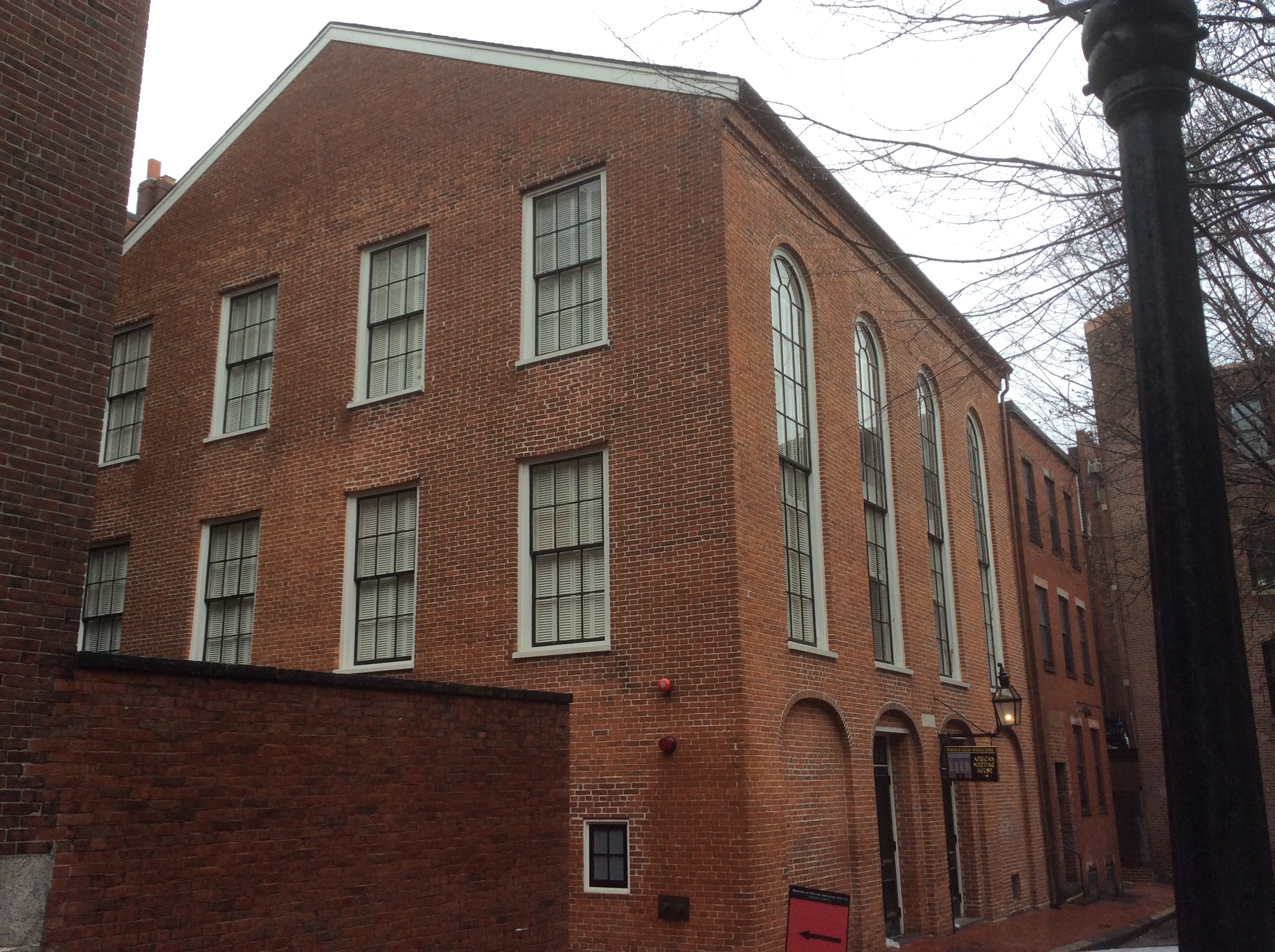
African Meeting House, the oldest black church in America
Then I head east on Phillips, turn right (south) on Irving, left on Myrtle, left on Joy, to Smith Court which heads off to the left from Joy St between Cambridge and Myrtle. The African Meeting House stands at the end of Smith Court just behind the Museum of Afro-American History at 46 Joy St. The Meeting House was built in 1806 ‘…to house the first African Baptist Church of Boston (a.k.a. First Independent Baptist Church) and it is now the oldest extant black church building in America’ according to the National Park Service, which maintains it and many other Black Heritage sites here on Beacon Hill. Douglass, William Lloyd Garrison, Wendell Phillips, and Sarah Grimke all spoke here at the African Meeting House, and for those in this list of people I haven’t talked about yet in my account, they will feature later on. There’s a guided tour you can take in season (I’m here too early in the year for that) or the self guided tour. I wish I had another day to visit all the site, including the guided tour of the Meeting house which is actually available today but I’d have to wait till the next available time (which, sadly, I run out of). Next time I’m in Boston…!
There are a great few things about traveling to historical places in the off-season: the crowds are light and you can get better pictures, it’s cheaper to fly, and it’s a bit easier to park (the fact that I can hope to find street parking at all is pretty good, and I didn’t get a ticket either time my meter expired). But, the weather can be iffy, the trees are bare, and some places are closed or have very limited hours. So, you have to decide if the trade-offs are worth it.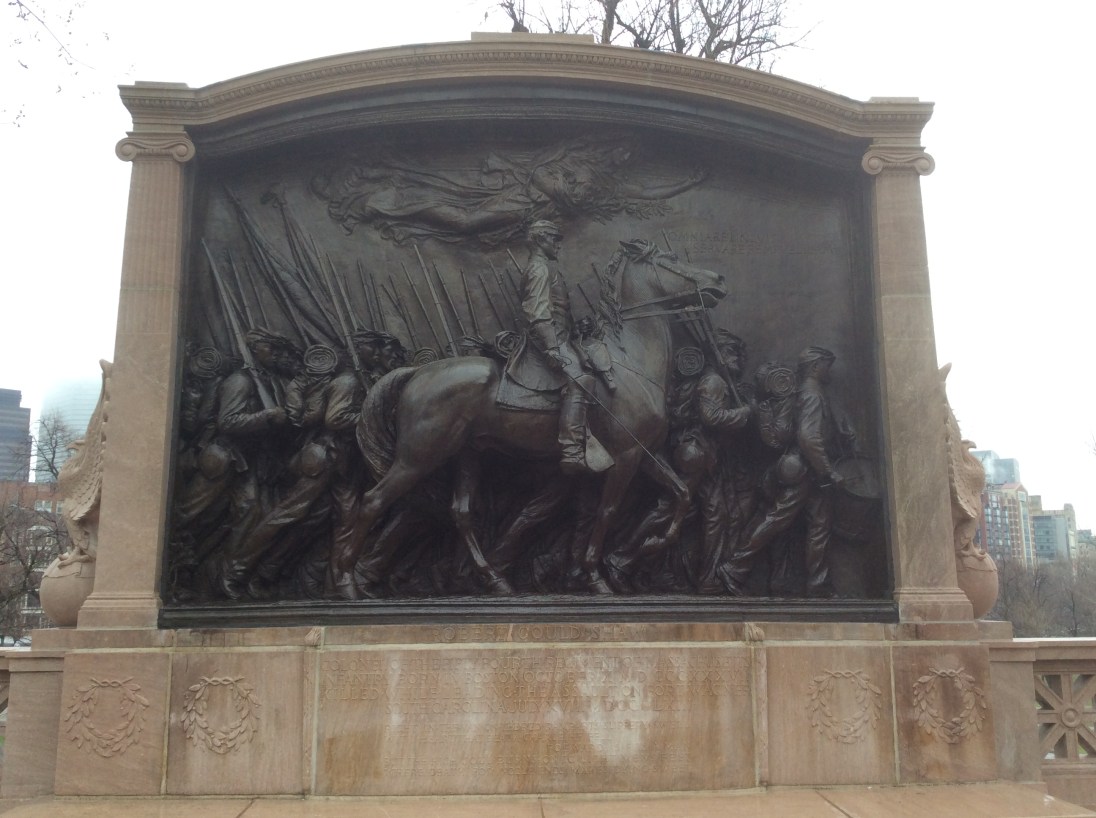
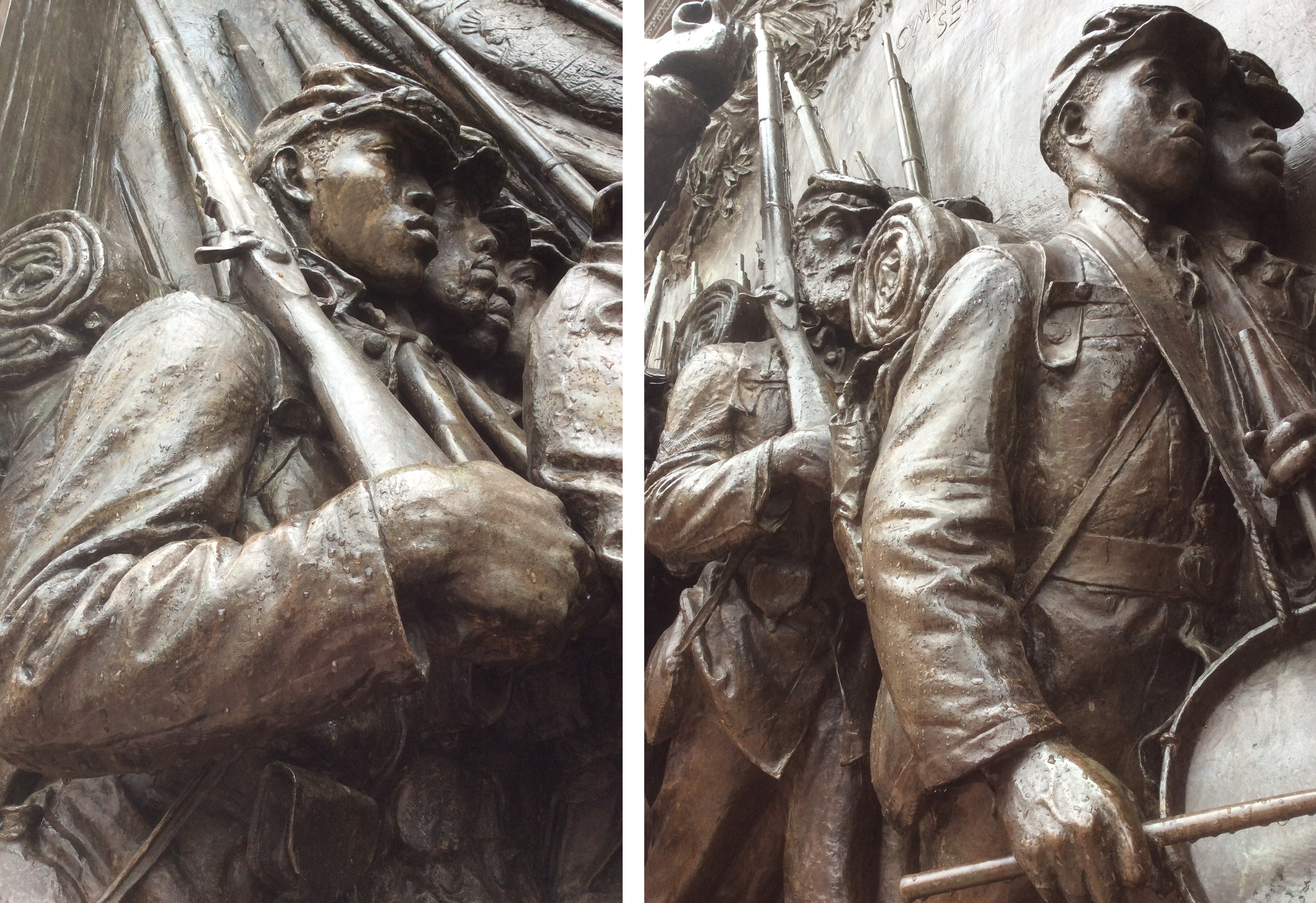
Two closeups of the 54th Regiment Memorial at Boston Common. What determination is expressed in these sculpted faces!
Then I turn back and head south to Boston Common, to the 54th Regiment Memorial on Beacon St at Park, near the park’s northeast corner. On May 28 1863, the Massachusetts 54th Infantry Regiment of 1000 troops marched triumphantly into Boston Common. It was the first black regiment to be raised in the North. As discussed in my post from yesterday’s travels to New Bedford, Douglass was instrumental in the fight to get Abraham Lincoln to authorize and federally fund black troops’ enlistment in the Union Army, and Douglass’ two sons Lewis and Charles enlisted to fight in this regiment. What a proud papa he certainly was!
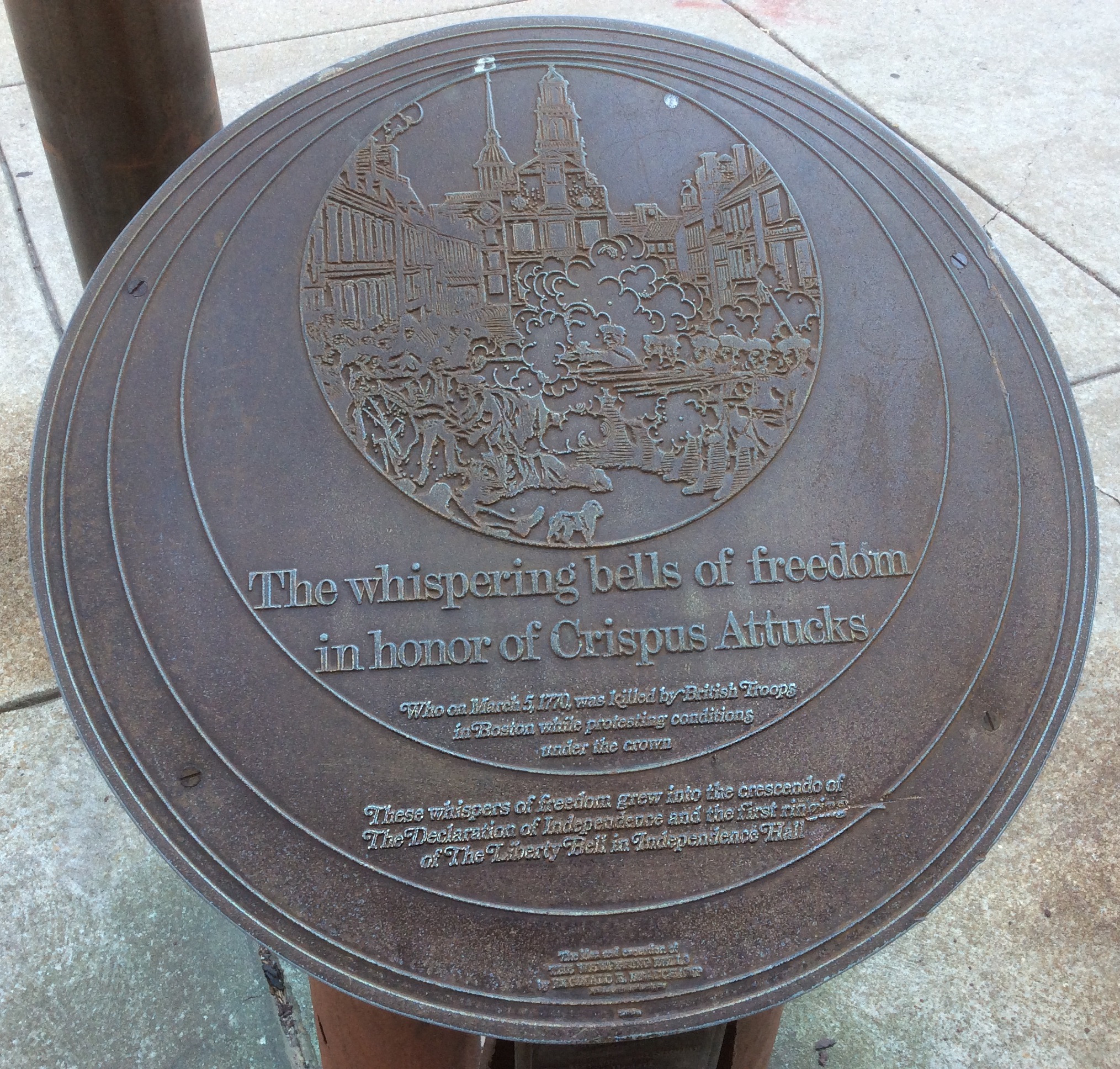
Plaque honoring Crispus Attucks, at Philadelphia’s African American Museum
The 54th Regiment continued their march from Boston Common on to Battery Wharf (which I will also do soon), passing the site of the Boston Massacre. That incident, where a colonial mob dared British guards to fire on them until they did, happened outside of the Old State House, at Congress, Court, and Washington Sts. (John Adams successfully defended most of the British soldiers. Though he was as ardent a patriot as you could find, he was also a man of high integrity and made the legally sound argument and fair point that if a large mob attacks a small number of armed guards, they are duty bound to defend themselves, whatever side they’re on. Crispus Attucks, a man of African and Native American ancestry, was mortally wounded in that scuffle 0n March 5th, 1770, and is often regarded as the first American casualty of the American Revolution. When I passed by Philadelphia’s African American Museum a few days ago, I snapped a photo of his memorial plaque there, knowing I would soon visit the site of his death.
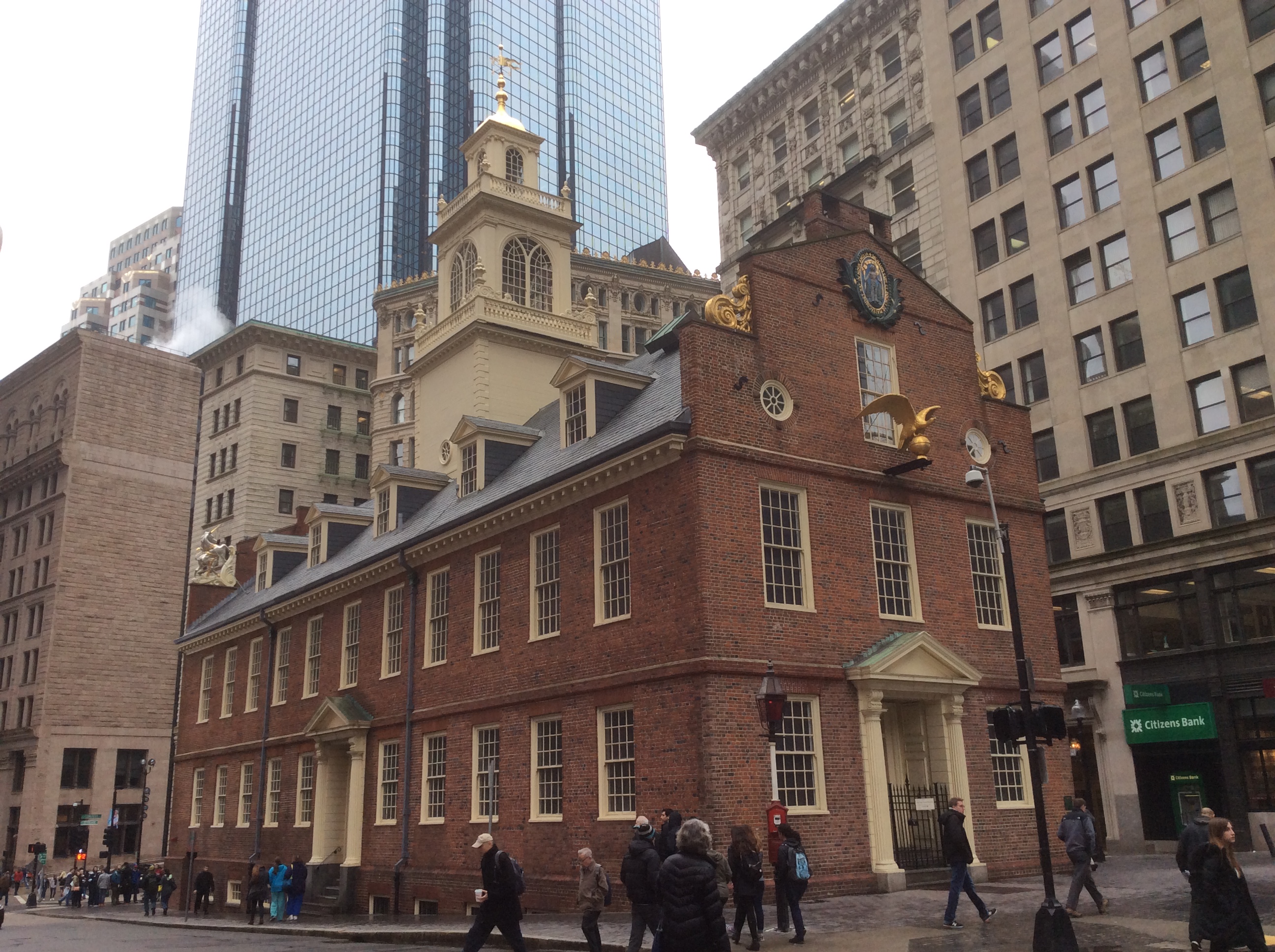
The Old State House in Boston Massachusetts, site of the Boston Massacre and of debates over whether the colonies should rebel against Britain
Back to the story of the 54th Regiment: Douglass was also active in recruiting efforts, believing that enlistment in the Union army, made possible by the Emancipation Proclamation, would give black people their chance to prove themselves as the strong, brave, patriotic, true Americans he knew them to be, and their participation in the war would establish their full right to citizenship once and for all. Unfortunately, black soldiers faced unfair and degrading treatment in the Union Army: lower pay than whites, less weapons and equipment, no chances for promotion, assigned the most dangerous and menial jobs, and so on. Many black soldiers, joined by the 54th’s white commander and son of wealthy Boston abolitionists Robert Gould Shaw, refused pay until it was equal, which was granted the next year. The South also imposed terrible penalties for captured black Union soldiers and anyone leading them: immediate execution, same as for insurrectionists. To his great credit, Shaw accepted no pay and braved the same risk of execution along with the rest of his regiment. In response to the poor treatment of black soldiers, Douglass stopped recruiting for awhile.

Tremont Temple, the very ornamental building on the right, Boston, Massachusetts
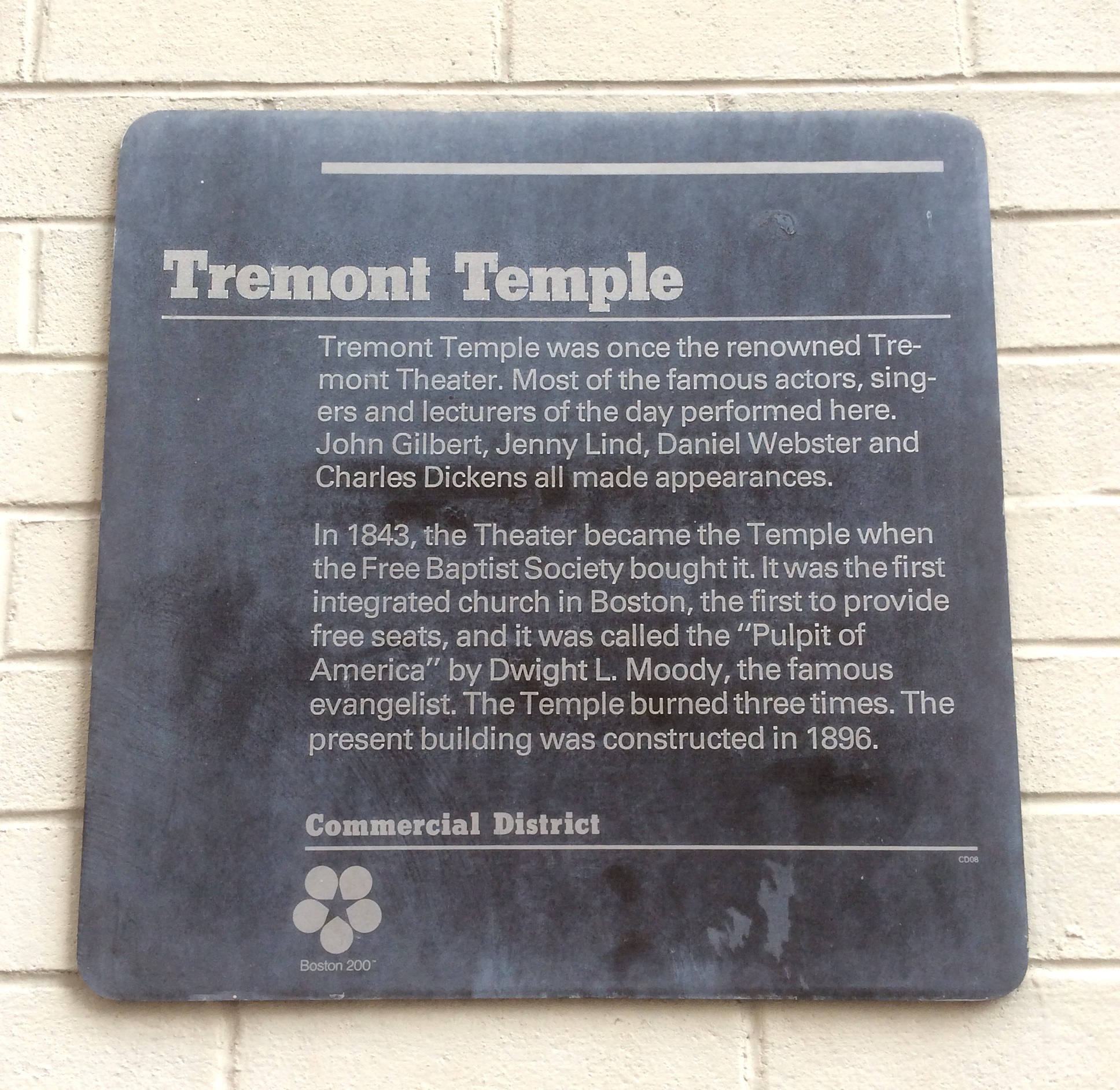
Then I wind my way east of Boston Common to 88 Tremont St, between Bosworth and School, to Tremont Temple. From December 31st, 1862 through the next day’s New Year holiday, Union Progressive Association and about 3,000 attendees, abolitionists, and human rights advocates gathered to greet the official announcement of the Emancipation Proclamation, and Douglass spoke at this event.
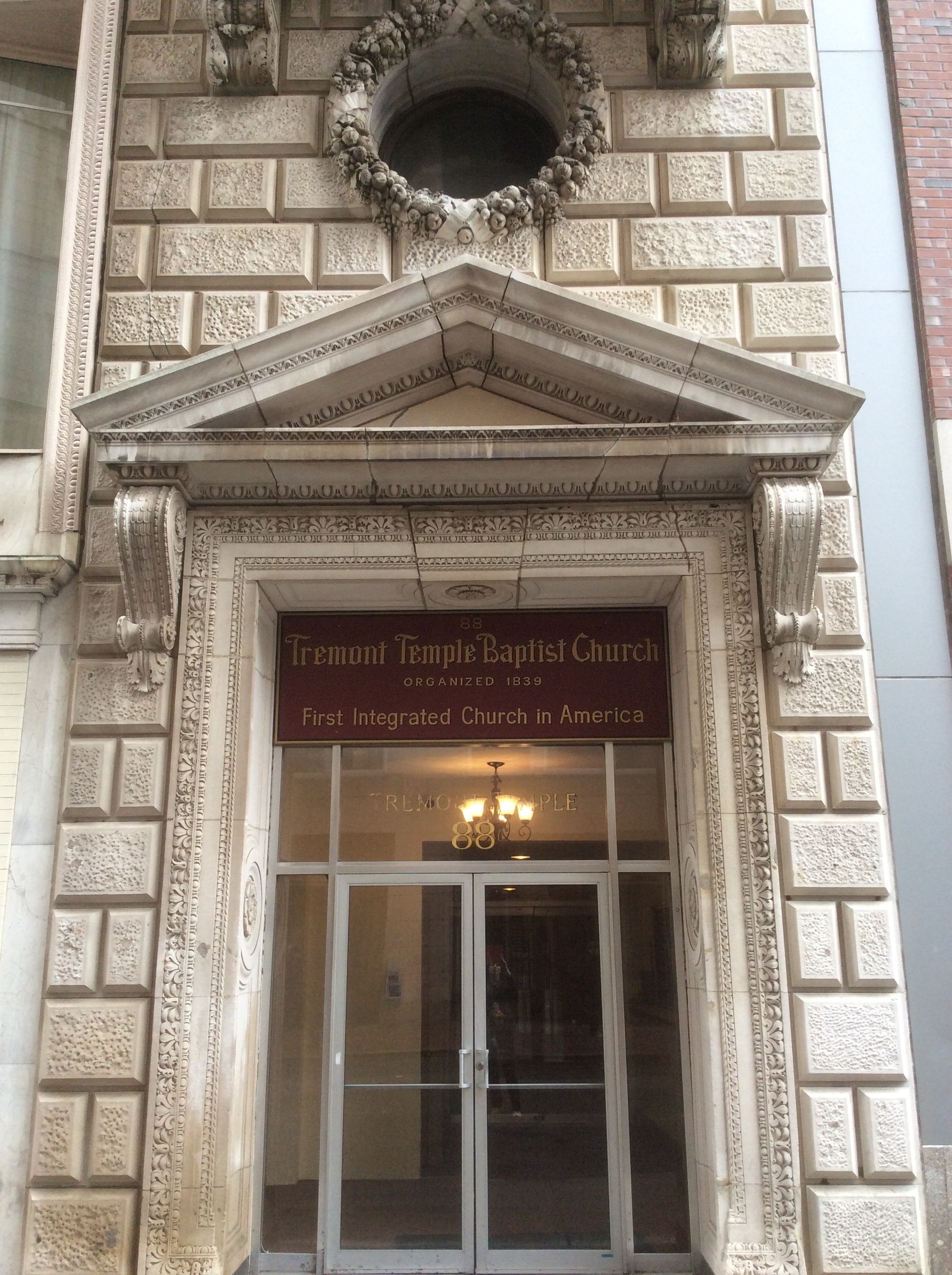
Tremont Temple doorway, ‘First Integrated Church in America’
Douglass had spoken here before, and at one time was roughed up when the recent election of Abraham Lincoln inflamed pro-slavery violence against abolitionists, even in relatively anti-slavery Boston. The Temple structure now here dates to 1896, replacing the original 1827 fire-damaged, much smaller building. Many years later, in 1893 (still in the old building), Douglass’s friend and inspiration Ida B. Wells delivered a lecture on lynching here at Tremont Temple; as discussed in my account of following Douglass in NYC, she inspired his anti-lynching activism later in life.
After the Union Progressive Association’s celebration of the Emancipation Proclamation, the party left Tremont Temple, since it closed at midnight, and moved the meeting to Twelfth Baptist Church. After fighting, working, and hoping for such a proclamation for so long, the party was not to end anytime soon, not until the wee hours at least.

43-47 Phillips St, former site of Twelfth St Baptist Church in Boston
I’ll backstep a bit here: remember the first site I visited today, on Phillips Street? That’s where the Twelfth Baptist Church (where the Emancipation Proclamation celebration continued) used to stand, founded by former congregants of the African Meeting House, at number 43-47 Phillips St, a little over a half mile away on the other side of Beacon Hill.
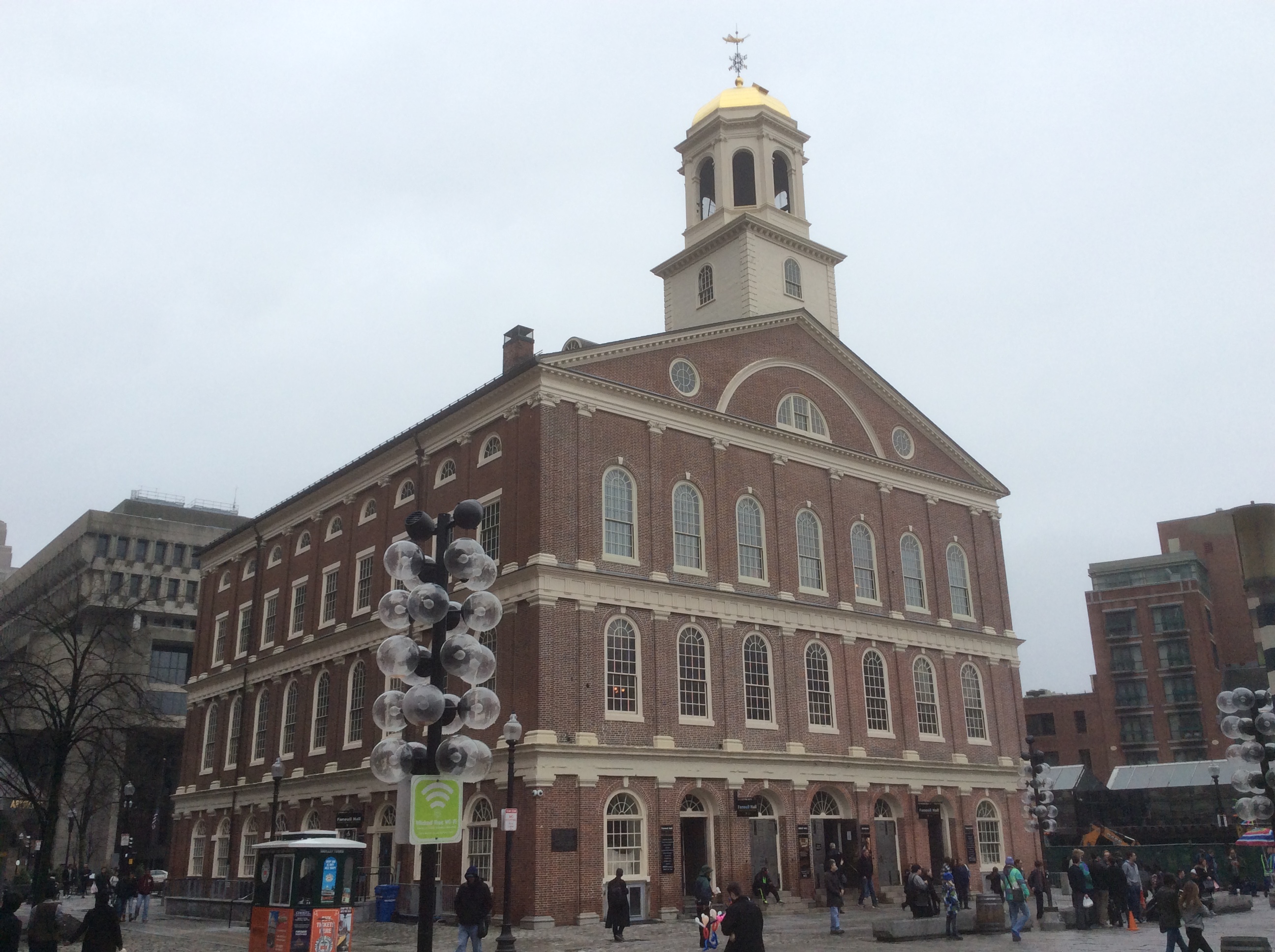
Faneuil Hall, Boston, Massachusetts
Then I head a little less than half a mile away in (kind of) the opposite direction of the Phillips St church site to Faneuil Hall at 1 Faneuil Square, where the body of Wendell Phillips lay in state in on February 6th 1884, after his funeral in the Hollis Street Church (more on this shortly, in fact, it’s the last story of the day and the most exciting as a traveling history nerd… ahem, enthusiast seeking a hard-to-find site). Phillips was another great human rights activist, writing in support of women’s civil rights including the right to the ballot box, in an article he published about two years before Elizabeth Cady Stanton famously introduced this same resolution at the 1848 Woman’s Rights Convention in Seneca Falls (we’ll be returning to this story in an upcoming piece). In his Life and Times, Douglass referred to the great abolitionist and reformer Phillip’s eloquence as ‘word painting’, an art which he had performed in life previously in this same hall.
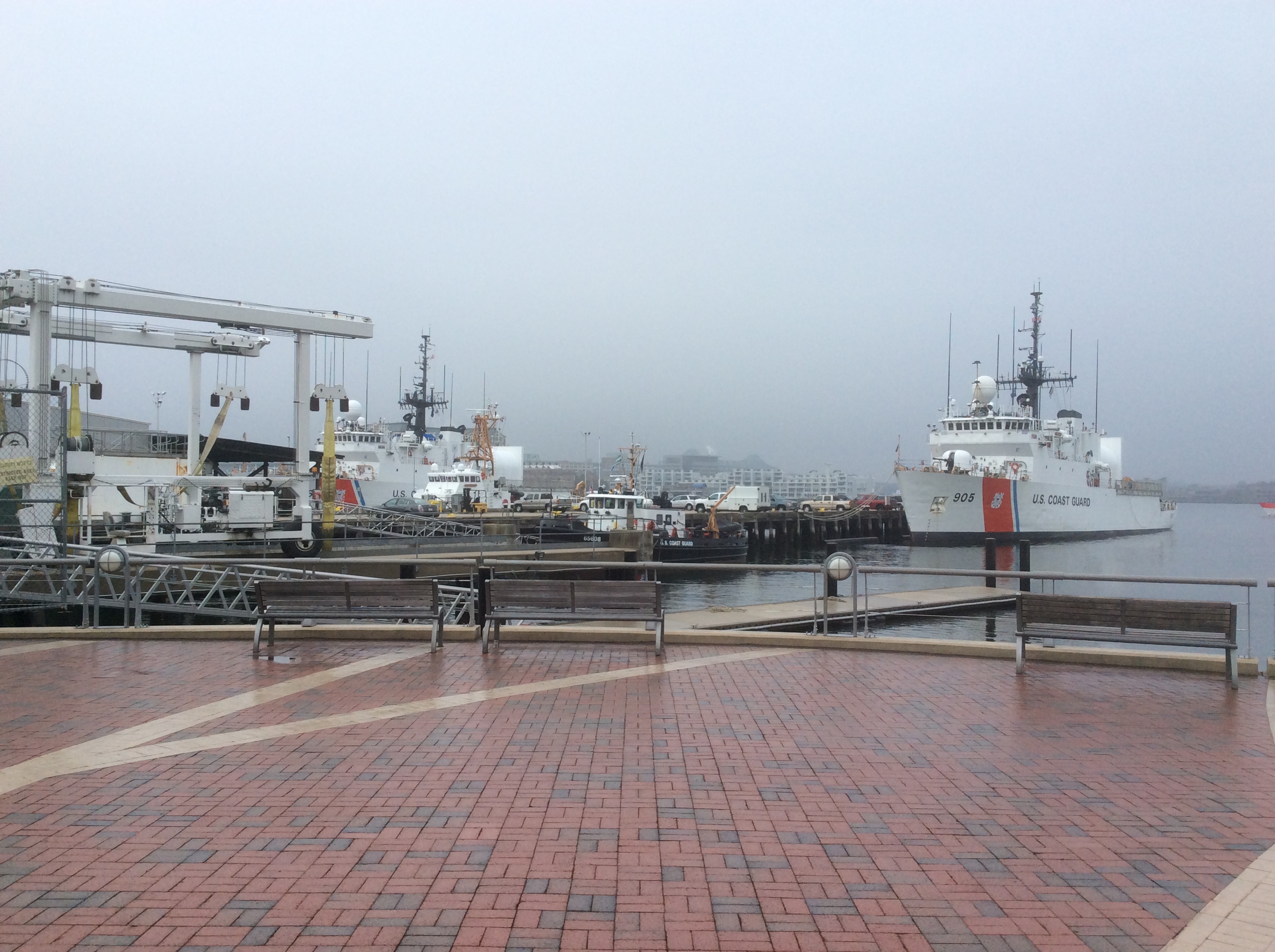
A view from Battery Wharf, now used by the Coast Guard

Battery Wharf plaque maps, detail

Battery Wharf office building
Then after moving the car (again!) I head to Battery Wharf, where, as I described earlier, the 54th Infantry Regiment continued their triumphal march to the sea on May 28th, 1863, to travel by steamship to South Carolina. Seven weeks later, about a quarter of their number and their commander Shaw died in a bold and bloody assault on Fort Wagner. Though that battle was lost, the heroic example of these soldiers inspired many others to enlist, and Shaw’s body remained buried in a common grave with many of his soldiers. The Confederates who buried Shaw this way saw it as an insult, since officers were generally accorded their own burial with special honors, even by the enemy. Shaw’s abolitionist family and the soldiers inspired to join by the Fort Wagner fight, however, thought this manner of burial a great honor, and a testament to his courage as a soldier and his devotion to his men and the cause of human rights.
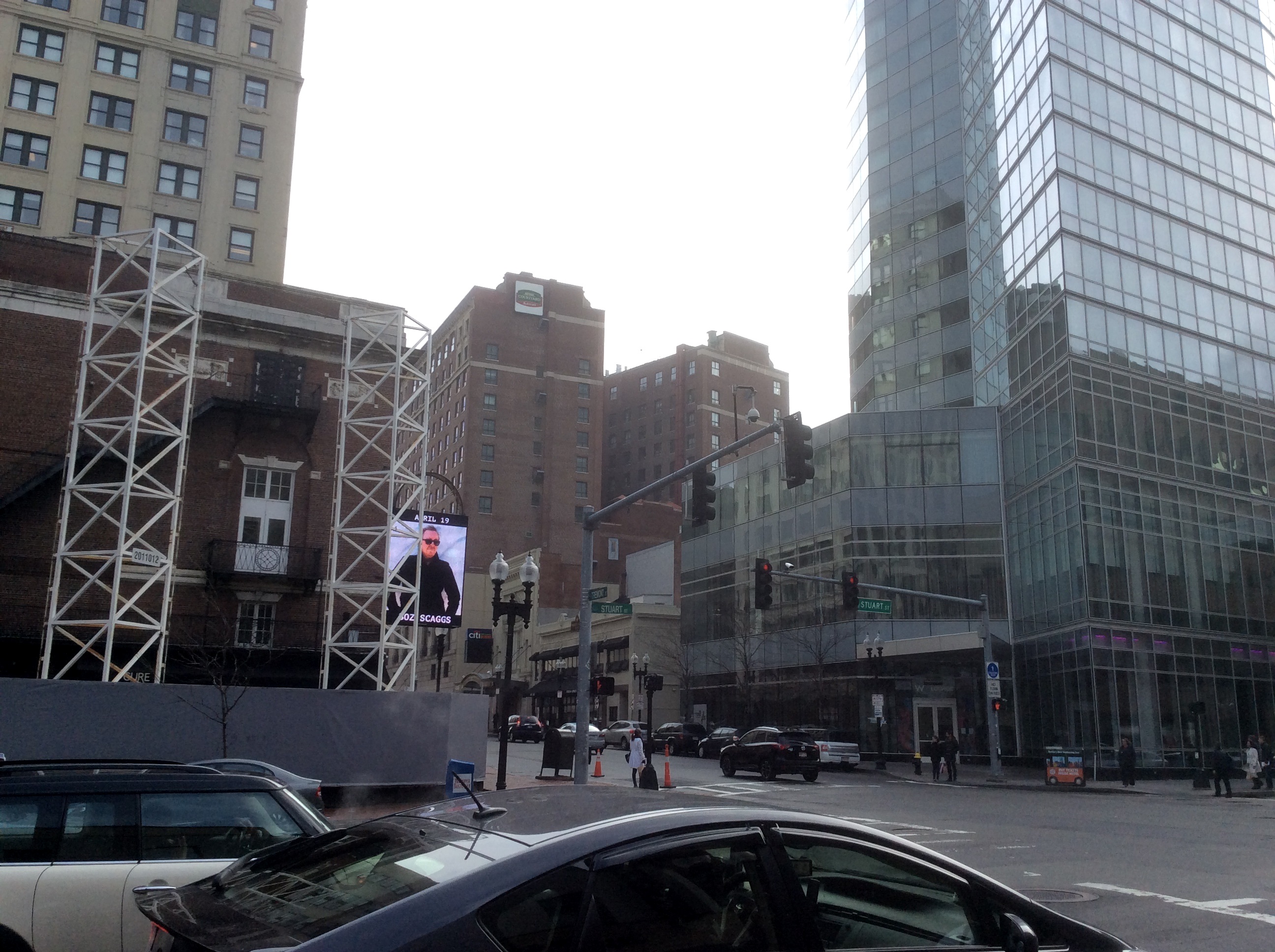
Tremont St at Stuart, approaching the Citi Performing Arts Center
I make the long walk south and a bit east, about a mile and a half, to the Citi Performing Arts Center. I’m seeking the site of the old Hollis Street Unitarian Church, where Wendell Phillips’ funeral took place prior to his lying in state at Faneuil Hall. This site took me far longer than any other site to find. I had scoured through old newspapers and finally discovered that his funeral was at ‘Hollis-street chapel’, certainly Hollis Street Unitarian Church, according to a Feb 16th 1884 edition of Washington D.C.’s The Bee. I found the entry in Chronicling America, an absolutely invaluable online resource for the history enthusiast on the go, an archive of old newspapers hosted on the Library of Congress website. (When fact-checking later, I find a secondary source that confirms this, based on another newspaper in an archive available only through a paid subscription.
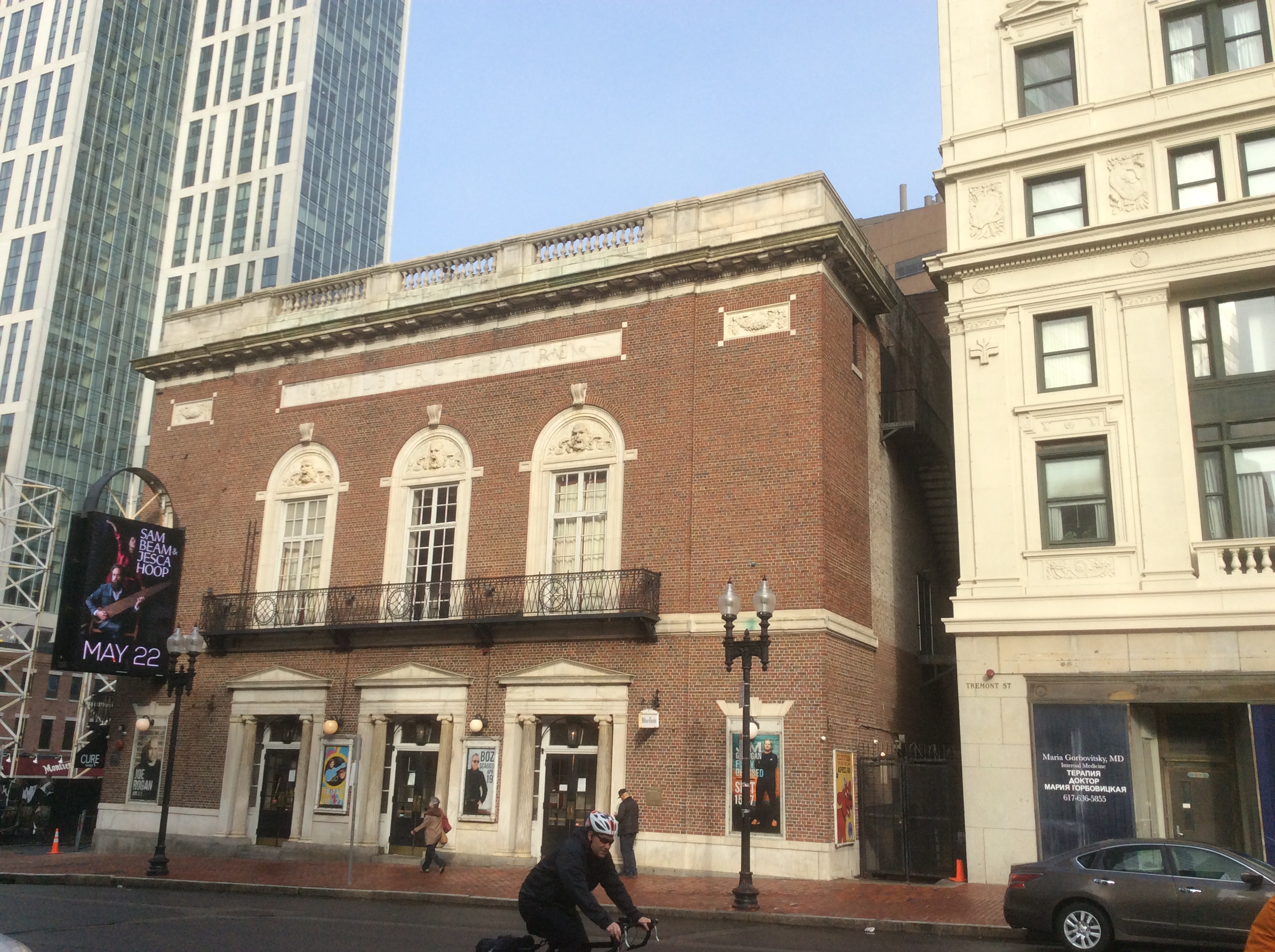
Ye Wilbur Theater (left) and Wang Theater at Citi Performing Arts Center (right)
To continue the story of Wendell Phillips’ funeral, which Douglass attended on February 56th, 1884… He was not alone: he was accompanied by his second wife, Helen Pitts Douglass, who he had married just that January. Helen was white, and even many of their closest friends and family couldn’t deal this fact, as we’ll discover more about later in this series. Even at this church packed with Phillips’ and Douglass’ most progressive, ardent, life-long abolitionists and human rights activists, no one would dare to be the first to sit next to them until… who other than the most beloved author of my youth, Louisa May Alcott. Alcott’s show of friendship and solidarity warms the deepest parts of my heart. I read every single Alcott novel I could get my hands on throughout my girl- and young adult-hood, over and over again. As it was and still is for so many young people, especially girls and women in the English speaking world, she was one of my primary early influences, one who helped set my moral compass more than just about anyone or anything else.
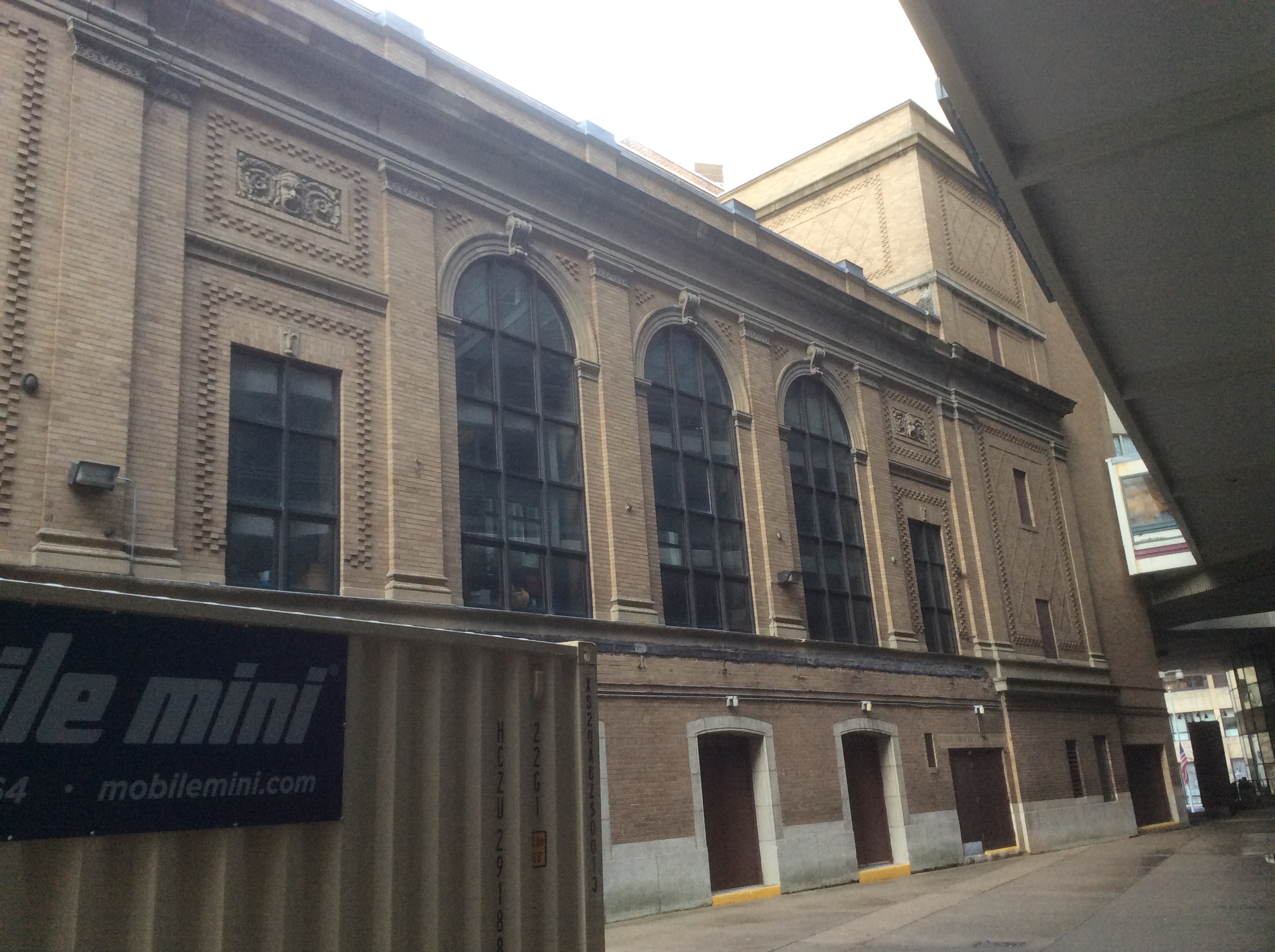
A rear side view of Wang Theater along the alley off Tremont St
I expect to find little here today, since the history of the church reveals it’s no longer standing, but I made the trip and spend some time poking around anyway. Because that moment at Phillips’ funeral is so beautiful to me, I’m doing to dig deep. Clearly, from the name, the church was on Hollis St; trouble is, there’s no longer a Hollis Street according to Google Maps, the print maps I have with me, or anywhere else online. Poring over old city atlases earlier today, I at last discovered where Hollis Street used to be. It seems that stood about where the Tremont St garage is now, just south of the historic and grand Wang Theatre of the Citi Arts Center and Tufts Health Sciences campus behind it. More specifically, Hollis St used to connect Tremont and Washington Streets halfway between Kneeland and Oak.
I also discover that Hollis Street Church became Hollis Street Theater in 1885, after the congregation moved to a more spacious location the year after the funeral. I poke around, and walk up and down the walkway between the Wang Theater and the garage. Could the Wang Theater be standing on the site of the old Hollis St Theater? I notice that the front of the Wang Building differs in motifs and materials than the wide of the building. It occurs to me that possibly, a building already standing here may have been incorporated into the Wang Theater. Could there be remnants here of the old Hollis Theater, once the old Hollis Street Unitarian Church where the funeral was held? In researching the history of the Wang Theater, formerly the Metropolitan Theater, I find no evidence of this; by all accounts this grand theater was built entirely in 1925, and the photos of the old Hollis Street Church show a very different looking structure, though looking at the half-windowed bottom parts of the two buildings (see photo below and at the end of this piece), there are some similarities. Too bad, that would have been a great find!
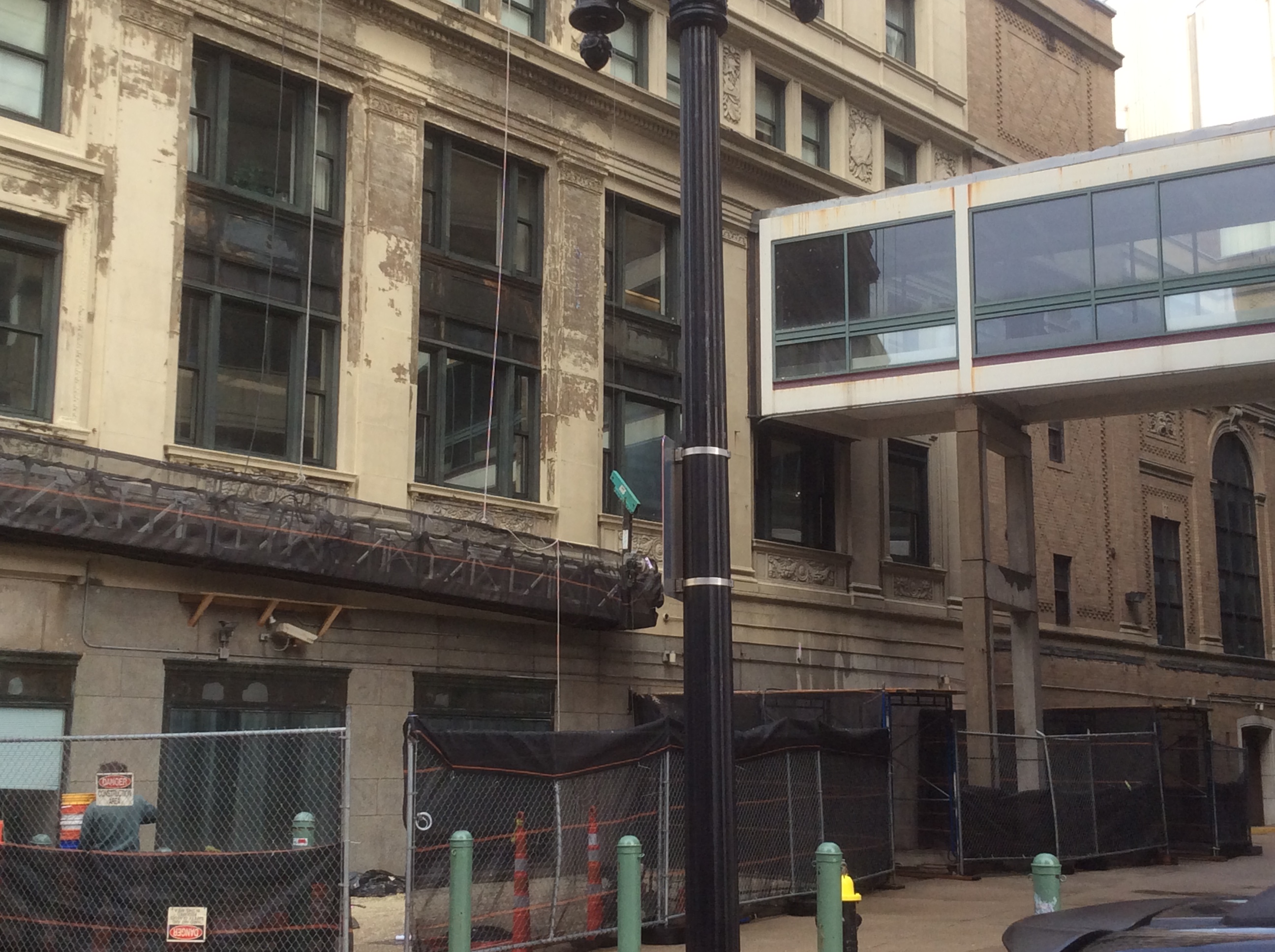
Wang Theater on Tremont St, side facing alley, showing contrast between marble front and brick back sections of the building. As you can see, this side is undergoing some restoration work
But in a moment of good luck, as I’m scanning the building and the area surrounding it for any evidence of older structures, I spot something among the scaffolding that wraps around the front and south sides of the Wang Theater as its south end it undergoing some maintenance. Near the corner of the building are old brass letters which spell out ‘Tremont St’ on its west side and ‘…ollis St’ on the south. My heart skips a beat. Here it is: confirmation that this is where Hollis St was.
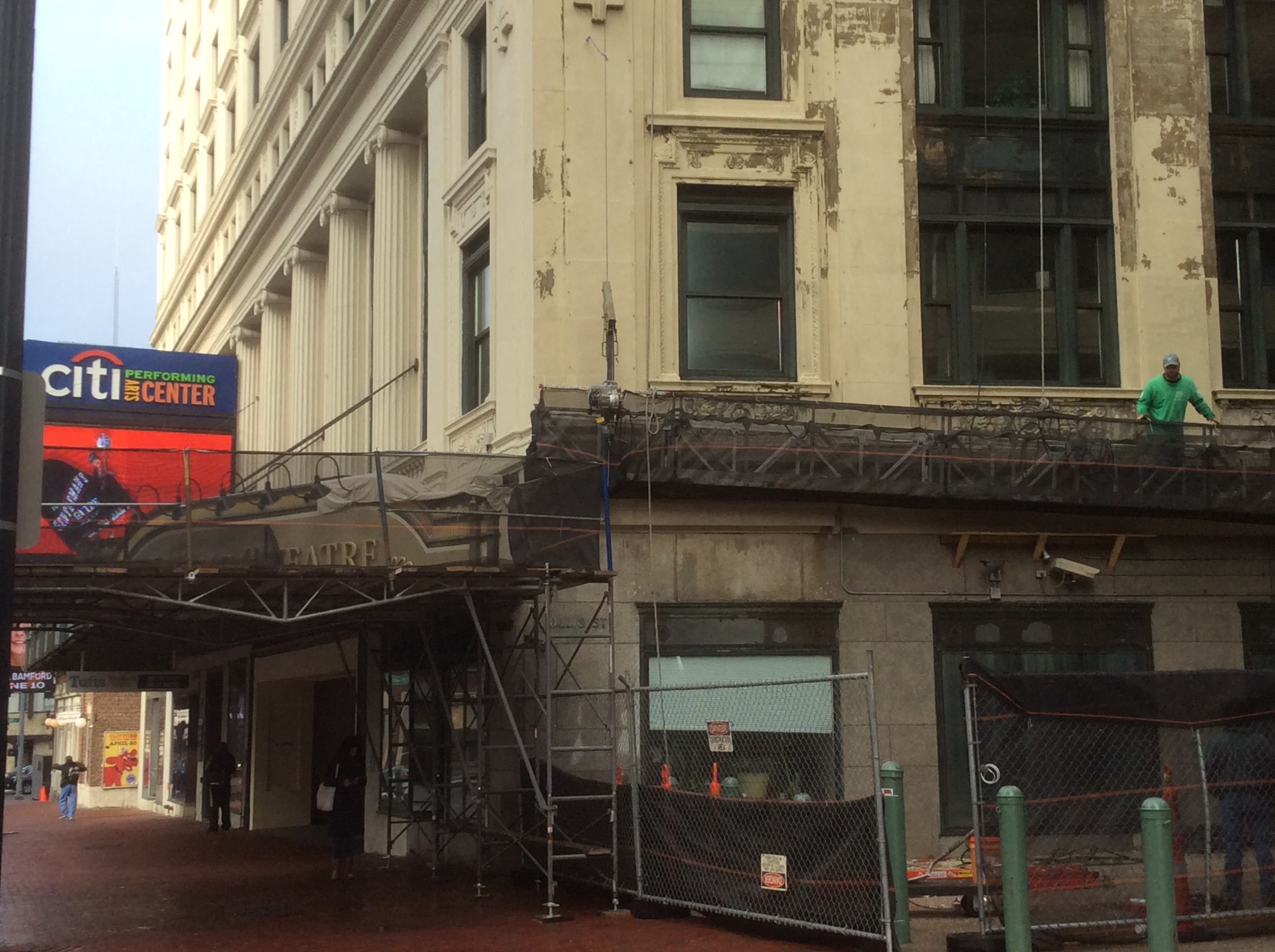

Wang Theater’s southwest corner revealing where Hollis St used to be
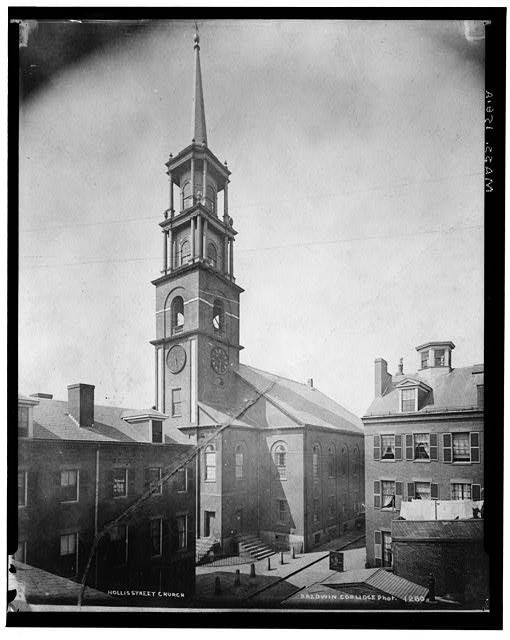
Hollis Street Church from the northeast, 1870, photo public domain via Library of Congress
We can see what the church looked like inside from an old photo I found online. But more importantly for my purposes here, the Library of Congress has a photo of the church ‘taken from the Northeast’. If that description is right, then it seems that the church stood not where the Wang Theater does but across from it, somewhere under where the Tremont St. Garage stands now, with its side facing Hollis (as you can see, it opens onto a square rather than the street) with its steepled front facing towards but not onto Washington St, and its back to Tremont.
This last discovery, successfully triangulating the location where this beautiful moment of true friendship, of love and sympathy overcoming prejudice, makes me feel very emotional and celebratory. My friend recommends The Lower Bottoms, a place that pours excellent ales, so off I go as the sun sets.
Many more adventures and exciting historical discoveries soon to come, as I continue to follow Douglass north… come on back, y’hear?
*Listen to the podcast version here or on iTunes

Wang Theater (left) and Tremont St Garage (right) view from Tremont St. (west)
Ordinary Philosophy and its Traveling Philosophy / History of Ideas series is a labor of love and ad-free, supported by patrons and readers like you. Please offer your support today!
~~~~~~~~~~~~~~~~~~~~~~~~~~~~~~~~~~~~
Sources and Inspiration:
‘1843 Boston Almanac Church Engravings: Hollis Street Church‘. Congregational Library Exhibits website
‘54th Massachusetts Infantry Regiment‘. In Wikipedia, The Free Encyclopedia.
‘African American Churches of Beacon Hill‘ and ‘African Meeting House‘. Boston African American National Historic Site Massachusetts, National Park Service website
Blassingame, J. (Ed.). The Frederick Douglass Papers, Series One: Speeches, Debates, and Interviews. 4 volumes, and The Frederick Douglass Papers, Series 2: Autobiographical Writings. 3 volumes. New Haven and London: Yale University Press, 1979-1999
‘Boston Athenæum Theater History‘, from BostonAthenæum.org
Brooks, Rebecca Beatrice. ‘Funerals and Wakes at Faneuil Hall‘. History of Massachusetts: A History Blog About The Bay State. May 14, 2012
Bromley, George Washington and Walter Scott. Boston, 1895. Index Map. Pub. G.W. Bromley and Co. From David Rumsey Historical Map Collection at davidrumsey.com
Cutter, William Richard and William Frederick Adams, eds. Genealogical and Personal Memoirs Relating to the Families of the State of Massachusetts, Volume 4. New York, 1910.
Daily National Republican. (Washington, D.C.), 12 Jan. 1863. Chronicling America: Historic American Newspapers. Lib. of Congress.
Douglass, Frederick. The Life and Times of Frederick Douglass. Re-published 1993, Avenal, New York: Gramercy Books, Library of Freedom series.
Douglass, Frederick. My Bondage and My Freedom: 1855 Edition with a new introduction. Re-published 1969, New York: Dover Publications, Inc.
Evening Star. (Washington, D.C.), 07 Feb. 1884. Chronicling America: Historic American Newspapers. Lib. of Congress.
Foner, Philip S. The Life and Writings of Frederick Douglass, Vol. 1-4. New York: International Publishers, 1950.
‘Frederick Douglass Chronology‘. From Frederick Douglass National Historic Site District of Columbia, National Park Service website
‘History of the Old State House Building‘. The Bostonian Society (website).
‘Hollis Street Church‘. (2016, March 23). In Wikipedia, The Free Encyclopedia.
Hollis Street, Harvard Street. Boston 1819 and 1820 Street-Lines. Pub. 1819 by John Graves Hale, author unknown
McFeely, William. Frederick Douglass. New York: W.W. Norton & Company, 1991.
Tremont Temple. In Wikipedia, The Free Encyclopedia.
‘Wendell Phillips‘. In Wikipedia, The Free Encyclopedia.
‘What was the Boston Massacre?.’ John Adams Historical Society (website).
 Ordinary Philosophy