O.P. Recommends: Malcolm Gladwell on Brian Williams, the Fungibility of Memory, and Journalistic Integrity

Brian Williams in 2011 by David Shankbone, free to use under Creative Commons license CC BY 3.0 via Wikimedia Commons

Brian Williams in 2011 by David Shankbone, free to use under Creative Commons license CC BY 3.0 via Wikimedia Commons

Yesterday, I listened to a recent episode of Malcolm Gladwell’s Revisionist History podcast about a subject I’ve been interested in for a long time: how memory actually works and how that understanding relates to our relationship with the truth.

A few years ago, I wrote a short opinion piece that was, in part, about news anchorman Brian Williams’ disproven claims to be on a helicopter that was shot down over Iraq in 2003. In that piece, I favorably compared how Williams behaved in the wake of that scandal to the behavior of other media personalities who made similarly false or distorted claims. Unlike the other figures I criticized in that piece, I believe that Williams’ ready admission of his mistakes and his willingness to heap recriminations on himself reveal that he is, in fact, a person of integrity with a real respect for the truth.

While listening to the podcast yesterday, I found that Gladwell agrees with my assessment and for many good reasons. In ‘Free Brian Williams’, Gladwell summarizes what we now know about the fungibility and therefore unreliability of memory, and applies this to a very good discussion of how we all should be careful about the claims we make, especially when we’re in a position to inform and influence the public. A very interesting listen…

~ Ordinary Philosophy is a labor of love and ad-free, supported by patrons and readers like you. Any support you can offer will be deeply appreciated!

Happy Birthday, Adam Smith!

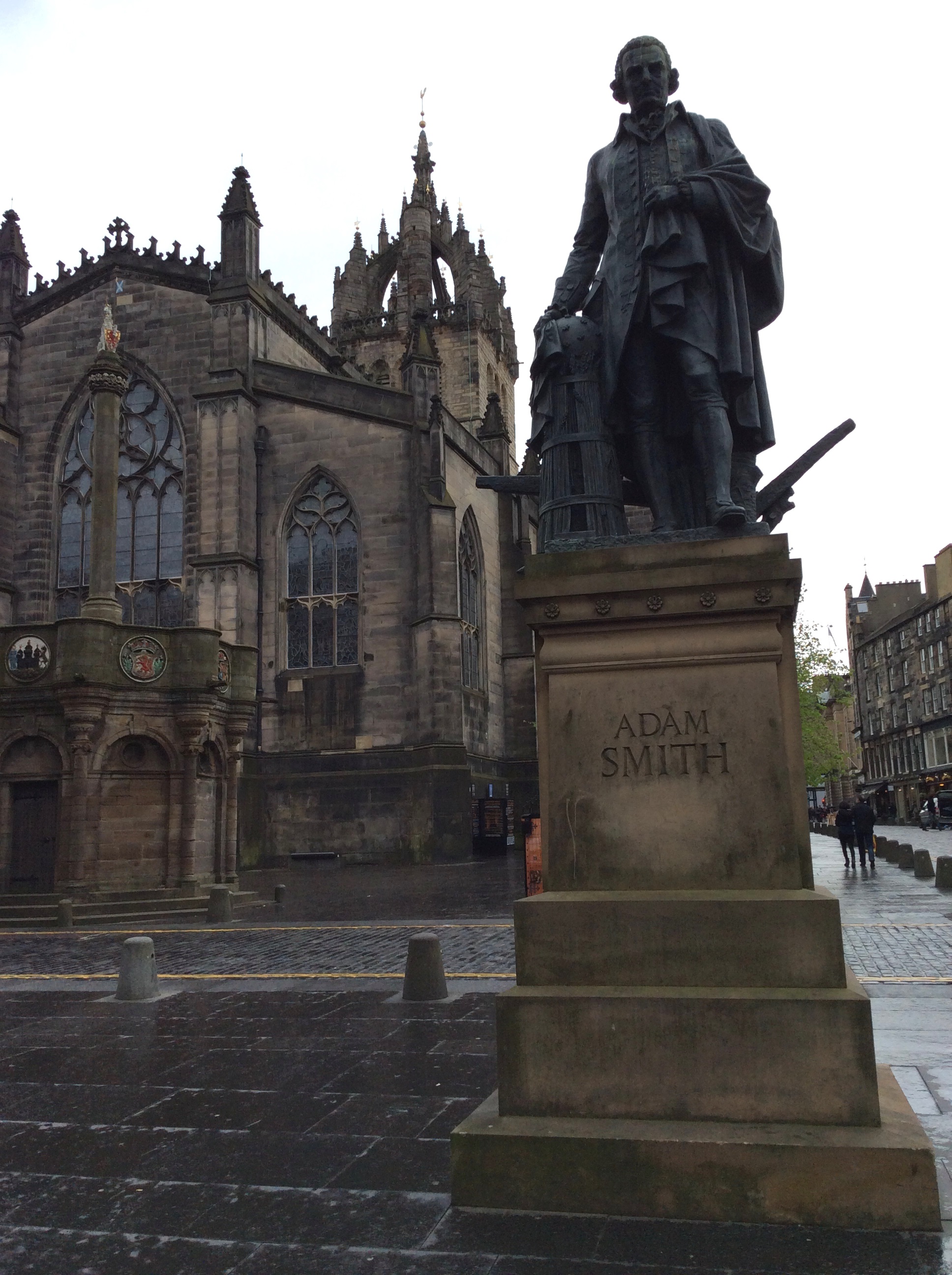
Adam Smith statue on the Royal Mile in Edinburgh, Scotland

Adam Smith was a philosophical disciple and life-long friend of David Hume, and as such, I encountered his ideas regularly while I was following the life and ideas of Hume a few years ago in Edinburgh. Smith wrote a moving account of Hume’s last days. I also encountered his ideas regularly in my undergraduate studies in moral philosophy.

Smith was baptized and perhaps born on June 5th, 1723 in Kirkcaldy, Scotland (a fishing village near Edinburgh) and died on July 17, 1790 in Edinburgh. He attended university at Glasgow and Oxford and found the former intellectual milieu more stimulating by orders of magnitude. Glasgow and Edinburgh were vigorous centers of Enlightenment thought in philosophy, natural philosophy (as the sciences were then known), linguistics, history, political theory, mathematics, and more. David Hume, Adam Smith, and their fellow leaders in the Scottish Enlightenment joined the ranks of this philosophical tradition’s greatest and most influential thinkers.

Like pretty much all Americans interested in basic economic theory, I’d heard a lot about The Wealth of Nations, Smith’s treatise on political economy. You likely have as well, since here you are reading a birthday tribute to Adam Smith! The Wealth of Nations is considered the foundational theoretical work on capitalism and therefore, Smith is regarded as a key figure in economic theory. But when I returned to university a few years ago to study philosophy, and when researching the life and ideas of Hume and his contemporaries for my aforementioned project, I spent more time with Smith’s moral philosophy. So I’ll focus this aspect of his thinking here. After all, this was his main arena of inquiry: he was not an economist, but a professor of moral philosophy at Glasgow. His Theory of Moral Sentiments was, and still is to a lesser consent, respected as a major work in moral philosophy.

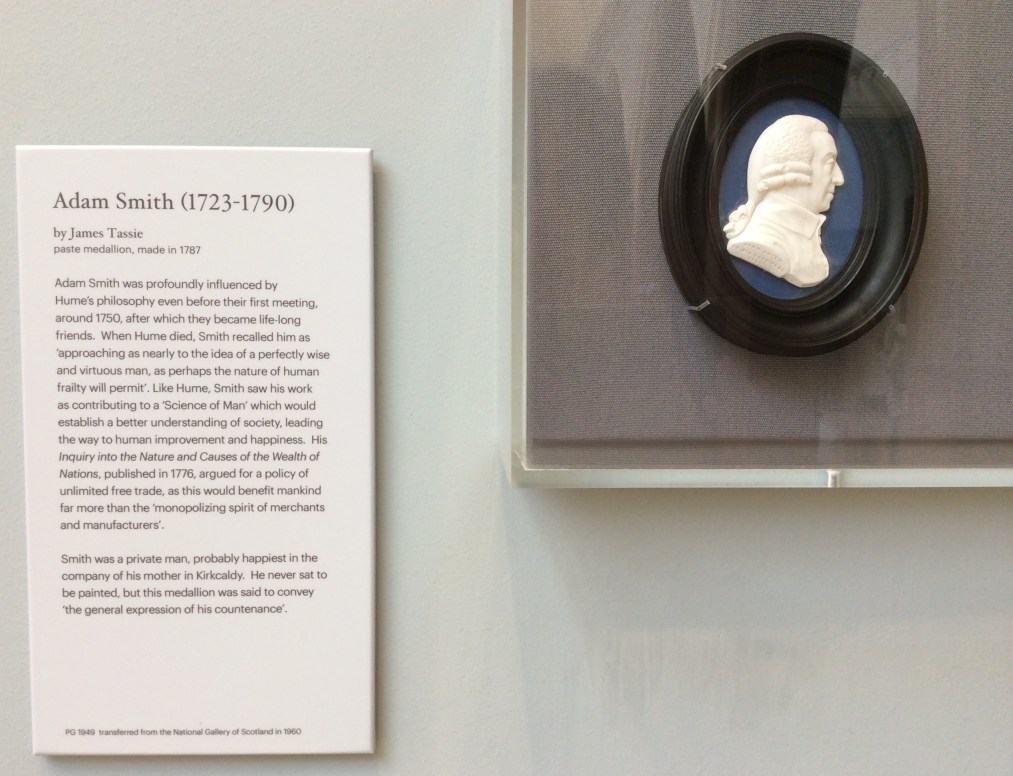
Portrait medallion of Adam Smith by James Tassie at the National Portrait Gallery in Edinburgh, Scotland.

Smith’s Theory of Moral Sentiments merges from a sort of compendium of elements of moral philosophy, in which Smith fuses what he considers the best and most coherent elements of moral philosophy into one compelling system. In it, one recognizes Humian sentimentalism, Kantian-type reason-based morality (Immanuel Kant’s work on this topic came after Smith’s, though the men were direct contemporaries), consequentialism, and Aristotelian virtue ethics. Like Hume, Smith thinks that the emotions play a central role. Before Hume, morality was widely considered to be primarily a matter of reason, and morality required us to quash our emotions, or as Hume put it, passions, because human are naturally and by default selfish, greedy, profane, lazy, and in myriad others way fallen creatures. Hume, however, does not agree. He believes that human beings naturally identify with the pains and joys of others, internalizing them and causing us to want to ameliorate their circumstances, and it’s this direct emotional response that drives the moral sense. Smith largely agrees, but not wholly. He also stresses the importance of sympathy (close to the sense that we’d usually now mean empathy) in making moral judgments. Smith explains that the moral agent is like an impartial spectator who participates in the daily lives, sufferings, and joys of our fellow human beings through our emotional response to their situation.

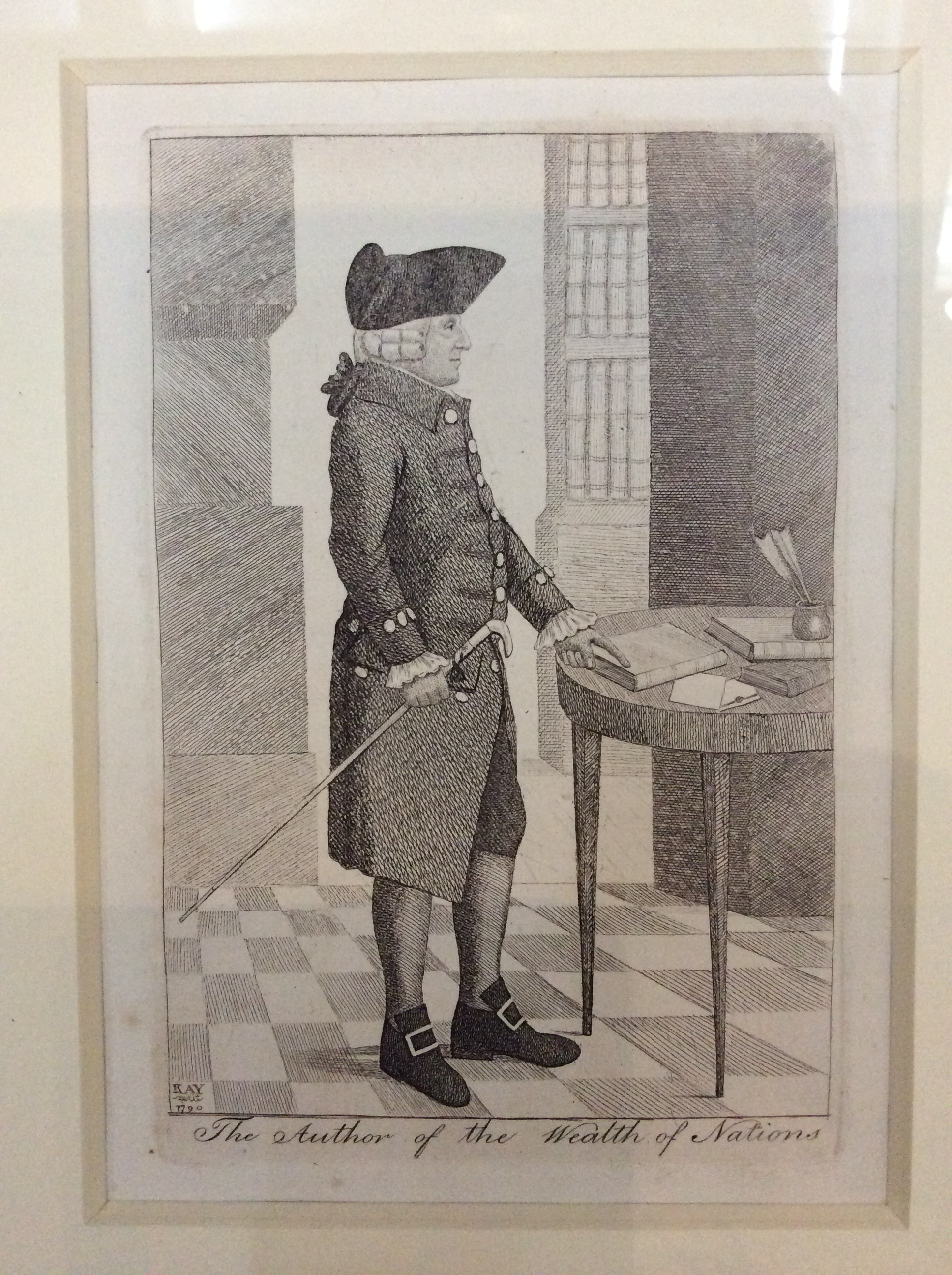
Adam Smith portrait by John Kay from 1790 (the year of Smith’s death), at the National Portrait Gallery, Edinburgh

But Smith also believes that sympathy (empathy) is not enough: our sympathies can and should be corrected by reason since our emotional responses can become inappropriate to the situation, corrupted by ignoble impulses such as greed, ambition, selfishness, and so on. An impartial, uncorrupted spectator would not consider indifference or cruelty, for example, as proper emotional responses to the plight of others. (I see shades of John Rawl’s ‘veil of ignorance‘ here.) One way to help us maintain moral ‘propriety’, as Smith put it, is to apply reason, and one way our reason can help us judge whether our moral sentiments are correct is to consider the consequence of actions we feel inclined to do. While the consequences of our actions don’t determine their rightness or wrongness as they do in consequentialist moral theories, they are an important consideration and in some cases, such as those in which human life hangs in the balance, they should take precedence. And finally, Smith agrees with Aristotle that we can’t rely on a pre-determined, reason-derived, emotionally-detached set of inflexible moral principles to differentiate right from wrong, good from bad, as Kant would have it. Rather, we naturally recognize and respond to virtue when we see it. We admire its beauty and goodness and have the desire to emulate it. Aristotle sees virtue as a perfect balance between opposing qualities in the same sphere: courage is the virtue on the right part of the spectrum between cowardliness and recklessness; temperance between licentiousness and insensibility; friendliness between obsequiousness and cold indifference. Smith likewise stresses the importance of balance in our moral character but focuses more on attuning our sympathies so they are in propriety, thereby driving us to act in the kindest, most honest, and fairest way towards one another as a matter of course.

adam smith_s grave in canongate kirkyard, edinburgh, scotland, 2017 amy cools

Adam Smith’s grave in Canongate Kirkyard, Edinburgh, Scotland

This is only a very short summary of Smith’s moral philosophy by one who not an expert on Smith’s life and thought. To learn more about the great philosopher and economist Adam Smith from those who are, and for more about the philosophical traditions that influenced him and which he influenced in turn, see:

Adam Smith (1723—1790) – Jack Russell Weinstein for the Internet Encyclopedia of Philosophy

Adam Smith’s Moral and Political Philosophy – by Samuel Fleischacker for The Stanford Encyclopedia of Philosophy

Adam Smith pt. 1 – Specialization and Adam Smith pt. 2 – The Tip of the Iceberg Of Wealth – Stephen West discusses Adam Smith’s political economy for his blog Philosophize This!

Adam Smith on What Human Beings Are Like – Nicholas Phillipson discusses Adam Smith’s view of human beings with Nigel Warburton for Philosophy Bites podcast

Dennis Rasmussen on Hume and Smith and his book The Infidel and the Professor – with Russ Roberts for EconTalk

Enlightenment – William Bristow for The Stanford Encyclopedia of Philosophy

Moral Sentimentalism – Antti Kauppinen for The Stanford Encyclopedia of Philosophy

The Problem With Inequality, According to Adam Smith – Dennis C. Rasmussen for The Atlantic

The Real Adam Smith – by Paul Sagar for Aeon

The Theory of Moral Sentiments – Adam Smith, first published in 1759

*A version of this piece was previously published in Ordinary Philosophy

~ Ordinary Philosophy is a labor of love and ad-free, supported by patrons and readers like you. Any support you can offer will be deeply appreciated!


Chicago’s Union Stockyards Gate

Union Stockyard Gate, Chicago, Illinois

August 9th, 2017, morning

~ Dedicated to Tracy Runyon 

This July and August, I’ve toured the United States for about three weeks before crossing the seas to pursue a Master’s degree at the University of Edinburgh, Scotland. I’ve driven north from Oakland, California to Spokane, Washington and zigzagged my way east to Chicago, visiting places as far north as Voyageurs National Park in northern Minnesota to as far south as Hannibal, Missouri. It’s been an absolutely exciting and glorious journey, and I’m not at all ready for it to end.

Yet today’s my last day in Chicago; I fly out headed for Europe this evening. There’s plenty of time to make a couple of stops today at interesting historical sites besides taking care of last minute details (donating my tent and other things I don’t want to lug with me to Europe to a thrift store, returning the rental car, etc). My first stop is a special request from a dear friend, who also generously helped sponsor this trip.

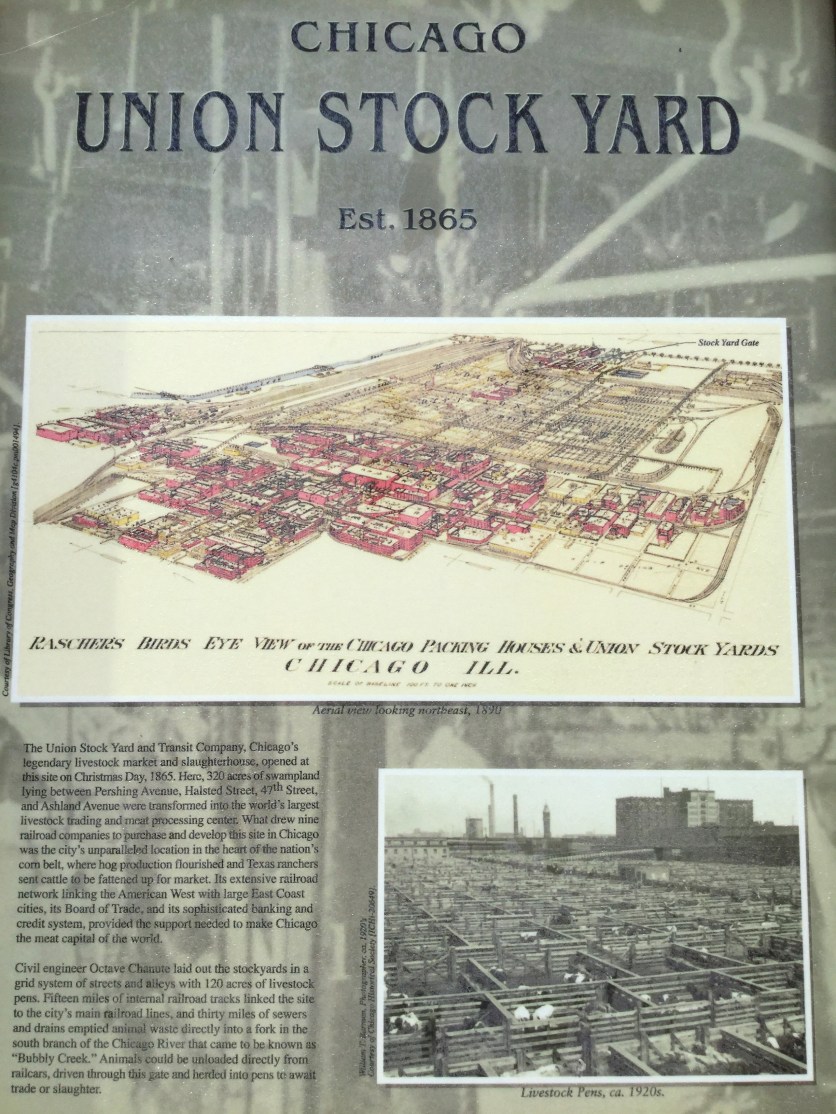
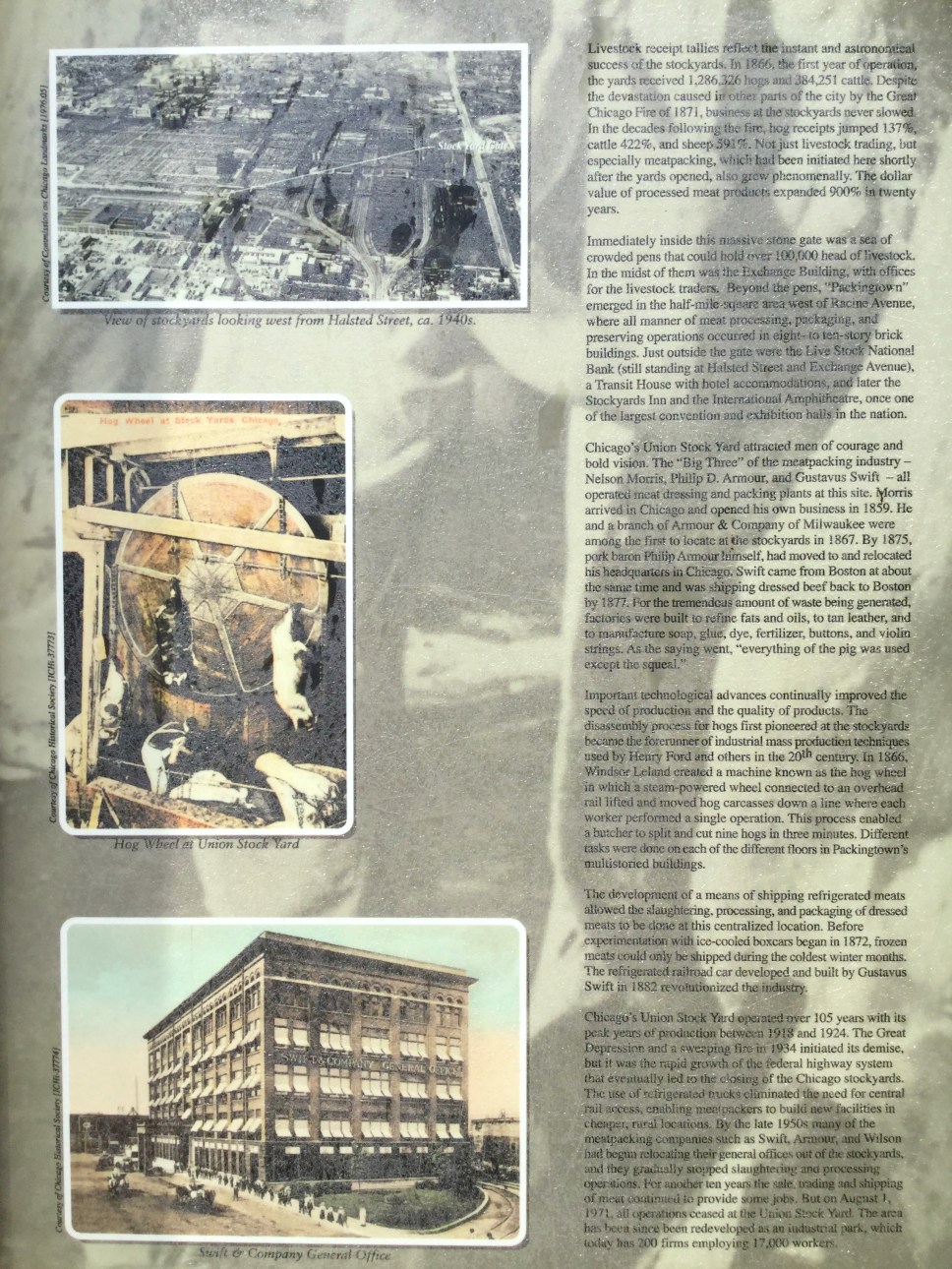
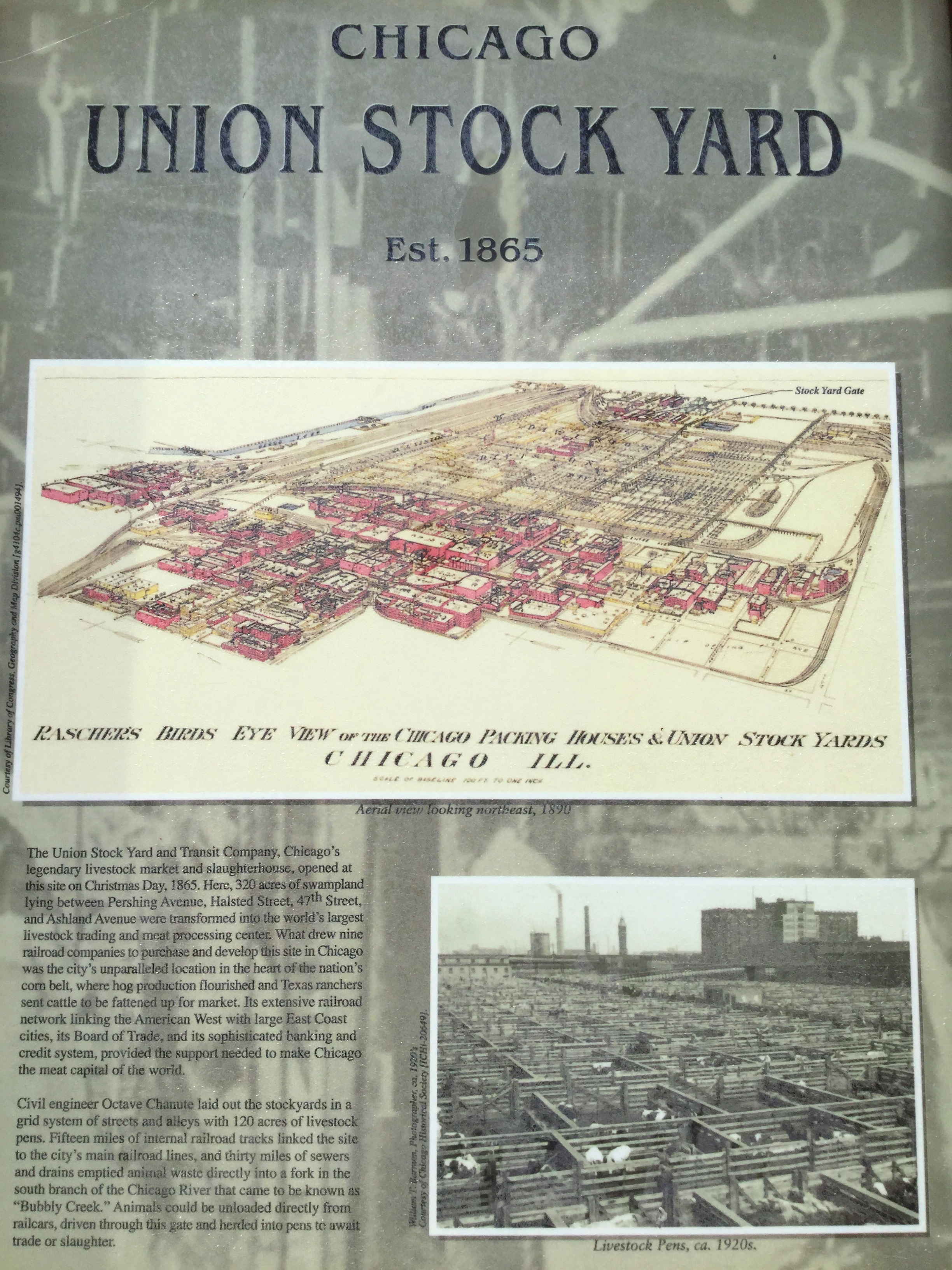
On June 1st, 1865, a crew of workmen began work on what would be the first example of modern industrial production of food on a massive scale. The Union Stockyards opened on Christmas Day that same year: ‘The Union Stock Yard & Transit Co. of Chicago received its first bellowing arrivals on Christmas Day 1865. …[It] covered a half square mile west of Halsted Street between Pershing Road and 47th Street- Anderson … [and] held on until 1971, when it closed forever…’, wrote Jon Anderson for the Chicago Tribune.
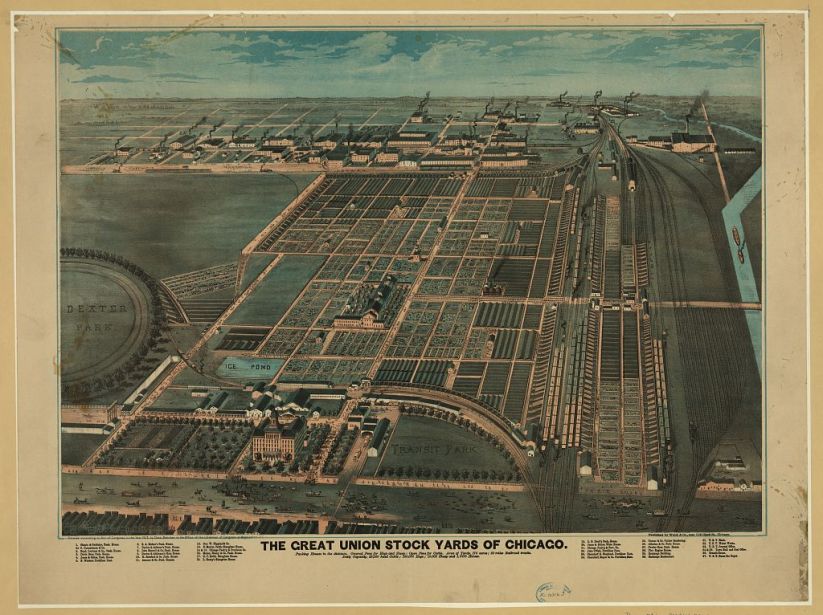
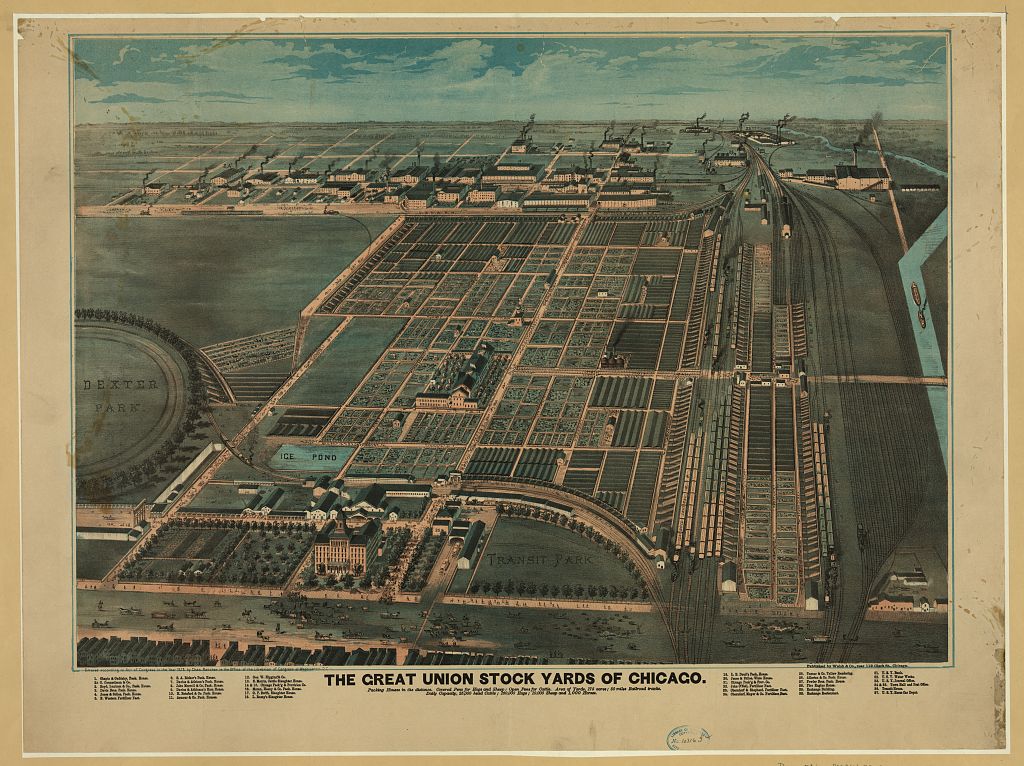
The Great Union Stock Yards of Chicago, ca. 1878, by Charles Rascher. Published by Walsh & Co of Chicago. Public domain via Library of Congress

I’m standing here in front of a pale limestone gateway at Exchange Avenue and Peoria Street. This gateway was built around a decade and a half after the work on the stockyards began, but my sources differ as to exactly when. One source says 1875, another says 1879, yet another says the exact date is unrecorded and therefore unknown. I do find an illustration of the stockyards by Charles Rascher published in 1878 and a gate like this appears to be included in it: if you look closely at the top of the quarter-circle formed by the curved railways and straight roads along Transit Park in the lower half of the picture, you’ll see a three-arched light-colored gateway represented there. However, the top of the gate in the illustration is flat across the top while this is not; it’s hard to say whether it’s the same gate represented a little inaccurately, or an earlier gate at the site. The current gateway was almost certainly designed by the Chicago architectural firm of Burnham and Root, who designed other buildings at the stockyards.

Another view of the Union Stockyard Gate, Chicago. According to the City of Chicago’s Chicago Landmark website, ‘The limestone steer head over the central arch is traditionally thought to represent “Sherman,” a prize-winning bull named after John B. Sherman, one of the founders of the Union Stock Yard and Transit Company.’
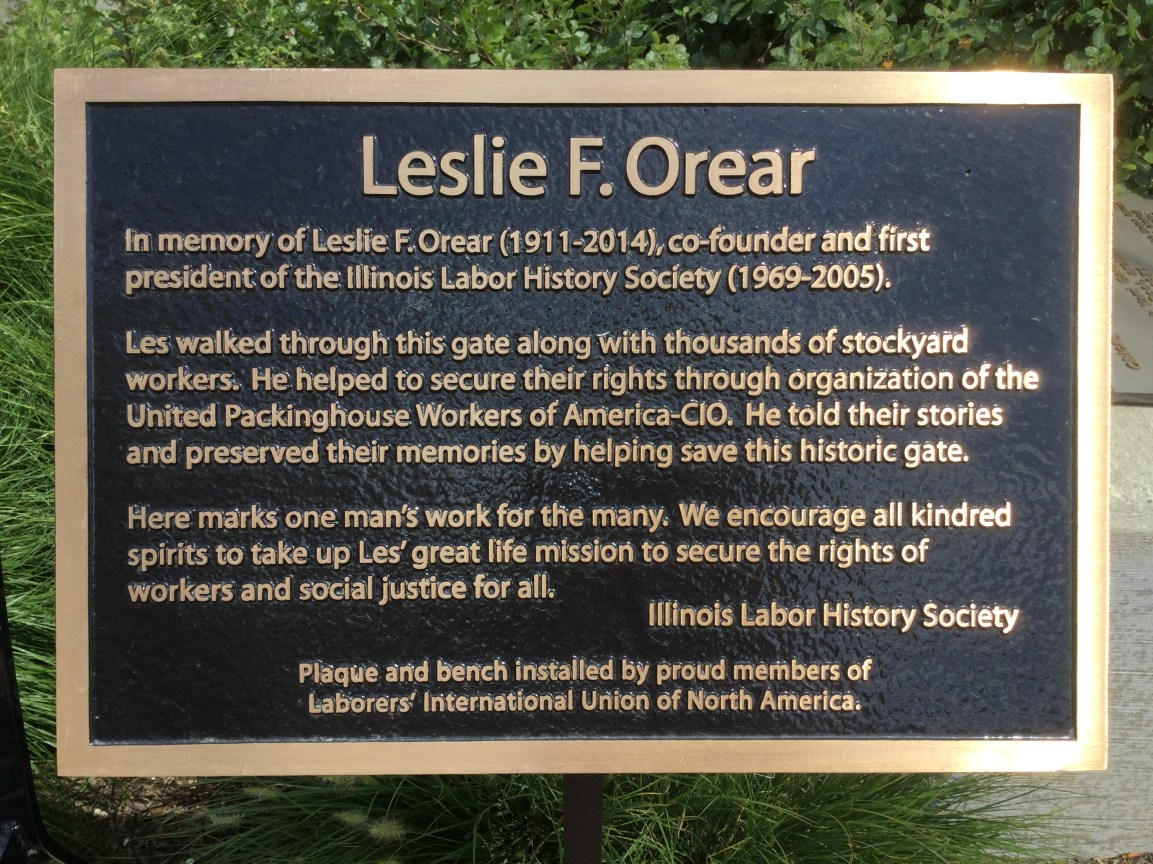
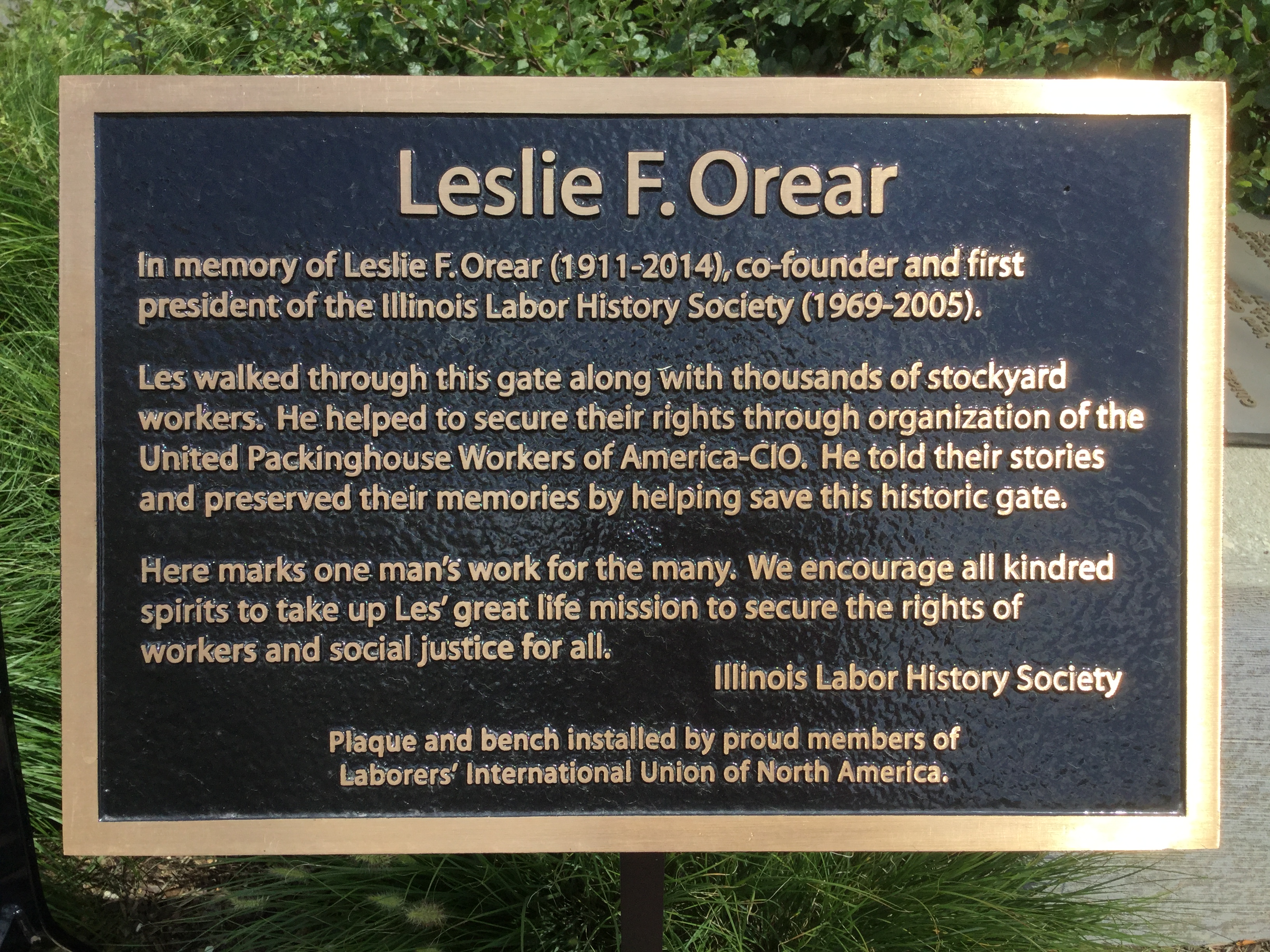
Leslie Orear plaque at the Union Stockyard Gate, Chicago, Illinois

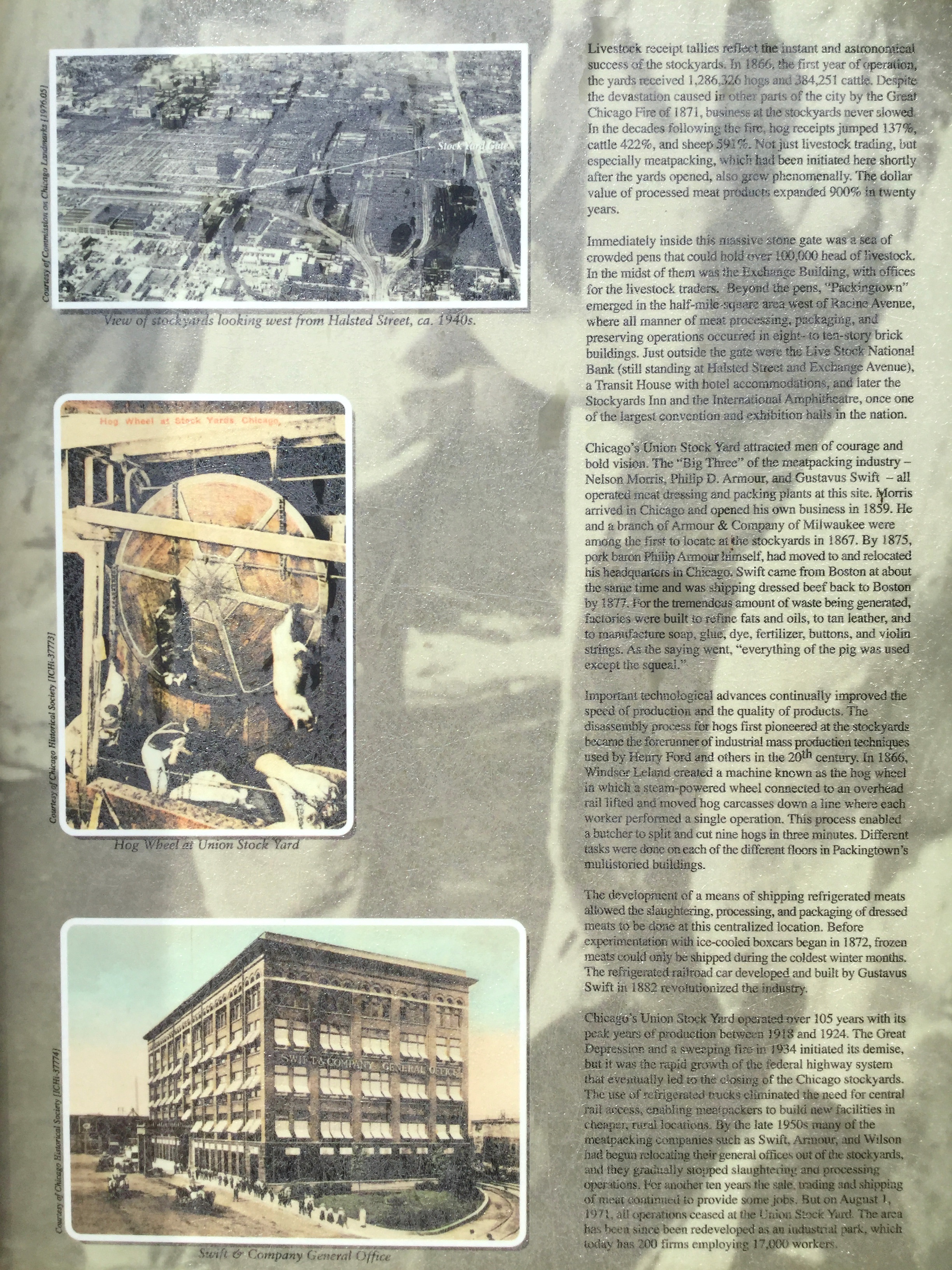
The 320-acre expanse of land that the stockyards occupied at its largest, like the site of our nation’s capital, was once conveniently-located but hard-to-develop swampland, and therefore available for builders visionary and determined (crazy?) enough to transform it. The stockyards were built because for many years, livestock traders and meatpackers thought that operating scattered yards and plants was far less efficient than one unified, or ‘union’ stockyard would be. Civil engineer Octave Chanute designed the grid layout which would make it possible to process live animals into fresh and packed meat products at a rate incredible at the time: down from 8-10 hours for a single butcher, even with assistants, to 35 minutes per animal passing through a Union slaughterhouse’s assembly line. John B. Sherman, who had owned one of Chicago’s earlier largest stockyards, oversaw all this efficiency, managing the Union Stockyards and the Transit Company for many years. According to tradition, it’s the head of a bull named after him that’s sculpted above the center arch of the gate.
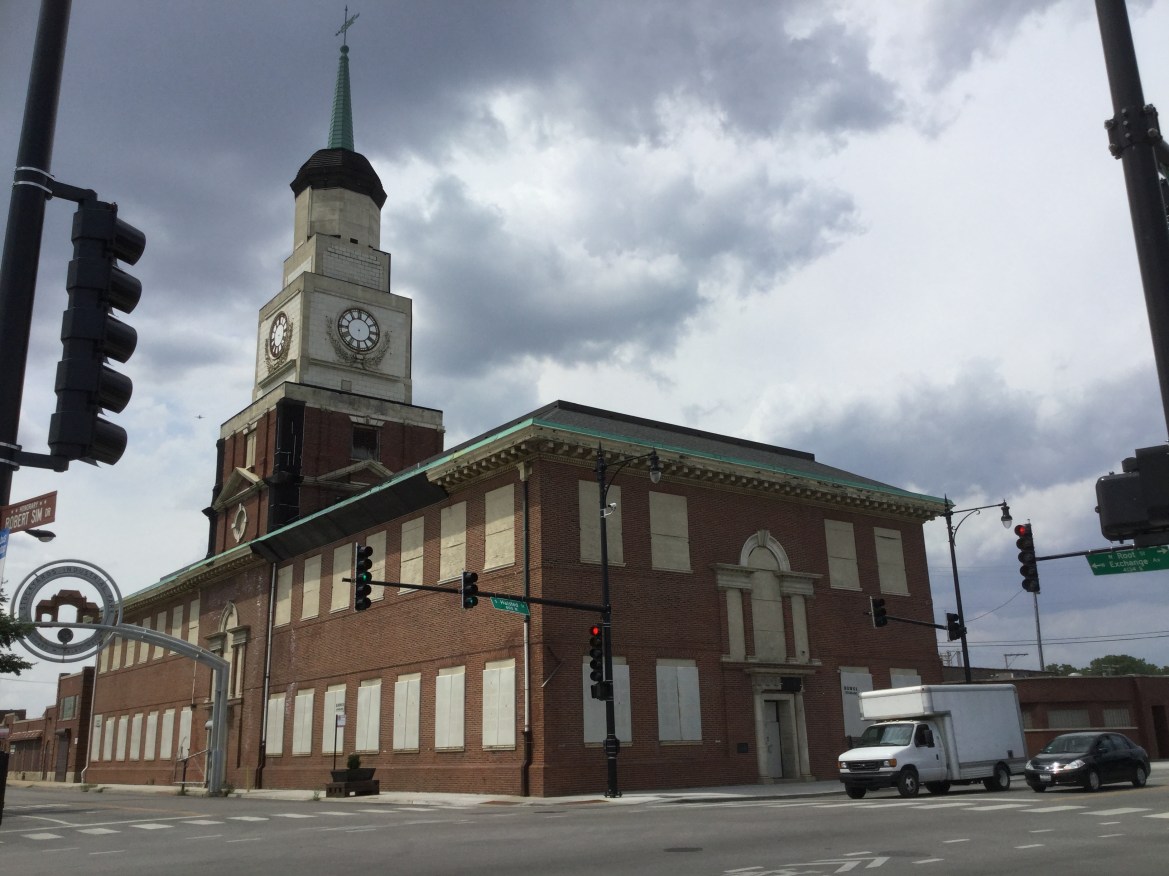
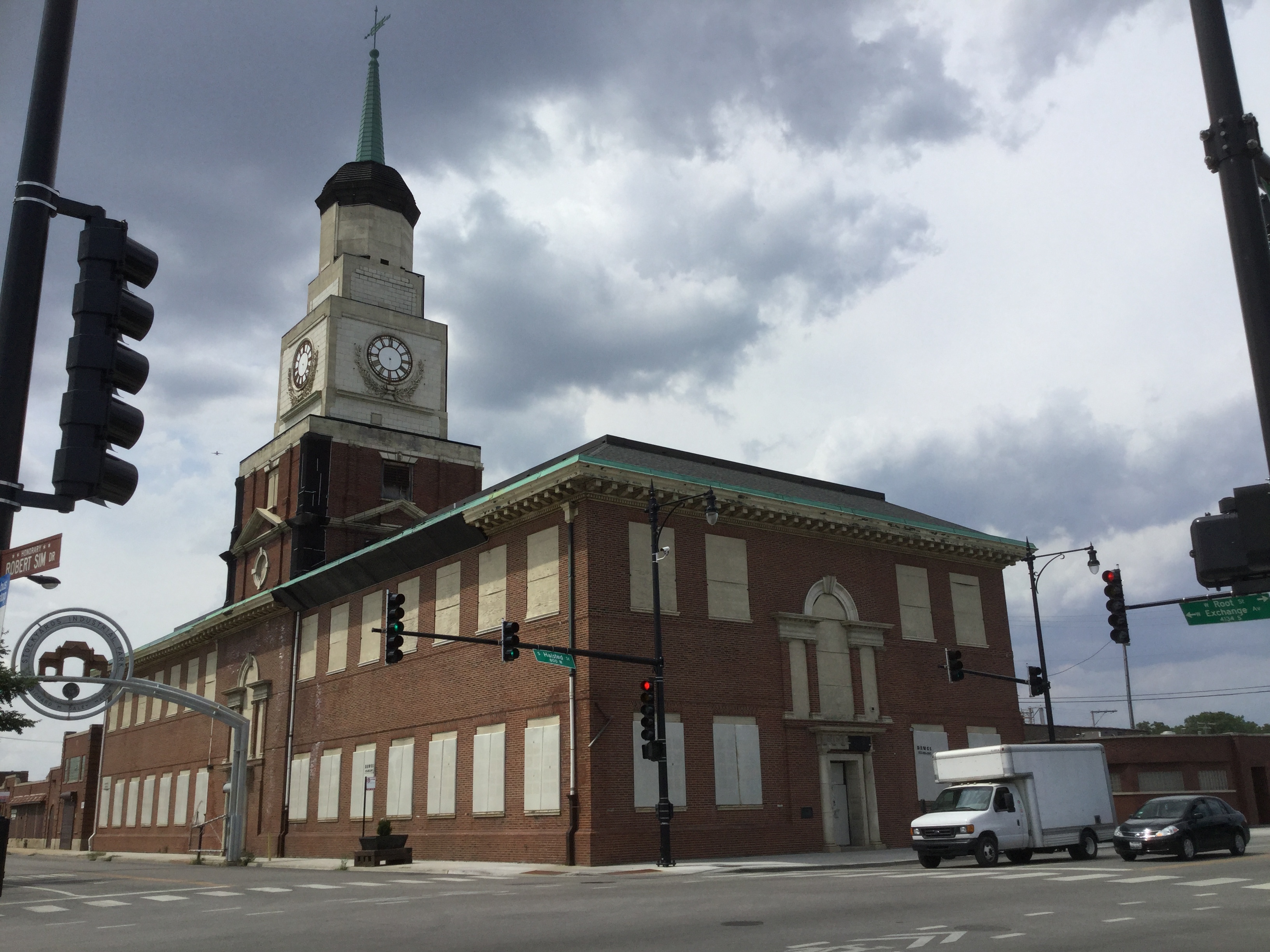
Stock Yards National Bank Building near the Union Stockyard Gate, Chicago, IL. It was built in 1925 and its design inspired by Independence Hall in Philadelphia
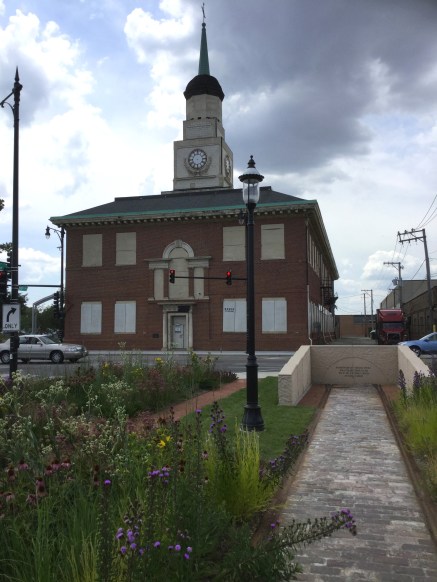
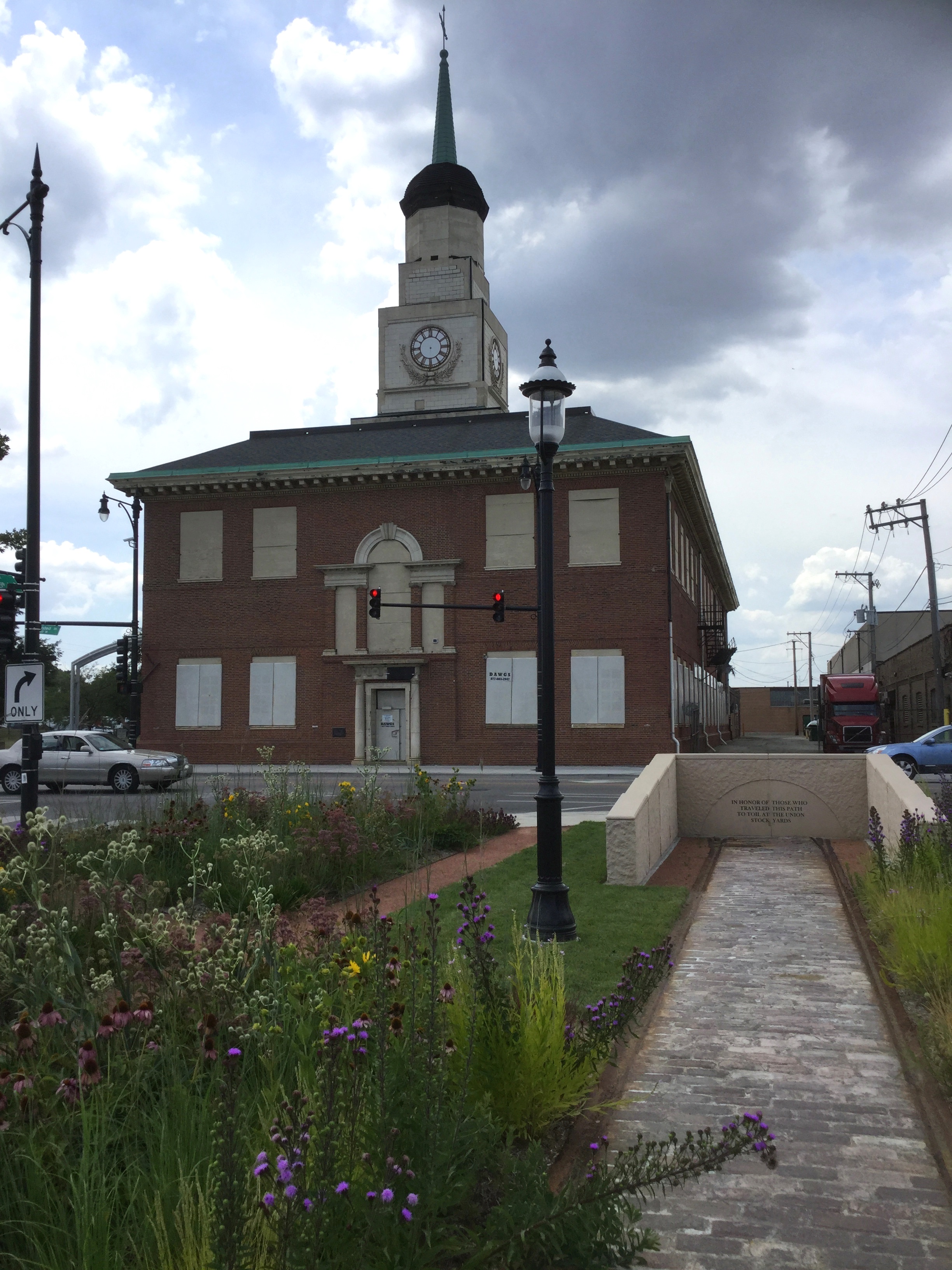
Stock Yards National Bank Building near the Union Stockyard Gate, Chicago, IL. The words inscribed in the arched niche in the low wall marking the old rail line read: ‘In Honor of Those Who Traveled this Path to Toil at the Union Stockyards’

Even more than for their size and efficiency, the Union Stockyards are likely most often brought to mind today for the horrific scenes described by Upton Sinclair in his 1906 book The Jungle. Sinclair, a socialist, wanted to demonstrate that unfettered capitalism did not, as it was so often claimed, result in more good than harm for working people, or reliably produce safe, quality products. His novel described the exploitation of desperate immigrants working for obscenely low wages in dangerous and filthy conditions; poorly fed, overcrowded, and sickly livestock; diseased livestock and other animals not legal to butcher for food processed into meat;  rotten meat and extremely poor quality offal disguised by heavy processing and spices in packed meat products; and so forth. While many protested that Sinclair’s novel was just that, all fiction, the public outcry reached many public figures and worker’s rights activists ready to receive his message, including Progressive President Theodore Roosevelt. He immediately sent out an inspection team who found that the very same conditions that Upton described so graphically were, in fact, rampant at the stockyards. Sweeping legislation protecting worker and consumer health and safety followed soon after.

Over time, as transportation became more efficient, it also became more efficient and much cheaper for meat producers to process livestock where they were raised. The shrinking Union Stockyards closed for good in 1971. Its arched limestone gate was declared a public landmark on February 24th, 1972.

See below for links for more excellent introductory sources to the history of the Union Stockyards, and scroll down to see the two signs I find at the site which also provide a brief history.

~ Ordinary Philosophy is a labor of love and ad-free, supported by patrons and readers like you. Any support you can offer will be deeply appreciated!

~~~~~~~~~~~~~~~~~~~~~~~~~~~~~~~~~~~~

Sources and inspiration

Anderson, Jon. ‘The Chicago Stockyards Open‘, Chicago Tribune 

Bramley, Anne. ‘How Chicago’s Slaughterhouse Spectacles Paved The Way For Big Meat.’ NPR: The Salt, Dec 3, 2015

Chicago Landmarks. ‘Stock Yards National Bank (Former)‘ and ‘Union Stock Yard Gate.‘ Website published by the City of Chicago

City of Chicago Landmark Designation Reports #210: Union Stock Yard Gate. City of Chicago, 1976.

Gregory, Terry. ‘Union Stockyards.’ Chicagology website

Rouse, Kristen L. ‘Meat Inspection Act of 1906.’ Encyclopædia Britannica

Twa, Garth. ‘The Jungle.Encyclopædia Britannica

Wilson, Mark R., Stephen R. Porter, and Janice L. Reiff. ‘Union Stock Yard & Transit Co.‘ The Electronic Encyclopedia of Chicago.