Frederick Douglass, Rochester NY Sites Day 2

Douglass is on my mind a lot these days, as I’m reading Leigh Fought’s new book on the crucial role of so many women in his work and in the development of his thought. Otherwise, I’m still in the depths of wrapping up my job here, selling off most of my worldly goods, and preparing to resume my academic pursuits in another country; therefore, I’m not writing nearly as much as I’d like. Here’s an account I wrote a year ago of following his life and thought, in case you missed it.

Amy M Cools's avatarOrdinary Philosophy

Douglass scholarship articles and posters, Dr. David Anderson's office, Nazareth College Rochester, 2016 Amy Cools Articles, posters, and mementos of Frederick Douglass scholarship and events, Dr. David Anderson’s office, Nazareth College of Rochester

Tenth day, Tuesday March 29th

I begin my day with an early visit to Dr. David Anderson, a Frederick Douglass scholar, visiting professor at Nazareth College, founding member of Blackstorytelling League, and an all around delightful and fascinating man! He is kind enough to grant me an interview of an hour or so, which ends up turning into a much longer conversation than that.

Among many other things too numerous to describe in full here (I’ll bring more details of our talk into the discussion of my subsequent discoveries), we talk about the Douglass family as a whole, and especially, Frederick Douglass’ wife Anna.

As discussed in the account of my day in Lynn, Anna took in piecework from Lynn’s thriving shoe industry, attaching uppers to soles, to help support the family…

View original post 4,591 more words

Happy Birthday, Adam Smith!

Adam Smith statue on the Royal Mile in Edinburgh, Scotland

Adam Smith was a philosophical disciple and life-long friend of David Hume, and as such, I encountered his ideas regularly while I was following the life and ideas of Hume a few years ago in Edinburgh. Smith wrote a moving account of Hume’s last days.

Smith was baptized and perhaps born on June 5th, 1723 in Kirkcaldy (a fishing village near Edinburgh) and died on July 17, 1790 in Edinburgh, Scotland. He attended university at Glasgow and Oxford, and found the former intellectual milieu more stimulating by orders of magnitude. Glasgow and Edinburgh were vigorous centers of Enlightenment thought in philosophy, natural philosophy (as the sciences were then known), linguistics, history, political theory, mathematics, and more. David Hume, Adam Smith, and their fellow leaders in the Scottish Enlightenment joined the ranks of this philosophical tradition’s greatest and most influential thinkers.

Like pretty much all Americans interested in basic economic theory, I’d heard a lot about The Wealth of Nations, Smith’s treatise on political economy. You likely have as well, since here you are reading a birthday tribute to Adam Smith! The Wealth of Nations is considered the foundational theoretical work on capitalism and therefore, Smith is regarded as a key figure in economic theory. But when I returned to university a few years ago to study philosophy, and when researching the life and ideas of Hume and his contemporaries for my aforementioned project, I spent more time with Smith’s moral philosophy. So I’ll focus this aspect of his thinking here. After all, this was his main arena of inquiry: he was not an economist, but a professor of moral philosophy at Glasgow. His Theory of Moral Sentiments was, and still is to a lesser consent, respected as a major work in moral philosophy. And, I think there are enough people promoting his Wealth of Nations as, like, the best thing ever; you can find plenty to read about that on the internet.
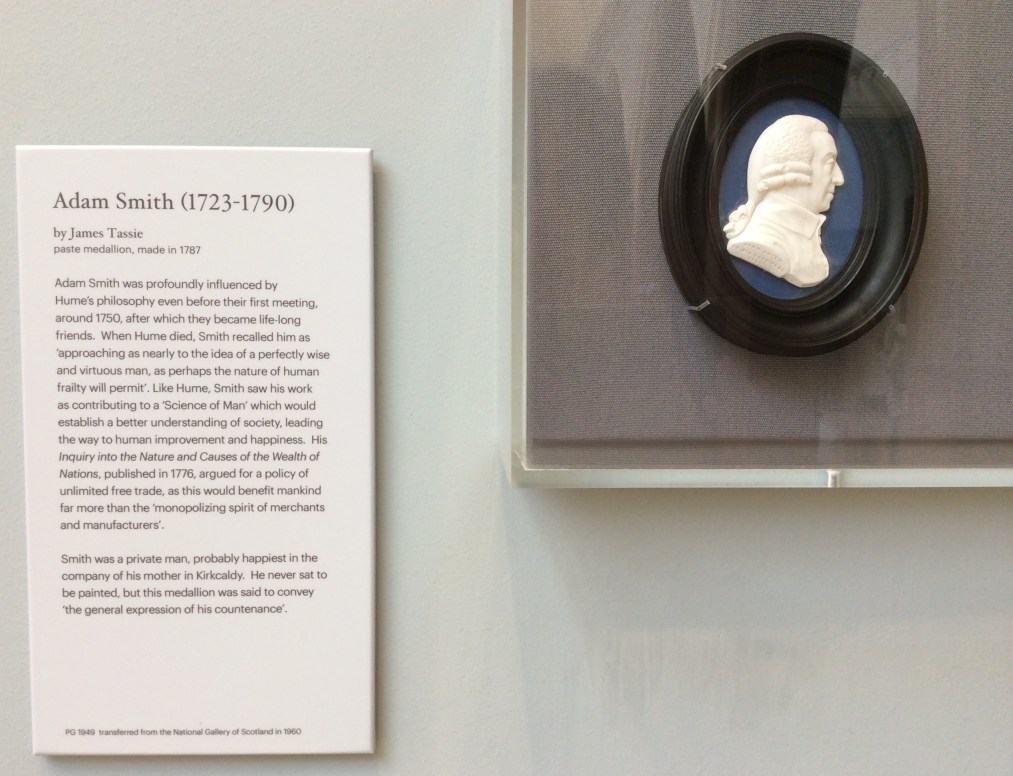
Portrait medallion of Adam Smith by James Tassie at the National Portrait Gallery in Edinburgh, Scotland.

Smith’s Theory of Moral Sentiments merges from a sort of compendium of elements of moral philosophy, in which Smith fuses what he considers the best and most coherent elements of moral philosophy into one compelling system. In it, one recognizes Humian sentimentalism, Kantian-type reason-based morality (Immanuel Kant’s work on this topic came after Smith’s, though the men were direct contemporaries), consequentialism, and Aristotelian virtue ethics. Like Hume, Smith thinks that the emotions play a central role. Before Hume, morality was widely considered to be primarily a matter of reason, and morality required us to quash our emotions, or as Hume put it, passions, because human are naturally and by default selfish, greedy, profane, lazy, and in myriad others way fallen creatures. Hume, however, does not agree. He believes that human beings naturally identify with the pains and joys of others, internalizing them and causing us to want to ameliorate their circumstances, and it’s this direct emotional response that drives the moral sense. Smith largely agrees, but not wholly. He also stresses the importance of sympathy (close to the sense that we’d usually now mean empathy) in making moral judgments. Smith explains that the moral agent is like an impartial spectator who participates in the daily lives, sufferings, and joys of our fellow human beings through our emotional response to their situation.

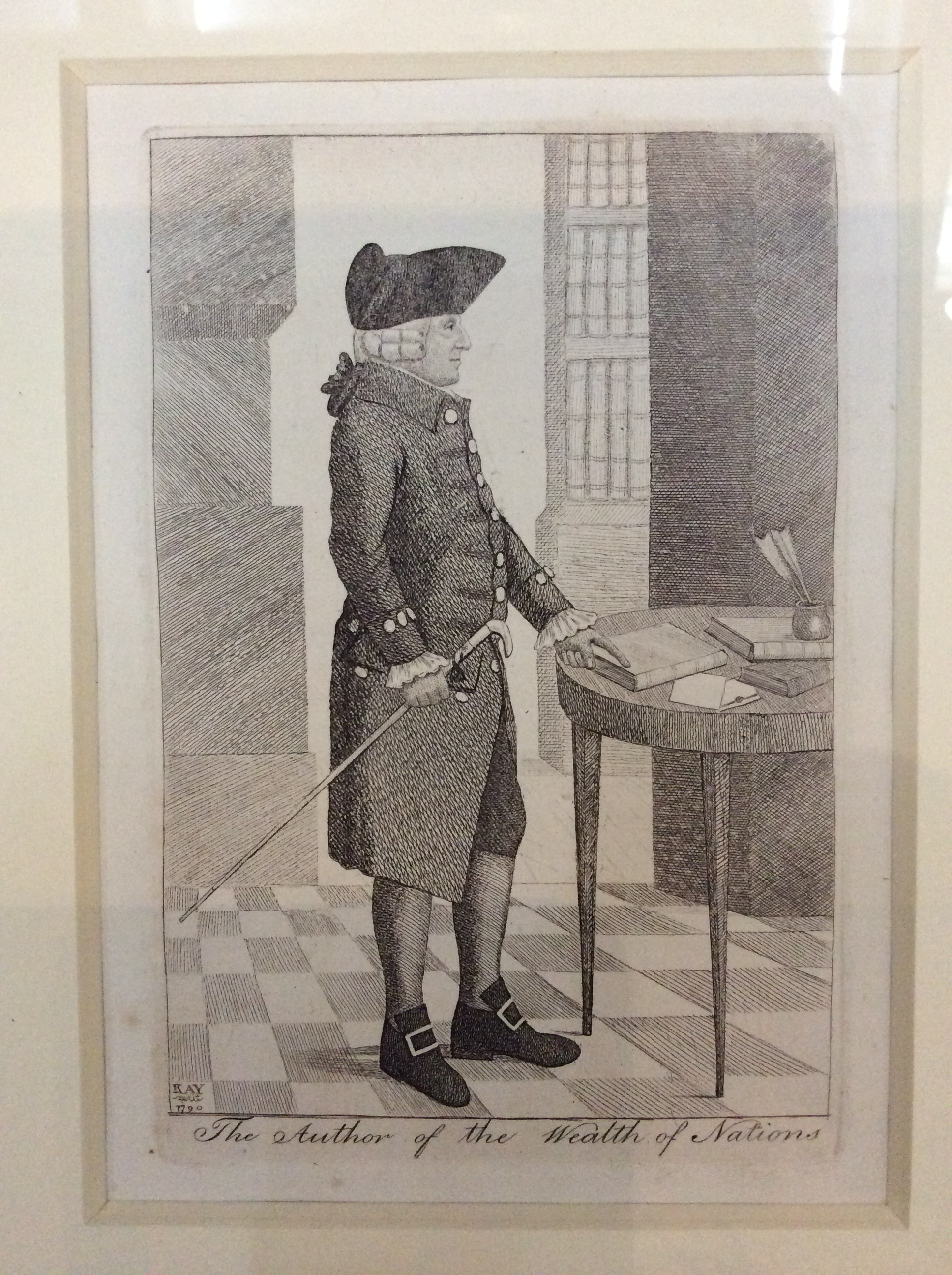
Adam Smith portrait by John Kay from 1790 (the year of Smith’s death), at the National Portrait Gallery, Edinburgh

But Smith also believes that sympathy (empathy) is not enough: our sympathies can and should be corrected by reason since our emotional responses can become inappropriate to the situation, corrupted by ignoble impulses such as greed, ambition, selfishness, and so on. An impartial, uncorrupted spectator would not consider indifference or cruelty, for example, as proper emotional responses to the plight of others. (I see shades of John Rawl’s ‘veil of ignorance‘ here.) One way to help us maintain moral ‘propriety’, as Smith put it, is to apply reason, and one way our reason can help us judge whether our moral sentiments are correct is to consider the consequence of actions we feel inclined to do. While the consequences of our actions don’t determine their rightness or wrongness as they do in consequentialist moral theories, they are an important consideration and in some cases, such as those in which human life hangs in the balance, they should take precedence. And finally, Smith agrees with Aristotle that we can’t rely on a pre-determined, reason-derived, emotionally-detached set of inflexible moral principles to differentiate right from wrong, good from bad, as Kant would have it. Rather, we naturally recognize and respond to virtue when we see it. We admire its beauty and goodness and have the desire to emulate it. Aristotle sees virtue as a perfect balance between opposing qualities in the same sphere: courage is the virtue on the right part of the spectrum between cowardliness and recklessness; temperance between licentiousness and insensibility; friendliness between obsequiousness and cold indifference. Smith likewise stresses the importance of balance in our moral character but focuses more on attuning our sympathies so they are in propriety, thereby driving us to act in the kindest, most honest, and fairest way towards one another as a matter of course.

This is only a very short summary of Smith’s moral philosophy by one who is by no means an expert. To learn more about the great philosopher and economist Adam Smith from those who are (including himelf, he’s an excellent and compelling writer), and for more about the philosophical traditions that influenced him and which he influenced in turn, see:

Adam Smith (1723—1790) – Jack Russell Weinstein for the Internet Encyclopedia of Philosophy

Adam Smith’s Moral and Political Philosophy – by Samuel Fleischacker for The Stanford Encyclopedia of Philosophy

Adam Smith pt. 1 – Specialization and Adam Smith pt. 2 – The Tip of the Iceberg Of Wealth – Stephen West discusses Adam Smith’s political economy for his blog Philosophize This!

Adam Smith on What Human Beings Are Like – Nicholas Phillipson discusses Adam Smith’s view of human beings with Nigel Warburton for Philosophy Bites podcast

Enlightenment – William Bristow for The Stanford Encyclopedia of Philosophy

Moral Sentimentalism – Antti Kauppinen for The Stanford Encyclopedia of Philosophy

The Problem With Inequality, According to Adam Smith – Dennis C. Rasmussen, Jun 9, 2016 for The Atlantic

The Theory of Moral Sentiments – Adam Smith, first published in 1759

~ Ordinary Philosophy and its Traveling Philosophy / History of Ideas series is a labor of love and ad-free, supported by patrons and readers like you. Please offer your support today!

Why Shouldn’t We Compel Them to Come In? Locke, the Enlightenment, and the Debate over Religious Toleration, by Nicholas Jolley

Religious Liberty, at the National Museum of American Jewish History in Philadelphia, by Moses Jacob Ezekiel, 1876

Most people in the West today unreflectively accept the need for religious toleration. Of course, if pressed, they will admit that toleration, like freedom of speech, can’t be absolute; there must be some limits. Suppose, for example, that my religion calls for human sacrifice every Sunday; no one will think that such a religion should be tolerated. Again, if pressed, people will agree that there are difficult cases: to take an issue that troubled John Locke, suppose that my religion demands allegiance to a foreign power. We may think that reasonable people can disagree over such cases. But the fact that there are these problem cases doesn’t shake people’s commitment to the principle of religious toleration.

We tend to be so wedded to this principle that we can easily forget how seductive the case for intolerance can be. Consider, for instance, a person who says with an authoritative air: “I know that my religion is the true one and that yours is completely false. I also know you will go to hell if you don’t convert to my religion.” Wouldn’t it be an act of charity on his part to convert you, by force if necessary, to the religion that will ensure your happiness in the afterlife? Here one might adapt an example given by that champion of liberalism, John Stuart Mill, for another purpose. A police officer sees a person trying to cross a bridge that he knows to be unsafe. According to Mill, it’s not an unwarranted interference with the person’s liberty for the officer to use force to prevent him or her from stepping on to the bridge; he knows, after all, that the bridge is unsafe and he knows that the person doesn’t want to fall into the river. One might take a similar line in the religious case: I know that John’s religion is leading him to hell, and I know that that’s not where he wishes to end up. Theologians in the Western tradition such as Augustine have argued for intolerance along these lines, and they have buttressed their argument by appealing to the biblical text: “Compel them to come in.”

Modern liberals are likely to respond that the appeal to Mill’s example is unfair, for the analogy is far from exact. For one thing, Mill builds into his example the assumption that there is no time to warn the person about the danger of the bridge; presumably, if there were time to warn him, then other things being equal, Mill would admit that there was no case for coercion. More importantly, one might argue that no one really knows, or can know, that the doctrines of revealed religion are true; acceptance of such doctrines depends on accepting the accounts of witnesses who may be unreliable or whose words may have been misinterpreted down the ages.

The idea that no one can know the claims of revealed religion are true is the basis for one of Locke’s main strategies of argument for religious toleration. The strategy is a powerful one, but it is open to a couple of objections. First, Locke sets the bar for knowledge very high: he allows little to count as knowledge that isn’t on a par with mathematical demonstration. By his lights, in the bridge example, even the policeman doesn’t strictly know that the bridge is unsafe. Further, even if the champion of intolerance concedes that he doesn’t strictly know his religion to be true, he may still say that he has very strong support for his beliefs, and that this level of support justifies him in coercing others. So the kind of case that Locke makes here may not be conclusive.

Fortunately, Locke has other strings to his bow. One intriguing argument turns on the nature of belief and its relation to the will. Suppose that the champion of intolerance says to the unbeliever: “You ought to believe the articles of my faith” (e.g. the doctrine of the Trinity). It seems apt for the unbeliever to reply to such a claim by saying: “It’s not in my power to believe this doctrine. You misunderstand the nature of belief. Belief is not a voluntary action like switching on a light. Rather, belief is more like falling in love; it’s something that happens to you.” One might then plug in the Kantian principle implicitly accepted by Locke: ought implies can. If belief is not in my power, and ought implies can, then I can have no obligation to believe the proposition in question.

This can seem like a powerful reply to the advocate of intolerance, but again, unfortunately, it’s not conclusive. For the advocate may say: “I agree that belief is not directly under your voluntary control, but I maintain that it is indirectly so. True, you can’t just switch on belief, but it’s in your power to do things that will result, or are likely to result, in your coming to believe.” Pascal, for instance, thought that though we can’t just believe at will, we can do things such as going to Mass and mixing with the congregation of the faithful that will have the effect of producing belief; faith, he thought, is catching. And then the intolerant person is in a position to make a case for religious persecution on the part of the state: there should be penalties for non-attendance at church so that people are induced to attend and at least to give a hearing to the teachings of the state-approved religion. This was the argument put to Locke by his opponent, Jonas Proast. Locke seeks to reply to this argument by saying that sincere religious belief can’t be produced in this way, and that it’s only sincere religious belief that is acceptable to God. Whether this reply to Proast is successful is a controversial issue among philosophers who have studied the debate. And the issue isn’t a narrowly academic one: it should be of interest to all those who seek to defend the values of the Enlightenment today.

This essay was originally published at OUP Blog: Oxford University Press’s Academic Insights for the Thinking World

Nicholas Jolley is Research Professor and Emeritus Professor of Philosophy at the University of California, Irvine. He has also taught at the University of California, San Diego, and Syracuse University. He is the author of a number of books for OUP, including Toleration and Understanding in Locke (2017), and Locke’s Touchy Subjects: Materialism and Immortality (2015).

~ Ordinary Philosophy is a labor of love and ad-free, supported by patrons and readers like you. Any support you can offer will be deeply appreciated!

*All views and opinions expressed by guest writers are their own and do not necessarily reflect those of Ordinary Philosophy’s editors and publishers

How ‘The Rubáiyát of Omar Khayyám’ Inspired Victorian Hedonists, by Roman Krznaric

The Angel of the Drink of Darkness, The Rubaiyat of Omar Khayyam, by Edmund Dulac

How did a 400-line poem based on the writings of a Persian sage and advocating seize-the-day hedonism achieve widespread popularity in Victorian England? The Rubáiyát of Omar Khayyám was written by the eccentric English scholar Edward FitzGerald, drawing on his loose translation of quatrains by the 12th-century poet and mathematician Omar Khayyám. Obscure beginnings perhaps, but the poem’s remarkable publishing history is the stuff of legend. Its initial publication in 1859 – the same year as Charles Darwin’s On the Origin of Species and J S Mill’s On Liberty – went completely unnoticed: it didn’t sell a single copy in its first two years. That all changed when a remaindered copy of FitzGerald’s 20-page booklet was picked up for a penny by the Celtic scholar Whitley Stokes, who passed it on to Dante Gabriel Rossetti, who subsequently fell in love with it and sang its praises to his Pre-Raphaelite circle.

When, in 1863, it fell into the hands of John Ruskin, he declared: ‘I never did – till this day – read anything so glorious.’ From that moment, there began a cult of Khayyám that lasted at least until the First World War, by which time there were 447 editions of FitzGerald’s translation in circulation. Omar dining clubs sprang up, and you could even buy Omar tooth powder and illustrated playing cards. During the war, dead soldiers were found in the trenches with battered copies tucked away in their pockets.

What then was the extraordinary attraction of the Rubáiyát? The answer sings out from some of its most famous verses:

XXIV
Ah, make the most of what we yet may spend,
Before we too into the Dust descend;
Dust into Dust, and under Dust to lie
Sans Wine, sans Song, sans Singer, and – sans End!

XXXV
Then to the lip of this poor earthen Urn
I lean’d, the Secret of my Life to learn:
And Lip to Lip it murmur’d – ‘While you live
Drink! – for, once dead, you never shall return.’

LXIII
Oh, threats of Hell and Hopes of Paradise!
One thing at least is certain – This Life flies;
One thing is certain and the rest is Lies;
The Flower that once has blown for ever dies.

The Rubáiyát was an unapologetic expression of hedonism, bringing to mind sensuous embraces in jasmine-filled gardens on balmy Arabian nights, accompanied by cups of cool, intoxicating wine. It was a passionate outcry against the unofficial Victorian ideologies of moderation, primness and self-control.

Yet the poem’s message was even more radical than this, for the Rubáiyát was a rejection not just of Christian morality, but of religion itself. There is no afterlife, Khayyám implied, and since human existence is transient – and death will come much faster than we imagine – it’s best to savour life’s exquisite moments while we can. This didn’t mean throwing oneself into wild hedonistic excess, but rather cultivating a sense of presence, and appreciating and enjoying the here and now in the limited time we have on Earth.

This heady union of bodily pleasures, religious doubt and impending mortality captured the imagination of its Victorian audience, who had been raised singing pious hymns at church on a Sunday morning. No wonder the writer G K Chesterton admonishingly declared that the Rubáiyát was the bible of the ‘carpe diem religion’.

The influence of the poem on Victorian culture was especially visible in the works of Oscar Wilde, who described it as a ‘masterpiece of art’ and one of his greatest literary loves. He took up its themes in his novel The Picture of Dorian Gray (1890). The character of Lord Henry Wotton is a champion of hedonism who explicitly refers to the sensual allures of ‘wise Omar’, and tempts the beautiful young man Dorian to sell his soul for the decadent pleasures of eternal youth. ‘Time is jealous of you, and wars against your lilies and your roses,’ says Lord Henry. ‘A new Hedonism – that is what our century wants.’

Wilde’s novel was a thinly veiled celebration of homosexuality – a crime for which he was gaoled in 1895 (passages of the book were read out at his trial as part of the incriminating evidence). He saw in the Rubáiyát an argument for individual freedom and sexual liberation from the constraints of Victorian social convention, not least because FitzGerald too was well-known for his homosexuality. For Wilde, as for FitzGerald, carpe diem hedonism was far more than the pursuit of sensory pleasures: it was a subversive political act with the power to reshape the cultural landscape.

Hedonism has a bad reputation today, being associated with ‘YOLO’ binge-drinking, drug overdoses, and a bucket-list approach to life that values fleeting novelty and thrill-seeking above all else. Yet the history of the Rubáiyát is a reminder that we might try to rediscover the hidden virtues of hedonism.

On the one hand, it could serve as an antidote to a growing puritanical streak in modern happiness thinking, which threatens to turn us into self-controlled moderation addicts who rarely express a passionate lust for life. Pick up a book from the self-help shelves and it is unlikely to advise dealing with your problems by smoking a joint under the stars or downing a few tequila slammers in an all-night club. Yet such hedonistic pursuits – enjoyed sensibly – have been central to human culture and wellbeing for centuries: when the Spanish conquistadors arrived in the Americas, they discovered the Aztecs tripping on magic mushrooms.

On the other hand, the kind of hedonism popularised by the Rubáiyát can help to put us back in touch with the virtues of direct experience in our age of mediation, where so much of daily life is filtered through the two-dimensional electronic flickers on a smartphone or tablet. We are becoming observers of life rather than participants, immersed in a society of the digital spectacle. We could learn a thing or two from the Victorians: let us keep a copy of the Rubáiyát in our pockets, alongside the iPhone, and remember the words of wise Khayyám: ‘While you live Drink! – for, once dead, you never shall return.’Aeon counter – do not remove

This article was originally published at Aeon and has been republished under Creative Commons.

Roman Krznaric is a social philosopher. He is the founder of the world’s first Empathy Museum and of the digital Empathy Library. He is also a founding faculty member of The School of Life and on the faculty of Year Here. His latest book is Carpe Diem Regained: The Vanishing Art of Seizing the Day (2017). Bio credit: Aeon

~ Ordinary Philosophy is a labor of love and ad-free, supported by patrons and readers like you. Any support you can offer will be deeply appreciated!

*All views and opinions expressed by guest writers are their own and do not necessarily reflect those of Ordinary Philosophy’s editors and publishers