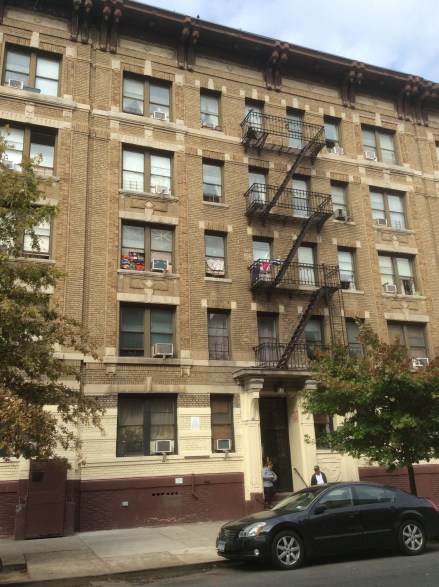
34 Post Ave near Dyckman St, Inglewood, Manhattan, NYC, 2016 by Amy Cools
Thursday, October 20th, 2016, continued
I exit the A train at the Dyckman St station, the second to the last stop on the line, and walk a couple of blocks to 34 Post Ave. Margaret Sanger moved into ‘an inexpensive little flat’ here in January of 1914 leaving her husband William, or Bill as she called him, behind in Paris. The Sangers had lived there for a few months as Sanger researched and wrote and William worked to establish himself as a painter. En route to Paris, they stopped in Glasgow, Scotland, so that Sanger could observe and write about the effects of municipal ownership, a system of public ownership often endorsed by Socialists, for a newspaper assignment. While in Paris, Sanger met with many socialists and activists, all the while researching French methods of contraception. But she was growing bored and restless, eager to get back to work and engage in activism once again. She and the three children returned to New York City around the New Year, leaving William behind to continue his artistic pursuits.
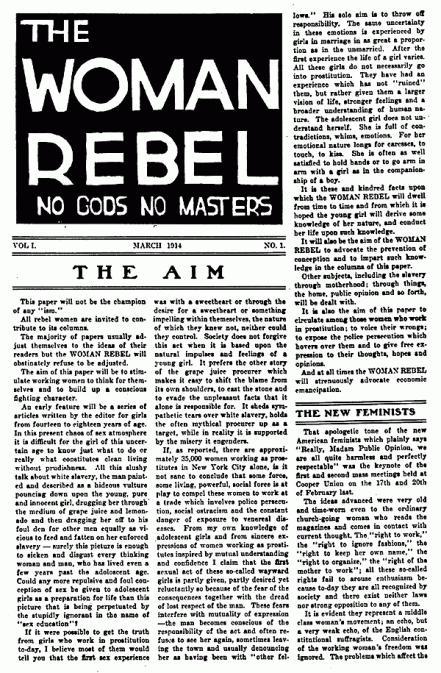
The Woman Rebel, First Edition, March 1914, directed that inquiries be sent to Sanger’s 34 Post St address
The lady in the photo above, in the black and white checked jacket, is standing in the doorway of today’s number 34, but this building does not date to Sanger’s time here: it was built in 1920. Sanger’s apartment in the former building was small, cheap and according to Sanger, dingy. But big things would happen here. On the return voyage from Paris to New York City, she had conceived of a journal that was, as her biographer Ellen Chesler describes it, ‘dedicated to working women and intended to challenge Comstock’s prohibition of information about sexuality and contraception’. Sanger and a group of like-minded radical thinkers and activists launched The Woman Rebel from the kitchen table of that little apartment, publishing the first edition in March of 2014. One of those radicals, Otto Bobstein, invented the term ‘birth control’ which Sanger seized on and popularized, often claiming to have invented it. Perhaps she lied, or perhaps this is an example of one of those memories that longtime friends or siblings argue over, of a favorite term or phrase used often and long enough that no-one can remember who really came up with it first.
In a speech at Hotel Brevoort given a few years later on January 17th, 1917, Sanger agreed with the magazine’s critics that The Woman Rebel was ‘..badly written; …crude; …emotional, and hysterical; that it mixed issues; that is was defiant, and too radical. Well, to all of these indictments I plead guilty!’ She was proud nevertheless of the passion and sturdy defiance expressed in its pages. And what was printed on those pages led to her first indictment on obscenity charges, which drove her right back to Europe by the end of the same year she had returned and established this journal.
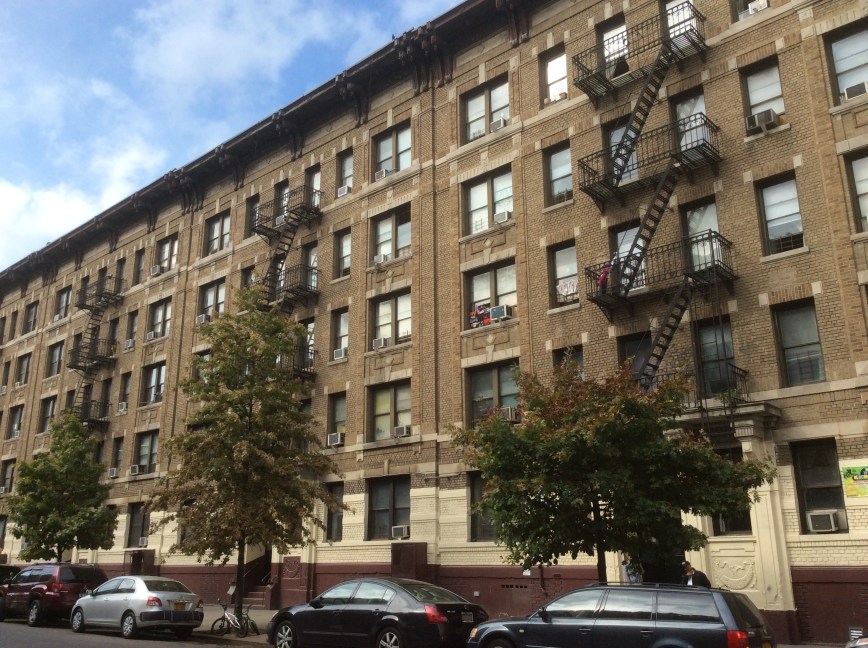
Apartment buildings which include 34 Post Ave near Dyckman St, in Inwood, upper Manhattan. The row continues for most of the block, all identical, including the site of Ethyl Byrne’s place at 26 Post Ave.
A few doors west in the same apartment row of identical buildings, heading back towards Dyckman St and the subway station, is number 26 Post Ave. Sanger stayed here with her sister and fellow birth control activist Ethel Byrne for a time in 1915. Sanger’s daughter Peggy had died of pneumonia just a short time before on Nov 6th, 1915.
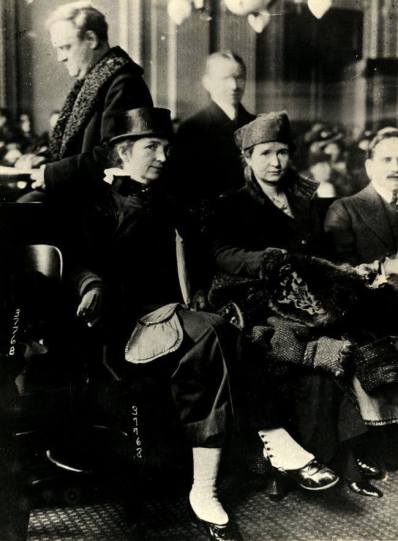
Margaret Sanger, left, and Ethel Byrne, right, in court in 1916
Sanger and her sister Byrne enjoyed a close relationship in their early lives and into the nineteen-teens. Byrne, who left her husband and children to pursue her own nursing career, was very involved with Sanger’s early birth control activism. She had gone on a hunger strike when imprisoned for her own role in Sanger’s Brownsville clinic, to the point of seriously endangering her health. And Byrne had often helped care for Sanger’s children while Sanger was in exile in Europe and out of town as she was very frequently. However, their relationship deteriorated over later years. Byrne was a direct, no-frills woman who thrived on practical work and remained a nurse for the rest of her life; Sanger had given up nursing in favor of theory and activism. Byrne disapproved of Sanger’s solicitation of wealthy society women for the cause; Sanger was willing to accept help, connections, and most crucially, money, wherever they were offered. It seems easy to pick sides in this divide, and I’m tempted to take Sanger’s on the grounds that I think Frederick Douglass would, according to my understanding of his pragmatist views: to eschew practical and political concerns in favor of staying true to the highest ideals of a cause is to show a commitment to the ideals themselves and not necessarily to the cause’s success. This won’t do when it comes to the liberty, health, and very lives of actual human beings. But it also takes people such as Byrne to make a successful cause: the idealistic, uncompromising, hard workers who are driven to perform many of the most laborious, tedious, and thankless tasks. Here’s to you, Byrne, and all your hard work!
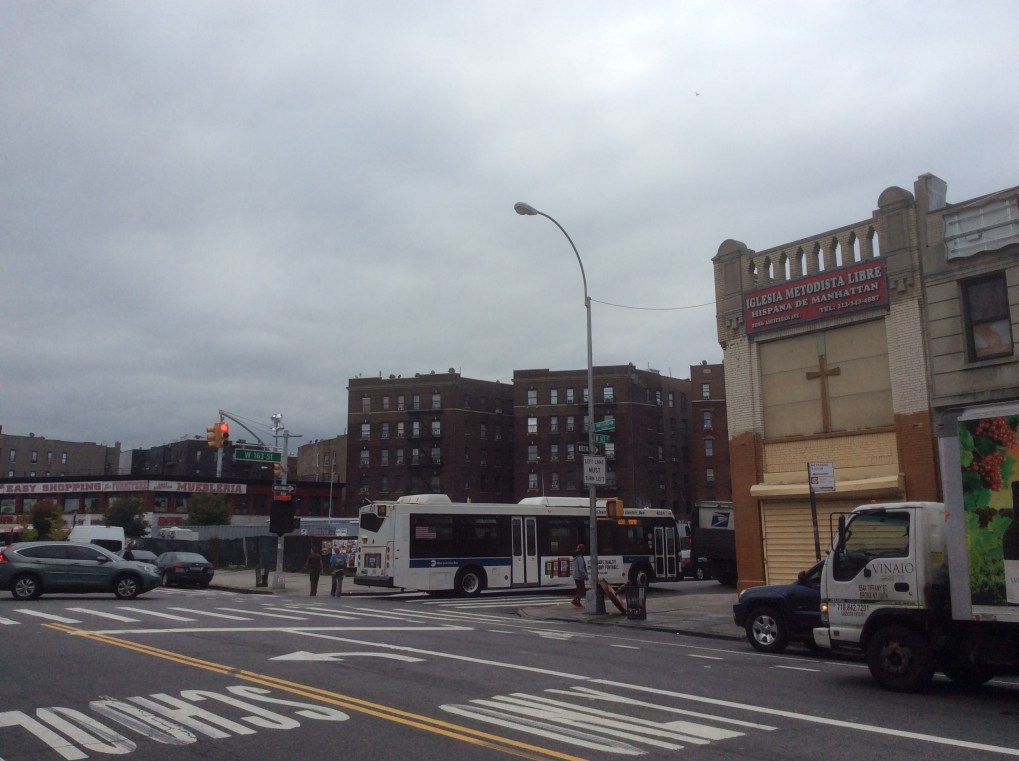
163rd St at Amsterdam. 503 163rd St. used to face where the bus is now.
I take the A train back south a few stops to the station at 163rd and walk to 502 W. 163rd St at Amsterdam. According to Bromley’s Atlas of that same year, the building that once stood at 502 was on the north end of a wedge-shaped lot, now vacant, at the intersection of 163rd, Amsterdam, and St Nicholas Ave /Juan Pablo Duarte Blvd. This section of St Nicholas Ave is another busy section of the street, crowded with small shops, fruit and vegetable stands, and sidewalk vendors.
Sanger spoke at the Free Synagogue here on Sunday, April 22nd, 1923. Rabbi Louis A. Mischkind, a socially conscious, progressive, even radical religious leader, had invited Sanger to speak on birth control at the Tremont Temple. When his superiors objected, he moved the talk here to the Free Synagogue but was still demoted for his disobedience. Sanger’s Birth Control Review extolled his decision as an act of free speech heroism.
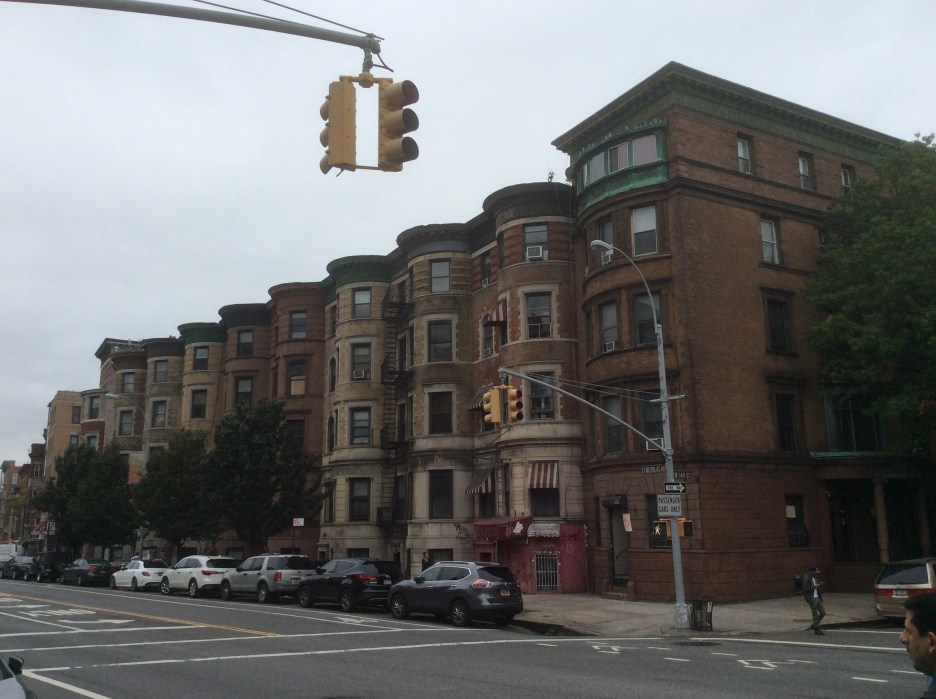
St. Nicholas Avenue at 149th Street, Broadbelt houses built in the late 1800’s.
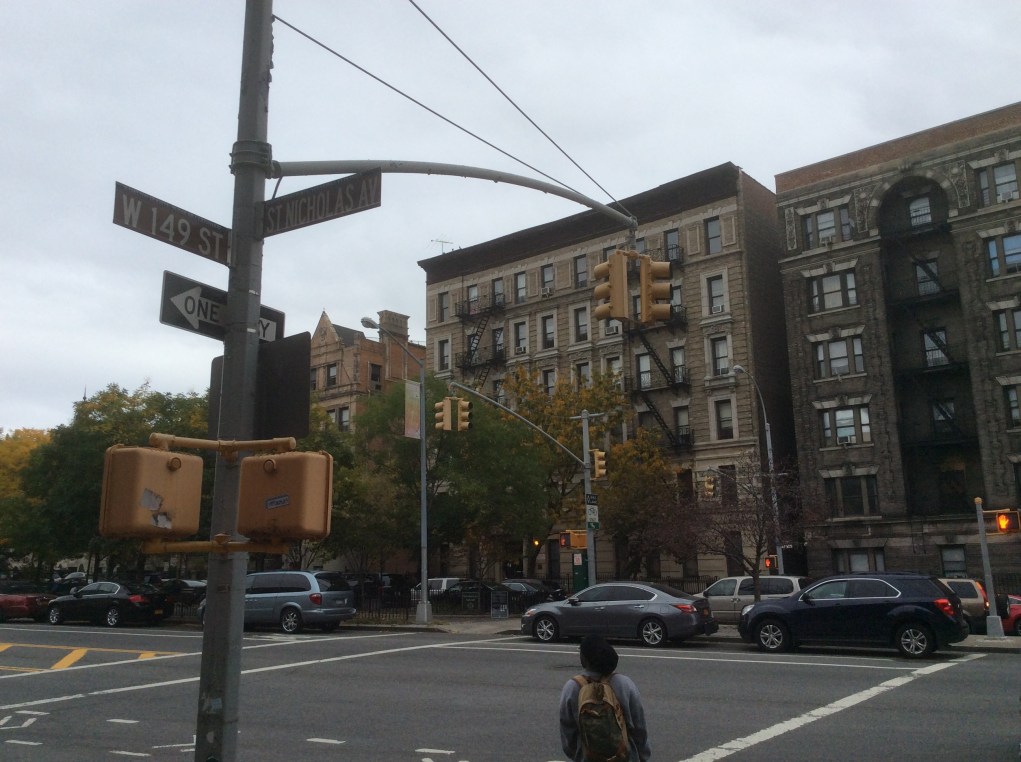
Apartments on St Nicholas Avenue at 149th, some of which date to Sanger’s time here or shortly after
Next, I walk a little over two-thirds of a mile south to where Sanger, newly wedded to William (she called him Bill), moved into a “practically suburban” “little apartment on St. Nicholas Avenue at 149th Street” shortly after their wedding on August 28th, 1902. As of the time I write this, I’ve found no exact address for their apartment here, just this little description she wrote in her autobiography. Their first son Stuart was born here on November 28th, 1903. The strain of his birth added to her general poor health, already worn out by a tough bout of her recurrent tuberculosis. She was also terribly despondent, with what her description indicates was post-partum depression. After she recuperated for some months in a farmhouse and a sanitarium, the couple moved to Hastings-on-Hudson. As we’ve seen, however, the suburban life did not suit the Sangers in the long run, especially Margaret, and they returned to New York City in 1910.
I continue south on St Nicholas, turn left on on 138th St, and go about two long blocks until I make a brief right on 7th Ave, also called Adam Clayton Powell Blvd. Here at 2352 7th Ave, Sanger opened the Harlem branch of the Birth Control Clinical Research Bureau on May 23, 1930. The BBCRB’s locations further south in Manhattan mainly served local women of European descent but Sanger believed that many other women needed the help of her clinics. She decided to open this northern branch to serve them.
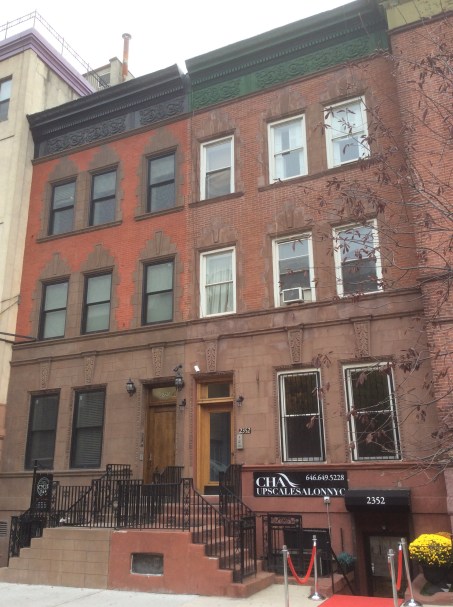
On the right, 2352 7th Ave (Adam Clayton Powell) at 138th St, NYC, the site of the Harlem branch BBCRB clinic
This clinic in Harlem was actually Sanger’s second attempt to open a clinic in New York for black and other underserved women; she had briefly opened one in west Midtown, in a small, predominantly black, impoverished neighborhood called Columbus Hill. I have not yet found an address for its former location. This first clinic was not a success and closed after only a few months; Sanger thought it would be best to conserve resources to open a clinic in a place where she might reach more people. She had the support of many black leaders throughout these efforts, including the influential Reverend Adam Clayton Powell of the Abyssinian Baptist Church (for whom this street has been renamed), Mary Bethune, and W. E. B. DuBois. DuBois spoke here on one occasion that fall, on November 21st, 1930.
Interestingly, a rumor that persists to this day, that Sanger’s efforts to provide reproductive services for black women were racist, may have originated with an intellectual and tactical foe of DuBois’. A Harlem preacher named Marcus Garvey believed that the black and white races could never get along and must be separated. He founded a shipping company called ‘The Black Star Line’ with the ultimate goal of taking all African descendants back to their home continent to found a racially pure black nation. To this end, he opposed all forms of contraception or childbirth limitation for black people: the nation of his dreams would need as many citizens as black women could bear to make it a vibrant and strong one. Garvey attacked Sanger’s clinics and all efforts to help black women control their fertility as genocidal projects. DuBois took the opposite view, believing that black people could and should live as equal citizens in the United States and wherever else they wanted to live, and that black families could better gain their rights as their financial and physical health improved through judiciously constrained childbearing. Of course, Sanger and DuBois were in agreement on this, as they were on matters of racial equality.
The Harlem clinic was more successful than the Columbus Hill one, but still only stayed open for about seven years. Though Sanger hired a black doctor and social worker to run the clinic, there was likely enough Garvey-inspired rumor and suspicion of their motives that the clinic not as widely welcomed as they hoped. No wonder, then, that she wrote that infamous line in a 1939 letter regarding her efforts to serve black women in the South: ‘We don’t want word to go out that we want to exterminate the Negro population…’ The ‘word’, untrue and unjustified as it was, had already ‘gone out’ for her Harlem clinic several years before.

Interior of 2352 7th Ave at 138th St, now CHA Upscale Salon
There’s now a hair salon at the on the lower level of the Harlem clinic site called Cha, and I go in. I find myself in a shining, sparkling lobby filled with mirror-lined and white furniture, a rhinestone chandelier, and white lilies in rhinestone vases. It promises pampering, which sounds glorious to this footsore woman. I see no one for a moment, then a voice calls, ‘Can I help you?’ A few steps in takes me to another stylist’s both, where a woman with a flowing, waved, luxuriant ‘do’ was doing another woman’s hair. I very briefly explain that I’m doing a history project and ask if I can take a quick photo of her lobby. She says yes, kindly, but distracted, focused on her client. I don’t catch her name as I don’t want to interrupt her task any further, but if you happen to read this, hospitable lady, thank you! Your salon is so lovely and welcoming.
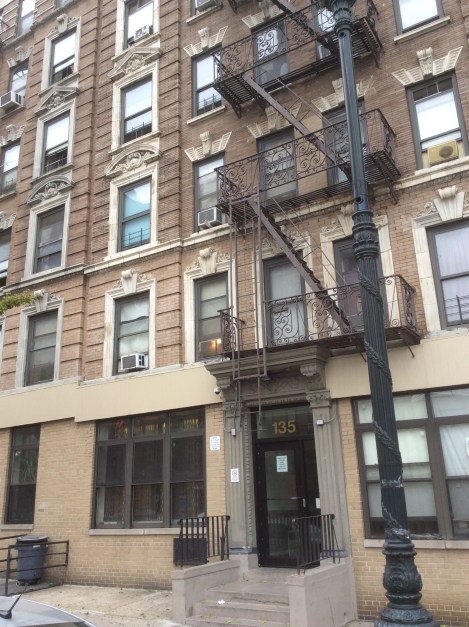
135 W. 135th St, between Malcolm X and Adam Powell Blvds, where Sanger and family lived in 1911
I continue to make my way south and a little east to 135 W. 135th St, between Malcolm X and Adam Powell Blvds, where Sanger and her family lived in 1911. The year before, the Sangers returned to New York City. The house Bill had designed and built for them suffered a fire which damaged the house and destroyed many of the furnishings. The expenses of repairing the house and replacing their lost things severely damaged their already precarious finances. While the situation was stressful and Sanger was frustrated with her husband’s inability to make a steady, reliable income, she was also bored and frustrated with her quiet, domestic suburban life. Upon returning to urban life, Sanger resumed nursing and Bill got into politics; both became very active in the bohemian Socialist scene. As we’ve discovered, it was Sanger’s experiences in these years that most inspired her birth control cause, from her Socialist activism on behalf of New York City’s beleaguered working class to the struggles of the poor mothers and families in the largely immigrant slums of the Lower East Side.
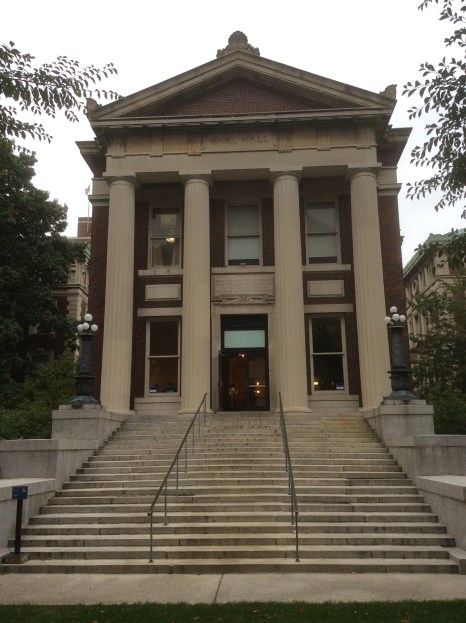
Earl Hall at Columbia University, New York City
As I head west on 135th St to the St Nicholas Ave station, I pass by a site I visited last time I was here: Ida Wells’ New York Age newspaper offices which published Wells’ groundbreaking Southern Horrors: Lynch Law in All Its Phases, and where Frederick Douglass likely met with her on at least once. I smile at the memory.
I enter the subway station where 135th St meets St. Nicholas Park and exit 116th, walking west across Morningside Park and up the hill to the Columbia University campus. It’s a beautiful walk; the park is lush and green, and the campus is an inspiring and lovely place, with broad lawns and elegant buildings in so many styles: Beaux-Arts, neo-classical, and Gothic Revival, to name a few.
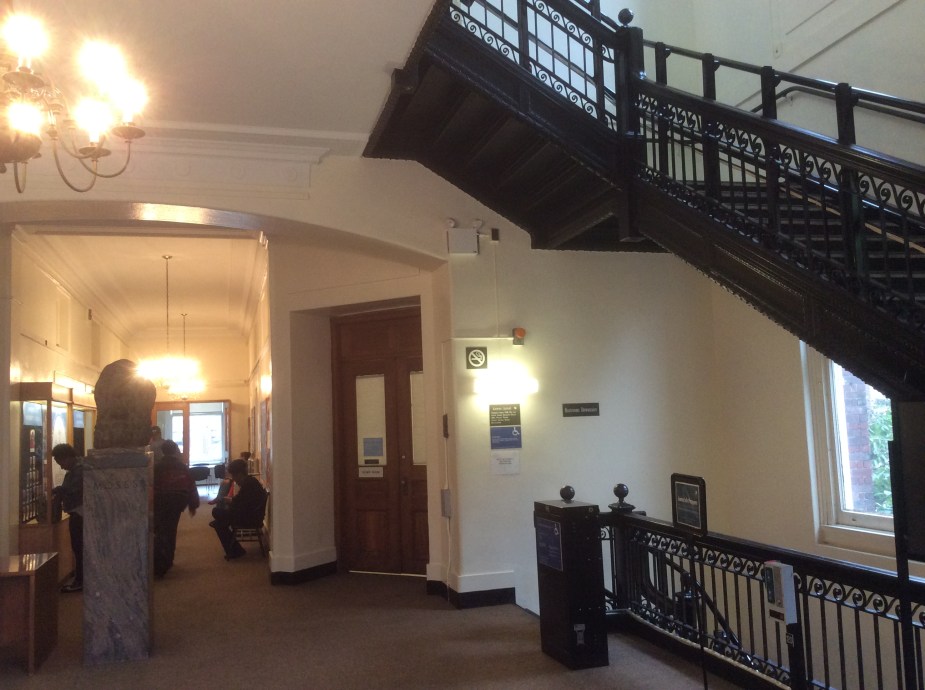
Interior of Earl Hall, Columbia University, NYC
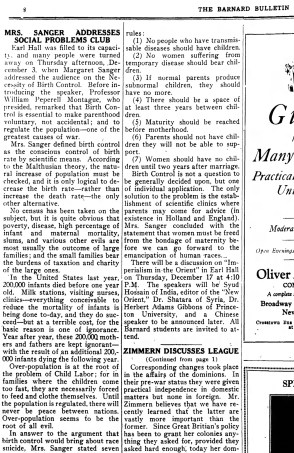
Newspaper account of Sanger’s talk at Earl Hall, from The Barnard Bulletin, New York, Fri Dec 11, 1925. Click to read a larger version.
I head to Earl Hall at 2980 Broadway, a little north of 116th St. On December 3rd, 1925, Sanger addressed the Social Problems Club here. She delivered her lecture ‘The Necessity of Birth Control’ at 4 pm to a packed house. According to the Columbia Daily Spectator, at this event, birth control ‘was discussed for the first time on the Columbia Campus’. That is, at least officially. The necessity of birth control was outlined in terms of major social problems that club would likely have discussed frequently: infant and maternal mortality rates, disease, crowding, poverty, crime, and women’s rights. The Barnard Bulletin published a detailed outline of the talk and its main topics (see the image and link to the right).
I take an indirect route to my next destination a mile away via Amsterdam Ave so I can see the spectacular Cathedral of Saint John the Divine on my way; it’s south of Columbia University on the west wide of Morningside Park. The cathedral is as wonderful as it’s been described to me by so many. I add my recommendation to theirs to visit if you haven’t yet.
I continue east from the cathedral heading for 141 W. 111th St. The doorway and its stoop of the building I find here is flanked on either side by classical columns with ‘Kenosha’ spelled out overhead; the others in an identical row of four apartment buildings (though this is the only one whose ground floor is painted white) have porches which read ‘Manitou’, ‘Pacific’, and ‘Mariposa’. I’m unable to discover any particular reason why they’re named this way. According to the Municipal Archives division of the NYC Department of Records, in answer to my inquiry, building names ‘were typically applied by the building architect or owner based on what you might today call “marketing-strategy”‘.
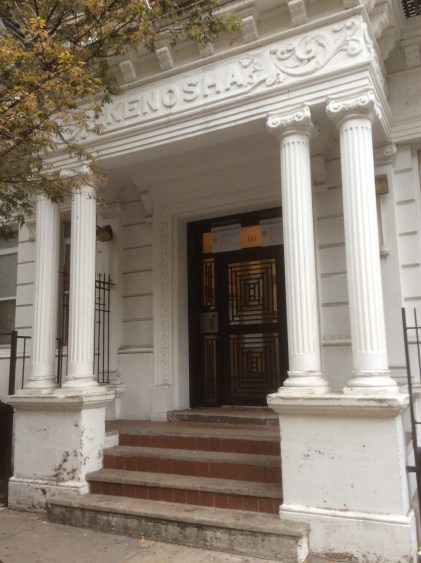
Porch of the Kenosha building at 141 W. 111th St, Harlem, NYC
Here in the Kenosha building, Sanger attended meetings of the Women’s Committee of the Local New York Socialist Party in 1911 through 1912. According to Mari Jo Buhle, writing for the journal Radical America in 1970, Sanger ‘regularly attended local meetings with her husband, but only inadvertently did she become one of the most important activists in the movement. She was asked to replace an ailing speaker at one of the local women’s meetings [of the Women’s Committee of the LNYSP]. Although she had never given a public speech before, she accepted on the condition that her topic be of her own choice. She had little confidence about her understanding of Marxian theory and decided to speak about her own speciality, sex education and hygiene.’ As discussed earlier, Sanger and her husband William threw themselves eagerly into the Socialist scene upon their return to New York City from Hastings-on-Hudson. This place is just a little under a mile-and-a-half, thirty-minute walk from the 135 W. 135th St apartment I visited just before Earl Hall, where the Sanger family lived at the time.
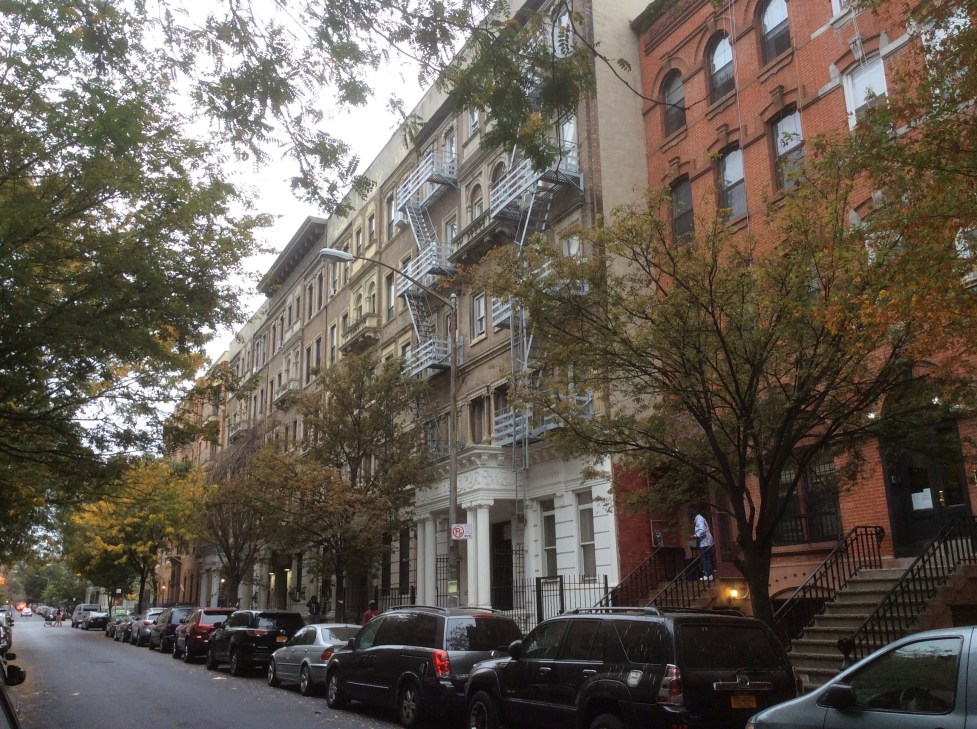
141 W. 111th St, Harlem, NYC, at center, with white porch which reads ‘Kenosha’
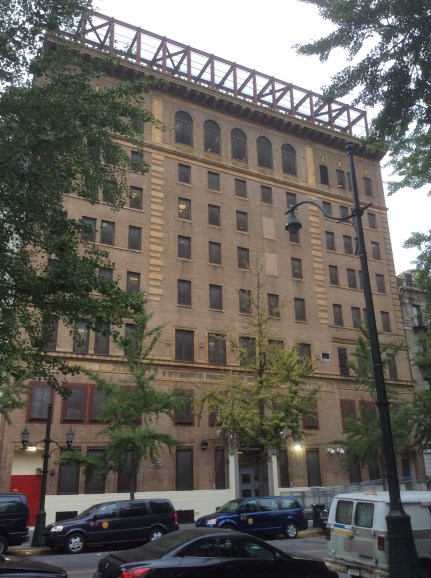
Lincoln Correctional Facility at the northeast end of Central Park, NYC
A long block east, short block south, and half a long block east again takes me back to Central Park, this time to the northeast end. I’m looking for 31 W. 110th St, between Malcolm X and Park Ave, near NE corner of Central Park. I’m surprised to find myself looking at a placard across the front lintel which reads ‘Lincoln Correctional Facility’. It’s a minimum security prison, not an institution one would expect to find facing onto Central Park. It was once the headquarters of New York City’s Young Women’s Hebrew Association, from 1914 until the late 1930’s, when the Y.W.H.A. leased the building to the U.S. Army in World War II. That explains why it doesn’t look like a prison. It was a community center, with classrooms, meeting rooms, and gym facilities including an indoor pool.
On April 1, 1924, Sanger addressed the Guardian Mothers of Young Women’s Hebrew Association here; as of this time, I find no record of what she said here that day.
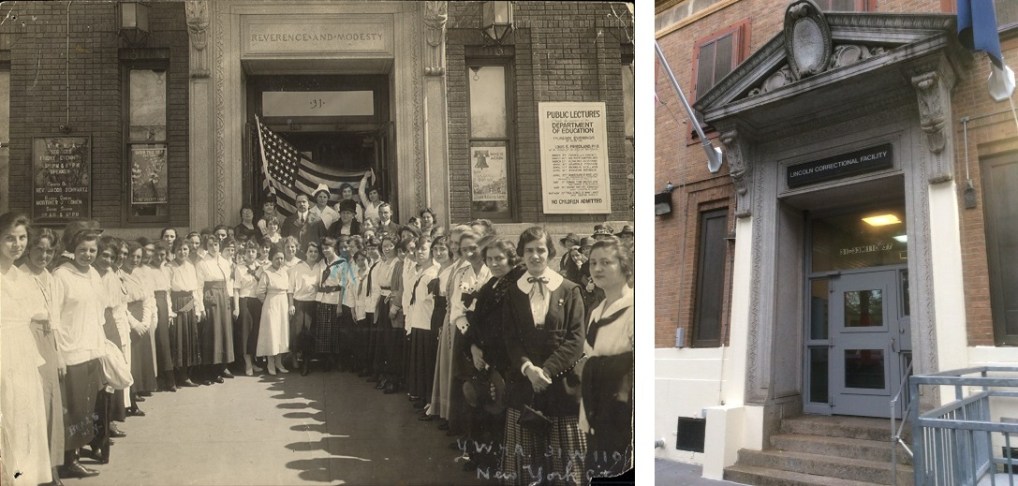
Left, Young Women’s Hebrew Association Flag Ceremony at 31 West 110th Street, 1918. Right, Lincoln Correctional Facility doorway at this address today. You can see the details and shape of the corbels supporting the overhang, the decorations around the door, and the placement and shape of the windows that it’s the same doorway
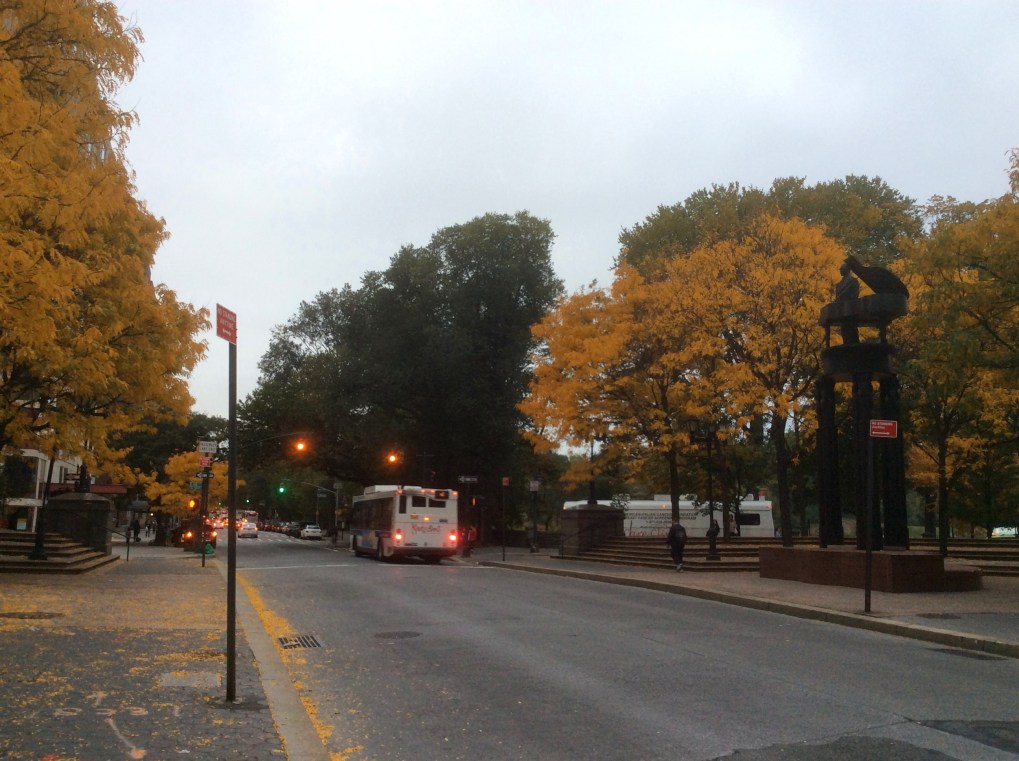
Duke Ellington Circle at 5th Ave and 110th St. Notice his statue on the tall pedestal to the right
Just a half block east on 110th St to where it meets 5th Ave, I arrive at Duke Ellington Circle. There’s a statue of the great jazz pianist and his instrument on a very tall pedestal in a stepped, paved, and grassy park surrounded by a traffic circle and split down the center by 5th Ave, north to south. The circle surrounded by a couple of plain brick highrises, an artistically modern building which houses The Africa Center, a few plain old mixed use buildings, and small vacant lot.
I’m seeking the site of Parkview Palace, which, according to Pokorski’s Mapping Margaret Sanger, was at 110th and 5th. There is no building now of that name and indeed, none at all that appear to be of the right vintage. I consult G.W. Bromley’s 1916 Atlas and find it named ‘Parkway Palace’ there. I spend a long time searching for photos or some other information about the Parkview Palace. I find lots of brief references to it, mostly in Socialist and anarchist history books since it was a popular meeting place for non-mainstream political thinkers and activists, and in old newspaper announcements for other events happening there. However, I find no photos of the Parkview at all. I do find a photo of the apparently more well-known Harlem 5th Avenue Theatre next door, but none that show the adjoining Parkview.
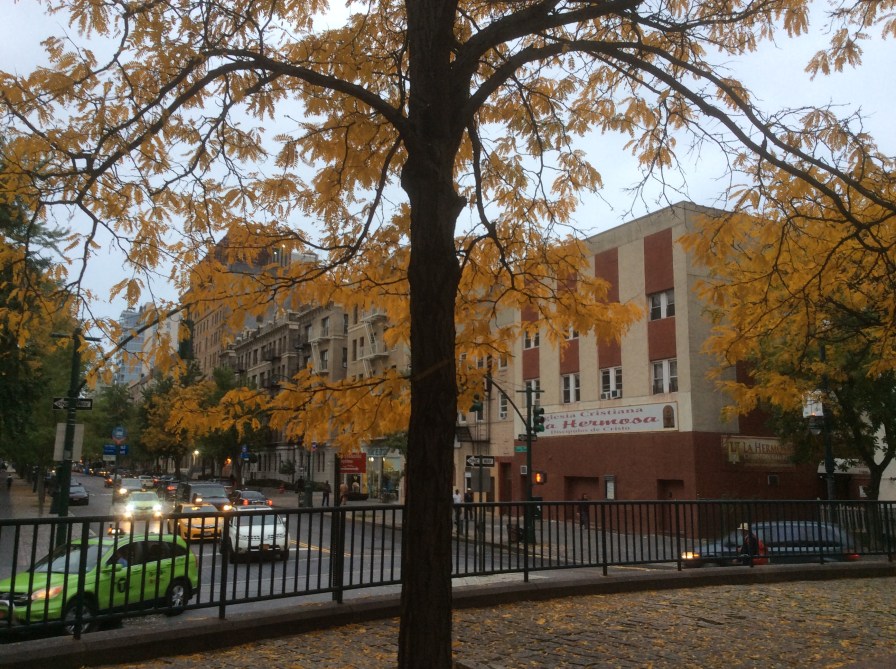
110th at 5th Ave, NW corner of intersection at Duke Ellington Circle. The Parview Palace likely stood where the Iglesia Christiana La Hermosa stands now, the red and cream building to the right
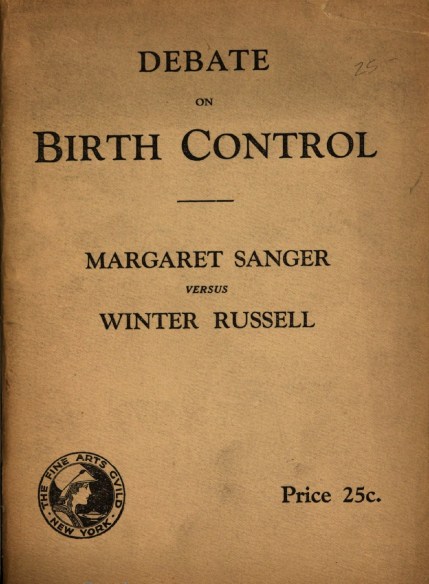
Debate on Birth Control, Margaret Sanger versus Winter Russell. Click to read the whole debate online
I’m seeking this place because Sanger debated with John Winter Russell on birth control here on December 12th, 1920. Russell was a lawyer and recent convert to Catholicism, and as we’ve considered in this series, Sanger was no particular fan of the Catholic church, to say the least. She was not a frequent debater, but she agreed to this one for two likely reasons. One, her participation fee. Since the Depression hit, she had to work harder to raise funds for herself and her cause. Second, this was another good opportunity to publicly refute arguments based on Catholic teaching. Sanger had many run-ins with Catholicism in the form of its influence on public policy as well as in the press and in local governments and police forces, as we saw in the Town Hall raid debacle. She likely relished the opportunity to demonstrate debating skills as a seasoned, well-informed birth control activist against this new convert to the Catholic religion. The entire debate was published by the Fine Arts Guild of New York City and is available online.
Russell gave Sanger many opportunities to defeat his arguments. For example: he equated the use of birth control with lack of sexual control, when the use of birth control actually requires a good deal of control in the form of foresight, planning, and proper use; he characterized sex without allowing for reproduction as animalistic and therefore unworthy of human beings, though it’s only all other animals besides humans which don’t use birth control; he conflated abortion with other forms of birth control though that characterization is not scientifically feasible and as Sanger pointed out, birth control prevents the need for abortion; he argued that pleasure can’t and shouldn’t be enjoyed without its counterpart of pain even though it’s generally only the woman who suffers it; and so forth. In the end, Russell more or less delivered the sort of arguments Sanger expected, which were, as she perceived them, rooted in a narrow and rigid brand of religiosity, sexual prudery, misogyny, and lack of scientific understanding. She and many other believed that she won this debate handily.
I’ve come to the end of my third day in New York City following Sanger, and it’s been an especially long and interesting one. I’ve decided to return to Greenwich Village and enjoy the offerings of a couple of its long-established eateries and watering holes, to read and rest my weary feet as I fill my empty belly and warm my chilly self. Until tomorrow, then!
Listen to the podcast version here or on Google Play, or subscribe on iTunes
Ordinary Philosophy and its Traveling Philosophy / History of Ideas series is a labor of love and ad-free, supported by patrons and readers like you. Please offer your support today!
~~~~~~~~~~~~~~~~~~~~~~~~~~~
Sources and inspiration:
Adams, Michael Henry. ‘The Best Address: St. Nicholas Avenue and Place, Part I‘, Jul 17, 2012.
‘Another Look at Margaret Sanger and Race‘, Feb 23, 2012. From The Margaret Sanger Papers Project at NYU
Bromley, G.W. and Co. Atlas of the Borough of Manhattan, City of New York. Desk and Library edition, 1916, Plate 129 and Plate 167. Retrieved from Lionel Pincus and Princess Firyal Map Division Digital Collection, The New York Public Library.
Buhle, Mari Jo. ‘Women & the Socialist Party‘ Radical America, Feb 1970, Vol, IV, 4F2, via National Progressive Review
Chesler, Ellen. Woman of Valor: Margaret Sanger and the Birth Control Movement in America. New York: Simon & Schuster, 1992
Debate on Birth Control / Margaret Sanger versus Winter Russell, by Margaret Sanger, Winter Russell, and Emma Sargent Russell. New York, NY: Fine Arts Guild, 1921.
East 110th Street [31 West 110th Street]. Y.W.H.A., detail of steps, interior. Photo by Wurts Bros. (New York, N.Y.), from Museum of the City of New York’s digitized archives
Eig, Jonathan. The Birth of the Pill: How Four Crusaders Reinvented Sex and Launched a Revolution. W.W. Norton & Company, New York, 2014.
Goldberg, Michelle. ‘Awakenings: On Margaret Sanger‘ Feb 7, 2012, The Nation
Gray, Christopher. ‘Built With the Ladies In Mind‘, Oct. 25, 2012, New York Times: Streetscapes
Grimaldi, Jill. ‘The First American Birth Control Conference‘, Nov 12, 2010. The Margaret Sanger Papers Project at NYU
‘House Tour Preview: Margaret Sanger’s Window.’ Apr 22, 2010, Hastings Historical Society blog
Katz, Esther. ‘Margaret Sanger and The Woman Rebel, 1914-1916: Historical Essay‘, 1999. From The Margaret Sanger Papers Electronic Edition, eds. Esther Katz, Cathy Moran Hajo and Peter Engelman (Columbia, S.C.: Model Editions Partnership, 1999)
‘Latest News‘ The Birth Control Review, May 1923, Vol VII, No. 5
‘Mrs. Sanger Addresses Social Problems Club‘, Barnard Bulletin (New York, New York) · Fri, Dec 11, 1925
‘Mrs. Sanger Glad She Was Indicted‘, New York Tribune, Feb. 21, 1916, p. 2, via The Margaret Sanger Papers Project, NYU
‘Mrs. Sanger to Talk on Birth Control‘, Columbia Daily Spectator, Volume XLIX, Number 58, 3 December 1925
Muigai, Wangui. ‘Looking Uptown: Margaret Sanger and the Harlem Branch Birth Control Clinic‘. Newsletter #54 (Spring 2010) of The Margaret Sanger Papers Project at NYU
‘On the Road with Birth Control‘, Newsletter #21 (Spring 1999) of The Margaret Sanger Papers Project at NYU
Pokorski, Robin. ‘Mapping Margaret Sanger‘ from The Margaret Sanger Papers Project at NYU
Revolutionary and Subversive Movements Abroad and at Home, (vol. I-II). By New York (State). Legislature. Joint Committee (address of Parkview Palace on p. 2020). J.B. Lyons: Albany, 1920
Risen, Clay. ‘Prison on the Park.’ Jul 9, 2002, The Morning News, New York, New York.
Sanger, Margaret. ‘Birth Control: Then and Now,’ 1944, Typed Article. Source: Margaret Sanger Papers, Sophia Smith Collection
Sanger, Margaret. ‘Hotel Brevoort Speech,” Jan 17, 1916. From The Margaret Sanger Papers Project at NYU
Sanger, Margaret. Margaret Sanger, an Autobiography. Cooper Square Press: New York 1999, originally published by W.W. Norton & Co: New York, 1938
Sanger, Margaret. The Pivot of Civilization, 1922. Free online version courtesy of Project Gutenberg, 2008, 2013
Sanger, Margaret. Woman and the New Race, 1920. Free online version courtesy of W. W. Norton & Company
‘Sanger v. Famous Father of 18!‘ Newsletter #29 (Winter 2001/2002) of The Margaret Sanger Papers Project at NYU
Sciancalepore, Victoria. ‘Rebels of Post Avenue‘, Jan 15, 2014, Margaret Sanger Papers Project
Silver, Rabbi Samuel. ‘Why I Became a Rabbi‘. Jewish Post, Indianapolis, Jan 28, 2004
Soclof, Adam. ‘Planned Parenthood Controversy‘, February 2, 2012
W. E. B. Du Bois, “The Black Star Line,” Crisis, September 1922, 210–214, via History Matters website (with introduction)



 For this next installment, I’ll be following Ernestine Rose and Elizabeth Cady Stanton, two of the greatest founders of the women’s rights movement. Elizabeth was born in New York state, and…

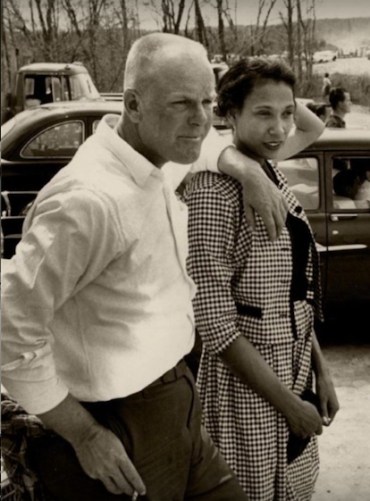 It’s not generally a very wise thing to do, but I entered into a little dispute on Facebook a little while ago. It was about Mildred and Richard Loving of Virginia. A friend shared a discussion thread which was mostly very critical of the way that the Lovings are portrayed in their recent namesake movie. The Lovings’ marriage was illegal in 1950’s Virginia because Mildred was a woman of color and Richard was white. They knew this, so a pregnant, 19-year-old Mildred and 25-year-old Richard traveled to Washington, D.C. to be married. But this didn’t help them when it came to state law: marrying out-of-state to avoid Virginia’s anti-miscegenation laws, then returning to live as husband and wife, was also illegal.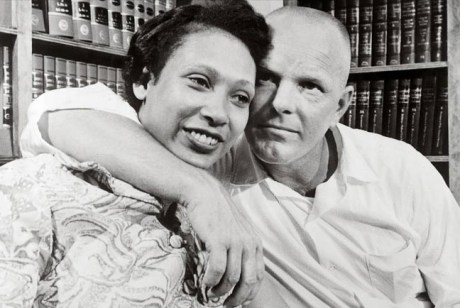

 Ordinary Philosophy