
 Ernestine Rose and Elizabeth Cady Stanton, two founders of modern feminism, are the subjects of my recent traveling philosophy series. While their advocacy for women’s rights, abolition of slavery, religious liberty, and other human rights issues was so important, wasn’t their work more about politics than anything else?
Why write about feminist activists for a philosophy blog?
It’s true, their focus was on achieving political goals: to establish laws protecting and empowering women and other classes of human beings in their property, their person, their range of opportunities, and their enfranchisement. But to accomplish this, they needed ideas: not only of their own, personal beliefs about the world and the way it should be, informed by facts and supported by reason; they needed to convince others that their ideas were not only interesting and desirable to themselves but good, true, and conducive to flourishing for all human beings.
The laws of their time, which barred most women from owning any property, which subjugated them and their children to husbands, fathers, and male relatives, and which failed to protect women as they sought to engage in traditionally ‘unwomanly’ activities such as voting, receiving a full education, pursuing any occupation other than housekeeping or teaching, speaking in public, taking leadership roles, and so on, were based on certain widely held ideas and beliefs about the nature and proper roles of women.
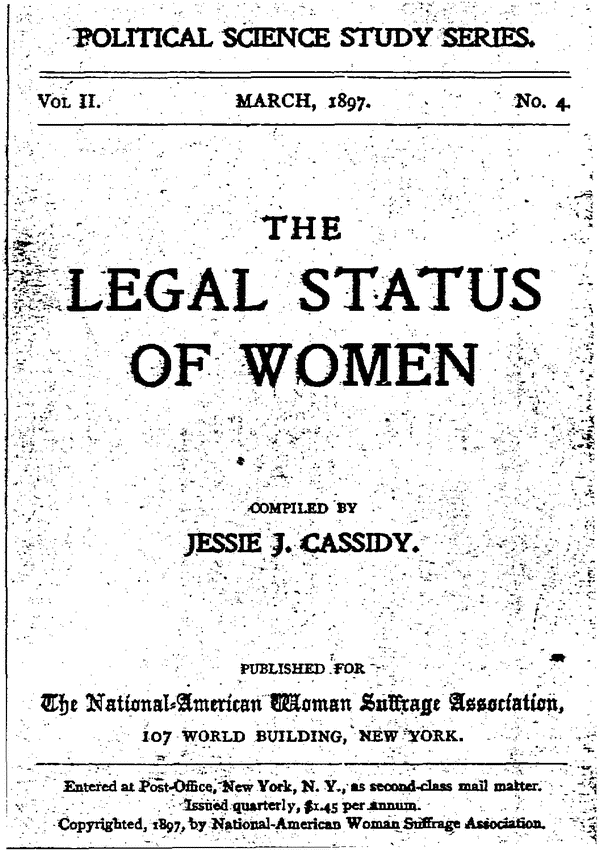
Women in some states, especially married women, had few political rights in the era when Rose and Stanton began to agitate for them. In fact, many women in the United States, legally, had as few rights as many slaves did, which may surprise many of us today; I know it surprised me as I did my research. Not to suggest that slaves were better off: far from it. Cultural expectations required better behavior toward and treatment of (non-slave) women. Most husbands, then as now, treat their wives with respect and try to make them happy, and they had a degree of power and influence in the home in her position as mother and keeper of the house. Many states had laws protecting women in cases of abuse, and some had laws requiring men to provide for their wives in a ‘decent’ manner. And adult single women legally enjoyed a degree of personal liberty a slave could only dream of. But it was extremely difficult for any woman to earn a decent wage or find an interesting, full-filling, non-menial job, and women were generally denied access to a full education.
While some states offered better protections for women than others with fairly liberal laws (for the standards of that time, not necessarily ours) concerning divorce, remarriage, and a woman’s right to some control of property she brought into a marriage, in many other states, women lost their individual identity upon marriage under coverture. The legal doctrine of coverture meant that a women’s identity was absorbed into, or ‘covered by’, that of her husband, and her rights were subsumed under those of her husband. In other words, they disappeared. As a result of coverture and other laws, if a married woman felt the desire or need to leave her husband for any reason, including abuse, cruelty, neglect, etc, she had no right whatsoever to her children, to any of her property besides the clothing she wore and utensils to cook with, or to keep any wages she would earn. Not only that, if she was apprehended, she could legally be forced to return, echoing the cruelty of the Fugitive Slave Law (Mistress of Herself, p 93-94, 185-86). It’s no wonder, then, that the early feminist movement rose out of, and in partnership with, the abolitionist movement, since many of the arguments in favor of emancipation of slaves applied to the liberation of women as well. Rose and Stanton’s sister feminists identified with their enslaved fellow women in this: married women had no identity as individual persons under the law, and all women were barred from choosing their own professions, fulfilling their intellectual and other capacities, and subject to laws to which they could not consent because they were not full citizens, or citizens at all.
And nowhere were women of any status permitted to vote. So how could they better their situation?
Rose, Stanton, and other human rights activists and reformers of their era recognized that laws and practices of their time that oppressed women, blacks and other racial minorities, religious dissenters, and immigrants, were all there, more or less, because of the same ideas. So to change the law, they had to change minds, not only with logical, well-supported, eloquent arguments, but with passion, which revealed the conviction behind the words. Their ideas inspired them, and in turn, inspired others. That’s where their philosophy comes in.
So what were these old ideas they wished to supplant? Why did they wish to supplant them? And with what?
Here are some of the most important ideas that underlie Ernestine Rose and Elizabeth Cady Stanton’s work; not comprehensive, to be sure, but central to their goals of attaining legal and cultural liberty and equality, and to their beliefs about human nature and what constitutes the good:
~ The nature of rights, and where they come from
Ernestine Rose and Elizabeth Cady Stanton both have similar, though not identical, views on the nature of human rights. Stanton believes in a divine creator*, and that all human beings are created with certain endowments and dignities, so to transgress against human nature was to transgress the divine will. Rose doesn’t believe in a divine creator, and doesn’t think it an important question in matters of ethics, law, or everyday life, as it would involve understanding a reality incomprehensible to the human mind. Since we can only comprehend this world, we are only responsible for life within it, and we must put all of our effort in making this life the best we can. For Rose, human nature is a product of nature, no supernatural explanation useful or necessary. To both of these thinkers, however, human rights are indissolubly linked to human nature, and one could no more be legitimately denied than the other, by the simple fact of the existence of human beings whose qualities and aspirations are clearly discernible to anyone. And both think that reason is all we need to describe these rights and put them into law. As Stanton says, ‘…Viewed as a woman, an equal factor in civilization, her rights and duties are still the same; individual happiness and development. ‘(Solitude Of Self)
Whether Rose and Stanton think human nature is primary and human rights are derived from it, or whether they think both exist equally as qualities or attributes of a human person, I haven’t been able to discern. For myself, I think human nature is primary, and rights are derived from it; that’s why we must formulate, fight for, and protect human rights, not merely observe them as facts of nature. Either view is consistent with Rose and Stanton’s writings, yet I suspect they perhaps would agree with me, or at least see my point, if we ever had a chance to sit down and thrash it out. What a delightful and invigorating afternoon that would be!
In any case, Rose says, one needs only to observe the world to discover the truth of the matter, and the evidence is available to anyone, anywhere, whatever one’s culture or belief system. In fact, one needs no education at all (though it helps!) to recognize what to her is so plain, if only one would put aside their biases for a moment. A young man once challenged Rose during a speech, claiming that divine revelation and authority are in opposition to the Women’s Rights movement platform and supportive of the traditional view of women’s rights and women’s ‘sphere’ in the home. Rose replied: ‘…I will show him the revelation from which we derive our authority, and the nature in which it is written, in living characters. It is true we do not go to revelations written in books… That revelation is no less than the living, breathing, thinking, feeling, acting revelation manifested in the nature of woman…Books and opinions, no matter from whom they came, if they are in opposition to human rights, are but dead letters’ (MOH, 227)
~ Individual identity
The legal doctrine of coverture, inherited from British law, remained more or less unchallenged in the United States until the early feminists, with Rose and Stanton, agitated for and finally pushed through laws protecting the property rights of married women in the mid-nineteenth century. Rose began the petition to the New York State Assembly in the 1930’s, where she was soon joined by other activists; Stanton’s efforts led to success in 1848, when the first Married Woman’s Property Act was passed into law in New York (MOH, 12). Coverture was widely justified on a Biblical basis: passages such as Ephesians 5:22-5:24 ‘Wives, submit yourselves unto your own husbands, as unto the Lord. For the husband is the head of the wife, even as Christ is the head of the Church…Therefore as the Church is subject unto Christ, so let the wives be to their own husbands in everything’ was used to demonstrate divine support for complete control of husbands over their wives. And not only wives: Stanton goes through the Bible line by line, and finds and critiques a multitude of verses in support of the idea that all women should be subjugated to men (The Woman’s Bible).
As we have seen, Rose does not accept the idea that any sort of ‘revelation’ trumps the evidence of nature, so she scorns the idea that a woman’s identity could be absorbed in another’s. ‘From the cradle to the grave she is subject to the power and control of man…At marriage she loses her entire identity, and her being is said to have become merged in her husband. Has nature thus merged it? Has she ceased to exist and feel pleasure and pain?…What an inconsistency, that from the moment she enters that compact, in which she assumes the high responsibility of wife and mother, she ceases legally to exist…’ (MOH, p 93). Since a woman feels her own feelings, thinks her own thoughts, and experiences her own selfhood, she is fully an individual as a man, whatever her relation to him. And since she is an individual person, she should have all the rights of an individual person, to the same extent as a man, and for the same reasons. Stanton concurs: ‘The point I wish plainly to bring before you on this occasion is the individuality of each human soul; our Protestant idea, the right of individual conscience and judgment; our republican idea, individual citizenship’ (SOS).
What drive Rose and Stanton is that same idea that drive all feminists to seek full human rights protections: the inner experience of our own selves as human persons in the fullest sense of the term. The differences between women and men, as they repeatedly point out, are of minor significance compared to the similarities.
~ The intellectual, emotional, and moral equality of women and men
 All able human persons, say Rose, Stanton, and their fellow feminists, enjoy and experience an inner life made up of the same components: reason, emotion, and the moral instincts chief among them. While there is some difference in degree and quality from person to person, and some minor differences in tendencies between male and female, women and men are the same kind of being. Rose, again, appeals to the evidence of experience: ‘What has man ever done, that woman, under the same advantages, could not do? …Even now, where her mind has been called out at all, her intellect is as bright, as capacious, and as powerful as his…And do you ask for fortitude, energy, and perseverance? Then look at woman under suffering, reverse of fortune, and affliction…’ (MOH, 99). She recognized, as her fellow reformers did, that the intelligence and ability they found in their own selves contradicted the claims underlying the rigid belief system of her day regarding the ‘proper spheres’ of men and women.
Instead of thinking of intelligent, ambitious, entrepreneurial, and independent women as ‘unwomanly’ freaks of nature, and women as subservient mother and housewife as ‘natural’, Rose and Stanton think of women as complex and rich in their interior lives as men, and have similar needs. For example, Stanton reveled in motherhood and was one seven times over, but she often felt stifled by the way motherhood, in her day, relegated her to a narrower arena of activity and intellectual stimulation than suited her. She is restless and curious thinker, deeply intelligent and active by nature, and while her family lived in Boston, her busy social life kept her satisfied in mind and body. When her family moved to Seneca Falls, a small town in upstate New York, however, her new life of a full-time homemaker often made her feel trapped (Jacoby, 88). Stanton doesn’t recognize herself as confined to a ‘sphere’, or conforming to the ideal of ‘true womanhood’ of the time. She thinks these ideas are not divinely inspired, but are human creations, derived from men’s need to carry on their legacy and keep the mothers of their children obediently at home under their control (TWB, Jacoby 195). Instead, like Rose, Stanton recognizes in herself and her fellow woman the full human intelligence that needs to be satisfied and developed, and the range of needs, desires, and challenges in life that, like men, can only be addressed by protecting and furthering their chances of pursuing their own goals, in law and cultural practice.
(I felt this very same way, growing up, regarding ideas about women I was brought up to believe. Beginning in my mid- to late teens, the ideal of the ‘proper sphere of women’ of the very traditional, conservative religion I was brought up in, felt alien to me. I just couldn’t believe that most, let along all, women wanted more or less the same things, and though I recognized that lifestyle made many women happy, it was not so for all women. As an adult, I’m much more interested in the experiences, the day-to-day joys and challenges of my friends and family who are mothers, yet I still don’t feel the desire to live that life myself, especially that of a homemaker, and it’s increasingly undesirable to me personally as the years pass. Yet I’m glad that so many women now have a choice: they are not forced into it, or out of it, by the state, and less and less by overbearing families or isolationist, fundamentalist communities.)
~ Women, men, and their capacities
In the period in which Ernestine Rose and Elizabeth Cady Stanton lived, the ‘myth of true womanhood’ held that each woman naturally has a specific and narrow set of capacities and tastes, all of which confine her to the choice of a few roles, the first two being primary: wife, mother, homemaker, and/or teacher (of children and other women, not of men), craftsperson in the ‘daintier’ arts, and nurse. But Rose and Stanton see things differently: while they allow there may be some differences in temperament and ability on the average, especially when it comes to physical strength, as we have seen, men and women are far more alike than they are different (intellectually, emotionally, and morally). Since women and men have similar capacities and aspirations in accordance with their human nature and their individual proclivities, so each individual should have equal opportunity to make the fullest use of them. The first and arguably most important method of developing ones capacity is a quality education, and the goal of their education should be to expand and fulfill the intellectual capacity of each individual person to the utmost.
 And all persons should have full and equal access to engage in any occupation that suits their own tastes. As Rose says, in response to an influential lecturer who argues that women’s natural talents were confined to the ornamental arts, housekeeping, and the care and education of children, ‘…the great difficulty is, that …certain taste and adaptation or peculiar faculties are required for proficiency in any art or science…then it would be just as reasonable to expect all men to be painters, sculptors, or chemists, as to ask all women to be scientific cooks [chefs]. If men and women were educated in accordance with their predilections and tastes, it might so happen that some men might have the best capacity for the science of cooking, and some women for the science of government…’ (MOH, 115). In other words, preordaining and then imposing narrowly defined roles is, in fact, unnatural, and systematically wastes human potential.
~ Marriage and relationships between women and men
Rose and Stanton both believe that the traditional hierarchical view of marriage was wrong. It was still generally believed in their time that a marriage could only survive harmoniously if one partner was ultimately the authority figure, and many people in the world still believe that today (as in Paul’s doctrine of men as the ‘head’ of the family, for example, outlined in the Ephesians quote we considered earlier). Rose and Stanton, to the contrary, believe that sort of arrangement to be not only non-conducive to harmony (since it builds resentment, reduces serious consideration of the wishes and solutions to problems of the ‘subject’ partner, and encourages bullying in one and passivity in the other), but a to vow of obedience in marriage is to renege on one’s responsibilities as a moral agent:
Ernestine Rose has much to say about this subject. She was happily married for 57 years to a man who, like her, was radically egalitarian for the time, and also considered marriage a partnership between equals. She says, ‘But I assert that every woman …is bound to maintain her own independence and her own integrity of character; to assert herself, earnestly and firmly, as the equal of man, who is her only peer. This is her first right, her first duty: and if she lives in a country where the law supposes that she is to be subjected to her husband, and she consents to this subjection, I do insist that she consents to degradation: that this is sin…Marriage is a union of equals’ (MOH 275-276). She critiques the idea that blanket submission is a virtue: ‘Blind submission in woman is considered a virtue, while submission to wrong is itself wrong, and resistance to wrong is virtue alike in woman as in man’ (MOH 93). And she considers the vow of obedience in marriage not only wrong, but a lack of civilization:‘…who knows but the time may come when man and woman will be so far civilized as to agree to differ in an amicable and friendly way whenever they should not be able to agree?’ (MOH 119)
Stanton demonstrates her own commitment to the idea of marriage as a full and equal partnership not only in her writing, espousing the same principles as Rose, but likewise through action. She kept her own name upon marriage, adding her husband’s at the end. She thinks that referring to a married woman by ‘Mrs’ tacked onto the husband’s name, while leaving out hers, was a much a symbol of denigration and ownership as it was to refer a bondsperson by the name of their plantation or master. She agrees wholeheartedly that the vow of obedience was retrograde and against the true ideal of marriage as an equal partnership (Eighty Years 72). She lived a life of as much independence as her situation would allow during her years raising dependent children, and reveled in her freedom in later years, becoming more active than ever in her work for women’s rights.
 ~ The role of reform and progress in morality
Rose and Stanton hold somewhat different views of religion: to Rose, most religions oppressed women for so long, and their holy books contained so many anti-woman passages, that religions, in general, could only be considered more harmful than helpful, and were pretty much all antithetical to the women’s rights movement. Stanton is mildly religious, in the sense that she doesn’t identify with any particular sect of Christianity, and openly criticizes most of them for their support of retrograde laws and practices in respect to women. Yet she admires Jesus Christ himself, as a friend to the poor and oppressed, as a revolutionary, and as a promoter of tolerance (the story of Magdalene’s interrupted stoning, the Good Samaritan parable, and apostleship of the tax collector are some examples.) Both of them, in their day, would have been called freethinkers, and Stanton would also have been called an atheist by many, since that term was often used to refer to anyone who did not agree with orthodox ideas about God.
Many of the major religions go through more or less the same cycle: inspired by one (probably) historical figure who was some sort of inspirational radical (Abram, Siddhārtha Gautama, Jesus of Nazareth, Muḥammad ibn `Abd Allāh), evolving oral traditions and hagiography transformed these figures into gods or sacred beings with special moral authority (Abraham, the Buddha, Christ, The Prophet). As well as encouraging good behavior in their believers and often radically changing cultures for the better with their progressive ideas, eventually these belief systems rigidified, and were pressed into political service to enforce power structures which adopted them. Over time, culturally and legally, these religions were transformed from their reformist roots to dogmatic systems which enforced othodoxy of belief and rigidly proscribed behavior, with promises of reward and/or threats of punishment, by the divine and by the state. Sometimes this was beneficial to promoting pro-social behavior and attitudes; sometimes it led to such evils as religious wars, persecution of heretics, witch-hunts, and pogroms. Rose cites the cruel treatment of dissenters as one of her main criticisms of religion (MOH 76-77).
Over time, new reformists would spring up, challenging the more ugly, oppressive, or retrograde beliefs and practices religions had accumulated over time. Dissenters came from the fringes of that tradition (in the West, liberal anti-clerical Protestants such as Stanton, Deists such as Thomases Paine and Jefferson, Quakers such as Lucretia Mott and Susan B. Anthony, and Unitarians* such as William Lloyd Garrison) as well as from the outside (freethinkers, atheists, and agnostics such as Rose, Robert Ingersoll, and Charles Darwin). Time and time again, it would take these reformers, and the moral and rational arguments with which they won over popular opinion, to convince these the old religions to reform themselves, to become more liberal and to adopt more humanistic beliefs and practices, in order to stay relevant. This process has advanced much more with some religions than with others; it’s not hard to recognize which ones, by the standard of living and the human rights protections in those countries in which those religions are most dominant.
Rose and Stanton, despite their differences of opinion of the existence of the divine, think that dogma is antithetical to morality, properly understood. The capacity of a culture or a belief system to be reformed from outside, or better yet, contain within it ideas that generate self-reform, is a sign of its superiority, since it can adapt to solve problems in a changing world. A rigid, ‘eternal’ system, by contrast, is necessarily harmful, since it’s immune to new evidence, and attempts to solve new problems with old ideas that don’t apply. In Rose’s and Stanton’s day, science had made a major breakthrough, illuminating how natural laws can explain the evolution of human nature and in turn, human morality. In Biblical times, for example, a relatively rigid, harsh moral code, centered on sexual dominance, tribal loyalty, and the accumulation of property (be it through farming, herding, dowry, or plunder) evolved to aid the survival of small nomadic tribes in a similarly harsh landscape. In a modern industrial society, such a code no longer appropriate. But aside from the usefulness of a moral code, Rose and Stanton think that morality should be drawn from observations of human nature, and as human nature expands and evolves, so does morality. Religion, they think, has this backward: it codifies some idea about what human nature is and should be in relation to a wider reality, and this rigid system is then imposed upon everyone, regardless of how poorly it’s equipped to deal with any particular circumstance or new problem that arises, or how poorly it fits with the personality, interests, or abilities of particular individuals.
 In sum: Rose, Stanton, and the ideas of the early feminists are as relevant and as important today as they ever were, since they so eloquently and convincingly make the case for the equality of legal rights for women, and for a cultural and religious reexamination of the predominant ideas about women in their time. The debate over the ideas that they opposed, and the better ideas with which they convinced most of the Western world, is still raging today. In many parts of the world, women are still subjugated to men, for many of the same reasons as they were in Rose and Stanton’s time, though the holy book these oppressive laws are often based on now is more often a different one.
*Note: it’s a little tricky to pin down Stanton’s religious views: she was, from early life, a liberal Protestant Christian, a believer in God and an admirer of Jesus Christ. Yet she was a fierce critic of the mainstream organized religions of her day which opposed rights for women, which were most of them, and did not consider the Bible the ultimate authority on questions of human rights or on morality generally. As she once remarked to Susan B. Anthony, she grew more radical in her opinions over the years, and later in life, may have been closer to a Deist or freethinking Theist than a Protestant (Eighty Years 44, Jacoby 194)
~ Listen to the podcast edition of this essay here or here in iTunes
Ordinary Philosophy and its Traveling Philosophy / History of Ideas series is a labor of love and ad-free, supported by patrons and readers like you. Please offer your support today!
~~~~~~~~~~~~~~~~~~~~~~~~~~~~~~~~
Sources and inspiration:
The Bible, King James version
Cassidy, Jessie J. ‘The Legal Status of Women’. New York, The National-American Woman Suffrage Association, 1897. Obtained from the Library of Congress website
Dorress-Worters, Paula. Mistress of Herself: Speeches and Letters of Ernestine Rose, Early Women’s Rights Leader. The Feminist Press at CUNY, 2008
Duke, Selwyn. ‘Just Say No to Stay-At-Home Moms‘. The New American. Nov 2nd, 2014.
‘Elizabeth Cady Stanton‘. (2014, November 4). In Wikipedia, The Free Encyclopedia
‘Ernestine Rose‘. (2014, July 7). In Wikipedia, The Free Encyclopedia
Gordon, Ann D. ‘Elizabeth Cady Stanton‘. American Natinal Biography Online.
Jacoby, Susan. Freethinkers: A History of American Secularism. New York: Owl Books, 2004.
‘Married Women’s Property Laws‘, American Memory: American Women. Library of Congress website. http://memory.loc.gov/ammem/awhhtml/awlaw3/property_law.html
Obama, Barack. ‘On Women and the Economy‘ speech, Oct 30th, 2014. Retrieved from the White House website, Office of the Press Secretary
Salmon, Marylynn. ‘The Legal Status of Women, 1776–1830‘. Gilder Lehrman Institute of American History (website)
Stanton, Elizabeth et al. Declarations and Sentiments / Proceedings of the First Women’s Rights Convention at Seneca Falls, New York, 1848.
Stanton, Elizabeth Cady. Eighty Years And More: Reminiscences 1815-1897. New Jersey: Mershon Company Press, 1897.
Stanton, Elizabeth. ‘Solitude of Self‘. Address Delivered by Mrs. Stanton before the Committee of the Judiciary of the United States Congress, Monday, January 18, 1892.
Stanton, Elizabeth et al. The Woman’s Bible, 1898.

.jpg "Photo: wikimedia commons")

 Ordinary Philosophy