Submit to Ordinary Philosophy!

Hello you thoughtful people out there who also love to write!

Ordinary Philosophy is my little blog that’s all about thinking through the Big Questions that arise from being a conscious, curious being in a vast, fascinating universe, and a social being whose life is filled with ethical quandaries and the ups and downs of cooperation and conflict. Examples of the sort of ‘Big Questions I’m talking about:

‘What is the universe, and is everything that can be talked about a part of it?’
‘What’s it like to feel/think/love/experience this?’
‘What is Beauty / Justice / the Self?’
‘How do we know what we know, and what is “knowing” anyway?’….
‘What is a good life, and how do I go about living it?’

We all confront these questions every day, and I think all of us come up with some pretty deep questions and some pretty interesting answers to them throughout our lives. Some of these we come up with when thinking about situations we personally have experienced or just heard about. Some we derive from the thoughts of others, reading, considering, then responding with our own critiques and defenses.

So I’d like to invite you to share your own essays, critiques, meditations, and so forth. They can deal with all manner of topics, from music and art (aesthetics), to politics and law, to culture and the humanities, to naturalism and theology, to the incredible and the humdrum occurrences of everyday experience. Philosophy is about everything, really. My favorite definition of philosophy I’ve heard (thanks, Daniel Dennett!) was formulated by Wilfred Sellers: “The aim of philosophy… is to understand how things in the broadest possible sense of the term hang together in the broadest possible sense of the term.” 

This is an amateur philosophy blog, though if professional philosophers want to take part, I would be thrilled too! I’m saying amateur in the sense that here at Ordinary Philosophy, the posts are aimed at a non-academic audience, using (mostly) ordinary language, for the edification of anyone who wishes to read it. I’m also (unusually, for philosophy forums) more focused here on original philosophy, with ideas drawn directly from life and from other arenas and disciplines, be it science, the news, politics, theology, arts and culture, and so forth, rather than work derived more from other philosophical works (though I value and would accept for posting the latter too).

Works submitted for publication on this blog must relate to some Big Question(s), and / or offer argument in favor of some position or other (not just mere opinions or preferences). They must demonstrate some good, honest thinking, not name-calling and mud-slinging, and while pieces can be strongly worded as needed for the topic at hand, no ad hominem attacks allowed! (Ad hominem is the name of a logical fallacy where you seek to disprove an argument or position by attacking or undermining the person, not the argument the person is making.) No preaching either, please. And yes, it is my blog, so it’s up to me to decide what to include. That being said, I’m also a very democratically-minded person, so I will be happy to include pieces with content I don’t agree with so long as it’s in line with the aforementioned simple rules. 

So send that good stuff your brain makes my way! 

To: ordinaryphilosophy (at) gmail (dot) com

In An Argument, Give Your Opponent the Benefit of the Doubt and You Will Always Win

….in the sense that, you will be more likely to win your opponent’s trust and respect, your own arguments will be better, and you will surely learn something, even if you fail to convince the other.

Among the feedback to a recent essay (a critique), I came across this sort of statement: ‘well, what do you expect? Of course, the author’s a so-and-so, and therefore, you can expect them to be full of it.’

That’s pure intellectual laziness, let alone empty bigotry. Here’s one of the single most valuable lessons I’ve learned over the years, and practiced and honed in my return to university: always, always listen to your opponent’s arguments carefully and respectfully, and examine them from the viewpoint that they might be right. You will then be in a position to actually understand the argument. And, if it turns out to be wrong, then you will really understand why, and your rebuttal will be more likely to be a quality one, less prone to fallacies.

Generosity pays off for everyone in the end.

O.P. Recommends: Jefferson on Redistribution by Clay Jenkinson

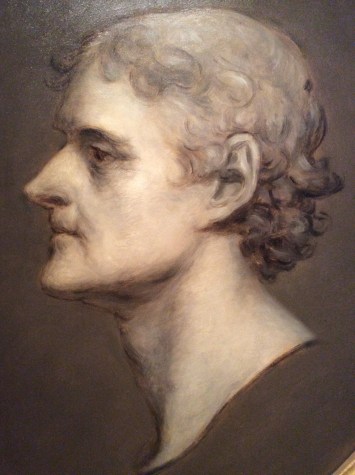
Thomas Jefferson by Charles Bird King, 1836, after Gilbert Stuart, at the Smithsonian Portrait Gallery, 2016 Amy Cools

Thomas Jefferson by Charles Bird King, 1836, after Gilbert Stuart, at the Smithsonian Portrait Gallery

A favorite podcast of mine is the Thomas Jefferson Hour, in which a TJ scholar and historical character actor named Clay Jenkinson holds weekly interviews and discusssions first in the character of Jefferson, then as himself as a scholar on T.J. and as a thinker in his own right. If you’re interested in American history, political philosophy, contemporary politics, and so on, you might really like this show. It’s not just about T.J. himself, but touches on all matter of topics since he lived such a long and influential life and remains such a controversial, brilliant, maddeningly inconsistent, and complex historical figure.

I found the episode on redistribution particularly interesting. Not only is it so relevant to today, but it reveals how Thomas Jefferson, in little-known and rarely cited letters to James Madison, revisits many of his own views in the light of the horrors he witnessed at the onset of the French Revolution.

Listen. You will like it.

Calling All Philosonerds and Philosophriends: Support Philosophy Bites!

Mirrored from http://www.amazon.co.uk/exec/obidos/ASIN/0199694664/virtualphilos-21

One of my very favorite podcasts is Philosophy Bites, by David Edmonds and Nigel Warburton.

In it, they interview philosophers on all manner of topics, which are fascinating and relevant to just about anyone who cares about what’s going on out there in the world and in the life of the mind.
The interviews are concise (10 – 15 minutes) and engaging, yet thorough, and the questions are excellently devised.

They’ve rather recently begun to be funded by private donations only, so I encourage you to pitch in a little and support these awesome guys doing their awesome thing!

If you click the ‘Subscribe’ button at the upper left of the page (under the ‘Donate’ button), it’ll go to Paypal, where you can choose a monthly amount to donate.
(May I suggest 6 pounds/month, about $10, a nice tidy figure that’s totally affordable)

Credits: I borrowed the term ‘Philosophriends’ from my own philosophriend Preston Tillotson. I  made up the term ‘philosonerd’, but I’ve since found that many others have come up with that on their own

Me and the Pope Against Tea Partiers and Conservatives and Even So Many Catholics! What’s Going On?

I’ve been finding it a bit strange and somewhat funny that for some time now, I’ve been finding myself, a ‘heathen’, ideologically aligned with Pope Francis I, and in opposition to many political and moral views of the larger number of my Catholic and Christian family and friends.

Especially when it comes to topics regarding public life: caring for the poor and needy, materialism, Tea-Party-brand political views, and so forth.

With Pope Francis, I share the general view that preserving the life of and caring for the wellbeing of other people is not something we engage in only privately, individually, or if our religion happens to say so, or if we feel like it at the time, but is a moral imperative for human societies and nations as a whole. I also agree that hyper-individualist ideology is bankrupt, is not only contrary to the best in human nature but an illusion: we are, in reality, intimately tied together, in thought, in action, and in fate.

That being said, I do part ways with the Pope in crucial ways: consider this is a teaser for my next essay. Stay tuned!

Sources, Influences, Shout-Outs, and all that Good Stuff

As I write these essays for publication in my own blog, I find that it’s liberating not to have to cite my sources in the same formal, painstaking way I would have to if I were writing a student paper or a formal scholarly work. I know that every single thought I have (and this is true not only for myself, but every thinker out there) is almost entirely possible because of other thinkers that came before me, and those who share their thoughts every single day. In this way, it’s actually impossible to really cite all my sources and properly thank all who influence and inspire me, so developing and writing down my thoughts without the added effort of laboriously disentangling those sources which I can consciously identify and those which I can’t remember helps this whole process flow much more freely.

But I also feel a sense of great indebtedness to all those thinkers out there who make the world such a fascinating place. I get to learn and think because, collectively, the human race is so generous when it comes to sharing their thoughts, purposefully altruistic (think Thomas Jefferson: “He who receives an idea from me, receives instruction himself without lessening mine; as he who lights his taper at mine, receives light without darkening me”or otherwise. This great pool of human consciousness, the sum of human thought up to now, in fact, is central to my own concept of transcendence, that ‘mystical’ state of reaching for and belonging to something larger and greater than myself (a topic for another essay that I’ve been plotting for some time). When I’m in the throes of figuring something out, I’m often conscious of the fact that that so many parts of the puzzle have already been worked out by others, and I’ve only gotten to where I’m at because of them. While I’ll continue to link to and quote sources as I write, I probably won’t be thorough about it in this informal setting, so this list serves as a catch-all to what I’ve missed.

So here’s my informal, unscholarly list of my sources and influences, of shout-outs to all of you wonderfully curious, intelligent, creative, witty, and thoughtful creatures out there without whom I couldn’t think much of anything at all, let along write about it. This will be an open-ended blog post, and I’ll add to it as I’m inspired, but it’s in no way exhaustive. It can’t be, because, like everyone, most of the things I ‘know’ I don’t know how I know, because I don’t remember who I learned it from.

In no particular order:

– All human beings who have contributed to the sum of human knowledge and creative thought
– My dad, John Cools, for patiently answering my endless questions throughout childhood and beyond
– My husband Bryan, my lover, best friend, and constant conversational partner
– John Rawls, A Theory of Justice (excerpts)
Randy Newman
– John Stuart Mill, On Liberty, The Subjection of Woman, and excerpts from Utilitarianism and other works
– John Locke, An Essay Concerning Human Understanding, Two Treatises of Government (well, the second one) and excerpts from other works
– Ernestine Rose: feminist, atheist, socialist, Polish, Jew, human rights crusader, incredible in every way
– Montaigne, Essays
– My uncle, Timothy Harrod, for his willingness to regularly engage in honest, no-holds-barred, but respectful and friendly debate (he was my confirmation sponsor – you Catholics know what that is – and he’s been kindly trying to re-convert me and save my soul for years)
– My uncle Mark Cools, for similar reasons, while letting me stay at his house for free when I attended college
The philosophy department and other instructors at Sacramento State University, especially Gregory Mayes, Lynne Fox, Thomas Pyne, Bradley Dowden, Russell DiSilvestro, and Clifford Anderson
– David Hume, An Enquiry Concerning Human Understanding, excerpts from various other works

– Daniel Dennett, Breaking the SpellIntuition Pumps and Other Tools for Thinking, lectures, interviews, and essays
– Susan Jacoby: Freethinkers and The Age of American Unreason

– Eric Gerlach
– Steven Pinker, The Blank Slate, lectures and essays
– Michael Sandel, Justice and What Money Can’t Buy
Jonathan Haidt, The Righteous Mind
– Elizabeth Cady Stanton, fierce feminist and freethinker

– Clay Jenkinson, scholar and podcaster of the Thomas Jefferson Hour
– The various authors of the Bible
Shakespeare
– Leonard Cohen
– Flannery O’Connor, The Complete Stories
– Robert Ingersoll, 44 Lectures
M. Somerset Maugham, Of Human Bondage and The Moon and Sixpence
– Carol Tavris, Mistakes Were Made But Not By Me, interviews and lectures
– Mark Twain, The Adventures of Huckleberry Finn and countless other stories, essays, and quotes
– Neil DeGrasse Tyson, essays, interviews, and lectures
– Bertrand Russell, History of Philosophy and various other works
– Townes Van Zandt
– Gabriel Marquez, One Hundred Years of Solitude 
– The wonderful student heathens at Sac State
– Cervantes, Don Quixote
Christopher Hitchens, God Is Not Great, debates, lectures, and interviews
– Jared Diamond, Guns, Germs, and Steel
Jennifer Michael Hecht, Doubt: A History, interviews 
– Charles Darwin, On the Origin of Species and The Descent of Man (excerpts; one day I intend to read them all the way through)
– Richard Dawkins, The Ancestor’s Tale, interviews, lectures, and essays
– My friend Tracy Runyon, with whom I’ve had so many depthy and exciting discussions

A Bit About Who I Am, and Why I Bother With All This Musing and Writing Stuff

I’ve long been obsessed with ideas and arguments, why people do and say the things they do, why people believe what they do, and so forth., as I’ve already discussed in an earlier piece. This curiosity and drive to understand, at least a little, the workings of the universe outside my own mind has not diminished over the years in the slightest. So a few years ago, when the job market dried up, my business partially failed, and my artistic pursuits provided me with much satisfaction but little income, I decided to more fully immerse myself in one of my greatest loves, philosophy, by going back to college.

It was a dream of mine that I had never seriously pursued in my early youth, though I eagerly attended junior college as soon as I was able. In my family, the goal of pursuing higher education was not discussed much. Most of my closest relatives are honest, hardworking people, generally blue-collar, hand-on work, and that was for the most part true of myself too, though I worked more in customer service jobs that had some sort of idealist or artistic element. I also have a strong affinity for blue-collar work, and really enjoyed the physically labrious aspects of my long-time intermittent job at a salvage yard.

Many of my relatives were and are suspicious of much of higher education too, seeing it as an array of dangerous temptations away from a life immersed in a particularly conservative brand of religious faith. Also, as a woman, higher education was less of a priority in my family. I felt it was always implied, but rarely said outright, that a good girl got married and stayed at home, perhaps after a stint at junior college, even a bachelor’s degree maybe, before settling in to homemaking while still young enough to make lots of babies. That’s it, unless I wanted to become a nun. All that sounds like a lovely, happy, fulfilling life for many, and I am fortunate to be a fond and proud auntie and cousin many, many times over precisely because so many women in my family find this lifestyle right for them. But never felt right for me, and over the years, I felt annoyed and a little resentful that other options were never discussed or encouraged, and that I never had a mentor intellectually. But I also realize that I may very well be unfair in this assessment. For one thing, my dad and other close family members never resented my constantly badgering them with questions and were always willing to answer them fully, and one of my dear uncles and I regularly engage in honest, no-holds-barred. lengthy debate and discussion to this day, and I thank him for that. It was also really entirely up to me to stop gadding around and instead of gleefully following my whims, to focus on the goal of completing a degree, applying the creativity I applied to other pursuits to the task of fundraising for school.

But why not keep all this to myself? Why have I taken this previously mostly internal process and dumping it out into the world? (With the full realization that few, at this point, even read this stuff.) I’ve often gotten the sense that philosophers, amateur and professional, are usually irritating to most other people besides fellow philosophers, and even these pick on each other at least as often as they engage in fruitful debate. (At least, it appears so from the public discourse, but my evidence for this is merely anecdotal.) But I think that this sense of philosophy being this annoying form of snobbery is based only on the archness with which some philosophers deliver their musings, and on a particular perception of what philosophy is. Many professional philosophers display a seemingly protectionist attitude toward their craft, preferring to share their ideas mostly or only with other professionals in highly arcane language. (Arcane: mysterious, secret. Arcane language: jargon) I actually think that this largely closed-off, rarified realm of philosophy is invaluable: it’s a place where ideas can be invented and pursued as far as they can go, by a community entirely devoted to this task. The untold riches that have emerged from this level of discourse is wonderful astounding. I just wish I and most of the public had the ability to fully understand and appreciate it, and the bit I’ve had the good fortune to experience left me amazed and entranced, and humbled.

But I also think that everyone, or almost everyone, engages in philosophical thinking of one sort or another, hence my blog’s byline. We not only react in moral matters but often make some sort of attempt to justify them to others. We all seek to describe or define, at times, the essential nature of reality. When it comes to aesthetics, to visual art and music and literature, we try to add a description of the idea(s) or driving force behind them, placing them within a context, rarely letting works of art speak entirely for themselves. Every one of us who has engaged in conscious reflection on anything has done some philosophy.

When it comes to writing and applying this sort of thinking, curiously enough, I’m almost entirely drawn to most areas of philosophy except philosophy of art. It seems kind of weird for a person who’s always been immersed in the arts, who has been drawing, sewing, sculpting, and so forth, and who loves music, for a lifetime. I think it’s because I do happen to be the sort of artist who likes to let my art speak for itself, and if I try to politicize or contextualize it, than it loses its immediacy and power for me. I’d rather let others do that, to read into my artwork whatever they’re compelled to read into it, or to discover some truths about me that I can’t since I lack the objectivity. But philosophy of science and of law, political and metaphysical, and most of all, moral philosophy… those I just can’t get enough of. And as I touched on in the aforementioned piece I wrote a month or so ago, I’ve been thinking on these things outside of academia for so long that I’m still far more comfortable doing philosophy in laypersons’ terms. But I still need that sharing and expressing of ideas without which a fuller understanding is impossible.

So I keep thinking about how the universe works, based on the information I receive about what’s going on in the world, and keeping writing about the process of figuring it out because it’s fascinating to me for its own sake. But not only that. I really feel a sense of deepest connection to the human family in its entirely, and feel a deep sense of responsibility towards it and gratitude to it. For me, that means I don’t feel satisfied simply by expressing my instinctive reactions to the occurrences and ideas I encounter in the world, such as simple anger, or disgust, or joy, or love. That’s because I don’t feel an isolated individual whose thoughts, feelings, and actions are as worthwhile or interesting on their own as they are within the larger realm of shared human experience.

For example, the blaming, the finger-pointing, the shaming I see going on in the public sphere over political matters seems like a giant room with a lot of people screaming and no one listening, because too many people forget that their ideological opponents are people with needs and interests and beliefs too. I feel the need to explore and explain what’s behind all this as well as expressing righteous approval or indignation because I feel that the screaming is not only not accomplishing anything, it’s just not that interesting, and reveals little about the world besides a very narrow set of facts about human psychology. I think that when we remember to sit back and reflect on why we feel and believe as we do, and patiently explain ourselves in an honest manner, with a generous spirit of always assuming the best of motives in your ideological opponent, it’s only then that we are justified in our beliefs, and have earned the right to feel that we are, indeed, in the right. But of course, this must always be provisional, because as it so happens, so one has all the needed information at any one time to know everything about everything. We must always be ready to acknowledge when we’ve been wrong, and always be ready to learn.

I look forward to what I will continue to learn from all of you out there, and always welcome your thoughts and your honest debate!


The Weird Concept of Nothing in A Universe Full of Somethings

‘Why is there something rather than nothing?’.

Most of us, I think, have been challenged with this question, usually as a preface to an attempt to convert us or to to convince us of the truth of one belief system or another.

But I’ve wondered for quite some time why so many consider this a compelling question. Why assume that ‘nothing’ is the default state in a universe that’s chock-full of ‘somethings’: objects with mass, properties, forces, the space-time continuum, subatomic particles, and so on?

It seems to me that ‘nothing’, unaccompanied by the existence of somethings, is the hypothetical state in need of explanation.

What do you think?

A Mind Like A Dog Endlessly Chasing Its Tail: Confessions of an Obsessive Thinker

I’ve always been a person with a lot of existential anxiety, but in a good way, I think. Ever since childhood, I obsessively think about the things I observe people say and do, about what I see around me, about the beliefs I and other people hold, and so on, and wonder what they mean and what they’re really like outside of my own perception.

I feel this driving urgency to question what I’ve been told, to understand what myself and what other people are really like, what they think, and why they think it (including, especially, our heroes: I want to know their flaws as well as their strengths, otherwise I know what I’m getting is not the full richness of a personality, but a glittering, hollow icon), and what is going on out there that I’m missing out on right now. I’m endlessly curious, and need change and adventure to keep me from becoming miserably restlessness. I like to mix it up, to, and hang out with people who are very different than me, since they present me with new and interesting viewpoints (including disturbing ones!), challenge my assumptions, and broaden my understanding of human nature. I use the dog chasing its tail analogy, in short, because I just can’t seem to stop endlessly evaluating and reevaluating every idea that’s every been in my mind, new or old.

I’m also an obsessive explainer: I find it very difficult to make simple statements of fact or opinion, without fully explaining what I really mean or describing the full set of circumstances surrounding the issue at hand. Although I’ve no doubt the latter is often a source of annoyance for my friends and family (in fact, I’ve been told as much), it’s something I really like about myself. Discovering what this world is like, both within and and without my own mind, is a project that I find endlessly fascinating and fulfilling, and I have no plans to break these habits anytime soon. (I call all of this ‘nerding’.)

But all of this often makes me an uncomfortable companion to have and even, sometimes, a shitty friend. When half your life is an existential crisis and you’re constantly chasing some new ideas around, you end up so scattered that it’s very unlikely you’ll make the decision nearly often enough to sit down and make that phone call, or write that email, or plan that group trip, or invite people over for dinner or a movie or a board game. Which is ridiculous of me, really, because I think that the human race, and its features and products (such as consciousness, and morality, and culture), is the most interesting phenomenon of the whole world! And not just the human race in the abstract: I mean the actual people in my life too. One of these days, I hope to settle down and improve my habits, all you loved ones out there that I neglect, and I am always glad when you’re a good influence on my flibbertigibbet self.

Anyway, I hope I’m reasonably adept at thinking some things through in an intelligent and capable fashion, but not because I’m at all brilliant. If so, I would have come up with some amazing original ideas long before now: the great minds, I’ve often heard, come up with their best ideas before they’re thirty. I’m most definitely nowhere near their league. I’m just hoping that in my case, the constant practice might be fruitful at some point, and in any case, I’ll keep myself busy and amused ’till I die.

One thing I think I’m okay at is explaining, in plain enough language, those complex or obscure ideas that I have managed to wrap my mind around. Another thing I like to do and might not be half bad at sometimes is to put together the disparate things I’ve learned into a larger, coherent picture or narrative, to reconcile or unify those aspects of reality that seem to exist contradictorily. For example, why do human beings, whose evolutionary success is due to highly developed social instincts, so often display such violent tendencies? (Still, like so many others, figuring that one out.)

So that’s what I’ll do: I’ll keep thinking, and thinking, and thinking, but now, since I’ve subjected my thoughts to the discipline of writing them down and sharing them with all of you out there on a regular basis, hopefully, my ideas and scribblings will improve in quality and even, I dare to hope, become useful for something other than my own amusement and satisfaction.

Believing in a ‘Grand Plan’ to Comfort Oneself

When facing the news of yet another disaster taking place in the world (a devastating earthquake, a genocide, an epidemic, the murder of schoolchildren, wrongdoers escaping justice, and so forth), who hasn’t heard a thought of this sort follow the initial horrified reaction: ‘Well, we must remember that in the end, it’s all a part of the Grand Design / God’s Plan / The Will of God…’ and so on and so forth. It’s pretty much always implied, and often said, that this means we must resign ourselves, on some level at least, to the situation. And everyone who expresses this sort of explanation seems to find it comforting.

I know I’m not the only one who finds this tendency disturbing, I can’t be the only one who’s discomfited at the idea that so many people think there must be some sort of justification, a ‘grand plan’ that makes all the suffering and death that occur in the world okay, just so they can feel better about it and move on. When someone who’s suffered such a blow themselves, the death of friends or family, the loss of their own health, the destruction of their community, I understand needing an immediate source of comfort to get through the worst of it as they try to carry on living, faced with such burdens. But for others who make such comments, I must ask: is it really a good thing to comfort yourself in this way?

I’ve never found this sort of thing helpful or good. Putting aside the weird idea of ‘choosing to believe’ something (this doesn’t square with my notion of belief as a spontaneous reaction to personal observation, or to an argument, or to scientific evidence, not something I can just adopt like a new style of dress), the very idea of trying to comfort myself in this way seems pretty selfish. I don’t want to feel better about the fact that there’s suffering in the world. I don’t want to think that death and disease and pain have some sort of ultimate moral justification. I want to feel awful about suffering because I want to keep that fire lit under me to spur me to do something about it, even if I can only help in small ways. I want to always feel that I and the rest of humanity can and should do as much about relieving suffering and correcting injustices as we can, because we’ve decided those things are bad. Trying to justify the wrongs in the world as a necessary part of ‘something greater’ can end up sabotaging the best in ourselves, the empathy and righteous anger that we need to drive us to make the world a better place.

That ‘Grand Plan / God’s Will’ excuse, in the end, sounds to me like a trite phrase, a Hallmark-card-worthy empty sentiment, a platitude, little more than a thumb to suck.