‘Free Speech’ is a Blunt Instrument. Let’s Break It Up, by Robert Simpson

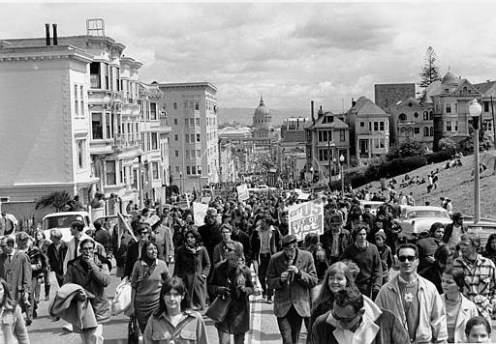
April 15, 1967, Spring Mobilization to End the War, San Francisco

Free speech is important. It guards against governments’ dangerous tendency to repress certain kinds of communication, including protest, journalism, whistleblowing, academic research, and critical work in the arts. On the other hand, think of a doctor dispensing bogus medical advice, or someone making a contract that she plans to breach, or a defendant lying under oath in court. These all involve written or spoken statements, but they don’t seem to fall within the domain of free speech. They are what the legal theorist Frederick Schauer at the University of Virginia calls ‘patently uncovered speech’: communication that warrants no special protection against government regulation.

However, once we extrapolate beyond the clear-cut cases, the question of what counts as free speech gets rather tricky. A business whose website gets buried in pages of search results might argue that Google’s algorithm is anti-competitive – that it impedes fair competition between sellers in a marketplace. But Google has dodged liability by likening itself to a newspaper, and arguing that free speech protects it from having to modify its results. Is this a case of free speech doing its proper work, or an instance of free speech running amok, serving as cover for a libertarian agenda that unduly empowers major corporations?

To answer this question, we need a principled account of the types of communication covered by free speech. But attempts to provide such an account haven’t really succeeded. We can pick out cases on either side of the divide – ‘Protections for journalism and protest? Yes! For perjury and contracts? No’ – but there aren’t any obvious or natural criteria that separate bona fide speech from mere verbal conduct. On the contrary, as theorists have told us since the mid-20th century, all verbal communication should be understood as both speech and conduct.

Some authors see these definitional difficulties as a fatal problem for the very idea of free speech. In There’s No Such Thing as Free Speech: And It’s a Good Thing Too (1994), the American literary critic and legal scholar Stanley Fish argued that ‘free speech’ is really just a rhetorically expedient label that people assign to their favoured forms of communication. There’s a grain of truth in this; but it doesn’t change the fact that governments still have a tendency to repress things such as protest and whistleblowing, and that we have good reasons to impose institutional safeguards against such repression if possible.

Instead of throwing out free speech entirely, a better response might be to keep the safeguards but make their sphere of application very broad. This is roughly what happens in Canadian law, where nearly any type of conduct can fall within the constitutional ideal of ‘free expression’, provided that it is trying to convey some kind of meaning. The downside is that if nearly anything can qualify as ‘expressive’ in the relevant sense, then we cannot categorically privilege expression itself as an inviolable norm. WhistlAll we can ask lawmakers to do is factor in the interests that such expression serves, and try to strike a balance with all the other, competing interests (such as ‘equality’, for example, or ‘national security’). While such trade-offs are standard in Commonwealth legal systems, they have the unwelcome effect of making it easier for governments to justify their repressive tendencies.

I’d propose a third way: put free ‘speech’ as such to one side, and replace it with a series of more narrowly targeted expressive liberties. Rather than locating actions such as protest and whistleblowing under the umbrella of ‘free speech’, we could formulate specially tailored norms, such as a principle of free public protest, or a principle of protected whistleblowing. The idea would be to explicitly nominate the particular species of communication that we want to defend, instead of just pointing to the overarching genus of ‘free speech’. This way the battle wouldn’t be fought out over the boundaries of what qualifies as speech, but instead, more directly, over the kinds of communicative activities we think need special protection.

Take the idea of public protest. Standard free-speech theory, concerned as it is with what counts as speech, tends to draw a line between interference based on the content of the speech, such as the speaker’s viewpoint (generally not allowed), and interference that merely affects the time, place and manner in which the speech takes place (generally allowed). But this distinction runs into trouble when it comes to protest. Clearly governments should be blocked from shutting down demonstrations whose messages they oppose. But equally they shouldn’t be able to multiply the rules about the time, place and manner in which demonstrations must take place, such that protests become prohibitively difficult to organise. One reason to have a dedicated principle of free public protest, then, is to help us properly capture and encode these concerns. Instead of seeing demonstrations as merely one application of a generic free-speech principle, we can use a narrower notion of expressive liberty to focus our attention on the distinctive hazards faced by different types of socially important communication.

If this all seems a bit optimistic, it’s worth noting that we already approach some types of communication in this way – such as academic freedom. Universities frequently come under pressure from political or commercial lobby groups – such as big oil, or the Israel lobby – to defund research that runs counter to their interests. This kind of threat has a distinctive underlying causal mechanism. In light of this problem, universities safeguard academic freedom via laws and regulations, including guidelines that specify the grounds for which academics can be fired or denied promotion. These moves are not just a specific implementation of a general free-speech principle. They’re grounded in notions of academic freedom that are narrower than and distinct from freedom of speech. My suggestion is that all our expressive liberties could be handled in this way.

The subdivision of expressive liberties isn’t going to magically fix all the genuinely controversial issues around free speech, such as what to do about search engines. However, we don’t need to resolve these debates in order to see, with clarity and confidence, that protest, journalism, whistleblowing, academic research and the arts need special protection. The parcelled-out view of expressive liberties captures the importance of these activities, while sidestepping the definitional problems that plague standard free-speech theory. These are not merely theoretical advantages. Any time a country is creating or revising a bill of rights, the question of how to protect communicative practices must be considered afresh. Multiple expressive liberties is an approach worth taking seriously.Aeon counter – do not remove

This article was originally published at Aeon and has been republished under Creative Commons.

Robert Simpson is a lecturer in philosophy at Monash University in Melbourne, Australia. He writes regularly about social and political philosophy. (Bio credit: Aeon)

~ Ordinary Philosophy is a labor of love and ad-free, supported by patrons and readers like you. Any support you can offer will be deeply appreciated!

*All views and opinions expressed by guest writers are their own and do not necessarily reflect those of Ordinary Philosophy’s editors and publishers


Are Human Rights Anything More than Legal Conventions? by John Tasioulas

Eleanor Roosevelt and The Universal Declaration of Human Rights

We live in an age of human rights. The language of human rights has become ubiquitous, a lingua franca used for expressing the most basic demands of justice. Some are old demands, such as the prohibition of torture and slavery. Others are newer, such as claims to internet access or same-sex marriage. But what are human rights, and where do they come from? This question is made urgent by a disquieting thought. Perhaps people with clashing values and convictions can so easily appeal to ‘human rights’ only because, ultimately, they don’t agree on what they are talking about? Maybe the apparently widespread consensus on the significance of human rights depends on the emptiness of that very notion? If this is true, then talk of human rights is rhetorical window-dressing, masking deeper ethical and political divisions.

Philosophers have debated the nature of human rights since at least the 12th century, often under the name of ‘natural rights’. These natural rights were supposed to be possessed by everyone and discoverable with the aid of our ordinary powers of reason (our ‘natural reason’), as opposed to rights established by law or disclosed through divine revelation. Wherever there are philosophers, however, there is disagreement. Belief in human rights left open how we go about making the case for them – are they, for example, protections of human needs generally or only of freedom of choice? There were also disagreements about the correct list of human rights – should it include socio-economic rights, like the rights to health or work, in addition to civil and political rights, such as the rights to a fair trial and political participation?

But many now argue that we should set aside philosophical wrangles over the nature and origins of human rights. In the 21st century, they contend, human rights exist not in the nebulous ether of philosophical speculation, but in the black letter of law. Human rights are those laid down in The Universal Declaration of Human Rights (1948) and the various international and domestic laws that implement it. Some who adopt this line of thought might even invoke the 18th-century English philosopher Jeremy Bentham, who contemptuously dismissed the idea of natural rights existing independently of human-made laws as ‘rhetorical nonsense – nonsense upon stilts’.

Now, it is true that since the middle of the previous century an elaborate architecture of human rights law has emerged at the international, regional and domestic levels, one that is effective to wildly varying degrees. And for most practical purposes, it might be that we can simply appeal to these laws when we talk about human rights. But, ultimately, this legalistic approach is unsatisfactory.

To begin with, the law does not always bind all those we believe should abide by human rights. For example, some states have not ratified human-rights treaties, or have ratified them subject to wide-ranging exceptions (‘reservations’) that blunt their critical edge. A country such as Saudi Arabia can have a seat on the UN Human Rights Council yet persist in severe forms of gender discrimination – for example, prohibiting women from driving – because it made its acceptance of human-rights treaties subject to an override in the case of conflict with Islamic law.

Moreover, the international law of human rights, like international law generally, almost exclusively binds states. Yet many believe that non-state agents, such as corporations, whose revenues in some instances exceed the GDP of all but the wealthiest nations, also bear grave human-rights responsibilities. When manufacturers such as Nike use 12-year-olds to stitch soccer balls in Pakistan, or internet service providers such as Yahoo secretly hand over the emails of dissidents to the Chinese government, many critics decry not just corporate malfeasance but human-rights violations. And this is so even if the corporation has complied with the laws of the country in which it is operating.

It is precisely in response to the threat to human rights posed by corporations that the ‘Guiding Principles on Business and Human Rights’ (2011), the brainchild of the Harvard political scientist John Ruggie, were established. Endorsed by the UN, the principles are not legally binding either on states or corporations. Instead, they aim to provide an authoritative statement of human-rights responsibilities that apply directly to corporations, quite apart from any legal obligations they might also bear. Ruggie’s ambition is that the principles will eventually inform corporate decision-making at all levels, illustrating the fact that human rights go beyond law and its enforcement.

Yet there is a deeper problem with identifying human rights with existing laws. Laws are the creations of fallible human beings. They might be good or bad, and so are always subject to interpretation and criticism in terms of independent moral principles. The international law of human rights, on this view, does not establish which human rights exist; instead, its goal is to implement moral rights we already possess, simply by virtue of our humanity. Slavery, torture and racial discrimination did not suddenly become human-rights violations only when they were legally prohibited. It is the other way round: we have human-rights law in order to give force to human rights that in some sense pre-exist their legal recognition. Unfortunately, no consensus has yet emerged among philosophers or anyone else on how human rights are to be defended as objective truths, independent of law.

The late American philosopher Richard Rorty sought a way out of this impasse. Although a staunch liberal, he turned his back on the philosophical enterprise of attempting to give a rational justification for human rights. He judged that activity to be pointless now that human rights are a deeply embedded fact of our culture, not just our law. How can we justify human rights when they seem more compelling to us liberal Westerners than any other idea we might use to justify them? The real task that confronts us, Rorty thought, was the practical one of enhancing compliance with human rights worldwide, not the intellectual one of grounding rights in the fabric of reality.

A similarly dismissive attitude is adopted by Ruggie, who conceives of his Guiding Principles not as reflecting ‘true’ moral demands, but as rooted in empirically measurable ‘social norms and expectations’. At a more sophisticated level, the late American political philosopher John Rawls, in his last work The Law of Peoples (1999), insisted that in a pluralistic world we cannot build our public commitment to human rights on any controversial account of the ‘truth’ about humanity or the good. We have to return, instead, to shared ideas embedded in the culture of a liberal democracy.

But is it enough to rely on the supposed fact that human rights are embedded in a liberal democratic culture? Or do we need to be able to step back from that culture and offer an objective justification for the principles embedded in it, as the philosophers have long supposed? The problem is that social expectations and cultural assumptions not only vary significantly across societies, but that they are fragile: various forces ranging from globalisation to propaganda can cause them to change dramatically or even wither away. Would rights against gender or racial discrimination disappear if sexist or racist attitudes come to predominate?

The question is not fanciful. Once apparently settled beliefs about the impermissibility of torture or the rights of refugees have recently suffered a backlash. There can be backsliding as well as progress, with no guarantees either way. Social expectations and deep cultural assumptions are no more a sufficient basis for human rights than the law is. There is a fatal contradiction in defending human rights against the rising authoritarianism of a ‘post-truth’ era while simultaneously abandoning the belief that our commitment to those rights is itself grounded in the truth, and being prepared to defend it on that basis.

My own view is that human rights are rooted in the universal interests of human beings, each and every one of whom possesses an equal moral status arising from their common humanity. In other words, in defending human rights, we will need to appeal to the inherent value of being a member of the human species and, in addition, the interests shared by all human beings in things like friendship, knowledge, achievement, play, and so on. And we will need to ask whether these considerations generate duties that are owed to each and every human being. This proposal is hardly uncontroversial. The appeal to the inherent value of humanity will be contested by some as a brute prejudice – a ‘speciesism’ on a par with racism. Similarly, the appeal to universal interests will be contested by those who think that human rights are ultimately about respecting individual freedom regardless of whether it advances the right-holder’s well-being.

Whether I’m right or not, I am convinced that we cannot sustain our commitment to human rights on the cheap, by invoking only the law or the assumptions of our liberal democratic culture. Only a deeper justification can explain why we are right to embody them in the law, or maintain a liberal democratic culture, in the first place. This has precisely been the aim of philosophical defences of human rights from the 12th century up until very recent times. To keep our human rights culture in good order, we cannot avoid engaging with the question of justification. And we should think of this not as the exclusive domain of professional philosophers, but as a process of public reasoning to which all citizens are called to contribute.Aeon counter – do not remove

This article was originally published at Aeon and has been republished under Creative Commons.

John Tasioulas is the inaugural Chair of Politics, Philosophy and Law, and director of the Yeoh Tiong Lay Centre for Politics, Philosophy and Law at King’s College London. He is working on his latest book, Human Rights: From Morality to Law (forthcoming, OUP). (Bio credit: Aeon)

~ Ordinary Philosophy is a labor of love and ad-free, supported by patrons and readers like you. Any support you can offer will be deeply appreciated!

*All views and opinions expressed by guest writers are their own and do not necessarily reflect those of Ordinary Philosophy’s editors and publishers
Happy Birthday, Averroes (Ibn Rushd)! By Eric Gerlach

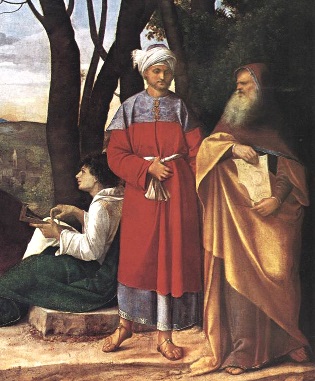
Averroes by Giorgione890 years ago today, on April 14th, 1126, the great Islamic philosopher, theologian, political theorist and scientist Ibn Rushd, or as he is known by the Latinate version of his name in Europe, Averroes, was born.

Among his many achievements, Averroes is credited with popularizing the study of Aristotle in Europe, inspiring the work of Thomas Aquinas and the Christian Scholastics.  Averroes was known as “The Commentator” and Aristotle “The Philosopher” to Aquinas and the Scholastics, as Averroes wrote multiple commentaries to help others understand Aristotle’s thought.  To the left is an image of Averroes standing between and above an ancient Greek sage, likely Aristotle, and an Italian scholar of the Renaissance, sitting at their feet, painted by Giorgione of Venice. Averroes was also a major influence on Maimonides, Giordano Bruno, Pico della Mirandola, and Baruch Spinoza, and was one of the great souls that Dante wrote was dwelling in limbo with the Greek sages who lived before Jesus.

Aquinas Averroes and Scholastics

Thomas Aquinas

Averroes’ grandfather and father both served as chief judge of Cordoba, the place where Averroes was born, which later became part of Spain.  Averroes wrote prolifically, twenty-eight works of philosophy as well as important treatises on law and medicine.  As a rationalist, Averroes argued that philosophy and religion teach the same truth and thus are not in conflict, such that intellectuals pursue the same matters that common people comprehend through religion and rhetoric.  He also argued that analytic thinking was important for the proper interpretation of the Quran, as Christian Scholastics would argue later about the Bible in Europe.  Averroes’ works were banned and burned in Islamic and Christian lands at different times, but they were revered enough to survive in both places.

Averroes was opposed to the work of Al-Ghazali, the Sufi mystic and author of The Incoherence of the Philosophers.  Ghazali argued that philosophers such as Plato, Aristotle, Al-Farabi and Avicenna contradict each other, and are thus incoherent as a set, and also contradict the teachings of Islam.  Ghazali also argued that Aristotle and those who follow him are wrong to assert that nature proceeds according to established laws, as all things proceed directly through the will of God.  Averroes wrote his most famous work, The Incoherence of the Incoherence, in response to Ghazali.  Averroes defended Aristotle and argued that philosophy doeslead to coherent truth, which is not in conflict with Islam, and that nature proceeds indirectly from God via the laws of nature, which God established during creation.

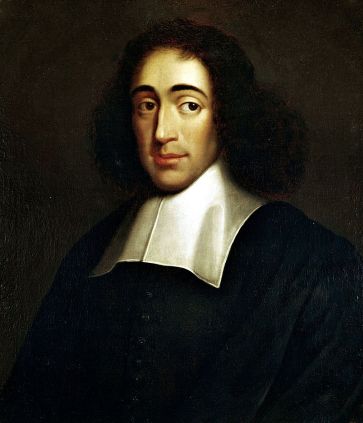
Portrait of Baruch de Spinoza (1632-1677), ca. 1665, by an unknown artist

Portrait of Baruch de Spinoza (1632-1677), ca. 1665, by an unknown artist

Averroes is also famous for his idea of monopsychism, that we all share the same divine soul, mind and awareness, with each taking a part such that the lower soul is individual and mortal but the higher soul is universal and immortal, the source of true inspiration and reason.  Spinoza, who said that each of us is like a wave on the great sea of being, was a pantheist, inspired in part by Averroes.  Much later, when Albert Einstein was asked if he believed in God, he said, in the spirit of Averroes, “I believe in Spinoza’s god”.

In these and countless other instances, we can discern the influence of Averroes throughout both Eastern and Western thought. Thank you for your wisdom and insight, Averroes!

~ Ordinary Philosophy is a labor of love and ad-free, supported by patrons and readers like you. Any support you can offer will be deeply appreciated!

*All views and opinions expressed by guest writers are their own and do not necessarily reflect those of Ordinary Philosophy’s editors and publishers

Paul Robeson, Black Dockworkers, and Labor-Left Pan-Africanism, by Peter Cole

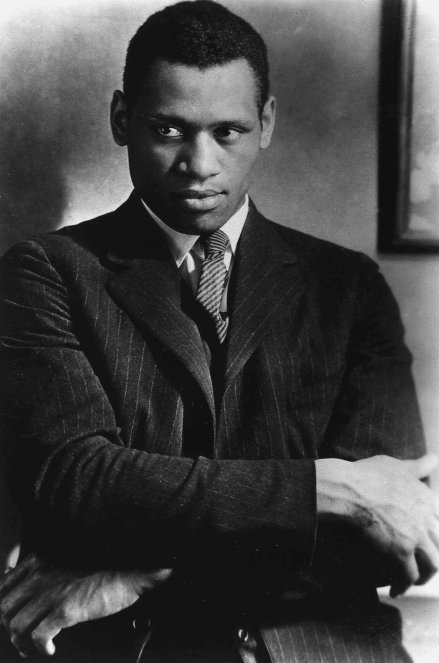
Actor Paul Robeson, photographed at Madame St. Georges studio in London in 1925 (AP Photo/Courtesy Paul Robeson Jr.). Click to hear Robeson’s incomparably beautiful baritone voice sing ‘Shenandoah’

In honor of singer, actor, and civil and labor rights activist Paul Robeson’s birthday, April 9, 1898, here’s an excellent piece by Peter Cole, originally published at the African American Intellectual History Society blog:

Paul Robeson was one of the greatest black internationalists of the twentieth century. A gifted actor and singer, he was also an unabashed leftist and union supporter. This resulted in his bitter persecution, destroying his career and causing, to a surprising degree, his disappearance from popular–if not academic–memory. Robeson’s connections to the fiery black dockworkers of the San Francisco Bay illuminate a form of black internationalism still left out of scholarly analyses –what I will refer to as Labor-Left Pan-Africanism.

Robeson’s life exemplified Pan-Africanism, a global movement of politically conscious black people who believed they shared much in common with all people of African descent in Africa and across the African Diaspora. In the 1930s, Robeson embraced this ideology, along with communism, and supported the Soviet Union. Robeson and other leftwing, Pan-African black intellectuals and activists—such as W. E. B. Du Bois, Eslanda Robeson, Vicki Garvin, and Hubert Harrison—fought long and hard for racial equality in the United States and for liberation of African and Caribbean nations abroad.

Robeson connected struggles for civil rights with socialism and working class politics. His interest in black equality first came from his father, William Drew Robeson, who was born a slave and successfully liberated himself. Robeson’s leftist politics emerged in the 1930s, first visiting the Soviet Union in 1934, and subsequently embracing socialism for treating black people as equals. He combined politics and artistry from then onwards.

In 1935, Robeson performed in the London debut of the American play Stevedore.1 The reviewer in the NAACP’s Crisis magazine concluded: “Stevedore is extremely valuable in the racial–social question—it is straight from the shoulder.” Later that year, he also played the lead in C. L. R. James’ take on Toussaint L’Ouverture, itself written shortly before James’ classic history of the Haitian Revolution, The Black Jacobins (1938).

In 1937, back in the United States, Robeson helped to establish the Council on African Affairs (CAA), which promoted African liberation in an era when few Americans actively engaged in such matters. Perhaps its greatest achievement came in 1946, when the CAA submitted a memorandum to the United Nations Commission on Human Rights in support of the African National Congress (ANC). Led by its US-educated President, Alfred Xuma, the ANC successfully fought to prevent the annexation of South-West Africa (now Namibia) by racist, white minority-ruled South Africa. Alas, the CAA was red-baited out of existence shortly after this victory.

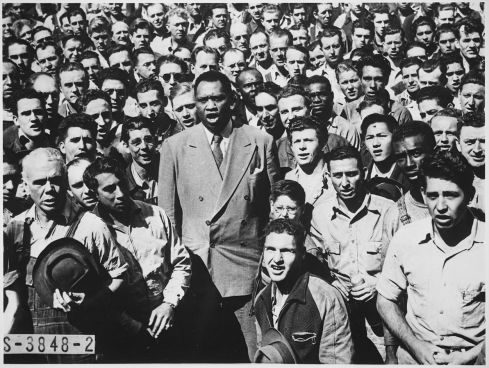
In 1942, during WWII, Robeson traveled to Oakland to champion the black and white union workers contributing to the Allied war effort on the home front. One of Robeson’s most famous photos shows him singing the “Star Spangled Banner” amidst a sea of black and white workers at Moore Shipyard in Oakland. The image captures his politics brilliantly, all the more so since Robeson had worked as a shipbuilder during WWI.

Paul Robeson, world famous baritone, at Moore Shipyard in Oakland, CA, leading workers in singing the Star Spangled Banner.

After WWII, the Cold War commenced and black people linked to communism, like Robeson and Du Bois, were persecuted by the US State Department, the FBI, and many so-called patriots intolerant of dissent. Historian Penny M. Von Eschen cites Robeson’s “extreme advocacy on behalf of the independence of the colonial peoples of Africa” as an explanation for his career’s destruction in the Red Scare. I would also add his labor activism.

Just like Robeson, many of the black dockworkers I study adhered to Labor-Left Pan-Africanism. In the San Francisco Bay Area, thousands of African Americans belonged to the International Longshore & Warehouse Union (ILWU).2  This leftwing union was renowned for its fierce and proud commitment to racial equality and black internationalism. Indeed, during WWII, Robeson became an honorary member of the ILWU. Robeson and the ILWU were, in many ways, a perfect fit.

The ILWU was—and remains—amongst America’s most radical unions, led for decades by its leftist President Harry Bridges and supported by many leftists in the rank-and-file. The union put socialism into action in its hiring halls, which dispatched members based upon a “low man out” system in which the person with the fewest amount of hours worked, that quarter, received the first available job.

In keeping with its politics, the ILWU attacked racism on the waterfront beginning with its initial “Big Strike” even though the workforce was 99% white in 1934. Local 10 welcomed thousands of African Americans during the WWII-induced shipping boom and these blacks, alongside leftist white allies, fully integrated their union and fought for civil rights in the Bay Area and nationwide. Due to their aggressive efforts, ILWU Local 10, which represents dockworkers in San Francisco, Oakland, and throughout the Bay Area, became black majority in the mid-1960s with blacks elected to every leadership position available. Truly, the ILWU embodied what historian Robert Korstad labeled “civil rights unionism.”

Robeson understood the significance of the ILWU as a platform from which to demand civil rights. Two of Robeson’s best friends– Joe Johnson and Revels Cayton— belonged to the ILWU. Together, these three black men articulated a commitment to Labor-Left Pan-Africanism.

The best example of its Pan-Africanism was ILWU’s commitment to the struggle against apartheid and, more broadly, for the liberation of all the peoples of southern Africa. In the 1950s and 1960s, the union repeatedly condemned white-minority rule in South Africa and also noted the ironic similarities with Jim Crow segregation in the States. In the 1970s and 1980s, rank-and-file members of ILWU Local 10 formed the Southern Africa Liberation Support Committee, which stood at the vanguard of black working class anti-apartheid activism during this period. Leo Robinson, Texas-born and a child of the 2nd Great Migration to Oakland, followed in his father’s footsteps to the waterfront in 1963. In Local 10 Robinson became a communist and activist who helped found the SALSC after the Soweto student uprising of 1976. Although Robeson died that same year, after declining health and decades in forced retirement due to McCarthyism, other radical longshoremen inspired by socialism and liberation movements in Africa joined Robinson and following in Robeson’s footsteps.

The black and white members of the SALSC fought for the liberation of black people in South Africa, Mozambique, Rhodesia, and elsewhere in the best way they knew how: direct action on the job. To leftist, Pan-African dockworkers, the most logical way to attack apartheid and racial capitalism was flexing their economic muscle, i.e. stop work. In 1962, 1977, and for eleven days in 1984 (shortly after Reagan’s landslide re-election), they refused to unload South African cargo. By contrast, other black Pan-Africanists embraced consumer boycotts or economic divestment. Local 10’s actions set the bar for US anti-apartheid activism and helped inspire many in the Bay Area to join the solidarity struggle. Nelson Mandela thanked the union on his first visit to Oakland in 1990 and Robinson received a posthumous award from the now-democratic South African government.

Long after his death, Paul Robeson continued to inspire African Americans in the ILWU including the Bay Area’s Alex Bagwell. Like Leo Robinson, Bagwell’s family moved to San Francisco during WWII. In the 1960s, he dropped out of college after admission to the union, which had elevated so many black folks into the middle class. Like Robeson, Bagwell was a leftist and active in the union’s anti-apartheid efforts. He and his wife, Harriet, belonged to a radical choir, Vukani Mawethu, founded by a South African who belonged to the ANC and had gone into exile. Alex and his wife were among those in Vukani who sang when Mandela visited Oakland.

In the early 1990s, though not yet retired, Bagwell finished his B.A. and then earned his M.A. in Creativity and Arts Education at San Francisco State University. For his graduate degree, he wrote a play on Robeson’s life, conducting interviews with twenty people who knew him including Local 10 member Joe Johnson, Robeson’s long-time friend.

After the birth of a multiracial, democratic South Africa, the Bagwells traveled to the country, as part of Vukani Mawethu, to perform there. Other black and white radicals in the ILWU did so, as well. The Pan-Africanism of these dockworkers clearly followed in the footsteps of Robeson, who first championed the rights of black South Africans in the 1940s. The spirit and ideals of Robeson continue to shape the Pan-Africanism of working class black dockworkers who now have established connections with black dockworkers in South African ports. Robeson would be proud.

  1.  Stevedore is an older term for dockworker or longshoreman, workers who load and unload cargo ships.
  2. The ILWU’s original name was the International Longshoremen’s & Warehousemen’s Union but, in 1997, a resolution was approved, unanimously at its biennial convention, that made its name gender-neutral. “What’s in a Name? For ILWU, it’s not ‘men’,Journal of Commerce, May 4, 1997

Peter Cole is a historian of the twentieth-century United States, South Africa and comparative history. Dr. Cole is Professor of History at Western Illinois University. He is the author of Wobblies on the Waterfront: Interracial Unionism in Progressive Era Philadelphia (University of Illinois Press, 2013) and currently at work on a book entitled Dockworker Power: Race, Technology & Unions in Durban and the San Francisco Bay Area. He writes on labor history and politics (Bio credit: AAIHS)

~ Ordinary Philosophy is a labor of love and ad-free, supported by patrons and readers like you. Any support you can offer will be deeply appreciated!

*All views and opinions expressed by guest writers are their own and do not necessarily reflect those of Ordinary Philosophy’s editors and publishers

Raconteur Street Blues, by East Street Prophet

Painting on a wall, photo by East Street Prophet at 518 Song of My People

I grew up around some of the great narcissists of our time. History won’t remember them, so I have to. They were great storytellers, who forged a knack for survival into an unequivocal hunger to live like kings. They spoke of riches and wealth that they couldn’t have possibly known, yet painted a picture so alluring we had no choice but to believe. They were raconteurs, wizards possessed of a singular illusion that painted the world in their image and presented it to us, as if it were ours.

A Raconteur is a person who excels in telling anecdotes. Also, an anecdote (Please note: I don’t want to insult anyone’s intelligence. I mean to provide clarity.) is a usually short narrative of an interesting, amusing, or biographical incident. A raconteur is a great storyteller. I’ve always considered the word to be closer to ‘being a good bullshitter’, which is worth its weight in gold. Anyone can tell a story, but getting people to care is a miracle akin to walking on water.

Storytellers are plentiful. You can see them in coffee shops behind laptops, biding their time until they have a chance to share, connect and separate. It’s in that singular moment, where we connect, that things change. They can become dangerous in a moment’s notice, as they infect your mind with complex riddles that the storytellers have been working on since the dawn of time. You might wonder, ‘why would a person share such a riddle?’ you can’t think like that. It’s how any good storyteller wants you to think. They want you to assume they have no reason to hurt you. There’s no harm in believing what they believe. There’s no harm in believing them without question.

The thing that all decent ‘raconteurs’ must ask themselves periodically is ‘do I care more about myself than I do the story?’ I’ve lived among some of the great bullshitters of modern history. We heard plenty of stories growing up, yet so few of them added up in a way that it could make me care. The raconteurs possessed this trait that added depth to their stories, not just with what images they infused, but with how they made us feel. We felt involved. They tugged on our heartstrings and moved us toward an end that we couldn’t see. They possessed our future, as we waited for these mindless heathens to comb through the vast wasteland of their psyches in search of an end to whatever narrative they were painting.

Any good story comes from a single point. It’s not the beginning. It’s just a point. They wanted to make a point. They’d lie about having sex, so they’d present a narrative that made the possibility of them having sex seem possible. They’d plant a few mental images here and there, forming past and future around this premise. Ultimately, their goal was to forge a real, however unlikely, narrative, in order to make us believe.

The raconteurs believed what they said. The proof was in their words. They told us to take it from there, because taking a man at his word is as good as taking it in blood… at least when you’re a child. When we were kids we lied and it helped. We had impossible things to accomplish in a collapsing world full of poverty and the imminent threat of some incomprehensible bullshit. We had to hide sensitive information from our parents, while taking advantage of our God-like inertia, limitless energy and simple-mindedness. We had to prove to other kids that we were cool, while, at the same time, making our parents think we’d never do the cool things that get you into trouble. It added to our personal mystique, having accomplished nothing, we needed something to set us apart. We’d lie about drinking and drugs, losing our virginity, feats of the utmost stupidity… you know… harmless bullshit.

Truth is the trickiest thing. Everyone says they want it, but when it’s not something they agree with they have a reaction that makes you wonder. Truth. It’s a funny thing, because I could write out the truth as I see it and (hopefully) half of you would love me and the other would hate me. The trick for any good raconteur is understanding the right formula, while having as full an understanding as you can of the truth. I believe that you can’t write a decent story, even if it sounds like nonsense, without a sense of truth. It has to be written, spoken and lived with conviction. Truth has to appear in every word, exactly as you’ve seen it, while managing not to conflict with the truth, as it is. You should, as a good storyteller, align yourself with the truth in order to make your narrative more honest and compelling.

I never thought about truth when I was young enough to fall for these stories. The morality of lying, as one presents it to himself, so that he might further his ends, has become all the more staggering as I’ve reached adulthood. I’ve been trying to think of the right way to word this question. I doubt it’s perfect, but it needs to be asked. I’m curious as to what everyone believes:

Can you have a moral premise without any evidence?

Some raconteurs have no regard for the truth. In all honesty, as a kid I didn’t care. I was surrounded by some of the greatest storytellers of my time. I couldn’t be bothered to figure out how some of these impossible stories could be real. I believed with all my heart, because I was a stupid kid who still believed in Santa. (FYI I believed in ghosts for longer than I believed in Santa, but I also assumed the ghosts would grant a wish or needed my help or whatever.) These are men who have learned to lie in a way that ‘everyone believes that you believe what you say’. You believe them, no matter the evidence to the contrary, because they, not their narrative, hold up well against the barrage of truth that assaults them on all sides.

They’re not not-sympathetic characters. Their truth is a depressing harangue of emotion and pain that most couldn’t understand. What’s worse, they keep it to themselves. They keep it! They hide all that pain and suffering, but even more, they hide the truth! They move with such intent when they tell their stories, as if revealing a deeper, more significant wisdom, while simultaneously hiding it from the world. It’s in their emphatic gestures, their movements, as if their bodies shift depending on the tone of their narratives, not to mention their eyes… it’s in all these things that those of us who were forced to listen HAD to believe.

We believed it all the more, because we lived it. They borrowed from our lives and, in this way, we added to the false narrative. Storytelling is a necessary skill. It made us feel good in a time where people were laughing at us, because our river was full of poison and visitors had no reason to… visit. The pain of being alive could’ve shown itself in crime and self abuse. For us, it showed itself in acceptance of nonsensical bullshit and downright lies.

Near-possible realities were a simple narrative that captured our attention, which begs the question: why do they need our attention? Evil raconteurs are like evil yogis. You can assume they don’t exist, as if there is no darkness when there is also light, but this is another simple narrative that’s easy to digest. The simple narrative is used to ensnare. You don’t need to talk about angels to be a good raconteur. You have to make people believe. This is that much more significant. You MAKE people believe. You take them on a journey, where they start out as a skeptic and then, through a few twists and turns… holy shit… you just made someone believe in angels.

(Also, if you don’t make them believe, you at least allow them to suspend reality for a time, which is kinda the same, although I admit there are differences.)

Making people believe and sharing with them a deeply personal truth is about as different as water and oil.

For what it’s worth, they thought they were kings, but that never stopped them from fighting to become that oh-so-desirable, and unquestioned ruler of the universe. They lied and stole and fought, but the stories to me became all the more touching. These people, the Raconteurs, were at war with themselves, as well as the truth and as well as a circumstance of poverty and extreme depravity, which was plentiful, in our ever-collapsing society. They fought for freedom: the freedom to be as insane and harmful to oneself as you can get. They fought to make the world a weird place.

Originally published at 518 – Song of My People

East Street Prophet 518 writes beautifully about hometown Rensselaer, just across the Hudson River from Albany, NY, and their experiences within the 518 area code: Albany, Rensselaer, and Troy, and various outlying places as well. They’ve been having a lot of fun with it and creating a bit of ‘folklore’ from local stories at 518 – Song of My People

~ Ordinary Philosophy is a labor of love and ad-free, supported by patrons and readers like you. Any support you can offer will be deeply appreciated!

*All views and opinions expressed by guest writers are their own and do not necessarily reflect those of Ordinary Philosophy’s editors and publishers

Cesar Chavez Day, by Alejandro Magaña

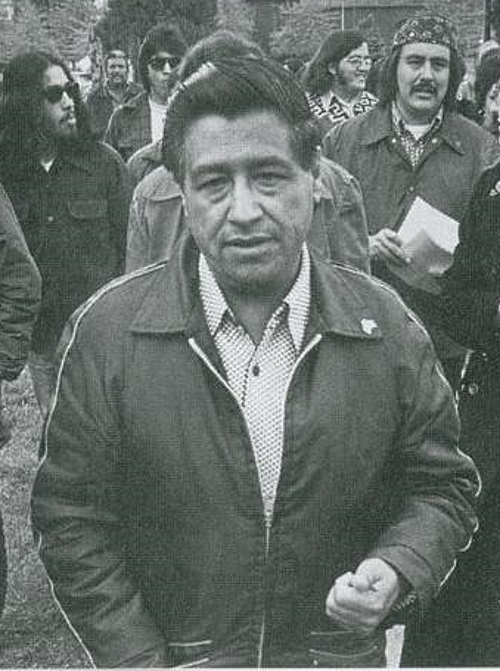
Cesar Chavez visits college - By Movimiento - Own work, cropped - CC BY-SA 3.0 httpcreativecommons.orglicensesby-sa3.0 via Wikimedia CommonsEvery year around Cesar Chavez’s birthday, as media outlets report of festivities in his honor, I’m reminded of a joke in a Simpsons episode and the strange sadness it elicited in me when I saw it: Homer Simpson is on his front lawn and is confronted with the apparition of a debonair, mustachioed man who introduces himself as, “the spirit of Cesar Chavez.”

In typical Homer confusion he asks, “Then why do you look like Cesar Romero?”

The ghost replies, “Because you don’t know what I look like!”

Cesar Chavez is certainly revered by many people, especially within the Latino community, but despite the steadily increasing ubiquity of his name across the United States, especially the American Southwest, there are still many Americans today who don’t really know who he is, let alone what he stood for, or what he accomplished.

Cesar Chavez was a Mexican-American community organizer turned labor leader. A former migrant farmworker recruited by the Community Service Organization (CSO) in its heyday of the 1950s, he co-founded the National Farmworkers Association (NFWA,) which later became the United Farm Workers (UFW,) the first successful union for migrant farmworkers. The UFW’s membership consisted mostly of indigent Latinos and Filipinos, and their struggle for justice and dignity, fighting to gain higher wages and better conditions in the fields where they were deprived of basic needs such as clean drinking water and bathrooms, became a national moral cause under the stewardship of Chavez, who courted national and international sympathy using militant non-violent tactics in the vein of Mahatma Gandhi and Martin Luther King Jr, such as strikes, boycotts, fasts, and peaceful marches.

Chavez was not an imposing orator with the fire-and-brimstone timbre of the Reverend Dr. King, nor did he cut as iconoclastic a figure as Gandhi, but in his unassuming way he could be just as charismatic and endearing, and this often caught people off guard, as it did an interviewer for the New Yorker in 1973, who, “had expected, if not a Mexican-American Lenin…a young, hard, intense man bristling with revolutionary zeal. Instead we found Mr. Chavez to be a stocky man…about five feet seven …with Indian features…and a pleasant earnest manner.” With his trademark regular boys’ haircut parted on the side and wearing simple cardigans with button down plaid shirts and slacks, his fashion was more Mr. Rogers than Mr. Lenin. He looked the part of the humble Everyman that people felt they could relate to.

On a personal note, my parents actually met while working with Cesar Chavez in the early ‘70s, and when they tell stories of those days, they both recall how approachable he was with his easy but confident demeanor; how people were drawn to him and trusted him, even as he took them out of their comfort zones, like the time he sent my mom and a few other farmworkers to Chicago, to publicize and organize the Grape Boycott, even though they spoke very little English and were armed with just a few phone numbers of sympathizers there along with the names of some churches that might possibly provide them with food, room and board. They believed they could accomplish such ambitious plans because this diminutive, unpretentious man seemed capable of stopping the engine of the entire agricultural industry and took on Big Agribusiness all by himself. Before it became widely known as the slogan of Barack Obama’s presidential campaign, I grew up with my father reminding me, “¡Si se puede!” (Yes, you can!) a phrase Chavez often chanted before throngs of people at picket lines and marches.

Like Gandhi and King, he was intensely spiritual and absolutely committed to non-violence. In what may be his most recognizable aphorism, he said, “It is my deepest belief that only by giving our lives do we find life. I am convinced that the truest act of courage…is to sacrifice ourselves for others in a totally non-violent struggle for justice.” Self-immolation was a recurring theme in both word and deed: in 1968, during the Delano Grape Strike, after several tense confrontations at the picket lines nearly devolved into violence, he fasted for 25 days to encourage and remind the farmworkers that their fight was to be a non-violent one. He would fast for 24 days again in 1972, and in 1988 he fasted for 36 days(!) to bring attention to the pesticide poisoning of grape workers and their children. It is thought that his relatively early death at the age of 63 in 1993 was probably due to aggregated health complications suffered from these sacrifices. Still, even now, if you talk to people who marched with Chavez and the UFW back then, most speak of Chavez in reverential, even hagiographical ways, for to them he was como un santo: like a saint..

Throughout the 1960s and 1970s, as the UFW made sweeping legislative strides on behalf of organized farm labor, Chavez was also becoming the most widely known leader within the broader Chicano Movement, or “El Movimiento,” a civil rights movement which empowered Mexican Americans caught between two cultures, not quite Mexican enough for their Mexican immigrant forebears, nor seen as truly American by the white hegemony. The term “chicano” was originally a derogatory term for the American children of Mexican migrants, but in the Movement it was flipped, transmogrified, to be a badge of ethnic pride. Of course Chavez always made sure to situate the fight of the UFW as united with the struggle of “all farm workers across the country, the Negroes and poor whites, the Puerto Ricans, Japanese, and Arabians…the races that comprise the oppressed minorities of the United States,” but “The Plan de Delano,” a text co-authored by Chavez with Dolores Huerta and the Chicano playwright Luis Valdez, reifies and emboldens his ethnic heritage, declaring “We are sons of the Mexican Revolution.” To this day, the flag of the UFW, showing a black Aztec eagle on stark red background, is widely considered a symbol of Chicano or Latino pride. Those of us who wear this symbol, or even, as in my case, have it tattooed on their body, recognize that the life we have so firmly rooted in the United States, with access to resources and opportunities that our parents or grandparents did not have, is due to the hard work and vigilance of people like Cesar Chavez, Dolores Huerta, or my mother, Maria Saludado.

The identity politics that certainly began to swell in the 1960s have persisted despite reactionary criticism and remain particularly relevant today; an era in which the ugly scars of racism seem as starkly etched in our national consciousness as ever. As we near the end of the second term of America’s first ‘non-white’ President, as Mexican immigration continues to be a galvanizing and polarizing issue in the US, and the Latino vote is highly prized on both sides of the political aisle, conditions would seem fecund for a reboot of El Movimiento. In appropriate fashion, this year the Cesar Chavez Foundation, an offshoot of the UFW, began its annual celebration in San Fernando, the first city in the nation to commemorate Cesar Chavez Day with a paid holiday, with a rally and march to encourage activism to “Dump Trump.”

¡Que viva César Chávez!

~ Alejandro Magaña is a musician, poet, and songwriter some of the time, and a father and husband all of the time. He also works full-time as an office manager at Urban Ore in West Berkeley. He lives in North Oakland with his wife and son and books and records.

Sources and Inspiration:

● My mother and father. ¡Que viva mis padres!
● Chasan, Daniel. “‘Marcher,’ an interview with Cesar Chavez,” The New Yorker, May 27, 1967.
● Chavez, Cesar, Huerta, Dolores, and Valdez, Luis. “The Plan of Delano,” El Malcriado, March 17, 1966.
● Chavez, Cesar. An Organizer’s Tale: Speeches Ed. Ilan Stevens. London: Penguin Books, 2008.

This piece was first published one year ago today here at Ordinary Philosophy

~ Ordinary Philosophy is a labor of love and ad-free, supported by patrons and readers like you. Any support you can offer will be deeply appreciated!

*All views and opinions expressed by guest writers are their own and do not necessarily reflect those of Ordinary Philosophy’s editors and publishers

Until Recently, Trump Got Health Care Right, by Fareed Zakaria

Fareed Zakaria's avatarFareed Zakaria

By Fareed Zakaria
Thursday, Mar. 30, 2017

The recent Republican debacle on health care could prove to be an opportunity. It highlighted, yet again, the complexity of the U.S. system, which continues to be by far the most expensive and inefficient in the advanced world. But President Trump could actually use the legislative collapse to fix health care if he went back to basics and to his core convictions on the topic, which are surprisingly intelligent and consistent.

There is an understandable impulse on the right to assume that health care would work more efficiently if it were a free market, or a freer market. This is true for most goods and services. But in 1963, economist Kenneth Arrow, who later won a Nobel Prize, offered an explanation as to why markets would not work well in this area. He argued that there was a huge mismatch of power and…

View original post 634 more words

Abortion: Conflict and Compromise, by Kate Greasley

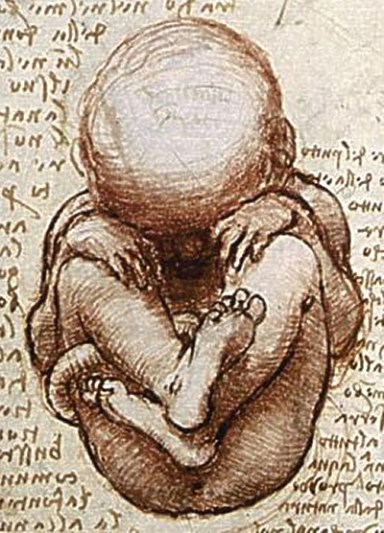
View of a Foetus in the Womb, c. 1510 – 1512, drawing by Leonardo da Vinci

A few years ago, when I told a colleague that I was working primarily on abortion rights, he looked at me quizzically and replied, “But I thought they had sorted all of that out in the seventies”. Needless to say, he was a scientist. Still, while the idea that the ethical questions implicated in abortion were somehow put to bed in the last century is humorous, I knew what he meant. The end of the ‘sixties and beginning of the ‘seventies marked watershed developments for reproductive freedom in both Britain and the U.S. – developments which have (with some non-negligible push and pull at the boundaries) continued to set the basic terms of abortion regulation ever since.

In Britain, the 1967 Abortion Act widely legalised termination of pregnancy for the first time and codified the grounds upon which abortions could be legally carried out. Shortly after, the 1973 Supreme Court decision Roe v Wade famously declared that there was a constitutionally protected right to abortion in the United States, albeit with some qualifications. Since those events, there have been no revolutionary changes to the system of abortion regulation on either side of the Atlantic, although there have been many meaningful ones.

Of course, legal resolution by no means signalled the end of moral disagreement about abortion. A significant minority voice has continued to vehemently oppose abortion practice. What was settled back then secured far more of a grudging détente than a happy compromise. (Like so much legislation, the Abortion Act was a product of political expediencies; I once heard one of its drafters describe the pandemonium of last-minute back-room deals in the Houses of Parliament, and the hotchpotch of provisions that emerged from all of the bargaining necessary to get it through.) As such, the political resolutions, whilst enduring, have always been intensely fragile, especially in the US where Christian conservatism and the anti-abortion lobby overlap so much. Of late, that fragility has become increasingly apparent. Recent developments in the United States and elsewhere have revealed just how misplaced any complacency about reproductive rights truly is.

It is, in truth, hardly surprising that abortion compromise is so precarious when one considers the nature of dissent to abortion practice. If one side of that debate really believes—as many claim to—that abortion is murder, akin to infanticide, then it is hard to see how they can ever truly accept legal abortion merely on the strength of its democratic pedigree. Against such a belief, rehearsing the familiar pro-choice mantras about women’s rights and bodily autonomy is a bit like shooting arrows at a Chinook helicopter. For what strength does control over one’s body and reproductive destiny really have when measured against the intentional inflicting of death on another?

Of course, if ideological opponents of abortion rights really believe that abortion amounts to murder, it may be hard to make sense of some of the traditional exceptions they themselves have defended, in circumstances, for example, of rape or incest, or where the pregnancy endangers the very life of the pregnant woman. If killing the fetus is no less than homicide, then how can it be justified even in these dire conditions? We certainly do not permit the out and out killing of born human beings for comparable reasons. This may be an indication that opponents of abortion who make such concessions do not truly, deeply, believe the claim that killing an embryo or fetus is like killing a child. Alternatively, it may just suggest that such concessions are rarely ever authentic, but adopted merely as a matter of political strategizing, to avoid losing moderate support in the wider conflict. If that were true, it would be unsurprising to see those traditional concessions gradually withdrawn as opponents of abortion become emboldened by increasing success.

Either way, defenders of abortion rights have a constant decision to make about how to respond to attacks on reproductive freedom and the denunciation of abortion as a moral horror. The approach most traditionally favoured, at least in public spheres, is to simply ignore all talk about abortion being murder and try to refocus attention on women’s stakes in abortion freedoms. As the Mad Men character Don Draper always quipped, “If you don’t like what’s being said, change the conversation”. This strategy can have its uses, but also its drawbacks. Most importantly, whilst reminding everyone of what women stand to lose through abortion prohibition is likely to strengthen the resolve of those sympathetic to abortion rights, it does nothing to address the consternation of those that are genuinely conflicted about the issue – who are not sure that abortion isn’t murder. As an effort to persuade avowed opponents of abortion rights to think again, it is even more pointless. For those who decry abortion as unjustified homicide do not usually need to be convinced that women can be hugely benefited by it, and harmed by its outlawing. That is not where their main ground of opposition ever lay.

It is for this reason that I think any effective defense of abortion rights must meet that opposition on its own terms, and confront the claims that abortion is homicide and the fetus the moral equivalent of a child. The task can seem daunting; how does one even begin to argue about whether or not unborn human lives have exactly the same right to life as mature human beings? But there are many reflections one can bring to bear on that question, and especially on the question whether, when examining our own or others’ beliefs, we are really committed to the claim that embryos are equal in moral value to human children. For one thing, as some philosophers have pointed out, if we really believed that claim, we may have to ask why infinitely more resources are not devoted to the prevention of natural miscarriage, which, it would follow, is the single biggest cause of child mortality – far greater than famine, disease, or war. At any rate, if defenders of reproductive freedoms do not concern themselves with the fundamental questions of abortion ethics, they are in danger of being left with little effective argument if and when the fragile settlements that have held for some decades threaten true collapse.

This essay was originally published at OUP Blog: Oxford University Press’s Academic Insights for the Thinking World

Can We Have More Than One Friend? According to Montaigne, No, by Manuel Bermudez

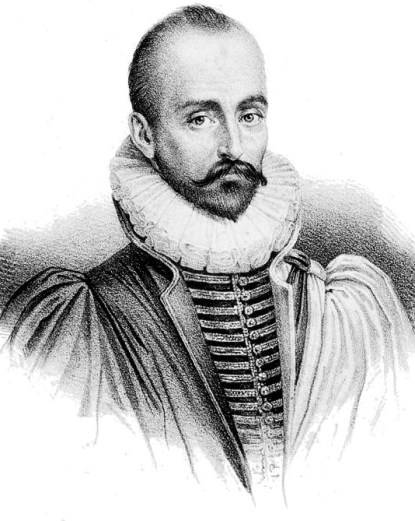
Michel de Montaigne, public domain via Wikimedia Commons

The Essais are the perfect mate to accompany anybody, throughout all stages of life. It’s always interesting to explore Michel de Montaigne‘s life and his marvelous book: the Essais. Within his lifespan, Montaigne was able to find true friendship for himself and record its effects therein. Here we propose to navigate Montaigne’s approach to friendship.

In his Nicomachean Ethics Aristotle wrote that friendship was “one soul in two bodies.” Montaigne, on the contrary, always thought that friendship was a free exchange between two people.

Montaigne thought that true friendship was rare. He himself acknowledges to have found only one proper friend in his life: Etienne de La Boétie. And he could enjoy this friendship only for a mere four years. They met as adults and death took Montaigne’s soulmate early. An irreplaceable loss. After La Boétie’s death (in 1563), Montaigne didn’t feel the desire to find a substitute for his dead friend. Perhaps the reason was that our French friend knew intuitively that such a profound bond could only happen once in a lifetime.

Is it possible to have many different friends at any given time? According to Montaigne, true friends are not only scarce, but they should be unique, if only for loyalty’s sake.

If two friends asked you to help them at the same time, which of them would you dash to? If they asked for conflicting favours, who would have the priority? If one entrusted to your silence something that was useful to the other, how would you manage?

— Montaigne, Essais, “On Friendship”

Montaigne-Dumonstier

Portrait of Montaigne by an unknown artist. Public Domain via Wikimedia Commons

The dilemma set here finds an easy solution for Montaigne, since the balance will always incline towards one of them. A succession of these choices would lead him to the real friend. Thus, it would be proved that true friendships tend to uniqueness.

When Montaigne talks about friendship, he does so from his own feelings towards a person of flesh and blood: Etienne de La Boétie. He transferred what he felt for his kindred spirit to the Essais. He loved his friend to the point where he felt despondently lost when La Boétie died. Montaigne attempted to find solace in his writing about La Boétie, even though he failed to portray the true nature of their relationship.

We can find a good deal of mystery in a friendship like these two men had. That strange and powerful empathy that Montaigne tried to describe is difficult to understand. Montaigne concludes that: “They are unimaginable facts for those who have not tried them.”

Montaigne distinguished true friendship from ordinary friendship. Ordinary friendships have, in a way or another, self-interest behind their development. It’s an investment made not with money, but with affection. On the other hand, true friendship is described by the author with the following words:

For the rest, which we commonly call friends, and friendships, are nothing but acquaintance, and familiarities, either occasionally contracted, or upon some design, by means of which, there happens some little intercourse betwixt our souls: but in the friendship I speak of, they mix and work themselves into one piece, with so universal a mixture, that there is no more sign of the seam by which they were first conjoyn’d.

— Montaigne, Essais, “On Friendship”

In an attempt to describe the nature of his friendship with La Boétie, Montaigne concludes with his famous expression: “If a man should importune me to give a reason why I lov’d him; I find it could no otherwise be exprest, than by making answer: because it was he, because it was I.”

We can only add here that in the example of Bordeaux of the Essais, Montaigne wrote first “because it was he.” Later he added “because it was I.”

This essay was originally published at OUP Blog: Oxford University Press’s Academic Insights for the Thinking World

Read Montaigne’s essay ‘On Friendship’ here

Manuel Bermudez is Professor of Philosophy at the University of Cordoba, Spain. He is the author of the Oxford Bibliographies in Philosophy article “Michel de Montaigne.” (Bio credit: OUPblog)

~ Ordinary Philosophy is a labor of love and ad-free, supported by patrons and readers like you. Any support you can offer will be deeply appreciated!

*All views and opinions expressed by guest writers are their own and do not necessarily reflect those of Ordinary Philosophy’s editors and publishers

“Held in Trust by History:” The Intellectual Activism of Lerone Bennett Jr., by Christopher Tinson

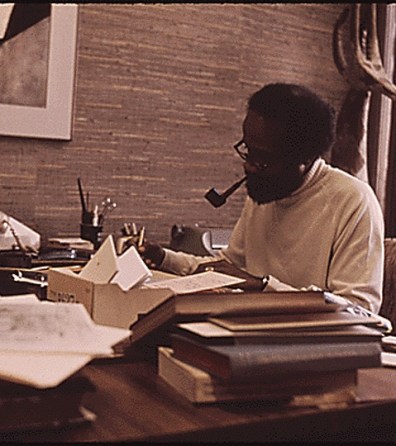
Lerone Bennett, Jr, by John H. White for Series DOCUMERICA, Oct 1973, public domain (cropped)

On the morning of December 11, 2016, a notice in the Chicago area news read as follows: “Author Lerone Bennett Found Safe After Being Reported Missing.” The 88-year old scholar and journalist had decided to go for an early morning walk, without telling anyone. According to the notice, Bennett had been located hours after he had gone missing. While the news report provided few details about the incident, it indicated that Bennett was “the author of multiple books” who had “previously worked as an editor at JET and Ebony Magazine.” The brevity of this note calls attention to two important facts: that Bennett is not dead as many have assumed, and that he is still largely known for his work at Ebony and for the publication of two critically acclaimed texts even though he produced over ten. While this notice locates Bennett, it fails to account for the extraordinary impact of this important figure.

Lerone Bennett, Jr.—social historian, Black Studies architect, and intellectual activist—spent over four decades at Ebony magazine. Ebony, arguably the premier African American lifestyle magazine of the 20th century, was founded by John H. Johnson in 1945. In addition to Ebony, Bennett also maintained a full organizational life, holding memberships and associations in such organizations as the short-lived Black Academy of Arts and Letters, the Race Relations Information Center, the Institute of the Black World, the Association for the Study of Negro Life and History, and the Martin Luther King, Jr. Memorial Center. In 1965, John Henrik Clarke was the first to announce Bennett as a social historian and historian Pero Dagbovie revisited Bennett’s influence on Africana Studies in an article in the Journal of Black Studies. Renewing the interest in Bennett’s life opens us to several objectives: to gain a sense of African American historical expertise and craftsmanship, to achieve an expansive definition of intellectual history and the social function of the historian, to contextualize Bennett’s productivity, motivations, and range as a thinker, to achieve a view into his philosophy of life, and lastly to arrive at the creatively disruptive and reparative dimensions of history, all of which are discernible in Bennett’s robust body of work.

Born and bred in the south, Bennett moved to Chicago after a stint at the Atlanta Daily World and was named Associate Editor at Ebony in 1954. Bennett’s time at Ebony was unique. Starting out slowly, he later emerged as one of Johnson’s trusted advisors—he eventually co-wrote Johnson’s autobiography. He used the prestige of one of America’s most successful black entrepreneurs to teach and disseminate black history. The common association of Bennett with the popularizing of history reduces his impact. His record shows that far from watering down the African American experience in the United States, he sought to forge a reparative, justice-centric, visionary account of past human endeavor and the stakes of social disequilibrium. For Bennett, history looks backwards and forwards simultaneously. A brief survey of Ebony issues over this period reveals several principal social concerns, including: African American struggles over rights, passionate interest in the decolonization of the African continent, the uncovering or rediscovering key contributors to Africana intellectual life, and measuring the growing discontent with the prospects of American democracy. On one hand, Ebony emphasized high-life aspiration and on the other it cultivated a devoted and deeply engaged readership. Throughout the 1960s Bennett published a broad range of essays commenting on African American politics, culture, and Afro-diasporic history. Virtually no subject escaped Bennett’s pen. Among the writings in this period are essays on African independence, civil rights militancy, popular culture, and other histories that comprised the series “Pioneers of Protest.”

However, Bennett’s career took off upon the publication of Before the Mayflower in 1962, which began as a series of Ebony essays in 1961. The book was an immediate sensation. Mainstream press outlets such as the Chicago Tribune favorably reviewed the book. The Tribune also carried book reviews written by Bennett while he served as associate editor at Ebony. Historian and activist John Henrik Clarke’s review essay for the black left periodical Freedomways in 1965 locates Bennett in relation to the Civil Rights upsurge carried out by “A new generation of restless black Americans.” For Clarke, Bennett was part of a new generation who, like himself, could be called participant historians. In other words these were historians who not only documented history, but were themselves poised and principled activists in their own regard. Clarke offered readers a glimpse into Bennett’s background before diving into a review of key sections of Before the Mayflower and several of his seminal Ebony articles. Accompanying the piece was two of Bennett’s poems, showcasing a multitalented intellect.

The great irony of Bennett’s career, perhaps, is found in his relationship with Ebony, a magazine known for its dependency on advertising that peddled skin lighteners, platform shoes, cigarettes, scotch, the latest styles, and wigs. Bennett was bent on using the popular magazine of the black high life as a reputable platform to document and forecast black struggle, and he succeeded. Still, this did not mean he went unquestioned about what some perceived to be a contradiction.

Without question, Ebony was a critical platform for Bennett. In the front matter of every book he published for JPC, he earnestly thanked Johnson for allowing him the massive platform, time, and resources to research and write. He could reach larger audiences than professors at exclusive colleges or universities, but he could also keep relationships with those institutions that had no effect on his work. Ebony thus emerges as a premier, if unlikely, site of black cultural knowledge production. In this sense Ebony was a different kind of public institution. Bennett certainly benefitted from this unique arrangement and never took it for granted. Not only could he be in the thick of key debates as sage and journalist and historian, but also Ebony’s book publishing gave him a direct line to the national book networks. Among their many publishing pursuits, Bennett and Johnson had plans for an Ebony Encyclopedia.

Bennett’s approach to publishing was methodical and systematic. Lectures and speeches became articles, articles became books, or anthologies. Ebony therefore was unparalleled in its disruption of American consumer trends and U.S. based intellectual work. Bennett had the best of both worlds in terms of institutional credibility among all sectors of the black community. Bennett’s work ethic and standards of excellence had earned him the trust of John H. Johnson. The two carved out what was an enviable relationship. Bennett had access to the publishing mogul, and Johnson needed Bennett’s intellectual heft to bolster the magazine’s reputation and commitment to sincere and earnest coverage of black life beyond the simple demands of capitalist advertising and an aspiring black middle class’s pursuit of the high life. But Johnson was no fool. And although he refused to wear his politics on his sleeve, Bennett viewed Johnson as a sincere and chief advocate of black life. Effectively, Bennett was the bridge across a full spectrum that stretched from a petty capitalist, black bourgeoisie, churchgoing, assimilationist community, to grassroots militants and middle- and working class intellectuals with nationalist proclivities, alongside full expressions of black elite aspiration. No matter the segments of the black community and their ideological shadings or capitalist accouterments, in Bennett’s view, their fates were linked, and, moreover, they all had to answer the call of history and the demands of time.

At the turn of the 21st Century, Bennett remained active. On April 26, 2000, Bennett testified in front of the “Joint Hearing of the Finance and Human Relations Committees of the Chicago City Council on Reparations for African-American Slaves and Their Descendants.” The sage historian took full advantage of the opportunity to underscore the unpaid debt long past due. Interestingly, atop the typed speech, in Bennett’s cursive handwriting are the words, “Held in Trust by History.” It was as if Bennett was reminding himself of the duty to once again shine due light on the evidence and make the case plain.

Like W.E.B. Du Bois and Carter G. Woodson, he showed a commitment to “living history” and modeled a kind of public intellectualism that was both strident and sensitive. His time at Ebony suggests that a popular media platform could just as easily become a classroom. For Bennett, history was not just a discipline–it was obligation, memory, and art. He was moved by the opportunity, calling, and challenge of doing good work on behalf of a people’s struggle. Lerone Bennett, Jr. no longer needs an “All Points Bulletin/Missing Persons Report.” He has been here the whole time.

This piece was originally published at The African American Intellectual History Society (AAIHS) Blog

Christopher Tinson is an Associate Professor of Africana Studies and History at Hampshire College. His interdisciplinary research and teaching focuses on the intersections between Africana radical traditions, Ethnic Studies, critical media studies, incarceration, and community-based education. His book on Liberator magazine and black activism of the 1960s, entitled Radical Intellect, is forthcoming. (Bio credit: AAIHS)

~ Ordinary Philosophy is a labor of love and ad-free, supported by patrons and readers like you. Any support you can offer will be deeply appreciated!

*All views and opinions expressed by guest writers are their own and do not necessarily reflect those of Ordinary Philosophy’s editors and publishers