A Moral and Political Critique of the Republican Primary Debates of 2015, Part 1

As have many Americans, no doubt, I put on the Presidential primary debates of both parties mostly as background entertainment while I was doing chores, at least at first listen. Yet it occurred to me that it might be fruitful to sit down and take some time to really consider the arguments. Yes, we’re all a bit cynical these days, it seems, and it’s easy to wonder: why bother? Aren’t all of these presidential hopefuls just corporate shills and lapdog ideologues of the powers that be anyway?

Be that as it may (and I doubt that’s the case for all or most of them, at least not fully, though I agree that the financial incentives in the current political structure are corruptive to say the least), many of these arguments win over or enrage a lot of people, and it seems important to understand why and how. After all, we’re still, ostensibly, a democracy, and we all still have to live together in this country. Why not make the effort to better understand the strengths and weaknesses of the arguments that pit citizens against one another, uniting people within factions while dividing the nation as a whole?

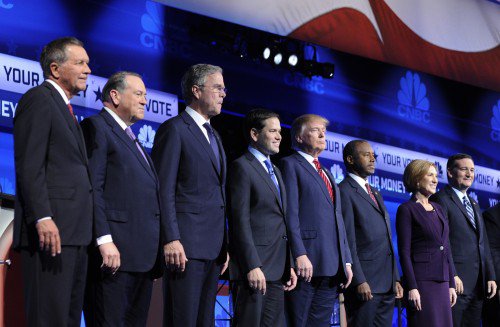
So here’s a critique of arguments offered in recent Republican primary debates; I’ll do the same with the Democratic debate(s) soon as well. The debate transcript selections are in red, and my own remarks in black. I leave out introductions, banter, moderator comments, lines which indicate audience response, some purely empirical claims, and other parts that don’t directly pertain to the political and moral ideas considered here. The parts I leave out are indicated, as usual, by a series of ellipses.

From the Fox News / Facebook Republican presidential primary debate, August 6th 2015

The source of the debate transcript which follows is Time.com
Participants: Donald Trump, Governor Jeb Bush, Governor Scott Walker, Senator Marco Rubio, Governor Chris Christie, Dr. Ben Carson, Senator Rand Paul, Senator Ted Cruz, and Governor John Kasich.
Moderators: Fox News anchors Bret Baier, Megyn Kelly and Chris Wallace.

KELLY: It is nine p.m. on the East Coast, and the moment of truth has arrived….

Great, truth, let’s hear it!

…Mr. Trump, one of the things people love about you is you speak your mind and you don’t use a politician’s filter. However, that is not without its downsides, in particular, when it comes to women.

You’ve called women you don’t like “fat pigs, dogs, slobs, and disgusting animals.” …. You once told a contestant on Celebrity Apprentice it would be a pretty picture to see her on her knees. Does that sound to you like the temperament of a man we should elect as president…?

TRUMP: I think the big problem this country has is being politically correct. …I’ve been challenged by so many people, and I don’t frankly have time for total political correctness…

I agree with Trump on one thing: political correctness can be a problem in public and political discourse, and I think our ‘outrage culture’ has gone too far in sanitizing what we could and should be able to say, both publicly and privately, and especially in education. Some of the outrage and sensitivity comes from a good place, the concern that, through offensive speech, we can harm one another, act as bad influences on one another, and perpetuate our own bad habits of thought. These are true. But it’s also true that speech is necessary for confronting and addressing ideas honestly, whether they be good or bad. For example, sexuality and gender issues, like all else, are all part of the human story that can and should be told, and humor, banter, and in-your-face crudeness are some of the valid ways in which we address them. Trump may consider himself a harmless participant in all that.

But we can and should consider what people say when we make judgments about people, especially when we’re choosing our representatives in government. In a free society, we all decide if someone who regularly makes remarks that disparages women as thinking beings and gauges their worth based on sexual attractiveness to men is the sort of person we think best represents the American people and their core values. And as we’ve already considered, the words we use, and especially that influential people use, can go a long way in determining how a society thinks and acts. Besides, do we really want to elect a person who makes such nasty remarks about the daughters, sisters, wives, and mothers of other people, which we wouldn’t tolerate directed to our own, to the highest office in the land?

So let Trump freely say what he wants to say. If Trump sounds like an asshole when he talks about women or anything else, that’s very useful information he’s providing. In the end, the people will decide if what he reveals about himself shows he’s worthy and capable of representing the rest of us on the national and international stage.

…WALLACE: Governor Huckabee, like Governor Walker, you have staked out strong positions on social issues. …You favor a constitutional amendment banning abortions, except for the life of the mother. …

HUCKABEE: Chris, I disagree with the idea that the real issue is a constitutional amendment. …I think it’s time to do something even more bold. I think the next president ought to invoke the Fifth, and Fourteenth Amendments to the constitution now that we clearly know that that baby inside the mother’s womb is a person at the moment of conception. The reason we know that it is is because of the DNA schedule that we now have clear scientific evidence on. And, this notion that we just continue to ignore the personhood of the individual is a violation of that unborn child’s Fifth and 14th Amendment rights for due process and equal protection under the law

The glaring assumption in this argument, of course, is that possessing a unique sequence of human DNA is equal to personhood. But so far as I know, neither American law nor its parent British law has ever established such a thing. Historically, legal personhood has been linked to the assignation of roles and responsibilities, and in modern times rights, to independently living, breathing human beings. Most spiritual and religious traditions have also equated breath and life throughout history, including the scriptures of Judaism and Christianity. It may very well be the case, with the advances we’ve made in medical science, that it’s time to reevaluate the concept of legal personhood. People who can no longer breathe on their own or otherwise survive naturally can be kept alive through extraordinary means, sometimes with their cognitive abilities intact or capable of restoration, and fetuses in the later stages of development are now usually viable and possess most or all of the mental capacities of newly born, healthy infants.

But linking personhood to DNA is a very recent and I would say extreme innovation, and as yet no federal court has recognized this linkage, to my relief. The science of human reproduction reveals that it’s a complex process, rife with false starts (it’s widely estimated that well over half of all human conceptions fail to result in healthy live births). To assign personhood to every human conception would overturn centuries of very good legal precedent which does not concern itself too much with assigning rights and responsibilities to human organisms in the earliest and not yet determinate stages of development. Instead, it does and should concern itself first with the protection of the rights and responsibilities of individual human beings who we know already possess the attributes traditionally assigned to legal persons: viability without radical intervention and/or evidence of consciousness. Recent attempts to enforce laws based on DNA-based personhood have reduced pregnant and potentially pregnant women too close to the legal status of mere incubators.

…KELLY: Governor Kasich, You chose to expand Medicaid in your state …[and] defended your Medicaid expansion by invoking God, saying to skeptics that when they arrive in heaven, Saint Peter isn’t going to ask them how small they’ve kept government, but what they have done for the poor.

KASICH: …we’re treating [drug addicts] and getting them on their feet. And …the working poor, instead of them having come into the emergency rooms where it costs more, where they’re sicker and we end up paying, we brought a program in here to make sure that people could get on their feet. And do you know what? Everybody has a right to their God-given purpose….

It’s a relief from time to time to hear an American politician on the Christian right who remembers, if only occasionally, what the Christian religion was originally all about, and what it’s still all about at its best: eschewing greed and helping others. The Ayn-Rand, Gordon-Gecko brand of ‘nothing personal, it’s just business’ ethics, equating selfishness and relentless personal enrichment with ‘personal responsibility’, is not traditional; it’s another very recent innovation, though not so recent as the unique human DNA = personhood one. The early Christians were the original socialists, though their government was not linked to the civic one, and the only enforcer of their laws was, according to the New Testament, God himself. The Acts of the Apostles tells the story of Ananias and Sapphira, who hid some of their wealth from their Christian community which required the sharing of all resources. When Paul calls them out on their deception, God strikes them dead.

If I heard more conservative Christian politicians declare publicly that while they don’t believe the government should interfere, it’s still a grave sin for people to spend their money on lavish lifestyles for themselves when their employees are underpaid and so many others go without healthcare and other basic necessities, I’d be inspired. If I heard their voices crying in the wilderness of this self-centered, hyper-materialistic society we’re creating that it’s wrong to hoard money in tax shelters, depriving their fellow citizens, including the military and its veterans, of lawful tax revenue, I’d listen and admire. What would the God of the Acts of the Apostles think of such deception? But it still appears clear that those who benefit most from tax loopholes are the ones funding most of these ‘pro-business’ politicians and giving them lucrative private sector jobs when they’re done. In such an environment, these politicians rarely proclaim that they believe Business, just like everyone else, should conduct itself according to principles that the biblical Jesus spent most of his time talking about.

….WALLACE: Gentlemen, we’re turning to …the issue of immigration. Governor Bush, …I want to ask you about a statement that you made last year about illegal immigrants. And here’s what you said. “They broke the law, but it’s not a felony, it’s an act of love. It’s an act of commitment to your family.” Do you stand by that statement and do you stand by your support for earned legal status?

BUSH: I do. I believe that the great majority of people coming here illegally have no other option. They want to provide for their family But we need to control our border… We need to be much more strategic on how we deal with border enforcement, border security. We need to eliminate the sanctuary cities in this country. It is ridiculous and tragic that people are dying because of the fact that — that local governments are not following the federal law. …I hope to be that president — will fix this once and for all so that we can turn this into a driver for high sustained economic growth. And there should be a path to earned legal status…

Sadly, this is not the first time people have been driven to our borders as political and economic refugees. In times past, we turned them away, and as they had no opportunity to enter illegally, their ships were forced to return, and they died in the Holocaust. In that case, I believe those fleeing to our country would have been justified in breaking the law, as their right to sustain their own lives trumped all. As Bush pointed out, the situation is not that different for many illegal immigrants. Our policies help perpetuate the drug war ravaging so many of the countries south of our border and our own citizens are the eager customers of the murderous cartels, and while we might point out that it’s their governments’ responsibility to protect them, not ours, that makes no difference when it comes time to choose, to try and make a safe and decent life for themselves and their children.

But Bush is not correct in claiming that people are dying specifically because sanctuary cities are not targeting illegal immigrants for arrest. The relatively few people who are the victims of crime at the hands of illegal immigrants are suffering because some people do wrong, whatever their citizenship status. Later in this debate, in remarks I leave out for the sake of space, Trump, Cruz, and Carson offer anecdotes of conversations had with Border Patrol agents and other officials as ‘proof’ that illegal immigrants are bringing unprecedented waves of crime with them, a very poor type of evidence compared with the official arrest and crime records which contradict their claims. If Bush, Trump, Cruz, Carson, and others want to make the argument that ‘sanctuary cities’ should do more to arrest illegal immigrants as a crime prevention measure, than for consistency’s sake they would need to argue in favor of also rounding up American citizens too, since they’re the ones committing violent crimes at higher rates.

It seems that we would do more to reduce crime and violent deaths across the board by reducing the incentives and opportunities which lead to them. We should change our drug policies, decriminalizing many drugs, replacing our prohibition system with sensible regulation and treatment options. And we should stop allowing guns to flood our country, making it all too easy for the depraved, the violent, the angry, the untrained, the mentally ill, the depressed, the clumsy, and the just plain unlucky to kill each other and themselves.

KELLY: Alright, gentlemen, we’re gonna switch topics now and talk a bit about terror and national security. Governor Christie. You’ve said that Senator Paul’s opposition to the NSA’s collection of phone records has made the United States weaker and more vulnerable….

CHRISTIE: When you actually have to be responsible for [prosecuting, investigated, and jailing] terrorists, you can do it, and we did it, for seven years in my office, respecting civil liberties and protecting the homeland….

PAUL: …I want to collect more records from terrorists, but less records from innocent Americans. The Fourth Amendment was what we fought the Revolution over! John Adams said it was the spark that led to our war for independence, and I’m proud of standing for the Bill of Rights…

CHRISTIE: …You know, that’s a completely ridiculous answer. “I want to collect more records from terrorists, but less records from other people.” How are you supposed to know, Megyn?

PAUL: Use the Fourth Amendment! …Get a warrant! …Here’s the problem, governor. You fundamentally misunderstand the Bill of Rights. Every time you did a case, you got a warrant from a judge. I’m talking about searches without warrants …indiscriminately, of all Americans’ records….

It’s always interesting to me when people who describe themselves as proponents of ‘small government’ become ardent defenders of big, intrusive government when it comes to certain pet causes. I agree with Paul here: one of the strengths of our system is that there are mechanisms built into our laws, at least ostensibly, to keep government accountable to its people. Obtaining a warrant before gathering information on citizens is one great way to accomplish this, and to show the world that we actually mean it when we claim to believe in a government of laws that’s accountable to its free citizens. And let’s not forget: amassing one massive, centralized database of the communication of private citizens provides an irresistible target for those who would want to hack into and steal such a gold mine of information, be it for political power, business, or terror.

… KELLY: Senator Cruz …you asked the chairman of the joint chiefs a question: “What would it take to destroy ISIS in 90 days?” He told you “ISIS will only be truly destroyed once they are rejected by the populations in which they hide.” …

CRUZ: Megyn, we need a commander in chief that speaks the truth. We will not defeat radical Islamic terrorism so long as we have a president unwilling to utter the words, “radical Islamic terrorism”. …When I asked General Dempsey, the chairman of the joint chiefs, what would be required militarily to destroy ISIS, he said there is no military solution. We need to change the conditions on the ground so that young men are not in poverty and susceptible to radicalization. That, with all due respect, is nonsense.

KELLY: You don’t see it as…an ideological problem — an ideological problem in addition to a military one?

CRUZ: Megyn, of course it’s an ideological problem …Let me contrast President Obama, who at the prayer breakfast, essentially acted as an apologist. He said, “Well, gosh, the crusades, the inquisitions–” ….

Cruz is right insofar as it’s an ideological problem, but not necessarily in the way he means. People are prone to be inspired and radicalized by ideology, and right now, there’s an influential brand of Islam that inspires its followers to do violence in its name. But waging war, especially in the opponent’s territory, doesn’t solve this problem; it doesn’t tend to make one’s ideological enemies wave the white flag right off the bat. It tends to do the opposite, to inflame patriotism on all sides, especially for citizens and sympathizers of the country that’s been ‘defiled’ by ‘outsiders’ breaching its borders. Young men, especially single and without families, have always been most susceptible to this. And a cause like ISIS, which promises salvation through glorious martyrdom, is an irresistible draw to people of certain temperaments and beliefs, and especially to those who have not made their own lives meaningful to themselves in some other way. History is rife with examples of this, the original Muslim conquests, the Inquisition, and the Crusades all included.

A policy which encourages a backlash of more martyrdom-seeking looks like the strategy of defeating the mythical Lernaean Hydra by cutting off heads as fast as you can, knowing all the while this causes twice as many to grow in their place. We would probably do better by other means, such as helping other Muslims defeat them, or by capturing their leaders and putting them on trial, showcasing them as criminals and murderers and not noble defenders of a worthy cause. While Obama may err sometimes on the side of political correctness, it’s clear from the context that his goals (and they are worthy ones) are to avoid stirring up more religiously-motivated hatred, and to reduce the use of religious- and ideologically-charged rhetoric that self-proclaimed holy warriors can use as recruitment tools.

…  KELLY: Dr. Carson, in one of his first acts as commander in chief, President Obama signed an executive order banning enhanced interrogation techniques in fighting terror. As president, would you bring back water boarding?

….CARSON: Alright. You know, what we do in order to get the information that we need is our business, and I wouldn’t necessarily be broadcasting what we’re going to do

This is a silly remark in the information age we live in. If government agents torture people, we all find out at some point, and not only does it undermines our credibility when we do it in secret, we cede the moral high ground. We’ve made the moral decision, along with most of the civilized world, that we no longer believe in using tactics that are so brutal and corrosive to respect for human dignity. How can we hold ourselves up as an example to the world while resorting to tactics we’ve declared wrong to use on our own people when it suits our purposes? And, of course, our willingness to resort to torture is yet another recruitment tool for ‘holy warriors’ and provides them with the justification they want to torture captured Americans.

CARSON: We’ve gotten into this — this mindset of fighting politically correct wars. There is no such thing as a politically correct war. …And I’ve talked to a lot of the generals, a lot of our advanced people. And believe me, if we gave them the mission, which is what the commander-in-chief does, they would be able to carry it out. And if we don’t tie their hands behind their back, they will do it extremely effectively…

If he means that torture is more effective than other means of extracting information, than he’s just empirically wrong. It’s been shown time and time again that people being tortured, just like people under other kinds of duress, will tell you whatever they think you want to hear. Look at the history of torture and how often torturers got people to confess to the most ridiculous and unbelievable things, such as trafficking with the Devil and casting spells to kill neighbors’ cattle. Not to mention the huge amount of data we have on coercive interrogation techniques in law enforcement, which we’ve come to discover has led to unacceptably high rates of false convictions.

BAIER: …Now, broadly, ..the size of government is a big concern … But year after year, decade after decade, there are promises from Republicans to shrink government. But year after year, decade after decade, it doesn’t happen. In fact, it gets bigger, even under Republican politicians. …Is the government simply too big for any one person, even a Republican, to shrink?

HUCKABEE: It’s not too big to shrink. But the problem is we have a Wall Street-to-Washington access of power that has controlled the political climate. The donor class feeds the political class who does the dance that the donor class wants. And the result is federal government keeps getting bigger.

True, Huckabee, that’s true of the revolving door, of the tendency of many of the wealthiest to co-opt the power of the federal government to promote their special interests. If Republicans were generally even a little less willing than Democrats to keep money flooding into politics from special interests, equating dollars with speech, I might believe he’s on the right stage. As of yet, it’s only been a relatively few libertarian-leaning candidates, and John McCain, who’s consistently, openly criticized the Republican party and called for its reform on this account.

…. HUCKABEE: And I’m still one who says that we can get rid of the Internal Revenue Service if we would pass the Fair Tax, which is a tax on consumption rather than a tax on people’s income, and move power back where the founders believed it should have been all along.

The so-called Fair Tax system is an interesting idea overall: it has a built-in system of basic welfare, which delivers on the claim that we value equal opportunity; it taxes consumption, which might significantly curb the environmental effects of industry; the code itself is simpler, increasing transparency and making the ordinary citizen more or less as able as the wealthy to navigate it without the help of professionals; and it’s progressive in one sense, in that people with less money, up to a point, end up paying less. It has some big problems as its currently formulated, such as: the excess money of the wealthiest people, who couldn’t spend most of it even if they tried, would not be taxed and would therefore fail to generate much-needed public revenue; it would be more difficult to enforce, especially when it comes to services; capital gains would not be taxed, encouraging investment in what Joseph Stieglitz calls ‘rent-seeking’ over innovation and the creation of useful goods and services; and its doesn’t have any disincentives that I could find for the kinds of financial speculation that so often brings down our economy. If the Fair Tax system underwent some pretty thorough reforms to solve some of these problems, I might become a proponent myself.

…BAIER: Dr. Carson, do you agree with that?

CARSON: What I agree with is that we need a significantly changed taxation system. And the one that I’ve advocated is based on tithing, because I think God is a pretty fair guy. And he said, you know, if you give me a tithe, it doesn’t matter how much you make

Carson, by contrast, advocates a flat tax, which is a deeply unfair system if there ever was one. $1 out of every $10 is a crushing burden to a poor person, but can have little to no impact on the quality of life of a wealthy person. And even if he wanted his Christian beliefs to inform our tax laws, there’s no evidence that the Judeo-Christian God would advocate a flat tax anyway. While tithing was a common charitable religious practice for the Jews as it was for other traditions, two remarks of the biblical Jesus express a different view of what the just person should contribute. In one parable, he dismisses the large charitable donations of the rich while praising an old women who gave only a tiny amount, because it was nearly everything she had. In another place, he said, ‘For unto whomsoever much is given, of him shall be much required’. Instead of proportionality, he valued the contribution according to the generous spirit with which it was given, and how much was given compared to how much one received in life. In this sense, Jesus could be considered a critic and advocate of reform of the old practice of tithing, just as he was of many other practices of his time.

KELLY: The subject of gay marriage and religious liberty. Governor Kasich, if you had a son or daughter who was gay or lesbian, how would you explain to them your opposition to same-sex marriage?

KASICH: Well, look, I’m an old-fashioned person here, and I happen to believe in traditional marriage. But I’ve also said the court has ruled … And guess what, I just went to a wedding of a friend of mine who happens to be gay. Because somebody doesn’t think the way I do, doesn’t mean that I can’t care about them or can’t love them. …I think the simple fact of the matter is …we need to give everybody a chance, treat everybody with respect, and let them share in this great American dream that we have….

Well said, a succinct and plain-spoken defense of the American value of pluralism and of the rule of law, the latter of which can be extended to protect people who had previously, and unjustly, been denied its protection.

…BAIER: Governor Huckabee, the culture of the American military is definitely changing. Women are moving into combat roles. Don’t Ask, Don’t Tell has obviously been dropped. And now Defense Secretary Ashton Carter recently directed the military to prepare for a moment when it is welcoming transgender persons to serve openly. As commander in chief, how would you handle that?

HUCKABEE: The military is not a social experiment. The purpose of the military is kill people and break things. It’s not to transform the culture by trying out some ideas that some people think would make us a different country and more diverse. The purpose is to protect America

The American military has been de-segregated and liberalized many times over the centuries, to it and the nation’s benefit. While its primary purpose to to fight wars and defend the homeland, its also a powerful symbol of how we conduct ourselves among the nations of the world. For example, when black soldiers were treated shamefully in the barracks, on the battlefield, and at home despite their heroism, the injustice of the differential treatment really sank in for the American people, and the civil rights movement first gained its real traction as a result. But the military is not only a symbol, it’s our national defense, and as such, should represent who we are as a people. And whether some individuals like it or not, we are, as a people, men, women, black, white, brown, straight, gay, and transgender.

KELLY: …In our final moments here together, we’re going to allow the candidates to offer their final thoughts. But first, we want to ask them an interesting closing question from Chase Norton on Facebook, who wants to know this of the candidates: “I want to know if any of them have received a word from God on what they should do and take care of first.”

….KASICH: …You know, today the country is divided. …We’ve got to unite our country again, because we’re stronger when we are united and we are weaker when we are divided. And we’ve got to listen to other people’s voices, respect them …because of how we respect human rights, because that we are a good force in the world, [the Lord] wants America to be strong. …And nothing is more important to me than my family, my faith, and my friends.

Again from Kasich, he is honest about his beliefs, but succinct: he places the focus of his answer on solving the political matter at hand, and expresses a commitment to the law and to human decency, which all Americans can unite behind, regardless of whether his religious beliefs cause him to disagree personally on specific matters. This is the right tone to take when you run for the presidency of a pluralistic society dedicated to freedom of belief. Carson took the same tone in answer to this question. The rest of the candidates made comments that mostly sounded religiously divisive to me, more like preachers and less like public officials.

….KELLY: Thank you all very much, and that will do it for the first Republican primary night of the 2016 presidential race. Our thanks to the candidates, who will now be joined by their families on stage.

To be continued….

* Listen to the podcast reading of this piece here or on iTunes
* A nearly identical version is also published as a guest post at The Moderate Voice.

Investing in People

I’ve been hearing this refrain for what seems like forever now: ‘We need to invest in our [insert demographic group here]!’ Pick some class of people (but not just any, as we shall see), plug that into that opening phrase, and do an internet search. We need to invest in our children, in our women, in our entrepreneurs, in our African-Americans, in our veterans, and in our students, political leaders and the media proclaim. This phrase has been enthusiastically adopted by liberals and progressives, despite its strong capitalist, and thus ostensibly conservative, overtones. Because the phrase is so often coupled with the name of some group we’d all like to help succeed, it sounds so nice, doesn’t it? Shouldn’t we put more of our resources into helping others do well in life?

Of course we should. But remember what investment means: it’s putting resources into some venture in the hopes that it will pay off, and especially, that it will pay off for you. That, in itself, is not a bad thing. Investment, like capitalism generally, can lead to to all kinds of wonderful things: goods, technology, infrastructure, the arts, and other stuff which make other people’s lives better as well as your own, and more money with which fund more worthy projects. But think of the implication when it comes to investing in people. First, a good investment is one which has good results; so far, so good. But here’s what it also implies: putting our resources into bettering people’s lives is only worth doing if there’s something in it for someone else, and especially, for you. And that’s why I find the expression ‘investing in people’ irksome.

Of course, I realize that such expressions as ‘We need to invest in people’ are often shorthand for entirely benign sentiments such as ‘We need to invest in the projects and infrastructure that will provide opportunities and improve the lives of people because we care about their well-being’. Investment has become a buzzword that’s taken on more shades of meaning than it originally had, and political speeches and rallying cries are most effective when they’re short, punchy, catchy, and heavy on the use of buzzwords; I get it.  But I would be a more convinced of the humanitarian sense of purpose that investment rhetoric inspires if market interests were routinely subjugated to considerations of human rights and dignity and the health of our planet than the other way around. If it was used at least as often in the context of publicly supporting our elderly, our disabled, our homeless, our mentally ill, our artists, musicians, poets, volunteers, and others who don’t produce much of market value, it might not bother me much, and this essay wouldn’t exist.

As philosopher Michael Sandel worries, rightly to my mind, we seem to be transitioning from a market
economy to a market society, to the detriment of many. The rhetoric of investing in people is an emblem of a transition too far from from a humanistic, rights-based value system, and towards an acquisitive, incentive-based value system.

While personal gain has always figured heavily in market decisions, it seems to me that our behavior reveals less concern than ever about how our values should influence these choices. Despite what we find out about the low pay and awful working conditions of employees here and abroad compared to the wages of the company’s higher-ups, we keep gobbling their products up as fast as they’re churned out, and CEO’s continue to accept ever more lavish salaries without qualm. We know that children as well as adults are forced into labor mining rare earths, and that massive dumps of discarded electronics are rendering massive swaths of land and water in developing countries toxic, but we continue to invent, create, and gobble up new electronics without a murmur, and so on and so on. These are only two of the myriad ways in which we’re exhibiting a general loss of commitment to higher values in our market choices, and the noble working-class protests, strikes, and boycotts of the last century have disappeared and given way to complacent consumerism. We occasionally complain on the internet that higher-ups shouldn’t make quite so much when their workers are underpaid, and we sign petitions calling for a hike in the minimum wage, but we don’t do anything about it if our daily lives are made slightly less comfortable by doing so. As we can see from rising economic inequality, the plight of millions of unprotected workers who suffer and even die to produce cheap and plentiful goods, and the rate at which we’re causing mass extinctions, pollution (especially in poor countries), and climate change, they promise to undermine social cohesion and destroy our ability to sustain ourselves if we don’t start to seriously re-examine our behavior, re-commit to our values, and change our hyper-consumerist habits.

None of this is to say that we do wrong when we take into account how sharing our resources will impact our own lives. It’s actually quite an important consideration, especially given the fact that our own wellbeing is connected to the wellbeing of others, often closely. To clarify: I’m not a believer in so-called pure altruism. For example, I don’t believe, as did the great Immanuel Kant (at least according to some interpretations of his ethics) and as do some other philosophical and theological traditions, that an action is only fully morally praiseworthy if you don’t benefit from it in any way, even if only by feeling good about it. Kant thought that all actions that benefit the doer even a little are less morally good than they could be, because it means such actions are at least partly selfish. Only actions done purely out of duty, that are difficult or come at a cost to the doer, in this view, can be considered truly good.

But this extreme view of selfishness, which holds that doing anything that benefit’s one’s self is less than fully good, has a fatal flaw. It implies that there’s at least one human being in that’s less deserving of care than others, namely yourself.  So if you believe that all human beings have equal moral worth, or at least should be treated as if they do, then acting without concern for one’s own wellbeing offends justice just as much as acting without concern for others. The extreme view of selfishness also implies that human beings are atomistic, that the wellbeing of one is disconnected from the wellbeing of others, which we can easily recognize is untrue. It’s a demonstrable fact that the lives and fates of human beings are intimately intertwined in a way that’s unique among living creatures, due to our human nature as hypersocial creatures with highly developed, complex skills of communication. From the moment we’re born, we need human connection and human assistance to sustain life and enjoy happiness. As we saw earlier, the most pressing problems we face today, just as it’s been throughout history, concern the wider impact of individual human behavior and thought. I challenge the reader to think of any action or idea that doesn’t have consequences of any sort outside the life of an individual. Our own private thoughts habituate and instigate us to act in one way and not another, thereby manifesting themselves in the wider world. Even withdrawing ourselves from the human community, which gave us our being in the first place, is depriving it of our help and our participation, and therefore affecting it.

This all means that there’s no such thing as pure altruism or pure selflessness for human beings since, as we’ve seen, what we do affects others as well as ourselves as a matter of course. Concern for ourselves is bound up in everything we do and think. We’re all aware of this: human beings generally behave in a cooperative and even generous way because we know, by instinct, reason, and observation, that if we behave badly, it’s likely to come back and hurt us. When we behave badly, we seek ways to minimize the harm to ourselves, knowing it’s an expected result. When we consume too much, pollute too much, are greedy with our money when so many others are in want, and so on, we undermine the human community that sustains us (yet, this even includes those far away). We don’t trust bad actors, we are prone to respond in kind, and we aren’t as willing to cooperate and share with them. But when humans routinely do good, everyone benefits, ourselves included.

Even actions that are generally classified as selfless, such as self-immolation or martyrdom, are not really selfless. When we choose to sacrifice at least some portion of our well-being for other people or for an idea, we are satisfying some need of our own, such as the satisfaction of being fully committed to a cause, or of believing we’re saving our own souls, often at a cost to the wellbeing of others, such as that of the friends and family we leave behind. (I have some serious problems with the idea of martyrdom too, which I’ll explore more fully in another piece.)

In sum, pure altruism and the extreme view of selfishness and pure altruism are useless concepts, the first because it’s impossible in a hypersocial species such as ourselves, and the second since it would apply to every thought we have and everything we do, and thereby rendered meaningless.

If I seem to digress, I do this for a good reason: this discussion of altruism and selfishness directly relates to an objection that may seem to undermine the project of this essay, which is to demonstrate why it’s important we don’t restrict sharing our resources only to those situations where we can recognize and identify the potential payoff. Returning from the consideration of altruism and selfishness back to the idea of investing in people, it seems that my critique of the first two undermines my critique of the latter. Since the wellbeing of everyone is linked, and everything that goes around comes around, doesn’t that indicate that we should only want to spend our resources in ways that might benefit ourselves as well as others?

Well, for one thing, the term investment doesn’t generally apply where the returns might be to indirect or too spread out to be readily identifiable as benefiting the investor. It also doesn’t generally apply where non-monetary or at least non-material returns are irrelevant, if we wish the term investment to include expectations of more noble returns, such as decreasing suffering or protecting the rights of others. But even if we extend the meaning of the term to include these, I still think that using the rhetoric of investment is not only unhelpful, it can instill a bad habit of thinking. In a democratic society that ostensibly protects the rights of all of its members equally, a rhetoric that originates with the monetary concerns of the the most wealthy, or at least only those with material wealth to invest, is a very poor fit with the more broadly humanitarian aims of the public endeavor it refers to. At best, it implies that we should apply a market mentality of only spending money in hopes of personal reward to situations where human rights and dignity should be of primary concern. At worst, it ends up crowding out the habit of thinking we would do better to instill in one another, that human beings are worth sharing our resources with for their own sake, and that anything we can do to make it more likely that human rights are protected is a worthy goal in and of itself.

Returning to Kant, investing in people sounds like a violation of his great categorical imperative, that every person should be treated as if they’re an end in themselves, never as if they’re just a means to an end. Human beings, in his view and in the context of a humanitarian, rights-based value system, are worthy of respect and of support for their own sake.

You may object, who cares what it sounds like? We should only care about what we really mean by ‘investing in people’. Well, in case this whole discussion leaves you wondering if this is really all just a case of nitpicking about verbiage, that I would do better just making a case for why we should do more for those who need our help, well, I think that words really can matter. While the theory that language itself influences our thoughts is controversial, what’s not controversial is the knowledge that the words we choose both directly convey and imply our ideas and our values. When we choose the language of investment rather than the language of virtue or of human rights and dignity to talk to each other about why we should share our resources, I think we imply that we place a higher value on the return than on the persons being helped. And when our political leaders and the media flood the internet and the airwaves with this rhetoric, I think they do a disservice by making people too comfortable with that implied idea through repetition. After all, the American people (though not alone, by any means) are bombarded right and left with the message that to be a happy person and a good citizen we should work tirelessly to get ahead, and that the measure of our success is to be as well-dressed, well-housed, well-fed, and possessed of as much money in the bank and as much stuff as possible, whatever the wider ramifications.

I think that it would be an excellent thing if our political rhetoric more regularly emphasized the idea that the human community, and the world that makes its possible, is worth our respect and our support for their own sake. ‘Investment in people’, to my mind, does nothing to emphasize that point. While it’s true that a public commitment to sharing our resources where needed does benefit ourselves as well as others, that’s the gravy. The meat is the commitment to protecting human rights and to making lives comfortable and happy as befits their human dignity, and to preserving the wonderful world we are so fortunate to find ourselves in and which makes our lives possible, just because we know it’s the right and the beautiful thing to do.

~~~~~~~~~~~~~~~~~~~~~~~~

Sources and inspiration:

Rohlf, Michael, “Immanuel Kant”, The Stanford Encyclopedia of Philosophy (Summer 2014 Edition), Edward N. Zalta (ed.), URL = <http://plato.stanford.edu/archives/sum2014/entries/kant/>

Sandel, Michael. What Money Can’t Buy: The Moral Limits of Markets. New York: Farrar, Straus and Giroux, 2012. https://books.google.com/books?id=06-54FCTQ9AC&printsec=frontcover&dq=

Colorful Language

I love slang, and I love cussin’.

But why, you might ask? Why love that which is rude, crude, and lewd?

I hear people complain a lot these days that ‘four-letter’ words and slang are taking over our language. Since the social revolutions of the 20th century, language has become much more casual, more free and easy, less mannered. By the latter, I’m not talking about manners as they relate to courtesy. I’m talking about rules of conversational etiquette that are often arbitrary. Most of these conventions are useful, as they help organize language and assign definitions so that people can readily make themselves understood to one another. But many other conventions seem contrived, imposed by a social elite to lend a patrician air of refinement to the speaker. Sometimes, it works to their advantage: after all, who isn’t impressed when hearing public intellectual Bertrand Russell wax eloquent on current events, the value of philosophy, and the horror of war in his rather delightful, oh-so-aristocratic style? But while this kind of etiquette can lend a certain pleasing elegance to language, it can give it a stiff, stilted, artificial, and to our modern ears, oddly quaint quality. And too much insistence on ‘correctness’ in speech can render a language dead, in the sense that it’s frozen in time, unable to evolve to express new ideas and ever more shades of meaning.

Those who are especially offended by the increasing use of slang and cuss words consider it a sign that we’re becoming lazier, ruder, more selfish, more aggressive, less respectful of one another. These ‘bad’ words, they complain, are proliferating ever more on the internet, in popular music, on TV, and in movies, infiltrating our kids’ vocabulary at an ever younger age, and worst of all, dumbing down our language.

I agree with these objections to a certain extent. People can be rude, selfish, aggressive, disrespectful, and hateful, and express these attitudes through the use of slang and cuss words. But they can and do express all of these with formal, more ‘acceptable’ language as well. Euphemisms, double-speak, and coded language are all classic examples of ways in which we insult, denigrate, and undermine one another while avoiding the use of lowbrow or taboo terms.

Yet I would argue that many types of ‘polite’ speech, such as euphemisms, double-speak, and coded language, can be much more offensive and harmful because they’re less direct and therefore, less honest. The speaker who chooses these indirect methods of expressing offensive ideas are often attempting to evade responsibility for them, giving themselves an ‘out’ they don’t deserve. These sorts of ‘weasel words’, easy to recognize with the uncanny ability most people have at recognizing and understanding innuendo, are so conveniently slippery that they’re a common tool of the self-righteous jerk, the racist, the sexist, and the elitist. The speaker who uses what are generally considered overtly offensive terms, on the other hand, render themselves accountable for what they say by expressing what they think in a way that’s readily understood and open to critique.

So it’s not slang or cussing that should give true offense in these cases, it’s the intent of the speaker and the content of the speech.

I also grant that people can be lazy and dumb down their language with slang and cuss words because they haven’t bothered to educate themselves, because they want to avoid saying anything challenging or of substance, and because they want to pander to the listener. But like the aforementioned forms of ‘polite’ offensive speech, this is true of other forms of speech as well. ‘Folksy’-speak (Sarah Palin is a famous example, and sadly, she has influenced too many of our politicians to pander ever more to the ‘folks’ in that way); psychobabble; obscurantist academic language; politically-correct speech; scrupulously ‘polite’ speech, and so on, can all be to obscure the fact that the speaker has little of substance they’re willing or able to say.

But those who pick on slang and cuss words generally are just plain wrong: they don’t always dumb down language. In fact, they often have rich and nuanced shades of meaning that polite language lacks, and can lend force, humor, and nuance to language. George Carlin’s immortal ‘Seven Words You Can’t Say on Television’ comedy routine is not only incredibly funny, it highlights the arbitrariness of so many of our language prohibitions, and how taboo words so often convey meaning that polite language can’t.

That’s why we have positive terms to refer to such language: strong, explicit, and colorful. And these terms point to the reasons why I love them.

As a fan of slang and cuss words when used right (no, you pedant, not ‘rightly’), I give the metaphorical finger right along with Carlin when I hear people complain about ‘bad’ language without bothering to understand and address the content behind the words. I suspect that most people who single out strong, explicit, and colorful language for criticism are mostly unfamiliar with the terms used, only enough to identify them as taboo. They assume that because these terms are sometimes used out of simple ignorance, crudeness, anger, or cheap desire to offend, they’re always used these ways. It seems, then, that the complaints often result form a simple lack of understanding. As restless and rebellious youth so often say of their parents, whose ability to understand is subject to the often self-imposed limits of their own experience, they just don’t get it.

Advocates for the exclusive use of polite language in public discourse usually claim that everything can be expressed in those terms, so long as a person possesses an excellent vocabulary. I’m here to tell you that just ain’t so. (My tiny little homage to Mark Twain, among the great innovators who introduced slang, colloquialisms, and other colorful language to great literature, as he illustrated better than anyone how the strictures of polite language so often hold us back.) Since slang and cuss words spring forth and evolve outside of the regulatory realm of polite language, the’re quick to fill in the gaps where there were no expressions for those exact ideas. For that reason, I submit, slang and cuss words are often much more nuanced and expressive than their much fewer yet more polite approximations.

This was brought home to me especially as I was reading (and commenting on) the the delightful Assholes: a Theory, and the many times I watched one of my favorite simultaneously very funny and informative documentariesF*ck. While you might immediately think ‘what a crude person that Amy is’, well, you’re partly right. Humor that is heavy on the use of strong, explicit, and colorful language tickles my funnybone like nothing else, but only if it’s simultaneously very witty. That’s because, for one thing, these terms reveal the wonderful nimbleness of language, when freed from its social constraints, to express just about anything our creative minds can come up with. It’s also because such terms generally concern themselves with the down-and-dirty (pun intended) realities of everyday human experience, for which laughter is the best cure, and humor the most accurate commentary. Strong, explicit, and colorful language chosen for nothing but its shock value, on the other hand, leaves me not only cold, but deeply annoyed, as it does nothing but justify the narrow stereotypes of the self-styled language police.
When it comes to strong colorful language, there’s a time and a place for everything. Formal language is great for the workplace, where strife needs to be avoided and the tasks readily made clear to everyone. Academic language can be great for academia, where highly technical, narrowly defined terms are needed to more efficiently discuss complex ideas. (Steven Pinker, however, very astutely points out that academic language has just as much of a tendency to become ever more obscure and confusing, even to other academics.) Likewise, jargon can be most suitable for professional conferences and talks, polite language most suitable for family and other gatherings of mixed age (since standards of politeness change over time), and so on.

But strong, explicit, and colorful language are also the best ways to express ourselves sometimes, and to avoid using them when they can best express what you’re trying to say is as foolish and self-defeating as refusing to use any tool that’s best for the job. Biting social commentary, humorous examinations of the human experience, expressions of just anger, getting to the bottom of how and why ‘douchebags’ and ‘assholes’ exemplify different ways of people failing to be decent… there are countless ways in which colorful language is the most excellent mode of expression. After all, ‘jerk’ or ‘louse’, while polite, are lame and far less nuanced terms to describe a person who behaves in such loathsome, or more accurately, ‘shitty’ ways as the douchebag and the asshole. From Chaucer to Shakespeare to Carlin, the discerning and true lover of language will recognize that polite terms often just don’t cut it when we need terms that will really help us get to the heart of the matter. Prissy fastidiousness or squeamishness about language can cause the listener to miss out on something interesting or important in what’s being said, and hamper the speaker in their efforts to express themselves as fully as they otherwise could.

So use language vigorously, creatively, and wittily, whatever form it takes, and it’s only proper to take offense at its use when the intent of the speaker, or the content of what they have to say, sucks.

– To Thomas Pyne, professor of philosophy at Sacramento State University, and his always fascinating and erudite lectures in Philosophy of Language, delightfully spiced with a little colorful language here and there

~~~~~~~~~~~~~~~~~~~~
Sources and inspiration:
Anderson, Steve. F**k, A Documentary, 2005 http://www.imdb.com/title/tt0486585/

Fry, Stephen. “Don’t Mind Your Language” Stephenfry.com
http://www.stephenfry.com/2008/11/04/dont-mind-your-language%E2%80%A6/

James, Aaron. Assholes, a Theory. First published Doubleday, NY 2012.
First Anchor Books Edition, Apr 2014. http://www.onassholes.com/Pinker, Steven. The Sense of Style: The Thinking Person’s Guide to Writing in the 21st Century. 2014, New York, NY: Penguin. http://stevenpinker.com/publications/sense-style-thinking-persons-guide

On Plastic Surgery and Other Cosmetic Interventions

I work for a dermatologist who focuses his practice on medical dermatology. While all treat many of the same medical conditions, an ever-increasing percentage of dermatologists devote a substantial portion of their time to performing cosmetic procedures, from Botox and filler injections, chemical peels, and laser treatments to surgeries: facelifts, chin implants, eyelid modifications, and so on. The sign on the door of the medical practice I work for, however, reads ‘Diseases of the Skin’.

To me, this is a reassuring message, as if to say to all who enter ‘We are here to try and cure what ails you.’ It contrasts sharply with the message I get from cosmetic dermatology and surgery ads: ‘We agree that you’re ugly and need to be altered.’

Now, of course, this is only what I read into those ads, especially in my more sensitive moods. I don’t for a moment speak for anyone else, including the doctor I work for. ‘Diseases of the Skin’ is a simple statement of fact, conveying the information that he specializes in certain areas of dermatology and nothing else.

I’ve thought about the issue of cosmetic medical interventions, aka, ‘getting work done’, quite a bit over the years. The idea of using surgery and other invasive procedures to permanently alter a person’s body because they and others have decided they don’t like and can’t accept how they look makes me very uncomfortable, even angry on their behalf in case others have led them to feel that way. I admit right now, I have a longstanding bias against most forms of plastic surgery and cosmetic dermatology, and even the de facto social requirement that women wear heavy makeup, binding clothing, and hobbling footwear to be successful in many fields of work, especially in the performing arts and public media, and to ‘make a good catch’ as it used to be commonly called. Oh, and these women are often effectively required to ‘get work done’ at some point, too. While these procedures (CMI’s for short) are performed on men too, over 90% are performed on women, so I’ll continue to address cosmetic interventions as if it’s primarily a woman’s issue, though most of my comments apply to men as well.

So why worry about any of it? Is it any of my business what other women freely choose to do with their bodies? Are are my objections just personal, rooted in some sort of insecurity, just ‘sour grapes’ towards other women who are willing to do what I’m too lazy, cheap, or tomboyish to do?

As to the first, I don’t believe our life decisions have nothing to do with others; in fact, as I often argue, our choices so often affect other people in some way that we should make it a habit of assuming that they do. But whether or not deciding to have a cosmetic procedure performed is a purely personal choice, it’s an important topic for public discussion, since there are so many risks and ramifications to financial, physical, and mental health, and so many moral issues to consider. And when it comes to freedom of choice, I’m not at all convinced that the pressure women feel to conform to certain standards of beauty, especially the perception that they must have cosmetic procedures in order to have the kind of life they want, can meaningfully be referred to as real freedom.

As to the latter, I’ve occasionally wondered if elements of some or all of those things influence my attitudes on the subject. Of course I sometimes feel insecure in the presence of particularly beautiful or glamorous people, especially as a teen, but I’m quite sure everyone experiences these feelings from time to time. I also refuse to wear makeup primarily for two reasons: I loathe the scent, feel, and taste of it, and I’m not willing to spend the time it takes to put it on and touch it up all the time. But this is also normal, I know plenty of women who wear little or no makeup. Still, perhaps, my youthful ‘sour grapes’ got the whole ball rolling on my mostly negative attitude towards cosmetic interventions, it’s hard to say. But at this point, I’ve considered the case for and against cosmetic interventions, especially those undergone for the sake of simple vanity, so many times that I’ve thought out a wide range of arguments, and though I’m not sure I’ve drawn rock-solid conclusions, the objections remain. I’d like to share them with you, dear readers, and see what comes of them.

I’ve often shared my concerns with the dermatologist I work for, but his attitude toward the whole issue of CMI’s is much more tolerant than mine. Some weeks ago, he gave me a cutting of an article published in the Journal of the American Medical Association in April of this year. It’s the abstract of a study whose purpose is ‘to introduce the concept of facial profiling to the surgical literature and to evaluate and quantify the changes in personality perception that occur with facial rejuvenation surgery’. The study seems, on the face of it, to provide some scientific evidence against at least some of my objections. So what are they, anyway? Well, the study gives me a good starting point.

It goes like this: the researchers gave people pictures of 30 white women who had undergone various kinds of plastic surgery, and gave the participants a mixed assortment of the before- and after-procedure photos. They then had the participants rate the people in the photos for several personality traits, including attractiveness and femininity. As you may have guessed, the study found that the people who had received plastic surgery were rated significantly higher in several four positive traits: attractiveness, femininity, social skills, and likeability. They rated the people in the photos for other traits, too, some positive and some neutral, but there were no significant statistical differences for those. By the way, I was surprised to find the researchers didn’t ask the participants to rate for traits usually considered negative, unless ‘aggressiveness’ counts.

As I read the abstract, however, I didn’t find much that told against my objections; rather, several problems with the study leapt to the eye.

First, the study had a very tiny pool of subjects whose pictures were rated, and an even tinier pool of participants doing the rating, which may render it little more than a record of statistical outliers. It is difficult to fund a study, and the small size may not necessarily render it useless, since the researchers may very well have conducted this small study just to see if their hypothesis had any merit at all. Still, it seems hard to be convinced by such thinly tested results.

Secondly, and I think especially problematically when it comes to perception, the participants only looked at still pictures. I’ve frequently observed that those who have had ‘some work done’ often look rather odd in person: Botox-paralyzed brows don’t harmonize well with the expression of the the rest of the face; various parts of the body don’t match in age appearance, with smooth cheeks and perked breasts accompanying evidence of age and softening in other parts of the body; eyebrows often end up arched alarmingly and eyes narrowed by being tightened too many times; the corners of the mouth curve artificially, Joker-like, whether the person is smiling, talking, or at rest; scar tissue often adds a stiff and often texturally incongruous look to surgically altered areas of the body. A still photo reveals only a small fraction of the actual alterations in appearance and movement that are caused by CMI’s.

As to measuring attractiveness, femininity, sociability, and the like: many of these are mostly or entirely culturally ingrained stereotypes of what a (white) woman ‘should’ look like if she is likely to possess these traits. But the cultivation and perpetuation of many of these stereotypes is one of those things I object to the most in the first place. What sorts of surgery did these few women choose to have and why did they select those particular ones? What results were they trying to achieve: to look like a typical Hollywood starlet or socialite, or to look like their own younger selves, or to express their own idiosyncratic ideals of beauty? And as to those involved in the study itself: Why were only white women chosen, and why these particular set of personality traits? Did the raters also perform other tasks to help determine what they think an ‘attractive, feminine, and socially skilled’ person ‘looks like’ in the first place, and why they assume that’s how they look?

Now, the authors of the study, at least in this abstract, seem to try not to make too many preemptive value judgments on these points. They merely state that the results of this study indicate that receiving plastic surgery can alter one’s likelihood of being perceived in certain ways by other people. I don’t critique this study to claim the researchers are wrong in their predictions, but to point out various ways in which I think the study is unsuccessful in demonstrating what they want it to. The study was just too small; the participants did not have an adequate opportunity to observe what recipients of plastic surgery really look like since they saw only stills; and the way the participants were asked to rate the photos, as well the way the researchers selected the traits and photos themselves, probably influenced the outcome to a significant degree, revealing at least as much about the researchers’ biases, or tendencies to ‘facially profile’, as anything else.

I’m also going to stop here and make this clear: I’m fully aware that CMI’s, like the field of dermatology as a whole, have many wonderful, life-enhancing applications, repairing all manner of disfigurements caused by disease and injury, from tumors to severe acne to burns to the ravages caused by severe weight-gain and -loss. People with such disfigurements, and those born with physical traits that are very unusual or exaggerated, may have a very hard time getting a job, promotions, and dates, and feeling as if they can live freely without the constant distractions that come with having a very unusual appearance. Try as one might, it’s extremely difficult to keep stares, startled or disgusted looks, and other negative reactions to one’s appearance from damaging one’s peace and overall happiness. CMI’s, in these cases, can provide enormous benefits by normalizing appearance and thus ease feelings of stress and isolation, remove unwanted negative attention, and open up opportunities.

I also want to make it clear that I’m not critiquing the human desire to be beautiful or to ornament ourselves. The human species is an imaginative, creative, and playful one, after all, and I am the first to admire a fantastic costume, a gorgeous shade of lipstick, or a flattering haircut. What I’m critiquing is the obsession we have with fitting into very narrow, culturally-derived stereotypes of what it means to be attractive, the ways in which we oblige one another to do so, and our blasé attitudes towards these procedures regardless of their effects on our financial, mental, and physical health.

Cosmetic dermatology treatments and plastic surgery are expensive. They may also be addictive, or signify and likely exacerbate underlying mental health problems. (I found conflicting information on this point, since few rigorous studies have been done; while a large percentage of recipients of cosmetic procedures display observable and well-documented behaviors consistent with addiction, it’s still uncertain if the procedure-seeking is a primary or secondary symptom.) They are also often unpredictable in their results, and sometimes dangerous. People can suffer allergic reactions to the chemicals used, or the skin can burn, scar, or be discolored. We all tend to heal and to scar at different rates as well, even in different parts of the same body, and often there’s no way to predict ahead of time how the procedures will turn out, how well the results will harmonize with one’s overall appearance, and how much they will affect the natural mobility and expression of the face and body.

The story of the twenty eerily near-identical Korean beauty queens that went viral a couple of years ago is a case in point, a story which I found disturbing in the way it reveals the degree to which an obsession with artificial beauty standards can overrun a culture, destroying even its acceptance of the way its individuals naturally look. One of the most popular cosmetic procedures these Korean beauty queens choose, after all, is eyelid surgery to make their eyes look less ‘Asian’ and more ‘western’. A quick internet search will reveal innumerable horror stories of individuals who become obsessed with cosmetic interventions, and their addiction to ‘getting work done’ leaves them scarred, deformed, even disabled.

Anecdotally, I tend to be very conscious of such things because of my years of training in observing the details of the human body. Drawing was among my favorite pursuits as a child and young adult, and I studied figure drawing and painting in my first go-around in college. My fascination with the human form, combined with my sewing hobby and my years as a buyer, seller, and tailor of denim and vintage clothing, led me to choose the career of dressmaker and independent fashion designer for many years. I assisted people in choosing the proper fit in clothing (and still do!), and designed and created patterns and custom pieces to fit various figure.

And over time, the detailed observation and assessment of bodily forms gave me a deep appreciation of the wonderful and fascinating variety inherent in the human species. Noticing how the features and foibles of a person’s appearance express their personality and life story has become such a deeply ingrained habit in me that I just can’t turn off. Automatically, I assess the proportions of the faces and bodies I see, and note how the ways people carry themselves, their bodily attitudes and ways of speaking, denote their mood and general personality. A gesture, an expression, a moment’s pose, the way the hair falls across the shoulders or the hand rests on a surface, will sometimes strike me as the perfect subject for artistic representation. I’ll draw, paint, quilt, or snap a picture in my imagination, or decide which other artist would choose this as their subject. What rich offerings to the imagination does the variety in human appearance bring! In so many ways, it’s strange to me to decide that wrinkles and other body folds, those curves and lines that lend interesting shape and dramatic texture to a face or body, are ugly and must be eliminated, or that all bodies should be tucked, sucked, and otherwise molded into a narrow and far less interesting range of forms. I remain very grateful for the wonderful training I received, and thank all of those who helped me to recognize the true beauty and interest there is in this world.

And in my day to day life, I regularly have the opportunity to closely observe the results of regular recipients of cosmetic interventions and the personality traits that often accompany them. The dermatology practice I work at rents out a cosmetic dermatologist’s office one day a week to see patients local to that area. When it’s my turn to accompany the doctor to that relatively wealthy suburb, I find myself in the position of closely observing the physical results of cosmetic intervention when that doctor’s patients come in to purchase skin care products, as well as their behavior towards those of us behind the front desk. And what I observe is not always pretty, to say the least. These women are often curt, demanding, complaining, and chatter at long length about every little real or perceived flaw in their appearance that they’re eager to ‘cure’, whether or not that European-formula sunblock-concealer or skin serum costs sixty dollars per tiny bottle, and many with the stiff, tight faces of the sort I described earlier, oddly inexpressive and of indeterminate age. They have very often not, in my view, purchased beauty, good social skills, or an aura of happiness with the faces they now wear.

There’s an actress I’ve long thought very lovely, and I admired her since I first saw her, self-confident and wry, in an early 90’s movie. A few years ago, I was glad to see her act again in a certain miniseries, and while I still enjoyed her acting very much, I watched in dismay as, between each season, her face was altered more and more until I found myself cringing a little during her scenes. Having clearly ‘gotten some work done’ time and time again, her once very expressive face stiffened, stretched, and morphed into an ever more mask-like appearance. Now, I find her nearly unrecognizable. Do I fault her, and so many others like her (yes, some men too)? Sometimes I think yes, sometimes no, usually somewhere between the two, but my intention is not at all to pick on people in her position. I don’t really know what it’s like to feel that you have to choose between staying in a profession you know and love and having to remain looking as young and smooth as possible. Like all people at at some point in their lives, I do know the deep discomfort of perceived bodily dysmorphism, a feeling particularly common in our culture as we so often compare our own appearance unfavorably with cultural standards of beauty. But in her case, as with so many others, I find the surgical, ahem, ‘enhancements’ a failure, not at all conducive to her fully expressing her talents or growing into new roles she could explore.

So far, we’ve considered the practical and artistic downsides to CMI’s. But what I find even more problematic are some of the ethical implications, the ways in which these practices can help create, instill, and perpetuate some undesirable character traits if we are concerned with respect, tolerance, and appreciation for ourselves and our fellow human beings.

For one thing, participating in the project of creating a world of beauty-conformism can be socially irresponsible. There’s an idea, commonly held by liberals, that if a person wants to do something with their own body, it’s nobody else’s business. In short, people should be allowed to do whatever they like, without being subject to moral judgment or criticism of any kind, unless it harms other people directly and only in certain ways. I think this view is mistaken, or at least shortsighted. While I’m a fellow liberal and lover of freedom, it’s also true that our actions more often than not can and do affect others, indirectly, directly, or in the aggregate, and judging our own and other’s actions in light of this fact is essential to caring about doing the right thing. When individuals make personal decisions in matters of what they buy, how much they consume and waste, how their actions affect public safety, how much they contribute to pollution and future overpopulation, how courteously, fairly, and respectfully we treat our fellow human beings in our day to day dealings with them, and so on, we see that our personal decisions really do impact other people. Participating in a harmful or potentially harmful practice of engendering beauty conformism, for example, can be as irresponsible as participating in the wasteful and polluting practices of a hyper-consumerist culture. In their concern for liberating people from the oppressions and encroachments of others as well as from government, many confuse liberalism in politics with the idea that we shouldn’t value certain things over others, and that we shouldn’t make judgments about might be better ways to think and act.

So when we keep buying into this view that the only people that count are the ones that look good (whatever we mean by that) and help perpetuate it by choosing cosmetic interventions for ourselves, we help create a world that’s less free. By doing so, we do our part to foster the view that women (and men) should all ‘look good’ in more or less the same way if they expect to get ahead in the world, and if they don’t, they can expect to be sidelined in their careers or even in life. For myself, I already feel this way about the expectation that we women must alter the appearance of our faces with makeup and increase the sexiness of our foot, butt, and leg shape with high heels in order to be feminine and attractive, so the Beyoncé and Miley Cyrus brand of hyper-sexualized ‘liberated grrrrl power’ doesn’t feel like freedom or empowerment to me. While I enjoy looking at cute shoes as much as anyone, we’ve gone beyond that: sexiness in women virtually equals high heels, blond and/or straight-to-wavy hair, and/or revealing skirts, if cultural mirrors such as Cannes File Festival organizers or Fox News policy-makers are to be believed. How much more oppressive is the social pressure such as that experienced by my aforementioned admired actress: whether or not she liked her own face as it was, it’s not ‘good enough’ in a culture that values the trappings of youth, such a smoothness, slimness, and sexual availability, real or manufactured. It’s the image that counts, not the person. To me, there’s something dehumanizing in all of it, something that smacks of the same old oppression that corseted Victorian women and foot-bound Chinese women experienced, whether they bought into the whole thing or not. By the way, I’ve also long wondered how men would deal with it if the fashions they were expected to wear and the beauty-alterations they were expected to undergo were as uncomfortable, binding, and camouflaging as women’s.

Another problem with CMI’s is the way they can reinforce one of our most self-destructive habits, an obsession with looks that all too often comes from equating worth with beauty, and equating beauty with fitting into a few narrow aesthetic stereotypes. We have become quite a vain and self-obsessed culture. While a certain amount of vanity may be useful in helping us stay fit, clean, and well-dressed at appropriate times, overall it’s limiting and even self-destructive. How many hours we waste when obsessed and disturbed by perceived imperfections in our appearance, and how much beauty and interest we fail to see in the world when our perspective is so unforgiving, so narrowed, so unimaginative! The person overcome by vanity draws into themselves; their world becomes small, their preoccupations dull and trite, and their problems loom large because they are no longer contrasted with the real problems outside the world of their own narrow range of interests. Acting on that vanity to often entrenches it ever more deeply into our character through habituation and reinforcement, justifying our vain preoccupation to ourselves by expending our money, time, even suffering satisfying its demands. And when we instill in ourselves the value that our looking a certain way matters so much that we’ll go through all that expense and pain to to attain it, it seems we also change the way we habitually perceive other people. Perhaps if we can’t appreciate or respect ourselves if we don’t look good enough, we might soon find that others who don’t look good enough by our own or society’s standards aren’t worthy of our appreciation or respect either.

It seems as if we want to get closer to creating a world where people are more generous, tolerant, and celebratory of one another, a good place to start is with one’s own face and body, and then to extend that disposition outward. If we can’t come to terms with our own appearance, to learn to appreciate one’s own self with its own set of quirks, wrinkles, spots, lines, bulges, colors, etc, how can we do that with other people? Each and every one of us enjoys the good fortune to be born into this world, so why do violence to the very body that makes our existence possible? Why not instead habituate in ourselves an attitude of gratitude to the body which gives us everything we have? And do we really want a world of clones and lookalikes anyway, or would we rather be in a habit of enjoying the marvelous richness and diversity of the world is that we’re so lucky to find ourselves in? And anyway, who decided that only the smooth, slim, and young are worth looking at? Definitely not the artist, the loving grandchild, the parent, the friend, or the kindest and noblest part of our own characters.

Perhaps it would be much better for us to habituate ourselves to looking at the world differently. Perhaps it’s better to decide it’s not up to others to conform themselves to our expectations of how they should look, just as it’s not up to others to impose their expectations on us. Perhaps we could train ourselves to look at people whose appearances do not conform to narrow stereotypes of beauty, ourselves included, and react not with the desire to change them, but to accept and appreciate them. Perhaps we could open ourselves up appreciating to more types of beauty, such as perceiving the lines and spots in an aged person’s face as the writing and punctuation of an interesting life story, or the prominent curves and angles of a nose as the proud badge of one’s ethnicity that also lends drama to one’s features, or the softened tummies and breasts of mothers as the tokens of the new life they bring into the world, and not as ugly flaws.

When we think about CMI’s generally and to consider whether we should do this to ourselves, maybe we should ask: is it really a good thing to chose to spend the time and money and take these risks in order to alter my looks to fit in with these contrived standards of beauty? And yes, they are contrived, as we can see by observing rigid but often non-overlapping beauty standards throughout the world and throughout history, as well as contradictory and changing societal attitudes towards the aged. Or might it be better to forgo all of that in favor of internalizing a more open and appreciative attitude towards the variety inherent in the world? Is it really a harmless thing to perpetuate in ourselves and others the kinds of attitudes about physical appearance that lead us to seek cosmetic interventions in the first place?

In a world struggling with racism, sexism, nationalism, ageism, celebrity-obsession, commodification of human beings, and all other kinds of racial and gendered bigotry, based on assumptions about who a person is and how desirable they are based on the color, shape, and smoothness of their body… should we think it’s generally a good idea to carve these expectations into our own bodies and burn them into our own skin?

What do you think?

~~~~~~~~~~~~~~~~~

Sources and inspiration:

‘2013 Plastic Surgery Statistics Report’. American Society of Plastic Surgeons website.
http://www.plasticsurgery.org/Documents/news-resources/statistics/2013-statistics/plastic-surg

‘The Dangers of Plastic Surgery Addiction’, Jun 26, 2015, Jim Brantner, MD Plastic & Reconstructive Surgery website. http://jimbrantnermd.com/the-dangers-of-plastic-surgery-addiction/

Dimiero, Ben & Eric Hananoki. ‘”I Can’t See Her Legs!”: Roger Ailes’ Rampant Sexism’. Jan 13th 2014, Media Matters blog. http://mediamatters.org/blog/2014/01/13/i-cant-see-her-legs-roger-ail

Griffiths, Mark D., Ph.D. ‘Cosmetic Products: Can People Become Addicted to Plastic Surgery?’ Sep 2, 2013. Psychology Today website, https://www.psychologytoday.com/blog/in-excess/2013

Nolan, Steve. ‘Has Plastic Surgery Made These Beauty Queens All Look the Same? Koreans Complain About Pageant “Clones”‘. Daily Mail.com, April 25th 2013.
http://www.dailymail.co.uk/news/article-2314647/Has-plastic-surgery-20-Korean-beauty-pageant

Reilly, Michael J, Jaclyn A. Tomsic, Stephen J. Fernandez, et al. ‘Abstract: Effect of Facial Rejuvenation Surgery on Perceived Attractiveness, Femininity, and Personality’. JAMA Facial Plastic Surgery Journal. May/June 2015, Vol 17, No. 3. http://archfaci.jamanetwork.com/article.aspx?art

On Today’s Supreme Court Ruling Striking Down State Bans on Gay Marriage

Congratulations to all of my fellow Americans in love who, until today, have been denied the equal protection that’s their Constitutional and moral right. This so happens to be the week I celebrate eight years of happy marriage with the love of my own heart, and I’m so glad that that our society is affirming the love and commitment of so many more people. Here’s to all you lovers out there!

In Defense of the Introverts

I just listened to this podcast episode from Australia’s Radio International series Big Ideas, and let me tell you, it was a breath of fresh air. It’s called ‘Extrovert bias: it’s all around us’, and it’s a rebroadcast from a 2012 recording of Susan Cain’s discussion of her book Quiet: The Power of Introverts in a World That Can’t Stop Talking at the RSA, or the Royal Society for the encouragement of Arts, Manufactures and Commerce.
 
The book had slipped under my radar, but I’m glad to have encountered her ideas in this talk. In her book (which I plan to read), Cain discusses the personal and social value of introversion, and she worries that extroversion has come to be valued in school, the workplace, and in the arts sometimes to the near-exclusion of all else. While she agrees that both introversive and extroversive personality traits are valuable, she thinks we would all benefit from renewed appreciation of the great creative and intellectual accomplishments introversion can help us attain.
 
As was abundantly clear from audience questions and from Cain’s summaries of her readers’ emails, many find her insights helpful and validating. There are just so many introverted people out there navigating a society which often seems structured to exclude them. It seems that you can hardly get a job, get a promotion, or get your inventions, your work, and your ideas taken seriously without running the rigorous gauntlet of ‘putting yourself out there’: schmoozing, gathering contacts, selling yourself, and otherwise being a go-getter. For an extrovert, this process is generally lots of fun; for an introvert, it can often be awkward, embarrassing, tedious, terrifying, or just plain miserable.
 
Sometimes I feel that way because I’m an introvert too… I think. Or at least partly so. As Cain points out, introversion and extroversion are not really manifested in people as a simple dichotomy. Extroverts are not 100% extroverted all the time, it’s just that people consider themselves or others extroverts because, on balance, they tend to exhibit extrovert traits. Same goes for introverts. So how do we know whether we are extroverts, introverts, or that diplomatically conceived third category, ambiverts (people who exhibit both types of personality traits more or less equally)?

And anyway, why should we care? 
 
Let’s address both questions by exploring what people generally mean by introversion and extroversion, and see if we can find anything useful by exploring the distinction.
 
Here’s how the Myers and Briggs Foundation website (after Isabel Briggs Myers and Katharine Briggs, creators of the famous Myers-Briggs Type Indicator personality test derived from Carl Jung’s theories) briefly summarizes the difference between the two: ‘Do you prefer to focus on the outer world or on your own inner world? This is called Extraversion (E) or Introversion (I).’
 
To find out more, let’s take the introvert / extrovert Myers-Briggs test to see what happens. Now, I, for one, don’t place much stock in the results of personality tests like these nor do I plan any part of my life around them. However, job applicant tests, marriage counseling, workplace policies, and so on are often crafted around these tests, so as a practical matter, it’s important to know if they’re useful, useless, or even downright harmful. So how about we give them a little trial run?
 
Well, I didn’t end up taking the Myers-Briggs MBTI test on the official(?) website since I’m too frugal (cheap?) to spend the $50 they’re charging, but I took several other similar free tests based on their work, and I get the same result every time: INTP. Let’s all take one and see what happens.
Here’s how one site described my results: ‘The INTP personality type is fairly rare, making up only three percent of the population, which is definitely a good thing for them, as there’s nothing they’d be more unhappy about than being “common”. INTPs pride themselves on their inventiveness and creativity, their unique perspective and vigorous intellect. Usually known as the philosopher, the architect, or the dreamy professor, INTPs have been responsible for many scientific discoveries throughout history.’
 
Now for a person with my interests, I find the results pleasing and even flattering, and find much to identify with in this description. I also feel quite certain that these personality type descriptions are written to pander and seem applicable to just about everyone who reads them, like horoscopes, so that their satisfied audience keeps coming back for more.

So are the terms introvert and extrovert (and ambivert) useless, a load of BS, little more than psychobabble? Perhaps they are. Or, perhaps they may have been originally, but have come to refer to more useful and interesting concepts since they entered into common discourse. The way Cain uses the terms in her talk seem more to have to do with common sense, day to day observations of people by other people. Maybe they’re closer in meaning to everyday terms like ‘shy’, ‘reserved’, or ‘outgoing’: less technical and categorical, with more shades of meaning. Thinking of the terms this way, I like them better already.

We can also test the introversion/extroversion hypothesis another way: we can look at how we go about our to day to day lives and self-sort our habits of personality into the introverted, having to do with the time we spend alone, in our own heads, and at a distance from other people, and the extroverted, having to do with the time we spend with other people and feeling connected to them, and see which term might fit our overall personalities best. Or, we can run this test with others, by giving others a list of our behaviors and having our friends sort them. Think of those general behaviors that mostly make up how you spend your day, and see what you come up with. Here are some of mine, self-sorted:
 
I spend quite a bit of time alone, love to have lots of projects and tasks to work on, and tend to most enjoy those which can just as well or even better alone. I love to write, but never end up going to writer’s circles, workshops, or reading clubs though I constantly tell myself I should. I spend months apiece making art quilts that rarely make it onto a wall, because I can’t bring myself to go to galleries and ‘sell’ my work by trying to convince people I’m a ‘real’ artist who deserves to have my work shown. I’m uncomfortable with cliques and generally avoid them, and the moment I feel pressured to adopt the interests, attitudes, and tastes of a group of people, I flee. I’m very interested in many social, political, and intellectual movements and follow theme closely, but I never feel like going to marches and protests even if I support the cause, and I’ve spent many miserable hours at the socializing portions of such otherwise interesting events as Skepti-Cal and Meet a Scientist because I can’t bring myself to jump in on others’ conversations, so then I feel out of place, and then, remembering the uncomfortable awkwardness, I don’t go back. Same goes for Meetup groups organized around interests I share. I generally spend at least the first half of my first day off my day job alone, and often the whole day, even if I had been telling myself all week I really, really need to get out more. So, with all this alone time I like to spend, and with my awkwardness and shyness in so many social situations, I must be an introvert.
 
And yet… I have many friends, because in addition to enjoying the security and peace of lots of alone time, I love people. I find them fascinating and I crave companionship, and can’t go more than a few days without socializing before I start to feel lonely and depressed. I love hanging out with friends, of course, especially one on one and in small groups. I also love going to small to medium size parties so long as good friends are there, and/or as long as there are hosts that are solicitous of guests, spotting those who are bashfully hanging out in the corner, inviting and facilitating but not forcing them to take part in conversation. I really love meeting interesting strangers. I love to travel, and almost always pick large cities as my destination, spending almost the whole day every day out and about exploring. And most of all, I love getting deeply into conversation, and enjoy it much more than small talk; in fact, I find the latter boring. As long as all parties involve share a real interest in the subjects under discussion and so long as they’re being genuine, I’m the first to show up and the last to leave. So… I must be an extrovert too.
 
How would you sort these traits? Would you sort them as I do here? And do you think that, given these list of traits, I would fall more on one side of the divide than the other?
Or, am I an ambivert?

Perhaps. But I’m willing to bet that most of you who took the self-test easily found a substantial list of introverted and extroverted traits manifested in your own life, and probably wouldn’t class yourself as mostly one or the other. Besides, separating these personality traits into two categories may be a mistake in the first place, since many traits generally considered introversive contain both self-contained and social aspects (after all, isn’t reading a book alone also intimately getting to know what another person thinks and feels, and doesn’t that make it a social activity? Isn’t that also true for preferring to stay home and write pieces for others to read instead of public speaking, or donating to worthy causes instead of personally appearing at protests, and so on?) and vice versa. It’s probably true that most people consider themselves a combination of introvert and extrovert, although there have been many studies on introversion, extroversion, and related traits that seem to indicate there are real phenomena of personality that these concepts usefully point to, originating from the way our brains are structured and probably influenced quite a bit by personal experience.

So what to do with all this often nebulous, often contradictory information? Despite the problems of talking about introversion and extroversion as distinct things, I think Cain is on to something, both in what she says specifically and what I think she hints at. Even if we can’t neatly divide the world into introverts and extroverts (and even ambiverts, which I get the impression she doesn’t think is as useful as the the other two categories), we can look at how different personality traits can offer something of value to the individual as well as to the rest of us. Categorizing personality traits can simply be a useful way of exploring how we can integrate seemingly disparate ways of being ourselves in the interests of personal growth, in becoming the people we want to be, even if the categories seem clunky or artificial.


Cain suggests we look a little closer and see what introversion has to offer both for the individual and to society. She offers, among many, many others, the famous example of Steve Wozniak and Steve Jobs, super-duo of the tech world. Jobs, with his outgoing and outsized personality, made Apple become one of the most successfully marketed products ever made. Wozniak, with his intense powers of concentration and habit of undistracted bouts of problem-solving, came up with the basic concept and design to begin with in the countless hours he spent alone in his personal space. And it’s not just amazing new gadgets that can be the products of introversion; they can be as grand as new discoveries in science and physics or as humble yet delightful and enriching to the mind as any lovely, clever, and insightful little poem by the ultra-introvert Emily Dickinson.

Cain’s insights can help us stop taking it for granted that having a quiet and reserved personality means a person is antisocial, or is ‘no fun’, or doesn’t care about others or can’t work with them, or any other negative stereotype often assigned to the non-extrovert. That’s because exploring the differences between personality traits can reveal how interconnected they are even as we recognize and explain how they fulfill different needs and perform different roles in our psyches.
 
Yet, I find there’s even more to be gleaned from what she has to say. She hints that even if introversion has no instrumental value, valuable only insofar as it facilitates or creates something else, it’s just as valid a way of being as is any other way of being. The marvelously rich variety of human nature, from introversion to extroversion and what’s in between, can all be reveled in and enjoyed for its own sake. There’s no need for the introvert to feel left out, to feel excluded, to feel ‘lacking’ in an extroverted world: there are great riches to be discovered and explored within ourselves too, which we all would do much better not to forget and neglect.

~~~~~~~~~~~~~~~~~~~~~~~~~~

Sources and inspiration:

Cain, Susan. ‘Extrovert Bias- It’s All Around Us’, RSA discussion on Big Ideas podcast, Radio National Australia  http://www.abc.net.au/radionational/programs/bigideas/susan-cain/6495096


‘Extraversion or Introversion’, Myers and Briggs Foundation website, 1997.
http://www.myersbriggs.org/my-mbti-personality-type/mbti-basics/extraversion-or-introversion.htm

‘Study Sheds Light on What Makes People Shy’, Live Science Staff, April 06, 2010
http://www.livescience.com/6291-study-sheds-light-people-shy.html

Argument & Censorship, Opposition & Oppression, by Eric Gerlach

A friend of mine passed me an article about millennials and George Orwell, which claimed that young people on the internet are bullying others mercilessly who are out of step with the dogmas of the left.  This is hardly a new claim about millennials, as many since the 80’s have said that “political correctness” is oppressive and invoked 1984. While I agree that militant dogmatism is found on both sides of the aisle, I think what irked me most about the article was the comparison to Orwell and claims of censorship regarding heated exchanges online between free individuals.  At a time when many are confusing arguments and boycotts with fascism, I feel that a distinction needs to be made between opposition and oppression, between argument and censorship.

If someone argues with you, and continues to argue with you, they are not censoring you.  They are speaking with you.  They are opposed to your beliefs, but not necessarily opposed to you speaking. They may not be good at listening, and they may give you little chance to speak, but they are engaging you in a conversation, even if it is a terrible one. Often, they are hoping to hear the reasons you won’t change your mind, to change your mind, and then hear you say that your mind has been changed.  When I receive critical comments, I am irritated, but I have not been censored.  Nietzsche said that one should appreciate one’s enemies, as they help one to grow stronger, which I find to be an inspirational strategy for getting the most out of one’s beliefs.

~~~~~~~~~

Eric Gerlach teaches philosophy and the history of human thought at Berkeley City College. This piece was originally published on April 16 at his excellent blog Eric Gerlach, ‘A Skeptical & Global Guide to the History of Human Thought’, which I highly recommend, and re-published here with the author’s permission.

On the Josh Duggar Controversy, Part 2

My recent piece on the Josh Duggar controversy was an especially controversial one for many of my readers, as I expected it would be, and here’s a response in answer to the many objections and questions I received in response to it.

To begin with, what do I mean by ‘child’ anyway? Fifteen-year-olds aren’t children, are they? I mean, it’s not like they’re little kids any more! C’mon, they know what they’re doing!

Well, yes and no, They know what they’re doing much more than younger children; but, like younger children, they’re encountering new and often staggering challenges which their not yet fully developed brains are still learning how to handle, especially when it comes to integrating their newfound sexual needs and urges into socially responsible behavior.

When it comes to nailing down an exact age or age range for the category child, I would leave it to relevant experts to decide this as it relates to policy. I consider a child a person who has not yet reached a stage of development in experience and physical maturity (including and especially of the brain) generally capable of practicing reason, forward-thinking, and self-control to the level that mature persons are generally capable of. I expect this age to be somewhere in the range of 17 – 19, though of course this differs from person to person. This might be better determined by a mental health professional when deciding if an offender should be directed to medical treatment or juvenile court or to the adult justice system.

Disgust is also playing a big role in public reactions to this case. Many are uncomfortable with the fact that children often act on their new sexual urges at all, let alone in ways that don’t respect the rights of others, since they lack the relevant social experience and their immature brains lack the structures that adults rely on for self-control. I was recently listening to a talk by the great Martha Nussbaum on how disgust often leads us to act unjustly towards one another; I think that this is happening here in Josh’s case. We all need to remember that sex is just as much a natural part of life as any other, and that to help them get through their life changes, we must react constructively and help children learn how to deal with it all. There are plenty of childhood misbehaviors that infringe on others’ rights: bullying, stealing, selfish refusal to help or share, and so on and so on. It makes no more sense to react hysterically to one than the other.

To single out sexuality in children as an instinct or set of behaviors to be disgusted at or feared more than others is to my mind not only unreasonable but superstitious, since it’s anti-scientific and anti-naturalistic, even inhumane. And to lump all sexual misbehavior in children together as ‘molestation’ and ‘assault’ is not only inappropriate, it’s absolutely wrong. Not only does it cause the public to treat the person slapped with these labels unjustly, it minimizes the injury of those who suffered real assaults or suffered substantial harm. In this case, people are referring to Josh’s unwanted groping or petting in the same terms that people are referring to the rape of children by clergy, for example: they are all being lumped together as ‘child molesters’. There is no moral justification for equating the forcible rape of a younger person by an older person with unwanted groping of one child by another, yet so many people are getting away with doing this very thing in the public debate right now by referring to them all in the same terms.

And it doesn’t make sense to react to the suffering of one child, the target of the undesirable behavior, by treating the misbehaving child unjustly. Whether or not we like it, the process of growing into our mature sexual nature is uncomfortable, complicated, and riddled with mistakes. Sometimes we need to give sexually misbehaving children a talking-to, sometimes we need to punish them, and sometimes we need to separate violent or dangerous children from others until they’ve learned their lesson. But we need to stop trying to sanitize childhood and adolescence, both on the right side of the ideological spectrum and on the left. Conservatives need to stop screeching about the horrors of teens having sex, the dire consequences of sex-ed, and how making contraceptives and the HPV vaccine available to youngsters will cause them all to be sex-addled reprobates. Liberals need to stop self-righteously acting as if children are simultaneously passive receptacles of adult virtues and perfect little angels whose misbehaviors are products of a corrupt society rather than immaturity, that children who cause discomfort or suffering in others must be ruthlessly tried, convicted, and sentenced in public opinion, and most of all, they need to stop promoting a culture of perpetual victimhood. Like I said before, we all need to grow up!

Even in the cases of extreme misbehavior, the future of the offending child should not be ruined by exposing them to a lifetime of media scrutiny, or placing them on a publicly accessible criminal registry for life, or otherwise lynching their reputation. The situation is never helped by heaping injustice upon suffering. And imagine what a society would look like, what a huge and oppressed underclass we would create, if we were to actually punish all children who were caught misbehaving in ways that caused other children suffering, or infringed on others’ rights, by publicizing their misdeeds for life. Today, I’m finding it quite funny (not ‘ha-ha’ funny) how many of the same people who’ve jumped on the ‘Josh Duggar is a child molester’ bandwagon are upset, as they absolutely should be, by Kalief Browder’s unjust punishment for allegedly stealing a backpack as a child of 16. Yet they’re treating Josh as a pariah since he ‘should have known better’ and Kalief as a tragedy because ‘he was just a kid’. Of course, Kalief’s treatment was far more unfair, and had far more dire consequences, than Josh’s. But many lives are ruined forever because of how society sometimes unjustly punishes people for life for offenses they commit as children, by the courts and in the media, and many people are driven to despair and even suicide because of it. And as Human Rights Watch and many other criminal justice reform organizations have found, people treated as Josh is being treated now are often driven to the same desperate lengths as Kalief.

Another thing: it doesn’t matter a tiny bit what Josh Duggar believes as an adult, what his religious or political opinions are, and especially, what his parents’ beliefs are, when it comes to how he misbehaved as a child and how we treat him because of it. I don’t like Josh’s religion, I don’t like the indoctrination brand of homeschooling his family promotes (which I experienced myself, to the detriment of my early education), and I don’t agree with the Duggar clan’s message overall. None of that matters. Neither I nor anyone else has license to do the wrong thing just because we don’t agree with someone’s opinions, even if we think they are being hypocritical. In Josh’s case, if he now promotes Christian moral values and believes we should deal with sexual misbehavior harshly, it has nothing to do with whether he failed to live up to those principles before he was old enough to maturely formulate them. An adult can oppose bullying (rightly!) even if they themselves bullied others as a child, or promote stricter laws against theft even if they stole things as a child. The one has nothing to do with the other when it comes to one’s beliefs; every single one of us have convictions that our childhood behavior doesn’t reflect. We should criticize Josh’s beliefs on their own merits, and not on anything else.

In fact, we all learn right from wrong precisely because we’ve made mistakes: we do the wrong thing constantly as we grow up, and learn not to do it again because of the consequences. Sometimes it’s because we’re corrected or punished by an authority figure, sometimes it’s because we hurt others and feel ashamed, or because our peers strike back or shun us, and so on. It’s not until we’ve had ample opportunity to learn these lessons, and for our brains to develop enough to process and implement them, that we should begin to be held fully responsible for our actions.

One more thing: I would ask my fellow liberals and progressives who are jumping on the ‘Josh Duggar is a child molester’ bandwagon to consider this: would you accept this brand of character assassination based on childhood misdeeds from people on the other side of the ideological divide?

Let’s imagine ourselves in a counterfactual (make-believe or what-might-have-been) world in which Peter Singer, influential philosopher and founder of the modern animal rights movement, was suddenly embroiled in controversy. Suppose an angry neighbor convinced the local police to publish a report revealing that Singer has thrown rocks at the neighbors’ cats when he was fourteen or fifteen, sometimes injuring them a little or causing them fear and distress; sometimes, the rocks missed and the cats didn’t even notice what happened since they were asleep at the time. Then suppose conservatives who oppose animal rights’ legislation started splashing this story all over the press, saying things like: ‘Look what a hypocrite Peter Singer is, that animal abuser!’ and ‘See, I told you so-called liberal values are no good, look how Peter Singer behaves, that just shows what all those animal-rights bleeding-heart liberals who support him are really like!’ If you were not outraged at that injustice, and amazed at the unconscionable behavior of conservatives who reacted to the story this way, I would be just as appalled at the lack of critical thinking, and the willingness to betray ones’ principles to score political points, as I am with the ‘Josh Duggar is a child molester’ crowd. Peter Singer’s principles and beliefs he espouses as an adult has nothing to do with whether or not he misbehaved as a child in that counterfactual world.

In sum: we all need to deal justly with one another, and not stoop to assassinating one another’s characters for bad reasons just because we disagree. If we really believe in truth, justice, tolerance, and the rightness of our cause, we should hold ourselves to the discipline of never taking the moral low ground, because, ultimately, we all lose by doing so.

~~~~~~~~~~~~~~~~~~~~~~~~~~~~~~~~~~~~~~~~~~~~~~~~~~~

Sources nad Inspiration:

Nussbaum, Martha. ‘Same-Sex Marriage and Constitutional Law: Beyond the Politics of Disgust’
Talk at Cornell Law School, Nov 11, 2009 https://www.youtube.com/watch?v=dybhnOZvCvw

Schwirtz, Michael & Michael Winerip. ‘Kalief Browder, Held at Rikers Island for 3 Years Without Trial, Commits Suicide’. New York Times, June 8, 2015 http://www.nytimes.com/2015/06/09/nyregi

Singer, Peter. Animal Liberation. Random House, New York, 1975
https://books.google.com/books?id=2wi8AAAAIAAJ&q=animal+liberation+peter+singer&d

‘US: More Harm Than Good: Exempt Youth Sex Offenders From Registration Laws’. Human Rights Watch, May 1, 2013. http://www.hrw.org/news/2013/05/01/us-more-harm-good

Fury Road, by Christina Bellon

Max:  Here, everyone is broken.
Furiosa: Out here, everything hurts.

~ Mad Max: Fury Road

I couldn’t wait to see this movie. And then I couldn’t wait to see it again. The first viewing was cathartic in all the right ways, but it was a sensory assault. In 3-D it was almost abusive. The second time allowed me to attend to the story, the characters, the art and imagery, the dance of bodies in fight and vehicles in chase. Those Pole Cats are terrifyingly beautiful swinging through the air at high speed (all done live). Now I could enjoy the artistry of this post-apocalyptic adventure. Fury Road has everything the genre demands, explosions, fights, minimal dialogue. But, there’s more.

This is a fractured world, bodily and psychically. We find two competing philosophies, that understanding of reality by which we make sense of our world. There is the dualism of Joe’s warrior-cult, expressed best in the War Boy creed, “I live. I die. I live again.” There’s the witnessing of a warrior’s meritorious death in battle, being taken to the gates of Valhalla (by Joe, himself, for those not “mediocre”), and of being reborn, “shiny and chrome.”

There’s also the non-dualism of Furiosa’s unsentimental realism, her willingness to risk everything to return home, to find redemption in this life for the unstated horrors she has committed, and of the Free Women’s matrilineal earth-centered pragmatism, where the value of living is in being with others, clean water, fertile soil, and where the dead are held close in name and memory. There is no next life. The film doesn’t decide this ultimate question for us, though. Even as Joe’s mythology shatters in the wreckage of flesh and steel, one of the freed women is praying, “to anyone who’s listening.”

Commentators have claimed this is a feminist film, or that it should really be called Furiosa rather than Mad Max. The feminist in me (well, it’s really all of me) agrees. But most of these commentators are selling it short. This is a real feminist movie, and they don’t seem to know why.

If all it takes for a film to be feminist these days is for there to be a woman lead who can throw a punch and drive a truck, who isn’t a mere plot device, or isn’t there to fall in love or in bed with the leading man, then, yawn, ok, this is a feminist movie. But that’s not saying much. A genuinely feminist movie is more than not demeaning or minimizing. It is one that takes women seriously – with our strengths and weaknesses, as equals, complex, capable and vulnerable (as we all are), as worth knowing, trusting, and joining. And that’s what Fury Road does so brilliantly. Here we see women, portrayed complexly, richly, and honestly. It’s still so rare. It’s as refreshing as it is riveting.

Here, everyone has a price, a place, a function, and with it a value. Absent these, you’re rabble fighting for drops of precious water. In this post-apocalyptic hell, where every life-giving resource is either scarce, toxic, or gone, the human body becomes the principal resource: as meat, as breeders, as perpetually pregnant women milked for “mother’s milk,” as those caged and tapped as living blood bags, and as those War Boys who are “cannon fodder.” It’s not just the women in this movie who have no bodily autonomy, without means for bodily integrity, who are exploited and abused. Everyone is. Even Joe is trapped by the mythology he creates, as his body literally rots from nuclear contamination and as he fails repeatedly to produce “perfect” sons.

There is a deeply humanist principle on offer in this movie. It’s in all the great stories and in any of the laws worth preserving. It justifies their escape. It’s what they each would die in pursuit of. It’s in our dread they will fail and our weeping for those who don’t make it. This principle reminds us that each and every one of us is valuable to her- and himself, and that we must treat each other accordingly. It tells us that people are not only not food, they are not property. This is a humanist message. It is a message which is carried by the women, and adopted by the men who help them. It’s written on the walls of their captivity, demonstrated by their willingness to share what little they have, to risk themselves for the vulnerable and like-minded, and in their rejection of war. It’s in the satchel of seeds, “heirlooms, the real thing,” which Giddy Mary protects like her life, their lives – our lives – depend on it.

We want their vision of the world to replace the one they flee, we need them to succeed and Joe to fail, because we fucked it up for them… “Who killed the world?” they ask several times. Well, we did, clearly. Whether accidentally, negligently, or intentionally, we killed it. Our misdeeds gave birth to the world where one’s choices are Gas Town, Bullet Farm, or Citadel… or being feral in the wild. We created their hell. We need that humanist message to get through, for those carrying it to be successful, for them not to falter, or die along the way. We fucked up.

There’s so much this film makes us ask:
Why does Furiosa seek redemption? We know what haunts Max, but have few clues about what haunts her. Likely, it’s bad. She’s the only woman, an Imperator, in Joe’s hyper-masculinized war machine. That achievement would have been costly.
What was “The Green Place”? How did it last so long, and then disappear?
Why are there so many War Pups but no girls… anywhere?
… and, so much it asks of us:
What is the moral cost of our sources of milk and meat?

Is it inevitable that we send our young to war?

Why are we not terrified at the loss of our green places?
What value do we place on others – on those who grow and produce our food, teach our children… keep our gas flowing?

~~~~~~~~~

Christina Bellon is Professor and Chair of the Department of Philosophy at Sacramento State University, California. This piece was originally published on June 8 at the excellent blog The Dance of Reason: the Sac State Department of Philosophy’s virtual hallway, which I highly recommend, and re-published here with the author’s permission.