How a Hackneyed Romantic Ideal is Used to Stigmatise Polyamory, by Carrie Jenkins

There’s no longer anything unusual about wanting an open relationship. Many who consider themselves progressive about sex, gender, love and relationships know this. It’s just that almost nobody in an open relationship wants to be open about it. What’s surprising is that so many people feel the need for secrecy.

I’ve been out as polyamorous for years. Because of this, non-monogamous people who aren’t out often feel able to talk to me about their own situations. When I go to conferences, I can’t help noticing all the philosophers who are in closeted non-monogamous relationships. This discrepancy between reality and socially acknowledged reality can be disorienting; the ‘official’ number of non-monogamous people in the room is almost always one (me).

So what’s going on? No doubt there are several factors at work, but I want to talk about one that’s both powerful and insidious: non-monogamy isn’t considered ‘romantic’.

Romantic love is widely considered to be the best thing life has to offer: ‘failing’ at romance is often construed as failing at life. Amatonormativity is a name for the attitude that privileges lives based around a focal monogamous romantic relationship. What gets called ‘romantic’ isn’t just about classification; it’s about marking out those relationships and lives we value most.

This monogamous ideal is supposed to appeal to women especially. According to the stereotypes, single women are desperate to ‘lock down’ a man, while men are desperate to avoid commitment. There’s nothing new here: monogamy has historically been gendered. Even in situations where marrying more than one woman has been illegal, it has often been normal for men to have mistresses, but different rules have applied to women. This is unsurprising: in a patriarchal society with property inheritance passing along the male line, paternity is key, and enforced female monogamy is an effective way to control it.

Women’s sexuality can also be policed by developing a feminine model that includes a ‘natural’ desire for monogamy, plus social benefits for conforming to that model (and penalties for non-conformity). This model can then be internalised by women as a ‘romantic’ ideal inculcated via fairytales. In a similar vein, rather than allowing only men to have more than one partner, we can instill a subtler cultural belief that men’s infidelity is ‘natural’ and therefore excusable, while women’s infidelity is not.

Our language undermines gender-related optimism about monogamous romantic ideals: there is no word for a male ‘mistress’; romantic comedies are ‘chick flicks’. ‘Romance’ novels are marketed to and consumed by women. Brides are ‘given away’ by men to other men. We never hear about ‘crazy old cat gentlemen’. And how many married men do you know who’ve taken their wife’s surname? These attitudes persist not just in word but in deed: wives in hetero marriages still do more housework than their husbands, even if they earn more (which they rarely do).

Recent growing acceptance of same-sex love as ‘romantic’ has presented challenges to gendered norms. But this has happened alongside another change: monogamy has become an even more powerful ‘romantic’ ideal by including same-sex relationships. And its impact is intensely gendered.

Women who enter voluntarily into non-monogamous relationships are a direct challenge to the idea that women are ‘naturally’ monogamous. They are socially penalised to maintain the status quo. A non-monogamous woman will be portrayed as debased and disgusting – a ‘slut’. When I have discussed my open relationships online, I have been called a ‘cum-dumpster’, a ‘degenerate herpes-infested whore’, and many other colourful names.

My internet trolls focus on sex, partly because presenting non-monogamous relationships as ‘just sex’ makes it easier to degrade them, and partly because women who violate the monogamy norm – whose sexuality is out of (someone’s) control – are a threat to an ancient feeling of entitlement over women’s sexuality and reproductive potential. In contrast, a non-monogamous man is, at least sometimes, liable to be regarded as a ‘stud’.

Apart from monogamy, the only other relationship structure that controls paternity in a similar way is patriarchal polygamy, which is stigmatised in contemporary North America, for reasons including bona fide feminism as well as racism and cultural imperialism. One effect of this is that monogamy is seen as the only fair and liberal alternative.

Actually, there are many alternatives. But to tolerate them is to tolerate widespread social uncertainty about who is having sex with whom. This would extend to everything sex is entangled with, and everything it represents. Our ideals of ‘romantic’ love regulate not just our expectations about sex but also our conceptions of family and the nature of parenthood.

Ultimately, what we call ‘romantic’ is a philosophical issue that touches on the core of who we (think we) are, and what we value. I believe that the ‘romantic-ness’ of romantic love is largely socially constructed, and as such malleable. We collectively write the ‘script’ that determines the shape of the privileged (‘romantic’) relationship style. This script has changed, and will continue to change. But currently that process goes on largely below the radar: we aren’t supposed to see it happening, or realise that we can control it. Romantic love maintains a wholly ‘natural’ image, evading challenge or critical scrutiny by seeming inevitable, incomprehensible and wonderful.

We must get beyond this. We need to question the limits we have placed on what counts as a ‘romantic’ relationship. Freedom to love – the right to choose one’s own relationships without fear, shame or secrecy – is critical, not just for individuals but for us all collectively. Non-conformity is the mechanism that reshapes the social construct to better represent who we are, and who we want to be. Instead of forcing our relationships to conform to what society thinks love is, we could force the image of love to conform to the realities of our relationships.

But it won’t be easy. If the love of a polyamorous triad is seen as ‘romantic’, and hence as valuable as the love of a monogamous couple, then the triad should have the same social and legal privileges as the couple. How could we deny them the right to be co-parents? How could we defend the legal or financial benefits of monogamous marriage, or the lack of legal recourse for anyone fired for being polyamorous? These are the privileges by which we signal to monogamous couples and nuclear family units that theirs are the most socially valuable social configurations.

Nor could we defend the countless ways in which non-monogamous people are stigmatised and rejected. My boyfriend’s father no longer speaks to him about anything but the weather because he is in a polyamorous relationship with me. An extended family member literally prayed over me when she learned that I was non-monogamous, feeling an urgent need to ask Jesus to ‘save’ me from this ‘culture’. Stigma against non-monogamy is beyond a joke: researchers have uncovered assumptions that the non-monogamous are just bad people: less likely to walk their dogs, or floss their teeth.

It’s far easier to pretend that this is not really happening. Or that it’s not really a big deal. Perhaps you feel that way right now: perhaps you’re thinking you don’t know any non-monogamous people. But I wouldn’t be too sure. Until quite recently, an awful lot of people thought that all their friends and relatives were straight.Aeon counter – do not remove

Carrie Jenkins is a writer and philosopher. She is working towards an MFA in creative writing at the University of British Columbia. Her latest book is What Love Is and What it Could Be (2017). She lives in Vancouver. (Bio credit: Aeon)

~ This article was originally published at Aeon and has been republished under Creative Commons.

Listen to Carrie Jenkins discuss romantic love with Joe Gelonesi at The Philosopher’s Zone

~ Ordinary Philosophy is a labor of love and ad-free, supported by patrons and readers like you. Any support you can offer will be deeply appreciated!

*All views and opinions expressed by guest writers are their own and do not necessarily reflect those of Ordinary Philosophy’s editors and publishers

Margaret Sanger and Race

Dr Dorothy Ferebee - Planned Parenthood as a Public Health Measure for the Negro Race, speech for Birth Control Federation of America, 1942

Dr Dorothy Ferebee – Planned Parenthood as a Public Health Measure for the Negro Race, speech for Birth Control Federation of America, 1942

Since the earliest days of her birth control activism, Margaret Sanger has been often accused of being a racist, among other things. To many of her critics, her birth control advocacy must be understood as a nefarious plot to undermine human morals and decency, and any means of twisting her message to convey this are fair game. As I discuss in an earlier piece, a favored method of attack, which persists to this day, is to present a sentence or phrase of Sanger’s out of context to ‘prove’ her ‘true’ beliefs about people of other races. Her detractors even claim that she was on a genocidal mission to reduce or even exterminate black people, Jews, and other immigrant groups by destroying future generations. Never mind that Martin Luther King, Jr. praised her work on behalf of his beleaguered people. Never mind that she worked closely with civil rights leaders such as Mary McLeod Bethune and W.E.B. DuBois. Never mind that she opened clinics to serve black and other minority women because so many existing clinics refused to serve anyone but whites. Never mind that she wrote in 1944:

‘We must protect tomorrow’s Chinese baby and Hindu baby, English and Russian baby, Puerto Rican, Negro and white American babies who will stand side by side… to bring promise of a better future’.

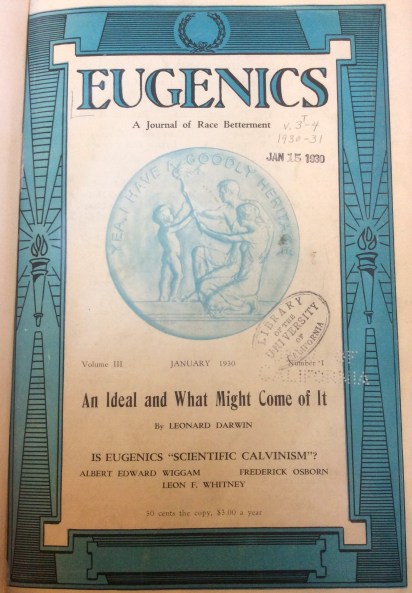
Eugenics journal, photo 2017 by Amy CoolsNow, as a eugenicist, Sanger did make herself an easy target for her accusers despite her decades of work with underserved and marginalized people, first as a nurse in the slums of the Lower East Side of New York City and then as a birth control pioneer. Eugenics, enthusiastically adopted by many who considered themselves scientific, progressive, and enlightened in the first half of the 20th century, is now recognized as pseudoscience, (mis)applying the evolutionary process of (unguided) natural selection to utopian social engineering theories. Eugenicists believed that the ills of humanity could be cured preemptively by breeding them out of existence while breeding in favor of ‘desirable’ traits. Despite the rosy vision of transforming humanity into the most vigorous, hyper-intelligent, and disease free race the world had ever seen, eugenics principles actually produced very ugly results when instituted as social policy. Here in the United States, government programs incarcerated mentally ill, disabled, and socially maladjusted people and forcibly sterilized them. Then the world’s most infamous eugenicists, the Nazis, took those principles to their most extreme logical conclusion, borrowing a page from the United States’ eugenics book in instituting the most horrific, murderous selective-breeding process the world has ever seen, inflicting untold and untellable quantities of human suffering and bloodshed.

Little wonder, then, that eugenics has a very bad name. Though the desire to reduce human suffering caused so many to embrace it, eugenics was based on a fundamental misunderstanding of Darwin’s great theory. Its proponents understood natural selection just well enough to appreciate its power for change but missed the greater point: the wide variety of human traits and capabilities is itself a long-evolved, complexly-balanced, and very very successful web of adaptations developed and attuned over hundreds of thousands of years. Human beings, necessarily self-centered and short-sighted, are very inept judges of trait selection in comparison with Nature itself.

Buck v Bell Virginia Historical Marker Q 28, Courtesy of Historical Collections, Claude Moore Health Sciences Library, University of VirginiaSanger, like many other eugenicists, was inconsistent in her attitudes about who should have children, when, and who should decide. Generally, she advocated for the right to self-determination in reproductive matters, calling for mass education and for cheap, reliable, widely available methods of birth control. In many instances, however, she advocated coercive sterilization for violent criminals and for those who she believed could not make this important decision for themselves, such as the mentally ill and cognitively disabled. She backed away from the latter, though, as the Nazis rose to power and instituted coercive, violent eugenics practices on a grand scale. Sanger was an early, ardent, and very vocal opponent of Nazism, and its policies alerted her to the problems of her short-sighted views on forced sterilization for anyone. As the logical-extreme beliefs of Nazism revealed, eugenics had its limits, and even the most non-coercive, most benign brands of eugenics were discarded by most of its former proponents over time.
But there are two other things Sanger was very consistent about.

One was her dismay at the sheer quantity of human suffering in the world and her desire to reduce it if she could. I find that oft-cited Sanger quotes, particularly from her book Woman and the New Race, refer to her observation that poor immigrants were especially likely to have more children than they could afford, and her claim that they were more likely therefore to produce ‘unfit’ children. ‘Unfit’, as Sanger described them, are those who are malnourished, diseased, undereducated, and in countless other ways ill-equipped to lead happy, flourishing lives. Yet, as is often the case with politically- and ideologically-motivated attacks, Sanger’s words are presented out of the context in which she wrote them, inspired by the plight of the immigrants she had in mind, mostly the Eastern Europeans she worked with in New York City’s Lower East Side. Before her time as a birth control activist, Sanger worked for them as a visiting nurse. As a Socialist activist and as a health care provider, she was driven by her special concern for the working poor that she observed were abused, often taken advantage of, in their desperation, by rapacious employers who offered them meager wages and terrible working conditions in exchange for backbreaking hours of miserable labor. These families were broken down from disease, hard labor, malnutrition, and, for the women, numerous pregnancies that often ended disastrously from these very health-destroying circumstances. One of Sanger’s most infamous quotes from Woman and the New Race, ‘The most merciful thing that the large family does to one of its infant members is to kill it’, so often used to ‘prove’ that Sanger was both racist and genocidal, is understood as a sarcastically-despairing remark when presented within the chapter in which it appears. That chapter describes the horror and suffering that preceded the all-too-frequent deaths of the immigrant poor, especially children and their mothers, and laments society’s lack of concern in preventing all this suffering and death. Even the next sentence alone will do: ‘The same factors which create the terrible infant mortality rate, and which swell the death rate of children between the ages of one and five, operate even more extensively to lower the health rate of the surviving members.’

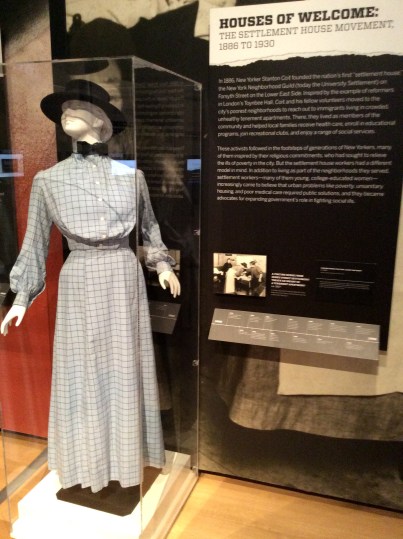
Nurse's uniform, ca. 1905, of Lilian Wald visiting service to the Lower East Side tenements of NYC

Nurse’s uniform, ca. 1905, of Lilian Wald visiting service to the Lower East Side tenements of NYC. Sanger would likely have worn an updated version of this uniform when she worked there in 1911

Second, Sanger believed all human beings should be given the same care and opportunities as everyone else. That’s why she opened her first birth control clinic in the racially diverse Brownsville neighborhood of Brooklyn in 1916, opened clinics to serve black and Latina women in Columbus Hill and Harlem neighborhoods in the late 1920’s and early 1930’s, and expanded her mission to help black communities in the American South in 1939. While there might be more than a shade of paternalism (maternalism?) in these efforts, her own writings, as well as the support of black civil rights leaders, demonstrate that her motives were, at least on the whole, motivated by her concern that justice be done for these underserved people.

As Sanger wrote to her friend Albert Lasker in 1939:

‘You are quite right in assuming that poor white people down South are not much better off than the Negroes, but there has been at least a start in several states to help the poor whites and as there is not sufficient time for a nurse, nor the material left over, for the Negroes, they are just left out of the service in most of the states. That is why I was anxious to have a special fund directed for the Negroes…’

Returning to Woman and the New Race, Sanger gave another reason why she was driven to improve lives in the disadvantaged communities she worked with and advocated for:

‘They would not be here if they did not bear within them the hardihood of pioneers, a courage of no mean order… And they have something else. The cell plasms of these peoples are freighted with the potentialities of the best in the Old World civilization. They come from lands rich in the traditions of courage, of art, music, letters, science, and philosophy… The immigrant brings the possibilities of all these things to our shores, but where is the opportunity to reproduce in the New World the cultures of the old? What opportunities have we given to these peoples to enrich our civilization? We have greeted them as “a lot of ignorant foreigners,” we have shouted at, bustled, and kicked them… What hope is there for racial progress in this human material, treated more carelessly and brutally than the cheapest factory product?’

In other words, America’s immigrants carry greatness in their very genetics, which our factories and farms have too often exploited, quashed, and wasted over the centuries by treating them as little more than wealth-generating fodder before kicking them to the curb or the ditch.

And in her article ‘Love or Babies: Must Negro Mothers Choose?’ Sanger wrote:

‘The Negro race has reached a place in its history when every possible effort should be made to have every Negro child count as a valuable contribution to the future of America. Negro parents, like all parents, must create the next generation from strength, not from weakness; from health, not from despair.’

Civil rights leader W.E.B. Dubois shared this view with Sanger: that if oppressed people were to overcome the social forces arrayed against them, they needed to forge their way from a position of strength: of health, of education, of increased wealth, and birth control was one of the ways to get there. And Sanger and DuBois both believed that they all could get there because they were just as capable of greatness as anyone else, given the same chances.

This doesn’t sound like racism to me.

*Listen to the podcast version here or on Google Play, or subscribe on iTunes

Ordinary Philosophy and its Traveling Philosophy / History of Ideas series is a labor of love and ad-free, supported by patrons and readers like you. Please offer your support today!

~~~~~~~~~~~~~~~~~~~~~~~~~~~~~~~~~~~

Sources and inspiration:

Another Look at Margaret Sanger and Race‘, Feb 23, 2012. From The Margaret Sanger Papers Project at NYU

Birth Control or Race Control? Sanger and the Negro Project‘ The Margaret Sanger Papers Project Newsletter #28 (Fall 2001)

Ferebee, Dorothy Boulding, d. 1980, “Speech by Dorothy Boulding Ferebee, M.D. entitled “Planned Parenthood as a Public Health Measure for the Negro Race,” January 29th, 1942,” Smith Libraries Exhibits

Margaret Sanger and the African American Community‘, compiled by Anna Holley, SisterSong Intern, July 2010, TrustBlackWomen.org

Marlin, George. ‘Margaret Sanger: “Abortion is Dangerous and Vicious”‘ Dec 14, 2011, The Catholic Thing blog

A Negro Number, June 1932 edition of Birth Control Review, by various authors.

Reed, Miriam. ‘Margaret Sanger: Correcting the False Narratives of Racism‘, June 30, 2016. Church and State

Sanger, Margaret, 1879-1966, “Letter from Margaret Sanger to Albert Lasker, November 12, 1939,” Smith Libraries Exhibits, Margaret Sanger Papers, Sophia Smith Collection.

Sanger, Margaret. ‘Love or Babies: Must Negro Mothers Choose?‘ Source: Negro Digest, August 1946, pp.3-8, via The Margaret Sanger Papers Project at NYU

Sanger, Margaret. ‘Population – Everybody’s Business,’ Published Article. Source: Tomorrow, 1944, pp. 16-18, Margaret Sanger Microfilm S72:0480, via The Margaret Sanger Papers Project at NYU

The Truth About Margaret Sanger‘, Blackgenocide.org

The Right to Be Poor, by Peter Adamson

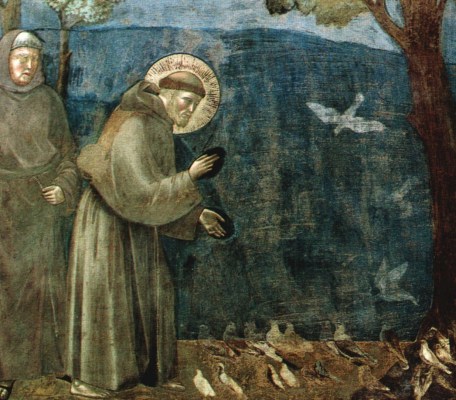
St Francis of Assisi by Giotto

St Francis of Assisi by Giotto

Peter Adamson just published a most fascinating and insightful essay in Philosophy Now about an aspect of the property rights debate that we rarely address: the right to own nothing. It’s an important question, especially in this culture of hyper-consumerism and the conviction that property ownership is essential to personal and political freedom. But as a certain innovative and humble friar realized in the early 13th century, property ownership can also be a burden, alienating us from one another and from the unencumbered pursuit of spiritual perfection. Perhaps Thomas Jefferson, when writing the Declaration of Independence, had a similar insight as St Francis of Assisi and his mendicants when he adapted John Locke’s principle of ‘life, liberty, and property’ as essential human rights as ‘life, liberty, and the pursuit of happiness’.

Adamson writes:

‘One of my favorite things about the history of philosophy is finding out that ideas we now take for granted originally emerged in surprising ways. I can think of no better example than the notion of a right to own property. Not that we can take it for granted that we have such a right, if we consider the history of communism in the Twentieth Century. Still, it seems such an obvious concept that it must surely always have been with us. But you can make a good case that it was first explicitly articulated in the later Middle Ages. And here’s the surprising part: the thinkers who first explored this notion were actually concerned with their right to own nothing.

They were members of the mendicant orders, especially the Franciscans. Following the example of their founder, Francis of Assisi, Franciscans argued that spiritual perfection requires the voluntary embrace of poverty. Like Blanche in A Streetcar Named Desire, they depended on the kindness of strangers, living on charitable donations. Hence the term ‘mendicant’, meaning, ‘given to begging’. Christ and his Apostles, the Franciscans argued, had shown the way by giving up all their possessions. Furthermore, ownership of property is a consequence of the Fall. In a state of innocence there would be no need for possessions, since by generosity of spirit all things would be shared. However, as well as an individual religious commitment, the embrace of poverty amounted to an implicit and sometimes explicit political critique, since the medieval church as an institution most certainly did not embrace poverty. The mendicants’ very existence was a rebuke to the opulence and worldliness of the papal court and the rest of the ecclesiastical hierarchy….’

Read the full article in Philosophy Now

Ordinary Philosophy and its Traveling Philosophy / History of Ideas series is a labor of love and ad-free, supported by patrons and readers like you. Please offer your support today!

Activism is Not Enough: As Long As We Keep Shopping and Don’t Vote, It’s Our Fault Too!

I’m out of town visiting family, and though I’m having a wonderful time, I miss you all and I’m anxious to get some new writing done. In the meantime, here’s a piece I wrote a couple of years ago, I hope you find it of interest!

Amy M Cools's avatarOrdinary Philosophy

I live in the San Francisco Bay Area, a wonderful place to live. It has a rich culture and a thriving music and arts scene and nightlife. It’s surrounded by great natural beauty in all directions: from oak forests to redwood groves, from chaparral to sandy beaches and sea cliffs. It has a fascinating history, plentiful and delicious food, beautiful architecture, and balmy weather. It’s also a liberal ‘bubble’, with an appetite for activism and, for better and for worse, a penchant for righteous outrage.

I admire and identify with the history and the culture of activism. Like the reformers of history and of today, the brave people who fight to create a more just world are among the finest the human race has ever produced. But I’ve been feeling something a bit lacking in activist movements lately. They still march in the streets, and we join them there and online by signing petitions…

View original post 2,290 more words

On Empathy, Sympathy, and Compassion

Here’s a little essay I wrote about two years ago.

Amy M Cools's avatarOrdinary Philosophy

I was listening to an episode of Inquiring Minds podcast the other day, and in it, cognitive scientist Paul Bloom discusses his and others’ research on the earliest manifestations of morality in human babies, a hot topic in psychology and neuroscience these days.

Near the end of the (fascinating) interview, Bloom discusses the difference between compassion and empathy, as he sees it:

‘..I’m writing a book on empathy now, and I’m against it. I’m arguing that empathy’s a poor moral guide. And it’s… it’s like saying you hate kittens, or you’re in favor of Ann Coulter… it just sounds really weird. But I would make a distinction between empathy and compassion, where empathy is putting yourself in someone’s shoes and feeling their pain. And I think empathy can do good in the short term, but it tends to distort things. It’s racist and parochial, it’s a lot easier for me…

View original post 1,660 more words

On Authoritarianism And Civilization, by Neil Roberts

W.E.B. Dubois, Photograph taken by J.E. Purdy in 1904, public domain via Library of Congress

W.E.B. Dubois, Photograph taken by J.E. Purdy in 1904, public domain via Library of Congress

In 1890 the young W.E.B. Du Bois delivered the Harvard University Commencement address “Jefferson Davis as a Representative of Civilization.” Du Bois focused on a central figure of nineteenth-century America as he prophesied the meanings of freedom, democracy, and what American life — or more accurately, civilization — would look like over the next hundred years and beyond for the white world, the black world, and other non-white populations that hitherto occupied spaces outside the epicenters of civil and political society.

Born in Kentucky, Jefferson Davis held the offices of U.S. Representative and Senator for the state of Mississippi and later Secretary of War under President Franklin Pierce. Following Pierce’s failure at the 1856 Democratic National Convention to acquire Presidential re-nomination support from party delegates, Davis ran again, won, and went back to Congress as a Senator. Yet with the 1860 election of Abraham Lincoln and escalating distrust between South and North, Davis resigned his Senate post.

After ensuing Southern secession, Davis assumed the Presidency of the Confederate States of America, maintaining the position until the Civil War’s end. Davis had poor health much of adulthood and detractors internal to the Confederacy. While underestimated by peers and despised by several prominent Confederate politicians and generals, he nevertheless forged an obedient coalition and crafted a resolute model of governance and rule. Although Davis lived until the post-Reconstruction year before Du Bois’s speech, his thoughts and actions as Confederacy President provided core teachable moments.

Du Bois considers Davis a person whose self-conception is that of “a typical Teutonic hero” and whose notion of leadership personifies “the idea of the Strong Man.” By ‘Strong Man,’ Du Bois means a leader espousing “[i]ndividualism coupled with the rule of might.” The Strong Man, suffuse with strength, privileges the “I” and self-assertion over the “Thou.” The Strong Man bolsters civilization through “stalwart manhood and heroic character” on the one hand and “moral obtuseness and refined brutality” on the other. The Strong Man often relies on disgruntled and violent mobs, adherents who are, as Hannah Arendt observes, angry masses that feel excluded from previously accessed corridors of politics, believe their standing is society has evaporated compared to the prior generation, loathe heterogeneous society as is, and cry out for the homogeneous order the Strong Man promises. The Strong Man’s patriarchal idea of civilization is intimately tied to racial orders, and it is his vision of a future world that augurs the consolidation and regeneration of the white race above all other races.

Du Bois contrasts the Strong Man with the ‘Submissive Man,’ characterized by weakness, a commitment to truth, and desire to acquiesce to the Thou, the You, the part of personhood not obsessed with the image of the being reflected back in the mirror. Whereas the American Teuton, of which Davis is exemplary, is indicative of the Strong Man, the Negro is for Du Bois the archetypal Submissive Man Davis dismisses.

Ironically, the Strong Man and Submissive Man need one another, their diametrically opposed views notwithstanding. Otherwise, the polity they inhabit devolves into despotism or slavery, and not merely for those emboldened at any given time with the might and right of state.

Jefferson Davis, “the peculiar champion of a people fighting to be free in order that another people should not be free,” missed the inseparability of the I and the You. He refused to admit the ways we’re interconnected, in relation, despite our pluralistic and differential conceptions of the free life and in spite of attempts by agents of state and their lackeys to interfere, dominate, segregate, deport, and annihilate.

Davis’s Strong Man hubris spawned a vitriolic, angry, white nationalist, revolting mass. It also led to his downfall, the Confederacy’s decline, and American civilization as he conceived it, in large measure due not only to abolitionists but also the actions of fugitives and slave agents catalyzing its genesis. It didn’t, however, obliterate the wages of whiteness and political philosophy of white supremacy in the post-1865 polity. Du Bois documents this in The Philadelphia Negro, The Souls of Black Folk, “The Souls of White Folk,” and, most notably, Black Reconstruction in America, as do scholars such as C.L.R. James, Frantz Fanon, Annette Gordon-Reed, and Nell Painter. This last point haunts us today.

Authority and authoritarianism undergird Du Bois’s prognostications. An agent with “authority” demands dogged obedience, compliance, and dispelling of ressentiment urges by the subjects of sovereign command. “Authoritarianism” is the structural macropolitical systemization of a type of statecraft designed by what Theodor Adorno and collaborators call an authoritarian personality. It is a hierarchical social, political, and economic order militating against egalitarianism. Moreover, as Arendt notes in “What Is Authority?” we shouldn’t confuse authoritarianism with tyranny, for “the tyrant rules in accordance with his own will and interest, whereas even the most draconian authoritarian government is bound by laws.”

Du Bois wrestles with Jefferson Davis’s legacy because Davis oversaw a confederation based on slavery and apparatuses of unfreedom enshrined in jurisprudence. Du Bois cautions against ambivalence, nihilism, and avoidance of the afterlife of chattel slavery, first since modes of enslavement sanctioned by law mutated and have been upheld at different junctures by authoritarian personalities, though not always in the public sphere by the prime executive. An amplification of these chilling effects occurs when the entity wielding authority — whose public beliefs defend racism, sexism, xenophobia, chauvinism, and rabid masculinity — is Commander-in-Chief. Second, struggle, resistance, and abolitionist challenges to authority and authoritarianism are as much a tradition as the tradition their actions seek to dislodge. Never forget that.

Our current moment is unprecedented. Yet past lessons offer signposts for future judgments and decision-making. President-elect Donald Trump entered campaign 2016 a noted businessman, consummate reality TV performer, and political chameleon. In the process of winning the Republican primary and shockingly defeating Hillary Clinton, Trump clarified certain issues and left many policy positions open-ended.

What’s incontrovertible is Trump’s authoritarian personality. Only time will tell what type of authoritarian President Trump will be, Jefferson Davis reincarnated or otherwise. And if his senior administrative appointments are any indication, particularly the ghastly selection of avowed white nationalist Stephen Bannon as top White House advisor, then we’d be foolish to assume Trump’s stated public beliefs and campaign promises are one big bluff. Parrhesia is hard to digest.

We have a choice in the Age of Trump: ignore history and our intrinsic abilities for action, thereby reifying the authoritarian order Trump very much plans to implement. *Or* protest. Petition. Resist authoritarianism and its mob enforcers. Organize. Unlock our political imaginations. Believe firmly our actions can match our convictions.

‘American Democracy’ is an unrealized and perhaps unrealizable Platonic ideal, but democracy in America, in the hemisphere, and in the globe, measured by nodes of progress, are attainable. Progress, as with regress, comes in stages. And like freedom, the theory of relativity, and quantum mechanics, the meaning of progress and attendant strivings for it begin with acknowledging a foundational phenomenon: perpetual flight.

Flight operates betwixt, between, and beyond the options of Strong Man and Submissive Man. “Human” progress, a consequence of ongoing marronage, beckons us.

This piece was published in the African American Intellectual Historical Society Blog on December 4th, 2016

~ Neil Roberts is an associate professor of Africana Studies and a faculty affiliate in Political Science at Williams College. He is author of the award-winning Freedom as Marronage (University of Chicago Press, 2015) and the collaborative work Journeys in Caribbean Thought (Rowman & Littlefield International, 2016). Roberts is presently completing A Political Companion to Frederick Douglass for The University Press of Kentucky, and he is President-Elect of the Caribbean Philosophical Association. Follow him on Twitter @neildsroberts. (Bio Credit: AAIHS Blog)

Ordinary Philosophy and its Traveling Philosophy / History of Ideas series is a labor of love and ad-free, supported by patrons and readers like you. Please offer your support today!

Should We Act on our Beliefs? The Vexing Nature of Responsibility, by Rik Peels

Brain illustration from The Principles and Practice of Medicine...' by W Osler, 1904, public domain via Wikimedia Commons

Brain illustration from The Principles and Practice of Medicine…’ by W Osler, 1904, public domain via Wikimedia Commons

Some people think that voting for Donald Trump was a detestable thing to do, whereas others are convinced that we had an obligation to vote for him in order to get rid of the political elite. Of course, in explaining why they voted the way they did, people will appeal to their beliefs. Some of those will be factive: beliefs about such things as whether someone paid his taxes or whether someone gave full disclosure of certain emails. Other beliefs will be normative: beliefs about such things as whether America should pursue international political leadership or about whether it is permissible to use water-boarding techniques to extract information from prisoners.

People act on their beliefs. Obviously, that, as such, does not get them off the hook for the ensuing actions. Those who voted for Clinton believe that adherents of Trump should know better and vice versa—when it comes to the facts, when it comes to certain moral norms, or, more likely, both. Or, to give a few examples on which most Westerners agree: we believe that ISIS fighters also act on their beliefs, but that they should know better, and we believe that climate skeptics act on their beliefs, but that they should know better. If people were not responsible for their beliefs, it would seem improper to blame them for the actions they perform on the basis of those beliefs.

However, the idea of responsibility for our beliefs faces two big challenges. First, how can we be responsible for our beliefs at all? I am responsible for whether I treat my neighbor kindly or rudely, because I can choose or decide to treat her kindly or rudely. But I do not choose or decide to hold a belief. Nobody ever wakes up in the morning and thinks: “Today, let me form this or that belief.” Beliefs are things that are not under the control of our will. How, then, are we responsible for them? This is a controversial issue in contemporary analytic philosophy. One way to think of it is this: we are responsible for our beliefs, because they are the consequences of things over which we do have control, such as whether we gather more evidence, whether we are humble and pay attention to our prejudices and biases, and whether we try to become more open-minded.

Second, assuming that the first challenge can be met and that we are indeed responsible for our beliefs, we still face a deep puzzle about responsibility. As I said, people normally act in accordance with their beliefs. And that, it seems, is the right thing to do. One should not act contrary to what one believes to be the facts or contrary to what one believes one ought to do. Philosophers have even come up with a name for situations in which one succumbs and acts against one’s better judgment. Ever since Aristotle, they call it akrasia. One is akratic, for instance, if one believes that eating an entire bag of chips is bad, but one still does it. We don’t want people to be akratic. Rather, they should act in accordance with their beliefs.

Now, here’s the problem. If we are to hold people responsible for their beliefs, then, given that belief is not under the control of the will, it must issue from an earlier culpable act: one neglected evidence, one failed to enter into conversation with certain people, one was not open-minded, or some such thing. But, presumably, at that earlier time, one believed it was alright to neglect that evidence, fail to enter into conversation, or not be open-minded on that occasion. Thus, how can we ever hold people responsible for their beliefs and the actions performed on the basis of those beliefs? We are unwilling to give up holding people accountable for their beliefs. But it seems we are equally unwilling to give up the principle that people should not act contrary to their beliefs.

I am not entirely sure how this challenge can be met. But here are at least a few things we ought to note that can help in solving the problem.

First, it seems that if people act on their beliefs and there was no way they could have changed those beliefs – for instance, because they have been thoroughly indoctrinated or they suffer from a psychosis – we cannot blame them for holding those beliefs and for the actions based on those beliefs. Maybe we should take protective measures and perhaps even incarcerate them, but they are not morally responsible for what they believe or what they do.

Second, intellectual virtues or, as philosopher Linda Zagzebski calls them, ‘virtues of the mind’, steadily grow over long periods of time: open-mindedness, curiosity, thoroughness. And so do intellectual vices, such as dogmatism, conformity, and sloppiness. They gradually arise out of choices we make on particular occasions, such as whether we listen to someone and try to understand what things would look like from their point of view. These intellectual virtues and vices heavily influence our beliefs and, consequently, our actions. Thus, the more evidence we have that someone has had enough opportunity to develop these virtues, the more we can hold them responsible for their beliefs.

Third, the flat-out principle that we should act on our beliefs might be too simplistic: it may need substantial qualification by taking into account serious doubts that one might have, whether or not one’s belief matches one’s emotions and desires, and whether or not there is substantial disagreement with others about the belief in question. This, as such, will not solve the problem, but such qualifications seem needed to do full justice to our intuitions about the plausibility of the akrasia principle.

The responsibility we bear for our beliefs is crucial for individual well-being and the flourishing of our societies. And yet, like so many things that are crucial in our lives, it is vexing and raises deep philosophical questions. We will need joint work by ethicists, epistemologists, psychologists, and sociologists to find satisfactory answers.

~ Originally published at OUP Blog: Oxford University Press’s Academic Insights for the Thinking World, on November 19th, 2016

~ Rik Peels is Assistant Professor in Ethics and Epistemology at Vrije Universiteit Amsterdam, the Netherlands. He is the author of Responsible Belief: A Theory in Ethics and Epistemology (OUP, 2016), editor of Perspectives on Ignorance from Moral and Social Philosophy (Routledge, 2016), and co-editor of The Epistemic Dimensions of Ignorance (CUP, 2016). You can read more on his personal website www.rikpeels.nl. (Bio credit: OUP Blog)

Ordinary Philosophy and its Traveling Philosophy / History of Ideas series is a labor of love and ad-free, supported by patrons and readers like you. Please offer your support today!

Margaret Sanger NYC Sites, Day 1 Part 1, and a 100 Year Anniversary

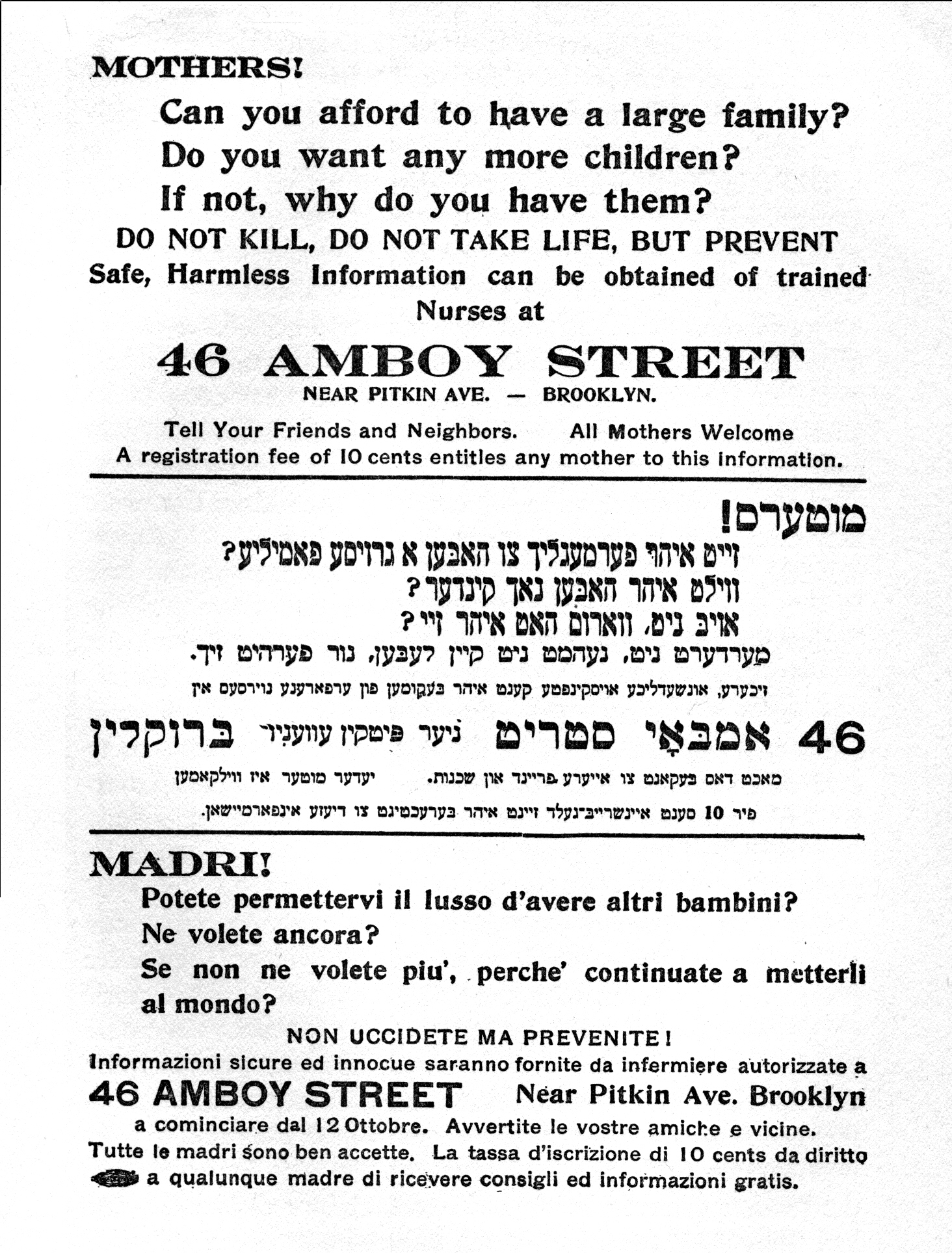
Flyer for Sanger Clinic, Brownsville, Brooklyn, image courtesy of the Margaret Sanger Papers Project

Flyer for Sanger Clinic, Brownsville, Brooklyn, image courtesy of the Margaret Sanger Papers Project

Tuesday, October 18th, 2016

I start the morning preparing my itinerary for the day as I fortify myself with coffee and the first half of a sandwich.

My first stop is also the furthest east I’ll go this trip, to the Brownsville neighborhood of Brooklyn. I take the C train to the Rockaway station, head south on Saratoga, and wander around getting a feel for the neighborhood. It’s predominantly black, solidly working class, with lots of handsome old buildings, mostly well worn with peeling paint. I see lots of mothers and grandparents with strollers and very small children (it’s around noon during work hours), people taking smoke breaks in backdoors, and some very poor and homeless people. Reaching Pitkin’s busy sidewalk, I see shoppers, people going out for lunch, and shop and cafe proprietors in front doorways under brightly colored signs, and I hear many accents and many languages spoken, English, Spanish and French, and many others I don’t recognize. It reminds me of neighborhoods I frequent at home in Oakland. I turn north on Amboy Street, which runs north and south between Pitkin and E. New York Ave.

At 46 Amboy Street, just north of Pitkin, Margaret Sanger opened the United States’ first birth control clinic two days less than 100 years ago today, on Oct 16th, 1916. Though just a  little late for the anniversary, I’m happy to be here at this historic place, humble as it now appears. The clinic was in the tall red brick building to the right of the tan one with the ‘diamond’ pattern on the upper center front of the façade. You’ll find a photo below that shows the clinic as it originally appeared, and here as well.

46 Amboy St, site of Sanger's first birth control clinic

Sanger’s first birth control clinic, given address 46 Amboy St. One thing’s more or less the same: the little pale brick building with the crenelated top still stands next to where the clinic was, as you can see two photos down. The narrower red brick building against and to the left of the larger one, with a sign now identifying it as 42 Amboy, stands on the former clinic site.

46 Amboy St, site of Sanger's first birth control clinic

Another view, angled more like the view in the photo below. The two red brick buildings appear not to be original unless they’ve been changed so much as to be unrecognizable. As you can see from the photo below, there was space between the original clinic building and the tan one, but not so for the current structure. The clapboard building beyond may be original.

Photograph shows women and men sitting with baby carriages in front of the Sanger Clinic, LOC

Women and children sitting with baby carriages in front of the Sanger Clinic, with the white curtains in the windows. Photo courtesy of the Library of Congress

Before opening this clinic, Sanger had trained and worked as a nurse for many years among the poorest and most oppressed Americans, the immigrant and minority working class and poor. Originally a Socialist radical, Sanger came to realize that Marxists, philanthropists, and charity workers alike were making the same essential mistake. Since they failed to identify the root cause of human misery in the slums, the crowded tenements, and the factory floors, all of their well-intended efforts to help were failing and sure to continue to fail. Sanger came to feel this way about her own nursing, which addressed the effects and not the cause, so she turned her efforts to where she believed she could do the most good: birth control activism.

Margaret Sanger as a nursing student around 1900, by Boyce Photographer, White Plains, courtesy of the Sophia Smith Collection, Smith College

Margaret Sanger as a nursing student around 1900, by Boyce Photographer, White Plains, courtesy of the Sophia Smith Collection, Smith College

As a nurse, Sanger cared for poor women broken down in health and mind by laboring all night and caring for children all day, often pregnant all the while, often miscarrying, and the infant mortality rates were very high. So were death rates for the mothers, be it from childbirth, diseases secondary to exhaustion and malnutrition, and worst of all, from self-inflicted abortions. The mothers who resorted to the latter were desperate: they had often already watched other children die, or suffer every day from hunger, or forced into the factories or other labor at a very young age in the struggle to survive.

Though there were plenty of organizations trying to help these families, governmental and charitable, they could not keep up since the need was so great and increasing every day. Industrialization, Sanger recognized, encouraged rapid population growth by the ever-increasing demand for more labor and more future customers. And the workers responded to the social pressure by producing more children in hopes that their offspring could help the family by going out to work. But those hopes were often in vain since the population growth always kept up with or surpassed the need for laborers, constantly driving down wages. And so the cycle continued: immiseration through near-starvation wages, families barely keeping up with the cost of feeding themselves if at all, and children deprived of an education and of health as factory and other hard work often left children stunted, with malformed and weak bones and muscles, and often injured by machinery and chemicals.

Sanger thought: instead of trying vainly to keep up with the spiraling misery caused by this cycle, why not get at the root of it? After all, as the old saying goes, an ounce of prevention is worth a pound of cure. If women were empowered to decide whether to have children, and only as many as their health and financial circumstances would allow, all this misery could be prevented in the first place since parents could adequately care for the children they did have, mother’s bodies would no longer be broken down by constant pregnancy, infants and mothers would more likely survive childbirth, overcrowding and its accompanying epidemics would be mitigated or even disappear, and a reduced labor force would force employers to compete for workers, driving wages up. And as we’ve seen over the decades, high population growth is strongly correlated with endemic poverty, high infant and mother mortality rates, women’s rights abuses, and high income inequality.

But people will never stop having sex, as Sanger pointed out. Sex is just too powerful a force in human nature. Our need for love, for affection, for physical pleasure and release, are too powerful to be squelched, and in fact, shouldn’t be. Love and the need for physical connection are positive things, indeed, two of the best things in human nature. Birth control, thought Sanger, was the answer.

I’ll be exploring Sanger’s ideas on these and other topics in more detail in upcoming essays, stay tuned. In the meantime, the Margaret Sanger Papers Project has a wealth of articles and original works by Sanger available online, and I’ve relied on them more than on any other single resource for my own project. (See below for the links). Thank you so much to the good people at the MSPP, I very much appreciate what you do!

Photobombed in Brownsville, Brooklyn, NY

Photobombed in Brownsville, Brooklyn, NY

Street with handsome row houses on Bergen Street, Brownsville, Brooklyn, NYC

Tree lined street with attractive row houses on Bergen Street, Brownsville, Brooklyn, NYC

Brownsville neighborhood of Brooklyn, NY, near the Rockaway station, 2016 Amy Cools

Street scene at the Rockaway station entrance near the northern edge of the Brownsville neighborhood in Brooklyn, NY

Hipster Gourmet Deli in Brownsville, Brooklyn, Amy Cools 2016.

Hipster Gourmet Deli in Brownsville, Brooklyn. I took this photo on the way to Amboy St, after my laughter subsided enough to take a picture.

I head back to the station, on the way stopping to photograph some scenes in the neighborhood, including an especially pretty row of houses on Bergen Street as a young man photobombs my pic with a laugh and a smile. On the train back, I eat the now rather smashed second half of my egg salad sandwich and write my notes. I transfer a couple of times and head north to Grand Central Station…. To be continued

Ordinary Philosophy and its Traveling Philosophy / History of Ideas series is a labor of love and ad-free, supported by patrons and readers like you. Please offer your support today!

~~~~~~~~~~~~~~~~~~~~~~~~~~~~

Sources and Inspiration:

Alter, Charlotte. ‘How Planned Parenthood Changed Everything‘. Time.com, Oct. 14, 2016

Chesler, Ellen. ‘Was Planned Parenthood’s Founder Racist?Salon.com, Wed, Nov 2, 2011

Child Labor in U.S. History‘. From the Child Labor Public Education Project by the University of Iowa Labor Center

Demographics and Poverty‘, Center for Global Development.

Jacobs, Emma. ‘Margaret Sanger Clinic (former): the First Birth Control Clinic in the United States‘. From Places That Matter

Margaret Sanger Papers Project by New York University.

Regan, Margaret. ‘Margaret Sanger: Tucson’s Irish Rebel.Tucson Weekly, Mar 11, 2004.

Sanger, Margaret. The Pivot of Civilization, 1922. Free online version courtesy of Project Gutenberg, 2008, 2013.

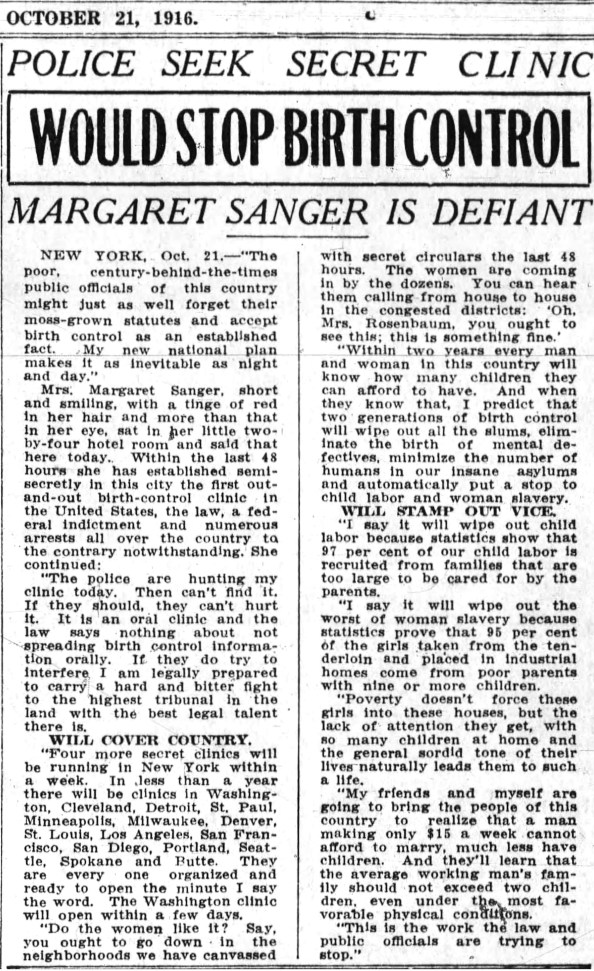
Sanger, Margaret. Woman and the New Race, 1920. Free online version courtesy of W. W. Norton & CompanyOakland Tribune Article about Margaret Sanger's NY clinic, Oct 21, 1916 evening edition

O.P. Recommends: ‘Capitalism’s Crisis of Care’ – Sarah Leonard interviews Nancy Fraser for Dissent Magazine

068e8-father2band2bchild2bby2bandre25c425ad2bosipovich2bkarelin252c2b18372b-2b1906252c2bpublic2bdomain2bvia2bwikimedia2bcommons

Capitalism’s Crisis of Care is a discussion between Sarah Leonard of Dissent magazine and critical theorist and feminist Nancy Fraser, which focuses on Fraser’s concept of today’s ‘crisis of care’, which, as she explains, is a product of capitalism. In capitalist societies, ‘social reproduction’, the social and family bonds necessary for raising families and caring for the elderly, have ‘no monetized value. They are taken for granted, treated as free and infinitely available “gifts,” which require no attention or replenishment’ and which, like nature itself, is ‘an infinite reservoir from which we can take as much as we want and into which we can dump any amount of waste.’ Capitalism, unjustifiably and artificially, splits ‘economic production off from social reproduction, treating them as two separate things, located in two distinct institutions and coordinated in two different ways.’ This leaves us with this crisis of care, in which working people are stretched to the breaking point, trying to make a living while trying to maintain the level of care and attention that children, the elderly, and social bonds in general need as much as ever.

Fraser outlines the history of the development of this crisis of care, ‘trac[ing] a historical path from the so-called liberal capitalism of the nineteenth century to the state-managed regime of the mid-twentieth and on to the financialized capitalism of the present day. In a nutshell: liberal capitalism privatized social reproduction; state-managed capitalism partially socialized it; financialized capitalism is increasingly commodifying it.’

If we are to resolve many of the most pressing social problems we face today, from funding health care to adequately providing for the elderly, ill, and disabled to giving working families sufficient time and resources to raise the very families society depends on, we need to start by examining our assumptions and habits with the same care and rigor Fraser reveals in her analysis.

Here’s another excerpt from this absorbing and enlightening interview:

Leonard: Many of the questions that you raise about social life and the family have come to seem utopian again, like some remnant of the 1960s, and not necessarily central to a socialist program. And yet, you argue that we’re actually at a crisis point—these issues must be central. The challenge of social reproduction is so fundamental to everyone’s lived day-to-day experience that it’s been surprising to me that it’s often absent in the current revival of socialism.

Fraser: I agree very strongly with that. Given the acuteness of this crisis of social reproduction, it would be utopian, in the bad sense, for the left not to be focusing on this. The idea that we could somehow bring back manufacturing, that’s what’s utopian—again, in the bad sense. Unlike the idea that you could build a society that assumes every adult is a person with primary care responsibilities, community engagements, and social commitments. That’s not utopian. It’s a vision based on what human life is really like.’… Read more

~ Ordinary Philosophy and its Traveling Philosophy / History of Ideas series is a labor of love and ad-free, entirely supported by patrons and readers like you. Please offer your support today!