O.P. Recommends The Stronger Sex: Women Scholars and Islam, by Peter Adamson

Bint al Shati, image credit AchetronI just listened to a podcast episode I had missed a year and a half or so ago, from my go-to podcast for discovering the gaps in my knowledge (of which there are so many! sigh) about Ancient Greek, Islamic, Medieval, and Indian philosophy from Peter Adamson’s History of Philosophy Without Any Gaps. As you may remember, I had the privilege of having a conversation with him not that long ago for Ordinary Philosophy’s podcast.

The podcast episode I just listened to that I’m recommending today is called The Stronger Sex: Women Scholars and Islam (#192). In it, ‘Fatema Mernissi and others challenge the long-standing (but not complete) exclusion of women from the intellectual traditions of Islam.’ It was altogether fascinating, and much of what I heard surprised me. It made me very curious to learn more about women in Islamic philosophy.

Enjoy!

Ordinary Philosophy and its Traveling Philosophy / History of Ideas series is a labor of love and ad-free, entirely supported by patrons and readers like you. Please offer your support today!

O.P. Recommends: Philosopher, an Inclusive Forum for Thought

Meena Krishnamurthy, image credit Meena KrishnamurthyI just discovered this wonderful blog called Philosopher, dedicated to women philosophers (‘philosop-hers’) and which ‘for the next six months will feature posts by philosophers of color. After this time, the blog will feature work by philosophers from underrepresented groups in philosophy, more generally.’

I have been inspired, edified, and intrigued by what I’ve read here thus far, and I trust you will be too. Thanks, Meena Krishnamurthy, for creating such an excellent forum!

You can learn more about Ms. Krishnamurthy, Assistant Professor of Philosophy at the University of Michigan, at her personal website, https://meenakrishnamurthy.net/

Ordinary Philosophy and its Traveling Philosophy / History of Ideas series is a labor of love and is ad-free, supported by patrons and readers like you. Please offer your support today!

O.P. Recommends: Two New Articles on Philosophy’s Value in Daily Life

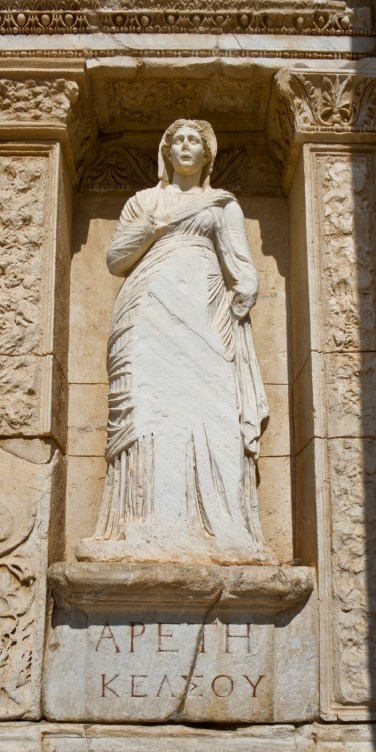
Statue of Arete in Celsus' Library in Ephesus by Carlos Delgado, Creative Commons Licence CC BY-SA 3.0

Statue of Arete, ‘Wisdom‘ or ‘Excellence

Yesterday, NPR’s 13.7 Cosmos & Culture blog published a piece by University of Rochester astrophysics professor Adam Frank. ‘The Greatest Philosopher You’ve Never Heard Of‘ is about Eihei Dogen, a ’13th century Japanese Zen teacher who is considered by many to be one of the world’s most profoundly subtle and creative thinkers’. Dogen thought a lot about what it means to experience the world as an aware, thinking, acting self. And he communicated his thought in language both obscure and poetic, which is perhaps the only ways we can express something so ineffable as what it’s really like to be you or me. I was delighted to be introduced to this fascinating thinker. Thanks, Mr. Frank!

Then there’s an article published in the Chicago Business Journal this morning by Peter DeMarco and Chris Morrissey. In ‘The Sword of Damocles: The Value of Philosophy to a Business Leader‘, DeMarco advises undergraduates to opt for more classes in philosophy instead of business. That way, subsequent education in business or indeed, any other subject, is built on the bedrock of training and experience in moral and intellectual thought necessary for success and fulfillment in any endeavor. Morrissey goes on to provide examples of lessons in moral reasoning from the writings of great thinkers from ancient Greece.

Ordinary Philosophy and its Traveling Philosophy / History of Ideas series is a labor of love and ad-free, entirely supported by patrons and readers like you. Please offer your support today!

~~~~~~~~~~~~~~~~~~~~~~~~~~~~~

Sources and Inspiration:

DeMarco, Peter and Chris Morrissey. ‘The Sword of Damocles: The Value of Philosophy to a Business Leader‘. Chicago Business Journal, Jun 1 2016.

Frank, Adam. ‘The Greatest Philosopher You’ve Never Heard Of‘. NPR’s 13.7 Cosmos & Culture blog, May 31, 2016.

Behind the Veil: Rawls, Locke, de Tocqueville, and Human Connection in a Liberal Society

People in a Public Square, cropped, Image Creative Commons CCO Public Domain via PixabayI’ve been listening to this excellent series from a favorite podcast of mine, the Philosopher’s Zone on Australia’s RN (Radio National), hosted by Joe Gelonesi. There’s this recent series called Political Philosophy in the World, hosted by guest host Scott Stephens, which considers and critiques seven important topics in political philosophy. I just listened to the last one, Political Philosophy in the World: Liberalism and the End of the World as We Know It.

In it, interviewee Patrick Deneen offers a series of critiques of liberalism, his own and others’ over its roughly five century history. (We’re speaking here not of liberalism as commonly understood in the U.S., as political positions on the left of the spectrum, but of classical liberalism, a political philosophy which focuses on liberty and the primacy of the individual.) From the beginning, liberal philosophers and their critics have identified and described possible contradictions in the system itself, and ways in which it may end up being self-defeating in the real world. For example, John Locke, a founding father of liberalism, recognizes that it would require a strong state to protect the autonomy of the individual from competitors and from the ‘querulous and contentious’, and that individual autonomy in a marketplace, unfettered by other constraints, will lead to conditions that foster inequality, discontent, and revolution (at about 4:40 and 14:40, then 10:30). Alexis de Tocqueville observes that though individuals enjoy this autonomy at the beginning, they are left weakened and alone by the erosion of those institutions that create bonds of loyalty and affection in a society, such as family, tradition, and belief (at about 15:00). Deneen, in sum, describes these and various other ways in which liberalism can fail to achieve its end of liberating the individual to achieve their potential to the fullest possible extent.

The discussion in its entirety is absolutely fascinating, but my attention is caught particularly by Deneen’s observation of a problem with the great liberal political philosopher John Rawls’ famed ‘veil of ignorance’ thought experiment (starting at about 19:00). Rawls’ veil of ignorance is a beautifully elegant method of envisioning and crafting a just society. Imagine you’re looking at a society from the outside knowing you’ll be placed in it with no idea what you’ll be: rich, poor, or middle-class; tall or short; intelligent or not; of which gender; outgoing or shy; of which race; employed or not and at what kind of job; and so on. Given this hypothetical situation, what cultural practices, laws, policies, governmental system, economic system, and so on, would you put into place? Behind that veil of ignorance, you’d be motivated to to design a society that’s just and fair, that benefits everyone to the greatest degree possible, since of course, you could be the one who suffers the ill effects of any injustice built into the system.

8694d-justice2bet2binc3a9galitc3a92b-2bles2bplateaux2bde2bla2bbalance2bby2bfrachet2c2bjan2b20102c2bpublic2bdomain2bvia2bwikimedia2bcommonsAs Deneen points out, Rawls, like other liberal political philosophers, recognizes that people in a liberal society may, over time, act not out of true freedom, but as slaves of their individual desires and passions. Since liberalism promotes the idea that society is and should be made of up autonomous individuals freely pursuing their own ends, the values of individuals in that society may become self-serving to the point of destructiveness. This destruction can be of social institutions that provide support and meaning, such as family, tradition, and belief, of liberalism’s own key institutions such as the free markets of goods and ideas, and as we now recognize, of the very environment from which all of this is derived. Rawls posits the veil of ignorance as a way to free ourselves from this trap, by transforming ourselves, in thought, into benevolent, self-effacing avatars of justice. But, Deneen points out, Rawls never really provides an explanation of why we we’d all want to go behind the veil of ignorance in the first place. After all, Rawls’ entire theory of justice-as-fairness as described in his magnum opus A Theory of Justice, which the view from behind the veil reveals to us, depends on the participation of everyone. If even one person remains aloof, that person’s interests and motivations aren’t considered or checked by those of others, which, in turn, is not fair.

From within the thought experiment, the motivation to go behind the veil makes sense: since liberalism is meant to promote the liberty and well-being of all individuals, it makes sense to envision and design a society where some individuals are not allowed to enjoy advantages that limit or even destroy the liberty and well-being of others. But this still doesn’t account for why we’d all want to go behind the veil in the first place. In a liberal society in the real world, only those suffering its ill effects will be motivated to do so, since those who have found relative success within its parameters will be ever more motivated to keep the pursuit of their own interests free from the demands and constraints of others until it serves them otherwise.

With the disconnection from other people which liberalism can tend to foster in mind, as described by de Toqueville and Rawls, I picture a whole society of people behind Rawls’ veil of ignorance. Then something in this picture strikes me: behind this veil, all the people are looking in the same direction, encircled around the society they must share. They are united, not separated by competing interests nor from the bonds of family, tradition, and belief. They are cooperating as equals, with a shared goal and a shared ethic: the liberty to achieve the fullest degree of perfection that an individual is capable of, with others’ interests as much in mind as their own so far as possible. These interests can and invariably do include family, tradition, and belief. Those with a narrow view of liberalism often speak only of individual interests as involving the individual pursuit for food and shelter, money, comfort, wealth, and prestige, and dismiss family, tradition, and belief as impediments to human liberty. But of course, this is not necessarily so, as we observe their lasting power and meaningfulness in the real world throughout history and to this day, even where liberalism as an institution is most robust. Material comfort and prestige are not and have never been the only and or even, for many, the primary motivators of thought and action in any society.

Behind the veil, then, is that deep need for human connection fulfilled in the context of an idealized liberalism, that the institution of liberalism in the real world can undermine if uncorrected by the state or by an ethic such as Rawls’ justice-as-fairness. Does Rawls have this picture of a united humanity in mind as he devises his thought experiment, though he doesn’t describe it per se? Perhaps Rawls does recognize this motivation for going behind the veil: our realization that while the pursuit of our own individual interests can be fulfilling, it can also undermine our potential of fulfilling our deepest humanity, not only tied to the destinies of others but with a deep emotional need for deep and lasting connections with one another. Behind the veil of ignorance, we are thus united, connected, bonded, sharing a vision, in a state of equal humanity, of a good and just world for all of us.

*Listen to the podcast version here or subscribe on iTunes

~ Also published at Darrow, a forum for culture and ideas

Ordinary Philosophy and its Traveling Philosophy / History of Ideas series is a labor of love and ad-free, entirely supported by patrons and readers like you. Please offer your support today!

~~~~~~~~~~~~~~~~~~~~~~~~~~~~~~

Sources and Inspiration:

Alexis de Tocqueville‘, in Encyclopædia Britannica Online.

Gaus, Gerald, Courtland, Shane D. and Schmidtz, David, ‘Liberalism‘, in The Stanford Encyclopedia of Philosophy

Political Philosophy in the World: Liberalism and the End of the World as We Know It.’ from The Philosopher’s Zone Podcast, Sun May 15 2016, Radio National, Australia. Host: Joe Gelonesi

Rawls, John. A Theory of Justice. Cambridge: Harvard University Press, 1971.

Uzgalis, William, “John Locke“, in The Stanford Encyclopedia of Philosophy

O.P. Recommends: How Paper Shaped Civilization

De briefschrijfsterIn his Atlantic review of Mark Kurlansky’s new book Paper: Paging Through History, Reid Mitenbuler gives us a brief overview of the history and impact of paper ,and how modern technology is once again radically shifting the way we communicate:

‘…Beyond tweeting, how would Plato have responded to modern changes in the way humans communicate? During his own time, people increasingly recorded their thoughts and experiences in writing, and he worried that written language reduced our reliance on memory. The tool made us less human, even mechanical, he argued, because once something was jotted down, it no longer came from within a person. It was less authentic, and therefore less true.

Then again, Plato expressed this concern in Phaedrus, his dialogue that most famously grapples with the issue, by writing it down.

Plato’s complicated relationship with writing—or really, with the seismic shifts of technological change—forms the heart of an impressive new book, Paper: Paging Through History. Mark Kurlansky …picks up a seemingly mundane commodity to examine a wider phenomenon: historical attitudes toward disruptive technologies. His question: how do humans absorb and disseminate information? His answer helps reveal the evolution, both politically and economically, of how the world has come to be organized….’ Read more: 

Ordinary Philosophy and its Traveling Philosophy / History of Ideas series is a labor of love and ad-free, supported by patrons and readers like you. Please offer your support today!

O.P. Recommends: Your Brain on the Scientific Method

Old Medicine Bottles, PublicDomain via Wikimedia CommonsIn ‘Your Brain on the Scientific Method‘, Sara E. and Jack M. Gorman open with a discussion of John Oliver’s recent takedown of scientific sensationalism in the media and its negative impact on the public’s understanding of science and its methods. Just about every day, it seems, there’s a study that comes out which reveals that things science said were bad are actually good for you and vice versa; that some foodstuff, familiar or exotic, was just discovered to be the ‘miracle cure’ for something or other;  some new report or yet another scientist will come out either proving or disproving human-caused climate change; and so on.

But there’s a lot more to the story of public misunderstanding of science, the authors say: the reason we often have trouble understanding science and its methods is the same reason why scientific sensationalism is so effective: science is so contrary to the way our brains generally, instinctively work. Find out why in this excellent piece…

Gorman, Sara E. and Jack M. ‘Your Brain on the Scientific Method‘. Oxford University Press blog, May 17th 2016.

Scientific Studies‘. Last Week Tonight with John Oliver, HBO, May 8th 2016.

~ Ordinary Philosophy and its Traveling Philosophy / History of Ideas series is a labor of love and ad-free, entirely supported by patrons and readers like you. Please offer your support today!

OP Recommends: A Piece About How All Rivers Lead to Philosophy on Wikipedia

River, by Brandom Lam, Creative Commons via Pixabay

In ‘All Wikipedia Roads Lead to Philosophy, but Some of Them Go Through Southeast Europe First‘, Nathan Collins writes about a University of Vermont study on how knowledge is structured on Wikipedia, following the observation by webcomic xkcd that following hyperlinks in this giant e-encyclopedia seem to lead almost inevitably to the Philosophy page.

Makes sense to me. The ‘major organizing principle’ for the world’s largest online forum for sharing knowledge turns out to be philosophy, literally the ‘love of wisdom’?

Surprise surprise!

An enjoyable read.

Ordinary Philosophy and its Traveling Philosophy / History of Ideas series is a labor of love and is ad-free, entirely supported by patrons and readers like you. Please offer your support today!

~~~~~~~~~~~~~~~~~~~~~~~~~~~~~~~~~~~~

Sources and inspiration:

Collins, Nathan. ‘All Wikipedia Roads Lead to Philosophy, but Some of Them Go Through Southeast Europe First‘, Pacific Standard, May 2016.

xkcd: A webcomic of romance, sarcasm, math, and language


O.P. Recommends: If Philosophy Won’t Diversify… A Critique of Philosophy’s Lack of Diversity

School of Athens by Raphael [Public domain], via Wikimedia Commons (cropped)

‘Old dead white guys’ – yes, we should study their great contributions to human thought, but what about the rest of the world’s great thinkers?

In this New York Times op-ed for the Stone (NYT’s philosophy forum), Jay L. Garfield and Bryan W. Van Norden critique philosophy’s lack of diversity, and point out the serious problems with calling an academic philosophy department simply a ‘Philosophy’ department while focusing almost exclusively on European and American philosophy.

Their point? If academic philosophy departments want to imply that their students will receive a thorough education in philosophy department by using the broad term ‘philosophy’, then the education they offer should likewise be broad. If not, then they need to be up front and call it what it is: ‘European and American Philosophy’ (…’with a smattering of Islamic Philosophy’: in my undergraduate philosophy courses, Eurocentric as they were, we inevitably received some, if severely limited, instruction in Islamic philosophy, given its strong influence on medieval European thought).

I, for one, look forward to the diversification of philosophy departments. It’s not only desirable but necessary, if philosophy is going to remain the relevant and dynamic pursuit it could and should be.

If Philosophy Won’t Diversify, Let’s Call It What It Really Is‘, by  Jay L. Garfield and Bryan W. Van Norden. New York Times: The Stone, May 11, 2016

Ordinary Philosophy and its Traveling Philosophy / History of Ideas series is a labor of love and ad-free, entirely supported by patrons and readers like you. Please offer your support today!

O.P. Recommends: Wired Interviews Sean Carroll on Poetic Naturalism & His New Book The Big Picture

In this interview, Eric Niiler discusses ‘poetic naturalism’, atheism, theism, the universe, our inner lives, and how we can find meaning regardless of the existence of a deity with Sean Carroll, theoretical physicist, Caltech professor, and author, for his new book The Big Picture: On the Origins of Life, Meaning and the Universe Itself.

I’ve enjoyed Carroll’s work before, mostly through podcast interviews, and I’m really looking forward to reading his book on this topic he’s though so much about over the years. The Big Picture is coming out today, May 10th, 2016.

Ordinary Philosophy and its Traveling Philosophy / History of Ideas series is a labor of love and is ad-free, entirely supported by patrons and readers like you. Please offer your support today!

Review: Strange Gods: A Secular History of Conversion, by Susan Jacoby

One of my favorite authors, who wrote the great Freethinkers: A History of American Secularism, has written another wonderful book that I believe should be foundational to any freethinker’s library, or any historian’s for that matter.

In Strange Gods, Susan Jacoby considers religious and ideological conversions, from those as famous as Augustines’s and Muhammmed Ali’s to the lesser known Margaret Fell’s and Peter Cartwright’s, in the wider context of the political and social circumstances of their times. From Augustine of Hippo, early father of the Christian church and author of Confessions and The City of God who converted from paganism to Manichaeism to Christianity, to Muhammad Ali, heavyweight boxing champion and activist who converted from Christianity to the Nation of Islam, to Sunni Islam, to Sufism, her book ranges mostly through the world dominated by Judaism, Christianity, and Islam after the turn of the first millennium CE. Jacoby explores the roles of the personal forces within and the forces of family, community, and the wider cultural, political, and religious shifts without, which led people to adopt new beliefs and in many cases, to spend the rest of their lives proselytizing for them.

What a great idea for a book! Jacoby’s in-depth study shows us how stories of conversion not only offer invaluable insights into the transformative power of newfound belief on individual persons, but how it can affect the lives of those around them and of those who come after them, for good and for ill. She offers us an in-depth exploration of each conversion from a refreshingly secular viewpoint, free of partisanship and complete with associated circumstances, influences, and social dynamics. Since conversion stories are rarely explored outside of the context of the newly adopted belief system, we don’t often get a clear view of the significance of this experience for the converted as well as for the people around them. To those within a religious tradition, converts, especially those who become prominent spokespersons or martyrs, are offered as proofs of the validity and superiority of that particular faith, yet all belief systems have their own and hold them up in this same manner. To those outside of each given tradition, converts can be dismissed as lost or misled, or even considered hoodwinked, brainwashed, or traitorous. Jacoby’s treatment helps to reveal how much larger a story conversion is than the exclusively religious and personal event it’s so often considered, while retaining a sympathetic understanding of its meaningfulness in individual lives. In these pages, each conversion story is not only a rich psychological study, but a valuable history lesson as well.

One of the conversion stories that stood out for me is one I’ve thought about many times over the years. A cultural Catholic myself, I’ve long been familiar with the story of Augustine’s conversion and with his resulting views on topics such as sex, sin, women, the Jews, and so forth. As I grew older and began to consider things more critically, Augustine seemed to me less a repentant sinner and paragon of virtue and more an off-the-deep-end zealot, who went from being a man with a healthy sex life in a loving relationship with a woman and their child to a self-obsessed, Jesus-freak fastidious hater of all that’s natural. His conversion was deeply meaningful to him, but what about the woman he dumped after their long-term relationship, their child whom he cast from his home, the friends he rejected, and the father he turned against? I try now to take a more balanced and sympathetic view of the man and I find Jacoby’s profile of his spiritual and psychological journey helpful in this regard, though I still believe many of his theological views are harmful and have had a long-term negative influence on the way the Christian world has regarded sex and the nature and role of women. Augustine did what he felt he needed to do and what he came to believe was right, and in light of the circumstances of his life and personality, his thoughts and actions are understandable, even if not always admirable. Jacoby does not idolize him by any means, but respects his intelligence and his right to believe freely, and presents a full picture of his life and circumstances with the right mixture of fairness, sympathy, critique, and refreshing touch of humor. (I’m gratified to find that someone else sees his mother Monica as a real ‘piece of work! I’ve long thought of her as manipulative, passive aggressive, and kind of creepy!)

Jacoby’s exploration of the divergence, convergence, and conflict in matters of belief is a masterful one, and goes beyond the study of conversion as a matter of faith: she also offers a deep study of the personal and social effects of forced conversions, a subject not discussed often enough. The imposition or social pressure to conform to religious and ideological orthodoxy is an ancient and effective tool to impose the will of the ruler on the people, or to impose the will of some people on others. But we kid ourselves if we think it’s just something people did in the bad old days; there are still many parts of the world where conversions are still imposed at the end of a gun or with the threat of the lash, or, at least, with knowledge that it’s the only road to social acceptance, ability to get a job and live free from harassment.

In the end, Jacoby’s book is a testament to how the Enlightenment brought about one of the world’s best inventions: the social and political ideal of freedom of conscience. The more it’s realized in the world, the longer, safer, and happier lives we’ll live, with a greater ability to understand and appreciate the true richness of the variety of human thought.

Ordinary Philosophy and its Traveling Philosophy / History of Ideas series is a labor of love and is ad-free, entirely supported by patrons and readers like you. Please offer your support today!