
New Podcast Episode: O.P. Recommends: Why Radio’s Feminism as Philosophy, Politics, and Friendship with Guests Gloria Steinem and Suzanne Braun Levine

Gloria Steinem and Suzanne Braun Levine, image via Why? Radio podcast website

Listen to this podcast episode here or on Google Play, or subscribe on iTunes

I was recently thrilled to discover Why? Radio‘s podcast. It’s about time I did, since it’s eight years and more than 100 episodes in. Thanks for the share, Laura of Bismarck, ND!

For the 100th episode this February, host and creator Jack Russell Weinstein interviews Gloria Steinem, co-founder of Ms. magazine, journalist, writer, and feminist extraordinaire; and Suzanne Braun Levine, first editor of Ms. magazine, author, and authority on feminism and gender issues. The topics covered in this episode are summarized in the title ‘Feminism as Philosophy, Politics, and Friendship‘. Weinstein is a Professor of Philosophy at the University of North Dakota and created the IPPL radio show and podcast Why? Philosophical discussions about everyday life for very similar reasons I created Ordinary Philosophy, as you can see from the subtitle…. Read the written version here

Ordinary Philosophy and its Traveling Philosophy / History of Ideas series is a labor of love and ad-free, supported by patrons and readers like you. Please offer your support today!
 

New Podcast Episode: On the Recent Intelligence Squared U.S. Debate About Basic Income

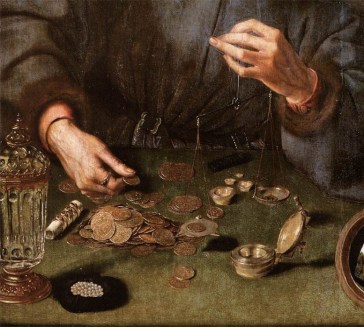
The Moneylender and his Wife by Quinten Massijs (detail)
This weekend, on the BART ride to San Francisco and on the walk to and from my destination there, I listened to this fascinating debate on Intelligence Squared U.S.: The Universal Basic Income Is The Safety Net Of The Future. (It’s also available as a podcast.) It was so thought-provoking that my walk turned into a rather long one, as I stopped every few blocks to sit down and scribble some notes in response to what I heard.
The debaters in favor of the motion are the libertarian political scientist Charles Murray, infamous in many

Listen to this podcast episode here or on Google Play, or subscribe on iTunes

This weekend, on the BART ride to San Francisco and on the walk to and from my destination there, I listened to this fascinating debate on Intelligence Squared U.S.:  The Universal Basic Income Is The Safety Net Of The Future. (It’s also available as a podcast.) It was so thought-provoking that my walk turned into a rather long one, as I stopped every few blocks to sit down and scribble some notes in response to what I heard.

The debaters in favor of the motion are the libertarian political scientist Charles Murray, infamous in many circles for co-authoring The Bell Curve, and labor leader Andrew Stern. These two make surprising debate partners, but of course, that’s part of the fun!

The debaters against the motion are Jared Bernstein and Jason Furman, both economic advisors to the Obama administration, and both more on the liberal / progressive end of the economic spectrum, which also adds to the interesting contrasts between audience expectations and the arguments made…. Read the written version here

Ordinary Philosophy and its Traveling Philosophy / History of Ideas series is a labor of love and ad-free, supported by patrons and readers like you. Please offer your support today!


New Podcast Episode: Margaret Sanger in the San Francisco Bay Area, California

Scottish Rite Temple mosaic, above the doorway of what’s now the Regency Center, San Francisco

Listen to this podcast episode here or on Google Play, or subscribe on iTunes

Fairly early on in my research for my history of ideas series on Margaret Sanger in New York City, I discover that she delivered one of her more famous addresses here in Oakland. Practically just around the corner from where I live, in fact!

So I’ve long had the idea of doing a follow-up Sanger project here in the San Francisco Bay Area, certain I’d find she’s been here more than once. That turns out to be the case. And not only do I discover that she visited here several times, I find that the excellent library at the University of California at Berkeley has some great resources for filling in some gaps in my information about Sanger in NYC. So, this story will have two parts: the first part is about sites associated with Sanger here, and the second part is about some discoveries I make in U.C. Berkeley’s archives following up on two NYC sites… Read the written version here

Ordinary Philosophy and its Traveling Philosophy / History of Ideas series is a labor of love and ad-free, supported by patrons and readers like you. Please offer your support today!

New Podcast Episode: Michel de Montaigne

Michel de Montaigne, public domain via Wikimedia Commons

Listen to this podcast episode here or on Google Play, or subscribe on iTunes

Michel de Montaigne, who lived from February 28, 1533 to September 13, 1592, was a thinker after my own heart.

Montaigne was a deeply philosophical thinker, though he never developed a complete philosophical system or moral theory. He invented, or at least popularized, a revolutionary way of writing: the essay. In his Essays, he wrote about anything and everything he found interesting enough to observe and think deeply about which was …well, just about everything, especially his inner life. His Essays are a rich source of wonderful philosophical and moral insights. As the Stanford Encyclopedia of Philosophy describes: “… under the guise of innocuous anecdotes, Montaigne achieved the humanist revolution in philosophy. He moved from a conception of philosophy conceived of as theoretical science, to a philosophy conceived of as the practice of free judgment’. Judgment, in this sense, involves applying both our cultivated moral sense and our reason, enriched with knowledge, to navigating the complexity and variety of situations we face throughout our lives; it also refers to the expansive, tolerant attitude we should display towards each other and towards the whole of reality…. Read the written version here

Ordinary Philosophy and its Traveling Philosophy / History of Ideas series is a labor of love and ad-free, supported by patrons and readers like you. Please offer your support today!

New Podcast Episode: Margaret Sanger and Race

Dr Dorothy Ferebee - Planned Parenthood as a Public Health Measure for the Negro Race, speech for Birth Control Federation of America, 1942

Dr Dorothy Ferebee – Planned Parenthood as a Public Health Measure for the Negro Race, speech for Birth Control Federation of America, 1942

Listen to this podcast episode here or on Google Play, or subscribe on iTunes

Since the earliest days of her birth control activism, Margaret Sanger has been often accused of being a racist, among other things. To many of her critics, her birth control advocacy must be understood as a nefarious plot to undermine human morals and decency, and any means of twisting her message to convey this are fair game. As I discuss in an earlier piece, a favored method of attack, which persists to this day, is to present a sentence or phrase of Sanger’s out of context to ‘prove’ her ‘true’ beliefs about people of other races. Her detractors even claim that she was on a genocidal mission to reduce or even exterminate black people, Jews, and other immigrant groups by destroying future generations. Never mind that Martin Luther King, Jr. praised her work on behalf of his beleaguered people. Never mind that she worked closely with civil rights leaders such as Mary McLeod Bethune and W.E.B. DuBois. Never mind that she opened clinics to serve black and other minority women because so many existing clinics refused to serve anyone but whites. Never mind that she wrote in 1944:

‘We must protect tomorrow’s Chinese baby and Hindu baby, English and Russian baby, Puerto Rican, Negro and white American babies who will stand side by side… to bring promise of a better future’

Read the written version here

Ordinary Philosophy and its Traveling Philosophy / History of Ideas series is a labor of love and ad-free, supported by patrons and readers like you. Please offer your support today!

New Podcast Episode: Margaret Sanger NYC Sites, Day 4

Planned Parenthood Clinic at Margaret Sanger Square, Mott and Bleeker Streets, NYC

Planned Parenthood Clinic at Margaret Sanger Square, Mott and Bleeker Streets, NYC

Listen to this podcast episode here or on Google Play, or subscribe on iTunes

Friday, October 21st, 2016

It’s cold and rainy, so I spend a long morning with my coffee as I do more research. Try as I might, I just can’t identify, with any certainty, the exact site of the Queens County Penitentiary, Long Island City, where Margaret Sanger was imprisoned for thirty days in 1917 for operating her Brownsville birth control clinic. Nor do I locate the site of the original White Plains Hospital where Sanger trained as a nurse. I had pored over the atlases of that town, from that time, in the New York Public Library map division, and I searched assiduously in their digitized records this morning. No luck.

So I finish my account of the first site I visited on Tuesday and publish it, then head out. It keeps raining, but oh well, it’s not a terribly long walk and besides, I welcome a walk in the rain, under my umbrella, of course. The drought back home had been mostly unrelenting for ages and it’s nice to experience a good rain again.

My first destination is Planned Parenthood’s Margaret Sanger Center at Mott and Bleecker Streets… Read the written version here

Ordinary Philosophy and its Traveling Philosophy / History of Ideas series is a labor of love and ad-free, supported by patrons and readers like you. Please offer your support today!

 

Margaret Sanger NYC Sites, Day 3 Part 2

24 Post Ave near Dyckman St, Inglewood, Manhattan, NYC, 2016 by Amy Cools

24 Post Ave near Dyckman St, Inglewood, Manhattan, NYC, 2016 by Amy Cools

Listen to this podcast episode here or on Google Play, or subscribe on iTunes

Thursday, October 20th, 2016, continued

I exit the A train at the Dyckman St station, the second to the last stop on the line, and walk a couple of blocks to 34 Post Ave. Margaret Sanger moved into ‘an inexpensive little flat’ here in January of 1914 leaving her husband William, or Bill as she called him, behind in Paris. The Sangers had lived there for a few months as Sanger researched and wrote and William worked to establish himself as a painter. En route to Paris, they stopped in Glasgow, Scotland, so that Sanger could observe and write about the effects of municipal ownership, a system of public ownership often endorsed by Socialists, for a newspaper assignment. While in Paris, Sanger met with many socialists and activists, all the while researching French methods of contraception. But she was growing bored and restless, eager to get back to work and engage in activism once again. She and the three children returned to New York City around the New Year, leaving William behind to continue his artistic pursuits… Read the written version here

Ordinary Philosophy and its Traveling Philosophy / History of Ideas series is a labor of love and ad-free, supported by patrons and readers like you. Please offer your support today!
 

New Podcast Episode: Margaret Sanger NYC Sites, Day 3, Part 1

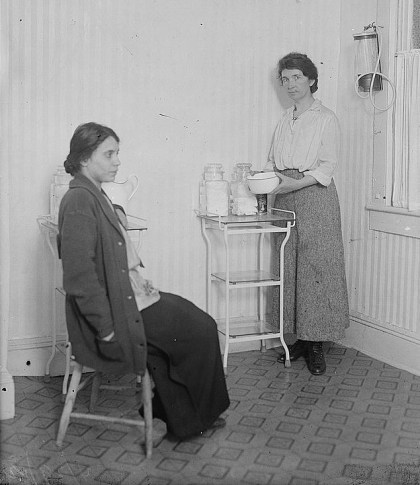
Margaret Sanger with Fania Mindell inside Brownsville clinic, forerunner of Palanned Parenthood, Oct. 1916, public domain via Library of Congress

Margaret Sanger with Fania Mindell inside Brownsville clinic, forerunner of Palanned Parenthood, Oct. 1916, public domain via Library of Congress

Listen to this podcast episode here or on Google Play, or subscribe on iTunes

Thursday, October 20th, 2016

I get out in decent time to start the day’s explorations, just after eight, but it’s not long before I realize I’m tired and hence, a little cranky. My friends and I watched the third Hillary Clinton and Donald Trump debate last night and some of the commentary which followed, then finally went to sleep very late after we talked about what we just watched, and other things. I’m mostly on New York time now, but not quite.

The abortion issue came up almost immediately in the debate since the first question from the moderator was about the Supreme Court and the appointment of justices. Trump pledged to nominate only strongly anti-abortion candidates. Clinton was adamant that Roe v. Wade and laws protecting women’s access to birth control and abortion (with appropriate limitations) be upheld. Clinton also strongly endorsed Planned Parenthood, praising the services it provides and criticizing all efforts to defund it. I, for one, am grateful to Planned Parenthood, the organization that Margaret Sanger founded…. Read the written version here

Ordinary Philosophy and its Traveling Philosophy / History of Ideas series is a labor of love and ad-free, supported by patrons and readers like you. Please offer your support today!

New Podcast Episode: Making the Perfect the Enemy of the Good

richard-and-mildred-lovingListen to this podcast episode here or on Google Play, or subscribe on iTunes

It’s not generally a very wise thing to do, but I entered into a little dispute on Facebook a little while ago. It was about Mildred and Richard Loving of Virginia. A friend shared a discussion thread which was mostly very critical of the way that the Lovings are portrayed in their recent namesake movie. The Lovings’ marriage was illegal in 1950’s Virginia because Mildred was a woman of color and Richard was white. They knew this, so a pregnant, 19-year-old Mildred and 25-year-old Richard traveled to Washington, D.C. to be married. But this didn’t help them when it came to state law: marrying out-of-state to avoid Virginia’s anti-miscegenation laws, then returning to live as husband and wife, was also illegal.

The young man who initiated the Facebook thread (I won’t name names here, since this piece is only about the ideas expressed) invited a discussion of this fact stated in Mildred Loving’s 2008 obituary in Legacy.com:  “Mildred Jeter was 11 when she and 17-year-old Richard began courting“. My friend who shared the thread, an African-American scholar, was also particularly concerned with another aspect of this story, as many others were: Mildred identified herself at the time of her marriage and for the rest of her life as ‘Indian’, not ‘Black’ or ‘Negro’…. Read the original piece here

Ordinary Philosophy and its Traveling Philosophy / History of Ideas series is a labor of love and ad-free, supported by patrons and readers like you. Please offer your support today!

 

New Podcast Episode: Margaret Sanger NYC Sites, Day 2, Part 2

79 and 71 W. 12th Street, New York City. 77 woy

79 and 71 W. 12th Street, New York City.

Listen to this podcast episode here or on Google Play, or subscribe on iTunes

Wednesday, October 19th, 2016, continued

The next site I seek is right across the street from the New School on W. 12th St near 6th Ave. The address was number 77, but as you can see, there’s no building with that number here anymore. According to Robin Pokorski of the Margaret Sanger Papers Project, Sanger made her first public appearance here on January 6th, 1916 after returning from her self-imposed exile in Europe to escape obscenity charges. She eventually decided to return and face them, however: her husband had already done so on behalf of her cause the month before, and her chances in court were better now since birth control had become a much more regular topic in the press. I find no record of her talk nor a history of a public venue here. I do find a listing for 77 W 12th St in the Catalogue of the First Exhibition of the Society of Independent Artists, Volume 1, published in 1917. It’s the address of Caroline Speare, who has two pieces of art pictured in the catalogue. Looking through it for more about Speare, which I don’t find, I stumble across an early charcoal work by Georgia O’Keeffe, which is a delightful find. Perhaps talks were held at Speare’s place as well as displays of her art, but I can find no evidence of this at this time.

I do find a form letter which Sanger had written the previous day, on Jan. 5th, 1916, to send out to friends. In it, she writes about the indictments against her over her distribution the year before of her magazine The Woman Rebel and its so-called obscene subject matters: the sexual liberty of women and birth control…. Read the written version here:

Ordinary Philosophy and its Traveling Philosophy / History of Ideas series is a labor of love and ad-free, supported by patrons and readers like you. Please offer your support today!