If Work Dominated Your Every Moment Would Life be Worth Living? by Andrew Taggart

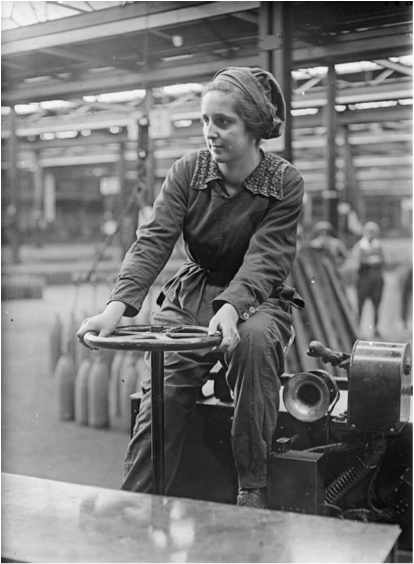
Working Woman, public domain via Wikimedia Commons

Imagine that work had taken over the world. It would be the centre around which the rest of life turned. Then all else would come to be subservient to work. Then slowly, almost imperceptibly, anything else – the games once played, the songs hitherto sung, the loves fulfilled, the festivals celebrated – would come to resemble, and ultimately become, work. And then there would come a time, itself largely unobserved, when the many worlds that had once existed before work took over the world would vanish completely from the cultural record, having fallen into oblivion.

And how, in this world of total work, would people think and sound and act? Everywhere they looked, they would see the pre-employed, employed, post-employed, underemployed and unemployed, and there would be no one uncounted in this census. Everywhere they would laud and love work, wishing each other the very best for a productive day, opening their eyes to tasks and closing them only to sleep. Everywhere an ethos of hard work would be championed as the means by which success is to be achieved, laziness being deemed the gravest sin. Everywhere among content-providers, knowledge-brokers, collaboration architects and heads of new divisions would be heard ceaseless chatter about workflows and deltas, about plans and benchmarks, about scaling up, monetisation and growth.

In this world, eating, excreting, resting, having sex, exercising, meditating and commuting – closely monitored and ever-optimised – would all be conducive to good health, which would, in turn, be put in the service of being more and more productive. No one would drink too much, some would microdose on psychedelics to enhance their work performance, and everyone would live indefinitely long. Off in corners, rumours would occasionally circulate about death or suicide from overwork, but such faintly sweet susurrus would rightly be regarded as no more than local manifestations of the spirit of total work, for some even as a praiseworthy way of taking work to its logical limit in ultimate sacrifice. In all corners of the world, therefore, people would act in order to complete total work’s deepest longing: to see itself fully manifest.

This world, it turns out, is not a work of science fiction; it is unmistakably close to our own.

‘Total work’, a term coined by the German philosopher Josef Pieper just after the Second World War in his book Leisure: The Basis of Culture (1948), is the process by which human beings are transformed into workers and nothing else. By this means, work will ultimately become total, I argue, when it is the centre around which all of human life turns; when everything else is put in its service; when leisure, festivity and play come to resemble and then become work; when there remains no further dimension to life beyond work; when humans fully believe that we were born only to work; and when other ways of life, existing before total work won out, disappear completely from cultural memory.

We are on the verge of total work’s realisation. Each day I speak with people for whom work has come to control their lives, making their world into a task, their thoughts an unspoken burden.

For unlike someone devoted to the life of contemplation, a total worker takes herself to be primordially an agent standing before the world, which is construed as an endless set of tasks extending into the indeterminate future. Following this taskification of the world, she sees time as a scarce resource to be used prudently, is always concerned with what is to be done, and is often anxious both about whether this is the right thing to do now and about there always being more to do. Crucially, the attitude of the total worker is not grasped best in cases of overwork, but rather in the everyday way in which he is single-mindedly focused on tasks to be completed, with productivity, effectiveness and efficiency to be enhanced. How? Through the modes of effective planning, skilful prioritising and timely delegation. The total worker, in brief, is a figure of ceaseless, tensed, busied activity: a figure, whose main affliction is a deep existential restlessness fixated on producing the useful.

What is so disturbing about total work is not just that it causes needless human suffering but also that it eradicates the forms of playful contemplation concerned with our asking, pondering and answering the most basic questions of existence. To see how it causes needless human suffering, consider the illuminating phenomenology of total work as it shows up in the daily awareness of two imaginary conversation partners. There is, to begin with, constant tension, an overarching sense of pressure associated with the thought that there’s something that needs to be done, always something I’m supposed to be doing right now. As the second conversation partner puts it, there is concomitantly the looming question: Is this the best use of my time? Time, an enemy, a scarcity, reveals the agent’s limited powers of action, the pain of harrying, unanswerable opportunity costs.

Together, thoughts of the not yet but supposed to be done, the should have been done already, the could be something more productive I should be doing, and the ever-awaiting next thing to do conspire as enemies to harass the agent who is, by default, always behind in the incomplete now. Secondly, one feels guilt whenever he is not as productive as possible. Guilt, in this case, is an expression of a failure to keep up or keep on top of things, with tasks overflowing because of presumed neglect or relative idleness. Finally, the constant, haranguing impulse to get things done implies that it’s empirically impossible, from within this mode of being, to experience things completely. ‘My being,’ the first man concludes, ‘is an onus,’ which is to say an endless cycle of unsatisfactoriness.

The burden character of total work, then, is defined by ceaseless, restless, agitated activity, anxiety about the future, a sense of life being overwhelming, nagging thoughts about missed opportunities, and guilt connected to the possibility of laziness. Hence, the taskification of the world is correlated with the burden character of total work. In short, total work necessarily causes dukkha, a Buddhist term referring to the unsatisfactory nature of a life filled with suffering.

In addition to causing dukkha, total work bars access to higher levels of reality. For what is lost in the world of total work is art’s revelation of the beautiful, religion’s glimpse of eternity, love’s unalloyed joy, and philosophy’s sense of wonderment. All of these require silence, stillness, a wholehearted willingness to simply apprehend. If meaning, understood as the ludic interaction of finitude and infinity, is precisely what transcends, here and now, the ken of our preoccupations and mundane tasks, enabling us to have a direct experience with what is greater than ourselves, then what is lost in a world of total work is the very possibility of our experiencing meaning. What is lost is seeking why we’re here.Aeon counter – do not remove

This article was originally published at Aeon and has been republished under Creative Commons.

Andrew Taggart is a practical philosopher and entrepreneur. He is a faculty member at the Banff Centre in Canada, where he trains creative leaders, and at Kaospilot in Denmark, where he trains social entrepreneurs. His latest book is The Good Life and Sustaining Life (2014). He lives in Santa Fe, New Mexico. (Bio credit: Aeon)

~ Ordinary Philosophy and its Traveling Philosophy / History of Ideas series is a labor of love and ad-free, supported by patrons and readers like you. Please offer your support today!

*All views and opinions expressed by guest writers are their own and do not necessarily express those of Ordinary Philosophy’s editors and publishers

Chirnside and Ninewells, Scottish Borders, Childhood and Summer Home of David Hume

Visiting David Hume’s tricentennial plaque on Chirnside Community Center, Chirnside, Scottish Borders

Chirnside, Scottish Borders, Friday, December 29th, 2017

I arise early this morning and take a 40-minute train ride east from Edinburgh’s Waverley Station to Berwick-upon-Tweed at the mouth of the River Tweed, in the northeast corner of England. From there, I take the 60 bus east to Chirnside, a twenty-minute ride to a small village of just under 1,500 people. As I leave Berwick-upon-Tweed, a few flurries of snow are gently sprinkling down; when I exit the bus at Chirnside, the snowflakes are larger and fall much more frequently. The bus drops me right across the street from my first destination of the day: the Chirnside Community Center.

Located at the southeast corner of Main and Crosshill, a buttress of the community center sports a plaque for its most famous and accomplished former inhabitant: the great empiricist philosopher and historian David Hume. It was placed here to celebrate the tricentennial of his birth, May 7th, 1711. While Hume was not born here at Chirnside (he was born in Edinburgh), his family returned to Ninewells, the Home family home a little ways southwest of the village, when David was very small. (The family name was spelled H-o-m-e at the time but pronounced ‘Hume’; David changed the spelling so that those outside of Scotland would know how to pronounce his name.) Little David grew up here until he returned to Edinburgh at age eleven to study at the University. Ninewells, on the north bank of the Whiteadder River, later became his summer residence. It was David Hume who first inspired me to visit Edinburgh, upon which I fell in love with that incomparable city. So when I discovered that the University of Edinburgh, Hume’s alma mater, had a master’s program in intellectual history, I applied and they accepted. Now, I live here in beautiful Scotland!
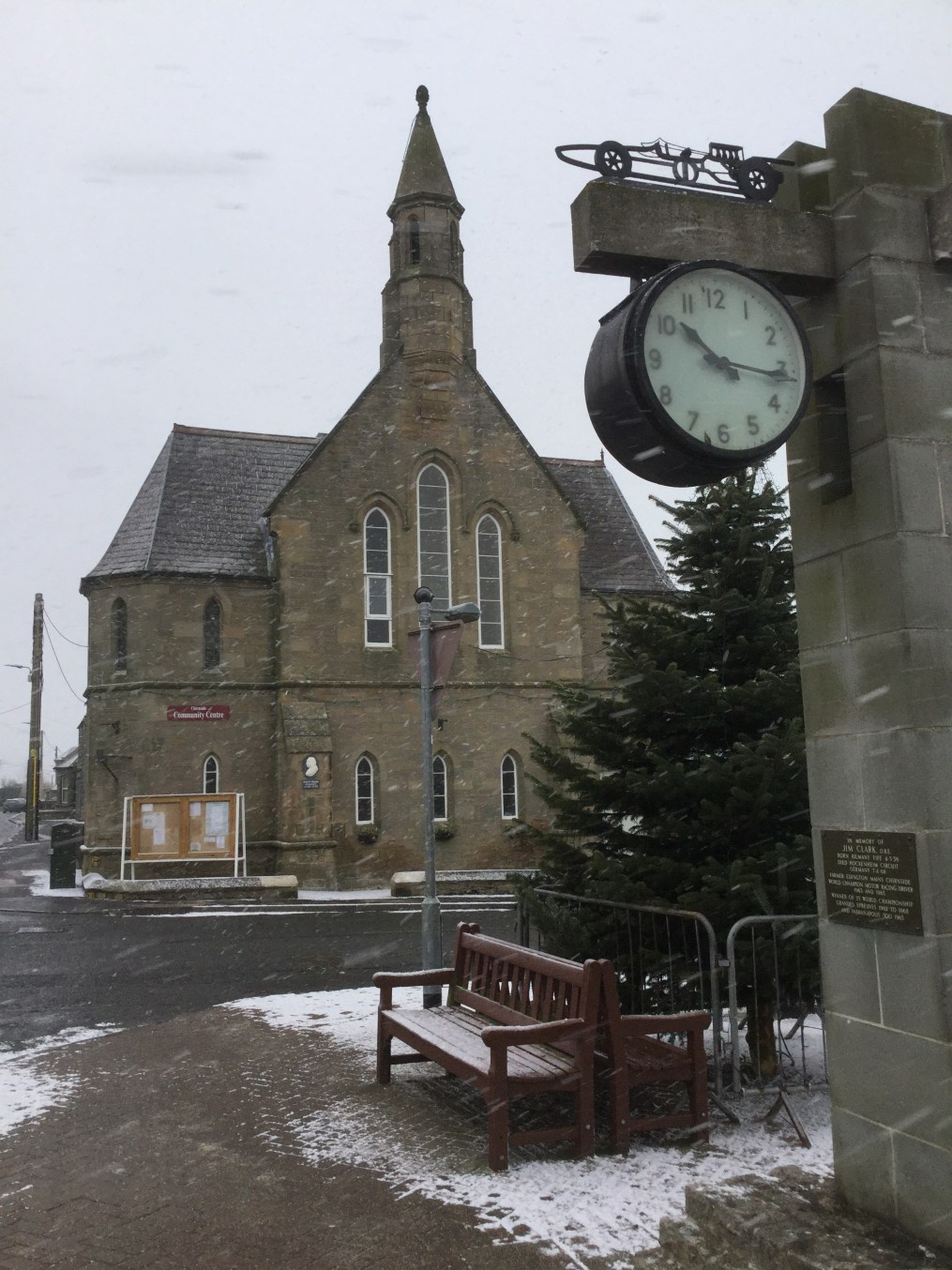
Chirnside Community Center with Hume’s plaque and to the right in the foreground, the memorial clock for Formula One racer Jim Clark, another of Chirnside’s famous one-time residents. Clark, who died in a racing accident, is buried here in Chirnside.

I’ve been planning to take this trip to Chirnside since my 2014 trip to Edinburgh, but I didn’t make it out here then. I’m so excited to be here today, and the snowfall is heightening my sense of adventure. After all, I grew up and lived in California nearly all of my life, and falling snow was not something you see much of there unless you live in the mountains or way up north, neither of which was true for me. So falling snow still never fails to give me a little thrill, a feeling of being in a new and unexpected, even magical place. As I head south on Crosshill, the snowfall is rapidly growing thicker, now falling in big, fluffy flakes. As I continue down the hill, Crosshill becomes Kirkgate where the road veers to the right where it meets the path that leads to the bright white primary school, at the bottom of the slope a little off to the left. The name of the road, Kirkgate, indicates my next destination but one.
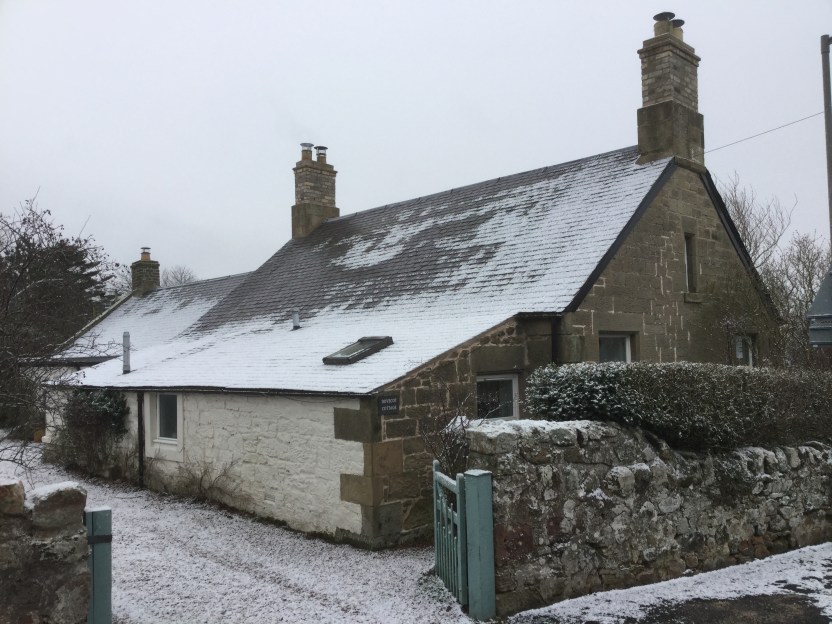
Dovecote Cottage, Chirnside, Scottish Borders

On my way to the old kirk (Scots for ‘church’), I keep watch for the structure I’m looking for, which I should find somewhere near here on my left. I spot a sign on the corner of a house: ‘Dovecote Cottage’. Ah hah! A dovecote is just the thing I’m looking for! Though the gate to the property is open, I’m loathe to enter the garden without a by-your-leave. So I walk slowly past, looking for someone I can talk to or perhaps a public path that will give me a good look into the garden. I find the gate open to a much wider drive just past Dovecote Cottage; the name on the gate, ‘White House,’ describes the large structure I pass as I enter. It appears to be a more public place than the cozy little cottage enclosure, so I don’t feel as if I’m trespassing or infringing on anyone’s privacy. Just a little ways in, I clearly see what I’m looking for off to my left over the garden wall, just where my sources said I would find it: in a garden near the church.
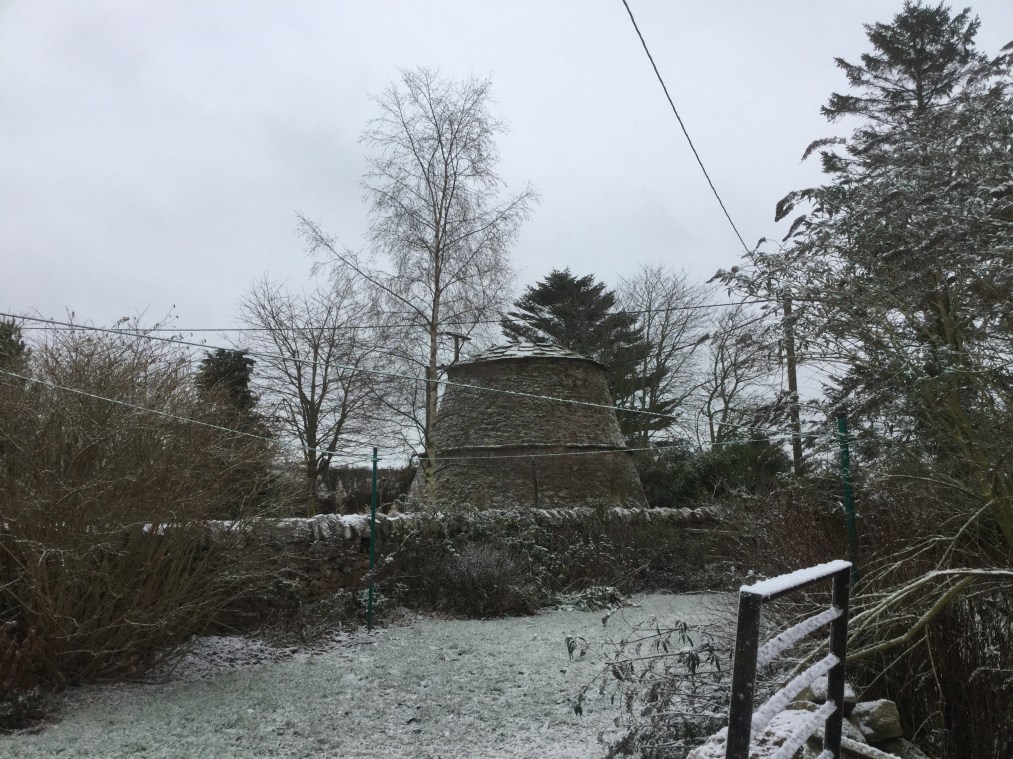
The dovecote built by the Humes of Ninewells, Chirnside, Scotland. It’s in the garden of Dovecote Cottage; this view is from the White House drive

The dovecote looks something like a giant hive built by a race of bees much larger and more skilled at masonry than any found on Earth. It’s had a new roof put on sometime since 1913, the date of a photograph I consulted during my research for identification. According to ‘Heritage Sites Around Chirnside,’ published by the Scottish Borders Council, it was built by a member of the Hume (again, variously spelled H-o-m-e) family in the 16th century on land won in a wager with a neighbor. This would explain why it’s at such a distance from the Ninewells grounds. A dovecote is a structure for raising doves and pigeons, a traditional and popular practice. I don’t know what the purpose was other than the enjoyment of their beauty and variety and of hearing their clucks and coos; I know people eat doves and pigeons (squab) but I believe that wasn’t then, and isn’t now, the primary purpose of pigeon-keeping.
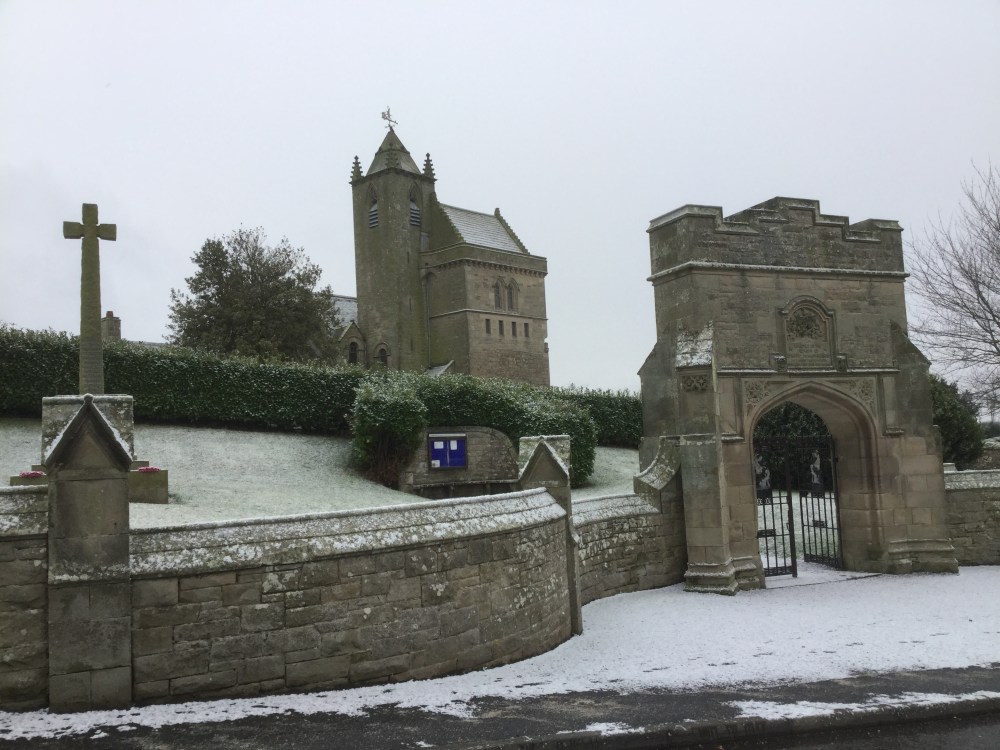
Approaching the Old Church / Chirnside Parish Church from Kirkyard Gate, Chirnside, Scotland, with the Tweedmouth Memorial Gateway to the right
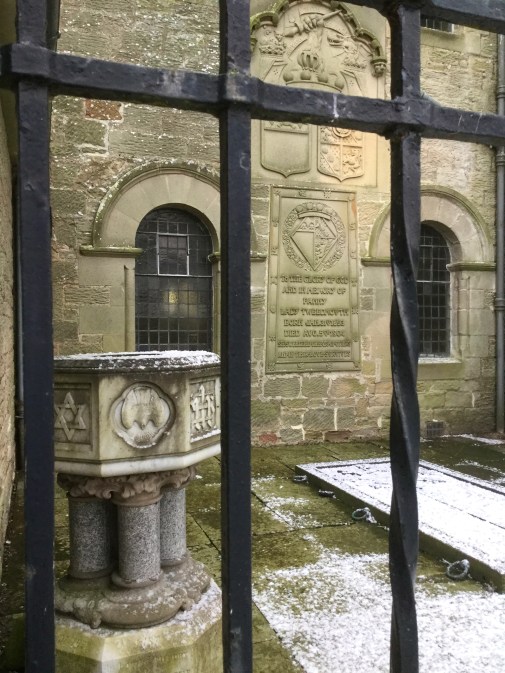
Lady Tweedmouth’s memorial tablet and grave at Chirnside Parish Church

I continue south on Kirkgate and before long, I see the old parish church on a rise to my left. The kirk is reached through a grand stone gateway: the Tweedmouth Gateway, named for Baron and Baroness Tweedmouth, erected in their honor by their son after the former’s death in 1909. Lady Tweedmouth was buried here in 1904, and in 1907, Lord Tweedmouth made extensive repairs and upgrades to the old church in her memory.

The building retains a few sections of the original Norman structure, including the south doorway under the portico (which I kick myself for neglecting to take a picture of!). The original church, a rectangular structure much smaller than what stands here today, was originally built in the 1100’s; the church was formally consecrated in 1242. It was largely rebuilt in 1572, repaired in 1705, enlarged in 1837, and repaired again and embellished during the early 1900’s.

A relation of Hume, it seems, was made parson of the church in 1573; at least, John Home shared the family name. David’s uncle George was the minister here when David was a boy. This church was the Presbyterian Church when Hume lived here and for long before. Hume’s mother Katherine was a devout Presbyterian and this was the Presbyterian church, so Hume likely attended services here regularly throughout his youth. Given his later lack of religious belief, it’s less certain that Hume would have done so as regularly when he spent summers and vacations here when he was an adult. Yet Hume was a sociable fellow and like any British village, its kirk would have been a center of social life; so, I think he would have attended sometimes at least.
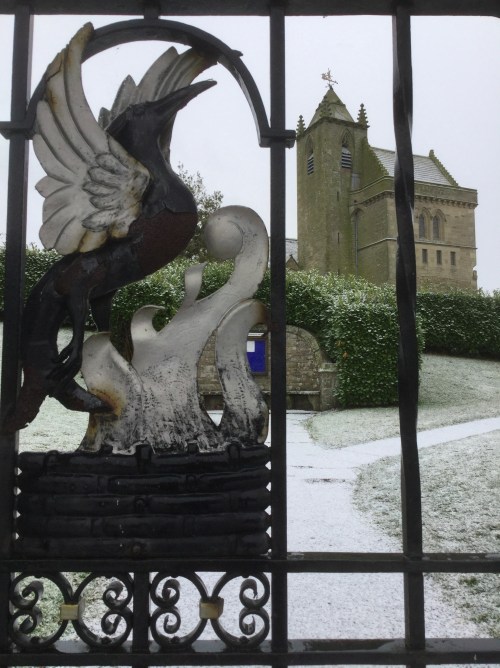
Chirnside Parish Church through the front gate

Given the religiosity of Hume’s family, I wonder what they thought of his religious skepticism. Being a very affable fellow, I think it unlikely he would have made a point of it with his family. In a 1745 letter, he writes with affection of his recently deceased mother and of mutual love and concern between himself and other members of his family, with no hint of rift or strain that may have been caused by religious strife. Hume was widely reputed to be an atheist and was notorious for it, but I think his equally well-known kindness and friendliness softened the effect that it may otherwise have had on public opinion. Because of his fascination with philosophy, I suspect his mother Katherine may have viewed any skepticism she spotted in him as the result of philosophical exploration, not wickedness or pride. She recognized early her David’s lively and precocious intelligence and saw to it that he had an excellent education. As I mentioned earlier, he attended the University of Edinburgh when he was just barely eleven. He never did graduate because he grew bored there; in 1735, he wrote of that university experience ‘there is nothing to be learnt from a Professor, which is not to be met with in Books.’ So, he dropped out at age 15 and continued his studies on his own, rejecting the study of law his family expected him to pursue (after his father, who was an advocate, as a lawyer’s called here, and who died when David was only two) in favor of his beloved philosophy. From all accounts, however, the University improved greatly not long after Hume attended. His nephew, also named David Hume, attended the University as well, becoming a distinguished advocate and the University’s Professor of Scottish Law.
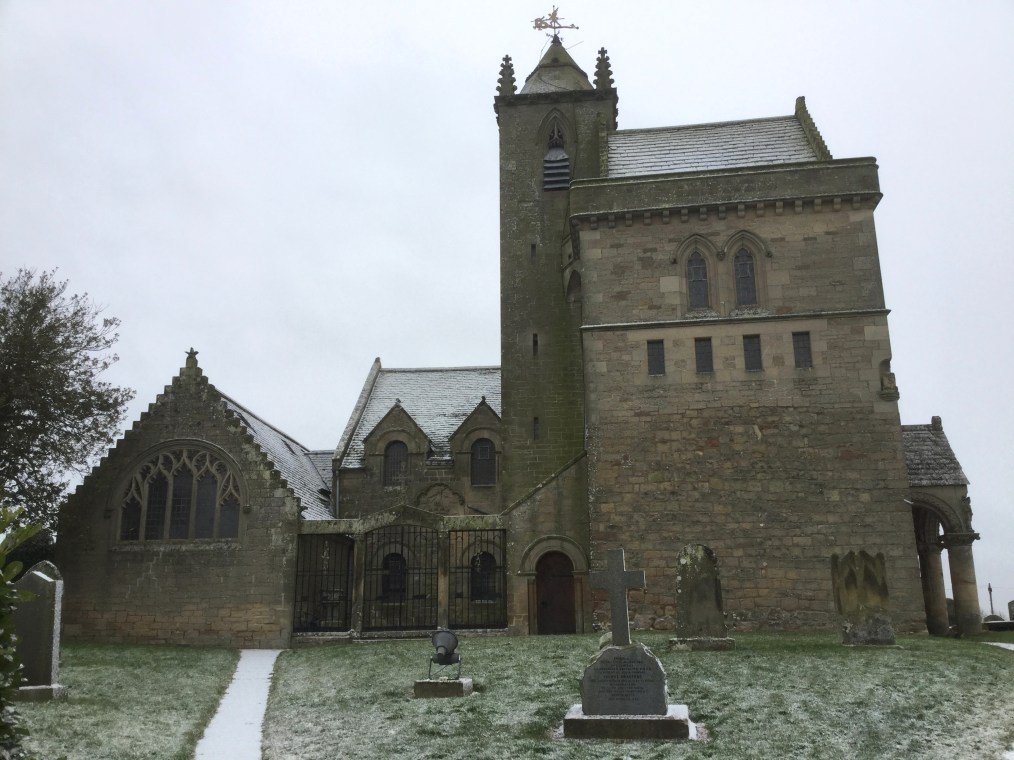
Chirnside Parish Church, west side
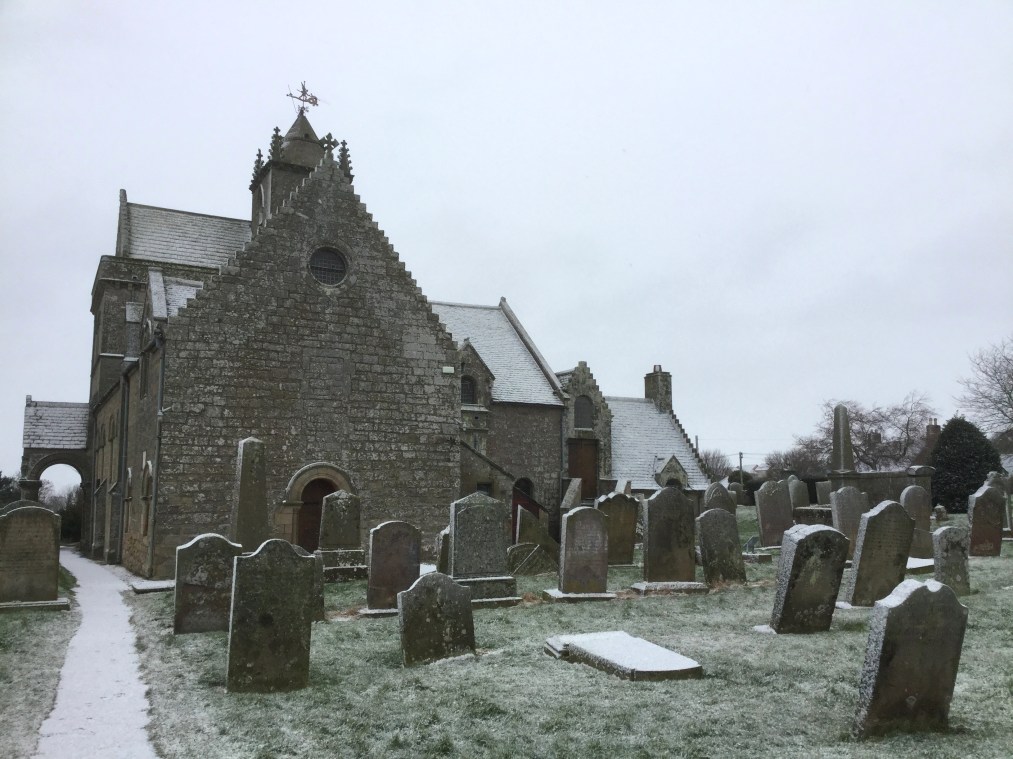
Chirnside Parish Church, east side from the kirkyard
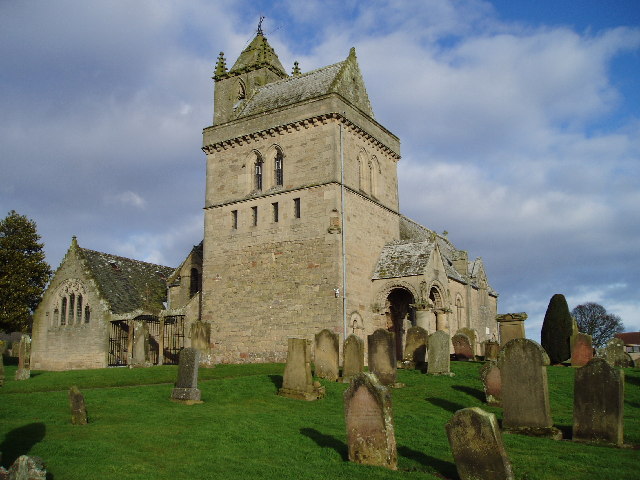
Chirnside Parish Church and kirkyard; some details are easier to see when free of the snow cover. The Norman doorway is under the pointy-roofed portico on the right. Photo by Kavin Rae, free to use under a CC BY-SA Creative Commons license.
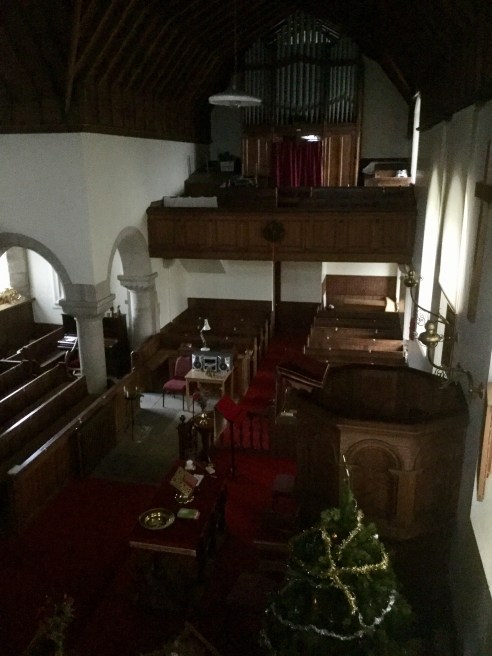
Chirnside Parish Church, interior from choir loft to the west

I circle the church slowly, both to see the details and to avoid slipping on the icy, snowy walkways. I try every door and tah-dah! I find a side door that was left unlocked. It opens with difficulty, appearing rarely used, the wood swelled so that it scrapes reluctantly along the ground as I slowly, carefully edge it open just enough to enter. I find myself in a very cobwebby stairwell. I ascend and find myself in a little choir loft, thick with white dust, an old fabric banner tossed over one of the pews. I step gingerly at first but the old wood floor is clearly very thick and sturdy.

The church, even with the lights out, looks festive with its red carpet, its three appliqued holiday banners hanging from the large central choir loft, and its Christmas decorations including, I’m charmed to see, a plastic baby doll in a rustic crib to represent the infant Christ. Though there’s a small pipe organ above and a piano below, I also see a boombox on a table. It’s low church, solid, practical, plain but not severe, with no imagery save a large plain cross over the raised, heavy wood pulpit.
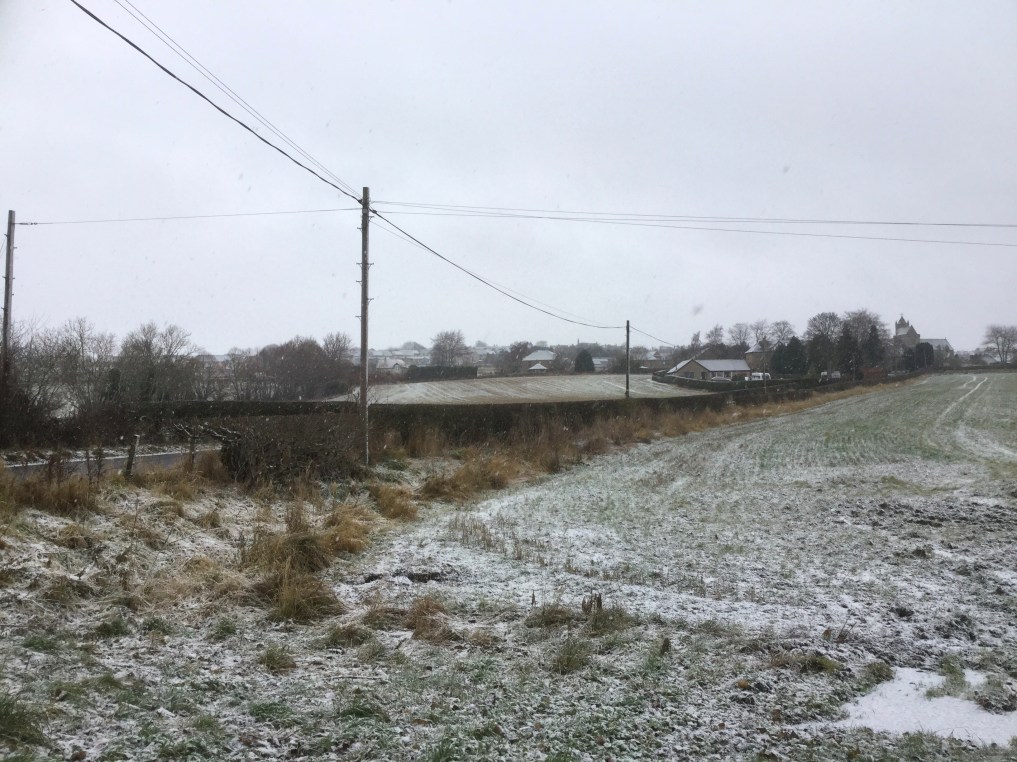
Looking north towards Chirnside from a path just off B6437. You can see the Chirnside Parish Church rising above the trees to the right

I take a good look around and many photos but don’t stay long: not sure I’m exactly trespassing since this is a place of public worship and the door was unlocked, but since this is a gray area, I don’t overstay any welcome I may have had. I close the door tightly behind me as I leave.

I continue south on Kirkgate, which turns to B4637 after it crosses A6105, the main thoroughfare east across this part of the Borders from Berwick-upon-Tweed. I’m looking to see how much of the old Ninewells estate I can see from the east side. I continue south as far as the Chirnside Sawmill, about a third of a mile south of the church. This takes me north and east of where the old Ninewells estate was, but based on the maps I consulted earlier, the best access is from the main road to the north of here. I retrace my steps, enjoying the ever-snowier landscape and the new views of the village from each bend.
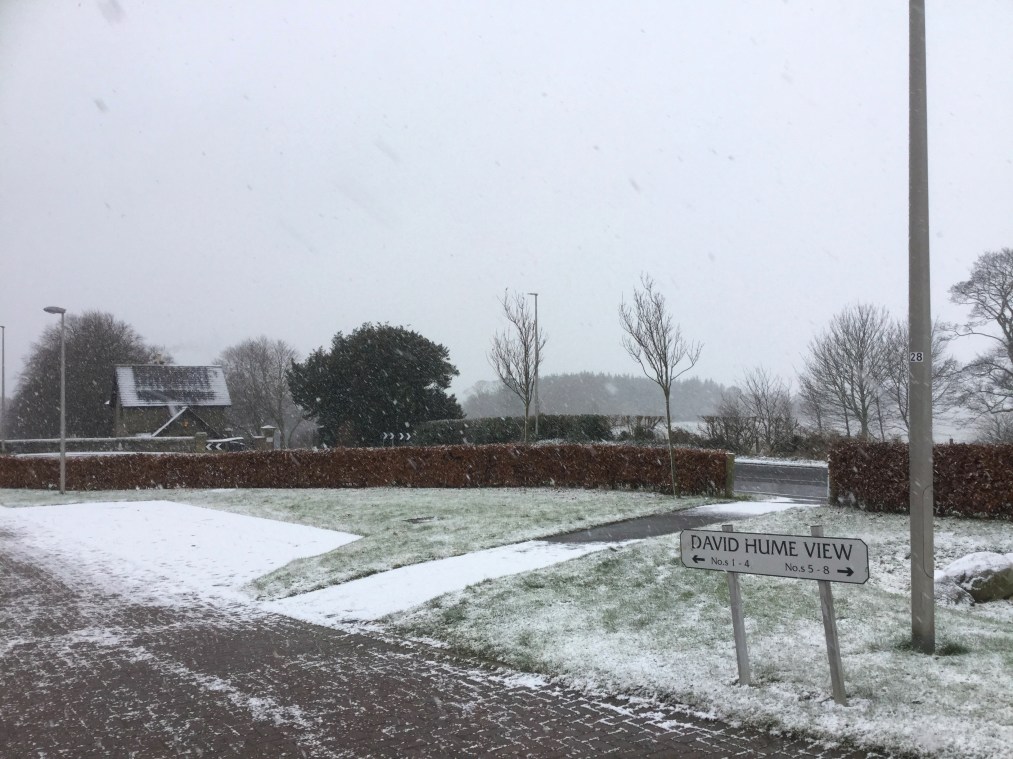
David Hume Way looking towards the Whiteadder River and the site of Ninewells

When I reach A6105, I turn left. After about a quarter of a mile, I turn right on Whiteadder Way, a road leading into a new-looking housing development. The sign tells me that I’ll access the next place I’m headed, a street named David Hume View. There’s nothing of historical interest that I know of relating to this street other than the name and the fact that you can see part of the old Ninewells estate grounds when you look south from the south end of the street. I look, but the view is blurred by the fresh snow that simultaneously beautifies it in its soft, pristine way. 

‘In all that idyllic countryside of the Merse, there is no lovelier situation than the estate of Ninewells. The house itself stands on a bluff some 80 feet above the rushing waters of the Whiteadder. Down the bluff a few yards, and to the south-east of the house, an overhanging rock forms a shallow cave. Here, David Hume probably played as a boy, or read a book in solitary majesty; and here, according to the inevitable local legend, he indulged in profound philosophical meditation.’ – Mossner’s Life of David Hume, p 20
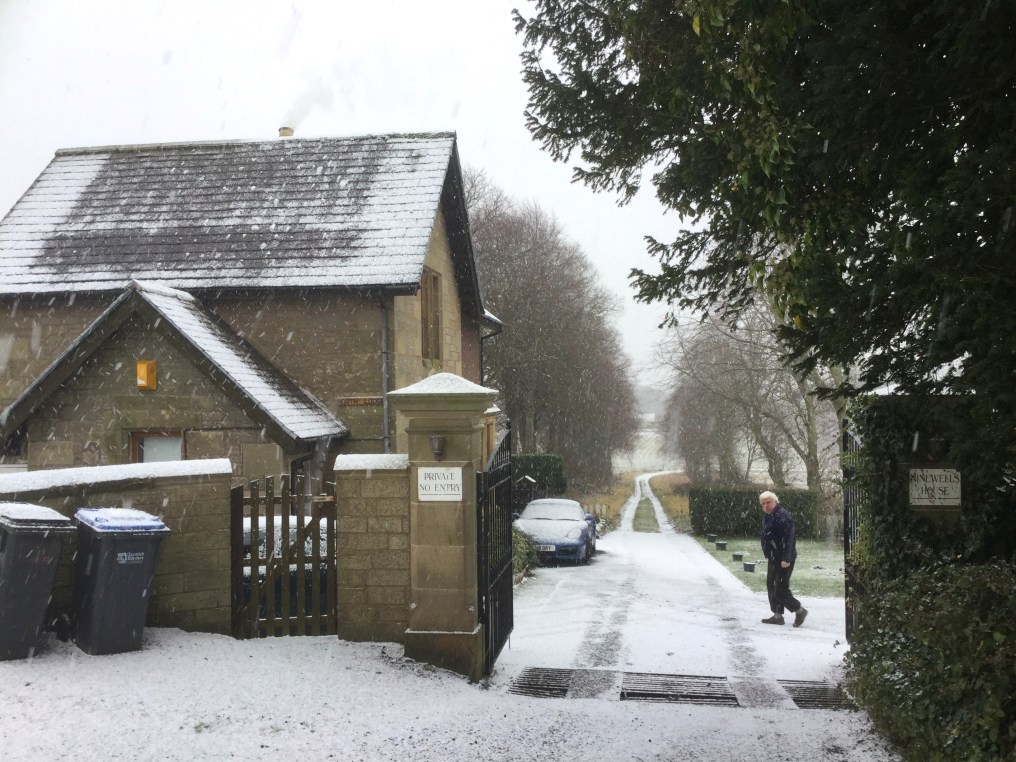
At Ninewells House, this man directs me to the path towards the site of the old Ninewells estate and the Whiteadder River

I retrace my steps to the foot of Whiteadder Way and turn right. On the south side of A6105, just as it veers north, there’s a pretty gabled house with its name prominently displayed on its stone wall, just to the right of the gate: ‘Ninewells House.’ I know I can reach the old Ninewells grounds from this direction from my maps, but this appears to be a private drive. I have only a moment to consider my next step when a man appears. He greets me, and in response to my inquiry, he directs me to the entry of the path that runs parallel to the drive heading towards the Whiteadder River, which will then continue all the way to and along the riverbank. I thank him and find the head of the path a short distance away to the east. It’s prominently marked by a large historical placard about David Hume, though I find it nearly entirely covered with snow. I take pictures of it to refer to later; I have to do so quickly since the snow is determined to obscure it nearly as fast as I sweep it away.
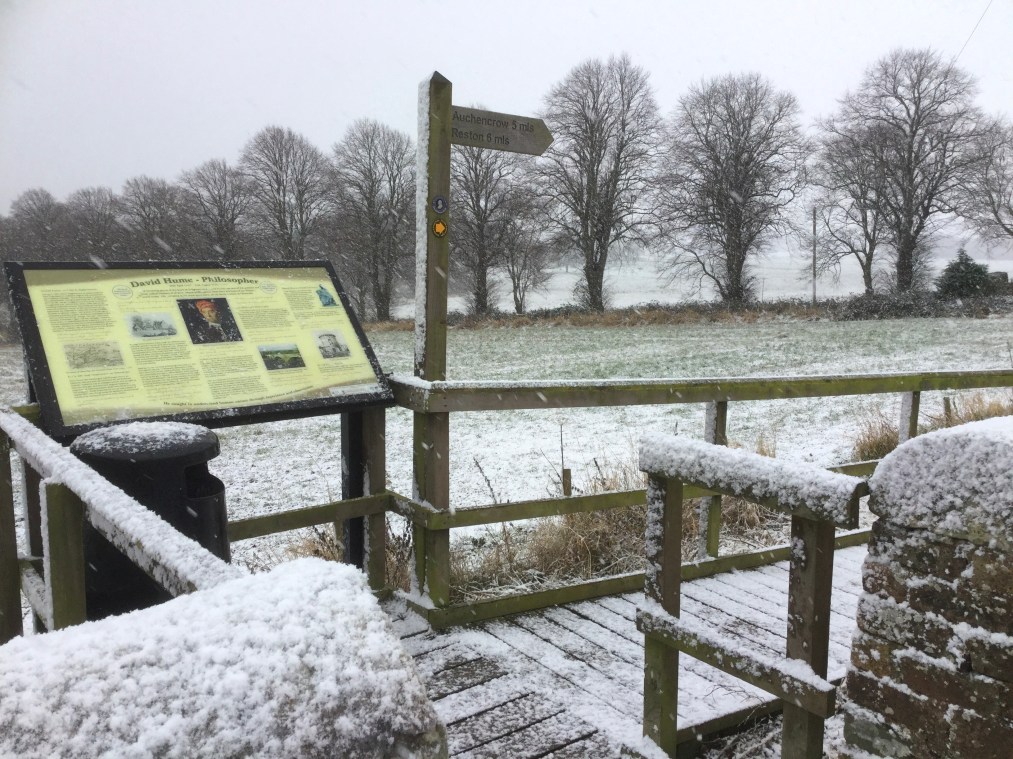
Historical placard at head of path to Ninewells site and Hume Walk.
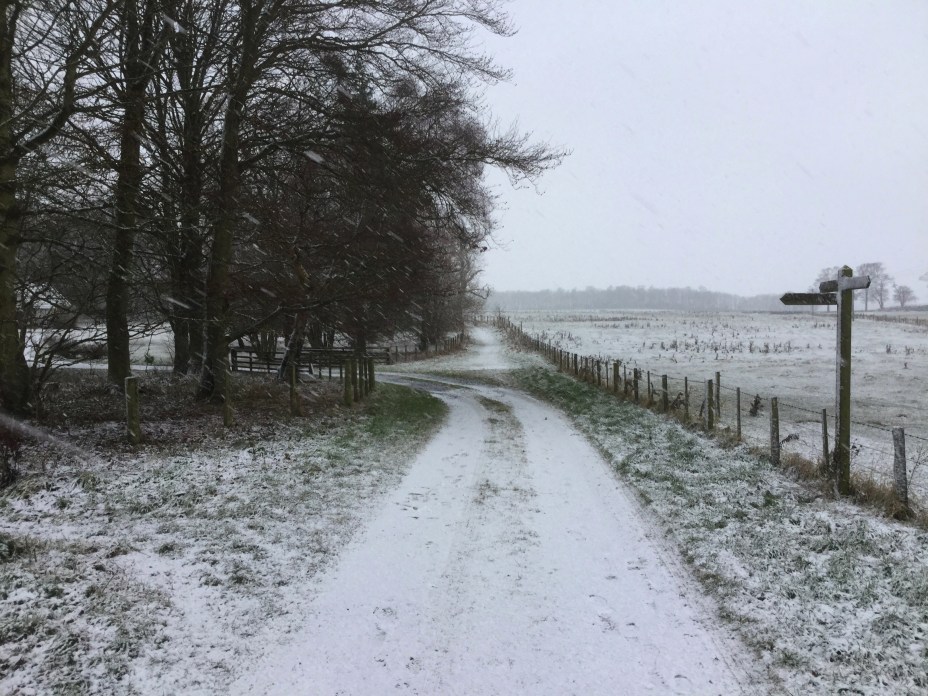
Continuing straight on the path to Ninewells site and Hume Walk
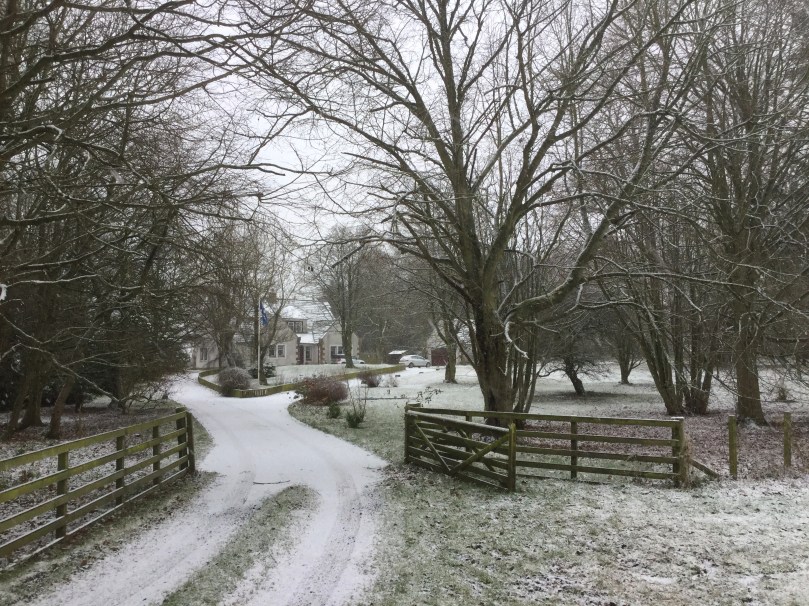
The house that stands just north of the site of Ninewells, on my left as I continue west on the path

I tromp through the accumulating snow and find that I have to step ever more carefully. I’m wearing my good sturdy leather boots but I discover that the rubber surface I had installed on the soles is not as grippy in the ice and snow as I would wish. At one point, the path leads me to the foot of the same unpaved drive that passes through the Ninewells House gate. I continue on where it veers right, then pause when I arrive at another curve to the left which enters the gate to a large, handsome, modern classic-style stone house. This house, I know from my sources, was built just north of the site of the house Hume grew up in. I also know, from my maps and the confirmation of the man at Ninewells House, that the path to the river will allow me to approach that site from below the house. So I continue past the house and onto the river path. As I walk, I join up and chat with three people also taking this walk, accompanied by their two dogs, joyful and frolicking in the snow.
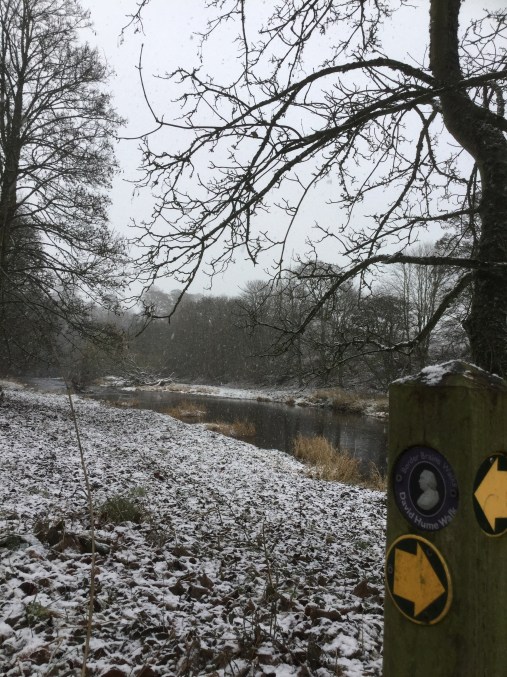
Post marking the start of David Hume Walk along the Whiteadder River

The path curves along the rise then leads to a set of wooden steps that leads down to the riverside. There’s a post here that identifies the path, which turns off to the right along the river, as the David Hume Walk. The site of Ninewells should be to my left here, on the north bank of the bend of the river from west to south. My sources tell me that southeast of the house there was a shallow riverside cave and other hollows and overhangs where young David would retreat and play or think. He and his brother also loved to fish in this river. So I decide to turn right first, to explore the river where it curves down to the southwest to see if I can spot any caves, overhangs, and likely fishing spots.

I need to pick my steps ever more carefully as I go along, the path growing ever slippier, and approaching so close to the Whiteadder in some spots that I’m in real danger of sliding right in. I walk in the branchy leaf-litter to the right of the path as often as I can, where my shoes find a better grip. In some places, I hold to the naked branches of the nearby trees and shrubs. Luckily, the sets of wooden steps at the steep rises and descents are each equipped with a rough but sturdy handrail. No doubt, the steps are often rendered slippery by Scotland’s abundant precipitation.
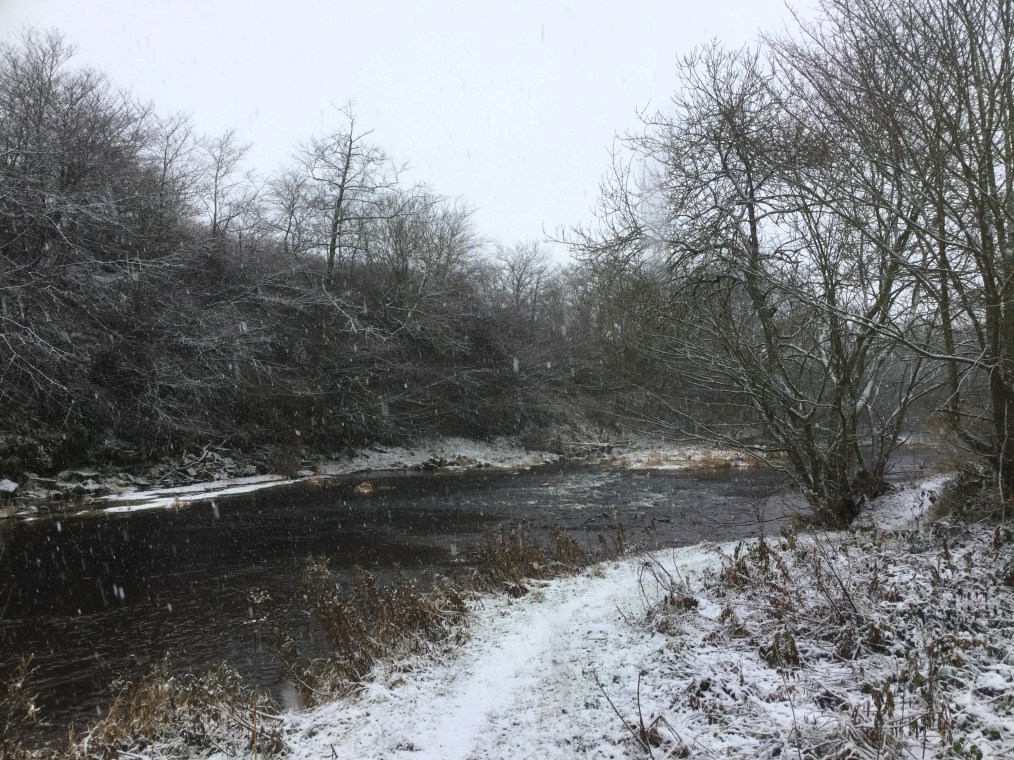
David Hume Walk along the Whiteadder River, looking west and a little south

During this glorious, wintry riverside walk, I see pheasant, ducks, and many small birds; at one point, off to my right, I see a very large hare bounding across a field. I also hear occasional shooting, presumably for pheasant, which reminds me not to leave the paths or hop fences to explore any private field or wood. Scotland’s laws permit free passage even through private property, but I’m not entirely confident that my bright red coat can guarantee against a hunting accident.

At a high clearing overlooking the river, I reach a wooden bench. It’s a good place, I think, to enjoy the little thermos of hot coffee I obtained at the little grocery store in the village shortly after I arrived this morning. I was a little surprised to discover, from the instructions posted on the wall behind the counter, that orders of fresh milk, bread, and eggs must be placed ahead of time; they don’t stock them otherwise. Hot water and instant coffee, however, are available on demand. Though nothing fancy, the coffee is warming and bracing, and I enjoy it thoroughly.
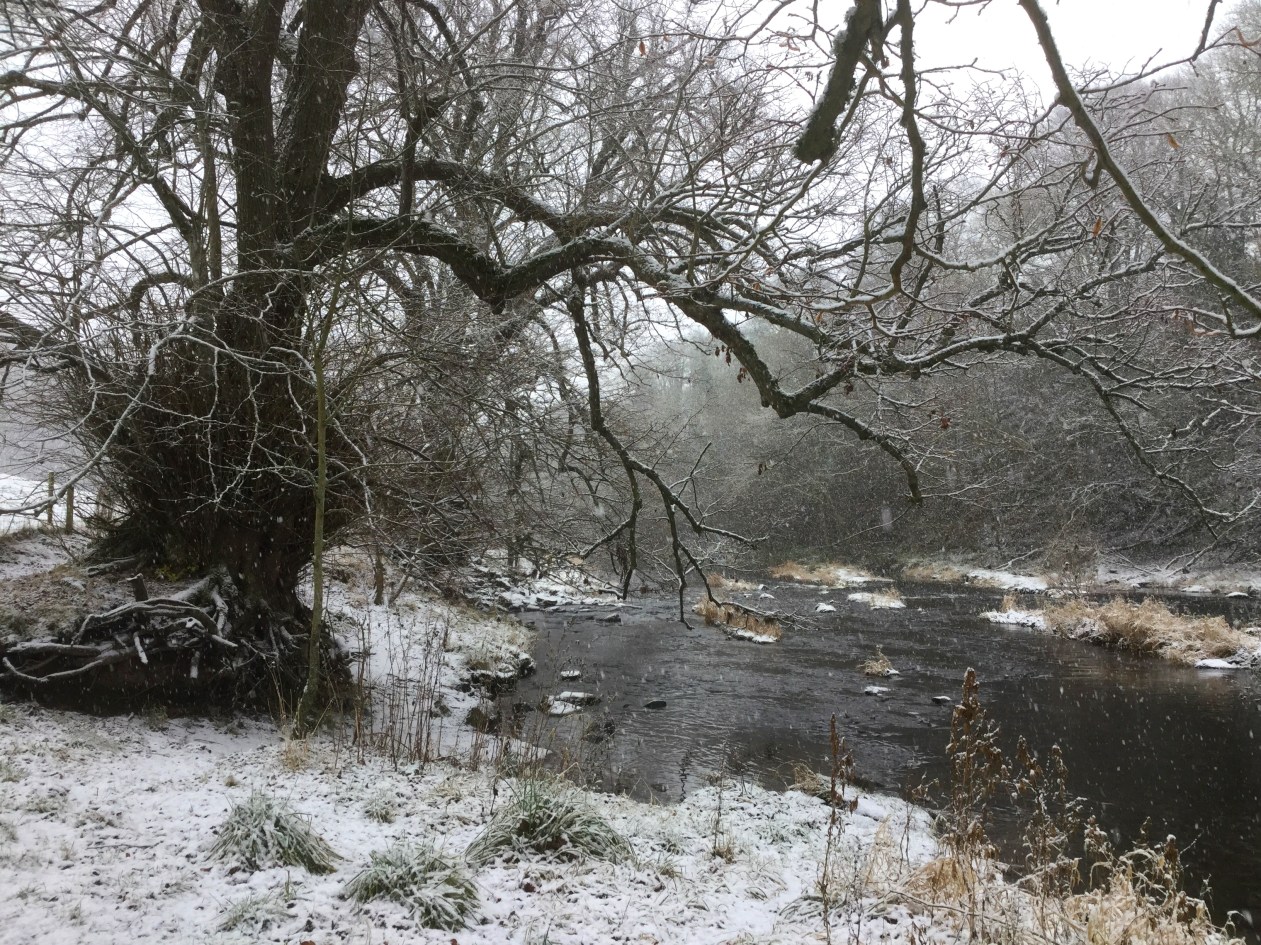
David Hume Walk along the Whiteadder River, looking east and north towards Ninewells.

After I finish my coffee, I brush as much snow off of myself as I can and bundle more firmly into my clothing: at this point, my coat is damp in places and my boots and two pairs of wool socks have allowed some of the cold and wet to reach my feet. I turn back and retrace my steps, walking more slowly this time and looking for the rocky overhangs I may find here. I don’t find much, but there is a small one with a tree that’s grown over the top of it. Perhaps the riverbank is higher here than it used to be, filling in the bottom of it. I think I’ll return in the summer when the river is lower and the banks are more accessible and not obscured by snow. When I reach the place where the wooden steps ascend the rise to the main path, I continue north this time, toward the site of Ninewells.
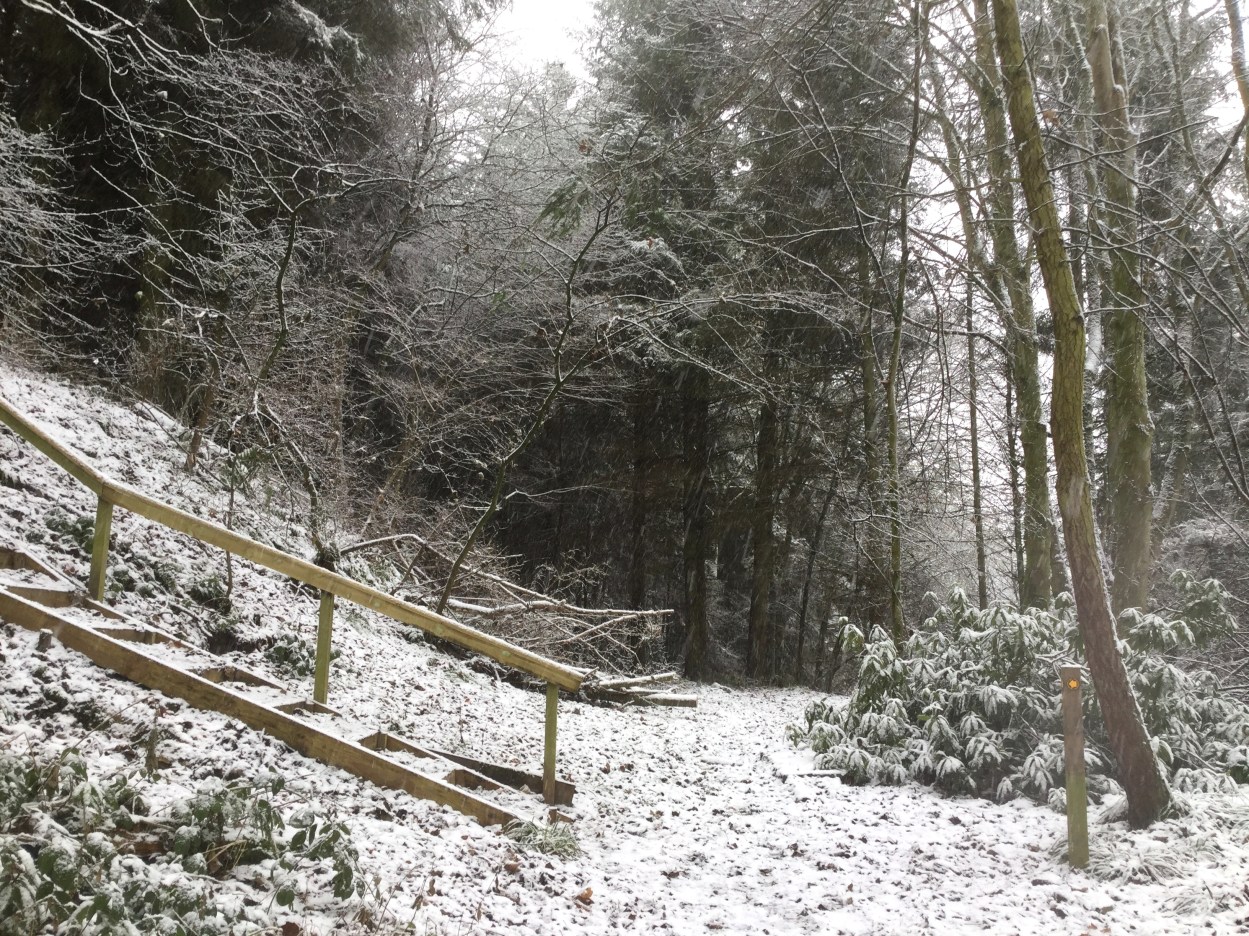
Stairs to the left continue the Chirnside Path, the unmarked branch straight ahead leads northeast and thus towards Ninewells site. So, I take the branch straight ahead
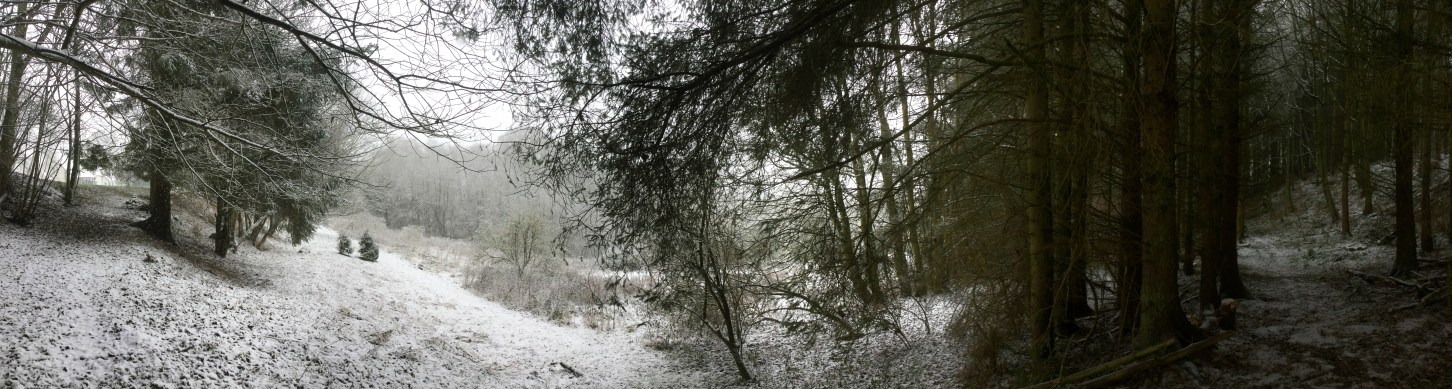
Left, the south side of the house built northeast of the original Ninewells site. Right, the path I came from branching north from Chirnside & Paxton Path

Path between the Chirnside Path and Ninewells site, with part of the rotted wood walkway passing over the springs. This is the view facing southwest as I’m returning to the main Chirnside path

As I walk, I see a raised wooden walkway rotting away under moss and leaf litter. Shortly after, my boots step off frozen ground and sink into mud. A few yards along, there’s another, even wetter patch. This is just what I hoped to find! It’s confirmation that I’m in the right place: Ninewells was named for the nine springs on the estate, which bubbled up from the slope down to the river. I’ve just passed two of them. These will have to do in lieu of any historical markers I fail to find here.

I imagine the old house and the three children, John, Katherine, and David, returning from their play along the river, wet and cold, ready for mother Katherine to bundle them up with books by the fireside. My mental picture of the old house is hazy, though, since I’ve found no images that reveal just what the house looked like during Hume’s time here. There’s an old drawing of the house, made no later than 1840, that I’ve seen here and there in my resources. It’s also reproduced on the David Hume historical placard at the head of the path to the river, which you can see below. Two successive fires damaged and then largely destroyed the original house, so David’s only brother John, his senior by two years and hence the family heir, had it rebuilt, likely in a very similar style to the original.
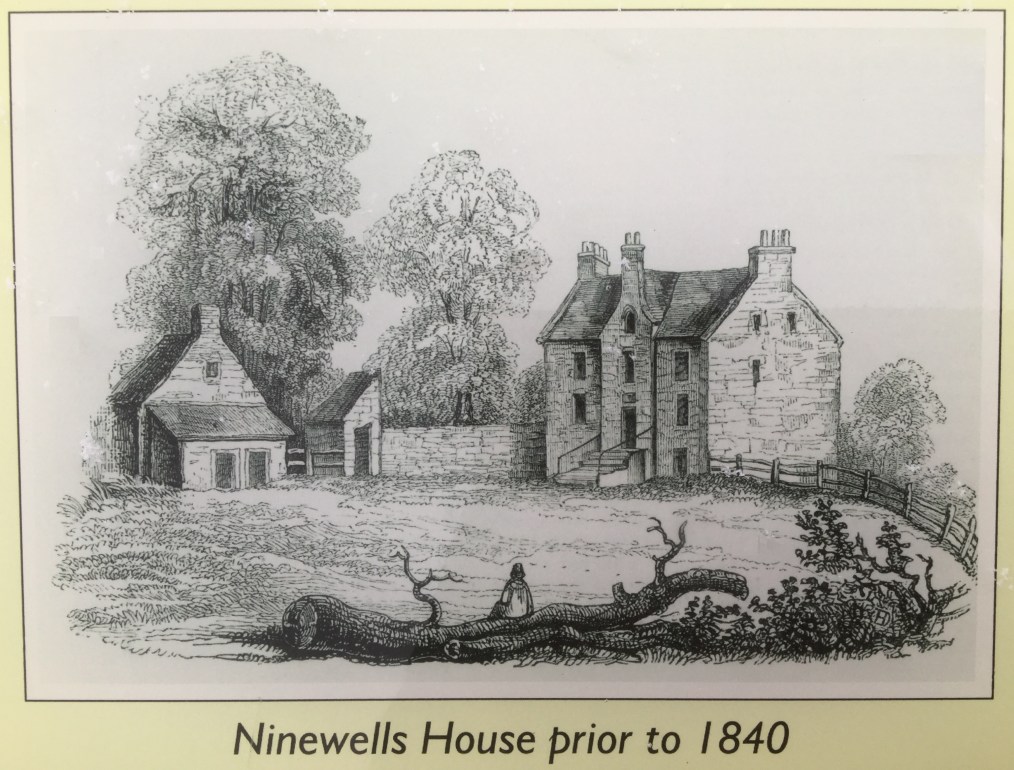
Ninewells House prior to 1840, from David Hume historical placard near Ninewells House

The house at Ninewells changed many times over the years, sometimes restored and expanded, sometimes torn down and replaced altogether. Its last incarnation, in World War II, saw its use as a hostel for displaced people and a prisoner of war camp. Its ruins were finally torn down in January of 1964. (I also find a photo of Ninewells’ ruins from the southwest, which would be my view from the path if it were still standing, in a Historic Environment Scotland website, but I’m still waiting to receive permission to publish it here.)

Clear view of the Ninewells site and south side of the modern house built to the northwest of it, looking northwest from the Chirnside Path. That places me somewhere very near or perhaps right on the old Ninewells house site. There’s no marker I can find.

I return to the main road, A6105, just to the east of the Ninewells house. A6105 veers sharply to the north where the driveway of Ninewells House meets the road, then a quarter mile on, makes a perpendicular meeting with Chirnside’s Main Street. Turning right would take you back into the village, but I’m not headed there yet. I turn left towards the river and the bridge.

The snow is still falling and my footing on the sidewalks ever more treacherous. As I walk along, there’s a truck salting the roads, so the snow on the asphalt turns quickly to muddy, icy brine. On my way to the bridge, I’m offered a ride by a kindly elderly couple. Then a little further on, I’m liberally splashed with that salty, slushy road water by the driver of a car paying no heed to the puddles or my proximity to them. I’ve spotted the danger and step as far off the road as I can when I see a car approaching, and most drivers see it too, thoughtfully veering over to avoid spraying me. But that one speedy driver just didn’t notice or care. Oh well, I’m wearing a secondhand coat anyway. From the head of the path to Ninewells to the bridge, it’s a little over a mile.
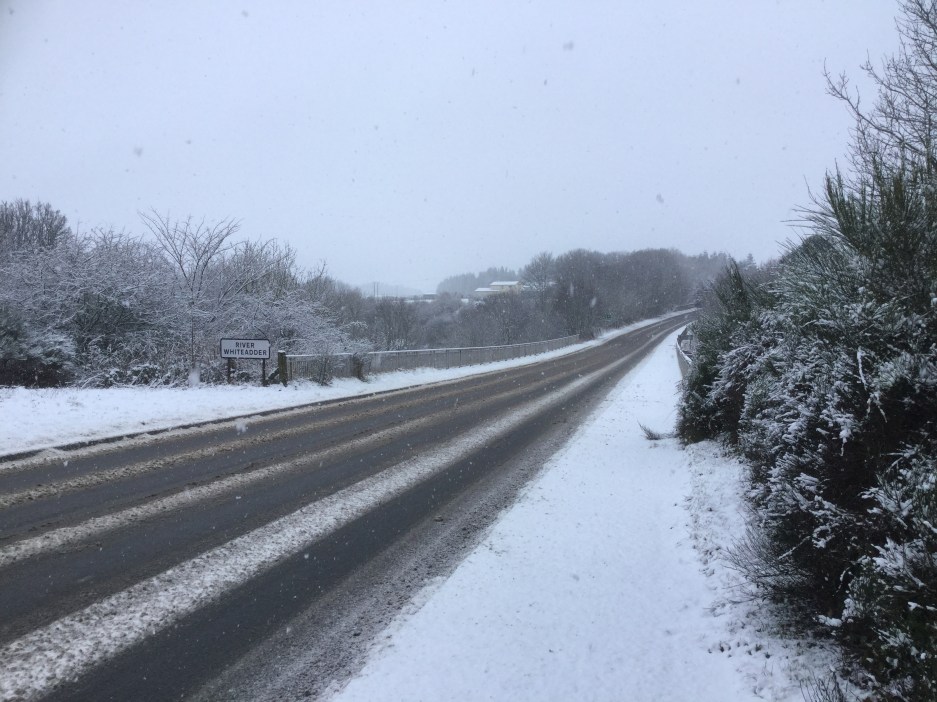
Walking on the A6105 towards the bridge over Whiteadder River from Chirnside, Scottish Borders

The David Hume Bridge over the Whiteadder Water is a modern span. I’m not sure just when it was built since its record in Historic Environment Scotland’s website doesn’t say. Not only is this bridge significant because it passes over the beautiful, rushing Whiteadder River, but because it parallels the old Chirnside Bridge. Hume left the sum of 100 pounds and instructions for its repair in his will. The bridge likely looks very much as it did then. Just beyond the bridge is the paper mill, a handsome Italianate structure built about a hundred years after the old bridge.

Looking at the old Chirnside Bridge from the David Hume Bridge over the Whiteadder River
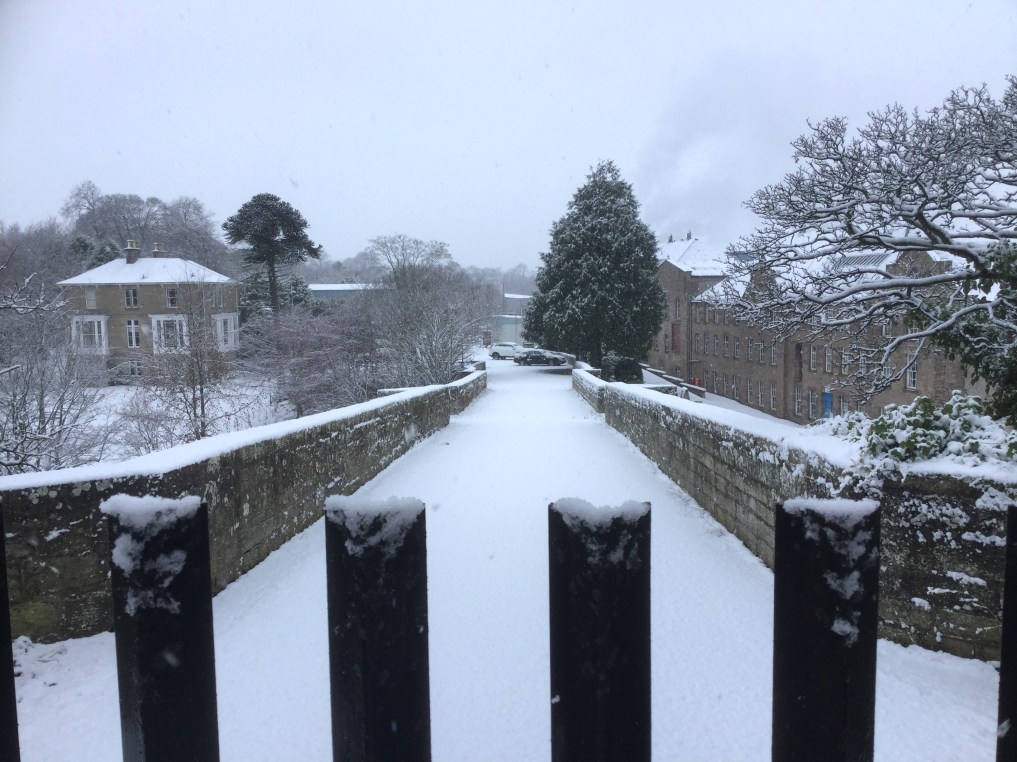
The old Chirnside Bridge over the Whiteadder River, near Chirnside, Scottish Borders

I turn and head back towards Chirnside, but pause to double back on the narrow little path that leads to the old bridge. I find I’m prevented from walking onto it by a high gate and warning signs to keep off, enforced via a CCTV camera. At this point, my gloves and much of my pants are soaked through and my toes are very cold, dampening any naughty urge I might have to climb over or go off path to find a way around the gate. Looking is enough for me for now. Maybe I’ll cross it if I get a chance to return this summer.

I return to Chirnside via the A6105, with another car splashing me even more liberally than the first one. I’m warmed somewhat by walking briskly up the hill, but still, I’m even wetter than I was on my way to the bridge, and my coat is looking rather disreputable. After a very chilly mile, my heart is gladdened when I see that the pub at the Red Lion Inn, just steps away from my bus stop across from the Chirnside Community Center, is open.

Russell, today’s master of Dovecote Cottage, at the Red Lion Inn pub, Chirnside

I find myself in a cozy, cheery room lined with gloriously warm radiators. The bartender nods his permission for me to strip off my coat and gloves and drape them on one of the radiators to dry. I plop on a barstool and promptly order a pint. My American accent, as it so often does here, sparks almost immediate conversation. I’m inclined to keep it for that reason.

I chat with the bartender and its one other patron as I hungrily devour my picnic lunch of cheese, oatcakes, biscuits, and a clementine I hadn’t found a good place to stop and eat earlier. It tastes that much better here in the warmth, washed down with my pint, accompanied by jolly conversation. We talk about the weather, where we’re all from originally, about how Russell, my barstool neighbor, was a geneticist, at one time doing research work at UCSF, and how he and his wife came to settle in this village upon retirement.

Once I’ve eaten, I move to the other side of the room to drape myself over the radiator along with my coat and gloves, mostly to warm my legs, chilly in my sodden jeans. The room is narrow here, placing little distance between us, and the conversation continues easily. When asked about what brings me here, I tell them, and we discuss my adventures of the day. Not long into that conversation, Russell says that there are just a few listed historical structures in Chirnside. He mentions the church and another place or two, and in answer to his expectant look, I say ‘…and the dovecote!’ I’ve evidently said the right thing since Russell’s face lights up. ‘I live at Dovecote Cottage!’ he tells me. I’m delighted to hear this, and Russell proceeds to tell me all about the pedigree of the structure and how dovecotes are used to ‘home’ pigeons.

I tell them of my visit to Ninewells, describing the location in relation to the river bend and landscape, and of finding the springs. They confirm that I was at the right place. At one point, Russell stops me. It’s ‘Nine-ulls,’ he says. Oh, I say apologetically, I often pronounce place names wrong here, I’m still learning. No, says the bartender, it’s ‘Ninewells’, just as you say, it’s named for the nine wells, and pointedly, to Russell, it has a ‘W’ in it. You English don’t say words right. We share a laugh over this. Our conversation continues, animated and a great deal of fun. It lasts for nearly an hour, until the time comes when I need, mentally as well as practically, to prepare myself to emerge into the cold and head for the bus stop.

At one point, Russell and Teddy, the bartender (I think I remember your name rightly, Teddy; if not and you’re reading this, please let me know!) mention one site I know nothing about: an old primary school which they claim David Hume attended as a child. This surprises me since it’s my understanding that young David and his siblings were taught at home by Katherine and tutors until the boys attended University. Perhaps I’m missing something? Russell and Teddy have an amusing little back-and-forth about the decision to place the plaque on the community center instead of the old primary school building, and how that decision was characteristic of a particular local official.
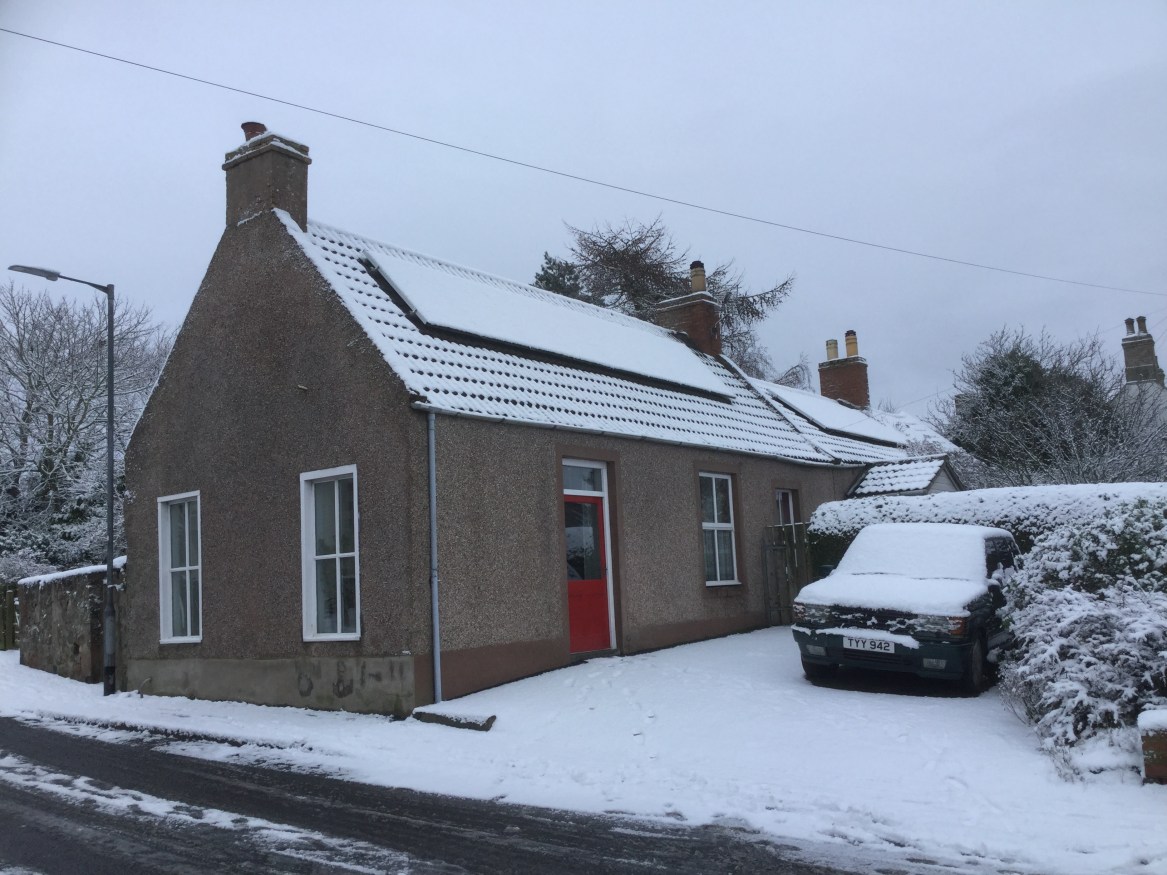
The building which Russell reports was the old Chirnside primary school expanded and converted into a family home

Russell volunteers to show me the old school, now a house, which they assure me is very nearby. When the clock advances enough to tell me we should leave to make that little excursion before I catch my bus, I rise. We laugh at the steam rising from my pant legs, well heated by the radiator I’ve been resting them against. My gloves at least are now well warmed and half dry, my coat now only damp in the places it had been sodden. I’m glad to see the muddy look has faded enough to be scarcely noticeable.

We walk past the last two buildings on Main Street before Dominies Loan and stop at the next building, on the northeast corner of Main and Dominies. It’s a very ordinary-looking, with pebbledash front and sides and a very steep roof. I comment that it looks very modern to me, and Russell agrees. But, he says, it’s been much altered since that time, as have many of the old buildings. In fact, the building was originally much smaller, and with all the additions and new siding, it’s unrecognizable. We walk up to where we can see the back of the house, and Russell points out the old stonework.

I’m intrigued. I don’t find this in any of the materials I found in my research for this day’s trip, and can’t confirm this tidbit of oral history in the resources I consult afterward. Perhaps I’ll find it in my research over time, or a helpful reader of my account of this day will guide me to some record of it. I do find an old Chirnside primary school as a listed historical building, but it’s at the other end of the village, the west end of Main Street. That one was built many decades after Hume’s death, and its only relation to him is that one of his two nieces, Katherine or Agnes, established it. My sources, Mossner’s Life of David Hume and the historical listing for the building in Historic Environment Scotland, don’t help me ascertain which.
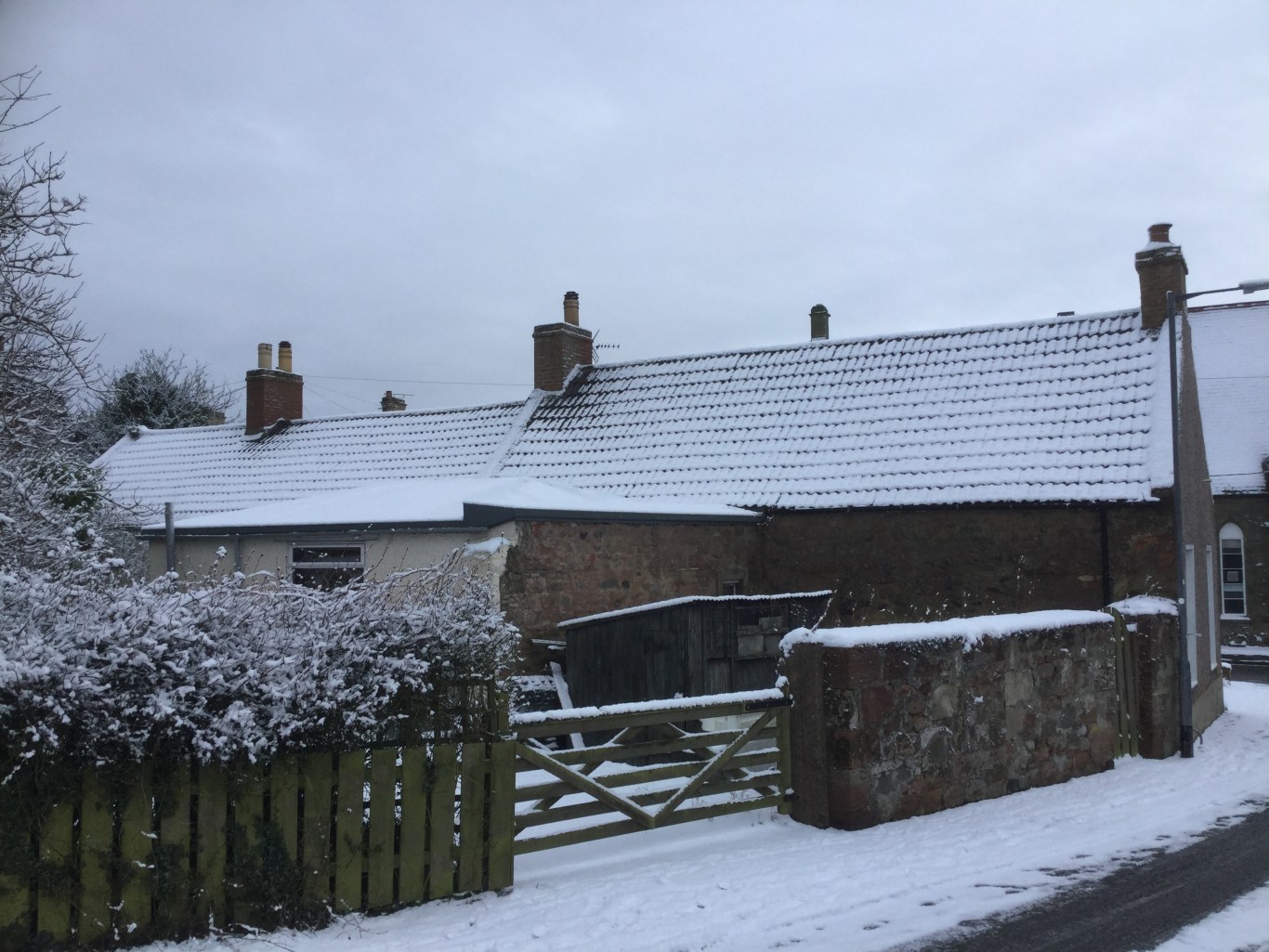
The rear walls of the old house which may have been a school, revealing some of the old stonework

Mourners enjoying an after-funeral smoke and a pint at the Red Lion Inn on Chirnside’s Main Street. I take this photo as I wait for the 60 bus back to Berwick-upon-Tweed.

We look at the building, discussing the history of the town a little more. Then, I regretfully tell Russell it’s time for me to get to the bus stop. I give him my thanks and a hug and tell him I hope to see him if I make it back and to hear from him sometime, especially if the account I write of my day’s adventure here contains any mistakes or is missing some important information.

I catch my bus, after a mercifully short wait, and return to Berwick-upon-Tweed. As I descend the steps which take me to the rail station platform and waiting room, I discover a sign which contains an interesting historical tidbit about both local and Scottish national history:

Railroad station platform on the site of the Great Hall of Berwick Castle, Berwick-upon-Tweed, England
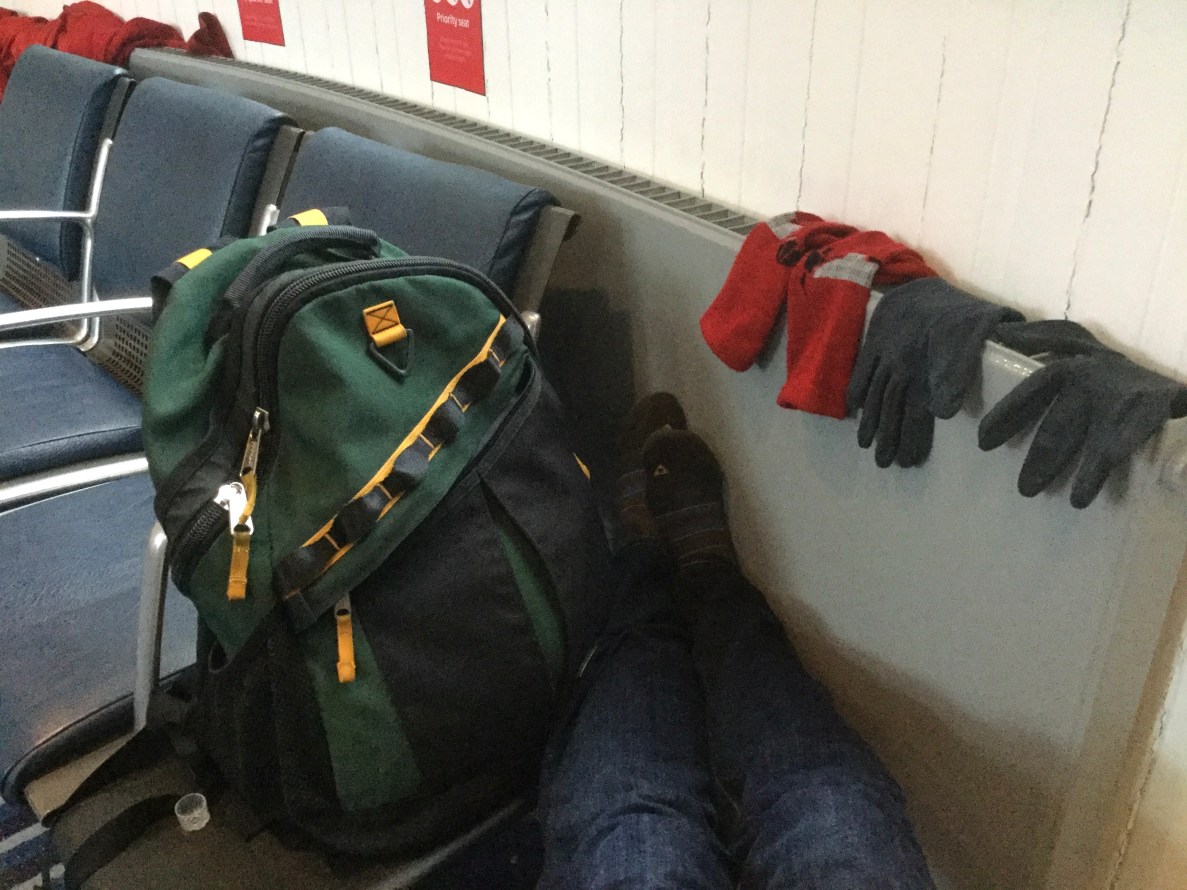
Continuing the drying-out process with the radiators in the railroad station waiting room at Berwick-upon-Tweed, England

In the waiting room, I find a comfy spot, drape my things over the radiators again, review my photos, jot down notes, and doze off a little: I was up early after a late night of research, and it’s been a somewhat taxing day. I have about an hour wait before my train arrives, but this is a nice cozy place to wait and dry off. I look forward to a hot dinner back in Edinburgh in a cozy little Sudanese restaurant near my place with some friends who are in town.

*Also published at Darrow webzine

Ordinary Philosophy and its Traveling Philosophy / History of Ideas series is a labor of love and ad-free, supported by patrons and readers like you. Please offer your support today!

~~~~~~~~~~~~~~~~~~~~~~~~~~~~~~~~~~

Sources and Inspiration:

Barton, Jim. ‘Plaque to David Hume, Chirnside‘, geograph.org.uk

Cairns, John W. ‘Hume, David (bap. 1757, d. 1838)‘, Oxford Dictionary of National Biography

Chirnside,’ Borders Family History Society website

Chirnside,‘ in Wikipedia, The Free Encyclopedia.

Chirnsidebridge, David Hume Bridge,Canmore: National Record of the Historic Environment, Historic Environment Scotland

Chirnside, in Scottish Borders (Scotland), citypopulationinfo.org

Chirnside, Kirkgate, The Old Church,’ Canmore: National Record of the Historic Environment, Historic Environment Scotland

Chirnside, Kirkgate, Chirnside Parish Church (Church of Scotland) including Graveyard, Mort-House, War Memorial, Boundary Walls, Gatepiers, Quadrant Walls, Memorial Gateway and Gates.‘ Historic Environment Scotland website

Chirnside, Kirkgate, Dovecot,’ Canmore: National Record of the Historic Environment, Historic Environment Scotland

Chirnside, Main Street West End, Elm Bank (Former Ninewells School and School House) including Ancillary Structure, Boundary Wall, Gatepiers and Gate.‘ Historic Environment Scotland website

David Hume,’ Melvin Bragg talks with Peter Millican, Helen Beebee, and James Harris for BBC Radio 4’s In Our Time, Oct 6, 2011

David Hume Anniversary Marked in Chirnside,’ BBC News, April 30, 2011

Heritage Sites Around Chirnside,’ Scottish Borders Council

Hillman’s Hyperlinked and Searchable Chambers’ Book of Days (original version published in 1869)

Hume, David. New Letters of David Hume. Ed. by Raymond Klibansky and Ernest C. Mossner. Oxford: Oxford University Press, 1954, 2011

Jefferson-Davies, Carol. ‘World’s Scholars at Chirnside,’ The Berwickshire News, July 30, 2011, republished at the Hume Society website

Jim Clark OBE (1936 – 1968),’ Unique Cars & Parts website

Morris, William Edward and Brown, Charlotte R., ‘David Hume‘, The Stanford Encyclopedia of Philosophy

Mossner, Ernest C. The Life of David Hume. Austin, TX, 2001.

Mossner, Ernest C. ‘Hume at La Flèche, 1735: An Unpublished Letter.‘ Texas Studies in English, vol. 37, 1958, pp. 30–33. JSTOR

Ninewells House,’ Canmore: National Record of the Historic Environment, Historic Environment Scotland

Ritchie, Thomas Edward. An Account of the Life and Writings of David Hume, Esq. London: T. Cadell and W. Davies, 1807

Scott, Hew; Macdonald, Donald Farquhar. Fasti Ecclesiæ Scoticanæ; Succession of Ministers in the Church of Scotland from the Reformation. Edinburgh: Oliver & Boyd, 1915

Sutherland, Stewart. ‘David Hume and Civil Society,’ Gifford Lecture, October 25, 2011. University of Edinburgh College of Arts, Humanities and Social Sciences website

Thursfield, J.R., revised by H. C. G. Matthew. ‘Marjoribanks, Edward, second Baron Tweedmouth (1849–1909)‘, Oxford Dictionary of National Biography

Which is More Fundamental: Processes or Things? by Celso Vieira

Glass Half Full or Half Empty by Sealle, public domain via Wikimedia Commons

Metaphysics is the attempt to understand how existence works by examining the building blocks of reality, the distinctions between mental and physical entities, and the fundamental questions of being and reality. But metaphysics is not only an arcane branch of philosophy: human beings use metaphysical assumptions to navigate the world. Assumptions about what exists and what is fundamental exert a powerful influence on our lives. Indeed, the less aware we are of our metaphysical assumptions, the more we are subject to them.

Western metaphysics tends to rely on the paradigm of substances. We often see the world as a world of things, composed of atomic molecules, natural kinds, galaxies. Objects are the paradigmatic mode of existence, the basic building blocks of the Universe. What exists exists as an object. That is to say, things are of a certain kind, they have some specific qualities and well-defined spatial and temporal limits. For instance: Fido is my dog, he is grey, and was born one year ago. (It’s worth noting that such a simple statement will give rise to a litany of metaphysical disputes within substance metaphysics: realists believe that universals, such as the natural kind ‘dogs’, exist while nominalists believe them to be only intellectual abstractions.)

Though substance metaphysics seems to undergird Western ‘common sense’, I think it is wrong. To see this, consider the cliché about the glass of water: is it half-empty or half-full? The question assumes a static arrangement of things serving as a basis for either an optimistic or a pessimistic interpretation. One can engage in interminable disputes about the correct description of the physical set-up, or about the legitimacy of the psychological evaluations. But what if the isolated frame ‘a glass of water’ fails to give the relevant information? Anyone would prefer an emptier glass that is getting full to a fuller one getting empty. Any analysis lacking information about change misses the point, which is just what substance metaphysics is missing. Process philosophers, meanwhile, think we should go beyond looking at the world as a set of static unrelated items, and instead examine the processes that make up the world. Processes, not objects, are fundamental.

The pre-Socratic Greek philosopher Heraclitus provides the most famous image of process metaphysics. ‘It is not possible,’ he says, ‘to step twice into the same river’ – because existence depends on change; the river you step into a second time is changed from the river you stepped into originally (and you have changed in the interval, too). And while substance philosophers will tend to search for the smallest constituent objects in order to locate reality’s most fundamental building blocks, process philosophers think this is insufficient. So do modern physicists. Electrons are now understood as bundles of energy in a field, and quantum vacuum fluctuations prove that there are fields without bundles but no bundles without fields. Things seem to be reducible to processes – and not the reverse. (As the philosopher Alfred North Whitehead put it, we should think about ‘occurrences’ instead of ‘things’.)

Change poses a recurring problem for substance metaphysics. Universals have traditionally been a popular way to circumvent it. These static entities are difficult to define precisely, but can be thought of as ‘hyper-things’ that are instantiated in many different particular things. A universal is the thing that particulars have in common, such as types, kinds and relations. Universals are essentially different from particulars: Aristotle, for instance, argued that particulars – such as Fido my dog – are subject to generation and corruption, while species – the universal – are eternal. This particular example provides another instance in which science seems to favour process metaphysics. Thanks to the theory of evolution, the Aristotelian view that species are unchanging and eternal was proven wrong. Species evolve. They change. Dogs, after all, evolved from wolves to constitute a whole different kind. Once again, we’re better off using the paradigm of change rather than substance.

Process metaphysics leads to a re-evaluation of other important philosophical notions. Consider identity. To explain why things change without losing their identity, substance philosophers need to posit some underlying core – an essence –that remains the same throughout change. It is not easy to pin down what this core might be, as the paradox of Theseus’ ship illustrates. A ship goes on a long voyage and requires significant repairs: new planks to replace the old, fresh oars to replace the decayed, and so on, until, by the time the ship returns to port, there is not one single piece that belonged to the ship when it departed. Is this the same ship, even though materially it is completely different? For substance philosophers, this is something of a paradox; for process philosophers, this is a necessary part of identity. Of course it is the same ship. Identity ceases to be a static equivalence of a thing with itself. After all, without the repairs, the ship would have lost its functionality. Instead, as the German philosopher Nicholas Rescher argues in Ideas in Process (2009), identity just is a programmatic development. That is, the identity of a process is the structural identity of its programme. Other things being equal, every puppy will turn out to be a dog. (This programme need not be thought of as deterministic. The interactions between processes, Rescher argues, open room for variations.)

Processes are not the mere intervals between two different states of affairs or two objects, as the paradox of the heap exemplifies: take a heap of sand and remove one grain. It remains a heap; one grain doesn’t make a difference. But if you repeat the subtraction enough times, eventually there will be just one grain. Clearly, this isn’t a heap. Where did it become a non-heap? By looking at the process, and not the end-states of affairs, you’ll realise the impossibility of pinpointing the boundary between heap and non-heap. (Similarly, no individual was the exact turning point between wolves and dogs.) At the very least, this gives us a warning about the unnoticed abstraction operating on our division of natural kinds. Process philosophers such as Henri Bergson stop at this negative conclusion, believing that processes cannot be known but only experienced. Regardless, as the Danish philosopher Johanna Seibt notes, it might just be the case that focusing on the process requires a whole new perspective.

Looking at the world as a manifold of interconnected processes has scientific and philosophical advantages, but there are more prosaic benefits too. Process philosophy invites us to look at longer stretches of time, blurred boundaries and connected relations. Identity as a programmatic – but not deterministic – process welcomes innovation through small, recurring changes. Under these metaphysical assumptions, a meaningful life is less about finding your ‘real’ self than expanding its boundaries. Aeon counter – do not remove

This article was originally published at Aeon and has been republished under Creative Commons.

Celso Vieira has a PhD in philosophy from the Federal University of Minas Gerais in Brazil. He lives in Belo Horizonte where he started the first Brazilian chapter of the effective altruist group The Life You Can Save. (Bio credit: Aeon)

~ Ordinary Philosophy and its Traveling Philosophy / History of Ideas series is a labor of love and ad-free, supported by patrons and readers like you. Please offer your support today!

*All views and opinions expressed by guest writers are their own and do not necessarily express those of Ordinary Philosophy’s editors and publishers

Happy Birthday, Baruch Spinoza!

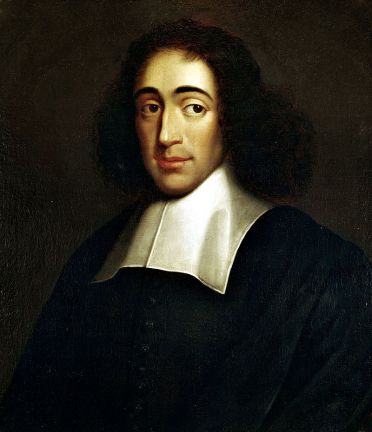
Portrait of Baruch de Spinoza (1632-1677), ca. 1665, by an unknown artist

Baruch Spinoza was born on November 24, 1632, in Amsterdam, the Netherlands. He was the son of Michael and Hannah Spinoza, Portuguese Jews who were forced to convert to Christianity, then imprisoned and tortured by the Inquisition, then fled to relatively tolerant Amsterdam. The Spinozas became successful and respected members of Amsterdam’s Jewish community.

Their son Baruch (also called by his Latinized name Benedicto, also meaning ‘blessed’), was a precocious and brilliant boy who became an intellectually rigorous, curious, and free-thinking man. He wrote prodigiously, profoundly, and often obscurely while earning a humble living as a scientific instrument lens-grinder. He was excommunicated for his unorthodox beliefs (rather surprising still given the relative broad-mindedness of that synagogue), shunned and condemned by his fellow Jews and by Christians alike, and lived the rest of his too-short life in near-solitude, though in rich correspondence with a wide circle of friends and intellectuals.

His idea of God as a unified substance which, in some sense, can be understood as being the same as Nature or the Universe itself, is still widely beloved (the great physicist Albert Einstein and eloquent, outspoken atheist Christopher Hitchens, for example, were among his biggest fans), hated, and debated widely, especially insofar as it can be difficult to grasp the exact nature of Spinoza’s metaphysical and ethical ideas. Spinoza refused to repudiate his ideas despite the intense social pressure he had to deal with for the rest of his life. But however much his correspondents argued, cajoled, threatened with hellfire, or otherwise tried to convince him to abandon his beliefs, Spinoza responded with firmness, constancy, thoroughness, and courtesy.

Learn more about the integrious Baruch Spinoza at:

Baruch Spinoza ~ by Steven Nadler for The Stanford Encyclopedia of Philosophy

Baruch Spinoza (1632 – 1677) ~ in the Jewish Virtual Library

Benedict De Spinoza (1632—1677) ~ by Blake D. Dutton for the Internet Encyclopedia of Philosophy

Betraying Spinoza ~ Rebecca Goldstein on her book Betraying Spinoza: The Renegade Jew Who Gave Us Modernity

Benedict de Spinoza: Dutch-Jewish Philosopher ~ by Richard H. Popkin for the Encyclopædia Britannica

From Baruch to Benedicto! (Spinoza pt. 1) and Spinoza Part 2 ~ by Stephen West for Philosophize This! podcast

God Intoxicated Man – The Life and Times of Benedict Spinoza ~ by Michael Goldfarb for the BBC’s Sunday Feature

Spinoza ~ Melvin Bragg discusses Spinoza’s life and thought with Jonathan Rée, Sarah Hutton, and John Cottingham for In Our Time

The Heretic Jew ~ by Harold Bloom, book review of Rebecca Goldstein’s Betraying Spinoza: The Renegade Jew Who Gave Us Modernity for The New York Times

The Writings of Spinoza ~ at Internet Sacred Text Archive

Ordinary Philosophy and its Traveling Philosophy / History of Ideas series is a labor of love and ad-free, supported by patrons and readers like you. Please offer your support today!

Enlightenment Scotland: Adam Smith’s Grave at Canongate Kirkyard

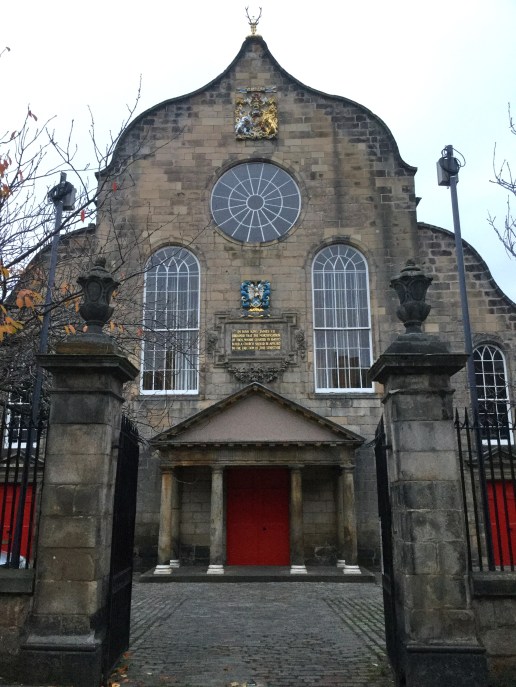
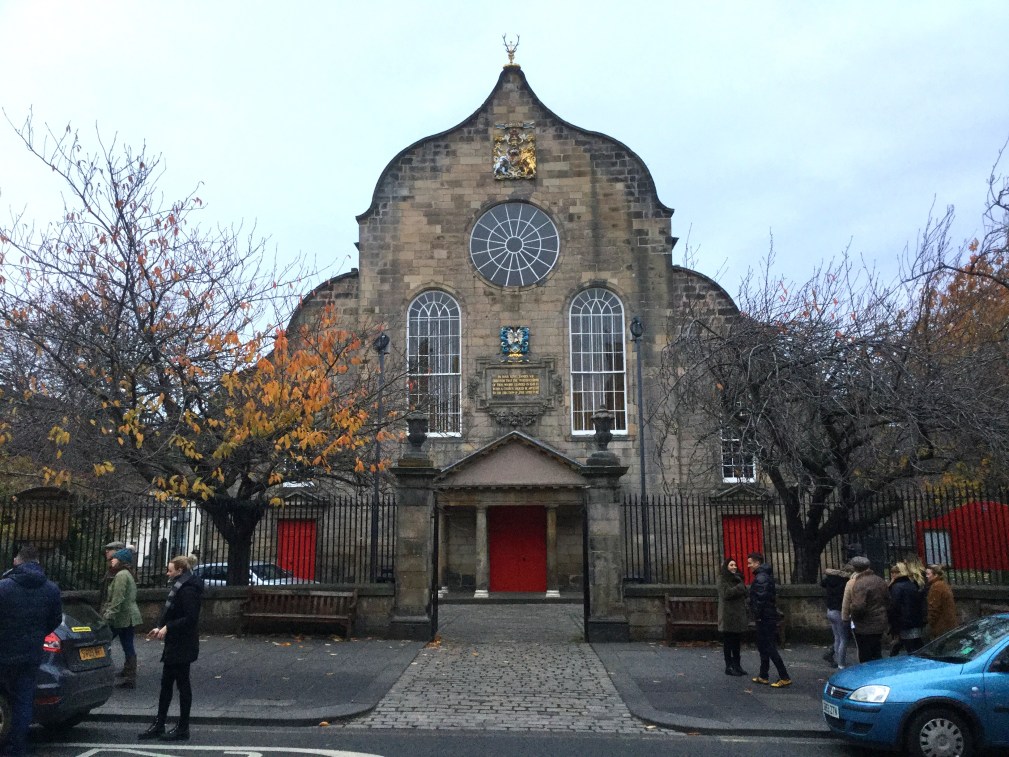
Canongate Kirk on the Royal Mile, Edinburgh, Scotland

Here in Edinburgh, where I’ve returned to University to earn my Master’s degree, I love to visit sites and monuments associated with the Enlightenment. As a lover of philosophy, the rich intellectual history of this city first brought me here: I followed (and still do) in the footsteps of David Hume for my first traveling philosophy/history of ideas series for O.P. I think it’s high time I share more of my explorations with you!

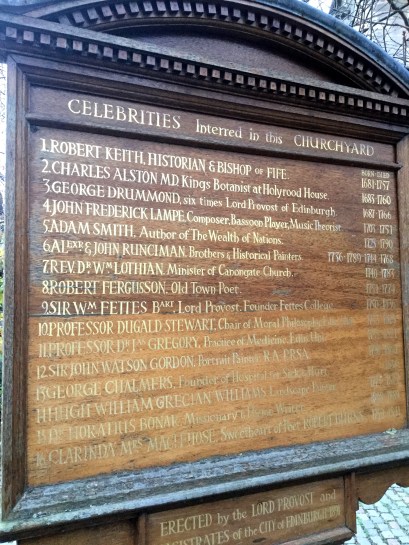
I’ll start with my visit yesterday afternoon to the great moral philosopher and economist Adam Smith‘s grave in Canongate Kirkyard on the Royal Mile. The lovely Kirk of the Canongate was built form 1688-1691, and is quite different in style than the other buildings on the Royal Mile. The graveyard behind it, however, is very like many others to be found behind kirks all over and around this great city, and includes the gravesites of many great Scots.

Canongate Kirkyard on the Royal Mile with Adam Smith’s grave center-left, Edinburgh, Scotland

Adam Smith’s grave in Canongate Kirkyard on the Royal Mile, Edinburgh, Scotland. Many of Adam Smith’s moral and political theories, and his ideas on trade and economics, were developed from the ideas of his great friend and mentor David Hume.

Canongate Kirk on the Royal Mile, Edinburgh, Scotland

List of famous people buried at Canongate Kirkyard on the Royal Mile, Edinburgh, Scotland

Ordinary Philosophy and its Traveling Philosophy / History of Ideas series is a labor of love and ad-free, supported by patrons and readers like you. Please offer your support today!

When I Help You, I Also Help Myself: On Being a Cosmopolitan, by Massimo Pigliucci

Kunyu Quantu, or Map of the World, 1674 by Ferdinand Verbiest. At the Hunterian Museum, University of Glasgow

One of the axioms of modern morality is that there is an inevitable tension between altruism and selfishness. The more you focus your attention, energy and resources toward your own benefit, the less ‘of course’ you can do for others. As a result, we all strive to find some balance between these two opposing demands, often ending up far short of our ideal, and feeling guilty about it. (Well, some of us feel guilty, at any rate.)

But what if this is in fact a false dichotomy? What if we adopted a different framework, according to which helping ourselves helps humanity at large, and conversely, helping others helps us as well? This is the basic idea behind cosmopolitanism, literally being a citizen of the world, which originated in Ancient Greece and was further developed in Rome. Turns out, ancient Greco-Roman philosophy still has a thing or two to teach us moderns.

The term ‘cosmopolitan’ was associated with the ancient Cynic philosophers, named after a word that didn’t have the modern connotation at all, but rather indicated a group of radicals devoted to challenging society’s norms by living simply, owning no property or housing. One of the schools of Hellenistic philosophy influenced by the Cynics was that of the much more mainstream Stoics (who lived in actual houses, and some – like the Roman Senator Seneca – were even rich). The Stoics developed the idea of cosmopolitanism into a general philosophy that guided their everyday thoughts and actions. As Epictetus, the slave-turned-philosopher of second-century Rome, put it in Discourses: ‘Do as Socrates did, never replying to the question of where he was from with: “I am Athenian,” or “I am from Corinth,” but always: “I am a citizen of the world.”’ This strikes me as something we ought to remember, internalise, and practise – especially in these times of fear-mongering, xenophobia, Brexit, Trumpism, and nationalistic tribalism.

The Stoic idea was simple and elegant: all humans inhabit the same big city, indeed we are so interconnected and interdependent that we are really an extended family, and we ought to act accordingly, for our own sake. The Stoic philosopher Hierocles came up with the image of a number of concentric circles of concern: at the centre of the smaller, inner circle, is you. Right outside is the circle of your family. Outside that is the one comprising your friends. The next circle over is that of your fellow citizens (ie, in the literal sense of those inhabiting the same city), then that of your countrymen, and finally humanity at large.

A modern philosopher such as Peter Singer talks of expanding the circles, meaning that we should aim at enlarging our concerns to encompass more and more people, thus overcoming our natural selfishness. Hierocles, in contrast, thought that we should aim at contracting the circles, bringing other people closer to us because we realise that they are our own kin. The closer we get them to us, the more the self/other dichotomy dissolves, and the more our interests align with those of our community. Indeed, Hierocles went so far as to instruct his students to address strangers as ‘brothers’ and ‘sisters’ (or, depending on their age, as ‘uncles’ and ‘aunts’), in an early form of cognitive therapy aiming at restructuring the very way we think about others – and consequently the way we act toward them.

In his Meditations, the emperor Marcus Aurelius, also a Stoic, summarised the idea of cosmopolitanism and our duty to others in the form of a logical sequence: ‘If the intellectual part is common to all men, so is reason, in respect of which we are rational beings: if this is so, common also is the reason that commands us what to do, and what not to do; if this is so, there is a common law also; if this is so, we are fellow-citizens; if this is so, we are members of some political community.’

This is what the Stoics captured in one of their fundamental slogans: ‘Live according to nature.’ It doesn’t mean that we should go around naked, hugging trees in the forest, but rather that we should examine human nature and live according to it. And human nature is fundamentally that of a social being capable of reason. (Notice that I said capable of reason, some of us employ such capacity more often or more keenly than others…) It follows that living according to, or in harmony with, nature, means doing our part to use reason to improve society. Whenever we do so, we at the same time make things better for us (because social beings thrive in a functional and just society) as well as for others. Which means that the modern self/other dichotomy is far too simplistic, and in fact misleading, because it artificially pits the interests of the individual against those of society. Of course, there will always be specific cases where we have to choose between the immediate interests of, say, our children and those of strangers. But keeping in mind that in the long run our children will thrive in a flourishing society helps to shift our way of thinking from treating life as a zero-sum game to seeing it as a cooperative one.

Stoic cosmopolitanism should not be taken to imply that the ideal human society resembles a beehive, where individuality is subsumed for the benefit of the group. On the contrary, the Stoics were keen defenders of human freedom and very much valued the independence of individual agents. But they thought that the freedom to pursue our individual goals, to flourish in our own way, is predicated on the existence of a society of similarly free individuals. And such society is possible only if we realise that our collective interests are broadly aligned. We might be from Athens or Corinth (or the United States or Mexico) as an accident of birth, but in a deeper sense we are all members of the same global polis. We would be well advised to start acting like it.Aeon counter – do not remove

This article was originally published at Aeon and has been republished under Creative Commons.

Massimo Pigliucci is professor of philosophy at City College and at the Graduate Center of the City University of New York. His latest book is How to Be a Stoic: Ancient Wisdom for Modern Living, 2017. He lives in New York. (Bio credit: Aeon)

~ Ordinary Philosophy and its Traveling Philosophy / History of Ideas series is a labor of love and ad-free, supported by patrons and readers like you. Please offer your support today!

*All views and opinions expressed by guest writers are their own and do not necessarily express those of Ordinary Philosophy’s editors and publishers

Say What? Montaigne on Accuracy

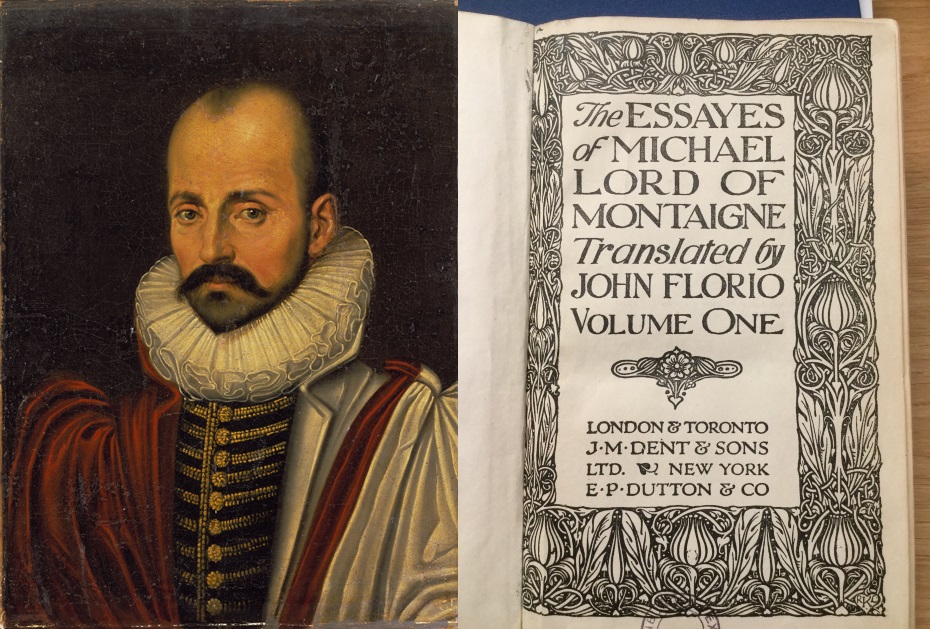
Michel de Montaigne and the frontispiece to an early 1900’s publication of Florio’s translation of his ‘Essayes’. Below is a later one by Donald Frame

‘This man I had [stay at my house] was a simple, crude fellow–a character fit to bear true witness: for clever people observe more things and more curiously, but they interpret them; and to lend weight and conviction to their interpretation, they cannot help altering history a little. They never show you things as they are, but bend and disguise them according to the way they have seen them; and to give credence to their judgment and attract you to it, they are prone to add something to their matter, to stretch it out and amplify it. We need a man either very honest, or so simple that he has not the stuff to build up false inventions and give them plausibility; and wedded to no theory.’

– From Michel de Montaigne’s Essays: ‘Of Cannibals’

Ordinary Philosophy and its Traveling Philosophy / History of Ideas series is a labor of love and ad-free, supported by patrons and readers like you. Please offer your support today!

He Died as He Lived: David Hume, Philosopher and Infidel, by Dennis Rasmussen

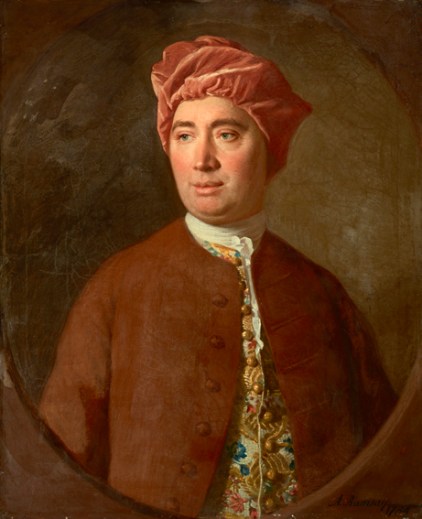
As the Scottish philosopher David Hume lay on his deathbed in the summer of 1776, his passing became a highly anticipated event. Few people in 18th-century Britain were as forthright in their lack of religious faith as Hume was, and his skepticism had earned him a lifetime of abuse and reproach from the pious, including a concerted effort to excommunicate him from the Church of Scotland. Now everyone wanted to know how the notorious infidel would face his end. Would he show remorse or perhaps even recant his skepticism? Would he die in a state of distress, having none of the usual consolations afforded by belief in an afterlife? In the event, Hume died as he had lived, with remarkable good humour and without religion.

The most famous depiction of Hume’s dying days, at least in our time, comes from James Boswell, who managed to contrive a visit with him on Sunday, 7 July 1776. As his account of their conversation makes plain, the purpose of Boswell’s visit was less to pay his respects to a dying man, or even to gratify a sense of morbid curiosity, than to try to fortify his own religious convictions by confirming that even Hume could not remain a sincere non-believer to the end. In this, he failed utterly.

‘Being too late for church,’ Boswell made his way to Hume’s house, where he was surprised to find him ‘placid and even cheerful … talking of different matters with a tranquility of mind and a clearness of head which few men possess at any time.’ Ever tactful, Boswell immediately brought up the subject of the afterlife, asking if there might not be a future state. Hume replied that ‘it was possible that a piece of coal put upon the fire would not burn; and he added that it was a most unreasonable fancy that we should exist for ever’. Boswell persisted, asking if he was not made uneasy by the thought of annihilation, to which Hume responded that he was no more perturbed by the idea of ceasing to exist than by the idea that he had not existed before he was born. What was more, Hume ‘said flatly that the morality of every religion was bad, and … that when he heard a man was religious, he concluded he was a rascal, though he had known some instances of very good men being religious.’

This interview might show Hume at his brashest, but in the 18th century it remained mostly confined to Boswell’s private notebooks. The most prominent and controversial public account of Hume’s final days came instead from an even more famous pen: that of Adam Smith, Hume’s closest friend. Smith composed a eulogy for Hume soon after the latter’s death in the form of a public letter to their mutual publisher, William Strahan. This letter was effectively the ‘authorised version’ of the story of Hume’s death, as it appeared (with Hume’s advance permission) as a companion piece to his short, posthumously published autobiography, My Own Life (1776).

Smith’s letter contains none of the open impiety that pervades Boswell’s interview, but it does chronicle – even flaunt – the equanimity of Hume’s last days, depicting the philosopher telling jokes, playing cards, and conversing cheerfully with his friends. It also emphasises the excellence of Hume’s character; indeed, Smith concluded the letter by declaring that his unbelieving friend approached ‘as nearly to the idea of a perfectly wise and virtuous man, as perhaps the nature of human frailty will permit’.

Though relatively little known today, in the 18th century Smith’s letter caused an uproar. He later proclaimed that it ‘brought upon me 10 times more abuse than the very violent attack I had made upon the whole commercial system of Great Britain’ – meaning, of course, The Wealth of Nations (1776). Throughout his life, Smith had generally gone to great lengths to avoid revealing much about his religious beliefs – or lack thereof – and to steer clear of confrontations with the devout, but his claim that an avowed skeptic such as Hume was a model of wisdom and virtue ‘gave very great offence’ and ‘shocked every sober Christian’ (as a contemporary commented).

Boswell himself deemed Smith’s letter a piece of ‘daring effrontery’ and an example of the ‘poisonous productions with which this age is infested’. Accordingly, he beseeched Samuel Johnson to ‘step forth’ to ‘knock Hume’s and Smith’s heads together, and make vain and ostentatious infidelity exceedingly ridiculous. Would it not,’ he pleaded, ‘be worth your while to crush such noxious weeds in the moral garden?’

Nor did the controversy subside quickly. Nearly a century later, one prolific author of religious tomes, John Lowrie, was still sufficiently incensed by Smith’s letter to proclaim that he knew ‘no more lamentable evidence of the weakness and folly of irreligion and infidelity’ in ‘all the range of English literature’.

In the 18th century, the idea that it was possible for a skeptic to die well, without undue hopes or fears, clearly haunted many people, including Boswell, who tried to call on Hume twice more after their 7 July conversation in order to press him further, but was turned away. Today, of course, non-believers are still regarded with suspicion and even hatred in some circles, but many die every day with little notice or comment about their lack of faith. It takes a particularly audacious and outspoken form of non-belief – more akin to the Hume of Boswell’s private interview than to the Hume of Smith’s public letter – to arouse much in the way of shock or resentment, of the kind that attended the death of Christopher Hitchens some years ago. (Indeed, there were a number of comparisons drawn between Hitchens and Hume at the time.) The fact that in the 18th century Smith endured vigorous and lasting abuse for merely reporting his friend’s calm and courageous end offers a stark reminder of just how far we have come in this regard.Aeon counter – do not remove

This article was originally published at Aeon and has been republished under Creative Commons.

Dennis Rasmussen is an associate professor in the department of political science at Tufts University in Massachusetts. He is the author of The Infidel and the Professor: David Hume, Adam Smith, and the Friendship That Shaped Modern Thought (2017). (Bio credit: Aeon)

~ Ordinary Philosophy is a labor of love and ad-free, supported by patrons and readers like you. Any support you can offer will be deeply appreciated!

*All views and opinions expressed by guest writers are their own and do not necessarily reflect those of Ordinary Philosophy’s editors and publishers

O.P. Recommends: The Relentless Honesty of Ludwig Wittgenstein, by Ian Ground

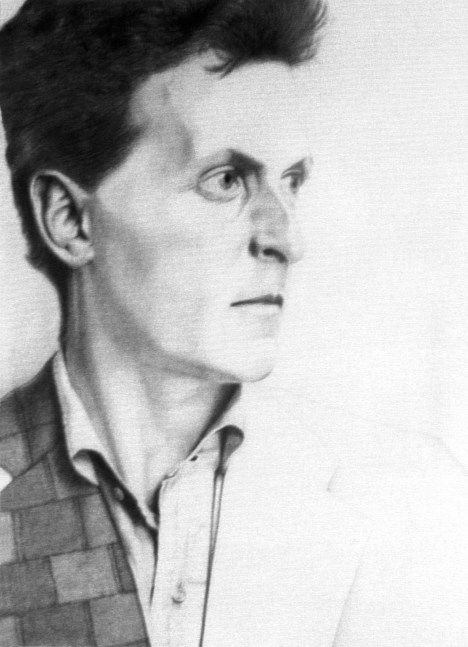
Drawing of Ludwig Wittgenstein by Christiaan Tonnism, Pencil on board 1985, Creative Commons via Wikimedia Commons

Ian Ground writes:

‘If you ask philosophers – those in the English speaking analytic tradition anyway – who is the most important philosopher of the twentieth century, they will most likely name Ludwig Wittgenstein. But the chances are that if you ask them exactly why he was so important, they will be unable to tell you. Moreover, in their own philosophical practice it will be rare, certainly these days, that they mention him or his work. Indeed, they may very fluently introduce positions, against which Wittgenstein launched powerful arguments: the very arguments which, by general agreement, make him such an important philosopher. Contemporary philosophers don’t argue with Wittgenstein. Rather they bypass him. Wittgenstein has a deeply ambivalent status – he has authority, but not influence.

For the more general reader, Wittgenstein’s status in contemporary philosophy will be puzzling. The general view is that Wittgenstein is surely the very model of a great philosopher. The perception is that he is difficult, obscure and intense, severe and mystical, charismatic and strange, driven and tragic, with his charisma and difficulty bound up with his character and his life. Wittgenstein saw philosophy not just as a vocation, but as a way of life he had to lead. This is perhaps why writers and artists have found him an object of fascination and inspiration. He is the subject of novels, poetry, plays, painting, music, sculpture and films. In the arts and the culture generally, Wittgenstein seems to be what a philosopher ought to be

Read more of this excellent piece in The Times Literary Supplementpart of a TLS series about great thinkers and their ideas called Footnotes to Plato

~ Ordinary Philosophy is a labor of love and ad-free, supported by patrons and readers like you. Any support you can offer will be deeply appreciated!

Black Issues in Philosophy – A New Series Presented by the American Philosophical Association Blog

Here’s the announcement by the APA:

‘Dear Readers:

We here introduce Black Issues in Philosophy: Blog of the APA Committee on the Status of Black Philosophers.

The purpose of this series is to offer announcements, discussions, critical reviews, opinionated statements (op-eds), and philosophical suggestions, ideas, or explorations relevant to the status of philosophers of African descent and readers interested in such issues….’

You can read articles, find out how to contribute, and more at the APA’s website

Ordinary Philosophy and its Traveling Philosophy / History of Ideas series is a labor of love and ad-free, entirely supported by patrons and readers like you. Please offer your support today!