Basic Income: Scotland & Beyond, by Kallum Corke

4ef8b-moneycountingpaydayImagine, for a moment, that you received enough money each month to cover all of your basic needs – no strings attached, regardless of whether or not you chose to work.

What would you do?

The ‘radical’ idea that none of us should have to work to survive is the basis of the Universal Basic Income (UBI), a monthly stipend payable to every person, regardless of how they choose to spend their time. Designed to replace existing, means-tested benefit and create a stable ‘economic floor’ under each individual, UBI offers a range of advantages over our current welfare system. For starters, the single, unconditional payment would do away with the expensive means-testing and sprawling bureaucracy that currently distributes benefit, actually saving money. Other benefits (among many) include increasing individual bargaining power in an increasingly exploitative and precarious labour market, rewarding women’s ‘invisible labour’ in the home, facilitating entrepreneurship and stimulating innovation, oh – and of course, eradicating poverty outright.

Basic Income is a resurgent economic idea with a surprisingly long history; advocated by Thomas Paine (who argued for payments to every person “rich or poor” financed by a “ground-rent” paid by property owners) and Friedrich Hayek, (who believed a basic level of economic security would greatly increase individual freedom) among other famous advocates from both the left and right of the political spectrum, it has been tried in various forms throughout history. Experiments in Canada and the U.S. in the 1970s and Uganda in 2008, for example, have explored the idea of a guaranteed income (or, a negative income tax in the U.S. example). While the methods have varied, the results have generally been similar: increased school attendance among children, improved overall health, increased entrepreneurship and a slight reduction in hours worked.

And these experiments aren’t confined to the past – with renewed public and political interest in Basic Income come new studies, with governments in Finland and the Netherlands committed to pilot programmes over the next few years and this month’s historic referendum in Switzerland. In Scotland, on the 13th of May, Professor Guy Standing, author of The Precariat: The New Dangerous Class and international advocate for Basic Income, gave a speech to the RSA (Royal Society for the encouragement of Arts, Manufactures and Commerce) in Scotland where he argued that:

“It’s the year of the pilots, and that is why I would appeal to all of us in this room and many others in Scotland, to take the lead… I don’t mind the motive, but we need pilots and Scotland with the SNP’s new commitment to move in this direction has a fantastic opportunity to do something like this. It’s desperately needed and Scotland could set an example and if it does, I think you’ll see a fire of copycats. It’s something we all must encourage.”

Professor Standing is right; with pilot programmes launching across the world, the time is ripe for a Scottish experiment – and with a Scottish parliamentary majority comprised of Greens, actively advocating for a basic income and a Scottish National Party amenable to the idea, there has never been a better time to push for a Scottish study. Scotland’s unique characteristics, population density, GDP and economic diversity make it an ideal candidate for a national pilot.

The idea has been criticised as ‘utopian’, ‘unrealisable’ and fundamentally unaffordable – but with around sixteen percent of the Scottish population estimated to be living in poverty, a continued rise in reliance on food banks across the country and with ‘jobs growth’ under the current government confined to precarious, zero-hours positions in jobs soon to be lost to automated labour, it’s fast becoming a question of whether we can afford not to implement a basic income.

Recent scandals, such as the Panama Papers leaks (which I wrote about for my last Darrow piece) have demonstrated that the world’s financial and political elite, who preach austerity at every opportunity, are the very reason basic income seems so unaffordable. There are a great many ‘routes’ to financing a universal basic income, from a land or financial transaction tax to simply forcing businesses and individuals, hiding an estimated $32tn offshore, to pay their fair share in tax. And therein lies the greatest challenge on the road to basic income: not affordability, but attitudes towards poverty and social responsibility. The same individuals who hide their assets from the taxman, denying us hospitals, roads, and education, feed us a narrative which vilifies the benefits claimants as scroungers, even though poverty has proven systemic, structural and often, inescapable.

The money to pay for basic income exists, in one form or another, just out of reach.

The Panama Papers were a symbol of ever-increasing global inequality, a world in which the richest 1% of society now has as much wealth as the other 99% combined. Universal Basic Income has the potential to redress the balance and to resolve some of the most pressing issues of our time; to eradicate poverty, to more equitably reward women for their work, achieve the mythical fusion of Capitalism and Socialism and to future-proof our economy, just in time for ‘the rise of the machines’, providing each of us with the basic necessities of life and affording us the luxury of aspiration.

Basic Income is an idea whose time has come – and Scotland, were it to implement a pilot programme of its own, has the potential to kick-start a global movement.

So I’ll ask again: What would you do if your income was guaranteed?

Kallum Corke is a filmmaker, writer and visual artist whose varied creative output is chiefly concerned with issues of social justice, politics, arts and culture. (Bio credit: Darrow) Follow the author at @kallumcorke

This article was originally published on Darrow. Read the original article.

Ordinary Philosophy and its Traveling Philosophy / History of Ideas series is a labor of love and ad-free, entirely supported by patrons and readers like you. Please offer your support today!

Behind the Veil: Rawls, Locke, de Tocqueville, and Human Connection in a Liberal Society

People in a Public Square, cropped, Image Creative Commons CCO Public Domain via PixabayI’ve been listening to this excellent series from a favorite podcast of mine, the Philosopher’s Zone on Australia’s RN (Radio National), hosted by Joe Gelonesi. There’s this recent series called Political Philosophy in the World, hosted by guest host Scott Stephens, which considers and critiques seven important topics in political philosophy. I just listened to the last one, Political Philosophy in the World: Liberalism and the End of the World as We Know It.

In it, interviewee Patrick Deneen offers a series of critiques of liberalism, his own and others’ over its roughly five century history. (We’re speaking here not of liberalism as commonly understood in the U.S., as political positions on the left of the spectrum, but of classical liberalism, a political philosophy which focuses on liberty and the primacy of the individual.) From the beginning, liberal philosophers and their critics have identified and described possible contradictions in the system itself, and ways in which it may end up being self-defeating in the real world. For example, John Locke, a founding father of liberalism, recognizes that it would require a strong state to protect the autonomy of the individual from competitors and from the ‘querulous and contentious’, and that individual autonomy in a marketplace, unfettered by other constraints, will lead to conditions that foster inequality, discontent, and revolution (at about 4:40 and 14:40, then 10:30). Alexis de Tocqueville observes that though individuals enjoy this autonomy at the beginning, they are left weakened and alone by the erosion of those institutions that create bonds of loyalty and affection in a society, such as family, tradition, and belief (at about 15:00). Deneen, in sum, describes these and various other ways in which liberalism can fail to achieve its end of liberating the individual to achieve their potential to the fullest possible extent.

The discussion in its entirety is absolutely fascinating, but my attention is caught particularly by Deneen’s observation of a problem with the great liberal political philosopher John Rawls’ famed ‘veil of ignorance’ thought experiment (starting at about 19:00). Rawls’ veil of ignorance is a beautifully elegant method of envisioning and crafting a just society. Imagine you’re looking at a society from the outside knowing you’ll be placed in it with no idea what you’ll be: rich, poor, or middle-class; tall or short; intelligent or not; of which gender; outgoing or shy; of which race; employed or not and at what kind of job; and so on. Given this hypothetical situation, what cultural practices, laws, policies, governmental system, economic system, and so on, would you put into place? Behind that veil of ignorance, you’d be motivated to to design a society that’s just and fair, that benefits everyone to the greatest degree possible, since of course, you could be the one who suffers the ill effects of any injustice built into the system.

8694d-justice2bet2binc3a9galitc3a92b-2bles2bplateaux2bde2bla2bbalance2bby2bfrachet2c2bjan2b20102c2bpublic2bdomain2bvia2bwikimedia2bcommonsAs Deneen points out, Rawls, like other liberal political philosophers, recognizes that people in a liberal society may, over time, act not out of true freedom, but as slaves of their individual desires and passions. Since liberalism promotes the idea that society is and should be made of up autonomous individuals freely pursuing their own ends, the values of individuals in that society may become self-serving to the point of destructiveness. This destruction can be of social institutions that provide support and meaning, such as family, tradition, and belief, of liberalism’s own key institutions such as the free markets of goods and ideas, and as we now recognize, of the very environment from which all of this is derived. Rawls posits the veil of ignorance as a way to free ourselves from this trap, by transforming ourselves, in thought, into benevolent, self-effacing avatars of justice. But, Deneen points out, Rawls never really provides an explanation of why we we’d all want to go behind the veil of ignorance in the first place. After all, Rawls’ entire theory of justice-as-fairness as described in his magnum opus A Theory of Justice, which the view from behind the veil reveals to us, depends on the participation of everyone. If even one person remains aloof, that person’s interests and motivations aren’t considered or checked by those of others, which, in turn, is not fair.

From within the thought experiment, the motivation to go behind the veil makes sense: since liberalism is meant to promote the liberty and well-being of all individuals, it makes sense to envision and design a society where some individuals are not allowed to enjoy advantages that limit or even destroy the liberty and well-being of others. But this still doesn’t account for why we’d all want to go behind the veil in the first place. In a liberal society in the real world, only those suffering its ill effects will be motivated to do so, since those who have found relative success within its parameters will be ever more motivated to keep the pursuit of their own interests free from the demands and constraints of others until it serves them otherwise.

With the disconnection from other people which liberalism can tend to foster in mind, as described by de Toqueville and Rawls, I picture a whole society of people behind Rawls’ veil of ignorance. Then something in this picture strikes me: behind this veil, all the people are looking in the same direction, encircled around the society they must share. They are united, not separated by competing interests nor from the bonds of family, tradition, and belief. They are cooperating as equals, with a shared goal and a shared ethic: the liberty to achieve the fullest degree of perfection that an individual is capable of, with others’ interests as much in mind as their own so far as possible. These interests can and invariably do include family, tradition, and belief. Those with a narrow view of liberalism often speak only of individual interests as involving the individual pursuit for food and shelter, money, comfort, wealth, and prestige, and dismiss family, tradition, and belief as impediments to human liberty. But of course, this is not necessarily so, as we observe their lasting power and meaningfulness in the real world throughout history and to this day, even where liberalism as an institution is most robust. Material comfort and prestige are not and have never been the only and or even, for many, the primary motivators of thought and action in any society.

Behind the veil, then, is that deep need for human connection fulfilled in the context of an idealized liberalism, that the institution of liberalism in the real world can undermine if uncorrected by the state or by an ethic such as Rawls’ justice-as-fairness. Does Rawls have this picture of a united humanity in mind as he devises his thought experiment, though he doesn’t describe it per se? Perhaps Rawls does recognize this motivation for going behind the veil: our realization that while the pursuit of our own individual interests can be fulfilling, it can also undermine our potential of fulfilling our deepest humanity, not only tied to the destinies of others but with a deep emotional need for deep and lasting connections with one another. Behind the veil of ignorance, we are thus united, connected, bonded, sharing a vision, in a state of equal humanity, of a good and just world for all of us.

*Listen to the podcast version here or subscribe on iTunes

~ Also published at Darrow, a forum for culture and ideas

Ordinary Philosophy and its Traveling Philosophy / History of Ideas series is a labor of love and ad-free, entirely supported by patrons and readers like you. Please offer your support today!

~~~~~~~~~~~~~~~~~~~~~~~~~~~~~~

Sources and Inspiration:

Alexis de Tocqueville‘, in Encyclopædia Britannica Online.

Gaus, Gerald, Courtland, Shane D. and Schmidtz, David, ‘Liberalism‘, in The Stanford Encyclopedia of Philosophy

Political Philosophy in the World: Liberalism and the End of the World as We Know It.’ from The Philosopher’s Zone Podcast, Sun May 15 2016, Radio National, Australia. Host: Joe Gelonesi

Rawls, John. A Theory of Justice. Cambridge: Harvard University Press, 1971.

Uzgalis, William, “John Locke“, in The Stanford Encyclopedia of Philosophy

On Martyrdom

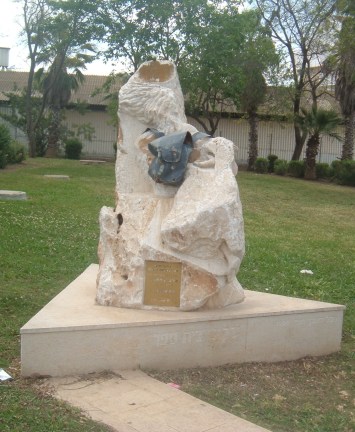
Memorial at Ben Gurion High school in Afula for students murdered in a suicide bombing in April 1994, by Almog (cropped), public domain via Wikimedia CommonsThe school shooting at Oregon’s Umpqua Community College on October 1st, 2015 ended with nine dead and many more injured. The shootings may have been religiously motivated: according to some reports, the gunman commanded some of the students to stand up, asked if they were Christian, and when they responded ‘yes’, he shot them down.

Some have praised these murder victims as Christian martyrs dying for their faith. In one sense, it’s a plausible, and in any sense, an understandable interpretation of what happened: the gunman shot them down after they responded ‘Yes’ to his question ‘Are you a Christian?’ Other survivors tell the story a little differently. In any case, the martyr interpretation is tricky: if it did happen as described above, the murder victims wouldn’t have known ahead of time whether ‘yes’ or ‘no’ was the right answer, as at least one survivor pointed out. Though they may have intended to defy death rather than deny their faith, they could instead have thought that the truthful answer of ‘yes’ would save them from death. Sadly, we can never really know.

I’ve found myself discomfited at the way many have used the horrific murders at Umpqua as a vindication of their own world view, often by portraying it as a tale of heroic martyrdom triumphing over evil. The account of the shooting itself is a very important story to tell: it’s one in a series of so many others in our country and around the world where disturbed young men channel their obsessions and their rage through the barrel of a gun and into the bodies of other people. There are so many similarities between the circumstances and motivations of the shooters that we have no choice, if we’re honest, but to acknowledge there’s a serious problem. We’ve seen too many times that maleness, youth, ideological extremism, mental disturbance, social alienation, and obsession with guns are a deadly mix. But when examples of mass killings and terrorism such as the Umpqua shooting are recast as tales of martyrdom, the motivation they should inspire in us, to do all we can to stop the killing, can for others become lost in the romanticism of idealized self-sacrifice.
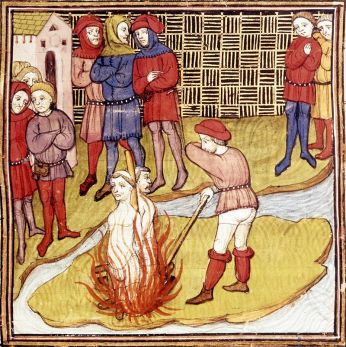
Detail of a miniature of the burning of the Grand Master of the Templars and another Templar. From the Chroniques de France ou de St Denis, Public Domain via Wikimedia CommonsThat’s because we’re still under the influence of a very old, even primal idea: that death is rendered not only glorious but a worthy goal if it’s for a cause. Nearly all ideologies and belief systems still prize their martyrs, and we see, worryingly, the resurgence of this idea in some parts of the world are leading to ever more deadly results. Martyrdom has long been such a potent symbol of belief and an effective recruitment tool that if there aren’t any genuine ones to hold up for emulation, it’s a sure bet some will be created. The Umpqua tragedy may be an example of this, of recasting the horrific murder of innocent people as a romantic tale of holy self-immolation in defiance of evil personified. The memory of the lives of the innocents who died there, and the heroism of those who risked themselves to protect others from harm, can become lost in the ideological rhetoric.

But what of beautiful, inspiring, authentic examples of martyrdom? How about Father Damien of Hawaii’s Molokai Island, who ministered to the leper colony quarantined there until he died from contracting the disease himself? How about Quảng Đức, who immolated himself in protest of the South Vietnamese government’s persecution of Buddhists? How about Joan of Arc (who’s long been an subject of my admiration and fascination), who was executed for refusing to betray her own beliefs about her mission to deliver the French from English rule? How about countless soldiers who have thrown themselves on mines and grenades and dashed through enemy fire to save innocent civilians and their comrades in arms? There are so many moving accounts of people who suffer and die because they will not compromise or allow themselves to speak or act otherwise than their sense of self and honor will allow. I, too, am deeply moved by the beauty and strength of their courage.

Joan of Arc statue in Paris, France, photo 2015 by Amy CoolsYet I am simultaneously wary of glorifying these cases of martyrdom for martyrdom’s sake, even when the circumstances of deaths such as these appear most moving, most noble, and most beautiful. That’s because I can’t forget, and I believe none of us can afford to forget, that what makes death or suffering count as martyrdom depends entirely on your frame of reference. My martyr may be your heretic; your martyr may be my traitor who deserved death; my martyr may be the holy warrior who attacked your corrupt and sinful country in the name of all that’s holy and your deadly foe it’s your patriotic duty to destroy. Martyrdom of this sort, understood as the ultimate sacrifice of the death-defying, uncompromising champion of the ultimate good, knows no side and every side. Every side claims their own, and every side who has martyrs to claim (creating them if necessary) treats them as their trump card, the ultimate demonstration of the rightness and superiority of their own beliefs. There’s Father Damien, and there are kamikaze pilots. There’s Quảng Đức, and there are suicide bombers. There’s Joan of Arc, and there are Crusaders, jihadists, those who carried out pogroms, and youth who still flock every day to join the ranks of ISIS and fight to deliver sacred territory from the hated infidels.

But surely there’s a distinction between those whose form of martyrdom imposes death and suffering on others, and those who choose suffering and death for themselves alone?

Kamikaze attack left HMS Formidable burning, 1945, by Royal Navy photographer aboard HMS Victorious (cropped), public domain via Wikimedia CommonsBut here’s the problem: if it’s okay to sacrifice one person, even if that person is one’s own self, then it’s more than just a slippery slope to thinking it’s okay to sacrifice others. As we can see in such cases as kamikaze pilots, crusaders, holy warriors, and suicide bombers, the glorification of martyrdom has always had the unfortunate tendency to inspire willingness to sacrifice others along with ourselves. After all, if it’s good to sacrifice one person for the greater good, isn’t it at least as good or even better to sacrifice more people? But self-inflicted martyrdom which simultaneously kills others is generally not driven by this sort of calculation, of each side just upping the ante. When we consider martyrdom, we must also consider the ideologies and belief systems that inspire or at least allow for it. And nearly all not only involve a belief in an afterlife, they believe this world is merely a proving ground for that afterlife, so death counts for little in comparison to eternity. Furthermore, most ideologies and faiths who glorify martyrdom base their beliefs on sacred books in which holy war and violent destruction of the nonbeliever, the godless, the idolator, and the infidel is celebrated as much or even more than personal martyrdom. In the end, we end up with the same old world full of mutually hostile martyr/holy warrior belief systems that have led to centuries of violent religious and ideological conflict and ethnic cleansing.

Martyrdom of Four Crowned Martyrs by Mario Minniti, San Pietro dal Carmine, at Siracusa, Sicily, public domain via Wikimedia CommonsAnd who’s to say who’s right? Which religion, which ideology has the correct view of martyrdom? Which, if any, can be demonstrated to inspire true martyrdom, to the exclusion of others? Bertrand Russell, philosopher and ardent pacifist, is often quoted as saying ‘I would never die for my beliefs because I might be wrong’. Many have described this as cynical or revealing a weakness of character, an inability to form convictions. I think a more fair and charitable interpretation is that Russell believed everyone should practice proper epistemic humility. Especially when it comes to such a momentous question as preserving human life, our own and others: we should do so whenever possible, since whatever our other beliefs, we can all readily demonstrate, whatever our other beliefs, that other human beings suffer grief when we die and that we can surely help others when we’re around to do so. It’s far more difficult to demonstrate, for example, that God likes it even better when we die in his name or that we can help those on earth from beyond the grave, as believers in intercessory prayer or spiritualists hold. Better all around, when it comes to our safety as well as our chances of not believing in things that are terribly wrong, when we’re accountable to one another for the larger consequences of our beliefs.

But how if we take religion and ideology out of it, and consider only those cases where the martyr’s entire cause is the well-being of others? Even in these cases, the problem is a simple matter of justice: it’s difficult to see how one can truly believe that all persons have equal rights and dignity and are therefore deserving of care, and still believe it’s okay to sacrifice one’s own well-being when that sacrifice can be avoided. There are times in which it can’t be: the example of heroic soldiers throwing themselves on grenades to save others comes to mind as a paradigm example of justifiable self-sacrifice, since equal concern for all logically allows for sacrificing one’s self to save many. Others are not so clear: Father Damien was clearly motivated by a noble desire to help his fellow human beings as he ministered to the exiled lepers at Molokai. He made it a point to embrace and kiss the lesions of patients to show a Christlike love, but the ideology of martyrdom that also drove him may have robbed him of an even better opportunity, the opportunity to show that love to more of his fellow human beings by keeping himself alive to serve them. If he had taken reasonable precautions to care for his own well-being and avoid contracting the disease, known in his time to be contagious, he likely would have lived much longer to serve the people who loved and counted on him; kissing of lesions and other reckless exposure to contagion is not an unavoidable requirement for showing our deep concern for others. Martyrdom, though it may not be apparent, involves at least to some degree the inequitable valuing of the lives of persons, at the very least our own.

And this leads us to consider whether martyrdom is really the ultimate altruistic, selfless act it’s so often characterized to be. It’s hard to see how there can be such a thing as truly selfless martyrdom in a world in which human lives are so intertwined. Through death, parents are deprived of a child, children of a parent, siblings of a sibling, friends of a friend, citizens of a fellow citizen, the needy of a benefactor, the world of a unique life that has something to offer. It seems to me, then, our lives are not fully our own: they are given to us by others, are largely sustained by the efforts of others, and provide emotional support for others, and vice versa. There is no human being that doesn’t rely on the support and contributions of others to sustain it and make it secure and happy. As in the case of Father Damien, when we choose death over life, we remove ourselves from the human community of inter-reliance we all belong to. I’m speaking here in the worldly sense; according to many religions, we can help others after death by interceding with God or by providing personal supernatural guidance, such as in spiritualist beliefs. But as we’ve already considered, this view of martyrdom as a holy thing is hard to justify consistently, and even worse, it necessarily values supernatural concerns over worldly ones, allowing for the same disdain for life that underlies all forms of martyrdom, from the self-sacrificer to the jihadist. So even when it appears that a martyr is sacrificing nothing but their own life and happiness, this is rarely if ever the case. And if this is so, our right to sacrifice our own life and well-being appears very tenuous in all but those very special circumstances, such as the case of those grenade-blocking soldiers who can’t help others unless they risk themselves.
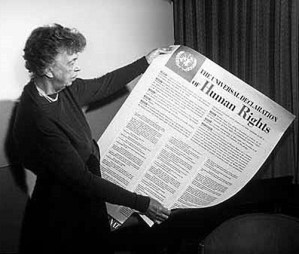
Eleanor Roosevelt and Human Rights Declaration, public domain via Wikimedia CommonsIn a world where religiously-, politically-, and ideologically-motivated terrorism and mass shootings are again on the rise, we need to let go of our old cherished ideal of martyrdom as the ultimate holy and noble act. If we want to instill in ourselves and others the value that all lives matter, the glorification of any kind of martyrdom appears as toxic to this as the old belief in the curative powers of bleeding and purging was to health. This seems like a call for rejecting our long-loved heroes, our Joans and Quảngs and Damiens, but I don’t believe it is. We have a robust capacity for understanding that context matters, and just as we can believe George Washington’s doctors did their best to cure him the only (turns out wrong) way they knew how, we can simultaneously revere the courage and conviction of martyrs of the past while believing that in the age of universal human rights and ethics of care, martyrdom is the wrong way to go and should not be glorified, praised, or used as evidence of the superiority of our own beliefs over others.

*Listen to the podcast version here or subscribe on iTunes

Ordinary Philosophy and its Traveling Philosophy / History of Ideas series is a labor of love and is ad-free, entirely supported by patrons and readers like you. Please offer your support today!

~~~~~~~~~~~~~~~~~~~~~~~~~~~~~~~~~~~~~~~~~~~~~~~~~~~~~~~~~~~

Sources and Inspiration:

The Death of George Washington‘, The George Washington Digital Encyclopedia

Father Damien‘. In Wikipedia, The Free Encyclopedia.

Sidner, Sara and Kyung Lah, Steve Almasy and Ralph Ellis. ‘Oregon Shooting: Gunman was Student in Class Where He Killed 9’. CNN (online), October 2, 2015. 

‘The “Werther-effect”: Legend or Reality?’ (abstract). Neuropsychiatr. 2007;21(4):284-90. Source: PubMed.gov http://www.ncbi.nlm.nih.gov/pubmed/18082110

Turkewitz, Julie. ‘Oregon Gunman Smiled, Then Fired, Student Says’
The New York Times (0nline), Oct. 9, 2015

Vanderhart, Dirk and Kirk Johnson and Julie Turkewitz. ‘Oregon Shooting at Umpqua College Kills 10, Sheriff Says’, The New York Times (0nline), Oct. 1, 2015.

Should A Minor Be Tried as an Adult Due to the Seriousness of the Crime?

Here’s a piece I published one year ago today, in case you missed it at the time, and I’d love to hear what you think. I’ll be publishing some brand new pieces very soon, including a piece by a returning guest, the continuing saga of my adventures following the life and ideas of Frederick Douglass, some recommendations, and birthday remembrances of great thinkers. Stay tuned!

Amy M Cools's avatarOrdinary Philosophy

Here’s a case, currently in the news, in which a young girl helps murder her mother because her mother was trying to break up her relationship with her much older boyfriend.

In this case, the girl charged is 14 years old. A long series of text messages, along with forensic evidence, the timeline of events, and the girl’s own testimony indicate that she and her boyfriend did in fact commit the murder (though, of course, this must be proved in court).

Here’s what troubles me most besides the cruel and terrible murder itself: the girl is being charged as an adult. And she’s being charged as an adult, apparently, due to the seriousness of the crime, a practice that’s been allowed in many states for decades. The main argument in favor of this practice goes something like this: if the crime is serious, or ‘adult’ enough (whatever that means), the…

View original post 177 more words

Cesar Chavez Day, by Alejandro Magana

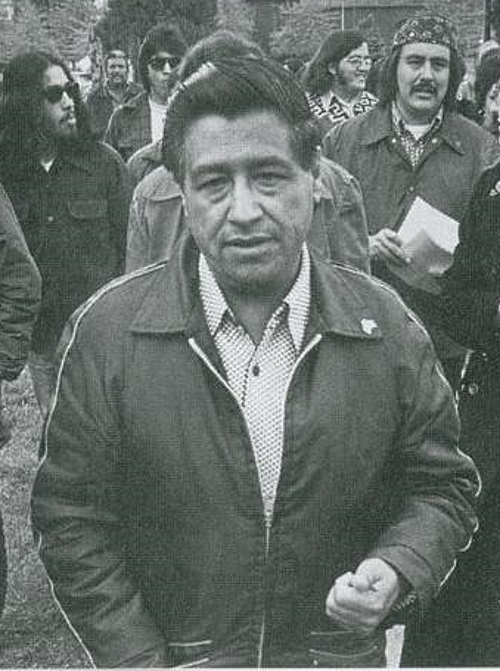
Cesar Chavez visits college - By Movimiento - Own work, cropped - CC BY-SA 3.0 httpcreativecommons.orglicensesby-sa3.0 via Wikimedia CommonsEvery year around Cesar Chavez’s birthday, as media outlets report of festivities in his honor, I’m reminded of a joke in a Simpsons episode and the strange sadness it elicited in me when I saw it: Homer Simpson is on his front lawn and is confronted with the apparition of a debonair, mustachioed man who introduces himself as, “the spirit of Cesar Chavez.”

In typical Homer confusion he asks, “Then why do you look like Cesar Romero?”

The ghost replies, “Because you don’t know what I look like!”

Cesar Chavez is certainly revered by many people, especially within the Latino community, but despite the steadily increasing ubiquity of his name across the United States, especially the American Southwest, there are still many Americans today who don’t really know who he is, let alone what he stood for, or what he accomplished.

Cesar Chavez was a Mexican-American community organizer turned labor leader and . A former migrant farmworker recruited by the Community Service Organization (CSO) in its heyday of the 1950s, he co-founded the National Farmworkers Association (NFWA,) which later became the United Farm Workers (UFW,) the first successful union for migrant farmworkers. The UFW’s membership consisted mostly of indigent Latinos and Filipinos, and their struggle for justice and dignity, fighting to gain higher wages and better conditions in the fields where they were deprived of basic needs such as clean drinking water and bathrooms, became a national moral cause under the stewardship of Chavez, who courted national and international sympathy using militant non-violent tactics in the vein of Mahatma Gandhi and Martin Luther King Jr, such as strikes, boycotts, fasts, and peaceful marches.

Chavez was not an imposing orator with the fire-and-brimstone timbre of the Reverend Dr. King, nor did he cut as iconoclastic a figure as Gandhi, but in his unassuming way he could be just as charismatic and endearing, and this often caught people off guard, as it did an interviewer for the New Yorker in 1973, who, “had expected, if not a Mexican-American Lenin…a young, hard, intense man bristling with revolutionary zeal. Instead we found Mr. Chavez to be a stocky man…about five feet seven …with Indian features…and a pleasant earnest manner.” With his trademark regular boys’ haircut parted on the side and wearing simple cardigans with button down plaid shirts and slacks, his fashion was more Mr. Rogers than Mr. Lenin. He looked the part of the humble Everyman that people felt they could relate to.

On a personal note, my parents actually met while working with Cesar Chavez in the early ‘70s, and when they tell stories of those days, they both recall how approachable he was with his easy but confident demeanor; how people were drawn to him and trusted him, even as he took them out of their comfort zones, like the time he sent my mom and a few other farmworkers to Chicago, to publicize and organize the Grape Boycott, even though they spoke very little English and were armed with just a few phone numbers of sympathizers there along with the names of some churches that might possibly provide them with food, room and board. They believed they could accomplish such ambitious plans because this diminutive, unpretentious man seemed capable of stopping the engine of the entire agricultural industry and took on Big Agribusiness all by himself. Before it became widely known as the slogan of Barack Obama’s presidential campaign, I grew up with my father reminding me, “¡Si se puede!” (Yes, you can!) a phrase Chavez often chanted before throngs of people at picket lines and marches.

Like Gandhi and King, he was intensely spiritual and absolutely committed to non-violence. In what may be his most recognizable aphorism, he said, “It is my deepest belief that only by giving our lives do we find life. I am convinced that the truest act of courage…is to sacrifice ourselves for others in a totally non-violent struggle for justice.” Self-immolation was a recurring theme in both word and deed: in 1968, during the Delano Grape Strike, after several tense confrontations at the picket lines nearly devolved into violence, he fasted for 25 days to encourage and remind the farmworkers that their fight was to be a non-violent one. He would fast for 24 days again in 1972, and in 1988 he fasted for 36 days(!) to bring attention to the pesticide poisoning of grape workers and their children. It is thought that his relatively early death at the age of 63 in 1993 was probably due to aggregated health complications suffered from these sacrifices. Still, even now, if you talk to people who marched with Chavez and the UFW back then, most speak of Chavez in reverential, even hagiographical ways, for to them he was como un santo: like a saint..

Throughout the 1960s and 1970s, as the UFW made sweeping legislative strides on behalf of organized farm labor, Chavez was also becoming the most widely known leader within the broader Chicano Movement, or “El Movimiento,” a civil rights movement which empowered Mexican Americans caught between two cultures, not quite Mexican enough for their Mexican immigrant forebears, nor seen as truly American by the white hegemony. The term “chicano” was originally a derogatory term for the American children of Mexican migrants, but in the Movement it was flipped, transmogrified, to be a badge of ethnic pride. Of course Chavez always made sure to situate the fight of the UFW as united with the struggle of “all farm workers across the country, the Negroes and poor whites, the Puerto Ricans, Japanese, and Arabians…the races that comprise the oppressed minorities of the United States,” but “The Plan de Delano,” a text co-authored by Chavez with Dolores Huerta and the Chicano playwright Luis Valdez, reifies and emboldens his ethnic heritage, declaring “We are sons of the Mexican Revolution.” To this day, the flag of the UFW, showing a black Aztec eagle on stark red background, is widely considered a symbol of Chicano or Latino pride. Those of us who wear this symbol, or even, as in my case, have it tattooed on their body, recognize that the life we have so firmly rooted in the United States, with access to resources and opportunities that our parents or grandparents did not have, is due to the hard work and vigilance of people like Cesar Chavez, Dolores Huerta, or my mother, Maria Saludado.

The identity politics that certainly began to swell in the 1960s have persisted despite reactionary criticism and remain particularly relevant today; an era in which the ugly scars of racism seem as starkly etched in our national consciousness as ever. As we near the end of the second term of America’s first ‘non-white’ President, as Mexican immigration continues to be a galvanizing and polarizing issue in the US, and the Latino vote is highly prized on both sides of the political aisle, conditions would seem fecund for a reboot of El Movimiento. In appropriate fashion, this year the Cesar Chavez Foundation, an offshoot of the UFW, began its annual celebration in San Fernando, the first city in the nation to commemorate Cesar Chavez Day with a paid holiday, with a rally and march to encourage activism to “Dump Trump.”

¡Que viva César Chávez!

~ Alejandro Magaña is a musician, poet, and songwriter some of the time, and a father and husband all of the time. He also works full-time as an office manager at Urban Ore in West Berkeley. He lives in North Oakland with his wife and son and books and records.

~ Ordinary Philosophy and its Traveling Philosophy / History of Ideas series is a labor of love and is ad-free, entirely supported by patrons and readers like you. Please offer your support today!

~~~~~~~~~~~~~~~~~~~~~~

Sources and Inspiration:

● My mother and father. ¡Que viva mis padres!
● Chasan, Daniel. “‘Marcher,’ an interview with Cesar Chavez,” The New Yorker, May 27, 1967.
● Chavez, Cesar, Huerta, Dolores, and Valdez, Luis. “The Plan of Delano,” El Malcriado, March 17, 1966.
● Chavez, Cesar. An Organizer’s Tale: Speeches Ed. Ilan Stevens. London: Penguin Books, 2008.

O.P. Recommends: The Supreme Court Ruling That Led To 70,000 Forced Sterilizations

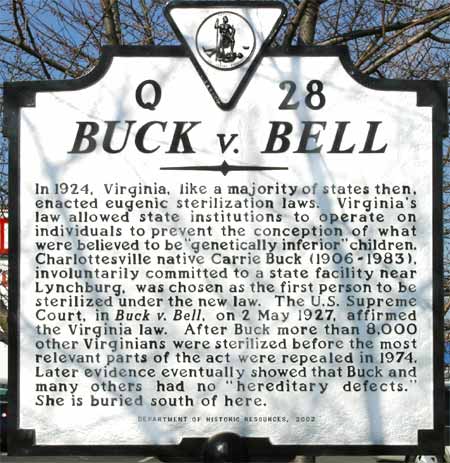
Buck v Bell Virginia Historical Marker Q 28, Courtesy of Historical Collections, Claude Moore Health Sciences Library, University of VirginiaFresh Air’s Terry Gross interviews author Adam Cohen about his book Imbeciles, which tells the story of eugenics in the United States and how the Supreme Court upheld many laws which arose from that once influential pseudoscience. Among these laws were those which forced the sterilization and incarceration into ‘colonies’, of the ‘feebleminded’ and ‘unfit’. Cohen makes the story of Carrie Buck central to his discussion in this podcast and to the book. She was a young woman who suffered about as greatly as one could from these policies and was eventually betrayed even by the Supreme Court, supposed to be the last bastion against legislative and democratic excess.

It’s a shocking story, and as Cohen and Gross point out, it’s not discussed nearly often enough today. Not only did such laws and practices harm thousands of American citizens, they influenced the Nazis, who based many of their own policies and tactics on American eugenics programs.

Less directly but important nonetheless, the backlash against that old eugenicist-brand forced confinement of mentally ill, disabled, and so-called unfit helped garner support for the release of huge numbers of people from mental hospitals in the late 1900’s. Intentions may have been good in many circumstances, since overcrowding, understaffing, and ineffective modes of treatment were at times serious problems. However, deinstitutionalization did little to solve them; the problematic institutions were not replaced with sufficient or viable options for patients and their families to continue receiving the treatment and care they needed. To this day, thousands of mentally ill people are arrested every year, incarcerated, and treated, often against their will, in prisons and other correctional facilities instead of hospitals, and only after they’ve committed crimes, victimizing yet more innocent people. And these correctional facilities, like the mental hospitals they’ve ended up replacing, are often overcrowded and ill-equipped to deal with those who should be patients rather than inmates.

Why link this podcast discussion about the failures of eugenics to the modern movement to deinstitutionalize the mentally ill? Because it’s important to remember that since it’s not always clear what the full ramifications of an idea are, we need to look at them more carefully and critically, beyond the obvious, considering the long-term and indirect effects of its influence as well. In the example of eugenics, its failures were so egregious, its lack of regard for the humanity of those it declared ‘unfit’ so ugly, that it became too easy to undermine all sorts of other things, many of them good, simply by finding a way to link them together. In this case, as the same century that saw the rise of eugenics was drawing to a close, all institutionalization of mentally ill people, all requirements that certain people receive treatment, became painted with the same broad eugenicist brush. But here’s the thing with deinstitutionalization: it turns out that a similar lack of regard for the suffering humanity of the mentally ill had more to do with those policies than anything else. This seems clear when we observe that the public debate ended up being about funding more than anything else, and not nearly enough of the savings from shutting down institutions were redirected to help the people who continued to need it. The mentally ill were too often simply abandoned by the state to survive on their own or with the help of their un-equipped families, in a world unnavigable and inhospitable to them, and their plight remains largely unaddressed by legislatures.

This one example shows how lessons to be learned from Carrie Buck’s sad story and from the eugenicist movement, then, are much more far-reaching than just the obvious ‘look how it inspired the Nazis!’ The 20th century was too often characterized by an obsession with progress and economic growth at all cost; all things and persons not seen as contributors were dismissed as superfluous and a drain on the rest of society. Let’s make the 21st century one that values humanity for its own sake, and deem scientific progress, economic policies, and public institutions successful only if they serve and promote humanitarian values, not the other way around.

~ Ordinary Philosophy and its Traveling Philosophy / History of Ideas series is a labor of love and is ad-free, entirely supported by patrons and readers like you. Please offer your support today!

~~~~~~~~~~~~~~~~~~~~~~~~~~~~~

Sources and inspiration

Frontline: The New Asylums May 2005 and The Released April 2009 (documentaries)
http://www.pbs.org/wgbh/pages/frontline/released/view/

Lyons, Richard. ‘How Release of Mental Patients Began.’, New York Times, Oct. 30, 1984
http://www.nytimes.com/1984/10/30/science/how-release-of-mental-patients-began.html

‘The Supreme Court Ruling That Led To 70,000 Forced Sterilizations’, Fresh Air interview
Mar 7 2016. http://www.npr.org/sections/health-shots/2016/03/07/469478098/the-supreme-court-ruling-that-led-to-70-000-forced-sterilizations

Happy Birthday, Rosa Luxemburg!

Rosa Luxemburg, By unknown photographer around 1895-1900 [Public domain], via Wikimedia CommonsRosa Luxemburg, Mar 5 1871 – Jan 15 1919, is the great Marxist theorist, writer, economist, revolutionist, anti-war and anti-capital-punishment activist, and philosopher who was murdered during the German Revolution of 1918–1919.

Though she’s an anti-war activist, Luxemburg is also critical of the idea that a just society can be brought about by incremental reforms through established political systems. If she were to be involved in the 2016 Democratic primary race between Hillary Clinton and Bernie Sanders, she would very likely back Bernie, with his more revolutionary style and rhetoric: she’s sharply critical of the Social Democratic Party of Germany, to which she belongs (in its left wing) for favoring a Hillary-style reformist approach. However, her internationalism takes Marxist thinking beyond the point where leading Marxists of her day had progressed, with their focus on unique formulations of Marxist political theory tailored to their own particular national identities and histories. She would likely find fault, then, with Bernie’s protectionism.

Luxemburg’s other great contribution to Marxist thought is her theory about the accumulation of capital. Since capitalism’s primary fuel is constant and ever-increasing consumption, she thinks it’s a mechanism for the ultimate destruction of our material capabilities to sustain ourselves, starting with the ecosystems on which indigenous people, the poor, and the working class depend. Here as well, her progressive thinking takes her far beyond Marx himself, and her concerns in this timely issue makes her as relevant now as ever.

Read more about the brilliant and fearless Luxemburg:

‘Who’s Who – Rosa Luxemburg’ at First World War.com

‘The Dialectic of the Spatial Determination of Capital: Rosa Luxemburg’s Accumulation of Capital Reconsidered’ by Peter Hudis

The Crisis of German Social Democracy (The Junius Pamphlet) by Rosa Luxemburg, 1915

‘Rosa Luxemburg’, from Wikipedia, the free encyclopedia

Ordinary Philosophy and its Traveling Philosophy / History of Ideas series is a labor of love and is ad-free, entirely supported by patrons and readers like you. Please offer your support today!

Happy Birthday, John Rawls!

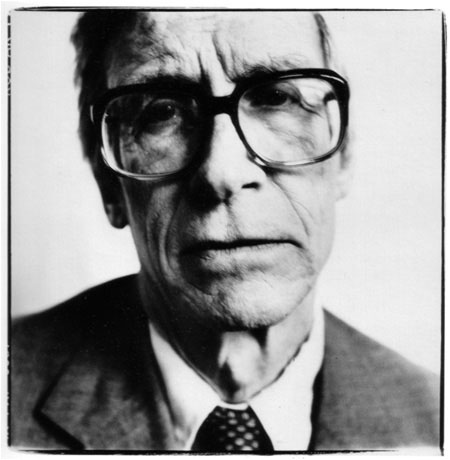
John Rawls, image via BBC's Will and Testament blogJohn Rawls, Feb 21, 1921 – Nov 24, 2002, is the great moral theorist who thinks of justice as fairness.

Among his greatest contributions is the thought experiment called ‘the veil of ignorance’. It’s a beautifully simple method for helping to design a just society: imagine you’re to be placed into society with no idea what you would be: rich, poor, or middle-class; tall or short; intelligent or not; of which gender; outgoing or shy; of which race; employed or not and at what kind of job; and so on.

Given that you have no idea what your roles in life will be, what cultural practices, laws, policies, governmental system, economic system, and so on, would you put into place? Remember, behind that veil of ignorance, you’ll have to decide what kind of society benefits everyone the most, since you could end up being anyone. If you were really in that situation, imagine just how fair you’d be. Perhaps, as Rawls imagines, we’d all be far better off if that was really how the world works.

~~~~~~~~~~~~~~~~~~~~~~~~~~~~~~~~~~~~

Further reading:

Stanford Encyclopedia of Philosophy: John Rawls

John Rawls’ A Theory of Justice (book preview)

Ordinary Philosophy pieces featuring John Rawls:

Communitarianism, Writ Large

Sources, Influences, Shout-Outs, and all that Good Stuff

What Ordinary Philosophy’s All About: Clarifying the Vision

People in a Public Square, Image Creative Commons via PixabayIt’s been an especially busy few weeks for me: studying, researching, writing, planning for my upcoming traveling philosophy journey and for the expanded future of Ordinary Philosophy. This year so far, I’ve had the great good fortune to meet some inspiring new people: passionate, thinking, active, and creative. I’ve also gotten to know others better as well, and am opening new doors and making new contacts every day. Our conversations have been inspiring me to think more clearly and deeply about my vision for Ordinary Philosophy, about my hopes, dreams, and goals, and about the wonderful people who will work with me to accomplish them in the future.

So I’ve just been looking over my introductory statement about Ordinary Philosophy, and thought it needed some clarifying and expanding. Here’s my vision as it stands now, best as I can describe it, and it’s beautiful to me. I hope it is to you too!

~~~~~~~~~~~~~~~~~~~~~~~~~~~~~~

Ordinary Philosophy is founded on the belief that philosophy is an eminently useful endeavor as well as a fascinating and beautiful one, and that citizen philosophers and academic philosophers alike share in making it so.

So why the name Ordinary Philosophy?

The ‘Ordinary’ in Ordinary Philosophy means: Philosophy is not only pursued behind the walls of academia.

It’s an ordinary activity, something we can do regularly whatever our education, background, or profession, from our homes, workplaces, studies, public spaces, and universities. It’s applicable to ordinary life, since it’s about solving the problems we all encounter in the quest to pursue a good, happy, and meaningful one.

It’s about seeking answers to the ‘big questions’ we ask ourselves all the time: ‘What’s the right thing to do?’ ‘What’s a meaningful life, and how can I make mine so?’ ‘What’s the truth of the matter, what does truth mean anyway, and how do I know when I’ve found it?’ ‘What does it mean to have rights?’ ‘How did reality come to be as it is?’, and so on.

It’s also just as much about the ordinary, day-to-day questions: ‘Should I take this job, and will it help fulfill my highest aspirations?’ ‘It is wrong to put my interests first this time, even if it will harm someone else?’ ‘What’s the difference between just talking about other people and malicious gossip?’ ‘Why should I go out of my way to vote?’

And in the end, it’s about living philosophy, about philosophy in the public square, and the stories and histories of philosophy as it is realized, personified, lived out by activists, artists, scholars, educators, communicators, leaders, engaged citizens, and everyone else who loves what’s just, what’s beautiful, and what’s true.

All of this is philosophy.

~ Amy Cools, founder and editor of Ordinary Philosophy

O.P. Recommends: Landmark Cases / Injustices, Two Great Works on the Supreme Court

This last couple of weeks or so, I’ve been packing in a lot more learning about the Supreme Court, and is it ever fascinating.

It began when I stumbled on Landmark Cases last month, a C-Span series about 12 Supreme Court cases chosen because they had a dramatic impact on the legal landscape in United States history, and because they likewise had a significant impact on the Court itself, as precedent and on its perceived legitimacy, for good or ill. It can be found as a video series online, but I’ve been listening to the podcast version.
http://landmarkcases.c-span.org/

As I was listening, the discussions reminded me of a book I had heard about a little while ago but had forgotten to read, a book about the Supreme Court’s worst failures, terrible decisions that undermined its legitimacy and had a negative impact on the lives of people for years to come. It’s called Injustices: The Supreme Court’s History of Comforting the Comfortable and Afflicting the Afflicted, by Ian Millhiser. So, I went and picked it up, and just as with the Landmark Cases Series, I’ve been finding it difficult to tear myself away.

Both the Landmark Cases series and Injustices reveal that though sometimes the Supreme Court has been the bulwark against congressional, state, and individual encroachments of freedom, it has also too often betrayed the public trust. While we remember and celebrate such cases as Brown vs. Board of EducationGriswold v. Connecticut, and Obergefell v. Hodges, which brought the blessings of liberty to more of the American people than ever before, we sometimes forget how extensive the history of freedom-crushing Supreme Court decisions really is. The Dred Scott case, Lochner vs. New York, Korematsu vs. United States, and Citizens United v. FEC, for example, allowed employers to exploit desperate workers by cornering the market, fixing wages, and creating terrible working conditions with health-destroying long hours; permitted the government to imprison innocent citizens and allow the looting of their property based on no other consideration than race; and enabled the wealthy few to effectively buy up elections. Millhiser’s view of the Supreme Court’s historical tendency to value states and property rights over civil rights and the public interest is summarized here: ‘If American government truly derives its legitimacy from the consent of the governed, then [the] agenda [of the hardline conservatives] that is so often and so soundly rejected at the polls must not be implemented by one unelected branch of government when there is no constitutional basis to do so.’ (pp 184-85).

The Supreme Court’s conservative justices, joined at times by their otherwise more liberal-minded colleagues, all too often decided their cases according to the view that the Constitution only prescribes and limits federal action, and was not intended to do likewise with state or individual action. But as many other Supreme Court justices observed, especially in its civil rights phase throughout the latter half of the twentieth century, this reading of the Constitution renders it impotent (FDR’s terminology in his second inaugural address) to extend the protections of the Bill of Rights to citizens in almost all arenas of life.

After all, most of one’s life is not spent interacting directly with the federal government or its institutions, but in homes, shops, public squares, workplaces, and so on. If the state, or an employer, or a county sheriff, or a bus driver, or a neighbor, or any other non-federal institution or person uses their liberty to oppress another individual, then the latter can’t actually enjoy the freedoms that the Bill of Rights guarantees*. And surely the founders of our nation didn’t intend the Bill of Rights, demanded as a condition of the Constitution’s passage, to be powerless to protect individual freedoms in most circumstances. This is the principle which drives the more liberal Supreme Court Justices, Millhiser, and commentators on the Landmark Cases series to agree that strict constructionist, hyper-conservative, elitist, and commerce-centric justices have historically imposed opinions on the public that do not serve their interests as idealized in the Bill of Rights, and allowed the the powerful and wealthy few to claim the right to do as they like while trampling the liberties of everyone else. Since the Constitution derives its legitimacy from ‘we the people’, then we the people, in our institutions and as individuals, should be likewise bound by the Bill of Rights.

At times, I think that Milhiser champions too strongly the general principle that unelected judges should get out of the way and allow elected representatives to legislate as their constituents demand. After all, as so many of Milhiser’s examples indicate, legislators historically have been all too happy, too often, to make laws that favor some while trampling the rights of others. The potential value of an unelected judiciary to balance the power of an elected legislature is, I think, revealed more clearly in the Landmark Cases discussions. After all, the will of the majority often runs contrary to the national project laid out in the Preamble of the Constitution and the Bill of Rights, to protect and promote the rights of everyone, especially those in the minority who need protection the most. However, as author Jeffrey Toobin points out in his endorsement of the book, Millhiser’s book does an excellent job of balancing the good history of good Supreme Court jurisprudence with the bad.

Listen to the podcast version here or on iTunes

*For more on the distinction between liberty and freedom, please see my essay Freedom, Liberty, and the Inevitable Interconnectedness of Human Life

Ordinary Philosophy and its Traveling Philosophy / History of Ideas series is a labor of love and ad-free, supported by patrons and readers like you. Please offer your support today!

~~~~~~~~~~~~~~~~~~~~~~~

Sources and inspiration:

Landmark Cases: A C-Span Original TV Series, 2015
http://landmarkcases.c-span.org

Millhider, Ian. Injustices: The Supreme Court’s History of Comforting the Comfortable and Afflicting the Afflicted. New York: Nation Books, 2015.

“One Third of a Nation”: FDR’s Second Inaugural Address, published at History Matters website. http://historymatters.gmu.edu/d/5105/