Happy Birthday, Søren Kierkegaard! By Eric Gerlach

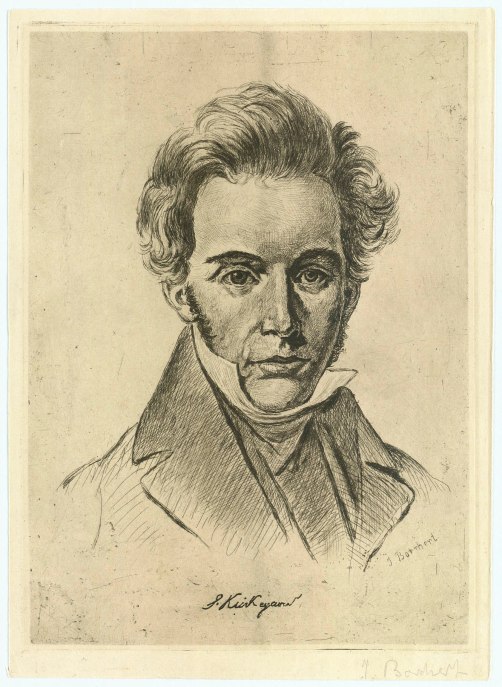
S. <>Søren Kierkegaard (May 5, 1813 – Nov. 11, 1855 CE), the great Danish philosopher and forerunner of existentialism, was born in the Danish city of Copenhagen, and throughout his life he enjoyed walking through the city, greeting everyone he met as his equal regardless of their station in life.  As a young boy, Kierkegaard’s father drilled him with difficult lessons so he would be the top student in his class, but to prevent his son from developing selfish pride, the father demanded that his son get the third best grades in the class, purposefully making mistakes to prevent the boy from being recognized as first or second student.

Caspar_David_Friedrich_-_Wanderer_above_the_sea_of_fog

For Kierkegaard, genuine truth is human subjectivity and perspective, and it is only the individual who accepts subjectivity who comes to realize the greater truth insofar as it is achievable by individuals.  For Kierkegaard, truth is not objective, but subjective, not an object achieved, but a test withstood, not a hurdle overcome, but an experience endured.  Kierkegaard argued that no social system can authentically give the individual meaning and truth. Individuals must make choices, and if they choose to go along with the masses, they have sacrificed their own ability to give truth meaning.  Kierkegaard wrote that he could have, like most scholars of his day, become a voice pronouncing the greatness and objectivity of his race, his country, his historical period, his fellow scholars, but rather than commit treason to truth he chose to become a spy, a solitary individual who chronicled the hypocrisy of all claims to objectivity.

472px-Kittinger-jump

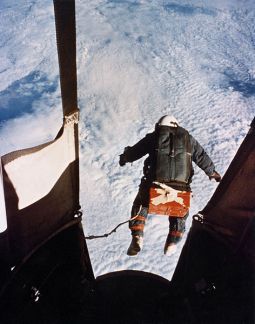
To be an individual is to experience “a vertigo of possibilities”, the monstrosity of spontaneity.  Kierkegaard wrote, “We are condemned to be free”.  It is our freedom, the experience of the infinite, undefined and unbounded, which unites us most intimately with our world.  Kierkegaard argued that one can overcome the angst, the vertigo of possibilities, by making a leap of faith, by choosing to believe in something and act with some purpose in spite of the fact that beliefs and purposes can never be fully justified.  Only this is authentic individuality and truth, having chosen what one is to be, with the honest recognition of the freedom involved in the choice.

373px-Head_of_Socrates_in_Palazzo_Massimo_alle_Terme_(Rome)

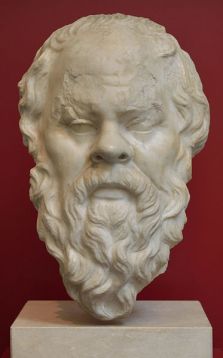
Kierkegaard saw himself as a true follower of Socrates, who argued that he knew that he did not know, which is why the Oracle at Delphi said that no man was wiser than he.  Kierkegaard wrote his college thesis on Socrates, irony, and indirect communication, much as Kierkegaard himself indirectly communicated through his pseudonyms.  Socrates never made great claims to truth, and would instead use analogy, myth, and paradox to show that human judgments and beliefs are problematic and contradictory even as they assert themselves with certainty, which Kierkegaard argued was also the method of Jesus.  Kierkegaard wrote that Socrates “approached each man individually, deprived him of everything, and sent him away empty-handed”.  Socrates showed others that they did not truly know what they believed themselves to know, and he was killed by the Athenian assembly just as Jesus was killed for questioning the Pharisees.

Brooklyn_Museum_-_Saint_John_the_Baptist_and_the_Pharisees_(Saint_Jean-Baptiste_et_les_pharisiens)_-_James_Tissot_-_overall

Kierkegaard’s works are dominated by theological concerns, wondering on many pages about the individual’s relationship to God and Jesus.  For Kierkegaard, the meaning of Christianity was not the achievement of objectivity, but the acceptance of subjectivity, of individually lacking the God’s eye view.  Kierkegaard was brutally critical of the Danish Lutheran Church for presenting itself as the objective truth, and argued that it is only as an individual that one can be a genuine Christian.  Kierkegaard argued that Christianity began as a rebellion against the status quo, but then became the entrenched regime.

450px-Image-Søren_Kierkegaard_grave_4

After healing a blind man, Jesus rebuked the Pharisees, the political and religious establishment of his time, and said that because they think they see they are in fact blind.  In his later years, Kierkegaard attacked the Danish Church without mercy, and at his funeral a fight broke out when young theology students, progressive and inspired by Kierkegaard, protested that the church was attempting to hijack his name and fame by calling him one of their own after he had so bitterly attacked their hypocrisy for decades.  Kierkegaard wanted his tombstone to read only, “The Individual”, though his relatives decided otherwise.

A version of this piece was previously published at Ordinary Philosophy

~ Ordinary Philosophy is a labor of love and ad-free, supported by patrons and readers like you. Any support you can offer will be deeply appreciated!

*All views and opinions expressed by guest writers are their own and do not necessarily express those of Ordinary Philosophy’s editors and publishers

Happy Birthday, Una Marson! A Profile of this Great Cultural and Literary Nationalist by Lisa Tomlinson

Una Marson, image from AAIHS

Una Marson: Cultural and Literary Nationalist

Una Marson was born on May 5, 1905 in the rural parish of St. Elizabeth, Jamaica, sixteen years after the novelist and poet Claude McKay. Following in the literary footsteps of McKay, Marson valorized African working-class cultural aesthetics and engaged with the wider African diaspora through her literary and political work. Although her work has not received the same attention or accolades as her fellow countryman Claude McKay, Marson has, without a doubt, made a significant contribution to Caribbean and diasporic literature. She was certainly a key figure in twentieth century black internationalist politics.

Fortunately, conversations around the life and work of Una Marson have been kept alive and archived in a few libraries throughout the world. Writers such as Erika Smilowitz, Honor Ford Smith, and Alison Donnell have also written critical essays on Marson’s literary and political involvement inside and outside of Jamaica. Additionally, her biographer Delia Jarrett-Macauley has provided a comprehensive documentation of Marson’s life and writing. Therefore, their works are most instructive in offering more information concerning Marson’s life and activism.

Not surprisingly, Marson’s early works of literature reflected her colonial education. Marson’s writing in her first collection of poems, Tropic Reveries (1930) and Heights and Depth (1931), adapted traditional European literary structure and spoke to pastoral style poetry. As her travels abroad strengthened her race consciousness in the mid-1930s, Marson’s literary work departed from the conventions of British Victorian and Romantic literature. As such, her third volume of poems, The Moth and the Star (1937), articulated themes that resonated with the experiences of African women entrapped within received notions of white beauty standards.

In her poem “Cinema eyes,” for example, the narrator tries to protect her daughter from procuring a “cinema mind” under the influence of white supremacy, which “saw no beauty in black faces.” Two other poems, “Kinky hair blues” and “Black is Fancy,” reveal black hair politics and many black women’s desire to alter their physical appearances:

I hate dat ironed hair
And dat bleaching skin
Hate dat ironed hair
And dat bleaching skin
But I’ll be alone
If I don’t fall in 2

Over time, Marson’s work also became more rooted in Jamaican experiences, and she integrated the indigenous culture of the black Jamaican working-class. In her poem “Stone Breaker, ”Marson sheds light on the experiences of black working-class Jamaican women using the native language, Jamaican, to express class and racial inequalities that inform life on the island: “De big backra car dem/ A lik up de dus’ in a we face” 3

Maintaining a bond to her Jamaican roots, Quashie Comes to London, a more lighthearted poem, highlights the immigrant experience of homesickness in the metropolis of London. Quashie’s diasporic journey in cold dreary London and yearning for familiar food items such as “some ripe breadfruit / Some fresh ackee and saltfish too / An’dumpins hot will suit,” later becomes common threads in the works of Caribbean diasporic writers living outside of the region.

Marson further developed her use of African Jamaican cultural aesthetics and experiences in her popular plays, London Calling and Pocomania. In Pocomania, for instance, she includes the local vernacular, folklore, and African-centered religious practice called Pocomania to challenge middle-class respectability and Christianity. She does this through Stella, the middle-class character in the play, who journeys to the world of the black Jamaican working-class in a bid to experience the forbidden religious rituals of Pocomania. Given the fact that the reference to anything “African” was frowned upon in colonial Jamaica, Marson’s plays and poems reflected a transgressive intervention in conventional Jamaican literature.

In many ways, Marson unselfishly employed her literary status to foster and build upon the development of a Caribbean literary canon. In her desire to advance Jamaican literature and culture, Marson formed the Writers Club, the Kingston Drama Club, and the Poetry League during the 1930s. Marson was also responsible for starting a publishing press.

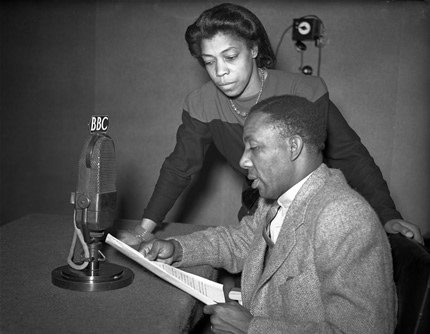
una1While living in England, Marson developed the BBC radio program, “Caribbean Voices,” which evolved into a significant literary show, one that would have a crucial impact on the development of new writings and writers from the Anglophone Caribbean. Caribbean cultural luminaire Kamau Braithwaite has characterized the forum as the “single most important literary catalyst for Caribbean creative and critical writing in English.” 4

In addition to her literary engagement, Marson was also very politically active in local and international affairs. In 1928, at the age of 23, she became the first woman in Jamaica to own and edit a magazine, The Cosmopolitan. Marson used this publication as an outlet to express social concerns in Jamaica (i.e., race and class prejudices) and also to address gender issues. In her editorials, Marson consistently advocated for the expansion of educational and employment opportunities, the development of women’s self-help groups, and the granting of women’s suffrage.

As a feminist, Marson worked in various overseas women organizations and was the only black woman to attend the 12th Annual Congress of the International Alliance of Women for Suffrage and Equal Citizenship conference in Istanbul, Turkey in 1935. Motivated by wider diasporic experiences, she used the opportunity to advocate for the rights of black woman globally and called on the conference to recognize African women in their daily struggles.

Coupled with her feminist work, Pan-Africanism became a dominant feature of Marson’s activism. Marson’s Pan-Africanist vision, for example, was invested in the need for educational reform on her island, a reform that would reverse the colonial education to which she was subjected and instead teach Jamaican children about their African past. Equally, Marson worked as a secretary for the Ethiopian emperor, Haile Selassie, where she used this position to highlight the separation of families and Italian atrocities against women and children in Ethiopia. As his private secretary, Marson also accompanied him to Geneva where he pleaded his country’s case to the League of Nations on the matter of the Italian invasion and occupation.

Marson’s last years of political activism focused on advocacy for the Rastafarian community in her native Jamaica, where she successfully established a home for Rastafarians. She also created the Save the Children Fund, an organization that helped to fund poor children’s basic education.

According to published sources and acquaintances, Marson’s extensive work and travels later contributed to her frail health. Marson struggled with depression and was hospitalized several times in mental health facilities before she died of a heart attack in Jamaica in 1965.

Like Claude McKay, Una Marson’s literary and political work emerged out of their native country Jamaica and later became a part of a wider community of diasporic Africans who sought to assert a distinct national voice and identity. Both writers combined their work with the indigenous cultural expression of the island but were also open to bridging the conversation with other black art forms as evident in the jazz poems of Marson and her brief experimentation with the African American vernacular.

Unlike McKay, however, Marson remained in Jamaica to witness the fruition of her goal toward a cultural and literary renaissance. The 1950s and 1960s defined a literary and cultural rebirth for Anglophone Caribbean people as seen in the dramatic growth in the number of artists, musicians, and creative writers working regionally and internationally. Writers such as Jamaican Andrew Salkey, Barbadian George Lamming, and Trinidadian Samuel Selvon all began to make their mark as renowned Caribbean writers and cultural activists in various parts of the globe.

Therefore, Marson’s commitment to gender politics, race, class, and her impulse to divert from British literary style shaped a generation of writers who aspired to attain cultural and political sovereignty. Indeed, Marson belongs to a long line of black internationalist intellectuals and activists, whose works have been fundamental to struggles for cultural assertion and self-hood.

  1. D. Jarrett-Macauley, The Life of Una Marson 1905-65 (Manchester: Manchester University Press, 1998), 73
  2. Una Marson, Moth and the Star, 91.
  3. Una Marson, Moth and the Star, 70; Like Professor Carolyn Cooper and some Caribbean linguistics I have chosen to use Jamaican (rather than patois) because the term “patois” has a negative linguistic connotation of inferiority.
  4. Kamau Brathwaite, History of the Voice: The Development of Nation Language in Anglophone Caribbean Poetry (London: New Beacon, 1984).

This piece was originally published at the African American Intellectual History Society blog on March 26, 2016, and published here when under a Creative Commons license

~ Lisa Tomlinson is a Jamaican researcher and scholar residing in Kingston, Jamaica. Her area of specialization includes literary and cultural studies of the Caribbean and African diaspora, Black literary criticism and anti-colonial studies. She holds a degree in English Literature from Carleton University and a Ph.D. in Humanities (Comparative Perspective and Culture) with a graduate diploma in Latin America and Caribbean Studies.

Lisa has worked in tertiary institutions in Ontario, Canada where she taught courses in English literature, humanities, and visual culture. She is currently a lecturer at the University of the West Indies, Mona Campus in the Department of Literatures in English. Some of her publications include book chapters in Jamaicans in the Canadian Experience: A Multicultralizing Presence, Archipelagos of Sound: Transnational Caribbeanities: Women and Music, Critical Insights: Harlem Renaissance, as well as encyclopedia entries in the Dictionary of Afro-Latin American and Caribbean Biography. (Bio credit: AAIHS)

~ Ordinary Philosophy is a labor of love and ad-free, supported by patrons and readers like you. Any support you can offer will be deeply appreciated!

*All views and opinions expressed by guest writers are their own and do not necessarily express those of Ordinary Philosophy’s editors and publishers

Photobook: Marker and Train Station Where Abraham Lincoln’s Body Returned to Springfield, Illinois on May 3rd, 1865

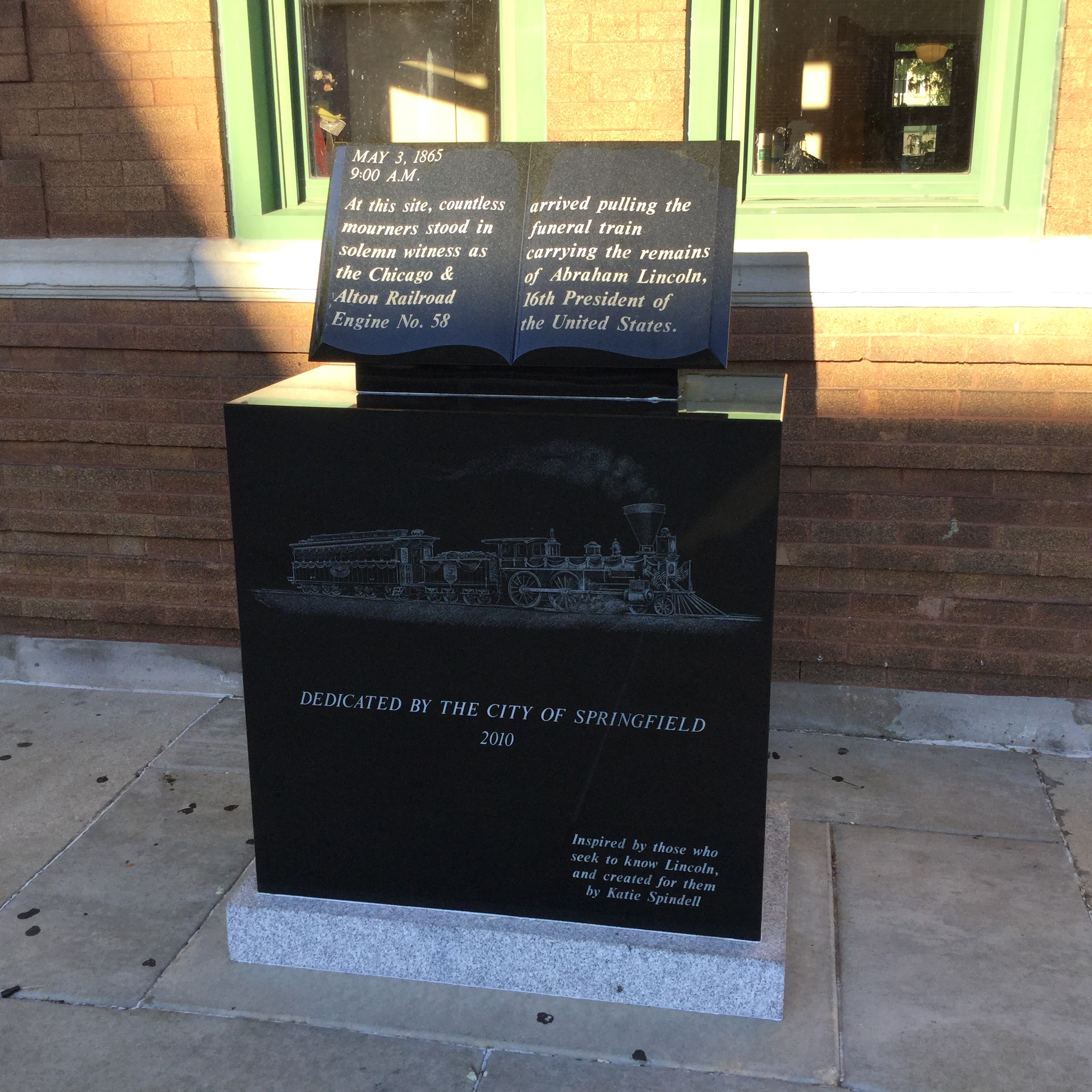
Marker for Lincoln’s funeral train in the summer evening light, at the Springfield Train Station at 100 N. 3rd Street, Springfield, Illinois

Last year, I visited Springfield, Illinois to follow the life and ideas of Abraham Lincoln while following in his footsteps. The last Springfield site associated with Lincoln that I visited on July 29th, 2017 was the train station at 100 N. 3rd St. The brick station, though plain, has clearly been spruced up since the photos featured on Google Maps, dated 2007, that I find on the day I write this. There’s now a shady porch over the outdoor waiting platform, new paint and benches, and a handsome stone marker signed by Katie Spindell.

The marker commemorates the May 3rd, 1865 arrival of the funeral train carrying Lincoln’s assassinated body. He lies buried at Oak Ridge Cemetery, in the city where he established his legal and political careers, married, and raised a family. Read more about my Lincoln travels in articles linked here, or listen to the podcast versions.

Springfield Train Station at 100 N. 3rd Street, Springfield, Illinois

Screenshot of 2007 Google Maps image of the N. 3rd Street train station in Springfield, IL

~ Ordinary Philosophy is a labor of love and ad-free, supported by patrons and readers like you. Any support you can offer will be deeply appreciated!

Happy Birthday, Niccolò Machiavelli!

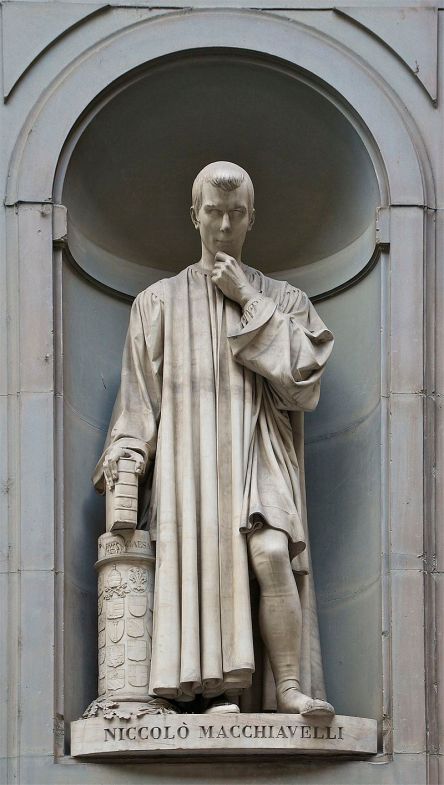
Niccolò Machiavelli statue at the Uffizi

Cary Nederman introduces us to his piece on Niccolò Machiavelli for The Stanford Encyclopedia of Philosophy thusly:

Why an entry on Machiavelli? That question might naturally and legitimately occur to anyone encountering an entry about him in an encyclopedia of philosophy. Certainly, Machiavelli [May 3, 1469 – June 21, 1527] contributed to a large number of important discourses in Western thought—political theory most notably, but also history and historiography, Italian literature, the principles of warfare, and diplomacy. But Machiavelli never seems to have considered himself a philosopher—indeed, he often overtly rejected philosophical inquiry as beside the point—nor do his credentials suggest that he fits comfortably into standard models of academic philosophy. His writings are maddeningly and notoriously unsystematic, inconsistent and sometimes self-contradictory. He tends to appeal to experience and example in the place of rigorous logical analysis. Yet succeeding thinkers who more easily qualify as philosophers of the first rank did (and do) feel compelled to engage with his ideas, either to dispute them or to incorporate his insights into their own teachings. Machiavelli may have grazed at the fringes of philosophy, but the impact of his musings has been widespread and lasting. The terms “Machiavellian” or “Machiavellism” find regular purchase among philosophers concerned with a range of ethical, political, and psychological phenomena, even if Machiavelli did not invent “Machiavellism” and may not even have been a “Machiavellian” in the sense often ascribed to him. Moreover, in Machiavelli’s critique of “grand” philosophical schemes, we find a challenge to the enterprise of philosophy that commands attention and demands consideration and response. Thus, Machiavelli deserves a place at the table in any comprehensive survey of philosophy…’

Learn more about the often contradictory, ever controversial, always fascinating and relevant Niccolò Machiavelli:

The Inverted Advice of Niccolò Machiavelli – by William J. Connell for the Times Literary Supplement

Machiavelli and the Italian City States – Melvin Bragg in conversation with his guests Quentin Skinner, Evelyn Welch, and Lisa Jardine

Niccolò Machiavelli – by Cary Nederman for The Stanford Encyclopedia of Philosophy

Niccolò Machiavelli: Italian Statesman and Writer – by Harvey Mansfield for Encyclopædia Britannica

A version of this piece was previously published at Ordinary Philosophy

~ Ordinary Philosophy is a labor of love and ad-free, supported by patrons and readers like you. Any support you can offer will be deeply appreciated!

Happy Birthday, Santiago Ramón y Cajal!

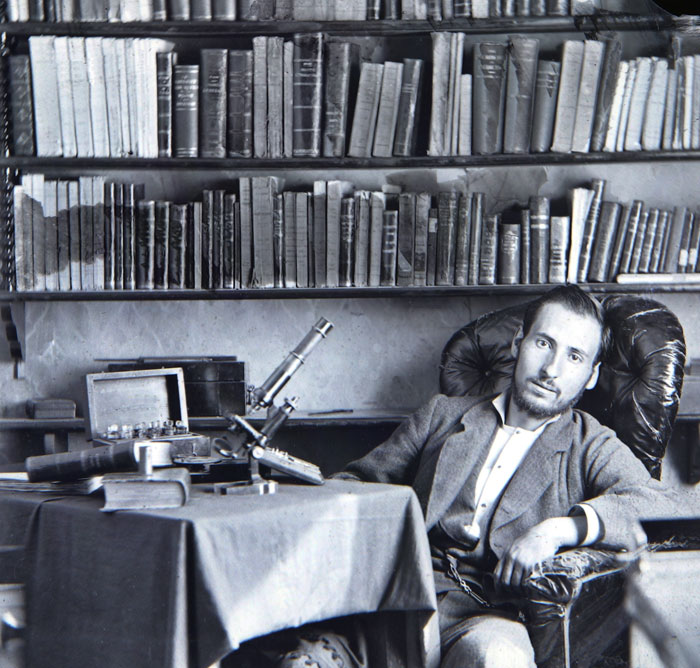
Santiago Ramón y Cajal, estudiante de medicina en Zaragoza 1876: self portrait, public domain via Wikimedia Commons

I discovered the fascinating scientist and thinker Santiago Ramón y Cajal (May 1, 1852 – Oct. 17, 1934) not long ago among the always excellent writings of Maria Popova:

Diseases of the Will: Neuroscience Founding Father Santiago Ramón y Cajal on the Six Psychological Flaws That Keep the Talented from Achieving Greatness – by Maria Popova for Brain Pickings

I don’t think I could improve upon her excellent article at all, so I recommend that to you first. Her article summarizes Cajal’s observations about the ways in which we can so easily defeat ourselves in the pursuit of excellence. I, for one, find that his observations and advice offer very wise guidance, a series of signposts marking pitfalls that can entrap our egos all too easily. Cajal clearly lived by his own advice, and his achievements were marked by hard work and dogged perseverance as well as brilliant insight.

Learn more about Cajal’s life and scientific achievements:

Life and Discoveries of Santiago Ramón y Cajal – by Marina Bentivoglio for Nobelprize.org

Santiago Ramón y Cajal – by Abdellatif Nemri for Scholarpedia

Santiago Ramón y Cajal – Biographical – from Nobel Lectures, Physiology or Medicine 1901-1921, Elsevier Publishing Company, Amsterdam, 1967, at Nobelprize.org

Santiago Ramón y Cajal: Spanish Histologist – by the editors of Encyclopaedia Britannica

~ Ordinary Philosophy is a labor of love and ad-free, supported by patrons and readers like you. Any support you can offer will be deeply appreciated!

Philosophers Should be Keener to Talk About the Meaning of Life, by Kieran Setiya

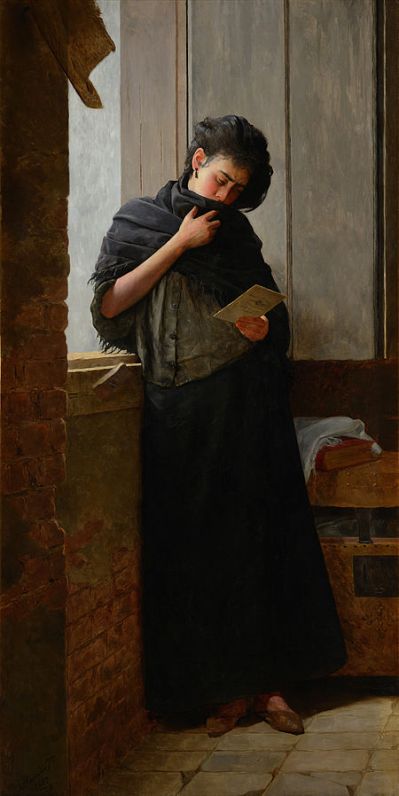
Saudade (Longing), by José Ferraz de Almeida Júnior, oil on canvas, 1899. Public domain via Wikimedia Commons

Philosophers ponder the meaning of life. At least, that is the stereotype. When I risk admitting to a stranger that I teach philosophy for a living and face the question ‘What is the meaning of life?’, I have a ready response: we figured that out in the 1980s, but we have to keep it secret or we’d be out of a job; I could tell you, but then I’d have to kill you. In fact, professional philosophers rarely ask the question and, when they do, they often dismiss it as nonsense.

The phrase itself is of relatively recent origin. Its first use in English is in Thomas Carlyle’s parodic novel Sartor Resartus (1836), where it appears in the mouth of a comic German philosopher, Diogenes Teufelsdröckh (‘God-born devil-dung’), noted for his treatise on clothes. The question of life’s meaning remains both easy to mock and paradigmatically obscure.

What is the meaning of ‘meaning’ in ‘the meaning of life’? We talk about the meaning of words, or linguistic meaning, the meaning of an utterance or of writing in a book. When we ask if human life has meaning, are we asking whether it has meaning in this semantic sense? Could human history be a sentence in some cosmic language? The answer is that it could, in principle, but that this isn’t what we want when we search for the meaning of life. If we are unwitting ink in some alien script, it would be interesting to know what we spell out, but the answer would not have authority over us, as befits the meaning of life.

‘Meaning’ could mean purpose or function in a larger system. Could human life play that role? Again, it could, but yet again, this seems irrelevant. In Douglas Adams’s Hitchhiker’s books, the Earth is part of a galactic computer, designed (ironically) to reveal the meaning of life. Whatever that meaning might be, our role in the computer program is not it. To discover that we are cogs in some cosmic machine is not to discover the meaning of life. It leaves our existential maladies untouched.

Seeing no other way to interpret the question, many philosophers conclude that the question is confused. If they go on to talk about meaning in life, they have in mind the meaning of individual lives, the question of whether this life or that life is meaningful for the person who is living it. But the meaning of life is not an individual possession. If life has meaning, it has a meaning that applies to us all. Does this idea make sense?

I think it does. We can make progress if we turn from the words that make up the question – ‘meaning’ in particular – to the contexts in which we feel compelled to ask it. We raise the question ‘Does life have meaning?’ in times of anguish, or despair, or emptiness. We ask it when we confront mortality and loss, the pervasiveness of suffering and injustice, the facts of life from which we recoil and which we cannot accept. Life seems profoundly flawed. Is there meaning to it all? Historically, the question of life’s meaning comes into focus through the anxiety of early existentialist philosophers, such as Søren Kierkegaard and Friedrich Nietzsche, who worried that it has none.

On the interpretation that this context suggests, the meaning of life would be a truth about us and about the world that makes sense of the worst. It would be something we could know about life, the Universe and everything, that should reconcile us to mortality and loss, suffering and injustice. Knowledge of this truth would make it irrational not to affirm life as it is, not to accept things as they are. It would show that despair, or angst, is a mistake.

The idea that life has meaning is the idea that there is a truth of this extraordinary kind. Whether or not there is, the suggestion is not nonsense. It is a hope that animates the great religions. Whatever else they do, religions offer metaphysical pictures whose acceptance is meant to bestow salvation, to reconcile us to the seeming faults of life. Or if they do not supply the truth, if they do not claim to convey the meaning of life, they offer the conviction that there is one, however hard to grasp or articulate it might be.

The meaning of life might be theistic, involving God or gods, or it might be non-theistic, as in one form of Buddhism. What distinguishes Buddhist meditation from mindfulness-based stress-reduction is the aim of ending suffering through metaphysical revelation. The emotional solace of Buddhism is meant to derive from insight into how things are – in particular, into the non-existence of the self – an insight that should move anyone. To come to terms with life through meditation for serenity, or through talk therapy, is not to discover the meaning of life, since it is not to discover any such truth.

Albert Einstein wrote that to know an answer to the question ‘What is the meaning of human life?’ means to be religious. But there is in principle room for non-religious accounts of meaning, ones that do not appeal to anything beyond the given world or the world revealed to us by science. Religion has no monopoly on meaning, even if it is hard to see how a non-transcendent truth could meet our definition: to know the meaning of life is to be reconciled to all that is wrong with the world. At the same time, it is hard to prove a negative, to show that nothing short of religion could play this role.

Philosophers are prone to see confusion in the question ‘What is the meaning of life?’ They have replaced it with questions about meaningful lives. But the search for life’s meaning will not go away and it is perfectly intelligible. I cannot tell you the meaning of life or give assurance that it has one. But I can say that it is not a mistake to ask the question. Does life have meaning? The answer is: it might.Aeon counter – do not remove

~ Kieran Setiya is a professor of philosophy at the Massachusetts Institute of Technology. His latest book is Midlife: A Philosophical Guide (2017). He lives in Brookline, Massachusetts. (Bio credit: Aeon)

This article was originally published at Aeon and has been republished under Creative Commons.

~ Ordinary Philosophy is a labor of love and ad-free, supported by patrons and readers like you. Any support you can offer will be deeply appreciated!

*All views and opinions expressed by guest writers are their own and do not necessarily express those of Ordinary Philosophy’s editors and publishers

Happy Birthday, Morton White!

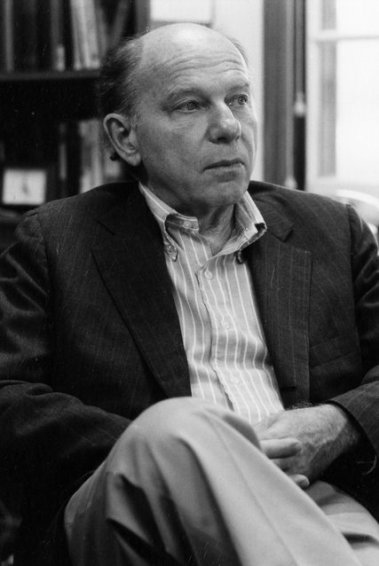
Morton White in 1981

The world lost Morton White (April 29, 1917 – May 27, 2016) less than two years ago, and I first learned of him through reading his obituary in The New York Times. As I read, I knew this is a man and an approach to philosophy I must learn more about.

White was a philosopher and historian of ideas. According to the Institute for Advanced Studies, ‘he maintained that philosophy of science is not philosophy enough, thereby encouraging the examination of other aspects of civilized life—especially art, history, law, politics and religion—and their relations with science’. And as William Grimes put it for TNYT, his ‘innovative theory of “holistic pragmatism” showed the way toward a more socially engaged, interdisciplinary role for philosophy’.

I studied philosophy with great love and enthusiasm as an undergraduate, yet I found myself then as now just as curious about other disciplines, especially history and the arts, and have often felt that the lines dividing these areas of study are sometimes artificial and even impediments to understanding. Since then, I’ve been pursuing my studies in the history of ideas more broadly, informally for the past several years, formally now at the University of Edinburgh. No doubt, White has influenced the direction my studies in intellectual history will take in ways I’ll learn as I go along, and in many more ways than I’ll ever know.

Learn more about White and his fascinating ideas:

Holistic Pragmatism and the Philosophy of Culture‘ – chapter 1 of A Philosophy of Culture: The Scope of Holistic Pragmatism, New Jersey: Princeton University Press 2002, in which White summarizes what his holistic pragmatism is all about

Morton White, Philosopher of Holistic Pragmatism, Dies at 99‘ – Obituary by William Grimes for The New York Times, June 10, 2016

Morton White 1917–2016 – His memorial page at the Institute for Advanced Study website, June 08, 2016

And you can find his selected bibliography at Wikipedia

*A version of this piece was previously published at Ordinary Philosophy

~ Ordinary Philosophy is a labor of love and ad-free, supported by patrons and readers like you. Any support you can offer will be deeply appreciated!

Happy Birthday, Ludwig Wittgenstein!

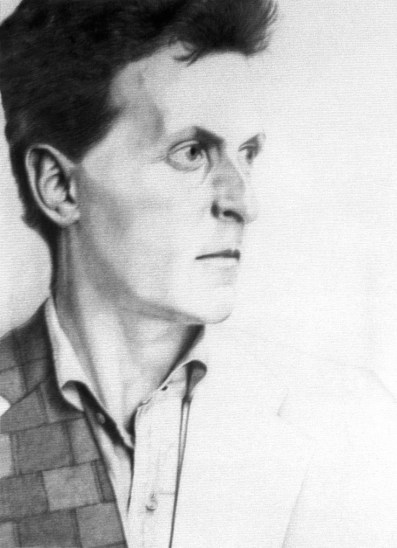
Drawing of Ludwig Wittgenstein by Christiaan Tonnism, pencil on board 1985, Creative Commons

In honor of Ludwig Wittgenstein’s birthday, Apr 26, 1889, let me share four fascinating discussions about the great philosopher’s life and ideas.

The first is by philosopher Stephen West for his podcast Philosophize This!, in which he discusses ‘…the limitations of language as described by Ludwig Wittgenstein. Considered by some to be the greatest philosopher of the 20th century, Ludwig Wittgenstein played a central, if controversial, role in 20th-century analytic philosophy. He continues to influence current philosophical thought in topics as diverse as logic and language, perception and intention, ethics and religion, aesthetics and culture….’ (this episode is only the first West will create about Wittgenstein)

The second is from the BBC series Great Lives, hosted by Matthew Parris and featuring guests Raymond Tallis and Ray Monk. In this program, Parris, Tallis, and Monk discuss ‘Ludwig Wittgenstein, the fascinating and misunderstood genius who changed the course of philosophy…’

The third is from the BBC series In Our Time, hosted by Melvin Bragg and featuring guests Ray Monk, Barry Smith, and Marie McGinn. In this program, Monk, Bragg, Smith, and McGinn discuss ‘…the life, work and legacy of Ludwig Wittgenstein… Wittgenstein is credited with being the greatest philosopher of the modern age, a thinker who left not one but two philosophies for his descendants to argue over: The early Wittgenstein said, “the limits of my mind mean the limits of my world”; the later Wittgenstein replied, “If God looked into our minds he would not have been able to see there whom we were speaking of”. Language was at the heart of both. Wittgenstein stated that his purpose was to finally free humanity from the pointless and neurotic philosophical questing that plagues us all. As he put it, “To show the fly the way out of the fly bottle.” How did he think language could solve all the problems of philosophy? How have his ideas influenced contemporary culture?…’

The fourth is by Ian Ground for the Times Literary Supplement, an excellent piece I recommended here at Ordinary Philosophy last fall. In it, Ground discusses ‘why writers and artists have found him an object of fascination and inspiration. He is the subject of novels, poetry, plays, painting, music, sculpture and films. In the arts and the culture generally, Wittgenstein seems to be what a philosopher ought to be.’

Enjoy, and be inspired, awed, puzzled, and enlightened!

*A version of this piece was previously published at Ordinary Philosophy

~ Ordinary Philosophy is a labor of love and ad-free, supported by patrons and readers like you. Any support you can offer will be deeply appreciated!

Photobook: Thomas Paine Artifacts at the People’s History Museum, Manchester, England

Thomas Paine display at the People’s History Museum, Manchester, England, 2018 Amy Cools

Thomas Paine display at the People’s History Museum, Manchester, England.

Paine’s death mask at the People’s History Museum. As you can see, this great thinker and writer was also a rather homely man.

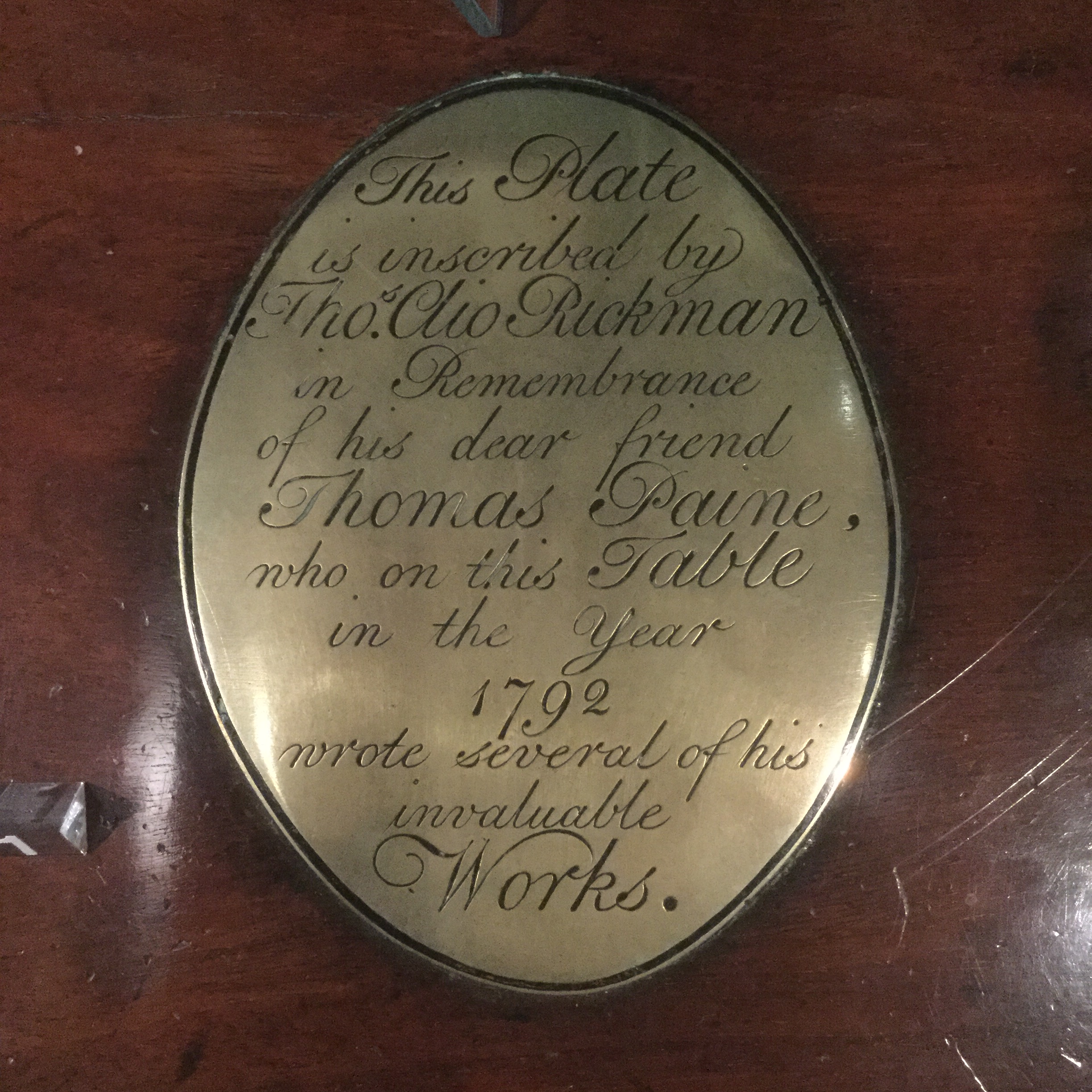
Thomas Paine’s writing table. As the People’s History Museum website explains, ‘The table actually belonged to Thomas Clio Rickman who lived at number 7 Upper Marylebone Street, London and whom Paine stayed with in 1792 before fleeing to France following the publication of The Rights of Man. Rickman would proudly show his visitors the table, now sanctified by his plaque…’

Plaque on the Paine writing table at the People’s History Museum

Lock of Thomas Paine’s hair in a snuffbox

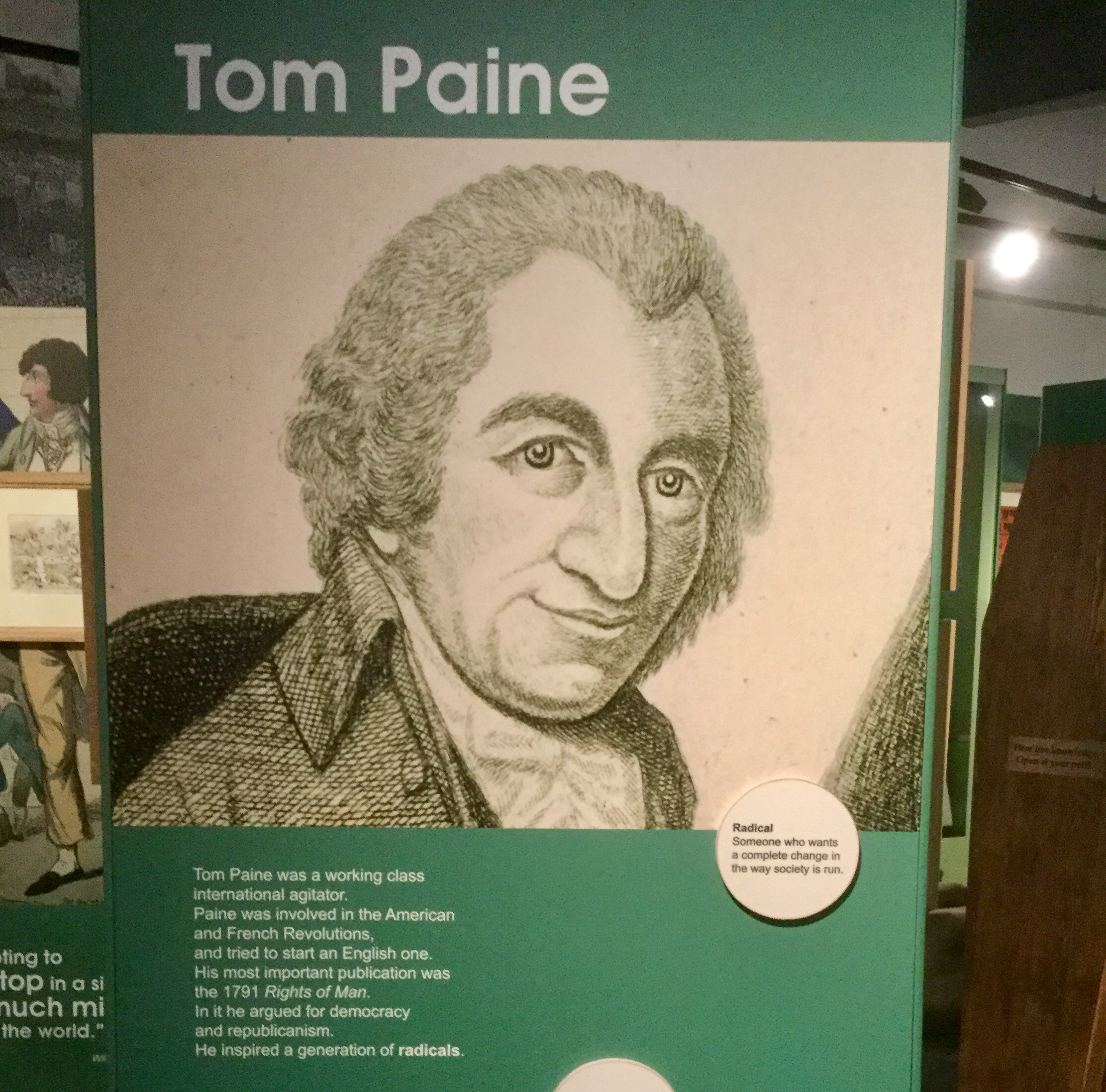
Placard for the Thomas Paine display at the People’s History Museum, Manchester, England

Thomas Paine display placard at the People’s History Museum, Manchester, England, 2018 Amy Cools

Another Paine display placard at the People’s History Museum, Manchester, England

~ Ordinary Philosophy is a labor of love and ad-free, supported by patrons and readers like you. Any support you can offer will be deeply appreciated!

Remembering Margaret Fell

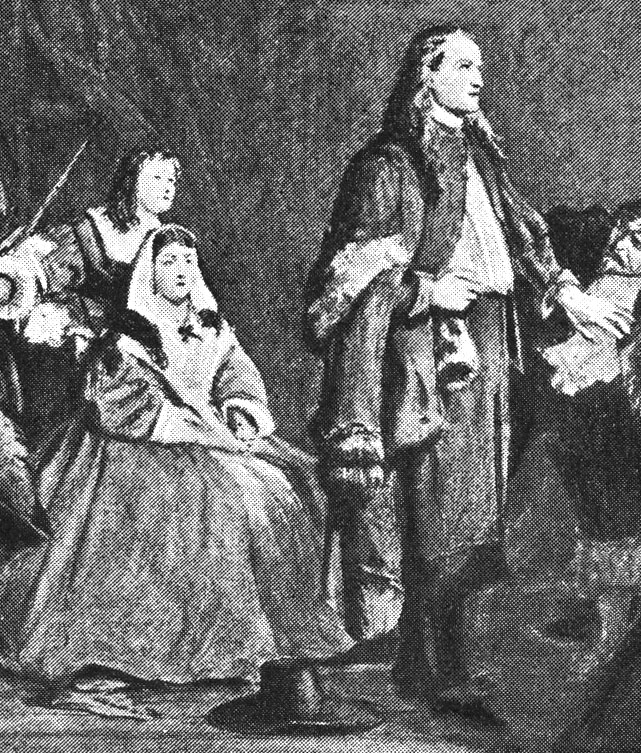
Margaret Fell, with George Fox before the judges, from a painting by J. Pettie 1663, public domain via Wikimedia Commons

Margaret Fell with George Fox before the judges, from a painting by J. Pettie, 1663

Margaret Fell was born on some unknown date in 1614, so let’s take this occasion to remember her on the date of her death, April 23rd, 1702.

Fell’s lived a life as passionate as it was long. She was an unconventional thinker for her time, a zealous and progressive religious activist at times imprisoned for her beliefs, a prolific writer, well-traveled, a mother of eight children and a wife twice.

An early adherent and eloquent promoter of Quakerism, Fell is now considered one of its founders. She converted to Quakerism after hearing a sermon by one of its most charismatic preachers, George Fox, and almost immediately launched into a lifetime of hosting Quaker meetings and speaking out on behalf of her new religion. After her husband died some years later, Fell married Fox, probably more as a co-missionary than as a romantic partner since their work, travels, and imprisonments kept them apart for much of their marriage.

As I’ve had a lifelong fascination with the history of human rights, I’ve long admired the Quakers because, along with Unitarians and Deists, so many have been leaders in the struggle to expand, establish, and promote them. That’s because these faiths emphasize the importance of individual conscience, the primacy of the human mind, God’s rational nature, and the moral equality of all human beings.

Fell believed in the Quaker doctrine of the Inner Light which God has caused to shine equally in the hearts of all beings; all we need do is heed it. Therefore, one does not need ministers, priests, or any other authorities or intercessors to achieve salvation. And because God has created everyone for the same purpose and gave everyone that light, everyone is spiritually equal and capable of understanding and proclaiming the Truth. We can see how this doctrine, central to Quakerism, readily aligns with human rights movements centered on a belief human spiritual and intellectual equality. The right of women to speak in church and write religious texts, in her time limited to men, was a cause particularly dear to Fell’s heart. While Fell’s belief in the equality of women was limited to their role as spiritual beings, Quakerism tended to encourage ever-more progressive beliefs in its adherents. Over time, many Quakers came to be leaders in the abolitionist and pacifist movements, promoting the right of all to receive equal and universal education and for women’s rights in social and political spheres as well.

In light of her achievements as a female religious pioneer, and the human rights advances facilitated by the Quaker faith she helped found, Fell’s contributions should continue to be remembered and celebrated.

*A version of this piece has been previously published at Ordinary Philosophy

~ Ordinary Philosophy is a labor of love and ad-free, supported by patrons and readers like you. Any support you can offer will be deeply appreciated!

~~~~~~~~~~~~~~~~~~~~~~~~~~

Sources and inspiration

Broad, Jacqueline, ‘Margaret Fell‘, The Stanford Encyclopedia of Philosophy, Edward N. Zalta (ed.)

Jacoby, Susan. Strange Gods: A Secular History of Conversion. New York: Pantheon, 2016 (see the chapter on Margaret Fell)