Cesar Chavez Day, by Alejandro Magaña

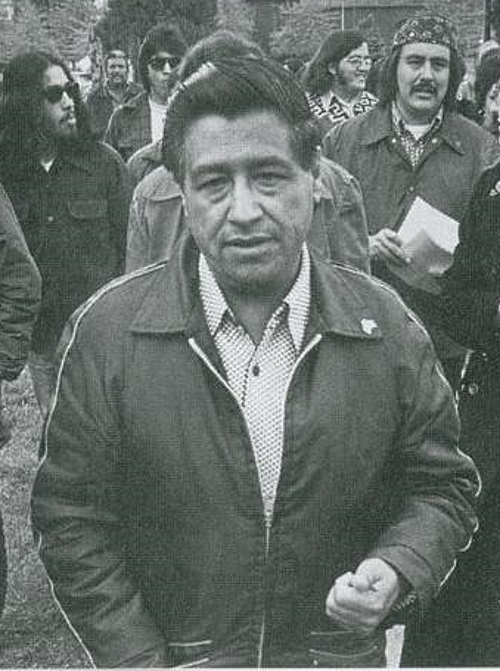
Cesar Chavez visits college - By Movimiento - Own work, cropped - CC BY-SA 3.0 httpcreativecommons.orglicensesby-sa3.0 via Wikimedia CommonsEvery year around Cesar Chavez’s birthday, as media outlets report of festivities in his honor, I’m reminded of a joke in a Simpsons episode and the strange sadness it elicited in me when I saw it: Homer Simpson is on his front lawn and is confronted with the apparition of a debonair, mustachioed man who introduces himself as, “the spirit of Cesar Chavez.”

In typical Homer confusion he asks, “Then why do you look like Cesar Romero?”

The ghost replies, “Because you don’t know what I look like!”

Cesar Chavez is certainly revered by many people, especially within the Latino community, but despite the steadily increasing ubiquity of his name across the United States, especially the American Southwest, there are still many Americans today who don’t really know who he is, let alone what he stood for, or what he accomplished.

Cesar Chavez was a Mexican-American community organizer turned labor leader. A former migrant farmworker recruited by the Community Service Organization (CSO) in its heyday of the 1950s, he co-founded the National Farmworkers Association (NFWA,) which later became the United Farm Workers (UFW,) the first successful union for migrant farmworkers. The UFW’s membership consisted mostly of indigent Latinos and Filipinos, and their struggle for justice and dignity, fighting to gain higher wages and better conditions in the fields where they were deprived of basic needs such as clean drinking water and bathrooms, became a national moral cause under the stewardship of Chavez, who courted national and international sympathy using militant non-violent tactics in the vein of Mahatma Gandhi and Martin Luther King Jr, such as strikes, boycotts, fasts, and peaceful marches.

Chavez was not an imposing orator with the fire-and-brimstone timbre of the Reverend Dr. King, nor did he cut as iconoclastic a figure as Gandhi, but in his unassuming way he could be just as charismatic and endearing, and this often caught people off guard, as it did an interviewer for the New Yorker in 1973, who, “had expected, if not a Mexican-American Lenin…a young, hard, intense man bristling with revolutionary zeal. Instead we found Mr. Chavez to be a stocky man…about five feet seven …with Indian features…and a pleasant earnest manner.” With his trademark regular boys’ haircut parted on the side and wearing simple cardigans with button down plaid shirts and slacks, his fashion was more Mr. Rogers than Mr. Lenin. He looked the part of the humble Everyman that people felt they could relate to.

On a personal note, my parents actually met while working with Cesar Chavez in the early ‘70s, and when they tell stories of those days, they both recall how approachable he was with his easy but confident demeanor; how people were drawn to him and trusted him, even as he took them out of their comfort zones, like the time he sent my mom and a few other farmworkers to Chicago, to publicize and organize the Grape Boycott, even though they spoke very little English and were armed with just a few phone numbers of sympathizers there along with the names of some churches that might possibly provide them with food, room and board. They believed they could accomplish such ambitious plans because this diminutive, unpretentious man seemed capable of stopping the engine of the entire agricultural industry and took on Big Agribusiness all by himself. Before it became widely known as the slogan of Barack Obama’s presidential campaign, I grew up with my father reminding me, “¡Si se puede!” (Yes, you can!) a phrase Chavez often chanted before throngs of people at picket lines and marches.

Like Gandhi and King, he was intensely spiritual and absolutely committed to non-violence. In what may be his most recognizable aphorism, he said, “It is my deepest belief that only by giving our lives do we find life. I am convinced that the truest act of courage…is to sacrifice ourselves for others in a totally non-violent struggle for justice.” Self-immolation was a recurring theme in both word and deed: in 1968, during the Delano Grape Strike, after several tense confrontations at the picket lines nearly devolved into violence, he fasted for 25 days to encourage and remind the farmworkers that their fight was to be a non-violent one. He would fast for 24 days again in 1972, and in 1988 he fasted for 36 days(!) to bring attention to the pesticide poisoning of grape workers and their children. It is thought that his relatively early death at the age of 63 in 1993 was probably due to aggregated health complications suffered from these sacrifices. Still, even now, if you talk to people who marched with Chavez and the UFW back then, most speak of Chavez in reverential, even hagiographical ways, for to them he was como un santo: like a saint..

Throughout the 1960s and 1970s, as the UFW made sweeping legislative strides on behalf of organized farm labor, Chavez was also becoming the most widely known leader within the broader Chicano Movement, or “El Movimiento,” a civil rights movement which empowered Mexican Americans caught between two cultures, not quite Mexican enough for their Mexican immigrant forebears, nor seen as truly American by the white hegemony. The term “chicano” was originally a derogatory term for the American children of Mexican migrants, but in the Movement it was flipped, transmogrified, to be a badge of ethnic pride. Of course Chavez always made sure to situate the fight of the UFW as united with the struggle of “all farm workers across the country, the Negroes and poor whites, the Puerto Ricans, Japanese, and Arabians…the races that comprise the oppressed minorities of the United States,” but “The Plan de Delano,” a text co-authored by Chavez with Dolores Huerta and the Chicano playwright Luis Valdez, reifies and emboldens his ethnic heritage, declaring “We are sons of the Mexican Revolution.” To this day, the flag of the UFW, showing a black Aztec eagle on stark red background, is widely considered a symbol of Chicano or Latino pride. Those of us who wear this symbol, or even, as in my case, have it tattooed on their body, recognize that the life we have so firmly rooted in the United States, with access to resources and opportunities that our parents or grandparents did not have, is due to the hard work and vigilance of people like Cesar Chavez, Dolores Huerta, or my mother, Maria Saludado.

The identity politics that certainly began to swell in the 1960s have persisted despite reactionary criticism and remain particularly relevant today; an era in which the ugly scars of racism seem as starkly etched in our national consciousness as ever. As we near the end of the second term of America’s first ‘non-white’ President, as Mexican immigration continues to be a galvanizing and polarizing issue in the US, and the Latino vote is highly prized on both sides of the political aisle, conditions would seem fecund for a reboot of El Movimiento. In appropriate fashion, this year the Cesar Chavez Foundation, an offshoot of the UFW, began its annual celebration in San Fernando, the first city in the nation to commemorate Cesar Chavez Day with a paid holiday, with a rally and march to encourage activism to “Dump Trump.”

¡Que viva César Chávez!

~ Alejandro Magaña is a musician, poet, and songwriter some of the time, and a father and husband all of the time. He also works full-time as an office manager at Urban Ore in West Berkeley. He lives in North Oakland with his wife and son and books and records.

Sources and Inspiration:

● My mother and father. ¡Que viva mis padres!
● Chasan, Daniel. “‘Marcher,’ an interview with Cesar Chavez,” The New Yorker, May 27, 1967.
● Chavez, Cesar, Huerta, Dolores, and Valdez, Luis. “The Plan of Delano,” El Malcriado, March 17, 1966.
● Chavez, Cesar. An Organizer’s Tale: Speeches Ed. Ilan Stevens. London: Penguin Books, 2008.

This piece was first published one year ago today here at Ordinary Philosophy

~ Ordinary Philosophy is a labor of love and ad-free, supported by patrons and readers like you. Any support you can offer will be deeply appreciated!

*All views and opinions expressed by guest writers are their own and do not necessarily reflect those of Ordinary Philosophy’s editors and publishers

Happy Birthday, Moses Maimonides!

Maimonides medallion, photo by T. Horydczak, approx. 1950, sculpture over the door of the gallery of House chamber, U.S. Capitol. Photo public domain via Library of Congress

‘Moses Maimonides… [born on March 30, 1135]… is the greatest Jewish philosopher of the medieval period and is still widely read today. The Mishneh Torah, his 14-volume compendium of Jewish law, established him as the leading rabbinic authority of his time and quite possibly of all time. His philosophic masterpiece, the Guide of the Perplexed, is a sustained treatment of Jewish thought and practice that seeks to resolve the conflict between religious knowledge and secular….’ ~ Kenneth Seeskin, Stanford Encyclopedia of Philosophy

Read and hear more about this great philosopher and religious thinker at:

Jewish Philosophy: Maimonides – Joe Gelonesi interviews Steven Nadler for The Philosopher’s Zone podcast

Maimonides – by Melvyn Bragg and his guests John Haldane, Sarah Stroumsa, and Peter Adamson for In Our Time BBC Radio 4 podcast

Maimonides – by Kenneth Seeskin for Stanford Encyclopedia of Philosophy

Maimonides (1138—1204) – by Jonathan Jacobs for the Internet Encyclopedia of Philosophy

Maimonides (Rambam) and His Texts – by Danny Moss for My Jewish Learning website

Moses Maimonides | Jewish Philosopher, Scholar, and Physician – by Ben Zion Bokser for Encyclopædia Britannica

Oath and Prayer of Maimonides – Bioethics – The Sheridan Libraries at Johns Hopkins University website

Sarah Stroumsa on Maimonides – Conversation with Peter Adamson for History of Philosophy Without Any Gaps podcast

Ordinary Philosophy and its Traveling Philosophy / History of Ideas series is a labor of love and ad-free, supported by patrons and readers like you. Please offer your support today!

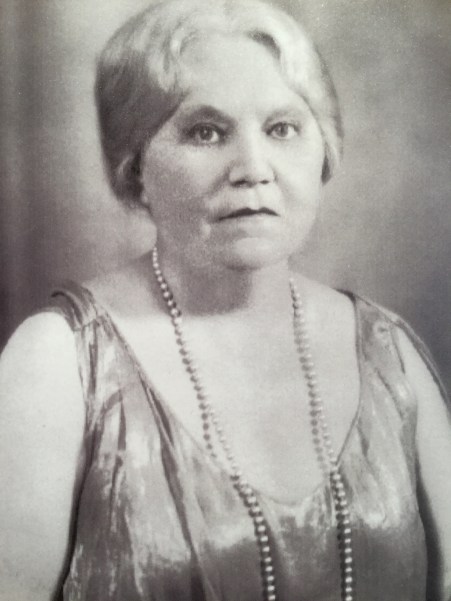
Happy Birthday, Minerva Hamilton Hoyt, and Thank You for Joshua Tree National Park!

Minerva Hoyt

Just last week, I returned to one of my favorite places in the world: Joshua Tree National Park.

A native of Southern California, I have visited it many, many times throughout my life, ever since I was a young girl: with family, with friends, and alone. This place is full of wonder, beauty, and a clear clean vastness which tricks your eyes and makes you never quite certain if the rock, rise, or Joshua tree you see in the distance is close enough to touch or miles and miles away. I’ve hiked here, camped here, explored here, laughed and talked here, sighed, embraced, and frolicked with my first love here; I’ve experienced companionship, loneliness, solitude, joy, pain, and peace here. Joshua Tree played a great role in the development of my mind, soul, and heart. The beauty and richness of this place have thus affected so many others, including and especially one other woman, and it shaped her life:

There was once a natural wonder in the California desert — one you may not have heard of — that was essentially destroyed 90 years ago because people wanted desert plants for their own gardens.

One Pasadena-based environmental activist was horrified at that destruction. Her response forever changed the way Californians look at the desert, and earned her a permanent place in the pantheon of California environmentalist women… – Chris Clarke

A young Joshua Tree, cholla, creosote, and yucca at Joshua Tree National Park

…This woman was Minerva Hoyt.

Not many will recall Minerva Hamilton Hoyt and her tireless efforts on behalf of California desert protection. In fact, without her leadership, Joshua Tree National Park might never have become part of the National Park System. How a transplanted southern belle born on a Mississippi plantation became a staunch backer of the protection of desert landscapes is perhaps one of the more unlikely stories in the annals of national park history.

Minerva Hamilton led a genteel early life attending finishing schools and music conservatories. Her marriage to Dr. Sherman Hoyt led her away from the deep south to New York and eventually to South Pasadena where she immersed herself in southern California high society and civic causes. She demonstrated talent as an organizer of special charity events and developed a passion for gardening, which introduced her to some of the native desert vegetation commonly used in southern California landscaping. Trips to the desert instilled in Ms. Hoyt a strong appreciation for the austere beauty and wonderful inventiveness of desert plants that somehow managed to thrive in the harsh climate. She also saw the widespread destruction of native desert plants by thoughtless people who dug up, burned, and other wise destroyed so many of the cacti and Joshua trees that Minerva found beautiful.

Following the deaths of her son and husband, Minerva dedicated herself to the cause of protecting desert landscapes… – Joseph W. Zarki

A Joshua tree in bloom

Here’s a photo journal of some of the beauties I marveled at on my latest visit, including the marvelous desert plants Minerva Hoyt loved so well. There were some wildflowers already in bloom, but this was mid-March, a little early for wildflowers at the higher, cooler, western Mohave Desert end of the park. I heard they were in full bloom at the eastern, lower, warmer Colorado Desert end of the park, but I was with a large family group during this visit and we were unable to round everyone up to make the additional drive.

Following these photos, you’ll find links to articles and books where you can read more about this hero of conservation. The political climate we find ourselves in in the United States does not bode well for the conservation of our greatest national wonders. Yet I hope the great vision of Minerva Hoyt, John Muir, Theodore Roosevelt (and later his cousin Franklin, who established Joshua Tree National Park by proclamation), and so many others who fought the good fight on its behalf, fueled by the love of nature which ennobles every heart it finds a home in, continues to win over the hearts and minds of all Americans. This is our pride and our heritage, and once gone, it may never return.

A natural sphinx stands tall among the sunrays and above the yucca plants in Hidden Valley, Joshua Tree National Park

Early blooming cactus, Joshua Tree National Park

Panoramic view of Hidden Valley in early spring, Joshua Tree National Park

A beautiful arrangement of stone, sky, cactus, and creosote, Joshua Tree National Park

Stone, flora, and sky in Hidden Valley, Joshua Tree National Park

Western tent caterpillars in a creosote bush, Joshua Tree National Park

A young Joshua tree forest, Joshua Tree National Park

Another view of Hidden Valley, Joshua Tree National Park

Sources and Inspiration

Bishop, Kim. ‘How One Tireless Advocate Protected Joshua Tree National Park‘. Aug 8, 2016, San Bernardino County Sun

Clarke, Chris. ‘The Woman Who Saved The California Desert‘. March 11, 2016, KCET.org

Kaufman, Polly Welts. National Parks and the Woman’s Voice: A History. University of New Mexico Press, 2006.

Zarki, Joseph W. Joshua Tree National Park, for Images of America book series. Arcadia, 2015

Zarki, Joseph W. ‘Minerva Hoyt‘. For the National Park Service at nps.gov

Ordinary Philosophy and its Traveling Philosophy / History of Ideas series is a labor of love and ad-free, supported by patrons and readers like you. Please offer your support today!

Happy Birthday, Elizabeth Anscombe!

‘Elizabeth Anscombe, [born Mar 18, 1919] was considered by some to be the greatest English philosopher of her generation. She was professor of philosophy at Cambridge from 1970 to 1986, having already, as a research fellow at Oxford in the 50s, helped change the course of moral philosophy. Also influential in philosophy of mind, she pioneered contemporary action theory, and the pre-eminent philosopher Donald Davidson called her 1957 monograph Intention the best work on practical reasoning since Aristotle. The philosophical world owes her an enormous debt, too, for bringing Wittgenstein, probably the greatest philosopher of the 20th century, to public knowledge…. from Jane O’Grady’s obituary for The Guardian

Let us honor Elizabeth Anscombe on the anniversary of her birth by learning more about this important, influential, and trailblazing philosopher:

G. E. M. Anscombe (1919—2001) – by Duncan Richter for the Internet Encyclopedia of Philosophy

Gertrude Elizabeth Margaret Anscombe – by Julia Driver for The Stanford Encyclopedia of Philosophy

Elizabeth Anscombe – A BBC Programme Woman’s Hour episode in which Sarah Woolman speaks to Dr Rosalinde Hursthouse and Professor Philippa Foot

The Golden Age of Female Philosophy – A recent episode of Philosopher’s Zone which discusses Anscombe’s work along with the work of other great contemporary women philosophers

Anscombe Bioethics Centre – ‘a Roman Catholic academic institute that engages with the moral questions arising in clinical practice and biomedical research’

G.E.M. Anscombe Bibliography – by José M. Torralba for Universidad de Navarra

~ Ordinary Philosophy is a labor of love and ad-free, supported by patrons and readers like you. Please offer your support today!

In Memory of Hypatia of Alexandria

Detail of the death portrait of a wealthy woman, c. 160-170 AD near modern-day Er-Rubayat in the Fayum, public domain via Wikimedia CommonsHypatia’s birthday is somewhere between 350 and 370 AD; a range of dates indicating great uncertainty, to be sure, but original sources that old are hard to come by, especially from a city as turbulent and violence-torn as the Alexandria of her day. The day of her death is better known, sometime in March of 415 AD. Since the latter date is more precise, we’ll break with our birthday remembrance tradition here and celebrate the memory of Hypatia in the month of her tragic and violent death instead of on the date of her birth.

She was a mathematician, astronomer, teacher, and philosopher who wrote commentaries on important works in geometry and astronomy with her father Theon, likely contributing original work of her own. Hypatia was a Neoplatonist, a philosophy with mystical overtones which posits that everything derives its being from the One, an ultimately conscious yet nonmaterial, non-spacial entity which is the pure ideal of everything that is. She was a scholar and teacher in a field and in a male-dominated world, and historians from her day to ours emphasize her extraordinary talents and her femininity with a nearly equal mix of awe and bemusement.

So let us remember and honor Hypatia for her great contributions to human knowledge and to the history of women’s liberation, living proof that women are equals in intellect and courage.

And let us also remember her sad death as a cautionary tale against those who inflame popular sentiment to seize power for themselves. Hypatia met her death at the hands of a Christian mob caught up in the anti-pagan hysteria of the day; Alexandria itself was caught up in a power struggle between civic and religious authority. The mob of extremists who dragged Hypatia from her carriage, torture and kill her with roofing tiles, and defile her body are inspired by their partisanship with theocratic bishop Cyril to kill this pagan philosopher, this mathematician and astronomer (then often equated with sorcerer), this woman who dared teach men, this friend of Cyril’s rival Orestes, civic leader of Alexandria. According to Hypatia scholar Micheal Deakin, “Cyril was no party to this hideous deed, but it was the work of men whose passions he had originally called out. Had there been no [earlier such episodes], there would doubtless have been no murder of Hypatia.”

From a certain millionaire we all know* who rose to power whipping up populist support throughout his presidential race with extremist racial and religious rhetoric, back to Hypatia’s time and beyond, power-hungry opportunists plead innocence from the very violence they inspire. Yet it appears hard to justify that plea when reason and the lessons of history plainly reveal the nearly inevitable results of fomenting sectarian strife. Extremism in the defense of liberty or anything else is a vice** because of the way it drives away reason and sympathy, and after all, nothing is as liberty-destroying as mob violence and death.

* ‘What If Trump Wins?’ by Jeet Heer in New Republic, Nov 24, 2015

** in reference to the quote ‘Extremism in the defense of liberty is no vice’ from Barry Goldwater’s 1964 presidential nomination acceptance speech 

Read more about the great Hypatia of Alexandria:

Deakin, Michael.’Hypatia of Alexandria‘ from Ockham’s Razor radio program of Radio National of Australia (transcript), Sun August 3rd 1997. (click ‘Show’ across from ‘Transcript’)

O’Connor, J J and E F Robertson. ‘Hypatia of Alexandria‘, from the School of Mathematics and Statistics, University of St Andrews, Scotland website.

‘O’Neill, Tim. ‘“Agora” and Hypatia – Hollywood Strikes Again‘. Armarium Magnum blog, Wed May 20, 2009

Zielinski, Sarah. ‘Hypatia, Ancient Alexandria’s Great Female Scholar‘. Smithsonianmag.com, Mar 14, 2010.

…and about Neoplatonism

Wildberg, Christian, “Neoplatonism“, The Stanford Encyclopedia of Philosophy (Spring 2016 Edition), Edward N. Zalta (ed.)

~ Ordinary Philosophy is a labor of love and is ad-free, supported by patrons and readers like you. Please offer your support today!

~ A version of this piece was originally published here at Ordinary Philosophy one year ago

Happy Birthday, Rosa Luxemburg!

Amy M Cools's avatarOrdinary Philosophy

Rosa Luxemburg, By unknown photographer around 1895-1900 [Public domain], via Wikimedia CommonsRosa Luxemburg, Mar 5 1871 – Jan 15 1919, is the great Marxist theorist, writer, economist, revolutionist, anti-war and anti-capital-punishment activist, and philosopher who was murdered during the German Revolution of 1918–1919.
Though she’s an anti-war activist, Luxemburg is also critical of the idea that a just society can be brought about by incremental reforms through established political systems. If she were to be involved in the 2016 Democratic primary race between Hillary Clinton and Bernie Sanders, she would very likely back Bernie, with his more revolutionary style and rhetoric: she’s sharply critical of the Social Democratic Party of Germany, to which she belongs (in its left wing) for favoring a Hillary-style reformist approach. However, her internationalism takes Marxist thinking beyond the point where leading Marxists of her day had progressed, with their focus on unique formulations of Marxist political theory tailored to their own particular national identities and histories. She would likely find fault, then, with Bernie’s protectionism.

Luxemburg’s other great contribution to…

View original post 148 more words

Happy Birthday, Karl Marx!

Marx by Sam Kaprielov, 76x61cm, oil on canvas, 2015, image used by permission of the artist

Marx by Sam Kaprielov, 76x61cm, oil on canvas, 2015, http://www.samkaprielov.com/

Born on May 5, 1818, few thinkers have been as influential as Karl Marx. Philosopher, theoretician of history, economist, sociologist, journalist, and revolutionary socialist, he was a prolific thinker and writer, widely lauded, criticized, and misunderstood, all of these especially by those who claim to act in his name.

In honor of his birthday, here’s a series of works about Karl Marx, a recent painting by an artist whose work my good friend introduced me to, and a song that I love.

Karl Marx (1818 – 1883) – a brief bio at BBC: History

Karl Marx, 1818-1883 – by Steven Kreis for The History Guide

Karl Marx – by Jonathan Wolff for The Stanford Encyclopedia of Philosophy

Marx – Melvyn Bragg and guests Anthony Grayling, Francis Wheen, and Gareth Stedman Jones discuss Karl Marx for BBC’s In Our Time podcast and radio series

Karl Marx: Capitalism vs. Communism, Marx and Kierkegaard on Religion Part 1 and Part 2and Austrians and Marx – by Stephen West for Philosophize This!

~ Ordinary Philosophy and its Traveling Philosophy / History of Ideas series is a labor of love and ad-free, supported by patrons and readers like you. Please offer your support today!

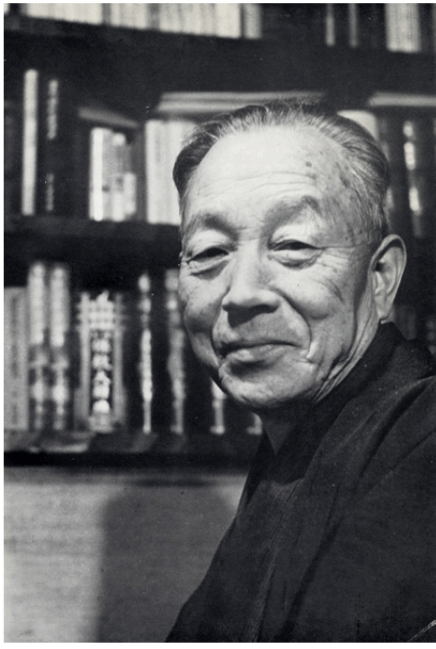
Happy Birthday, Watsuji Tetsurô!

Tetsuro Watsuji, photo via Alchetron, Creative Commons CC BY-SA

Tetsuro Watsuji, photo via Alchetron, Creative Commons CC BY-SA

Let us remember the philosopher Watsuji Tetsurô on the anniversary of his birth, March 1, 1889.

Robert Carter and Erin McCarthy wrire for The Stanford Encyclopedia of Philosophy:

‘Watsuji Tetsurô was one of a small group of philosophers in Japan during the twentieth century who brought Japanese philosophy to the world. He wrote important works on both Eastern and Western philosophy and philosophers, from ancient Greek, to Schopenhauer, Nietzsche, Kierkegaard and Heidegger, and from primitive Buddhism and ancient Japanese culture, to Dōgen (whose now famous writings Watsuji single-handedly rediscovered), aesthetics, and Japanese ethics. His works on Japanese ethics are still regarded as the definitive studies.

Influenced by Heidegger, Watsuji’s Climate and Culture is both an appreciation of, and a critique of Heidegger. In particular, Watsuji argues that Heidegger under-emphasizes spatiality, and over-emphasizes temporality. Watsuji contends that had Heidegger equally emphasized spatiality, it would have tied him more firmly to the human world where we interact, both fruitfully and negatively. We are inextricably social, connected in so many ways, and ethics is the study of these social connections and positive ways of interacting….’ Read the full bio of Watsuji Tetsurô here

… and learn more from and about this great philosopher who wrote extensively about personhood and our place in the world, and one who bridged Eastern and Western thought:

Climate and Culture: A Philosophical Study – by Watsuji Tetsurô

Summary / SUNY Press page for Rinrigaku (Ethics) by Watsuji Tetsuro (translation by Seisaku Yamamoto and Robert E. Carter) – The Cambridge Encyclopedia of Philosophy describes Tetsurô’s Ethics as ‘the premier work in modern Japanese moral theory [which] develops a communitarian ethics in terms of the “betweenness” (aidagara) of persons based on the Japanese notion of self as ningen, whose two characters reveal the double structure of personhood as both individual and social.’ (p 449)

Watsuji Tetsurō: Japanese Philosopher and Historian – in Encyclopædia Britannica

Watsuji Tetsuro – in New World Encyclopedia

Ordinary Philosophy and its Traveling Philosophy / History of Ideas series is a labor of love and ad-free, supported by patrons and readers like you. Please offer your support today!

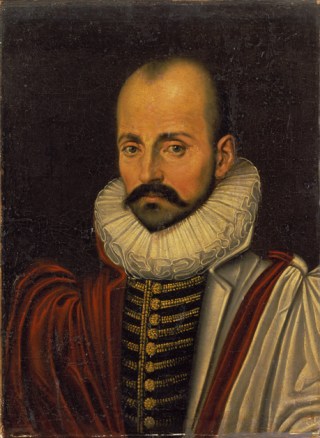
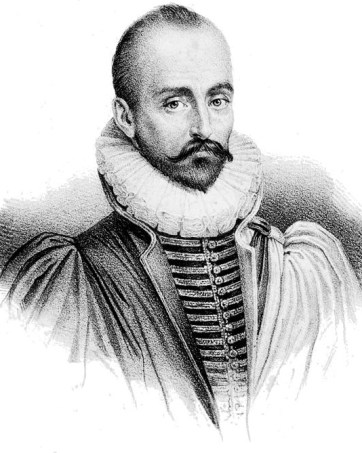
Happy Birthday, Michel de Montaigne!

Michel de Montaigne, public domain via Wikimedia Commons

Michel de Montaigne, public domain via Wikimedia Commons

Michel de Montaigne, born on February 28, 1533, was a thinker after my own heart.

Montaigne was a deeply philosophical thinker, though he never developed a complete philosophical system or moral theory. He invented, or at least popularized, a revolutionary way of writing: the essay. In his essays, he wrote about anything and everything he found interesting enough to observe and think deeply about which was …well, just about everything, especially his inner life. His Essays are a rich source of wonderful philosophical and moral insights. As the Stanford Encyclopedia of Philosophy describes: “… under the guise of innocuous anecdotes, Montaigne achieved the humanist revolution in philosophy. He moved from a conception of philosophy conceived of as theoretical science, to a philosophy conceived of as the practice of free judgment’. Judgment, in this sense, involves applying both our cultivated moral sense and our reason, enriched with knowledge, to navigating the complexity and variety of situations we face throughout our lives; it also refers to the expansive, tolerant attitude we should display towards each other and towards the whole of reality.

While Montaigne highly valued education, he also recognized that it can be overemphasized to the detriment of learning from our own experiences. In his day, education often consisted largely, even mostly, of rote memorization of a vast quantity of facts. This learning method can stifle our ability to exercise practical judgment and serve to blunt social skills as well, preventing us from learning from and about each other, which is essential for cultivating moral understanding. We should learn as much about the world and each other as possible, Montaigne thought, through interpersonal interaction as well as through more formal types of education.

Montaigne also thought that sometimes, our big, smart brains can even hinder our quest for wisdom. For example, we can become ashamed, insecure, even hateful of our own bodies when we contrast the refinements of education and the arts to the material, often messy, even disgusting reality of caring for the body and satisfying its needs. This distaste for our bodies is ungenerous and ungrateful, said Montaigne, considering how we rely on our bodies for so much. In fact, even to this Catholic Christian man who believed in the soul, we are our bodies in an essential way. Our bodies are much more than just meat that our souls inhabit, they are intimate partners of souls, and together, they comprise whole human beings. As such, our bodies deserve our compassion, gratitude, love, and respect.

Our big brains can make also make us too proud, unable to recognize wisdom in humble or unexpected places. Those of little or no education, Montaigne maintains, sometimes display more wisdom than the most rigorous scholar. This includes animals, who, especially, are sometimes wiser than we are; for example, they live their whole lives with the natural, unembarrassed, proper attitudes towards their own bodies that allows them to unapologetically enjoy the pleasure of being alive. Montaigne believed that we should learn from them and imitate them in these respects. Those who have the most wisdom to teach us, then, can come from all walks of life, and the wisest person will be receptive to the lessons that can be learned anywhere.

Furthermore, we shouldn’t limit our exposure merely to our own cultures, but should learn about as many other cultures and beliefs as possible. Montaigne, like Confucius, believed that before you can be a philosopher or a moral theorist, you must first be an anthropologist. A wide-ranging education and exposure to the world has two major advantages. First, the information you have to work with will be much more vast, your scope much wider, than if you merely stuck to the received wisdom of your own culture. Secondly, you will cultivate in yourself the very virtues that characterize the wise and moral person: tolerance, benevolence, respect, kindness, generosity, understanding, and so forth. Conversely, narrowness of outlook and xenophobia lead to hatred, violence, and so on, as the horrific stories coming back from the conquest of the New World made him all too aware. Montaigne believed we shouldn’t base our attitudes about right and wrong on habit, which is morally lazy and which a narrow education can easily lead us to do; rather, we should temper our moral attitudes with reason, and our reason, in turn, should be informed by an expansive and ever-expanding body of knowledge.

michel-de-montaigneThis can make Montaigne seem like a moral relativist, but I don’t think that this is so. He was a committed Catholic, which seems to rule that out. Yet he did recognize that some things society traditionally recognized as wrong are in fact both bad and good, sometimes one or sometimes the other depending on the circumstances, sometimes both at the same time. For example, consider drunkenness. It can be bad, such as when it gets you fired or leads you to violence. But, it can also be good, such as promoting sociability or artistic disinhibition. Montaigne recognized that if there are universally true moral maxims, they’re likely to be few. Rather, his approach to philosophy is a skeptical one: he recognized that an attitude of uncertainty and doubt is a fruitful one for gaining wisdom. When you don’t easily accept the first easy answers that come along, when you’re always waiting for more information to come in, when you generally accept that there’s a possibility you are wrong, you are practicing a wise skepticism; otherwise, you cheat yourself out of the opportunity to learn.
Ethically, Montaigne espoused some behaviors as universally preferable: those that are inspired by tolerance, joyfulness, sociability, generosity, benevolence, curiosity, a good-humored attitude towards other people and their varied ways of living, and so on; he specifically denounced cruelty and narrowness in thinking and feeling. He described his ethical theory not by outlining a rigorous system, however, but by enacting and describing a moral attitude that inspired moral behavior in others. In sum, he may or may not have been a relativist when it comes to a specific theory or set of maxims, but he was definitely not relativistic in the overarching value he placed on the art of being a good, complete human being, and on promoting the same in others.

Montaigne’s Essays demonstrate that the most well-reasoned advanced moral theory may never be quite as convincing, effective, or influential when spelled out as that which is lived out. Montaigne showed us how we can all be philosophers, how we can live ethically, and how we can discover it all for ourselves.

Philosophers, if they’re doing it right, will be the happiest of all people since philosophy can and should be a joyful enterprise, and we should all be philosophers.

Listen to the podcast version here or on Google Play, or subscribe on iTunes

~ I wrote this essay in 2012 and edited it substantially for this publication in 2017

Learn more about this great master of introspection here:

Essays – by Michel de Montaigne

Me, Myself, and I: What Made Michel de Montaigne the First Modern Man? – by Jane Kramer for The New Yorker

Michel de Montaigne – by Marc Foglia for The Stanford Encyclopedia of Philosophy

Michel de Montaigne – from The Book of Life

Michel de Montaigne (1533—1592) – by Christopher Edelman for Internet Encyclopedia of Philosophy

Michel de Montaigne (1533-1592) – by Terence Green for Philosophy Now

Michel de Montaigne: French Writer and Philosopher – by Tilde A. Sankovitch for Encyclopædia Britannica

Montaigne on Death and the Art of Living – by Maria Popova for Brain Pickings

Can We Have More Than One Friend? According to Montaigne, No – by Manuel Bermudez

Philosophy: A Guide to Happiness – Montaigne on Self-Esteem – by Alain de Botton

Ordinary Philosophy and its Traveling Philosophy / History of Ideas series is a labor of love and ad-free, supported by patrons and readers like you. Please offer your support today!

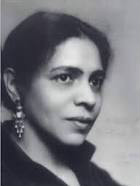
Happy Birthday, Angelina Weld Grimké!

angelina-weld-grimke-image-public-domain

Angelina Weld Grimké

El Beso

Twilight—and you
Quiet—the stars;
Snare of the shine of your teeth,
Your provocative laughter,
The gloom of your hair;
Lure of you, eye and lip;
Yearning, yearning,
Languor, surrender;
Your mouth,
And madness, madness,
Tremulous, breathless, flaming,
The space of a sigh;
Then awakening—remembrance,
Pain, regret—your sobbing;
And again, quiet—the stars,
Twilight—and you.   (via Poets.org)

Let us celebrate the memory of the wonderful and far-too-unknown author of this gorgeous poem and so many other wonderful works of art and literature on her birthday!

Alix North of Island of Lesbos writes of Grimké:

Angelina Weld Grimké was born [on February 27th, 1880] in Boston, the only child of Archibald Grimké and Sarah Stanley. Angelina had a mixed racial background; her father was the son of a white man and a black slave, and her mother was from a prominent white family. Her parents named her after her great aunt Angelina Grimké Weld, a famous white abolitionist and women’s rights advocate.

Angelina received a physical education degree at the Boston Normal School of Gymnastics in 1902. She worked as a gym teacher until 1907, when she became an English teacher, and she continued to teach until her retirement in 1926. During her teaching career, she wrote poetry, fiction, reviews, and biographical sketches. She became best known for her play entitled “Rachel.” The story centers around an African-American woman (Rachel) who rejects marriage and motherhood. Rachel believes that by refusing to reproduce, she declines to provide the white community with black children who can be tormented with racist atrocities. “Rachel” was the only piece of Angelina’s work to be published as a book; only some of her stories and poems were published, primarily in journals, newspapers, and anthologies.

Only her poetry reveals Angelina’s romantic love toward women. The majority of her poems are love poems to women or poems about grief and loss. Some (particularly those published during her lifetime) deal with racial concerns, but the bulk of her poems are about other women, and were unlikely to be published for this reason. Only about a third of her poetry has been published to date… Read the complete bio and a wonderful selection of poems here

angelina-weld-grimke…and learn more about Angelina Weld Grimké at:

Angelina Weld Grimké – in Encyclopedia of African American Women Writers, edited by Yolanda Williams Page

Angelina Weld Grimké – by Judith Zvonkin for The Black Renaissance in Washington, D.C.

Angelina Weld Grimké – from Encyclopædia Britannica

Grimke, Angelina Weld (1880-1958) – by Claudia E. Sutherland for Blackpast.org

Grimkè’s Life and Career: The Introduction to The Selected Works of Angelina Weld Grimké – by Carolivia Herron for Modern American Poetry at the Department of English, University of Illinois at Urbana-Champaign

Further reading: Selected Women Writers of the Harlem Renaissance: A Resource Guide – Angelina Weld Grimké 

Ordinary Philosophy and its Traveling Philosophy / History of Ideas series is a labor of love and ad-free, supported by patrons and readers like you. Please offer your support today!