
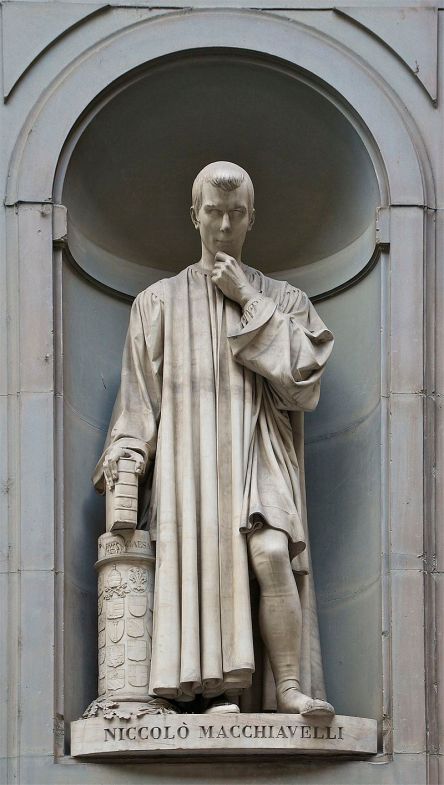
Niccolò Machiavelli statue at the Uffizi
Why an entry on Machiavelli? That question might naturally and legitimately occur to anyone encountering an entry about him in an encyclopedia of philosophy. Certainly, Machiavelli [May 3, 1469 – June 21, 1527] contributed to a large number of important discourses in Western thought—political theory most notably, but also history and historiography, Italian literature, the principles of warfare, and diplomacy. But Machiavelli never seems to have considered himself a philosopher—indeed, he often overtly rejected philosophical inquiry as beside the point—nor do his credentials suggest that he fits comfortably into standard models of academic philosophy. His writings are maddeningly and notoriously unsystematic, inconsistent and sometimes self-contradictory. He tends to appeal to experience and example in the place of rigorous logical analysis. Yet succeeding thinkers who more easily qualify as philosophers of the first rank did (and do) feel compelled to engage with his ideas, either to dispute them or to incorporate his insights into their own teachings. Machiavelli may have grazed at the fringes of philosophy, but the impact of his musings has been widespread and lasting. The terms “Machiavellian” or “Machiavellism” find regular purchase among philosophers concerned with a range of ethical, political, and psychological phenomena, even if Machiavelli did not invent “Machiavellism” and may not even have been a “Machiavellian” in the sense often ascribed to him. Moreover, in Machiavelli’s critique of “grand” philosophical schemes, we find a challenge to the enterprise of philosophy that commands attention and demands consideration and response. Thus, Machiavelli deserves a place at the table in any comprehensive survey of philosophy…’
In addition to Nederman’s excellent entry in The Stanford Encyclopedia of Philosophy, learn more about the often contradictory, ever controversial, always fascinating and relevant Niccolò Machiavelli:
The Inverted Advice of Niccolò Machiavelli ~ by William J. Connell for the Times Literary Supplement
Machiavelli and the Italian City States ~ Melvin Bragg in conversation with his guests Quentin Skinner, Evelyn Welch, and Lisa Jardine
Niccolò Machiavelli ~ by Cary Nederman for The Stanford Encyclopedia of Philosophy
Niccolò Machiavelli: Italian Statesman and Writer ~ by Harvey Mansfield for Encyclopædia Britannica
*A version of this piece was previously published at Ordinary Philosophy
~ Ordinary Philosophy is a labor of love and ad-free, supported by patrons and readers like you. Any support you can offer will be deeply appreciated!
 Ordinary Philosophy