
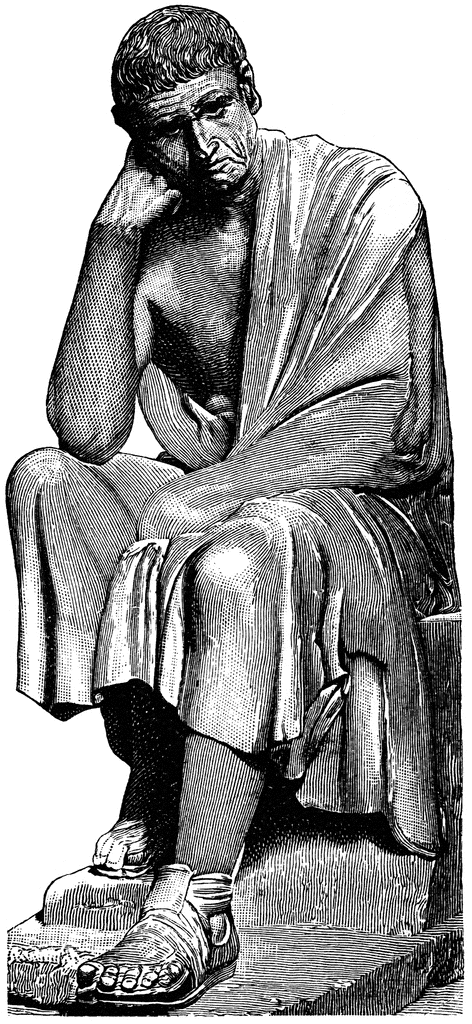
Aristotle
I recently discovered this piece by Peter D.O. Smith in Scientia Salon, a favorite ‘webzine about philosophy and science‘ of mine.
I’m especially interested in philosophy’s attempt to unify ethics, to help bring the various particular ethical systems and local moralities into some sort of accord, or at least to bridge the gaps between them to whatever extent possible. Great harm often results when adherents of different ethical / moral systems come into conflict (religious wars, political gridlock), where instead of seeking common ground in the pursuit of the good, conflicting parties seek to dominate by force and inflammatory rhetoric. Blinded by self-righteousness, these conflicting parties can bring about a situation where at best, no progress is made as each side expends all of their efforts undermining the other, or at worst, inflict death and destruction on each other and on innocent bystanders.
This piece addresses this problem, and offers virtue ethics as an excellent candidate for its resolution.
What do you think?
~~~~~~~~~~~~~~~~~~~
Introduction
This article is neither a defense of nor an attack against either religion or secularism. It treats them as well established sociological facts and no more than that. I take them as given and argue that a greater moral good can be achieved if the two belief systems find common moral ground in virtue ethics.
Why should we care?
Moral choices infuse most aspects of our life, whether we know it or not. And a great number of these moral choices are bad ones. This is why our prisons are filled to overflowing [1], and recidivism is so high at 66% [2]. This is why we have so many war dead and this is why so many die violent deaths at the hands of murderers or radical ideologues. This is also why we have such an inequitable distribution of wealth. This is why cheating is rampant at schools and universities [3]. We maintain large standing armies to protect ourselves from the bad moral choices of others and on occasion we use it to inflict our bad moral choices on others. This is why we have no qualms in spying on our own citizens [4] or in killing without due process. This is why almost everyone has been the victim of crime, unfairness, injustice, discrimination, bullying [5], sexism, racism, ageism or other forms of bigotry, bias, and discrimination. This is why stalking is commonplace [6].
Bad moral choices touch us all and are the major cause of suffering in today’s world. Every person who has been jilted by a cheating partner has felt that suffering. Marital infidelity is the most common cause of divorce and abuse is another important cause [7]. One in five women are sexually assaulted at university [8]. Even natural disasters such as earthquakes or floods are compounded by moral failures as nations don’t respond adequately. Famines become moral failures when we cannot distribute food where and when it is needed. Our economic systems become moral failures when they turn into instruments of greed. Our political systems become moral failures when they are used for the advantage of the powerful, to exploit or neglect the weak.
The point I am making is that moral suffering is real, pervasive and needs attention. We have made great progress in reducing material suffering, but only some progress in reducing moral suffering. This is the important challenge that faces us today, to reduce moral suffering with the same degree of success that we have reduced material suffering.
What then is the problem?
The problem quite simply is that, in comparative terms, we do not give moral problems much attention at all and that we give it the wrong kind of attention, by creating a growing thicket of rules and regulations [9].
Modern society rewards material progress while neglecting moral progress. We have huge budgets for science research and we give large rewards to outstanding achievers in science. But society allocates far smaller amounts to advance moral interests or to reward moral achievers. As a simple example, of the six Nobel awards, only one (Peace) has a moral dimension [10]. Of the other 21 high-honour prizes, only seven have a moral component [11]. School education has a strong science bias but gives little attention to moral education [12]. Our criminal justice system spends a great deal on addressing the outcome of moral problems but little on addressing the causes of moral problems, with the result we have a recidivism rate of 66% [2]. We punish moral offenses but we do not prevent them. We have resorted to a form of legislated morality with our criminal justice and human rights systems. This is a framework with large gaps that does not address or give guidance to private morality.
We are becoming a rules based society, but the rules have only a weak hold because they lack intrinsic motivation [13]. Perhaps the most dramatic example of this was the collapse of the banking system. Banking is one of the most highly regulated parts of the economy, and yet that does not prevent abuse and exploitation [14]. Without intrinsic motivation the rules become a challenge to find means of evasion. We have reacted by adding more rules but it is only a matter of time before more means are found to evade them too. There has been an explosive growth in criminal laws. For the past twenty-five years, a period over which the growth of the federal criminal law has come under increasing scrutiny, Congress has created over 500 new crimes per decade [9]. Adding to this, the Administration is increasingly relying on mandates and directives.
A modern problem
Western society, for a long time, had a broad consensus on morality that was derived from religion. Indeed religion can be seen, in sociological terms, as society’s way of promoting cohesion through moral consensus [15]. Modernity and the Enlightenment have weakened the hold of religious morality, providing space for alternative conceptions of it to take hold. Modernity introduced a spirit of utilitarianism [16] and this has shaped present day society’s concept of morality. But it was not merely the concept that changed, but also the authority of moral systems. Religious moral systems derived their authority from their concept of God and this helped to provide intrinsic motivation. With the new utilitarian morality a new authority was introduced, the individual. Inevitably this has resulted in a weakened and diffuse moral sensibility that contains many contradictions. This new concept of morality has been accompanied by a shift from intrinsic to extrinsic motivation. Extrinsic motivation is, by its very nature, less effective.
With this new concept of morality came a changed approach to society’s problems. The spirit of utilitarianism has created a tacit assumption that alleviating material need reduces the impetus for moral wrongs. There is a belief that moral wrongs are largely the outcome of material conditions. Thus effort has been directed to solving material problems, which have in any case been shown to have easy solutions, while true moral problems remain intractable and so are neglected. We have been picking the low hanging fruit.
We are divided by differing concepts of morality
With the weakening of religious morality and the widespread adoption of utilitarian approaches a sharp moral divide has opened up in society.
The secular world has adopted a tacit, inchoate form of moral consequentialism. It believes there is no absolute good or bad, only that acts should be judged by their consequences. It rejects the absolute lawgiver and the laws of religious deontology. It makes the individual the final arbiter of his acts.
The religious world, by contrast, believes in absolute good and bad and that acts can themselves be inherently good or bad. It believes there is an absolute lawgiver that has handed down a set of rules for a good life. The religious world rejects moral consequentialism on the grounds that it is a shifting and dangerous moral system that is easily tailored to suit the needs and desires of the moment.
As consequentialism or utilitarianism rose to the fore, reflecting the material and mechanical spirit of the times, challenging long held moral conceptions, Protestant Christianity (and Islam) retreated into a form of hardline deontology. The result is the strong ethical divide we see today.
There is thus a yawning chasm between the moral concepts of the religious and secular worlds. This chasm weakens the ability of society to address common moral problems since it lacks consensus. Society has reacted to this problem with a growing thicket of laws with no end in sight [17]. This has proven to be a poor solution, since adding rules merely invites further evasion if they are not reinforced or accompanied by some form of intrinsic motivation.
The need for a middle ground
We are a common people with common moral problems that affect us all. To solve these problems we need a unifying moral concept that both the religious and secular worlds can accept. For example, schools are a place where we should also give our youth moral preparation for adult life, and schools serve both world-views. This is one example of why it is necessary that we find common ground. Deontology and moral consequentialism are not acceptable to both sides of the divide and so cannot fulfill this need.
Which raises the question: is there a middle moral ground where the secular and religious worlds can meet and agree? Today’s society places a strong emphasis on the concepts of justice and rights. These can be seen as instances of what are known as ‘virtues’ and it is in virtue ethics, the third major branch of ethical philosophy, that I see an important opportunity for finding common ground between the secular and the religious worlds. Virtue ethics shows promise as the means of filling in the gaps of legislated morality. One can think of it as being the soft flesh on the hard skeleton of legislated morality, making a healthy, functioning body that is directed to the purpose of flourishing. Virtue ethics can be seen as an important form of intrinsic motivation that makes the regulated rules of society more effective while providing strong guidance to unregulated, private conduct. It is not accidental that here has been a sharp increase in academic interest in virtue ethics lately [18].
The appeal of virtue ethics
Virtue ethics is an enduring idea with ancient roots. Aristotle, some 2,300 years ago, clearly articulated the ethical philosophy known today as virtue ethics [19, 20]. Cicero, close to the time of Christ, wrote of it as being one of the three main contending moral systems of the day [21]. Catholicism, early on, incorporated it into its teachings where it continues to this day to be a major influence [22]. The last 50 years have seen a marked revival of academic interest in virtue ethics [18, 23], and Alisdair McIntyre’s publication of After Virtue was a landmark in this revival [24].
Virtue ethics looks neither to rules nor to consequences. Instead it considers internal motivations directed at realizing the telos, or end, of a “good” person, and it is in this that the religious and secular worlds can find agreement. In my mind, the appeal of virtue ethics is fivefold.
First, the generally accepted list of virtues is free of religious terminology or implications. This makes the virtues acceptable to the secular world. At the same time the religious world finds them a natural extension of its beliefs. For example, Catholicism has embraced virtue ethics, and both secularists and theists would readily agree on the list of 52 virtues given by the Virtue Project [25]. Theists would add faith, hope and charity to that list while secularists would ignore them, a minor difference. The differences that the many belief systems bring to this are largely ones of terminology and emphasis. It is an ethical system that is neutral about belief systems and can therefore be accepted by all belief systems.
Second, supplying an internal motivation is a better way of obtaining a good outcome, whether of act or consequence. It is widely agreed that intrinsic motivation is more effective than extrinsic motivation (intrinsic motivation refers to doing something because it is inherently interesting or enjoyable, and extrinsic motivation refers to doing something because it leads to a separable outcome[13]).
Third, by supplying intrinsic principles, rather than rules, it is adaptable to a wide range of circumstances. A rules based system can only adapt to new circumstances by adding new rules, something that becomes intolerable in the long run.
Fourth, virtue ethics supplies a means of internalizing and integrating rules into a person’s behavior, making them more effective. It is a powerful way of reinforcing the rules and regulations of society by translating them into intrinsic motivation.
Fifth, virtue ethics can supply a new source of meaning, independent of but complementary to religious belief. It can be an antidote to the angst of modernity. This is a large field that is only touched on here.
In short, virtue ethics is capable of supplying an intrinsic motivation that is acceptable to both the secular and religious worlds. We live in an overwhelmingly rules dominated world. Virtue ethics offers a way of internalizing and then integrating rules such that they become intrinsically motivating. It is a promising field for finding common ground between the secular and religious worlds, to makes rules and regulations more effective, and to provide a source of meaning for the non-religious.
A practical solution
The attraction of virtue ethics is its practicality and simplicity. It can be formulated in simple terms that are appealing to most people. It is independent of belief systems and yet most belief systems can accept it, with only changes in terminology. It can easily be taught at an elementary level while still be challenging at a philosophical level. It is easily incorporated into codes of conduct for organizations.
But it is not just a solution to individual moral concerns. It can also be expanded to any domain of activity as an example discussed by Bruni and Sugden shows in the case of market economics [26]. They describe the market as a practice having a telos of voluntary and mutually beneficial exchanges. They explain: “On the supposition that the telos of the market is mutual benefit, a market virtue in the sense of virtue ethics is an acquired character trait with two properties: possession of the trait makes an individual better able to play a part in the creation of mutual benefit through market transactions; and the trait expresses an intentional orientation towards and a respect for mutual benefit. In this section, we present a catalog of traits with these properties, without claiming that our catalog is exhaustive.” Their catalogue of traits, or virtues, include universality, enterprise and alertness, respect for trading partners, trust and trustworthiness, acceptance of competition, non-rivalry, self-help and stoicism about reward.
Another example is the Character Counts! Coalition for moral education in schools, which uses a virtue ethics framework centered on respect, responsibility, trustworthiness, caring, justice, fairness, civic virtue and citizenship [27].
These examples are intended to show that a virtue ethics framework can readily be adapted to any domain of activity or ‘practice.’ This makes virtue ethics a very flexible approach that can be tailored to all parts of our culture.
The role of secularism
Secularism has defined itself in opposition to theism. Its great achievement was the separation of religion from public life. Going beyond that, some secularists have set themselves the goal of destroying religion. This seems to be an ill advised goal as its chief result has been: to poison the public perception of atheism [28] and to harden the stance of Christian fundamentalism. Religion is a deep seated sociological phenomenon and is not going away. It has been part of human history for at least 40,000 years and remains an important part of all societies. It is far too durable a phenomenon and there is no realistic prospect that it will be ended [29]. The criticisms directed at religion by secularism have prompted strong reforms in religion and so have been useful for that end. The so-called war between secularism and religion is now becoming counterproductive as it obscures the major issue facing society, that of moral suffering. Now it is time that secularism embraces this problem and treats religion as an ally and not an enemy, or at least declares a truce. This does not mean religion should not be criticized when the occasion demands it, and indeed criticism can be a healthy impetus for reform. But attention should be shifted to the real enemy, moral suffering. To overcome this enemy the secular world should make common cause with the religious world. It can do this by embracing virtue ethics and making it the central plank of a morally committed secularism.
A solution to future problems
Population growth and rapid industrialization of the third world will create a situation of resource shortages and ultimately low growth [30]. Coping with this new world will require a major re-adjustment of values away from today’s one of rampant consumerism centered on hedonistic happiness. It will require a strong sense of responsibility and restraint, frugality will become the new watchword. Virtue ethics is our best hope of navigating this challenging new world. As Julia Annas, in Intelligent Virtue [31], explains, the virtues are a template for flourishing, in that to become a virtuous person is to become a flourishing person. It is a move away from hedonistic happiness to the eudaimonia of the virtues. This is a radical move away from the idea of happiness that depends on circumstances or goods, a necessary move in the resource constrained world that lies in our future.
That this goal is not so elusive can readily be appreciated when we compare the levels of positive emotions of some poor countries with those of some rich countries [32]:
Panama 85%, Singapore 46%;
Lesotho 77%, United Kingdom 77%;
Swaziland 76%, Germany, 74%.
_____
Peter D.O. Smith is a foundry metallurgist, quality engineer, software engineer, and corporate manager (recently retired), who lives by the motto fides quaerens intellectum.
[1] US incarceration rate.
[2] Recidivism in the United Sates.
[3] Academic cheating fact sheet.
[4] The Snowden Files.
[5] 44% of children report having been bullied.
[6] Stalking.
[7] Causes of divorce.
[8] Sexual assaults at university.
[9] Revisiting the explosive growth of new crimes.
[10 Nobel prizes, literature, medicine, physics, chemistry, peace, and economics.
[11] Other high honor prizes.
[12] How Moral Education Is Finding Its Way Back into America’s Schools.
[13] Ryan and Deci, Intrinsic and Extrinsic motivation.
[14] Why only One Banker Went to Jail.
[15] Nicholas Wade, The Faith Instinct.
[16] Trends in utilitarianism – Google books Ngram.
[17] Business Ethics: The Law of Rules.
[18] Trends in virtue ethics – Google books Ngram.
[19] Nichomacaen Ethics.
[20] Notes on Nichomachean Ethics.
[21] On Moral Ends, Marcus Tullius Cicero, Julia Annas.
[22] The Cardinal Virtues in the Middle Ages: A Study in Moral Thought from the Fourth to the Fourteenth Century.
[23] Contemporary virtue ethics.
[24] Alisdair MacIntyre, After Virtue.
[25] The Virtues Project.
[26] Reclaiming virtue ethics for economics.
[27] The Six Pillars of Character.
[28] Net rating of religious belief systems.
[29] Growth of Religion.
[30] Paul Gilding, The Great Disruption.
[31] Julia Annas, Intelligent Virtue.
[32] Gallup poll, Positive emotions worldwide.
This piece was originally published on Sept 25th, 2014 at
http://scientiasalon.wordpress.com/2014/09/25/virtue-ethics-an-ancient-solution-to-a-modern-problem/
 Ordinary Philosophy